





































CURIOSO
Quiz competition
Presented under Medicus Conventus’17
PRELIMS
Quizmaster Shaileja Yadav Content provided by Quizzine
• 25 questions in total, each carry +10/-0 marks
• Star marked questions would be used to resolve ties. If a tie persists
still then sudden death shall be used starting from first question.
• Use of mobile phones/internet = DISQUALIFICATION
• On the sheet:
• Write your team name (be creative)
• Names of the team members
• Contact number of atleast 1 team member (not landline)
• Please use numerical ordering only (1,2,3,...) because we hate bullet
points -_-
Rules
1
• X's disease is a type of IBD that may affect any part of the
gastrointestinal tract from mouth to anus. Signs and symptoms often
include abdominal pain, diarrhea (sometimes bloody), fever, and
weight loss.
• In 1932, Burrill Bernard X and his colleagues published the case series
of 14 cases. However, due to the precedence of X's name in the
alphabet, it later became known in the worldwide literature as X's
disease.
• Identify X
Crohn’s Disease
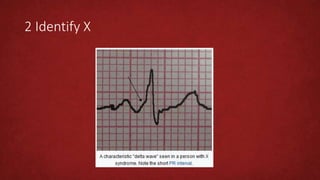
2 Identify X
Wolff–Parkinson–White syndrome
3
• Discovered in 1898 by an Italian physician Camillo X, some considered
it merely an optical illusion created by the observation technique
used by X. With the development of modern microscopes in the 20th
century, the discovery was confirmed. Owing to its large size and
distinctive structure, it was one of the first organelles to be
discovered and observed in detail. What are we talking about?
Golgi Apparatus
4
Several addiction experts in
psychiatry, chemistry,
pharmacology, forensic
science, epidemiology, and
the police and legal services
engaged in delphic analysis
regarding 20 popular
recreational drugs, and the
result is depicted in the
picture (right).
Identify X and Y.
X = Cannabis (Marijuana)
Y = Heroine
5 *
• This is a test for the measurement of H and O agglutinins for a
microbe in the patient's sera.
• Two types of tubes are generally used for the test:
1. A narrow tube with a conical bottom (Dreyer's agglutination tube)
for H agglutination.
2. A short round bottomed tube( Felix tube) for O agglutination.
• Name this test.
Widal Test
6
• It is a triangular area in the wall of the pharynx between the
thyropharyngeal and cricopharyngeus of the inferior constrictor of
the pharynx. It represents a potentially weak spot where a
pharyngoesophageal diverticulum (Zenker's diverticulum) is more
likely to occur.
• What am I talking about?
Killian's dehiscence
7 FITB
• The one who can not see : Blind
• The one who can not hear : Deaf
• The one who can not speak: Dumb
• The one who can not smell : ________
• The one who can not sense touch : ________
Anosmic and Hypoesthesiac
8
•What does this series of alphabets signify?
C, D, E, F, H, K, N, P, R, U, V, and Z
Snellen’s Chart
9
• In 1855, X approached his colleague Henry Vandyke Carter with his
idea to produce an inexpensive and accessible ______ textbook for
medical students. By dissecting unclaimed bodies from workhouse
and hospital mortuaries, the two worked for 18 months on what
would form the basis of the book. Their work was first published in
1858 and early editions of this book were called ______: Descriptive
and Surgical and X's ______: Descriptive and Applied, but the book's
name is commonly shortened to its current name which is very
popular not only in medicine fraternity but among non-medicos as
well (with a slight alternation).
• Identify X and the name of this book.
Gray's Anatomy
By Henry Gray
The American medical drama Grey's Anatomy takes its name from
the textbook.
10 *
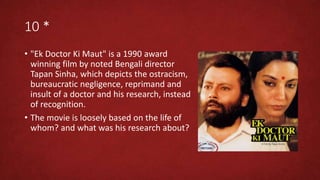
• "Ek Doctor Ki Maut" is a 1990 award
winning film by noted Bengali director
Tapan Sinha, which depicts the ostracism,
bureaucratic negligence, reprimand and
insult of a doctor and his research, instead
of recognition.
• The movie is loosely based on the life of
whom? and what was his research about?
Dr. Subhash Mukhopadhyay
who created the world's second and India's first child using in-vitro fertilisation, Durga
who was born 67 days after the first IVF baby in United Kingdom
11
• German scientist Karl Vogt was first to describe the principle of X in
1842. In Greek, X translates to the "falling off" of leaves from a tree.
James Cormack, a professor of Greek language at University of
Aberdeen, reintroduced the term for medical use as it had a medical
meaning for the Greeks over two thousand years before. Hippocrates
used the term to mean "the falling off of the bones". Galen extended
its meaning to "the dropping of the scabs". Debate still continues over
its correct pronunciation. What is X?
Apoptosis
12
• X is a chronic neurodegenerative disease that usually starts slowly
and worsens over time. In developed countries, it is one of the most
financially costly diseases. Former United States President Ronald
Reagan was later diagnosed with this disease.
• <Next slide for image>
• Identify X.
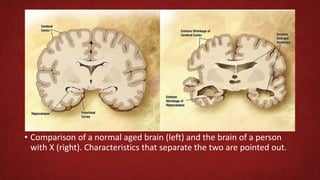
• Comparison of a normal aged brain (left) and the brain of a person
with X (right). Characteristics that separate the two are pointed out.
Alzheimer's
13 What does this exhaustive list represents?
*
• Bing
• Cornell
• Chaddock
• Gonda
• Gordon
• Moniz
• Oppenheim
• Schaeffer
• Stransky
All are clinical signs (Babinski-like) or
plantar reflexes
14
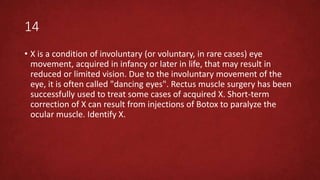
• X is a condition of involuntary (or voluntary, in rare cases) eye
movement, acquired in infancy or later in life, that may result in
reduced or limited vision. Due to the involuntary movement of the
eye, it is often called "dancing eyes". Rectus muscle surgery has been
successfully used to treat some cases of acquired X. Short-term
correction of X can result from injections of Botox to paralyze the
ocular muscle. Identify X.
Nystagmus
15 *
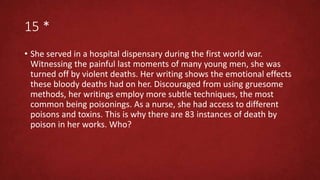
• She served in a hospital dispensary during the first world war.
Witnessing the painful last moments of many young men, she was
turned off by violent deaths. Her writing shows the emotional effects
these bloody deaths had on her. Discouraged from using gruesome
methods, her writings employ more subtle techniques, the most
common being poisonings. As a nurse, she had access to different
poisons and toxins. This is why there are 83 instances of death by
poison in her works. Who?
Agatha Christie
16 Distribution of X around the world. Identify X.
Plasmodium f Or Malaria
17
• To determine the patient's suitability for undergoing this surgical
procedure, called r********y, the surgeon clinically evaluates him or
her with a complete medical history (anamnesis) to determine his or
her physical and psychological health. In the case of men, the surgeon
must identify prospective patients presenting the mental traits
denoted by the psychiatric acronym SIMON (single, immature, male,
over-expectant, and narcissistic), which might indicate a man over-
valuing the outcome of a r********y. What is the common name of
r********y?
Rhinoplasty, commonly
known as Nosejob
18
• Prior to X’s work, it was commonly accepted by the medical
community that Y were caused by a combination of stress, spicy food
and too much stomach acid being produced. At that time, suggesting
Y were caused by anything other than stress was a career suicide. As
X couldn’t test his theory on humans, no law could stop him from
testing his theory on himself.
• He then treated his Ys with antibiotics and was soon fully cured.
Eleven years after the incident, in 2005, he was given a Nobel prize
for his work. Identify X and Y.
Pylori and (peptic) ulcers
19 (pseudo-colored) Electron micrograph of
which virus?
Ebola
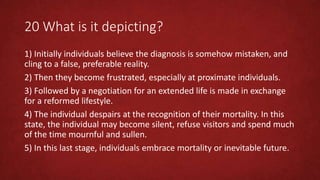
20 What is it depicting?
1) Initially individuals believe the diagnosis is somehow mistaken, and
cling to a false, preferable reality.
2) Then they become frustrated, especially at proximate individuals.
3) Followed by a negotiation for an extended life is made in exchange
for a reformed lifestyle.
4) The individual despairs at the recognition of their mortality. In this
state, the individual may become silent, refuse visitors and spend much
of the time mournful and sullen.
5) In this last stage, individuals embrace mortality or inevitable future.
The Kübler-Ross model, or
the five stages of grief.
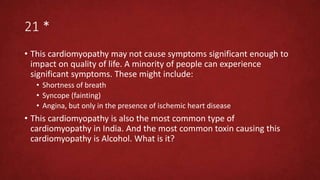
21 *
• This cardiomyopathy may not cause symptoms significant enough to
impact on quality of life. A minority of people can experience
significant symptoms. These might include:
• Shortness of breath
• Syncope (fainting)
• Angina, but only in the presence of ischemic heart disease
• This cardiomyopathy is also the most common type of
cardiomyopathy in India. And the most common toxin causing this
cardiomyopathy is Alcohol. What is it?
Dilated cardiomyopathy
22
• The process goes as follows:
• Lachrymatory-factor synthase is released into the air.
• The synthase enzyme converts the amino acids sulfoxides into sulfenic acid.
• The unstable sulfenic acid rearranges itself into syn-ropanethial-S-oxide.
• Syn-propanethial-S-oxide gets into the air and reaches its destination.
• The lachrymal glands become irritated and releases water, the gas reacts with
the produced water to form sulfuric acid. The sulfuric acid burns, stimulating
the glands to release more water to wash the irritant away.
• The process is describing what?
Tears while chopping onion
23
• X is the largest protein in the body, with a molecular weight of about
3 million Dalton and composed of more than 27,000 amino acids. Due
to its enormous size and structural role in sarcomere, X is a prominent
target for mutations that give rise to muscle disease.
• As the largest known protein, X also has the longest IUPAC name of a
protein, containing 189,819 letters and is sometimes stated to be the
longest word in the English language. It takes more than 3 hours to
pronounce its IUPAC name.
• Identify X.
Titin
24
• Ignez Semmelweis was a 19th century Hungarian doctor who
revolutinalized the world of medicine with a simple suggestion.
Semmelweis realized that there was a direct correlation between
infection and puerperal fever in obstetrical clinics. Puerperal fever
was a common problem in the 19th century and had a mortality rate
of up to 18 percent. However, doctors simply refused to believe that
they could be responsible for so many deaths.
• A few years later Pasteur proved germ theory and people finally
realized Semmelweis’s ideas had some merit. Unfortunately for him,
the recognition came too late. By then, Semmelweis went insane
trying to convince others and was committed to an asylum, where he
was beaten to death by guards. What exactly was Semmelweis
suggesting?
Asked doctors to wash hands before surgeries
25
• Somnambulism also known as noctambulism, is a kind of medical
disorder and has the following characteristics:
• 1) No prior warning.
• 2) Glassy-Eyed stare/blank expression
• 3) Disorientation after the episode.
• 4) Meaningless talk.
• 5) Amnesia.
• What does this commonly known as??
Sleepwalking
Curioso LHMC prelims

Curioso LHMC prelims

  • 1.
    CURIOSO Quiz competition Presented underMedicus Conventus’17 PRELIMS Quizmaster Shaileja Yadav Content provided by Quizzine
  • 2.
    • 25 questionsin total, each carry +10/-0 marks • Star marked questions would be used to resolve ties. If a tie persists still then sudden death shall be used starting from first question. • Use of mobile phones/internet = DISQUALIFICATION • On the sheet: • Write your team name (be creative) • Names of the team members • Contact number of atleast 1 team member (not landline) • Please use numerical ordering only (1,2,3,...) because we hate bullet points -_- Rules
  • 4.
    1 • X's diseaseis a type of IBD that may affect any part of the gastrointestinal tract from mouth to anus. Signs and symptoms often include abdominal pain, diarrhea (sometimes bloody), fever, and weight loss. • In 1932, Burrill Bernard X and his colleagues published the case series of 14 cases. However, due to the precedence of X's name in the alphabet, it later became known in the worldwide literature as X's disease. • Identify X
  • 5.
  • 6.
  • 7.
  • 8.
    3 • Discovered in1898 by an Italian physician Camillo X, some considered it merely an optical illusion created by the observation technique used by X. With the development of modern microscopes in the 20th century, the discovery was confirmed. Owing to its large size and distinctive structure, it was one of the first organelles to be discovered and observed in detail. What are we talking about?
  • 9.
  • 10.
    4 Several addiction expertsin psychiatry, chemistry, pharmacology, forensic science, epidemiology, and the police and legal services engaged in delphic analysis regarding 20 popular recreational drugs, and the result is depicted in the picture (right). Identify X and Y.
  • 11.
    X = Cannabis(Marijuana) Y = Heroine
  • 12.
    5 * • Thisis a test for the measurement of H and O agglutinins for a microbe in the patient's sera. • Two types of tubes are generally used for the test: 1. A narrow tube with a conical bottom (Dreyer's agglutination tube) for H agglutination. 2. A short round bottomed tube( Felix tube) for O agglutination. • Name this test.
  • 13.
  • 14.
    6 • It isa triangular area in the wall of the pharynx between the thyropharyngeal and cricopharyngeus of the inferior constrictor of the pharynx. It represents a potentially weak spot where a pharyngoesophageal diverticulum (Zenker's diverticulum) is more likely to occur. • What am I talking about?
  • 15.
  • 16.
    7 FITB • Theone who can not see : Blind • The one who can not hear : Deaf • The one who can not speak: Dumb • The one who can not smell : ________ • The one who can not sense touch : ________
  • 17.
  • 18.
    8 •What does thisseries of alphabets signify? C, D, E, F, H, K, N, P, R, U, V, and Z
  • 19.
  • 20.
    9 • In 1855,X approached his colleague Henry Vandyke Carter with his idea to produce an inexpensive and accessible ______ textbook for medical students. By dissecting unclaimed bodies from workhouse and hospital mortuaries, the two worked for 18 months on what would form the basis of the book. Their work was first published in 1858 and early editions of this book were called ______: Descriptive and Surgical and X's ______: Descriptive and Applied, but the book's name is commonly shortened to its current name which is very popular not only in medicine fraternity but among non-medicos as well (with a slight alternation). • Identify X and the name of this book.
  • 21.
    Gray's Anatomy By HenryGray The American medical drama Grey's Anatomy takes its name from the textbook.
  • 22.
    10 * • "EkDoctor Ki Maut" is a 1990 award winning film by noted Bengali director Tapan Sinha, which depicts the ostracism, bureaucratic negligence, reprimand and insult of a doctor and his research, instead of recognition. • The movie is loosely based on the life of whom? and what was his research about?
  • 23.
    Dr. Subhash Mukhopadhyay whocreated the world's second and India's first child using in-vitro fertilisation, Durga who was born 67 days after the first IVF baby in United Kingdom
  • 24.
    11 • German scientistKarl Vogt was first to describe the principle of X in 1842. In Greek, X translates to the "falling off" of leaves from a tree. James Cormack, a professor of Greek language at University of Aberdeen, reintroduced the term for medical use as it had a medical meaning for the Greeks over two thousand years before. Hippocrates used the term to mean "the falling off of the bones". Galen extended its meaning to "the dropping of the scabs". Debate still continues over its correct pronunciation. What is X?
  • 25.
  • 26.
    12 • X isa chronic neurodegenerative disease that usually starts slowly and worsens over time. In developed countries, it is one of the most financially costly diseases. Former United States President Ronald Reagan was later diagnosed with this disease. • <Next slide for image> • Identify X.
  • 27.
    • Comparison ofa normal aged brain (left) and the brain of a person with X (right). Characteristics that separate the two are pointed out.
  • 28.
  • 29.
    13 What doesthis exhaustive list represents? * • Bing • Cornell • Chaddock • Gonda • Gordon • Moniz • Oppenheim • Schaeffer • Stransky
  • 30.
    All are clinicalsigns (Babinski-like) or plantar reflexes
  • 31.
    14 • X isa condition of involuntary (or voluntary, in rare cases) eye movement, acquired in infancy or later in life, that may result in reduced or limited vision. Due to the involuntary movement of the eye, it is often called "dancing eyes". Rectus muscle surgery has been successfully used to treat some cases of acquired X. Short-term correction of X can result from injections of Botox to paralyze the ocular muscle. Identify X.
  • 32.
  • 33.
    15 * • Sheserved in a hospital dispensary during the first world war. Witnessing the painful last moments of many young men, she was turned off by violent deaths. Her writing shows the emotional effects these bloody deaths had on her. Discouraged from using gruesome methods, her writings employ more subtle techniques, the most common being poisonings. As a nurse, she had access to different poisons and toxins. This is why there are 83 instances of death by poison in her works. Who?
  • 34.
  • 35.
    16 Distribution ofX around the world. Identify X.
  • 36.
  • 37.
    17 • To determinethe patient's suitability for undergoing this surgical procedure, called r********y, the surgeon clinically evaluates him or her with a complete medical history (anamnesis) to determine his or her physical and psychological health. In the case of men, the surgeon must identify prospective patients presenting the mental traits denoted by the psychiatric acronym SIMON (single, immature, male, over-expectant, and narcissistic), which might indicate a man over- valuing the outcome of a r********y. What is the common name of r********y?
  • 38.
  • 39.
    18 • Prior toX’s work, it was commonly accepted by the medical community that Y were caused by a combination of stress, spicy food and too much stomach acid being produced. At that time, suggesting Y were caused by anything other than stress was a career suicide. As X couldn’t test his theory on humans, no law could stop him from testing his theory on himself. • He then treated his Ys with antibiotics and was soon fully cured. Eleven years after the incident, in 2005, he was given a Nobel prize for his work. Identify X and Y.
  • 40.
  • 41.
    19 (pseudo-colored) Electronmicrograph of which virus?
  • 42.
  • 43.
    20 What isit depicting? 1) Initially individuals believe the diagnosis is somehow mistaken, and cling to a false, preferable reality. 2) Then they become frustrated, especially at proximate individuals. 3) Followed by a negotiation for an extended life is made in exchange for a reformed lifestyle. 4) The individual despairs at the recognition of their mortality. In this state, the individual may become silent, refuse visitors and spend much of the time mournful and sullen. 5) In this last stage, individuals embrace mortality or inevitable future.
  • 44.
    The Kübler-Ross model,or the five stages of grief.
  • 45.
    21 * • Thiscardiomyopathy may not cause symptoms significant enough to impact on quality of life. A minority of people can experience significant symptoms. These might include: • Shortness of breath • Syncope (fainting) • Angina, but only in the presence of ischemic heart disease • This cardiomyopathy is also the most common type of cardiomyopathy in India. And the most common toxin causing this cardiomyopathy is Alcohol. What is it?
  • 46.
  • 47.
    22 • The processgoes as follows: • Lachrymatory-factor synthase is released into the air. • The synthase enzyme converts the amino acids sulfoxides into sulfenic acid. • The unstable sulfenic acid rearranges itself into syn-ropanethial-S-oxide. • Syn-propanethial-S-oxide gets into the air and reaches its destination. • The lachrymal glands become irritated and releases water, the gas reacts with the produced water to form sulfuric acid. The sulfuric acid burns, stimulating the glands to release more water to wash the irritant away. • The process is describing what?
  • 48.
  • 49.
    23 • X isthe largest protein in the body, with a molecular weight of about 3 million Dalton and composed of more than 27,000 amino acids. Due to its enormous size and structural role in sarcomere, X is a prominent target for mutations that give rise to muscle disease. • As the largest known protein, X also has the longest IUPAC name of a protein, containing 189,819 letters and is sometimes stated to be the longest word in the English language. It takes more than 3 hours to pronounce its IUPAC name. • Identify X.
  • 50.
  • 51.
    24 • Ignez Semmelweiswas a 19th century Hungarian doctor who revolutinalized the world of medicine with a simple suggestion. Semmelweis realized that there was a direct correlation between infection and puerperal fever in obstetrical clinics. Puerperal fever was a common problem in the 19th century and had a mortality rate of up to 18 percent. However, doctors simply refused to believe that they could be responsible for so many deaths. • A few years later Pasteur proved germ theory and people finally realized Semmelweis’s ideas had some merit. Unfortunately for him, the recognition came too late. By then, Semmelweis went insane trying to convince others and was committed to an asylum, where he was beaten to death by guards. What exactly was Semmelweis suggesting?
  • 52.
    Asked doctors towash hands before surgeries
  • 53.
    25 • Somnambulism alsoknown as noctambulism, is a kind of medical disorder and has the following characteristics: • 1) No prior warning. • 2) Glassy-Eyed stare/blank expression • 3) Disorientation after the episode. • 4) Meaningless talk. • 5) Amnesia. • What does this commonly known as??
  • 54.