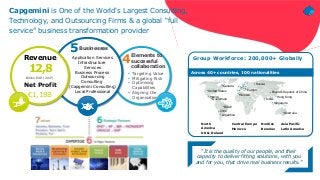
Capgemini is Oneof the World's Largest Consulting,
Technology, and Outsourcing Firms & a global “full
service” business transformation provider
Group Workforce: 200,000+ Globally
Asia Pacific
Latin America
Canada
United States
Mexico
Brazil
Argentina
Europe
Morocco
Australia
People’s Republic of China
India
Chile
Guatemala
Russia
Singapore
Hong Kong
North
America
UK & Ireland
Nordics
Benelux
“It is the quality of our people, and their
capacity to deliver fitting solutions, with you
and for you, that drive real business results.”
Across 40+ countries, 100 nationalities
5Businesses
Revenue
12,8
Billion EUR (2017)
Central Europe
Morocco
Net Profit
€1,18B
Targeting Value
Mitigating Risk
Optimising
Capabilities
Aligning the
Organisation
Elements to
successful
collaboration
Application Services
Infrastructure
Services
Business Process
Outsourcing
Consulting
(Capgemini Consulting)
Local Professional
4
3.
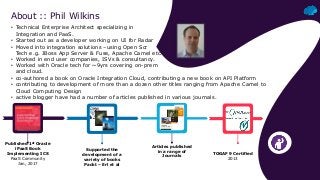
• Technical EnterpriseArchitect specializing in
Integration and PaaS.
• Started out as a developer working on UI for Radar
• Moved into integration solutions –using Open Scr
Tech e.g. JBoss App Server & Fuse, Apache Camel etc.
• Worked in end user companies, ISVs & consultancy.
• Worked with Oracle tech for ~9yrs covering on-prem
and cloud.
About :: Phil Wilkins
Supported the
development of a
variety of books
Packt – Erl et al
Articles published
in a range of
Journals
Published 1st Oracle
iPaaS Book
Implementing ICS
PaaS Community
Jan, 2017
TOGAF 9 Certified
2013
• co-authored a book on Oracle Integration Cloud, contributing a new book on API Platform
• contributing to development of more than a dozen other titles ranging from Apache Camel to
Cloud Computing Design
• active blogger have had a number of articles published in various journals.
4.
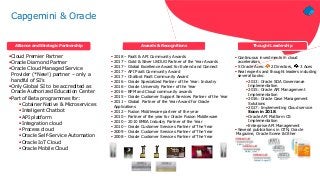
Cloud Premier Partner
OracleDiamond Partner
Oracle Cloud Managed Service
Provider (*New!) partner – only a
handful of SI’s
Only Global SI to be accredited as
Oracle Authorized Education Center
Part of Beta programmes for:
Cotainer Native & Microservices
Inteligent Chatbot
API platform
Integration cloud
Process cloud
Oracle Self-Service Automation
Oracle IoT Cloud
Oracle Mobile Cloud
Continuous investments in cloud
accelerators
5 Oracle Aces: 2 Directors, 3 Aces
Real experts and thought leaders including
several books:
2013: Oracle SOA Governance
Implementation
2015: Oracle API Management
Implementation
2016: Oracle Case Management
Solutions
2017: Implementing Cloud service
Soon in 2018:
Oracle API Platform CS
Implementation
Enterprise API Management
Several publications in OTN, Oracle
Magazine, Oracle Scene & Other
2018 – PaaS & API Community Awards
2017 – Gold & Silver UKOUG Partner of the Year Awards
2017 – Global Excellence Award for Extend and Connect
2017 – API PaaS Community Award
2017 – Chatbot PaaS Community Award
2016 – Oracle Specialized Partner of the Year: Industry
2016 – Oracle University Partner of the Year
2016 – BPM and Cloud community awards
2015 – Oracle Customer Support Services Partner of the Year
2011 – Global Partner of the Year Award for Oracle
Applications
2012 – Fusion Middleware partner of the year
2010 – Partner of the year for Oracle Fusion Middleware
2010 – 2010 EMEA Industry Partner of the Year
2010 – Oracle Customer Services Partner of The Year
2009 – Oracle Customer Services Partner of The Year
2008 – Oracle Customer Services Partner of The Year
Alliance and Strategic Partnership Awards & Recognitions Thought Leadership
Article – June 17
Article – June 17
Podcast – August 17
Capgemini & Oracle
5.
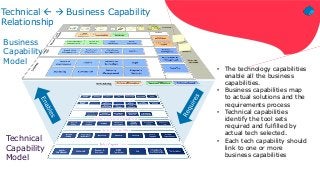
Technical Business Capability
Relationship
Technical
Capability
Model
Business
Capability
Model
• The technology capabilities
enable all the business
capabilities.
• Business capabilities map
to actual solutions and the
requirements process
• Technical capabilities
identify the tool sets
required and fulfilled by
actual tech selected.
• Each tech capability should
link to one or more
business capabilities
6.
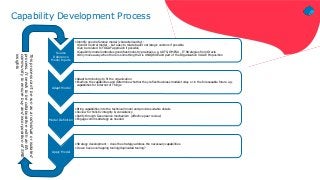
Capability Development Process
Source
Reference
ModelInputs
•Identify good reference model (characterised by):
•Vendor neutral model – but easy to relate back to strategic vendors if possible
•Can be related to TOGAF approach if possible
•Capability model embodies good/best industry practises e.g. ARTS, OMESA , IT Strategies from Oracle
•Only move away when there is something that is UNIQWUE and part of the Organization VALUE Proposition
Adapt Model
•Adapt terminology to fit the organization
•Examine the capabilities and determine whether they reflect business models today or in the foreseeable future e.g.
capabilities for Internet of Things
Model Definition
•Bring capabilities into the technical model and provide suitable details
•Review for holistic integrity & consistency
•Ratify through Governance mechanism (effective peer review)
•Engage comms strategy as needed
Apply Model
•Strategy development – does the strategy address the necessary capabilities
•Do we have overlapping tooling/duplicated tooling?
Thisprocesscan’tberunasaindividualorisolated
process.ItneedstobecollaborativewithanEA
communitytoensurebuyandincorporationofSME
insights
7.
Technical Capabilities ModelValue
Utilising a technical capabilities model to provide
• A means to draw in industry best practise thinking
• By assessing strategies and tooling approaches we can ascertain whether we a
suitable mix of products is in place – may also help draw attention to the ‘art of the
possible’ with our portfolio of technologies available
• Map onto the model products in the portfolio can result in an evidence based manner
whether there is unnecessary overlaps in capabilities or where overlaps occur as an
inherent part of a COTs/SaaS approach, help determine where best practises &
patterns will deliver value (drive consistency in tool use)
• Opportunity to inform design work with prompts as to whether a solution is complete
(do I need a technical capability/have I considered the use of the different capabilities
within the design context)
• Once the capability model is overlaid with named technologies a set of IT skills
profiles for the organisation and teams supporting business capabilities
8.
Value of theTechnical Capabilities Model
when Mapped to Business Capabilities
Mapping the business capabilities onto the technical capabilities can provide a number of
insights, including:
• Facilitate more insight into non functional demand/capacity profiles e.g each capability has
x users – if 10 different capabilities depend a specific technical capability we can deduce a
level of demand
• The mapping can enable an understanding of the impact of change across the business
• The mapping can help determine overall service criticality (may small uses of a service
could disrupt as much as 1 large use)
• The mapping can help show where technology investment can be maximised in terms of
positive benefit to the business
However, providing such a mapping has a number of implications
• many to many mapping between business capabilities and technologies so the best value is
at the finest level of detail
• the mapping task is complex and to attribute information to capabilities to achieve some of
the deductions is likely to need tooling