Opioids for Chronic Pain
Where is the Science for the
Clinician?
David Borsook MD PhD
Professor, HMS
1MGH Center for Law, Brain and Behavior
2MGH Center for Law, Brain and Behavior
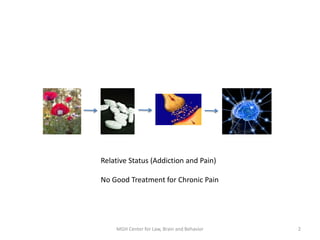
Relative Status (Addiction and Pain)
No Good Treatment for Chronic Pain
3MGH Center for Law, Brain and Behavior
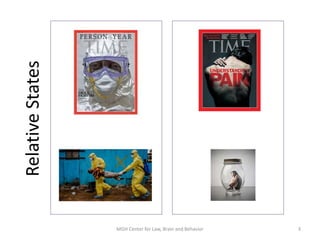
RelativeStates
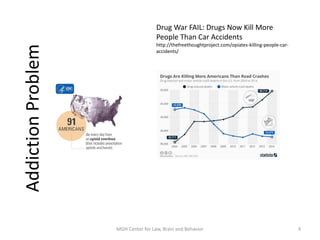
Drug War FAIL: Drugs Now Kill More
People Than Car Accidents
http://thefreethoughtproject.com/opiates-killing-people-car-
accidents/
4MGH Center for Law, Brain and Behavior
AddictionProblem
MGH Center for Law, Brain and Behavior 5
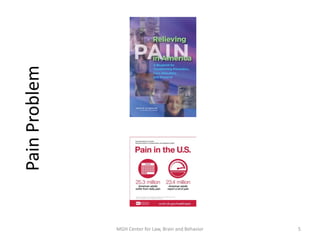
PainProblem
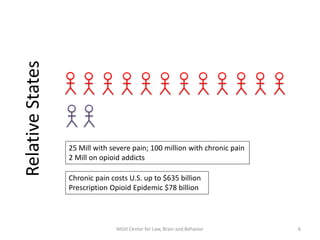
25 Mill with severe pain; 100 million with chronic pain
2 Mill on opioid addicts
6MGH Center for Law, Brain and Behavior
RelativeStates
Chronic pain costs U.S. up to $635 billion
Prescription Opioid Epidemic $78 billion
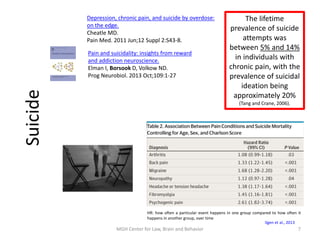
Depression, chronic pain, and suicide by overdose:
on the edge.
Cheatle MD.
Pain Med. 2011 Jun;12 Suppl 2:S43-8.
Pain and suicidality: insights from reward
and addiction neuroscience.
Elman I, Borsook D, Volkow ND.
Prog Neurobiol. 2013 Oct;109:1-27
Ilgen et al., 2013
HR: how often a particular event happens in one group compared to how often it
happens in another group, over time
The lifetime
prevalence of suicide
attempts was
between 5% and 14%
in individuals with
chronic pain, with the
prevalence of suicidal
ideation being
approximately 20%
(Tang and Crane, 2006).
7MGH Center for Law, Brain and Behavior
Suicide
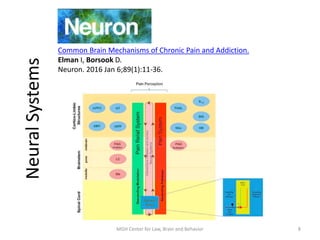
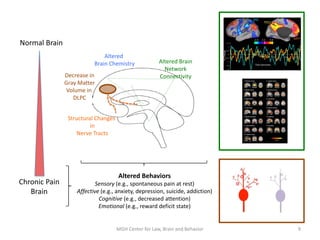
Common Brain Mechanisms of Chronic Pain and Addiction.
Elman I, Borsook D.
Neuron. 2016 Jan 6;89(1):11-36.
8MGH Center for Law, Brain and Behavior
NeuralSystems
9
Decrease in
Gray Matter
Volume in
DLPC
Altered Brain
Network
Connectivity
Structural Changes
in
Nerve Tracts
Altered
Brain Chemistry
Normal Brain
Chronic Pain
Brain
Altered Behaviors
Sensory (e.g., spontaneous pain at rest)
Affective (e.g., anxiety, depression, suicide, addiction)
Cognitive (e.g., decreased attention)
Emotional (e.g., reward deficit state)
MGH Center for Law, Brain and Behavior
0.0014
0.0012
0.0010
AmygdalaVolume
(Normalized)
Left Right
Opioid-Dependent Patients
Controls
*
*
* p < 0.05
Amygdala
Upadhyay at al., 2010 Brain
10
1
MGH Center for Law, Brain and Behavior
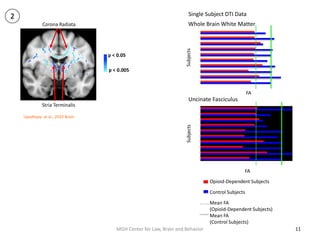
Stria Terminalis
p < 0.05
p < 0.005
Corona Radiata
Opioid-Dependent Subjects
Control Subjects
Mean FA
(Opioid-Dependent Subjects)
Mean FA
(Control Subjects)
FA
Whole Brain White Matter
0.3 0.6
1
2
3
4
5
6
7
8
9
10
Subjects
0.3 0.5
1
2
3
4
5
6
7
8
9
10
Uncinate Fasciculus
Subjects
FA
Single Subject DTI Data
Upadhyay at al., 2010 Brain
11
2
MGH Center for Law, Brain and Behavior
12
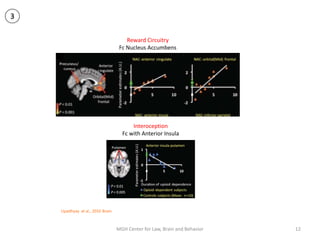
Interoception
Fc with Anterior Insula
Reward Circuitry
Fc Nucleus Accumbens
Upadhyay at al., 2010 Brain
3
MGH Center for Law, Brain and Behavior
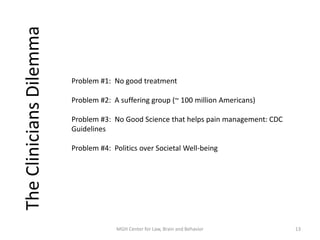
Problem #1: No good treatment
Problem #2: A suffering group (~ 100 million Americans)
Problem #3: No Good Science that helps pain management: CDC
Guidelines
Problem #4: Politics over Societal Well-being
13MGH Center for Law, Brain and Behavior
TheCliniciansDilemma
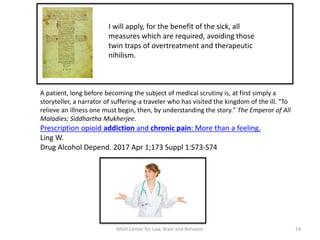
A patient, long before becoming the subject of medical scrutiny is, at first simply a
storyteller, a narrator of suffering-a traveler who has visited the kingdom of the ill. "To
relieve an illness one must begin, then, by understanding the story." The Emperor of All
Maladies; Siddhartha Mukherjee.
Prescription opioid addiction and chronic pain: More than a feeling.
Ling W.
Drug Alcohol Depend. 2017 Apr 1;173 Suppl 1:S73-S74
14MGH Center for Law, Brain and Behavior
I will apply, for the benefit of the sick, all
measures which are required, avoiding those
twin traps of overtreatment and therapeutic
nihilism.
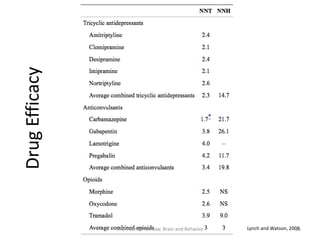
Cochrane Reports
Lynch and Watson, 2006
DrugEfficacy
15MGH Center for Law, Brain and Behavior
MMWR Morb Mortal Wkly Rep. 2017 Mar 17;66(10):265-269. doi:
10.15585/mmwr.mm6610a1.
Characteristics of Initial Prescription Episodes and Likelihood of Long-
Term Opioid Use - United States, 2006-2015.
Shah A, Hayes CJ, Martin BC.
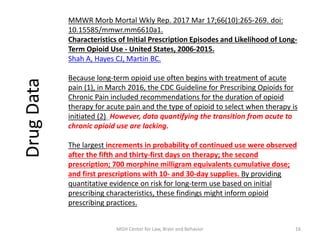
Because long-term opioid use often begins with treatment of acute
pain (1), in March 2016, the CDC Guideline for Prescribing Opioids for
Chronic Pain included recommendations for the duration of opioid
therapy for acute pain and the type of opioid to select when therapy is
initiated (2). However, data quantifying the transition from acute to
chronic opioid use are lacking.
The largest increments in probability of continued use were observed
after the fifth and thirty-first days on therapy; the second
prescription; 700 morphine milligram equivalents cumulative dose;
and first prescriptions with 10- and 30-day supplies. By providing
quantitative evidence on risk for long-term use based on initial
prescribing characteristics, these findings might inform opioid
prescribing practices.
DrugData
16MGH Center for Law, Brain and Behavior
The findings of this systematic review suggest that proper
management of a type of strong painkiller (opioids) in well-selected
patients with no history of substance addiction or abuse can lead to
long-term pain relief for some patients with a very small (though not
zero) risk of developing addiction, abuse, or other serious side effects.
However, the evidence supporting these conclusions is weak, and
longer-term studies are needed to identify the patients who are most
likely to benefit from treatment.
Evidence is insufficient to determine the effectiveness of long-term
opioid therapy for improving chronic pain and function. Evidence
supports a dose-dependent risk for serious harms.
The effectiveness and risks of long-term opioid therapy for chronic pain:
a systematic review for a National Institutes of Health Pathways to
Prevention Workshop.
Chou R, Turner JA, Devine EB, Hansen RN, Sullivan SD, Blazina I, Dana T,
Bougatsos C, Deyo RA.
Ann Intern Med. 2015 Feb 17;162(4):276-86
Opioids compared with placebo or other treatments for chronic low
back pain: an update of the Cochrane Review.
Chaparro LE, Furlan AD, Deshpande A, Mailis-Gagnon A, Atlas S, Turk
DC.
Spine (Phila Pa 1976). 2014 Apr 1;39(7):556-63.
DrugData
17MGH Center for Law, Brain and Behavior
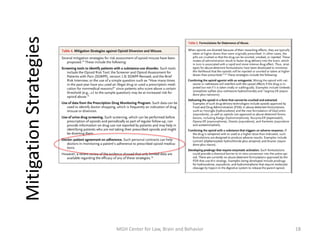
MitigationStrategies
18MGH Center for Law, Brain and Behavior
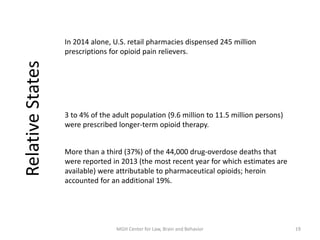
3 to 4% of the adult population (9.6 million to 11.5 million persons)
were prescribed longer-term opioid therapy.
In 2014 alone, U.S. retail pharmacies dispensed 245 million
prescriptions for opioid pain relievers.
More than a third (37%) of the 44,000 drug-overdose deaths that
were reported in 2013 (the most recent year for which estimates are
available) were attributable to pharmaceutical opioids; heroin
accounted for an additional 19%.
RelativeStates
19MGH Center for Law, Brain and Behavior
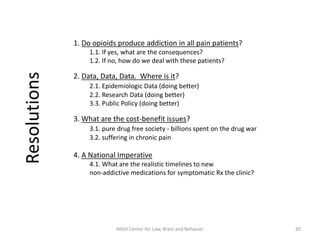
1. Do opioids produce addiction in all pain patients?
1.1. If yes, what are the consequences?
1.2. If no, how do we deal with these patients?
2. Data, Data, Data. Where is it?
2.1. Epidemiologic Data (doing better)
2.2. Research Data (doing better)
3.3. Public Policy (doing better)
3. What are the cost-benefit issues?
3.1. pure drug free society - billions spent on the drug war
3.2. suffering in chronic pain
4. A National Imperative
4.1. What are the realistic timelines to new
non-addictive medications for symptomatic Rx the clinic?
20MGH Center for Law, Brain and Behavior
Resolutions

David Borsook, "Opioids for Chronic Pain: Where is the Science for the Clinician?"

  • 1.
    Opioids for ChronicPain Where is the Science for the Clinician? David Borsook MD PhD Professor, HMS 1MGH Center for Law, Brain and Behavior
  • 2.
    2MGH Center forLaw, Brain and Behavior Relative Status (Addiction and Pain) No Good Treatment for Chronic Pain
  • 3.
    3MGH Center forLaw, Brain and Behavior RelativeStates
  • 4.
    Drug War FAIL:Drugs Now Kill More People Than Car Accidents http://thefreethoughtproject.com/opiates-killing-people-car- accidents/ 4MGH Center for Law, Brain and Behavior AddictionProblem
  • 5.
    MGH Center forLaw, Brain and Behavior 5 PainProblem
  • 6.
    25 Mill withsevere pain; 100 million with chronic pain 2 Mill on opioid addicts 6MGH Center for Law, Brain and Behavior RelativeStates Chronic pain costs U.S. up to $635 billion Prescription Opioid Epidemic $78 billion
  • 7.
    Depression, chronic pain,and suicide by overdose: on the edge. Cheatle MD. Pain Med. 2011 Jun;12 Suppl 2:S43-8. Pain and suicidality: insights from reward and addiction neuroscience. Elman I, Borsook D, Volkow ND. Prog Neurobiol. 2013 Oct;109:1-27 Ilgen et al., 2013 HR: how often a particular event happens in one group compared to how often it happens in another group, over time The lifetime prevalence of suicide attempts was between 5% and 14% in individuals with chronic pain, with the prevalence of suicidal ideation being approximately 20% (Tang and Crane, 2006). 7MGH Center for Law, Brain and Behavior Suicide
  • 8.
    Common Brain Mechanismsof Chronic Pain and Addiction. Elman I, Borsook D. Neuron. 2016 Jan 6;89(1):11-36. 8MGH Center for Law, Brain and Behavior NeuralSystems
  • 9.
    9 Decrease in Gray Matter Volumein DLPC Altered Brain Network Connectivity Structural Changes in Nerve Tracts Altered Brain Chemistry Normal Brain Chronic Pain Brain Altered Behaviors Sensory (e.g., spontaneous pain at rest) Affective (e.g., anxiety, depression, suicide, addiction) Cognitive (e.g., decreased attention) Emotional (e.g., reward deficit state) MGH Center for Law, Brain and Behavior
  • 10.
    0.0014 0.0012 0.0010 AmygdalaVolume (Normalized) Left Right Opioid-Dependent Patients Controls * * *p < 0.05 Amygdala Upadhyay at al., 2010 Brain 10 1 MGH Center for Law, Brain and Behavior
  • 11.
    Stria Terminalis p <0.05 p < 0.005 Corona Radiata Opioid-Dependent Subjects Control Subjects Mean FA (Opioid-Dependent Subjects) Mean FA (Control Subjects) FA Whole Brain White Matter 0.3 0.6 1 2 3 4 5 6 7 8 9 10 Subjects 0.3 0.5 1 2 3 4 5 6 7 8 9 10 Uncinate Fasciculus Subjects FA Single Subject DTI Data Upadhyay at al., 2010 Brain 11 2 MGH Center for Law, Brain and Behavior
  • 12.
    12 Interoception Fc with AnteriorInsula Reward Circuitry Fc Nucleus Accumbens Upadhyay at al., 2010 Brain 3 MGH Center for Law, Brain and Behavior
  • 13.
    Problem #1: Nogood treatment Problem #2: A suffering group (~ 100 million Americans) Problem #3: No Good Science that helps pain management: CDC Guidelines Problem #4: Politics over Societal Well-being 13MGH Center for Law, Brain and Behavior TheCliniciansDilemma
  • 14.
    A patient, longbefore becoming the subject of medical scrutiny is, at first simply a storyteller, a narrator of suffering-a traveler who has visited the kingdom of the ill. "To relieve an illness one must begin, then, by understanding the story." The Emperor of All Maladies; Siddhartha Mukherjee. Prescription opioid addiction and chronic pain: More than a feeling. Ling W. Drug Alcohol Depend. 2017 Apr 1;173 Suppl 1:S73-S74 14MGH Center for Law, Brain and Behavior I will apply, for the benefit of the sick, all measures which are required, avoiding those twin traps of overtreatment and therapeutic nihilism.
  • 15.
    Cochrane Reports Lynch andWatson, 2006 DrugEfficacy 15MGH Center for Law, Brain and Behavior
  • 16.
    MMWR Morb MortalWkly Rep. 2017 Mar 17;66(10):265-269. doi: 10.15585/mmwr.mm6610a1. Characteristics of Initial Prescription Episodes and Likelihood of Long- Term Opioid Use - United States, 2006-2015. Shah A, Hayes CJ, Martin BC. Because long-term opioid use often begins with treatment of acute pain (1), in March 2016, the CDC Guideline for Prescribing Opioids for Chronic Pain included recommendations for the duration of opioid therapy for acute pain and the type of opioid to select when therapy is initiated (2). However, data quantifying the transition from acute to chronic opioid use are lacking. The largest increments in probability of continued use were observed after the fifth and thirty-first days on therapy; the second prescription; 700 morphine milligram equivalents cumulative dose; and first prescriptions with 10- and 30-day supplies. By providing quantitative evidence on risk for long-term use based on initial prescribing characteristics, these findings might inform opioid prescribing practices. DrugData 16MGH Center for Law, Brain and Behavior
  • 17.
    The findings ofthis systematic review suggest that proper management of a type of strong painkiller (opioids) in well-selected patients with no history of substance addiction or abuse can lead to long-term pain relief for some patients with a very small (though not zero) risk of developing addiction, abuse, or other serious side effects. However, the evidence supporting these conclusions is weak, and longer-term studies are needed to identify the patients who are most likely to benefit from treatment. Evidence is insufficient to determine the effectiveness of long-term opioid therapy for improving chronic pain and function. Evidence supports a dose-dependent risk for serious harms. The effectiveness and risks of long-term opioid therapy for chronic pain: a systematic review for a National Institutes of Health Pathways to Prevention Workshop. Chou R, Turner JA, Devine EB, Hansen RN, Sullivan SD, Blazina I, Dana T, Bougatsos C, Deyo RA. Ann Intern Med. 2015 Feb 17;162(4):276-86 Opioids compared with placebo or other treatments for chronic low back pain: an update of the Cochrane Review. Chaparro LE, Furlan AD, Deshpande A, Mailis-Gagnon A, Atlas S, Turk DC. Spine (Phila Pa 1976). 2014 Apr 1;39(7):556-63. DrugData 17MGH Center for Law, Brain and Behavior
  • 18.
  • 19.
    3 to 4%of the adult population (9.6 million to 11.5 million persons) were prescribed longer-term opioid therapy. In 2014 alone, U.S. retail pharmacies dispensed 245 million prescriptions for opioid pain relievers. More than a third (37%) of the 44,000 drug-overdose deaths that were reported in 2013 (the most recent year for which estimates are available) were attributable to pharmaceutical opioids; heroin accounted for an additional 19%. RelativeStates 19MGH Center for Law, Brain and Behavior
  • 20.
    1. Do opioidsproduce addiction in all pain patients? 1.1. If yes, what are the consequences? 1.2. If no, how do we deal with these patients? 2. Data, Data, Data. Where is it? 2.1. Epidemiologic Data (doing better) 2.2. Research Data (doing better) 3.3. Public Policy (doing better) 3. What are the cost-benefit issues? 3.1. pure drug free society - billions spent on the drug war 3.2. suffering in chronic pain 4. A National Imperative 4.1. What are the realistic timelines to new non-addictive medications for symptomatic Rx the clinic? 20MGH Center for Law, Brain and Behavior Resolutions