What is BLAST?
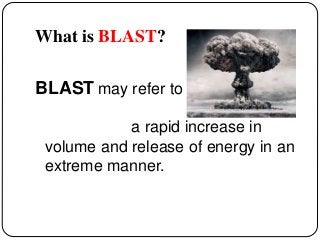
BLASTmay refer to :
a rapid increase in
volume and release of energy in an
extreme manner.
3.
Blast Damage dueto Over-Pressure
An over-pressure is the pressure on an object as a
result of an impacting shock wave.
The explosion of a gas or dust results in a reaction
front moving outwards from the ignition source
preceded by a shock wave or pressure front. After the
combustible material is consumed, the reaction front
terminates, but the pressure wave continues it outward
movement. A blast wave is composed of the pressure
wave and subsequent wind. It is the blast wave that
causes most of the damage.
4.
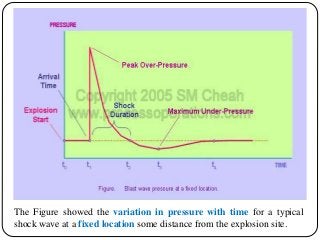
The Figure showedthe variation in pressure with time for a typical
shock wave at a fixed location some distance from the explosion site.
5.
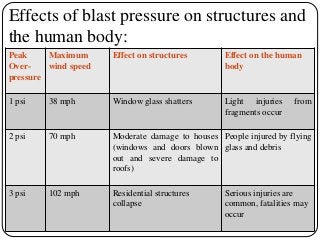
Effects of blastpressure on structures and
the human body:
Peak
Over-
pressure
Maximum
wind speed
Effect on structures Effect on the human
body
1 psi 38 mph Window glass shatters Light injuries from
fragments occur
2 psi 70 mph Moderate damage to houses
(windows and doors blown
out and severe damage to
roofs)
People injured by flying
glass and debris
3 psi 102 mph Residential structures
collapse
Serious injuries are
common, fatalities may
occur
6.
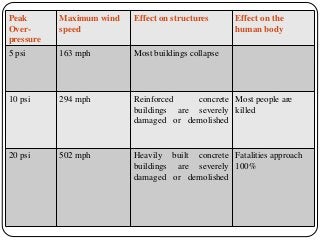
Peak
Over-
pressure
Maximum wind
speed
Effect onstructures Effect on the
human body
5 psi 163 mph Most buildings collapse
10 psi 294 mph Reinforced concrete
buildings are severely
damaged or demolished
Most people are
killed
20 psi 502 mph Heavily built concrete
buildings are severely
damaged or demolished
Fatalities approach
100%
7.
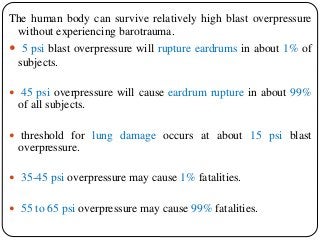
The human bodycan survive relatively high blast overpressure
without experiencing barotrauma.
5 psi blast overpressure will rupture eardrums in about 1% of
subjects.
45 psi overpressure will cause eardrum rupture in about 99%
of all subjects.
threshold for lung damage occurs at about 15 psi blast
overpressure.
35-45 psi overpressure may cause 1% fatalities.
55 to 65 psi overpressure may cause 99% fatalities.
8.
References:
Kissane, Karen(2015-04-15). "Fire power equalled 1500 atomic
bombs". The Age (Melbourne).
Dubnikova, Faina; Kosloff, Ronnie; Almog, Joseph; Zeiri, Yehuda;
Boese, Roland; Itzhaky, Harel; Alt, Aaron; Keinan, Ehud (2015-04-
15). "Decomposition of Triacetone Triperoxide Is an Entropic
Explosion". Journal of the American Chemical Society
processoperations.com/FireExplode/FE_Chp05(2015-04-15)
R. Karl Zipf, Jr., Ph.D., P.E; Kenneth L. Cashdollar (2015-04-15);
“Explosions and Refuge Chambers”.