Mobile applications usageis growing day by day.
Thanks to phenomenal advances in mobile device
capabilities, your smartphone continues to define you.
The apps you use are developed as a result of a
meticulous mobile development life cycle. Every mobile
app is designed using the best development strategy in
mind.
Mobile App Development
Phases
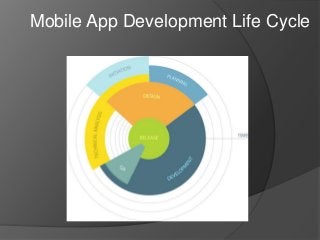
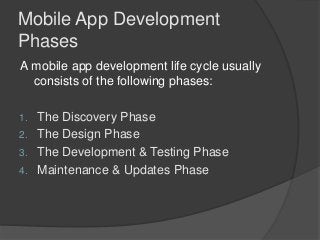
Amobile app development life cycle usually
consists of the following phases:
1. The Discovery Phase
2. The Design Phase
3. The Development & Testing Phase
4. Maintenance & Updates Phase
6.
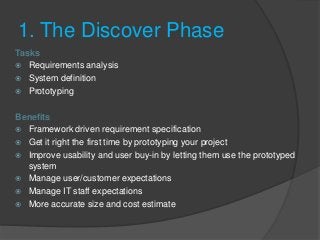
1. The DiscoverPhase
Tasks
Requirements analysis
System definition
Prototyping
Benefits
Framework driven requirement specification
Get it right the first time by prototyping your project
Improve usability and user buy-in by letting them use the prototyped
system
Manage user/customer expectations
Manage IT staff expectations
More accurate size and cost estimate
7.
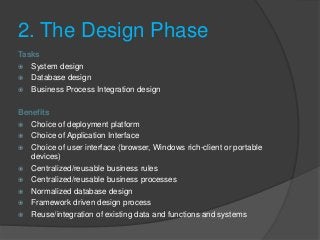
2. The DesignPhase
Tasks
System design
Database design
Business Process Integration design
Benefits
Choice of deployment platform
Choice of Application Interface
Choice of user interface (browser, Windows rich-client or portable
devices)
Centralized/reusable business rules
Centralized/reusable business processes
Normalized database design
Framework driven design process
Reuse/integration of existing data and functions and systems
8.
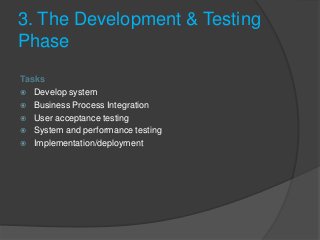
3. The Development& Testing
Phase
Tasks
Develop system
Business Process Integration
User acceptance testing
System and performance testing
Implementation/deployment
9.
Benefit
User prototypefrom the design phase as basis for system
Framework driven development process
One integrated suite of development tools
Lower skill requirements
Multi skilling
Business level coding
Task tracking and audit
Downplay/hide technology focus
Easy-to-learn and master
Deploy same code to multiple platforms
Task and change control tracking
RDML level debugging
Multitier, real-time client/server testing and tracing
Just-In-Time deployment
10.
4. Maintenance &Updates
Phase
Tasks
Ongoing system maintenance
Extend and enhance functionality
Benefits
Centralized/reusable business rules
Centralized/reusable business processes
Repository based impact analysis
11.
Thank You
Mobile AppDevelopment Life
Cycle
Created By : http://www.cygnismedia.com/



![5G Explained! A High Level Overview [Introduction]](https://cdn.slidesharecdn.com/ss_thumbnails/5gexplainedahighleveloverview-260119165306-cc137a3e-thumbnail.jpg?width=640&height=640&fit=bounds)


