SAM
PLE


Table of Contents
Lesson 1 Scientists Observe
Objectives: The student will become more aware of the surrounding world by observing with all five senses.
Lesson 2 Scientists Compare
Objectives: The student will become aware of how objects are alike and different. The student will use the senses to
compare objects
Lesson 3 Scientists Compare, Continued
Objectives: The student will utilize what he learned in Lesson 2. The student will compare and contrast an apple and
orange
Lesson 4 Scientists Measure
Objectives: The student will use nonstandard measurement to measure items. The student will be introduced to a
balance, thermometer, measuring cups, and a ruler. The student will recall what a balance, thermometer and ruler are
used for.
Lesson 5 Scientists Measure with a Ruler, Tape Measure, and a Yardstick
Objectives: The student will experiment with measuring tools. The student will select appropriate measuring tools. The
student will measure, with help.
Lesson 6 Scientists Measure with a Thermometer
Objectives: The student will identify which temperatures are cold and which are hot. The student will be introduced to
Thermometer.
Lesson 7 Scientists Measure with a Scale
Objectives: To introduce the students to the scale
Lesson 8 Scientists Measure with Measuring Cups
Objectives: Introduce the student to measuring with measuring cups. Introduce the concept of volume.
Lesson 9 Making Play Dough
Objectives: The student will apply what he learned in Lesson 8.
Lesson 10 Scientists Classify
Objectives: The student will be able to classify an object in two or more different ways.
Lesson 11 Scientists Make Models
Objective: The student will understand the concept of a model and be able to make a model of his favorite room in the
house.
Lesson 12 Scientists Communicate
Objective: The student will be able to communicate by drawing, writing or talking.
Lesson 13 Scientists Infer
Objective: The student will be introduced to the concept of inferring. The student will be able to infer what the teacher is
acting out.
Lesson 14 Scientists Put Things in Order
Objective: The student will be able to tell what happened first, next and last in a story. The students will be able to put a
series of events in order.
Lesson 15 Scientists Predict
Objective: The student will understand the concept of predicting and be able to make a reasonable prediction.
Lesson 16 Scientists
Objective: The student will use investigation to solve a problem.
SAM
PLE


Lesson 17 Scientists Investigate - Continued
Objective: The student will use the experiment to investigate how crystals are formed.
Lesson 18 Scientists Draw Conclusions
Objective: The student will be introduced to drawing conclusions.
Lesson 19 Scientists – Culminating Activity
Objective: The student will use or observe the scientific skills he has learned.
Lesson 20 Introduction to the Five Senses
Objectives: Today you will be introduced to the 5 senses.
Lesson 21 You Observe with Your Eyes
Objectives: To learn that one of the five senses is the sense of sight. The student will use his eyes to observe.
Lesson 22 You Observe with Your Ears
Objectives: To learn that one of the five senses is the sense of hearing. Each thing has its own sound and it can be
identified it by the sound it makes.
Lesson 23 You Observe by Touching
Objectives: To learn that one of the five senses is touch. You can identify different objects by the way they feel.
Lesson 24 You Observe by Smelling
Objectives: To learn that one of the five senses is smell. You can identify different things by the way they smell.
Lesson 25 You Observe By Tasting
Objectives: To learn that one of the senses is taste. You can identify something by the way it tastes.
Lesson 26 The Five Senses Review
Objectives: The student will be able to recall the previous lessons and fill in the Senses Worksheet
Lesson 27 Living and Nonliving Things
Objectives: Recognize living and nonliving things, compare living and nonliving things
Lesson 28 What Plants Need to Live and Where They Live
Objectives: Recognize that plants grow in a variety of places. Observe plants to see what happens when they do not
get water and communicate what happens to others. Identify that plants need water, soil, light, and air to live.
Lesson 29 The Parts of a Plant
Objectives: Observe the parts of a plant. Identify the parts of a plant.
Lesson 30 The Roots of a Plant
Objectives: Explain the function of roots. Explore the roots.
Lesson 31 Stems are Plant Straws and More
Objectives: The student will be able to explain that a stem holds a plant up. The student will be able to explain that
water moves up the stem to the leaves.
Lesson 32 Big, Small, Short or Tall, Leaves Do it All
Objectives: Observe that different plants have different leaves. Identify the function of plant.
Lesson 33 Seeds, Seeds, Everywhere
Objectives: Identify the parts of a seed. Recognize that a seed grows into a plant
Lesson 34 Plants Start Out Little Like You
Objectives: Recognize that seeds grow into plants. Identify what a seed needs to grow.
SAM
PLE


Lesson 35 Yum, Plants!
Objectives: Identify ways humans use plants and understand that some plants can be eaten and some cannot
Lesson 36 Budding Artists
Objectives: Identify the senses. Recognize that artist use science skills.
Lesson 37 Exploring You Will Go
Objectives: Observe plants in their natural habitats. Identify the parts of a plant and tell what they do
Lesson 38 Animals, Animals, Animals
Objectives: Tell that animals need food, water, air and shelter to live
Lesson 39 Amazing Animals
Objectives: Compare and contrast different animals by their characteristics. Identify different ways to group animals
Lesson 40 Magnificent Mammals
Objectives: Recall that all mammals have hair or fur and feed their young milk.
Lesson 41 Beautiful Birds Objectives: Tell that all birds have feathers. Recall that birds have two legs and wings. Tell
that birds lay eggs, make a nest, and have a beak.
Lesson 42 Fabulous Fish
Objectives: Tell that the characteristics of a fish are that they have scales and breathe through their gills.
Lesson 43 Awesome Amphibians and Revealing Reptiles
Objectives: Recall 2 characteristics of an amphibian. Recall 2 characteristics of a reptile. Give an example of an
amphibian. Give an example of a reptile
Lesson 44 Interesting Insects
Objectives: To recognize the parts of an insect. Identify the characteristics of an insect.
Lesson 45 Animals Grow and Change
Objectives: Understand that all animals change as they grow. Animals grow up to look like their parents.
Lesson 46 Beautiful Butterflies
Objectives: Observe and identify changes in the life cycle of a butterfly.
Lesson 47 Fantastic Frogs
Objectives: Put the changes in the life cycle of a frog in order.
Lesson 48 A Hunting We Will Go
Objectives: Demonstrate knowledge of the different animal groups. Put the butterfly life cycle in order. Name two things
animals need to live.
Lesson 49 What’s for Dinner?
Objectives: Explore food chains. Define food chain.
Lesson 50 Tongues, Beaks, Teeth, Jaws, and Claws, Oh, My!
Objectives: Recognize that body parts help animals get food.
Lesson 51 Animals Need Plants
Objectives: Give two ways animals depend on plants for their basic needs.
Lesson 52 Animals Are Good Friends to Plants
Objectives: Name two ways animals help plants meet their needs
Lesson 53 You and Me, We All Need Plants and Animals
SAM
PLE
CLICK ON THIS SLIDE FOR MORE DETAILS & TO DOWNLOAD PREVIEW FILES!


Objectives: Give two examples of ways people need plants or animals for their basic needs
Lesson 54 Chapter Review
Objectives: Review of chapter
Lesson 55 Chapter Test
Objective: Chapter Test
Lesson 56 Animal Homes
Objectives: Name one need animals need met by where they live.
Lesson 57 The Dry Desert
Objectives: Recognize that plants and animals that live in a desert have their needs met. Give one example of a
characteristic that helps plants and animals live in a desert.
Lesson 58 What You Will Find in a Forest
Objectives: Recognize that plants and animals that live in a forest have their needs met. Give one example of a
characteristic that helps plants and animals live in a forest.
Lesson 59 Oceans
Objectives: Recognize that plants and animals that live in the ocean have their needs met. Give one example of a
characteristic that helps plants and animals live in the ocean.
Lesson 60 The Wet, Wet, Rain Forest
Objectives: Recognize that plants and animals that live in a rain forest have their needs met. Give one example of a
characteristic that helps plants and animals live in a rain forest.
Lesson 61 Chapter Review
Objectives: Chapter Review
Lesson 62 Chapter Test
Objectives: Chapter Test
Lesson 63 A Marine Biologist
Objectives: Can tell one thing a marine biologist does.
Lesson 64 What is a natural resource?
Objective: The student will identify and define a natural resource.
Lesson 65 Fossil Fuels
Objective: The student will define fossil fuel and give one example
Lesson 66 Where can we find natural resources?
Objective: The student should be able to identify pictures from magazines to identify renewable and non-renewable
resources.
Lesson 67 Are soils different? How?
Objective: When complete, The student will understand that scientists use many different tools to make their work
easier.
Lesson 68 What life is found in soil?
Objective: The student will be able to identify two or more living things that survive in soil
Lesson 69 Where are these rocks and soil found?
Objective: The student will look at pictures of different types of soil and rocks and identify characteristics. The student
will be able to identify where the rocks and soil pictures may be found by recalling places they have been.
Lesson 70 What are rocks and soil?
Objective: The student will read and be able to define what a rock is and what soil is.
SAM
PLE
CLICK ON THIS SLIDE FOR MORE DETAILS & TO DOWNLOAD PREVIEW FILES!


Lesson 71 Types of soil
Objective: The student will be able to identify types of soil and what they look like
Lesson 72 Discovering Minerals
Objective: The student will use internet to search types of minerals and choose one to research. The student will
research a mineral to discover its use, where it is found, what it looks like, and which country has the most. The student
will report findings in one of two ways: Presentation on computer, or poster board.
Lesson 73 What are plants used for?
Objective: The student will be able to choose resources that we use on a daily basis for food, shelter, and water.
Lesson 74 Plants to avoid
Objective: The student will understand that not all plants are good for human contact or use.
Lesson 75 Warning, Dangerous Plants Ahead!
Objective: The student will create a brochure to warn about poisonous plants.
Lesson 76 The Changing Earth
Objective: The student will understand weathering and erosion
Lesson 77 Where can you find weathering?
Objective: The student will research weathering and find sample pictures. The student will share pictures with teacher
and explain how weathering affected each photograph.
Lesson 78 Tsunami’s can make the earth change.
Objective: The student will learn about what causes a tsunami and how it affects the earth.
Lesson 79 Protecting our Earth
Objective: Student understands how humans affect the earth. Student knows that humans can also cause a change on
the earth, both good and bad.
Lesson 80 Water Pollution
Objective: The student will learn how water is polluted through the ground
Lesson 81 The Water Cycle and Groundwater
Objective: The student will understand how the water cycle affects groundwater
Lesson 82 Groundwater experiment
Objective: The student will create an edible sample of the ground water process.
Lesson 83 What can you do to protect groundwater?
Objective: The student will make a checklist of what kids can do to protect ground water.
Lesson 84 Making a compost pile
Objective: The student will understand that compost is a way to stop dumping things that are biodegradable into
landfills.
Lesson 85 Recycling
Objective: The student will understand that by recycling, we can help keep pollution to a minimum.
Lesson 86 Landfills
Objective: The student will understand what landfill is.
Lesson 87 Reviewing recycling
Objective: The student will discuss what it means to recycle and what happens when pollution enters in to water.
SAM
PLE
CLICK ON THIS SLIDE FOR MORE DETAILS & TO DOWNLOAD PREVIEW FILES!


Lesson 88 Keeping our plants and animals safe
Objective: Student understands that humans affect the earth. Student understands that people cause change in their
environment
Lesson 89 Forest Fires-How they begin and how they can be prevented
Objective: The student will find ways that forest fires start and how they can be prevented
Lesson 90 Forest Fires-How they begin and how they can be prevented Continued
Objective: The student will find ways that forest fires start and how they can be prevented
Lesson 91 Forests and protecting animals
Objective: The student will answer assessment questions to follow-up about forest fires.
Lesson 92 How can worms help the soil?
Objective: The student will record science data and learn about worms helping the soil.
Lesson 93 Review
Objective: The student will use pictures and words to demonstrate their knowledge of Rocks, minerals, erosion, water
table, recycling.
Lesson 94 Looking down at the Earth
Objective: The student will understand that scientists use technology and satellites to look down at the earth.
Lesson 95 International Space Station
Objective: The student will discover what the International Space Station is and how it works.
Lesson 96 How does weather change?
Objective: The student will identify words and concepts that will establish knowledge for weather unit.
Lesson 97 Lightning Never Strikes Twice
Objective: The student will recognize that there are some misconceptions in Science
Lesson 98 Rain
Objective: The student will understand varying rain levels and the importance of measuring it.
Lesson 99 What are some kinds of weather?
Objective: The student will know that weather has patterns over time.
Lesson 100 What is weather?
Objective: The student will understand what weather is and that it is ever-changing.
Lesson 101 How Much Rain Falls in Your Area?
Objective: The student will conduct some research using the internet or local library.
Lesson 102 Water Cycle review
Objective: The student will understand that water cycle is an ongoing pattern
Lesson 103 Spring, Spring, Spring!
Objective: The student will understand that weather patterns change over time.
Lesson 104 What is summer?
Objective: The student will understand changes in seasons.
Lesson 105 What is fall?
Objective: The student will understand that weather conditions have patterns.
Lesson 106 What is winter?
SAM
PLE
CLICK ON THIS SLIDE FOR MORE DETAILS & TO DOWNLOAD PREVIEW FILES!


Objective: The student will know that weather conditions occur in patterns
Lesson 107 Bad Weather
Objective: Students understands weather patterns
Lesson 108 Thunderstorm safety
Objective: The student will learn how to stay safe during a storm and will create a poster for others.
Lesson 109 How tornadoes form
Objective: The student will understand weather pattern and complex movement
Lesson 110 Tornado safety plan for your family
Objective: The student will make a tornado safety plan and share it with their family in the event of a tornado.
Lesson 111 Hurricanes
Objective: The student will understand impact of hurricanes. The student will understand ways to stay safe in
hurricanes.
Lesson 112 Stay safe in a hurricane
Objective: The student will prepare a poster on Hurricane safety and preparedness.
Lesson 113 Review and Quiz
Objective: Review weather and weather elements
Lesson 114 A long time ago there were dinosaurs and fossils
Objective: Introduce unit of dinosaur and fossils.
Lesson 115 What do I really see in a museum?
Objective: The student will understand that not all dinosaur bones or fossils they see in a museum are real. They are
replicas
Lesson 116 What does a paleontologist do? Objective: The student will understand the job of a paleontologist.
Lesson 117 What is a fossil?
Objective: The student will identify what a fossil is.
Lesson 118 How do we know what dinosaurs looked like?
Objective: The student will learn about fossils and how they are used to determine what things looked like.
Lesson 119 More about fossils
Objective: The student will learn some common misconceptions about fossils
Lesson 120 What can we learn from fossils?
Objective: Student explains how fossils giver information about plants and animals that lived on earth long ago.
Lesson 121 Tell me about the dinosaurs
Objective: The student will be able to give some characteristics about dinosaurs.
Lesson 122 Researching a Dinosaur
Objective: The student will choose a dinosaur to research and write about
Lesson 123 Physical features
Objective: The student will learn how different physical features helped them survive in their habitat
Lesson 124 Create your own dinosaur
Objective: The student will create his/her own dinosaur and defend their creation with information they have learned
about dinosaurs
Lesson 125 Make your own fossil
Objective: The student will make his/her own fossil to understand the process
SAM
PLE
CLICK ON THIS SLIDE FOR MORE DETAILS & TO DOWNLOAD PREVIEW FILES!


Lesson 126 Review and quiz
Objective: The student will review dinosaurs, extinction and fossils and answer questions to ensure comprehension
Lesson 127 How do you describe objects?
Objective: The student will be able to identify words of matter to describe objects
Lesson 128 Alike and Different
Objective: The student will be able to give descriptions of how things are alike and how they are different. This is a key
skill in science
Lesson 129 Matter
Objective: The student will know that objects are made up of matter.
Lesson 130 Gases and Liquids
Objective: The student will learn that objects can be grouped by physical characteristics.
Lesson 131 Different liquids
Objective: The student will understand that not all liquids are the same.
Lesson 132 The student will conduct experiment to determine viscosity
Objective: The student will conduct experiment to determine viscosity
Lesson 133 How matter changes
Objective: The student will understand that heating and cooling effects solids, liquids and gases.
Lesson 134 How water changes
Objective: The student will know the properties of ice, water and steam
Lesson 135 How does matter change?
Objective: The student will understand matter and energy.
Lesson 136 Heights and Weight
Objective: The student will compare and order objects by length and weight.
Lesson 137 What really moves us?
Objective: The student will be introduced to movement and what makes things move.
Lesson 138 How do objects move?
Objective: The student will understand what makes objects move
Lesson 139 Mr. Newton, please hold this apple
Objective: The student will read three laws of gravity and make a connection
Lesson 140 How fast can you move?
Objective: The student will understand that objects move at a different speed with different forces
Lesson 141 Which way do objects move?
Objective: The student will discover that things move in different ways, they are not always straight.
Lesson 142 Which way do I go?
Objective: The student will use knowledge of how things move to create a map to a location either inside or outside
his/her home.
Lesson 143 What is a magnet and what does it do?
Objective: The student will learn what a magnet is and what it does.
Lesson 144 Sounds in the air
SAM
PLE
CLICK ON THIS SLIDE FOR MORE DETAILS & TO DOWNLOAD PREVIEW FILES!
Objective: The student will learn about vibration of objects to make sound.
Lesson 145 What around us makes noise?
Objective: The student will think about sounds that they hear all of the time.
Lesson 146 White noise
Objective: The student will learn that sometimes sounds are around just to make noise
Lesson 147 Make your own instrument
Objective: The student will discover vibrations of objects by creating own instrument.
Lesson 148 Review and quiz time!
Objective: The student will review concepts and then take a short quiz
Lesson 149 Where does energy come from?
Objective: Throughout this unit, The student will learn about sources of energy and be able to make basic
connections.
Lesson 150 How do we get heat?
Objective: The student will know that the Sun provides heat and light to give energy.
Lesson 151 How do we use energy?
Objective: The student will understand that the sun’s heats things differently
Lesson 152 Have you ever seen your shadow?
Objective: The student will understand that the sun gives light to Earth. The student will understand that light passes
through some objects.
Lesson 153 Make a shadow story
Objective: The student will use objects to create a story using shadows
Lesson 154 Do shadows stay the same?
Objective: The student understands that light can pass through some objects, but not others. This is caused by light
being blocked by a solid object.
Lesson 155 What things need energy?
Objective: The student understands systems of matter and energy
Lesson 156 How is electricity made?
Objective: The student will understand how electricity is made.
Lesson 157 Oh no, no electricity!
Objective: The student will recall how electricity is made and write a story incorporating bad weather elements.
Lesson 158 How do humans get energy? Objective: The student will know how humans gain and release energy.
The student will know that people need food for energy.
Lesson 159 Review and quiz
Objective: The student will answer questions and review concepts learned in unit.
Lesson 160 The daytime sky
Objective: The student knows how to decipher what is in the day time sky.
Lesson 161 What causes daytime and nighttime?
Objective: The student will know that day and night are caused by the rotation of the Earth.
Lesson 162 Planet and stars
Objective: The student will learn the difference between planets and stars.
Lesson 163 Researching a planet
Objective: The student will research a planet
SAM
PLE
CLICK ON THIS SLIDE FOR MORE DETAILS & TO DOWNLOAD PREVIEW FILES!


Lesson 164 The Moon
Objective: The student will understand the differences between the sun and the Moon
Lesson 165 A journey into space
Objective: The student will research the first man to walk on the Moon.
Lesson 166 Name that planet
Objective: The student will create own planet based on their knowledge of stars and planets
Lesson 167 Review and quiz
Objective: Students will review concepts and answer questions related to space
Lesson 168 Which animals have backbones?
Objective: The student will be able to identify which animals have backbones that belong to the group called vertebrates
(mammals, reptiles, birds, amphibians, and fish)
Lesson 169 How have mammals adapted?
Objective: The student will be able to identify how mammals have changed or adapted to their environments.
Lesson 170 How have fish adapted?
Objective: The student will be able to identify how fish have changed or adapted to their environments.
Lesson 171 How have amphibians adapted?
Objective: The student will be able to identify how amphibians have changed or adapted to their environments.
Lesson 172 What are same animals without backbones?
Objective: The student will be able to identify which animals do not have backbones that belong to the group called
invertebrates.
Lesson 173 What do plants and animals need to live?
Objective: The student will be able to understand how plants and animals dependent on each other for survival.
Lesson 174 What is a food web?
Objective: The student will be able to identify food webs and what comprise them.
Lesson 175 What can cause a food web to change?
Objective: The student will be able to identify how humans cause food webs to change.
Lesson 176 How do plants and animals help each other?
Objective: Student knows that plants and animals depend upon each other to survive.
Lesson 177 Review and quiz
Objective: The student will review concepts and answer questions.
Lesson 178 Animals helping others
Objective: The student will use concepts discussed to illustrate how plants and animals help one another.
Lesson 179 What does a farmer do?
Objective: The student will conduct research to learn and then illustrate what a farmer does.
Lesson 180 Course Completions
Objective: The student will reflect on what he/she has learned throughout the course.
SAM
PLE
CLICK ON THIS SLIDE FOR MORE DETAILS & TO DOWNLOAD PREVIEW FILES!
STUDENT
Less
Scie
Look at
you tell?
study? W
When yo
Look at
senses w
out? Do
What els
When yo
Read an
without f
Take a b
interesti
then go
Take ou
object?
it hard o
Answer
Share w
Draw a p
activity.
T MANUAL
son 1
ntists
Worksheet
? What are
What sense
ou are done
worksheet
would you u
o you think
se might yo
ou are done
nd discuss t
first asking
bag and tak
ng and put
back inside
ut one of the
What shap
or soft? Wh
the questio
what you ob
picture abo
Obser
t 1. Who is
the scienti
es are the s
e studying t
1a. What
use to expl
it would be
ou hear or s
e studying t
the “You Ar
an adult!
ke a walk w
them in the
e.
e objects an
pe is it? Wh
hat does it s
ons about th
served abo
out what you
rve
the scienti
sts in the p
scientists u
the picture,
t do you se
ore it? Wo
noisy or qu
see here?
the picture,
re the Scien
with outside
e bag. Why
nd look, tou
hat happen
smell like?
he other ob
out your obj
u observed
FIRST
st? Do you
pictures doin
sing?
, answer the
e in this pic
ould the wat
uiet here? W
, answer the
ntist” activit
with your t
y did you he
uch, smell, a
ns when you
bjects that y
jects from t
and write t
T GRADE SC
u think they
ng? Can y
e question
cture? If yo
ter be cold
What sense
e question
ty. Remem
teacher. Pi
e pick that
and feel the
u give it a p
you collecte
the walk wit
two things y
CIENCE / LES
y are all scie
you name o
about the p
ou were exp
or warm?
e would you
about the p
mber, never
ick up items
item? Coll
e object. C
push? What
ed.
th your teac
you observ
SSON 1
entists? Ho
ther things
picture.
ploring this
How could
u use to fin
picture.
taste anyth
s you think
ect five or s
Can you hea
t does it fee
cher.
ved during y
)	
ow can
scientists
river what
you find
d out?
hing
are
six items
ar the
el like? Is
your
SAM
PLE
CLICK ON THIS SLIDE FOR MORE DETAILS & TO DOWNLOAD PREVIEW FILES!
STUDENT
Less
Scie
There
All sci
If you
T MANUAL
son 1
ntists
are man
entists o
were a s
Obser
ny kinds
observe t
scientist,
rve
of scien
things.
what kin
FIRST
tists.
nd of sci
T GRADE SC
ientist wo
CIENCE / LES
ould you
SSON 1 (DR)
u like to b
)	
be?
SAM
PLE
CLICK ON THIS SLIDE FOR MORE DETAILS & TO DOWNLOAD PREVIEW FILES!
STUDENT
Less
Scie
Work
Name:
Date: _
Directio
Who is
scientist
are the s
1. W
s
_
_
_
_
_
2. C
_
_
3. N
_
_
T MANUAL
son 1
ntists
ksheet
_______
________
ons: Answ
the scientis
ts in the pic
scientists u
Who is the
scientists?
_________
_________
_________
_________
_________
Can you nam
_________
_________
Name the se
_________
_________
Obser
t 1
________
________
wer the qu
st? Do you
ctures doing
sing?
e scientist
?
________
________
________
________
________
me other th
________
________
enses these
________
________
rve
_________
_________
uestions b
u think they
g? Can you
in the pic
________
________
________
________
________
hings scient
________
________
e scientists
________
________
FIRST
________
________
below
are all scie
u name oth
ctures abo
_________
_________
_________
_________
_________
tists study?
_________
_________
s are using
_________
_________
T GRADE SC
________
________
entists? Ho
er things sc
ove? Do y
________
________
________
________
________
________
________
in the pictu
________
________
CIENCE / LES
_________
_________
ow can you
cientists stu
you think
________
________
________
________
________
________
________
ures.
________
________
SSON 1
________
________
tell? What
udy? What
they are a
_________
_________
_________
_________
_________
_________
_________
_________
_________
	
______
______
t are the
t senses
all
_______
_______
_______
_______
_______
_______
_______
_______
_______
SAM
PLE
CLICK ON THIS SLIDE FOR MORE DETAILS & TO DOWNLOAD PREVIEW FILES!
STUDENT
Less
Scie
Work
A Scien
Use yo
_______
_______
_______
T MANUAL
son 1
ntists
ksheet
ntist Obse
our senses
_________
_________
_________
Obser
t 1
erves.
s to obser
__________
__________
__________
rve
rve things
__________
__________
__________
FIRST
s. What do
_________
_________
_________
T GRADE SC
o you see
__________
__________
__________
CIENCE / LES
e in this pi
_________
_________
_________
SSON 1 (DR)
icture?
__________
__________
__________
)	
________
________
________
SAM
PLE
CLICK ON THIS SLIDE FOR MORE DETAILS & TO DOWNLOAD PREVIEW FILES!
STUDENT
Less
Scie
You
What do
Things
B
What yo
1. Take
2. Pick
3. Put th
4. Take
5. Draw
T MANUAL
son 1
ntists
are the
o you obse
you need
Bag
ou will be d
e a walk out
up objects
hem in you
e the objects
w a picture a
Obser
e Scie
erve?
doing:
tside.
that you lik
r bag.
s inside and
and write tw
rve
ntist A
Crayo
ke.
d observe t
wo things yo
FIRST
Activity
ons
them using
ou observe
T GRADE SC
y
Jo
your sense
ed about yo
CIENCE / LES
ournal (Pap
es.
ur favorite
SSON 1 (DR
per or Digit
item in you
tal)
r journal.
SAM
PLE
CLICK ON THIS SLIDE FOR MORE DETAILS & TO DOWNLOAD PREVIEW FILES!
STUDENT
Picture
Two thi
_______
_______
_______
_______
_______
_______
T MANUAL
of my favo
ngs about
_________
_________
_________
_________
_________
_________
orite item.
my favorit
__________
__________
__________
__________
__________
__________
te item:
__________
__________
__________
__________
__________
__________
FIRST
_________
_________
_________
_________
_________
_________
T GRADE SC
__________
__________
__________
__________
__________
__________
CIENCE / LES
_________
_________
_________
_________
_________
_________
SSON 1
__________
__________
__________
__________
__________
__________
	
________
________
________
________
________
________
SAM
PLE
CLICK ON THIS SLIDE FOR MORE DETAILS & TO DOWNLOAD PREVIEW FILES!
STUDENT MANUAL FIRST GRADE SCIENCE / LESSON 2
Lesson 2
Scientists Compare
Today you will become aware of how objects are alike and different. You
will use your senses to compare objects.
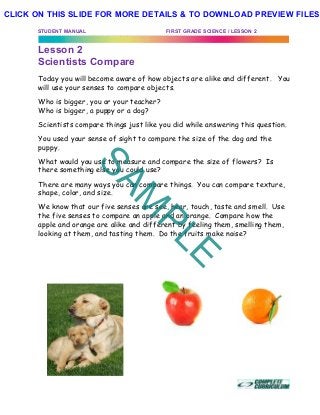
Who is bigger, you or your teacher?
Who is bigger, a puppy or a dog?
Scientists compare things just like you did while answering this question.
You used your sense of sight to compare the size of the dog and the
puppy.
What would you use to measure and compare the size of flowers? Is
there something else you could use?
There are many ways you can compare things. You can compare texture,
shape, color, and size.
We know that our five senses are see, hear, touch, taste and smell. Use
the five senses to compare an apple and an orange. Compare how the
apple and orange are alike and different by feeling them, smelling them,
looking at them, and tasting them. Do the fruits make noise?
SAM
PLE
CLICK ON THIS SLIDE FOR MORE DETAILS & TO DOWNLOAD PREVIEW FILES!
STUDENT MANUAL FIRST GRADE SCIENCE / LESSON 2
Lesson 2
Scientists Compare
Worksheet
Name: _______________________________________________________
Directions: Answer the questions below.
1. Use a balance to weigh the apple and orange. Write down the
results.
Answers will vary
_________________________________________________________________
_________________________________________________________
_________________________________________________________________
2. Use a tape measure to measure the two fruits to see which is
bigger. Which fruit is bigger?
Answers will vary
_________________________________________________________________
_________________________________________________________
_________________________________________________________________
3. Your teacher will cut open the fruit. How are the apple and orange
alike and different on the inside?
Answers will vary-may include, alike: seeds different: color, juice, etc
_______________________________________________________
____________________________________________________
___________________________________________________________
SAM
PLE
CLICK ON THIS SLIDE FOR MORE DETAILS & TO DOWNLOAD PREVIEW FILES!
STUDENT MANUAL FIRST GRADE SCIENCE / LESSON 2
4. Write two ways the apple and orange are alike and different.
Answers will vary but assure descriptiveness
_________________________________________________________
_________________________________________________________________
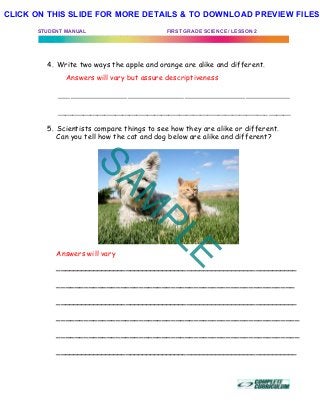
5. Scientists compare things to see how they are alike or different.
Can you tell how the cat and dog below are alike and different?
Answers will vary
___________________________________________________________
____________________________________________________
___________________________________________________________
_____________________________________________________
_____________________________________________________
___________________________________________________________
SAM
PLE
CLICK ON THIS SLIDE FOR MORE DETAILS & TO DOWNLOAD PREVIEW FILES!
STUDENT MANUAL FIRST GRADE SCIENCE / LESSON 2
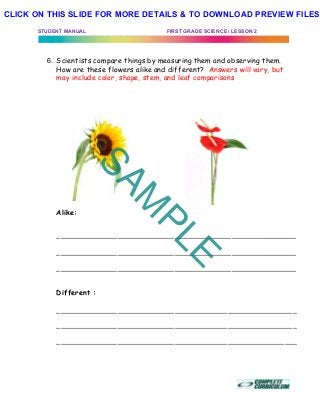
6. Scientists compare things by measuring them and observing them.
How are these flowers alike and different? Answers will vary, but
may include color, shape, stem, and leaf comparisons
Alike:
___________________________________________________________
___________________________________________________________
___________________________________________________________
Different :
___________________________________________________________
___________________________________________________________
___________________________________________________________
SAM
PLE
CLICK ON THIS SLIDE FOR MORE DETAILS & TO DOWNLOAD PREVIEW FILES!
STUDENT
	
Less
Scie
Name:
Date: __
Directi
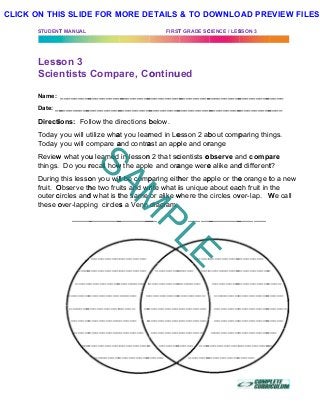
Today
Today
Review
things.
During
fruit. O
outer c
these o
T MANUAL
son 3
ntists
_________
_________
ions: Fol
you will u
you will c
w what you
Do you r
this lesso
Observe th
circles and
over-lappi
_____
____
_____
_______
______
______
_____
___
Comp
__________
__________
low the d
tilize wha
ompare a
u learned
recall how
on you wil
he two fru
d what is t
ng circles
________
_________
__________
_________
__________
__________
__________
__________
__________
________
are, Co
_________
__________
irections b
at you lear
and contra
in lesson
w the appl
ll be comp
its and wr
the same
s a Venn
_________
________
________
________ _
_____ __
_____ __
_____ _
_______
_________
_________
FIRST
ontinu
__________
_________
below.
rned in Le
ast an app
n 2 that sc
e and ora
paring eith
rite what i
or alike w
diagram.
___
_______
_________
_________
__________
__________
_________
_ ______
_____
T GRADE SC
ued
_________
__________
esson 2 ab
ple and or
cientists o
ange were
her the ap
is unique
where the
______
_____
_____ ___
_______
________
________
________
_______
_____ ___
_______
CIENCE / LES
__________
_________
bout comp
range
observe a
e alike and
pple or the
about eac
circles ov
________
_________
_________
________
________
________
________
_________
__________
__________
SSON 3
_________
__________
paring thi
nd comp
d different
e orange t
ch fruit in
ver-lap. W
_______
________
__________
__________
_________
_________
_________
_________
__________
_____
	
	
_____
____
ngs.
are
t?
to a new
the
We call
_
____
_____
______
_____
___
__
SAM
PLE
CLICK ON THIS SLIDE FOR MORE DETAILS & TO DOWNLOAD PREVIEW FILES!

First Grade Homeschool Curriculum - 1st Grade Science - Best Homeschool Curriculum , Cheap Homeschool Curriculum (Affordable)

  • 1.
  • 2.
            Table of Contents Lesson1 Scientists Observe Objectives: The student will become more aware of the surrounding world by observing with all five senses. Lesson 2 Scientists Compare Objectives: The student will become aware of how objects are alike and different. The student will use the senses to compare objects Lesson 3 Scientists Compare, Continued Objectives: The student will utilize what he learned in Lesson 2. The student will compare and contrast an apple and orange Lesson 4 Scientists Measure Objectives: The student will use nonstandard measurement to measure items. The student will be introduced to a balance, thermometer, measuring cups, and a ruler. The student will recall what a balance, thermometer and ruler are used for. Lesson 5 Scientists Measure with a Ruler, Tape Measure, and a Yardstick Objectives: The student will experiment with measuring tools. The student will select appropriate measuring tools. The student will measure, with help. Lesson 6 Scientists Measure with a Thermometer Objectives: The student will identify which temperatures are cold and which are hot. The student will be introduced to Thermometer. Lesson 7 Scientists Measure with a Scale Objectives: To introduce the students to the scale Lesson 8 Scientists Measure with Measuring Cups Objectives: Introduce the student to measuring with measuring cups. Introduce the concept of volume. Lesson 9 Making Play Dough Objectives: The student will apply what he learned in Lesson 8. Lesson 10 Scientists Classify Objectives: The student will be able to classify an object in two or more different ways. Lesson 11 Scientists Make Models Objective: The student will understand the concept of a model and be able to make a model of his favorite room in the house. Lesson 12 Scientists Communicate Objective: The student will be able to communicate by drawing, writing or talking. Lesson 13 Scientists Infer Objective: The student will be introduced to the concept of inferring. The student will be able to infer what the teacher is acting out. Lesson 14 Scientists Put Things in Order Objective: The student will be able to tell what happened first, next and last in a story. The students will be able to put a series of events in order. Lesson 15 Scientists Predict Objective: The student will understand the concept of predicting and be able to make a reasonable prediction. Lesson 16 Scientists Objective: The student will use investigation to solve a problem. SAM PLE
  • 3.
            Lesson 17 ScientistsInvestigate - Continued Objective: The student will use the experiment to investigate how crystals are formed. Lesson 18 Scientists Draw Conclusions Objective: The student will be introduced to drawing conclusions. Lesson 19 Scientists – Culminating Activity Objective: The student will use or observe the scientific skills he has learned. Lesson 20 Introduction to the Five Senses Objectives: Today you will be introduced to the 5 senses. Lesson 21 You Observe with Your Eyes Objectives: To learn that one of the five senses is the sense of sight. The student will use his eyes to observe. Lesson 22 You Observe with Your Ears Objectives: To learn that one of the five senses is the sense of hearing. Each thing has its own sound and it can be identified it by the sound it makes. Lesson 23 You Observe by Touching Objectives: To learn that one of the five senses is touch. You can identify different objects by the way they feel. Lesson 24 You Observe by Smelling Objectives: To learn that one of the five senses is smell. You can identify different things by the way they smell. Lesson 25 You Observe By Tasting Objectives: To learn that one of the senses is taste. You can identify something by the way it tastes. Lesson 26 The Five Senses Review Objectives: The student will be able to recall the previous lessons and fill in the Senses Worksheet Lesson 27 Living and Nonliving Things Objectives: Recognize living and nonliving things, compare living and nonliving things Lesson 28 What Plants Need to Live and Where They Live Objectives: Recognize that plants grow in a variety of places. Observe plants to see what happens when they do not get water and communicate what happens to others. Identify that plants need water, soil, light, and air to live. Lesson 29 The Parts of a Plant Objectives: Observe the parts of a plant. Identify the parts of a plant. Lesson 30 The Roots of a Plant Objectives: Explain the function of roots. Explore the roots. Lesson 31 Stems are Plant Straws and More Objectives: The student will be able to explain that a stem holds a plant up. The student will be able to explain that water moves up the stem to the leaves. Lesson 32 Big, Small, Short or Tall, Leaves Do it All Objectives: Observe that different plants have different leaves. Identify the function of plant. Lesson 33 Seeds, Seeds, Everywhere Objectives: Identify the parts of a seed. Recognize that a seed grows into a plant Lesson 34 Plants Start Out Little Like You Objectives: Recognize that seeds grow into plants. Identify what a seed needs to grow. SAM PLE
  • 4.
            Lesson 35 Yum,Plants! Objectives: Identify ways humans use plants and understand that some plants can be eaten and some cannot Lesson 36 Budding Artists Objectives: Identify the senses. Recognize that artist use science skills. Lesson 37 Exploring You Will Go Objectives: Observe plants in their natural habitats. Identify the parts of a plant and tell what they do Lesson 38 Animals, Animals, Animals Objectives: Tell that animals need food, water, air and shelter to live Lesson 39 Amazing Animals Objectives: Compare and contrast different animals by their characteristics. Identify different ways to group animals Lesson 40 Magnificent Mammals Objectives: Recall that all mammals have hair or fur and feed their young milk. Lesson 41 Beautiful Birds Objectives: Tell that all birds have feathers. Recall that birds have two legs and wings. Tell that birds lay eggs, make a nest, and have a beak. Lesson 42 Fabulous Fish Objectives: Tell that the characteristics of a fish are that they have scales and breathe through their gills. Lesson 43 Awesome Amphibians and Revealing Reptiles Objectives: Recall 2 characteristics of an amphibian. Recall 2 characteristics of a reptile. Give an example of an amphibian. Give an example of a reptile Lesson 44 Interesting Insects Objectives: To recognize the parts of an insect. Identify the characteristics of an insect. Lesson 45 Animals Grow and Change Objectives: Understand that all animals change as they grow. Animals grow up to look like their parents. Lesson 46 Beautiful Butterflies Objectives: Observe and identify changes in the life cycle of a butterfly. Lesson 47 Fantastic Frogs Objectives: Put the changes in the life cycle of a frog in order. Lesson 48 A Hunting We Will Go Objectives: Demonstrate knowledge of the different animal groups. Put the butterfly life cycle in order. Name two things animals need to live. Lesson 49 What’s for Dinner? Objectives: Explore food chains. Define food chain. Lesson 50 Tongues, Beaks, Teeth, Jaws, and Claws, Oh, My! Objectives: Recognize that body parts help animals get food. Lesson 51 Animals Need Plants Objectives: Give two ways animals depend on plants for their basic needs. Lesson 52 Animals Are Good Friends to Plants Objectives: Name two ways animals help plants meet their needs Lesson 53 You and Me, We All Need Plants and Animals SAM PLE CLICK ON THIS SLIDE FOR MORE DETAILS & TO DOWNLOAD PREVIEW FILES!
  • 5.
            Objectives: Give twoexamples of ways people need plants or animals for their basic needs Lesson 54 Chapter Review Objectives: Review of chapter Lesson 55 Chapter Test Objective: Chapter Test Lesson 56 Animal Homes Objectives: Name one need animals need met by where they live. Lesson 57 The Dry Desert Objectives: Recognize that plants and animals that live in a desert have their needs met. Give one example of a characteristic that helps plants and animals live in a desert. Lesson 58 What You Will Find in a Forest Objectives: Recognize that plants and animals that live in a forest have their needs met. Give one example of a characteristic that helps plants and animals live in a forest. Lesson 59 Oceans Objectives: Recognize that plants and animals that live in the ocean have their needs met. Give one example of a characteristic that helps plants and animals live in the ocean. Lesson 60 The Wet, Wet, Rain Forest Objectives: Recognize that plants and animals that live in a rain forest have their needs met. Give one example of a characteristic that helps plants and animals live in a rain forest. Lesson 61 Chapter Review Objectives: Chapter Review Lesson 62 Chapter Test Objectives: Chapter Test Lesson 63 A Marine Biologist Objectives: Can tell one thing a marine biologist does. Lesson 64 What is a natural resource? Objective: The student will identify and define a natural resource. Lesson 65 Fossil Fuels Objective: The student will define fossil fuel and give one example Lesson 66 Where can we find natural resources? Objective: The student should be able to identify pictures from magazines to identify renewable and non-renewable resources. Lesson 67 Are soils different? How? Objective: When complete, The student will understand that scientists use many different tools to make their work easier. Lesson 68 What life is found in soil? Objective: The student will be able to identify two or more living things that survive in soil Lesson 69 Where are these rocks and soil found? Objective: The student will look at pictures of different types of soil and rocks and identify characteristics. The student will be able to identify where the rocks and soil pictures may be found by recalling places they have been. Lesson 70 What are rocks and soil? Objective: The student will read and be able to define what a rock is and what soil is. SAM PLE CLICK ON THIS SLIDE FOR MORE DETAILS & TO DOWNLOAD PREVIEW FILES!
  • 6.
            Lesson 71 Typesof soil Objective: The student will be able to identify types of soil and what they look like Lesson 72 Discovering Minerals Objective: The student will use internet to search types of minerals and choose one to research. The student will research a mineral to discover its use, where it is found, what it looks like, and which country has the most. The student will report findings in one of two ways: Presentation on computer, or poster board. Lesson 73 What are plants used for? Objective: The student will be able to choose resources that we use on a daily basis for food, shelter, and water. Lesson 74 Plants to avoid Objective: The student will understand that not all plants are good for human contact or use. Lesson 75 Warning, Dangerous Plants Ahead! Objective: The student will create a brochure to warn about poisonous plants. Lesson 76 The Changing Earth Objective: The student will understand weathering and erosion Lesson 77 Where can you find weathering? Objective: The student will research weathering and find sample pictures. The student will share pictures with teacher and explain how weathering affected each photograph. Lesson 78 Tsunami’s can make the earth change. Objective: The student will learn about what causes a tsunami and how it affects the earth. Lesson 79 Protecting our Earth Objective: Student understands how humans affect the earth. Student knows that humans can also cause a change on the earth, both good and bad. Lesson 80 Water Pollution Objective: The student will learn how water is polluted through the ground Lesson 81 The Water Cycle and Groundwater Objective: The student will understand how the water cycle affects groundwater Lesson 82 Groundwater experiment Objective: The student will create an edible sample of the ground water process. Lesson 83 What can you do to protect groundwater? Objective: The student will make a checklist of what kids can do to protect ground water. Lesson 84 Making a compost pile Objective: The student will understand that compost is a way to stop dumping things that are biodegradable into landfills. Lesson 85 Recycling Objective: The student will understand that by recycling, we can help keep pollution to a minimum. Lesson 86 Landfills Objective: The student will understand what landfill is. Lesson 87 Reviewing recycling Objective: The student will discuss what it means to recycle and what happens when pollution enters in to water. SAM PLE CLICK ON THIS SLIDE FOR MORE DETAILS & TO DOWNLOAD PREVIEW FILES!
  • 7.
            Lesson 88 Keepingour plants and animals safe Objective: Student understands that humans affect the earth. Student understands that people cause change in their environment Lesson 89 Forest Fires-How they begin and how they can be prevented Objective: The student will find ways that forest fires start and how they can be prevented Lesson 90 Forest Fires-How they begin and how they can be prevented Continued Objective: The student will find ways that forest fires start and how they can be prevented Lesson 91 Forests and protecting animals Objective: The student will answer assessment questions to follow-up about forest fires. Lesson 92 How can worms help the soil? Objective: The student will record science data and learn about worms helping the soil. Lesson 93 Review Objective: The student will use pictures and words to demonstrate their knowledge of Rocks, minerals, erosion, water table, recycling. Lesson 94 Looking down at the Earth Objective: The student will understand that scientists use technology and satellites to look down at the earth. Lesson 95 International Space Station Objective: The student will discover what the International Space Station is and how it works. Lesson 96 How does weather change? Objective: The student will identify words and concepts that will establish knowledge for weather unit. Lesson 97 Lightning Never Strikes Twice Objective: The student will recognize that there are some misconceptions in Science Lesson 98 Rain Objective: The student will understand varying rain levels and the importance of measuring it. Lesson 99 What are some kinds of weather? Objective: The student will know that weather has patterns over time. Lesson 100 What is weather? Objective: The student will understand what weather is and that it is ever-changing. Lesson 101 How Much Rain Falls in Your Area? Objective: The student will conduct some research using the internet or local library. Lesson 102 Water Cycle review Objective: The student will understand that water cycle is an ongoing pattern Lesson 103 Spring, Spring, Spring! Objective: The student will understand that weather patterns change over time. Lesson 104 What is summer? Objective: The student will understand changes in seasons. Lesson 105 What is fall? Objective: The student will understand that weather conditions have patterns. Lesson 106 What is winter? SAM PLE CLICK ON THIS SLIDE FOR MORE DETAILS & TO DOWNLOAD PREVIEW FILES!
  • 8.
            Objective: The studentwill know that weather conditions occur in patterns Lesson 107 Bad Weather Objective: Students understands weather patterns Lesson 108 Thunderstorm safety Objective: The student will learn how to stay safe during a storm and will create a poster for others. Lesson 109 How tornadoes form Objective: The student will understand weather pattern and complex movement Lesson 110 Tornado safety plan for your family Objective: The student will make a tornado safety plan and share it with their family in the event of a tornado. Lesson 111 Hurricanes Objective: The student will understand impact of hurricanes. The student will understand ways to stay safe in hurricanes. Lesson 112 Stay safe in a hurricane Objective: The student will prepare a poster on Hurricane safety and preparedness. Lesson 113 Review and Quiz Objective: Review weather and weather elements Lesson 114 A long time ago there were dinosaurs and fossils Objective: Introduce unit of dinosaur and fossils. Lesson 115 What do I really see in a museum? Objective: The student will understand that not all dinosaur bones or fossils they see in a museum are real. They are replicas Lesson 116 What does a paleontologist do? Objective: The student will understand the job of a paleontologist. Lesson 117 What is a fossil? Objective: The student will identify what a fossil is. Lesson 118 How do we know what dinosaurs looked like? Objective: The student will learn about fossils and how they are used to determine what things looked like. Lesson 119 More about fossils Objective: The student will learn some common misconceptions about fossils Lesson 120 What can we learn from fossils? Objective: Student explains how fossils giver information about plants and animals that lived on earth long ago. Lesson 121 Tell me about the dinosaurs Objective: The student will be able to give some characteristics about dinosaurs. Lesson 122 Researching a Dinosaur Objective: The student will choose a dinosaur to research and write about Lesson 123 Physical features Objective: The student will learn how different physical features helped them survive in their habitat Lesson 124 Create your own dinosaur Objective: The student will create his/her own dinosaur and defend their creation with information they have learned about dinosaurs Lesson 125 Make your own fossil Objective: The student will make his/her own fossil to understand the process SAM PLE CLICK ON THIS SLIDE FOR MORE DETAILS & TO DOWNLOAD PREVIEW FILES!
  • 9.
            Lesson 126 Reviewand quiz Objective: The student will review dinosaurs, extinction and fossils and answer questions to ensure comprehension Lesson 127 How do you describe objects? Objective: The student will be able to identify words of matter to describe objects Lesson 128 Alike and Different Objective: The student will be able to give descriptions of how things are alike and how they are different. This is a key skill in science Lesson 129 Matter Objective: The student will know that objects are made up of matter. Lesson 130 Gases and Liquids Objective: The student will learn that objects can be grouped by physical characteristics. Lesson 131 Different liquids Objective: The student will understand that not all liquids are the same. Lesson 132 The student will conduct experiment to determine viscosity Objective: The student will conduct experiment to determine viscosity Lesson 133 How matter changes Objective: The student will understand that heating and cooling effects solids, liquids and gases. Lesson 134 How water changes Objective: The student will know the properties of ice, water and steam Lesson 135 How does matter change? Objective: The student will understand matter and energy. Lesson 136 Heights and Weight Objective: The student will compare and order objects by length and weight. Lesson 137 What really moves us? Objective: The student will be introduced to movement and what makes things move. Lesson 138 How do objects move? Objective: The student will understand what makes objects move Lesson 139 Mr. Newton, please hold this apple Objective: The student will read three laws of gravity and make a connection Lesson 140 How fast can you move? Objective: The student will understand that objects move at a different speed with different forces Lesson 141 Which way do objects move? Objective: The student will discover that things move in different ways, they are not always straight. Lesson 142 Which way do I go? Objective: The student will use knowledge of how things move to create a map to a location either inside or outside his/her home. Lesson 143 What is a magnet and what does it do? Objective: The student will learn what a magnet is and what it does. Lesson 144 Sounds in the air SAM PLE CLICK ON THIS SLIDE FOR MORE DETAILS & TO DOWNLOAD PREVIEW FILES!
  • 10.
    Objective: The studentwill learn about vibration of objects to make sound. Lesson 145 What around us makes noise? Objective: The student will think about sounds that they hear all of the time. Lesson 146 White noise Objective: The student will learn that sometimes sounds are around just to make noise Lesson 147 Make your own instrument Objective: The student will discover vibrations of objects by creating own instrument. Lesson 148 Review and quiz time! Objective: The student will review concepts and then take a short quiz Lesson 149 Where does energy come from? Objective: Throughout this unit, The student will learn about sources of energy and be able to make basic connections. Lesson 150 How do we get heat? Objective: The student will know that the Sun provides heat and light to give energy. Lesson 151 How do we use energy? Objective: The student will understand that the sun’s heats things differently Lesson 152 Have you ever seen your shadow? Objective: The student will understand that the sun gives light to Earth. The student will understand that light passes through some objects. Lesson 153 Make a shadow story Objective: The student will use objects to create a story using shadows Lesson 154 Do shadows stay the same? Objective: The student understands that light can pass through some objects, but not others. This is caused by light being blocked by a solid object. Lesson 155 What things need energy? Objective: The student understands systems of matter and energy Lesson 156 How is electricity made? Objective: The student will understand how electricity is made. Lesson 157 Oh no, no electricity! Objective: The student will recall how electricity is made and write a story incorporating bad weather elements. Lesson 158 How do humans get energy? Objective: The student will know how humans gain and release energy. The student will know that people need food for energy. Lesson 159 Review and quiz Objective: The student will answer questions and review concepts learned in unit. Lesson 160 The daytime sky Objective: The student knows how to decipher what is in the day time sky. Lesson 161 What causes daytime and nighttime? Objective: The student will know that day and night are caused by the rotation of the Earth. Lesson 162 Planet and stars Objective: The student will learn the difference between planets and stars. Lesson 163 Researching a planet Objective: The student will research a planet SAM PLE CLICK ON THIS SLIDE FOR MORE DETAILS & TO DOWNLOAD PREVIEW FILES!
  • 11.
            Lesson 164 TheMoon Objective: The student will understand the differences between the sun and the Moon Lesson 165 A journey into space Objective: The student will research the first man to walk on the Moon. Lesson 166 Name that planet Objective: The student will create own planet based on their knowledge of stars and planets Lesson 167 Review and quiz Objective: Students will review concepts and answer questions related to space Lesson 168 Which animals have backbones? Objective: The student will be able to identify which animals have backbones that belong to the group called vertebrates (mammals, reptiles, birds, amphibians, and fish) Lesson 169 How have mammals adapted? Objective: The student will be able to identify how mammals have changed or adapted to their environments. Lesson 170 How have fish adapted? Objective: The student will be able to identify how fish have changed or adapted to their environments. Lesson 171 How have amphibians adapted? Objective: The student will be able to identify how amphibians have changed or adapted to their environments. Lesson 172 What are same animals without backbones? Objective: The student will be able to identify which animals do not have backbones that belong to the group called invertebrates. Lesson 173 What do plants and animals need to live? Objective: The student will be able to understand how plants and animals dependent on each other for survival. Lesson 174 What is a food web? Objective: The student will be able to identify food webs and what comprise them. Lesson 175 What can cause a food web to change? Objective: The student will be able to identify how humans cause food webs to change. Lesson 176 How do plants and animals help each other? Objective: Student knows that plants and animals depend upon each other to survive. Lesson 177 Review and quiz Objective: The student will review concepts and answer questions. Lesson 178 Animals helping others Objective: The student will use concepts discussed to illustrate how plants and animals help one another. Lesson 179 What does a farmer do? Objective: The student will conduct research to learn and then illustrate what a farmer does. Lesson 180 Course Completions Objective: The student will reflect on what he/she has learned throughout the course. SAM PLE CLICK ON THIS SLIDE FOR MORE DETAILS & TO DOWNLOAD PREVIEW FILES!
  • 12.
    STUDENT Less Scie Look at you tell? study?W When yo Look at senses w out? Do What els When yo Read an without f Take a b interesti then go Take ou object? it hard o Answer Share w Draw a p activity. T MANUAL son 1 ntists Worksheet ? What are What sense ou are done worksheet would you u o you think se might yo ou are done nd discuss t first asking bag and tak ng and put back inside ut one of the What shap or soft? Wh the questio what you ob picture abo Obser t 1. Who is the scienti es are the s e studying t 1a. What use to expl it would be ou hear or s e studying t the “You Ar an adult! ke a walk w them in the e. e objects an pe is it? Wh hat does it s ons about th served abo out what you rve the scienti sts in the p scientists u the picture, t do you se ore it? Wo noisy or qu see here? the picture, re the Scien with outside e bag. Why nd look, tou hat happen smell like? he other ob out your obj u observed FIRST st? Do you pictures doin sing? , answer the e in this pic ould the wat uiet here? W , answer the ntist” activit with your t y did you he uch, smell, a ns when you bjects that y jects from t and write t T GRADE SC u think they ng? Can y e question cture? If yo ter be cold What sense e question ty. Remem teacher. Pi e pick that and feel the u give it a p you collecte the walk wit two things y CIENCE / LES y are all scie you name o about the p ou were exp or warm? e would you about the p mber, never ick up items item? Coll e object. C push? What ed. th your teac you observ SSON 1 entists? Ho ther things picture. ploring this How could u use to fin picture. taste anyth s you think ect five or s Can you hea t does it fee cher. ved during y ) ow can scientists river what you find d out? hing are six items ar the el like? Is your SAM PLE CLICK ON THIS SLIDE FOR MORE DETAILS & TO DOWNLOAD PREVIEW FILES!
  • 13.
    STUDENT Less Scie There All sci If you TMANUAL son 1 ntists are man entists o were a s Obser ny kinds observe t scientist, rve of scien things. what kin FIRST tists. nd of sci T GRADE SC ientist wo CIENCE / LES ould you SSON 1 (DR) u like to b ) be? SAM PLE CLICK ON THIS SLIDE FOR MORE DETAILS & TO DOWNLOAD PREVIEW FILES!
  • 14.
    STUDENT Less Scie Work Name: Date: _ Directio Who is scientist arethe s 1. W s _ _ _ _ _ 2. C _ _ 3. N _ _ T MANUAL son 1 ntists ksheet _______ ________ ons: Answ the scientis ts in the pic scientists u Who is the scientists? _________ _________ _________ _________ _________ Can you nam _________ _________ Name the se _________ _________ Obser t 1 ________ ________ wer the qu st? Do you ctures doing sing? e scientist ? ________ ________ ________ ________ ________ me other th ________ ________ enses these ________ ________ rve _________ _________ uestions b u think they g? Can you in the pic ________ ________ ________ ________ ________ hings scient ________ ________ e scientists ________ ________ FIRST ________ ________ below are all scie u name oth ctures abo _________ _________ _________ _________ _________ tists study? _________ _________ s are using _________ _________ T GRADE SC ________ ________ entists? Ho er things sc ove? Do y ________ ________ ________ ________ ________ ________ ________ in the pictu ________ ________ CIENCE / LES _________ _________ ow can you cientists stu you think ________ ________ ________ ________ ________ ________ ________ ures. ________ ________ SSON 1 ________ ________ tell? What udy? What they are a _________ _________ _________ _________ _________ _________ _________ _________ _________ ______ ______ t are the t senses all _______ _______ _______ _______ _______ _______ _______ _______ _______ SAM PLE CLICK ON THIS SLIDE FOR MORE DETAILS & TO DOWNLOAD PREVIEW FILES!
  • 15.
    STUDENT Less Scie Work A Scien Use yo _______ _______ _______ TMANUAL son 1 ntists ksheet ntist Obse our senses _________ _________ _________ Obser t 1 erves. s to obser __________ __________ __________ rve rve things __________ __________ __________ FIRST s. What do _________ _________ _________ T GRADE SC o you see __________ __________ __________ CIENCE / LES e in this pi _________ _________ _________ SSON 1 (DR) icture? __________ __________ __________ ) ________ ________ ________ SAM PLE CLICK ON THIS SLIDE FOR MORE DETAILS & TO DOWNLOAD PREVIEW FILES!
  • 16.
    STUDENT Less Scie You What do Things B What yo 1.Take 2. Pick 3. Put th 4. Take 5. Draw T MANUAL son 1 ntists are the o you obse you need Bag ou will be d e a walk out up objects hem in you e the objects w a picture a Obser e Scie erve? doing: tside. that you lik r bag. s inside and and write tw rve ntist A Crayo ke. d observe t wo things yo FIRST Activity ons them using ou observe T GRADE SC y Jo your sense ed about yo CIENCE / LES ournal (Pap es. ur favorite SSON 1 (DR per or Digit item in you tal) r journal. SAM PLE CLICK ON THIS SLIDE FOR MORE DETAILS & TO DOWNLOAD PREVIEW FILES!
  • 17.
    STUDENT Picture Two thi _______ _______ _______ _______ _______ _______ T MANUAL ofmy favo ngs about _________ _________ _________ _________ _________ _________ orite item. my favorit __________ __________ __________ __________ __________ __________ te item: __________ __________ __________ __________ __________ __________ FIRST _________ _________ _________ _________ _________ _________ T GRADE SC __________ __________ __________ __________ __________ __________ CIENCE / LES _________ _________ _________ _________ _________ _________ SSON 1 __________ __________ __________ __________ __________ __________ ________ ________ ________ ________ ________ ________ SAM PLE CLICK ON THIS SLIDE FOR MORE DETAILS & TO DOWNLOAD PREVIEW FILES!
  • 18.
    STUDENT MANUAL FIRSTGRADE SCIENCE / LESSON 2 Lesson 2 Scientists Compare Today you will become aware of how objects are alike and different. You will use your senses to compare objects. Who is bigger, you or your teacher? Who is bigger, a puppy or a dog? Scientists compare things just like you did while answering this question. You used your sense of sight to compare the size of the dog and the puppy. What would you use to measure and compare the size of flowers? Is there something else you could use? There are many ways you can compare things. You can compare texture, shape, color, and size. We know that our five senses are see, hear, touch, taste and smell. Use the five senses to compare an apple and an orange. Compare how the apple and orange are alike and different by feeling them, smelling them, looking at them, and tasting them. Do the fruits make noise? SAM PLE CLICK ON THIS SLIDE FOR MORE DETAILS & TO DOWNLOAD PREVIEW FILES!
  • 19.
    STUDENT MANUAL FIRSTGRADE SCIENCE / LESSON 2 Lesson 2 Scientists Compare Worksheet Name: _______________________________________________________ Directions: Answer the questions below. 1. Use a balance to weigh the apple and orange. Write down the results. Answers will vary _________________________________________________________________ _________________________________________________________ _________________________________________________________________ 2. Use a tape measure to measure the two fruits to see which is bigger. Which fruit is bigger? Answers will vary _________________________________________________________________ _________________________________________________________ _________________________________________________________________ 3. Your teacher will cut open the fruit. How are the apple and orange alike and different on the inside? Answers will vary-may include, alike: seeds different: color, juice, etc _______________________________________________________ ____________________________________________________ ___________________________________________________________ SAM PLE CLICK ON THIS SLIDE FOR MORE DETAILS & TO DOWNLOAD PREVIEW FILES!
  • 20.
    STUDENT MANUAL FIRSTGRADE SCIENCE / LESSON 2 4. Write two ways the apple and orange are alike and different. Answers will vary but assure descriptiveness _________________________________________________________ _________________________________________________________________ 5. Scientists compare things to see how they are alike or different. Can you tell how the cat and dog below are alike and different? Answers will vary ___________________________________________________________ ____________________________________________________ ___________________________________________________________ _____________________________________________________ _____________________________________________________ ___________________________________________________________ SAM PLE CLICK ON THIS SLIDE FOR MORE DETAILS & TO DOWNLOAD PREVIEW FILES!
  • 21.
    STUDENT MANUAL FIRSTGRADE SCIENCE / LESSON 2 6. Scientists compare things by measuring them and observing them. How are these flowers alike and different? Answers will vary, but may include color, shape, stem, and leaf comparisons Alike: ___________________________________________________________ ___________________________________________________________ ___________________________________________________________ Different : ___________________________________________________________ ___________________________________________________________ ___________________________________________________________ SAM PLE CLICK ON THIS SLIDE FOR MORE DETAILS & TO DOWNLOAD PREVIEW FILES!
  • 22.
    STUDENT Less Scie Name: Date: __ Directi Today Today Review things. During fruit. O outerc these o T MANUAL son 3 ntists _________ _________ ions: Fol you will u you will c w what you Do you r this lesso Observe th circles and over-lappi _____ ____ _____ _______ ______ ______ _____ ___ Comp __________ __________ low the d tilize wha ompare a u learned recall how on you wil he two fru d what is t ng circles ________ _________ __________ _________ __________ __________ __________ __________ __________ ________ are, Co _________ __________ irections b at you lear and contra in lesson w the appl ll be comp its and wr the same s a Venn _________ ________ ________ ________ _ _____ __ _____ __ _____ _ _______ _________ _________ FIRST ontinu __________ _________ below. rned in Le ast an app n 2 that sc e and ora paring eith rite what i or alike w diagram. ___ _______ _________ _________ __________ __________ _________ _ ______ _____ T GRADE SC ued _________ __________ esson 2 ab ple and or cientists o ange were her the ap is unique where the ______ _____ _____ ___ _______ ________ ________ ________ _______ _____ ___ _______ CIENCE / LES __________ _________ bout comp range observe a e alike and pple or the about eac circles ov ________ _________ _________ ________ ________ ________ ________ _________ __________ __________ SSON 3 _________ __________ paring thi nd comp d different e orange t ch fruit in ver-lap. W _______ ________ __________ __________ _________ _________ _________ _________ __________ _____ _____ ____ ngs. are t? to a new the We call _ ____ _____ ______ _____ ___ __ SAM PLE CLICK ON THIS SLIDE FOR MORE DETAILS & TO DOWNLOAD PREVIEW FILES!