Standard Template Library
Object Oriented Programming Copyright © 2012 IM
Group. All rights
reserved
Iterators
• STL has containers, algorithms and
Iterators
▫ Containers hold objects, all of a specified type
▫ Generic algorithms act on objects in containers
▫ Iterators provide access to objects in the
containers yet hide the internal structure of the
container
Copyright © 2012 IM
Group. All rights
reserved
Containers
• A container is a holder object that stores a collection of other objects (its
elements). They are implemented as class templates, which allows a great
flexibility in the types supported as elements.
The container manages the storage space for its elements and provides
member functions to access them, either directly or through iterators
(reference objects with similar properties to pointers).
Containers replicate structures very commonly used in programming:
▫ Dynamic Arrays (vector)
▫ Queues (queue)
▫ Stacks (stack)
▫ Heaps (priority_queue)
▫ Linked lists (list)
▫ Trees (set)
▫ Associative Arrays (map)
Copyright © 2012 IM
Group. All rights
reserved
Common Container Members
• The STL sequential containers each have different
characteristics, but they all support these members:
▫ container( ); // creates empty container
▫ ~container( ); // destroys container, erases all
members
▫ c.empty( ) // true if there are no entries in c
▫ c.size( ) const; // number of entries in container c
▫ c = v; //replace contents of c with contents of v
Copyright © 2012 IM
Group. All rights
reserved
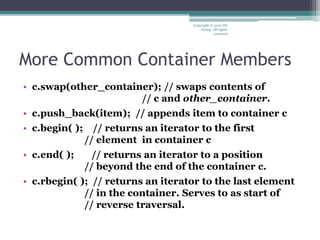
More Common Container Members
• c.swap(other_container); // swaps contents of
// c and other_container.
• c.push_back(item); // appends item to container c
• c.begin( ); // returns an iterator to the first
// element in container c
• c.end( ); // returns an iterator to a position
// beyond the end of the container c.
• c.rbegin( ); // returns an iterator to the last element
// in the container. Serves to as start of
// reverse traversal.
Copyright © 2012 IM
Group. All rights
reserved
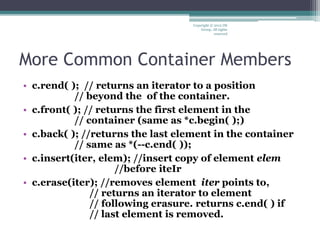
More Common Container Members
• c.rend( ); // returns an iterator to a position
// beyond the of the container.
• c.front( ); // returns the first element in the
// container (same as *c.begin( );)
• c.back( ); //returns the last element in the container
// same as *(--c.end( ));
• c.insert(iter, elem); //insert copy of element elem
//before iteIr
• c.erase(iter); //removes element iter points to,
// returns an iterator to element
// following erasure. returns c.end( ) if
// last element is removed.
Copyright © 2012 IM
Group. All rights
reserved
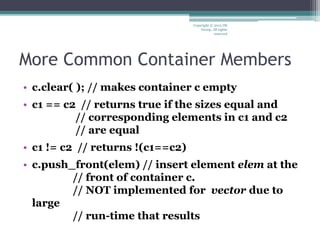
More Common Container Members
• c.clear( ); // makes container c empty
• c1 == c2 // returns true if the sizes equal and
// corresponding elements in c1 and c2
// are equal
• c1 != c2 // returns !(c1==c2)
• c.push_front(elem) // insert element elem at the
// front of container c.
// NOT implemented for vector due to
large
// run-time that results
Copyright © 2012 IM
Group. All rights
reserved
Slide 18-
8
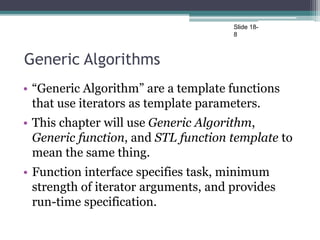
Generic Algorithms
• “Generic Algorithm” are a template functions
that use iterators as template parameters.
• This chapter will use Generic Algorithm,
Generic function, and STL function template to
mean the same thing.
• Function interface specifies task, minimum
strength of iterator arguments, and provides
run-time specification.
Training
• Let’s make the Vector class.
Copyright © 2012 IM
Group. All rights
reserved
Any Questions
Session 7 Copyright © 2012 IM
Group. All rights
reserved

OOP - STL

  • 1.
    Standard Template Library ObjectOriented Programming Copyright © 2012 IM Group. All rights reserved
  • 2.
    Iterators • STL hascontainers, algorithms and Iterators ▫ Containers hold objects, all of a specified type ▫ Generic algorithms act on objects in containers ▫ Iterators provide access to objects in the containers yet hide the internal structure of the container Copyright © 2012 IM Group. All rights reserved
  • 3.
    Containers • A containeris a holder object that stores a collection of other objects (its elements). They are implemented as class templates, which allows a great flexibility in the types supported as elements. The container manages the storage space for its elements and provides member functions to access them, either directly or through iterators (reference objects with similar properties to pointers). Containers replicate structures very commonly used in programming: ▫ Dynamic Arrays (vector) ▫ Queues (queue) ▫ Stacks (stack) ▫ Heaps (priority_queue) ▫ Linked lists (list) ▫ Trees (set) ▫ Associative Arrays (map) Copyright © 2012 IM Group. All rights reserved
  • 4.
    Common Container Members •The STL sequential containers each have different characteristics, but they all support these members: ▫ container( ); // creates empty container ▫ ~container( ); // destroys container, erases all members ▫ c.empty( ) // true if there are no entries in c ▫ c.size( ) const; // number of entries in container c ▫ c = v; //replace contents of c with contents of v Copyright © 2012 IM Group. All rights reserved
  • 5.
    More Common ContainerMembers • c.swap(other_container); // swaps contents of // c and other_container. • c.push_back(item); // appends item to container c • c.begin( ); // returns an iterator to the first // element in container c • c.end( ); // returns an iterator to a position // beyond the end of the container c. • c.rbegin( ); // returns an iterator to the last element // in the container. Serves to as start of // reverse traversal. Copyright © 2012 IM Group. All rights reserved
  • 6.
    More Common ContainerMembers • c.rend( ); // returns an iterator to a position // beyond the of the container. • c.front( ); // returns the first element in the // container (same as *c.begin( );) • c.back( ); //returns the last element in the container // same as *(--c.end( )); • c.insert(iter, elem); //insert copy of element elem //before iteIr • c.erase(iter); //removes element iter points to, // returns an iterator to element // following erasure. returns c.end( ) if // last element is removed. Copyright © 2012 IM Group. All rights reserved
  • 7.
    More Common ContainerMembers • c.clear( ); // makes container c empty • c1 == c2 // returns true if the sizes equal and // corresponding elements in c1 and c2 // are equal • c1 != c2 // returns !(c1==c2) • c.push_front(elem) // insert element elem at the // front of container c. // NOT implemented for vector due to large // run-time that results Copyright © 2012 IM Group. All rights reserved
  • 8.
    Slide 18- 8 Generic Algorithms •“Generic Algorithm” are a template functions that use iterators as template parameters. • This chapter will use Generic Algorithm, Generic function, and STL function template to mean the same thing. • Function interface specifies task, minimum strength of iterator arguments, and provides run-time specification.
  • 9.
    Training • Let’s makethe Vector class. Copyright © 2012 IM Group. All rights reserved
  • 10.
    Any Questions Session 7Copyright © 2012 IM Group. All rights reserved