Training Session Overview
Classroom – 45 Minutes
• Introduction
• Troubleshooting 101
• Test Box
• Basic review of the C337 Alternator System
• Fault Isolation
• Helpful Tips
• Review and Questions
Hands on – 20 Minutes
• Test Box connection
• Test Box operation
AirScan C337 Alternator System Diagnostic Test Box
INTRODUCTION
Cessna 337 Alternator System –
AirScan C337 Alternator System Diagnostic Test Box
INTRODUCTION
Cessna 337 Alternator System –
 High rate of failure
AirScan C337 Alternator System Diagnostic Test Box
INTRODUCTION
Cessna 337 Alternator System –
 High rate of failure
 Operational impact of failures
AirScan C337 Alternator System Diagnostic Test Box
INTRODUCTION
Cessna 337 Alternator System –
 High rate of failure
 Operational impact of failures
 Significant amount of repeat write-ups
AirScan C337 Alternator System Diagnostic Test Box
INTRODUCTION
Cessna 337 Alternator System –
 High rate of failure
 Operational impact of failures
 Significant amount of repeat write-ups
 No standard troubleshooting process
AirScan C337 Alternator System Diagnostic Test Box
INTRODUCTION
Cessna 337 Alternator System –
 High rate of failure
 Operational impact of failures
 Significant amount of repeat write-ups
 No standard troubleshooting process
 Time and cost saving opportunity
AirScan C337 Alternator System Diagnostic Test Box
INTRODUCTION
The intent of this training is to provide the Technician with the basic
knowledge and tools to enable efficient troubleshooting of the
alternator system of the Cessna 337 legacy models. It is not applicable
to the Raven 550’s.
AirScan C337 Alternator System Diagnostic Test Box
TROUBLESHOOTING 101
Every aviation maintenance organization is responsible for performing the
full range of maintenance tasks. However, these tasks do not count equally
in determining whether or not an organization is doing a good job.
“The basis for judging the efficiency and effectiveness of a maintenance
organization, and of individual maintenance workers, is the ability to find and
fix problems efficiently.”
Quote: Michael E. Maddox - ERAU
AirScan C337 Alternator System Diagnostic Test Box
TROUBLESHOOTING 101
Research related to troubleshooting has greatly increased our
understanding of factors affecting performance. An extensive analysis of
previous research published in the mid-1980's identified three general skills
that appear to produce good troubleshooting performance:
• Ability to repair or replace system components
• Ability to make tests to eliminate components from further consideration
• Ability to employ a strategy to search for failed components.
Most researchers focus on the ability to employ an efficient strategy as the
most important and the most difficult to teach and learn.
AirScan C337 Alternator System Diagnostic Test Box
TROUBLESHOOTING 101
Inefficient Troubleshooting -
Improper diagnoses cause inefficiency in the maintenance process.
However, improper diagnoses are not as potentially degrading to efficiency
as inefficient troubleshooting strategies.
 AMTs tend to apply the same strategies to nearly every
problem they address.
 Thus, an inefficient strategy's effects are multiplied across every
troubleshooting task a maintainer performs.
AirScan C337 Alternator System Diagnostic Test Box
TROUBLESHOOTING 101
Easter Egging (Shot Gunning) –
One method of troubleshooting is to replace various LRUs until the
symptoms of trouble disappear. This method is known as "Easter Egging"
because a technician never really knows where he or she will find the failed
part.
Easter Egging is an extremely inefficient, expensive way to find a problem.
AirScan C337 Alternator System Diagnostic Test Box
TROUBLESHOOTING 101
Troubleshooting errors are the bane of most aviation maintenance
organizations. In fact, troubleshooting is notoriously error-prone. The
fundamental complexity of many aircraft systems contributes to the number and
type of errors observed in actual troubleshooting tasks.
Various strategies can be used to reduce troubleshooting errors -
The structure imposed on troubleshooting activities varies widely among
organizations. In some cases, maintenance personnel are allowed to develop
their own diagnostic strategies.
In others, diagnostic procedures are tightly controlled by procedures or step-
by-step job aids. Even within the same maintenance organization, the flexibility
of troubleshooting strategies may vary considerably.
AirScan C337 Alternator System Diagnostic Test Box
TROUBLESHOOTING 101
A number of research studies consistently have shown that
proceduralization improves most measures of troubleshooting
performance.
Two aspects of proceduralization are most salient for aviation maintenance:
First, when procedures are simple and apply to the specific system on
which work is being performed, they lead to the most pronounced
improvements.
Second, proceduralization can reduce, can in fact eliminate, differences in
troubleshooting performance between experts and novices.
AirScan C337 Alternator System Diagnostic Test Box
TROUBLESHOOTING 101
The alternator system troubleshooting procedures that follows are a form of
proceduralization .
The goal is to timely and accurately isolate and rectify alternator
system malfunctions on the Cessna 337.
AirScan C337 Alternator System Diagnostic Test Box
ALTERNATOR SYSTEM
DIAGNOSTIC TEST BOX
Test Indicator Lights
Voltmeter Test Jacks
Isolation Diode Test Switch
Full Charge Simulation Switch
Volt/Amp Display
Display Power Switch
Test Mode Rotary Switch
AirScan C337 Alternator System Diagnostic Test Box
ALTERNATOR SYSTEM DIAGNOSTIC TEST BOX CONNECTIONS
AirScan C337 Alternator System Diagnostic Test Box
ALTERNATOR SYSTEM DIAGNOSTIC TEST BOX CONNECTIONS
Ground clip to suitable
ground point.
Molex connectors patch
into Voltage Regulator.
AirScan C337 Alternator System Diagnostic Test Box
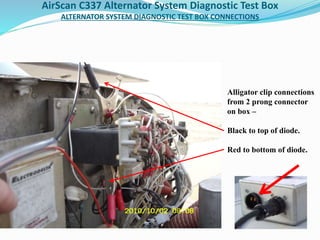
ALTERNATOR SYSTEM DIAGNOSTIC TEST BOX CONNECTIONS
Alligator clip connections
from 2 prong connector
on box –
Black to top of diode.
Red to bottom of diode.
AirScan C337 Alternator System Diagnostic Test Box
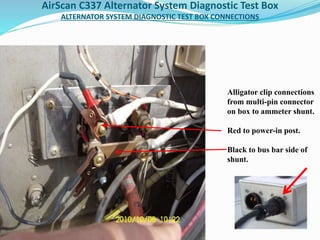
ALTERNATOR SYSTEM DIAGNOSTIC TEST BOX CONNECTIONS
Alligator clip connections
from multi-pin connector
on box to ammeter shunt.
Red to power-in post.
Black to bus bar side of
shunt.
AirScan C337 Alternator System Diagnostic Test Box
Basic Review of the C337 Alternator System
AirScan C337 Alternator System Diagnostic Test Box
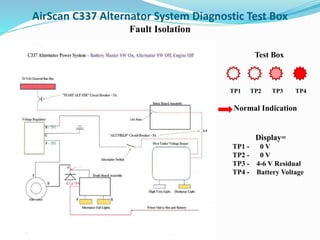
Fault Isolation
Test Box
TP1 TP2 TP3 TP4
Normal Indication
Display=
TP1 - 0 V
TP2 - 0 V
TP3 - 4-6 V Residual
TP4 - Battery Voltage
AirScan C337 Alternator System Diagnostic Test Box
Fault Isolation
Test Box
TP1 TP2 TP3 TP4
No Light on TP4
Display=
TP1 - 0 V
TP2 - 0 V
TP3 - 0 V
TP4 - 0 V
Primary wiring defect
between battery and
isolation diode.
AirScan C337 Alternator System Diagnostic Test Box
Fault Isolation
Test Box
TP1 TP2 TP3 TP4
Normal operation
Display=
TP1 - Battery Voltage
TP2 - Within 1-2V of TP1
TP3 - 4-6 V Residual
TP4 - Battery Voltage
AirScan C337 Alternator System Diagnostic Test Box
Fault Isolation
Test Box
TP1 TP2 TP3 TP4
No TP1 or TP2 Light
Display=
TP1 - 0V
TP2 - 0V
TP3 - 4-6 V Residual
TP4 - Battery Voltage
Field or Start CB popped
Fuse on Diode Assembly open
Over Voltage Sensor failure
Alternator Switch failure
Wiring problem
AirScan C337 Alternator System Diagnostic Test Box
Fault Isolation
Test Box
TP1 TP2 TP3 TP4
No TP2 Light
Display=
TP1 - Battery Voltage
TP2 - 0V
TP3 - 4-6 V Residual
TP4 - Battery Voltage
AirScan C337 Alternator System Diagnostic Test Box
Fault Isolation
TP1 TP2 TP3 TP4
Battery Master SW On, Alternator SW On, Engine Off
No TP2 Light
1. Select rotary test switch to “Field Current”.
 Normal field current will be 2-4 Amps.
 If full scale (5 Amps) this indicates shorted
alternator field or short in field wire between
regulator and alternator.
 Zero or very low amps on display indicates a
malfunctioning Voltage Regulator.
AirScan C337 Alternator System Diagnostic Test Box
Fault Isolation
Test Box
TP1 TP2 TP3 TP4
Normal Operation
Display= *
TP1 - 27.5 +- .2 V
TP2 - Variable
TP3 - 28.5 +- 2.5 V
TP4 - 27.5 +- .2 V
*Battery stabilized.
1000 RPM.
Landing and taxi
lights ON.
AirScan C337 Alternator System Diagnostic Test Box
Fault Isolation
Test Box
TP1 TP2 TP3 TP4
No TP3 Light
Display=
TP1 - Battery Voltage
TP2 - Within 1-2V of TP1
TP3 - 4-6 V Residual
TP4 – Battery Voltage
AirScan C337 Alternator System Diagnostic Test Box
Fault Isolation
TP1 TP2 TP3 TP4
Battery Master SW On, Alternator SW On, Engine On
No TP3 Light
1. Select rotary test switch to “Field Current”.
 Normal field current will be 2-4 Amps with a load
on the system. Maybe less than an amp if no load
and battery charged. If field current is normal then
Alternator itself or Alternator Drive Coupling has failed.
 If field current is not in the normal range then
inspect field wire and connections between Voltage
Regulator and Alternator for defects.
AirScan C337 Alternator System Diagnostic Test Box
Fault Isolation
Test Box
TP1 TP2 TP3 TP4
All lights on but
Alternator Fail Light lit.
Display= *
TP1 - 27.5 +- .2 V
TP2 - Variable
TP3 - 28.5 +- 2.5 V
TP4 -
AirScan C337 Alternator System Diagnostic Test Box
Fault Isolation
TP1 TP2 TP3 TP4
Battery Master SW On, Alternator SW On, Engine On
All Lights On but Alternator Fail Light Lit
1. Select rotary test switch to “Alternator Current”.
 If no charge current indicated then:
 Momentarily move Isolation Diode switch to “Parallel”.
 If normal current is observed replace open diode.
AirScan C337 Alternator System Diagnostic Test Box
Helpful Tips
TP1 TP2 TP3 TP4
Aircraft with Dual Volt/Amp meters:
 The Cessna 337 alternator system downstream of the
isolation diodes is a single bus.
 The shunts for the Dual Volt/Amp meters are
downstream of the isolation diodes.
 Therefore, the amp readings are not an accurate
indication of what load each alternator is picking up.
 Primary indication of an alternator problem is the
aircraft’s respective “Alt Fail” light.
AirScan C337 Alternator System Diagnostic Test Box
Helpful Tips
TP1 TP2 TP3 TP4
Intermittent Failures
 Blinking “Alt Fail” Light
 Voltage Regulator settings
 With pulsing post lights
 Possible Diode Board Assembly
 Solid on and off intermittent Light
 Alternator Switch
 With low field input voltage to regulator
 Faulty Over Voltage Sensor or associated
connections
AirScan C337 Alternator System Diagnostic Test Box
Helpful Tips
TP1 TP2 TP3 TP4
System Operation
Best Practices –
 It has been proven to help negate alternator
failures by allowing battery to recharge following
engine start before bringing avionics, sensor
station power and especially MCU power on line.
 Usually, three to four minutes is all that is needed
with both alternators up and running.
AirScan C337 Alternator System Diagnostic Test Box
Review
TP1 TP2 TP3 TP4
Questions?

AirScan Alternator T-shooting Test Box

  • 2.
    Training Session Overview Classroom– 45 Minutes • Introduction • Troubleshooting 101 • Test Box • Basic review of the C337 Alternator System • Fault Isolation • Helpful Tips • Review and Questions Hands on – 20 Minutes • Test Box connection • Test Box operation
  • 3.
    AirScan C337 AlternatorSystem Diagnostic Test Box INTRODUCTION Cessna 337 Alternator System –
  • 4.
    AirScan C337 AlternatorSystem Diagnostic Test Box INTRODUCTION Cessna 337 Alternator System –  High rate of failure
  • 5.
    AirScan C337 AlternatorSystem Diagnostic Test Box INTRODUCTION Cessna 337 Alternator System –  High rate of failure  Operational impact of failures
  • 6.
    AirScan C337 AlternatorSystem Diagnostic Test Box INTRODUCTION Cessna 337 Alternator System –  High rate of failure  Operational impact of failures  Significant amount of repeat write-ups
  • 7.
    AirScan C337 AlternatorSystem Diagnostic Test Box INTRODUCTION Cessna 337 Alternator System –  High rate of failure  Operational impact of failures  Significant amount of repeat write-ups  No standard troubleshooting process
  • 8.
    AirScan C337 AlternatorSystem Diagnostic Test Box INTRODUCTION Cessna 337 Alternator System –  High rate of failure  Operational impact of failures  Significant amount of repeat write-ups  No standard troubleshooting process  Time and cost saving opportunity
  • 9.
    AirScan C337 AlternatorSystem Diagnostic Test Box INTRODUCTION The intent of this training is to provide the Technician with the basic knowledge and tools to enable efficient troubleshooting of the alternator system of the Cessna 337 legacy models. It is not applicable to the Raven 550’s.
  • 10.
    AirScan C337 AlternatorSystem Diagnostic Test Box TROUBLESHOOTING 101 Every aviation maintenance organization is responsible for performing the full range of maintenance tasks. However, these tasks do not count equally in determining whether or not an organization is doing a good job. “The basis for judging the efficiency and effectiveness of a maintenance organization, and of individual maintenance workers, is the ability to find and fix problems efficiently.” Quote: Michael E. Maddox - ERAU
  • 11.
    AirScan C337 AlternatorSystem Diagnostic Test Box TROUBLESHOOTING 101 Research related to troubleshooting has greatly increased our understanding of factors affecting performance. An extensive analysis of previous research published in the mid-1980's identified three general skills that appear to produce good troubleshooting performance: • Ability to repair or replace system components • Ability to make tests to eliminate components from further consideration • Ability to employ a strategy to search for failed components. Most researchers focus on the ability to employ an efficient strategy as the most important and the most difficult to teach and learn.
  • 12.
    AirScan C337 AlternatorSystem Diagnostic Test Box TROUBLESHOOTING 101 Inefficient Troubleshooting - Improper diagnoses cause inefficiency in the maintenance process. However, improper diagnoses are not as potentially degrading to efficiency as inefficient troubleshooting strategies.  AMTs tend to apply the same strategies to nearly every problem they address.  Thus, an inefficient strategy's effects are multiplied across every troubleshooting task a maintainer performs.
  • 13.
    AirScan C337 AlternatorSystem Diagnostic Test Box TROUBLESHOOTING 101 Easter Egging (Shot Gunning) – One method of troubleshooting is to replace various LRUs until the symptoms of trouble disappear. This method is known as "Easter Egging" because a technician never really knows where he or she will find the failed part. Easter Egging is an extremely inefficient, expensive way to find a problem.
  • 14.
    AirScan C337 AlternatorSystem Diagnostic Test Box TROUBLESHOOTING 101 Troubleshooting errors are the bane of most aviation maintenance organizations. In fact, troubleshooting is notoriously error-prone. The fundamental complexity of many aircraft systems contributes to the number and type of errors observed in actual troubleshooting tasks. Various strategies can be used to reduce troubleshooting errors - The structure imposed on troubleshooting activities varies widely among organizations. In some cases, maintenance personnel are allowed to develop their own diagnostic strategies. In others, diagnostic procedures are tightly controlled by procedures or step- by-step job aids. Even within the same maintenance organization, the flexibility of troubleshooting strategies may vary considerably.
  • 15.
    AirScan C337 AlternatorSystem Diagnostic Test Box TROUBLESHOOTING 101 A number of research studies consistently have shown that proceduralization improves most measures of troubleshooting performance. Two aspects of proceduralization are most salient for aviation maintenance: First, when procedures are simple and apply to the specific system on which work is being performed, they lead to the most pronounced improvements. Second, proceduralization can reduce, can in fact eliminate, differences in troubleshooting performance between experts and novices.
  • 16.
    AirScan C337 AlternatorSystem Diagnostic Test Box TROUBLESHOOTING 101 The alternator system troubleshooting procedures that follows are a form of proceduralization . The goal is to timely and accurately isolate and rectify alternator system malfunctions on the Cessna 337.
  • 17.
    AirScan C337 AlternatorSystem Diagnostic Test Box ALTERNATOR SYSTEM DIAGNOSTIC TEST BOX Test Indicator Lights Voltmeter Test Jacks Isolation Diode Test Switch Full Charge Simulation Switch Volt/Amp Display Display Power Switch Test Mode Rotary Switch
  • 18.
    AirScan C337 AlternatorSystem Diagnostic Test Box ALTERNATOR SYSTEM DIAGNOSTIC TEST BOX CONNECTIONS
  • 19.
    AirScan C337 AlternatorSystem Diagnostic Test Box ALTERNATOR SYSTEM DIAGNOSTIC TEST BOX CONNECTIONS Ground clip to suitable ground point. Molex connectors patch into Voltage Regulator.
  • 20.
    AirScan C337 AlternatorSystem Diagnostic Test Box ALTERNATOR SYSTEM DIAGNOSTIC TEST BOX CONNECTIONS Alligator clip connections from 2 prong connector on box – Black to top of diode. Red to bottom of diode.
  • 21.
    AirScan C337 AlternatorSystem Diagnostic Test Box ALTERNATOR SYSTEM DIAGNOSTIC TEST BOX CONNECTIONS Alligator clip connections from multi-pin connector on box to ammeter shunt. Red to power-in post. Black to bus bar side of shunt.
  • 22.
    AirScan C337 AlternatorSystem Diagnostic Test Box Basic Review of the C337 Alternator System
  • 23.
    AirScan C337 AlternatorSystem Diagnostic Test Box Fault Isolation Test Box TP1 TP2 TP3 TP4 Normal Indication Display= TP1 - 0 V TP2 - 0 V TP3 - 4-6 V Residual TP4 - Battery Voltage
  • 24.
    AirScan C337 AlternatorSystem Diagnostic Test Box Fault Isolation Test Box TP1 TP2 TP3 TP4 No Light on TP4 Display= TP1 - 0 V TP2 - 0 V TP3 - 0 V TP4 - 0 V Primary wiring defect between battery and isolation diode.
  • 25.
    AirScan C337 AlternatorSystem Diagnostic Test Box Fault Isolation Test Box TP1 TP2 TP3 TP4 Normal operation Display= TP1 - Battery Voltage TP2 - Within 1-2V of TP1 TP3 - 4-6 V Residual TP4 - Battery Voltage
  • 26.
    AirScan C337 AlternatorSystem Diagnostic Test Box Fault Isolation Test Box TP1 TP2 TP3 TP4 No TP1 or TP2 Light Display= TP1 - 0V TP2 - 0V TP3 - 4-6 V Residual TP4 - Battery Voltage Field or Start CB popped Fuse on Diode Assembly open Over Voltage Sensor failure Alternator Switch failure Wiring problem
  • 27.
    AirScan C337 AlternatorSystem Diagnostic Test Box Fault Isolation Test Box TP1 TP2 TP3 TP4 No TP2 Light Display= TP1 - Battery Voltage TP2 - 0V TP3 - 4-6 V Residual TP4 - Battery Voltage
  • 28.
    AirScan C337 AlternatorSystem Diagnostic Test Box Fault Isolation TP1 TP2 TP3 TP4 Battery Master SW On, Alternator SW On, Engine Off No TP2 Light 1. Select rotary test switch to “Field Current”.  Normal field current will be 2-4 Amps.  If full scale (5 Amps) this indicates shorted alternator field or short in field wire between regulator and alternator.  Zero or very low amps on display indicates a malfunctioning Voltage Regulator.
  • 29.
    AirScan C337 AlternatorSystem Diagnostic Test Box Fault Isolation Test Box TP1 TP2 TP3 TP4 Normal Operation Display= * TP1 - 27.5 +- .2 V TP2 - Variable TP3 - 28.5 +- 2.5 V TP4 - 27.5 +- .2 V *Battery stabilized. 1000 RPM. Landing and taxi lights ON.
  • 30.
    AirScan C337 AlternatorSystem Diagnostic Test Box Fault Isolation Test Box TP1 TP2 TP3 TP4 No TP3 Light Display= TP1 - Battery Voltage TP2 - Within 1-2V of TP1 TP3 - 4-6 V Residual TP4 – Battery Voltage
  • 31.
    AirScan C337 AlternatorSystem Diagnostic Test Box Fault Isolation TP1 TP2 TP3 TP4 Battery Master SW On, Alternator SW On, Engine On No TP3 Light 1. Select rotary test switch to “Field Current”.  Normal field current will be 2-4 Amps with a load on the system. Maybe less than an amp if no load and battery charged. If field current is normal then Alternator itself or Alternator Drive Coupling has failed.  If field current is not in the normal range then inspect field wire and connections between Voltage Regulator and Alternator for defects.
  • 32.
    AirScan C337 AlternatorSystem Diagnostic Test Box Fault Isolation Test Box TP1 TP2 TP3 TP4 All lights on but Alternator Fail Light lit. Display= * TP1 - 27.5 +- .2 V TP2 - Variable TP3 - 28.5 +- 2.5 V TP4 -
  • 33.
    AirScan C337 AlternatorSystem Diagnostic Test Box Fault Isolation TP1 TP2 TP3 TP4 Battery Master SW On, Alternator SW On, Engine On All Lights On but Alternator Fail Light Lit 1. Select rotary test switch to “Alternator Current”.  If no charge current indicated then:  Momentarily move Isolation Diode switch to “Parallel”.  If normal current is observed replace open diode.
  • 34.
    AirScan C337 AlternatorSystem Diagnostic Test Box Helpful Tips TP1 TP2 TP3 TP4 Aircraft with Dual Volt/Amp meters:  The Cessna 337 alternator system downstream of the isolation diodes is a single bus.  The shunts for the Dual Volt/Amp meters are downstream of the isolation diodes.  Therefore, the amp readings are not an accurate indication of what load each alternator is picking up.  Primary indication of an alternator problem is the aircraft’s respective “Alt Fail” light.
  • 35.
    AirScan C337 AlternatorSystem Diagnostic Test Box Helpful Tips TP1 TP2 TP3 TP4 Intermittent Failures  Blinking “Alt Fail” Light  Voltage Regulator settings  With pulsing post lights  Possible Diode Board Assembly  Solid on and off intermittent Light  Alternator Switch  With low field input voltage to regulator  Faulty Over Voltage Sensor or associated connections
  • 36.
    AirScan C337 AlternatorSystem Diagnostic Test Box Helpful Tips TP1 TP2 TP3 TP4 System Operation Best Practices –  It has been proven to help negate alternator failures by allowing battery to recharge following engine start before bringing avionics, sensor station power and especially MCU power on line.  Usually, three to four minutes is all that is needed with both alternators up and running.
  • 37.
    AirScan C337 AlternatorSystem Diagnostic Test Box Review TP1 TP2 TP3 TP4 Questions?