34 ISSUE 1 | OCTOBER 2016 FM NOW 35
O
n Tsebo, Andrew says that the company is forging ahead steadily into
Africa, and making steady inroads into the financial services industry
in South Africa and north of the border. Of the local FM industry,
he is optimistic that FM is heading into a much more disciplined and
dynamic space.
“There’s a lot of action in the tender market at the moment, and the
retention of clients is a big issue. The challenging aspect facing FM here is
that it is still a very undervalued discipline. I am putting info out there at
www.workplacefundi.com that will hopefully help FMs leverage their
influence in counteracting this perspective. Funnily enough, my readers
seem to be more prevalent in the US than in Africa, which in one way
is great in that I am spreading the word that we in South Africa are not
a backwater. What we are doing as an industry here can stand up very
well to what’s happening in the UK, Europe and the US. We must dispel
that ‘backward’ myth and get to lift FM up the status ladder to where it
should be.”
“It’s very challenging because the regulatory environment particularly in
banking is second to none, and can be quite restrictive. The weight of
compliance that is coming our way is astronomical – some of it is good,
but the main point is that it is going to sort out the men from the boys.
All sorts of issues appear to be forthcoming, and everyone awaits with
baited breath.
“The weight of compliance in the UK is very onerous. They have over 100
legislative instruments in place that govern workplace from normal HR and
IT to health and safety, environmental and business governance issues.”
FM, then, has to be on the ball and be forward-thinking to be able to cope.
Making a meal of it
with MasonCatching up with Andrew Mason, Director of Projects at Tsebo
Facilities Solutions, is always great. He is positive, forthright and so
skilled in FM techniques that you feel like you’ve just had a tutorial
from a lecturer in advanced education, and thoroughly enjoyed the
experience.
By Terry Owen
ANDREW MASON FEATURE
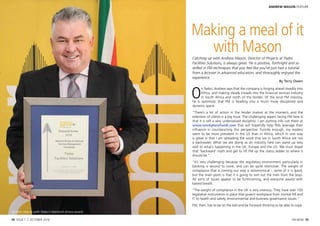
Andrew Mason with Tsebo’s Diamond Arrow award.
36 ISSUE 1 | OCTOBER 2016
“We are getting to the stage now that you can’t have the repository of FM
information residing with one person. It’s physically impossible. Outsourcing,
then, is naturally on the rise as Companies seek what is becoming increasingly
specialist knowledge from outside their organisations. With the downturn
of the economy every business is looking to its revenue streams and looking
at where costs can be cut. Good quality outsourcing is the answer, because
Clients are looking to improved service and to ensure good governance.
“We get enquiries from companies on a weekly basis looking for an outsourced
service and wanting to know how much it’s going to cost. They say they
want to reduce costs by 10-15% and we ask how much they are spending at
the moment? The reality is, in many instances they don’t know what they’re
spending. Once we have had a chance to do a deep dive analysis we often
find that companies have unrealistic views of the savings potential. We try to
focus on the value our offering will bring, but the focus seems to on savings at
any cost. The whole drive on cost-savings obviously puts pressure on margins,
but you have to supply some figure that is compatible with yourself and the
prospective client.
“At Tsebo we work extremely hard to retain Clients for the long term and we
are very proactive in understanding our Customer’s loyalty. Perhaps this is why
we have been voted the Best External Facilities Management Company in the
PMR Africa Awards for the 5th consecutive year? One very important point is
that you want to keep your existing clients loyal because you don’t want to
come under the same price pressure retaining your contract. Most contracts
are for a set period, but I don’t think anyone today expects anything more
than a 5-year contract. Gone are the days where you would get a 10-year
contract as a matter of course. I think it’s a good thing – it keeps you on your
toes and ensures that you will always be going the extra mile for your client.”
“Another challenge that seems to be gaining traction at the moment is
payment in excess of 90 days, which at our current interest rates is very
worrying. Some clients don’t seem to understand that we have suppliers to
pay and it all adds to the risk that we face. Most FM companies are working
on razor thin margins.”
“I do, however, think that there’s a change of awareness among those that
are truly well-versed in FM, and that are now linking it to productivity and
wellness. I think that we are moving to a workplace services environment
rather than general FM. It’s becoming more about people in the box than the
box itself!”
Andrew also questions the fact that why, with all the gadgetry that is prevalent
these days, is productivity falling?
FM NOW 37
notice the difference we make.
but you’ll always
at first,
see us
You
may not
FACILITIES
CATERING
CLEANING
PROCUREMENT
HYGIENE
ENERGY
SECURITY
FACILITIES
CATERING
CLEANING
SECURITY
HYGIENE
ENERGY
PROCUREMENT
FACILITIES
CATERING
CLEANING
PROCUREMENT
HYGIENE
ENERGY
SECURITY
FACILITIES
CATERING
CLEANING
SECURITY
HYGIENE
ENERGY
PROCUREMENT
AfricanExpertise.GlobalStandards.
www.tsebo.com
A f r i c a n E x p e r t i s e
G l o b a l S t a n d a r d s
The Andrew Mason pages…
38 ISSUE 1 | OCTOBER 2016 FM NOW 39
“I think it’s about staff engagement by businesses. I think that South Africa
has a lot to learn in that respect from our European neighbours, who seem
to understand more what workers want, and how they can be optimally
involved. We must also realise the move towards open offices can destroy
collaboration as much as it is meant to have the opposite effect. It destroys
the privacy that people need, and that fosters resentment. Let’s face it, as a
country we have our own challenges getting on with each other anyway, so
it can be a very tricky situation.”
He says that green issues can be a great catalyst for productivity, and that the
C-suite has become very aware of that, so that is a positive step for FMs, who
have to become steeped in the whole offering.
“What I have been very disappointed in, is the industry uptake green-wise in
the existing building environment. Bouwer Kleynhans, who works for Tsebo,
assisted with the development of an incredible ratings tool for the as-built
market, alongside the Green Building Council of South Africa, and there hasn’t
been an uptake. Here’s a tool which measures energy, water and utilities use
(how many FMs know what the energy footprint of their building is?). It’s easy
and very, very effective and is a great opportunity for the FM industry to take
the ball and run with it – but so far it’s been ignored.”
I associate with that disappointment, having been so excited when the
building tool was being developed, and having attended many seminars with
interested role players.
I tend to see the industry at the moment as a mix of sunshine and showers,
very much reflecting what Andrew has told me.
“However,” he says firmly, “It certainly isn’t all doom and gloom. I think it
could well be a natural progression in finding our feet and marching boldly
forward!” FM
The Andrew Mason pages…
I
n this last post of the series on contract retention, I want to wrap up our journey
so far by setting out 10 not so apparent benefits of getting contract retention
right. These are ones over and above the obvious in terms of defending revenue
and margin.
This series has been about the benefits of retaining long term supplier contracts.
As the incumbent provider you should have a wealth of information that your
competitors do not. You should have an intimate working knowledge of your
client’s needs, together with what you have been delivering. You should have
a history of value add initiatives as well as customer satisfaction data. Above all
else, you have the advantage of understanding the intricacies of delivering day-
to-day operations inside your client’s organisation.
Having said all this, you must consciously avoid any form of complacency or
assumption of an advantage being the incumbent. Never assume that because
you already deliver the business, you can sit back and not worry about the
rebid process. You must focus on renewing your knowledge of the client and
discovering what, if any, changes they miss may wish to implement in the new
contract.
In addition to this, a cardinal rule, never re-estimate based on your existing
contract. The client may not have introduced major changes to their requirements
BUT they will want to see a change in how you are going to deliver. In the event
that the client does introduce major changes to the upcoming contract, your
incumbency will work against you, if you have not performed well so making a
change in your offering will go some way to placating concerns.
This is the last of Andrew’s blog on contracts and clients… and you most
certainly will want to know what led up to this! Read it on
www.workfundi.com
10 Surprising Benefits
of Contract Retention
ANDREW MASON FEATUREANDREW MASON FEATURE
40 ISSUE 1 | OCTOBER 2016 FM NOW 41
“YOU NEED TO SHARPEN
YOUR SKILLS, SO YOU CAN
NAVIGATE A TIGHTROPE
WITH EASE…”
ANDREW MASON FEATURE
While each rebid is a sales opportunity, there is much more at stake than justWhile each rebid is a sales opportunity, there is much more at stake than justWhile each rebid is a sales opportunity, there is much more at stake than just
defending your revenue stream as we will point out in the 10 items listed laterdefending your revenue stream as we will point out in the 10 items listed laterdefending your revenue stream as we will point out in the 10 items listed later
on in this post. The process should not therefore just be the responsibility ofon in this post. The process should not therefore just be the responsibility ofon in this post. The process should not therefore just be the responsibility of
the sales team. As outlined in previous posts, the operations team has thethe sales team. As outlined in previous posts, the operations team has thethe sales team. As outlined in previous posts, the operations team has the
clearest picture of what they have been delivering for the life of the contract.clearest picture of what they have been delivering for the life of the contract.clearest picture of what they have been delivering for the life of the contract.
If they have taken part in the process as outlined in post No 2 in this series,If they have taken part in the process as outlined in post No 2 in this series,If they have taken part in the process as outlined in post No 2 in this series,
6 Steps to Improving Contract Retention, they will have formulated opinions6 Steps to Improving Contract Retention, they will have formulated opinions6 Steps to Improving Contract Retention, they will have formulated opinions
about their strengths weaknesses and what is required from the new contract.about their strengths weaknesses and what is required from the new contract.about their strengths weaknesses and what is required from the new contract.
Finance, Marketing and Business Development teams will also have usefulFinance, Marketing and Business Development teams will also have usefulFinance, Marketing and Business Development teams will also have useful
insight into new solutions in the marketplace that could help win the rebid.insight into new solutions in the marketplace that could help win the rebid.insight into new solutions in the marketplace that could help win the rebid.
This bringing together of cross functional skills to tackle the topic, will reapThis bringing together of cross functional skills to tackle the topic, will reapThis bringing together of cross functional skills to tackle the topic, will reap
huge benefits.
You need to make sure that you exploit the client’s experience of your abilityYou need to make sure that you exploit the client’s experience of your abilityYou need to make sure that you exploit the client’s experience of your ability
to deliver well. You also need to do your research on how you have performedto deliver well. You also need to do your research on how you have performedto deliver well. You also need to do your research on how you have performed
on the contract. Make sure that you take stock of any feedback that you haveon the contract. Make sure that you take stock of any feedback that you haveon the contract. Make sure that you take stock of any feedback that you have
received and refer to this in the rebid. Do this even if the feedback is negativereceived and refer to this in the rebid. Do this even if the feedback is negativereceived and refer to this in the rebid. Do this even if the feedback is negative
as this will demonstrate your acceptance of the current situation and youras this will demonstrate your acceptance of the current situation and youras this will demonstrate your acceptance of the current situation and your
determination to improve.determination to improve.determination to improve.
Don’t forget to clearly demonstrate your unique value proposition to the clientDon’t forget to clearly demonstrate your unique value proposition to the clientDon’t forget to clearly demonstrate your unique value proposition to the client
in the rebid. Do not assume that this is understood or even visible. Rememberin the rebid. Do not assume that this is understood or even visible. Rememberin the rebid. Do not assume that this is understood or even visible. Remember
that some of the individuals involved in adjudicating your rebid may not bethat some of the individuals involved in adjudicating your rebid may not bethat some of the individuals involved in adjudicating your rebid may not be
familiar with your offering or your history with the client. Take time to makefamiliar with your offering or your history with the client. Take time to makefamiliar with your offering or your history with the client. Take time to make
them aware of what you have provided, the value you have added, and relatethem aware of what you have provided, the value you have added, and relatethem aware of what you have provided, the value you have added, and relate
this to the future needs of the client.this to the future needs of the client.this to the future needs of the client.
The advantage of an intimate knowledge of your client should mean thatThe advantage of an intimate knowledge of your client should mean thatThe advantage of an intimate knowledge of your client should mean that
you are able to illicit information about their future needs, which should putyou are able to illicit information about their future needs, which should putyou are able to illicit information about their future needs, which should put
you well ahead of the pack in terms of the rebid. You need to prepare earlyyou well ahead of the pack in terms of the rebid. You need to prepare earlyyou well ahead of the pack in terms of the rebid. You need to prepare early
and pro-actively introduce changes ahead of the rebid otherwise the clientand pro-actively introduce changes ahead of the rebid otherwise the clientand pro-actively introduce changes ahead of the rebid otherwise the client
will simply ask “why did they not do this for me during their contract”. Beingwill simply ask “why did they not do this for me during their contract”. Beingwill simply ask “why did they not do this for me during their contract”. Being
well prepared for your rebid will make the most of your advantages as thewell prepared for your rebid will make the most of your advantages as thewell prepared for your rebid will make the most of your advantages as the
incumbent provider. It will send signals that you do not take the client, or theirincumbent provider. It will send signals that you do not take the client, or theirincumbent provider. It will send signals that you do not take the client, or their
business for granted. Taking stock of what you have already provided willbusiness for granted. Taking stock of what you have already provided willbusiness for granted. Taking stock of what you have already provided will
allow you to rectify any issues before they become a problem.allow you to rectify any issues before they become a problem.allow you to rectify any issues before they become a problem.
Spending so much time finding out what your clients’ needs are and revisingSpending so much time finding out what your clients’ needs are and revisingSpending so much time finding out what your clients’ needs are and revising
your service to match, can’t fail to be noticed by the senior decision-makers.your service to match, can’t fail to be noticed by the senior decision-makers.your service to match, can’t fail to be noticed by the senior decision-makers.
Having a keen interest in your clients’ satisfaction level is bound to have aHaving a keen interest in your clients’ satisfaction level is bound to have aHaving a keen interest in your clients’ satisfaction level is bound to have a
positive effect on your relationships. As we will see, this will lead to morepositive effect on your relationships. As we will see, this will lead to morepositive effect on your relationships. As we will see, this will lead to more
conversations about what else you can do for the client. This in turn willconversations about what else you can do for the client. This in turn willconversations about what else you can do for the client. This in turn will
provide opportunities for up-selling or cross-selling.provide opportunities for up-selling or cross-selling.provide opportunities for up-selling or cross-selling.
The Andrew Mason pages…
42 ISSUE 1 | OCTOBER 2016 FM NOW 43
ANDREW MASON FEATURE
The Andrew Mason pages…
Clients are running complex businesses themselves and they want to deal
with as few brands as possible. The ones that are ever present and continually
engaging, are the ones with whom the customers feel a connection at a
deeper level.
In the contract retention game, forget about your unique selling proposition,
the best brands have a unique contract retention proposition.
4. EARN MORE WITh REFERRALS
Without doubt, loyal customers are the best source of new business. With
the advent of online, mobile and social media, digital marketing experts say
that the average person is exposed to between 4 000 and 10 000 marketing
messages a day. Amid all this noise it is hardly surprising, then, that customers
are strongly influenced by referrals from trusted colleagues and friends.
Building excellent customer relationships will mean that they will have no
hesitation in referring your brand to their network. Interestingly Millennial’s
are particularly good at spreading the word of brand exploits with 90%
sharing their brand preferences online.
5. ENGAGED CUSTOMERS PROvIDE BETTER FEEDBACk
A key factor in contract retention planning is the solicitation of feedback
from your client. Feedback is critical to the success of any business. Feedback
is about engagement and customers who are engaged are willing to give
suppliers the benefit of the doubt. If you engage with your clients despite
negative feedback you’re more likely to be able to win that customer over.
Customers who are engaged are providing signals on how to repeatedly earn
their business. Research has shown that customers who have complained and
see their issues resolved are 84% less likely to decrease their spend.
6. CUSTOMERS WILL ExPLORE YOUR BRAND
As an extension to the previous item, engaged customers are six times more
likely to be open to exploring your brand and trying a new product or service
once that brand has proven itself. This is valuable for up selling and cross
selling initiatives.
7. CUSTOMERS WILL GO OUT OF ThEIR WAY TO DO BUSINESS WITh YOU
Brand loyalty decreases the possibility of a competitor undercutting with
a similar service. 68% of women and 53% of men are less likely to swap
suppliers if they are engaged with your brand.
It is hard to believe that in 2016 so many companies still devote huge amounts
of resources to chasing new business. As outlined in the first post in the series,
the 3 Common Causes for Contract Losses, chasing new business is a worthy
of pursuit but sometimes this focus on the future comes at the expense of the
present. Good things happen to companies that win new customers but the
benefits of contract retention go much deeper.
Here are 10 not so obvious ways you can benefit from being contract retention-
centric
1. IT’S ChEAPER ThAN ACqUISITION
In the first post in the series, I laid scorn upon the numerous versions of how
new Customer acquisition costs X times more than customer retention. The
numbers vary incredibly and may not be entirely accurate but vast swathes of
research has been conducted on customer acquisition versus retention. Every
one of them come back with the economics favouring retention as the more
commercially viable. The basic principle is still the same, it is much more cost-
effective to keep a client in the fold them to bring in new customers.
However, one must be vigilant. Retention maybe cheaper than acquisition but
it isn’t any easier.
2. LOYAL CUSTOMERS ARE MORE PROFITABLE
Not only is loyalty cheaper it produces better returns, according to the
developer of the Net Promoter Score Frederick Reicheld in his book The Loyalty
Effect, engaged consumers buy 90% more frequently, spend 60% more per
transaction and are five times more likely to indicate it is the only brand they
would purchase in the future.
In addition to this, these customers on average are delivering 23% more
revenue and profitability more than the average customer. While loyal
customers are more profitable we must be careful not to take their loyalty for
granted. Lifetime revenue is the end goal not a quick buck.
One must also consider the flipside that actively disengaged customers can
cost a brand 13% of its revenue.
All of these factors lead to engaged Customers delivering three times the
value to the brand over the course of a year.
3. STAND OUT FROM ThE CROWD
Once you are successful at retaining clients, long-term brand equity is built.
Once you become contract retention-centric you stand out from the crowd
even more. You are a supplier that other customers would prefer to deal with.
44 ISSUE 1 | OCTOBER 2016
8. Customers weLCome your marketIng
Loyal Customers are four times more likely to accept being marketed to and
seven times more likely to respond to offers from your brand.
9. earn wrIggLe room to try new thIngs
Customers are crying out for innovation, but innovation is both costly and
requires experimentation. Loyalty can be fickle and too many changes could
chase your customers away. However, once you have established a degree
of loyalty your brand will be allowed to expand its boundaries and test new
innovations. Crucially, customers will be more understanding if these efforts
fail. The bottom line is as long as you maintain the basic Service, your customer
will fight your corner for you. Do this and they will stick with you through
thick and thin. In fact some of them maybe excited to see what you can do
and Millennial’s in particular cite new and exciting products and services as a
way to keep them loyal.
10. empLoyees stress Less
As we have seen throughout this series, contract retention is premised upon
relationship building. Good relationships make life better for everyone.
Relationships are mutually beneficial whereas sales are transactional. Doing
relational business makes everything easier and customers are less likely to
be critical at the first sign of distress. This protects your revenue and makes
life easier on your employees who after all play the biggest role in customer
loyalty.
go aLL-In on ContraCt retentIon
In these 10 benefits, we’ve covered a gamut of profitable business activities
– revenue generation, innovation, marketing, customer feedback, branding,
differentiation, and more. Each one of them is a natural by-product of focusing
on customer retention.
The cost of contract retention is likely to be less than your new business
activities, yet the rate of return should be higher. The overall impact on a
business is probably incalculable, considering all the different aspects that are
impacted.
Contract retention planning should become a way of doing business, not just
something to consider a few months or short weeks before renewal becomes
imminent. By proactively considering every contract through each stage of
planning, delivery and re-bidding, contract renewal can be a formality.
The most important thing is to not lose sight of your existing customers in
pursuit of new ones. I promise, it’ll pay off. FM
The Andrew Mason pages…

FM

  • 1.
    34 ISSUE 1| OCTOBER 2016 FM NOW 35 O n Tsebo, Andrew says that the company is forging ahead steadily into Africa, and making steady inroads into the financial services industry in South Africa and north of the border. Of the local FM industry, he is optimistic that FM is heading into a much more disciplined and dynamic space. “There’s a lot of action in the tender market at the moment, and the retention of clients is a big issue. The challenging aspect facing FM here is that it is still a very undervalued discipline. I am putting info out there at www.workplacefundi.com that will hopefully help FMs leverage their influence in counteracting this perspective. Funnily enough, my readers seem to be more prevalent in the US than in Africa, which in one way is great in that I am spreading the word that we in South Africa are not a backwater. What we are doing as an industry here can stand up very well to what’s happening in the UK, Europe and the US. We must dispel that ‘backward’ myth and get to lift FM up the status ladder to where it should be.” “It’s very challenging because the regulatory environment particularly in banking is second to none, and can be quite restrictive. The weight of compliance that is coming our way is astronomical – some of it is good, but the main point is that it is going to sort out the men from the boys. All sorts of issues appear to be forthcoming, and everyone awaits with baited breath. “The weight of compliance in the UK is very onerous. They have over 100 legislative instruments in place that govern workplace from normal HR and IT to health and safety, environmental and business governance issues.” FM, then, has to be on the ball and be forward-thinking to be able to cope. Making a meal of it with MasonCatching up with Andrew Mason, Director of Projects at Tsebo Facilities Solutions, is always great. He is positive, forthright and so skilled in FM techniques that you feel like you’ve just had a tutorial from a lecturer in advanced education, and thoroughly enjoyed the experience. By Terry Owen ANDREW MASON FEATURE Andrew Mason with Tsebo’s Diamond Arrow award.

  • 2.
    36 ISSUE 1| OCTOBER 2016 “We are getting to the stage now that you can’t have the repository of FM information residing with one person. It’s physically impossible. Outsourcing, then, is naturally on the rise as Companies seek what is becoming increasingly specialist knowledge from outside their organisations. With the downturn of the economy every business is looking to its revenue streams and looking at where costs can be cut. Good quality outsourcing is the answer, because Clients are looking to improved service and to ensure good governance. “We get enquiries from companies on a weekly basis looking for an outsourced service and wanting to know how much it’s going to cost. They say they want to reduce costs by 10-15% and we ask how much they are spending at the moment? The reality is, in many instances they don’t know what they’re spending. Once we have had a chance to do a deep dive analysis we often find that companies have unrealistic views of the savings potential. We try to focus on the value our offering will bring, but the focus seems to on savings at any cost. The whole drive on cost-savings obviously puts pressure on margins, but you have to supply some figure that is compatible with yourself and the prospective client. “At Tsebo we work extremely hard to retain Clients for the long term and we are very proactive in understanding our Customer’s loyalty. Perhaps this is why we have been voted the Best External Facilities Management Company in the PMR Africa Awards for the 5th consecutive year? One very important point is that you want to keep your existing clients loyal because you don’t want to come under the same price pressure retaining your contract. Most contracts are for a set period, but I don’t think anyone today expects anything more than a 5-year contract. Gone are the days where you would get a 10-year contract as a matter of course. I think it’s a good thing – it keeps you on your toes and ensures that you will always be going the extra mile for your client.” “Another challenge that seems to be gaining traction at the moment is payment in excess of 90 days, which at our current interest rates is very worrying. Some clients don’t seem to understand that we have suppliers to pay and it all adds to the risk that we face. Most FM companies are working on razor thin margins.” “I do, however, think that there’s a change of awareness among those that are truly well-versed in FM, and that are now linking it to productivity and wellness. I think that we are moving to a workplace services environment rather than general FM. It’s becoming more about people in the box than the box itself!” Andrew also questions the fact that why, with all the gadgetry that is prevalent these days, is productivity falling? FM NOW 37 notice the difference we make. but you’ll always at first, see us You may not FACILITIES CATERING CLEANING PROCUREMENT HYGIENE ENERGY SECURITY FACILITIES CATERING CLEANING SECURITY HYGIENE ENERGY PROCUREMENT FACILITIES CATERING CLEANING PROCUREMENT HYGIENE ENERGY SECURITY FACILITIES CATERING CLEANING SECURITY HYGIENE ENERGY PROCUREMENT AfricanExpertise.GlobalStandards. www.tsebo.com A f r i c a n E x p e r t i s e G l o b a l S t a n d a r d s The Andrew Mason pages…
  • 3.
    38 ISSUE 1| OCTOBER 2016 FM NOW 39 “I think it’s about staff engagement by businesses. I think that South Africa has a lot to learn in that respect from our European neighbours, who seem to understand more what workers want, and how they can be optimally involved. We must also realise the move towards open offices can destroy collaboration as much as it is meant to have the opposite effect. It destroys the privacy that people need, and that fosters resentment. Let’s face it, as a country we have our own challenges getting on with each other anyway, so it can be a very tricky situation.” He says that green issues can be a great catalyst for productivity, and that the C-suite has become very aware of that, so that is a positive step for FMs, who have to become steeped in the whole offering. “What I have been very disappointed in, is the industry uptake green-wise in the existing building environment. Bouwer Kleynhans, who works for Tsebo, assisted with the development of an incredible ratings tool for the as-built market, alongside the Green Building Council of South Africa, and there hasn’t been an uptake. Here’s a tool which measures energy, water and utilities use (how many FMs know what the energy footprint of their building is?). It’s easy and very, very effective and is a great opportunity for the FM industry to take the ball and run with it – but so far it’s been ignored.” I associate with that disappointment, having been so excited when the building tool was being developed, and having attended many seminars with interested role players. I tend to see the industry at the moment as a mix of sunshine and showers, very much reflecting what Andrew has told me. “However,” he says firmly, “It certainly isn’t all doom and gloom. I think it could well be a natural progression in finding our feet and marching boldly forward!” FM The Andrew Mason pages… I n this last post of the series on contract retention, I want to wrap up our journey so far by setting out 10 not so apparent benefits of getting contract retention right. These are ones over and above the obvious in terms of defending revenue and margin. This series has been about the benefits of retaining long term supplier contracts. As the incumbent provider you should have a wealth of information that your competitors do not. You should have an intimate working knowledge of your client’s needs, together with what you have been delivering. You should have a history of value add initiatives as well as customer satisfaction data. Above all else, you have the advantage of understanding the intricacies of delivering day- to-day operations inside your client’s organisation. Having said all this, you must consciously avoid any form of complacency or assumption of an advantage being the incumbent. Never assume that because you already deliver the business, you can sit back and not worry about the rebid process. You must focus on renewing your knowledge of the client and discovering what, if any, changes they miss may wish to implement in the new contract. In addition to this, a cardinal rule, never re-estimate based on your existing contract. The client may not have introduced major changes to their requirements BUT they will want to see a change in how you are going to deliver. In the event that the client does introduce major changes to the upcoming contract, your incumbency will work against you, if you have not performed well so making a change in your offering will go some way to placating concerns. This is the last of Andrew’s blog on contracts and clients… and you most certainly will want to know what led up to this! Read it on www.workfundi.com 10 Surprising Benefits of Contract Retention ANDREW MASON FEATUREANDREW MASON FEATURE
  • 4.
    40 ISSUE 1| OCTOBER 2016 FM NOW 41 “YOU NEED TO SHARPEN YOUR SKILLS, SO YOU CAN NAVIGATE A TIGHTROPE WITH EASE…” ANDREW MASON FEATURE While each rebid is a sales opportunity, there is much more at stake than justWhile each rebid is a sales opportunity, there is much more at stake than justWhile each rebid is a sales opportunity, there is much more at stake than just defending your revenue stream as we will point out in the 10 items listed laterdefending your revenue stream as we will point out in the 10 items listed laterdefending your revenue stream as we will point out in the 10 items listed later on in this post. The process should not therefore just be the responsibility ofon in this post. The process should not therefore just be the responsibility ofon in this post. The process should not therefore just be the responsibility of the sales team. As outlined in previous posts, the operations team has thethe sales team. As outlined in previous posts, the operations team has thethe sales team. As outlined in previous posts, the operations team has the clearest picture of what they have been delivering for the life of the contract.clearest picture of what they have been delivering for the life of the contract.clearest picture of what they have been delivering for the life of the contract. If they have taken part in the process as outlined in post No 2 in this series,If they have taken part in the process as outlined in post No 2 in this series,If they have taken part in the process as outlined in post No 2 in this series, 6 Steps to Improving Contract Retention, they will have formulated opinions6 Steps to Improving Contract Retention, they will have formulated opinions6 Steps to Improving Contract Retention, they will have formulated opinions about their strengths weaknesses and what is required from the new contract.about their strengths weaknesses and what is required from the new contract.about their strengths weaknesses and what is required from the new contract. Finance, Marketing and Business Development teams will also have usefulFinance, Marketing and Business Development teams will also have usefulFinance, Marketing and Business Development teams will also have useful insight into new solutions in the marketplace that could help win the rebid.insight into new solutions in the marketplace that could help win the rebid.insight into new solutions in the marketplace that could help win the rebid. This bringing together of cross functional skills to tackle the topic, will reapThis bringing together of cross functional skills to tackle the topic, will reapThis bringing together of cross functional skills to tackle the topic, will reap huge benefits. You need to make sure that you exploit the client’s experience of your abilityYou need to make sure that you exploit the client’s experience of your abilityYou need to make sure that you exploit the client’s experience of your ability to deliver well. You also need to do your research on how you have performedto deliver well. You also need to do your research on how you have performedto deliver well. You also need to do your research on how you have performed on the contract. Make sure that you take stock of any feedback that you haveon the contract. Make sure that you take stock of any feedback that you haveon the contract. Make sure that you take stock of any feedback that you have received and refer to this in the rebid. Do this even if the feedback is negativereceived and refer to this in the rebid. Do this even if the feedback is negativereceived and refer to this in the rebid. Do this even if the feedback is negative as this will demonstrate your acceptance of the current situation and youras this will demonstrate your acceptance of the current situation and youras this will demonstrate your acceptance of the current situation and your determination to improve.determination to improve.determination to improve. Don’t forget to clearly demonstrate your unique value proposition to the clientDon’t forget to clearly demonstrate your unique value proposition to the clientDon’t forget to clearly demonstrate your unique value proposition to the client in the rebid. Do not assume that this is understood or even visible. Rememberin the rebid. Do not assume that this is understood or even visible. Rememberin the rebid. Do not assume that this is understood or even visible. Remember that some of the individuals involved in adjudicating your rebid may not bethat some of the individuals involved in adjudicating your rebid may not bethat some of the individuals involved in adjudicating your rebid may not be familiar with your offering or your history with the client. Take time to makefamiliar with your offering or your history with the client. Take time to makefamiliar with your offering or your history with the client. Take time to make them aware of what you have provided, the value you have added, and relatethem aware of what you have provided, the value you have added, and relatethem aware of what you have provided, the value you have added, and relate this to the future needs of the client.this to the future needs of the client.this to the future needs of the client. The advantage of an intimate knowledge of your client should mean thatThe advantage of an intimate knowledge of your client should mean thatThe advantage of an intimate knowledge of your client should mean that you are able to illicit information about their future needs, which should putyou are able to illicit information about their future needs, which should putyou are able to illicit information about their future needs, which should put you well ahead of the pack in terms of the rebid. You need to prepare earlyyou well ahead of the pack in terms of the rebid. You need to prepare earlyyou well ahead of the pack in terms of the rebid. You need to prepare early and pro-actively introduce changes ahead of the rebid otherwise the clientand pro-actively introduce changes ahead of the rebid otherwise the clientand pro-actively introduce changes ahead of the rebid otherwise the client will simply ask “why did they not do this for me during their contract”. Beingwill simply ask “why did they not do this for me during their contract”. Beingwill simply ask “why did they not do this for me during their contract”. Being well prepared for your rebid will make the most of your advantages as thewell prepared for your rebid will make the most of your advantages as thewell prepared for your rebid will make the most of your advantages as the incumbent provider. It will send signals that you do not take the client, or theirincumbent provider. It will send signals that you do not take the client, or theirincumbent provider. It will send signals that you do not take the client, or their business for granted. Taking stock of what you have already provided willbusiness for granted. Taking stock of what you have already provided willbusiness for granted. Taking stock of what you have already provided will allow you to rectify any issues before they become a problem.allow you to rectify any issues before they become a problem.allow you to rectify any issues before they become a problem. Spending so much time finding out what your clients’ needs are and revisingSpending so much time finding out what your clients’ needs are and revisingSpending so much time finding out what your clients’ needs are and revising your service to match, can’t fail to be noticed by the senior decision-makers.your service to match, can’t fail to be noticed by the senior decision-makers.your service to match, can’t fail to be noticed by the senior decision-makers. Having a keen interest in your clients’ satisfaction level is bound to have aHaving a keen interest in your clients’ satisfaction level is bound to have aHaving a keen interest in your clients’ satisfaction level is bound to have a positive effect on your relationships. As we will see, this will lead to morepositive effect on your relationships. As we will see, this will lead to morepositive effect on your relationships. As we will see, this will lead to more conversations about what else you can do for the client. This in turn willconversations about what else you can do for the client. This in turn willconversations about what else you can do for the client. This in turn will provide opportunities for up-selling or cross-selling.provide opportunities for up-selling or cross-selling.provide opportunities for up-selling or cross-selling. The Andrew Mason pages…
  • 5.
    42 ISSUE 1| OCTOBER 2016 FM NOW 43 ANDREW MASON FEATURE The Andrew Mason pages… Clients are running complex businesses themselves and they want to deal with as few brands as possible. The ones that are ever present and continually engaging, are the ones with whom the customers feel a connection at a deeper level. In the contract retention game, forget about your unique selling proposition, the best brands have a unique contract retention proposition. 4. EARN MORE WITh REFERRALS Without doubt, loyal customers are the best source of new business. With the advent of online, mobile and social media, digital marketing experts say that the average person is exposed to between 4 000 and 10 000 marketing messages a day. Amid all this noise it is hardly surprising, then, that customers are strongly influenced by referrals from trusted colleagues and friends. Building excellent customer relationships will mean that they will have no hesitation in referring your brand to their network. Interestingly Millennial’s are particularly good at spreading the word of brand exploits with 90% sharing their brand preferences online. 5. ENGAGED CUSTOMERS PROvIDE BETTER FEEDBACk A key factor in contract retention planning is the solicitation of feedback from your client. Feedback is critical to the success of any business. Feedback is about engagement and customers who are engaged are willing to give suppliers the benefit of the doubt. If you engage with your clients despite negative feedback you’re more likely to be able to win that customer over. Customers who are engaged are providing signals on how to repeatedly earn their business. Research has shown that customers who have complained and see their issues resolved are 84% less likely to decrease their spend. 6. CUSTOMERS WILL ExPLORE YOUR BRAND As an extension to the previous item, engaged customers are six times more likely to be open to exploring your brand and trying a new product or service once that brand has proven itself. This is valuable for up selling and cross selling initiatives. 7. CUSTOMERS WILL GO OUT OF ThEIR WAY TO DO BUSINESS WITh YOU Brand loyalty decreases the possibility of a competitor undercutting with a similar service. 68% of women and 53% of men are less likely to swap suppliers if they are engaged with your brand. It is hard to believe that in 2016 so many companies still devote huge amounts of resources to chasing new business. As outlined in the first post in the series, the 3 Common Causes for Contract Losses, chasing new business is a worthy of pursuit but sometimes this focus on the future comes at the expense of the present. Good things happen to companies that win new customers but the benefits of contract retention go much deeper. Here are 10 not so obvious ways you can benefit from being contract retention- centric 1. IT’S ChEAPER ThAN ACqUISITION In the first post in the series, I laid scorn upon the numerous versions of how new Customer acquisition costs X times more than customer retention. The numbers vary incredibly and may not be entirely accurate but vast swathes of research has been conducted on customer acquisition versus retention. Every one of them come back with the economics favouring retention as the more commercially viable. The basic principle is still the same, it is much more cost- effective to keep a client in the fold them to bring in new customers. However, one must be vigilant. Retention maybe cheaper than acquisition but it isn’t any easier. 2. LOYAL CUSTOMERS ARE MORE PROFITABLE Not only is loyalty cheaper it produces better returns, according to the developer of the Net Promoter Score Frederick Reicheld in his book The Loyalty Effect, engaged consumers buy 90% more frequently, spend 60% more per transaction and are five times more likely to indicate it is the only brand they would purchase in the future. In addition to this, these customers on average are delivering 23% more revenue and profitability more than the average customer. While loyal customers are more profitable we must be careful not to take their loyalty for granted. Lifetime revenue is the end goal not a quick buck. One must also consider the flipside that actively disengaged customers can cost a brand 13% of its revenue. All of these factors lead to engaged Customers delivering three times the value to the brand over the course of a year. 3. STAND OUT FROM ThE CROWD Once you are successful at retaining clients, long-term brand equity is built. Once you become contract retention-centric you stand out from the crowd even more. You are a supplier that other customers would prefer to deal with.
  • 6.
    44 ISSUE 1| OCTOBER 2016 8. Customers weLCome your marketIng Loyal Customers are four times more likely to accept being marketed to and seven times more likely to respond to offers from your brand. 9. earn wrIggLe room to try new thIngs Customers are crying out for innovation, but innovation is both costly and requires experimentation. Loyalty can be fickle and too many changes could chase your customers away. However, once you have established a degree of loyalty your brand will be allowed to expand its boundaries and test new innovations. Crucially, customers will be more understanding if these efforts fail. The bottom line is as long as you maintain the basic Service, your customer will fight your corner for you. Do this and they will stick with you through thick and thin. In fact some of them maybe excited to see what you can do and Millennial’s in particular cite new and exciting products and services as a way to keep them loyal. 10. empLoyees stress Less As we have seen throughout this series, contract retention is premised upon relationship building. Good relationships make life better for everyone. Relationships are mutually beneficial whereas sales are transactional. Doing relational business makes everything easier and customers are less likely to be critical at the first sign of distress. This protects your revenue and makes life easier on your employees who after all play the biggest role in customer loyalty. go aLL-In on ContraCt retentIon In these 10 benefits, we’ve covered a gamut of profitable business activities – revenue generation, innovation, marketing, customer feedback, branding, differentiation, and more. Each one of them is a natural by-product of focusing on customer retention. The cost of contract retention is likely to be less than your new business activities, yet the rate of return should be higher. The overall impact on a business is probably incalculable, considering all the different aspects that are impacted. Contract retention planning should become a way of doing business, not just something to consider a few months or short weeks before renewal becomes imminent. By proactively considering every contract through each stage of planning, delivery and re-bidding, contract renewal can be a formality. The most important thing is to not lose sight of your existing customers in pursuit of new ones. I promise, it’ll pay off. FM The Andrew Mason pages…