Carol Vernallis
Vernallisis known for her theory based on Music Video editing, she claims that
music videos contain four key concepts
1. Narrative
2. Editing
3. Camera Movement and Framing
4. Digesis
3.
Narrative
She suggeststhat the music video is a visual response to the music. As a result the
lyrics often compliment and amplify the sound or they completely juxtapose the
music. She also notes that the narrative is fragmented and does not flow like a
film. Films follow a clear cut structure with a start, middle and ending. Music
videos can go the opposite way and have no middle or no narrative at all. The
video can raise questions that it does not have to answer, for example the video
can pose the question of a possible love interest for a character but whether it
shows the love developing is not needed to be answered. They are normally
filmed in a montage style.
4.
Editing
The firstand most obvious component to the editing is that the pace of the
editing has to match the beat of the song. The editing can overtake the narrative
and be the main point of the video, to be visually appealing and pleasing. Editing
in music videos can break many editing rules for example the 180 degree rule.
There is the frequent use of jump cuts. It is unlikely that the audience will see the
use of smooth transitions, match on action and an even pace of editing (there will
be a variety of shot lengths.)
5.
Camera Movement andFraming
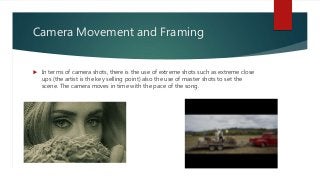
In terms of camera shots, there is the use of extreme shots such as extreme close
ups (the artist is the key selling point) also the use of master shots to set the
scene. The camera moves in time with the pace of the song.
6.
Digesis
Digesis simplymeans the world within the song. She explains that some actions in
the music video will not always be completed. As it is a fictional world anything
can happen. Some actions may be repeated and certain camera angles re-used,
the song ‘Wake me Up’ by Chris Brown does this frequently by cutting to a shot of
him in his bed.