Bear off cube action
by mochy
@ Merit Backgammon Open 2013
Today’s agenda

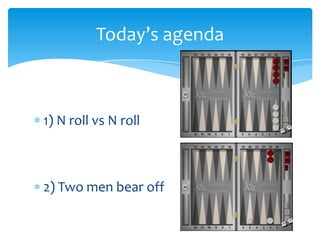
1) N roll vs N roll

2) Two men bear off
Why Important?
Each decision in the bear off is CRITICAL
as Equity difference is usually very large.
Cube gets high in the end game much
more often.
It shows the nature of the game. You
can’t win without taking a risk.
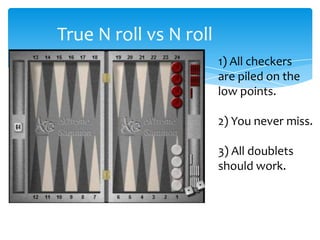
True N roll vs N roll
1) All checkers
are piled on the
low points.
2) You never miss.
3) All doublets
should work.
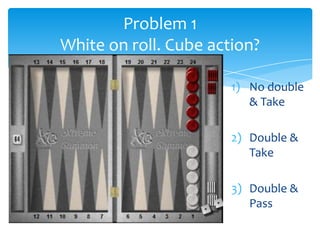
Problem 1
White on roll. Cube action?
1) No double
& Take

2) Double &
Take
3) Double &
Pass
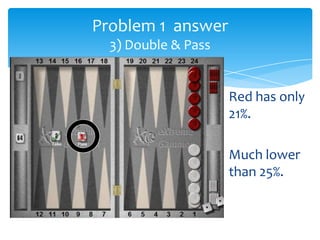
Problem 1 answer
3) Double & Pass

Red has only
21%.
Much lower
than 25%.
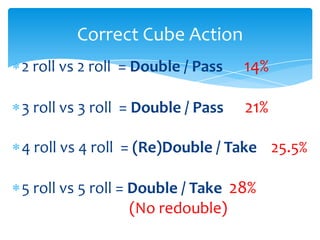
Correct Cube Action
2 roll vs 2 roll = Double / Pass

14%

3 roll vs 3 roll = Double / Pass

21%

4 roll vs 4 roll = (Re)Double / Take 25.5%
5 roll vs 5 roll = Double / Take 28%
(No redouble)
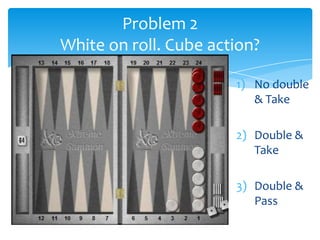
Problem 2
White on roll. Cube action?
1) No double
& Take
2) Double &
Take
3) Double &
Pass
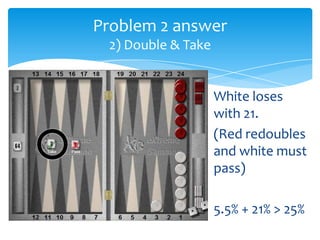
Problem 2 answer
2) Double & Take

White loses
with 21.
(Red redoubles
and white must
pass)
5.5% + 21% > 25%
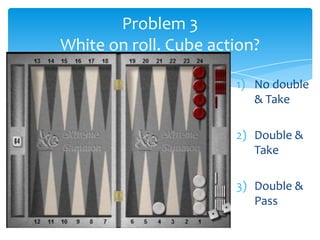
Problem 3
White on roll. Cube action?
1) No double
& Take
2) Double &
Take
3) Double &
Pass
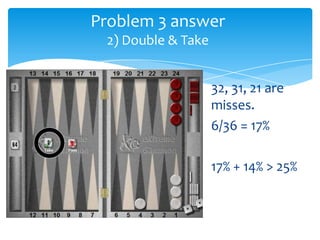
Problem 3 answer
2) Double & Take
32, 31, 21 are
misses.
6/36 = 17%
17% + 14% > 25%
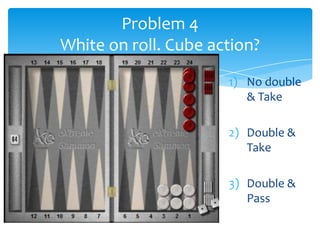
Problem 4
White on roll. Cube action?
1) No double
& Take
2) Double &
Take
3) Double &
Pass
Problem 4 answer
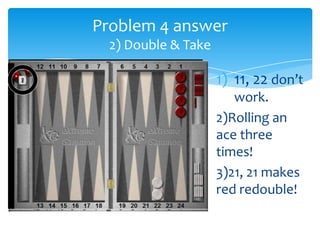
2) Double & Take

1) 11, 22 don’t
work.
2)Rolling an
ace three
times!
3)21, 21 makes
red redouble!
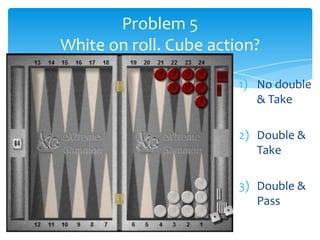
Problem 5
White on roll. Cube action?
1) No double
& Take
2) Double &
Take
3) Double &
Pass
Problem 5 answer
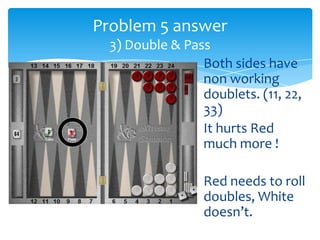
3) Double & Pass
Both sides have
non working
doublets. (11, 22,
33)
It hurts Red
much more !
Red needs to roll
doubles, White
doesn’t.
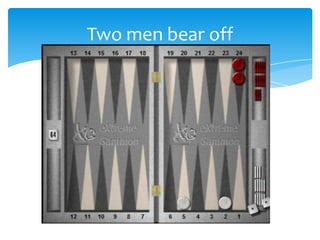
Two men bear off
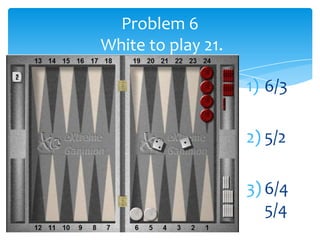
Problem 6
White to play 21.
1) 6/3
2) 5/2
3) 6/4
5/4
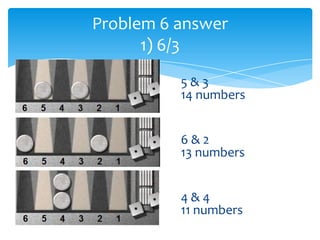
Problem 6 answer
1) 6/3
5&3
14 numbers
6&2
13 numbers
4&4
11 numbers
The rule
1 ) If you can bear off, do so.
2) Never put checkers on the same point

3) Magic Number “31524”
It is the ranking of the gap between two
checkers.
3 pips apart is the best, 1 pip apart is the
second… and so on.
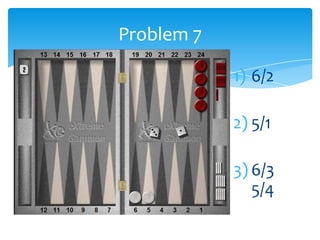
Problem 7
1) 6/2
2) 5/1
3) 6/3
5/4
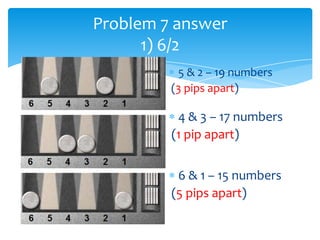
Problem 7 answer
1) 6/2
5 & 2 – 19 numbers
(3 pips apart)

4 & 3 – 17 numbers
(1 pip apart)
6 & 1 – 15 numbers
(5 pips apart)
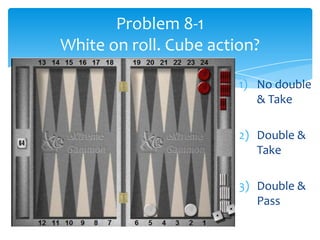
Problem 8-1
White on roll. Cube action?
1) No double
& Take
2) Double &
Take
3) Double &
Pass
Counting
1) Count the lesser!

2) Count them in order. (from big to small
or vice versa)
3) Count non-doublet first, multiply by 2,
then go for doublet.
- 65, 64, 63, 62, 61, 54,,,,21. (multiply by 2)
- 66, 55, 44, 33, 22, 11
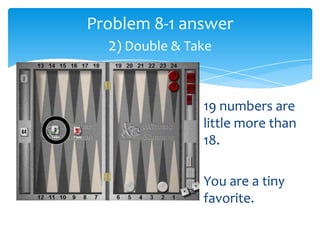
Problem 8-1 answer
2) Double & Take

19 numbers are
little more than
18.
You are a tiny
favorite.
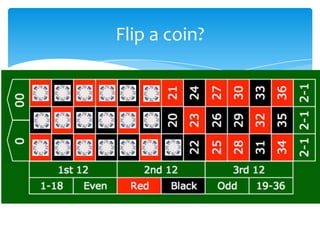
Flip a coin?
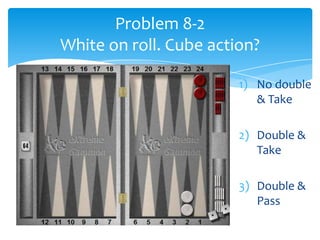
Problem 8-2
White on roll. Cube action?
1) No double
& Take
2) Double &
Take
3) Double &
Pass
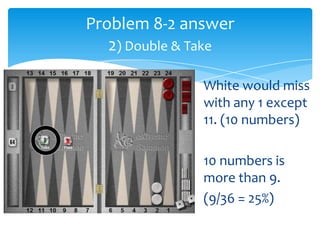
Problem 8-2 answer
2) Double & Take
White would miss
with any 1 except
11. (10 numbers)

10 numbers is
more than 9.
(9/36 = 25%)
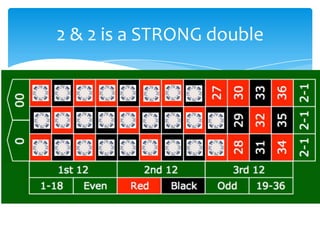
2 & 2 is a STRONG double
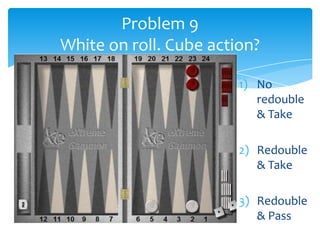
Problem 9
White on roll. Cube action?
1) No
redouble
& Take

2) Redouble
& Take
3) Redouble
& Pass
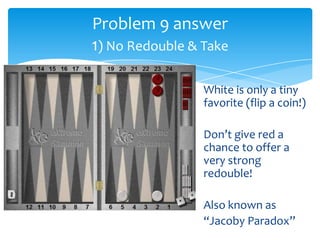
Problem 9 answer
1) No Redouble & Take
White is only a tiny
favorite (flip a coin!)
Don’t give red a
chance to offer a
very strong
redouble!
Also known as
“Jacoby Paradox”
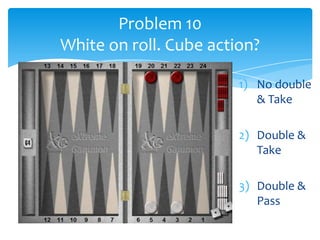
Problem 10
White on roll. Cube action?
1) No double
& Take
2) Double &
Take
3) Double &
Pass
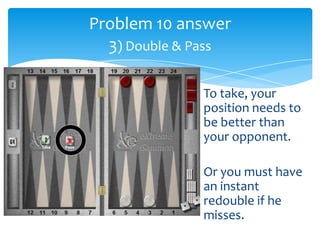
Problem 10 answer
3) Double & Pass
To take, your
position needs to
be better than
your opponent.
Or you must have
an instant
redouble if he
misses.

Bear off cube action

  • 1.
    Bear off cubeaction by mochy @ Merit Backgammon Open 2013
  • 2.
    Today’s agenda 1) Nroll vs N roll 2) Two men bear off
  • 3.
    Why Important? Each decisionin the bear off is CRITICAL as Equity difference is usually very large. Cube gets high in the end game much more often. It shows the nature of the game. You can’t win without taking a risk.
  • 4.
    True N rollvs N roll 1) All checkers are piled on the low points. 2) You never miss. 3) All doublets should work.
  • 5.
    Problem 1 White onroll. Cube action? 1) No double & Take 2) Double & Take 3) Double & Pass
  • 6.
    Problem 1 answer 3)Double & Pass Red has only 21%. Much lower than 25%.
  • 7.
    Correct Cube Action 2roll vs 2 roll = Double / Pass 14% 3 roll vs 3 roll = Double / Pass 21% 4 roll vs 4 roll = (Re)Double / Take 25.5% 5 roll vs 5 roll = Double / Take 28% (No redouble)
  • 8.
    Problem 2 White onroll. Cube action? 1) No double & Take 2) Double & Take 3) Double & Pass
  • 9.
    Problem 2 answer 2)Double & Take White loses with 21. (Red redoubles and white must pass) 5.5% + 21% > 25%
  • 10.
    Problem 3 White onroll. Cube action? 1) No double & Take 2) Double & Take 3) Double & Pass
  • 11.
    Problem 3 answer 2)Double & Take 32, 31, 21 are misses. 6/36 = 17% 17% + 14% > 25%
  • 12.
    Problem 4 White onroll. Cube action? 1) No double & Take 2) Double & Take 3) Double & Pass
  • 13.
    Problem 4 answer 2)Double & Take 1) 11, 22 don’t work. 2)Rolling an ace three times! 3)21, 21 makes red redouble!
  • 14.
    Problem 5 White onroll. Cube action? 1) No double & Take 2) Double & Take 3) Double & Pass
  • 15.
    Problem 5 answer 3)Double & Pass Both sides have non working doublets. (11, 22, 33) It hurts Red much more ! Red needs to roll doubles, White doesn’t.
  • 16.
  • 17.
    Problem 6 White toplay 21. 1) 6/3 2) 5/2 3) 6/4 5/4
  • 18.
    Problem 6 answer 1)6/3 5&3 14 numbers 6&2 13 numbers 4&4 11 numbers
  • 19.
    The rule 1 )If you can bear off, do so. 2) Never put checkers on the same point 3) Magic Number “31524” It is the ranking of the gap between two checkers. 3 pips apart is the best, 1 pip apart is the second… and so on.
  • 20.
    Problem 7 1) 6/2 2)5/1 3) 6/3 5/4
  • 21.
    Problem 7 answer 1)6/2 5 & 2 – 19 numbers (3 pips apart) 4 & 3 – 17 numbers (1 pip apart) 6 & 1 – 15 numbers (5 pips apart)
  • 22.
    Problem 8-1 White onroll. Cube action? 1) No double & Take 2) Double & Take 3) Double & Pass
  • 23.
    Counting 1) Count thelesser! 2) Count them in order. (from big to small or vice versa) 3) Count non-doublet first, multiply by 2, then go for doublet. - 65, 64, 63, 62, 61, 54,,,,21. (multiply by 2) - 66, 55, 44, 33, 22, 11
  • 24.
    Problem 8-1 answer 2)Double & Take 19 numbers are little more than 18. You are a tiny favorite.
  • 25.
  • 26.
    Problem 8-2 White onroll. Cube action? 1) No double & Take 2) Double & Take 3) Double & Pass
  • 27.
    Problem 8-2 answer 2)Double & Take White would miss with any 1 except 11. (10 numbers) 10 numbers is more than 9. (9/36 = 25%)
  • 28.
    2 & 2is a STRONG double
  • 29.
    Problem 9 White onroll. Cube action? 1) No redouble & Take 2) Redouble & Take 3) Redouble & Pass
  • 30.
    Problem 9 answer 1)No Redouble & Take White is only a tiny favorite (flip a coin!) Don’t give red a chance to offer a very strong redouble! Also known as “Jacoby Paradox”
  • 31.
    Problem 10 White onroll. Cube action? 1) No double & Take 2) Double & Take 3) Double & Pass
  • 32.
    Problem 10 answer 3)Double & Pass To take, your position needs to be better than your opponent. Or you must have an instant redouble if he misses.