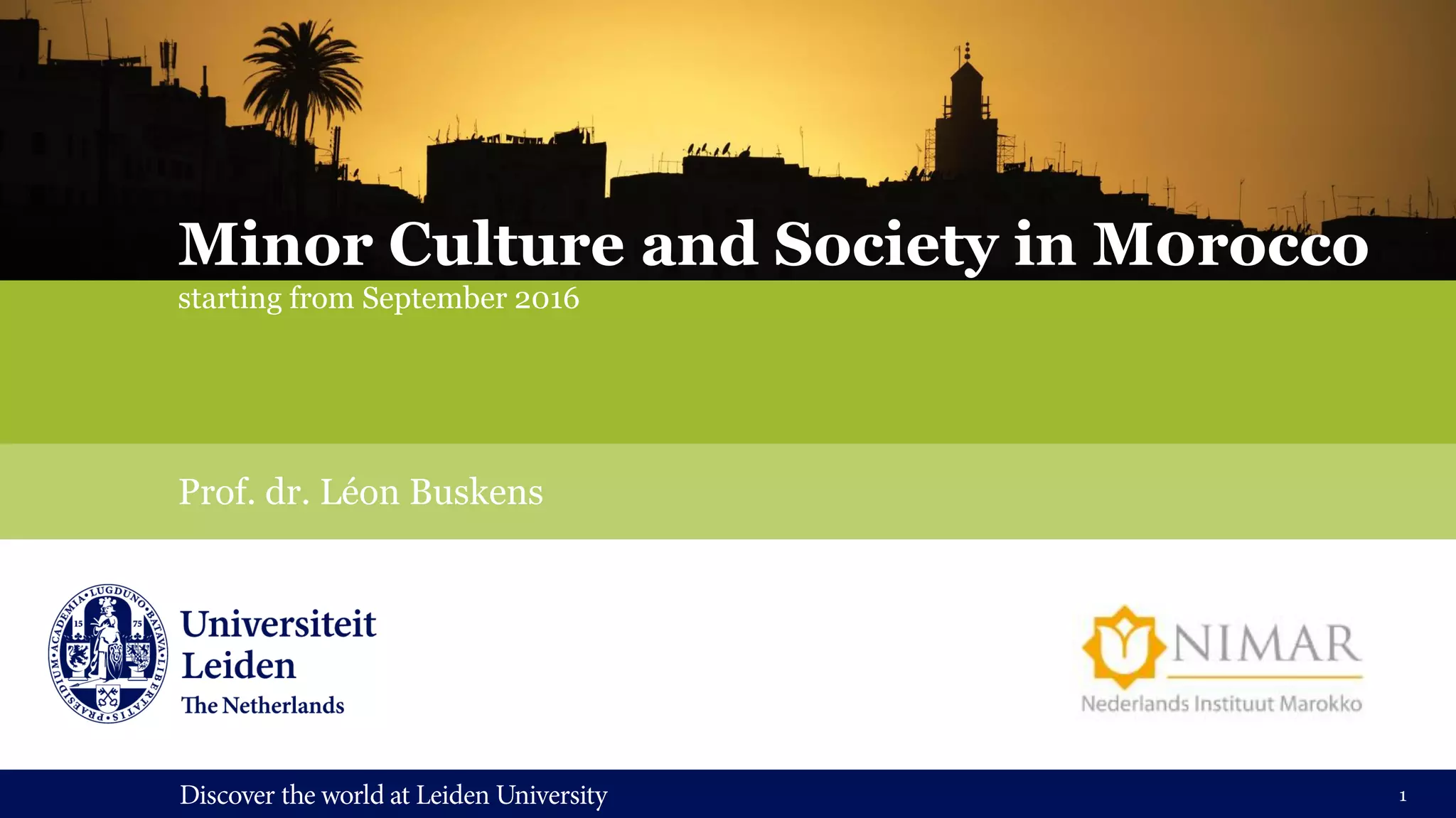
Prof. dr. Léon Buskens
1
Minor Culture and Society in M0rocco
starting from September 2016
Minor Culture and Society in Morocco; in brief
• A challenging semester in Rabat
• A course on social-scientific research of and
in Morocco
• A series of on-site visits
• A course ‘Methods of Qualitative Research’
• A course ‘Research Design’
• Intensive language instruction in Moroccan Arabic,
including conversation classes
• An independent field research project during the
last part of the term
• The courses are taught by NIMAR faculty and
by guest lecturers from Moroccan institutions.
2
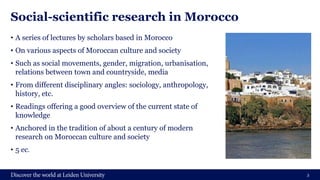
Social-scientific research in Morocco
• A series of lectures by scholars based in Morocco
• On various aspects of Moroccan culture and society
• Such as social movements, gender, migration, urbanisation,
relations between town and countryside, media
• From different disciplinary angles: sociology, anthropology,
history, etc.
• Readings offering a good overview of the current state of
knowledge
• Anchored in the tradition of about a century of modern
research on Moroccan culture and society
• 5 ec.
3
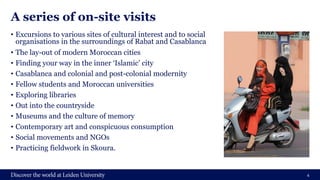
A series of on-site visits
• Excursions to various sites of cultural interest and to social
organisations in the surroundings of Rabat and Casablanca
• The lay-out of modern Moroccan cities
• Finding your way in the inner ‘Islamic’ city
• Casablanca and colonial and post-colonial modernity
• Fellow students and Moroccan universities
• Exploring libraries
• Out into the countryside
• Museums and the culture of memory
• Contemporary art and conspicuous consumption
• Social movements and NGOs
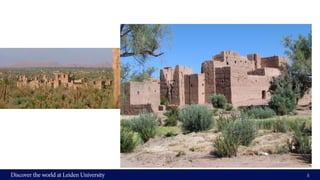
• Practicing fieldwork in Skoura.
4
5
A course ‘Methods of Qualitative Research’
• An initiation into doing independent ethnographic
fieldwork
• (Participant) observation
• Conversations and interviews
• Life histories
• Focus groups
• Writing ethnographic reports
• Weekly assignments
• Literature on doing fieldwork in Morocco
• 5 ec.
6
A course ‘Research Design’
• Planning your own research project
• Formulating a research question
• Designing your research: questions and time
schedule
• The uses of theories and concepts
• Paper outline
• Fine tuning your project
• Relating to existing knowledge
• Identifying experts.
7
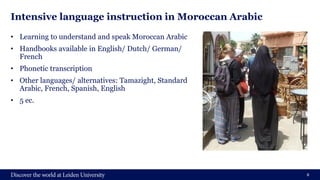
Intensive language instruction in Moroccan Arabic
• Learning to understand and speak Moroccan Arabic
• Handbooks available in English/ Dutch/ German/
French
• Phonetic transcription
• Other languages/ alternatives: Tamazight, Standard
Arabic, French, Spanish, English
• 5 ec.
8
Your own fieldwork project
• Individually or in small groups of two to three persons
• Specific well-defined projects
• Under supervision of a lecturer
• Weekly intervision
• Six weeks
• An ethnographic report as term paper
• A combination of original empirical research, study of
existing literature, and theoretical framework
• 15 ec.
9
Program overview (provisional)
10
Weeks 1 - 7:
• Social scientific research in Morocco
• Excursions
• Methods and Techniques
• Research Design
• Moroccan Arabic (or an alternative).
Weeks 8- 13:
• Fieldwork
• Weekly reporting and intervison.
December - February
• Writing your term paper.
EC’s:
• Social-scientific research in Morocco, and excursions:
5 EC
• Moroccan Arabic: 5 EC
• Methods and Techniques, and Research design: 5 EC
• Research project and term paper: 15 EC.
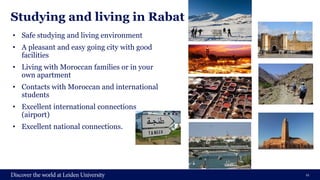
Studying and living in Rabat
• Safe studying and living environment
• A pleasant and easy going city with good
facilities
• Living with Moroccan families or in your
own apartment
• Contacts with Moroccan and international
students
• Excellent international connections
(airport)
• Excellent national connections.
11
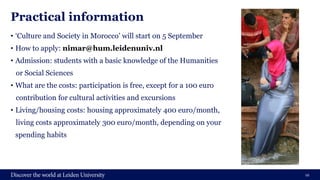
Practical information
• ‘Culture and Society in Morocco’ will start on 5 September
• How to apply: nimar@hum.leidenuniv.nl
• Admission: students with a basic knowledge of the Humanities
or Social Sciences
• What are the costs: participation is free, except for a 100 euro
contribution for cultural activities and excursions
• Living/housing costs: housing approximately 400 euro/month,
living costs approximately 300 euro/month, depending on your
spending habits
12
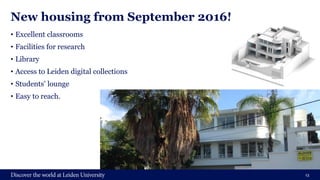
New housing from September 2016!
• Excellent classrooms
• Facilities for research
• Library
• Access to Leiden digital collections
• Students’ lounge
• Easy to reach.
13
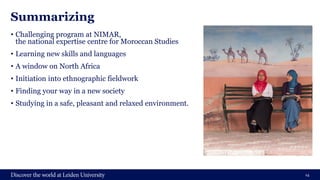
Summarizing
• Challenging program at NIMAR,
the national expertise centre for Moroccan Studies
• Learning new skills and languages
• A window on North Africa
• Initiation into ethnographic fieldwork
• Finding your way in a new society
• Studying in a safe, pleasant and relaxed environment.
14
15
See you in Rabat!
• Further information: nimar@hum.leidenuniv.nl
*) pictures Mike Spaans & Jan Hoogland

Challenging minor programme in Morocco - starting in September

  • 1.
    Prof. dr. LéonBuskens 1 Minor Culture and Society in M0rocco starting from September 2016
  • 2.
    Minor Culture andSociety in Morocco; in brief • A challenging semester in Rabat • A course on social-scientific research of and in Morocco • A series of on-site visits • A course ‘Methods of Qualitative Research’ • A course ‘Research Design’ • Intensive language instruction in Moroccan Arabic, including conversation classes • An independent field research project during the last part of the term • The courses are taught by NIMAR faculty and by guest lecturers from Moroccan institutions. 2
  • 3.
    Social-scientific research inMorocco • A series of lectures by scholars based in Morocco • On various aspects of Moroccan culture and society • Such as social movements, gender, migration, urbanisation, relations between town and countryside, media • From different disciplinary angles: sociology, anthropology, history, etc. • Readings offering a good overview of the current state of knowledge • Anchored in the tradition of about a century of modern research on Moroccan culture and society • 5 ec. 3
  • 4.
    A series ofon-site visits • Excursions to various sites of cultural interest and to social organisations in the surroundings of Rabat and Casablanca • The lay-out of modern Moroccan cities • Finding your way in the inner ‘Islamic’ city • Casablanca and colonial and post-colonial modernity • Fellow students and Moroccan universities • Exploring libraries • Out into the countryside • Museums and the culture of memory • Contemporary art and conspicuous consumption • Social movements and NGOs • Practicing fieldwork in Skoura. 4
  • 5.
  • 6.
    A course ‘Methodsof Qualitative Research’ • An initiation into doing independent ethnographic fieldwork • (Participant) observation • Conversations and interviews • Life histories • Focus groups • Writing ethnographic reports • Weekly assignments • Literature on doing fieldwork in Morocco • 5 ec. 6
  • 7.
    A course ‘ResearchDesign’ • Planning your own research project • Formulating a research question • Designing your research: questions and time schedule • The uses of theories and concepts • Paper outline • Fine tuning your project • Relating to existing knowledge • Identifying experts. 7
  • 8.
    Intensive language instructionin Moroccan Arabic • Learning to understand and speak Moroccan Arabic • Handbooks available in English/ Dutch/ German/ French • Phonetic transcription • Other languages/ alternatives: Tamazight, Standard Arabic, French, Spanish, English • 5 ec. 8
  • 9.
    Your own fieldworkproject • Individually or in small groups of two to three persons • Specific well-defined projects • Under supervision of a lecturer • Weekly intervision • Six weeks • An ethnographic report as term paper • A combination of original empirical research, study of existing literature, and theoretical framework • 15 ec. 9
  • 10.
    Program overview (provisional) 10 Weeks1 - 7: • Social scientific research in Morocco • Excursions • Methods and Techniques • Research Design • Moroccan Arabic (or an alternative). Weeks 8- 13: • Fieldwork • Weekly reporting and intervison. December - February • Writing your term paper. EC’s: • Social-scientific research in Morocco, and excursions: 5 EC • Moroccan Arabic: 5 EC • Methods and Techniques, and Research design: 5 EC • Research project and term paper: 15 EC.
  • 11.
    Studying and livingin Rabat • Safe studying and living environment • A pleasant and easy going city with good facilities • Living with Moroccan families or in your own apartment • Contacts with Moroccan and international students • Excellent international connections (airport) • Excellent national connections. 11
  • 12.
    Practical information • ‘Cultureand Society in Morocco’ will start on 5 September • How to apply: nimar@hum.leidenuniv.nl • Admission: students with a basic knowledge of the Humanities or Social Sciences • What are the costs: participation is free, except for a 100 euro contribution for cultural activities and excursions • Living/housing costs: housing approximately 400 euro/month, living costs approximately 300 euro/month, depending on your spending habits 12
  • 13.
    New housing fromSeptember 2016! • Excellent classrooms • Facilities for research • Library • Access to Leiden digital collections • Students’ lounge • Easy to reach. 13
  • 14.
    Summarizing • Challenging programat NIMAR, the national expertise centre for Moroccan Studies • Learning new skills and languages • A window on North Africa • Initiation into ethnographic fieldwork • Finding your way in a new society • Studying in a safe, pleasant and relaxed environment. 14
  • 15.
    15 See you inRabat! • Further information: nimar@hum.leidenuniv.nl *) pictures Mike Spaans & Jan Hoogland