Krista Coulson: "Book to E-Book: Contract Issues"--AAUP10
1.
Book to E-Book:Contract Issues Krista Coulson Electronic Publishing Manager University of Wisconsin Press Association of American University Presses June 19, 2010, Salt Lake City, Utah
2.
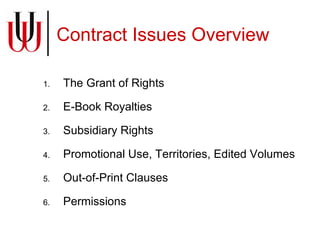
Contract Issues OverviewThe Grant of Rights E-Book Royalties Subsidiary Rights Promotional Use, Territories, Edited Volumes Out-of-Print Clauses Permissions
3.
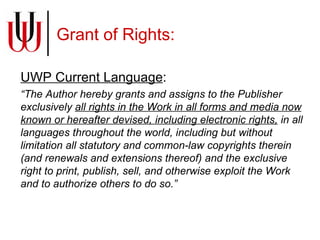
Grant of Rights:UWP Current Language : “ The Author hereby grants and assigns to the Publisher exclusively all rights in the Work in all forms and media now known or hereafter devised, including electronic rights, in all languages throughout the world, including but without limitation all statutory and common-law copyrights therein (and renewals and extensions thereof) and the exclusive right to print, publish, sell, and otherwise exploit the Work and to authorize others to do so.”
4.
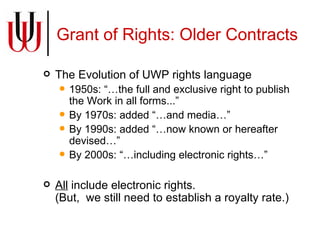
Grant of Rights:Older Contracts The Evolution of UWP rights language 1950s: “…the full and exclusive right to publish the Work in all forms...” By 1970s: added “…and media…” By 1990s: added “…now known or hereafter devised…” By 2000s: “…including electronic rights…” All include electronic rights. (But, we still need to establish a royalty rate.)
5.
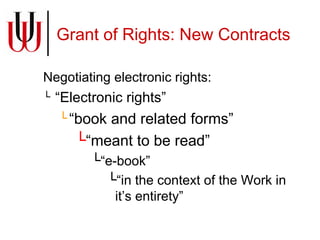
Grant of Rights:New Contracts Negotiating electronic rights: “ Electronic rights” “ book and related forms” “ meant to be read” “ e-book” “ in the context of the Work in it’s entirety”
6.
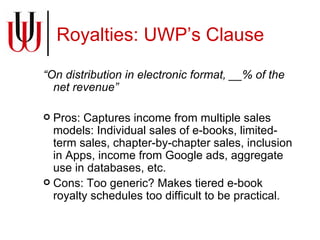
Royalties: UWP’s Clause “ On distribution in electronic format, __% of the net revenue” Pros: Captures income from multiple sales models: Individual sales of e-books, limited-term sales, chapter-by-chapter sales, inclusion in Apps, income from Google ads, aggregate use in databases, etc. Cons: Too generic? Makes tiered e-book royalty schedules too difficult to be practical.
7.
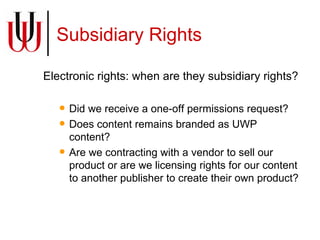
Subsidiary Rights Electronicrights: when are they subsidiary rights? Did we receive a one-off permissions request? Does content remains branded as UWP content? Are we contracting with a vendor to sell our product or are we licensing rights for our content to another publisher to create their own product?
8.
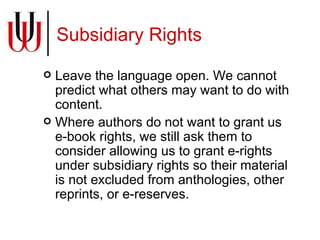
Subsidiary Rights Leavethe language open. We cannot predict what others may want to do with content. Where authors do not want to grant us e-book rights, we still ask them to consider allowing us to grant e-rights under subsidiary rights so their material is not excluded from anthologies, other reprints, or e-reserves.
9.
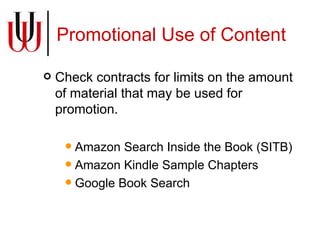
Promotional Use ofContent Check contracts for limits on the amount of material that may be used for promotion. Amazon Search Inside the Book (SITB) Amazon Kindle Sample Chapters Google Book Search
10.
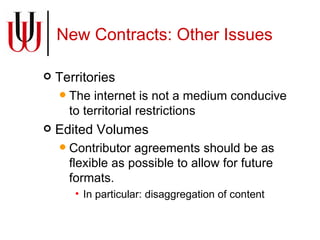
New Contracts: OtherIssues Territories The internet is not a medium conducive to territorial restrictions Edited Volumes Contributor agreements should be as flexible as possible to allow for future formats. In particular: disaggregation of content
11.
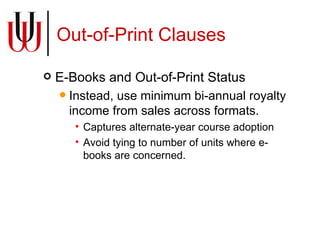
Out-of-Print Clauses E-Booksand Out-of-Print Status Instead, use minimum bi-annual royalty income from sales across formats. Captures alternate-year course adoption Avoid tying to number of units where e-books are concerned.
12.
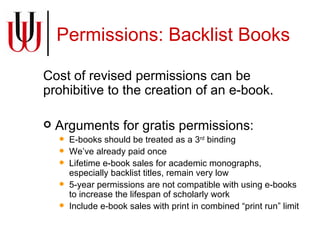
Permissions: Backlist BooksCost of revised permissions can be prohibitive to the creation of an e-book. Arguments for gratis permissions: E-books should be treated as a 3 rd binding We’ve already paid once Lifetime e-book sales for academic monographs, especially backlist titles, remain very low 5-year permissions are not compatible with using e-books to increase the lifespan of scholarly work Include e-book sales with print in combined “print run” limit
13.
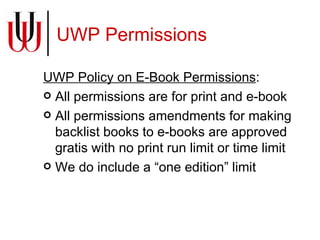
UWP Permissions UWPPolicy on E-Book Permissions : All permissions are for print and e-book All permissions amendments for making backlist books to e-books are approved gratis with no print run limit or time limit We do include a “one edition” limit
14.
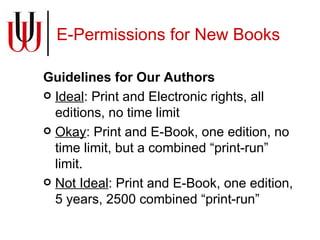
E-Permissions for NewBooks Guidelines for Our Authors Ideal : Print and Electronic rights, all editions, no time limit Okay : Print and E-Book, one edition, no time limit, but a combined “print-run” limit. Not Ideal : Print and E-Book, one edition, 5 years, 2500 combined “print-run”
#3 All interpretations should be done with the definition of a “contract” (a meeting of the minds) at the forefront. Is it really a contract (defined: a meeting of the minds) to read e-books into “all formats” or “all media” an author agreed to in 1962? 1982? How fair is it, even if it says “…now known or hereafter devised?” But, for us, it was moot: Get a contract amendment. E-Rights E-Royalties
#4 Incorporating e-rights language into new contracts: Our current grant of rights: “ “electronic rights” language is probably unnecessary: EQUALLY VALID WITHOUT was inserted around 2000, based on a regulatory article that did not become law.
#5 The Change in UWP grant of rights language over time: Interesting, because it becomes increasingly redundant. I assess Rights fairly, but a little liberally—ROYALTY AMENDMENTS I figure that if an author disagrees with my interpretation, she will let me know when she gets her amendment & letter. I have only had a handful of authors (usu: author’s heirs) ask me to explain my assessment. And, when I have, they don’t seem to have any problems with it. But! What if it’s an edited volume? I check both Editor’s and contributor’s agreements. I have had a few contributors complain on finding their essay on Google Book Search (even though we maintain non-contiguous display). So, while no one has complained about institutional e-books, I wouldn’t be surprised if Google Editions and Kindle’s visibility leads to an increase in emails asking about this.
#6 NEGOTIATING FOR E-RIGHTS: Step-downs in the grant of electronic rights (awkwardness is not mine! Negotiated with authors) “ Electronic rights”: could include audiobooks, revenue from ads (Google, Wowio, etc), apps. Could include CDs, etc, too. “ Book & Related Forms”: removes audiobooks—judgement call on how “related” something is. I try to elicit where that line is from the author. But, generally, I’d say that this language would permit: e-books, apps related to the e-/book, text-to-speech, multi-media/enhanced e-books, etc. “ Meant to Be Read”: removes all non-text rights, but leaves e-books, text-based apps “ E-Book”: I would still interpret this as allowing disaggregation in e-book formats. “ in the context of the Work as a a whole”: Sadly, many of our contributor agreements have this language.
#7 Here is our current language: Pros: Intended to be as broad as possible to let us capture income from sources we can’t predict yet, as well as to allow us to experiment with formats. Easy(-ier) to deal with in administration and royalties. Cons: Possibly, too generic? Administratively, can’t track “sales.” Right now, we can’t have tiered roy schedule. Partly a lack of std reporting—maybe in the future it will be possible.
#8 Primary Right or SubRight? We have moved most of the electronic rights into the Primary Rights. Partly (very frankly), that is because that is what we were doing when I started. But also because I really think that there is a very gray area in determining the division between primary rights and subrights for e-content—especially as these digital formats expand and Presses increasingly outsource the technical work that can’t be done in house. I have been trying to assemble some guidelines to use as new kinds of digital opportunities arise: EBSCO, Gale requests to include content in databases come as one-off requests for a single chapter or article. These are paid as permissions under subrights. & 3) These will be on a continuum and do not have clear answers. They are issues I am keeping in mind as new kinds of formats emerge.
#9 We are seeing an increasing amount of negotiation with authors about subrights. I try to make the case to keep the terms open since we can’t predict what requests may come in—especially with new technology. E.g., Standardized tests, Online exams, racecars. But, we have a list of std. subrights that we substitute for our open language if they ask. And, if they absolutely DO NOT want to grant us e-rights in the primary grant-of-rights, I ask that the author consider it under subsidiary rights, even in a limited way. E-reserves Republished content with other publishers creating e-books.
#10 Have not had any problems getting agents to amend the contracts, where needed—especially as Google Book Search becomes more well known. More trouble convincing some skeptical authors.
#11 Territories: we try to keep e-rights worldwide, especially in co-pubs But, of course, differing sales territories for print and e-books creates its own hassles. Edited volumes! Contributor agreements: “You agree that all details of publishing the article shall be under the control of the Press and shall be governed by the contract between the Press and the Editor of the volume.” New contributor agreements which are designed to let us disaggregate content when we get to that point, our old contributor language only allows us to use the articles “in the context of the work as a whole.” Disaggregation is the trend of the web.
#12 We’ve written a few of these, but, of course, haven’t had them tested yet.
#13 Laura will cover the specifics of assessing permissions next. -PARTICULARLY BACKLIST BOOKS Arguments: Print-run: still a problem with different distribution models.
#14 We also charge an additional fee for database use AND apply a time limit. Have tried asking about royalties, but the database vendors don’t want to deal with that.
#15 Permissions for New Titles: We offer our authors two step-down alternates to our preferred permissions requirements if they have trouble or excessive expense in getting permissions. Let me know if you want to see that table and I’ll email it. Ultimately, I think “print-run” limits and time limits are unsustainable. -”print-run” already out-of-date and difficult to track with POD titles, and it’s even more incompatible with electronic sales, which can easily include distribution that doesn’t count as a single “sale” (e.g., 3 month rentals, chapter sales, etc.) Seems obvious to me, but I have had to make a point to require authors to obtain permissions that match the (primary) grant of rights they are offering (except in languages). Caution!: We must walk a tightrope on giving advice—too much and we void the Warranty section in our contract which enforces author responsibility for permissions.

![Thank you! Krista Coulson [email_address]](https://image.slidesharecdn.com/aaup2010econtractsfinal-100622084325-phpapp02/85/Krista-Coulson-Book-to-E-Book-Contract-Issues-AAUP10-15-320.jpg)


