usa.siemens.com/TO500
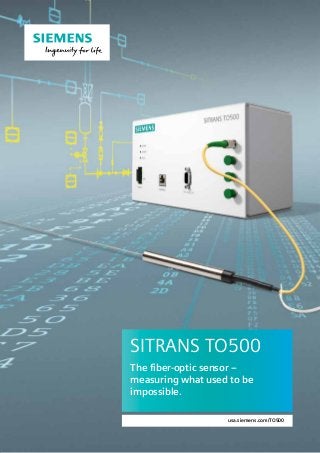
SITRANS TO500
The fiber-optic sensor –
measuring what used to be
impossible.
SITRANS TO500
The extremely thin multipoint
­measuring system
Measured values are transmitted through
an extremely thin sensor measuring lance.
The ­diameter of the sensor measuring lance is
independent of the number of measuring points.
Optimize the life cyle and yield
Recognizing temperature profiles and detailed understand-
ing of the process are great challenges to plant operators.
The fiber-optic based SITRANS TO500 multipoint measuring
system enables you to determine a large number of tem-
perature measuring points along a single sensor fiber and
read out a temperature profile in a matter of seconds. For
example, you can quickly and precisely identify points
overheating to help avoid or counteract potential damage
to your product and/or equipment.
Typical application areas for the SITRANS TO500 are
temperature measurements in:
•	 Tube and tube-bundle reactors
•	 Capillary and microreactors
•	 Distillation
•	 Rectifications
Function of the SITRANS TO500
Do you want to install a very large number of measuring
points in the smallest possible space with a low thermal
mass? The fiber optic weighs only a few gram, and its
diameter of < 2 mm enables the SITRANS TO500 to make
measurements in very narrow protective tubes, because
the larger cross-section provides a larger volume for the
reaction in the reactor.
The response times of the sensors are also reduced because
of the low thermal mass of the fiber optic.
The SITRANS TO500 multipoint measuring system compris-
es two components:
•	 Transmitter (reading unit)
•	 Sensor measuring lances (with up to
48 temperature measuring points)
A continuously tunable laser generates light in the SI-
TRANS TO500 transmitter with a wavelength between 1500
and 1600 nm, which is output to the sensor measuring
lances. The transmitter evaluates the reflected light compo-
nent. Fiber Bragg Gratings (FBG) are inscribed at defined
points on the sensor measuring lances, that reflect a de-
fined wavelength. The wavelength reflected by the grating
changes as a function of temperature and so indicates the
temperature at the relevant measuring point. A gas cell
with a fixed absorption line serves as a reference in the
SITRANS TO500, against which the determined wavelength
is continuously calibrated.
The transmitter sends the measured values via a Profibus
DP interface to control systems for evaluation.
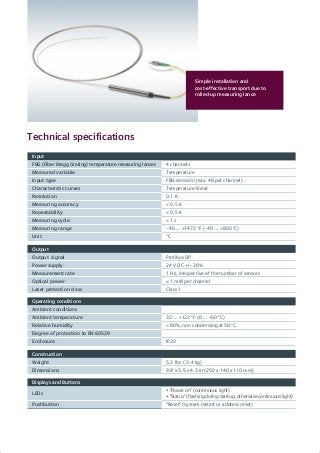
Simple installation and
­cost-effective transport due to
rolled-up measuring lance
Technical specifications
Input
FBG (Fiber Bragg Grating) temperature measuring lances 4 channels
Measured variable Temperature
Input type FBG-sensors (max. 48 per channel)
Characteristic curves Temperature-linear
Resolution 0.1 K
Measuring accuracy < 0.5 K
Repeatability < 0,5 K
Measuring cycle < 1 s
Measuring range - 40 ... +1472 °F (- 40 ... +800 °C)
Unit °C
Output
Output signal Profibus DP
Power supply 24 V DC +/– 20%
Measurement rate 1 Hz, irrespective of the number of sensors
Optical power ≤ 1 mW per channel
Laser protection class Class 1
Operating conditions
Ambient conditions
Ambient temperature 32 ... +122 °F (0 ... +50 °C)
Relative humidity < 80%, non condensing at 50 °C
Degree of protection to EN 60529
Enclosure IP20
Construction
Weight 5.2 lbs ( 2.4 kg)
Dimensions 9.8 x 5.5 x 4.3 in (250 x 140 x 110 mm)
Displays and Buttons
LEDs
• “Power on” (continuous light)
• “Status” (flashing during startup; otherwise continuous light)
Pushbutton “Reset” (system restart or address reset)
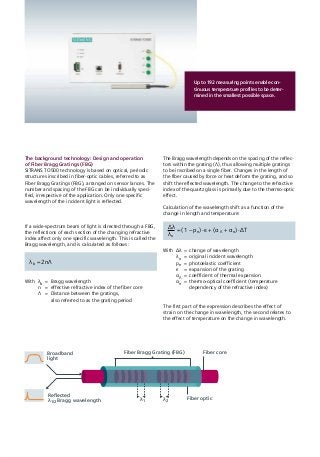
Up to 192 measuring points enable con-
tinuous temperature profiles to be deter-
mined in the smallest possible space.
The background technology: Design and operation
of Fiber Bragg Gratings (FBG)
SITRANS TO500 technology is based on optical, periodic
structures inscribed in fiber-optic cables, referred to as
Fiber Bragg Gratings (FBG), arranged on sensor lances. The
number and spacing of the FBG can be individually speci-
fied, irrespective of the application. Only one specific
wavelength of the incident light is reflected.
The Bragg wavelength depends on the spacing of the reflec-
tors within the grating (Λ), thus allowing multiple gratings
to be inscribed on a single fiber. Changes in the length of
the fiber caused by force or heat deform the grating, and so
shift the reflected wavelength. The change to the refractive
index of the quartz glass is primarily due to the thermo-optic
effect.
Calculation of the wavelength shift as a function of the
change in length and temperature:
The first part of the expression describes the effect of
strain on the change in wavelength, the second relates to
the effect of temperature on the change in wavelength.
If a wide-spectrum beam of light is directed through a FBG,
the reflections of each section of the changing refractive
index affect only one specific wavelength. This is called the
Bragg wavelength, and is calculated as follows:
With 	λb	 =	 Bragg wavelength
	 n	 =	 effective refractive index of the fiber core
	 Λ	 =	Distance between the gratings,
also referred to as the grating period
With	 Δλ	 = 	change of wavelength
	 λo	 =	 original incident wavelength
	pe	 =	 photoelastic coefficient
	 ε	 =	 expansion of the grating
	 αΛ	 =	 coefficient of thermal expansion
	 αn	 =	thermo-optical coefficient (temperature
dependency of the refractive index)
Δλ
λo
= (1 – pe)·ε + (α Λ + αn)·ΔT
λb = 2nΛ
Fiber optic
Fiber coreFiber Bragg Grating (FBG)Broadband
light
Reflected
λ1/2 Bragg wavelength λ1 λ2
SITRANS TO500
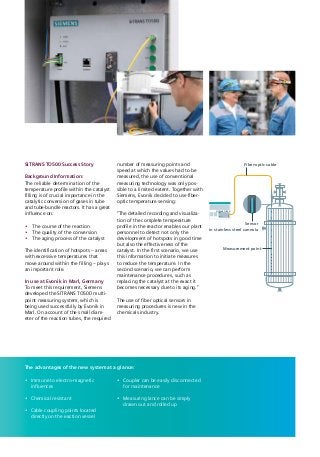
Sensor
in stainless steel cannula
Fiber-optic cable
Measurement point
The advantages of the new system at a glance:
•	 Immune to electro-magnetic
­influences
•	 Chemical resistant
•	 Cable coupling points located
directly on the eaction vessel
•	 Coupler can be easily disconnected
for maintenance
•	 Measuring lance can be simply
drawn out and rolled up
SITRANS TO500 Success Story
Background Information:
The reliable determination of the
temperature profile within the catalyst
filling is of crucial importance in the
catalytic conversion of gases in tube
and tube-bundle reactors. It has a great
influence on:
•	 The course of the reaction
•	 The quality of the conversion
•	 The aging process of the catalyst
The identification of hotspots – areas
with excessive temperatures that
move around within the filling – plays
an important role.
In use at Evonik in Marl, Germany
To meet this requirement, Siemens
developed the SITRANS TO500 multi-
point measuring system, which is
being used successfully by Evonik in
Marl. On account of the small diam-
eter of the reaction tubes, the required
number of measuring points and
speed at which the values had to be
measured, the use of conventional
measuring technology was only pos-
sible to a limited extent. Together with
Siemens, Evonik decided to use fiber-
optic temperature sensing:
“The detailed recording and visualiza-
tion of the complete temperature
profile in the reactor enables our plant
personnel to detect not only the
development of hotspots in good time
but also the effectiveness of the
catalyst. In the first scenario, we use
this information to initiate measures
to reduce the temperature. In the
second scenario, we can perform
maintenance procedures, such as
replacing the catalyst at the exact it
becomes necessary due to its aging.”
The use of fiber optical sensors in
­measuring procedures is new in the
chemicals industry.
Siemens Industry, Inc.
100 Technology Drive
Alpharetta, GA 30005
1-800-365-8766
info.us@siemens.com
Subject to change without prior notice.
Order No.: PIBR-B10203-0117
All rights reserved
Printed in the USA
© 2017 Siemens Industry, Inc.
Subject to changes and errors. The information given in this document
only contains general descriptions and/or performance features which
may not always specifically reflect those described, or which may
undergo modification in the course of further development of the
products. The requested performance features are binding only when
they are expressly agreed upon in the concluded contract.
Contact your channel partner for more information:

SITRANS TO500 Extremely Thin, Multipoint, Temperature Measuring System

  • 1.
    usa.siemens.com/TO500 SITRANS TO500 The fiber-opticsensor – measuring what used to be impossible.
  • 2.
    SITRANS TO500 The extremelythin multipoint ­measuring system Measured values are transmitted through an extremely thin sensor measuring lance. The ­diameter of the sensor measuring lance is independent of the number of measuring points. Optimize the life cyle and yield Recognizing temperature profiles and detailed understand- ing of the process are great challenges to plant operators. The fiber-optic based SITRANS TO500 multipoint measuring system enables you to determine a large number of tem- perature measuring points along a single sensor fiber and read out a temperature profile in a matter of seconds. For example, you can quickly and precisely identify points overheating to help avoid or counteract potential damage to your product and/or equipment. Typical application areas for the SITRANS TO500 are temperature measurements in: • Tube and tube-bundle reactors • Capillary and microreactors • Distillation • Rectifications Function of the SITRANS TO500 Do you want to install a very large number of measuring points in the smallest possible space with a low thermal mass? The fiber optic weighs only a few gram, and its diameter of < 2 mm enables the SITRANS TO500 to make measurements in very narrow protective tubes, because the larger cross-section provides a larger volume for the reaction in the reactor. The response times of the sensors are also reduced because of the low thermal mass of the fiber optic. The SITRANS TO500 multipoint measuring system compris- es two components: • Transmitter (reading unit) • Sensor measuring lances (with up to 48 temperature measuring points) A continuously tunable laser generates light in the SI- TRANS TO500 transmitter with a wavelength between 1500 and 1600 nm, which is output to the sensor measuring lances. The transmitter evaluates the reflected light compo- nent. Fiber Bragg Gratings (FBG) are inscribed at defined points on the sensor measuring lances, that reflect a de- fined wavelength. The wavelength reflected by the grating changes as a function of temperature and so indicates the temperature at the relevant measuring point. A gas cell with a fixed absorption line serves as a reference in the SITRANS TO500, against which the determined wavelength is continuously calibrated. The transmitter sends the measured values via a Profibus DP interface to control systems for evaluation.
  • 3.
    Simple installation and ­cost-effectivetransport due to rolled-up measuring lance Technical specifications Input FBG (Fiber Bragg Grating) temperature measuring lances 4 channels Measured variable Temperature Input type FBG-sensors (max. 48 per channel) Characteristic curves Temperature-linear Resolution 0.1 K Measuring accuracy < 0.5 K Repeatability < 0,5 K Measuring cycle < 1 s Measuring range - 40 ... +1472 °F (- 40 ... +800 °C) Unit °C Output Output signal Profibus DP Power supply 24 V DC +/– 20% Measurement rate 1 Hz, irrespective of the number of sensors Optical power ≤ 1 mW per channel Laser protection class Class 1 Operating conditions Ambient conditions Ambient temperature 32 ... +122 °F (0 ... +50 °C) Relative humidity < 80%, non condensing at 50 °C Degree of protection to EN 60529 Enclosure IP20 Construction Weight 5.2 lbs ( 2.4 kg) Dimensions 9.8 x 5.5 x 4.3 in (250 x 140 x 110 mm) Displays and Buttons LEDs • “Power on” (continuous light) • “Status” (flashing during startup; otherwise continuous light) Pushbutton “Reset” (system restart or address reset)
  • 4.
    Up to 192 measuringpoints enable con- tinuous temperature profiles to be deter- mined in the smallest possible space. The background technology: Design and operation of Fiber Bragg Gratings (FBG) SITRANS TO500 technology is based on optical, periodic structures inscribed in fiber-optic cables, referred to as Fiber Bragg Gratings (FBG), arranged on sensor lances. The number and spacing of the FBG can be individually speci- fied, irrespective of the application. Only one specific wavelength of the incident light is reflected. The Bragg wavelength depends on the spacing of the reflec- tors within the grating (Λ), thus allowing multiple gratings to be inscribed on a single fiber. Changes in the length of the fiber caused by force or heat deform the grating, and so shift the reflected wavelength. The change to the refractive index of the quartz glass is primarily due to the thermo-optic effect. Calculation of the wavelength shift as a function of the change in length and temperature: The first part of the expression describes the effect of strain on the change in wavelength, the second relates to the effect of temperature on the change in wavelength. If a wide-spectrum beam of light is directed through a FBG, the reflections of each section of the changing refractive index affect only one specific wavelength. This is called the Bragg wavelength, and is calculated as follows: With λb = Bragg wavelength n = effective refractive index of the fiber core Λ = Distance between the gratings, also referred to as the grating period With Δλ = change of wavelength λo = original incident wavelength pe = photoelastic coefficient ε = expansion of the grating αΛ = coefficient of thermal expansion αn = thermo-optical coefficient (temperature dependency of the refractive index) Δλ λo = (1 – pe)·ε + (α Λ + αn)·ΔT λb = 2nΛ Fiber optic Fiber coreFiber Bragg Grating (FBG)Broadband light Reflected λ1/2 Bragg wavelength λ1 λ2
  • 5.
    SITRANS TO500 Sensor in stainlesssteel cannula Fiber-optic cable Measurement point The advantages of the new system at a glance: • Immune to electro-magnetic ­influences • Chemical resistant • Cable coupling points located directly on the eaction vessel • Coupler can be easily disconnected for maintenance • Measuring lance can be simply drawn out and rolled up SITRANS TO500 Success Story Background Information: The reliable determination of the temperature profile within the catalyst filling is of crucial importance in the catalytic conversion of gases in tube and tube-bundle reactors. It has a great influence on: • The course of the reaction • The quality of the conversion • The aging process of the catalyst The identification of hotspots – areas with excessive temperatures that move around within the filling – plays an important role. In use at Evonik in Marl, Germany To meet this requirement, Siemens developed the SITRANS TO500 multi- point measuring system, which is being used successfully by Evonik in Marl. On account of the small diam- eter of the reaction tubes, the required number of measuring points and speed at which the values had to be measured, the use of conventional measuring technology was only pos- sible to a limited extent. Together with Siemens, Evonik decided to use fiber- optic temperature sensing: “The detailed recording and visualiza- tion of the complete temperature profile in the reactor enables our plant personnel to detect not only the development of hotspots in good time but also the effectiveness of the catalyst. In the first scenario, we use this information to initiate measures to reduce the temperature. In the second scenario, we can perform maintenance procedures, such as replacing the catalyst at the exact it becomes necessary due to its aging.” The use of fiber optical sensors in ­measuring procedures is new in the chemicals industry.
  • 6.
    Siemens Industry, Inc. 100Technology Drive Alpharetta, GA 30005 1-800-365-8766 info.us@siemens.com Subject to change without prior notice. Order No.: PIBR-B10203-0117 All rights reserved Printed in the USA © 2017 Siemens Industry, Inc. Subject to changes and errors. The information given in this document only contains general descriptions and/or performance features which may not always specifically reflect those described, or which may undergo modification in the course of further development of the products. The requested performance features are binding only when they are expressly agreed upon in the concluded contract. Contact your channel partner for more information: