COUNTABLE AND UNCOUNTABLE NOUNS (count and mass nouns) By Inma Domínguez Images in  http://hcmc.uvic.ca/clipart/
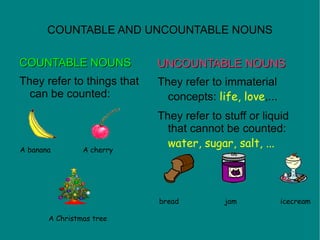
COUNTABLE AND UNCOUNTABLE NOUNS COUNTABLE NOUNS They refer to things that can be counted: UNCOUNTABLE NOUNS They refer to immaterial concepts:  life, love ,... They refer to stuff or liquid that cannot be counted:  water, sugar, salt, ... A banana A cherry A Christmas tree bread  jam  icecream
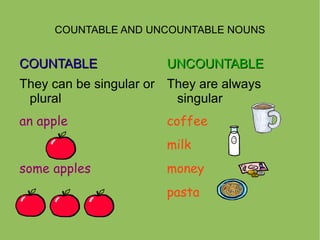
COUNTABLE AND UNCOUNTABLE NOUNS COUNTABLE They can be singular or plural an apple some apples UNCOUNTABLE They are always singular coffee  milk money pasta
COUNTABLE AND UNCOUNTABLE NOUNS COUNTABLE Before them you can use: A /an  a house The  the table Numbers  two children Some /any (when they are plural only) There are some apples on the table UNCOUNTABLE Before them you can use: Some/any There is some water in the glass There isn't any cheese on the table But you can't use:  a /an  or numbers before them.
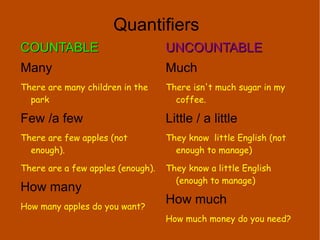
Quantifiers  COUNTABLE Many There are many children in the park Few /a few There are few apples (not enough). There are a few apples (enough). How many How many apples do you want? UNCOUNTABLE Much  There isn't much sugar in my coffee. Little / a little They know  little English (not enough to manage) They know a little English (enough to manage) How much How much money do you need?
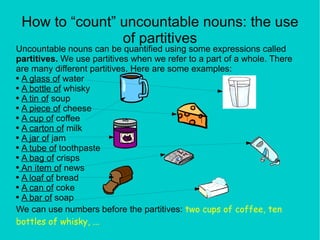
How to “count” uncountable nouns: the use of partitives Uncountable nouns can be quantified using some expressions called  partitives.  We use partitives when we refer to a part of a whole. There are many different partitives. Here are some examples: A glass of  water A bottle of  whisky A tin of  soup A piece of  cheese A cup of  coffee A carton of  milk A jar of  jam A tube of  toothpaste A bag of  crisps An item of  news A loaf of  bread A can of  coke A bar of  soap We can use numbers before the partitives:  two cups of coffee, ten bottles of whisky, ...
Countable and uncountable nouns

  • 1.
    COUNTABLE AND UNCOUNTABLENOUNS (count and mass nouns) By Inma Domínguez Images in http://hcmc.uvic.ca/clipart/
  • 2.
    COUNTABLE AND UNCOUNTABLENOUNS COUNTABLE NOUNS They refer to things that can be counted: UNCOUNTABLE NOUNS They refer to immaterial concepts: life, love ,... They refer to stuff or liquid that cannot be counted: water, sugar, salt, ... A banana A cherry A Christmas tree bread jam icecream
  • 3.
    COUNTABLE AND UNCOUNTABLENOUNS COUNTABLE They can be singular or plural an apple some apples UNCOUNTABLE They are always singular coffee milk money pasta
  • 4.
    COUNTABLE AND UNCOUNTABLENOUNS COUNTABLE Before them you can use: A /an a house The the table Numbers two children Some /any (when they are plural only) There are some apples on the table UNCOUNTABLE Before them you can use: Some/any There is some water in the glass There isn't any cheese on the table But you can't use: a /an or numbers before them.
  • 5.
    Quantifiers COUNTABLEMany There are many children in the park Few /a few There are few apples (not enough). There are a few apples (enough). How many How many apples do you want? UNCOUNTABLE Much There isn't much sugar in my coffee. Little / a little They know little English (not enough to manage) They know a little English (enough to manage) How much How much money do you need?
  • 6.
    How to “count”uncountable nouns: the use of partitives Uncountable nouns can be quantified using some expressions called partitives. We use partitives when we refer to a part of a whole. There are many different partitives. Here are some examples: A glass of water A bottle of whisky A tin of soup A piece of cheese A cup of coffee A carton of milk A jar of jam A tube of toothpaste A bag of crisps An item of news A loaf of bread A can of coke A bar of soap We can use numbers before the partitives: two cups of coffee, ten bottles of whisky, ...