
PROVERBS 15 COMME
TARY 
Written and edited by Glenn Pease 
PREFACE 
The purpose of this work is to save Bible students the enormous amount of time to 
research all of these resources. I have brought them together in one place for a 
quick grasp of what each proverb is saying. You will note that some commentators 
are using an old translation, and it does not seem like the same proverb we are 
dealing with in the IV. They were doing the best they could with an incomplete 
translation, and their comments can still be useful even if they are not accurate for 
the proverb they are commenting on. Just because I add a quote does not mean I 
agree with it, for there are different perspectives, and I give them all for the reader 
to decide on their value. 
It also needs to be pointed out that some of the old translations of the Proverbs were 
quite different than the new translations. The Hebrew text can be very complicated, 
and it has taken a great deal of scholarship to better understand the text. Even yet 
there is uncertainty in some cases, and so commentators have a different slant on 
the same proverb. This is not a problem when the several ideas that are followed all 
deal with some aspect of wise or foolish living. This theme has endless possibilities, 
and so even if different men have varying ideas of what a proverb means, take them 
all in, for no idea, or even several can ever exhaust the ways men can be wise or 
foolish. You might even come up with an idea of what Solomon is getting at yourself. 
As always, I am grateful for all who have made comments on this chapter, but 
sometimes I do not have their name, and so cannot give credit. If anyone can verify 
they are the author, I will gladly give credit. If anyone does not wish that their work 
be shared in this way, please let me know and I will remove it. My e-mail is 
glenn_p86@yahoo.com 
I
TRODUCTIO
 
Charles Spurgeon has an introduction to one of his sermons on Proverbs that is an 
excellent introduction to any study of them. I am adding it here as a reminder that 
though some proverbs seem so commonplace and earthly, they do serve a valuable 
purpose in God's plan for the believer in everyday life. 
Spurgeon wrote, “must have noticed how frequently godly people almost wear out 
their Bibles in certain places. The Psalms, the Gospel of John, and parts of the 
Epistles are favourite portions, and are thumbed in many an old believer’s Bible till
the fact is very noticeable. There are certain sheep-tracks up the slopes of Scripture 
which are much more trodden than the rest of the holy fields. I suppose it has 
always been so, and I will not quarrel with the instincts of the saints.I do however 
regret that any portion of Holy Writ should be neglected. There are Bible-readers 
who keep clear of the historical parts of Scripture, and also greatly avoid the Book 
of Proverbs: indeed, they almost wonder how Proverbs and Ecclesiastes come to be 
a part of the Word of God. Very singular it must seem to them that this Book of 
Proverbs should be placed so very near to Solomon’s Song ―that sacred canticle 
which is the center and climax of inspired Scripture: a book which I do not hesitate 
to call “the holy of holies”―the innermost sanctuary of divine love. 
It is certainly remarkable that hard by such a deeply-spiritual Book there should be 
placed the Book of Proverbs, which mainly consists of instructions for this life. 
Doubtless there is a meaning in that arrangement. The Lord would not have the 
highest spirituality divorced from common-sense. God has made us body and soul, 
and he would have us serve him with both. There is a part of us that is material and 
there is a part that is spiritual; and both need guidance such as the Holy Spirit 
affords us in the inspired Book. The Lord Jesus Christ has redeemed us, not as to 
our soul alone, nor our spirit alone, but as to our body also; and he would have us 
recognize this fact. While we are in the world we are not to regard ourselves as if we 
were pure spirits, having nothing to do with earth; but we are to look to our lower 
nature and our earthly surroundings, and order all these in accordance with the will 
of the Lord. It is not enough that our hearts are cleansed; our bodies are to be 
washed with pure water. We are in the world, and we must eat and drink and 
work and trade even as other men do; and all this must be as much brought under 
the rule of wisdom as our higher nature and its actions. The Christian’s faith does 
not come to him merely to create holy raptures and heavenly emotions, but it comes 
to help him in the business of every day. Grace is intended to sanctify all the 
relations of life. There is no necessity that a man who is wise unto salvation should 
in other respects be a fool; but the reverse should be constantly seen: sanctity should 
beget sagacity, and purity should be the mother of prudence. We are to make the 
common things of this world sacred to God, so that the bells of the horses may be as 
truly “Holiness unto the LORD” as was the mitre of the consecrated priest who 
served at the altar. 
As the religion of the Lord Jesus Christ is meant for this world as well as for worlds 
to come, so the volume of Holy Scripture is fitly made to contain Proverbs as well as 
Psalms. I have been told, but I do not know how true it is, that Scotland owes very 
much of its practical shrewdness to the fact that the Book of Proverbs used to be 
printed in a small form, and was one of the first books read by all the children at the 
public schools. I can only say that if it was so, it showed much wisdom on the part of 
those who made the arrangement; and I have no doubt that if it were so still, it 
would be a clear gain to the rising generation. It is a right thing to have practical 
teaching in connection with sound doctrine, and common-sense in conjunction with 
deep spirituality. Let the Gospels, and Psalms, and Prophets, and Epistles be your 
bread, and let the Book of Proverbs be your salt. 
eglect neither the one nor the
other.” 
1 A gentle answer turns away wrath, 
but a harsh word stirs up anger. 
1. Scott Hoezee sees a theme in this chapter that follows this first verse. He wrote, 
“Verse 1 kicks things off with the well-known proverb about how a gentle word 
makes life better whereas a harsh word just makes people angry. In a similar vein 
verse 4 says that the wise person's tongue creates situations of healing whereas the 
mouth of the fool crushes the spirit of those who get deceived. There are likewise 
several other verses in chapter 15 which have something to do with how positive 
forms of speech make people glad whereas foolish speech just makes people 
depressed. Wise people delight in being able to give what verse 23 calls an "apt 
reply" and a "timely word." Verse 28 says that the wise know how to keep their 
mouths from running ahead of their brains by pausing before speaking--fools on the 
other hand blurt out the first thing that comes to mind and then let the chips fall 
where they may.” 
1B. Here we see the power of words to effect the souls of men and their actions. 
Words have pacifying and provoking power. Someone wrote, “Here we see the 
power of words to alter the feelings and actions of people. Words are to people what 
the switch is to electricity. They are the activators. If they are kind words they 
generate kind responses. If they are harsh they generate harsh responses. 
The gentle word is the water to quench the fire, 
The harsh word is the fuel to stir up the fire.” 
1C. Bridges, “Let us ponder this valuable rule for self-discipline, family peace and 
Church unity. Scripture often illustrates the different effects of the tongue. The soft 
answer is the water to quench Grievous words are the oil to stir up, the fire. And 
this is, alas! man's natural propensity to feed rather than to quench the angry flame. 
We yield to irritation ; retort upon our neighbor ; have recourse to self-justification 
; insist upon the last word ; say all that we could say ; and think we " 
do well to be angry." 
either party gives up an atom of the will. Pride and passion 
on both sides strike together like two flints ; and " behold ! how great a matter a 
little fire kindleth !" Thus there is the self-pleasing sarcasm ; as if we had rather 
lose a friend, than miss a clever stroke. All this the world excuses as a sensitive and 
lively temper. But the gospel sets before us our Savior s example ; imbues with his 
spirit ; and imparts that blessed " charity, that is not easily provoked ;" and
therefore is careful nof to provoke a chafed or wounded spirit. If others begin, let us 
forbear from continuing, the strife. Soft and healing words gain a double victory 
over ourselves, and over our brother.” 
1D. J. M. Gibbon. “If anybody says a rude or angry word to you, and you 
answer in the same way, you are adding fire to fire, you are helping to make a bad 
thing worse, you are multiplying one evil by two — the very worst part of 
arithmetic. But " a soft answer" is like water to fire ; it helps to put the flame out. 
This is what the firemen do. If you give a soft answer to angry words you will be one 
of God's firemen, you will have helped to put out a fire that might have done great 
harm. 
It is very hard to speak softly to people sometimes, very hard indeed. But it is 
worth while learning to do it ; and though hard, like most other good things, it is 
not too hard. It can be managed. How ? First of all by making up your mind 
to do it, and then setting to work to practise the art of soft speaking, and asking 
God to help you and give you strength. It needs no courage to be angry and loud 
and rude. Bullies and cowards have always plenty of angry words at their com-mand. 
Brave boys do not brag or threaten, and the bravest thing of all is 
patience and self-mastery. Illustrate from the patience of the Lord Jesus in the 
judgment hall and on the Cross. The highest courage is the Cross of Christ. You 
will prove yourselves truly brave, not when you strike back, but when rising above 
the temptation you master yourselves and those around you.” 
2. Many years ago Lavonne and I were in a motel in a very hot season and the air 
was not working. We were frustrated and I went over the office to complain. Little 
did I think about the fact that probably everybody else was also complaining, and 
the owner would be terribly frustrated. I was the last straw. When I complained 
that our room was not getting any cool air he hit the ceiling and began to scream at 
me as no adult has ever screamed at me. I could tell he was on the brink of losing it 
and I was in no mood to get popped in the nose. The sweat was bad enough without 
blood to cope with. So I held my tongue and let him get out frustration. I spoke 
very gently in my apology, and because I did not add fuel to his fire he was able to 
get control again and he offered to give me my money back so we could go to 
another motel. He did this and I thanked him and walked out feeling it is great to 
be alive. I know that if I would have provoked him by screaming back he would 
have lost control, and who knows what I would have lost as a result. He was 
murderously mad and I am grateful this proverb proved true on that occasion. It 
was my great example of appeasement. 
3. A great Bible example is with Abigail in I Sam. 25:4-35. She changed history by 
her gentle answer. David was in such a fit of anger that he was about to kill a great 
many innocent people because he was provoked by a fool. Abigail came with her 
gentle words and sweet offer of food, and it calmed David down, and it saved him 
from doing what would damage his image forever by his brutal mass murder. He
was so grateful that he eventually married Abigail. 
3b. Another great Bible example of the gentle answer turning away wrath is that of 
Gideon in Judges 8:1-2 were we read, “ 1 
ow the Ephraimites asked Gideon, "Why 
have you treated us like this? Why didn't you call us when you went to fight 
Midian?" And they criticized him sharply. 2 But he answered them, "What have I 
accomplished compared to you? Aren't the gleanings of Ephraim's grapes better 
than the full grape harvest of Abiezer? 3 God gave Oreb and Zeeb, the Midianite 
leaders, into your hands. What was I able to do compared to you?" At this, their 
resentment against him subsided.” Gideon could have said, “I didn't call you 
because I didn't need you. I handled it by myself with no help from you.” That 
would have provoked them, and there could have been another battle. Gideon was 
wise to be humble instead of being the hero who needed nobody's help. 
4. Wouldn’t you love to know what words accounted for this entry into the 
Britannica back in the year 1900 under the section, “Unusual but noteworthy 
events.” “The Blue Dolphin Restaurant in San Leandro, Calif. has been the scene 
of numerous memorable gatherings, but none perhaps quite as unforgettable as the 
wedding reception that took place in mid-June. As the 300 guests chatted happily 
among themselves, they suddenly grew silent when the newlyweds began arguing in 
loud voices. Dismay turned to disbelief when the groom grabbed the wedding cake 
and threw it in his bride’s face. By the time a police squad pulled up, guests were 
breaking chairs and smashing mirrors. It took half an hour for more than 30 police 
to get the crowd under control. By that time the newlyweds had disappeared.” 
5. David Mace in his book Love And Anger In Marriage points out that there is 
more anger generated in marriage than in any other relationship because you avoid 
it or walk away from others, but you have to live with your mate. Anger is viewed as 
heat. We talk of red hot anger and of blazing anger and of being inflamed or 
seething with anger. We see red and are hot under the collar or boiling mad. Like a 
volcano we fume, erupt and blow our top. Mates are doing things and saying things 
all the time that annoy or anger each other, and so there needs to be a great deal of 
gentle answers to keep the lid on. If mates take everything critical as that which 
demands a negative response, they are failing to realize that it is one of the blessings 
of marriage that you can be critical and still be loving. Mates help each other get 
their frustrations expressed and thus, released. They can't blow up at work, and let 
their anger out on fellow workers, and so they come home and often let it out on the 
children and their mate. If you can see this is happening, you need to realize that 
you are not the target. You are just a resource of release because the real target 
cannot be used, for the risk is too great and might cost a good job to be lost. 
Sometimes we just need to let our mate get some frustration out of their system 
without needing to fire back in defense. Don't get mad, but get gentle. 
6. Jacox gives us these words from history that illustrate this proverb. “The
historian of the conquest of Peru tells us how Gasca was assailed by reproaches and 
invectives which, however, had no power to disturb his equanimity; he patiently 
listened, and replied to all in the mild tone of expostulation best calculated to turn 
away wrath. "By this victory over himself," says Garcilasso, "he acquired more real 
glory, than by all his victories over his foes." As Spenser has it, — "Words well-disposed 
Have secret power t' appease inflamed rage." Sir Matthew Hale's 
celebrated letter of advice includes this counsel, —if a person be passionate, and 
give you ill language, rather to pity him than be moved to anger. We shall find, the 
pious judge asserts, that silence, or very gentle words, are the most exquisite revenge 
for reproaches; they will either cure the distemper in the angry man, and make him 
sorry for his passion, or they will be a severe reproof and punishment to him. " But 
at any rate," adds Sir Matthew, "they will preserve your innocence, give you the 
deserved reputation of wisdom and moderation, and keep up the serenity and 
composure 
7. Jacox goes on, “The fact is, maintains the author of " The Gentle Life," all hard 
words are a mistake: most of our quarrels arise from a total misunderstanding of 
each other; and at any rate, hard words will not mend the matter. One might as 
well, he says, try to mend glass windows by pelting them with stones. Soft words, on 
the other hand, fall like a healing balm on the hearts of all. "Such power," in the 
words of one who loved to be written, if not to write himself, Leontius, " such power 
has the least shadow of a pleasant speech, to do away an ill-feeling of the moment, in 
the complacency it produces, both in the giver and receiver." To apply, again, a 
passage from Spenser, descriptive of a damsel's success in deterring two doughty 
knights from mortal encounter, so effective was her speech to... calm the sea of their 
tempestuous spite: Such power have pleasing words! Such is the might Of courteous 
clemency in gentle heart! " We are all of us fond of gentle words, once more to quote 
an authority on all that concerns gentle living; and he denies the truth of the 
common rough proverb, " Soft words butter no parsnips," which is shown to be, 
after all, an apologetic proverb, meaning that the hearer is tickled with the 
politeness, albeit real satisfaction is not yet made. "Soft words do butter parsnips; 
and many an oily fellow, whose talent, industry, and conscientiousness are small, 
owes his position and advancement in life to the soft words which drop continually 
from his mouth." The soft answer that avails to dispel wrath, comes of practiced 
patience; and when patience has its perfect work, it works miracles, as detailed by 
that fine old forgotten poet, Decker: — "It is the greatest enemy to law That can be, 
for it doth embrace all wrongs, And so chains up lawyers and women's tongues; 
And last of all, to end a household strife, It is the honey 'gainst a waspish wife." 
8. In I Kings 19:11-12 we read of this encounter of God with Elijah: “The LORD 
said, "Go out and stand on the mountain in the presence of the LORD, for the 
LORD is about to pass by." Then a great and powerful wind tore the mountains 
apart and shattered the rocks before the LORD, but the LORD was not in the wind. 
After the wind there was an earthquake, but the LORD was not in the earthquake. 
12 After the earthquake came a fire, but the LORD was not in the fire. And after
the fire came a gentle whisper.” God can speak in the wild wind, shattering rocks, 
fierce fire, and shaking earthquake, but he sometimes prefers the gentle whisper. 
There are times to be angry and sin not, but most often it is time for us to choose the 
gentle whisper. 
9. Let God Be True, “If a party is angry with you, even if it is your fault, you can 
end the matter peaceably by responding gently and kindly, rather than with your 
own anger in defense (12:16; 15:18; 29:22). Will you crush your pride and end the 
fight (13:10; 21:24; 28:25)? Our rule works with family members, job situations, the 
government, or anyone else. Use it. 
Solomon taught great fear of kings, for kings were very dreadful then (19:12; 20:2). 
But he also taught even their wrath could be pacified by yielding (16:14; Eccl 10:4). 
Gentle words are your most powerful weapon against an offended prince, or anyone 
else (25:15). 
This is godly peacemaking. Jesus promised blessing on peacemakers (Matt 5:9), and 
He taught those who may have offended another to go and be reconciled to them 
(Matt 5:23-26). He applied our proverb by teaching you to agree quickly with your 
adversary to bring matters to an end. The Spirit of Christ, which every true saint 
desires to have, is peaceable, gentle, easy to be entreated, and makes peace actively 
(James 3:17-18).” 
10. Clarke, “will often disarm the most furious, where positive derangement has not 
taken place; one angry word will always beget another, for the disposition of one 
spirit always begets its own likeness in another: thus kindness produces kindness, 
and rage produces rage. Universal experience confirms this proverb. 
11. Gill, “soft answer turneth away wrath,.... Mild words, gentle expressions, 
delivered with kindness and tenderness, humility and submission; these will work 
upon a man's passions, weaken his resentments, and break and scatter the storm of 
wrath raised in his breast, just breaking forth in a very boisterous and blustering 
manner; so high winds are sometimes laid by soft showers. Thus the Ephraimites 
were pacified by Gideon's mild answer; and David by Abigail's very submissive and 
respectful address, Jdg_8:1; 
but grievous words stir up anger; such as are rough and menacing, scornful and 
sneering, reproachful and reviling, proud, haughty, and overbearing; like those of 
Jephthah to the Ephraimites; and of the Ephraimites to the Gileadites; and of 
abal 
to David's servants, concerning him; and of Rehoboam, who answered the people 
roughly: in all which instances anger was stirred up, and either were or like to have 
been attended with bad consequences, Jdg_12:1. Or a "word" causing, or rather 
expressing, "grief" (r); upbraiding others with being the cause of grief to them. 
12. Henry, “, as conservator of the public peace, here tells us, 1. How the peace may
be kept, that we may know how in our places to keep it; it is by soft words. If wrath 
be risen like a threatening cloud, pregnant with storms and thunder, a soft 
answerwill disperse it and turn it away. When men are provoked, speak gently to 
them, and give them good words, and they will be pacified, as the Ephraimites were 
by Gideon's mildness (Jdg_8:1-3); whereas, upon a like occasion, by Jephthah's 
roughness, they were exasperated, and the consequences were bad, Jdg_12:1-3. 
Reason will be better spoken, and a righteous cause better pleaded, with meekness 
then with passion; hard arguments do best with soft words. 2. How the peace will be 
broken, that we, for our parts, may do nothing towards the breaking of it. 
othing 
stirs up anger, and sows discord, like grievous words,calling foul names, as Raca,and 
Thou fool,upbraiding men with their infirmities and infelicities, their extraction or 
education, or any thing that lessens them and makes them mean; scornful spiteful 
reflections, by which men affect to show their wit and malice, stir up the anger of 
others, which does but increase and inflame their own anger. Rather than lose a jest 
some will lose a friend and make an enemy.” 
13. An unknown pastor shows by the following outline how strongly this chapter has 
a focus on words. “By your words you will be justified, and by your words you will 
be condemned.” 
KI
D WORDS CREATE FRIE
DSHIP. 
(KJV-15:2) The tongue of the wise useth knowledge aright: but the mouth of fools 
poureth out foolishness. (TLB-15:2) A wise teacher makes learning a joy; a 
rebellious teacher spouts foolishness. 
I
FORMED WORDS CREATE JOY. 
(KJV-15:3) The eyes of the LORD are in every place, beholding the evil and the 
good. (TLB-15:3) The Lord is watching everywhere and keeps his eye on both the 
evil and the good. 
OUR WORDS ARE BEI
G RECORDED. 
(KJV-15:4) A wholesome tongue is a tree of life: but perverseness therein is a breach 
in the spirit. (TLB-15:4) Gentle words cause life and health; griping brings 
discouragement. 
GE
TLE WORDS STRE
GTHE
 OTHERS. 
(KJV-15:5) A fool despiseth his father's instruction: but he that regardeth reproof is 
prudent. (TLB-15:5) Only a fool despises his father's advice; a wise son considers 
each suggestion. 
WISE CHILDRE
 LISTE
 TO PARE
TAL WORDS.
(KJV-15:6) In the house of the righteous is much treasure: but in the revenues of the 
wicked is trouble. (TLB-15:6) There is treasure in being good, but trouble dogs the 
wicked. 
RIGHT LIVI
G CAUSES SPIRITUAL GAI
. 
(KJV-15:7) The lips of the wise disperse knowledge: but the heart of the foolish 
doeth not so. (TLB-15:7) Only the good can give good advice. Rebels can't. 
GOOD WORDS COME FROM GOOD HEARTS. 
(KJV-15:8) The sacrifice of the wicked is an abomination to the LORD: but the 
prayer of the upright is his delight. (TLB-15:8) The Lord hates the gifts of the 
wicked but delights in the prayers of his people. 
WORDS OF PRAYER PLEASE THE LORD. 
(KJV-15:9) The way of the wicked is an abomination unto the LORD: but he loveth 
him that followeth after righteousness. (TLB-15:9) The Lord despises the deeds of 
the wicked but loves those who try to be good. 
2 The tongue of the wise commends knowledge, 
but the mouth of the fool gushes folly. 
The Message, “Knowledge flows like spring water from the wise; 
fools are leaky faucets, dripping nonsense.” 
1. When the wise speak they impress others to realize how valuable it is to gain 
knowledge. Their use of words and great ideas make it obvious that a good 
education is a valuable asset to living the good life. On the other hand, when a fool 
speaks it is also obvious how pathetic it is to be ignorant and unlearned. They reveal 
how little they grasp the nature of reality, and make it look shameful to remain so 
unaware of what makes life more meaningful and precious. The wise tongue 
motivates you to press on to upgrade your mind, and paradoxically, so does the 
foolish tongue, for it makes you feel embarrassed to stay on such an ignorant level. 
It seems funny, but it is true, that even the speech of the fool can be an inspiration to 
go deeper and climb higher, for he reveals the folly of being shallow and lowly in 
the knowledge department. Wisdom and folly can both be a blessing if you respond 
to them the way God expects you to do all through the Proverbs. 
2. Bridges, “Before we had the tongue of love. Here is the tongue of wisdom. The 
tongue shews the man. The wise commands his tongue. The fool his tongue 
commands him. He may have a mass of knowledge in possession. But from the want 
of the right use it runs to waste. Wisdom is proved, not by the quantum of 
knowledge, but by its right application. Observe our Divine Master with " the spirit
of knowledge resting upon him." In condescending to the ignorance of the people ; 
in commanding their respect ; in silencing the gainsayers ; in alluring sinners to 
himself how did this wise tongue use knowledge aright ! Thus did his great Apostle 
give to all the same knowledge, but wisely not the same form or gradation. Instead 
of exasperating his Heathen congregation by an open protest, he supplied their 
acknowledged defect, by bringing before them the true God, " whom they were 
ignorantly worshiping." He pointed an arrow to Agrippa s conscience, by the 
kindly admission cf his candor and Intelligence. 
This right use of knowledge distinguishes the " workman approved of God, and that 
needeth not to be ashamed." The want of it often gives out truth so loosely and 
unsuitably, as to open rather than to shut the mouth of the gainsayer ; rather to 
bring discredit upon the truth, than conviction to the adversary. Specially will the 
tongue of the wise direct a right application of knowledge to those, who have newly 
entered the path of God. May we not sometimes, in our present stature, forget our 
own feeble infancy ; and that, if now we " strike our roots as Lebanon," time was, 
when it was with us only, " the least of all seeds ?" Let our considerate instruction 
pluck the thorn out of their tender feet, " lest that which is lamed be turned out of 
the way ; but rather let it be healed." 
But judge what must be the waters flowing from such a fool's fountain. Listen to 
Baal's worshipers, Rabshakeh s proud boasting: the fretting murmurings of the 
people of God, all pouring out foolishness. Oh ! for a large infusion of sound know 
ledge in the treasure-house within, that the tongue may be at once disciplined and 
consecrated !” 
3. Clarke, “Useth knowledge aright - is very difficult to know: - when to speak, and 
when to be silent; what to speak, and what to leave unspoken; the manner that is 
best and most suitable to the occasion, the subject, the circumstances, and the 
persons. All these are difficulties, often even to the wisest men. Even wise counsel 
may be foolishly given.” 
4. Gill, “The tongue of the wise useth knowledge aright,.... As the heart of a wise and 
good man is filled with useful knowledge, civil, moral, spiritual, and evangelical; so 
he takes care to communicate it, at proper times and seasons, in proper places, and 
to proper persons; adapting it to their case and circumstances, so as it may be for 
their comfort, edification, and instruction, and minister grace unto them; which is 
using knowledge "well", as the word (s)signifies: such an use of it recommends it, 
and makes it appear beautiful and lovely, decorates and adorns it. Thus every good 
man, out of the good treasure of knowledge in his heart, brings forth his good things 
seasonably, to the use of edifying; in like manner, ministers of the word, scribes well 
instructed in the things of God, bring forth both new and old, to the profit of those 
to whom they minister; so Christ, as man and Mediator, had the tongue of the 
learned, to speak a word in season to weary souls;
but the mouth of fools poureth out foolishness; their knowledge, as they take it to be, 
but it is no other than folly; this they throw out in great plenty, in a hurry, without 
fear or wit; they "babble" it out, as the word signifies, as water out of a fountain; 
their hearts are full of it, and their mouths proclaim it, Pro_12:23. 
5. Henry, “ A good heart by the tongue becomes very useful. He that has knowledge 
is not only to enjoy it, for his own entertainment, but to use it, to use it aright, for 
the edification of others; and it is the tonguethat must make use of it in pious 
profitable discourse, in giving suitable and seasonable instructions, counsels, and 
comforts, with all possible expressions of humility and love, and then knowledge is 
used aright;and to him that has, and thus uses what he has, more shall be given. 2. A 
wicked heart by the tongue becomes very hurtful; for the mouth of fools belches out 
foolishness,which is very offensive; and the corrupt communication which proceeds 
from an evil treasure within (the filthiness, and foolish talking, and jesting) corrupts 
the good manners of some and debauches them, and grieves the good hearts of 
others and disturbs them.” 
6. Let God Be True, “You can say the wrong thing. And you can say the right thing 
the wrong way, or at the wrong time, or to the wrong person. Wisdom learns what 
to say, how to say it, when to say it, and to whom to say it. Truth is not enough. Do 
you know how, when, and to whom to speak the truth? Fools babble without regard 
to these four factors of godly speech. 
Solomon taught often that speech is one of the most obvious signs of wisdom or folly 
(10:18-19; 15:28; 17:27-28; 18:6-7; 29:11; Eccl 10:11-14). A wise man or a fool can 
be easily discerned by his speech, which is measured by content, manner, timing, 
and audience. The key to this proverb is the qualifying adverb "aright." A wise man 
speaks knowledge acceptably, but a fool prates offensively without knowing what he 
is saying. 
What is godly content? The proverb says wise men speak knowledge. They do not 
belch vain opinions, which fools love to do. They study before they speak (15:28). 
They crave the certain words of truth (22:17-21). They know speech contrary to 
Scripture is totally worthless (Is 8:20). They want to edify (Eph 4:29). Speak only if 
you have truth (16:23), when it is important to the hearers (29:11), and cut your 
words in half (17:27-28).” 
3 The eyes of the LORD are everywhere, keeping 
watch on the wicked and the good. 
1. The little children's song says “Be careful little eyes what you see, for your Father
up above is looking down in tender love, so be careful little eyes what you see.” It 
goes on to deal with what you hear and do etc. The point is, God in all seeing, and so 
everything we are and do is exposed. We are naked before God, and so it if folly to 
think anything is hidden from him. Awareness of this should make us fearful to go 
ahead and do what he forbids. How foolish could one be to do what his parents 
forbid right in their presence, or for a driver to go through a stop light right in the 
presence of the police car along side of his. It is obvious that we do not live with this 
awareness, for we choose to do what we know is not God's will, and we think that it 
is unknown because no human eyes can see it. Awareness of God's all seeing eyes is 
the greatest safeguard against doing what is folly. It is a powerful guide to be ever 
pressing on to life on a higher level. Practicing the presence of God is the key to 
Christian maturity. 
2. Bridges, “Adored be this All-seeing God ! His inspection of the universe, so 
minute, exact, unwearied! The first mark of the apostasy was a dread of his 
presence. The ungodly try to forget it, and often succeed in banishing him out of 
their thoughts. Yet in despite of all their efforts to hide, he does see them. His eyes 
are in every place. Heaven, hell the secret places of the earth are all open before 
him. He beholds the evil whether the King on his throne, or in his palace ; or the 
servant indulging his secret sin. Yes he may shut out the sun from his retreat, but 
he cannot shut out the eye of God, "from whom the darkness hideth not." Reckless 
indeed is he to do or think what he would hide from God ; and then such is the 
secret root of atheism ! thinking he can 
do so. 
But his eyes also behold the good. He sees them in outward destitution. in secret 
retirement, in deep affliction. He pierces the prison walls. He " covers their heads 
in the day of battle." He is with them in the furnace, and in the tempest. His eye 
guides them as their journeying God, and will guide them safe home; full of 
blessing, protection, and support. He fills hell with his severity, heaven with his 
glory, his people with his grace. But how shall I meet these eyes ! As a rebel or as a 
child. Do they inspire me with terror, or with love? Do I walk carefully 
under their lively impression ? Conscious corruption leads me to shrink from the 
eyes of man. But Oh ! my God ! I would lay myself naked and open to thee. Search 
me ; try me ; shew me to myself. Bring out my hidden iniquities, and slay them 
before me. How is the overwhelming thought of this piercing eye more than 
counterbalanced by the view of the .great High Priest, who covers and cleanses all 
infirmities and defilement, and pleads and maintains my acceptance 
notwithstanding all discouragement !” 
3. Henry, “The great truths of divinity are of great use to enforce the precepts of 
morality, and none more than this - That the eye of God is always upon the children 
of men. 1. An eye to discern all, not only from which nothing can be concealed, but 
by which every thing is actually inspected, and nothing overlooked or looked slightly 
upon: The eyes of the Lord are in every place; for he not only sees all from on high
(Psa_33:13), but he is every where present. Angels are full of eyes (Rev_4:8), but 
God is all eye. It denotes not only his omniscience, that he sees all, but his universal 
providence, that he upholds and governs all. Secret sins, services, and sorrows, are 
under his eye. 2. An eye to distinguish both persons and actions. He beholds the evil 
and the good, is displeased with the evil and approves of the good, and will judge 
men according to the sight of his eyes, Psa_1:6; Psa_11:4. The wicked shall not go 
unpunished, nor the righteous unrewarded, for God has his eye upon both and 
knows their true character; this speaks as much comfort to sas terror to sinners. 
4. Gill, “eyes of the Lord arein every place,.... Which are expressive of his 
omniscience, of the full, clear, distinct, and perfect knowledge, which he has of all 
creatures and things; so that nothing is hid from him, but all open and manifest to 
him; as they are to Christ the essential Word, Heb_4:13; and also of the providence 
of God with respect to all persons in general, and to his own people in particular; 
and as he is infinite and immense, omnipresent and in all places of the world, so his 
omniscience and providence reach everywhere, to places most distant and secret, 
and to persons in them, who cannot be concealed from him, since he fills heaven and 
earth, Jer_23:23; 
beholding the evil and the good; meaning not evil things and good things, though 
that is true; the one he beholds with dislike, the other with pleasure; but evil men 
and good men: he beholds them as from a watch tower, as the word (u)signifies, 
from above, from heaven, where he is; see Psa_33:13. By "evil" men may be meant 
both profane sinners and carnal professors; such as are more openly wicked, and 
declare their sin, as Sodom, or more secretly so; he sees into all the wickedness there 
is in their hearts, all their secret devices against his people; the works done by them 
in the dark, as well as their more open ones; and his eyes are upon all of them, to 
bring them into judgment at the last day: his eyes are particularly on the proud, to 
abase them; such as are under a disguise of religion, and have a form of godliness, 
he has his eyes upon; he sees through all their disguises; he knows on what foot they 
took up their profession; he discerns between that and true grace; he sees how they 
retain their lusts with their profession; observes the springs and progress of their 
apostasy; and will fix his eyes on the man without a righteousness, not having on the 
wedding garment, and order him into outer darkness. He also beholds "good" men; 
he sees all their bad things, their sins, and corrects them for them; their good things, 
their graces, and the exercise of them; their good works, the fruits of his own grace; 
their weaknesses, and supports and strengthens them; their wants, and supplies 
them; their persons, and never withdraws his eyes from them: these are on them 
continually, to protect and defend them; nor will he leave them till he has brought 
them safe to heaven; see 1Ch_16:9.” 
5. Clarke, “eyes of the Lord are in every place - not only sees all things, by his 
omnipresence, but his providence is everywhere. And if the consideration that his 
eye is in every place, have a tendency to appal those whose hearts are not right 
before him, and who seek for privacy, that they may commit iniquity; yet the other
consideration, that his providence is everywhere, has a great tendency to encourage 
the upright, and all who may be in perilous or distressing circumstances.” 
6. Let God Be True, “Where will you hide from the LORD? David could not hide in 
heaven, hell, the farthest parts of the sea, or in darkness (Ps 139:7-12). God is 
everywhere to see everything (Jer 23:24). What can you hide from the LORD? 
David could not hide his thoughts, dreams, or unspoken words (Ps 139:1-6). Even 
the intents of the heart are known (15:11; Heb 4:12). 
o matter where you go or 
what you try to hide, the LORD sees and knows it all. All your ways are naked and 
opened to His all-seeing eyes (5:21; Job 34:21-22; Heb 4:13). The LORD also sees 
your good works. He does not miss a single prayer you make in secret (Matt 6:1-8). 
Every good thing you have done will be remembered in the great Day of Judgment 
(Eccl 12:14; II Cor 5:10; Matt 25:31-40).” 
4 The tongue that brings healing is a tree of life, 
but a deceitful tongue crushes the spirit. 
1. Each of us has the power to become a tree of life to others, and all that is 
necessary for this to become a reality is for us to learn how to use our tongue to be a 
healing agent in the world. We see dogs licking themselves on their sores, and we 
are told that the tongue of the dog has healing properties that help cure the wound 
so it heals faster. So it is with our tongue in dealing with the wounded people in our 
life. They need what our tongue can give them to heal and be restored to a normal 
balanced life instead of being oppressed and depressed by the events of life that have 
damaged their spirit. What a wonderful gift we have, but beware, for this gift can 
also be abused so that this same tongue can crush the depressed even deeper into 
despair by our deceitful words. The wise use of the tongue can make us healers, but 
the foolish use of it can make us crushers of the spirit. It is so important then that 
we study to know how to use this tool aright that we might be an asset rather than a 
liability in our environment. Are people glad to see us, or glad to see us go? 
2. Keil, “Gentleness characterizes the tongue when all that it says to a neighbor, 
whether it be instruction or correction, or warning or consolation, it says in a 
manner without rudeness, violence, or obtrusiveness, by which it finds the easiest 
and surest acceptance, because he feels the goodwill, the hearty sympathy, the 
humility of him who is conscious of his own imperfection. Such gentleness is a tree 
of life, whose fruits preserve life, heal the sick, and raise up the bowed down.”
3. Gill, “ wholesome tongue isa tree of life,.... A tongue that delivers out salutary 
instructions, wholesome advice and counsel; a "healing tongue" (w), as it may be 
rendered, which pacifies contending parties, and heals the divisions between them; 
to have the benefit of such a man's company and conversation is like being in 
paradise. Such is the tongue of a Gospel minister, which delivers out the wholesome 
words of our Lord Jesus Christ; sound speech and doctrines, which cannot be 
condemned; healing truths to wounded consciences, such as peace, pardon, 
righteousness, and atonement by the blood of Christ. These are the means of 
quickening dead sinners, reviving and comforting distressed ones, and show the way 
of eternal life unto them; 
but perverseness therein isa breach in the spirit; impure, unchaste, unsavory, and 
corrupt language, does mischief to the spirits of men; evil communications corrupt 
the heart and manners, defile the soul and the conversation; these and unsound 
doctrines eat as a canker; and as they make the heart of God's people sad, whom he 
would not have made sad; so they bring distress and despair into the spirits of 
others, and make sad wounds and breaches there, which are never healed, and that 
both in the spirits of speakers and hearers; for damnable heresies bring swift 
destruction on the propagators of them, and them that receive them.” 
4. Henry, “good tongue is healing, healing to wounded consciences by comforting 
them, to sin-sick souls by convincing them, to peace and love when it is broken by 
accommodating differences, compromising matters in variance, and reconciling 
parties at variance; this is the healing of the tongue, which is a tree of life,the leaves 
of which have a sanative virtue, Rev_22:2. He that knows how to discourse will 
make the place he lives in a paradise. 2. An evil tongue is wounding 
(perverseness,passion, falsehood, and filthiness there, are a breach in the spirit); it 
wounds the conscience of the evil speaker, and occasions either guilt or grief to the 
hearers, and both are to be reckoned breaches in the spirit.Hard words indeed break 
no bones, but many a heart has been broken by them.” 
5. Bridges, “Wisdom is finely portrayed as a tree of life: So is also the genial 
influence of the righteous here the fruitfulness of his little member. A high image of 
what it ought to be not negative not harmless, but wholesome. As the salt cast into 
the spring cleansed the bitter waters; so, when there is grace in the heart, there will 
be healing in the tongue. "The speech will be with grace, seasoned with salt." 
Large indeed is the sphere, and abundant the blessing. When employed in soothing 
the afflicted, calming the troubled waters with words of peace, it creates a paradise 
around. It is not like the thorny bush, pricking and hurting those that are about us, 
but a fruitful tree a tree of life. 
But if the gracious tongue be healing, the evil tongue is wounding. The meekest of 
men felt its perverseness a breach in the spirit. The tongue of Job s friends broke 
"the bruised reed." which needed to be bound up. Even our beloved Lord, who
never shrunk from external evil, keenly felt the piercing edge of this sword in his 
inmost soul. May it be with me, as with my Divine Master, that "grace may be 
poured upon my lips," so that it may be a wholesome tongue, full of blessing and of 
good fruits !” 
6. Let God Be True, “What do others think when you talk? Are they delighted with 
pleasure and rewarded with profit? Are your words the helpful words of truth and 
wisdom? Do you edify your hearers with kind and uplifting speech? Are family and 
friends strengthened by your gracious words? Do you motivate others to godliness 
and zeal? Are they thankful to have you around? Are you asked for advice from 
many quarters? Do you cause hearts to sing? 
Or is your speech contrary, discouraging, and offensive? Do others consider you 
irritating and obnoxious and avoid you because of your mouth? Are family and 
friends tired of your foolish talking, jesting, criticizing, or whining? Do you leave 
hearers bleeding from sarcastic cuts and defeated by negative comments? Are 
others angry about your regular backbiting and tale bearing? Are you known as 
never being cheerful or thankful? 
You are either a tree of life to others or a breach in their spirit. You either heal and 
help with your words, or you hurt and injure. You either instruct and uplift, or you 
corrupt and offend. "Death and life are in the power of the tongue: and they that 
love it shall eat the fruit thereof" (18:21). You can be a tree of life, providing kind 
and useful words to help others; or you can be a breach in their spirit, discouraging 
and irritating them. 
God gave you a tongue to glorify Him and help others (Ps 30:12; 108:1; Mal 3:16; I 
Thess 5:14; Heb 10:24-25). Boasting in the Lord and magnifying Him is one of the 
grandest ways to honor God and uplift others (Ps 34:1-3). Will your funeral be 
cause to reflect on how your tongue was a tree of life to many, or a breach of the 
spirit to many? Will there be grief for the loss of your words? Or relief that your 
negative and stinging tongue is gone?” 
5 A fool spurns his father's discipline, 
but whoever heeds correction shows prudence. 
1. Solomon is obviously referring to youth here, for adults are not usually still under 
the discipline of fathers. Many a foolish teenager learns the hard way that father 
does, in fact, know best. They want to think that times have advanced beyond the 
old way of thinking, and dad is locked into a morality of the past. They cast off his
wise advice and, like the Prodigal, go off to really live the good life of fun and 
adventure, only to learn that it leads to the pig pen in the long run. Some come back 
home and clean up their act, but many spend the rest of their lives slopping the pigs, 
and living the life of the fool. The wisest of them all are those who listen and learn, 
and are grateful for being disciplined for their wrong behavior. When they get older 
they realize just how wonderful it was to be so loved and spared from the mistakes 
they see that ruined the lives of many of their friends who were never punished for 
their folly. 
2. Bridges, “Alas ! We cannot wonder at this folly. Remember the birth of the fool 
"as a wild ass's colt," despising discipline and restraint. Yet subjection to parents is 
the law of nature, recognized by the most uncivilized nations. Much more is it the 
law of God. The authority of parents is the authority of God. The wayward 
resistance of the ungodly will be fearfully scourged. And even the Christian 
penitent has felt the smart of the rod to the end of life. If example would put this 
folly to shame, do we not read of One child able to teach yea to command his 
parents, who yet exhibited the lovely pattern of filial subjection? But pride must 
be broken down, and the "clothing of humility worn, before the child will see that 
his parents know better than himself; and that to count their word law to " bear the 
yoke in the youth," and to regard counsel, and even reproof as it is the path of 
honor, so it is the path of prudence. Solomon's wisdom, though the special gift of 
God, was doubtless connected with this filial regard to his wise father's instruction. 
Will those, who despise their earthly father's instruction, be ready to listen to their 
heavenly father ? How surely therefore will this untractable spirit exclude from the 
Kingdom of God !” 
3. Henry, “Let superiors be admonished to give instruction and reproof to those that 
are under their charge, as they will answer it in the day of account. They must not 
only instruct with the light of knowledge, but reprove with the heat of zeal; and both 
these must be done with the authority and affection of a father, and must be 
continued, though the desired effect be not immediately perceived. If the instruction 
be despised, give reproof, and rebuke sharply. It is indeed against the grain with 
good-humored men to find fault, and make those about them uneasy; but better so 
than to suffer them to go on undisturbed in the way to ruin. 2. Let inferiors be 
admonished, not only to submit to instruction and reproof (even hardships must be 
submitted to), but to value them as favors and not despise them, to make use of 
them for their direction, and always to have a regard to them; this will be an 
evidence that they are wise and a means of making them so; whereas he that slights 
his good education is a fool and is likely to live and die one.” 
4. Gill, “A fool despiseth his father's instruction,.... They are fools that despise any 
instruction that is wise, good, and profitable; and especially a father's instruction, 
whose love, tender affection, and care, will not suffer him, knowingly, to give any 
but what is good and wholesome: wherefore to despise it is not only a contempt of 
his authority, but a slight of his love; which are both very aggravating, and 
sufficiently demonstrate his folly; and of which he may be himself convinced when it
is too late, and say, "how have I hated instruction and despised reproof?" Pro_5:12. 
He is a fool that despises the instruction of anyone superior to him in years and 
experience; of ministers of the word; and especially of our Father which is in 
heaven, declared in the sacred Scriptures, which are written for instruction in 
righteousness; 
but he that regardeth reproof is prudent; the reproof of a father, whose corrections 
are to be submitted to, and received with reverence; and especially of the Father of 
spirits, whose rebukes are in love, and for profit and advantage; yea, he is a wise 
man that regards the reproof of the word of God, and the ministers of it; and indeed 
of any Christian, whether his superior, equal, or inferior, as David did, Psa_141:5.” 
5. Rich Cathers tells this story, “A man was on the golf practice course, when the 
club pro, Maury, brought an important-looking man out for a lesson. Maury 
watched the guy swing several times and started making suggestions for 
improvement, but each time the pupil interrupted with his own versions of what was 
wrong and how to correct it. After a few minutes of this interference, Maury began 
nodding his head in agreement. At the end of the lesson, the man paid Maury, 
congratulated him on his expertise as a teacher and left in an obviously pleased 
frame of mind. 
The observer was so astonished by the performance, that he had to ask, “Why did 
you go along with him?” “Son,” the old pro said with a grin as he carefully 
pocketed his fee, “I learned long ago that it’s a waste of time to sell answers to a 
man who wants to buy echoes.” 
6. Let God Be True, “As is true with all the proverbs, there is also wisdom for girls 
and mothers here. The same rules apply to daughters and their father's instruction 
and reproofs. And mothers may also give instruction and reproofs to sons and 
daughters, along with fathers (1:8; 6:20; 31:1). 
My son, God gave me several advantages to help you. Only foolish and wild sons 
reject a father's advice and warnings. Wise sons will use their father's advantages to 
be even greater in life. And this is my great desire for you, son, to outstrip and 
surpass me; but you will only do it by receiving my experience and wisdom. Do I 
have your heart? 
A prudent and wise son with a great future will seek his father's counsel and listen 
eagerly to any advice he can gather. He will not be offended by correction, 
restrictions, or repeated warnings. Son, can I convince you to trust me? There are 
reasons I can help you, and I want to give them to you. Will you consider why God 
chose me to be your father? 
Consider my knowledge of you, son. I was analyzing you before you knew you were 
alive. I have memories of years of your life that you cannot recall. I am not blinded
by the passions of your deceitful heart. You are lost in many ways right now due to 
your youth, but I can see clearly what would be best for you. I have watched you 
react to many situations as a child, and I know you better than you know you. Let 
me help you, son.” 
6 The house of the righteous contains great 
treasure, but the income of the wicked brings 
them trouble. 
1. Both the righteous and the wicked may have an abundance of things, and even 
become quite rich, but the righteous are to enjoy and be grateful for their treasures, 
and not controlled by them. The wicked rich are so often so controlled that it 
becomes a pain to be rich. I remember reading the testimony of a rich woman who 
left her husband because they had so much stuff that she had to stay home almost 
all the time because of the many repair people that we coming to fix things. She was 
a slave to her wealth, and she wanted freedom instead, so she left her rich husband. 
If your riches are bringing pain rather than pleasure, it is time to get rid of some 
stuff. The righteous are to deal wisely with their stuff, and not let it dominate their 
lives as the wicked so often do. 
2. Henry, “righteousness is riches are, and the comforts of them: In the house of the 
righteous is much treasure.Religion teaches men to be diligent, temperate, and just, 
and by these means, ordinarily, the estate is increased. But that is not all: God 
blesses the habitation of the just,and that blessing makes rich without trouble. Or, if 
there be not much of this world's goods, yet where there is grace there is true 
treasure; and those who have but little, if they have a heart to be therewith content, 
and to enjoy the comfort of that little, it is enough; it is all riches. The righteous 
perhaps are not themselves enriched, but there is treasure in their house, a blessing 
in store, which their children after them may reap the benefit of. A wicked worldly 
man is only for having his belly filled with those treasures, his own sensual appetite 
gratified (Psa_17:14); but a righteous man's first care is for his soul and then for his 
seed, to have treasure in his heart and then in his house, which his relations and 
those about him may have the benefit of. 2. Where wickedness is, though there may 
be riches, yet there is vexation of spirit with them: In the revenues of the wicked,the 
great incomes they have, there is trouble;for there is guilt and a curse; there is pride 
and passion, and envy and contention; and those are troublesome lusts, which rob 
them of the joy of their revenues and make them troublesome to their neighbors.”
3. Gill, “the house of the righteous ismuch treasure,.... God sometimes blesses the 
righteous with great riches, as he did Abraham; or, however, if they have but little, 
it is better than the riches of many wicked; because they have what they have with a 
blessing, and they are content with it: and they have abundance of spiritual 
treasure; they have God for their portion; Christ, and all good things along with 
him; the rich graces of the Spirit; a rich experience of the grace of God; and all this 
is but a pledge and earnest of what they shall possess hereafter; 
but in the revenues of the wicked is trouble; they have much trouble in getting their 
riches, by which they pierce themselves through with many sorrows; they have 
much trouble in keeping them; cannot rest nor sleep because of their abundance, 
lest it should be taken away from them; and they have much trouble in parting with 
them, when they are, by one providence or another, stripped of them; and, besides, 
they have them with a curse, and are ever attended with uneasiness, on one account 
or another. 
4. Bridges, “The comparison between the righteous and the wicked always turns in 
favor of the righteous. Even in treasure the world s idol, he exceeds. For though his 
house may be destitute of money, yet is there much treasure ; often unseen, yet such 
that the revenues of the wicked, compared with it, sink into nothing. Drop millions 
of gold, boundless revenues, ample territories, crowns and sceptres ; and a poor 
contemptible worm lays his One God against all of them. The treasures of the 
wicked are too much for their good, and too little for their lust. They cannot satisfy 
their senses much less their souls. They may "take wings" at any moment; and 
while they continue, unlike the treasures of the righteous they are burdened with 
trouble. But is it not the crown of the Christian s crown, and the glory of his glory, 
that his portion is so full, that he cannot desire more? All the excellences of the 
creation are only dark shadows of its more substantial excellence. What a mercy to 
be delivered from the idolatrous bait so ruinous alike to our present peace and 
eternal welfare I But a greater mercy still, to be enriched with that treasure beyond 
the reach of harm, that raises to heaven, a portion in God his favor his image his 
everlasting joy.” 
7 The lips of the wise spread knowledge; 
not so the hearts of fools. 
1. The wise by their very nature have something to spread to others. If not, in what 
sense are they wise, and what would be the value of being so if there is nothing 
about it to share to benefit others? Wise people have to spread knowledge for they 
cannot be wise if they do not do so. A wise man who never adds to the knowledge of 
another is not wise at all, but is just another fool who may be ahead of his class in
knowing things. So if you know something that is good for others to know, and you 
do not spread the word, you fall into the class of the fools. Fools may know things of 
value too, but they do not have the heart that cares to share it. They are self 
centered in contrast with the wise who are other centered, and want people to 
benefit by their knowledge. 
2. Gill, “The lips of the wise disperse knowledge,.... Scatter it about for the benefit of 
others; they are communicative and diffusive of it unto others, that fruit may 
abound to their account: so the first ministers of the Gospel diffused the savor of the 
knowledge of Christ and his Gospel in every place; their words went into all the 
earth, and their sound to the end of the world; and so every Gospel minister will 
speak according to the oracles of God, and according to the abilities and measure of 
the gift which he has received; and to the utmost of his power feeds souls with 
knowledge and understanding; 
but the heart of the foolish dothnot so; does not disperse knowledge, for he has no 
solid substantial knowledge in him: or, "the heart of the foolish isnot right" (x); it is 
full of folly and wickedness: or "the heart of the foolish doesnot disperse that which 
isright"; true and right things, and the knowledge of them; but, on the contrary, as 
in Pro_15:2, "pours out foolishness".” 
3. Henry, “This is to the same purport with Pro_15:2, and shows what a blessing a 
wise man is and what a burden a fool is to those about him. Only here observe 
further, 1. That we then use knowledge aright when we disperse it, not confine it to 
a few of our intimates, and grudge it to others who would make as good use of it, but 
give a portion of this spiritual alms to seven and also to eight, not only be 
communicative, but diffusive, of this good, with humility and prudence. We must 
take pains to spread and propagate useful knowledge, must teach some that they 
may teach others, and so it is dispersed. 2. That it is not only a fault to pour out 
foolishness, but it is a shame not to disperse knowledge, at least not to drop some 
wise word or other: The heart of the foolish does not so; it has nothing to disperse 
that is good, or, if it had, has neither skill nor will to do good with it and therefore is 
little worth.” 
4. Keil, “What, after 7a, is more appropriate than to say of the heart of the 
fool, that it wants the receptivity for knowledge which the lips of the wise 
scatter abroad? The heart of the fool is not right, it has not the right 
direction, is crooked and perverse, has no mind for wisdom; and that which 
proceeds from the wise, therefore, finds with him neither estimation nor 
acceptance.” 
5. Let God Be True, “Wise men use their mouths to give knowledge, but the speech 
of fools helps no one. If you are wise, others will benefit by your words; if you are
foolish, others will not profit. How will you affect others today by your talking? Will 
you increase their knowledge? Or will you merely fill their ears with noise and not 
profit them at all? God gave you a heart and lips to praise Him and help others. 
And He gave you Scripture to fill your heart with knowledge, so you can have 
wonderful words to speak (22:17-21; II Tim 3:16-17). 
Words carefully chosen and wisely spoken are beautiful, for which both God and 
men will hold you in high esteem and favor (12:14,18; 15:23; 16:13,24; 22:11; 24:26; 
25:11). And wise men use such words to feed many (10:21). They are trees of life to 
those around them, but fools are traps of sin and death (11:30; 15:4). How many do 
you feed?” 
6. Bridges, “The " right use of knowledge" is first to " lay it up" in a store house; 1 
then out of. the store-house to disperse it. The sower scatters the seed in the furrow, 
and calculates upon a proportionate harvest. Thus the lips of the wise disperse the 
precious seed, "giving a portion to seven, and also to eight," not discouraged by 
trifling difficulties, but " sowing morning and evening," and committing the result 
to God. The Ministry of our Lord thus dispersed the heavenly knowledge of his 
gospel. He commanded his Apostles to scatter the seed through the vast field of the 
world. The persecution of the Church was overruled for this great end. I-ie 
Reformers widely dispersed their treasures both by preaching and writing ; and 
rich indeed was the fruit. Do we remember that our gifts and talents are the riches 
of the Church, that we are blessed like our father Abraham not for our own sakes 
but to " be a blessing." And does not conscience speak of the waste of many of 
important opportunities, when Christians meet, and not an atom of knowledge is 
dispersed! We contend for no eccentric irregularity. We wish for no passing of our 
proper boundary no iritrenchinent upon paramount obligations. But be careful, 
lest in quenching unnatural fire, we inadvertently damp some genuine spark of holy 
flame. Be mindful of small opportunities. The careful cultivation of the smallest field 
ensures an abundant harvest. The acceptance is not to the number, but to the 
improvement of the talents ; not necessarily " where much have been given," but 
where we " have been faithful in a few things." 
The sin of tlte wicked is, not always that they " pour out foolishness ;" but. that 
they do not so. They neglect to disperse. They do not abuse their talent, but they 
omit to improve it. If not blots, they are blanks in the Church. They do no harm, but 
they do nothing. Indeed, they can disperse nothing from their empty store-house. 
They can only trade with the trash of the world, not with the commerce of 
substantial knowledge. The end of both is according to their works "Unto every one 
that hath (actively improves) shall be given, and he shall have abundance ; but from 
him that hath not (uses not) shall be taken away even that which he hath." 
8 The LORD detests the sacrifice of the wicked,
but the prayer of the upright pleases him. 
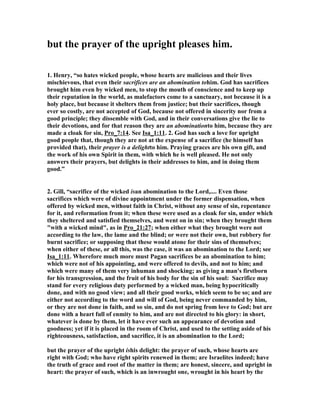
1. Henry, “so hates wicked people, whose hearts are malicious and their lives 
mischievous, that even their sacrifices are an abomination tohim. God has sacrifices 
brought him even by wicked men, to stop the mouth of conscience and to keep up 
their reputation in the world, as malefactors come to a sanctuary, not because it is a 
holy place, but because it shelters them from justice; but their sacrifices, though 
ever so costly, are not accepted of God, because not offered in sincerity nor from a 
good principle; they dissemble with God, and in their conversations give the lie to 
their devotions, and for that reason they are an abominationto him, because they are 
made a cloak for sin, Pro_7:14. See Isa_1:11. 2. God has such a love for upright 
good people that, though they are not at the expense of a sacrifice (he himself has 
provided that), their prayer is a delightto him. Praying graces are his own gift, and 
the work of his own Spirit in them, with which he is well pleased. He not only 
answers their prayers, but delights in their addresses to him, and in doing them 
good.” 
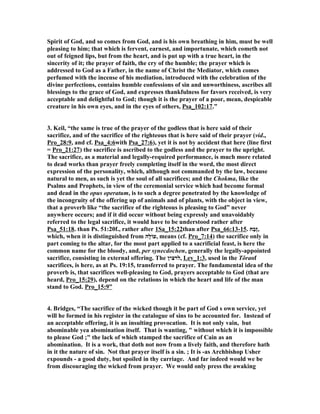
2. Gill, “sacrifice of the wicked isan abomination to the Lord,.... Even those 
sacrifices which were of divine appointment under the former dispensation, when 
offered by wicked men, without faith in Christ, without any sense of sin, repentance 
for it, and reformation from it; when these were used as a cloak for sin, under which 
they sheltered and satisfied themselves, and went on in sin; when they brought them 
"with a wicked mind", as in Pro_21:27; when either what they brought were not 
according to the law, the lame and the blind; or were not their own, but robbery for 
burnt sacrifice; or supposing that these would atone for their sins of themselves; 
when either of these, or all this, was the case, it was an abomination to the Lord; see 
Isa_1:11. Wherefore much more must Pagan sacrifices be an abomination to him; 
which were not of his appointing, and were offered to devils, and not to him; and 
which were many of them very inhuman and shocking; as giving a man's firstborn 
for his transgression, and the fruit of his body for the sin of his soul: Sacrifice may 
stand for every religious duty performed by a wicked man, being hypocritically 
done, and with no good view; and all their good works, which seem to be so; and are 
either not according to the word and will of God, being never commanded by him, 
or they are not done in faith, and so sin, and do not spring from love to God; but are 
done with a heart full of enmity to him, and are not directed to his glory: in short, 
whatever is done by them, let it have ever such an appearance of devotion and 
goodness; yet if it is placed in the room of Christ, and used to the setting aside of his 
righteousness, satisfaction, and sacrifice, it is an abomination to the Lord; 
but the prayer of the upright ishis delight: the prayer of such, whose hearts are 
right with God; who have right spirits renewed in them; are Israelites indeed; have 
the truth of grace and root of the matter in them; are honest, sincere, and upright in 
heart: the prayer of such, which is an inwrought one, wrought in his heart by the
Spirit of God, and so comes from God, and is his own breathing in him, must be well 
pleasing to him; that which is fervent, earnest, and importunate, which cometh not 
out of feigned lips, but from the heart, and is put up with a true heart, in the 
sincerity of it; the prayer of faith, the cry of the humble; the prayer which is 
addressed to God as a Father, in the name of Christ the Mediator, which comes 
perfumed with the incense of his mediation, introduced with the celebration of the 
divine perfections, contains humble confessions of sin and unworthiness, ascribes all 
blessings to the grace of God, and expresses thankfulness for favors received, is very 
acceptable and delightful to God; though it is the prayer of a poor, mean, despicable 
creature in his own eyes, and in the eyes of others, Psa_102:17.” 
3. Keil, “the same is true of the prayer of the godless that is here said of their 
sacrifice, and of the sacrifice of the righteous that is here said of their prayer (vid., 
Pro_28:9, and cf. Psa_4:6with Psa_27:6), yet it is not by accident that here (line first 
= Pro_21:27) the sacrifice is ascribed to the godless and the prayer to the upright. 
The sacrifice, as a material and legally-required performance, is much more related 
to dead works than prayer freely completing itself in the word, the most direct 
expression of the personality, which, although not commanded by the law, because 
natural to men, as such is yet the soul of all sacrifices; and the Chokma, like the 
Psalms and Prophets, in view of the ceremonial service which had become formal 
and dead in the opus operatum, is to such a degree penetrated by the knowledge of 
the incongruity of the offering up of animals and of plants, with the object in view, 
that a proverb like “the sacrifice of the righteous is pleasing to God” never 
anywhere occurs; and if it did occur without being expressly and unavoidably 
referred to the legal sacrifice, it would have to be understood rather after 
Psa_51:18. than Ps. 51:20f., rather after 1Sa_15:22than after Psa_66:13-15. ,זֶבַח 
which, when it is distinguished from עוֹלָה , means (cf. Pro_7:14) the sacrifice only in 
part coming to the altar, for the most part applied to a sacrificial feast, is here the 
common name for the bloody, and, per synecdochen, generally the legally-appointed 
sacrifice, consisting in external offering. The לרצין , Lev_1:3, used in the Tôraof 
sacrifices, is here, as at Ps. 19:15, transferred to prayer. The fundamental idea of the 
proverb is, that sacrifices well-pleasing to God, prayers acceptable to God (that are 
heard, Pro_15:29), depend on the relations in which the heart and life of the man 
stand to God. Pro_15:9” 
4. Bridges, “The sacrifice of the wicked though it be part of God s own service, yet 
will he formed in his register in the catalogue of sins to be accounted for. Instead of 
an acceptable offering, it is an insulting provocation. It is not only vain, but 
abominable yea abomination itself. That is wanting, " without which it is impossible 
to please God ;" the lack of which stamped the sacrifice of Cain as an 
abomination. It is a work, that doth not now from a lively faith, and therefore hath 
in it the nature of sin. 
ot that prayer itself is a sin. ; It is -as Archbishop Usher 
expounds - a good duty, but spoiled in thy carriage. And far indeed would we be 
from discouraging the wicked from prayer. We would only press the awaking
conviction, that it must be done in God s order and way ; else never can it find his 
acceptance.” 
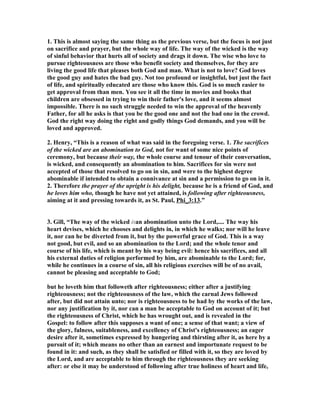
5. Let God Be True, “Does the LORD God despise your worship, or delight in it? 
What a contrast! The LORD considers the worship of some an abomination. He 
does not just dislike their worship: He hates it! But He delights in the prayers of 
others. What a difference! Is your worship an abominable stench in His holy 
nostrils? Or is He pleased with it and your prayers? 
When wicked men worship God, no matter how accurate, sincere, or costly the 
effort, it is detestable, disgusting, and loathsome to Him (21:27). He hates it! He told 
Israel, "Incense is an abomination unto me.... Your new moons and your appointed 
feasts my soul hateth: they are a trouble unto me; I am weary to bear them" (Is 
1:12-14). "I hate, I despise your feast days, and I will not smell in your solemn 
assemblies" (Amos 5:21). 
God hates your sacrifices, prayers, and worship, if you come with sin in your life. 
Ritual without righteousness is obnoxious to Him. He wants your obedience, not 
your worship! The sacrifice He seeks is a broken heart (Ps 51:17). He did not want 
offerings from Israel: He wanted obedience (Jer 7:22-23). "And Samuel said, Hath 
the LORD as great delight in burnt offerings and sacrifices, as in obeying the voice 
of the LORD? Behold, to obey is better than sacrifice, and to hearken than the fat of 
rams" (I Sam 15:22). 
Fools put on suits, attend church, carry Bibles, sing hymns, bow heads, make 
prayers, and worship with sin in their lives! They believe such religious exercises 
will appease God. They think He will overlook their wickedness, because they attend 
church. But He hates their hypocrisy. They keep up a pretense for men to think 
more highly of them, but God will miserably expose and destroy all hypocrites 
(26:24-26; Job 27:8; Ps 144:11-15). 
God delights in the prayer of the upright - He hears it and answers it with pleasure. 
"The effectual fervent prayer of a righteous man availeth much" (James 5:16). 
"The LORD is far from the wicked: but he heareth the prayer of the righteous" 
(15:29). If sinful fathers give good things to their children, how much more will God 
give good things to His children that obey and please Him (Matt 7:11)!” 
6. John Piper has an excellent message on this text that I will break down into a few 
paragraphs that convey the essence of it. “My first question is this: How can 
something as good as a sacrifice to God, which God ordained in the book of 
Leviticus, become an abomination to the Lord? The first half of our text says, "The 
sacrifice of the wicked is an abomination to the LORD." The answer seems to be 
that an act that is good in itself can become ugly to God when it is done with the 
wrong inner disposition. An outward act that looks pious to us can look horrible in
God's eyes because it comes from a heart that is wrong. There seems to be a 
principle implied here that would go something like this: the beauty of an act is the 
outworking of inward beauty, and the ugliness of an act is the outworking of an 
inward ugliness. Since God always looks on the heart (1 Samuel 16:7), he always 
sees our outward acts not as man sees them but as extensions of what he sees on the 
inside. Whether our acts are immoral, like stealing and adultery, or whether our 
acts are moral like church attendance and community service, both will be 
abominable in God's eyes if the heart is not right. 
Paul teaches the same thing when he says in Romans 14:23, "Whatever is not from 
faith is sin." And Hebrews 11:6 teaches this when it says, "Without faith it is 
impossible to please God." In fact, in Hebrews 11:4 the very issue of sacrifices is 
addressed that we have here in Proverbs 15:8, namely, why Abel's sacrifice was 
accepted by God and Cain's wasn't. The reason is that Abel's sacrifice was offered 
by faith but Cain's wasn't; and without faith a sacrifice is not pleasing to God; it is 
an abomination. 
So my second question is: what is the essence of the badness of this heart? Or more 
importantly, what is the opposite of this heart? What makes a person upright 
instead of wicked in heart so that his prayers will delight God instead of being an 
abomination to him? Psalm 4:5 says, "Offer right sacrifices, and put your trust in 
the Lord." I take that to mean that an essential part of the upright heart whose 
sacrifices are not an abomination is trust. 
We could easily make the mistake of thinking that when the Old Testament speaks 
of the "upright" or the "righteous," it cannot mean us because we are still sinners. 
But the righteous and the upright are not perfect. They are persons who confess 
their sin, hate it, and trust God for forgiveness and help. 
One of the best places to see this is Psalm 32. It begins, "Blessed is he whose 
transgression is forgiven, whose sin is covered." So the psalm is about forgiven 
sinners, not about perfect people. Then at the end it distinguishes the wicked from 
the righteous and upright. What is the difference? Verses 10–11: 
Many are the pangs of the wicked; 
but steadfast love surrounds him 
who trusts in the Lord. 
Be glad in the Lord, and rejoice, O righteous, 
and shout for joy, all you upright in heart!” 
9 The LORD detests the way of the wicked 
but he loves those who pursue righteousness.
1. This is almost saying the same thing as the previous verse, but the focus is not just 
on sacrifice and prayer, but the whole way of life. The way of the wicked is the way 
of sinful behavior that hurts all of society and drags it down. The wise who love to 
pursue righteousness are those who benefit society and themselves, for they are 
living the good life that pleases both God and man. What is not to love? God loves 
the good guy and hates the bad guy. 
ot too profound or insightful, but just the fact 
of life, and spiritually educated are those who know this. God is so much easier to 
get approval from than men. You see it all the time in movies and books that 
children are obsessed in trying to win their father's love, and it seems almost 
impossible. There is no such struggle needed to win the approval of the heavenly 
Father, for all he asks is that you be the good one and not the bad one in the crowd. 
God the right way doing the right and godly things God demands, and you will be 
loved and approved. 
2. Henry, “This is a reason of what was said in the foregoing verse. 1. The sacrifices 
of the wicked are an abomination to God, not for want of some nice points of 
ceremony, but because their way, the whole course and tenour of their conversation, 
is wicked, and consequently an abomination to him. Sacrifices for sin were not 
accepted of those that resolved to go on in sin, and were to the highest degree 
abominable if intended to obtain a connivance at sin and a permission to go on in it. 
2. Therefore the prayer of the upright is his delight, because he is a friend of God, and 
he loves him who, though he have not yet attained, is following after righteousness, 
aiming at it and pressing towards it, as St. Paul, Phi_3:13.” 
3. Gill, “The way of the wicked isan abomination unto the Lord,.... The way his 
heart devises, which he chooses and delights in, in which he walks; nor will he leave 
it, nor can he be diverted from it, but by the powerful grace of God. This is a way 
not good, but evil, and so an abomination to the Lord; and the whole tenor and 
course of his life, which is meant by his way being evil: hence his sacrifices, and all 
his external duties of religion performed by him, are abominable to the Lord; for, 
while he continues in a course of sin, all his religious exercises will be of no avail, 
cannot be pleasing and acceptable to God; 
but he loveth him that followeth after righteousness; either after a justifying 
righteousness; not the righteousness of the law, which the carnal Jews followed 
after, but did not attain unto; nor is righteousness to be had by the works of the law, 
nor any justification by it, nor can a man be acceptable to God on account of it; but 
the righteousness of Christ, which he has wrought out, and is revealed in the 
Gospel: to follow after this supposes a want of one; a sense of that want; a view of 
the glory, fulness, suitableness, and excellency of Christ's righteousness; an eager 
desire after it, sometimes expressed by hungering and thirsting after it, as here by a 
pursuit of it; which means no other than an earnest and importunate request to be 
found in it: and such, as they shall be satisfied or filled with it, so they are loved by 
the Lord, and are acceptable to him through the righteousness they are seeking 
after: or else it may be understood of following after true holiness of heart and life,
without which there is no seeing the Lord; and though perfection in it is not 
attainable in this live, yet a gracious soul presses after it, which is well pleasing in 
the sight of God.” 
4. Rich Cathers has put together a list of verses from the KJV that show what God 
hates and despises to the point that they are an abomination to him.
(Prov 3:32 KJV) For the froward is abomination to the LORD: but his secret is 
with the righteous. 
(Prov 6:16-18 KJV) These six things doth the LORD hate: yea, seven are an 
abomination unto him: {17} A proud look, a lying tongue, and hands that shed 
innocent blood, {18} An heart that deviseth wicked imaginations, feet that be swift 
in running to mischief, 
(Prov 11:1 KJV) A false balance is abomination to the LORD: but a just weight is 
his delight. 
(Prov 11:20 KJV) They that are of a froward heart are abomination to the LORD: 
but such as are upright in their way are his delight. 
(Prov 12:22 KJV) Lying lips are abomination to the LORD: but they that deal truly 
are his delight. 
(Prov 15:8 KJV) The sacrifice of the wicked is an abomination to the LORD: but the 
prayer of the upright is his delight. 
(Prov 15:9 KJV) The way of the wicked is an abomination unto the LORD: but he 
loveth him that followeth after righteousness. 
(Prov 15:26 KJV) The thoughts of the wicked are an abomination to the LORD: 
but the words of the pure are pleasant words. 
(Prov 16:5 KJV) Every one that is proud in heart is an abomination to the LORD: 
though hand join in hand, he shall not be unpunished. 
(Prov 17:15 KJV) He that justifieth the wicked, and he that condemneth the just, 
even they both are abomination to the LORD. 
(Prov 20:10 KJV) Divers weights, and divers measures, both of them are alike 
abomination to the LORD. 
(Prov 20:23 KJV) Divers weights are an abomination unto the LORD; and a false 
balance is not good. 
5. Let God Be True, “Some say, "God hates the sin, but loves the sinner." But such 
words are not from the Bible! Men invented this jingle to tickle the ears of 
unregenerate sinners and carnal Christians, who want a God that will accept them 
no matter what. When this proverb is understood, it confirms the message of the
rest of Scripture, that God abhors and loathes wicked persons, their prayers, and 
their lifestyle. Worship God in the beauty of holiness! 
Consider the context. The previous proverb is similar and helps reveal the hatred 
God has for sinful lifestyles. "The sacrifice of the wicked is an abomination to the 
LORD: but the prayer of the upright is his delight" (15:8). God even hates the 
sacrifice of the wicked - his worship and religious activities. But He loves the 
prayers of the upright. When a man chooses to sin against the Most High, God 
despises and loathes his worship (21:27; 28:9). 
The difference is great! Either God abominates your life, or He loves it. Either you 
follow the way of wickedness, or you follow the way of righteousness. How can we 
comprehend the difference between God's hatred and His love? It is very great! You 
cannot avoid God either despising you or favoring you. Most do not care anymore, 
because they have been seduced into carnal living by false teaching of God's 
unconditional love for them.” 
10 Stern discipline awaits him who leaves the 
path; he who hates correction will die. 
The Message, “It's a school of hard knocks for those who leave God's path, 
a dead-end street for those who hate God's rules. 
1. God does not spoil and indulge his children, for when they go astray, he makes 
sure they pay a price for their departure from his path. Many have learned the hard 
way that taking a detour from the path of righteousness on to the path of 
wickedness is truly a choice of folly. They lose their reputation forever sometimes. 
They lose all the value of their previous good example to family and friends. They 
lose the favor of God, that can be regained by repentance, but it is still a great loss 
that will never be forgotten. There is just no winning on the path of sinning. So give 
heed to correction, take your punishment and avoid going over the cliff of folly to a 
tragic death of judgment. 
2. Henry, “shows that those who cannot bear to be corrected must expect to be 
destroyed. 1. It is common for those who have known the way of righteousness, but 
have forsaken it, to reckon it a great affront to be reproved and admonished. They 
are very uneasy at reproof; they cannot, they will not, bear it; nay, because they 
hate to be reformed, they hate to be reproved, and hate those who deal faithfully
and kindly with them. Of all sinners, reproofs are worst resented by apostates. 2. It 
is certain that those who will not be reproved will be ruined: He that hates 
reproof,and hardens his heart against it, is joined to his idols; let him alone. He shall 
die,and perish for ever, in his sins, since he would not be parted from his sins. 
2Ch_25:15, I know that God has determined to destroy thee,because thou couldst not 
bear to be reproved; see also Pro_29:1.” 
3. Gill, “isgrievous unto him that forsaketh the way,.... The right way, the way of 
God; the way of his commandments: the Vulgate Latin version is, "the way of life"; 
the same with the way of righteousness, which apostates, having known and walked 
in, turn aside from; see 2Pe_2:15. And such deserve severe correction, the 
chastisement of a cruel one, correction in wrath and hot displeasure; which, when 
they have, is very disagreeable to them; they behave under it like a bullock 
unaccustomed to the yoke, and yet they are but dealt righteously with. Or the words 
may be rendered, "he has hadbad discipline" or "instruction (z) that forsakes the 
way"; due care has not been taken of him; he has not been properly instructed, nor 
seasonably corrected; had he, he would not easily have departed from the way in 
which he should go; see Pro_22:6. The Targum is, "the discipline of an evil man 
causes his way to err;'' or him to err from his way; 
and he that hateth reproof shall die; that hates the reproof of parents, masters, and 
ministers of the word; as he may be said to do that neglects and rejects it, and does 
not act agreeably to it: and such a man, dying in impenitence and without faith in 
Christ, dies in his sins; and sometimes shamefully, or a shameful death, as the 
Septuagint and Arabic versions, or an untimely one; as well as dies the second 
death, an eternal one.” 
4. Bridges, “But correction turns back him who had forsaken the way. Then it is 
grievous no more. Had not Manasseh more cause to bless God for his fetters than 
for his crown for his dungeon than for his palace ? " This man was born there." We 
would always look hopefully at a sinner under correction. For surely so long 
as the physician administers the medicine, there is no ground for despondency. 
Child of God ! Dost not thou still need the correction ? Oh ! when the thorn is in the 
flesh, pray for grace in the heart. Seek thy Father s favor, more than thine own 
ease. Desire the sanctifying, rather than the removal, of his rod. Mock him not by 
the empty ceremonial of repentance. But, in true penitence look up to thy smiter to 
be thy healer yet not till his correction has fully accomplished his gracious work. 
Lord ! let me know the smart of thy rod, rather than the eclipse of thy love. Shew 
me thy love then do with me what thou wilt.” 
5. Let God Be True, “Prove the character of your soul! Can you take correction? 
Can you take it gladly? Do you appreciate reproof? Do you appreciate the 
reprover? Your attitude toward correction and reproof says more about your heart
than any other measure. Fools and scorners hate correction and reproof, but both 
are going to die in their folly. This measure and warning are repeated themes of 
Solomon in Proverbs (9:8; 10:17; 12:1; 13:18; 15:32; 29:1)! 
You arrived in this world ignorant and depraved. Your heart was dead to God and 
righteousness, and it was alive to rebellion and sin. You were given parents, who 
corrected your childish antics and prepared you to survive life. They reproved your 
youthful folly. If you rebelled against them, then they and a harsh world punished 
you. 
Your evil heart does not like to be corrected. You resent being reproved. You do not 
like to be told you are wrong and need to change. You want to keep your sins. You 
hate those who examine and condemn your conduct. But these are the very means 
by which you acquire wisdom and are saved from life's pitfalls! Why do you resent 
what was ordained for your blessing and salvation? Because your depraved heart 
loves its own folly! 
Two rules are taught in this proverb. First, if you dislike correction, it proves you 
have forsaken the way of righteousness and wisdom. A man seeking knowledge and 
truth does not have such a rebellious spirit. Second, if you hate reproof, you will die. 
Ignorance will trap you, and rebellion will condemn you. Folly and sin will certainly 
destroy you. 
How do ignorant men obtain truth and wisdom? Obviously, they need warnings and 
rebuke. If you resent these means for obtaining wisdom, then you are going to die in 
your stupidity and stubbornness. The snares of wicked men will deceive you; the 
various authorities in life will condemn you; and the blessed God of heaven will 
destroy you.” 
6. The following quote from an unknown author is a brilliant insight into man's 
basic problem that the Proverbs are so often dealing with, as is the case with this 
verse. 
“The sin-problem in this passage is mankind s rebellion. In these verses, Solomon 
explores how humanity relates to not just any god, but to a sovereign God. And the 
reason it is such a big deal is that man s favorite pastime may well be rebellion. 

ow when we come to a book of wisdom, we might be tempted to think that our 
need is that of information that if we just get the right how to steps, life will take 
care of itself and we ll skip and hop right into heaven. But our need is much deeper 
and greater than information because we are more than simply ignorant, we are 
rebellious. 
ot only do we lack good information about reality, we are born in active 
rebellion against God. We are born despising God s sovereignty, bucking against 
His decrees in our life. And even after He draws us unto Himself, we find ourselves 
fighting that temptation of rebellion.
God uses two major themes in the Old Testament to give our hearts a sense of sin s 
devastation: the first is the theme of adultery. Often, as in the book of Hosea, the sin 
of God s people is represented, not as counts on a criminal record, but as a wife 
forsaking her husband and giving herself to lust and adultery. The second theme is 
this theme of rebellion; and not the rebellion of a soldier against his commander or 
a driver against the speed limit, but the hurtful rebellion of a child much loved by 
his parents. Why does God use these two pictures of adultery and rebellion? 
Because they are tied to the closest, most intimate relationships we have on this 
earth, and by meditating on how sin is adultery and rebellion, we will come to hate 
sin as much as God does. Rebellion is an idea that can be traced from the first to the 
last sin. When Adam took the fruit, it wasn't an ignorant sin; he had to decide that 
he was going to walk the opposite way from God s will. He had to dig his heels in 
against God s commandments and accuse God of being stupid and mean. After that, 
man s rebellion only grew; soon, the human race had a plan to dethrone God and 
they began building a tower they thought would reach to heaven. At Babel men and 
women were so uncomfortable with God s rule, they did everything they could to 
cast off His cords and break apart His yoke. 
If you looked up the words rebel and rebellion and rebellious in a concordance, 
you'd see after Babel a general increase of those words as history progressed toward 
Christ. It s found a few times in Genesis, a few more times in Joshua and the books 
of Kings, then rebellion becomes more of a major theme in the Psalms, and then 
those terms pop up all over the place in the books of Isaiah, Jeremiah, and Ezekiel. 
Why the increase? Because as the people of Israel increased in their sin, God called 
it for what it was: rebellion. 
ot just the rebellion of pagan nations against God, but 
the rebellion of a covenant people against their loving, covenant God. It s precisely 
this love of God for His people that makes rebellion so horrible. Isaiah s prophecy 
begins this way: Hear, O heavens, and give ear, O earth; for the Lord has spoken: 
Children have I reared and brought up, but they have rebelled against me.” 
11 Death and Destruction lie open before the 
LORD—how much more the hearts of men! 
1. If God can see into the depths of death and hell like they were an open book, how 
foolish for men to think that he cannot see into the depths of their hearts and know 
all of the evil and folly that resides there. Pretending to hide things from God is a 
sign that one does not have a valid conception of the God of the Bible. He is all 
knowing, and nothing is hid from his eyes. When you know this, it make s big 
difference in how you live. 
2. Bridges, “Once more behold we the Omniscient Omnipresent God. Hell and 
destruction every recess of the vast Hades the state of the dead and the place of the
damned are before the Lord before his eye ; open to his cognizance. How much 
more then the hearts of the children of men 6 unsearchable though they be ! 
o 
depth is there within, that he cannot fathom; no manner of deceit so complicated, 
that he cannot track them ; and yet what a mass of practical unbelief is there in this 
plain demonstrative truth ! For would men dare to indulge their vain thoughts, their 
light notions, their trifles, their impurities, did they really believe that the Lord 
searched their hearts? Would they attempt a forced concealment from his eye; as if 
outward service, lip-worship, would avail, while the heart was cherishing its un-repented 
sin? It is an awful moment, in privacy to stand the test of this searching 
eye. Awful is the thought of the idolatrous 9 sinner ; to the lover of pleasure, 
distinction, or low ambition. Thine heart is open before thy God. 
ever will he 
condescend to occupy the second place there. Thy covering of deceit is swept away. 
The refuges of lies are pierced and laid bare. 
The conscious sinner shrinks from this appalling view. The believer walks 
undismayed in the sight of this " consuming fire." His godly fear is the exercise of 
filial confidence. The sins that are opened to his Father s knowledge are covered 
from his justice. When he "cannot do the things that he would;" when he finds 
the law; that when he would do good, evil is present with him,"he can look up " All 
my desire is before thee." Thus does the Gospel clothe the Divine attributes with 
light and love.” 
3. Henry, “This confirms what was said (Pro_15:3) concerning God's omnipresence, 
in order to his judging of evil and good. 1. God knows all things, even those things 
that are hidden from the eyes of all living: Hell and destruction are before the 
Lord,not only the centre of the earth, and its subterraneous caverns, but the grave, 
and all the dead bodies which are there buried out of our sight; they are all before 
the Lord,all under his eye, so that none of them can be lost or be to seek when they 
are to be raised again. He knows where every man lies buried, even Moses, even 
those that are buried in the greatest obscurity; nor needs he any monument with a 
Hic jacet- Here he lies,to direct him. The place of the damned in particular, and all 
their torments, which are inexpressible, the state of separate souls in general, and all 
their circumstances, are under God's eye. The word here used for destructionis 
Abaddon,which is one of the devil's names, Rev_9:11. That destroyer, though he 
deceives us, cannot evade or elude the divine cognizance. God examines him whence 
he comes (Job_1:7), and sees through all his disguises though he is sly, and subtle, 
and swift, Job_26:6. 2. He knows particularly the hearts of the children of men.If he 
sees through the depths and wiles of Satan himself, much morecan he search men's 
hearts, though they be deceitful, since they learned all their fraudulent arts of Satan. 
God is greater than our hearts,and knows them better than we know them ourselves, 
and therefore is an infallible Judge of every man's character, Heb_4:13.” 
4. Gill, “Hell and destruction arebefore the Lord,.... Or "the grave" (a), which is the 
pit of destruction; where bodies being put, putrefy, and are destroyed by worms: 
this is known by the Lord, even the grave of everyone from the beginning; the
graves of Adam, Abel, Abraham; he knows where their dust lies, and will raise it up 
again at the last day. Hades, or the invisible state of the departed, as the Septuagint 
has it, is manifest before him; he knows where departed spirits are; what their 
condition and employment be; and so the place and state of the damned, known by 
the name of "hell"; and may be called "destruction", where soul and body are 
destroyed by the Lord with an everlasting destruction; and is the destruction which 
the broad way of sin leads unto. 
ow though we know not where this place is, who 
are there, and what the torments endured in it; yet all is before the Lord, and 
known to him: "tophet" is ordained of old; everlasting fire is prepared by the Lord 
for devils and wicked men; see Job_26:6; 
how much more then the hearts of the children of men? which, though desperately 
wicked, are known by him; who is the searcher of the hearts and the trier of the 
reins of the children of men: he to whom hell is naked, and can look into that outer 
darkness, the blackness of darkness, can look into a man's heart, a second hell, in 
which all manner of wickedness is, and observe it all; he needs no testimony of man; 
he knows what is in man, all his secret thoughts, wicked purposes, designs, and 
devices; see Jer_17:9.” 
5. Keil, “The conclusion which is drawn in the proverb proceeds from the 
supposition that in the region of creation there is nothing more separated, and by a 
wide distance, from God, than the depth, and especially the undermost depth, of the 
realm of the dead. If now God has this region in its whole compass wide open before 
Him, if it is visible and thoroughly cognisable by Him ( נֶגֶד , acc. adv.: in conspectu, 
from נָגַד , eminere, conspicuum esse) - for He is also present in the underworld, 
Psa_139:8- then much more will the hearts of the children of men be open, the 
inward thoughts of men living and acting on the earth being known already from 
their expressions. Man sees through man, and also himself, never perfectly; but the 
Lord can try the heart and prove the reins, Jer_17:10. What that means this 
proverb gives us to understand, for it places over against the hearts of men nothing 
less than the depths of the underworld in eternity.” 
6. Spurgeon, “..the doctrine of Divine Omniscience, although it is received and 
believed, has no practical effect upon our lives at all. The mass of mankind forget 
God: whole nations who know his existence and believe that he beholds them, live 
as if they had no God at all. Merchants, farmers, men in their shops, and in their 
fields, husbands in their families, and wives in the midst of their households, live as 
if there were no God; no eye inspecting them; no ear listening to the voice of their 
lips, and no eternal mind always treasuring up the recollection of their acts. Ah! we 
are practical Atheists, the mass of us; yea, all but those that have been born again 
and have passed from death unto life, be their creeds what they may, are Atheists, 
after all, in life; for if there were no God and no hereafter, multitudes of men would 
never be affected by the change; they would live the same as they do now―their 
lives being so full of disregard of God and his ways that the absence of a God could
not affect them in any great degree. 
First then, the word here translated “hell,” might just as well be translated “death,” 
or the state of departed spirits. 
ow, death, with all its solemn consequences, is 
visible before the Lord. Between us and the hereafter of departed spirits a great 
black cloud is hanging. Here and there the Holy Spirit hath made chinks as it were 
in the black wall of separation, through which by faith we can see; for he hath 
“revealed unto us by the Spirit” the things which “eye hath not seen nor ear 
heard,” and which the human intellect could never compass. Yet what we know is 
but very little. When men die they pass beyond the realm of our knowledge: both in 
body and in soul they go beyond our understandings. But God understands all the 
secrets of death. 
And as the body, so the soul when separated from the body is before the Lord. We 
look upon the countenance of our dying friend, and on a sudden a mysterious 
change passes over his frame. “His soul has fled,” we say. But have we any idea of 
what his soul is? Can we form even a conjecture of what the flying of that soul may 
be, and what the august presence into which it is ushered when it is disentangled 
from its earthly coil? Is it possible for us to guess what is that state where spirits 
without bodies, perpetually blest, behold their God? It is possible for us to compass 
some imagination of what heaven is to be, when bodies and souls, reunited, shall 
before God’s throne enjoying the highest bliss; but I do think that so gross are our 
conceptions whilst we are in our bodies that it is almost, if not quite impossible, for 
any of us to form any idea whatever as to the position of souls whilst in the 
disembodied state, between the hour of death and the time of resurrection. 
ˇgThis much, and this is all, we know; 
They are supremely blest: 
Have done with sin, and care, and woe, 
And with their Savior rest.” 
7. Let God Be True, “The great and dreadful God of heaven has seen every thought 
in your heart. Why would you fear men, who cannot do anything to you, but not 
fear God, Who can cast your body and soul into hell (Luke 12:4-5)? How do the 
mere thoughts of others modify your conduct, but the fearful implication of God 
knowing every desire of your heart does not? An angry look from His face will 
infinitely exceed any angry look from men (Rev 20:11). 
The omniscient God knows the small details of hell and destruction (Job 26:6), but 
He knows the intents of your heart even better. There is no aspect of destruction in 
the earth, corruption of the dead in graves, or torment of a soul in hell that the Lord 
of creation does not know and understand altogether. He knows you perfectly! Do 
not deceive yourself by thinking that God does not hear or see (Ps 97:7-9). He sees 
you naked and bare! 
David once spoke of hiding in heaven or hell, but he knew that God would be in
both places knowing every thought of his heart, every word in his tongue, and every 
movement of his body (Ps 139:1-13). All things, every thought and intent of your 
heart, are naked and opened to the eyes of the Lord Jesus Christ (Heb 4:12-14). 
Though you cannot know the wickedness of your own heart, He knows it perfectly 
(Jer 17:9-10). 
Reader, do you tremble before the God of heaven and His word (Is 66:2; Heb 12:28- 
29)? Take precious comfort in Peter's desperate appeal to Jesus Christ after His 
resurrection: "Lord, thou knowest all things; thou knowest that I love thee" (John 
21:17). It is just as true that the omniscient God of heaven knows your good 
thoughts and intentions as well as your bad. But He has blotted out the latter and 
sanctified the former! Glory!” 
12 A mocker resents correction; 
he will not consult the wise. 
The Message, “Know-it-alls don't like being told what to do; 
they avoid the company of wise men and women. 
1. Henry, “A scorner is one that not only makes a jest of God and religion, but bids 
defiance to the methods employed for his conviction and reformation, and, as an 
evidence of that, 1. He cannot endure the checks of his own conscience, nor will he 
suffer it to deal plainly with him: He loves not to reprove him(so some read it); he 
cannot endure to retire into his own heart and commune seriously with that, will not 
admit of any free thought or fair reasoning with himself, nor let his own heart smite 
him, if he can help it. That man's case is sad who is afraid of being acquainted and 
of arguing with himself. 2. He cannot endure the advice and admonitions of his 
friends: He will not go unto the wise,lest they should give him wise counsel. We ought 
not only to bid the wise welcome when they come to us, but to go to them, as beggars 
to the rich man's door for an alms; but this the scorner will not do, for fear of being 
told of his faults and prevailed upon to reform.” 
2. Gill, “scorner loveth not one that reproveth him,.... He that makes a jest of 
religion; scoffs at godliness and godly men; treats the Gospel and the ministers of it 
with contempt; makes a mock at good men, and all that is good; a pestilent fellow, 
as the Vulgate Latin version: such an one not only does not love, for more is 
intended than is expressed; but hates him that reproves him, and especially if 
publicly, Amo_5:10; he thinks ill of him; bears him a grudge, and abhors him; and 
speaks evil of him, and reproaches him; and does all he can to the injury of his 
person and name; hence the advice of the wise man, Pro_9:7. Some render it, he
"loves not reproving himself", or "to reprove himself" (b); he does not care to look 
into his own heart and ways, or to call himself to an account for what he does; nor to 
check himself in the pursuit of sin, nor argue with and reprove himself for it; 
neither will he go unto the wise; to the private houses of wise and good men; nor to 
the house of wisdom, or place of public instruction, where wise dispensers of the 
word give good advice and counsel; scorners do not choose to go to either, lest they 
should be reproved for their evil ways, and be advised leave them; neither of which 
is agreeable to them; see Joh_3:20. “ 
3. Bridges, “How different from David s spirit thankful for the " kind smiting of the 
righteous ," and from the lovely humility of an Apostle, who shewed before the 
Church his honor and love to his r-prover 's Yet we had need to be wise with " the 
wisdom that is from above" to give reproof aright. So cleaving is the mixture of our 
own spirit to every Christian exercise ! 
ot less grace and wisdom does it require to 
receive reproof, and, instead of revolting from our re-prover to go unto him, and 
ask the continuance of his faithful offices. The scorner has been his own flatterer so 
long, that he cannot bear to be brought down to his proper level. He loveth not 
therefore yea he hateth one that reproveth him, though before he might have 
reverenced him." The Pharisees derided our beloved Lord with marks of external 
scorn, when he struck at their right eye, and reproved their hypocritical service. " 
Every one that doeth evil hateth the light ; neither cometh he to the light, 
lest his deeds should be reproved. " 
4. Let God Be True, “Good men love those who teach and reprove them (9:8; 25:12; 
27:5-6,9; Ps 141:5; John 3:21), but fools and scorners cannot stand them (9:7-8; 
12:15; 23:9; II Chron 18:7; Amos 5:10; John 3:20). When a person resents or avoids 
a teacher, you have likely found a scorner. We are living in a generation of scorners. 
Wise parents pursue children who avoid them or their correction. They also correct 
facial expressions or body language that shows a haughty or sullen spirit toward 
authority, instruction, or correction (19:25; 21:11). The bud of scorn in a child must 
be nipped quickly and totally, unless you want hell in your home and future (21:24; 
22:10; 24:9). 
Dear reader, do you love reproof from parents? your pastor? church members? 
your spouse? If not, what is your problem? Wise men love reproof! What sins are 
you hiding? Do you have a scornful spirit from hell fighting against authority and 
correction? 
13 A happy heart makes the face cheerful,
but heartache crushes the spirit. 
1. Happy heart, or heart ache. Those are the two keys to the emotional life. If your 
heart is happy it will show on your face, and in all your body language, but if it 
aches, it will show in negative body language of sadness of face, and a depressing 
negative attitude about life in general. The heart is not just about how you feel, but 
about how you think, and so it is true that what you think, you are. 
2. Henry, “Harmless mirth is recommended to us, as that which contributes to the 
health of the body, making men lively and fit for business, and to the acceptableness 
of the conversation, making the face to shine and rendering us pleasant one to 
another. A cheerful spirit, under the government of wisdom and grace, is a great 
ornament to religion, puts a further lustre upon the beauty of holiness, and makes 
men the more capable of doing good. 2. Hurtful melancholy is what we are 
cautioned against, as a great enemy to us, both in our devotion and in our 
conversation: By sorrow of the heart,when it has got dominion and plays the tyrant, 
as it will be apt to do it if be indulged awhile, the spirit is brokenand sunk, and 
becomes unfit for the service of God. The sorrow of the world works death.Let us 
therefore weep as though we wept not,in justice to ourselves, as well as in conformity 
to God and his providence.” 
3. Gill, “merry heart maketh a cheerful countenance,.... Or, a "joyful heart" (c); 
that is joyful in the God of its salvation; that rejoices in Christ Jesus; is filled with 
joy and peace through believing in him, in his person, blood, righteousness, and 
sacrifice; that has a comfortable view of his justification by his righteousness, of 
peace and pardon by his blood, of the atonement of his sins by his sacrifice; to whom 
he has said, "be of good cheer, thy sins are forgiven thee", Mat_9:2; who has peace 
in him, though tribulation in the world: as such a man's heart must be made glad, 
this will make his countenance cheerful, or cause him to lift up his head with joy; as 
it is in natural things, so it is in spiritual ones; 
but by sorrow of the heart the spirit is broken; a man is dejected, his spirits sink, 
and it is seen in his countenance: there is a great sympathy between the body and 
mind, the one is much affected by the other; when the heart is full of sorrow, the 
animal spirits are low, the nerves are loosened, the whole frame, of nature is 
enfeebled, and the body emaciated; this is often the case through outward troubles 
(d): physicians say (e) that grief weakens the strength, and destroys the spirits, more 
than labor does. "The sorrow of the world worketh death", 2Co_7:10; and 
sometimes, through spiritual troubles, a sense of sin and guilt of it, a legal sorrow, 
which produces a legal contrition of spirit; and such "a wounded spirit who can 
bear?" Pro_18:14. This is the effect of a mere work of the law upon the conscience; 
and stands opposed to the spiritual joy, and the effects of it, the Gospel brings.”
4. Bridges, “How close is the sympathy between the body and soul, though framed of 
such opposite elements ! A man s countenance is the index of his spirit. In the 
sensation of joy the heart sits smiling in the face, and looks merrily out of the 
windows of the eyes." Yet who has a right to a merry heart, but he that is walking in 
acceptance with God ? It was this spring of joy. that lighted up Hannah s sorrowful 
countenance into godly cheerfulness. Stephen stood before his judge, with his 
heavenly prospects beaming in his " angel s face." Everywhere does the hearty 
reception of the gospel " give beauty for ashes " sunshine for gloom. 
Sad indeed, is the contrast of a heart broken by worldly sorrow. Too often does a 
mischievous gloom worm itself into the vitals of the child of God. The melancholy 
victim drags on a weary heavy-laden existence, clouding a distinct feature of his 
character ; despoiled of one of the most attractive ornaments of his profession. 
His hands slacken : his whole energies are paralyzed for the work of God ; and he 
sinks into desponding apathy and indolence. 
In times of depression, let sense and feeling be kept within their bounds ; and the 
Savior s voice, encouraging confidence, will be practically regarded. Even our very 
" sighing and crying for the abominations of the land" must not issue in heartless 
complaints, but rather stimulate to the diligent improvement of present oppor-tunities. 
Did we realize, as we ought, our present privileges, and grasp our eternal 
prospects ; no sorrow of the heart would break our spirit. The gleam of sunshine 
would be to us the earnest of what it will be, when as Rutherford beautifully 
observes we shall be on the sunny side of the Brae. Meanwhile the first step in 
religion is not only beginning to be serious, but to be happy. To maintain our 
Christian balance, even " godly sorrow" must be disciplined ; lest it break the heart, 
which it was intended only to humble ; lest it give advantage to the enemy, and 
bring hindrance to the Church.” 
5. Let God Be True, “A smile is the best facial! A joyful soul enhances your 
appearance more than anything else. A happy face is a wonderful thing, and it is the 
result of a peaceful and contented heart. But a troubled heart clouds your face, as it 
saps your features and body of energy and vitality. Wise men guard their hearts, 
and they learn to perceive the hearts of others. 
Women spend much time, expense, and effort in being visually attractive. Yet a 
warm and sincere smile does more for their appearance than any hairdo, makeup, 
or accessories could ever do. Cheerful eyes, a relaxed face, a pleasant smile, and 
contented posture are much more appealing than fine clothing and perfect features! 
A kind and happy smile is ten times better than a bored look, angry face, furrowed 
brows, or haughty stare! 
Your countenance is primarily your facial appearance, but it also includes your 
bearing and demeanor. It is your face and body language combined. When you are
happy and joyful, your countenance reflects this inner condition. And when your 
soul is burdened under fear, loss, trouble, or worry, your face and body reveal it as 
well (I Sam 1:10,18). 
How do you get a merry heart? It is a choice! The gracious God of heaven expects 
you to be joyful (Acts 14:17; Phil 4:4). If you know Him, how can you not be content 
(Ps 73:25-26; Heb 13:5-6)? With your heart in the right place, Solomon's priorities 
make sense (15:16-17). With eternal life as a gift of God and heaven waiting, what 
can get you down! And with a cheerful countenance, you give visual proof of 
Christianity's superiority. 
6. Cheerfulness is a key theme in this chapter as we see in these verses: 
(Prov 15:13) A merry heart makes a cheerful countenance, But by sorrow of the 
heart the spirit is 
broken. 
(Prov 15:15) All the days of the afflicted are evil, But he who is of a merry heart has 
a continual feast. 
(Prov 15:30) The light of the eyes [a cheerful look] rejoices the heart, And a good 
report makes the 
bones healthy. 
(Prov 15:23) A man has joy by the answer of his mouth [by giving an apt reply], 
And a word spoken in 
due season, how good it is! 
7. An unknown author wrote, “In the vestibule of a certain hospital visitors see a 
card bearing this advice: "
ever utter a discouraging word while you are in this 
hospital. You should come here only for the purpose of helping. Keep your 
hindering, sad looks for other places, and if you can't smile don't go in." 
ot in the 
hospitals only, but the home and on the street, there is the same need for the kindly, 
sunny smile. The way to have it is to get the heart right with God.” 
7B. Arnot, “A merry heart maketh a cheerful countenance. — Mirth a medicine : — 
The emotions that thrill in the heart mark themselves in legible lines on the 
countenance. This is a feature in the constitution of man, and a useful feature it 
is. The wisdom of our Maker may be seen in the degree of its development. Joy 
in the heart can do more than make the aspect winsome. Besides enlivening a dull 
countenance, it heals a diseased nature. There is nothing equal to cheerful and 
even mirthful conversation for restoring the tone of mind and body when both have 
been overdone. Mirth, after exhaustive toil, is one of nature's instinctive efforts to 
heal the part which has been racked and bruised. Even a dull observer may see 
wisdom and goodness in the habitual cheerfulness of the young. To maintain a 
patient's cheerfulness often hastens the patient's cure. A bright hope within will 
sometimes do more to restore the wasted strength than all the prescriptions of the 
physician. If Christians could get living hope lighted within, and let it beam like 
sunlight all the day through an open countenance, their lives would be more legible
as epistles of Christ, and more effectual to win souls." 
8. Another unknown author said, “Cheerfulness removes the rust from the mind, 
lubricates our inward machinery, and enables us to do our work with fewer creaks 
and groans. If people were universally cheerful, there wouldn't be half the 
quarreling or a tenth part of the wickedness there is. Cheerfulness, too, promotes 
health and morality. Cheerful people live longest here on earth, afterward in our 
hearts.” 
9. SMILE 
A Smile costs nothing, but gives much 
It enriches those who receive, without making poorer those who give 
It takes but a moment, but the memory of it sometimes lasts forever 

one is so rich or mighty that he can get along without it, 
and none is so poor, but that he can be made rich by it 
A Smile creates happiness in the home, fosters good will in business, 
and is the countersign of friendship 
It brings rest to the weary, cheer to the discouraged, sunshine to the sad, 
and it is nature's best antidote for trouble. 
Yet it cannot be bought, begged, borrowed, or stolen, 
for it is something that is of no value to anyone, until it is given away 
Some people are too tired to give you a smile; 
Give them one of yours, as none needs a smile so much as he who has no more to 
give. Smile quotes ollected by an unknown author 
10. Many have made comments on the importance of cheerfulness in life, and they 
all just confirm what the Scripture says about living a good and wise life that is 
helpful to others. Here are a few that I liked: 
Those who bring sunshine to the lives of others cannot keep it from themselves. 
- James M. Barrie 
The comfortable and comforting people are those who look upon 
the bright side of life; gathering its roses and sunshine and making 
the most that happens seem the best. Dorothy Dix 
The clearest sign of wisdom is continued cheerfulness.- Michel Montaigne
The best way to cheer yourself up Is to cheer someone else up.- Mark Twain 
What a joy it is to feel the soft, springy earth under my feet 
once more, to follow grassy roads that lead to ferny brooks 
where I can bathe my fingers in a cataract of rippling notes, 
or to clamber over a stone wall into green fields that tumble 
and roll and climb in riotous gladness!- Helen Keller 
The colors of the rainbow so pretty in the sky 
Are also on the faces of people goin' by 
I see friends shaking hands saying, "How do you do" 
They're really saying "I love you." 
I hear babies cry, I watch then grow 
They'll learn much more than I'll ever know; 
And I think to myself, What a wonderful world; 
Yes, I think to myself, What a wonderful world. 
Oh yeah!- Louis Armstrong 
The man who radiates good cheer, who makes life happier wherever he 
meets it, is always a man of vision and faith.- Ella Wilcox 
Wondrous is the strength of cheerfulness, and its power of endurance. 
The cheerful man will do more in the same time, will do it better, 
and will preserve it longer."- Thomas Carlyle 
Cheerfulness and contentment are great beautifiers and are famous preservers of 
youthful looks. Charles Dickens 
Cheerfulness is the best promoter of health and is as friendly to the mind as to the 
body. Joseph Addison 
Cheerfulness keeps up a kind of daylight in the mind, and fills it with a steady and 
perpetual serenity. Joseph Addison 
Mirth, and even cheerfulness, when employed as remedies in low spirits, are like hot 
water to a frozen limb. Benjamin Rush (1746 - 1813) US physician, congressman 
14 The discerning heart seeks knowledge,
but the mouth of a fool feeds on folly. 
1. It makes sense that the discerning person would seek knowledge, for they want to 
make wise choices for their life, and you need to knowledge to make them. It is a 
normal desire to want to improve your awareness of what is available in this world 
of so much information. It is just good sense to be ever growing in knowledge. 
However, there are those who do not care about that, for all they desire in life is to 
be entertained, and so that is what they feed their brain. They swallow it up day by 
day, and that is their daily bread. It will not improve their life or future, and it will 
not benefit any other person, but it is enjoyable. In the long run it is all a waste of 
time and life, and so it is labeled folly. Only a fool goes through life caring not to 
grow in knowledge. 
2. Henry, “Here are two things to be wondered at: - 1. A wise man not satisfied with 
his wisdom, but still seeking the increase of it; the more he has the more he would 
have: The heart of him that has understanding,rejoices so in the knowledge it has 
attained to that it is still coveting more, and in the use of the means of knowledge is 
still labouring for more, growing in grace, and in the knowledge of Christ. Si dixisti, 
Sufficit, periisti- If you say, I have enough, you are undone.2. A fool well satisfied 
with his folly and not seeking the cure of it. While a good man hungers after the 
solid satisfactions of grace, a carnal mind feasts on the gratifications of appetite and 
fancy. Vain mirth and sensual pleasures are its delight, and with these it can rest 
contented, flattering itself in these foolish ways” 
3. Gill, “The heart of him that hath understanding seeketh knowledge,.... He that 
has in his heart an understanding of divine and spiritual things, of the Gospel and of 
the truths of it, will seek earnestly and diligently in the use of proper means after 
more knowledge; as he will desire to know more of Christ, his person, offices, and 
grace, he will follow on to know him, and not be content with the present degree of 
knowledge he has attained unto; he will hear and read the word, and pray and 
meditate, in order to come to a more perfect knowledge of the son of God, and of 
those things which relate to his spiritual peace and eternal welfare; 
but the mouth of fools feedeth on foolishness; on foolish talking and jesting; on 
foolish and unlearned questions; on foolish and false doctrines; on foolish and 
hurtful lusts; on wind and ashes, a deceived heart having turned them aside: they 
take pleasure and satisfaction in those things; feed their fancy with them and feast 
upon them, which shows what fools they are; and such all unregenerate men be.” 
4. Bridges, “Observe the man of natural understanding. Every apprehension 
quickens the appetite to seek knowledge. He is ready to learn from any quarter, 
even from a child. He is all eye all ear all heart for his object. Much more will
spiritual understanding stimulate the desire. Beware of the lust to be " wise above 
what is written." But let every vigorous effort be made to be wise, up to what is 
written. David, with his high attainments, was ever crying for Divine teaching. His 
wise son sought knowledge upon his knees, and not less in the diligent habit of 
application. The Queen of Sheba, " coining from the utmost parts of the earth ;" 

icodemus and Mary, sitting at the feet of Jesus; the Eunuch, journeying to 
Jerusalem ; Cornelius and his company, drinking in the precious message of 
salvation; the Bereans, carefully searching the Scriptures" do not all these shew 
the understanding heart, seeking a larger interest in the blessing? 
Invaluable indeed is the gift. Warm affections need the discipline of knowledge to 
form principle and consistency, Christian completeness and proportion : seeking 
for wholesome food, not intoxicating droughts ; not deeming novelty the most 
desirable thing: but rather with the wise Sir M. Hale to be impressed and affected, 
and to have old and known truths reduced to experience and practice. 
But while the man of understanding is never satisfied with knowledge, the fool is 
fully satisfied with folly. So brutish is his taste, that his mouth feeds upon 
foolishness. It is his meat and his drink. His spirit " is of earth, earthy." Many such 
fools we find in religion, who prefer empty speculations and disputing on matters 
indifferent to the rich pasture of the children of God. a Let us ponder the 
responsibility of " going on to perfection ; that, being of full age, we may have our 
senses exercised to discern both good and evil." 
5. J. Jortin, “The heart of him that hath understanding seeketh knowledge. — 
Seeking knowledge : — The desire of knowledge is in some sense natural to us all ; 
and it is the duty of us all to cherish that desire ; to direct it to proper objects ; and 
to keep it within due bounds. Knowledge is necessary. Conscience may dictate to us 
that things are right or wrong, but she may be mistaken in her decisions, unless she 
call in reason to her assistance ; for a clear knowledge of morality cannot be 
obtained without serious consideration and the exercise of our intellectual faculties ; 
nor can the revealed will of God be understood without application of mind. We at 
first receive the knowledge of things by perception, and then improve it by 
reflection. 
The general desire of knowledge is manifested very soon ; but it varies in strength. 
It is meet that there should be men of smaller as well as of larger capacities, that 
they may be fitted for different ways of life ; and this also makes it expedient that 
there should be various degrees of this propensity toward knowledge. The 
pleasure of any creature consists in having objects suitable to his faculties. In 
Scripture, ignorance is styled darkness, which is disagreeable ; and truth is called 
light, which it is pleasant to behold. The enlargement of knowledge will be no 
small part of the satisfaction which the good will enjoy in a future and better state. 
Our natural desire of knowledge may be misused, as well as the other inclinations 
and passions of the human mind. It may be too little ; it may be too great ; it may
be applied to wrong objects. Some persons do not desire knowledge as much as 
they ought. Some persons mind things less considerable more than those of 
greater moment. In the Scriptures themselves, all things are not of the same 
importance. Some things there are which we ought not to know ; and a vain 
curiosity after them constitutes another abuse of our natural desire of knowledge. 
Sin should only be known as the rocks at sea, that it may be avoided. They also 
are inexcusable who in speculative points of religion rashly and proudly dogmatise 
about things which they cannot comprehend. Our understanding is confined 
within small bounds, and reason and Scripture tell us that no man by searching 
can find out the Almighty to perfection. Another abuse of our love of knowledge 
is an impetuous desire of extending it to too many objects ; which is the case of 
some persons who have had a liberal education. Most errors arise from laziness, or 
rash judgments, or prejudice, or worldly interest, or some favorite passion. 
Intemperate desire of knowledge, and sometimes of applause or of profit, puts 
persons upon studies for which they have no genius or capacity.” 
6. Let God Be True, “Wise men love learning and crave knowledge; but fools love 
amusing themselves with foolishness. A man of understanding is not content with 
knowledge; he wants more! But a fool never considers his ignorance; he continues to 
make folly the goal of his life! 
If you hear both talk, the wise man says little, knowing his knowledge is limited; the 
fool, knowing nothing, belches nonsense, declaring to all that he is a fool (Eccl 
10:3,12-14). Ah, reader! How is it with you? Do you want to learn? Or do you want 
to talk? 
Your character is visible. If you seek knowledge, you will read the Bible, love 
preaching, associate with wise men, and avoid folly in every form. If you are an 
ignorant fool, you will emphasize business, health, hobbies, amusement, and 
chitchat. Which do you prefer? The Bible or your favorite newsletter? Preaching or 
pleasure? Or is preaching a pleasure? Do you think you know a lot? Or do you 
crave knowing more? This difference is great! 
Cornelius wanted truth! He gathered family and friends to hear Peter (Ac 10:24). 
God told him that Peter could teach him the truth, so he said to Peter, "Immediately 
therefore I sent to thee; and thou hast well done that thou art come. 
ow therefore 
are we all here present before God, to hear all things that are commanded thee of 
God" (Ac 10:33). 
15 All the days of the oppressed are wretched, 
but the cheerful heart has a continual feast.
1. In verse 14 we see the fool feeding on folly, but here we see the cheerful also 
eating, but it is not garbage that he is eating, for it is a feast, and that means an 
abundance of good and delicious food. It is no wonder that the fool is depressed, for 
he lacks meaning to his life, and when that reality gets a hold on your mind it makes 
you depressed and oppressed with the fact of meaninglessness. This is a wretched 
life, for there is no ultimate value in life. Those who have that ultimate value in God, 
and the Lord Jesus Christ, have a basis for cheerfulness that goes beyond this life 
into eternity. We don't always feel cheerful, but it is there in our hearts for we have 
a trust in God's promises that rise above all of the negatives of life that may put us 
under a temporary cloud. 
2. Henry, “here what a great difference there is between the condition and temper of 
some and others of the children of men. 1. Some are much in affliction, and of a 
sorrowful spirit, and all their days are evil days, like those of old age, and days of 
which they say they have no pleasure in them.They eat in darkness(Ecc_5:17) and 
never eat with pleasure,Job_21:25. How many are the afflictions of the afflicted in 
this world! Such are not to be censured or despised, but pitied and prayed for, 
succored and comforted. It might have been our own lot, or may be yet, merry as we 
are at present. 2. Others enjoy great prosperity and are of a cheerful spirit; and they 
have not only good days, but have a continual feast;and if in the abundance of all 
things they serve God with gladness of heart, and it is oil to the wheels of their 
obedience (all this, and heaven too), then they serve a good Master. But let not such 
feast without fear; a sudden change may come; therefore rejoice with trembling.” 
3. Gill, “the days of the afflicted areevil,.... And some are afflicted all their days, 
from their youth up; so that not only the days of old age are evil days, in which they 
have no pleasure, but even the days of their youth; all their days, as Jacob says, 
"few and evil have the days of the years of my life been", Gen_47:9; because they 
had been filled up with affliction and trouble of one sort or another. Or, "all the 
days of the poor" (f); either in purse, who want many of the good things of life; or in 
knowledge, as Gersom and Aben Ezra observe; 
but he that is of a merry heart hatha continual feast; a heart that has "the kingdom 
of God" in it, which lies "not inmeat and drink, but inrighteousness, peace, and joy 
in the Holy Ghost", Rom_14:17, which has the love of God shed abroad in it by the 
Spirit, where Christ dwells by faith; and that lives by faith on him, and on the 
provisions of his grace; all this is a constant continual feast to a gracious soul, made 
joyful hereby.” 
4. Keil, “ עָנִ י (the afflicted), vid., 21b. They are so called on whom a misfortune, or 
several of them, press externally or internally. If such an one is surrounded by ever 
so many blessings, yet is his life day by day a sad one, because with each new day the 
feeling of his woe which oppresses him renews itself; whoever, on the contrary, is of 
joyful heart (as Pro_11:13; Pro_12:8), such an one (his life) is always a feast, a
banquet. true and real happiness of a man is thus defined, not by external things, 
but by the state of the heart, in which, in spite of the apparently prosperous 
condition, a secret sorrow may gnaw, and which, in spite of an externally sorrowful 
state, may be at peace, and be joyfully confident in God.” 
5. Bridges, “The abounding consolation of Christian affliction, does not blot out its 
penal character. As the fruit and chastening of sin, it is an evil ; and therefore all the 
days of the afflicted are evil. Yet the child of God in affliction is not so miserable as 
he seems to be. The darkest of these evil days can never make " the consolations 
of God small with him." He can sing in the prison as in a "palace. He can " take 
joyfully the spoiling of his goods." He can praise his God, when he hath stripped 
him naked. He can rejoice in him, as his portion in earthly destitution. Who is it 
said the heavenly Martyn in a moment of faintness that maketh my comforts to be a 
source of enjoyment? Cannot the same hand make cold, and hunger, and nakedness, 
and peril, to be a train of ministering angels conducting me to glory ? u What real 
evil then can affliction bring? Or rather, what does it bring b. t many feast- days ? A 
few days feasting would soon weary the epicure. But here the merry heart hath a 
continual feast. And all his trouble is but the rattling hail upon the tiles of his house, 
12 not disturbing his enjoyment. Fed with this heavenly portion, shall I not thank 
my God, that he hath rooted me up from present satisfactions ? " Let me not eat of 
this world s dainties. Thou hast put gladness into my heart, more than in the time 
that their corn and their wine increased." 
6. Let God Be True, “A wonderful life is a choice - choosing to have a godly and 
joyful heart. An evil life - filled with trouble, pain, and misery - is also a choice. For 
negative and discontented people choose to let circumstances and foolish feelings 
destroy their lives. 
Here is one of the greatest proverbs. Read it again. Think about its words. Read it 
again. Consider its value. It teaches the difference between a miserable life and a 
wonderful life. What more could you want? And the Preacher gave it to us in 20 
precious words of beauty and rhythm. 
o wonder David said God's word was more 
valuable than gold, sweeter than honey, and brings great reward (Ps 19:10-11)! 
Context, not often significant in Proverbs, gives inside wisdom from the wisest king 
and the only wise God (15:16-17). After spending his life and fortune trying 
everything to find happiness and purpose in life, Solomon contrasts and ranks meals 
and lives. A continual feast is within the reach of every reader! It is your choice to 
avoid the pain, darkness, and sorrow of the hopeless life (Eccl 5:10-20)! 
Evil in this proverb is not sin: it is trouble, without peace or pleasure. An evil life in 
this sense is hard, painful, and miserable. Scripture uses the word evil this way (Job 
2:10; Is 45:7; Amos 3:6). It is how Jacob described his troubled life (Gen 47:9). His 
brother and father-in-law hated him; his four wives were envious; he had a
perpetual limp; his sons were liars, incestuous, envious, and murderers; his favorite 
wife died in childbirth; and his favorite son was supposedly killed by wild beasts. 
7. The continual feast is based on the awareness that “this is the day that the Lord 
has made, let us be glad and rejoice in it.” And so the believer is one who wants to 
make every day count. I like the way Jean Kyler McManus expresses it: 
The day before tomorrow 
Is a very special day 
And I feel that I should live it 
In a happy kind of way... 
Tomorrow's so mysterious 
That I really can't foresee 
The things that might be happening 
And the way that life might be 
But the Day Before Tomorrow 
That's quite a different thing... 
Those hours are so much closer 
I can guess what they might bring... 
I'd rather be a sparrow 
Or a lily of the field 
And just wait til God's will for me 
Is finally revealed... 
I'll put aside the griefs and cares -- 
The trouble I won't borrow 
And just be glad I'm living in 
The Day Before Tomorrow! 
16 Better a little with the fear of the LORD 
than great wealth with turmoil. 
1. Little is better than big in some situations, and this even includes your bank 
account, and all wealth. You can have an enormous amount of riches, but if all you 
do is argue about it, and have fights as to how to use it, then it is a burden rather 
than a blessing. A small bank account with the peace of God in your life makes your
life a song with a sweet melody compared to the fighting rich who have no song at 
all, for it is drowned out by the constant uproar over their money. 
2. Henry, “Solomon had said in the foregoing verse that he who has not a large 
estate, or a great income, but a cheerful spirit, has a continual feast;Christian 
contentment, and joy in God, make the life easy and pleasant; now here he tells us 
what is necessary to that cheerfulness of spirit which will furnish a man with a 
continual feast,though he has but little in the world - holiness and love. 
I. Holiness. A little,if we manage it and enjoy it in the fear of the Lord,if we keep a 
good conscience and go on in the way of duty, and serve God faithfully with the little 
we have, will be more comfortable, and turn to a better account, than great treasure 
and trouble therewith.Observe here, 1. It is often the lot of those that fear God to 
have but a little of this world. The poor receive the gospel,and poor they still are, 
Jam_2:5. 2. Those that have great treasure have often great trouble therewith; it is so 
far from making them easy that it increases their care and hurry. The abundance of 
the rich will not suffer them to sleep. 3. If great treasure bring trouble with it, it is for 
want of the fear of God. If those that have great estates would do their duty with 
them, and then trust God with them, their treasure would not have so much trouble 
attending it. It is therefore far better, and more desirable, to have but a little of the 
world and to have it with a good conscience, to keep up communion with God, and 
enjoy him in it, and live by faith, than to have the greatest plenty and live without 
God in the world.” 
3. Gill, “islittle with the fear of the Lord than great treasure and trouble 
therewith.
ot that a "little" is better than "much" of that which is good, as the 
things of this world are in themselves; poverty is not better than riches, simply 
considered; but as these are attended with different circumstances: if a man has but 
little of worldly substance, yet if he has "the fear of God" in his heart, and before 
his eyes; that fear which has God for its author and for its object, and which is itself 
a treasure; and may be here put for all grace, for the riches of grace saints are 
partakers of; such a man's little is better than another man's abundance without the 
fear of the Lord, as the Septuagint and Arabic versions render it: for such a man, 
though he has but little, which is the common portion of good men, yet he does not 
lack; be has enough, and is content; what he has he has with a blessing, and he 
enjoys it, and God in it, and has communion with him; and has also other bread to 
eat, the world knows nothing of: and particularly having the fear of God, the eve of 
God is upon him with pleasure; his heart is towards him, and sympathizes with him 
in all his troubles; his hand communicates unto him both temporal and spiritual 
meat, which is given to them that fear the Lord; his angels encamp about him, his 
power protects him; his secrets are with him, and inconceivable and inexpressible 
goodness is laid up for him: wherefore he is better off with his little, having the fear 
of God, than another with his great abundance and affluence, being destitute of it: 
and besides, having a great deal of "trouble" along with his treasure; trouble in 
amassing and getting it together; trouble in keeping it from being lost, or taken 
away by thieves and, robbers, for fear of which he cannot sleep; trouble through an
insatiable desire of having more; he has no rest nor peace because he has not so 
much as he would have, or others have. Besides, he has what he has with curse; God 
sends upon him cursing, vexation, and rebuke, in all he sets his hand to, Deu_28:2; 
where the same word is used as here: and he has it also with the cry of the poor; so 
some render the word, "a noise" or "tumult" (g); and interpret it of the cries and 
tears of those that are oppressed and injured; so Jarchi and Gersom; or, "with 
terror" (h), as some render it; with the terrors of a guilty conscience, with the fear 
of hell and everlasting damnation. Better have a little with a good conscience, than 
ever so much attended with such circumstances; it is not any man's little, but the 
good man's little, that is preferable to the wicked man's much; see Psa_37:16.” 
4. Bridges, “Here are the sources of the merry heart the fear of the Lord and love to 
man. And here also is the continual feast, so satisfying, that the saint s little is better 
than the worldling's all. It is his Father s gift; the fruit of his Savior s love; enjoyed 
by special promise, and sweetened with the " great gain of godly contentment." If 
it be only little, it is not from lack of his Father s care and love ; but because his 
wisdom knows what he really needs, and that all beyond would be a temptation and 
snare. Truly " a man s life consisteth not in the abundance of the things which he 
possesseth." The universe will not fill a worldly ; while a little will suffice for an 
heavenly, heart. There must be trouble with great treasure, without the fear of the 
Lord. And far more destitute is its possessor in his unsubstantial happiness, than the 
man of God, who is eating his bread in the sweat of his brow. Jacob s ladder, which 
conveys to heaven, may have its foot in the smoking cottage.” 
5. Mark Copeland, “Instilling a fear of the Lord - Pro 15:16 
a. More important than riches is providing for your family 
through your own example a deep and abiding respect for the 
Lord 
b. For the fear of the Lord provides: 
a. The beginning of knowledge - Pro 1:7 
b. A means to prolong life - Pro 10:27 
c. The key to avoiding sin - Pro 16:6 
d. The key to true wealth - Pro 22:4 
c. The fear of the Lord, then, is perhaps the most important 
"provision" that one can give to his or her family. 
6. Let God Be True, “Get your priorities right! Solomon, who tried everything life 
can offer, compared things for us, so we can avoid perplexity and the pain of wrong 
priorities. What is better - being poor with the fear of the LORD, or being rich 
without it? The answer is simple! Make the fear of the LORD most important in 
your life, for it has great reward and will save you from trouble. In other words, 
"Godliness with contentment is great gain" (I Tim 6:6). 
Who cares what's in the bank, if you know the living God and His Son Jesus Christ?
It does not matter what you are eating or wearing, or where you live! The fear of the 
LORD is a gift from heaven in your soul, for the world has none (Rom 3:18). Many 
thousands of martyrs burned slowly and painfully at the stake with great hope and 
peace, for their hearts were filled with the fear of the LORD. They would not bow to 
any man, confess any heresy, nor defraud their Savior or His scriptures of even one 
jot or tittle of glory. 
What did Solomon conclude after testing every possible means for human happiness 
and purpose in life? Read it: "Let us hear the conclusion of the whole matter: Fear 
God, and keep his commandments: for this is the whole duty of man" (Eccl 12:13). 
There should be no questions in your mind. This is the most important thing for you 
to find and keep. 
This is no servile fear of miserable anxiety and debilitating intimidation - this is the 
awestruck reverence and overwhelming affection for the blessed and glorious God 
that fills the soul with confident joy! It leads to angry hatred for sin and passionate 
craving for holiness. It causes sober trembling before His blessed word and eager 
desire to learn more. It leads to a life of godliness and love with fruit the world can 
never bear.” 
17 Better a meal of vegetables where there is love 
than a fattened calf with hatred. 
1. Wait a minute Solomon; are you implying that a vegetarian meal is of less value 
than a beef meal. Is it only love that makes it tolerable? Is it the lesser of the two, 
and enjoyed only as second class, and the favorite of those less fortunate? That 
appears to be the clear implication. If you have the very best meal without love, you 
are still falling short of the blessing of those with any kind of meal in fellowship 
with those who love them. The saying is that you can't live on love, but Solomon is 
saying that you can live happier than the rich on a lot less when love comes to the 
table with you. Solomon is somewhat anti-vegetarian here, but his point is not that 
at all. His point is pro-love. You can get by with a lot less of worldly goods when you 
have love. Solomon is just dealing with the better here, But, of course, the best of all 
is the fatted calf, with vegetables at the table of loving people. 
2. Henry, “. 
ext to the fear of God, peace with all men is necessary to the comfort 
of this life. 1. If brethren dwell together in unity,if they are friendly, and hearty, and 
pleasant, both in their daily meals and in more solemn entertainments, that will 
make a dinner of herbsa feast sufficient; though the fare be coarse, and the estate so 
small that they can afford no better, yet love will sweeten it and they may be as 
merry over it as if they had all dainties. 2. If there be mutual enmity and strife,
though there be a whole ox for dinner, a fat ox, there can be no comfort in it; the 
leaven of malice, of hating and being hated, is enough to sour it all. Some refer it to 
him that makes the entertainment; better have a slender dinner and be heartily 
welcome than a table richly spread with a grudging evil eye.” 
3. Bridges, “And as to this world s comforts the dinner of herbs the homely meal of 
love, is better than the stalled ox, prepared for a sumptuous. but unbrotherly, feast. 
Love sweetens the meanest food. Hatred embitters the richest feast. How did the 
presence and converse of the Lord of angels dignify the humble fare! 15 How much 
more refreshing were the social meals of the Pentecostal Christians, than the well-furnished 
tables of their enemies ! 16 When the Lord s ordinance is marred by 
man s selfishness When wealth, rank, or adventitious accomplishments, govern the 
choice of life s companion, rather than the fear of the Lord ; what wonder, if the 
stalled ox, and hatred therewith be the order of the house ? Mutual disappointment 
is too often the source of criminal indulgence abroad ; always the bane of peace and 
unity at home. Few alas ! practically believe this divine testimony. Parents ! Do you 
seek the solid happiness of your children ? Then lead them to expect little from the 
world; every thing from God.” 
4. Let God Be True, “Collard greens, anyone? If love unites the hearts at the table, it 
sounds like a feast! But if there is hatred in any heart, even filet mignon is a bitter 
disappointment! A tossed salad enjoyed in love is better than a steak dinner where 
the parties hate each other. 
Our Preacher teaches wisdom by comparisons. By showing one action better than 
another, he teaches us wise priorities. In this case, we should value love over dinner 
fare and material things. Keeping our relationships loving and peaceful is more 
important than picking the right restaurant and spending a fortune. Even the very 
poor can do this. 
Our greedy society emphasizes material things as the measure of success. But 
Solomon teaches here that the good life is not dependent on what you have, but 
rather the love you share with others. Godliness with contentment is great gain (I 
Tim 6:6)! 
5. Gill, “Better [is] a dinner of herbs, where love is. What Plautus calls "asperam et 
terrestrem caenam", "a harsh and earthly supper", made of what grows out of the 
earth; which is got without much cost or care, and dressed with little trouble; a 
traveler's dinner, as the word signifies, and a poor one too to travel upon, such as is 
easily obtained, and presently cooked, and comes cheap. 
ow, where there are love 
and good nature in the host that prepares this dinner; or in a family that partakes of 
such an one, having no better; or among guests invited, who eat friendly together; 
or in the person that invites them, who receives them cheerfully, and heartily bids 
them welcome: such a dinner, with such circumstances, is better than a stalled ox,
and hatred therewith; than an ox kept up in the stall for fattening; or than a fatted 
one, which with the ancients was the principal in a grand entertainment; hence the 
allusion in ( Matthew 22:4 Matthew 22:4 Matthew 22:4 ) ( Luke 15:23 Luke 
15:23 Luke 15:23 ) . 
In the times of Homer, an ox was in high esteem at their festivals; at the feasts made 
by his heroes, Agamemnon, Menelaus, and Ajax, an ox was a principal part of them, 
if not the whole; the back of a fat ox, or a sirloin of beef, was a favorite dish. Indeed 
in some ages, both among Greeks and Romans, an ox was abstained from, through a 
superstitious regard to it, because so useful a creature in ploughing of the land; and 
it was carried so far as to suppose it to be as sinful to slay an ox as to kill a man : 
and Aratus represents it as not done, neither in the golden nor silver age, but that 
in the brasen age men first began to kill and eat oxen; but this is to be confuted by 
the laws of God, ( Genesis 9:3 Genesis 9:3 Genesis 9:3 ) ( Deuteronomy 
14:4 Deuteronomy 14:4 Deuteronomy 14:4 ) ; and by the examples of Abraham and 
others. 
ow if there is hatred, either in the host, or in the guests among themselves, 
or in a family, it must stir up strifes and contentions, and render all enjoyments 
unpleasant and uncomfortable; see ( Proverbs 17:1 Proverbs 17:1 Proverbs 17:1 ) ( 
Ecclesiastes 4:6 Ecclesiastes 4:6 Ecclesiastes 4:6 ) ; but where the love of God is , 
which is better than life, and the richest enjoyments of it; which sweetens every 
mercy, and cannot be purchased with money; and secures the best of blessings, the 
riches of grace and glory, and itself can never be lost; where this is, the meanest diet 
is preferable to the richest and most costly banquets of wicked men; who are hated 
and abhorred by the Lord, for their oppression and injustice, their luxury, or their 
covetousness; for poor men may be loved of God, and the rich be abhorred by him, ( 
Psalms 10:4 Psalms 10:4 Psalms 10:4 ) ( Luke 15:19-23 Luke 15:19-23 Luke 15:19-23 
) .” 
18 A hot-tempered man stirs up dissension, 
but a patient man calms a quarrel. 
Bridges, “A wrathful man slirreth up strife: but he that is slow to anger appeaseth 
strife.” “This Proverb requires no explanation. But observe the principles of hatred 
and love, contrasted in active exercise. Some persons make it their occupation to sit 
by the fire, to feed and fan the flame, lest it be extinguished An useful and friendly 
employment, were it a fire to warm. But when it is an injurious, consuming, and 
destructive element, it would seem difficult to discover the motive of these 
incendiaries, did we not read, that " out of the heart proceed evil thoughts, 
murders, wickedness, an evil eye, pride, foolishness." 
What then is the Christian's experience? Instead of stirring up to appease strife ; to
bring water -not fuel to the fire ; by " a soft answer to turn away wrath ;" by a 
yielding spirit to melt, subdue, and bring peace. Let me remember that I owe my 
very salvation to this attribute slow to anger. And shall I not endeavor to imbue my 
profession with this lovely adorning, and to " be a follower of God, a? his dear child, 
walking in love ?" Will not this temper of the gospel secure my earthly enjoyment of 
godliness ? Will it not also seal my title as a child of God ? 
2. Henry, “the great make-bate. Thence come wars and fightings.Anger strikes the fire 
which sets cities and churches into a flame: A wrathful man,with his peevish passionate 
reflections, stirs up strife,and sets people together by the ears; he gives occasion to others to 
quarrel, and takes the occasion that others give, though ever so trifling. When men carry 
their resentments too far, one quarrel still produces another. 2. Meekness the great peace-maker: 
He that is slow to angernot only preventsstrife, that it be not kindled, but appeasesit 
if it be already kindled, brings water to the flame, unites those again that have fallen out, 
and by gentle methods brings them to mutual concessions for peace-sake.” 
3. Gill, “wrathful man stirreth up strife,.... A man of a wrathful disposition, of a 
furious spirit, of an angry temper; that is under the power and dominion of such a 
passion, and indulges it, and takes all opportunities to gratify it; he stirs up strife 
and contention where there was none, or where it was laid; as a man stirs up coals of 
fire and raises a flame; see Pro_26:21. He stirs up strife in families, sets one relation 
against another, and the house in an uproar; he stirs up contentions in 
neighborhoods, and sets one friend and neighbor against another, whence proceed 
quarrels and lawsuits: he stirs up strife in churches, breaks brotherly love, and 
causes animosities and divisions; he stirs up strife in kingdoms and states, whence 
come wars and fighting, confusion, and every evil work; 
but he that isslow to anger appeaseth strife: a man of a quiet and peaceable 
disposition, possessed of the true grace of charity; who is not easily provoked, long 
suffering, bears and endures all things; he allays the heat of anger; he quenches the 
coals of contention; he calms the storm and makes it quiet, as the word (o) signifies; 
he "mitigates strifes raised,'' as the Vulgate Latin version renders it; he composes 
differences, reconciles the parties at variance, and makes all hush and still; and so 
prevents the ill consequences of contention and strife.” 
4. Let God Be True, “All men will fight at the drop of a hat! And they may drop it 
themselves! This fighting spirit is from man's depraved nature inherited from Adam 
(Titus 3:3; Rom 1:29-31; 3:13-18). It is based in man's pride and selfishness, which 
demand preeminence over others (13:10; Phil 2:3-4). It is based in hasty anger from 
an impulsive spirit, which instantly reacts to discredit or dominate others and 
revenge any offense or wrong (Jas 4:1-5). 
A wrathful man is one that gets angry quickly. At even slight provocations, he reacts 
immediately against the person that offended him. Of course, this provokes the 
offending party to greater anger as well. Therefore, what might have been solved
easily or might have simply disappeared becomes a major conflict. The wrathful 
man has stirred up strife beyond what it would have been. His quick anger increases 
conflicts wherever he goes. 
However, a man that gets angry slowly can calm feelings and end fights. Rather 
than react with haste or violence, he gently and patiently absorbs the offenses of 
aggressors and causes their fury to dissipate. It is impossible to fight with a pillow! 
If it takes two to fight, which it does; then the slow-to-anger person ends fights by 
calming the escalating emotions and attacks. His lack of anger appeases the strife 
that briefly appeared. 
Jesus Christ taught that offering the other cheek was a godly response to 
provocation (Matt 5:38-42). He condemned anger without a righteous cause (Matt 
5:21-26). The great ones in the kingdom of heaven are peacemakers, not fighters 
(Matt 5:9; Jas 3:17-18). They are the meek of the earth, and they rejoice to give in to 
others whenever possible. 
Hatred stirs up strife by anger; but love covers all the offenses and sins that occur 
among men (10:12; I Pet 4:8). Jesus Christ gave the ultimate example of being slow 
to anger during his outrageous trial and crucifixion (I Pet 2:19-23; Mark 15:5). Are 
you like him?” 
19 The way of the sluggard is blocked with thorns, 
but the path of the upright is a highway. 
1. Bridges, “The way of the slothful man is as an hedge of thorns; but the way of (he 
righteous is made plain.” “Another picture of the slothful man drawn to life ! He 
plants his own hedge, and then complains of its hindrance. Every effort to break 
through his difficulty, like afresh thorn-bush in his way, tears his flesh. He is 
brought to a stand. Indecision, delav, reluctance, sluggishness, paralyze his 
exertions. He not only exaggerates his real, but pictures to his mind imaginary, 
difficulties ; so that, after a feeble struggle of conscience, with much to do, but no 
heart to do any thing, he gives himself up to idleness or pleasure. 
This sloth is a ruinous evil in temporals. Young men ! remember, that one or two 
hills of difficulty, vigorously climbed in youth, will make the way plain for future 
and successful progress. But to put half the soul to the work; to drag to it as an 
unavoidable task ; to avoid present difficulties in order to find a smoother path, 
will make a hedge of thorns, harassing to the end of the journey. 
Much more ruinous is this evil in the Christian life. The sluggard in religion is
miserable never at ease. He knows his need of a change. He makes an effort to pray. 
But all withers for want of purpose of heart. His way is a hedge of thorns. Exertion 
is absolutely impossible. He sees no hope of overcoming, and lies down in despair. 
Child of God! Beware of yielding to a sluggish spirit. Soon will nothing remain but 
the dead form of religion ; the bare walls of the house, instead of the temple filled 
with the glory ; the heartless externals of godliness, while the spirit that breathed 
life into them is gone. 
After all the difficulties are more in the mind than in the path. For while the slothful 
sits down by the side of his hedge in despondency ; the righteous, in the habit of 
diligence, finds his way made plain. 14 An honest desire and effort make the way 
easy. Faith brings him to the strong for strength. Hope, love, and joy are conquering 
principles. " The mountains are threshed" by the energy of faith. Religion, with all 
its crosses, is found to be a practicable thing. 2 The victory over sloth opens a happy 
and prosperous way to heaven.” 
2. Henry, “those difficulties arise which men pretend to meet with in the way of 
their duty, and to be insuperable; they arise not from any thing in the nature of the 
duty, but from the slothfulness of those that have really no mind to it. Those that 
have no heart to their work pretend that their way is hedged up with thorns, and 
they cannot do their work at all (as if God were a hard Master, reaping where he 
had not sown), at least that their way is strewed with thorns, that they cannot do 
their work without a great deal of hardship and danger; and therefore they go 
about it with as much reluctance as if they were to go barefoot through a thorny 
hedge. 2. How these imaginary difficulties may be conquered. An honest desire and 
endeavor to do our duty will, by the grace of God, make it easy, and we shall find it 
strewed with roses: The way of the righteous is made plain;it is easy to be trodden 
and not rough, easy to be found, and not intricate.” 
3. Gill, “way of the slothful man isas an hedge of thorns,.... Or, "strewed with 
thorns", as the Septuagint and Arabic versions; the Targum is, "the ways of the 
slothful are briers and thorns.'' Either really being made so by his own conduct; 
who, by his slothfulness, has implicated and entangled himself in such difficulties, 
that he cannot extricate himself; his way is not passable, at least not very easily; it is 
as it were hedged up with thorns; see Hos_2:6; or in his own apprehensions; who 
raises such difficulties about doing business, which to him seem insurmountable; at 
least which discourage him from attempting it, it being like breaking through thorns 
and briers; hence he will not plough because of the cold, nor go abroad because 
there is a lion in the streets, Pro_20:4; or the way of his duty, especially of virtue 
and religion, is as troublesome and disagreeable to him as breaking through a thorn 
hedge, or treading upon briers and thorns; to attend the duties of public worship, 
prayer, and hearing the word, is very irksome to him; to be present at family 
worship, at prayer, and hearing the Scriptures or religious discourses read, is like 
sitting upon thorns unto him. This, as Aben Ezra observes, is to be understood of a
wicked man, as the opposition in the next clause shows; 
but the way of the righteous ismade plain: it is a castup way, as the word 
(p)signifies; a causeway, a highway, and a plain one, in which a truly righteous and 
good man finds no difficulty; yea, it is so plain, that men, though fools in other 
respects, shall not err therein, Isa_35:8; nor is it grievous and troublesome, but, on 
the contrary, very delightful, as the ways of Christ and wisdom are; his 
commandments are not grievous, his yoke is easy, and his paths pleasant; and the 
righteous man walks at liberty and with pleasure in them; and without offence or 
stumbling, as the Vulgate Latin version renders it. 
4. Clarke, “way of the slothful man is as a hedge of thorns - he is slothful, he 
imagines ten thousand difficulties in the way which cannot be surmounted; but they 
are all the creatures of his own imagination, and that imagination is formed by his 
sloth.” 
5. Keil, “..that he goes not forwards, and sees hindrances and difficulties 
everywhere, which frighten him back, excusing his shunning his work, his 
remissness of will, and his doing nothing; on the contrary, the path of those who 
wait truly and honestly on their calling, and prosecute their aim, is raised up like a 
skilfully made street, so that unhindered and quickly they go forward.” 
6. Spurgeon, “then first of all that a slothful man is the opposite of a righteous man. 
In the text they are in opposition. “The way of the slothful man” is placed in 
contrast, not with the way of the diligent man, but with “the way of the righteous,” 
as if to show that the slothful man is the very opposite of being a righteous man. A 
sluggard is not a righteous man, and he cannot be, he misses 
a main part of rightness. It is very seldom that a sluggard is honest: he owes at least 
more labor to the world than he pays. He is guilty of sins of omission, for he fails in 
obedience to one of the laws laid upon manhood since the fall: “In the sweat of thy 
face shalt thou eat bread.” He aspires to eat his bread without earning it: he would 
if he could eat bread for nought, or eat the bread for which others toil, and this 
verges upon coveting and stealing and generally leads up to one or both of these 
sins. The sluggard evades the common law of society; and equally does he offend 
against the rule which our apostle promulgated in the church: “If any would not 
work, neither should he eat.” 
The sluggard is not righteous for he does not render to God according to the 
strength lent to him, nor to man according to the work assigned him. A slothful man 
is a soldier who would let others fight the battle of life while he lies under the 
baggage-wagon asleep, until rations are served out. He is a husbandman who only 
husbands his own strength, and would eat the grapes while others trim the vines. He 
would, if possible, be carried on his bed into the kingdom of heaven; he is much too 
great a lover of ease to go on pilgrimage over rough and weary ways. If the kingdom 
of heaven sufferethviolence from others it will never suffer violence from him. He is
too idle to be importunate, too to be earnest. 
He cannot be a righteous man for slothfulness leads to the neglect of duty in many 
ways, and very soon it leads to lying about those neglects of duty, and no liar can 
have a portion in heaven. Idleness is selfishness, and this is not consistent with the 
love of our neighbor, nor with any high degree of virtue. Every good thing withers 
in the drought of idleness. In fact, all kinds of vices are comprehended in the one 
vice of sloth, and if you tell me that a man is a sluggard I have his whole character 
before me in the blackest of letters. His fallow fields are well adapted for evil seed, 
and no doubt Satan will raise a fine crop of weeds in every corner of his life. What 
this world would have been if we had all been gentlemen with nothing to do, I 
cannot tell. The millions that have to work are largely kept out of mischief by their 
toil, and although crimes are abundant enough in our great city as it is, what would 
they have been if there had not been daily tasks to keep men from excessive 
indulgence in drink and other forms of evil? Without labor, the ale-houses would 
have been crammed every one of the twenty-four hours; folly would have held 
unbroken carnival, and licentiousness would have burst all bounds. Amongst the 
sanitary and salutary regulations of the moral universe there is none much better 
than this―that men must work. He who does not work is not a righteous man for he 
is out of accord with that which makes for righteousness. In some form or other, 
with either brain or hand, either by working or enduring, we share the common 
labors of the race appointed them of heaven; and if we are not doing so, we are not 
righteous. 
I call to your remembrance the remarkable words of the Savior, “Thou wicked and 
slothful servant.” Those two adjectives are nearly related―“wicked and slothful.” 
Might not our Lord have said “slothful” alone? He might, but he knew how much of 
wickedness goes with sloth and is inherent in it, and therefore he branded it with the 
condemning word. second observation is this: if we avoid sloth we have not done 
enough, we must also be righteous. If it had been sufficient to shake off idleness and 
become industrious the text would have run thus: “The way of the slothful is as an 
hedge of thorns: but the way of the diligent is made plain.” Ah, dear friends! a man 
may be very industrious, and energetic, and earnest, but if it is in wrong cause he 
might have been less mischievous had he been slothful. To be exhibiting industry 
by doing a great deal of mischief is not commendable. To be actively disseminating 
your opinions if those opinions are false is to be doing grievous harm. To rise up 
early, and to sit up late, and to eat the bread of carefulness merely for selfish ends is 
not to secure a blessing. There is a diligence which is produced by greed or 
ambition; and this is no better than the selfishness which is the cause of it. Many 
wear themselves to skin and bone to gather that which is not bread, to hoard up that 
which can never satisfy them. We are to become the servants of righteousness when 
we escape from the servitude of sloth. “
ot slothful in business” is very well; but to 
complete the change we must be gracious in our diligence, being “fervent in spirit, 
serving the Lord.” We must do that which is right, and kind, and holy; and so we 
must live to the honor and glory of him to whom we owe things.”
7. Let God Be True, “Has your life been rough or smooth the last year? What is 
your outlook? Does the future frighten you, or welcome you? There is a reason for 
your answers to these questions. Lazy people have two problems in life - things do 
not work out well for them, and they are afraid of the future. Diligent men find life 
is smooth and easy, and they rejoice in the opportunities it provides. How many 
thorns are in your way? You can remove them! 
There are two important similes - or identified comparisons - in this proverb. A lazy 
man's life is like a hedge of thorns, which is a difficult and painful obstacle to 
progress and travel. He has a hard time going forward, and he dreads the effort and 
trouble. A righteous man's life is like a smooth, paved highway, which makes his 
travel comfortable and fast. He finds progress in life to be easy, and he looks 
forward to the future. 
The proverb contrasts slothful men and diligent men, wicked men and righteous 
men. The slothful man is contrasted to the righteous man to teach that slothful men 
are wicked and righteous men are diligent. God and good men despise lazy men, for 
slothfulness is a terrible sin (6:6-11; 10:26; 18:9; 24:30-34; 26:16; Gen 3:19; Matt 
25:26-28; Rom 12:11; I Thess 4:11-12). God's solution for lazy men is their full 
starvation (20:4; II Thess 3:10). 
How is a slothful man's life like a hedge of thorns? By his procrastination and 
neglect of things needful for his progress and success! Laziness creates numerous 
hardships that make life much more difficult than God ever intended. By 
procrastinating and excusing himself from preparing for the future, he arrives at 
the future without assets, credit, skills, or reputation. He is defenseless before 
adversity; he has no capital to invest in anything; he is worthless in the job market; 
and he has no friends to vouch for him. 
How is a diligent man's life made plain? By his past efforts that make the present 
much easier! By careful planning and hard work, he has provided those things 
necessary for his progress and success. He knows where he is going, and he has 
taken the steps to get there. He accumulates assets, credit, skills, and reputation. He 
can handle adversity, invest in offered opportunities, obtain replacement 
employment if necessary, and call upon any number of excellent references to help 
him. 
How is a diligent man's life made plain? By his cheerful and righteous attitude 
toward work! Hard work is a joy to him! He rejoices at the opportunity to work. He 
is thankful for his job. He offers to work overtime. He enjoys helping a business. He 
appreciates and respects his employers. He sleeps well, but only at night (6:6-11; 
Eccl 5:12). He looks forward to rising and going to work in the morning. He dives 
into projects and finishes them, better than anyone else. He is committed to 
outworking others (I Cor 15:10).
20 A wise son brings joy to his father, 
but a foolish man despises his mother. 
1. Bridges, “A wise son maketh a glad father : but a foolish man despiseih his 
mother.”“Do not the brightest joys, and the bitterest tears in this world of tears, 
flow from parents hearts ? Whatever be the delight to see a son prospering in life, 
the Christian father finds no rest, until a wise son maketh him glad. And here we 
need not any development of talent or superior attainment, but the true wisdom ; 
humble and docile, marked (as the contrast suggests) by filial reverence, specially by 
the cleaving choice of that fear of the Lord which " is the beginning of wisdom."* 
Such a son does indeed rejoice his father, as he watches with equal pleasure and 
thankfulness the daily growth and healthiness of his choice vine. 
But what if folly, instead of gladdening, despise, a mother ? She whose tender love, 
and yearning faithfulness, is a faint picture of the heart of God She is despised by " 
the son of her womb !" The law of God commands honor and reverence ; and 
the transgression of. the law will not be forgotten. But is not this neglect a 
chastening rebuke for capricious indulgence ? What grace and wisdom is needed, so 
that parents may be a valuable blessing to their children for their highest interests ! 
2. Henry, “the praise of good children, that they are the joy of their parents, who 
ought to have joy of them, having taken so much care and pains about them. And it 
adds much to the satisfaction of those that are good if they have reason to think that 
they have been a comfort to their parents in their declining years, when evil days 
come. 2. To the shame of wicked children, that by their wickedness they put 
contempt upon their parents, slight their authority, and make an ill requital for 
their kindness: A foolish son despises his mother,that had most sorrow with him and 
perhaps had too much indulged him, which makes his sin in despising her the more 
sinful and her sorrow the more sorrowful.” 
3. Gill, “a foolish man despiseth his mother; that bore him and brought him up, and 
perhaps was too indulgent to him; which aggravates his sin and her sorrow; See Gill 
on Pro_10:1; or causes her to be despised by others, as Jarchi interprets it; such a 
man's sin, which is great folly, and shows him to be a foolish man, is highly resented 
by the Lord, and will be severely punished; see Pro_30:17. The Targum is, "a 
foolish son despises his mother;'' and so the Septuagint, Syriac, and Arabic versions, 
which makes the antithesis more clear; and the Hebrew text designs one grown up 
to man's estate.”
4. The following is a series of thoughts from an unknown author: 
"You can make your parents very happy by being wise, and God will bless you for 
it. Your future depends on pleasing your parents. God ordained parents, and He 
expects you to reverence them for their office and what they have done for you. A 
foolish son despises his mother indirectly by being a source of heaviness and 
bitterness to her through his foolish living. If you choose to be foolish, you offend 
God, you hurt yourself, you offend other men, and you hurt your parents. Beware! 
What is wisdom? The power of right judgment! Wise men fear God and learn His 
word to know and do the perfect will of God in all situations. They are diligent, 
gracious, just, merciful, noble, prudent, righteous, and virtuous. Parents see such 
children living wisely, and it gives them great joy (10:1; 17:21; 19:13; 23:15-16,24- 
25; 27:11; 29:3). Rather than think you have done your duty toward your parents 
by getting them a card or taking them out to eat, make the fear of the Lord and 
Bible wisdom the most important things in your life. This will give godly parents 
much greater joy than any gift. It is a win-win-win proposition! God will be pleased 
and bless you for it; wisdom will bring you prosperity and save you from trouble; 
and your parents will be thrilled." 
21 Folly delights a man who lacks judgment, but a 
man of understanding keeps a straight course. 
1. Keil, “..is to the fool as the sport of a child. Here אִוֶּלֶ ת is folly and buffoonery, 
drawing aside in every kind of way from the direct path of that which is good, and 
especially from the path of one's duty. This gives joy to the fool; he is thereby drawn 
away from the earnest and faithful performance of the duties of his calling, and thus 
wastes time and strength; while, on the contrary, a man of understanding, who 
perceives and rejects the vanity and unworthiness of such trifling and such 
nonsense, keeps the straight direction of his going, i.e., without being drawn aside or 
kept back, goes straight forward, i.e., true to duty, prosecutes the end of his calling.” 
2. Bridges, “Folly is joy to him that is destitute of wisdom : but a man of 
understanding walkelh uprightly.” “Let this Book of instruction probe our 
profession. What think we of folly 
ot only does the ungodly practice it. But it is joy 
to him. He sins without temptation or motive. He cannot sleep without it. It is "the 
sweet morsel under his tongue." He "obeys it in the lusts thereof." He "works it 
with greediness. He hates the gospel, because it proposes to "save him from it." 
But hear the humbling confessions of a child of God " I am carnal, sold under sin. O 
wretched man that I am ! who shall deliver me ?" Verily would he sink under his 
hated burden, but for the confidence " I thank God There is no condemnation."
What greater proof can there be of being destitute of wisdom, than this appetite of 
sin ? That which hath turned this fair and blooming world into a sepulchre nay that 
which hath kindled " everlasting burnings" is his joy. And thus he goes on, intent 
upon the trifles of the day ; and trifling with eternal concerns ; preferring shadowy 
vanities to everlasting glory. Will he not open his eyes to the discovery ; that " they 
that observe lying vanities, forsake their own mercy? The Lord save him ere it be 
too late from reaping the bitter fruits of his foolish choice ! Just how know we the 
man of understanding ? He gives his heart and mind to the word of God. He has joy 
in wisdom, as the sinner in folly. Even his painful discoveries of indwelling cor 
ruption, ground him deeper in solid religion, than those who know only the surface. 
He is taught of God, and his upright walk is a bright " shining path." Give me, O 
my God, understanding that my joy may be in thy wisdom not in my own folly.” 
3. Henry, “is the character of a wicked man that he takes pleasure in sin; he has an 
appetite to the bait, and swallows it greedily, and has no dread of the hook, nor feels 
from it when he has swallowed it: Folly is joy to him;the folly of others is so, and his 
own much more. He sins, not only without regret, but with delight, not only repents 
not of it, but makes his boast of it. This is a certain sign of one that is graceless. 2. It 
is the character of a wise and good man that he makes conscience of his duty. A fool 
lives at large, walks at all adventures, by no rule, acts with no sincerity or 
steadiness; but a man of understanding,the eyes of whose understanding are 
enlightened by the Spirit (and those that have not a good understanding have no 
understanding), walks uprightly,lives a sober, orderly, regular life, and studies in 
every thing to conform himself to the will of God; and this is a constant pleasure 
and joy to him.But what foolishness remains in him, or proceeds from him at any 
time, is a grief to him, and he is ashamed of it. By these characters we may try 
ourselves.” 
4. Gill, “isjoy to him that isdestitute of wisdom,.... Or "that wants a heart" (q), a 
wise and understanding one; by "folly" is meant sin, for all sin is folly; and that is 
very pleasing and joyous to a wicked he chooses it and delights in it; instead of being 
ashamed of it, and sorry for it, he glories in it, and makes his boast of it; and not 
only takes pleasure in committing it himself, but also in those that do it; see 
Pro_10:23;” 
but a man of understanding walketh uprightly; he who has his understanding 
enlightened by the Spirit of God; who has an understanding given him by the Son of 
God; who has a spiritual and experimental understanding of the Gospel, and the 
truths of it: he walks according to the rule of the divine word; he walks as he has 
Christ for an example, and by faith on him; and after the spirit, and not after the 
flesh: or "directs himself in walking" (r), his goings, as the Vulgate Latin version, 
according to the above rule, example, and guidance, by the assistance of the spirit 
and grace of God; otherwise it is not in man that walketh of himself to direct his 
steps, Jer_10:23.”
5. Let God Be True, “Fools defy God and waste their lives, because they are 
rebellious and stupid. But worse than that, they think their idiotic and imbecilic sins 
are amusing, funny, and pleasant! Life is a joke to fools, and they laugh themselves 
right into the grave and hell. But wise men know life is serious, and they delight to 
live soberly according to God's rules. 
Sin is bad enough ... bringing instant death (Gen 2:17), pain and trouble (Gen 3:17- 
19), lingering death (Gen 5:5), dysfunction (Job 14:1), and eternal death (Rev 21:8). 
But to greedily run after sin and laugh at it reveals the dark and profane heart of a 
fool (10:23; 14:9; Eph 4:17-19). In spite of their laughter, a wise man knows hell is 
coming for them! 
It is horrible enough to watch a man swallow the devil's bait with his hook; but 
when that man boasts and laughs about the wonderful taste of the bait, you know 
you are watching a mindless fool. In contrast, the wise man examines everything to 
avoid the devices of the devil (II Cor 2:11; Eph 4:27). If he foolishly takes a bite, he 
spits it out with disgust! 
If the Bible is only half true, sin is a terrible thing, and meeting God after death as a 
sinner is a horrible prospect. But deceived fools believe confidently that there is 
neither God nor sin ... until it is too late (Ps 36:1-2). Men with understanding know 
life is very serious, and they are grave and sober about it (14:16; Titus 2:2,4,6; I Pet 
1:13; 4:7; 5:8). 
As the world gets stupider, it rejoices more. Most great grandparents of this 
generation would gasp to watch the folly of modern sitcoms, but they would be 
shocked even worse to hear staged studio laughter every 10 seconds! The generation 
of the information age is more destitute of wisdom than ever, and they bark and 
cackle about it like rabid hyenas! 
Consider cool high school fools. They laugh about getting drunk and racing! They 
laugh about sexual conquests! They laugh about cheating! They laugh about 
vandalism! They laugh about gluttonous gorging! They laugh about everything, or 
nothing! They are fools! 
Reader, what is folly to you? Do you rejoice to sin (Job 15:16)? Is life a joke and sin 
a pleasure? If you love folly, you hate wisdom; if you hate wisdom, you love death 
(8:36). You forfeit God's mercy in your life by choosing the lies of folly, or sin 
(Jonah 2:8)! 
Or are you like Paul, "O wretched man that I am! who shall deliver me from the 
body of this death?" (Rom 7:24). A wise man rejoices both in the wisdom of God's 
words (21:15; Ps 119:111,162; Jer 15:16) and in God saving him from folly (Rom 
7:25; Titus 3:3-7)!”
22 Plans fail for lack of counsel, 
but with many advisers they succeed. 
1. Henry, “Of what ill consequence it is to be precipitate and rash, and to act 
without advice: Men's purposes are disappointed,their measures broken, and they 
come short of their point, gain not their end, because they would not ask counsel 
about the way. If men will not take time and pains to deliberate with themselves, or 
are so confident of their own judgment that they scorn to consult with others, they 
are not likely to bring any thing considerable to pass; circumstances defeat them 
which, with a little consultation, might have been foreseen and obviated. It is a good 
rule, both in public and domestic affairs, to do nothing rashly and of one's own 
head. Plus vident oculi quam oculus- Many eyes see more than one.That often proves 
best which was least our own doing. 2. How much it will be for our advantage to ask 
the advice of our friends: In the multitude of counsellors(provided they be discreet 
and honest, and will not give counsel with a spirit of contradiction) purposes are 
established.Solomon's son made no good use of this proverb when he acquiesced not 
in the counsel of the old men, but because he would have a multitude of 
counsellors,regarding number more than weight, advised with the young men.” 
2. Gill, “counsel purposes are disappointed,.... If a man determines and resolves 
upon a matter, and at once hastily and precipitately goes about it, without mature 
deliberation, without consulting with himself, and taking the advice of others in 
forming a scheme to bring about his designs, it generally comes to nothing; see 
Luk_14:28; or "without a secret" (s) without keeping one; if a man divulges his 
intentions, it is much if they are not frustrated; so the Targum, "vain are the 
thoughts (or designs) where there is no secret;'' if a man makes no secret of what he 
designs to do, he is easily counter worked, and his purposes disappointed; 
but in the multitude of counsellors they are established; his purposes are, as in 
Pro_20:18; having the advice of others, and these many, he is confirmed that he is 
right in what he has thought of and purposed to do; and therefore goes about it with 
the greater spirit and cheerfulness, and is most likely to succeed, and generally does; 
see Pro_11:14.” 
3. Keil, “..is and remains a rule of morals: not stubbornly to follow one's own heart 
(head), and not obstinately to carry out one's own will, and not in the darkness of 
wisdom to regard one's own plans as unimproveable, and not needing to be 
examined; but to listen to the counsel of intelligent and honest friends, and, 
especially where weighty matters are in hand, not affecting one's own person, but 
the common good, not to listen merely to one counsellor, but to many. 
ot merely
the organism of the modern state, but also of old the Mosaic arrangement of the 
Israelitish community, with its representative organization, its courts and councils, 
rested on the acknowledged justice and importance of the saying uttered in 
Pro_11:14, and here generalized.” 
4. Bridges, “22. Without counsel purposes are disappointed: but in the multitude of 
counselors they are established. “Consider how weak and ignorant we are. Were our 
judgment perfect, the first impressions would be infallibly right. But feeble and 
shaken as it is by the fall, every dictate needs pondering. How much evil has been 
done by acting upon impulse in a few hasty moments, or by a few warm words or 
lines without consideration ! Our wisdom lies in self-distrust, at least leaning to the 
suspicion that we may be wrong. Yet, guard also, on the other side, against that 
indecision of judgment, which is carried about by every per son s opinion. Upon the 
whole, Christian prudence suggests the expediency especially in important matters 
of experienced counsel. By the neglect of this advantage, many good purposes have 
been disappointed. 5 God has ordained the commerce of wisdom for mutual benefit, 
and by the multitude of counselors many valuable purposes have been established. 6 
But as the wisest of these are fallible, and often in error, is it not our only safe path, 
in the use of human means, to look up to the great " Counselor" of his Church for 
guidance, and in reverential thankfulness, to take " his testimonies as the men of 
our counsel ?" Blessed be God for this special privilege of counsel always at hand ! 
In humility and confidence, we shall not materially err.” 
5. An unnamed pastor wrote, “I asked around this week to inquire as to “Why 
people may shy away from seeking advice from others.” Here are some responses I 
got: 
Pride 
People don’t realize the benefits of getting wise counsel 
Fear 
Prone to take easy road or simply follow the path of least resistance 

ot want to hear last 10% 
Don’t want to be held accountable 
Simple lack of intentionality 
Individualist mind set…”I did it my way” 
Instead of taking the time or making the effort to get wise counsel for any of the 
reasons just mentioned, there can be a tendency to simply trust your gut…go with 
your instincts. Sometimes I witnessed people simply relying on circumstances. 
Whatever ends up unfolding in the circumstances they face is interpreted as “God’s 
Will”…it must have been God’s will and so without thinking it through any further 
they move forward.”
6. Gf. Hutchinson Smyth, “ Without counsel purposes are disappointed. — 
Disappointments: — 
1. Disappointments are the common lot of man. Prince and peasant, prophet 
and people, wise and unwise, rich and poor, young and old — all have suffered 
disappointment. Eve was disappointed in the good promised her if she ate of the 
tree of knowledge. The builders of Babel were disappointed. Solomon sought to 
find happiness in all human inventions, but had to write on them all, " Vanity I " 
So we might pass through the whole range of human history, from Alexander to 

apoleon, and find disappointment the common lot of all. 2. The number of 
disappointments are incalculable. 3. The variety of disappointments which men 
suffer is very great. Men are disappointed in carrying out schemes of ambition, in 
securing preferment, in amassing and holding wealth ; yes, even in carrying out 
plans of good, benevolence and charity. 4. The bitterness and melancholy 
results of these disappointments are worthy of note. Many a bright and happy 
life has been for ever clouded and depressed by early disappointment. Many a 
life has been shortened, and many another tragically ended, because of some over-powering 
disappointment. 5. The sources of disappointments are many. In 
general terms we may say they belong to a sinful world, where all is confusion, 
uncertain, and deranged. Disappointments arise from man's shortsightedness, 
mistakes, failures, and weakness. The connection of our text reads : " Without 
counsel purposes are disappointed." We cannot control events, or foresee contin-gencies 
that may intervene or insure the capacity, integrity, and fidelity of others. 
We are constantly taken by surprise at things springing up that we never dreamed 
of, and made no provision for. 6. The use to be made of disappointments. 
(1) They teach us the uncertainty of all human expectations and our absolute 
dependence upon God (Jas. iv. 13-1-5). (2) Our own impotence. (3) We are to 
expect disappointments. (4) When they come accept them resignedly, not stoically 
but look at them rationally. (5) Disappointment may sometimes be better than 
success. (6) There is one thing that can make all disappointments blessings. It 
is said that Croesus had some magic power about him by which he turned every-thing 
he touched to gold. There is more than a magic power which the believer 
wields over the trying dispensations of life ; there is a Divine power. " All things " 
— disappointments included — "work together for good to them that love God." 
7. Let God Be True, “A sure rule for success in life is to submit decisions to the 
review of wise counselors. King Solomon, seeking to prepare his son to govern 
Israel, repeated this axiom several times in his manual of wisdom (11:14; 20:18; 
24:6). He knew that many factors could distort a man's decision making, especially 
when he is personally involved in the matter. 
People make plans - to get married, change jobs, respond to an enemy, go back to 
school, buy a house, find a new church, teach children at home, invest in a business, 
etc. If you push ahead without using wise friends who are not emotionally involved
to criticize your ideas, you will be disappointed. But if you humbly allow 
knowledgeable acquaintances to review your plans, you can settle on a sure course 
for your life. 
This rule for success is basic and simple. Why do most ignore it? They are too proud 
to ask anyone else (26:12,16). They do not want to hear any negative criticism 
(18:17). They are too impatient (19:2). They are already committed, and it is too 
humbling to turn back. They do not have any wise counselors. They have bad 
decision-making habits. 
considering the matter! 
You need more than one counselor. Safety and success depend on the multiplied 
wisdom of many counselors. It takes more humility and time to consult several 
counselors, but the benefits gained cannot be appreciated, until you have been 
burned a few times by your own decisions. King Ahasuerus of Persia wisely trusted 
seven men to guide him in a matter of passion (Esther 1:10-22). God gave you royal 
advice by inspiring Solomon.” 
23 A man finds joy in giving an apt reply— 
and how good is a timely word! 
1. Henry, “speak wisely when we speak seasonably: The answer of the mouthwill be 
our credit and joy when it is pertinent and to the purpose, and is spoken in due 
season,when it is needed and will be regarded, and, as we say, hits the joint. Many a 
good word comes short of doing the good it might have done, for want of being well-timed. 

or is any thing more the beauty of discourse than to have a proper answer 
ready off-hand, just when there is occasion for it, and it comes in well. 2. If we speak 
wisely and well, it will redound to our own comfort and to the advantage of others: 
A man has joy by the answer of his mouth;he may take a pleasure, but may by no 
means take a pride, in having spoken so acceptably and well that the hearers admire 
him and say, “How good is it,and how much good does it do!” 
2. Gill, “A man hath joy by the answer of his mouth,.... When his advice is asked, 
and he gives good and wholesome counsel, and that being taken succeeds; it is a 
pleasure to a man that he is capable of assisting his friend, and doing him service, or 
a common good, whether it be in things natural, civil, or religious; when his speech 
is with salt, seasoned with grace, and he knows how he ought to answer every man; 
when that which is good proceeds from him, and is to the use of edifying, and 
ministers grace to the hearers, and is acceptable to them; when with readiness he
gives an answer to every man that asks him a reason of the hope that is in him, with 
meekness and fear, Col_3:6, Eph_4:29; 
and a word spokenin due season, how good is it? whether by way of advice and 
counsel to such who stand in need of it, or of exhortation and instruction to those 
that want it, or of comfort to those that are distressed; such is a word of promise 
spoken and applied by the Spirit of God to the hearts of his people in a time of need; 
and such is the Gospel of peace, pardon, righteousness, and salvation, as spoken by 
Christ and his ministers to weary and wounded souls; it cannot be well and fully 
expressed how sweet, how good, how suitable, as well as seasonable, it is: see 
Pro_25:11.” 
3. Keil, “has happened to one in his reply to hit the nail on its head, and he has joy 
from that ( שִׂמְ Pro_23:24), and with right; for the reply does not always succeed. A 
reply like this, which, according to circumstances, stops the mouth or bringeth a 
kiss (Pro_24:26), is a fortunate throw, is a gift from above. The synonymous parallel 
line measures that which is appropriate, not to that which is to be answered, but 
from a general point of view as to its seasonableness; is “the ethically right, 
becoming time, determined by the laws of wisdom (moral)” . Pro_16:16; both ideas 
lie in it: that such a word is in itself well-conditioned and successful, and also that it 
is welcome, agreeable, and of beneficial influence.” 
3B. "A word spoken In reason, how good it is ! — A word in season is a word 
spoken just when wanted. It is a word spoken just in the right way and manner. 
Such a word, how good it is! It is good because — 1. It has often kept men back 
from a career of vice. 2. It has often instructed them under doubts and difficulties. 
3. Cheered them under sorrows. 4. Weaned them from earth and pointed them to 
heaven. Who would not say that such a word was good ? How good it is — I. In 
reproof. II. In counsel. 
o one is shut out from this blessed path of usefulness. 
Masters and servants, even the humble, may use the talent. 
aaman was healed 
through the wisdom of his attendants. But, like rebuke, counsel must be spoken 
in season." author unknown 
4. Bridges, “A man hath joy by the answer of his mouth : and a word spoken in due 
season, how good is it ?” “A word for our Divine Master to our fellow-sinners he 
will condescend to bless. The remembrance "Who made man s mouth?" puts away 
pride. Bat have we joy by the answer of our mouth ? The pain that every right-minded 
Christian feels in giving " open rebuke," is abundantly compensated by the 
joy of the happy issue. Even an unsuccessful effort brings the joy in " the testimony 
of our conscience." It must however be a word spoken indue season. "How forcible 
are right words;" well timed, though from feeble lips ! There are some happy 
seasons, when the most rugged natures are accessible. Yet many a good word is lost 
by being given out of season. Would we bring true conviction ? Then pass by the 
moment of irritation, and wait for the return of calmness and reason. Give reproof 
privately, not exasperating, except when the occasion calls for it, by public
exposure. 
ever commence with an attack an enemy s position, that naturally 
provokes resistance. Study a pointed application. 
A word spoken for every one, like a coat made for every one, has no individual 
fitness. When "the. wise man s heart discerneth both time and judgment," the word 
is doubly effective. Manoah s wife-upheld her husband s faith. Abigail restrained 
David s murderous intent. 
aainan s servants brought their Master to sober 
reason. Paul withheld the jailor s hand from self-destruction, and opened salvation 
to his soul. 12 Sweet indeed also is the Minister s joy from the answer of his mouth, 
when his gifted tongue " speaks a word in season to him that is weary." And will it 
not be an element of his consummating joy " at that day," when he shall welcome 
those, instrumentally saved by the answer of Ids mouth, as his " glory and joy ?" 
5. Let God Be True, “Answering well is a wonderful thing, especially when it is done 
at the right time! It is as beautiful as gold apples in a silver bowl (25:11)! Knowing 
how to answer others is a great skill wise men will diligently pursue. The ability to 
help another with the right words is serving in a precious and profitable way (12:14; 
16:13; 23:16; 24:26; 25:12). 
The Lord Jesus taught that giving is more blessed than receiving (Acts 20:35). And 
one of the finest ways to give and support others is with a kind or wise word when 
they need it. There is righteous joy in helping someone with good counsel. But such 
ability only comes by careful preparation before the opportunity presents itself. 
Jesus Christ had this ability. "The Lord GOD hath given me the tongue of the 
learned, that I should know how to speak a word in season to him that is weary" (Is 
50:4). It is our duty and privilege to seek this wise tongue, so we also might help 
others. We can learn how to answer every man and take pleasure in doing it (Col 
4:6; Gal 6:1-5; I Pet 3:15). 
How? Listen very attentively and speak cautiously (18:13; James 1:19). 
How? Reduce words to only valuable ones (10:19; 17:27-28; Eccl 5:3). 
How? Spend time examining speech by prayer (Ps 19:12-14; 139:23-24). 
How? Keep your heart and thoughts pure and wise (4:23; Luke 6:45). 
How? Always be gracious in your speech (22:11; Eccl 10:12; Col 4:6). 
How? Make the glory of God the object of speech (Col 3:17; I Cor 10:31). 
How? Study to make sure all your answers are right (15:2,28; 16:23). 
How? Make sure the words fit the occasion (10:32; 25:20; I Cor 13:5).
How? Choose words that build others up (12:18; Eph 4:29; I Cor 10:24). 
How? Use gentle words when a person is angry (15:1; Judges 8:1-3). 
How? Give certain words of truth rather than opinions (22:17-22). 
How? Learn wisdom to solve dilemmas for others (10:21; 16:21; 27:9). 
How? Be encouraging and uplifting to others (12:25; I Sam 23:16). 
How? Use pleasant rather than harsh words (16:24; Col 4:6; Luke 4:22). 
How? Do not debate or dispute with fools (23:9; 26:4-5; II Tim 2:23). 
How? Avoid complaining or negative speech (17:20; Phil 2:14; Col 3:17). 
How? Reject pride and contention in speech (13:10; 18:6; I Cor 6:7). 
How? Let negative words only season speech (James 3:9-12; Col 4:6). 
The true purpose of the church is the mutual help members give one another while 
waiting for the return of Jesus Christ (Heb 3:12-13; 10:23-25). But this great goal 
will only be realized where members learn to answer well at the right time. If godly 
speech is learned by all, a church can grow up to the full measure of Jesus Christ 
(Eph 4:13-16).” 
24 The path of life leads upward for the wise 
to keep him from going down to the grave. 
1. Gill, “way of life isabove to the wise,.... Of "the way of life"; See Gill on 
Pro_10:17; this is said to be "above", or it tends "to what isabove"; it leads to 
heaven and happiness above; the life itself it is the way of or to is above, it is hid 
with Christ in God; eternal life, glory, and happiness, is above; it is a house eternal 
in the heavens, an inheritance reserved there, and will be there enjoyed by the 
saints: the way to it is above; Christ is the way, and he is in heaven, at the Father's 
right hand, through whom only men can come at this life; wherefore those who are 
in the way of it have their thoughts, their hearts, their affections and conversations, 
above, Mat_6:21. Faith, which deals with Christ the way, and by which men walk in 
him, is signified by soaring aloft, mounting up with wings as eagles, by entering
within the vail, and dwelling on high, and by looking upwards, and at things unseen, 
and being the evidence of them. The Vulgate Latin version renders it, "the way of 
life is above the learned man", or wise man; the man that has no other than natural 
learning and wisdom, this way of life and salvation by Christ lies out of his 
knowledge; it is what the most sagacious and penetrating man could never discover; 
it is hid from the wise and prudent, and revealed to babes; or this is only known to 
such who are truly wise unto salvation; it is plain to them, and they highly esteem it, 
and choose to walk in it; it is an "ascent to him that understands", as the Syriac 
version renders it; it is a going up hill, it is an ascending upwards and heavenwards; 
such a man is continually looking upwards unto Christ, the author and finisher of 
his faith; pressing towards him, the mark for the prize; keeping his eye, not on 
things on earth, things temporal, which are seen here below, but on things above, 
things unseen, which are eternal in the heavens; 
that he may depart from hell beneath; not from the grave, as "sheol" sometimes 
signifies: for wise men die as well as fools, and come to the grave, which is the house 
appointed for all living; even those who are in the way of life that is above do not 
escape death and the grave: but such are secured from everlasting ruin and 
destruction, from being destroyed soul and body in hell; they steer quite a different 
course and road from that; every step they take upwards carries them so far off 
from hell; which is the contrary way; the broad road of sin is the lower way, or what 
leads to hell and destruction beneath; the narrow way of faith in Christ is the upper 
way, and that leads to eternal life above.” 
2. Henry, “way of wisdom and holiness is here recommended to us, 1. As very safe 
and comfortable: It is the way of life,the way that leads to eternal life, in which we 
shall find the joy and satisfaction which will be the life of the soul, and at the end of 
which we shall find the perfection of blessedness. Be wise and live. It is the way to 
escape that misery which we cannot but see ourselves exposed to, and in danger of. 
It is to depart from hell beneath,from the snares of hell, the temptations of Satan, 
and all his wiles, from the pains of hell, that everlasting destruction which our sins 
have deserved. 2. As very sublime and honorable: It is above.A good man sets his 
affections on things above,and deals in those things. His conversation is in heaven;his 
way leads directly thither; there his treasure is, above,out of the reach of enemies, 
above the changes of this lower world. A good man is truly noble and great; his 
desires and designs are high, and he lives above the common rate of other men. It is 
above the capacity and out of the sight of foolish men.” 
3. Keil, “O.T. reveals heaven, i.e., the state of the revelation of God in glory, yet not 
as the abode of saved men; the way of the dying leads, according to the O.T. 
representation, downwards into Sheôl; but the translations of Enoch and Elijah are 
facts which, establishing the possibility of an exception, break through the dark 
monotony of that representation, and, as among the Greeks the mysteries 
encouraged ἡδυστέρας ἐλπίδας, so in Israel the Chokmaappears pointing the
possessor of wisdom upwards, and begins to shed light on the darkness of Sheôl by 
the new great thoughts of a life of immortality, thus of a ζωὴ αἰώνιος(Pro_12:28) 
(Psychologie, p. 407ff.), now for the first time becoming prominent, but only as a 
foreboding and an enigma. The idea of the Sheôl opens the way for a change: the 
gathering place of all the living on this side begins to be the place of punishment for 
the godless (Pro_7:27; Pro_9:18); the way leading upwards, εἰς τὴν ζωὴν, and that 
leading downwards, εἰς τὴν ἀπωλειαν(Mat_7:13.), come into direct contrast.” 
4. Bridges, “The way of life is above to the wise, that he may depart from hell 
beneath.” “The way of life the way in which alone life is found the way to God the 
way to glory is but one. That way is Christ. If therefore I come to him renouncing all 
other hope, casting all my hope on Him, and every step of my way "looking unto 
Him" am not I in this way? And if I follow Him in "the obedience of faith," am not I 
advancing in that way ? This way is above of heavenly origin. Fools rise not high 
enough to discern it ? much less to devise and walk in it. Their highest elevation is 
grovelling. God does not allow them even the name of life. Cleaving to the dust of 
earth, they sink into the hell beneath. But this is the way of the wise born from 
above taught from above therefore walking above, while they are living upon earth 
A most transcendent life ! " partaker of the Divine nature !" the life of God himself 
in humble sublimity, ascending above things under the sun above the sun itself The 
further we walk in this way above, the further we depart from hell beneath. Heaven 
and Hell are here before us Soon will our state be fixed for eternity. What am I ? 
Where am I ? Those " who mind earthly things, their end is" the hell beneath. 
Those who walk in the way above " their conversation is in heaven ;" their hope is 
fixed on the Lord s coming from thence ; their everlasting joy will be this complete 
transformation into his own image.” 
Children of God ! walk like yourselves ; with " your hearts lifted up in the ways of 
the Lord ;" with a holy loftiness above the debasing pleasures of earth ; " looking at 
the things that are unseen ;" " having respect unto the recompense of the reward ;" 
walking in the way above where your hope is where your treasure where your home 
above all where your ascended Saviour is ; and where one golden ray of his favor, 
one reflected beam of his glory will outshine all the glare of a shadowy world. Grant, 
we beseech thee, that like as we do believe thy only-begotten Son, our Lord Jesus 
Christ, to have ascended into the heavens ; so we may also in heart and mind thither 
ascend, and with him continually dwell.” 
5. J. H. Evans, “I. Certain characters here spoken of. " The wise." God's Word sets 
two characters before us— the godly and the ungodly. But there are various 
grades of both. The godly, or wise, are not so by natural intellect. They are the 
wise whom God esteems to be wise, and whom God makes wise. Though wise, 
they have much foolishness at times still in them ; but they know the plague of 
their own heart. They know Christ. And they know something of the world's 
emptiness. II. The course that they take. "Depart from hell beneath." God's 
Word says hell is a place, just as heaven is a place. Then they are wise who fear
that dreadful place, and seek to depart from it, and avoid all peril of it. But the 
wise also take the " way of life." By this we understand the place to which they 
go, the way by which they go to it, and their mode of walking in it. III. A descrip-tive 
CHARACTER GIVE
 OF THAT COURSE. " Above." This is applicable as 
well to the end of the way, which is life ; and the way to it, which is Christ ; and 
their mode of walking in it, which is by faith.” 
25 The LORD tears down the proud man's house 
but he keeps the widow's boundaries intact. 
1. Bridges, “The Lord will destroy the house of the proud: but he will establish the 
border of the widow.” “The administration of the Divine Government is to humble 
the proud, and to exalt the humble. The contrast seems to mark the proud 
oppressor an usurper of God s rights. He deals with him therefore as a traitor, and 
destroys not only his person, but his house. And who can but acknowledge the 
retributive vengeance of the Judge of the earth ! 
But the widow, whom many care not for, many are ready to trample on what a 
Friend and Protector has she ! "Let thy widows trust in me." God condescends to 
link himself with them in a special relation, concentrating all his care and 
tenderness on their bereaved condition. 16 Did not he provide for sorrowing 
aomi, 
a staff in her faithful daughter ; and ultimately establish her border in Israel? Did 
he not supply the pressing need of the Minister s widow (a cheering warrant of faith 
in similar affliction), and take up the Shunamite s oppression, and again establish 
her border ? And shall we forget, how he teaches the returning penitent to plead 
the gracious manifestation " In thee the fatherless findeth mercy ?" 
2. Henry, “that are elevated God delights to abase, and commonly does it in the 
course of his providence: The proud,that magnify themselves, bid defiance to the 
God above them and trample on all about them, are such as God resists and will 
destroy,not them only, but their houses,which they are proud of and are confident of 
the continuance and perpetuity of. Pride is the ruin of multitudes. 2. Those that are 
dejected God delights to support, and often does it remarkably: He will establish the 
border of the poor widow,which proud injurious men break in upon, and which the 
poor widow is not herself able to defend and make good. It is the honour of God to 
protect the weak and appear for those that are oppressed. 
3. Gill, “Lord will destroy the house of the proud,.... To whom he has the utmost 
aversion; he sets himself against them and resists them, and will not only destroy
them, but their stately houses too, which their have fancied shall continue for ever; 
and also their families, their children and posterity; these shall be as stubble, and 
shall be burnt up in his wrath, and neither root nor branch left. Moreover, the man 
of sin, the son of perdition, may be more especially intended, that exalts himself 
above all that is called God, with all the sons of pride supported by him; his house, 
which is the house of the foolish and adulterous woman, the idolatrous church of 
Rome, shall be rooted up; the city of Rome, the seat of the beast itself, where his 
house or palace is, shall be destroyed, and all that belong unto him, even all they 
that have destroyed the earth, Rev_11:18; 
but he will establish the border of the widow; whose advocate, judge, and defender 
he is; when men, rich, proud, and oppressive, attempt to remove the landmark of 
the widow's border, and so lessen her land and enlarge their own, God will not 
suffer it to be done, but will establish it in its place; that is, such who are weak and 
helpless, as widows are, and cannot defend themselves and their property, he will 
protect them and secure it for them. So the church of Christ, during the reign of 
antichrist, being obliged to flee into the wilderness, looks like a widow deprived of 
her husband, and has but "little strength" to support and defend herself, as is said 
of the church of Philadelphia, Rev_3:8; yet the Lord will secure and preserve her, 
and firmly settle and establish her, yea, enlarge her borders, and make them of 
pleasant stones; spread the kingdom of Christ from sea to sea, and from the river to 
the ends of the earth. Frequent mention is made of the establishing of the church in 
the latter day, Psa_48:8, Isa_2:2. 
4. Barnes, “widow - , as elsewhere Deu_10:18; Psa_68:5, the widow, as the most 
extreme type of desolation, stands as the representative of a class safer in their 
poverty under the protection of the Lord, than the proud in the haughtiness of their 
strength.” 
5. Keil, “possession of land in Israel was secured by severe punishment inflicted in 
him who removed the “landmark” (Deu_19:14; Deu_27:17), and the 
Chokma(Pro_22:28; Pro_24:2) as well as the prophets (e.g., Hos_5:10) inculcate the 
inviolability of the borders of the possession, as the guardian of which Jahve here 
Himself appears. 
6. Let God Be True, “Pride brings the LORD's destruction, regardless of popularity 
and strength. Humility brings the LORD's blessing, regardless of disrespect and 
weakness. The LORD loves to rescue the helpless, and He loves to destroy those who 
take confidence in themselves and their own power (Deut 10:17-18; Job 40:9-14; Ps 
18:27; 146:9; Luke 1:51-53). 
The LORD hates pride. He cannot stand a man thinking he is something, when he is 
nothing. A man lies to himself with such thoughts (Gal 6:3). Anything a man is or
has was God's gift; and he should not glory in it, as if he accomplished anything 
himself (I Cor 4:7). 
ot only will God destroy the wicked, but He will also destroy 
his house - his family and estate, which he vainly thought would endure to all 
generations (Ps 49:11). 
He cast Lucifer out of heaven for pride (Is 14:14; I Tim 3:6; Jude 1:6). He crushed 
the great King 
ebuchadnezzar and left him crawling for seven years (Dan 4:25; 
5:20); He had Haman and his ten sons hung on his own gallows (Esth 7:10; 9:14). 
Can any man find the house of Alexander the Great? It was utterly destroyed within 
fifteen years of his untimely death! Where is the madman's Third Reich that would 
last a thousand years? 
The LORD loves humility. He will bless the man who trembles before Him (Is 57:15; 
66:2). He loves to take the beggar from the dunghill and set him among princes to 
inherit the throne of glory, as Hannah gloriously described (I Sam 2:1-10). He is the 
Protector of all orphans and widows (Ps 10:14,18; 68:5). The very idea of altering a 
widow's property boundaries is fatal folly (22:22-23; 23:10-11). 
God sent Elijah to preserve the starving widow of Zarephath (I Kgs 17:8-16; Luke 
4:25-26). He sent Elisha to save another widow from her creditor (II Kgs 4:1-7). 
Consider 
aomi, whose borders were confirmed and male descendants included 
David (Ruth 4:14-17)! Consider carefully the abbreviated story of the Shunamite's 
borders (II Kgs 8:1-6)! 
The LORD says, "Let thy widows trust in me" (Jer 49:11). The 
ew Testament, 
with all its doctrine and strictness, takes special notice and care of widows (Matt 
23:14; Luke 2:36-38; 7:11-18; 21:1-4; John 19:26-27; Acts 6:1-7; 9:36-41; I Tim 5:3- 
10; Jas 1:27).” 
26 The LORD detests the thoughts of the wicked, 
but those of the pure are pleasing to him. 
1. Bridges, “The thoughts of the wicked are an abomination to the Lord : but the 
words of the pure are pleasant words, (words of pleasantness, Marg.)” “ How 
lightly do the mass of men think of the responsibility of their thoughts ! as if they 
were their own, and they might indulge them without restraint or evil. But they are 
the seminal principles of sin. 1 And as the cause virtually includes its effects ; so do 
they contain, like the seed in its little body, all the after fruit. They are also the index
of character. Watch their infinite variety- not so much those that are under the 
control of circumstances, or thrown up by the occasion, as the voluntary flow, 
following the habitual train of our associations. " For as a man thinketh in his heart, 
so is he." Let the Christian yield himself up to the clear radiance of " the word, as a 
discerner of the thoughts and intents of the heart ;" and what a mass of vanity does 
only one day one hour bring to account ! What then is the result with the wicked ! 
" Evil thoughts" are the first bubbling of the corrupt fountain. The tide of evil rolls 
on unceasingly. Thoughts of iniquity" " vain thoughts lodging within" all are an 
abomination. 
Very different is his mind towards his own people. The words of the pure the 
expressions of their thoughts are pleasant words. How pleasant is manifest from his 
inviting call to their intercourse with him ; 8 yet more from the open reward 
prepared for them before the assembled world " They that spake often one to 
another and thought upon his name they shall be mine, saith the Lord, in that day, 
when I make up my jewels." 
2. Let God Be True, “Your mouth is the vent of your heart. Your words are chosen 
and formed there. Are your thoughts and speech an abomination to the LORD 
Jehovah? Or are your words the gracious and pleasant words that rejoice God and 
men? Every time you speak, you reveal to God and man what is in your heart. 
Every time you speak, God and men appreciate and delight in your words, or they 
abominate and despise them. You have been warned! 
Your thoughts are not your own. You are duty bound by your Creator to think 
upon Him with all your heart (Deut 6:4-7). But the wicked never think of Him (Ps 
10:4; Rom 1:20-28). Their throat is an open grave, revealing decay and death in 
their hearts (Rom 3:13). 
Even when you lie, your lying words do not lie ... they tell the truth about your 
heart. You are a liar! Your heart, whether black with wickedness or gold with 
purity and white with righteousness, is clearly revealed to God and men by your 
words. Fools say, "You cannot know my heart." They deceive themselves. Everyone, 
including God, knows their hearts by their words (Matt 12:33-37; Jas 3:5-16). What 
color is your heart, reader? 
Solomon warned that God sees everything done in the earth (15:3). But David 
taught earlier that God hears and analyzes every thought, even before they are 
expressed in words (Ps 139:1-6). The great and dreadful God knows the thoughts 
and intents of your heart (Heb 4:12), and you will give an account for every idle 
word (Matt 12:34-37). He counts foolish thoughts as sin (24:9). Guard your thoughts 
and words starting right now! 
The thoughts and words of pure men are cheerful, gracious, helpful, kind, 
knowledgeable, merciful, peaceful, virtuous, and wise (10:20-21; 15:2,4; 16:23-24; 
Eccl 10:12). They speak carefully and slowly. Their words are formed in a pure
heart, for it is a pure heart that generates gracious words, and even kings desire to 
be around such men (22:11). Their words are pleasant to God and men (15:23; 
24:26; 25:11). 
3. Henry, “former part of this verse speaks of thoughts, the latter of words, but they 
come all to one; for thoughts are words to God, and words are judged of by the 
thoughts from which they proceed, so that, 1. The thoughtsand words of the 
wicked,which are, like themselves, wicked, which aim at mischief, and have some ill 
tendency or other, are an abomination to the Lord;he is displeased at them and will 
reckon for them. The thoughts of wicked men, for the most part, are such as God 
hates, and are an offence to him, who not only knows the heart and all that passes 
and repasses there, but requires the innermost and uppermost place in it. 2. The 
thoughts and words of the pure,being pure like themselves, clean, honest, and 
sincere, are pleasant wordsand pleasant thoughts, well-pleasing to the holy God, who 
delights in purity. It may be understood both of their devotions to God (the words of 
their mouth and the meditations of their heart,in prayer and praise, are acceptable to 
God,Psa_19:14; Psa_69:13) and of their discourses with men, tending to edification. 
Both are pleasant when they come from a pure, a purified, heart.” 
4. Gill, “The thoughts of the wicked arean abomination to the Lord,.... They are 
known unto the Lord, who is the searcher of the heart, and a discerner of the 
thoughts and intents of it; he knows they are vain and sinful, yea, that they are only 
evil, and that continually, and therefore are hateful and abominable to him; it may 
be rendered "the thoughts of evil", as by the Targum; or evil thoughts, as the 
Septuagint, Vulgate Latin, and the Oriental versions; but Aben Ezra interprets as 
we, the thoughts of a wicked man, which are never otherwise but evil; whereas in a 
good man, though there are many evil thoughts which are abominable to himself, 
yet there are some good thoughts, and which are pleasing to the Lord, as follows; 
but the wordsof the pure arepleasant words; that is, unto the Lord; which are the 
same with their thoughts, and are the effect of them, and so stand opposed to the 
thoughts of the wicked; these, expressed either in a way of prayer or of praise, are 
sweet and pleasant, and acceptable unto God through Christ; as likewise their 
words and discourse in religious conversation, which also minister grace unto the 
hearer, and are very delightful and pleasing to saints; the words may be supplied 
thus, "but the thoughtsof the pure", of such who are pure in heart, whose hearts are 
purified by faith in the blood of Christ, are "words of pleasantness", so Gersom; 
there is a language in thought which is known to a man's self, and by the Lord; 
there is the meditation or discourse of the heart, and this being about divine and 
spiritual things is pleasing to God; he hearkens to it, and writes a book of 
remembrance for them that fear him, and have thought on his name; see Psa_19:14. 
5. Keil, “Thoughts which are of a bad kind and of a bad tendency, particularly 
(what the parallel member brings near) of a bad disposition and design against
others, are an abomination to God; but, on the contrary, pure, viz., in His eyes, 
which cannot look upon iniquity (Hab_1:13), are the of compassion and of 
friendship toward men, which are (after 26a) the expression of such thoughts, thus 
sincere, benevolent words, the influence of which on the soul and body of him to 
whom they refer is described, Pro_16:24.” 
27 A greedy man brings trouble to his family, 
but he who hates bribes will live. 
1. Bridges, “He that is greedy of gain troubleth his own house : but he that hateth 
gifts shall live.” “ What an awful stamp has God fixed upon covetousness ! 
Idolatry , abomination, an evil eye, and the cause of poverty; " the root of all evil !" 

ot only is it a curse to the sinner, but often a trouble to his house. So did Lot, 
Achan, Saul, Ahab, Gehazi, Jehoiakim, and the Jews, find it. And often in our 
own day has greediness of gain plunged whole families into misery in ruinous 
speculations ! For where the enriching blessing of God is not desired or sought, we 
cannot wonder that it be withheld ! gifts, not only in the corrupting influence of 
bribes, but in any case, that would bring dishonor upon his God, For this reason 
Abraham refused the gifts of the king of Sodom, and Peter the enticement of Simon. 
The man who thus walks in integrity, does not he live on high in the special favor of 
his God ? Does not he, who hateth this world s gifts for the affliction of the cross 
receive an hundred-fold recompense in this life, and, in the world to come, 
everlasting life ?" Let their money perish with them (was the noble confession of 
the Marquis of Vico, nephew to Paul V.) that prefer all the world s wealth before 
one day s communion with Jesus Christ and his despised people. 
2. Let God Be True, “The desire to be rich is dangerous to a man's family. He will 
be tempted to accept bribes or compromise righteousness, which will bring trouble 
to his wife, children, and estate. But a man that hates bribes or financial 
compromise will preserve and prosper his family. Greed is excessive ambition and 
covetous desire for more than you have or should reasonably expect (1:19; Isaiah 
56:11). Gain is financial success or wealth. The proverb condemns desiring to be 
rich, which leads to compromising godliness and wisdom. 
The gifts here are bribes, which are given to pay a man to compromise the law or 
financial wisdom (29:4; Ex 23:8; Deut 16:19; Is 33:15). A virtuous man will hate 
such gifts, for he will not sell his integrity or the approval of God for any price.
There are many temptations associated with desire for financial success, and they 
often bring pain and trouble to a man's family. But a man who is content with his 
income, and would never consider cheating for any advantage, will protect and 
prosper his family. 
Beyond bribes, desiring riches brings temptation to compromise in dealings, break 
the law, violate financial wisdom, overwork, be tempted by investment scams, 
mistreat employees, cheat on giving, neglect charity, over-expand, deprive the 
family of affection and time, forget your soul, worry about tomorrow, be carnally 
minded, associate excessively with the world, be puffed up, despise others, and 
numerous other sins. 
Here is Paul's sober warning: "But they that will be rich fall into temptation and a 
snare, and into many foolish and hurtful lusts, which drown men in destruction and 
perdition. For the love of money is the root of all evil: which while some coveted 
after, they have erred from the faith, and pierced themselves through with many 
sorrows" (I Tim 6:9-10). 
3. Henry, “Those that are covetous entail trouble upon their families: He that is 
greedy of gain,and therefore makes himself a slave to the world, rises up early, sits 
up late, and eats the bread of carefulness, in pursuit of it - he that hurries, and puts 
himself and all about him upon the stretch, in business, frets and vexes at every loss 
and disappointment, and quarrels with every body that stands in the way of his 
profit - he troubles his own house,is a burden and vexation to his children and 
servants. He that, in his greediness of gain, takes bribes, and uses unlawful ways of 
getting money, leaves a curse with what he gets to those that come after him, which 
sooner or later will bring trouble into the house, Hab_2:9, Hab_2:10. 2. Those that 
are generous as well as righteous entail a blessing upon their families: He that hates 
gifts, that shakes his hands from holding the bribes that are thrust into his hand to 
pervert justice and abhors all sinful indirect ways of getting money - that hates to be 
paltry and mercenary, and is willing, if there be occasion, to do good gratis - he shall 
live; he shall have the comfort of life, shall live in prosperity and reputation; his 
name and family shall live and continue. 
4. Gill, “that is greedy of gain troubleth his own house,.... Or "that covets a 
covetousness" (t), an evil one, as in Hab_2:9; that seeks riches by unlawful means, 
that gathers the mammon of falsehood, or unrighteousness, as the Targum; he 
entails a curse and brings ruin and destruction upon his family; the Septuagint and 
Arabic versions are, he "destroys himself"; or "his own soul", as the Syriac version; 
it may be understood of a man that is over anxious and eager to be rich, and hurries 
on business, and gives his servants no proper time for food and rest; See Gill on 
Pro_11:29; 
but he that hateth gifts shall live; that rejects them with abhorrence, when offered to 
bribe him to pervert judgment, or to do an unjust thing; otherwise gifts may be
lawfully received from one friend by another; the sin is when they are given and 
taken for the sake of doing what is base and sinful; and a man that shakes his hand 
from receiving gifts on such a basis, he and his family shall prosper and increase in 
worldly things; and, doing this from a right principle of grace, shall live comfortably 
in a spiritual sense, and thrive and flourish in his soul, and live an eternal life 
hereafter; see Psa_16:5.” 
5. Barnes, “- is a special application to the office of the judge. The Aramaic Targum 
paraphrases the first words of this passage as: “he who gathers the mammon of 
unrighteousness,” using the words with special reference to wealth obtained by 
unjust judgments. May we infer that Christ’s adoption of that phrase Luk_16:9had 
a point of contact with this proverb, through the version then popularly used in the 
synagogues of Palestine?” 
6. Covetousness is what the issue is here. It means, "an evil craving, or a compulsive 
lust". “Its objects are wealth and its attending pleasures, comfortable homes, 
expensive cars, exotic vacations, private schools, luxuries, ease, dignity, influence, 
and the like. Thus in brief, covetousness may be defined as "An inordinate desire 
for earthly things". It must not therefore, be confused with the mere accumulation 
of wealth, financial interest, or general ambition. It is a preoccupation with wealth 
or an excessive interest in temporal objects.” author unknown 
28 The heart of the righteous weighs its answers, 
but the mouth of the wicked gushes evil. 
1. Bridges, “The heart of the righteous studieth to answer: but the mouth of the wicked 
poureth out evil things.” “ Consideration is an important part of the Christian 
character ; nowhere more important than in the discipline of the tongue. 
Think twice before we speak once. " The wise man s heart is in his right hand," 
that he may weigh his words, and study how to answer, and be ready "always to 
give an answer to him that asketh a reason of the hope that is in him." Though 
there may be " good treasure" within, yet we must carefully ponder to draw from 
it " a w r ord in due season." Often may we reflect upon ourselves, for speaking 
hastily. And indeed, when that comes out which is uppermost, nothing but the dross 
of evil can be looked for? Many stumblings have been made by speaking from the 
hasty feeling of the moment, rather than from a well-balanced and considerate 
judgment. In this haste, Joshua was beguiled by the Gibeonites; David indulged a 
burst of murderous revenge ; Peter would fain have dissuaded his master from the 
work, which he came down from heaven to do, and without which we should have 
been a world eternally lost. Cultivate a pondering mind. If ever asked to open an
important subject, throw it not off hastily ; nor give an answer, till it has been 
obtained from God. For the heart s study to answer, necessarily implies prayer the 
only medium of receiving the "wisdom that is profitable to direct." 
ehemiah 
darted up his prayer for the answer for the moment, and how graciously was it 
vouchsafed ! This is more especially a Ministerial responsibility for the many cases 
of conscience, that require " the tongue of the learned" a word of wisdom, 
conviction, or consolation. How can " the priest s lips keep knowledge," unless the 
heart, under his Master s teaching, studieth to answer ? 
The wicked have no such restraint. He cares not what he may say. It is of little 
consequence to him, whether it be true, or well-timed, or whom it wounds. His 
poisoned fountain poureth out poisonous waters. 1 Yet fearful is it to think, how 
every light word brings it. account, 2 and will be found a hot coal to make the fire of 
hell burn more fiercely. Such a plague often infests the Church. " From such 
withdraw thyself." 5 Separation is the keeping of the soul.” 
2. Let God Be True, “Which is better? A quick answer to a question? Or the right 
answer? Do you feel pressure to answer questions quickly? Kill the need for speed to 
make sure you are right. 
A righteous man may take a while to answer a question, but he will give the right 
answer in the end; while a foolish and wicked man will blurt out whatever first 
comes to mind. To the untrained eye, the righteous man may appear bewildered, 
while the wicked man may seem to be a great source of knowledge for the speed and 
quantity of his response. 
But a wise man will consider this: haste makes waste and quantity usually covers for 
a lack of quality. The speed and length of an answer are not proofs of a right 
answer. 
Wise men hear and consider questions before forming an answer; for answering a 
matter before hearing it is folly and shame (18:13; 25:8). 
icodemus appealed to 
this wisdom of the law to protect Jesus (John 7:51; Deut 13:12-18). If you answer by 
first impressions, you will often judge by appearance, rather than righteous 
judgment (John 7:24). 
To avoid getting only one side of a story, at least two witnesses to any event is the 
wisdom of God (Matt 18:16; I Tim 5:19; Heb 10:28). This is certainly true in all 
matters of marriage, business deals, and other two-party controversies. Remember 
this rule well. 
Searching out a matter is the honor of kings (25:2), which is to study all the details 
of a situation before judging. Wisdom requires circumspection, which is looking 
carefully in all directions (Eph 5:15). Perfect Job searched out matters before 
judging (Job 29:16).”
3. Henry, “A good man proved to be a wise man by this, that he governs his tongue 
well; he that does so the same is a perfect man,Jam_3:2. It is part of the character of 
a righteous man that being convinced of the account he must give of his words, and 
of the good and bad influence of them upon others, he makes conscience of speaking 
truly (it is his heartthat answers,that is, he speaks as he thinks, and dares not do 
otherwise, he speaks the truth in his heart,Psa_15:2), and of speaking pertinently and 
profitably, and therefore he studies to answer,that his speech may be with grace, 

eh_2:4; 
eh_5:7. 2. A wicked man is proved to be a fool by this, that he never 
heeds what he says, but his mouth pours out evil things,to the dishonour of God and 
religion, his own reproach, and the hurt of others. Doubtless that is an evil heart 
which thus overflows with evil.” 
4. Gill, “The heart of the righteous studieth to answer,.... He thinks before he 
speaks, meditates what he shall say, what answer to give to men; whether in things 
civil, natural, or religious; and what to return to the Lord when he is reproved by 
him; or what to say in prayer to him, or by way of thankfulness for mercies received 
from him; see Pro_3:6; though our Lord advises his disciples, when summoned 
before their persecutors, not to meditate beforehand what they should answer, since 
they should have immediate assistance, Luk_21:14; but this was in extraordinary 
cases; in common ones the observation of the wise man should be attended to. A 
Jewish (u)writer renders the words, "the heart of the righteous meditates 
wormwood", or bitter things; see Pro_5:4; as the judgment of God, death, and hell; 
this sense is mentioned by Aben Ezra, but rejected; 
but the mouth of the wicked poureth out evil things; without any previous thought 
and consideration, without fear or wit; in great abundance, as water out of a 
fountain; thus an evil man out of the evil treasure of his heart brings forth evil 
things readily and at once, having no concern about the consequences of things, 
Mat_12:25;” 
5. Keil, “Instead of the righteous, the wise might be named, and instead of the 
godless, fools (cf. 2b); but the poet places the proverb here under the point of view 
of duty to neighbours. It is the characteristic of the righteous that he does not give 
the reins to his tongue; but as Luther has translated: the heart of the righteous 
considers [tichtetfrom dictare, frequently to speak, here carefully to think over] what 
is to be answered, or rather, since מַה־לַּֽעֲנוֹת is not used, he thinks thereupon to 
answer rightly, for that the word ענות is used in this pregnant sense is seen from 
23a. The godless, on the contrary, are just as rash with their mouth as the righteous 
are of a thoughtful heart: their mouth sputters forth (effutit) evil, for they do not 
first lay to heart the question what may be right and just in the case that has 
arisen.” 
6. “Wise men hear and consider questions before forming an answer; for answering 
a matter before hearing it is folly and shame (18:13; 25:8). 
icodemus appealed to
this wisdom of the law to protect Jesus (John 7:51; Deut 13:12-18). If you answer by 
first impressions, you will often judge by appearance, rather than righteous 
judgment (John 7:24). To avoid getting only one side of a story, at least two 
witnesses to any event is the wisdom of God (Matt 18:16; I Tim 5:19; Heb 10:28). 
This is certainly true in all matters of marriage, business deals, and other two-party 
controversies. Remember this rule well. Searching out a matter is the honour of 
kings (25:2), which is to study all the details of a situation before judging. Wisdom 
requires circumspection, which is looking carefully in all directions (Eph 5:15). 
Perfect Job searched out matters before judging (Job 29:16).” author unknown 
7. “As we all know, there is a class of people who are so gullible that they believe 
almost everything they hear, every story that is told, every promise that is made 
them. They are easily imposed upon, for they do not think for themselves, and never 
properly outgrow their infancy. Thoroughly unsophisticated, they are ready victims 
for any retailers of fairy-tales who come along. 
God has bidden His people to "Believe not every spirit, but test the spirits whether 
they are of God: because many false prophets are gone out into the world" (1 John 
4:1); and "Prove all things; hold fast that which is good" (1 Thes. 5:21). O how 
great is the need for so doing: never more requisite and urgent than in these evil 
days. How often does that warning occur in the 
ew Testament, "Take heed that no 
man deceive you" (Matt. 24:4; Eph. 5:6; 1 John 3:7 etc.) To take things on trust is 
the height of folly. Emulate those spoken of in Acts. 17:11, "These were more noble 
than those in Thessalonica, in that they received the word with all readiness of 
mind, and searched the scriptures daily, whether those things were so." author 
unknown 
29 The LORD is far from the wicked 
but he hears the prayer of the righteous. 
1. Bridges, “The Lord is far from the wicked : but He heareth the prayer of the 
righteous.” “Such is the Lord s difference between these two classes. He is 
equally near to them both in his essence. But in his favor he is far from the wicked? 
and rejects their prayer. He is near to the righteous, and heareth them. His 
distance from the wicked is to their hearts desire. Yet does he sometimes make 
them. groan, as they will sink hereafter, under its final and everlasting curse. But 
who can estimate the grace that calls these " stouthearted, that are afar off. to 
hearken, and brings near righteousness and salvation to them?" Inexpressible must 
be the guilt of despising such free, abounding, mercy !
But to the righteous^ he is most graciously near. He heareth their breath, when 
there is no voice; their desire and weeping, when there are no words; their 
stammering, when there is no gift. Wonderful indeed is it, that he should hear such 
prayers, polluted as they are in their very breath. Yet does our compassionate High 
Priest wait for these vile offerings at the door of the oracle ; and in his golden censer 
they appear spotless -before the throne. For his sake we are not only borne with, 
but accepted. Add to which our prayers his own Spirit has dictated. How then can 
he turn away from them ? 
Yet the enemy will suggest the doubt. Does he hear ? Well he knows, what a shelter 
prayer is from his assault ; and gladly would he drive us from it. Am I righteous? Be 
it so that thou art not. But is not thine advocate so? Then put thy prayer in his 
hands. Thou canst not doubt his access to God ; or that the ear, that may be shut to 
thee, is open to him. "Wouldst thou be spoken for to the king?" Stammer out the 
prayer to thy Friend " O Lord, I am oppressed ; undertake for me." But I see no 
answer. Correct the errors of sense by faith in his word, which declares whatever 
appearances may be He heareth. Judge not by thy feelings or conceptions, but by his 
own unchangeable word by the manifestation of his name; that he will refuse thee 
nothing that is really good ; that thou dost obtain, if not what thou desirest, yet what 
upon the whole is best and fittest for thee. Have patience with God. Dictate nothing. 
Commit thy will to him. Say not " I will that thou give me by and by." Leave time 
and all to him. If he does not answer in thy time, he will in his own far better season. 
Study the character of God. It is not the Judge on his seat ; or the King on his 
throne of state ; but the Father in the full flowing of his love. Is not this attraction ? 
In the sharpest trial not all the world not all the power of hell can bar thine access to 
him. 
o child runs to his Father with such a confidence as thine. 
ever will he chill 
the heart, that throws itself upon his love. Then honor him in this confidence. Shew 
that you really mean what you say. Bring to him no general petitions (the signs 
of an heartless frame) but definite objects. Tell him what you want, and all that you 
want. Prize his presence supremely the pleasures of the closet above all privileges. 

o creature not even the company of Apostles can compensate for the loss of Him. 
Wrestle in prayer, but sit still in faith. He has bound himself by his own promises. 
And the fulfillment of them in answer to prayer will quicken confidence and praise. 
2. Let God Be True, “Prayer is not a right. Prayer is a privilege, a blessed privilege. 
The LORD is not obligated to hear the prayer of any man, and He will reject the 
prayer of the wicked. But as He has promised, He will hear the prayer of the 
righteous. He will answer them tenderly, mightily, and speedily. This axiom was 
perfectly understood by the Jews (John 9:31). 
The wicked are those continuing in sin, any sin, even one sin. They know they are 
sinning, but they do not care. They do not confess and forsake it. They ignore the 
warnings of God's Word, His minister, their whispering conscience, and the 
conviction of the Holy Spirit. They think they can get away with their sin. They do
not think it important enough to forsake and repudiate. They hide it under a cloak 
of hypocrisy. 
You can hide sin from your parents, your spouse, your children, your church, and 
your pastor. They will continue to treat you with the same kindness and affection as 
in the past. You can snow friends and family with hypocrisy, but you cannot snow 
the LORD. 
The LORD sees the very thoughts and intents of every heart (Heb 4:12). There is 
nothing hid from His holy eyes (Heb 4:13). He sees and knows perfectly every sin of 
thought, word, and deed. And He does not overlook them. They grieve and offend 
Him, and unless they are confessed and forsaken, He will not hear your prayers. 
You are doomed to a life without His blessing, and He will bring severe chastening 
upon you. 
The LORD is not far from the wicked in location and knowledge, for He fills heaven 
and earth, and no one can hide from Him (Jer 23:24). But He is far from helping 
them, comforting them, blessing them, and having fellowship with them. He is near 
at hand to see their wickedness, but He is far away from answering their prayers. 
And in the great Day of Judgment, He will tell them to depart from Him into eternal 
hellfire (Matt 7:23). 
Dear reader, you do not have to be perfect for God to hear your every prayer, but 
you do need to confess your failures. Consider Elijah, the wild man that he was. 
When reviewing the power of his prayers, the LORD comforts us by declaring that 
Elijah was a man subject to the same passions we face every day (James 5:16-18). 
Thank you, Lord! 
The LORD heard every prayer of our blessed Lord Jesus (John 11:42), for He 
always did those things that pleased Him (John 8:29). In His deepest hour of need, 
though the cross was unavoidable, His Father sent an angel to strengthen Him 
(Luke 22:43). And the angel of the LORD encamps around us, and delivers us, when 
we fear Him (Ps 34:7). Glory!” 
3. Henry, “sets himself at a distance from those that set him at defiance: The wicked 
say to the Almighty, Depart from us,and he is, accordingly, far fromthem; he does not 
manifest himself to them, has no communion with them, will not hear them, will not 
help them, no, not in the time of their need. They shall be for ever banished from his 
presence and he will behold them afar off. Depart from me, you cursed.2. He will 
draw nigh to those in a way of mercy who draw nigh to him in a way of duty: He 
hears the prayer of the righteous,accepts it, is well pleased with it, and will grant an 
answer of peace to it. It is the prayer of a righteous manthat avails much,Jam_5:16. 
He is nigh to them,a present help, in all that they call upon him for.” 
4. Gill, “Lord isfar from the wicked,.... 
ot as to his essence or powerful presence, 
which is everywhere, for he is God omnipresent; but with respect to his favour and
good will, he is far from helping in distress, and from hearing their cries when they 
apply unto him in desperate circumstances; nor does he admit them to nearness and 
communion with him now, as he does the righteous; nor will he receive them to 
himself at the last day, but bid them depart from him; they are far from him and 
from his law, and from all righteousness; and he is far from them, and keeps them 
at a distance from him; 
but he heareth the prayer of the righteous; they draw nigh to him, and he draws 
nigh to them; he is nigh to all that call upon him in truth; and there is none like 
them that has God so nigh them as they have; his eyes are upon them, and his ears 
are open to their cries; he is a God hearing and answering their prayers, and 
bestows upon them the favors they ask for, and stand in need of.” 
5. Keil, “has withdrawn Himself from them, Hos_10:6, so that if they pray, their 
prayer reaches not to Him. The prayer of the righteous, on the contrary, He hears, 
He is graciously near to them, they have access to Him, He listens to their petitions; 
and if they are not always fulfilled according to their word, yet they are not without 
an answer (Psa_145:18).” 
30 A cheerful look brings joy to the heart, 
and good news gives health to the bones. 
1. Bridges, “The light of the eyes rejoiceth the heart ; and a good report maketh the 
bones fat.” “The eye is the medium of the most rational enjoyment. Most elevating 
is the sight of the wonders of the creation ! The Psalm first s Hymns of praise finely 
portray his delight. Glowing. was the joy, which burst from the wise man s heart in 
the sight of the morning glory " Truly light is sweet, and a pleasant thing it is for the 
eyes to behold the sun." Look also at gracious and unexpected providences How did 
the light of the aged Patriarch s eyes rejoice his heart, when he embraced his long-lost 
son ! A sun beam truly was it in the cloud of despondency ! And when the eye 
fastens upon the one object of attraction, does not one look clothed with light, cast a 
glory on the soul, and fill it with life and joy? " They looked unto him and were 
lightened." And what will it be, when the whole soul, animated with Divine Power, 
shall centre in the eye, when the light of the eyes shall present him to unclouded 
view, whom all heaven adores with everlasting praise ! 
But let us look at the joy of hearing. See how the Patriarch s heart bounded at the 
good report of his beloved Joseph. The absent Minister seems to live again in the 
good tidings of his thriving people. How delightful must it be to the humbled sinner
to hear the good report of salvation, and to have his eyes enlightened to behold the 
glory of God in the face of Jesus Christ! The animating delight with which the 
Shepherds saw the good report realized before their eyes, can scarcely be conceived. 
So joyful is it still to the humbled sinner, that the very "feet of its messengers are 
beautiful" in his eyes. "Blessed are the people, that know the joyful sound." 
2. Henry, “things are here pronounced pleasant: - 1. It is pleasant to have a good 
prospect to see the light of the sun (Ecc_11:7) and by it to see the wonderful works 
of God, with which this lower world is beautified and enriched. Those that want the 
mercy know how to value it; how would the light of the eyes rejoice their hearts!The 
consideration of this should make us thankful for our eyesight. 2. It is more pleasant 
to have a good name,a name for good things with God and good people; this is as 
precious ointment,Ecc_7:1. It makes the bones fat;it gives a secret pleasure, and that 
which is strengthening. It is also very comfortable to hear (as some understand it) a 
good reportconcerning others; a good man has no greater joy than to hear that his 
friends walk in the truth. 
3. Gill, “light of the eyes rejoiceth the heart,.... 
ot so much the visive power, the 
faculty of seeing, a strong and clear eyesight; though this is a great mercy, and from 
the Lord, and to be prized, and does give joy of heart; but rather the objects seen by 
the light of the eyes, as Jarchi; as green gardens, flowing rivers, pleasant meadows, 
rising hills, lowly vales, herbs, plants, trees, birds, beasts, and creatures of every 
kind; nor is the eye ever satisfied with seeing; especially light itself beheld rejoiceth 
the heart, and particularly that grand luminary and fountain of light, the sun. 
"Light is sweet", says the wise man, Ecc_11:7, "and a pleasant thing it is for the 
eyes to behold the sun", which is a proper comment on this text: and much more 
pleasant and delightful, cheering and rejoicing, must be the spiritual light of the 
eyes of the understanding, when opened by the Spirit of God at conversion; it is 
marvellous light souls are then called into, and wonderful things do they then 
behold, which rejoice their hearts; as Christ the sun of righteousness himself, the 
light of the world, the glories of his person and office, the fulness of grace that is in 
him, pardon of sin by his blood, justification by his righteousness, and free and full 
salvation through him for the worst and chief of sinners: in the light which is 
thrown into them they see light; the light of God's countenance, his face and favour, 
which put gladness into them; the light of the divine word, and the precious truths 
of it; yea, the light, joy, and happiness of the world to come, in the hope of which 
their hearts rejoice. Jarchi mystically interprets this of the light of the eyes in the 
law; but it is much better to understand it of the light of the eyes in the Gospel, and 
the mysteries of it; 
and a good report maketh the bones fat; or "a good hearing" (w); not the sense of 
hearing, or a quick exercise of that, though a very great blessing; but things heard. 
Some understand this of a good or "fame" (x), which is sometimes the sense of the 
phrase; either a good report which a man hears of himself, which makes his spirit 
cheerful; and this affects his body and the juices of it, which fill his bones with 
marrow, and cover them with fatness; or which he hears of his friends, and is
pleasing to him, as it was to the Apostle John that Demetrius had a good report of 
all men, 3Jo_1:12. But rather this is to be understood of the good news, or good 
hearing, from a far country, as the same phrase is rendered in Pro_25:25; and here 
in the Arabic version is so translated, even the Gospel, which is a report; see 
Isa_53:1; a report concerning God, the perfections of his nature, the purposes of his 
heart, the covenant of his grace, his love, grace, and mercy towards men in Christ 
Jesus; a "report" concerning Christ, concerning his person and offices, concerning 
his incarnation, obedience, sufferings, and death; concerning his resurrection, 
ascension, sitting at the right hand of God, intercession for his people, and second 
coming to judgment; and concerning salvation, peace, pardon, righteousness, and 
eternal life by him; a report concerning the good land, the heavenly Canaan, and 
the glories of it, the way unto it, and the persons that shall possess it: and this is a 
"good" report; it is good tidings of good things, a report of good things laid up in 
covenant, which are come by Christ the great High Priest, which saints are 
interested in, and shall partake of here and hereafter; it is a true report, and to be 
believed, since it is made by God himself, by Jesus Christ the faithful witness, and 
by the apostles of Christ, who were eye and ear witnesses of the things they 
reported; and such a report being heard, received, and embraced, greatly 
contributes to the spiritual health and prosperity of the children of God, it makes 
them fat and flourishing; such pleasant words are as the honeycomb, sweet to the 
soul, make glad the heart, and are marrow and health to the bones; see Pro_3:8. 
4. Keil, “But the clear brightness of one's own eye cannot be meant, for then that 
were as much as to say that it is the effect, not that it is the cause, of a happy heart, 
but the brightness of the eyes of others that meet us. That this gladdens the heart of 
him who has a sight of it is evident, without any interchanging relation of the joy-beaming 
countenance, for it is indeed heart-gladdening to a man, to whom 
selfishness has not made the χαίρειν μετὰ χαιρόντωνimpossible, to see a countenance 
right joyful in truth. But in connection with Pro_16:15, it lies nearer to think on a 
love-beaming countenance, a countenance on which joyful love to us mirrors itself, 
and which reflects itself in our heart, communicating this sense of gladness.” 
31 He who listens to a life-giving rebuke 
will be at home among the wise. 
1. Bridges, “The ear that hearelh the reproof of life abideth among the wise. 32. He 
that refuseth instruction despiseth his own soul: but he that heareth reproof getteth 
understanding (possesseth an heart, Marg.) 
“What a contrast to the " scorner," lately described, who " goeth not unto the wise"
The circumcised ear heareth the reproof that tends to life* and welcomes it as a 
probing medicine, needful for the soul s health. It is indeed the absolute law of social 
life, a component part of the love of our neighbor, the bounden obligation to be "our 
brother s keeper" to the utmost of our power. And yet for its discharge there should 
be a special office or relation, or concurrent providential circumstances. So wisely 
has God fenced its exercise from needless or willful provocations. 
o wise man 
would incur the reproach of a tale-bearer, by thrusting himself into this ungracious 
work. But beautiful indeed is the sight of "a wise re-prover upon an obedient ear." 
The man of God abode with the wise. He took his meek re-prover to his wife. He 
honored 
the faithful messenger of his Father s rod with his highest confidence. The Apostle s 
affectionate testimony to his reproving brother showed, that he had heard the 
reproof of life. This considerate and humble temper always gets understanding. 
o 
thing teaches like experience, and no experience is more useful, because none so 
abasing, as rebuke. 
But he that refuseth instruction, despiseth his own soul. He will not indeed own the 
charge. But does he not underrate its high value and imminent danger, when he 
despises God s warning and provision for its salvation? "Be thou instructed, O 
Jerusalem, lest my soul depart from thee." 
2. Henry, “is the character of a wise man that he is very willing to be reproved, and 
therefore chooses to converse with those that, both by their words and example, will 
show him what is amiss in him: The ear thatcan take the reproofwill love the 
reprover. Faithful friendly reproofs are here called the reproofs of life,not only 
because they are to be given in a lively manner, and with a prudent zeal (and we 
must reprove by our lives as well as by our doctrine), but because, where they are 
well-taken, they are means of spiritual life, and lead to eternal life, and (as some 
think) to distinguish them from rebukes and reproaches for well-doing, which are 
rather reproofs of death, which we must not regard nor be influenced by. 2. Those 
that are so wise as to bear reproof well will hereby be made wiser(Pro_9:9), and 
come at length to be numbered among the wise men of the age, and will have both 
ability and authority to reprove and instruct others. Those that learn well, and obey 
well, are likely in time to teach well and rule well. 
3. Gill, “ear that heareth the reproof of life,.... That is given according to the word of 
life, in a warm, fervent, and lively manner, with zeal, and in good earnest; which 
reproves the life of another by his own, as well as by words; and which tends to the 
spiritual and eternal life of the person reproved; being taken, a man that diligently 
hearkens to, kindly and cordially receives, and cheerfully obeys such reproof given 
him, 
abideth among the wise; he not only chooseth to be among them, that he may have 
the advantage of their wise counsels and reproofs, but he becomes wise himself 
thereby, and attains to the character of a wise man, and is numbered among them;
such a man abides in the house of wisdom, the church of God, and attends upon and 
has conversation with the wise dispensers of the word, and shall have a part with 
them in the church above, in the kingdom of heaven, where the wise will shine as the 
firmament; the word here used does not denote a lodging for a night, as it 
sometimes signifies, but a perpetual abiding. 
4. Keil, “now the meaning this, that the ear which willingly hears and receives such 
doctrine of life will come to dwell among the wise, i.e., that such an one (for אזֶֹ ן is 
synecdoche partis pro persona, as Job_29:11) will have his residence among wise 
men, as being one of them, inter eos sedem firmam habebit iisque 
annumerabitur(Fl.)? By such a rendering, one is surprised at the harshness of the 
synecdoche, as well as at the circumstantiality of the expression (cf. Pro_13:20, 
יֶחְכָּם ). On the contrary, this corresponds with the thought that one who willingly 
permits to be said to him what he must do and suffer in order that he may be a 
partaker of life, on this account remains most gladly in the circle of the wise, and 
there has his appropriate place.” 
32 He who ignores discipline despises himself, but 
whoever heeds correction gains understanding. 
1. Henry, “The folly of those that will not be taught, that refuse instruction,that will 
not heed it, but turn their backs upon it, or will not hear it, but turn their hearts 
against it. They refuse correction(margin); they will not take it,no, not from God 
himself, but kick against the pricks. Those that do so despise their own souls;they 
show that they have a low and mean opinion of them, and are in little care and 
concern about them, considered as rational and immortal, instruction being 
designed to cultivate reason and prepare for the immortal state. The fundamental 
error of sinners is undervaluing their own souls; therefore they neglect to provide 
for them, abuse them, expose them, prefer the body before the soul, and wrong the 
soul to please the body. 2. The wisdom of those that are willing, not only to be 
taught, but to be reproved: He that hears reproof,and amends the faults he is 
reproved for, gets understanding,by which his soul is secured from bad ways and 
directed in good ways, and thereby he both evidences the value he has for his own 
soul and puts true honor upon it.” 
2. Let God Be True, “ Here again is the most common theme of Proverbs. A wise 
man will gladly hear instruction and submissively take reproof, but a foolish and 
wicked man will resist them both. The wise man will gain understanding by 
receiving correction, but the wicked man who refuses admonition must hate his own 
soul, for he is guaranteeing his destruction.
Resistance to instruction and correction marks a person as a fool. In fact, this is the 
surest measure of a man: how well does he listen to reproofs, how eager is he to be 
taught, how thankful is he to the man that reproves him. A fool does not like to be 
corrected, and a scorner hates it; a fool does not appreciate a reprover, and a 
scorner despises him. 
Every person arrives in life knowing nothing. The only way he can learn anything is 
to listen to those who were born before him and who have wisdom from the Word of 
God and/or experience. Parents, even retarded ones, have greater intelligence and 
experience than their children, so wise children will hear their reproofs. When God 
sends a wise man to you in the course of life, love that man, submit to his correction, 
and learn from him. 

oble men in God's sight are those with ready minds for receiving the instruction of 
God's Word (Acts 17:11). They listen well with eager anticipation of learning from 
the man of God. They do not consider any man infallible, so they search the 
Scriptures to verify what they hear; but they do this with a receptive mind, not a 
belligerent one. 
Understanding requires a great increase in knowledge and discretion, which can 
only come by folly and error being reproved. 
o one likes to be corrected, because 
we are proud and arrogant by our sinful nature from Adam. But the wise man, the 
man born of God, will put this nature down and humble himself before any who 
come to instruct him. 
3. Gill, “that refuseth instruction,.... The instruction of parents, masters, ministers, 
and of God himself; or "correction", instruction either by the word or by the rod; 
he that withdraws himself from it, will not be in the way of it, that shuns, neglects, 
and despises it, or carelessly and contemptuously attends it: 
despiseth his own soul; shows that he makes no account of it, has no regard for it or 
care about it, when it is so precious a jewel, and the loss of it irreparable; not that a 
man can strictly and properly despise his soul, but comparatively, having a greater 
regard for his body, and especially for his carnal lusts and pleasures, than for that; 
or as a man diseased and refuses proper medicines may be said to despise his health; 
but he that heareth reproof getteth understanding; or "a heart"; he gets 
understanding by listening to reproof, and behaving according to it; he better 
understands himself and his case, what he should shun and avoid, what he should 
receive, embrace, and do; instead of losing his soul, as the man that refuses 
correction does, he finds the life of it, and possesses it, and with it a large share of 
experience and spiritual wisdom.” 
4. Keil, “despising of the soul is then the neglecting, endangering, exposing of the 
life; in a word, it is suicide (10b). Pro_19:8is a variation derived from this distich: 
“He who gains understanding loves his soul,”
33 The fear of the LORD teaches a man wisdom, 
and humility comes before honor. 
1. Bridges, “The fear of the Lord is the instruction of wisdom: and before honor is 
humility.” “ The fear of the Lord is described as the substance the beginning or 
principal part 21 here the instruction of wisdom. For is it not the medium of the 
deepest most heavenly wisdom ? Though given under the law, it is linked with the 
full privileges of the Gospel. The fear of terror melts away. The fear of reverence 
fills the soul. God rejoices in his mercy the child of God in his confidence. But as it 
realizes the presence of a holy God, it must always be connected with humility. 
Indeed what Christian grace of the Gospel can exist without this conservating 
principle ? Every dispensation of God strikes at the root of self exaltation, and 
tends to that real absence of self-esteem and self-sufficiency, which most of us rather 
long after than attain. 
Most wise therefore is our Father s discipline. Before honor, humility. Indeed, 
without humility, honor would be our temptation, rather than our glory. Had not 
the Apostle been kept down by a most humbling trial, his honor would have been his 
ruin. The exaltation of the Lord s people in providence, is therefore often conducted 
through the valley of Humiliation. Joseph was raised from the prison to the throne. 
Moses and David were taken from the Shepherd s fold to feed the Lord s 
inheritance. Gideon acknowledged himself to be of " the least of the families of 
Israel." Ruth was humbled by adversity, ere she was raised to the high honor of a 
Mother in Israel, and progenitor of the Savior. Abigail confessed herself unworthy 
to wash the feet of her Lord s servants, before she was honored to be his wife. And 
in the daily walk of life, the lowest place is the pathway to honor. 
The same principle obtains in the dispensations of grace. " He that humbleth 
himself shall be exalted in due time." 
ot that in the forgetfulness of our high 
privileges and confidence, we are to be weighed down in a sense of degradation. The 
true humility, which realizes our vileness, casts us most simply upon the full re 
sources of the gospel, so that the most humble is the most triumphant believer. The 
lower, then, any descend in humiliation, the higher they shall ascend in exaltation. 
The lower this foundation of humility is laid, the higher shall the roof of honor be 
over laid. And was not this the track of our beloved Lord before honor, humility the 
cross before the crown ? How deep was that descent, by which he, who was infinitely 
more than man became " a worm and no man!" And yet the honor which rewarded 
this humility, what tongue can tell ! ; We must not disdain to follow Jesus Christ. Is 
it a light privilege to follow in the pathway consecrated by his steps irradiated by his 
smile ?”
2. Keil, “The fear of Jahve is an educational maxim, and the end of education of the 
Chokma; but the phrase may also be the subject, and by such a rendering Luther's 
parallelism lies nearer: “The fear of the Lord is discipline to wisdom;” the fear of 
God, viz., continually exercised and tried, is the right school of wisdom, and 
humility is the right way to honour.” 
3. Gill, “fear of the Lord isthe instruction of wisdom,.... It is "the beginning of 
wisdom", Pro_9:10; it leads unto it, instructs a man in it; by means of it he attains to 
true spiritual and evangelical wisdom; it teaches him to abstain from sin, and to 
serve the Lord; and to seek the salvation of his soul in the way God has appointed, 
which is by his Son Jesus Christ, which to do is the highest wisdom; 
and before honour ishumility; the fear of God and humility go together, where the 
one is the other is; and as the one is the way to wisdom, the other is the way to glory; 
Christ's humiliation was before his exaltation; men are first humbled and laid low 
in their own eyes, and then they are raised out of their low estate, and are set among 
princes; and shall inherit the throne of glory, being made kings and priests unto 
God; it is a frequent saying of Christ's, "he that humbleth himself shall be exalted", 
Luk_14:11; such an one is raised to a high estate of grace, and at last to eternal 
glory. 
4. Henry, “See here how much it is our interest, as well as duty, 1. To submit to our 
God, and keep up a reverence for him: The fear of the Lord, as it is the beginning of 
wisdom, so it is the instruction and correction of wisdom; the principles of religion, 
closely adhered to, will improve our knowledge, rectify our mistakes, and be the best 
and surest guide of our way. An awe of God upon our spirits will put us upon the 
wisest counsels and chastise us when we say or do unwisely. 2. To stoop to our 
brethren, and keep up a respect for them. Where there is humility there is a happy 
presage of honor and preparative for it. Those that humble themselves shall be 
exalted here and hereafter.” 
5. J.I. Packer in Knowing God says, “Wisdom is the power to see and the inclination 
to choose the best and highest goal, together with the surest means of attaining it.” 
6. “Godly fear and genuine humility : — I. Godly fear. This is godly fear, a fear of 
wounding the dearest object of the heart. Concerning this fear, it is here said 
that it "is the instruction of Wisdom." 1. It is the great subject of Wisdom's 
instruction. Everywhere in nature, in the events of life, and in the holy book of 
God, does heavenly Wisdom inculcate this godly fear. 2. It is the great end of 
Wisdom's instruction. Heavenly Wisdom, in all its communications, deals with 
our souls not merely to enlighten the intellect and refine the tastes, but to fill us
with loving fear toward God. II. Genuine humility. " The fear of the Lord is 
the instruction of Wisdom ; and before honor is humility." This is a maxim of 
very wide application. 1. It is sometimes applicable to secular exaltation. As a 
rule, the man who rises to affluence and power in the world has had to humble 
himself. He has stooped to conquer. He has condescended to drudgeries and 
concessions most wounding to his pride. 2. This always applies to intellectual 
exaltation. A most humbling sense of one's ignorance is the first step to intel-lectual 
eminence, and almost the last. 3. This invariably applies to moral 
exaltation, "He that humbleth himself shall be exalted." {Homilist.) 
6B. Spurgeon, “Humiliation of soul always brings a positive blessing with it. If we 
empty our hearts of self God will fill them with his love. He who desires close 
communion with Christ should remember the word of the Lord, “To this man will I 
look, even to him that is poor and of a contrite spirit, and trembleth at my word.” 
Stoop if you would climb to heaven. Do we not say of Jesus, “He descended that he 
might ascend?” so must you. You must grow downwards, that you may grow 
upwards; for the sweetest fellowship with heaven is to be had by humble souls, and 
by them alone. God will deny no blessing to a thoroughly humbled spirit. “Blessed 
are the poor in spirit: for theirs is the kingdom of heaven,” with all its riches and 
treasures. The whole exchequer of God shall be made over by deed of gift to the soul 
which is humble enough to be able to receive it without growing proud because of it. 
God blesses us all up to the full measure and extremity of what it is safe for him to 
do. If you do not get a blessing, it is because it is not safe for you to have one. If our 
heavenly Father were to let your unhumbled spirit win a victory in his holy war, you 
would pilfer the crown for yourself, and meeting with a fresh enemy you would fall 
a victim; so that you are kept low for your own safety. When a man is sincerely 
humble, and never ventures to touch so much as a grain of the praise, there is 
scarcely any limit to what God will do for him. Humility makes us ready to be 
blessed by the God of all grace, and fits us to deal efficiently with our fellow men. 
True humility is a flower which will adorn any garden. This is a sauce with which 
you may season every dish of life, and you will find an improvement in every case. 
Whether it be prayer or praise, whether it be work or suffering, the genuine salt of 
humility cannot be used in excess.” 
7. Let God Be True, “How important is the fear of the LORD for getting wisdom? 
Absolutely essential! You will not get close to wisdom without fearing God (Job 
28:28). How important is humility to getting honor? Absolutely essential! You will 
not get close to true honor without it (11:2; 16:18; 18:12; 29:23). If you love wisdom 
and seek the favor of God and men, then here are the rules for your life. Humble 
yourself before God and men in the fear of God. 
What is the fear of the Lord? It is a reverent awe for Him and His power, a deep 
respect for His commandments and laws, and a fearful regard for the punishment 
He can bring on the foolish. It is not a slavish, demoralizing fear that causes terror 
or distress. It is a fervent and holy desire to please Him in all things and fulfill His
desire for your life as close as possible. It is the sober realization that He is God and 
you are His mere creature. 
What is humility? It is the knowledge that you are very fallible, very foolish, and 
very weak. It is the willingness to reject your own thoughts and opinions in order to 
be taught by God or men wiser than yourself. It is the ability to take correction, 
confess your faults, and change your methods based on the instruction of others. It 
is the discipline to keep your mouth shut, avoid the conflicts of others, and forgive 
their offences against you. 
The importance of these two prerequisites cannot be overstated. Moses taught the 
fear of the Lord (Deut 10:12), and so did Joshua (Josh 24:14), Samuel (I Sam 
12:14,20,24), David (Ps 34:9-11), and Solomon (Eccl 12:13-14). It was the conclusion 
of Solomon's conclusive experimentation! It is the whole duty of man! The very 
foundation of wisdom requires the fear of God: without it you cannot even get 
started (1:7; 9:10; Ps 111:10). 
The surest and shortest way to honor is the hovel of humility! Get down, before God 
and men put you down! If you get down, God and men will put you up! The lesson is 
certain; the law is infallible. God resists the proud, but He helps the humble. It is the 
way of Him Who cannot stand the stench of human confidence! Joseph reached the 
throne through the slave market and prison. Jesus reached the throne of glory 
through a stable and a cross!”

33598894 proverbs-15-commentary

  • 1.
    PROVERBS 15 COMME TARY Written and edited by Glenn Pease PREFACE The purpose of this work is to save Bible students the enormous amount of time to research all of these resources. I have brought them together in one place for a quick grasp of what each proverb is saying. You will note that some commentators are using an old translation, and it does not seem like the same proverb we are dealing with in the IV. They were doing the best they could with an incomplete translation, and their comments can still be useful even if they are not accurate for the proverb they are commenting on. Just because I add a quote does not mean I agree with it, for there are different perspectives, and I give them all for the reader to decide on their value. It also needs to be pointed out that some of the old translations of the Proverbs were quite different than the new translations. The Hebrew text can be very complicated, and it has taken a great deal of scholarship to better understand the text. Even yet there is uncertainty in some cases, and so commentators have a different slant on the same proverb. This is not a problem when the several ideas that are followed all deal with some aspect of wise or foolish living. This theme has endless possibilities, and so even if different men have varying ideas of what a proverb means, take them all in, for no idea, or even several can ever exhaust the ways men can be wise or foolish. You might even come up with an idea of what Solomon is getting at yourself. As always, I am grateful for all who have made comments on this chapter, but sometimes I do not have their name, and so cannot give credit. If anyone can verify they are the author, I will gladly give credit. If anyone does not wish that their work be shared in this way, please let me know and I will remove it. My e-mail is glenn_p86@yahoo.com I TRODUCTIO Charles Spurgeon has an introduction to one of his sermons on Proverbs that is an excellent introduction to any study of them. I am adding it here as a reminder that though some proverbs seem so commonplace and earthly, they do serve a valuable purpose in God's plan for the believer in everyday life. Spurgeon wrote, “must have noticed how frequently godly people almost wear out their Bibles in certain places. The Psalms, the Gospel of John, and parts of the Epistles are favourite portions, and are thumbed in many an old believer’s Bible till
  • 2.
    the fact isvery noticeable. There are certain sheep-tracks up the slopes of Scripture which are much more trodden than the rest of the holy fields. I suppose it has always been so, and I will not quarrel with the instincts of the saints.I do however regret that any portion of Holy Writ should be neglected. There are Bible-readers who keep clear of the historical parts of Scripture, and also greatly avoid the Book of Proverbs: indeed, they almost wonder how Proverbs and Ecclesiastes come to be a part of the Word of God. Very singular it must seem to them that this Book of Proverbs should be placed so very near to Solomon’s Song ―that sacred canticle which is the center and climax of inspired Scripture: a book which I do not hesitate to call “the holy of holies”―the innermost sanctuary of divine love. It is certainly remarkable that hard by such a deeply-spiritual Book there should be placed the Book of Proverbs, which mainly consists of instructions for this life. Doubtless there is a meaning in that arrangement. The Lord would not have the highest spirituality divorced from common-sense. God has made us body and soul, and he would have us serve him with both. There is a part of us that is material and there is a part that is spiritual; and both need guidance such as the Holy Spirit affords us in the inspired Book. The Lord Jesus Christ has redeemed us, not as to our soul alone, nor our spirit alone, but as to our body also; and he would have us recognize this fact. While we are in the world we are not to regard ourselves as if we were pure spirits, having nothing to do with earth; but we are to look to our lower nature and our earthly surroundings, and order all these in accordance with the will of the Lord. It is not enough that our hearts are cleansed; our bodies are to be washed with pure water. We are in the world, and we must eat and drink and work and trade even as other men do; and all this must be as much brought under the rule of wisdom as our higher nature and its actions. The Christian’s faith does not come to him merely to create holy raptures and heavenly emotions, but it comes to help him in the business of every day. Grace is intended to sanctify all the relations of life. There is no necessity that a man who is wise unto salvation should in other respects be a fool; but the reverse should be constantly seen: sanctity should beget sagacity, and purity should be the mother of prudence. We are to make the common things of this world sacred to God, so that the bells of the horses may be as truly “Holiness unto the LORD” as was the mitre of the consecrated priest who served at the altar. As the religion of the Lord Jesus Christ is meant for this world as well as for worlds to come, so the volume of Holy Scripture is fitly made to contain Proverbs as well as Psalms. I have been told, but I do not know how true it is, that Scotland owes very much of its practical shrewdness to the fact that the Book of Proverbs used to be printed in a small form, and was one of the first books read by all the children at the public schools. I can only say that if it was so, it showed much wisdom on the part of those who made the arrangement; and I have no doubt that if it were so still, it would be a clear gain to the rising generation. It is a right thing to have practical teaching in connection with sound doctrine, and common-sense in conjunction with deep spirituality. Let the Gospels, and Psalms, and Prophets, and Epistles be your bread, and let the Book of Proverbs be your salt. eglect neither the one nor the
  • 3.
    other.” 1 Agentle answer turns away wrath, but a harsh word stirs up anger. 1. Scott Hoezee sees a theme in this chapter that follows this first verse. He wrote, “Verse 1 kicks things off with the well-known proverb about how a gentle word makes life better whereas a harsh word just makes people angry. In a similar vein verse 4 says that the wise person's tongue creates situations of healing whereas the mouth of the fool crushes the spirit of those who get deceived. There are likewise several other verses in chapter 15 which have something to do with how positive forms of speech make people glad whereas foolish speech just makes people depressed. Wise people delight in being able to give what verse 23 calls an "apt reply" and a "timely word." Verse 28 says that the wise know how to keep their mouths from running ahead of their brains by pausing before speaking--fools on the other hand blurt out the first thing that comes to mind and then let the chips fall where they may.” 1B. Here we see the power of words to effect the souls of men and their actions. Words have pacifying and provoking power. Someone wrote, “Here we see the power of words to alter the feelings and actions of people. Words are to people what the switch is to electricity. They are the activators. If they are kind words they generate kind responses. If they are harsh they generate harsh responses. The gentle word is the water to quench the fire, The harsh word is the fuel to stir up the fire.” 1C. Bridges, “Let us ponder this valuable rule for self-discipline, family peace and Church unity. Scripture often illustrates the different effects of the tongue. The soft answer is the water to quench Grievous words are the oil to stir up, the fire. And this is, alas! man's natural propensity to feed rather than to quench the angry flame. We yield to irritation ; retort upon our neighbor ; have recourse to self-justification ; insist upon the last word ; say all that we could say ; and think we " do well to be angry." either party gives up an atom of the will. Pride and passion on both sides strike together like two flints ; and " behold ! how great a matter a little fire kindleth !" Thus there is the self-pleasing sarcasm ; as if we had rather lose a friend, than miss a clever stroke. All this the world excuses as a sensitive and lively temper. But the gospel sets before us our Savior s example ; imbues with his spirit ; and imparts that blessed " charity, that is not easily provoked ;" and
  • 4.
    therefore is carefulnof to provoke a chafed or wounded spirit. If others begin, let us forbear from continuing, the strife. Soft and healing words gain a double victory over ourselves, and over our brother.” 1D. J. M. Gibbon. “If anybody says a rude or angry word to you, and you answer in the same way, you are adding fire to fire, you are helping to make a bad thing worse, you are multiplying one evil by two — the very worst part of arithmetic. But " a soft answer" is like water to fire ; it helps to put the flame out. This is what the firemen do. If you give a soft answer to angry words you will be one of God's firemen, you will have helped to put out a fire that might have done great harm. It is very hard to speak softly to people sometimes, very hard indeed. But it is worth while learning to do it ; and though hard, like most other good things, it is not too hard. It can be managed. How ? First of all by making up your mind to do it, and then setting to work to practise the art of soft speaking, and asking God to help you and give you strength. It needs no courage to be angry and loud and rude. Bullies and cowards have always plenty of angry words at their com-mand. Brave boys do not brag or threaten, and the bravest thing of all is patience and self-mastery. Illustrate from the patience of the Lord Jesus in the judgment hall and on the Cross. The highest courage is the Cross of Christ. You will prove yourselves truly brave, not when you strike back, but when rising above the temptation you master yourselves and those around you.” 2. Many years ago Lavonne and I were in a motel in a very hot season and the air was not working. We were frustrated and I went over the office to complain. Little did I think about the fact that probably everybody else was also complaining, and the owner would be terribly frustrated. I was the last straw. When I complained that our room was not getting any cool air he hit the ceiling and began to scream at me as no adult has ever screamed at me. I could tell he was on the brink of losing it and I was in no mood to get popped in the nose. The sweat was bad enough without blood to cope with. So I held my tongue and let him get out frustration. I spoke very gently in my apology, and because I did not add fuel to his fire he was able to get control again and he offered to give me my money back so we could go to another motel. He did this and I thanked him and walked out feeling it is great to be alive. I know that if I would have provoked him by screaming back he would have lost control, and who knows what I would have lost as a result. He was murderously mad and I am grateful this proverb proved true on that occasion. It was my great example of appeasement. 3. A great Bible example is with Abigail in I Sam. 25:4-35. She changed history by her gentle answer. David was in such a fit of anger that he was about to kill a great many innocent people because he was provoked by a fool. Abigail came with her gentle words and sweet offer of food, and it calmed David down, and it saved him from doing what would damage his image forever by his brutal mass murder. He
  • 5.
    was so gratefulthat he eventually married Abigail. 3b. Another great Bible example of the gentle answer turning away wrath is that of Gideon in Judges 8:1-2 were we read, “ 1 ow the Ephraimites asked Gideon, "Why have you treated us like this? Why didn't you call us when you went to fight Midian?" And they criticized him sharply. 2 But he answered them, "What have I accomplished compared to you? Aren't the gleanings of Ephraim's grapes better than the full grape harvest of Abiezer? 3 God gave Oreb and Zeeb, the Midianite leaders, into your hands. What was I able to do compared to you?" At this, their resentment against him subsided.” Gideon could have said, “I didn't call you because I didn't need you. I handled it by myself with no help from you.” That would have provoked them, and there could have been another battle. Gideon was wise to be humble instead of being the hero who needed nobody's help. 4. Wouldn’t you love to know what words accounted for this entry into the Britannica back in the year 1900 under the section, “Unusual but noteworthy events.” “The Blue Dolphin Restaurant in San Leandro, Calif. has been the scene of numerous memorable gatherings, but none perhaps quite as unforgettable as the wedding reception that took place in mid-June. As the 300 guests chatted happily among themselves, they suddenly grew silent when the newlyweds began arguing in loud voices. Dismay turned to disbelief when the groom grabbed the wedding cake and threw it in his bride’s face. By the time a police squad pulled up, guests were breaking chairs and smashing mirrors. It took half an hour for more than 30 police to get the crowd under control. By that time the newlyweds had disappeared.” 5. David Mace in his book Love And Anger In Marriage points out that there is more anger generated in marriage than in any other relationship because you avoid it or walk away from others, but you have to live with your mate. Anger is viewed as heat. We talk of red hot anger and of blazing anger and of being inflamed or seething with anger. We see red and are hot under the collar or boiling mad. Like a volcano we fume, erupt and blow our top. Mates are doing things and saying things all the time that annoy or anger each other, and so there needs to be a great deal of gentle answers to keep the lid on. If mates take everything critical as that which demands a negative response, they are failing to realize that it is one of the blessings of marriage that you can be critical and still be loving. Mates help each other get their frustrations expressed and thus, released. They can't blow up at work, and let their anger out on fellow workers, and so they come home and often let it out on the children and their mate. If you can see this is happening, you need to realize that you are not the target. You are just a resource of release because the real target cannot be used, for the risk is too great and might cost a good job to be lost. Sometimes we just need to let our mate get some frustration out of their system without needing to fire back in defense. Don't get mad, but get gentle. 6. Jacox gives us these words from history that illustrate this proverb. “The
  • 6.
    historian of theconquest of Peru tells us how Gasca was assailed by reproaches and invectives which, however, had no power to disturb his equanimity; he patiently listened, and replied to all in the mild tone of expostulation best calculated to turn away wrath. "By this victory over himself," says Garcilasso, "he acquired more real glory, than by all his victories over his foes." As Spenser has it, — "Words well-disposed Have secret power t' appease inflamed rage." Sir Matthew Hale's celebrated letter of advice includes this counsel, —if a person be passionate, and give you ill language, rather to pity him than be moved to anger. We shall find, the pious judge asserts, that silence, or very gentle words, are the most exquisite revenge for reproaches; they will either cure the distemper in the angry man, and make him sorry for his passion, or they will be a severe reproof and punishment to him. " But at any rate," adds Sir Matthew, "they will preserve your innocence, give you the deserved reputation of wisdom and moderation, and keep up the serenity and composure 7. Jacox goes on, “The fact is, maintains the author of " The Gentle Life," all hard words are a mistake: most of our quarrels arise from a total misunderstanding of each other; and at any rate, hard words will not mend the matter. One might as well, he says, try to mend glass windows by pelting them with stones. Soft words, on the other hand, fall like a healing balm on the hearts of all. "Such power," in the words of one who loved to be written, if not to write himself, Leontius, " such power has the least shadow of a pleasant speech, to do away an ill-feeling of the moment, in the complacency it produces, both in the giver and receiver." To apply, again, a passage from Spenser, descriptive of a damsel's success in deterring two doughty knights from mortal encounter, so effective was her speech to... calm the sea of their tempestuous spite: Such power have pleasing words! Such is the might Of courteous clemency in gentle heart! " We are all of us fond of gentle words, once more to quote an authority on all that concerns gentle living; and he denies the truth of the common rough proverb, " Soft words butter no parsnips," which is shown to be, after all, an apologetic proverb, meaning that the hearer is tickled with the politeness, albeit real satisfaction is not yet made. "Soft words do butter parsnips; and many an oily fellow, whose talent, industry, and conscientiousness are small, owes his position and advancement in life to the soft words which drop continually from his mouth." The soft answer that avails to dispel wrath, comes of practiced patience; and when patience has its perfect work, it works miracles, as detailed by that fine old forgotten poet, Decker: — "It is the greatest enemy to law That can be, for it doth embrace all wrongs, And so chains up lawyers and women's tongues; And last of all, to end a household strife, It is the honey 'gainst a waspish wife." 8. In I Kings 19:11-12 we read of this encounter of God with Elijah: “The LORD said, "Go out and stand on the mountain in the presence of the LORD, for the LORD is about to pass by." Then a great and powerful wind tore the mountains apart and shattered the rocks before the LORD, but the LORD was not in the wind. After the wind there was an earthquake, but the LORD was not in the earthquake. 12 After the earthquake came a fire, but the LORD was not in the fire. And after
  • 7.
    the fire camea gentle whisper.” God can speak in the wild wind, shattering rocks, fierce fire, and shaking earthquake, but he sometimes prefers the gentle whisper. There are times to be angry and sin not, but most often it is time for us to choose the gentle whisper. 9. Let God Be True, “If a party is angry with you, even if it is your fault, you can end the matter peaceably by responding gently and kindly, rather than with your own anger in defense (12:16; 15:18; 29:22). Will you crush your pride and end the fight (13:10; 21:24; 28:25)? Our rule works with family members, job situations, the government, or anyone else. Use it. Solomon taught great fear of kings, for kings were very dreadful then (19:12; 20:2). But he also taught even their wrath could be pacified by yielding (16:14; Eccl 10:4). Gentle words are your most powerful weapon against an offended prince, or anyone else (25:15). This is godly peacemaking. Jesus promised blessing on peacemakers (Matt 5:9), and He taught those who may have offended another to go and be reconciled to them (Matt 5:23-26). He applied our proverb by teaching you to agree quickly with your adversary to bring matters to an end. The Spirit of Christ, which every true saint desires to have, is peaceable, gentle, easy to be entreated, and makes peace actively (James 3:17-18).” 10. Clarke, “will often disarm the most furious, where positive derangement has not taken place; one angry word will always beget another, for the disposition of one spirit always begets its own likeness in another: thus kindness produces kindness, and rage produces rage. Universal experience confirms this proverb. 11. Gill, “soft answer turneth away wrath,.... Mild words, gentle expressions, delivered with kindness and tenderness, humility and submission; these will work upon a man's passions, weaken his resentments, and break and scatter the storm of wrath raised in his breast, just breaking forth in a very boisterous and blustering manner; so high winds are sometimes laid by soft showers. Thus the Ephraimites were pacified by Gideon's mild answer; and David by Abigail's very submissive and respectful address, Jdg_8:1; but grievous words stir up anger; such as are rough and menacing, scornful and sneering, reproachful and reviling, proud, haughty, and overbearing; like those of Jephthah to the Ephraimites; and of the Ephraimites to the Gileadites; and of abal to David's servants, concerning him; and of Rehoboam, who answered the people roughly: in all which instances anger was stirred up, and either were or like to have been attended with bad consequences, Jdg_12:1. Or a "word" causing, or rather expressing, "grief" (r); upbraiding others with being the cause of grief to them. 12. Henry, “, as conservator of the public peace, here tells us, 1. How the peace may
  • 8.
    be kept, thatwe may know how in our places to keep it; it is by soft words. If wrath be risen like a threatening cloud, pregnant with storms and thunder, a soft answerwill disperse it and turn it away. When men are provoked, speak gently to them, and give them good words, and they will be pacified, as the Ephraimites were by Gideon's mildness (Jdg_8:1-3); whereas, upon a like occasion, by Jephthah's roughness, they were exasperated, and the consequences were bad, Jdg_12:1-3. Reason will be better spoken, and a righteous cause better pleaded, with meekness then with passion; hard arguments do best with soft words. 2. How the peace will be broken, that we, for our parts, may do nothing towards the breaking of it. othing stirs up anger, and sows discord, like grievous words,calling foul names, as Raca,and Thou fool,upbraiding men with their infirmities and infelicities, their extraction or education, or any thing that lessens them and makes them mean; scornful spiteful reflections, by which men affect to show their wit and malice, stir up the anger of others, which does but increase and inflame their own anger. Rather than lose a jest some will lose a friend and make an enemy.” 13. An unknown pastor shows by the following outline how strongly this chapter has a focus on words. “By your words you will be justified, and by your words you will be condemned.” KI D WORDS CREATE FRIE DSHIP. (KJV-15:2) The tongue of the wise useth knowledge aright: but the mouth of fools poureth out foolishness. (TLB-15:2) A wise teacher makes learning a joy; a rebellious teacher spouts foolishness. I FORMED WORDS CREATE JOY. (KJV-15:3) The eyes of the LORD are in every place, beholding the evil and the good. (TLB-15:3) The Lord is watching everywhere and keeps his eye on both the evil and the good. OUR WORDS ARE BEI G RECORDED. (KJV-15:4) A wholesome tongue is a tree of life: but perverseness therein is a breach in the spirit. (TLB-15:4) Gentle words cause life and health; griping brings discouragement. GE TLE WORDS STRE GTHE OTHERS. (KJV-15:5) A fool despiseth his father's instruction: but he that regardeth reproof is prudent. (TLB-15:5) Only a fool despises his father's advice; a wise son considers each suggestion. WISE CHILDRE LISTE TO PARE TAL WORDS.
  • 9.
    (KJV-15:6) In thehouse of the righteous is much treasure: but in the revenues of the wicked is trouble. (TLB-15:6) There is treasure in being good, but trouble dogs the wicked. RIGHT LIVI G CAUSES SPIRITUAL GAI . (KJV-15:7) The lips of the wise disperse knowledge: but the heart of the foolish doeth not so. (TLB-15:7) Only the good can give good advice. Rebels can't. GOOD WORDS COME FROM GOOD HEARTS. (KJV-15:8) The sacrifice of the wicked is an abomination to the LORD: but the prayer of the upright is his delight. (TLB-15:8) The Lord hates the gifts of the wicked but delights in the prayers of his people. WORDS OF PRAYER PLEASE THE LORD. (KJV-15:9) The way of the wicked is an abomination unto the LORD: but he loveth him that followeth after righteousness. (TLB-15:9) The Lord despises the deeds of the wicked but loves those who try to be good. 2 The tongue of the wise commends knowledge, but the mouth of the fool gushes folly. The Message, “Knowledge flows like spring water from the wise; fools are leaky faucets, dripping nonsense.” 1. When the wise speak they impress others to realize how valuable it is to gain knowledge. Their use of words and great ideas make it obvious that a good education is a valuable asset to living the good life. On the other hand, when a fool speaks it is also obvious how pathetic it is to be ignorant and unlearned. They reveal how little they grasp the nature of reality, and make it look shameful to remain so unaware of what makes life more meaningful and precious. The wise tongue motivates you to press on to upgrade your mind, and paradoxically, so does the foolish tongue, for it makes you feel embarrassed to stay on such an ignorant level. It seems funny, but it is true, that even the speech of the fool can be an inspiration to go deeper and climb higher, for he reveals the folly of being shallow and lowly in the knowledge department. Wisdom and folly can both be a blessing if you respond to them the way God expects you to do all through the Proverbs. 2. Bridges, “Before we had the tongue of love. Here is the tongue of wisdom. The tongue shews the man. The wise commands his tongue. The fool his tongue commands him. He may have a mass of knowledge in possession. But from the want of the right use it runs to waste. Wisdom is proved, not by the quantum of knowledge, but by its right application. Observe our Divine Master with " the spirit
  • 10.
    of knowledge restingupon him." In condescending to the ignorance of the people ; in commanding their respect ; in silencing the gainsayers ; in alluring sinners to himself how did this wise tongue use knowledge aright ! Thus did his great Apostle give to all the same knowledge, but wisely not the same form or gradation. Instead of exasperating his Heathen congregation by an open protest, he supplied their acknowledged defect, by bringing before them the true God, " whom they were ignorantly worshiping." He pointed an arrow to Agrippa s conscience, by the kindly admission cf his candor and Intelligence. This right use of knowledge distinguishes the " workman approved of God, and that needeth not to be ashamed." The want of it often gives out truth so loosely and unsuitably, as to open rather than to shut the mouth of the gainsayer ; rather to bring discredit upon the truth, than conviction to the adversary. Specially will the tongue of the wise direct a right application of knowledge to those, who have newly entered the path of God. May we not sometimes, in our present stature, forget our own feeble infancy ; and that, if now we " strike our roots as Lebanon," time was, when it was with us only, " the least of all seeds ?" Let our considerate instruction pluck the thorn out of their tender feet, " lest that which is lamed be turned out of the way ; but rather let it be healed." But judge what must be the waters flowing from such a fool's fountain. Listen to Baal's worshipers, Rabshakeh s proud boasting: the fretting murmurings of the people of God, all pouring out foolishness. Oh ! for a large infusion of sound know ledge in the treasure-house within, that the tongue may be at once disciplined and consecrated !” 3. Clarke, “Useth knowledge aright - is very difficult to know: - when to speak, and when to be silent; what to speak, and what to leave unspoken; the manner that is best and most suitable to the occasion, the subject, the circumstances, and the persons. All these are difficulties, often even to the wisest men. Even wise counsel may be foolishly given.” 4. Gill, “The tongue of the wise useth knowledge aright,.... As the heart of a wise and good man is filled with useful knowledge, civil, moral, spiritual, and evangelical; so he takes care to communicate it, at proper times and seasons, in proper places, and to proper persons; adapting it to their case and circumstances, so as it may be for their comfort, edification, and instruction, and minister grace unto them; which is using knowledge "well", as the word (s)signifies: such an use of it recommends it, and makes it appear beautiful and lovely, decorates and adorns it. Thus every good man, out of the good treasure of knowledge in his heart, brings forth his good things seasonably, to the use of edifying; in like manner, ministers of the word, scribes well instructed in the things of God, bring forth both new and old, to the profit of those to whom they minister; so Christ, as man and Mediator, had the tongue of the learned, to speak a word in season to weary souls;
  • 11.
    but the mouthof fools poureth out foolishness; their knowledge, as they take it to be, but it is no other than folly; this they throw out in great plenty, in a hurry, without fear or wit; they "babble" it out, as the word signifies, as water out of a fountain; their hearts are full of it, and their mouths proclaim it, Pro_12:23. 5. Henry, “ A good heart by the tongue becomes very useful. He that has knowledge is not only to enjoy it, for his own entertainment, but to use it, to use it aright, for the edification of others; and it is the tonguethat must make use of it in pious profitable discourse, in giving suitable and seasonable instructions, counsels, and comforts, with all possible expressions of humility and love, and then knowledge is used aright;and to him that has, and thus uses what he has, more shall be given. 2. A wicked heart by the tongue becomes very hurtful; for the mouth of fools belches out foolishness,which is very offensive; and the corrupt communication which proceeds from an evil treasure within (the filthiness, and foolish talking, and jesting) corrupts the good manners of some and debauches them, and grieves the good hearts of others and disturbs them.” 6. Let God Be True, “You can say the wrong thing. And you can say the right thing the wrong way, or at the wrong time, or to the wrong person. Wisdom learns what to say, how to say it, when to say it, and to whom to say it. Truth is not enough. Do you know how, when, and to whom to speak the truth? Fools babble without regard to these four factors of godly speech. Solomon taught often that speech is one of the most obvious signs of wisdom or folly (10:18-19; 15:28; 17:27-28; 18:6-7; 29:11; Eccl 10:11-14). A wise man or a fool can be easily discerned by his speech, which is measured by content, manner, timing, and audience. The key to this proverb is the qualifying adverb "aright." A wise man speaks knowledge acceptably, but a fool prates offensively without knowing what he is saying. What is godly content? The proverb says wise men speak knowledge. They do not belch vain opinions, which fools love to do. They study before they speak (15:28). They crave the certain words of truth (22:17-21). They know speech contrary to Scripture is totally worthless (Is 8:20). They want to edify (Eph 4:29). Speak only if you have truth (16:23), when it is important to the hearers (29:11), and cut your words in half (17:27-28).” 3 The eyes of the LORD are everywhere, keeping watch on the wicked and the good. 1. The little children's song says “Be careful little eyes what you see, for your Father
  • 12.
    up above islooking down in tender love, so be careful little eyes what you see.” It goes on to deal with what you hear and do etc. The point is, God in all seeing, and so everything we are and do is exposed. We are naked before God, and so it if folly to think anything is hidden from him. Awareness of this should make us fearful to go ahead and do what he forbids. How foolish could one be to do what his parents forbid right in their presence, or for a driver to go through a stop light right in the presence of the police car along side of his. It is obvious that we do not live with this awareness, for we choose to do what we know is not God's will, and we think that it is unknown because no human eyes can see it. Awareness of God's all seeing eyes is the greatest safeguard against doing what is folly. It is a powerful guide to be ever pressing on to life on a higher level. Practicing the presence of God is the key to Christian maturity. 2. Bridges, “Adored be this All-seeing God ! His inspection of the universe, so minute, exact, unwearied! The first mark of the apostasy was a dread of his presence. The ungodly try to forget it, and often succeed in banishing him out of their thoughts. Yet in despite of all their efforts to hide, he does see them. His eyes are in every place. Heaven, hell the secret places of the earth are all open before him. He beholds the evil whether the King on his throne, or in his palace ; or the servant indulging his secret sin. Yes he may shut out the sun from his retreat, but he cannot shut out the eye of God, "from whom the darkness hideth not." Reckless indeed is he to do or think what he would hide from God ; and then such is the secret root of atheism ! thinking he can do so. But his eyes also behold the good. He sees them in outward destitution. in secret retirement, in deep affliction. He pierces the prison walls. He " covers their heads in the day of battle." He is with them in the furnace, and in the tempest. His eye guides them as their journeying God, and will guide them safe home; full of blessing, protection, and support. He fills hell with his severity, heaven with his glory, his people with his grace. But how shall I meet these eyes ! As a rebel or as a child. Do they inspire me with terror, or with love? Do I walk carefully under their lively impression ? Conscious corruption leads me to shrink from the eyes of man. But Oh ! my God ! I would lay myself naked and open to thee. Search me ; try me ; shew me to myself. Bring out my hidden iniquities, and slay them before me. How is the overwhelming thought of this piercing eye more than counterbalanced by the view of the .great High Priest, who covers and cleanses all infirmities and defilement, and pleads and maintains my acceptance notwithstanding all discouragement !” 3. Henry, “The great truths of divinity are of great use to enforce the precepts of morality, and none more than this - That the eye of God is always upon the children of men. 1. An eye to discern all, not only from which nothing can be concealed, but by which every thing is actually inspected, and nothing overlooked or looked slightly upon: The eyes of the Lord are in every place; for he not only sees all from on high
  • 13.
    (Psa_33:13), but heis every where present. Angels are full of eyes (Rev_4:8), but God is all eye. It denotes not only his omniscience, that he sees all, but his universal providence, that he upholds and governs all. Secret sins, services, and sorrows, are under his eye. 2. An eye to distinguish both persons and actions. He beholds the evil and the good, is displeased with the evil and approves of the good, and will judge men according to the sight of his eyes, Psa_1:6; Psa_11:4. The wicked shall not go unpunished, nor the righteous unrewarded, for God has his eye upon both and knows their true character; this speaks as much comfort to sas terror to sinners. 4. Gill, “eyes of the Lord arein every place,.... Which are expressive of his omniscience, of the full, clear, distinct, and perfect knowledge, which he has of all creatures and things; so that nothing is hid from him, but all open and manifest to him; as they are to Christ the essential Word, Heb_4:13; and also of the providence of God with respect to all persons in general, and to his own people in particular; and as he is infinite and immense, omnipresent and in all places of the world, so his omniscience and providence reach everywhere, to places most distant and secret, and to persons in them, who cannot be concealed from him, since he fills heaven and earth, Jer_23:23; beholding the evil and the good; meaning not evil things and good things, though that is true; the one he beholds with dislike, the other with pleasure; but evil men and good men: he beholds them as from a watch tower, as the word (u)signifies, from above, from heaven, where he is; see Psa_33:13. By "evil" men may be meant both profane sinners and carnal professors; such as are more openly wicked, and declare their sin, as Sodom, or more secretly so; he sees into all the wickedness there is in their hearts, all their secret devices against his people; the works done by them in the dark, as well as their more open ones; and his eyes are upon all of them, to bring them into judgment at the last day: his eyes are particularly on the proud, to abase them; such as are under a disguise of religion, and have a form of godliness, he has his eyes upon; he sees through all their disguises; he knows on what foot they took up their profession; he discerns between that and true grace; he sees how they retain their lusts with their profession; observes the springs and progress of their apostasy; and will fix his eyes on the man without a righteousness, not having on the wedding garment, and order him into outer darkness. He also beholds "good" men; he sees all their bad things, their sins, and corrects them for them; their good things, their graces, and the exercise of them; their good works, the fruits of his own grace; their weaknesses, and supports and strengthens them; their wants, and supplies them; their persons, and never withdraws his eyes from them: these are on them continually, to protect and defend them; nor will he leave them till he has brought them safe to heaven; see 1Ch_16:9.” 5. Clarke, “eyes of the Lord are in every place - not only sees all things, by his omnipresence, but his providence is everywhere. And if the consideration that his eye is in every place, have a tendency to appal those whose hearts are not right before him, and who seek for privacy, that they may commit iniquity; yet the other
  • 14.
    consideration, that hisprovidence is everywhere, has a great tendency to encourage the upright, and all who may be in perilous or distressing circumstances.” 6. Let God Be True, “Where will you hide from the LORD? David could not hide in heaven, hell, the farthest parts of the sea, or in darkness (Ps 139:7-12). God is everywhere to see everything (Jer 23:24). What can you hide from the LORD? David could not hide his thoughts, dreams, or unspoken words (Ps 139:1-6). Even the intents of the heart are known (15:11; Heb 4:12). o matter where you go or what you try to hide, the LORD sees and knows it all. All your ways are naked and opened to His all-seeing eyes (5:21; Job 34:21-22; Heb 4:13). The LORD also sees your good works. He does not miss a single prayer you make in secret (Matt 6:1-8). Every good thing you have done will be remembered in the great Day of Judgment (Eccl 12:14; II Cor 5:10; Matt 25:31-40).” 4 The tongue that brings healing is a tree of life, but a deceitful tongue crushes the spirit. 1. Each of us has the power to become a tree of life to others, and all that is necessary for this to become a reality is for us to learn how to use our tongue to be a healing agent in the world. We see dogs licking themselves on their sores, and we are told that the tongue of the dog has healing properties that help cure the wound so it heals faster. So it is with our tongue in dealing with the wounded people in our life. They need what our tongue can give them to heal and be restored to a normal balanced life instead of being oppressed and depressed by the events of life that have damaged their spirit. What a wonderful gift we have, but beware, for this gift can also be abused so that this same tongue can crush the depressed even deeper into despair by our deceitful words. The wise use of the tongue can make us healers, but the foolish use of it can make us crushers of the spirit. It is so important then that we study to know how to use this tool aright that we might be an asset rather than a liability in our environment. Are people glad to see us, or glad to see us go? 2. Keil, “Gentleness characterizes the tongue when all that it says to a neighbor, whether it be instruction or correction, or warning or consolation, it says in a manner without rudeness, violence, or obtrusiveness, by which it finds the easiest and surest acceptance, because he feels the goodwill, the hearty sympathy, the humility of him who is conscious of his own imperfection. Such gentleness is a tree of life, whose fruits preserve life, heal the sick, and raise up the bowed down.”
  • 15.
    3. Gill, “wholesome tongue isa tree of life,.... A tongue that delivers out salutary instructions, wholesome advice and counsel; a "healing tongue" (w), as it may be rendered, which pacifies contending parties, and heals the divisions between them; to have the benefit of such a man's company and conversation is like being in paradise. Such is the tongue of a Gospel minister, which delivers out the wholesome words of our Lord Jesus Christ; sound speech and doctrines, which cannot be condemned; healing truths to wounded consciences, such as peace, pardon, righteousness, and atonement by the blood of Christ. These are the means of quickening dead sinners, reviving and comforting distressed ones, and show the way of eternal life unto them; but perverseness therein isa breach in the spirit; impure, unchaste, unsavory, and corrupt language, does mischief to the spirits of men; evil communications corrupt the heart and manners, defile the soul and the conversation; these and unsound doctrines eat as a canker; and as they make the heart of God's people sad, whom he would not have made sad; so they bring distress and despair into the spirits of others, and make sad wounds and breaches there, which are never healed, and that both in the spirits of speakers and hearers; for damnable heresies bring swift destruction on the propagators of them, and them that receive them.” 4. Henry, “good tongue is healing, healing to wounded consciences by comforting them, to sin-sick souls by convincing them, to peace and love when it is broken by accommodating differences, compromising matters in variance, and reconciling parties at variance; this is the healing of the tongue, which is a tree of life,the leaves of which have a sanative virtue, Rev_22:2. He that knows how to discourse will make the place he lives in a paradise. 2. An evil tongue is wounding (perverseness,passion, falsehood, and filthiness there, are a breach in the spirit); it wounds the conscience of the evil speaker, and occasions either guilt or grief to the hearers, and both are to be reckoned breaches in the spirit.Hard words indeed break no bones, but many a heart has been broken by them.” 5. Bridges, “Wisdom is finely portrayed as a tree of life: So is also the genial influence of the righteous here the fruitfulness of his little member. A high image of what it ought to be not negative not harmless, but wholesome. As the salt cast into the spring cleansed the bitter waters; so, when there is grace in the heart, there will be healing in the tongue. "The speech will be with grace, seasoned with salt." Large indeed is the sphere, and abundant the blessing. When employed in soothing the afflicted, calming the troubled waters with words of peace, it creates a paradise around. It is not like the thorny bush, pricking and hurting those that are about us, but a fruitful tree a tree of life. But if the gracious tongue be healing, the evil tongue is wounding. The meekest of men felt its perverseness a breach in the spirit. The tongue of Job s friends broke "the bruised reed." which needed to be bound up. Even our beloved Lord, who
  • 16.
    never shrunk fromexternal evil, keenly felt the piercing edge of this sword in his inmost soul. May it be with me, as with my Divine Master, that "grace may be poured upon my lips," so that it may be a wholesome tongue, full of blessing and of good fruits !” 6. Let God Be True, “What do others think when you talk? Are they delighted with pleasure and rewarded with profit? Are your words the helpful words of truth and wisdom? Do you edify your hearers with kind and uplifting speech? Are family and friends strengthened by your gracious words? Do you motivate others to godliness and zeal? Are they thankful to have you around? Are you asked for advice from many quarters? Do you cause hearts to sing? Or is your speech contrary, discouraging, and offensive? Do others consider you irritating and obnoxious and avoid you because of your mouth? Are family and friends tired of your foolish talking, jesting, criticizing, or whining? Do you leave hearers bleeding from sarcastic cuts and defeated by negative comments? Are others angry about your regular backbiting and tale bearing? Are you known as never being cheerful or thankful? You are either a tree of life to others or a breach in their spirit. You either heal and help with your words, or you hurt and injure. You either instruct and uplift, or you corrupt and offend. "Death and life are in the power of the tongue: and they that love it shall eat the fruit thereof" (18:21). You can be a tree of life, providing kind and useful words to help others; or you can be a breach in their spirit, discouraging and irritating them. God gave you a tongue to glorify Him and help others (Ps 30:12; 108:1; Mal 3:16; I Thess 5:14; Heb 10:24-25). Boasting in the Lord and magnifying Him is one of the grandest ways to honor God and uplift others (Ps 34:1-3). Will your funeral be cause to reflect on how your tongue was a tree of life to many, or a breach of the spirit to many? Will there be grief for the loss of your words? Or relief that your negative and stinging tongue is gone?” 5 A fool spurns his father's discipline, but whoever heeds correction shows prudence. 1. Solomon is obviously referring to youth here, for adults are not usually still under the discipline of fathers. Many a foolish teenager learns the hard way that father does, in fact, know best. They want to think that times have advanced beyond the old way of thinking, and dad is locked into a morality of the past. They cast off his
  • 17.
    wise advice and,like the Prodigal, go off to really live the good life of fun and adventure, only to learn that it leads to the pig pen in the long run. Some come back home and clean up their act, but many spend the rest of their lives slopping the pigs, and living the life of the fool. The wisest of them all are those who listen and learn, and are grateful for being disciplined for their wrong behavior. When they get older they realize just how wonderful it was to be so loved and spared from the mistakes they see that ruined the lives of many of their friends who were never punished for their folly. 2. Bridges, “Alas ! We cannot wonder at this folly. Remember the birth of the fool "as a wild ass's colt," despising discipline and restraint. Yet subjection to parents is the law of nature, recognized by the most uncivilized nations. Much more is it the law of God. The authority of parents is the authority of God. The wayward resistance of the ungodly will be fearfully scourged. And even the Christian penitent has felt the smart of the rod to the end of life. If example would put this folly to shame, do we not read of One child able to teach yea to command his parents, who yet exhibited the lovely pattern of filial subjection? But pride must be broken down, and the "clothing of humility worn, before the child will see that his parents know better than himself; and that to count their word law to " bear the yoke in the youth," and to regard counsel, and even reproof as it is the path of honor, so it is the path of prudence. Solomon's wisdom, though the special gift of God, was doubtless connected with this filial regard to his wise father's instruction. Will those, who despise their earthly father's instruction, be ready to listen to their heavenly father ? How surely therefore will this untractable spirit exclude from the Kingdom of God !” 3. Henry, “Let superiors be admonished to give instruction and reproof to those that are under their charge, as they will answer it in the day of account. They must not only instruct with the light of knowledge, but reprove with the heat of zeal; and both these must be done with the authority and affection of a father, and must be continued, though the desired effect be not immediately perceived. If the instruction be despised, give reproof, and rebuke sharply. It is indeed against the grain with good-humored men to find fault, and make those about them uneasy; but better so than to suffer them to go on undisturbed in the way to ruin. 2. Let inferiors be admonished, not only to submit to instruction and reproof (even hardships must be submitted to), but to value them as favors and not despise them, to make use of them for their direction, and always to have a regard to them; this will be an evidence that they are wise and a means of making them so; whereas he that slights his good education is a fool and is likely to live and die one.” 4. Gill, “A fool despiseth his father's instruction,.... They are fools that despise any instruction that is wise, good, and profitable; and especially a father's instruction, whose love, tender affection, and care, will not suffer him, knowingly, to give any but what is good and wholesome: wherefore to despise it is not only a contempt of his authority, but a slight of his love; which are both very aggravating, and sufficiently demonstrate his folly; and of which he may be himself convinced when it
  • 18.
    is too late,and say, "how have I hated instruction and despised reproof?" Pro_5:12. He is a fool that despises the instruction of anyone superior to him in years and experience; of ministers of the word; and especially of our Father which is in heaven, declared in the sacred Scriptures, which are written for instruction in righteousness; but he that regardeth reproof is prudent; the reproof of a father, whose corrections are to be submitted to, and received with reverence; and especially of the Father of spirits, whose rebukes are in love, and for profit and advantage; yea, he is a wise man that regards the reproof of the word of God, and the ministers of it; and indeed of any Christian, whether his superior, equal, or inferior, as David did, Psa_141:5.” 5. Rich Cathers tells this story, “A man was on the golf practice course, when the club pro, Maury, brought an important-looking man out for a lesson. Maury watched the guy swing several times and started making suggestions for improvement, but each time the pupil interrupted with his own versions of what was wrong and how to correct it. After a few minutes of this interference, Maury began nodding his head in agreement. At the end of the lesson, the man paid Maury, congratulated him on his expertise as a teacher and left in an obviously pleased frame of mind. The observer was so astonished by the performance, that he had to ask, “Why did you go along with him?” “Son,” the old pro said with a grin as he carefully pocketed his fee, “I learned long ago that it’s a waste of time to sell answers to a man who wants to buy echoes.” 6. Let God Be True, “As is true with all the proverbs, there is also wisdom for girls and mothers here. The same rules apply to daughters and their father's instruction and reproofs. And mothers may also give instruction and reproofs to sons and daughters, along with fathers (1:8; 6:20; 31:1). My son, God gave me several advantages to help you. Only foolish and wild sons reject a father's advice and warnings. Wise sons will use their father's advantages to be even greater in life. And this is my great desire for you, son, to outstrip and surpass me; but you will only do it by receiving my experience and wisdom. Do I have your heart? A prudent and wise son with a great future will seek his father's counsel and listen eagerly to any advice he can gather. He will not be offended by correction, restrictions, or repeated warnings. Son, can I convince you to trust me? There are reasons I can help you, and I want to give them to you. Will you consider why God chose me to be your father? Consider my knowledge of you, son. I was analyzing you before you knew you were alive. I have memories of years of your life that you cannot recall. I am not blinded
  • 19.
    by the passionsof your deceitful heart. You are lost in many ways right now due to your youth, but I can see clearly what would be best for you. I have watched you react to many situations as a child, and I know you better than you know you. Let me help you, son.” 6 The house of the righteous contains great treasure, but the income of the wicked brings them trouble. 1. Both the righteous and the wicked may have an abundance of things, and even become quite rich, but the righteous are to enjoy and be grateful for their treasures, and not controlled by them. The wicked rich are so often so controlled that it becomes a pain to be rich. I remember reading the testimony of a rich woman who left her husband because they had so much stuff that she had to stay home almost all the time because of the many repair people that we coming to fix things. She was a slave to her wealth, and she wanted freedom instead, so she left her rich husband. If your riches are bringing pain rather than pleasure, it is time to get rid of some stuff. The righteous are to deal wisely with their stuff, and not let it dominate their lives as the wicked so often do. 2. Henry, “righteousness is riches are, and the comforts of them: In the house of the righteous is much treasure.Religion teaches men to be diligent, temperate, and just, and by these means, ordinarily, the estate is increased. But that is not all: God blesses the habitation of the just,and that blessing makes rich without trouble. Or, if there be not much of this world's goods, yet where there is grace there is true treasure; and those who have but little, if they have a heart to be therewith content, and to enjoy the comfort of that little, it is enough; it is all riches. The righteous perhaps are not themselves enriched, but there is treasure in their house, a blessing in store, which their children after them may reap the benefit of. A wicked worldly man is only for having his belly filled with those treasures, his own sensual appetite gratified (Psa_17:14); but a righteous man's first care is for his soul and then for his seed, to have treasure in his heart and then in his house, which his relations and those about him may have the benefit of. 2. Where wickedness is, though there may be riches, yet there is vexation of spirit with them: In the revenues of the wicked,the great incomes they have, there is trouble;for there is guilt and a curse; there is pride and passion, and envy and contention; and those are troublesome lusts, which rob them of the joy of their revenues and make them troublesome to their neighbors.”
  • 20.
    3. Gill, “thehouse of the righteous ismuch treasure,.... God sometimes blesses the righteous with great riches, as he did Abraham; or, however, if they have but little, it is better than the riches of many wicked; because they have what they have with a blessing, and they are content with it: and they have abundance of spiritual treasure; they have God for their portion; Christ, and all good things along with him; the rich graces of the Spirit; a rich experience of the grace of God; and all this is but a pledge and earnest of what they shall possess hereafter; but in the revenues of the wicked is trouble; they have much trouble in getting their riches, by which they pierce themselves through with many sorrows; they have much trouble in keeping them; cannot rest nor sleep because of their abundance, lest it should be taken away from them; and they have much trouble in parting with them, when they are, by one providence or another, stripped of them; and, besides, they have them with a curse, and are ever attended with uneasiness, on one account or another. 4. Bridges, “The comparison between the righteous and the wicked always turns in favor of the righteous. Even in treasure the world s idol, he exceeds. For though his house may be destitute of money, yet is there much treasure ; often unseen, yet such that the revenues of the wicked, compared with it, sink into nothing. Drop millions of gold, boundless revenues, ample territories, crowns and sceptres ; and a poor contemptible worm lays his One God against all of them. The treasures of the wicked are too much for their good, and too little for their lust. They cannot satisfy their senses much less their souls. They may "take wings" at any moment; and while they continue, unlike the treasures of the righteous they are burdened with trouble. But is it not the crown of the Christian s crown, and the glory of his glory, that his portion is so full, that he cannot desire more? All the excellences of the creation are only dark shadows of its more substantial excellence. What a mercy to be delivered from the idolatrous bait so ruinous alike to our present peace and eternal welfare I But a greater mercy still, to be enriched with that treasure beyond the reach of harm, that raises to heaven, a portion in God his favor his image his everlasting joy.” 7 The lips of the wise spread knowledge; not so the hearts of fools. 1. The wise by their very nature have something to spread to others. If not, in what sense are they wise, and what would be the value of being so if there is nothing about it to share to benefit others? Wise people have to spread knowledge for they cannot be wise if they do not do so. A wise man who never adds to the knowledge of another is not wise at all, but is just another fool who may be ahead of his class in
  • 21.
    knowing things. Soif you know something that is good for others to know, and you do not spread the word, you fall into the class of the fools. Fools may know things of value too, but they do not have the heart that cares to share it. They are self centered in contrast with the wise who are other centered, and want people to benefit by their knowledge. 2. Gill, “The lips of the wise disperse knowledge,.... Scatter it about for the benefit of others; they are communicative and diffusive of it unto others, that fruit may abound to their account: so the first ministers of the Gospel diffused the savor of the knowledge of Christ and his Gospel in every place; their words went into all the earth, and their sound to the end of the world; and so every Gospel minister will speak according to the oracles of God, and according to the abilities and measure of the gift which he has received; and to the utmost of his power feeds souls with knowledge and understanding; but the heart of the foolish dothnot so; does not disperse knowledge, for he has no solid substantial knowledge in him: or, "the heart of the foolish isnot right" (x); it is full of folly and wickedness: or "the heart of the foolish doesnot disperse that which isright"; true and right things, and the knowledge of them; but, on the contrary, as in Pro_15:2, "pours out foolishness".” 3. Henry, “This is to the same purport with Pro_15:2, and shows what a blessing a wise man is and what a burden a fool is to those about him. Only here observe further, 1. That we then use knowledge aright when we disperse it, not confine it to a few of our intimates, and grudge it to others who would make as good use of it, but give a portion of this spiritual alms to seven and also to eight, not only be communicative, but diffusive, of this good, with humility and prudence. We must take pains to spread and propagate useful knowledge, must teach some that they may teach others, and so it is dispersed. 2. That it is not only a fault to pour out foolishness, but it is a shame not to disperse knowledge, at least not to drop some wise word or other: The heart of the foolish does not so; it has nothing to disperse that is good, or, if it had, has neither skill nor will to do good with it and therefore is little worth.” 4. Keil, “What, after 7a, is more appropriate than to say of the heart of the fool, that it wants the receptivity for knowledge which the lips of the wise scatter abroad? The heart of the fool is not right, it has not the right direction, is crooked and perverse, has no mind for wisdom; and that which proceeds from the wise, therefore, finds with him neither estimation nor acceptance.” 5. Let God Be True, “Wise men use their mouths to give knowledge, but the speech of fools helps no one. If you are wise, others will benefit by your words; if you are
  • 22.
    foolish, others willnot profit. How will you affect others today by your talking? Will you increase their knowledge? Or will you merely fill their ears with noise and not profit them at all? God gave you a heart and lips to praise Him and help others. And He gave you Scripture to fill your heart with knowledge, so you can have wonderful words to speak (22:17-21; II Tim 3:16-17). Words carefully chosen and wisely spoken are beautiful, for which both God and men will hold you in high esteem and favor (12:14,18; 15:23; 16:13,24; 22:11; 24:26; 25:11). And wise men use such words to feed many (10:21). They are trees of life to those around them, but fools are traps of sin and death (11:30; 15:4). How many do you feed?” 6. Bridges, “The " right use of knowledge" is first to " lay it up" in a store house; 1 then out of. the store-house to disperse it. The sower scatters the seed in the furrow, and calculates upon a proportionate harvest. Thus the lips of the wise disperse the precious seed, "giving a portion to seven, and also to eight," not discouraged by trifling difficulties, but " sowing morning and evening," and committing the result to God. The Ministry of our Lord thus dispersed the heavenly knowledge of his gospel. He commanded his Apostles to scatter the seed through the vast field of the world. The persecution of the Church was overruled for this great end. I-ie Reformers widely dispersed their treasures both by preaching and writing ; and rich indeed was the fruit. Do we remember that our gifts and talents are the riches of the Church, that we are blessed like our father Abraham not for our own sakes but to " be a blessing." And does not conscience speak of the waste of many of important opportunities, when Christians meet, and not an atom of knowledge is dispersed! We contend for no eccentric irregularity. We wish for no passing of our proper boundary no iritrenchinent upon paramount obligations. But be careful, lest in quenching unnatural fire, we inadvertently damp some genuine spark of holy flame. Be mindful of small opportunities. The careful cultivation of the smallest field ensures an abundant harvest. The acceptance is not to the number, but to the improvement of the talents ; not necessarily " where much have been given," but where we " have been faithful in a few things." The sin of tlte wicked is, not always that they " pour out foolishness ;" but. that they do not so. They neglect to disperse. They do not abuse their talent, but they omit to improve it. If not blots, they are blanks in the Church. They do no harm, but they do nothing. Indeed, they can disperse nothing from their empty store-house. They can only trade with the trash of the world, not with the commerce of substantial knowledge. The end of both is according to their works "Unto every one that hath (actively improves) shall be given, and he shall have abundance ; but from him that hath not (uses not) shall be taken away even that which he hath." 8 The LORD detests the sacrifice of the wicked,
  • 23.
    but the prayerof the upright pleases him. 1. Henry, “so hates wicked people, whose hearts are malicious and their lives mischievous, that even their sacrifices are an abomination tohim. God has sacrifices brought him even by wicked men, to stop the mouth of conscience and to keep up their reputation in the world, as malefactors come to a sanctuary, not because it is a holy place, but because it shelters them from justice; but their sacrifices, though ever so costly, are not accepted of God, because not offered in sincerity nor from a good principle; they dissemble with God, and in their conversations give the lie to their devotions, and for that reason they are an abominationto him, because they are made a cloak for sin, Pro_7:14. See Isa_1:11. 2. God has such a love for upright good people that, though they are not at the expense of a sacrifice (he himself has provided that), their prayer is a delightto him. Praying graces are his own gift, and the work of his own Spirit in them, with which he is well pleased. He not only answers their prayers, but delights in their addresses to him, and in doing them good.” 2. Gill, “sacrifice of the wicked isan abomination to the Lord,.... Even those sacrifices which were of divine appointment under the former dispensation, when offered by wicked men, without faith in Christ, without any sense of sin, repentance for it, and reformation from it; when these were used as a cloak for sin, under which they sheltered and satisfied themselves, and went on in sin; when they brought them "with a wicked mind", as in Pro_21:27; when either what they brought were not according to the law, the lame and the blind; or were not their own, but robbery for burnt sacrifice; or supposing that these would atone for their sins of themselves; when either of these, or all this, was the case, it was an abomination to the Lord; see Isa_1:11. Wherefore much more must Pagan sacrifices be an abomination to him; which were not of his appointing, and were offered to devils, and not to him; and which were many of them very inhuman and shocking; as giving a man's firstborn for his transgression, and the fruit of his body for the sin of his soul: Sacrifice may stand for every religious duty performed by a wicked man, being hypocritically done, and with no good view; and all their good works, which seem to be so; and are either not according to the word and will of God, being never commanded by him, or they are not done in faith, and so sin, and do not spring from love to God; but are done with a heart full of enmity to him, and are not directed to his glory: in short, whatever is done by them, let it have ever such an appearance of devotion and goodness; yet if it is placed in the room of Christ, and used to the setting aside of his righteousness, satisfaction, and sacrifice, it is an abomination to the Lord; but the prayer of the upright ishis delight: the prayer of such, whose hearts are right with God; who have right spirits renewed in them; are Israelites indeed; have the truth of grace and root of the matter in them; are honest, sincere, and upright in heart: the prayer of such, which is an inwrought one, wrought in his heart by the
  • 24.
    Spirit of God,and so comes from God, and is his own breathing in him, must be well pleasing to him; that which is fervent, earnest, and importunate, which cometh not out of feigned lips, but from the heart, and is put up with a true heart, in the sincerity of it; the prayer of faith, the cry of the humble; the prayer which is addressed to God as a Father, in the name of Christ the Mediator, which comes perfumed with the incense of his mediation, introduced with the celebration of the divine perfections, contains humble confessions of sin and unworthiness, ascribes all blessings to the grace of God, and expresses thankfulness for favors received, is very acceptable and delightful to God; though it is the prayer of a poor, mean, despicable creature in his own eyes, and in the eyes of others, Psa_102:17.” 3. Keil, “the same is true of the prayer of the godless that is here said of their sacrifice, and of the sacrifice of the righteous that is here said of their prayer (vid., Pro_28:9, and cf. Psa_4:6with Psa_27:6), yet it is not by accident that here (line first = Pro_21:27) the sacrifice is ascribed to the godless and the prayer to the upright. The sacrifice, as a material and legally-required performance, is much more related to dead works than prayer freely completing itself in the word, the most direct expression of the personality, which, although not commanded by the law, because natural to men, as such is yet the soul of all sacrifices; and the Chokma, like the Psalms and Prophets, in view of the ceremonial service which had become formal and dead in the opus operatum, is to such a degree penetrated by the knowledge of the incongruity of the offering up of animals and of plants, with the object in view, that a proverb like “the sacrifice of the righteous is pleasing to God” never anywhere occurs; and if it did occur without being expressly and unavoidably referred to the legal sacrifice, it would have to be understood rather after Psa_51:18. than Ps. 51:20f., rather after 1Sa_15:22than after Psa_66:13-15. ,זֶבַח which, when it is distinguished from עוֹלָה , means (cf. Pro_7:14) the sacrifice only in part coming to the altar, for the most part applied to a sacrificial feast, is here the common name for the bloody, and, per synecdochen, generally the legally-appointed sacrifice, consisting in external offering. The לרצין , Lev_1:3, used in the Tôraof sacrifices, is here, as at Ps. 19:15, transferred to prayer. The fundamental idea of the proverb is, that sacrifices well-pleasing to God, prayers acceptable to God (that are heard, Pro_15:29), depend on the relations in which the heart and life of the man stand to God. Pro_15:9” 4. Bridges, “The sacrifice of the wicked though it be part of God s own service, yet will he formed in his register in the catalogue of sins to be accounted for. Instead of an acceptable offering, it is an insulting provocation. It is not only vain, but abominable yea abomination itself. That is wanting, " without which it is impossible to please God ;" the lack of which stamped the sacrifice of Cain as an abomination. It is a work, that doth not now from a lively faith, and therefore hath in it the nature of sin. ot that prayer itself is a sin. ; It is -as Archbishop Usher expounds - a good duty, but spoiled in thy carriage. And far indeed would we be from discouraging the wicked from prayer. We would only press the awaking
  • 25.
    conviction, that itmust be done in God s order and way ; else never can it find his acceptance.” 5. Let God Be True, “Does the LORD God despise your worship, or delight in it? What a contrast! The LORD considers the worship of some an abomination. He does not just dislike their worship: He hates it! But He delights in the prayers of others. What a difference! Is your worship an abominable stench in His holy nostrils? Or is He pleased with it and your prayers? When wicked men worship God, no matter how accurate, sincere, or costly the effort, it is detestable, disgusting, and loathsome to Him (21:27). He hates it! He told Israel, "Incense is an abomination unto me.... Your new moons and your appointed feasts my soul hateth: they are a trouble unto me; I am weary to bear them" (Is 1:12-14). "I hate, I despise your feast days, and I will not smell in your solemn assemblies" (Amos 5:21). God hates your sacrifices, prayers, and worship, if you come with sin in your life. Ritual without righteousness is obnoxious to Him. He wants your obedience, not your worship! The sacrifice He seeks is a broken heart (Ps 51:17). He did not want offerings from Israel: He wanted obedience (Jer 7:22-23). "And Samuel said, Hath the LORD as great delight in burnt offerings and sacrifices, as in obeying the voice of the LORD? Behold, to obey is better than sacrifice, and to hearken than the fat of rams" (I Sam 15:22). Fools put on suits, attend church, carry Bibles, sing hymns, bow heads, make prayers, and worship with sin in their lives! They believe such religious exercises will appease God. They think He will overlook their wickedness, because they attend church. But He hates their hypocrisy. They keep up a pretense for men to think more highly of them, but God will miserably expose and destroy all hypocrites (26:24-26; Job 27:8; Ps 144:11-15). God delights in the prayer of the upright - He hears it and answers it with pleasure. "The effectual fervent prayer of a righteous man availeth much" (James 5:16). "The LORD is far from the wicked: but he heareth the prayer of the righteous" (15:29). If sinful fathers give good things to their children, how much more will God give good things to His children that obey and please Him (Matt 7:11)!” 6. John Piper has an excellent message on this text that I will break down into a few paragraphs that convey the essence of it. “My first question is this: How can something as good as a sacrifice to God, which God ordained in the book of Leviticus, become an abomination to the Lord? The first half of our text says, "The sacrifice of the wicked is an abomination to the LORD." The answer seems to be that an act that is good in itself can become ugly to God when it is done with the wrong inner disposition. An outward act that looks pious to us can look horrible in
  • 26.
    God's eyes becauseit comes from a heart that is wrong. There seems to be a principle implied here that would go something like this: the beauty of an act is the outworking of inward beauty, and the ugliness of an act is the outworking of an inward ugliness. Since God always looks on the heart (1 Samuel 16:7), he always sees our outward acts not as man sees them but as extensions of what he sees on the inside. Whether our acts are immoral, like stealing and adultery, or whether our acts are moral like church attendance and community service, both will be abominable in God's eyes if the heart is not right. Paul teaches the same thing when he says in Romans 14:23, "Whatever is not from faith is sin." And Hebrews 11:6 teaches this when it says, "Without faith it is impossible to please God." In fact, in Hebrews 11:4 the very issue of sacrifices is addressed that we have here in Proverbs 15:8, namely, why Abel's sacrifice was accepted by God and Cain's wasn't. The reason is that Abel's sacrifice was offered by faith but Cain's wasn't; and without faith a sacrifice is not pleasing to God; it is an abomination. So my second question is: what is the essence of the badness of this heart? Or more importantly, what is the opposite of this heart? What makes a person upright instead of wicked in heart so that his prayers will delight God instead of being an abomination to him? Psalm 4:5 says, "Offer right sacrifices, and put your trust in the Lord." I take that to mean that an essential part of the upright heart whose sacrifices are not an abomination is trust. We could easily make the mistake of thinking that when the Old Testament speaks of the "upright" or the "righteous," it cannot mean us because we are still sinners. But the righteous and the upright are not perfect. They are persons who confess their sin, hate it, and trust God for forgiveness and help. One of the best places to see this is Psalm 32. It begins, "Blessed is he whose transgression is forgiven, whose sin is covered." So the psalm is about forgiven sinners, not about perfect people. Then at the end it distinguishes the wicked from the righteous and upright. What is the difference? Verses 10–11: Many are the pangs of the wicked; but steadfast love surrounds him who trusts in the Lord. Be glad in the Lord, and rejoice, O righteous, and shout for joy, all you upright in heart!” 9 The LORD detests the way of the wicked but he loves those who pursue righteousness.
  • 27.
    1. This isalmost saying the same thing as the previous verse, but the focus is not just on sacrifice and prayer, but the whole way of life. The way of the wicked is the way of sinful behavior that hurts all of society and drags it down. The wise who love to pursue righteousness are those who benefit society and themselves, for they are living the good life that pleases both God and man. What is not to love? God loves the good guy and hates the bad guy. ot too profound or insightful, but just the fact of life, and spiritually educated are those who know this. God is so much easier to get approval from than men. You see it all the time in movies and books that children are obsessed in trying to win their father's love, and it seems almost impossible. There is no such struggle needed to win the approval of the heavenly Father, for all he asks is that you be the good one and not the bad one in the crowd. God the right way doing the right and godly things God demands, and you will be loved and approved. 2. Henry, “This is a reason of what was said in the foregoing verse. 1. The sacrifices of the wicked are an abomination to God, not for want of some nice points of ceremony, but because their way, the whole course and tenour of their conversation, is wicked, and consequently an abomination to him. Sacrifices for sin were not accepted of those that resolved to go on in sin, and were to the highest degree abominable if intended to obtain a connivance at sin and a permission to go on in it. 2. Therefore the prayer of the upright is his delight, because he is a friend of God, and he loves him who, though he have not yet attained, is following after righteousness, aiming at it and pressing towards it, as St. Paul, Phi_3:13.” 3. Gill, “The way of the wicked isan abomination unto the Lord,.... The way his heart devises, which he chooses and delights in, in which he walks; nor will he leave it, nor can he be diverted from it, but by the powerful grace of God. This is a way not good, but evil, and so an abomination to the Lord; and the whole tenor and course of his life, which is meant by his way being evil: hence his sacrifices, and all his external duties of religion performed by him, are abominable to the Lord; for, while he continues in a course of sin, all his religious exercises will be of no avail, cannot be pleasing and acceptable to God; but he loveth him that followeth after righteousness; either after a justifying righteousness; not the righteousness of the law, which the carnal Jews followed after, but did not attain unto; nor is righteousness to be had by the works of the law, nor any justification by it, nor can a man be acceptable to God on account of it; but the righteousness of Christ, which he has wrought out, and is revealed in the Gospel: to follow after this supposes a want of one; a sense of that want; a view of the glory, fulness, suitableness, and excellency of Christ's righteousness; an eager desire after it, sometimes expressed by hungering and thirsting after it, as here by a pursuit of it; which means no other than an earnest and importunate request to be found in it: and such, as they shall be satisfied or filled with it, so they are loved by the Lord, and are acceptable to him through the righteousness they are seeking after: or else it may be understood of following after true holiness of heart and life,
  • 28.
    without which thereis no seeing the Lord; and though perfection in it is not attainable in this live, yet a gracious soul presses after it, which is well pleasing in the sight of God.” 4. Rich Cathers has put together a list of verses from the KJV that show what God hates and despises to the point that they are an abomination to him.
  • 29.
    (Prov 3:32 KJV)For the froward is abomination to the LORD: but his secret is with the righteous. (Prov 6:16-18 KJV) These six things doth the LORD hate: yea, seven are an abomination unto him: {17} A proud look, a lying tongue, and hands that shed innocent blood, {18} An heart that deviseth wicked imaginations, feet that be swift in running to mischief, (Prov 11:1 KJV) A false balance is abomination to the LORD: but a just weight is his delight. (Prov 11:20 KJV) They that are of a froward heart are abomination to the LORD: but such as are upright in their way are his delight. (Prov 12:22 KJV) Lying lips are abomination to the LORD: but they that deal truly are his delight. (Prov 15:8 KJV) The sacrifice of the wicked is an abomination to the LORD: but the prayer of the upright is his delight. (Prov 15:9 KJV) The way of the wicked is an abomination unto the LORD: but he loveth him that followeth after righteousness. (Prov 15:26 KJV) The thoughts of the wicked are an abomination to the LORD: but the words of the pure are pleasant words. (Prov 16:5 KJV) Every one that is proud in heart is an abomination to the LORD: though hand join in hand, he shall not be unpunished. (Prov 17:15 KJV) He that justifieth the wicked, and he that condemneth the just, even they both are abomination to the LORD. (Prov 20:10 KJV) Divers weights, and divers measures, both of them are alike abomination to the LORD. (Prov 20:23 KJV) Divers weights are an abomination unto the LORD; and a false balance is not good. 5. Let God Be True, “Some say, "God hates the sin, but loves the sinner." But such words are not from the Bible! Men invented this jingle to tickle the ears of unregenerate sinners and carnal Christians, who want a God that will accept them no matter what. When this proverb is understood, it confirms the message of the
  • 30.
    rest of Scripture,that God abhors and loathes wicked persons, their prayers, and their lifestyle. Worship God in the beauty of holiness! Consider the context. The previous proverb is similar and helps reveal the hatred God has for sinful lifestyles. "The sacrifice of the wicked is an abomination to the LORD: but the prayer of the upright is his delight" (15:8). God even hates the sacrifice of the wicked - his worship and religious activities. But He loves the prayers of the upright. When a man chooses to sin against the Most High, God despises and loathes his worship (21:27; 28:9). The difference is great! Either God abominates your life, or He loves it. Either you follow the way of wickedness, or you follow the way of righteousness. How can we comprehend the difference between God's hatred and His love? It is very great! You cannot avoid God either despising you or favoring you. Most do not care anymore, because they have been seduced into carnal living by false teaching of God's unconditional love for them.” 10 Stern discipline awaits him who leaves the path; he who hates correction will die. The Message, “It's a school of hard knocks for those who leave God's path, a dead-end street for those who hate God's rules. 1. God does not spoil and indulge his children, for when they go astray, he makes sure they pay a price for their departure from his path. Many have learned the hard way that taking a detour from the path of righteousness on to the path of wickedness is truly a choice of folly. They lose their reputation forever sometimes. They lose all the value of their previous good example to family and friends. They lose the favor of God, that can be regained by repentance, but it is still a great loss that will never be forgotten. There is just no winning on the path of sinning. So give heed to correction, take your punishment and avoid going over the cliff of folly to a tragic death of judgment. 2. Henry, “shows that those who cannot bear to be corrected must expect to be destroyed. 1. It is common for those who have known the way of righteousness, but have forsaken it, to reckon it a great affront to be reproved and admonished. They are very uneasy at reproof; they cannot, they will not, bear it; nay, because they hate to be reformed, they hate to be reproved, and hate those who deal faithfully
  • 31.
    and kindly withthem. Of all sinners, reproofs are worst resented by apostates. 2. It is certain that those who will not be reproved will be ruined: He that hates reproof,and hardens his heart against it, is joined to his idols; let him alone. He shall die,and perish for ever, in his sins, since he would not be parted from his sins. 2Ch_25:15, I know that God has determined to destroy thee,because thou couldst not bear to be reproved; see also Pro_29:1.” 3. Gill, “isgrievous unto him that forsaketh the way,.... The right way, the way of God; the way of his commandments: the Vulgate Latin version is, "the way of life"; the same with the way of righteousness, which apostates, having known and walked in, turn aside from; see 2Pe_2:15. And such deserve severe correction, the chastisement of a cruel one, correction in wrath and hot displeasure; which, when they have, is very disagreeable to them; they behave under it like a bullock unaccustomed to the yoke, and yet they are but dealt righteously with. Or the words may be rendered, "he has hadbad discipline" or "instruction (z) that forsakes the way"; due care has not been taken of him; he has not been properly instructed, nor seasonably corrected; had he, he would not easily have departed from the way in which he should go; see Pro_22:6. The Targum is, "the discipline of an evil man causes his way to err;'' or him to err from his way; and he that hateth reproof shall die; that hates the reproof of parents, masters, and ministers of the word; as he may be said to do that neglects and rejects it, and does not act agreeably to it: and such a man, dying in impenitence and without faith in Christ, dies in his sins; and sometimes shamefully, or a shameful death, as the Septuagint and Arabic versions, or an untimely one; as well as dies the second death, an eternal one.” 4. Bridges, “But correction turns back him who had forsaken the way. Then it is grievous no more. Had not Manasseh more cause to bless God for his fetters than for his crown for his dungeon than for his palace ? " This man was born there." We would always look hopefully at a sinner under correction. For surely so long as the physician administers the medicine, there is no ground for despondency. Child of God ! Dost not thou still need the correction ? Oh ! when the thorn is in the flesh, pray for grace in the heart. Seek thy Father s favor, more than thine own ease. Desire the sanctifying, rather than the removal, of his rod. Mock him not by the empty ceremonial of repentance. But, in true penitence look up to thy smiter to be thy healer yet not till his correction has fully accomplished his gracious work. Lord ! let me know the smart of thy rod, rather than the eclipse of thy love. Shew me thy love then do with me what thou wilt.” 5. Let God Be True, “Prove the character of your soul! Can you take correction? Can you take it gladly? Do you appreciate reproof? Do you appreciate the reprover? Your attitude toward correction and reproof says more about your heart
  • 32.
    than any othermeasure. Fools and scorners hate correction and reproof, but both are going to die in their folly. This measure and warning are repeated themes of Solomon in Proverbs (9:8; 10:17; 12:1; 13:18; 15:32; 29:1)! You arrived in this world ignorant and depraved. Your heart was dead to God and righteousness, and it was alive to rebellion and sin. You were given parents, who corrected your childish antics and prepared you to survive life. They reproved your youthful folly. If you rebelled against them, then they and a harsh world punished you. Your evil heart does not like to be corrected. You resent being reproved. You do not like to be told you are wrong and need to change. You want to keep your sins. You hate those who examine and condemn your conduct. But these are the very means by which you acquire wisdom and are saved from life's pitfalls! Why do you resent what was ordained for your blessing and salvation? Because your depraved heart loves its own folly! Two rules are taught in this proverb. First, if you dislike correction, it proves you have forsaken the way of righteousness and wisdom. A man seeking knowledge and truth does not have such a rebellious spirit. Second, if you hate reproof, you will die. Ignorance will trap you, and rebellion will condemn you. Folly and sin will certainly destroy you. How do ignorant men obtain truth and wisdom? Obviously, they need warnings and rebuke. If you resent these means for obtaining wisdom, then you are going to die in your stupidity and stubbornness. The snares of wicked men will deceive you; the various authorities in life will condemn you; and the blessed God of heaven will destroy you.” 6. The following quote from an unknown author is a brilliant insight into man's basic problem that the Proverbs are so often dealing with, as is the case with this verse. “The sin-problem in this passage is mankind s rebellion. In these verses, Solomon explores how humanity relates to not just any god, but to a sovereign God. And the reason it is such a big deal is that man s favorite pastime may well be rebellion. ow when we come to a book of wisdom, we might be tempted to think that our need is that of information that if we just get the right how to steps, life will take care of itself and we ll skip and hop right into heaven. But our need is much deeper and greater than information because we are more than simply ignorant, we are rebellious. ot only do we lack good information about reality, we are born in active rebellion against God. We are born despising God s sovereignty, bucking against His decrees in our life. And even after He draws us unto Himself, we find ourselves fighting that temptation of rebellion.
  • 33.
    God uses twomajor themes in the Old Testament to give our hearts a sense of sin s devastation: the first is the theme of adultery. Often, as in the book of Hosea, the sin of God s people is represented, not as counts on a criminal record, but as a wife forsaking her husband and giving herself to lust and adultery. The second theme is this theme of rebellion; and not the rebellion of a soldier against his commander or a driver against the speed limit, but the hurtful rebellion of a child much loved by his parents. Why does God use these two pictures of adultery and rebellion? Because they are tied to the closest, most intimate relationships we have on this earth, and by meditating on how sin is adultery and rebellion, we will come to hate sin as much as God does. Rebellion is an idea that can be traced from the first to the last sin. When Adam took the fruit, it wasn't an ignorant sin; he had to decide that he was going to walk the opposite way from God s will. He had to dig his heels in against God s commandments and accuse God of being stupid and mean. After that, man s rebellion only grew; soon, the human race had a plan to dethrone God and they began building a tower they thought would reach to heaven. At Babel men and women were so uncomfortable with God s rule, they did everything they could to cast off His cords and break apart His yoke. If you looked up the words rebel and rebellion and rebellious in a concordance, you'd see after Babel a general increase of those words as history progressed toward Christ. It s found a few times in Genesis, a few more times in Joshua and the books of Kings, then rebellion becomes more of a major theme in the Psalms, and then those terms pop up all over the place in the books of Isaiah, Jeremiah, and Ezekiel. Why the increase? Because as the people of Israel increased in their sin, God called it for what it was: rebellion. ot just the rebellion of pagan nations against God, but the rebellion of a covenant people against their loving, covenant God. It s precisely this love of God for His people that makes rebellion so horrible. Isaiah s prophecy begins this way: Hear, O heavens, and give ear, O earth; for the Lord has spoken: Children have I reared and brought up, but they have rebelled against me.” 11 Death and Destruction lie open before the LORD—how much more the hearts of men! 1. If God can see into the depths of death and hell like they were an open book, how foolish for men to think that he cannot see into the depths of their hearts and know all of the evil and folly that resides there. Pretending to hide things from God is a sign that one does not have a valid conception of the God of the Bible. He is all knowing, and nothing is hid from his eyes. When you know this, it make s big difference in how you live. 2. Bridges, “Once more behold we the Omniscient Omnipresent God. Hell and destruction every recess of the vast Hades the state of the dead and the place of the
  • 34.
    damned are beforethe Lord before his eye ; open to his cognizance. How much more then the hearts of the children of men 6 unsearchable though they be ! o depth is there within, that he cannot fathom; no manner of deceit so complicated, that he cannot track them ; and yet what a mass of practical unbelief is there in this plain demonstrative truth ! For would men dare to indulge their vain thoughts, their light notions, their trifles, their impurities, did they really believe that the Lord searched their hearts? Would they attempt a forced concealment from his eye; as if outward service, lip-worship, would avail, while the heart was cherishing its un-repented sin? It is an awful moment, in privacy to stand the test of this searching eye. Awful is the thought of the idolatrous 9 sinner ; to the lover of pleasure, distinction, or low ambition. Thine heart is open before thy God. ever will he condescend to occupy the second place there. Thy covering of deceit is swept away. The refuges of lies are pierced and laid bare. The conscious sinner shrinks from this appalling view. The believer walks undismayed in the sight of this " consuming fire." His godly fear is the exercise of filial confidence. The sins that are opened to his Father s knowledge are covered from his justice. When he "cannot do the things that he would;" when he finds the law; that when he would do good, evil is present with him,"he can look up " All my desire is before thee." Thus does the Gospel clothe the Divine attributes with light and love.” 3. Henry, “This confirms what was said (Pro_15:3) concerning God's omnipresence, in order to his judging of evil and good. 1. God knows all things, even those things that are hidden from the eyes of all living: Hell and destruction are before the Lord,not only the centre of the earth, and its subterraneous caverns, but the grave, and all the dead bodies which are there buried out of our sight; they are all before the Lord,all under his eye, so that none of them can be lost or be to seek when they are to be raised again. He knows where every man lies buried, even Moses, even those that are buried in the greatest obscurity; nor needs he any monument with a Hic jacet- Here he lies,to direct him. The place of the damned in particular, and all their torments, which are inexpressible, the state of separate souls in general, and all their circumstances, are under God's eye. The word here used for destructionis Abaddon,which is one of the devil's names, Rev_9:11. That destroyer, though he deceives us, cannot evade or elude the divine cognizance. God examines him whence he comes (Job_1:7), and sees through all his disguises though he is sly, and subtle, and swift, Job_26:6. 2. He knows particularly the hearts of the children of men.If he sees through the depths and wiles of Satan himself, much morecan he search men's hearts, though they be deceitful, since they learned all their fraudulent arts of Satan. God is greater than our hearts,and knows them better than we know them ourselves, and therefore is an infallible Judge of every man's character, Heb_4:13.” 4. Gill, “Hell and destruction arebefore the Lord,.... Or "the grave" (a), which is the pit of destruction; where bodies being put, putrefy, and are destroyed by worms: this is known by the Lord, even the grave of everyone from the beginning; the
  • 35.
    graves of Adam,Abel, Abraham; he knows where their dust lies, and will raise it up again at the last day. Hades, or the invisible state of the departed, as the Septuagint has it, is manifest before him; he knows where departed spirits are; what their condition and employment be; and so the place and state of the damned, known by the name of "hell"; and may be called "destruction", where soul and body are destroyed by the Lord with an everlasting destruction; and is the destruction which the broad way of sin leads unto. ow though we know not where this place is, who are there, and what the torments endured in it; yet all is before the Lord, and known to him: "tophet" is ordained of old; everlasting fire is prepared by the Lord for devils and wicked men; see Job_26:6; how much more then the hearts of the children of men? which, though desperately wicked, are known by him; who is the searcher of the hearts and the trier of the reins of the children of men: he to whom hell is naked, and can look into that outer darkness, the blackness of darkness, can look into a man's heart, a second hell, in which all manner of wickedness is, and observe it all; he needs no testimony of man; he knows what is in man, all his secret thoughts, wicked purposes, designs, and devices; see Jer_17:9.” 5. Keil, “The conclusion which is drawn in the proverb proceeds from the supposition that in the region of creation there is nothing more separated, and by a wide distance, from God, than the depth, and especially the undermost depth, of the realm of the dead. If now God has this region in its whole compass wide open before Him, if it is visible and thoroughly cognisable by Him ( נֶגֶד , acc. adv.: in conspectu, from נָגַד , eminere, conspicuum esse) - for He is also present in the underworld, Psa_139:8- then much more will the hearts of the children of men be open, the inward thoughts of men living and acting on the earth being known already from their expressions. Man sees through man, and also himself, never perfectly; but the Lord can try the heart and prove the reins, Jer_17:10. What that means this proverb gives us to understand, for it places over against the hearts of men nothing less than the depths of the underworld in eternity.” 6. Spurgeon, “..the doctrine of Divine Omniscience, although it is received and believed, has no practical effect upon our lives at all. The mass of mankind forget God: whole nations who know his existence and believe that he beholds them, live as if they had no God at all. Merchants, farmers, men in their shops, and in their fields, husbands in their families, and wives in the midst of their households, live as if there were no God; no eye inspecting them; no ear listening to the voice of their lips, and no eternal mind always treasuring up the recollection of their acts. Ah! we are practical Atheists, the mass of us; yea, all but those that have been born again and have passed from death unto life, be their creeds what they may, are Atheists, after all, in life; for if there were no God and no hereafter, multitudes of men would never be affected by the change; they would live the same as they do now―their lives being so full of disregard of God and his ways that the absence of a God could
  • 36.
    not affect themin any great degree. First then, the word here translated “hell,” might just as well be translated “death,” or the state of departed spirits. ow, death, with all its solemn consequences, is visible before the Lord. Between us and the hereafter of departed spirits a great black cloud is hanging. Here and there the Holy Spirit hath made chinks as it were in the black wall of separation, through which by faith we can see; for he hath “revealed unto us by the Spirit” the things which “eye hath not seen nor ear heard,” and which the human intellect could never compass. Yet what we know is but very little. When men die they pass beyond the realm of our knowledge: both in body and in soul they go beyond our understandings. But God understands all the secrets of death. And as the body, so the soul when separated from the body is before the Lord. We look upon the countenance of our dying friend, and on a sudden a mysterious change passes over his frame. “His soul has fled,” we say. But have we any idea of what his soul is? Can we form even a conjecture of what the flying of that soul may be, and what the august presence into which it is ushered when it is disentangled from its earthly coil? Is it possible for us to guess what is that state where spirits without bodies, perpetually blest, behold their God? It is possible for us to compass some imagination of what heaven is to be, when bodies and souls, reunited, shall before God’s throne enjoying the highest bliss; but I do think that so gross are our conceptions whilst we are in our bodies that it is almost, if not quite impossible, for any of us to form any idea whatever as to the position of souls whilst in the disembodied state, between the hour of death and the time of resurrection. ˇgThis much, and this is all, we know; They are supremely blest: Have done with sin, and care, and woe, And with their Savior rest.” 7. Let God Be True, “The great and dreadful God of heaven has seen every thought in your heart. Why would you fear men, who cannot do anything to you, but not fear God, Who can cast your body and soul into hell (Luke 12:4-5)? How do the mere thoughts of others modify your conduct, but the fearful implication of God knowing every desire of your heart does not? An angry look from His face will infinitely exceed any angry look from men (Rev 20:11). The omniscient God knows the small details of hell and destruction (Job 26:6), but He knows the intents of your heart even better. There is no aspect of destruction in the earth, corruption of the dead in graves, or torment of a soul in hell that the Lord of creation does not know and understand altogether. He knows you perfectly! Do not deceive yourself by thinking that God does not hear or see (Ps 97:7-9). He sees you naked and bare! David once spoke of hiding in heaven or hell, but he knew that God would be in
  • 37.
    both places knowingevery thought of his heart, every word in his tongue, and every movement of his body (Ps 139:1-13). All things, every thought and intent of your heart, are naked and opened to the eyes of the Lord Jesus Christ (Heb 4:12-14). Though you cannot know the wickedness of your own heart, He knows it perfectly (Jer 17:9-10). Reader, do you tremble before the God of heaven and His word (Is 66:2; Heb 12:28- 29)? Take precious comfort in Peter's desperate appeal to Jesus Christ after His resurrection: "Lord, thou knowest all things; thou knowest that I love thee" (John 21:17). It is just as true that the omniscient God of heaven knows your good thoughts and intentions as well as your bad. But He has blotted out the latter and sanctified the former! Glory!” 12 A mocker resents correction; he will not consult the wise. The Message, “Know-it-alls don't like being told what to do; they avoid the company of wise men and women. 1. Henry, “A scorner is one that not only makes a jest of God and religion, but bids defiance to the methods employed for his conviction and reformation, and, as an evidence of that, 1. He cannot endure the checks of his own conscience, nor will he suffer it to deal plainly with him: He loves not to reprove him(so some read it); he cannot endure to retire into his own heart and commune seriously with that, will not admit of any free thought or fair reasoning with himself, nor let his own heart smite him, if he can help it. That man's case is sad who is afraid of being acquainted and of arguing with himself. 2. He cannot endure the advice and admonitions of his friends: He will not go unto the wise,lest they should give him wise counsel. We ought not only to bid the wise welcome when they come to us, but to go to them, as beggars to the rich man's door for an alms; but this the scorner will not do, for fear of being told of his faults and prevailed upon to reform.” 2. Gill, “scorner loveth not one that reproveth him,.... He that makes a jest of religion; scoffs at godliness and godly men; treats the Gospel and the ministers of it with contempt; makes a mock at good men, and all that is good; a pestilent fellow, as the Vulgate Latin version: such an one not only does not love, for more is intended than is expressed; but hates him that reproves him, and especially if publicly, Amo_5:10; he thinks ill of him; bears him a grudge, and abhors him; and speaks evil of him, and reproaches him; and does all he can to the injury of his person and name; hence the advice of the wise man, Pro_9:7. Some render it, he
  • 38.
    "loves not reprovinghimself", or "to reprove himself" (b); he does not care to look into his own heart and ways, or to call himself to an account for what he does; nor to check himself in the pursuit of sin, nor argue with and reprove himself for it; neither will he go unto the wise; to the private houses of wise and good men; nor to the house of wisdom, or place of public instruction, where wise dispensers of the word give good advice and counsel; scorners do not choose to go to either, lest they should be reproved for their evil ways, and be advised leave them; neither of which is agreeable to them; see Joh_3:20. “ 3. Bridges, “How different from David s spirit thankful for the " kind smiting of the righteous ," and from the lovely humility of an Apostle, who shewed before the Church his honor and love to his r-prover 's Yet we had need to be wise with " the wisdom that is from above" to give reproof aright. So cleaving is the mixture of our own spirit to every Christian exercise ! ot less grace and wisdom does it require to receive reproof, and, instead of revolting from our re-prover to go unto him, and ask the continuance of his faithful offices. The scorner has been his own flatterer so long, that he cannot bear to be brought down to his proper level. He loveth not therefore yea he hateth one that reproveth him, though before he might have reverenced him." The Pharisees derided our beloved Lord with marks of external scorn, when he struck at their right eye, and reproved their hypocritical service. " Every one that doeth evil hateth the light ; neither cometh he to the light, lest his deeds should be reproved. " 4. Let God Be True, “Good men love those who teach and reprove them (9:8; 25:12; 27:5-6,9; Ps 141:5; John 3:21), but fools and scorners cannot stand them (9:7-8; 12:15; 23:9; II Chron 18:7; Amos 5:10; John 3:20). When a person resents or avoids a teacher, you have likely found a scorner. We are living in a generation of scorners. Wise parents pursue children who avoid them or their correction. They also correct facial expressions or body language that shows a haughty or sullen spirit toward authority, instruction, or correction (19:25; 21:11). The bud of scorn in a child must be nipped quickly and totally, unless you want hell in your home and future (21:24; 22:10; 24:9). Dear reader, do you love reproof from parents? your pastor? church members? your spouse? If not, what is your problem? Wise men love reproof! What sins are you hiding? Do you have a scornful spirit from hell fighting against authority and correction? 13 A happy heart makes the face cheerful,
  • 39.
    but heartache crushesthe spirit. 1. Happy heart, or heart ache. Those are the two keys to the emotional life. If your heart is happy it will show on your face, and in all your body language, but if it aches, it will show in negative body language of sadness of face, and a depressing negative attitude about life in general. The heart is not just about how you feel, but about how you think, and so it is true that what you think, you are. 2. Henry, “Harmless mirth is recommended to us, as that which contributes to the health of the body, making men lively and fit for business, and to the acceptableness of the conversation, making the face to shine and rendering us pleasant one to another. A cheerful spirit, under the government of wisdom and grace, is a great ornament to religion, puts a further lustre upon the beauty of holiness, and makes men the more capable of doing good. 2. Hurtful melancholy is what we are cautioned against, as a great enemy to us, both in our devotion and in our conversation: By sorrow of the heart,when it has got dominion and plays the tyrant, as it will be apt to do it if be indulged awhile, the spirit is brokenand sunk, and becomes unfit for the service of God. The sorrow of the world works death.Let us therefore weep as though we wept not,in justice to ourselves, as well as in conformity to God and his providence.” 3. Gill, “merry heart maketh a cheerful countenance,.... Or, a "joyful heart" (c); that is joyful in the God of its salvation; that rejoices in Christ Jesus; is filled with joy and peace through believing in him, in his person, blood, righteousness, and sacrifice; that has a comfortable view of his justification by his righteousness, of peace and pardon by his blood, of the atonement of his sins by his sacrifice; to whom he has said, "be of good cheer, thy sins are forgiven thee", Mat_9:2; who has peace in him, though tribulation in the world: as such a man's heart must be made glad, this will make his countenance cheerful, or cause him to lift up his head with joy; as it is in natural things, so it is in spiritual ones; but by sorrow of the heart the spirit is broken; a man is dejected, his spirits sink, and it is seen in his countenance: there is a great sympathy between the body and mind, the one is much affected by the other; when the heart is full of sorrow, the animal spirits are low, the nerves are loosened, the whole frame, of nature is enfeebled, and the body emaciated; this is often the case through outward troubles (d): physicians say (e) that grief weakens the strength, and destroys the spirits, more than labor does. "The sorrow of the world worketh death", 2Co_7:10; and sometimes, through spiritual troubles, a sense of sin and guilt of it, a legal sorrow, which produces a legal contrition of spirit; and such "a wounded spirit who can bear?" Pro_18:14. This is the effect of a mere work of the law upon the conscience; and stands opposed to the spiritual joy, and the effects of it, the Gospel brings.”
  • 40.
    4. Bridges, “Howclose is the sympathy between the body and soul, though framed of such opposite elements ! A man s countenance is the index of his spirit. In the sensation of joy the heart sits smiling in the face, and looks merrily out of the windows of the eyes." Yet who has a right to a merry heart, but he that is walking in acceptance with God ? It was this spring of joy. that lighted up Hannah s sorrowful countenance into godly cheerfulness. Stephen stood before his judge, with his heavenly prospects beaming in his " angel s face." Everywhere does the hearty reception of the gospel " give beauty for ashes " sunshine for gloom. Sad indeed, is the contrast of a heart broken by worldly sorrow. Too often does a mischievous gloom worm itself into the vitals of the child of God. The melancholy victim drags on a weary heavy-laden existence, clouding a distinct feature of his character ; despoiled of one of the most attractive ornaments of his profession. His hands slacken : his whole energies are paralyzed for the work of God ; and he sinks into desponding apathy and indolence. In times of depression, let sense and feeling be kept within their bounds ; and the Savior s voice, encouraging confidence, will be practically regarded. Even our very " sighing and crying for the abominations of the land" must not issue in heartless complaints, but rather stimulate to the diligent improvement of present oppor-tunities. Did we realize, as we ought, our present privileges, and grasp our eternal prospects ; no sorrow of the heart would break our spirit. The gleam of sunshine would be to us the earnest of what it will be, when as Rutherford beautifully observes we shall be on the sunny side of the Brae. Meanwhile the first step in religion is not only beginning to be serious, but to be happy. To maintain our Christian balance, even " godly sorrow" must be disciplined ; lest it break the heart, which it was intended only to humble ; lest it give advantage to the enemy, and bring hindrance to the Church.” 5. Let God Be True, “A smile is the best facial! A joyful soul enhances your appearance more than anything else. A happy face is a wonderful thing, and it is the result of a peaceful and contented heart. But a troubled heart clouds your face, as it saps your features and body of energy and vitality. Wise men guard their hearts, and they learn to perceive the hearts of others. Women spend much time, expense, and effort in being visually attractive. Yet a warm and sincere smile does more for their appearance than any hairdo, makeup, or accessories could ever do. Cheerful eyes, a relaxed face, a pleasant smile, and contented posture are much more appealing than fine clothing and perfect features! A kind and happy smile is ten times better than a bored look, angry face, furrowed brows, or haughty stare! Your countenance is primarily your facial appearance, but it also includes your bearing and demeanor. It is your face and body language combined. When you are
  • 41.
    happy and joyful,your countenance reflects this inner condition. And when your soul is burdened under fear, loss, trouble, or worry, your face and body reveal it as well (I Sam 1:10,18). How do you get a merry heart? It is a choice! The gracious God of heaven expects you to be joyful (Acts 14:17; Phil 4:4). If you know Him, how can you not be content (Ps 73:25-26; Heb 13:5-6)? With your heart in the right place, Solomon's priorities make sense (15:16-17). With eternal life as a gift of God and heaven waiting, what can get you down! And with a cheerful countenance, you give visual proof of Christianity's superiority. 6. Cheerfulness is a key theme in this chapter as we see in these verses: (Prov 15:13) A merry heart makes a cheerful countenance, But by sorrow of the heart the spirit is broken. (Prov 15:15) All the days of the afflicted are evil, But he who is of a merry heart has a continual feast. (Prov 15:30) The light of the eyes [a cheerful look] rejoices the heart, And a good report makes the bones healthy. (Prov 15:23) A man has joy by the answer of his mouth [by giving an apt reply], And a word spoken in due season, how good it is! 7. An unknown author wrote, “In the vestibule of a certain hospital visitors see a card bearing this advice: " ever utter a discouraging word while you are in this hospital. You should come here only for the purpose of helping. Keep your hindering, sad looks for other places, and if you can't smile don't go in." ot in the hospitals only, but the home and on the street, there is the same need for the kindly, sunny smile. The way to have it is to get the heart right with God.” 7B. Arnot, “A merry heart maketh a cheerful countenance. — Mirth a medicine : — The emotions that thrill in the heart mark themselves in legible lines on the countenance. This is a feature in the constitution of man, and a useful feature it is. The wisdom of our Maker may be seen in the degree of its development. Joy in the heart can do more than make the aspect winsome. Besides enlivening a dull countenance, it heals a diseased nature. There is nothing equal to cheerful and even mirthful conversation for restoring the tone of mind and body when both have been overdone. Mirth, after exhaustive toil, is one of nature's instinctive efforts to heal the part which has been racked and bruised. Even a dull observer may see wisdom and goodness in the habitual cheerfulness of the young. To maintain a patient's cheerfulness often hastens the patient's cure. A bright hope within will sometimes do more to restore the wasted strength than all the prescriptions of the physician. If Christians could get living hope lighted within, and let it beam like sunlight all the day through an open countenance, their lives would be more legible
  • 42.
    as epistles ofChrist, and more effectual to win souls." 8. Another unknown author said, “Cheerfulness removes the rust from the mind, lubricates our inward machinery, and enables us to do our work with fewer creaks and groans. If people were universally cheerful, there wouldn't be half the quarreling or a tenth part of the wickedness there is. Cheerfulness, too, promotes health and morality. Cheerful people live longest here on earth, afterward in our hearts.” 9. SMILE A Smile costs nothing, but gives much It enriches those who receive, without making poorer those who give It takes but a moment, but the memory of it sometimes lasts forever one is so rich or mighty that he can get along without it, and none is so poor, but that he can be made rich by it A Smile creates happiness in the home, fosters good will in business, and is the countersign of friendship It brings rest to the weary, cheer to the discouraged, sunshine to the sad, and it is nature's best antidote for trouble. Yet it cannot be bought, begged, borrowed, or stolen, for it is something that is of no value to anyone, until it is given away Some people are too tired to give you a smile; Give them one of yours, as none needs a smile so much as he who has no more to give. Smile quotes ollected by an unknown author 10. Many have made comments on the importance of cheerfulness in life, and they all just confirm what the Scripture says about living a good and wise life that is helpful to others. Here are a few that I liked: Those who bring sunshine to the lives of others cannot keep it from themselves. - James M. Barrie The comfortable and comforting people are those who look upon the bright side of life; gathering its roses and sunshine and making the most that happens seem the best. Dorothy Dix The clearest sign of wisdom is continued cheerfulness.- Michel Montaigne
  • 43.
    The best wayto cheer yourself up Is to cheer someone else up.- Mark Twain What a joy it is to feel the soft, springy earth under my feet once more, to follow grassy roads that lead to ferny brooks where I can bathe my fingers in a cataract of rippling notes, or to clamber over a stone wall into green fields that tumble and roll and climb in riotous gladness!- Helen Keller The colors of the rainbow so pretty in the sky Are also on the faces of people goin' by I see friends shaking hands saying, "How do you do" They're really saying "I love you." I hear babies cry, I watch then grow They'll learn much more than I'll ever know; And I think to myself, What a wonderful world; Yes, I think to myself, What a wonderful world. Oh yeah!- Louis Armstrong The man who radiates good cheer, who makes life happier wherever he meets it, is always a man of vision and faith.- Ella Wilcox Wondrous is the strength of cheerfulness, and its power of endurance. The cheerful man will do more in the same time, will do it better, and will preserve it longer."- Thomas Carlyle Cheerfulness and contentment are great beautifiers and are famous preservers of youthful looks. Charles Dickens Cheerfulness is the best promoter of health and is as friendly to the mind as to the body. Joseph Addison Cheerfulness keeps up a kind of daylight in the mind, and fills it with a steady and perpetual serenity. Joseph Addison Mirth, and even cheerfulness, when employed as remedies in low spirits, are like hot water to a frozen limb. Benjamin Rush (1746 - 1813) US physician, congressman 14 The discerning heart seeks knowledge,
  • 44.
    but the mouthof a fool feeds on folly. 1. It makes sense that the discerning person would seek knowledge, for they want to make wise choices for their life, and you need to knowledge to make them. It is a normal desire to want to improve your awareness of what is available in this world of so much information. It is just good sense to be ever growing in knowledge. However, there are those who do not care about that, for all they desire in life is to be entertained, and so that is what they feed their brain. They swallow it up day by day, and that is their daily bread. It will not improve their life or future, and it will not benefit any other person, but it is enjoyable. In the long run it is all a waste of time and life, and so it is labeled folly. Only a fool goes through life caring not to grow in knowledge. 2. Henry, “Here are two things to be wondered at: - 1. A wise man not satisfied with his wisdom, but still seeking the increase of it; the more he has the more he would have: The heart of him that has understanding,rejoices so in the knowledge it has attained to that it is still coveting more, and in the use of the means of knowledge is still labouring for more, growing in grace, and in the knowledge of Christ. Si dixisti, Sufficit, periisti- If you say, I have enough, you are undone.2. A fool well satisfied with his folly and not seeking the cure of it. While a good man hungers after the solid satisfactions of grace, a carnal mind feasts on the gratifications of appetite and fancy. Vain mirth and sensual pleasures are its delight, and with these it can rest contented, flattering itself in these foolish ways” 3. Gill, “The heart of him that hath understanding seeketh knowledge,.... He that has in his heart an understanding of divine and spiritual things, of the Gospel and of the truths of it, will seek earnestly and diligently in the use of proper means after more knowledge; as he will desire to know more of Christ, his person, offices, and grace, he will follow on to know him, and not be content with the present degree of knowledge he has attained unto; he will hear and read the word, and pray and meditate, in order to come to a more perfect knowledge of the son of God, and of those things which relate to his spiritual peace and eternal welfare; but the mouth of fools feedeth on foolishness; on foolish talking and jesting; on foolish and unlearned questions; on foolish and false doctrines; on foolish and hurtful lusts; on wind and ashes, a deceived heart having turned them aside: they take pleasure and satisfaction in those things; feed their fancy with them and feast upon them, which shows what fools they are; and such all unregenerate men be.” 4. Bridges, “Observe the man of natural understanding. Every apprehension quickens the appetite to seek knowledge. He is ready to learn from any quarter, even from a child. He is all eye all ear all heart for his object. Much more will
  • 45.
    spiritual understanding stimulatethe desire. Beware of the lust to be " wise above what is written." But let every vigorous effort be made to be wise, up to what is written. David, with his high attainments, was ever crying for Divine teaching. His wise son sought knowledge upon his knees, and not less in the diligent habit of application. The Queen of Sheba, " coining from the utmost parts of the earth ;" icodemus and Mary, sitting at the feet of Jesus; the Eunuch, journeying to Jerusalem ; Cornelius and his company, drinking in the precious message of salvation; the Bereans, carefully searching the Scriptures" do not all these shew the understanding heart, seeking a larger interest in the blessing? Invaluable indeed is the gift. Warm affections need the discipline of knowledge to form principle and consistency, Christian completeness and proportion : seeking for wholesome food, not intoxicating droughts ; not deeming novelty the most desirable thing: but rather with the wise Sir M. Hale to be impressed and affected, and to have old and known truths reduced to experience and practice. But while the man of understanding is never satisfied with knowledge, the fool is fully satisfied with folly. So brutish is his taste, that his mouth feeds upon foolishness. It is his meat and his drink. His spirit " is of earth, earthy." Many such fools we find in religion, who prefer empty speculations and disputing on matters indifferent to the rich pasture of the children of God. a Let us ponder the responsibility of " going on to perfection ; that, being of full age, we may have our senses exercised to discern both good and evil." 5. J. Jortin, “The heart of him that hath understanding seeketh knowledge. — Seeking knowledge : — The desire of knowledge is in some sense natural to us all ; and it is the duty of us all to cherish that desire ; to direct it to proper objects ; and to keep it within due bounds. Knowledge is necessary. Conscience may dictate to us that things are right or wrong, but she may be mistaken in her decisions, unless she call in reason to her assistance ; for a clear knowledge of morality cannot be obtained without serious consideration and the exercise of our intellectual faculties ; nor can the revealed will of God be understood without application of mind. We at first receive the knowledge of things by perception, and then improve it by reflection. The general desire of knowledge is manifested very soon ; but it varies in strength. It is meet that there should be men of smaller as well as of larger capacities, that they may be fitted for different ways of life ; and this also makes it expedient that there should be various degrees of this propensity toward knowledge. The pleasure of any creature consists in having objects suitable to his faculties. In Scripture, ignorance is styled darkness, which is disagreeable ; and truth is called light, which it is pleasant to behold. The enlargement of knowledge will be no small part of the satisfaction which the good will enjoy in a future and better state. Our natural desire of knowledge may be misused, as well as the other inclinations and passions of the human mind. It may be too little ; it may be too great ; it may
  • 46.
    be applied towrong objects. Some persons do not desire knowledge as much as they ought. Some persons mind things less considerable more than those of greater moment. In the Scriptures themselves, all things are not of the same importance. Some things there are which we ought not to know ; and a vain curiosity after them constitutes another abuse of our natural desire of knowledge. Sin should only be known as the rocks at sea, that it may be avoided. They also are inexcusable who in speculative points of religion rashly and proudly dogmatise about things which they cannot comprehend. Our understanding is confined within small bounds, and reason and Scripture tell us that no man by searching can find out the Almighty to perfection. Another abuse of our love of knowledge is an impetuous desire of extending it to too many objects ; which is the case of some persons who have had a liberal education. Most errors arise from laziness, or rash judgments, or prejudice, or worldly interest, or some favorite passion. Intemperate desire of knowledge, and sometimes of applause or of profit, puts persons upon studies for which they have no genius or capacity.” 6. Let God Be True, “Wise men love learning and crave knowledge; but fools love amusing themselves with foolishness. A man of understanding is not content with knowledge; he wants more! But a fool never considers his ignorance; he continues to make folly the goal of his life! If you hear both talk, the wise man says little, knowing his knowledge is limited; the fool, knowing nothing, belches nonsense, declaring to all that he is a fool (Eccl 10:3,12-14). Ah, reader! How is it with you? Do you want to learn? Or do you want to talk? Your character is visible. If you seek knowledge, you will read the Bible, love preaching, associate with wise men, and avoid folly in every form. If you are an ignorant fool, you will emphasize business, health, hobbies, amusement, and chitchat. Which do you prefer? The Bible or your favorite newsletter? Preaching or pleasure? Or is preaching a pleasure? Do you think you know a lot? Or do you crave knowing more? This difference is great! Cornelius wanted truth! He gathered family and friends to hear Peter (Ac 10:24). God told him that Peter could teach him the truth, so he said to Peter, "Immediately therefore I sent to thee; and thou hast well done that thou art come. ow therefore are we all here present before God, to hear all things that are commanded thee of God" (Ac 10:33). 15 All the days of the oppressed are wretched, but the cheerful heart has a continual feast.
  • 47.
    1. In verse14 we see the fool feeding on folly, but here we see the cheerful also eating, but it is not garbage that he is eating, for it is a feast, and that means an abundance of good and delicious food. It is no wonder that the fool is depressed, for he lacks meaning to his life, and when that reality gets a hold on your mind it makes you depressed and oppressed with the fact of meaninglessness. This is a wretched life, for there is no ultimate value in life. Those who have that ultimate value in God, and the Lord Jesus Christ, have a basis for cheerfulness that goes beyond this life into eternity. We don't always feel cheerful, but it is there in our hearts for we have a trust in God's promises that rise above all of the negatives of life that may put us under a temporary cloud. 2. Henry, “here what a great difference there is between the condition and temper of some and others of the children of men. 1. Some are much in affliction, and of a sorrowful spirit, and all their days are evil days, like those of old age, and days of which they say they have no pleasure in them.They eat in darkness(Ecc_5:17) and never eat with pleasure,Job_21:25. How many are the afflictions of the afflicted in this world! Such are not to be censured or despised, but pitied and prayed for, succored and comforted. It might have been our own lot, or may be yet, merry as we are at present. 2. Others enjoy great prosperity and are of a cheerful spirit; and they have not only good days, but have a continual feast;and if in the abundance of all things they serve God with gladness of heart, and it is oil to the wheels of their obedience (all this, and heaven too), then they serve a good Master. But let not such feast without fear; a sudden change may come; therefore rejoice with trembling.” 3. Gill, “the days of the afflicted areevil,.... And some are afflicted all their days, from their youth up; so that not only the days of old age are evil days, in which they have no pleasure, but even the days of their youth; all their days, as Jacob says, "few and evil have the days of the years of my life been", Gen_47:9; because they had been filled up with affliction and trouble of one sort or another. Or, "all the days of the poor" (f); either in purse, who want many of the good things of life; or in knowledge, as Gersom and Aben Ezra observe; but he that is of a merry heart hatha continual feast; a heart that has "the kingdom of God" in it, which lies "not inmeat and drink, but inrighteousness, peace, and joy in the Holy Ghost", Rom_14:17, which has the love of God shed abroad in it by the Spirit, where Christ dwells by faith; and that lives by faith on him, and on the provisions of his grace; all this is a constant continual feast to a gracious soul, made joyful hereby.” 4. Keil, “ עָנִ י (the afflicted), vid., 21b. They are so called on whom a misfortune, or several of them, press externally or internally. If such an one is surrounded by ever so many blessings, yet is his life day by day a sad one, because with each new day the feeling of his woe which oppresses him renews itself; whoever, on the contrary, is of joyful heart (as Pro_11:13; Pro_12:8), such an one (his life) is always a feast, a
  • 48.
    banquet. true andreal happiness of a man is thus defined, not by external things, but by the state of the heart, in which, in spite of the apparently prosperous condition, a secret sorrow may gnaw, and which, in spite of an externally sorrowful state, may be at peace, and be joyfully confident in God.” 5. Bridges, “The abounding consolation of Christian affliction, does not blot out its penal character. As the fruit and chastening of sin, it is an evil ; and therefore all the days of the afflicted are evil. Yet the child of God in affliction is not so miserable as he seems to be. The darkest of these evil days can never make " the consolations of God small with him." He can sing in the prison as in a "palace. He can " take joyfully the spoiling of his goods." He can praise his God, when he hath stripped him naked. He can rejoice in him, as his portion in earthly destitution. Who is it said the heavenly Martyn in a moment of faintness that maketh my comforts to be a source of enjoyment? Cannot the same hand make cold, and hunger, and nakedness, and peril, to be a train of ministering angels conducting me to glory ? u What real evil then can affliction bring? Or rather, what does it bring b. t many feast- days ? A few days feasting would soon weary the epicure. But here the merry heart hath a continual feast. And all his trouble is but the rattling hail upon the tiles of his house, 12 not disturbing his enjoyment. Fed with this heavenly portion, shall I not thank my God, that he hath rooted me up from present satisfactions ? " Let me not eat of this world s dainties. Thou hast put gladness into my heart, more than in the time that their corn and their wine increased." 6. Let God Be True, “A wonderful life is a choice - choosing to have a godly and joyful heart. An evil life - filled with trouble, pain, and misery - is also a choice. For negative and discontented people choose to let circumstances and foolish feelings destroy their lives. Here is one of the greatest proverbs. Read it again. Think about its words. Read it again. Consider its value. It teaches the difference between a miserable life and a wonderful life. What more could you want? And the Preacher gave it to us in 20 precious words of beauty and rhythm. o wonder David said God's word was more valuable than gold, sweeter than honey, and brings great reward (Ps 19:10-11)! Context, not often significant in Proverbs, gives inside wisdom from the wisest king and the only wise God (15:16-17). After spending his life and fortune trying everything to find happiness and purpose in life, Solomon contrasts and ranks meals and lives. A continual feast is within the reach of every reader! It is your choice to avoid the pain, darkness, and sorrow of the hopeless life (Eccl 5:10-20)! Evil in this proverb is not sin: it is trouble, without peace or pleasure. An evil life in this sense is hard, painful, and miserable. Scripture uses the word evil this way (Job 2:10; Is 45:7; Amos 3:6). It is how Jacob described his troubled life (Gen 47:9). His brother and father-in-law hated him; his four wives were envious; he had a
  • 49.
    perpetual limp; hissons were liars, incestuous, envious, and murderers; his favorite wife died in childbirth; and his favorite son was supposedly killed by wild beasts. 7. The continual feast is based on the awareness that “this is the day that the Lord has made, let us be glad and rejoice in it.” And so the believer is one who wants to make every day count. I like the way Jean Kyler McManus expresses it: The day before tomorrow Is a very special day And I feel that I should live it In a happy kind of way... Tomorrow's so mysterious That I really can't foresee The things that might be happening And the way that life might be But the Day Before Tomorrow That's quite a different thing... Those hours are so much closer I can guess what they might bring... I'd rather be a sparrow Or a lily of the field And just wait til God's will for me Is finally revealed... I'll put aside the griefs and cares -- The trouble I won't borrow And just be glad I'm living in The Day Before Tomorrow! 16 Better a little with the fear of the LORD than great wealth with turmoil. 1. Little is better than big in some situations, and this even includes your bank account, and all wealth. You can have an enormous amount of riches, but if all you do is argue about it, and have fights as to how to use it, then it is a burden rather than a blessing. A small bank account with the peace of God in your life makes your
  • 50.
    life a songwith a sweet melody compared to the fighting rich who have no song at all, for it is drowned out by the constant uproar over their money. 2. Henry, “Solomon had said in the foregoing verse that he who has not a large estate, or a great income, but a cheerful spirit, has a continual feast;Christian contentment, and joy in God, make the life easy and pleasant; now here he tells us what is necessary to that cheerfulness of spirit which will furnish a man with a continual feast,though he has but little in the world - holiness and love. I. Holiness. A little,if we manage it and enjoy it in the fear of the Lord,if we keep a good conscience and go on in the way of duty, and serve God faithfully with the little we have, will be more comfortable, and turn to a better account, than great treasure and trouble therewith.Observe here, 1. It is often the lot of those that fear God to have but a little of this world. The poor receive the gospel,and poor they still are, Jam_2:5. 2. Those that have great treasure have often great trouble therewith; it is so far from making them easy that it increases their care and hurry. The abundance of the rich will not suffer them to sleep. 3. If great treasure bring trouble with it, it is for want of the fear of God. If those that have great estates would do their duty with them, and then trust God with them, their treasure would not have so much trouble attending it. It is therefore far better, and more desirable, to have but a little of the world and to have it with a good conscience, to keep up communion with God, and enjoy him in it, and live by faith, than to have the greatest plenty and live without God in the world.” 3. Gill, “islittle with the fear of the Lord than great treasure and trouble therewith. ot that a "little" is better than "much" of that which is good, as the things of this world are in themselves; poverty is not better than riches, simply considered; but as these are attended with different circumstances: if a man has but little of worldly substance, yet if he has "the fear of God" in his heart, and before his eyes; that fear which has God for its author and for its object, and which is itself a treasure; and may be here put for all grace, for the riches of grace saints are partakers of; such a man's little is better than another man's abundance without the fear of the Lord, as the Septuagint and Arabic versions render it: for such a man, though he has but little, which is the common portion of good men, yet he does not lack; be has enough, and is content; what he has he has with a blessing, and he enjoys it, and God in it, and has communion with him; and has also other bread to eat, the world knows nothing of: and particularly having the fear of God, the eve of God is upon him with pleasure; his heart is towards him, and sympathizes with him in all his troubles; his hand communicates unto him both temporal and spiritual meat, which is given to them that fear the Lord; his angels encamp about him, his power protects him; his secrets are with him, and inconceivable and inexpressible goodness is laid up for him: wherefore he is better off with his little, having the fear of God, than another with his great abundance and affluence, being destitute of it: and besides, having a great deal of "trouble" along with his treasure; trouble in amassing and getting it together; trouble in keeping it from being lost, or taken away by thieves and, robbers, for fear of which he cannot sleep; trouble through an
  • 51.
    insatiable desire ofhaving more; he has no rest nor peace because he has not so much as he would have, or others have. Besides, he has what he has with curse; God sends upon him cursing, vexation, and rebuke, in all he sets his hand to, Deu_28:2; where the same word is used as here: and he has it also with the cry of the poor; so some render the word, "a noise" or "tumult" (g); and interpret it of the cries and tears of those that are oppressed and injured; so Jarchi and Gersom; or, "with terror" (h), as some render it; with the terrors of a guilty conscience, with the fear of hell and everlasting damnation. Better have a little with a good conscience, than ever so much attended with such circumstances; it is not any man's little, but the good man's little, that is preferable to the wicked man's much; see Psa_37:16.” 4. Bridges, “Here are the sources of the merry heart the fear of the Lord and love to man. And here also is the continual feast, so satisfying, that the saint s little is better than the worldling's all. It is his Father s gift; the fruit of his Savior s love; enjoyed by special promise, and sweetened with the " great gain of godly contentment." If it be only little, it is not from lack of his Father s care and love ; but because his wisdom knows what he really needs, and that all beyond would be a temptation and snare. Truly " a man s life consisteth not in the abundance of the things which he possesseth." The universe will not fill a worldly ; while a little will suffice for an heavenly, heart. There must be trouble with great treasure, without the fear of the Lord. And far more destitute is its possessor in his unsubstantial happiness, than the man of God, who is eating his bread in the sweat of his brow. Jacob s ladder, which conveys to heaven, may have its foot in the smoking cottage.” 5. Mark Copeland, “Instilling a fear of the Lord - Pro 15:16 a. More important than riches is providing for your family through your own example a deep and abiding respect for the Lord b. For the fear of the Lord provides: a. The beginning of knowledge - Pro 1:7 b. A means to prolong life - Pro 10:27 c. The key to avoiding sin - Pro 16:6 d. The key to true wealth - Pro 22:4 c. The fear of the Lord, then, is perhaps the most important "provision" that one can give to his or her family. 6. Let God Be True, “Get your priorities right! Solomon, who tried everything life can offer, compared things for us, so we can avoid perplexity and the pain of wrong priorities. What is better - being poor with the fear of the LORD, or being rich without it? The answer is simple! Make the fear of the LORD most important in your life, for it has great reward and will save you from trouble. In other words, "Godliness with contentment is great gain" (I Tim 6:6). Who cares what's in the bank, if you know the living God and His Son Jesus Christ?
  • 52.
    It does notmatter what you are eating or wearing, or where you live! The fear of the LORD is a gift from heaven in your soul, for the world has none (Rom 3:18). Many thousands of martyrs burned slowly and painfully at the stake with great hope and peace, for their hearts were filled with the fear of the LORD. They would not bow to any man, confess any heresy, nor defraud their Savior or His scriptures of even one jot or tittle of glory. What did Solomon conclude after testing every possible means for human happiness and purpose in life? Read it: "Let us hear the conclusion of the whole matter: Fear God, and keep his commandments: for this is the whole duty of man" (Eccl 12:13). There should be no questions in your mind. This is the most important thing for you to find and keep. This is no servile fear of miserable anxiety and debilitating intimidation - this is the awestruck reverence and overwhelming affection for the blessed and glorious God that fills the soul with confident joy! It leads to angry hatred for sin and passionate craving for holiness. It causes sober trembling before His blessed word and eager desire to learn more. It leads to a life of godliness and love with fruit the world can never bear.” 17 Better a meal of vegetables where there is love than a fattened calf with hatred. 1. Wait a minute Solomon; are you implying that a vegetarian meal is of less value than a beef meal. Is it only love that makes it tolerable? Is it the lesser of the two, and enjoyed only as second class, and the favorite of those less fortunate? That appears to be the clear implication. If you have the very best meal without love, you are still falling short of the blessing of those with any kind of meal in fellowship with those who love them. The saying is that you can't live on love, but Solomon is saying that you can live happier than the rich on a lot less when love comes to the table with you. Solomon is somewhat anti-vegetarian here, but his point is not that at all. His point is pro-love. You can get by with a lot less of worldly goods when you have love. Solomon is just dealing with the better here, But, of course, the best of all is the fatted calf, with vegetables at the table of loving people. 2. Henry, “. ext to the fear of God, peace with all men is necessary to the comfort of this life. 1. If brethren dwell together in unity,if they are friendly, and hearty, and pleasant, both in their daily meals and in more solemn entertainments, that will make a dinner of herbsa feast sufficient; though the fare be coarse, and the estate so small that they can afford no better, yet love will sweeten it and they may be as merry over it as if they had all dainties. 2. If there be mutual enmity and strife,
  • 53.
    though there bea whole ox for dinner, a fat ox, there can be no comfort in it; the leaven of malice, of hating and being hated, is enough to sour it all. Some refer it to him that makes the entertainment; better have a slender dinner and be heartily welcome than a table richly spread with a grudging evil eye.” 3. Bridges, “And as to this world s comforts the dinner of herbs the homely meal of love, is better than the stalled ox, prepared for a sumptuous. but unbrotherly, feast. Love sweetens the meanest food. Hatred embitters the richest feast. How did the presence and converse of the Lord of angels dignify the humble fare! 15 How much more refreshing were the social meals of the Pentecostal Christians, than the well-furnished tables of their enemies ! 16 When the Lord s ordinance is marred by man s selfishness When wealth, rank, or adventitious accomplishments, govern the choice of life s companion, rather than the fear of the Lord ; what wonder, if the stalled ox, and hatred therewith be the order of the house ? Mutual disappointment is too often the source of criminal indulgence abroad ; always the bane of peace and unity at home. Few alas ! practically believe this divine testimony. Parents ! Do you seek the solid happiness of your children ? Then lead them to expect little from the world; every thing from God.” 4. Let God Be True, “Collard greens, anyone? If love unites the hearts at the table, it sounds like a feast! But if there is hatred in any heart, even filet mignon is a bitter disappointment! A tossed salad enjoyed in love is better than a steak dinner where the parties hate each other. Our Preacher teaches wisdom by comparisons. By showing one action better than another, he teaches us wise priorities. In this case, we should value love over dinner fare and material things. Keeping our relationships loving and peaceful is more important than picking the right restaurant and spending a fortune. Even the very poor can do this. Our greedy society emphasizes material things as the measure of success. But Solomon teaches here that the good life is not dependent on what you have, but rather the love you share with others. Godliness with contentment is great gain (I Tim 6:6)! 5. Gill, “Better [is] a dinner of herbs, where love is. What Plautus calls "asperam et terrestrem caenam", "a harsh and earthly supper", made of what grows out of the earth; which is got without much cost or care, and dressed with little trouble; a traveler's dinner, as the word signifies, and a poor one too to travel upon, such as is easily obtained, and presently cooked, and comes cheap. ow, where there are love and good nature in the host that prepares this dinner; or in a family that partakes of such an one, having no better; or among guests invited, who eat friendly together; or in the person that invites them, who receives them cheerfully, and heartily bids them welcome: such a dinner, with such circumstances, is better than a stalled ox,
  • 54.
    and hatred therewith;than an ox kept up in the stall for fattening; or than a fatted one, which with the ancients was the principal in a grand entertainment; hence the allusion in ( Matthew 22:4 Matthew 22:4 Matthew 22:4 ) ( Luke 15:23 Luke 15:23 Luke 15:23 ) . In the times of Homer, an ox was in high esteem at their festivals; at the feasts made by his heroes, Agamemnon, Menelaus, and Ajax, an ox was a principal part of them, if not the whole; the back of a fat ox, or a sirloin of beef, was a favorite dish. Indeed in some ages, both among Greeks and Romans, an ox was abstained from, through a superstitious regard to it, because so useful a creature in ploughing of the land; and it was carried so far as to suppose it to be as sinful to slay an ox as to kill a man : and Aratus represents it as not done, neither in the golden nor silver age, but that in the brasen age men first began to kill and eat oxen; but this is to be confuted by the laws of God, ( Genesis 9:3 Genesis 9:3 Genesis 9:3 ) ( Deuteronomy 14:4 Deuteronomy 14:4 Deuteronomy 14:4 ) ; and by the examples of Abraham and others. ow if there is hatred, either in the host, or in the guests among themselves, or in a family, it must stir up strifes and contentions, and render all enjoyments unpleasant and uncomfortable; see ( Proverbs 17:1 Proverbs 17:1 Proverbs 17:1 ) ( Ecclesiastes 4:6 Ecclesiastes 4:6 Ecclesiastes 4:6 ) ; but where the love of God is , which is better than life, and the richest enjoyments of it; which sweetens every mercy, and cannot be purchased with money; and secures the best of blessings, the riches of grace and glory, and itself can never be lost; where this is, the meanest diet is preferable to the richest and most costly banquets of wicked men; who are hated and abhorred by the Lord, for their oppression and injustice, their luxury, or their covetousness; for poor men may be loved of God, and the rich be abhorred by him, ( Psalms 10:4 Psalms 10:4 Psalms 10:4 ) ( Luke 15:19-23 Luke 15:19-23 Luke 15:19-23 ) .” 18 A hot-tempered man stirs up dissension, but a patient man calms a quarrel. Bridges, “A wrathful man slirreth up strife: but he that is slow to anger appeaseth strife.” “This Proverb requires no explanation. But observe the principles of hatred and love, contrasted in active exercise. Some persons make it their occupation to sit by the fire, to feed and fan the flame, lest it be extinguished An useful and friendly employment, were it a fire to warm. But when it is an injurious, consuming, and destructive element, it would seem difficult to discover the motive of these incendiaries, did we not read, that " out of the heart proceed evil thoughts, murders, wickedness, an evil eye, pride, foolishness." What then is the Christian's experience? Instead of stirring up to appease strife ; to
  • 55.
    bring water -notfuel to the fire ; by " a soft answer to turn away wrath ;" by a yielding spirit to melt, subdue, and bring peace. Let me remember that I owe my very salvation to this attribute slow to anger. And shall I not endeavor to imbue my profession with this lovely adorning, and to " be a follower of God, a? his dear child, walking in love ?" Will not this temper of the gospel secure my earthly enjoyment of godliness ? Will it not also seal my title as a child of God ? 2. Henry, “the great make-bate. Thence come wars and fightings.Anger strikes the fire which sets cities and churches into a flame: A wrathful man,with his peevish passionate reflections, stirs up strife,and sets people together by the ears; he gives occasion to others to quarrel, and takes the occasion that others give, though ever so trifling. When men carry their resentments too far, one quarrel still produces another. 2. Meekness the great peace-maker: He that is slow to angernot only preventsstrife, that it be not kindled, but appeasesit if it be already kindled, brings water to the flame, unites those again that have fallen out, and by gentle methods brings them to mutual concessions for peace-sake.” 3. Gill, “wrathful man stirreth up strife,.... A man of a wrathful disposition, of a furious spirit, of an angry temper; that is under the power and dominion of such a passion, and indulges it, and takes all opportunities to gratify it; he stirs up strife and contention where there was none, or where it was laid; as a man stirs up coals of fire and raises a flame; see Pro_26:21. He stirs up strife in families, sets one relation against another, and the house in an uproar; he stirs up contentions in neighborhoods, and sets one friend and neighbor against another, whence proceed quarrels and lawsuits: he stirs up strife in churches, breaks brotherly love, and causes animosities and divisions; he stirs up strife in kingdoms and states, whence come wars and fighting, confusion, and every evil work; but he that isslow to anger appeaseth strife: a man of a quiet and peaceable disposition, possessed of the true grace of charity; who is not easily provoked, long suffering, bears and endures all things; he allays the heat of anger; he quenches the coals of contention; he calms the storm and makes it quiet, as the word (o) signifies; he "mitigates strifes raised,'' as the Vulgate Latin version renders it; he composes differences, reconciles the parties at variance, and makes all hush and still; and so prevents the ill consequences of contention and strife.” 4. Let God Be True, “All men will fight at the drop of a hat! And they may drop it themselves! This fighting spirit is from man's depraved nature inherited from Adam (Titus 3:3; Rom 1:29-31; 3:13-18). It is based in man's pride and selfishness, which demand preeminence over others (13:10; Phil 2:3-4). It is based in hasty anger from an impulsive spirit, which instantly reacts to discredit or dominate others and revenge any offense or wrong (Jas 4:1-5). A wrathful man is one that gets angry quickly. At even slight provocations, he reacts immediately against the person that offended him. Of course, this provokes the offending party to greater anger as well. Therefore, what might have been solved
  • 56.
    easily or mighthave simply disappeared becomes a major conflict. The wrathful man has stirred up strife beyond what it would have been. His quick anger increases conflicts wherever he goes. However, a man that gets angry slowly can calm feelings and end fights. Rather than react with haste or violence, he gently and patiently absorbs the offenses of aggressors and causes their fury to dissipate. It is impossible to fight with a pillow! If it takes two to fight, which it does; then the slow-to-anger person ends fights by calming the escalating emotions and attacks. His lack of anger appeases the strife that briefly appeared. Jesus Christ taught that offering the other cheek was a godly response to provocation (Matt 5:38-42). He condemned anger without a righteous cause (Matt 5:21-26). The great ones in the kingdom of heaven are peacemakers, not fighters (Matt 5:9; Jas 3:17-18). They are the meek of the earth, and they rejoice to give in to others whenever possible. Hatred stirs up strife by anger; but love covers all the offenses and sins that occur among men (10:12; I Pet 4:8). Jesus Christ gave the ultimate example of being slow to anger during his outrageous trial and crucifixion (I Pet 2:19-23; Mark 15:5). Are you like him?” 19 The way of the sluggard is blocked with thorns, but the path of the upright is a highway. 1. Bridges, “The way of the slothful man is as an hedge of thorns; but the way of (he righteous is made plain.” “Another picture of the slothful man drawn to life ! He plants his own hedge, and then complains of its hindrance. Every effort to break through his difficulty, like afresh thorn-bush in his way, tears his flesh. He is brought to a stand. Indecision, delav, reluctance, sluggishness, paralyze his exertions. He not only exaggerates his real, but pictures to his mind imaginary, difficulties ; so that, after a feeble struggle of conscience, with much to do, but no heart to do any thing, he gives himself up to idleness or pleasure. This sloth is a ruinous evil in temporals. Young men ! remember, that one or two hills of difficulty, vigorously climbed in youth, will make the way plain for future and successful progress. But to put half the soul to the work; to drag to it as an unavoidable task ; to avoid present difficulties in order to find a smoother path, will make a hedge of thorns, harassing to the end of the journey. Much more ruinous is this evil in the Christian life. The sluggard in religion is
  • 57.
    miserable never atease. He knows his need of a change. He makes an effort to pray. But all withers for want of purpose of heart. His way is a hedge of thorns. Exertion is absolutely impossible. He sees no hope of overcoming, and lies down in despair. Child of God! Beware of yielding to a sluggish spirit. Soon will nothing remain but the dead form of religion ; the bare walls of the house, instead of the temple filled with the glory ; the heartless externals of godliness, while the spirit that breathed life into them is gone. After all the difficulties are more in the mind than in the path. For while the slothful sits down by the side of his hedge in despondency ; the righteous, in the habit of diligence, finds his way made plain. 14 An honest desire and effort make the way easy. Faith brings him to the strong for strength. Hope, love, and joy are conquering principles. " The mountains are threshed" by the energy of faith. Religion, with all its crosses, is found to be a practicable thing. 2 The victory over sloth opens a happy and prosperous way to heaven.” 2. Henry, “those difficulties arise which men pretend to meet with in the way of their duty, and to be insuperable; they arise not from any thing in the nature of the duty, but from the slothfulness of those that have really no mind to it. Those that have no heart to their work pretend that their way is hedged up with thorns, and they cannot do their work at all (as if God were a hard Master, reaping where he had not sown), at least that their way is strewed with thorns, that they cannot do their work without a great deal of hardship and danger; and therefore they go about it with as much reluctance as if they were to go barefoot through a thorny hedge. 2. How these imaginary difficulties may be conquered. An honest desire and endeavor to do our duty will, by the grace of God, make it easy, and we shall find it strewed with roses: The way of the righteous is made plain;it is easy to be trodden and not rough, easy to be found, and not intricate.” 3. Gill, “way of the slothful man isas an hedge of thorns,.... Or, "strewed with thorns", as the Septuagint and Arabic versions; the Targum is, "the ways of the slothful are briers and thorns.'' Either really being made so by his own conduct; who, by his slothfulness, has implicated and entangled himself in such difficulties, that he cannot extricate himself; his way is not passable, at least not very easily; it is as it were hedged up with thorns; see Hos_2:6; or in his own apprehensions; who raises such difficulties about doing business, which to him seem insurmountable; at least which discourage him from attempting it, it being like breaking through thorns and briers; hence he will not plough because of the cold, nor go abroad because there is a lion in the streets, Pro_20:4; or the way of his duty, especially of virtue and religion, is as troublesome and disagreeable to him as breaking through a thorn hedge, or treading upon briers and thorns; to attend the duties of public worship, prayer, and hearing the word, is very irksome to him; to be present at family worship, at prayer, and hearing the Scriptures or religious discourses read, is like sitting upon thorns unto him. This, as Aben Ezra observes, is to be understood of a
  • 58.
    wicked man, asthe opposition in the next clause shows; but the way of the righteous ismade plain: it is a castup way, as the word (p)signifies; a causeway, a highway, and a plain one, in which a truly righteous and good man finds no difficulty; yea, it is so plain, that men, though fools in other respects, shall not err therein, Isa_35:8; nor is it grievous and troublesome, but, on the contrary, very delightful, as the ways of Christ and wisdom are; his commandments are not grievous, his yoke is easy, and his paths pleasant; and the righteous man walks at liberty and with pleasure in them; and without offence or stumbling, as the Vulgate Latin version renders it. 4. Clarke, “way of the slothful man is as a hedge of thorns - he is slothful, he imagines ten thousand difficulties in the way which cannot be surmounted; but they are all the creatures of his own imagination, and that imagination is formed by his sloth.” 5. Keil, “..that he goes not forwards, and sees hindrances and difficulties everywhere, which frighten him back, excusing his shunning his work, his remissness of will, and his doing nothing; on the contrary, the path of those who wait truly and honestly on their calling, and prosecute their aim, is raised up like a skilfully made street, so that unhindered and quickly they go forward.” 6. Spurgeon, “then first of all that a slothful man is the opposite of a righteous man. In the text they are in opposition. “The way of the slothful man” is placed in contrast, not with the way of the diligent man, but with “the way of the righteous,” as if to show that the slothful man is the very opposite of being a righteous man. A sluggard is not a righteous man, and he cannot be, he misses a main part of rightness. It is very seldom that a sluggard is honest: he owes at least more labor to the world than he pays. He is guilty of sins of omission, for he fails in obedience to one of the laws laid upon manhood since the fall: “In the sweat of thy face shalt thou eat bread.” He aspires to eat his bread without earning it: he would if he could eat bread for nought, or eat the bread for which others toil, and this verges upon coveting and stealing and generally leads up to one or both of these sins. The sluggard evades the common law of society; and equally does he offend against the rule which our apostle promulgated in the church: “If any would not work, neither should he eat.” The sluggard is not righteous for he does not render to God according to the strength lent to him, nor to man according to the work assigned him. A slothful man is a soldier who would let others fight the battle of life while he lies under the baggage-wagon asleep, until rations are served out. He is a husbandman who only husbands his own strength, and would eat the grapes while others trim the vines. He would, if possible, be carried on his bed into the kingdom of heaven; he is much too great a lover of ease to go on pilgrimage over rough and weary ways. If the kingdom of heaven sufferethviolence from others it will never suffer violence from him. He is
  • 59.
    too idle tobe importunate, too to be earnest. He cannot be a righteous man for slothfulness leads to the neglect of duty in many ways, and very soon it leads to lying about those neglects of duty, and no liar can have a portion in heaven. Idleness is selfishness, and this is not consistent with the love of our neighbor, nor with any high degree of virtue. Every good thing withers in the drought of idleness. In fact, all kinds of vices are comprehended in the one vice of sloth, and if you tell me that a man is a sluggard I have his whole character before me in the blackest of letters. His fallow fields are well adapted for evil seed, and no doubt Satan will raise a fine crop of weeds in every corner of his life. What this world would have been if we had all been gentlemen with nothing to do, I cannot tell. The millions that have to work are largely kept out of mischief by their toil, and although crimes are abundant enough in our great city as it is, what would they have been if there had not been daily tasks to keep men from excessive indulgence in drink and other forms of evil? Without labor, the ale-houses would have been crammed every one of the twenty-four hours; folly would have held unbroken carnival, and licentiousness would have burst all bounds. Amongst the sanitary and salutary regulations of the moral universe there is none much better than this―that men must work. He who does not work is not a righteous man for he is out of accord with that which makes for righteousness. In some form or other, with either brain or hand, either by working or enduring, we share the common labors of the race appointed them of heaven; and if we are not doing so, we are not righteous. I call to your remembrance the remarkable words of the Savior, “Thou wicked and slothful servant.” Those two adjectives are nearly related―“wicked and slothful.” Might not our Lord have said “slothful” alone? He might, but he knew how much of wickedness goes with sloth and is inherent in it, and therefore he branded it with the condemning word. second observation is this: if we avoid sloth we have not done enough, we must also be righteous. If it had been sufficient to shake off idleness and become industrious the text would have run thus: “The way of the slothful is as an hedge of thorns: but the way of the diligent is made plain.” Ah, dear friends! a man may be very industrious, and energetic, and earnest, but if it is in wrong cause he might have been less mischievous had he been slothful. To be exhibiting industry by doing a great deal of mischief is not commendable. To be actively disseminating your opinions if those opinions are false is to be doing grievous harm. To rise up early, and to sit up late, and to eat the bread of carefulness merely for selfish ends is not to secure a blessing. There is a diligence which is produced by greed or ambition; and this is no better than the selfishness which is the cause of it. Many wear themselves to skin and bone to gather that which is not bread, to hoard up that which can never satisfy them. We are to become the servants of righteousness when we escape from the servitude of sloth. “ ot slothful in business” is very well; but to complete the change we must be gracious in our diligence, being “fervent in spirit, serving the Lord.” We must do that which is right, and kind, and holy; and so we must live to the honor and glory of him to whom we owe things.”
  • 60.
    7. Let GodBe True, “Has your life been rough or smooth the last year? What is your outlook? Does the future frighten you, or welcome you? There is a reason for your answers to these questions. Lazy people have two problems in life - things do not work out well for them, and they are afraid of the future. Diligent men find life is smooth and easy, and they rejoice in the opportunities it provides. How many thorns are in your way? You can remove them! There are two important similes - or identified comparisons - in this proverb. A lazy man's life is like a hedge of thorns, which is a difficult and painful obstacle to progress and travel. He has a hard time going forward, and he dreads the effort and trouble. A righteous man's life is like a smooth, paved highway, which makes his travel comfortable and fast. He finds progress in life to be easy, and he looks forward to the future. The proverb contrasts slothful men and diligent men, wicked men and righteous men. The slothful man is contrasted to the righteous man to teach that slothful men are wicked and righteous men are diligent. God and good men despise lazy men, for slothfulness is a terrible sin (6:6-11; 10:26; 18:9; 24:30-34; 26:16; Gen 3:19; Matt 25:26-28; Rom 12:11; I Thess 4:11-12). God's solution for lazy men is their full starvation (20:4; II Thess 3:10). How is a slothful man's life like a hedge of thorns? By his procrastination and neglect of things needful for his progress and success! Laziness creates numerous hardships that make life much more difficult than God ever intended. By procrastinating and excusing himself from preparing for the future, he arrives at the future without assets, credit, skills, or reputation. He is defenseless before adversity; he has no capital to invest in anything; he is worthless in the job market; and he has no friends to vouch for him. How is a diligent man's life made plain? By his past efforts that make the present much easier! By careful planning and hard work, he has provided those things necessary for his progress and success. He knows where he is going, and he has taken the steps to get there. He accumulates assets, credit, skills, and reputation. He can handle adversity, invest in offered opportunities, obtain replacement employment if necessary, and call upon any number of excellent references to help him. How is a diligent man's life made plain? By his cheerful and righteous attitude toward work! Hard work is a joy to him! He rejoices at the opportunity to work. He is thankful for his job. He offers to work overtime. He enjoys helping a business. He appreciates and respects his employers. He sleeps well, but only at night (6:6-11; Eccl 5:12). He looks forward to rising and going to work in the morning. He dives into projects and finishes them, better than anyone else. He is committed to outworking others (I Cor 15:10).
  • 61.
    20 A wiseson brings joy to his father, but a foolish man despises his mother. 1. Bridges, “A wise son maketh a glad father : but a foolish man despiseih his mother.”“Do not the brightest joys, and the bitterest tears in this world of tears, flow from parents hearts ? Whatever be the delight to see a son prospering in life, the Christian father finds no rest, until a wise son maketh him glad. And here we need not any development of talent or superior attainment, but the true wisdom ; humble and docile, marked (as the contrast suggests) by filial reverence, specially by the cleaving choice of that fear of the Lord which " is the beginning of wisdom."* Such a son does indeed rejoice his father, as he watches with equal pleasure and thankfulness the daily growth and healthiness of his choice vine. But what if folly, instead of gladdening, despise, a mother ? She whose tender love, and yearning faithfulness, is a faint picture of the heart of God She is despised by " the son of her womb !" The law of God commands honor and reverence ; and the transgression of. the law will not be forgotten. But is not this neglect a chastening rebuke for capricious indulgence ? What grace and wisdom is needed, so that parents may be a valuable blessing to their children for their highest interests ! 2. Henry, “the praise of good children, that they are the joy of their parents, who ought to have joy of them, having taken so much care and pains about them. And it adds much to the satisfaction of those that are good if they have reason to think that they have been a comfort to their parents in their declining years, when evil days come. 2. To the shame of wicked children, that by their wickedness they put contempt upon their parents, slight their authority, and make an ill requital for their kindness: A foolish son despises his mother,that had most sorrow with him and perhaps had too much indulged him, which makes his sin in despising her the more sinful and her sorrow the more sorrowful.” 3. Gill, “a foolish man despiseth his mother; that bore him and brought him up, and perhaps was too indulgent to him; which aggravates his sin and her sorrow; See Gill on Pro_10:1; or causes her to be despised by others, as Jarchi interprets it; such a man's sin, which is great folly, and shows him to be a foolish man, is highly resented by the Lord, and will be severely punished; see Pro_30:17. The Targum is, "a foolish son despises his mother;'' and so the Septuagint, Syriac, and Arabic versions, which makes the antithesis more clear; and the Hebrew text designs one grown up to man's estate.”
  • 62.
    4. The followingis a series of thoughts from an unknown author: "You can make your parents very happy by being wise, and God will bless you for it. Your future depends on pleasing your parents. God ordained parents, and He expects you to reverence them for their office and what they have done for you. A foolish son despises his mother indirectly by being a source of heaviness and bitterness to her through his foolish living. If you choose to be foolish, you offend God, you hurt yourself, you offend other men, and you hurt your parents. Beware! What is wisdom? The power of right judgment! Wise men fear God and learn His word to know and do the perfect will of God in all situations. They are diligent, gracious, just, merciful, noble, prudent, righteous, and virtuous. Parents see such children living wisely, and it gives them great joy (10:1; 17:21; 19:13; 23:15-16,24- 25; 27:11; 29:3). Rather than think you have done your duty toward your parents by getting them a card or taking them out to eat, make the fear of the Lord and Bible wisdom the most important things in your life. This will give godly parents much greater joy than any gift. It is a win-win-win proposition! God will be pleased and bless you for it; wisdom will bring you prosperity and save you from trouble; and your parents will be thrilled." 21 Folly delights a man who lacks judgment, but a man of understanding keeps a straight course. 1. Keil, “..is to the fool as the sport of a child. Here אִוֶּלֶ ת is folly and buffoonery, drawing aside in every kind of way from the direct path of that which is good, and especially from the path of one's duty. This gives joy to the fool; he is thereby drawn away from the earnest and faithful performance of the duties of his calling, and thus wastes time and strength; while, on the contrary, a man of understanding, who perceives and rejects the vanity and unworthiness of such trifling and such nonsense, keeps the straight direction of his going, i.e., without being drawn aside or kept back, goes straight forward, i.e., true to duty, prosecutes the end of his calling.” 2. Bridges, “Folly is joy to him that is destitute of wisdom : but a man of understanding walkelh uprightly.” “Let this Book of instruction probe our profession. What think we of folly ot only does the ungodly practice it. But it is joy to him. He sins without temptation or motive. He cannot sleep without it. It is "the sweet morsel under his tongue." He "obeys it in the lusts thereof." He "works it with greediness. He hates the gospel, because it proposes to "save him from it." But hear the humbling confessions of a child of God " I am carnal, sold under sin. O wretched man that I am ! who shall deliver me ?" Verily would he sink under his hated burden, but for the confidence " I thank God There is no condemnation."
  • 63.
    What greater proofcan there be of being destitute of wisdom, than this appetite of sin ? That which hath turned this fair and blooming world into a sepulchre nay that which hath kindled " everlasting burnings" is his joy. And thus he goes on, intent upon the trifles of the day ; and trifling with eternal concerns ; preferring shadowy vanities to everlasting glory. Will he not open his eyes to the discovery ; that " they that observe lying vanities, forsake their own mercy? The Lord save him ere it be too late from reaping the bitter fruits of his foolish choice ! Just how know we the man of understanding ? He gives his heart and mind to the word of God. He has joy in wisdom, as the sinner in folly. Even his painful discoveries of indwelling cor ruption, ground him deeper in solid religion, than those who know only the surface. He is taught of God, and his upright walk is a bright " shining path." Give me, O my God, understanding that my joy may be in thy wisdom not in my own folly.” 3. Henry, “is the character of a wicked man that he takes pleasure in sin; he has an appetite to the bait, and swallows it greedily, and has no dread of the hook, nor feels from it when he has swallowed it: Folly is joy to him;the folly of others is so, and his own much more. He sins, not only without regret, but with delight, not only repents not of it, but makes his boast of it. This is a certain sign of one that is graceless. 2. It is the character of a wise and good man that he makes conscience of his duty. A fool lives at large, walks at all adventures, by no rule, acts with no sincerity or steadiness; but a man of understanding,the eyes of whose understanding are enlightened by the Spirit (and those that have not a good understanding have no understanding), walks uprightly,lives a sober, orderly, regular life, and studies in every thing to conform himself to the will of God; and this is a constant pleasure and joy to him.But what foolishness remains in him, or proceeds from him at any time, is a grief to him, and he is ashamed of it. By these characters we may try ourselves.” 4. Gill, “isjoy to him that isdestitute of wisdom,.... Or "that wants a heart" (q), a wise and understanding one; by "folly" is meant sin, for all sin is folly; and that is very pleasing and joyous to a wicked he chooses it and delights in it; instead of being ashamed of it, and sorry for it, he glories in it, and makes his boast of it; and not only takes pleasure in committing it himself, but also in those that do it; see Pro_10:23;” but a man of understanding walketh uprightly; he who has his understanding enlightened by the Spirit of God; who has an understanding given him by the Son of God; who has a spiritual and experimental understanding of the Gospel, and the truths of it: he walks according to the rule of the divine word; he walks as he has Christ for an example, and by faith on him; and after the spirit, and not after the flesh: or "directs himself in walking" (r), his goings, as the Vulgate Latin version, according to the above rule, example, and guidance, by the assistance of the spirit and grace of God; otherwise it is not in man that walketh of himself to direct his steps, Jer_10:23.”
  • 64.
    5. Let GodBe True, “Fools defy God and waste their lives, because they are rebellious and stupid. But worse than that, they think their idiotic and imbecilic sins are amusing, funny, and pleasant! Life is a joke to fools, and they laugh themselves right into the grave and hell. But wise men know life is serious, and they delight to live soberly according to God's rules. Sin is bad enough ... bringing instant death (Gen 2:17), pain and trouble (Gen 3:17- 19), lingering death (Gen 5:5), dysfunction (Job 14:1), and eternal death (Rev 21:8). But to greedily run after sin and laugh at it reveals the dark and profane heart of a fool (10:23; 14:9; Eph 4:17-19). In spite of their laughter, a wise man knows hell is coming for them! It is horrible enough to watch a man swallow the devil's bait with his hook; but when that man boasts and laughs about the wonderful taste of the bait, you know you are watching a mindless fool. In contrast, the wise man examines everything to avoid the devices of the devil (II Cor 2:11; Eph 4:27). If he foolishly takes a bite, he spits it out with disgust! If the Bible is only half true, sin is a terrible thing, and meeting God after death as a sinner is a horrible prospect. But deceived fools believe confidently that there is neither God nor sin ... until it is too late (Ps 36:1-2). Men with understanding know life is very serious, and they are grave and sober about it (14:16; Titus 2:2,4,6; I Pet 1:13; 4:7; 5:8). As the world gets stupider, it rejoices more. Most great grandparents of this generation would gasp to watch the folly of modern sitcoms, but they would be shocked even worse to hear staged studio laughter every 10 seconds! The generation of the information age is more destitute of wisdom than ever, and they bark and cackle about it like rabid hyenas! Consider cool high school fools. They laugh about getting drunk and racing! They laugh about sexual conquests! They laugh about cheating! They laugh about vandalism! They laugh about gluttonous gorging! They laugh about everything, or nothing! They are fools! Reader, what is folly to you? Do you rejoice to sin (Job 15:16)? Is life a joke and sin a pleasure? If you love folly, you hate wisdom; if you hate wisdom, you love death (8:36). You forfeit God's mercy in your life by choosing the lies of folly, or sin (Jonah 2:8)! Or are you like Paul, "O wretched man that I am! who shall deliver me from the body of this death?" (Rom 7:24). A wise man rejoices both in the wisdom of God's words (21:15; Ps 119:111,162; Jer 15:16) and in God saving him from folly (Rom 7:25; Titus 3:3-7)!”
  • 65.
    22 Plans failfor lack of counsel, but with many advisers they succeed. 1. Henry, “Of what ill consequence it is to be precipitate and rash, and to act without advice: Men's purposes are disappointed,their measures broken, and they come short of their point, gain not their end, because they would not ask counsel about the way. If men will not take time and pains to deliberate with themselves, or are so confident of their own judgment that they scorn to consult with others, they are not likely to bring any thing considerable to pass; circumstances defeat them which, with a little consultation, might have been foreseen and obviated. It is a good rule, both in public and domestic affairs, to do nothing rashly and of one's own head. Plus vident oculi quam oculus- Many eyes see more than one.That often proves best which was least our own doing. 2. How much it will be for our advantage to ask the advice of our friends: In the multitude of counsellors(provided they be discreet and honest, and will not give counsel with a spirit of contradiction) purposes are established.Solomon's son made no good use of this proverb when he acquiesced not in the counsel of the old men, but because he would have a multitude of counsellors,regarding number more than weight, advised with the young men.” 2. Gill, “counsel purposes are disappointed,.... If a man determines and resolves upon a matter, and at once hastily and precipitately goes about it, without mature deliberation, without consulting with himself, and taking the advice of others in forming a scheme to bring about his designs, it generally comes to nothing; see Luk_14:28; or "without a secret" (s) without keeping one; if a man divulges his intentions, it is much if they are not frustrated; so the Targum, "vain are the thoughts (or designs) where there is no secret;'' if a man makes no secret of what he designs to do, he is easily counter worked, and his purposes disappointed; but in the multitude of counsellors they are established; his purposes are, as in Pro_20:18; having the advice of others, and these many, he is confirmed that he is right in what he has thought of and purposed to do; and therefore goes about it with the greater spirit and cheerfulness, and is most likely to succeed, and generally does; see Pro_11:14.” 3. Keil, “..is and remains a rule of morals: not stubbornly to follow one's own heart (head), and not obstinately to carry out one's own will, and not in the darkness of wisdom to regard one's own plans as unimproveable, and not needing to be examined; but to listen to the counsel of intelligent and honest friends, and, especially where weighty matters are in hand, not affecting one's own person, but the common good, not to listen merely to one counsellor, but to many. ot merely
  • 66.
    the organism ofthe modern state, but also of old the Mosaic arrangement of the Israelitish community, with its representative organization, its courts and councils, rested on the acknowledged justice and importance of the saying uttered in Pro_11:14, and here generalized.” 4. Bridges, “22. Without counsel purposes are disappointed: but in the multitude of counselors they are established. “Consider how weak and ignorant we are. Were our judgment perfect, the first impressions would be infallibly right. But feeble and shaken as it is by the fall, every dictate needs pondering. How much evil has been done by acting upon impulse in a few hasty moments, or by a few warm words or lines without consideration ! Our wisdom lies in self-distrust, at least leaning to the suspicion that we may be wrong. Yet, guard also, on the other side, against that indecision of judgment, which is carried about by every per son s opinion. Upon the whole, Christian prudence suggests the expediency especially in important matters of experienced counsel. By the neglect of this advantage, many good purposes have been disappointed. 5 God has ordained the commerce of wisdom for mutual benefit, and by the multitude of counselors many valuable purposes have been established. 6 But as the wisest of these are fallible, and often in error, is it not our only safe path, in the use of human means, to look up to the great " Counselor" of his Church for guidance, and in reverential thankfulness, to take " his testimonies as the men of our counsel ?" Blessed be God for this special privilege of counsel always at hand ! In humility and confidence, we shall not materially err.” 5. An unnamed pastor wrote, “I asked around this week to inquire as to “Why people may shy away from seeking advice from others.” Here are some responses I got: Pride People don’t realize the benefits of getting wise counsel Fear Prone to take easy road or simply follow the path of least resistance ot want to hear last 10% Don’t want to be held accountable Simple lack of intentionality Individualist mind set…”I did it my way” Instead of taking the time or making the effort to get wise counsel for any of the reasons just mentioned, there can be a tendency to simply trust your gut…go with your instincts. Sometimes I witnessed people simply relying on circumstances. Whatever ends up unfolding in the circumstances they face is interpreted as “God’s Will”…it must have been God’s will and so without thinking it through any further they move forward.”
  • 67.
    6. Gf. HutchinsonSmyth, “ Without counsel purposes are disappointed. — Disappointments: — 1. Disappointments are the common lot of man. Prince and peasant, prophet and people, wise and unwise, rich and poor, young and old — all have suffered disappointment. Eve was disappointed in the good promised her if she ate of the tree of knowledge. The builders of Babel were disappointed. Solomon sought to find happiness in all human inventions, but had to write on them all, " Vanity I " So we might pass through the whole range of human history, from Alexander to apoleon, and find disappointment the common lot of all. 2. The number of disappointments are incalculable. 3. The variety of disappointments which men suffer is very great. Men are disappointed in carrying out schemes of ambition, in securing preferment, in amassing and holding wealth ; yes, even in carrying out plans of good, benevolence and charity. 4. The bitterness and melancholy results of these disappointments are worthy of note. Many a bright and happy life has been for ever clouded and depressed by early disappointment. Many a life has been shortened, and many another tragically ended, because of some over-powering disappointment. 5. The sources of disappointments are many. In general terms we may say they belong to a sinful world, where all is confusion, uncertain, and deranged. Disappointments arise from man's shortsightedness, mistakes, failures, and weakness. The connection of our text reads : " Without counsel purposes are disappointed." We cannot control events, or foresee contin-gencies that may intervene or insure the capacity, integrity, and fidelity of others. We are constantly taken by surprise at things springing up that we never dreamed of, and made no provision for. 6. The use to be made of disappointments. (1) They teach us the uncertainty of all human expectations and our absolute dependence upon God (Jas. iv. 13-1-5). (2) Our own impotence. (3) We are to expect disappointments. (4) When they come accept them resignedly, not stoically but look at them rationally. (5) Disappointment may sometimes be better than success. (6) There is one thing that can make all disappointments blessings. It is said that Croesus had some magic power about him by which he turned every-thing he touched to gold. There is more than a magic power which the believer wields over the trying dispensations of life ; there is a Divine power. " All things " — disappointments included — "work together for good to them that love God." 7. Let God Be True, “A sure rule for success in life is to submit decisions to the review of wise counselors. King Solomon, seeking to prepare his son to govern Israel, repeated this axiom several times in his manual of wisdom (11:14; 20:18; 24:6). He knew that many factors could distort a man's decision making, especially when he is personally involved in the matter. People make plans - to get married, change jobs, respond to an enemy, go back to school, buy a house, find a new church, teach children at home, invest in a business, etc. If you push ahead without using wise friends who are not emotionally involved
  • 68.
    to criticize yourideas, you will be disappointed. But if you humbly allow knowledgeable acquaintances to review your plans, you can settle on a sure course for your life. This rule for success is basic and simple. Why do most ignore it? They are too proud to ask anyone else (26:12,16). They do not want to hear any negative criticism (18:17). They are too impatient (19:2). They are already committed, and it is too humbling to turn back. They do not have any wise counselors. They have bad decision-making habits. considering the matter! You need more than one counselor. Safety and success depend on the multiplied wisdom of many counselors. It takes more humility and time to consult several counselors, but the benefits gained cannot be appreciated, until you have been burned a few times by your own decisions. King Ahasuerus of Persia wisely trusted seven men to guide him in a matter of passion (Esther 1:10-22). God gave you royal advice by inspiring Solomon.” 23 A man finds joy in giving an apt reply— and how good is a timely word! 1. Henry, “speak wisely when we speak seasonably: The answer of the mouthwill be our credit and joy when it is pertinent and to the purpose, and is spoken in due season,when it is needed and will be regarded, and, as we say, hits the joint. Many a good word comes short of doing the good it might have done, for want of being well-timed. or is any thing more the beauty of discourse than to have a proper answer ready off-hand, just when there is occasion for it, and it comes in well. 2. If we speak wisely and well, it will redound to our own comfort and to the advantage of others: A man has joy by the answer of his mouth;he may take a pleasure, but may by no means take a pride, in having spoken so acceptably and well that the hearers admire him and say, “How good is it,and how much good does it do!” 2. Gill, “A man hath joy by the answer of his mouth,.... When his advice is asked, and he gives good and wholesome counsel, and that being taken succeeds; it is a pleasure to a man that he is capable of assisting his friend, and doing him service, or a common good, whether it be in things natural, civil, or religious; when his speech is with salt, seasoned with grace, and he knows how he ought to answer every man; when that which is good proceeds from him, and is to the use of edifying, and ministers grace to the hearers, and is acceptable to them; when with readiness he
  • 69.
    gives an answerto every man that asks him a reason of the hope that is in him, with meekness and fear, Col_3:6, Eph_4:29; and a word spokenin due season, how good is it? whether by way of advice and counsel to such who stand in need of it, or of exhortation and instruction to those that want it, or of comfort to those that are distressed; such is a word of promise spoken and applied by the Spirit of God to the hearts of his people in a time of need; and such is the Gospel of peace, pardon, righteousness, and salvation, as spoken by Christ and his ministers to weary and wounded souls; it cannot be well and fully expressed how sweet, how good, how suitable, as well as seasonable, it is: see Pro_25:11.” 3. Keil, “has happened to one in his reply to hit the nail on its head, and he has joy from that ( שִׂמְ Pro_23:24), and with right; for the reply does not always succeed. A reply like this, which, according to circumstances, stops the mouth or bringeth a kiss (Pro_24:26), is a fortunate throw, is a gift from above. The synonymous parallel line measures that which is appropriate, not to that which is to be answered, but from a general point of view as to its seasonableness; is “the ethically right, becoming time, determined by the laws of wisdom (moral)” . Pro_16:16; both ideas lie in it: that such a word is in itself well-conditioned and successful, and also that it is welcome, agreeable, and of beneficial influence.” 3B. "A word spoken In reason, how good it is ! — A word in season is a word spoken just when wanted. It is a word spoken just in the right way and manner. Such a word, how good it is! It is good because — 1. It has often kept men back from a career of vice. 2. It has often instructed them under doubts and difficulties. 3. Cheered them under sorrows. 4. Weaned them from earth and pointed them to heaven. Who would not say that such a word was good ? How good it is — I. In reproof. II. In counsel. o one is shut out from this blessed path of usefulness. Masters and servants, even the humble, may use the talent. aaman was healed through the wisdom of his attendants. But, like rebuke, counsel must be spoken in season." author unknown 4. Bridges, “A man hath joy by the answer of his mouth : and a word spoken in due season, how good is it ?” “A word for our Divine Master to our fellow-sinners he will condescend to bless. The remembrance "Who made man s mouth?" puts away pride. Bat have we joy by the answer of our mouth ? The pain that every right-minded Christian feels in giving " open rebuke," is abundantly compensated by the joy of the happy issue. Even an unsuccessful effort brings the joy in " the testimony of our conscience." It must however be a word spoken indue season. "How forcible are right words;" well timed, though from feeble lips ! There are some happy seasons, when the most rugged natures are accessible. Yet many a good word is lost by being given out of season. Would we bring true conviction ? Then pass by the moment of irritation, and wait for the return of calmness and reason. Give reproof privately, not exasperating, except when the occasion calls for it, by public
  • 70.
    exposure. ever commencewith an attack an enemy s position, that naturally provokes resistance. Study a pointed application. A word spoken for every one, like a coat made for every one, has no individual fitness. When "the. wise man s heart discerneth both time and judgment," the word is doubly effective. Manoah s wife-upheld her husband s faith. Abigail restrained David s murderous intent. aainan s servants brought their Master to sober reason. Paul withheld the jailor s hand from self-destruction, and opened salvation to his soul. 12 Sweet indeed also is the Minister s joy from the answer of his mouth, when his gifted tongue " speaks a word in season to him that is weary." And will it not be an element of his consummating joy " at that day," when he shall welcome those, instrumentally saved by the answer of Ids mouth, as his " glory and joy ?" 5. Let God Be True, “Answering well is a wonderful thing, especially when it is done at the right time! It is as beautiful as gold apples in a silver bowl (25:11)! Knowing how to answer others is a great skill wise men will diligently pursue. The ability to help another with the right words is serving in a precious and profitable way (12:14; 16:13; 23:16; 24:26; 25:12). The Lord Jesus taught that giving is more blessed than receiving (Acts 20:35). And one of the finest ways to give and support others is with a kind or wise word when they need it. There is righteous joy in helping someone with good counsel. But such ability only comes by careful preparation before the opportunity presents itself. Jesus Christ had this ability. "The Lord GOD hath given me the tongue of the learned, that I should know how to speak a word in season to him that is weary" (Is 50:4). It is our duty and privilege to seek this wise tongue, so we also might help others. We can learn how to answer every man and take pleasure in doing it (Col 4:6; Gal 6:1-5; I Pet 3:15). How? Listen very attentively and speak cautiously (18:13; James 1:19). How? Reduce words to only valuable ones (10:19; 17:27-28; Eccl 5:3). How? Spend time examining speech by prayer (Ps 19:12-14; 139:23-24). How? Keep your heart and thoughts pure and wise (4:23; Luke 6:45). How? Always be gracious in your speech (22:11; Eccl 10:12; Col 4:6). How? Make the glory of God the object of speech (Col 3:17; I Cor 10:31). How? Study to make sure all your answers are right (15:2,28; 16:23). How? Make sure the words fit the occasion (10:32; 25:20; I Cor 13:5).
  • 71.
    How? Choose wordsthat build others up (12:18; Eph 4:29; I Cor 10:24). How? Use gentle words when a person is angry (15:1; Judges 8:1-3). How? Give certain words of truth rather than opinions (22:17-22). How? Learn wisdom to solve dilemmas for others (10:21; 16:21; 27:9). How? Be encouraging and uplifting to others (12:25; I Sam 23:16). How? Use pleasant rather than harsh words (16:24; Col 4:6; Luke 4:22). How? Do not debate or dispute with fools (23:9; 26:4-5; II Tim 2:23). How? Avoid complaining or negative speech (17:20; Phil 2:14; Col 3:17). How? Reject pride and contention in speech (13:10; 18:6; I Cor 6:7). How? Let negative words only season speech (James 3:9-12; Col 4:6). The true purpose of the church is the mutual help members give one another while waiting for the return of Jesus Christ (Heb 3:12-13; 10:23-25). But this great goal will only be realized where members learn to answer well at the right time. If godly speech is learned by all, a church can grow up to the full measure of Jesus Christ (Eph 4:13-16).” 24 The path of life leads upward for the wise to keep him from going down to the grave. 1. Gill, “way of life isabove to the wise,.... Of "the way of life"; See Gill on Pro_10:17; this is said to be "above", or it tends "to what isabove"; it leads to heaven and happiness above; the life itself it is the way of or to is above, it is hid with Christ in God; eternal life, glory, and happiness, is above; it is a house eternal in the heavens, an inheritance reserved there, and will be there enjoyed by the saints: the way to it is above; Christ is the way, and he is in heaven, at the Father's right hand, through whom only men can come at this life; wherefore those who are in the way of it have their thoughts, their hearts, their affections and conversations, above, Mat_6:21. Faith, which deals with Christ the way, and by which men walk in him, is signified by soaring aloft, mounting up with wings as eagles, by entering
  • 72.
    within the vail,and dwelling on high, and by looking upwards, and at things unseen, and being the evidence of them. The Vulgate Latin version renders it, "the way of life is above the learned man", or wise man; the man that has no other than natural learning and wisdom, this way of life and salvation by Christ lies out of his knowledge; it is what the most sagacious and penetrating man could never discover; it is hid from the wise and prudent, and revealed to babes; or this is only known to such who are truly wise unto salvation; it is plain to them, and they highly esteem it, and choose to walk in it; it is an "ascent to him that understands", as the Syriac version renders it; it is a going up hill, it is an ascending upwards and heavenwards; such a man is continually looking upwards unto Christ, the author and finisher of his faith; pressing towards him, the mark for the prize; keeping his eye, not on things on earth, things temporal, which are seen here below, but on things above, things unseen, which are eternal in the heavens; that he may depart from hell beneath; not from the grave, as "sheol" sometimes signifies: for wise men die as well as fools, and come to the grave, which is the house appointed for all living; even those who are in the way of life that is above do not escape death and the grave: but such are secured from everlasting ruin and destruction, from being destroyed soul and body in hell; they steer quite a different course and road from that; every step they take upwards carries them so far off from hell; which is the contrary way; the broad road of sin is the lower way, or what leads to hell and destruction beneath; the narrow way of faith in Christ is the upper way, and that leads to eternal life above.” 2. Henry, “way of wisdom and holiness is here recommended to us, 1. As very safe and comfortable: It is the way of life,the way that leads to eternal life, in which we shall find the joy and satisfaction which will be the life of the soul, and at the end of which we shall find the perfection of blessedness. Be wise and live. It is the way to escape that misery which we cannot but see ourselves exposed to, and in danger of. It is to depart from hell beneath,from the snares of hell, the temptations of Satan, and all his wiles, from the pains of hell, that everlasting destruction which our sins have deserved. 2. As very sublime and honorable: It is above.A good man sets his affections on things above,and deals in those things. His conversation is in heaven;his way leads directly thither; there his treasure is, above,out of the reach of enemies, above the changes of this lower world. A good man is truly noble and great; his desires and designs are high, and he lives above the common rate of other men. It is above the capacity and out of the sight of foolish men.” 3. Keil, “O.T. reveals heaven, i.e., the state of the revelation of God in glory, yet not as the abode of saved men; the way of the dying leads, according to the O.T. representation, downwards into Sheôl; but the translations of Enoch and Elijah are facts which, establishing the possibility of an exception, break through the dark monotony of that representation, and, as among the Greeks the mysteries encouraged ἡδυστέρας ἐλπίδας, so in Israel the Chokmaappears pointing the
  • 73.
    possessor of wisdomupwards, and begins to shed light on the darkness of Sheôl by the new great thoughts of a life of immortality, thus of a ζωὴ αἰώνιος(Pro_12:28) (Psychologie, p. 407ff.), now for the first time becoming prominent, but only as a foreboding and an enigma. The idea of the Sheôl opens the way for a change: the gathering place of all the living on this side begins to be the place of punishment for the godless (Pro_7:27; Pro_9:18); the way leading upwards, εἰς τὴν ζωὴν, and that leading downwards, εἰς τὴν ἀπωλειαν(Mat_7:13.), come into direct contrast.” 4. Bridges, “The way of life is above to the wise, that he may depart from hell beneath.” “The way of life the way in which alone life is found the way to God the way to glory is but one. That way is Christ. If therefore I come to him renouncing all other hope, casting all my hope on Him, and every step of my way "looking unto Him" am not I in this way? And if I follow Him in "the obedience of faith," am not I advancing in that way ? This way is above of heavenly origin. Fools rise not high enough to discern it ? much less to devise and walk in it. Their highest elevation is grovelling. God does not allow them even the name of life. Cleaving to the dust of earth, they sink into the hell beneath. But this is the way of the wise born from above taught from above therefore walking above, while they are living upon earth A most transcendent life ! " partaker of the Divine nature !" the life of God himself in humble sublimity, ascending above things under the sun above the sun itself The further we walk in this way above, the further we depart from hell beneath. Heaven and Hell are here before us Soon will our state be fixed for eternity. What am I ? Where am I ? Those " who mind earthly things, their end is" the hell beneath. Those who walk in the way above " their conversation is in heaven ;" their hope is fixed on the Lord s coming from thence ; their everlasting joy will be this complete transformation into his own image.” Children of God ! walk like yourselves ; with " your hearts lifted up in the ways of the Lord ;" with a holy loftiness above the debasing pleasures of earth ; " looking at the things that are unseen ;" " having respect unto the recompense of the reward ;" walking in the way above where your hope is where your treasure where your home above all where your ascended Saviour is ; and where one golden ray of his favor, one reflected beam of his glory will outshine all the glare of a shadowy world. Grant, we beseech thee, that like as we do believe thy only-begotten Son, our Lord Jesus Christ, to have ascended into the heavens ; so we may also in heart and mind thither ascend, and with him continually dwell.” 5. J. H. Evans, “I. Certain characters here spoken of. " The wise." God's Word sets two characters before us— the godly and the ungodly. But there are various grades of both. The godly, or wise, are not so by natural intellect. They are the wise whom God esteems to be wise, and whom God makes wise. Though wise, they have much foolishness at times still in them ; but they know the plague of their own heart. They know Christ. And they know something of the world's emptiness. II. The course that they take. "Depart from hell beneath." God's Word says hell is a place, just as heaven is a place. Then they are wise who fear
  • 74.
    that dreadful place,and seek to depart from it, and avoid all peril of it. But the wise also take the " way of life." By this we understand the place to which they go, the way by which they go to it, and their mode of walking in it. III. A descrip-tive CHARACTER GIVE OF THAT COURSE. " Above." This is applicable as well to the end of the way, which is life ; and the way to it, which is Christ ; and their mode of walking in it, which is by faith.” 25 The LORD tears down the proud man's house but he keeps the widow's boundaries intact. 1. Bridges, “The Lord will destroy the house of the proud: but he will establish the border of the widow.” “The administration of the Divine Government is to humble the proud, and to exalt the humble. The contrast seems to mark the proud oppressor an usurper of God s rights. He deals with him therefore as a traitor, and destroys not only his person, but his house. And who can but acknowledge the retributive vengeance of the Judge of the earth ! But the widow, whom many care not for, many are ready to trample on what a Friend and Protector has she ! "Let thy widows trust in me." God condescends to link himself with them in a special relation, concentrating all his care and tenderness on their bereaved condition. 16 Did not he provide for sorrowing aomi, a staff in her faithful daughter ; and ultimately establish her border in Israel? Did he not supply the pressing need of the Minister s widow (a cheering warrant of faith in similar affliction), and take up the Shunamite s oppression, and again establish her border ? And shall we forget, how he teaches the returning penitent to plead the gracious manifestation " In thee the fatherless findeth mercy ?" 2. Henry, “that are elevated God delights to abase, and commonly does it in the course of his providence: The proud,that magnify themselves, bid defiance to the God above them and trample on all about them, are such as God resists and will destroy,not them only, but their houses,which they are proud of and are confident of the continuance and perpetuity of. Pride is the ruin of multitudes. 2. Those that are dejected God delights to support, and often does it remarkably: He will establish the border of the poor widow,which proud injurious men break in upon, and which the poor widow is not herself able to defend and make good. It is the honour of God to protect the weak and appear for those that are oppressed. 3. Gill, “Lord will destroy the house of the proud,.... To whom he has the utmost aversion; he sets himself against them and resists them, and will not only destroy
  • 75.
    them, but theirstately houses too, which their have fancied shall continue for ever; and also their families, their children and posterity; these shall be as stubble, and shall be burnt up in his wrath, and neither root nor branch left. Moreover, the man of sin, the son of perdition, may be more especially intended, that exalts himself above all that is called God, with all the sons of pride supported by him; his house, which is the house of the foolish and adulterous woman, the idolatrous church of Rome, shall be rooted up; the city of Rome, the seat of the beast itself, where his house or palace is, shall be destroyed, and all that belong unto him, even all they that have destroyed the earth, Rev_11:18; but he will establish the border of the widow; whose advocate, judge, and defender he is; when men, rich, proud, and oppressive, attempt to remove the landmark of the widow's border, and so lessen her land and enlarge their own, God will not suffer it to be done, but will establish it in its place; that is, such who are weak and helpless, as widows are, and cannot defend themselves and their property, he will protect them and secure it for them. So the church of Christ, during the reign of antichrist, being obliged to flee into the wilderness, looks like a widow deprived of her husband, and has but "little strength" to support and defend herself, as is said of the church of Philadelphia, Rev_3:8; yet the Lord will secure and preserve her, and firmly settle and establish her, yea, enlarge her borders, and make them of pleasant stones; spread the kingdom of Christ from sea to sea, and from the river to the ends of the earth. Frequent mention is made of the establishing of the church in the latter day, Psa_48:8, Isa_2:2. 4. Barnes, “widow - , as elsewhere Deu_10:18; Psa_68:5, the widow, as the most extreme type of desolation, stands as the representative of a class safer in their poverty under the protection of the Lord, than the proud in the haughtiness of their strength.” 5. Keil, “possession of land in Israel was secured by severe punishment inflicted in him who removed the “landmark” (Deu_19:14; Deu_27:17), and the Chokma(Pro_22:28; Pro_24:2) as well as the prophets (e.g., Hos_5:10) inculcate the inviolability of the borders of the possession, as the guardian of which Jahve here Himself appears. 6. Let God Be True, “Pride brings the LORD's destruction, regardless of popularity and strength. Humility brings the LORD's blessing, regardless of disrespect and weakness. The LORD loves to rescue the helpless, and He loves to destroy those who take confidence in themselves and their own power (Deut 10:17-18; Job 40:9-14; Ps 18:27; 146:9; Luke 1:51-53). The LORD hates pride. He cannot stand a man thinking he is something, when he is nothing. A man lies to himself with such thoughts (Gal 6:3). Anything a man is or
  • 76.
    has was God'sgift; and he should not glory in it, as if he accomplished anything himself (I Cor 4:7). ot only will God destroy the wicked, but He will also destroy his house - his family and estate, which he vainly thought would endure to all generations (Ps 49:11). He cast Lucifer out of heaven for pride (Is 14:14; I Tim 3:6; Jude 1:6). He crushed the great King ebuchadnezzar and left him crawling for seven years (Dan 4:25; 5:20); He had Haman and his ten sons hung on his own gallows (Esth 7:10; 9:14). Can any man find the house of Alexander the Great? It was utterly destroyed within fifteen years of his untimely death! Where is the madman's Third Reich that would last a thousand years? The LORD loves humility. He will bless the man who trembles before Him (Is 57:15; 66:2). He loves to take the beggar from the dunghill and set him among princes to inherit the throne of glory, as Hannah gloriously described (I Sam 2:1-10). He is the Protector of all orphans and widows (Ps 10:14,18; 68:5). The very idea of altering a widow's property boundaries is fatal folly (22:22-23; 23:10-11). God sent Elijah to preserve the starving widow of Zarephath (I Kgs 17:8-16; Luke 4:25-26). He sent Elisha to save another widow from her creditor (II Kgs 4:1-7). Consider aomi, whose borders were confirmed and male descendants included David (Ruth 4:14-17)! Consider carefully the abbreviated story of the Shunamite's borders (II Kgs 8:1-6)! The LORD says, "Let thy widows trust in me" (Jer 49:11). The ew Testament, with all its doctrine and strictness, takes special notice and care of widows (Matt 23:14; Luke 2:36-38; 7:11-18; 21:1-4; John 19:26-27; Acts 6:1-7; 9:36-41; I Tim 5:3- 10; Jas 1:27).” 26 The LORD detests the thoughts of the wicked, but those of the pure are pleasing to him. 1. Bridges, “The thoughts of the wicked are an abomination to the Lord : but the words of the pure are pleasant words, (words of pleasantness, Marg.)” “ How lightly do the mass of men think of the responsibility of their thoughts ! as if they were their own, and they might indulge them without restraint or evil. But they are the seminal principles of sin. 1 And as the cause virtually includes its effects ; so do they contain, like the seed in its little body, all the after fruit. They are also the index
  • 77.
    of character. Watchtheir infinite variety- not so much those that are under the control of circumstances, or thrown up by the occasion, as the voluntary flow, following the habitual train of our associations. " For as a man thinketh in his heart, so is he." Let the Christian yield himself up to the clear radiance of " the word, as a discerner of the thoughts and intents of the heart ;" and what a mass of vanity does only one day one hour bring to account ! What then is the result with the wicked ! " Evil thoughts" are the first bubbling of the corrupt fountain. The tide of evil rolls on unceasingly. Thoughts of iniquity" " vain thoughts lodging within" all are an abomination. Very different is his mind towards his own people. The words of the pure the expressions of their thoughts are pleasant words. How pleasant is manifest from his inviting call to their intercourse with him ; 8 yet more from the open reward prepared for them before the assembled world " They that spake often one to another and thought upon his name they shall be mine, saith the Lord, in that day, when I make up my jewels." 2. Let God Be True, “Your mouth is the vent of your heart. Your words are chosen and formed there. Are your thoughts and speech an abomination to the LORD Jehovah? Or are your words the gracious and pleasant words that rejoice God and men? Every time you speak, you reveal to God and man what is in your heart. Every time you speak, God and men appreciate and delight in your words, or they abominate and despise them. You have been warned! Your thoughts are not your own. You are duty bound by your Creator to think upon Him with all your heart (Deut 6:4-7). But the wicked never think of Him (Ps 10:4; Rom 1:20-28). Their throat is an open grave, revealing decay and death in their hearts (Rom 3:13). Even when you lie, your lying words do not lie ... they tell the truth about your heart. You are a liar! Your heart, whether black with wickedness or gold with purity and white with righteousness, is clearly revealed to God and men by your words. Fools say, "You cannot know my heart." They deceive themselves. Everyone, including God, knows their hearts by their words (Matt 12:33-37; Jas 3:5-16). What color is your heart, reader? Solomon warned that God sees everything done in the earth (15:3). But David taught earlier that God hears and analyzes every thought, even before they are expressed in words (Ps 139:1-6). The great and dreadful God knows the thoughts and intents of your heart (Heb 4:12), and you will give an account for every idle word (Matt 12:34-37). He counts foolish thoughts as sin (24:9). Guard your thoughts and words starting right now! The thoughts and words of pure men are cheerful, gracious, helpful, kind, knowledgeable, merciful, peaceful, virtuous, and wise (10:20-21; 15:2,4; 16:23-24; Eccl 10:12). They speak carefully and slowly. Their words are formed in a pure
  • 78.
    heart, for itis a pure heart that generates gracious words, and even kings desire to be around such men (22:11). Their words are pleasant to God and men (15:23; 24:26; 25:11). 3. Henry, “former part of this verse speaks of thoughts, the latter of words, but they come all to one; for thoughts are words to God, and words are judged of by the thoughts from which they proceed, so that, 1. The thoughtsand words of the wicked,which are, like themselves, wicked, which aim at mischief, and have some ill tendency or other, are an abomination to the Lord;he is displeased at them and will reckon for them. The thoughts of wicked men, for the most part, are such as God hates, and are an offence to him, who not only knows the heart and all that passes and repasses there, but requires the innermost and uppermost place in it. 2. The thoughts and words of the pure,being pure like themselves, clean, honest, and sincere, are pleasant wordsand pleasant thoughts, well-pleasing to the holy God, who delights in purity. It may be understood both of their devotions to God (the words of their mouth and the meditations of their heart,in prayer and praise, are acceptable to God,Psa_19:14; Psa_69:13) and of their discourses with men, tending to edification. Both are pleasant when they come from a pure, a purified, heart.” 4. Gill, “The thoughts of the wicked arean abomination to the Lord,.... They are known unto the Lord, who is the searcher of the heart, and a discerner of the thoughts and intents of it; he knows they are vain and sinful, yea, that they are only evil, and that continually, and therefore are hateful and abominable to him; it may be rendered "the thoughts of evil", as by the Targum; or evil thoughts, as the Septuagint, Vulgate Latin, and the Oriental versions; but Aben Ezra interprets as we, the thoughts of a wicked man, which are never otherwise but evil; whereas in a good man, though there are many evil thoughts which are abominable to himself, yet there are some good thoughts, and which are pleasing to the Lord, as follows; but the wordsof the pure arepleasant words; that is, unto the Lord; which are the same with their thoughts, and are the effect of them, and so stand opposed to the thoughts of the wicked; these, expressed either in a way of prayer or of praise, are sweet and pleasant, and acceptable unto God through Christ; as likewise their words and discourse in religious conversation, which also minister grace unto the hearer, and are very delightful and pleasing to saints; the words may be supplied thus, "but the thoughtsof the pure", of such who are pure in heart, whose hearts are purified by faith in the blood of Christ, are "words of pleasantness", so Gersom; there is a language in thought which is known to a man's self, and by the Lord; there is the meditation or discourse of the heart, and this being about divine and spiritual things is pleasing to God; he hearkens to it, and writes a book of remembrance for them that fear him, and have thought on his name; see Psa_19:14. 5. Keil, “Thoughts which are of a bad kind and of a bad tendency, particularly (what the parallel member brings near) of a bad disposition and design against
  • 79.
    others, are anabomination to God; but, on the contrary, pure, viz., in His eyes, which cannot look upon iniquity (Hab_1:13), are the of compassion and of friendship toward men, which are (after 26a) the expression of such thoughts, thus sincere, benevolent words, the influence of which on the soul and body of him to whom they refer is described, Pro_16:24.” 27 A greedy man brings trouble to his family, but he who hates bribes will live. 1. Bridges, “He that is greedy of gain troubleth his own house : but he that hateth gifts shall live.” “ What an awful stamp has God fixed upon covetousness ! Idolatry , abomination, an evil eye, and the cause of poverty; " the root of all evil !" ot only is it a curse to the sinner, but often a trouble to his house. So did Lot, Achan, Saul, Ahab, Gehazi, Jehoiakim, and the Jews, find it. And often in our own day has greediness of gain plunged whole families into misery in ruinous speculations ! For where the enriching blessing of God is not desired or sought, we cannot wonder that it be withheld ! gifts, not only in the corrupting influence of bribes, but in any case, that would bring dishonor upon his God, For this reason Abraham refused the gifts of the king of Sodom, and Peter the enticement of Simon. The man who thus walks in integrity, does not he live on high in the special favor of his God ? Does not he, who hateth this world s gifts for the affliction of the cross receive an hundred-fold recompense in this life, and, in the world to come, everlasting life ?" Let their money perish with them (was the noble confession of the Marquis of Vico, nephew to Paul V.) that prefer all the world s wealth before one day s communion with Jesus Christ and his despised people. 2. Let God Be True, “The desire to be rich is dangerous to a man's family. He will be tempted to accept bribes or compromise righteousness, which will bring trouble to his wife, children, and estate. But a man that hates bribes or financial compromise will preserve and prosper his family. Greed is excessive ambition and covetous desire for more than you have or should reasonably expect (1:19; Isaiah 56:11). Gain is financial success or wealth. The proverb condemns desiring to be rich, which leads to compromising godliness and wisdom. The gifts here are bribes, which are given to pay a man to compromise the law or financial wisdom (29:4; Ex 23:8; Deut 16:19; Is 33:15). A virtuous man will hate such gifts, for he will not sell his integrity or the approval of God for any price.
  • 80.
    There are manytemptations associated with desire for financial success, and they often bring pain and trouble to a man's family. But a man who is content with his income, and would never consider cheating for any advantage, will protect and prosper his family. Beyond bribes, desiring riches brings temptation to compromise in dealings, break the law, violate financial wisdom, overwork, be tempted by investment scams, mistreat employees, cheat on giving, neglect charity, over-expand, deprive the family of affection and time, forget your soul, worry about tomorrow, be carnally minded, associate excessively with the world, be puffed up, despise others, and numerous other sins. Here is Paul's sober warning: "But they that will be rich fall into temptation and a snare, and into many foolish and hurtful lusts, which drown men in destruction and perdition. For the love of money is the root of all evil: which while some coveted after, they have erred from the faith, and pierced themselves through with many sorrows" (I Tim 6:9-10). 3. Henry, “Those that are covetous entail trouble upon their families: He that is greedy of gain,and therefore makes himself a slave to the world, rises up early, sits up late, and eats the bread of carefulness, in pursuit of it - he that hurries, and puts himself and all about him upon the stretch, in business, frets and vexes at every loss and disappointment, and quarrels with every body that stands in the way of his profit - he troubles his own house,is a burden and vexation to his children and servants. He that, in his greediness of gain, takes bribes, and uses unlawful ways of getting money, leaves a curse with what he gets to those that come after him, which sooner or later will bring trouble into the house, Hab_2:9, Hab_2:10. 2. Those that are generous as well as righteous entail a blessing upon their families: He that hates gifts, that shakes his hands from holding the bribes that are thrust into his hand to pervert justice and abhors all sinful indirect ways of getting money - that hates to be paltry and mercenary, and is willing, if there be occasion, to do good gratis - he shall live; he shall have the comfort of life, shall live in prosperity and reputation; his name and family shall live and continue. 4. Gill, “that is greedy of gain troubleth his own house,.... Or "that covets a covetousness" (t), an evil one, as in Hab_2:9; that seeks riches by unlawful means, that gathers the mammon of falsehood, or unrighteousness, as the Targum; he entails a curse and brings ruin and destruction upon his family; the Septuagint and Arabic versions are, he "destroys himself"; or "his own soul", as the Syriac version; it may be understood of a man that is over anxious and eager to be rich, and hurries on business, and gives his servants no proper time for food and rest; See Gill on Pro_11:29; but he that hateth gifts shall live; that rejects them with abhorrence, when offered to bribe him to pervert judgment, or to do an unjust thing; otherwise gifts may be
  • 81.
    lawfully received fromone friend by another; the sin is when they are given and taken for the sake of doing what is base and sinful; and a man that shakes his hand from receiving gifts on such a basis, he and his family shall prosper and increase in worldly things; and, doing this from a right principle of grace, shall live comfortably in a spiritual sense, and thrive and flourish in his soul, and live an eternal life hereafter; see Psa_16:5.” 5. Barnes, “- is a special application to the office of the judge. The Aramaic Targum paraphrases the first words of this passage as: “he who gathers the mammon of unrighteousness,” using the words with special reference to wealth obtained by unjust judgments. May we infer that Christ’s adoption of that phrase Luk_16:9had a point of contact with this proverb, through the version then popularly used in the synagogues of Palestine?” 6. Covetousness is what the issue is here. It means, "an evil craving, or a compulsive lust". “Its objects are wealth and its attending pleasures, comfortable homes, expensive cars, exotic vacations, private schools, luxuries, ease, dignity, influence, and the like. Thus in brief, covetousness may be defined as "An inordinate desire for earthly things". It must not therefore, be confused with the mere accumulation of wealth, financial interest, or general ambition. It is a preoccupation with wealth or an excessive interest in temporal objects.” author unknown 28 The heart of the righteous weighs its answers, but the mouth of the wicked gushes evil. 1. Bridges, “The heart of the righteous studieth to answer: but the mouth of the wicked poureth out evil things.” “ Consideration is an important part of the Christian character ; nowhere more important than in the discipline of the tongue. Think twice before we speak once. " The wise man s heart is in his right hand," that he may weigh his words, and study how to answer, and be ready "always to give an answer to him that asketh a reason of the hope that is in him." Though there may be " good treasure" within, yet we must carefully ponder to draw from it " a w r ord in due season." Often may we reflect upon ourselves, for speaking hastily. And indeed, when that comes out which is uppermost, nothing but the dross of evil can be looked for? Many stumblings have been made by speaking from the hasty feeling of the moment, rather than from a well-balanced and considerate judgment. In this haste, Joshua was beguiled by the Gibeonites; David indulged a burst of murderous revenge ; Peter would fain have dissuaded his master from the work, which he came down from heaven to do, and without which we should have been a world eternally lost. Cultivate a pondering mind. If ever asked to open an
  • 82.
    important subject, throwit not off hastily ; nor give an answer, till it has been obtained from God. For the heart s study to answer, necessarily implies prayer the only medium of receiving the "wisdom that is profitable to direct." ehemiah darted up his prayer for the answer for the moment, and how graciously was it vouchsafed ! This is more especially a Ministerial responsibility for the many cases of conscience, that require " the tongue of the learned" a word of wisdom, conviction, or consolation. How can " the priest s lips keep knowledge," unless the heart, under his Master s teaching, studieth to answer ? The wicked have no such restraint. He cares not what he may say. It is of little consequence to him, whether it be true, or well-timed, or whom it wounds. His poisoned fountain poureth out poisonous waters. 1 Yet fearful is it to think, how every light word brings it. account, 2 and will be found a hot coal to make the fire of hell burn more fiercely. Such a plague often infests the Church. " From such withdraw thyself." 5 Separation is the keeping of the soul.” 2. Let God Be True, “Which is better? A quick answer to a question? Or the right answer? Do you feel pressure to answer questions quickly? Kill the need for speed to make sure you are right. A righteous man may take a while to answer a question, but he will give the right answer in the end; while a foolish and wicked man will blurt out whatever first comes to mind. To the untrained eye, the righteous man may appear bewildered, while the wicked man may seem to be a great source of knowledge for the speed and quantity of his response. But a wise man will consider this: haste makes waste and quantity usually covers for a lack of quality. The speed and length of an answer are not proofs of a right answer. Wise men hear and consider questions before forming an answer; for answering a matter before hearing it is folly and shame (18:13; 25:8). icodemus appealed to this wisdom of the law to protect Jesus (John 7:51; Deut 13:12-18). If you answer by first impressions, you will often judge by appearance, rather than righteous judgment (John 7:24). To avoid getting only one side of a story, at least two witnesses to any event is the wisdom of God (Matt 18:16; I Tim 5:19; Heb 10:28). This is certainly true in all matters of marriage, business deals, and other two-party controversies. Remember this rule well. Searching out a matter is the honor of kings (25:2), which is to study all the details of a situation before judging. Wisdom requires circumspection, which is looking carefully in all directions (Eph 5:15). Perfect Job searched out matters before judging (Job 29:16).”
  • 83.
    3. Henry, “Agood man proved to be a wise man by this, that he governs his tongue well; he that does so the same is a perfect man,Jam_3:2. It is part of the character of a righteous man that being convinced of the account he must give of his words, and of the good and bad influence of them upon others, he makes conscience of speaking truly (it is his heartthat answers,that is, he speaks as he thinks, and dares not do otherwise, he speaks the truth in his heart,Psa_15:2), and of speaking pertinently and profitably, and therefore he studies to answer,that his speech may be with grace, eh_2:4; eh_5:7. 2. A wicked man is proved to be a fool by this, that he never heeds what he says, but his mouth pours out evil things,to the dishonour of God and religion, his own reproach, and the hurt of others. Doubtless that is an evil heart which thus overflows with evil.” 4. Gill, “The heart of the righteous studieth to answer,.... He thinks before he speaks, meditates what he shall say, what answer to give to men; whether in things civil, natural, or religious; and what to return to the Lord when he is reproved by him; or what to say in prayer to him, or by way of thankfulness for mercies received from him; see Pro_3:6; though our Lord advises his disciples, when summoned before their persecutors, not to meditate beforehand what they should answer, since they should have immediate assistance, Luk_21:14; but this was in extraordinary cases; in common ones the observation of the wise man should be attended to. A Jewish (u)writer renders the words, "the heart of the righteous meditates wormwood", or bitter things; see Pro_5:4; as the judgment of God, death, and hell; this sense is mentioned by Aben Ezra, but rejected; but the mouth of the wicked poureth out evil things; without any previous thought and consideration, without fear or wit; in great abundance, as water out of a fountain; thus an evil man out of the evil treasure of his heart brings forth evil things readily and at once, having no concern about the consequences of things, Mat_12:25;” 5. Keil, “Instead of the righteous, the wise might be named, and instead of the godless, fools (cf. 2b); but the poet places the proverb here under the point of view of duty to neighbours. It is the characteristic of the righteous that he does not give the reins to his tongue; but as Luther has translated: the heart of the righteous considers [tichtetfrom dictare, frequently to speak, here carefully to think over] what is to be answered, or rather, since מַה־לַּֽעֲנוֹת is not used, he thinks thereupon to answer rightly, for that the word ענות is used in this pregnant sense is seen from 23a. The godless, on the contrary, are just as rash with their mouth as the righteous are of a thoughtful heart: their mouth sputters forth (effutit) evil, for they do not first lay to heart the question what may be right and just in the case that has arisen.” 6. “Wise men hear and consider questions before forming an answer; for answering a matter before hearing it is folly and shame (18:13; 25:8). icodemus appealed to
  • 84.
    this wisdom ofthe law to protect Jesus (John 7:51; Deut 13:12-18). If you answer by first impressions, you will often judge by appearance, rather than righteous judgment (John 7:24). To avoid getting only one side of a story, at least two witnesses to any event is the wisdom of God (Matt 18:16; I Tim 5:19; Heb 10:28). This is certainly true in all matters of marriage, business deals, and other two-party controversies. Remember this rule well. Searching out a matter is the honour of kings (25:2), which is to study all the details of a situation before judging. Wisdom requires circumspection, which is looking carefully in all directions (Eph 5:15). Perfect Job searched out matters before judging (Job 29:16).” author unknown 7. “As we all know, there is a class of people who are so gullible that they believe almost everything they hear, every story that is told, every promise that is made them. They are easily imposed upon, for they do not think for themselves, and never properly outgrow their infancy. Thoroughly unsophisticated, they are ready victims for any retailers of fairy-tales who come along. God has bidden His people to "Believe not every spirit, but test the spirits whether they are of God: because many false prophets are gone out into the world" (1 John 4:1); and "Prove all things; hold fast that which is good" (1 Thes. 5:21). O how great is the need for so doing: never more requisite and urgent than in these evil days. How often does that warning occur in the ew Testament, "Take heed that no man deceive you" (Matt. 24:4; Eph. 5:6; 1 John 3:7 etc.) To take things on trust is the height of folly. Emulate those spoken of in Acts. 17:11, "These were more noble than those in Thessalonica, in that they received the word with all readiness of mind, and searched the scriptures daily, whether those things were so." author unknown 29 The LORD is far from the wicked but he hears the prayer of the righteous. 1. Bridges, “The Lord is far from the wicked : but He heareth the prayer of the righteous.” “Such is the Lord s difference between these two classes. He is equally near to them both in his essence. But in his favor he is far from the wicked? and rejects their prayer. He is near to the righteous, and heareth them. His distance from the wicked is to their hearts desire. Yet does he sometimes make them. groan, as they will sink hereafter, under its final and everlasting curse. But who can estimate the grace that calls these " stouthearted, that are afar off. to hearken, and brings near righteousness and salvation to them?" Inexpressible must be the guilt of despising such free, abounding, mercy !
  • 85.
    But to therighteous^ he is most graciously near. He heareth their breath, when there is no voice; their desire and weeping, when there are no words; their stammering, when there is no gift. Wonderful indeed is it, that he should hear such prayers, polluted as they are in their very breath. Yet does our compassionate High Priest wait for these vile offerings at the door of the oracle ; and in his golden censer they appear spotless -before the throne. For his sake we are not only borne with, but accepted. Add to which our prayers his own Spirit has dictated. How then can he turn away from them ? Yet the enemy will suggest the doubt. Does he hear ? Well he knows, what a shelter prayer is from his assault ; and gladly would he drive us from it. Am I righteous? Be it so that thou art not. But is not thine advocate so? Then put thy prayer in his hands. Thou canst not doubt his access to God ; or that the ear, that may be shut to thee, is open to him. "Wouldst thou be spoken for to the king?" Stammer out the prayer to thy Friend " O Lord, I am oppressed ; undertake for me." But I see no answer. Correct the errors of sense by faith in his word, which declares whatever appearances may be He heareth. Judge not by thy feelings or conceptions, but by his own unchangeable word by the manifestation of his name; that he will refuse thee nothing that is really good ; that thou dost obtain, if not what thou desirest, yet what upon the whole is best and fittest for thee. Have patience with God. Dictate nothing. Commit thy will to him. Say not " I will that thou give me by and by." Leave time and all to him. If he does not answer in thy time, he will in his own far better season. Study the character of God. It is not the Judge on his seat ; or the King on his throne of state ; but the Father in the full flowing of his love. Is not this attraction ? In the sharpest trial not all the world not all the power of hell can bar thine access to him. o child runs to his Father with such a confidence as thine. ever will he chill the heart, that throws itself upon his love. Then honor him in this confidence. Shew that you really mean what you say. Bring to him no general petitions (the signs of an heartless frame) but definite objects. Tell him what you want, and all that you want. Prize his presence supremely the pleasures of the closet above all privileges. o creature not even the company of Apostles can compensate for the loss of Him. Wrestle in prayer, but sit still in faith. He has bound himself by his own promises. And the fulfillment of them in answer to prayer will quicken confidence and praise. 2. Let God Be True, “Prayer is not a right. Prayer is a privilege, a blessed privilege. The LORD is not obligated to hear the prayer of any man, and He will reject the prayer of the wicked. But as He has promised, He will hear the prayer of the righteous. He will answer them tenderly, mightily, and speedily. This axiom was perfectly understood by the Jews (John 9:31). The wicked are those continuing in sin, any sin, even one sin. They know they are sinning, but they do not care. They do not confess and forsake it. They ignore the warnings of God's Word, His minister, their whispering conscience, and the conviction of the Holy Spirit. They think they can get away with their sin. They do
  • 86.
    not think itimportant enough to forsake and repudiate. They hide it under a cloak of hypocrisy. You can hide sin from your parents, your spouse, your children, your church, and your pastor. They will continue to treat you with the same kindness and affection as in the past. You can snow friends and family with hypocrisy, but you cannot snow the LORD. The LORD sees the very thoughts and intents of every heart (Heb 4:12). There is nothing hid from His holy eyes (Heb 4:13). He sees and knows perfectly every sin of thought, word, and deed. And He does not overlook them. They grieve and offend Him, and unless they are confessed and forsaken, He will not hear your prayers. You are doomed to a life without His blessing, and He will bring severe chastening upon you. The LORD is not far from the wicked in location and knowledge, for He fills heaven and earth, and no one can hide from Him (Jer 23:24). But He is far from helping them, comforting them, blessing them, and having fellowship with them. He is near at hand to see their wickedness, but He is far away from answering their prayers. And in the great Day of Judgment, He will tell them to depart from Him into eternal hellfire (Matt 7:23). Dear reader, you do not have to be perfect for God to hear your every prayer, but you do need to confess your failures. Consider Elijah, the wild man that he was. When reviewing the power of his prayers, the LORD comforts us by declaring that Elijah was a man subject to the same passions we face every day (James 5:16-18). Thank you, Lord! The LORD heard every prayer of our blessed Lord Jesus (John 11:42), for He always did those things that pleased Him (John 8:29). In His deepest hour of need, though the cross was unavoidable, His Father sent an angel to strengthen Him (Luke 22:43). And the angel of the LORD encamps around us, and delivers us, when we fear Him (Ps 34:7). Glory!” 3. Henry, “sets himself at a distance from those that set him at defiance: The wicked say to the Almighty, Depart from us,and he is, accordingly, far fromthem; he does not manifest himself to them, has no communion with them, will not hear them, will not help them, no, not in the time of their need. They shall be for ever banished from his presence and he will behold them afar off. Depart from me, you cursed.2. He will draw nigh to those in a way of mercy who draw nigh to him in a way of duty: He hears the prayer of the righteous,accepts it, is well pleased with it, and will grant an answer of peace to it. It is the prayer of a righteous manthat avails much,Jam_5:16. He is nigh to them,a present help, in all that they call upon him for.” 4. Gill, “Lord isfar from the wicked,.... ot as to his essence or powerful presence, which is everywhere, for he is God omnipresent; but with respect to his favour and
  • 87.
    good will, heis far from helping in distress, and from hearing their cries when they apply unto him in desperate circumstances; nor does he admit them to nearness and communion with him now, as he does the righteous; nor will he receive them to himself at the last day, but bid them depart from him; they are far from him and from his law, and from all righteousness; and he is far from them, and keeps them at a distance from him; but he heareth the prayer of the righteous; they draw nigh to him, and he draws nigh to them; he is nigh to all that call upon him in truth; and there is none like them that has God so nigh them as they have; his eyes are upon them, and his ears are open to their cries; he is a God hearing and answering their prayers, and bestows upon them the favors they ask for, and stand in need of.” 5. Keil, “has withdrawn Himself from them, Hos_10:6, so that if they pray, their prayer reaches not to Him. The prayer of the righteous, on the contrary, He hears, He is graciously near to them, they have access to Him, He listens to their petitions; and if they are not always fulfilled according to their word, yet they are not without an answer (Psa_145:18).” 30 A cheerful look brings joy to the heart, and good news gives health to the bones. 1. Bridges, “The light of the eyes rejoiceth the heart ; and a good report maketh the bones fat.” “The eye is the medium of the most rational enjoyment. Most elevating is the sight of the wonders of the creation ! The Psalm first s Hymns of praise finely portray his delight. Glowing. was the joy, which burst from the wise man s heart in the sight of the morning glory " Truly light is sweet, and a pleasant thing it is for the eyes to behold the sun." Look also at gracious and unexpected providences How did the light of the aged Patriarch s eyes rejoice his heart, when he embraced his long-lost son ! A sun beam truly was it in the cloud of despondency ! And when the eye fastens upon the one object of attraction, does not one look clothed with light, cast a glory on the soul, and fill it with life and joy? " They looked unto him and were lightened." And what will it be, when the whole soul, animated with Divine Power, shall centre in the eye, when the light of the eyes shall present him to unclouded view, whom all heaven adores with everlasting praise ! But let us look at the joy of hearing. See how the Patriarch s heart bounded at the good report of his beloved Joseph. The absent Minister seems to live again in the good tidings of his thriving people. How delightful must it be to the humbled sinner
  • 88.
    to hear thegood report of salvation, and to have his eyes enlightened to behold the glory of God in the face of Jesus Christ! The animating delight with which the Shepherds saw the good report realized before their eyes, can scarcely be conceived. So joyful is it still to the humbled sinner, that the very "feet of its messengers are beautiful" in his eyes. "Blessed are the people, that know the joyful sound." 2. Henry, “things are here pronounced pleasant: - 1. It is pleasant to have a good prospect to see the light of the sun (Ecc_11:7) and by it to see the wonderful works of God, with which this lower world is beautified and enriched. Those that want the mercy know how to value it; how would the light of the eyes rejoice their hearts!The consideration of this should make us thankful for our eyesight. 2. It is more pleasant to have a good name,a name for good things with God and good people; this is as precious ointment,Ecc_7:1. It makes the bones fat;it gives a secret pleasure, and that which is strengthening. It is also very comfortable to hear (as some understand it) a good reportconcerning others; a good man has no greater joy than to hear that his friends walk in the truth. 3. Gill, “light of the eyes rejoiceth the heart,.... ot so much the visive power, the faculty of seeing, a strong and clear eyesight; though this is a great mercy, and from the Lord, and to be prized, and does give joy of heart; but rather the objects seen by the light of the eyes, as Jarchi; as green gardens, flowing rivers, pleasant meadows, rising hills, lowly vales, herbs, plants, trees, birds, beasts, and creatures of every kind; nor is the eye ever satisfied with seeing; especially light itself beheld rejoiceth the heart, and particularly that grand luminary and fountain of light, the sun. "Light is sweet", says the wise man, Ecc_11:7, "and a pleasant thing it is for the eyes to behold the sun", which is a proper comment on this text: and much more pleasant and delightful, cheering and rejoicing, must be the spiritual light of the eyes of the understanding, when opened by the Spirit of God at conversion; it is marvellous light souls are then called into, and wonderful things do they then behold, which rejoice their hearts; as Christ the sun of righteousness himself, the light of the world, the glories of his person and office, the fulness of grace that is in him, pardon of sin by his blood, justification by his righteousness, and free and full salvation through him for the worst and chief of sinners: in the light which is thrown into them they see light; the light of God's countenance, his face and favour, which put gladness into them; the light of the divine word, and the precious truths of it; yea, the light, joy, and happiness of the world to come, in the hope of which their hearts rejoice. Jarchi mystically interprets this of the light of the eyes in the law; but it is much better to understand it of the light of the eyes in the Gospel, and the mysteries of it; and a good report maketh the bones fat; or "a good hearing" (w); not the sense of hearing, or a quick exercise of that, though a very great blessing; but things heard. Some understand this of a good or "fame" (x), which is sometimes the sense of the phrase; either a good report which a man hears of himself, which makes his spirit cheerful; and this affects his body and the juices of it, which fill his bones with marrow, and cover them with fatness; or which he hears of his friends, and is
  • 89.
    pleasing to him,as it was to the Apostle John that Demetrius had a good report of all men, 3Jo_1:12. But rather this is to be understood of the good news, or good hearing, from a far country, as the same phrase is rendered in Pro_25:25; and here in the Arabic version is so translated, even the Gospel, which is a report; see Isa_53:1; a report concerning God, the perfections of his nature, the purposes of his heart, the covenant of his grace, his love, grace, and mercy towards men in Christ Jesus; a "report" concerning Christ, concerning his person and offices, concerning his incarnation, obedience, sufferings, and death; concerning his resurrection, ascension, sitting at the right hand of God, intercession for his people, and second coming to judgment; and concerning salvation, peace, pardon, righteousness, and eternal life by him; a report concerning the good land, the heavenly Canaan, and the glories of it, the way unto it, and the persons that shall possess it: and this is a "good" report; it is good tidings of good things, a report of good things laid up in covenant, which are come by Christ the great High Priest, which saints are interested in, and shall partake of here and hereafter; it is a true report, and to be believed, since it is made by God himself, by Jesus Christ the faithful witness, and by the apostles of Christ, who were eye and ear witnesses of the things they reported; and such a report being heard, received, and embraced, greatly contributes to the spiritual health and prosperity of the children of God, it makes them fat and flourishing; such pleasant words are as the honeycomb, sweet to the soul, make glad the heart, and are marrow and health to the bones; see Pro_3:8. 4. Keil, “But the clear brightness of one's own eye cannot be meant, for then that were as much as to say that it is the effect, not that it is the cause, of a happy heart, but the brightness of the eyes of others that meet us. That this gladdens the heart of him who has a sight of it is evident, without any interchanging relation of the joy-beaming countenance, for it is indeed heart-gladdening to a man, to whom selfishness has not made the χαίρειν μετὰ χαιρόντωνimpossible, to see a countenance right joyful in truth. But in connection with Pro_16:15, it lies nearer to think on a love-beaming countenance, a countenance on which joyful love to us mirrors itself, and which reflects itself in our heart, communicating this sense of gladness.” 31 He who listens to a life-giving rebuke will be at home among the wise. 1. Bridges, “The ear that hearelh the reproof of life abideth among the wise. 32. He that refuseth instruction despiseth his own soul: but he that heareth reproof getteth understanding (possesseth an heart, Marg.) “What a contrast to the " scorner," lately described, who " goeth not unto the wise"
  • 90.
    The circumcised earheareth the reproof that tends to life* and welcomes it as a probing medicine, needful for the soul s health. It is indeed the absolute law of social life, a component part of the love of our neighbor, the bounden obligation to be "our brother s keeper" to the utmost of our power. And yet for its discharge there should be a special office or relation, or concurrent providential circumstances. So wisely has God fenced its exercise from needless or willful provocations. o wise man would incur the reproach of a tale-bearer, by thrusting himself into this ungracious work. But beautiful indeed is the sight of "a wise re-prover upon an obedient ear." The man of God abode with the wise. He took his meek re-prover to his wife. He honored the faithful messenger of his Father s rod with his highest confidence. The Apostle s affectionate testimony to his reproving brother showed, that he had heard the reproof of life. This considerate and humble temper always gets understanding. o thing teaches like experience, and no experience is more useful, because none so abasing, as rebuke. But he that refuseth instruction, despiseth his own soul. He will not indeed own the charge. But does he not underrate its high value and imminent danger, when he despises God s warning and provision for its salvation? "Be thou instructed, O Jerusalem, lest my soul depart from thee." 2. Henry, “is the character of a wise man that he is very willing to be reproved, and therefore chooses to converse with those that, both by their words and example, will show him what is amiss in him: The ear thatcan take the reproofwill love the reprover. Faithful friendly reproofs are here called the reproofs of life,not only because they are to be given in a lively manner, and with a prudent zeal (and we must reprove by our lives as well as by our doctrine), but because, where they are well-taken, they are means of spiritual life, and lead to eternal life, and (as some think) to distinguish them from rebukes and reproaches for well-doing, which are rather reproofs of death, which we must not regard nor be influenced by. 2. Those that are so wise as to bear reproof well will hereby be made wiser(Pro_9:9), and come at length to be numbered among the wise men of the age, and will have both ability and authority to reprove and instruct others. Those that learn well, and obey well, are likely in time to teach well and rule well. 3. Gill, “ear that heareth the reproof of life,.... That is given according to the word of life, in a warm, fervent, and lively manner, with zeal, and in good earnest; which reproves the life of another by his own, as well as by words; and which tends to the spiritual and eternal life of the person reproved; being taken, a man that diligently hearkens to, kindly and cordially receives, and cheerfully obeys such reproof given him, abideth among the wise; he not only chooseth to be among them, that he may have the advantage of their wise counsels and reproofs, but he becomes wise himself thereby, and attains to the character of a wise man, and is numbered among them;
  • 91.
    such a manabides in the house of wisdom, the church of God, and attends upon and has conversation with the wise dispensers of the word, and shall have a part with them in the church above, in the kingdom of heaven, where the wise will shine as the firmament; the word here used does not denote a lodging for a night, as it sometimes signifies, but a perpetual abiding. 4. Keil, “now the meaning this, that the ear which willingly hears and receives such doctrine of life will come to dwell among the wise, i.e., that such an one (for אזֶֹ ן is synecdoche partis pro persona, as Job_29:11) will have his residence among wise men, as being one of them, inter eos sedem firmam habebit iisque annumerabitur(Fl.)? By such a rendering, one is surprised at the harshness of the synecdoche, as well as at the circumstantiality of the expression (cf. Pro_13:20, יֶחְכָּם ). On the contrary, this corresponds with the thought that one who willingly permits to be said to him what he must do and suffer in order that he may be a partaker of life, on this account remains most gladly in the circle of the wise, and there has his appropriate place.” 32 He who ignores discipline despises himself, but whoever heeds correction gains understanding. 1. Henry, “The folly of those that will not be taught, that refuse instruction,that will not heed it, but turn their backs upon it, or will not hear it, but turn their hearts against it. They refuse correction(margin); they will not take it,no, not from God himself, but kick against the pricks. Those that do so despise their own souls;they show that they have a low and mean opinion of them, and are in little care and concern about them, considered as rational and immortal, instruction being designed to cultivate reason and prepare for the immortal state. The fundamental error of sinners is undervaluing their own souls; therefore they neglect to provide for them, abuse them, expose them, prefer the body before the soul, and wrong the soul to please the body. 2. The wisdom of those that are willing, not only to be taught, but to be reproved: He that hears reproof,and amends the faults he is reproved for, gets understanding,by which his soul is secured from bad ways and directed in good ways, and thereby he both evidences the value he has for his own soul and puts true honor upon it.” 2. Let God Be True, “ Here again is the most common theme of Proverbs. A wise man will gladly hear instruction and submissively take reproof, but a foolish and wicked man will resist them both. The wise man will gain understanding by receiving correction, but the wicked man who refuses admonition must hate his own soul, for he is guaranteeing his destruction.
  • 92.
    Resistance to instructionand correction marks a person as a fool. In fact, this is the surest measure of a man: how well does he listen to reproofs, how eager is he to be taught, how thankful is he to the man that reproves him. A fool does not like to be corrected, and a scorner hates it; a fool does not appreciate a reprover, and a scorner despises him. Every person arrives in life knowing nothing. The only way he can learn anything is to listen to those who were born before him and who have wisdom from the Word of God and/or experience. Parents, even retarded ones, have greater intelligence and experience than their children, so wise children will hear their reproofs. When God sends a wise man to you in the course of life, love that man, submit to his correction, and learn from him. oble men in God's sight are those with ready minds for receiving the instruction of God's Word (Acts 17:11). They listen well with eager anticipation of learning from the man of God. They do not consider any man infallible, so they search the Scriptures to verify what they hear; but they do this with a receptive mind, not a belligerent one. Understanding requires a great increase in knowledge and discretion, which can only come by folly and error being reproved. o one likes to be corrected, because we are proud and arrogant by our sinful nature from Adam. But the wise man, the man born of God, will put this nature down and humble himself before any who come to instruct him. 3. Gill, “that refuseth instruction,.... The instruction of parents, masters, ministers, and of God himself; or "correction", instruction either by the word or by the rod; he that withdraws himself from it, will not be in the way of it, that shuns, neglects, and despises it, or carelessly and contemptuously attends it: despiseth his own soul; shows that he makes no account of it, has no regard for it or care about it, when it is so precious a jewel, and the loss of it irreparable; not that a man can strictly and properly despise his soul, but comparatively, having a greater regard for his body, and especially for his carnal lusts and pleasures, than for that; or as a man diseased and refuses proper medicines may be said to despise his health; but he that heareth reproof getteth understanding; or "a heart"; he gets understanding by listening to reproof, and behaving according to it; he better understands himself and his case, what he should shun and avoid, what he should receive, embrace, and do; instead of losing his soul, as the man that refuses correction does, he finds the life of it, and possesses it, and with it a large share of experience and spiritual wisdom.” 4. Keil, “despising of the soul is then the neglecting, endangering, exposing of the life; in a word, it is suicide (10b). Pro_19:8is a variation derived from this distich: “He who gains understanding loves his soul,”
  • 93.
    33 The fearof the LORD teaches a man wisdom, and humility comes before honor. 1. Bridges, “The fear of the Lord is the instruction of wisdom: and before honor is humility.” “ The fear of the Lord is described as the substance the beginning or principal part 21 here the instruction of wisdom. For is it not the medium of the deepest most heavenly wisdom ? Though given under the law, it is linked with the full privileges of the Gospel. The fear of terror melts away. The fear of reverence fills the soul. God rejoices in his mercy the child of God in his confidence. But as it realizes the presence of a holy God, it must always be connected with humility. Indeed what Christian grace of the Gospel can exist without this conservating principle ? Every dispensation of God strikes at the root of self exaltation, and tends to that real absence of self-esteem and self-sufficiency, which most of us rather long after than attain. Most wise therefore is our Father s discipline. Before honor, humility. Indeed, without humility, honor would be our temptation, rather than our glory. Had not the Apostle been kept down by a most humbling trial, his honor would have been his ruin. The exaltation of the Lord s people in providence, is therefore often conducted through the valley of Humiliation. Joseph was raised from the prison to the throne. Moses and David were taken from the Shepherd s fold to feed the Lord s inheritance. Gideon acknowledged himself to be of " the least of the families of Israel." Ruth was humbled by adversity, ere she was raised to the high honor of a Mother in Israel, and progenitor of the Savior. Abigail confessed herself unworthy to wash the feet of her Lord s servants, before she was honored to be his wife. And in the daily walk of life, the lowest place is the pathway to honor. The same principle obtains in the dispensations of grace. " He that humbleth himself shall be exalted in due time." ot that in the forgetfulness of our high privileges and confidence, we are to be weighed down in a sense of degradation. The true humility, which realizes our vileness, casts us most simply upon the full re sources of the gospel, so that the most humble is the most triumphant believer. The lower, then, any descend in humiliation, the higher they shall ascend in exaltation. The lower this foundation of humility is laid, the higher shall the roof of honor be over laid. And was not this the track of our beloved Lord before honor, humility the cross before the crown ? How deep was that descent, by which he, who was infinitely more than man became " a worm and no man!" And yet the honor which rewarded this humility, what tongue can tell ! ; We must not disdain to follow Jesus Christ. Is it a light privilege to follow in the pathway consecrated by his steps irradiated by his smile ?”
  • 94.
    2. Keil, “Thefear of Jahve is an educational maxim, and the end of education of the Chokma; but the phrase may also be the subject, and by such a rendering Luther's parallelism lies nearer: “The fear of the Lord is discipline to wisdom;” the fear of God, viz., continually exercised and tried, is the right school of wisdom, and humility is the right way to honour.” 3. Gill, “fear of the Lord isthe instruction of wisdom,.... It is "the beginning of wisdom", Pro_9:10; it leads unto it, instructs a man in it; by means of it he attains to true spiritual and evangelical wisdom; it teaches him to abstain from sin, and to serve the Lord; and to seek the salvation of his soul in the way God has appointed, which is by his Son Jesus Christ, which to do is the highest wisdom; and before honour ishumility; the fear of God and humility go together, where the one is the other is; and as the one is the way to wisdom, the other is the way to glory; Christ's humiliation was before his exaltation; men are first humbled and laid low in their own eyes, and then they are raised out of their low estate, and are set among princes; and shall inherit the throne of glory, being made kings and priests unto God; it is a frequent saying of Christ's, "he that humbleth himself shall be exalted", Luk_14:11; such an one is raised to a high estate of grace, and at last to eternal glory. 4. Henry, “See here how much it is our interest, as well as duty, 1. To submit to our God, and keep up a reverence for him: The fear of the Lord, as it is the beginning of wisdom, so it is the instruction and correction of wisdom; the principles of religion, closely adhered to, will improve our knowledge, rectify our mistakes, and be the best and surest guide of our way. An awe of God upon our spirits will put us upon the wisest counsels and chastise us when we say or do unwisely. 2. To stoop to our brethren, and keep up a respect for them. Where there is humility there is a happy presage of honor and preparative for it. Those that humble themselves shall be exalted here and hereafter.” 5. J.I. Packer in Knowing God says, “Wisdom is the power to see and the inclination to choose the best and highest goal, together with the surest means of attaining it.” 6. “Godly fear and genuine humility : — I. Godly fear. This is godly fear, a fear of wounding the dearest object of the heart. Concerning this fear, it is here said that it "is the instruction of Wisdom." 1. It is the great subject of Wisdom's instruction. Everywhere in nature, in the events of life, and in the holy book of God, does heavenly Wisdom inculcate this godly fear. 2. It is the great end of Wisdom's instruction. Heavenly Wisdom, in all its communications, deals with our souls not merely to enlighten the intellect and refine the tastes, but to fill us
  • 95.
    with loving feartoward God. II. Genuine humility. " The fear of the Lord is the instruction of Wisdom ; and before honor is humility." This is a maxim of very wide application. 1. It is sometimes applicable to secular exaltation. As a rule, the man who rises to affluence and power in the world has had to humble himself. He has stooped to conquer. He has condescended to drudgeries and concessions most wounding to his pride. 2. This always applies to intellectual exaltation. A most humbling sense of one's ignorance is the first step to intel-lectual eminence, and almost the last. 3. This invariably applies to moral exaltation, "He that humbleth himself shall be exalted." {Homilist.) 6B. Spurgeon, “Humiliation of soul always brings a positive blessing with it. If we empty our hearts of self God will fill them with his love. He who desires close communion with Christ should remember the word of the Lord, “To this man will I look, even to him that is poor and of a contrite spirit, and trembleth at my word.” Stoop if you would climb to heaven. Do we not say of Jesus, “He descended that he might ascend?” so must you. You must grow downwards, that you may grow upwards; for the sweetest fellowship with heaven is to be had by humble souls, and by them alone. God will deny no blessing to a thoroughly humbled spirit. “Blessed are the poor in spirit: for theirs is the kingdom of heaven,” with all its riches and treasures. The whole exchequer of God shall be made over by deed of gift to the soul which is humble enough to be able to receive it without growing proud because of it. God blesses us all up to the full measure and extremity of what it is safe for him to do. If you do not get a blessing, it is because it is not safe for you to have one. If our heavenly Father were to let your unhumbled spirit win a victory in his holy war, you would pilfer the crown for yourself, and meeting with a fresh enemy you would fall a victim; so that you are kept low for your own safety. When a man is sincerely humble, and never ventures to touch so much as a grain of the praise, there is scarcely any limit to what God will do for him. Humility makes us ready to be blessed by the God of all grace, and fits us to deal efficiently with our fellow men. True humility is a flower which will adorn any garden. This is a sauce with which you may season every dish of life, and you will find an improvement in every case. Whether it be prayer or praise, whether it be work or suffering, the genuine salt of humility cannot be used in excess.” 7. Let God Be True, “How important is the fear of the LORD for getting wisdom? Absolutely essential! You will not get close to wisdom without fearing God (Job 28:28). How important is humility to getting honor? Absolutely essential! You will not get close to true honor without it (11:2; 16:18; 18:12; 29:23). If you love wisdom and seek the favor of God and men, then here are the rules for your life. Humble yourself before God and men in the fear of God. What is the fear of the Lord? It is a reverent awe for Him and His power, a deep respect for His commandments and laws, and a fearful regard for the punishment He can bring on the foolish. It is not a slavish, demoralizing fear that causes terror or distress. It is a fervent and holy desire to please Him in all things and fulfill His
  • 96.
    desire for yourlife as close as possible. It is the sober realization that He is God and you are His mere creature. What is humility? It is the knowledge that you are very fallible, very foolish, and very weak. It is the willingness to reject your own thoughts and opinions in order to be taught by God or men wiser than yourself. It is the ability to take correction, confess your faults, and change your methods based on the instruction of others. It is the discipline to keep your mouth shut, avoid the conflicts of others, and forgive their offences against you. The importance of these two prerequisites cannot be overstated. Moses taught the fear of the Lord (Deut 10:12), and so did Joshua (Josh 24:14), Samuel (I Sam 12:14,20,24), David (Ps 34:9-11), and Solomon (Eccl 12:13-14). It was the conclusion of Solomon's conclusive experimentation! It is the whole duty of man! The very foundation of wisdom requires the fear of God: without it you cannot even get started (1:7; 9:10; Ps 111:10). The surest and shortest way to honor is the hovel of humility! Get down, before God and men put you down! If you get down, God and men will put you up! The lesson is certain; the law is infallible. God resists the proud, but He helps the humble. It is the way of Him Who cannot stand the stench of human confidence! Joseph reached the throne through the slave market and prison. Jesus reached the throne of glory through a stable and a cross!”