Product Name
Value Proposition and Messaging
Version 1.0
May 2016
Template by @GerardoDada www.theAdaptiveMarketer.com
CUSTOMER PROBLEMS AND CONTEXT
Describe the ideal target customer
Top three problems our product
solves (use cases)
Problem Statement #1 Problem Statement #2 Problem Statement #3
Top Google search queries
customers would use to research
solutions for these problems
Top online resources used by
customers researching these
problems
Websites, Publications, Events, Forums, etc.
What is the customer’s buying
criteria, with key factors in order
of importance
PRODUCT POSITIONING AND MESSAGING
Positioning statement
50 word product description
100 word product description
Economic benefits / rational
justification (or ROI/TCO for B2B)
Key product value drivers (and
differentiators) in order of
importance. (If you met a
prospect, what are the top three
things you would like him to know
about the product)
Value #1 Value #2 Value #3
Customer quotes or supporting
facts to top three values
Fact #1 Fact #2 Fact #3
Interesting product features and
secondary customer benefits
Features Benefits
#1
#2
#3
#4
#5
#6
#7
Top three competitors or
alternatives (including doing
nothing)
Competitor Competitor Positioning How we Compete
#1
#2
#3
CUSTOMER CONTEXT
Customer event that triggers need
to purchase
How do we create urgency to buy
Key questions in the mind of
customers who first look at
product
#1.
#2.
Are existing customers likely to
buy? If so, which ones?
Key customer questions they need
to answer before deciding to buy
#1.
#2.
Top three+ evaluation resources
for customers
Resource #1 Resource #2 Resource #3
Additional info
Product Name
Sales Battle Card –INTERNAL ONLY-
Version 1.0
May 2016
Template by @GerardoDada www.theAdaptiveMarketer.com
ELEVATOR PITCH QUALIFYING QUESTIONS to Discover pain points
When you need X and Y, product Z can help
you achieve A and B by doing C and D
 Do you ever worry about X?
 Has Y ever happened at your company? How do you
manage that?
 How much time do you spend dealing with X and Y issues
per month?
KEY DIFFERENTIATORS (unique features) KEY REASONS TO BUY
 Other customers find that C and D are great for them
 Voted most useful product by customers
 Only this product can do X and Y
 You can save % time/money with this
product
 Only this product can help you do A and
B in less time
 It is the only product focused on solving
X and Y problems
CUSTOMER OBJECTION RESPONSE
Objection 1 – How do I do this?
Objection 2 – Wouldn’t I spend more money?
Objection 3 – This sounds expensive
Response to Objection 1
Customers who are concerned about this objection find
that by doing A and B they actually reduce their costs by
an average of 20%
Yes it is expensive, but when you consider the costs
savings you will actually save money in the end
ADDITIONAL RESOURCES
 Customer presentation – link
 ROI document – link
 Case Studies and Testimonials – Link
 Etc

Product value proposition and messaging template plus sales card

  • 1.
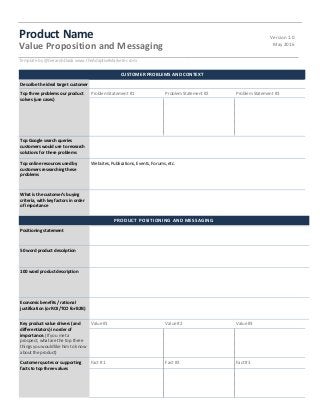
    Product Name Value Propositionand Messaging Version 1.0 May 2016 Template by @GerardoDada www.theAdaptiveMarketer.com CUSTOMER PROBLEMS AND CONTEXT Describe the ideal target customer Top three problems our product solves (use cases) Problem Statement #1 Problem Statement #2 Problem Statement #3 Top Google search queries customers would use to research solutions for these problems Top online resources used by customers researching these problems Websites, Publications, Events, Forums, etc. What is the customer’s buying criteria, with key factors in order of importance PRODUCT POSITIONING AND MESSAGING Positioning statement 50 word product description 100 word product description Economic benefits / rational justification (or ROI/TCO for B2B) Key product value drivers (and differentiators) in order of importance. (If you met a prospect, what are the top three things you would like him to know about the product) Value #1 Value #2 Value #3 Customer quotes or supporting facts to top three values Fact #1 Fact #2 Fact #3
  • 2.
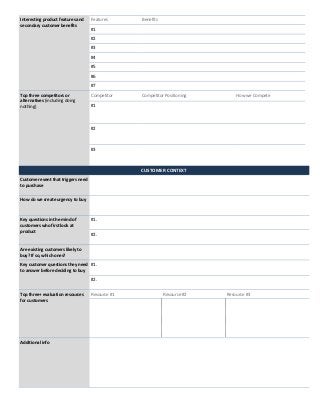
    Interesting product featuresand secondary customer benefits Features Benefits #1 #2 #3 #4 #5 #6 #7 Top three competitors or alternatives (including doing nothing) Competitor Competitor Positioning How we Compete #1 #2 #3 CUSTOMER CONTEXT Customer event that triggers need to purchase How do we create urgency to buy Key questions in the mind of customers who first look at product #1. #2. Are existing customers likely to buy? If so, which ones? Key customer questions they need to answer before deciding to buy #1. #2. Top three+ evaluation resources for customers Resource #1 Resource #2 Resource #3 Additional info
  • 3.
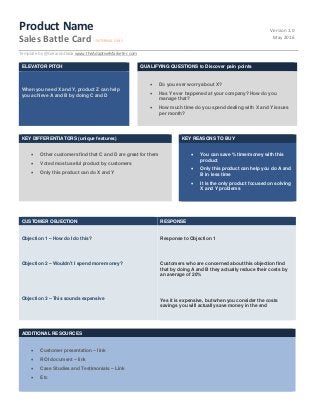
    Product Name Sales BattleCard –INTERNAL ONLY- Version 1.0 May 2016 Template by @GerardoDada www.theAdaptiveMarketer.com ELEVATOR PITCH QUALIFYING QUESTIONS to Discover pain points When you need X and Y, product Z can help you achieve A and B by doing C and D  Do you ever worry about X?  Has Y ever happened at your company? How do you manage that?  How much time do you spend dealing with X and Y issues per month? KEY DIFFERENTIATORS (unique features) KEY REASONS TO BUY  Other customers find that C and D are great for them  Voted most useful product by customers  Only this product can do X and Y  You can save % time/money with this product  Only this product can help you do A and B in less time  It is the only product focused on solving X and Y problems CUSTOMER OBJECTION RESPONSE Objection 1 – How do I do this? Objection 2 – Wouldn’t I spend more money? Objection 3 – This sounds expensive Response to Objection 1 Customers who are concerned about this objection find that by doing A and B they actually reduce their costs by an average of 20% Yes it is expensive, but when you consider the costs savings you will actually save money in the end ADDITIONAL RESOURCES  Customer presentation – link  ROI document – link  Case Studies and Testimonials – Link  Etc