Award 1949 Newbery Honor ALA Notable Book Book One of  “ Three Tales of My  Father's Dragon”
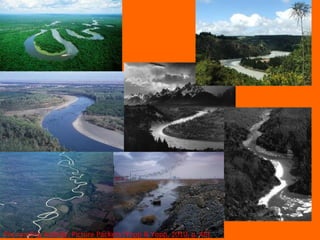
Pre-reading Activity: Picture Packets (Yopp & Yopp, 2010, p. 46)
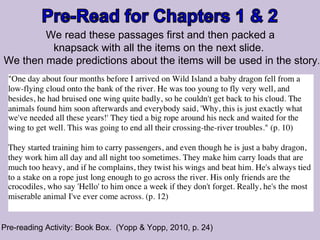
Pre-reading Activity: Book Box.  (Yopp & Yopp, 2010, p. 24) We read these passages first and then packed a knapsack with all the items on the next slide.  We then made predictions about how they will be used in the story .
Pre-reading Activity: Book Box.  (Yopp & Yopp, 2010, p. 24) We read these passages first and then packed a  knapsack with all the items on the next slide.  We then made predictions about the items will be used in the story .
Pre-reading Activity: Book Box.  (Yopp & Yopp, 2010, p. 24)
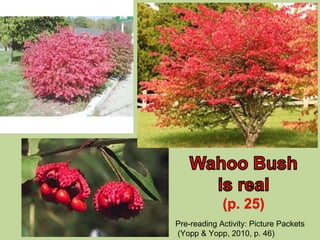
Pre-reading Activity: Picture Packets  (Yopp & Yopp, 2010, p. 46)
Pre-reading Activity: Picture Packets (Yopp & Yopp, 2010, p. 46)
a person who evokes boredom; cause to be bored 2. tidal bore: a high wave (often dangerous) caused by tidal flow (as by colliding tidal currents) 3. diameter of a tube or gun barrel 4. make a hole, especially with a pointed power or hand tool;  “bees are boring holes into the wall” 5. wild swine having a narrow body and prominent tusks from which most domestic swine come 6. a crude uncouth ill-bred person lacking culture or refinement
Turtle Tortoise 1. smaller 2. lives in water  comes land to  warm in the sun 3. have flippers 1. both dirty 1 bigger shell. 2 both green. 2. lives only on land 3. both lay eggs 3. have claws to dig in dirt Post-reading Activity [used During reading] Venn Diagram  (Yopp & Yopp, 2010, pp.115-117)
All turtles and tortoises are reptiles.  They all have scales, lay eggs, and are ectothermic (a cold-blooded animal; that is, an animal whose body temperature varies with the temperature of its surroundings. Ectotherms cannot produce their own body heat.)  So why the different names?  Those common names usually refer to differences in where the species live and how they use their habitat . Turtle— Spends most of its life in the water. Turtles tend to have webbed feet for swimming.  Sea turtles (Cheloniidae family) are especially adapted for an aquatic life, with long feet that form flippers and a streamlined body shape. They rarely leave the ocean, except when the females come ashore to lay their eggs. Other turtles live in fresh water, like ponds and lakes. They swim, but they also climb out onto banks, logs, or rocks to bask in the sun. In cold  weather, they may burrow into the mud, where they go into torpor until spring brings warm weather again.  Tortoise— A land-dweller that eats low-growing shrubs, grasses, and even cactus. Tortoises do not have webbed feet. Their feet are round and stumpy for walking on land. Tortoises that live in hot, dry habitats use their strong legs to dig burrows. Then, when it’s too hot in the sun, they slip underground.
Orange Tangerine 1. bigger 2. thicker peel 3. I like it better to eat because no seeds  1. taste sweet 1. seeds 2. both orange 2. smaller and dirty 3. smell the same 3. thin peel like paper Post-reading Activity [used During reading] Venn Diagram  (Yopp & Yopp, 2010, pp.115-117)
Pre-reading Activity: Picture Packets  [video clips] (Yopp & Yopp, 2010, p. 46)

Activate background knowledge "My Father's Dragon"

  • 1.
    Award 1949 NewberyHonor ALA Notable Book Book One of “ Three Tales of My Father's Dragon”
  • 2.
    Pre-reading Activity: PicturePackets (Yopp & Yopp, 2010, p. 46)
  • 3.
    Pre-reading Activity: PicturePackets (Yopp & Yopp, 2010, p. 46)
  • 4.
    Pre-reading Activity: PicturePackets (Yopp & Yopp, 2010, p. 46)
  • 5.
    Pre-reading Activity: PicturePackets (Yopp & Yopp, 2010, p. 46)
  • 6.
    Pre-reading Activity: PicturePackets (Yopp & Yopp, 2010, p. 46)
  • 7.
    Pre-reading Activity: PicturePackets (Yopp & Yopp, 2010, p. 46)
  • 8.
    Pre-reading Activity: PicturePackets (Yopp & Yopp, 2010, p. 46)
  • 9.
    Pre-reading Activity: BookBox. (Yopp & Yopp, 2010, p. 24) We read these passages first and then packed a knapsack with all the items on the next slide. We then made predictions about how they will be used in the story .
  • 10.
    Pre-reading Activity: BookBox. (Yopp & Yopp, 2010, p. 24) We read these passages first and then packed a knapsack with all the items on the next slide. We then made predictions about the items will be used in the story .
  • 11.
    Pre-reading Activity: BookBox. (Yopp & Yopp, 2010, p. 24)
  • 12.
    Pre-reading Activity: PicturePackets (Yopp & Yopp, 2010, p. 46)
  • 13.
    Pre-reading Activity: PicturePackets (Yopp & Yopp, 2010, p. 46)
  • 14.
    a person whoevokes boredom; cause to be bored 2. tidal bore: a high wave (often dangerous) caused by tidal flow (as by colliding tidal currents) 3. diameter of a tube or gun barrel 4. make a hole, especially with a pointed power or hand tool; “bees are boring holes into the wall” 5. wild swine having a narrow body and prominent tusks from which most domestic swine come 6. a crude uncouth ill-bred person lacking culture or refinement
  • 15.
    Turtle Tortoise 1.smaller 2. lives in water comes land to warm in the sun 3. have flippers 1. both dirty 1 bigger shell. 2 both green. 2. lives only on land 3. both lay eggs 3. have claws to dig in dirt Post-reading Activity [used During reading] Venn Diagram (Yopp & Yopp, 2010, pp.115-117)
  • 16.
    All turtles andtortoises are reptiles. They all have scales, lay eggs, and are ectothermic (a cold-blooded animal; that is, an animal whose body temperature varies with the temperature of its surroundings. Ectotherms cannot produce their own body heat.) So why the different names? Those common names usually refer to differences in where the species live and how they use their habitat . Turtle— Spends most of its life in the water. Turtles tend to have webbed feet for swimming. Sea turtles (Cheloniidae family) are especially adapted for an aquatic life, with long feet that form flippers and a streamlined body shape. They rarely leave the ocean, except when the females come ashore to lay their eggs. Other turtles live in fresh water, like ponds and lakes. They swim, but they also climb out onto banks, logs, or rocks to bask in the sun. In cold weather, they may burrow into the mud, where they go into torpor until spring brings warm weather again. Tortoise— A land-dweller that eats low-growing shrubs, grasses, and even cactus. Tortoises do not have webbed feet. Their feet are round and stumpy for walking on land. Tortoises that live in hot, dry habitats use their strong legs to dig burrows. Then, when it’s too hot in the sun, they slip underground.
  • 17.
    Orange Tangerine 1.bigger 2. thicker peel 3. I like it better to eat because no seeds 1. taste sweet 1. seeds 2. both orange 2. smaller and dirty 3. smell the same 3. thin peel like paper Post-reading Activity [used During reading] Venn Diagram (Yopp & Yopp, 2010, pp.115-117)
  • 18.
    Pre-reading Activity: PicturePackets [video clips] (Yopp & Yopp, 2010, p. 46)

Editor's Notes

  • #3 Pre-reading Activity: Picture Packets. (Yopp & Yopp, 2010, p. 46)
  • #4 Pre-reading Activity: Picture Packets. (Yopp & Yopp, 2010, p. 46)
  • #5 Pre-reading Activity: Picture Packets. (Yopp & Yopp, 2010, p. 46)
  • #6 Pre-reading Activity: Picture Packets. (Yopp & Yopp, 2010, p. 46)
  • #7 Pre-reading Activity: Picture Packets. (Yopp & Yopp, 2010, p. 46)
  • #8 Pre-reading Activity: Picture Packets. (Yopp & Yopp, 2010, p. 46)
  • #9 Pre-reading Activity: Picture Packets. (Yopp & Yopp, 2010, p. 46)
  • #10 Pre-reading Activity: Book Box. (Yopp & Yopp, 2010, p. 24)
  • #11 Pre-reading Activity: Book Box. (Yopp & Yopp, 2010, p. 24)
  • #12 Pre-reading Activity: Book Box. (Yopp & Yopp, 2010, p. 24)
  • #15 Vocabulary Strategy: A self designed strategy that combines a think aloud with word selection based on context.