“The Doctor”
A commentary on Luke Fields painting,
“the Doctor”
Farhad Zargari, MD, PhD
Biography
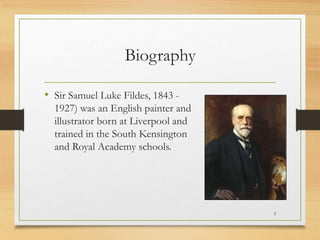
• Sir Samuel Luke Fildes, 1843 -
1927) was an English painter and
illustrator born at Liverpool and
trained in the South Kensington
and Royal Academy schools.
2
Biography
• Fildes shared his grandmother's concern for the poor
and in 1869 joined the staff of The Graphic
newspaper.
3
Biography
• Fildes' illustrations were in the black-and-white style
popular in France and Germany. He worked in a
social realist style, and focused on images about
living conditions in London.
4
Biography
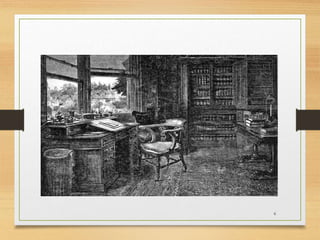
• The Graphic published an illustration completed by
Fildes the day after Charles Dickens' death, showing
Dickens' empty chair in his study; this illustration was
widely reprinted worldwide.
5
6
Biography
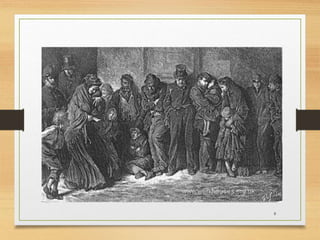
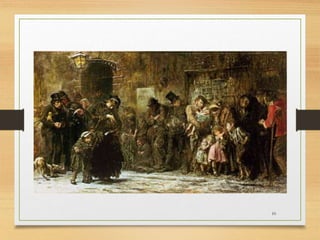
• In the first edition of The Graphic newspaper that
appeared in December 1869, Luke Fildes was asked
to provide an illustration to accompany an article on
the Houseless Poor Act. The picture produced by
Fildes showed a line of homeless people applying for
tickets to stay overnight in the workhouse.
7
8
Biography
• Fildes soon became a popular artist and by 1870 he
had given up working for The Graphic and had
turned his full attention to oil painting. He took rank
among the ablest English painters.
9
10
11
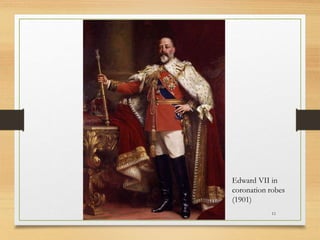
Edward VII in
coronation robes
(1901)
12
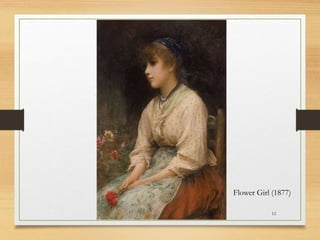
Flower Girl (1877)
“The Doctor”
13
14
The Doctor
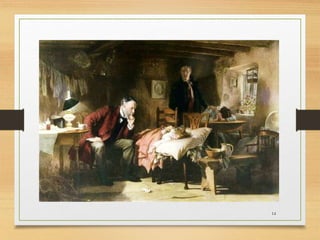
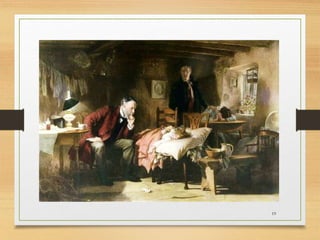
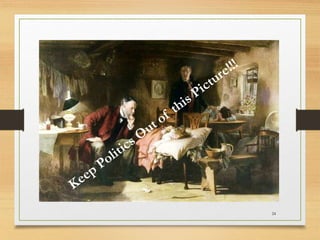
• Fildes' celebrated 1887 work, The Doctor, depicts a
Victorian GP on a home visit. He is watching over an
impoverished laborer's sick child; the bed is
makeshift, two non-matching chairs pushed together.
The central figure is the imposing male doctor,
gazing intently at his patient, while in the background
the father looks on helplessly his hand on the
shoulders of his tearful wife.
15
The Doctor
• The Doctor, shows a GP on a home visit. He is
watching over a worker’s sick child; the bed is
makeshift, two non-matching chairs pushed together.
The main figure is the doctor, gazing intently at his
patient, while in the background the father stands
worried with his hand on the shoulders of his tearful
wife.
16
The Doctor
• Different stories exist about the origins of the
painting. It may have been inspired by the death of
Fildes' eldest son, Phillip, who died on Christmas
morning 1877, attended by a Dr Murray, who
impressed Fildes with the care and attention he gave
to his dying child.
17
The Doctor
• The painting shows how humanistically the doctor is
watching his patient with kindness, affection and
attention.
18
19
The picture received much praise
from contemporary critics:
• British Medical Journal in 1892:
20
“ What do we not owe to Mr Fildes for showing the world
the typical doctor, as we would like to be shown — an
honest man and a gentleman, doing his best to relieve
suffering?”
Mitchell Banks, MD, FRCS, 1893,
Professor of Anatomy, Royal Infirmary, Liverpool
• “A library of books written in our honor would not
do what this picture has…”
• “Remember always to hold before you the ideal
figure of Luke Fields picture, and be at once
gentlemen and gentle doctors.”
21
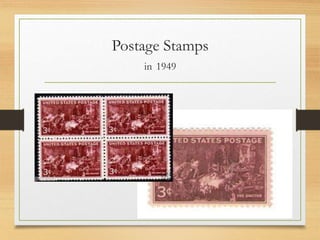
Postage Stamps
in 1949
22
The Doctor in AMA Campaign
• In 1949 Fildes' painting, The Doctor, was used by the
American Medical Association in a campaign not to
politicize the Medicine.
23
24
The Lancet
July 1998
• In July 1998, The Lancet reproduced the painting to
mark the anniversary of the National Health Service
in the UK.
25
The Missing Part of Today’s
Medicine
26
Dr. Brody
Family Med. Magazine, Sep 1998
• Medical practice is more the maintenance of a
network of human relationships than the application
of scientific knowledge.
27
History and Physical Exam
• The medical technology predisposed doctors to the
negligence of due attention to their patients.
Financial issues made the situation even worse. The
typical doctor of today depends more on test results,
imaging and other paraclinical procedures than
medical history and physical examination.
28
New Testament
• “I was ill and you cared for me.” Matthew 25:30
29
Holy Quran
• And whoever saves one - it is as if he had saved
mankind entirely. 5:32
30
Dr. Hogarth:
• “… as long as medical treatment has been a
commodity to be bought and sold, the quality of
treatment has varied according to the social status of
patients”
31
32
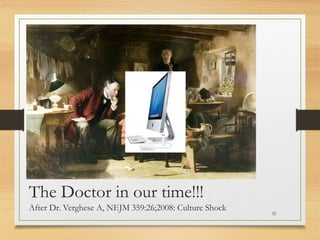
The Doctor in our time!!!
After Dr. Verghese A, NEJM 359:26;2008: Culture Shock
33
• References
• 1. Douglas C. Doing better, looking worse. BMJ. 2002;325:720.
• 2. W Mitchell Banks. Doctors in literature. BMJ. 1892;8:787–788.
• 3. Wilson S. The Tate Gallery, an illustrated companion to the national collections of British & modern art. Millbank, London: Tate Gallery Publications; 1990.
• 4. Burney F. Journals and letters. London: Penguin Classics; 2001.
• 5. Porter R. The greatest benefit to mankind: a medical history of humanity from antiquity to the present. London: Fontana; 1997.
• 6. Aronson SH. The Lancet on the telephone 1876–1975. Med Hist. 1977;21(1):69–87. [PMC free article] [PubMed]
• 7. Hawkes Nigel. The Times. Failings in out-of-hours GP care ‘will claim more victims’. http://www.timesonline.co.uk/tol/news/uk/health/article1843039.ece (accessed 1 Feb
2008)
• 8. Hogarth S, Marks L. The golden narrative in British medicine. In: Greenhalgh T, Hurwitz B, editors. Narrative based medicine: dialogue and discourse in clinical practice.
London: BMJ Books; 1998. p. 142.
• 9. Rendell R. Introduction to Dr Thorne (first published 1858) London: Penguin Books; 2004.
• 10. Wilson S. Tate Gallery: an illustrated companion. Millbank: Tate Gallery Publications; 1990.
• 11. Nochlin L. Realism. London: Penguin Books; 1971.
• 12. Borsay A. The Doctor — an interlude.’. Swansea, University of Wales: MA Medical Humanities Course; 2005.
• 13. Downie RS. The healing arts. Oxford: Oxford University Press; 1994.
• 14. Jewson ND. The disappearance of the sick man from medical cosmology. Sociology. 1976;10:225–244.
• 15. Foucault M. The birth of the clinic. London: Routledge Classics; 1973.
• 16. The Medical Register. London: General Medical Council;
• 17. Graham H. Understanding health inequalities. Buckingham, London: Oxford University Press; 2000.
• 18. Illich I. Limits to medicine: medical nemesis — the expropriation of health. London: Marion Boyars; 1976.
• 19. Friedson E. The profession of medicine: a study of the sociology of applied knowledge. New York: Dodd, Mead; 1970.
• 20. Hobsbawm E. The new century. London: Little, Brown; 2000.
• 21. Camp J. The healers art. New York: Taplinger Publishing Co.; 1977.
• 22. Stuttaford Thomas. The Times. Brought forth in pain and sorrow. http://www.timesonline.co.uk/tol/life_and_style/health/features/article1882303.ece (accessed 1 Feb 2008)
• 23. MORI poll. Opinion of professions. London: Ipsos Mori; 2005.
Thank You For Your Attention
34

Luke Fields, the Doctor

  • 1.
    “The Doctor” A commentaryon Luke Fields painting, “the Doctor” Farhad Zargari, MD, PhD
  • 2.
    Biography • Sir SamuelLuke Fildes, 1843 - 1927) was an English painter and illustrator born at Liverpool and trained in the South Kensington and Royal Academy schools. 2
  • 3.
    Biography • Fildes sharedhis grandmother's concern for the poor and in 1869 joined the staff of The Graphic newspaper. 3
  • 4.
    Biography • Fildes' illustrationswere in the black-and-white style popular in France and Germany. He worked in a social realist style, and focused on images about living conditions in London. 4
  • 5.
    Biography • The Graphicpublished an illustration completed by Fildes the day after Charles Dickens' death, showing Dickens' empty chair in his study; this illustration was widely reprinted worldwide. 5
  • 6.
  • 7.
    Biography • In thefirst edition of The Graphic newspaper that appeared in December 1869, Luke Fildes was asked to provide an illustration to accompany an article on the Houseless Poor Act. The picture produced by Fildes showed a line of homeless people applying for tickets to stay overnight in the workhouse. 7
  • 8.
  • 9.
    Biography • Fildes soonbecame a popular artist and by 1870 he had given up working for The Graphic and had turned his full attention to oil painting. He took rank among the ablest English painters. 9
  • 10.
  • 11.
  • 12.
  • 13.
  • 14.
  • 15.
    The Doctor • Fildes'celebrated 1887 work, The Doctor, depicts a Victorian GP on a home visit. He is watching over an impoverished laborer's sick child; the bed is makeshift, two non-matching chairs pushed together. The central figure is the imposing male doctor, gazing intently at his patient, while in the background the father looks on helplessly his hand on the shoulders of his tearful wife. 15
  • 16.
    The Doctor • TheDoctor, shows a GP on a home visit. He is watching over a worker’s sick child; the bed is makeshift, two non-matching chairs pushed together. The main figure is the doctor, gazing intently at his patient, while in the background the father stands worried with his hand on the shoulders of his tearful wife. 16
  • 17.
    The Doctor • Differentstories exist about the origins of the painting. It may have been inspired by the death of Fildes' eldest son, Phillip, who died on Christmas morning 1877, attended by a Dr Murray, who impressed Fildes with the care and attention he gave to his dying child. 17
  • 18.
    The Doctor • Thepainting shows how humanistically the doctor is watching his patient with kindness, affection and attention. 18
  • 19.
  • 20.
    The picture receivedmuch praise from contemporary critics: • British Medical Journal in 1892: 20 “ What do we not owe to Mr Fildes for showing the world the typical doctor, as we would like to be shown — an honest man and a gentleman, doing his best to relieve suffering?”
  • 21.
    Mitchell Banks, MD,FRCS, 1893, Professor of Anatomy, Royal Infirmary, Liverpool • “A library of books written in our honor would not do what this picture has…” • “Remember always to hold before you the ideal figure of Luke Fields picture, and be at once gentlemen and gentle doctors.” 21
  • 22.
  • 23.
    The Doctor inAMA Campaign • In 1949 Fildes' painting, The Doctor, was used by the American Medical Association in a campaign not to politicize the Medicine. 23
  • 24.
  • 25.
    The Lancet July 1998 •In July 1998, The Lancet reproduced the painting to mark the anniversary of the National Health Service in the UK. 25
  • 26.
    The Missing Partof Today’s Medicine 26
  • 27.
    Dr. Brody Family Med.Magazine, Sep 1998 • Medical practice is more the maintenance of a network of human relationships than the application of scientific knowledge. 27
  • 28.
    History and PhysicalExam • The medical technology predisposed doctors to the negligence of due attention to their patients. Financial issues made the situation even worse. The typical doctor of today depends more on test results, imaging and other paraclinical procedures than medical history and physical examination. 28
  • 29.
    New Testament • “Iwas ill and you cared for me.” Matthew 25:30 29
  • 30.
    Holy Quran • Andwhoever saves one - it is as if he had saved mankind entirely. 5:32 30
  • 31.
    Dr. Hogarth: • “…as long as medical treatment has been a commodity to be bought and sold, the quality of treatment has varied according to the social status of patients” 31
  • 32.
    32 The Doctor inour time!!! After Dr. Verghese A, NEJM 359:26;2008: Culture Shock
  • 33.
    33 • References • 1.Douglas C. Doing better, looking worse. BMJ. 2002;325:720. • 2. W Mitchell Banks. Doctors in literature. BMJ. 1892;8:787–788. • 3. Wilson S. The Tate Gallery, an illustrated companion to the national collections of British & modern art. Millbank, London: Tate Gallery Publications; 1990. • 4. Burney F. Journals and letters. London: Penguin Classics; 2001. • 5. Porter R. The greatest benefit to mankind: a medical history of humanity from antiquity to the present. London: Fontana; 1997. • 6. Aronson SH. The Lancet on the telephone 1876–1975. Med Hist. 1977;21(1):69–87. [PMC free article] [PubMed] • 7. Hawkes Nigel. The Times. Failings in out-of-hours GP care ‘will claim more victims’. http://www.timesonline.co.uk/tol/news/uk/health/article1843039.ece (accessed 1 Feb 2008) • 8. Hogarth S, Marks L. The golden narrative in British medicine. In: Greenhalgh T, Hurwitz B, editors. Narrative based medicine: dialogue and discourse in clinical practice. London: BMJ Books; 1998. p. 142. • 9. Rendell R. Introduction to Dr Thorne (first published 1858) London: Penguin Books; 2004. • 10. Wilson S. Tate Gallery: an illustrated companion. Millbank: Tate Gallery Publications; 1990. • 11. Nochlin L. Realism. London: Penguin Books; 1971. • 12. Borsay A. The Doctor — an interlude.’. Swansea, University of Wales: MA Medical Humanities Course; 2005. • 13. Downie RS. The healing arts. Oxford: Oxford University Press; 1994. • 14. Jewson ND. The disappearance of the sick man from medical cosmology. Sociology. 1976;10:225–244. • 15. Foucault M. The birth of the clinic. London: Routledge Classics; 1973. • 16. The Medical Register. London: General Medical Council; • 17. Graham H. Understanding health inequalities. Buckingham, London: Oxford University Press; 2000. • 18. Illich I. Limits to medicine: medical nemesis — the expropriation of health. London: Marion Boyars; 1976. • 19. Friedson E. The profession of medicine: a study of the sociology of applied knowledge. New York: Dodd, Mead; 1970. • 20. Hobsbawm E. The new century. London: Little, Brown; 2000. • 21. Camp J. The healers art. New York: Taplinger Publishing Co.; 1977. • 22. Stuttaford Thomas. The Times. Brought forth in pain and sorrow. http://www.timesonline.co.uk/tol/life_and_style/health/features/article1882303.ece (accessed 1 Feb 2008) • 23. MORI poll. Opinion of professions. London: Ipsos Mori; 2005.
  • 34.
    Thank You ForYour Attention 34