Treating Gum
Problems
Keeping your teeth healthy depends
on the actions you take every day.
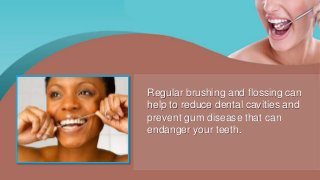
Regular brushing and flossing can
help to reduce dental cavities and
prevent gum disease that can
endanger your teeth.
Scheduling regular visits to family
dentists can help individuals prevent
tooth loss caused by gum disease
and help preserve their healthy
smiles.
Importance of Healthy Gums
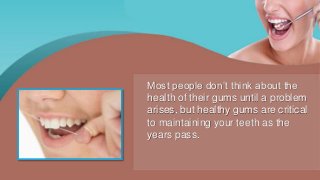
Most people don’t think about the
health of their gums until a problem
arises, but healthy gums are critical
to maintaining your teeth as the
years pass.
A healthy diet, regular brushing
and flossing and periodic dental
checkups can help to prevent
gingivitis and other gum
problems.
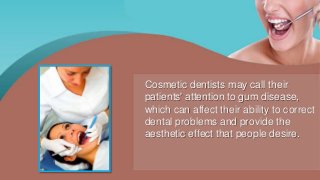
Cosmetic dentists may call their
patients' attention to gum disease,
which can affect their ability to correct
dental problems and provide the
aesthetic effect that people desire.
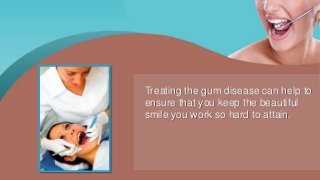
Treating the gum disease can help to
ensure that you keep the beautiful
smile you work so hard to attain.
Nonsurgical Treatments
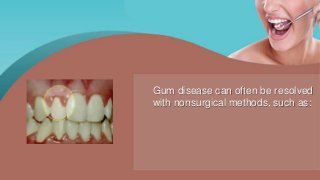
Gum disease can often be resolved
with nonsurgical methods, such as:
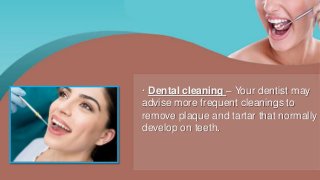
· Dental cleaning – Your dentist may
advise more frequent cleanings to
remove plaque and tartar that normally
develop on teeth.
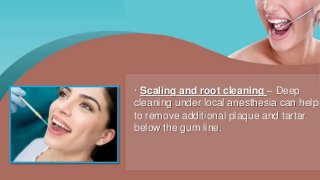
· Scaling and root cleaning – Deep
cleaning under local anesthesia can help
to remove additional plaque and tartar
below the gum line.
· Antibiotic treatment – Your dentist may
prescribe a course of antibiotics to reduce the
amount of bacteria in the gums that is causing
inflammation. Doxycycline, tetracycline and
minocycline are used for this purpose.
· Prescription mouth rinse –
Chlorhexidine is a liquid anti-
microbial medication that can be
used as a mouth rinse to treat gum
disease.
· Special toothpastes – You can
purchase special, non-
prescription toothpastes that
contain fluoride and triclosan to
help treat gum disease.
Surgical Treatments
A number of surgical treatments can
help resolve problems from gum
disease:
· Pocket reduction/flap surgery –
In this method, the pockets around
the base of the teeth are pulled back
and tartar is removed.
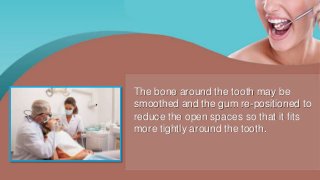
The bone around the tooth may be
smoothed and the gum re-positioned to
reduce the open spaces so that it fits
more tightly around the tooth.
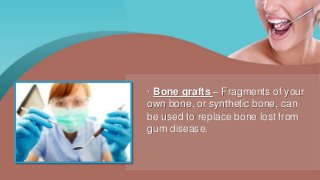
· Bone grafts – Fragments of your
own bone, or synthetic bone, can
be used to replace bone lost from
gum disease.
The graft then serves as a base
for your own normal bone
growth.
· Soft tissue grafts – Tissue from the
roof of the mouth can be removed and
re-positioned on gums to add tissue to
support the teeth.
· Guided tissue regeneration – This
is a process that stimulates the growth
of bone tissue and soft tissue.
It uses a mesh-like fabric onto which
cells can grow. The new tissue then
helps to support teeth.
· Bone surgery – This type of
surgery is used to decrease the
depth of craters that develop in
advanced bone loss.
The reshaped bone makes it harder
for bacteria to grow in the spaces.
With regular exams and daily
care, you can prevent gum
disease and ensure that your
teeth have the support they need
to last a lifetime.
Talk to your dentist about gum
health to get the best advice about
taking care of your smile.
If you are seeking professional
dental advice, it's time to call
Shumway Dental Care.
Their Chandler dentists will ask you
questions, examine you, and
determine exactly what needs to be
done to get you back to normal.
Call today for an appointment.
Visit
www.shumwaydental.com
3150 S Gilbert Rd Suite 1
Chandler, AZ 85286
(480) 659-7800

Treating Gum Problems

  • 1.
  • 2.
    Keeping your teethhealthy depends on the actions you take every day.
  • 3.
    Regular brushing andflossing can help to reduce dental cavities and prevent gum disease that can endanger your teeth.
  • 4.
    Scheduling regular visitsto family dentists can help individuals prevent tooth loss caused by gum disease and help preserve their healthy smiles.
  • 5.
  • 6.
    Most people don’tthink about the health of their gums until a problem arises, but healthy gums are critical to maintaining your teeth as the years pass.
  • 7.
    A healthy diet,regular brushing and flossing and periodic dental checkups can help to prevent gingivitis and other gum problems.
  • 8.
    Cosmetic dentists maycall their patients' attention to gum disease, which can affect their ability to correct dental problems and provide the aesthetic effect that people desire.
  • 9.
    Treating the gumdisease can help to ensure that you keep the beautiful smile you work so hard to attain.
  • 10.
  • 11.
    Gum disease canoften be resolved with nonsurgical methods, such as:
  • 12.
    · Dental cleaning– Your dentist may advise more frequent cleanings to remove plaque and tartar that normally develop on teeth.
  • 13.
    · Scaling androot cleaning – Deep cleaning under local anesthesia can help to remove additional plaque and tartar below the gum line.
  • 14.
    · Antibiotic treatment– Your dentist may prescribe a course of antibiotics to reduce the amount of bacteria in the gums that is causing inflammation. Doxycycline, tetracycline and minocycline are used for this purpose.
  • 15.
    · Prescription mouthrinse – Chlorhexidine is a liquid anti- microbial medication that can be used as a mouth rinse to treat gum disease.
  • 16.
    · Special toothpastes– You can purchase special, non- prescription toothpastes that contain fluoride and triclosan to help treat gum disease.
  • 17.
  • 18.
    A number ofsurgical treatments can help resolve problems from gum disease:
  • 19.
    · Pocket reduction/flapsurgery – In this method, the pockets around the base of the teeth are pulled back and tartar is removed.
  • 20.
    The bone aroundthe tooth may be smoothed and the gum re-positioned to reduce the open spaces so that it fits more tightly around the tooth.
  • 21.
    · Bone grafts– Fragments of your own bone, or synthetic bone, can be used to replace bone lost from gum disease.
  • 22.
    The graft thenserves as a base for your own normal bone growth.
  • 23.
    · Soft tissuegrafts – Tissue from the roof of the mouth can be removed and re-positioned on gums to add tissue to support the teeth.
  • 24.
    · Guided tissueregeneration – This is a process that stimulates the growth of bone tissue and soft tissue.
  • 25.
    It uses amesh-like fabric onto which cells can grow. The new tissue then helps to support teeth.
  • 26.
    · Bone surgery– This type of surgery is used to decrease the depth of craters that develop in advanced bone loss.
  • 27.
    The reshaped bonemakes it harder for bacteria to grow in the spaces.
  • 28.
    With regular examsand daily care, you can prevent gum disease and ensure that your teeth have the support they need to last a lifetime.
  • 29.
    Talk to yourdentist about gum health to get the best advice about taking care of your smile.
  • 30.
    If you areseeking professional dental advice, it's time to call Shumway Dental Care.
  • 31.
    Their Chandler dentistswill ask you questions, examine you, and determine exactly what needs to be done to get you back to normal.
  • 32.
    Call today foran appointment.
  • 33.
  • 34.
    3150 S GilbertRd Suite 1 Chandler, AZ 85286 (480) 659-7800