Seamless Pipe & Welded
Pipe
Pipes are usually produced by two distinct
methods which result in either a welded
pipe or a seamless pipe. In both methods,
raw material is first cast into ingots. It is
then made into a pipe by stretching the
steel out into a seamless tube or forcing
the edges together and sealing them with
a weld.
Seamless Pipe and Tube
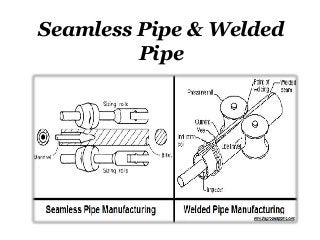
Seamless pipe, as the name suggests, is a
pipe without a seam or a weld-joint.
Seamless Steel Pipe is made from a solid
round steel ‘billet’ which is heated and
pushed or pulled over a form until the
steel is shaped into a hollow pipe. The
hollow pipe is then extruded through a die
and mandrel combination to reduce the
outside diameter and to expand the inside
diameter.
Welded Pipe and Tube
Welded pipe is manufactured by rolling metal sheet
and then welding it longitudinally across its
length. The welded pipe manufacturing process
begins with the rolling of a steel coil to the desired
gauge thickness to form a flat strip. The flat strip
is cut to the width that corresponds with the size
of the pipe to be produced. The pipe is formed by
moving the cut coil through a series of rollers,
and the seam of the tube is then welded in a
chemically neutral environment. In a welded
pipe, the seam or the weld-joint is the weaker
part of the pipe limiting the strength of the pipe to
the strength of the weld-joint.
Difference between Seamless
& Welded Pipes and Tubes
• Seamless pipes don’t have a weld seam. Traditionally, the seam of
welded pipes has been viewed as a weak spot, vulnerable to failure
and corrosion. However, improvements in the manufacturing
process for welded pipes have increased the strength and
performance of the weld seam. Still seamless pipes prevent any
possibility of a weak seam. In general, welded steel pipes can
withhold 20% less working pressure than seamless ones.
• Seamless pipes has higher working pressures compared to welded
pipes of the same material and size due to having no welded seam.
• Seamless pipes offers superior corrosion resistance because it has
little potential for impurities, defects and differences in malleability
that may be associated with the welded area in welded pipe.
• Seamless pipes do not require testing for weld integrity. This is a
must for welded pipes.
• Seamless pipes harden as they are manufactured, so heat
treatment after manufacturing is not required. Most welded pipes
require heat treatment after manufacturing.
• The cost of welded pipes is less expensive than seamless pipes
and is readily available in long continuous lengths.
• Seamless pipes can be substituted for welded pipe but welded
pipes may not always be able to be substituted for seamless
pipe due to the weld seam.
• The wall thickness of welded pipes is generally more
consistent than that of seamless pipes. Its easier to get a
uniform thick flat strip and produce a welded pipe than
drawing a uniformly thick seamless pipe through extrusion.
Also welded pipes surface finish quality is much better than
seamless pipes.
• Longer procurement lead time is required for seamless pipes
as compared to welded pipes.
•

Seamless Pipe & Welded Pipe

  • 1.
    Seamless Pipe &Welded Pipe
  • 2.
    Pipes are usuallyproduced by two distinct methods which result in either a welded pipe or a seamless pipe. In both methods, raw material is first cast into ingots. It is then made into a pipe by stretching the steel out into a seamless tube or forcing the edges together and sealing them with a weld.
  • 3.
    Seamless Pipe andTube Seamless pipe, as the name suggests, is a pipe without a seam or a weld-joint. Seamless Steel Pipe is made from a solid round steel ‘billet’ which is heated and pushed or pulled over a form until the steel is shaped into a hollow pipe. The hollow pipe is then extruded through a die and mandrel combination to reduce the outside diameter and to expand the inside diameter.
  • 4.
    Welded Pipe andTube Welded pipe is manufactured by rolling metal sheet and then welding it longitudinally across its length. The welded pipe manufacturing process begins with the rolling of a steel coil to the desired gauge thickness to form a flat strip. The flat strip is cut to the width that corresponds with the size of the pipe to be produced. The pipe is formed by moving the cut coil through a series of rollers, and the seam of the tube is then welded in a chemically neutral environment. In a welded pipe, the seam or the weld-joint is the weaker part of the pipe limiting the strength of the pipe to the strength of the weld-joint.
  • 5.
    Difference between Seamless &Welded Pipes and Tubes • Seamless pipes don’t have a weld seam. Traditionally, the seam of welded pipes has been viewed as a weak spot, vulnerable to failure and corrosion. However, improvements in the manufacturing process for welded pipes have increased the strength and performance of the weld seam. Still seamless pipes prevent any possibility of a weak seam. In general, welded steel pipes can withhold 20% less working pressure than seamless ones. • Seamless pipes has higher working pressures compared to welded pipes of the same material and size due to having no welded seam. • Seamless pipes offers superior corrosion resistance because it has little potential for impurities, defects and differences in malleability that may be associated with the welded area in welded pipe. • Seamless pipes do not require testing for weld integrity. This is a must for welded pipes. • Seamless pipes harden as they are manufactured, so heat treatment after manufacturing is not required. Most welded pipes require heat treatment after manufacturing.
  • 6.
    • The costof welded pipes is less expensive than seamless pipes and is readily available in long continuous lengths. • Seamless pipes can be substituted for welded pipe but welded pipes may not always be able to be substituted for seamless pipe due to the weld seam. • The wall thickness of welded pipes is generally more consistent than that of seamless pipes. Its easier to get a uniform thick flat strip and produce a welded pipe than drawing a uniformly thick seamless pipe through extrusion. Also welded pipes surface finish quality is much better than seamless pipes. • Longer procurement lead time is required for seamless pipes as compared to welded pipes. •