Samira Afzal, Farzad Tashtarian, Hamid Hadian, Alireza Erfanian, Christian Timmerer, and Radu Prodan
Institute of Information Technology (ITEC), Alpen-Adria-Universität Austria
samira.afzal@aau.at | https://athena.itec.aau.at/
OTEC: An Optimized Transcoding Task Scheduler for
Cloud and Fog Environments
APOLLO
1
Agenda
Motivation and main
objectives
OTEC
Evaluated results
Conclusion
Motivation and Main Objectives
Video streaming is a significant part of the current network traffic
Computationally intensive
Costly
Time-consuming
Video encoding is
Minimizing cost and/or minimizing encoding time
Making a trade-off between encoding time and cost
Considering encoding time deadline and cost limit
To select Cloud/Fog resources for video encoding/transcoding operations,
aiming at:
2
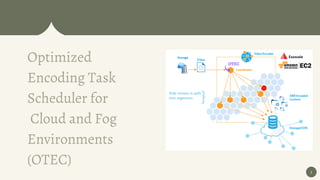
Optimized
Encoding Task
Scheduler for
Cloud and Fog
Environments
(OTEC)
OTEC
3
OTEC Architecture Overview
4
OTEC Architecture Overview
Mixed Integer Linear
Programming (MILP) model
5
Resource Allocation Example
7
Optimization Model
Cluster selection
One cluster per timeslot
Select the required number of instances
Cluster start and end times
Non-overlapping encoding timeslots
Time and cost
Total transcoding time
Total transcoding cost
Sets of constraints:
8
Objective Function
9
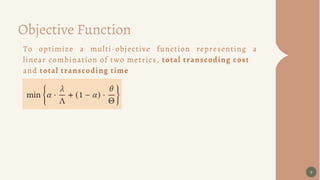
To optimize a multi-objective function representing a
linear combination of two metrics, total transcoding cost 𝜆
and total transcoding time 𝜃
Maximum possible cost
10
Objective Function
To optimize a multi-objective function representing a
linear combination of two metrics, total transcoding cost 𝜆
and total transcoding time 𝜃
Administration priority
𝛼 ∈ [0, 1]
Time-optimized (𝛼 = 0)
Cost-optimized (𝛼 = 1)
Maximum possible
transcoding time
Evaluation
Various administration priorities 𝛼
Various timeslot duration and number
of segments
Various segment transcoding times
11
12
Experimental Infrastructure
Administration Priority
Time-optimized results are 30.5% faster and 24.78% more expensive than the cost-optimized ones.
For 𝛼 = 0.5, there is a tradeoff between the total cost (0.0024 $/s) and transcoding time (6.99 s).
13
Resource Allocation Results
14
Coordinator on a local cloud instance
A four-core Intel core-i7 processor
32 GB of memory
10 segments
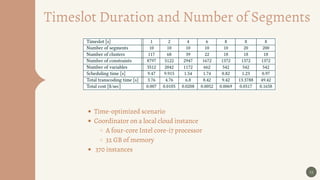
Timeslot Duration and Number of Segments
Time-optimized scenario
Coordinator on a local cloud instance
A four-core Intel core-i7 processor
32 GB of memory
370 instances
15
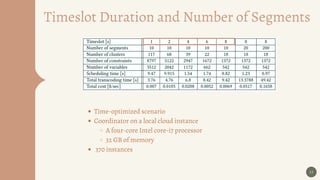
Timeslot Duration and Number of Segments
Time-optimized scenario
Coordinator on a local cloud instance
A four-core Intel core-i7 processor
32 GB of memory
370 instances
16
Timeslot Duration and Number of Segments
Time-optimized scenario
Coordinator on a local cloud instance
A four-core Intel core-i7 processor
32 GB of memory
370 instances
17
Timeslot Duration and Number of Segments
∼2.5 times
15%
Time-optimized scenario
Coordinator on a local cloud instance
A four-core Intel core-i7 processor
32 GB of memory
370 instances
18
Timeslot Duration and Number of Segments
∼5.24 times
Time-optimized scenario
Coordinator on a local cloud instance
A four-core Intel core-i7 processor
32 GB of memory
370 instances
19
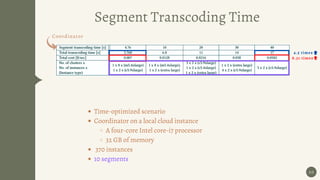
Coordinator
4.5 times
8.31 times
Segment Transcoding Time
Time-optimized scenario
Coordinator on a local cloud instance
A four-core Intel core-i7 processor
32 GB of memory
370 instances
10 segments
20
Conclusions
Proposed OTEC for optimized scheduling of adaptive transcoding processes in
Cloud and Fog environments
Proposed an MILP optimization model
Highlighted factors:
Administrator priorities, such as cost and/or time priorities
Resources priorities, location, type, cost, number of instances for each
resource type
Segment properties, such as duration, number of segments, segment
transcoding time
Evaluated OTEC on a set of Cloud AWS and Fog Exoscale resource instances
Achieved that time-optimized scenarios are 30.5% faster and 24.78% more
expensive than the cost-optimized ones.
21
Thank you
Have a
great day
ahead!
Institute of Information Technology (ITEC) Alpen-Adria-Universität Austria
samira.afzal@aau.at https://itec.aau.at/
APOLLO

OTEC: An Optimized Transcoding Task Scheduler for Cloud and Fog Environments

  • 1.
    Samira Afzal, FarzadTashtarian, Hamid Hadian, Alireza Erfanian, Christian Timmerer, and Radu Prodan Institute of Information Technology (ITEC), Alpen-Adria-Universität Austria samira.afzal@aau.at | https://athena.itec.aau.at/ OTEC: An Optimized Transcoding Task Scheduler for Cloud and Fog Environments APOLLO
  • 2.
  • 3.
    Motivation and MainObjectives Video streaming is a significant part of the current network traffic Computationally intensive Costly Time-consuming Video encoding is Minimizing cost and/or minimizing encoding time Making a trade-off between encoding time and cost Considering encoding time deadline and cost limit To select Cloud/Fog resources for video encoding/transcoding operations, aiming at: 2
  • 4.
    Optimized Encoding Task Scheduler for Cloudand Fog Environments (OTEC) OTEC 3
  • 5.
  • 6.
    OTEC Architecture Overview MixedInteger Linear Programming (MILP) model 5
  • 7.
  • 8.
    Optimization Model Cluster selection Onecluster per timeslot Select the required number of instances Cluster start and end times Non-overlapping encoding timeslots Time and cost Total transcoding time Total transcoding cost Sets of constraints: 8
  • 9.
    Objective Function 9 To optimizea multi-objective function representing a linear combination of two metrics, total transcoding cost 𝜆 and total transcoding time 𝜃
  • 10.
    Maximum possible cost 10 ObjectiveFunction To optimize a multi-objective function representing a linear combination of two metrics, total transcoding cost 𝜆 and total transcoding time 𝜃 Administration priority 𝛼 ∈ [0, 1] Time-optimized (𝛼 = 0) Cost-optimized (𝛼 = 1) Maximum possible transcoding time
  • 11.
    Evaluation Various administration priorities𝛼 Various timeslot duration and number of segments Various segment transcoding times 11
  • 12.
  • 13.
    Administration Priority Time-optimized resultsare 30.5% faster and 24.78% more expensive than the cost-optimized ones. For 𝛼 = 0.5, there is a tradeoff between the total cost (0.0024 $/s) and transcoding time (6.99 s). 13
  • 14.
    Resource Allocation Results 14 Coordinatoron a local cloud instance A four-core Intel core-i7 processor 32 GB of memory 10 segments
  • 15.
    Timeslot Duration andNumber of Segments Time-optimized scenario Coordinator on a local cloud instance A four-core Intel core-i7 processor 32 GB of memory 370 instances 15
  • 16.
    Timeslot Duration andNumber of Segments Time-optimized scenario Coordinator on a local cloud instance A four-core Intel core-i7 processor 32 GB of memory 370 instances 16
  • 17.
    Timeslot Duration andNumber of Segments Time-optimized scenario Coordinator on a local cloud instance A four-core Intel core-i7 processor 32 GB of memory 370 instances 17
  • 18.
    Timeslot Duration andNumber of Segments ∼2.5 times 15% Time-optimized scenario Coordinator on a local cloud instance A four-core Intel core-i7 processor 32 GB of memory 370 instances 18
  • 19.
    Timeslot Duration andNumber of Segments ∼5.24 times Time-optimized scenario Coordinator on a local cloud instance A four-core Intel core-i7 processor 32 GB of memory 370 instances 19
  • 20.
    Coordinator 4.5 times 8.31 times SegmentTranscoding Time Time-optimized scenario Coordinator on a local cloud instance A four-core Intel core-i7 processor 32 GB of memory 370 instances 10 segments 20
  • 21.
    Conclusions Proposed OTEC foroptimized scheduling of adaptive transcoding processes in Cloud and Fog environments Proposed an MILP optimization model Highlighted factors: Administrator priorities, such as cost and/or time priorities Resources priorities, location, type, cost, number of instances for each resource type Segment properties, such as duration, number of segments, segment transcoding time Evaluated OTEC on a set of Cloud AWS and Fog Exoscale resource instances Achieved that time-optimized scenarios are 30.5% faster and 24.78% more expensive than the cost-optimized ones. 21
  • 22.
    Thank you Have a greatday ahead! Institute of Information Technology (ITEC) Alpen-Adria-Universität Austria samira.afzal@aau.at https://itec.aau.at/ APOLLO