Copyright © 2014 Rochester Institute of Technology
UNYCC
Information Security
Discussion
Facilitated by
Rochester Institute of Technology
February 24, 2014
Copyright © 2014 Rochester Institute of Technology
Agenda
• Policy
• Jonathan Maurer, Information Security
Officer
• Security Awareness
• Ben Woelk, Program Manager
• Penetration Testing
• Paul Lepkowski, Enterprise Information
Security Lead Engineer
Copyright © 2014 Rochester Institute of Technology
About RIT
• RIT Environment
– 18,000 students
– 3,500 faculty and
staff
– International
Locations
– ~40,000+ systems on
the network at any
given time
– Very skilled IT
security students
• RIT ISO
– 4 full time
• Information Security
Officer
• Program Manager
• Lead Security Engineer
• Sr. Forensics Investigator
– 4+ student employees
• Mix of coop and part-time
Copyright © 2014 Rochester Institute of Technology
Information
Security Policy
Jonathan Maurer
Information Security Officer
RIT Information Security Office
February 24, 2014
Copyright © 2014 Rochester Institute of Technology
Agenda
• Policy Introduction
• Architecture
• Types of Policies
• Example Components
• Policy Development
• Ingredients
• Processes
• Discussion
Copyright © 2014 Rochester Institute of Technology
Policy Introduction
Copyright © 2014 Rochester Institute of Technology
Policy Introduction
• Policy is the essential foundation of an
effective information security program
• Policy objectives
– Reduced risk
– Compliance with laws and regulations
– Assurance of confidentiality, integrity and
continuity of operations (availability).
• Policies are the least expensive means of
control and often the most difficult to
implement
Copyright © 2014 Rochester Institute of Technology
Policy Considerations
• Basic rules for shaping a policy
– Policy should never conflict with law
– Policy must be able to stand up in court if
challenged
– Policy must be properly and administered
• Policies are important reference documents
– For internal audits
– For the resolution of legal disputes about
management's due diligence
– Policy documents can act as a clear statement of
management's intent
Copyright © 2014 Rochester Institute of Technology
Policy Architecture
• Policies
– Enterprise information security program policy
– Issue-specific information security policies
• Standards
– A more detailed statement of what must be done
to comply with policy
• Practices
– Procedures and guidelines explain how
employees will comply with policy
Copyright © 2014 Rochester Institute of Technology
Policies, Standards, & Practices
Copyright © 2014 Rochester Institute of Technology
Enterprise Information Security
Policy (EISP)
• Sets strategic direction, scope, and tone for
organization’s security efforts
• Assigns responsibilities for various areas of
information security
• Guides development, implementation, and
management requirements of information
security program
Copyright © 2014 Rochester Institute of Technology
Example EISP Components
• Statement of purpose
– An overview of the organizational philosophy on
security
• Information technology security elements
– Defines information security
• Need for information technology security
– Justifies importance of information security in the
organization
• Information technology security responsibilities and roles
– Defines organizational structure
• Reference to other information technology standards and
guidelines
Copyright © 2014 Rochester Institute of Technology
Issue-Specific Security Policy (ISSP)
• Provides detailed, targeted guidance
– Begins with introduction to fundamental
technological philosophy of the organization
– Instructs the organization in secure use of a
technology systems
• Protects organization from inefficiency and ambiguity
– Documents how the technology-based system is
controlled
– Identifies the processes and authorities that
provide this control
• Indemnifies the organization against liability for an
employee’s inappropriate or illegal system use
Copyright © 2014 Rochester Institute of Technology
Example ISSP Components
• Statement of Purpose
– Scope and applicability
– Definition of technology addressed
– Responsibilities
• Authorized Access and Usage of Equipment
– User access
– Fair and responsible use
– Protection of privacy
• Prohibited Usage of Equipment
– Disruptive use or misuse
– Criminal use
– Offensive or harassing materials
– Copyrighted, licensed or other
intellectual property
– Other restrictions
• Systems management
– Management of stored materials
– Employer monitoring
– Virus protection
– Physical security
– Encryption
• Violations of policy
– Procedures for reporting violations
– Penalties for violations
• Policy review and modification
– Scheduled review of policy and
procedures for modification
• Limitations of liability
– Statements of liability or disclaimers
Copyright © 2014 Rochester Institute of Technology
Standards
• A more detailed statement of what must be done to
comply with policy
• Articulate requirements for Technology, People and
Processes
Processes
Copyright © 2014 Rochester Institute of Technology
Practices
• Procedures and guidelines explain how
employees will comply with policy
• Reasons to separate out practices from
standards:
– Needs to be known by a small population
– Requires more frequent change than review
processes allow
– Provides the Information Security Office
professional judgment and discretion
– Protects confidential details from unauthorized
parties
Copyright © 2014 Rochester Institute of Technology
Policy Development
Copyright © 2014 Rochester Institute of Technology
Policy Ingredients
External
• Laws
• Security Standards
• Best Practices
• Benchmarks
Internal
• Governance
• Strategy
• Management
• Environment
• Culture
Policies, Standards and Practices
Copyright © 2014 Rochester Institute of Technology
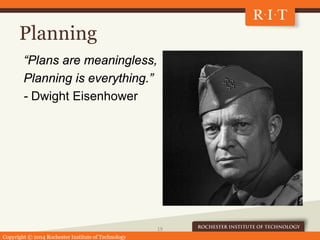
Planning
“Plans are meaningless,
Planning is everything.”
- Dwight Eisenhower
19
Copyright © 2014 Rochester Institute of Technology
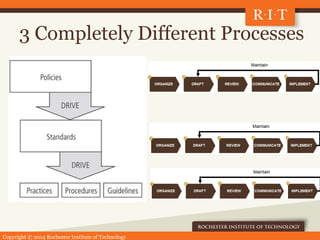
• Revised policies • Educated
community
• Compliance with
policies
• Draft policies• Structure and
team
• Review as dictated
by governance
process
• Identify issues,
gaps and
implications
• Management
Support
• Distribution
mechanisms
• Training &
Awareness
• Resource
prioritization and
allocation
• Impacted
organizations
implement policies
• Determine goals
• Consider
ingredients
• Write policies
ORGANIZE DRAFT REVIEW COMMUNICATE
1 2 3 4
IMPLEMENT
5
• Develop
governance
process
• Clarify roles and
responsibilities
• Fill roles with key
stakeholders
Process > Output
Key Activities
Key Deliverables
Maintain
Copyright © 2014 Rochester Institute of Technology
3 Completely Different Processes
Copyright © 2014 Rochester Institute of Technology
Key Learnings
Copyright © 2014 Rochester Institute of Technology
RIT Key Learnings
• Key Learnings
– Author to Facilitator
• Role shift for ISO during processes
– Patience is a virtue
• Tortoise and the Hare
• More heterogeneous = more complicated governance process
– Short and Simple
• Plain language
• Object-oriented
– Communication is key
• Means disseminated, read, understood, agreed-to, and
uniformly enforced. Understanding > Compliance
• Exception Process
Copyright © 2014 Rochester Institute of Technology
Experiences of Other
Universities and Colleges
Copyright © 2014 Rochester Institute of Technology
Security Awareness and
Training
Ben Woelk
Program Manager
RIT Information Security Office
February 24, 2014
Copyright © 2014 Rochester Institute of Technology
Overview
• Basic Security Awareness Principles
• What we’re doing at RIT
• What other colleges and universities are
doing
Copyright © 2014 Rochester Institute of Technology
EDUCAUSE Resources
• EDUCAUSE HEISC A&T Working Group
• Cybersecurity Awareness Resource Library
– https://wiki.internet2.edu/confluence/display/itsg2/Cybersecu
rity+Awareness+Resource+Library
• Security Awareness Quick Start Guide
– https://wiki.internet2.edu/confluence/display/itsg2/Security+A
wareness+Quick+Start+Guide
• Security Awareness Detailed Instruction Manual
– https://wiki.internet2.edu/confluence/display/itsg2/Security+A
wareness+Detailed+Instruction+Manual
Copyright © 2014 Rochester Institute of Technology
HEISC Quick Start Guide Overview
1. Establish an Information Security Program
2. Develop a Security Awareness Plan
3. Adopt and Modify “Key Messages”
4. Establish a Security Awareness Website
5. Use HEISC Awareness Posters and Videos
Copyright © 2014 Rochester Institute of Technology
Quick Start Guide
6. Present “Key Messages” and Campus
Resources in Existing Training Venues
7. Publish Original or Republish HEISC Articles
(or Ads) in Existing Campus Publications
8. Participate in National Cyber Security
Awareness Month (NCSAM)
9. Measure the Effectiveness of Your Program
Annually
10.Automate Services (Feeds, etc.)
Copyright © 2014 Rochester Institute of Technology
Establish an Information Security Program
• Information Security Guide: Effective
Practices and Solutions for Higher Education
– https://wiki.internet2.edu/confluence/display/itsg2/
Home
Copyright © 2014 Rochester Institute of Technology
Develop a Security Awareness
Plan
• Components
– Audience analysis
– Key messages
– Communications channels
– Calendar of promotions
– Develop relationships
Copyright © 2014 Rochester Institute of Technology
Audience Analysis
• Who are your audiences?
• How do they communicate now?
Copyright © 2014 Rochester Institute of Technology
Key Messages
• Short and Simple
Copyright © 2014 Rochester Institute of Technology
Communications Channels
Copyright © 2014 Rochester Institute of Technology
Calendar of Promotions
Copyright © 2014 Rochester Institute of Technology
Education, Training & Awareness
Awareness Training Education
ISO Website
- Comprehensive
information on RIT
Information Security
New Student
Orientation
- All incoming students
GCCIS S Courses
- Enterprise Security
- Cyber Self Defense
Social Media
- 6100 face fans (320
posts)
- 1400 twitter followers
(270 tweets)
Digital Self Defense
Training
- Hundreds of employees
trained since inception
FBI Infragard
Meetings
Phishing and
Poster Campaigns
McAfee Training
- 10 IT staff trained
Rochester Security
Summit
Alerts / Advisories
- Approx. 20 annually
Incident Handling
and DR Training
Copyright © 2014 Rochester Institute of Technology
RIT Infosec Website
Copyright © 2014 Rochester Institute of Technology
RIT Social Media
Copyright © 2014 Rochester Institute of Technology
Posters
Copyright © 2014 Rochester Institute of Technology
Alerts and Advisories
Copyright © 2014 Rochester Institute of Technology
Lightning Talks
Copyright © 2014 Rochester Institute of Technology
Experiences of Other
Universities and Colleges
Copyright © 2014 Rochester Institute of Technology
Penetration Testing
Paul Lepkowski
CISM, CISSP, GIAC-GPEN
Enterprise Information Security Lead Engineer
RIT Information Security Office
February 24, 2014
Copyright © 2014 Rochester Institute of Technology
Introduction
• More focus on concepts and not as
much on tools
• Why Pen Test?
– Deeper than vulnerability scans
– Actually confirm if systems may be penetrable
– Verify vulnerabilities
– Determine what data an attack might expose
Copyright © 2014 Rochester Institute of Technology
Available Certifications
• GIAC-GPEN
• CEH
Copyright © 2014 Rochester Institute of Technology
Pen Tests At RIT
• Done on an arranged basis
• Typically internal
• Security reviews
• Scheduled audits
• Automated and manual methods
• Using several methods and tools
– Metasploit Pro
– Core Impact – we discontinued this – cost
– Kali Linux
Copyright © 2014 Rochester Institute of Technology
Internal or External
• Internal
– Only if you have the skillset on staff
– Certified staff
– Done from the inside network
– Some or significant knowledge about network
– Minimal recon phases needed
• External
– Expensive
– May have more capabilities from off-campus
Copyright © 2014 Rochester Institute of Technology
Pen Testing – Planning Areas
Copyright © 2014 Rochester Institute of Technology
Pen Testing - Planning
• Determine scope
• Determine who
• Non-disclosure agreement
• Gather inventory
• Determine schedule
• Determine tools
• Determine if security controls should be on or
off?
• Systems be done as is or should they patch
before?
Copyright © 2014 Rochester Institute of Technology
Planning (con’t)
• Communication plan
• Boundaries if penetration happens
• Written permission
• Plan of attack
• System preparation
Copyright © 2014 Rochester Institute of Technology
Implementation
• Follow your plan
• Be careful with improvising – legal and scope
issues?
• If security control changes needed (i.e.
firewall rule changes), contact them
• Fill out your checklist
• Monitor the tests
Copyright © 2014 Rochester Institute of Technology
Implementation (con’t)
• Be ready for phone calls/emails if testing
causes problems
• Need to be able to stop testing immediately if
problems arise
• Try to multi-task without creating extra noise
• Exploitation?
• Remember to close any open firewall rules if
they were open for testing window!
Copyright © 2014 Rochester Institute of Technology
Reporting
• Who
– Customer
– ISO
– Audit?
• What
– Introduction
– Scope
– Tested systems / applications
– Results
Copyright © 2014 Rochester Institute of Technology
Reporting (con’t)
• Risks
– Penetrations?
• How
• What data accessed
• Could data be viewed, modified, deleted, moved
• System integrity
• Listener?
• Payload (malware) install?
Copyright © 2014 Rochester Institute of Technology
Reporting (con’t)
• Suggested remediations / prevention
– Patch
– Configuration
– Policies
– Additional security controls
• Timing
– Issue report right away depending on severity of
issues
Copyright © 2014 Rochester Institute of Technology
Experiences of Other
Universities and Colleges

UNYCC Information Security Discussion

  • 1.
    Copyright © 2014Rochester Institute of Technology UNYCC Information Security Discussion Facilitated by Rochester Institute of Technology February 24, 2014
  • 2.
    Copyright © 2014Rochester Institute of Technology Agenda • Policy • Jonathan Maurer, Information Security Officer • Security Awareness • Ben Woelk, Program Manager • Penetration Testing • Paul Lepkowski, Enterprise Information Security Lead Engineer
  • 3.
    Copyright © 2014Rochester Institute of Technology About RIT • RIT Environment – 18,000 students – 3,500 faculty and staff – International Locations – ~40,000+ systems on the network at any given time – Very skilled IT security students • RIT ISO – 4 full time • Information Security Officer • Program Manager • Lead Security Engineer • Sr. Forensics Investigator – 4+ student employees • Mix of coop and part-time
  • 4.
    Copyright © 2014Rochester Institute of Technology Information Security Policy Jonathan Maurer Information Security Officer RIT Information Security Office February 24, 2014
  • 5.
    Copyright © 2014Rochester Institute of Technology Agenda • Policy Introduction • Architecture • Types of Policies • Example Components • Policy Development • Ingredients • Processes • Discussion
  • 6.
    Copyright © 2014Rochester Institute of Technology Policy Introduction
  • 7.
    Copyright © 2014Rochester Institute of Technology Policy Introduction • Policy is the essential foundation of an effective information security program • Policy objectives – Reduced risk – Compliance with laws and regulations – Assurance of confidentiality, integrity and continuity of operations (availability). • Policies are the least expensive means of control and often the most difficult to implement
  • 8.
    Copyright © 2014Rochester Institute of Technology Policy Considerations • Basic rules for shaping a policy – Policy should never conflict with law – Policy must be able to stand up in court if challenged – Policy must be properly and administered • Policies are important reference documents – For internal audits – For the resolution of legal disputes about management's due diligence – Policy documents can act as a clear statement of management's intent
  • 9.
    Copyright © 2014Rochester Institute of Technology Policy Architecture • Policies – Enterprise information security program policy – Issue-specific information security policies • Standards – A more detailed statement of what must be done to comply with policy • Practices – Procedures and guidelines explain how employees will comply with policy
  • 10.
    Copyright © 2014Rochester Institute of Technology Policies, Standards, & Practices
  • 11.
    Copyright © 2014Rochester Institute of Technology Enterprise Information Security Policy (EISP) • Sets strategic direction, scope, and tone for organization’s security efforts • Assigns responsibilities for various areas of information security • Guides development, implementation, and management requirements of information security program
  • 12.
    Copyright © 2014Rochester Institute of Technology Example EISP Components • Statement of purpose – An overview of the organizational philosophy on security • Information technology security elements – Defines information security • Need for information technology security – Justifies importance of information security in the organization • Information technology security responsibilities and roles – Defines organizational structure • Reference to other information technology standards and guidelines
  • 13.
    Copyright © 2014Rochester Institute of Technology Issue-Specific Security Policy (ISSP) • Provides detailed, targeted guidance – Begins with introduction to fundamental technological philosophy of the organization – Instructs the organization in secure use of a technology systems • Protects organization from inefficiency and ambiguity – Documents how the technology-based system is controlled – Identifies the processes and authorities that provide this control • Indemnifies the organization against liability for an employee’s inappropriate or illegal system use
  • 14.
    Copyright © 2014Rochester Institute of Technology Example ISSP Components • Statement of Purpose – Scope and applicability – Definition of technology addressed – Responsibilities • Authorized Access and Usage of Equipment – User access – Fair and responsible use – Protection of privacy • Prohibited Usage of Equipment – Disruptive use or misuse – Criminal use – Offensive or harassing materials – Copyrighted, licensed or other intellectual property – Other restrictions • Systems management – Management of stored materials – Employer monitoring – Virus protection – Physical security – Encryption • Violations of policy – Procedures for reporting violations – Penalties for violations • Policy review and modification – Scheduled review of policy and procedures for modification • Limitations of liability – Statements of liability or disclaimers
  • 15.
    Copyright © 2014Rochester Institute of Technology Standards • A more detailed statement of what must be done to comply with policy • Articulate requirements for Technology, People and Processes Processes
  • 16.
    Copyright © 2014Rochester Institute of Technology Practices • Procedures and guidelines explain how employees will comply with policy • Reasons to separate out practices from standards: – Needs to be known by a small population – Requires more frequent change than review processes allow – Provides the Information Security Office professional judgment and discretion – Protects confidential details from unauthorized parties
  • 17.
    Copyright © 2014Rochester Institute of Technology Policy Development
  • 18.
    Copyright © 2014Rochester Institute of Technology Policy Ingredients External • Laws • Security Standards • Best Practices • Benchmarks Internal • Governance • Strategy • Management • Environment • Culture Policies, Standards and Practices
  • 19.
    Copyright © 2014Rochester Institute of Technology Planning “Plans are meaningless, Planning is everything.” - Dwight Eisenhower 19
  • 20.
    Copyright © 2014Rochester Institute of Technology • Revised policies • Educated community • Compliance with policies • Draft policies• Structure and team • Review as dictated by governance process • Identify issues, gaps and implications • Management Support • Distribution mechanisms • Training & Awareness • Resource prioritization and allocation • Impacted organizations implement policies • Determine goals • Consider ingredients • Write policies ORGANIZE DRAFT REVIEW COMMUNICATE 1 2 3 4 IMPLEMENT 5 • Develop governance process • Clarify roles and responsibilities • Fill roles with key stakeholders Process > Output Key Activities Key Deliverables Maintain
  • 21.
    Copyright © 2014Rochester Institute of Technology 3 Completely Different Processes
  • 22.
    Copyright © 2014Rochester Institute of Technology Key Learnings
  • 23.
    Copyright © 2014Rochester Institute of Technology RIT Key Learnings • Key Learnings – Author to Facilitator • Role shift for ISO during processes – Patience is a virtue • Tortoise and the Hare • More heterogeneous = more complicated governance process – Short and Simple • Plain language • Object-oriented – Communication is key • Means disseminated, read, understood, agreed-to, and uniformly enforced. Understanding > Compliance • Exception Process
  • 24.
    Copyright © 2014Rochester Institute of Technology Experiences of Other Universities and Colleges
  • 25.
    Copyright © 2014Rochester Institute of Technology Security Awareness and Training Ben Woelk Program Manager RIT Information Security Office February 24, 2014
  • 26.
    Copyright © 2014Rochester Institute of Technology Overview • Basic Security Awareness Principles • What we’re doing at RIT • What other colleges and universities are doing
  • 27.
    Copyright © 2014Rochester Institute of Technology EDUCAUSE Resources • EDUCAUSE HEISC A&T Working Group • Cybersecurity Awareness Resource Library – https://wiki.internet2.edu/confluence/display/itsg2/Cybersecu rity+Awareness+Resource+Library • Security Awareness Quick Start Guide – https://wiki.internet2.edu/confluence/display/itsg2/Security+A wareness+Quick+Start+Guide • Security Awareness Detailed Instruction Manual – https://wiki.internet2.edu/confluence/display/itsg2/Security+A wareness+Detailed+Instruction+Manual
  • 28.
    Copyright © 2014Rochester Institute of Technology HEISC Quick Start Guide Overview 1. Establish an Information Security Program 2. Develop a Security Awareness Plan 3. Adopt and Modify “Key Messages” 4. Establish a Security Awareness Website 5. Use HEISC Awareness Posters and Videos
  • 29.
    Copyright © 2014Rochester Institute of Technology Quick Start Guide 6. Present “Key Messages” and Campus Resources in Existing Training Venues 7. Publish Original or Republish HEISC Articles (or Ads) in Existing Campus Publications 8. Participate in National Cyber Security Awareness Month (NCSAM) 9. Measure the Effectiveness of Your Program Annually 10.Automate Services (Feeds, etc.)
  • 30.
    Copyright © 2014Rochester Institute of Technology Establish an Information Security Program • Information Security Guide: Effective Practices and Solutions for Higher Education – https://wiki.internet2.edu/confluence/display/itsg2/ Home
  • 31.
    Copyright © 2014Rochester Institute of Technology Develop a Security Awareness Plan • Components – Audience analysis – Key messages – Communications channels – Calendar of promotions – Develop relationships
  • 32.
    Copyright © 2014Rochester Institute of Technology Audience Analysis • Who are your audiences? • How do they communicate now?
  • 33.
    Copyright © 2014Rochester Institute of Technology Key Messages • Short and Simple
  • 34.
    Copyright © 2014Rochester Institute of Technology Communications Channels
  • 35.
    Copyright © 2014Rochester Institute of Technology Calendar of Promotions
  • 36.
    Copyright © 2014Rochester Institute of Technology Education, Training & Awareness Awareness Training Education ISO Website - Comprehensive information on RIT Information Security New Student Orientation - All incoming students GCCIS S Courses - Enterprise Security - Cyber Self Defense Social Media - 6100 face fans (320 posts) - 1400 twitter followers (270 tweets) Digital Self Defense Training - Hundreds of employees trained since inception FBI Infragard Meetings Phishing and Poster Campaigns McAfee Training - 10 IT staff trained Rochester Security Summit Alerts / Advisories - Approx. 20 annually Incident Handling and DR Training
  • 37.
    Copyright © 2014Rochester Institute of Technology RIT Infosec Website
  • 38.
    Copyright © 2014Rochester Institute of Technology RIT Social Media
  • 39.
    Copyright © 2014Rochester Institute of Technology Posters
  • 40.
    Copyright © 2014Rochester Institute of Technology Alerts and Advisories
  • 41.
    Copyright © 2014Rochester Institute of Technology Lightning Talks
  • 42.
    Copyright © 2014Rochester Institute of Technology Experiences of Other Universities and Colleges
  • 43.
    Copyright © 2014Rochester Institute of Technology Penetration Testing Paul Lepkowski CISM, CISSP, GIAC-GPEN Enterprise Information Security Lead Engineer RIT Information Security Office February 24, 2014
  • 44.
    Copyright © 2014Rochester Institute of Technology Introduction • More focus on concepts and not as much on tools • Why Pen Test? – Deeper than vulnerability scans – Actually confirm if systems may be penetrable – Verify vulnerabilities – Determine what data an attack might expose
  • 45.
    Copyright © 2014Rochester Institute of Technology Available Certifications • GIAC-GPEN • CEH
  • 46.
    Copyright © 2014Rochester Institute of Technology Pen Tests At RIT • Done on an arranged basis • Typically internal • Security reviews • Scheduled audits • Automated and manual methods • Using several methods and tools – Metasploit Pro – Core Impact – we discontinued this – cost – Kali Linux
  • 47.
    Copyright © 2014Rochester Institute of Technology Internal or External • Internal – Only if you have the skillset on staff – Certified staff – Done from the inside network – Some or significant knowledge about network – Minimal recon phases needed • External – Expensive – May have more capabilities from off-campus
  • 48.
    Copyright © 2014Rochester Institute of Technology Pen Testing – Planning Areas
  • 49.
    Copyright © 2014Rochester Institute of Technology Pen Testing - Planning • Determine scope • Determine who • Non-disclosure agreement • Gather inventory • Determine schedule • Determine tools • Determine if security controls should be on or off? • Systems be done as is or should they patch before?
  • 50.
    Copyright © 2014Rochester Institute of Technology Planning (con’t) • Communication plan • Boundaries if penetration happens • Written permission • Plan of attack • System preparation
  • 51.
    Copyright © 2014Rochester Institute of Technology Implementation • Follow your plan • Be careful with improvising – legal and scope issues? • If security control changes needed (i.e. firewall rule changes), contact them • Fill out your checklist • Monitor the tests
  • 52.
    Copyright © 2014Rochester Institute of Technology Implementation (con’t) • Be ready for phone calls/emails if testing causes problems • Need to be able to stop testing immediately if problems arise • Try to multi-task without creating extra noise • Exploitation? • Remember to close any open firewall rules if they were open for testing window!
  • 53.
    Copyright © 2014Rochester Institute of Technology Reporting • Who – Customer – ISO – Audit? • What – Introduction – Scope – Tested systems / applications – Results
  • 54.
    Copyright © 2014Rochester Institute of Technology Reporting (con’t) • Risks – Penetrations? • How • What data accessed • Could data be viewed, modified, deleted, moved • System integrity • Listener? • Payload (malware) install?
  • 55.
    Copyright © 2014Rochester Institute of Technology Reporting (con’t) • Suggested remediations / prevention – Patch – Configuration – Policies – Additional security controls • Timing – Issue report right away depending on severity of issues
  • 56.
    Copyright © 2014Rochester Institute of Technology Experiences of Other Universities and Colleges