CFEngine 3

                            Code Freeze 2012
                                      Jan 12, 2012
                                      Brian Repko
       http://www.learnthinkcode.com
Copyright 2011 LearnThinkCode, Inc.
This work is licensed under a Creative Commons Attribution-Noncommercial-Share Alike 3.0 Unported License
Agenda
●
    Introduction to CFEngine
          ●
              What it is
          ●
              How it works
●
    Examples
●
    New Machine Setup
●
    CFEngine vs Chef vs Puppet


       Copyright 2011 LearnThinkCode, Inc.
       This work is licensed under a Creative Commons Attribution-Noncommercial-Share Alike 3.0 Unported License
IANAS (sysadmin)
●
    My role has been as a developer / architect
    working with sysadmins to deploy our
    applications
●
    When automated, we have used cfengine
●
    This presentation will use cfengine
    configuration from Entagen (triplemap.com)
    for our examples
●
    Thanks to Frans Lawaetz!


      Copyright 2011 LearnThinkCode, Inc.
      This work is licensed under a Creative Commons Attribution-Noncommercial-Share Alike 3.0 Unported License
CFEngine
●   Systems Maintenance Tool
       ●   Configures and automates large-scale IT infrastructure
       ●   Ensures the availability, security and compliance of systems and
            applications
●   Created by Mark Burgess (Ph.D in Theoretical Physics)
       ●   CFEngine 1 – released in 1993 (at Oslo University / post-doc)
       ●   CFEngine 2 – released in 1998 (Computer Immunology)
       ●   CFEngine 3 – released in 2008 (Promise Theory)
●   Two editions – Community (FOSS) and Nova (commercial)
       ●   Nova has portal, reporting, native MS Mac/Windows mgmt, high-
            availability, virtualization, KM, commercial support
●   Written in C, runs on all types of systems including mobile, tablet
    and embedded systems
●   Tons of low-level functions and action configurations to reuse
           Copyright 2011 LearnThinkCode, Inc.
           This work is licensed under a Creative Commons Attribution-Noncommercial-Share Alike 3.0 Unported License
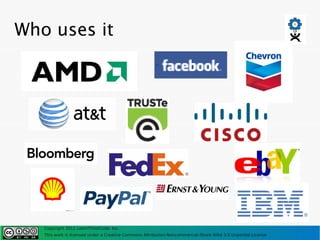
Who uses it


   Copyright 2011 LearnThinkCode, Inc.
   This work is licensed under a Creative Commons Attribution-Noncommercial-Share Alike 3.0 Unported License
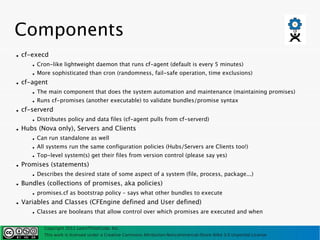
Components
●   cf-execd
       ●   Cron-like lightweight daemon that runs cf-agent (default is every 5 minutes)
       ●   More sophisticated than cron (randomness, fail-safe operation, time exclusions)
●   cf-agent
       ●   The main component that does the system automation and maintenance (maintaining promises)
       ●   Runs cf-promises (another executable) to validate bundles/promise syntax
●   cf-serverd
       ●   Distributes policy and data files (cf-agent pulls from cf-serverd)
●   Hubs (Nova only), Servers and Clients
       ●   Can run standalone as well
       ●   All systems run the same configuration policies (Hubs/Servers are Clients too!)
       ●   Top-level system(s) get their files from version control (please say yes)
●   Promises (statements)
       ●   Describes the desired state of some aspect of a system (file, process, package...)
●   Bundles (collections of promises, aka policies)
       ●   promises.cf as bootstrap policy – says what other bundles to execute
●   Variables and Classes (CFEngine defined and User defined)
       ●   Classes are booleans that allow control over which promises are executed and when

             Copyright 2011 LearnThinkCode, Inc.
             This work is licensed under a Creative Commons Attribution-Noncommercial-Share Alike 3.0 Unported License
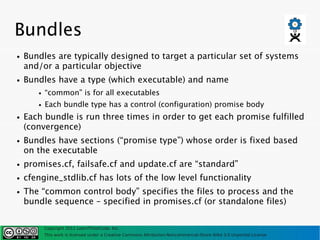
Bundles
●   Bundles are typically designed to target a particular set of systems
    and/or a particular objective
●   Bundles have a type (which executable) and name
       ●   “common” is for all executables
       ●   Each bundle type has a control (configuration) promise body
●   Each bundle is run three times in order to get each promise fulfilled
    (convergence)
●   Bundles have sections (“promise type”) whose order is fixed based
    on the executable
●   promises.cf, failsafe.cf and update.cf are “standard”
●   cfengine_stdlib.cf has lots of the low level functionality
●   The “common control body” specifies the files to process and the
    bundle sequence – specified in promises.cf (or standalone files)


           Copyright 2011 LearnThinkCode, Inc.
           This work is licensed under a Creative Commons Attribution-Noncommercial-Share Alike 3.0 Unported License
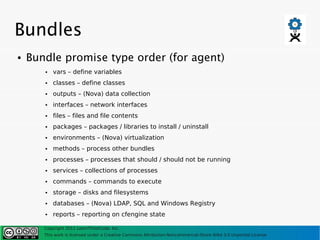
Bundles
●   Bundle promise type order (for agent)
       ●   vars – define variables
       ●   classes – define classes
       ●   outputs – (Nova) data collection
       ●   interfaces – network interfaces
       ●   files – files and file contents
       ●   packages – packages / libraries to install / uninstall
       ●   environments – (Nova) virtualization
       ●   methods – process other bundles
       ●   processes – processes that should / should not be running
       ●   services – collections of processes
       ●   commands – commands to execute
       ●   storage – disks and filesystems
       ●   databases – (Nova) LDAP, SQL and Windows Registry
       ●   reports – reporting on cfengine state

       Copyright 2011 LearnThinkCode, Inc.
       This work is licensed under a Creative Commons Attribution-Noncommercial-Share Alike 3.0 Unported License
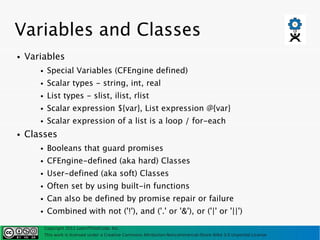
Variables and Classes
●   Variables
       ●    Special Variables (CFEngine defined)
       ●    Scalar types - string, int, real
       ●    List types - slist, ilist, rlist
       ●    Scalar expression ${var}, List expression @{var}
       ●    Scalar expression of a list is a loop / for-each
●   Classes
       ●    Booleans that guard promises
       ●    CFEngine-defined (aka hard) Classes
       ●    User-defined (aka soft) Classes
       ●    Often set by using built-in functions
       ●    Can also be defined by promise repair or failure
       ●    Combined with not ('!'), and ('.' or '&'), or ('|' or '||')
           Copyright 2011 LearnThinkCode, Inc.
           This work is licensed under a Creative Commons Attribution-Noncommercial-Share Alike 3.0 Unported License
Promises
●   Within its promise type
    class-expression::
            “promiser” [→ {“promisee1”,...}]
                         attr1 => value1,
                         attr2 => value2, ...
                         attrN => valueN;
●   Promisee is only used by Nova
●   Promise body is all the attributes
●   Promise body may reference body-parts
●   Many common attributes, others based on type
       Copyright 2011 LearnThinkCode, Inc.
       This work is licensed under a Creative Commons Attribution-Noncommercial-Share Alike 3.0 Unported License
Promises
●   File promise – edit_line bundle
        ●   Ability to handle file edits
        ●   Templates or line changes
●   Promise Body Parts
        ●   Reusable setup of promise attributes
        ●   Can take parameters / variables
        ●   Can use classes internally
●   Functions
        ●   Lots of built-in functions
        ●   Many functions return a class (boolean)
       Copyright 2011 LearnThinkCode, Inc.
       This work is licensed under a Creative Commons Attribution-Noncommercial-Share Alike 3.0 Unported License
Example 1 – Java Setup
●
    Review tm-java.cf (a portion of tm.cf)
●
    Goal is to have Oracle Java (JDK) as java
●
    No RHEL repo for it


      Copyright 2011 LearnThinkCode, Inc.
      This work is licensed under a Creative Commons Attribution-Noncommercial-Share Alike 3.0 Unported License
Example 2 – DB, Tomcat, HTTP
●
    Review tm-server.cf
●
    All install as packages
●
    All run as services
●
    Configuration and setup
         ●
             Httpd configuration as template
         ●
             Restart httpd if configuration changed
         ●
             Tomcat to run as non-root user
         ●
             Tomcat context copied in
         ●
             MySQL db creation as idempotent(?)
      Copyright 2011 LearnThinkCode, Inc.
      This work is licensed under a Creative Commons Attribution-Noncommercial-Share Alike 3.0 Unported License
Example 3 – Web App Deploy
●   Review tm-webapps.cf
●   Web applications are built with Jenkins
●   Jenkins jobs configure which hosts get which builds
       ●   Save war with .<host> appended to name
●   CFEngine needs to know when to pick up the wars
    (and not catch them in the middle)
       ●   Trigger file with <host> name
●   Some applications require special files
●   And then unzip everything and restart Tomcat


       Copyright 2011 LearnThinkCode, Inc.
       This work is licensed under a Creative Commons Attribution-Noncommercial-Share Alike 3.0 Unported License
New Machine Setup
●   Review Entagen Triplemap Demo script
        ●   Quick script to bootstrap Triplemap Demos
        ●   Builds <x>.triplemap.com
        ●   Machine setup with KVM
●   Some VM support in Nova (I've not seen it)
●   Have seen knife (Chef) used to bring up
    CFEngine policy servers and clients
        ●   And then CFEngine to setup Puppet
        ●   And then Puppet to setup Chef
        ●   http://blog.afistfulofservers.net/
      Copyright 2011 LearnThinkCode, Inc.
      This work is licensed under a Creative Commons Attribution-Noncommercial-Share Alike 3.0 Unported License
Challenges to CFEngine
●   Learning Curve
       ●   Syntax and flow in general
       ●   No “standard style”
       ●   Global vs Local on variables / classes
       ●   Reserved names
       ●   Timing / Locks
●   Large Ecosystem
       ●   Tons of variables, classes, functions
       ●   Start small! Collaborate!
       ●   Code review files in VCS!
●   Be careful – you are root everywhere at once!
       ●   cf-promises will verify syntax – it will not prevent stupid – test your files!
       ●   Use test.cf and limit its execution
       ●   Run on a virtual machine
       ●   Run your tests at least twice on a given machine

           Copyright 2011 LearnThinkCode, Inc.
           This work is licensed under a Creative Commons Attribution-Noncommercial-Share Alike 3.0 Unported License
Copyright 2011 LearnThinkCode, Inc.
This work is licensed under a Creative Commons Attribution-Noncommercial-Share Alike 3.0 Unported License
CFEngine vs Chef vs Puppet
●   Chef and Puppet are both Ruby-based
●   CFEngine is C
       ●   Runs on anything (Nova) and is fast and lightweight (memory footprint)
       ●   CFEngine scales very well (AMD running 10k clients per server)
●   Commercial support available for all
       ●   Is “only in Nova” driving people away from CFEngine?
●   Execution repairs itself (failsafe/update) – don't know for Chef/Puppet
●   CFEngine language is “odd” - learning curve for all
●   CFEngine file editing capabilities seem strong (lots of body parts in stdlib)
●   CFEngine will be more verbose
       ●   but everything is available and easily tweakable (vs “Puppet defines the how”)
       ●   to an extent...promise types are written in C
●   CFEngine based on heuristics / Promise Theory vs Graph / Dependencies / Model
●   Lots of sharing of Chef recipes and Puppet scripts – not so much with CFEngine
       ●   Community Open Promise Body Library but that's it...
●   Puppet a reaction to CFEngine 2 (Luke Kanies) – CFEngine 3 is a rewrite
●   Chef a reaction to Puppet

             Copyright 2011 LearnThinkCode, Inc.
             This work is licensed under a Creative Commons Attribution-Noncommercial-Share Alike 3.0 Unported License
References
●
    CFEngine
         ●
             http://cfengine.com/getting-started
●
    Vertical SysAdmin (Aleksey)
         ●
             http://www.verticalsysadmin.com/blog
         ●
             http://www.verticalsysadmin.com/cfengine/
               Getting_Started_with_CFEngine_3.pdf
●
    Sample WordPress setup
         ●
             http://sysadvent.blogspot.com/2011/12/da
               y-15-automating-wordpress-with.html

      Copyright 2011 LearnThinkCode, Inc.
      This work is licensed under a Creative Commons Attribution-Noncommercial-Share Alike 3.0 Unported License
Q/A – Thank You!


   Copyright 2011 LearnThinkCode, Inc.
   This work is licensed under a Creative Commons Attribution-Noncommercial-Share Alike 3.0 Unported License

CFEngine 3

  • 1.
    CFEngine 3 Code Freeze 2012 Jan 12, 2012 Brian Repko http://www.learnthinkcode.com Copyright 2011 LearnThinkCode, Inc. This work is licensed under a Creative Commons Attribution-Noncommercial-Share Alike 3.0 Unported License
  • 2.
    Agenda ● Introduction to CFEngine ● What it is ● How it works ● Examples ● New Machine Setup ● CFEngine vs Chef vs Puppet Copyright 2011 LearnThinkCode, Inc. This work is licensed under a Creative Commons Attribution-Noncommercial-Share Alike 3.0 Unported License
  • 3.
    IANAS (sysadmin) ● My role has been as a developer / architect working with sysadmins to deploy our applications ● When automated, we have used cfengine ● This presentation will use cfengine configuration from Entagen (triplemap.com) for our examples ● Thanks to Frans Lawaetz! Copyright 2011 LearnThinkCode, Inc. This work is licensed under a Creative Commons Attribution-Noncommercial-Share Alike 3.0 Unported License
  • 4.
    CFEngine ● Systems Maintenance Tool ● Configures and automates large-scale IT infrastructure ● Ensures the availability, security and compliance of systems and applications ● Created by Mark Burgess (Ph.D in Theoretical Physics) ● CFEngine 1 – released in 1993 (at Oslo University / post-doc) ● CFEngine 2 – released in 1998 (Computer Immunology) ● CFEngine 3 – released in 2008 (Promise Theory) ● Two editions – Community (FOSS) and Nova (commercial) ● Nova has portal, reporting, native MS Mac/Windows mgmt, high- availability, virtualization, KM, commercial support ● Written in C, runs on all types of systems including mobile, tablet and embedded systems ● Tons of low-level functions and action configurations to reuse Copyright 2011 LearnThinkCode, Inc. This work is licensed under a Creative Commons Attribution-Noncommercial-Share Alike 3.0 Unported License
  • 5.
    Who uses it Copyright 2011 LearnThinkCode, Inc. This work is licensed under a Creative Commons Attribution-Noncommercial-Share Alike 3.0 Unported License
  • 6.
    Components ● cf-execd ● Cron-like lightweight daemon that runs cf-agent (default is every 5 minutes) ● More sophisticated than cron (randomness, fail-safe operation, time exclusions) ● cf-agent ● The main component that does the system automation and maintenance (maintaining promises) ● Runs cf-promises (another executable) to validate bundles/promise syntax ● cf-serverd ● Distributes policy and data files (cf-agent pulls from cf-serverd) ● Hubs (Nova only), Servers and Clients ● Can run standalone as well ● All systems run the same configuration policies (Hubs/Servers are Clients too!) ● Top-level system(s) get their files from version control (please say yes) ● Promises (statements) ● Describes the desired state of some aspect of a system (file, process, package...) ● Bundles (collections of promises, aka policies) ● promises.cf as bootstrap policy – says what other bundles to execute ● Variables and Classes (CFEngine defined and User defined) ● Classes are booleans that allow control over which promises are executed and when Copyright 2011 LearnThinkCode, Inc. This work is licensed under a Creative Commons Attribution-Noncommercial-Share Alike 3.0 Unported License
  • 7.
    Bundles ● Bundles are typically designed to target a particular set of systems and/or a particular objective ● Bundles have a type (which executable) and name ● “common” is for all executables ● Each bundle type has a control (configuration) promise body ● Each bundle is run three times in order to get each promise fulfilled (convergence) ● Bundles have sections (“promise type”) whose order is fixed based on the executable ● promises.cf, failsafe.cf and update.cf are “standard” ● cfengine_stdlib.cf has lots of the low level functionality ● The “common control body” specifies the files to process and the bundle sequence – specified in promises.cf (or standalone files) Copyright 2011 LearnThinkCode, Inc. This work is licensed under a Creative Commons Attribution-Noncommercial-Share Alike 3.0 Unported License
  • 8.
    Bundles ● Bundle promise type order (for agent) ● vars – define variables ● classes – define classes ● outputs – (Nova) data collection ● interfaces – network interfaces ● files – files and file contents ● packages – packages / libraries to install / uninstall ● environments – (Nova) virtualization ● methods – process other bundles ● processes – processes that should / should not be running ● services – collections of processes ● commands – commands to execute ● storage – disks and filesystems ● databases – (Nova) LDAP, SQL and Windows Registry ● reports – reporting on cfengine state Copyright 2011 LearnThinkCode, Inc. This work is licensed under a Creative Commons Attribution-Noncommercial-Share Alike 3.0 Unported License
  • 9.
    Variables and Classes ● Variables ● Special Variables (CFEngine defined) ● Scalar types - string, int, real ● List types - slist, ilist, rlist ● Scalar expression ${var}, List expression @{var} ● Scalar expression of a list is a loop / for-each ● Classes ● Booleans that guard promises ● CFEngine-defined (aka hard) Classes ● User-defined (aka soft) Classes ● Often set by using built-in functions ● Can also be defined by promise repair or failure ● Combined with not ('!'), and ('.' or '&'), or ('|' or '||') Copyright 2011 LearnThinkCode, Inc. This work is licensed under a Creative Commons Attribution-Noncommercial-Share Alike 3.0 Unported License
  • 10.
    Promises ● Within its promise type class-expression:: “promiser” [→ {“promisee1”,...}] attr1 => value1, attr2 => value2, ... attrN => valueN; ● Promisee is only used by Nova ● Promise body is all the attributes ● Promise body may reference body-parts ● Many common attributes, others based on type Copyright 2011 LearnThinkCode, Inc. This work is licensed under a Creative Commons Attribution-Noncommercial-Share Alike 3.0 Unported License
  • 11.
    Promises ● File promise – edit_line bundle ● Ability to handle file edits ● Templates or line changes ● Promise Body Parts ● Reusable setup of promise attributes ● Can take parameters / variables ● Can use classes internally ● Functions ● Lots of built-in functions ● Many functions return a class (boolean) Copyright 2011 LearnThinkCode, Inc. This work is licensed under a Creative Commons Attribution-Noncommercial-Share Alike 3.0 Unported License
  • 12.
    Example 1 –Java Setup ● Review tm-java.cf (a portion of tm.cf) ● Goal is to have Oracle Java (JDK) as java ● No RHEL repo for it Copyright 2011 LearnThinkCode, Inc. This work is licensed under a Creative Commons Attribution-Noncommercial-Share Alike 3.0 Unported License
  • 13.
    Example 2 –DB, Tomcat, HTTP ● Review tm-server.cf ● All install as packages ● All run as services ● Configuration and setup ● Httpd configuration as template ● Restart httpd if configuration changed ● Tomcat to run as non-root user ● Tomcat context copied in ● MySQL db creation as idempotent(?) Copyright 2011 LearnThinkCode, Inc. This work is licensed under a Creative Commons Attribution-Noncommercial-Share Alike 3.0 Unported License
  • 14.
    Example 3 –Web App Deploy ● Review tm-webapps.cf ● Web applications are built with Jenkins ● Jenkins jobs configure which hosts get which builds ● Save war with .<host> appended to name ● CFEngine needs to know when to pick up the wars (and not catch them in the middle) ● Trigger file with <host> name ● Some applications require special files ● And then unzip everything and restart Tomcat Copyright 2011 LearnThinkCode, Inc. This work is licensed under a Creative Commons Attribution-Noncommercial-Share Alike 3.0 Unported License
  • 15.
    New Machine Setup ● Review Entagen Triplemap Demo script ● Quick script to bootstrap Triplemap Demos ● Builds <x>.triplemap.com ● Machine setup with KVM ● Some VM support in Nova (I've not seen it) ● Have seen knife (Chef) used to bring up CFEngine policy servers and clients ● And then CFEngine to setup Puppet ● And then Puppet to setup Chef ● http://blog.afistfulofservers.net/ Copyright 2011 LearnThinkCode, Inc. This work is licensed under a Creative Commons Attribution-Noncommercial-Share Alike 3.0 Unported License
  • 16.
    Challenges to CFEngine ● Learning Curve ● Syntax and flow in general ● No “standard style” ● Global vs Local on variables / classes ● Reserved names ● Timing / Locks ● Large Ecosystem ● Tons of variables, classes, functions ● Start small! Collaborate! ● Code review files in VCS! ● Be careful – you are root everywhere at once! ● cf-promises will verify syntax – it will not prevent stupid – test your files! ● Use test.cf and limit its execution ● Run on a virtual machine ● Run your tests at least twice on a given machine Copyright 2011 LearnThinkCode, Inc. This work is licensed under a Creative Commons Attribution-Noncommercial-Share Alike 3.0 Unported License
  • 17.
    Copyright 2011 LearnThinkCode,Inc. This work is licensed under a Creative Commons Attribution-Noncommercial-Share Alike 3.0 Unported License
  • 18.
    CFEngine vs Chefvs Puppet ● Chef and Puppet are both Ruby-based ● CFEngine is C ● Runs on anything (Nova) and is fast and lightweight (memory footprint) ● CFEngine scales very well (AMD running 10k clients per server) ● Commercial support available for all ● Is “only in Nova” driving people away from CFEngine? ● Execution repairs itself (failsafe/update) – don't know for Chef/Puppet ● CFEngine language is “odd” - learning curve for all ● CFEngine file editing capabilities seem strong (lots of body parts in stdlib) ● CFEngine will be more verbose ● but everything is available and easily tweakable (vs “Puppet defines the how”) ● to an extent...promise types are written in C ● CFEngine based on heuristics / Promise Theory vs Graph / Dependencies / Model ● Lots of sharing of Chef recipes and Puppet scripts – not so much with CFEngine ● Community Open Promise Body Library but that's it... ● Puppet a reaction to CFEngine 2 (Luke Kanies) – CFEngine 3 is a rewrite ● Chef a reaction to Puppet Copyright 2011 LearnThinkCode, Inc. This work is licensed under a Creative Commons Attribution-Noncommercial-Share Alike 3.0 Unported License
  • 19.
    References ● CFEngine ● http://cfengine.com/getting-started ● Vertical SysAdmin (Aleksey) ● http://www.verticalsysadmin.com/blog ● http://www.verticalsysadmin.com/cfengine/ Getting_Started_with_CFEngine_3.pdf ● Sample WordPress setup ● http://sysadvent.blogspot.com/2011/12/da y-15-automating-wordpress-with.html Copyright 2011 LearnThinkCode, Inc. This work is licensed under a Creative Commons Attribution-Noncommercial-Share Alike 3.0 Unported License
  • 20.
    Q/A – ThankYou! Copyright 2011 LearnThinkCode, Inc. This work is licensed under a Creative Commons Attribution-Noncommercial-Share Alike 3.0 Unported License