AUT’s Abundance Array
of Assessments
Are there any more?
3 CAMPUSES
STAFF: 2106
STUDENTS: 27,000 (approx)
What is assessment in today’s
University?
Some questions to ponder…
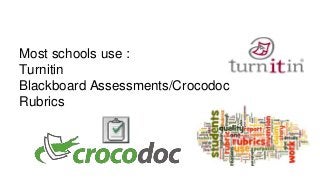
Most schools use :
Turnitin
Blackboard Assessments/Crocodoc
Rubrics
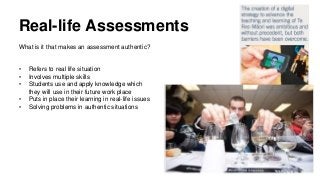
Real-life Assessments
What is it that makes an assessment authentic?
• Refers to real life situation
• Involves multiple skills
• Students use and apply knowledge which
they will use in their future work place
• Puts in place their learning in real-life issues
• Solving problems in authentic situations
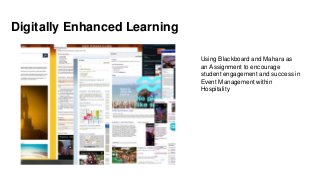
Digitally Enhanced Learning
Using Blackboard and Mahara as
an Assignment to encourage
student engagement and success in
Event Management within
Hospitality
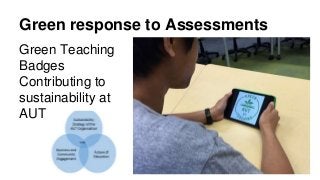
Green response to Assessments
Green Teaching
Badges
Contributing to
sustainability at
AUT
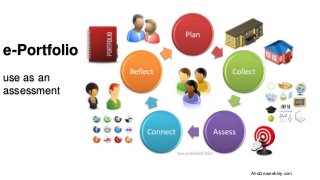
e-Portfolio
use as an
assessment
Ahdcte.weebley.com
“Mahara is an open source
ePortfolio and social networking
web application.
It provides users with tools to
create and maintain a digital
portfolio of their learning, and social
networking features to allow users
to interact with each other”.
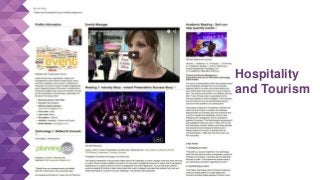
Hospitality
and Tourism
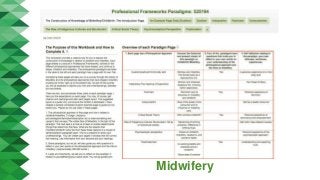
Midwifery
SOCIAL MEDIA
Using video as assessment
www.adresconseil.fr
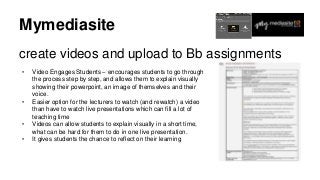
Mymediasite
create videos and upload to Bb assignments
• Video Engages Students – encourages students to go through
the process step by step, and allows them to explain visually
showing their powerpoint, an image of themselves and their
voice.
• Easier option for the lecturers to watch (and rewatch) a video
than have to watch live presentations which can fill a lot of
teaching time
• Videos can allow students to explain visually in a short time,
what can be hard for them to do in one live presentation.
• It gives students the chance to reflect on their learning
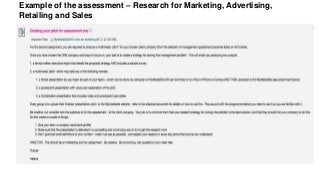
Example of the assessment – Research for Marketing, Advertising,
Retailing and Sales
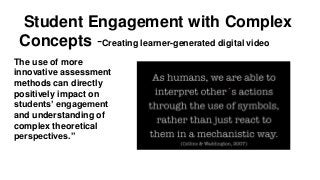
Student Engagement with Complex
Concepts -Creating learner-generated digital video
The use of more
innovative assessment
methods can directly
positively impact on
students’ engagement
and understanding of
complex theoretical
perspectives.”
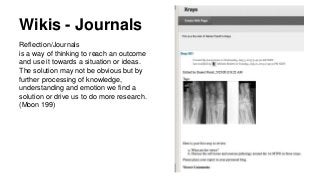
Wikis - Journals
Reflection/Journals
is a way of thinking to reach an outcome
and use it towards a situation or ideas.
The solution may not be obvious but by
further processing of knowledge,
understanding and emotion we find a
solution or drive us to do more research.
(Moon 199)
https://www.youtube.com/watch?v=NSfr7QUTv6Y
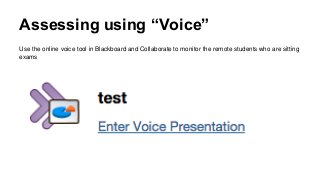
Assessing using “Voice”
Use the online voice tool in Blackboard and Collaborate to monitor the remote students who are sitting
exams
Lynda.com
evaluating course work
and Learning-oriented
assessment
ibooks etc
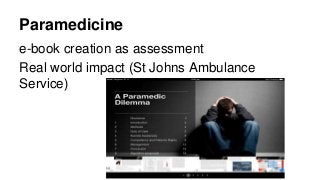
Paramedicine
e-book creation as assessment
Real world impact (St Johns Ambulance
Service)
Self and Peer
Assessment
Through a process of experiential
learning, self-reflection, peer
evaluation, and responsive lecturer
feedback, first year students
developed the ability
to set learning goals to improve their
professional practice. In tutorials,
students learned therapeutic
massage techniques by taking on the
roles of practitioner, client and
observer.
Student assessment
“It was easy to assign marks to
based on the requirement I had of
them to ask and answer at
least questions per week as you can
easily select a time and date range
and pull up this information”.
Staff assessment
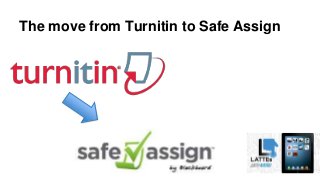
The move from Turnitin to Safe Assign
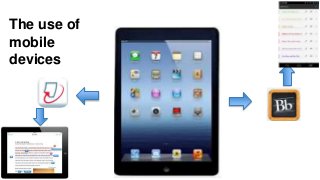
The use of
mobile
devices
Student Feedback
www.dreamstime.com
www.ecampusnews.com
Auckland University of Technology
Michele Bioletti michele.bioletti@aut.ac.nz
Lisa Ransom lisa.ransom@aut.ac.nz

AUT's Abundant Array of Assessments: are there any more? - Michele Bioletti an Lisa Rasom, Auckland University of Technology | ANZTLC15

Editor's Notes

  • #3  AUT University, the University for the changing world. AUT is a contemporary university, with a distinctive approach to teaching and learning, focused on providing student-centred, innovative and responsive learning experiences. AUT’s programmes - designed for modern careers and gain insight into our engaging learning environment that embraces people, cultures and ideas. - See more at: http://www.aut.ac.nz/study-at-aut#sthash.SXeH12YH.dpuf
  • #4 Where are we going? How will we get there How we will know we are there
  • #5 Most schools use Turnitin Blackboard Rubrics Crocodoc Rubric wordle – www.middleweb.com Bigger crocodc – embed.ly How can we best support learners in their ability to apply their knowledge and skills they have learnt to complex situations – using problem solving assessment and collaborative working on authentic tasks can be the key. To student’s successful transfer of knowlege and skills to real world …. Today’s university is gradually evolving to be more authentic and student centred, but in many cases is still overly-reliant on “old world” modes of essays and exams.
  • #6 Traditional exam and essay type assessments still occur but AUT is encourageing authentic assessments – encourage students to think for themselves, and if course is relevant to their future workplace etc. If more student centred learning (social constructive paradigm-Julia Hallas) then students are more motivated/intersted. GET IDEAS FROM THOSE ATTENDING Wikis/Journals/Blogs; MyMedia Site; Mahara; Lynda.com; Using Voice Boards/Videos for Interpreting Courses. Images from: http://www.aut.ac.nz/__data/assets/pdf_file/0012/150411/InsideAUT_final.pdf
  • #7  Hospitality –authentic assessments Authentic assessment focuses on students using and applying knowledge and skills in real-life settings. For example, you might have students take part in: simulation or role play of a scenario - completion of a real-world task - assessment in a workplace setting. For instance in Hospitality students need to design and host an event as their assessment. Some assessments have no specific application in real-work settings where students will be in the future. Authentic assessment helps students to put into place their learning and to see how real-life issues can affect a situation and therefore learning can come from this. Students can gain more competency and knowledge from learning through solving issues, and being engaged - . Authentic situations/practice can be a good characteristic of assessments and students often find this more rewarding. Students learning with technology rather than from it. Encourage students to paritcipate in a more collaborative experience. AIM This project aimed to change the trend in digital enhanced learning for students; moving them from passive users to active participants in the co-construction of knowledge - building technology into learning, not learning into technology. A 100 students from BA in Event Management were involved, for the first time, in an experimental learning project with digital and mobile technologies employed to reinforce, support and build on traditional learning activities. OUTCOMES The project progressed well and resulted in each student producing a personal investigation map of explored literature in the form of a Wiki as a collaborative assessment. They also became the creative author of a page related to the course in an online personal portfolio. This involved Blackboard and Mahara being linked to forge an “integrated learning system” to incorporate additional external content, some of which was produced with mobile and digital technologies. The project demonstrated the possibility of engaging students as “creative authors” instead of “passive consumers”. The teacher has an important role to play in stimulating students to collaboratively share and construct knowledge together.
  • #8 CFLAT – grant - dual goals of promoting awareness of the environmental effects of higher education and maximizing the use of Blackboard tools in teaching by rewarding academics for teaching sustainably with a Green Teaching Active Leader badge, and also the certified green course logo displayed with the course title in Blackboard. An individual academic can qualify for the Green Teaching Active Leader badge by self-evaluating their course’s sustainability through saving paper through online materials and course components, reducing carbon emissions, Moreover, their Blackboard courses can be awarded with the ‘Certified Green Course’ by displaying a green logo. OUTCOMES We have developed the process and criteria for achieving a Green Teaching Active Leader Badge. A prototype of the online green teaching course is currently hosted on Blackboard. and we will be inviting a group of academics to trial it... A paper was presented at the ascilite 2014 conference in Dunedin to share our findings. IMPLICATIONS There is strong evidence that AUT students are embracing online and mobile technologies. Moreover, the programme assists in reducing the overall costs of teaching without compromising quality, and it strengthens the engagement with learning and maintaining high levels of satisfaction. The achievement tool embeded in Blackboard will be used to advance the process and criteria for participants to achieve a series of green badge.
  • #9 Eportfolios use as an assessment.
  • #10 ePortfolios use as an Assessment it can be formative and summative, and is learning oriented. Allows students to produce an assessment which can be an example of their best work which can be shared not just with lecurers but future employers This also allows reflection – on personal, professional, and critical and analytical learning. Examples are wordpress, weebly, livejournal, blogger, pebblepad. AUT are using Mahara. Mahara is used in a variety of departments. The main users at AUT are: Midwifery, Early Childhood, Podiatry, Hospitality and Tourism, Computing, A trend in departments is to use one page templates or collections for the student portfolios. Students then submit their portfolio for assessment to their lecturers. Material may include: photographs, work samples, documents, videotaped interviews,
  • #11 Hospitality students use templates for their assessments, - to gather their research and the to embrace new technology ICT
  • #12 Midwifery have a 3 year programme and students record their work in collections. students separated in groups – for ease of marking as well. Mahara is also being investigated, with the use of embedded google forms, in a Counselling Paper. Students record details of client/patient visits – as part of their assessment for completing logs.
  • #13 Social Media has played a significant part in assessment in 2 papers at AUT – Visual Communcations and Design. 1. Designing transformative learning environments – Design Communications This course was designed as a series of ‘triggering events’ supported by an Ecology Of Resources based upon mobile social media 2. Mobile Social Media as a Catalyst for CollaborativeCurriculum Redesign A framework for using mobile social media to enable creative pedagogies Moving FROM a teacher-directed Pedagogy typified by: Content delivery • Digital assessment • Teacher delivered content Teacher defined Projects TOWARDS a student-directed pedagogy (Heutagogy) enabled by mobile social media tools: In both projects, different social media tools were chosen as examples of a range of collaborative tools including: GMail which provided access to the Google suite of collaborative tools – including google communities/hangouts 2. Wordpress as a reflective space 3. Twitter to facilitate an asynchronous community 5. Feedly for collating social media 6. LinkedIn as a professional portfolio 7. ResearchGate to create a research portfolio 8. ScoopIt for curating social media 9. http://www.autodesk.com/mobile-apps a suite of mobile 3D modelling Apps Youtube Vimeo Storify Bambuser Behance
  • #15 students in the past were required to make a presentation to a group of lecturers using eg ppt. This took up a considerable amount of teaching time for each student/group to present to the lecturers. Plus lecturers had to make many notes so that they could remember what they had viewed. My Mediasite is a hosted video management portal that students will use to record, upload, manage and publish their presentation for assessment; Now students create the video. Using My Media site.. Another advantage of using MyMediasite was previously videos uploaded to Bb meant a heavy load on our server usage – so having the videos uploaded to MyMediaSite and then the students upload the link into a Blackboard Assignment. students record their presentation and are given a relevant topic. Some papers such as Employment law – use a group presentation   Oral presentations: STRENGTHS: giving the students a chance to talk about their project encourages personal ownership of ideas and helps to develops understanding and confidence. Students can receive prompt feedback fromlecturers and lecturers have the opportunity to rewatch the videos. LIMITATIONS:Oral presentations can be difficult for students who do not have English as a first language.
  • #16 GROUP presentation needs to be uploaded
  • #17 Example of
  • #18  AIMS The aim of this project was to change current assessment methods and learning and teaching strategies in the Sport and Recreation paper to improve learners’ creative and critical thinking abilities, and technology skills. The change was initiated through the use of social and digital media providing an environment conducive for learner engagement. Firstly, a written assessment was replaced with a digital video assessment, generating learner-to-content interaction. secondly, a workshop learning environment was utilised to support learners through learner-learner interaction. The success of this project was monitored through student success rates and focus group feedback.
  • #19 Daniel Porrit’s wikis – used for Podiatry Learning journals: Outcomes -Journal reflections help students to integrate course learning, and apply theoretical ideas to practical areas, plus undertake workplace reflections, develop reflective skills, develop reflective, writing and analytical skills. An ongoing requirement for students to record their responses to course learning can help to promote personal engagement with course learning. ► Find a way of seeing the journals regularly and giving feedback and feedforward. ► It is possible in Blackboard to award a percentage for completing the journal and then grade a summary account of the journal entries From Daniel Porat’s paper Reflective Diary There are many models and definitions of reflection . Reflection is a way of thinking to reach an outcome and use it towards a situation or ideas. The solution may not be obvious but by further processing of knowledge, understanding and emotion we find a solution or drive us to do more research. (Moon 1999) Mezirow (1991) divides reflection into three categories. Content -What we perceive, think, feel, or do. Then how, that is the Process in performing them. Finally, premisethat involves becoming aware of Why. Reflective thinking is a part of the critical thinking process referring specifically to the processes of analysing and making judgments about what has happened. Dewey (1933) suggests that reflective thinking is an active, persistent, and careful consideration of a belief or supposed form of knowledge, of the grounds that support that knowledge, and the further conclusions to which that knowledge leads. Reflective thinking is most important in prompting learning during complex problem-solving situations because it provides us an opportunity to step back and think about how we actually solve problems and how a particular set of problem solving strategies is appropriated for achieving our goal. We need to assess what we know, what we need to know, and how we bridge that gap – during learning situations. Reflective practice is a skill which takes time to learn and is a powerful learning tool which will affect you and enhance your clinical abilities . Student reflective practice template •Students are expected to write regular reflective entries under the clinical reflections tab in PCP1. •The lecturers and clinical educators involved with dry clinics will be reviewing your entries. •This is to check they are being completed and carried out in a reflective manner. •They will not be assessed or marked Students are encouraged to reflect on their own performance and experience in PCP1 .Reflective journaling takes practise and initially it may be easier to follow the template provided. From Daniel Porat’s paper Reflective Diary There are many models and definitions of reflection . Reflection is a way of thinking to reach an outcome and use it towards a situation or ideas. The solution may not be obvious but by further proc essing of knowledge, understanding and emotion we find a solution or drive us to do mo re research. (Moon 1999) Mezirow (1991) divides reflection into three catego ries. Content - what we perceive, think, feel, or do. Then how, that is the process in performing them. Finally, premise that involves becoming aware of why. Reflective thinking is a part of the critical thinking process referrin g specifically to the processes of analysing and making judgments about w hat has happened. Dewey (1933) suggests that reflective thinking is an active, per sistent, and careful consideration of a belief or supposed form of knowledge, of the grounds that support that knowledge, and the further conclusions to which that knowledge leads. Reflective thinking is most important in prompting learning during com plex problem- solving situations because it provides us an opport unity to step back and think about how we actually solve problems and how a particular set of problem solving strategies is appropriated for achieving our goal. We need to ass ess what we know, what we need to know, and how we bridge that gap – during learning situations. Reflective practice is a skill which takes time to learn and is a powerful learning tool which will affect you and enhance your clinical abilities . Student reflective practice template • Students are expected to write regular reflective e ntries under the clinical reflections tab in PCP1. • The lecturers and clinical educators involved with dry clinics will be reviewing your entries. • This is to check they are being completed and carri ed out in a reflective manner. • They will not be assessed or marked Students are encouraged to reflect on their own performance and experience in PCP1 . Reflective journaling takes practise and initially it may be easier to follow the template provided.
  • #20 The Sport and Recreation department use Journals for the Sport and Recreation Co-operative 1 and 2 papers. Bachelor of Sport and Recreation students are required to post a weekly journal entry (using the journal feature in Blackboard) that reflects on their work-integrated learning experiences. Students are encouraged and required to reflect using written text as well as a variety of creative mediums such as images, video clips and other artefacts. Academic supervisors are able to provide regular feedback comments on the journal posts. A recent addition has been the inclusion of a Blackboard rubric to give overall feedback at the end of the semester. Overall the use of the journals has been a valuable addition to the learning strategies for this course. Both students and staff have found the journals easy to use any time and anywhere. Co-operative education (Co-op) is a strategy for students to integrate theory and practice within the working context of a sport or recreation organisation. The name ‘co-operative education’ reflects the tripartite nature in which the student, AUT University and a sport and recreation organisation work together collaboratively to develop capabilities to enhance graduate employability.
  • #21  Written exams for remote students   Use the online test tool in Blackboard and Blackboard Collaborate to monitor the remote students. Prepare the online exams The written exams are setup in AUTonline papers respectively using the online tests tool (the setting Force Completion is not recommended); Adaptive release needs to be applied to the exam links to make sure it’s only available to the remote students. Before the exam starts Students: Students can pass the audio set up wizard in Collaborate; Their webcam is set up correctly; Share their desktop (they need to be assigned a moderator’s role). Exam supervisors: Exam supervisors to ensure they can hear the students, see them on the screen comfortably and see their desktop, before you make the online exam link accessible to the students. When the exam finishes Make sure the students goes out the Collaborate session before you log off to make sure the recording gets generated; Hide the exam link from the students; Review the recordings if necessary.
  • #22 LYNDA new project –This is a core paper for students in the Māori Development, Māori Media,Criminology,Event Management and Social Sciences. The teaching focus is on providing a learning environment that makes use of online resources to support classroom learning and. to strongly reflect Matauranga Maori and Maori learning pedagogy, while utilising e-learning technologies. Maori philosophical approaches to learning are often compromised within a tertiary learning setting unless courses are delivered in wananga style - face-to-face learning (for example, Marae-based learning). AIMS The aims of this project were to increase student engagement and satisfaction through learning experiences. . The approaches were to develop digital and social media based learning while also increasing the access for students to engage in matauranga Maori based learning. Digital learning resources were developed in the form of eBooks for course content, recorded lectures for online students .- students are encouragedto work collaboratively using digital technology such as social media and networking sites to communicate with each other outside of the classroom – mostly within a Google+ community.   In class there was face-to-face, student discussion based learning is aligned to Maˉ ori learning approaches. Therefore, the overall approaches to the project are complemented with the use of both digital and face-to-face learning,   Assessments for students were to encourage students to create an ebook -where students have the opportunity to develop learning and reflective based assessments through digital media.   This means that learning is not confined to the classroom and provides the platform for new ways of teaching and learning A tool that allows access to lynda.com. Lecturers may create a link that will automatically connect students to Lynda.com  v Lecturers may create a link that will automatically connect students to Lybnda.com   FUTURE DIRECTIONS This can therefore inform mainstream teaching approaches about how indigenous teaching frameworks can be utilised effectively.
  • #23 There is a move at AUT towards students converting their work from pieces of paper to ibooks/ebooks. Started with a few small papers such as the Paramedic paper. There were many issues caused by the lack of technical knowledge of some students, ibooks needed a Mac. Some students created their assessment in powerpoint/word on Windows and then our digital team had had to help them convert them into ibooks. Students also encouraged to make a video which was inserted into the ibook. At the end most of the students managed it and were very happy to have a final product that they could take with them to Iteachlounge.wordpress.com (hand one)
  • #25 The project utilized both self and peer evaluation strategies, and incorporated these into the assessments as a way of engaging students in critical analysis and reflection. It not only enhanced student engagement but also informed the lecturer of gaps in their knowledge and students’ experience. Ma¯ori, Pasifika and international students brought a different experience of touch, whereby learning to massage through a western medical model raised cultural and boundary issues for the students. By providing an appropriate forum in which to discuss these issues, students of all cultures voiced their challenges and different experiences of touch, culture and boundaries, resulting in enhanced intercultural
  • #26 Peerwise – used with a few departments. Students use Peerwise to create and to explain their understand of course related assessment questions, and to answer and discuss questions created by their peers I love using PeerWise for my students as I feel that it helps them to develop their own learning further and also create themselves a bank of study questions for exam time, or just to come back an visit later on when they want to refresh their memory again on certain topics.   Like everything you will get students who pour their heart and soul into it, and those who just get by and do the basics.   I like the students ability to rate the questions and challenge the answers if they feel they are not quite on the right track or sharing the right point of view and knowledge required to answer the question, they literally pounce on each other and sort it out quick smart if it is a problem.   The only downfall I found is when it came to marking if you were marking against more than one learning outcome (as I was) it became hard to ensure they had met the criteria for completion of the LO. A good way around this is to have one PeerWise established per LO you are marking them against – I will do this in future and will drop the number of LO I mark against to save them having to login and complete a lot of different PeerWise.   It was easy to assign marks to based on the requirement I had of them to ask and answer at least  questions per week as you can easily select a time and date range and pull up this information.   All in all, for a new lecturer who had no training in using PeerWise it was a fantastic tool and one I would love to incorporate into my teaching at both undergraduate and postgraduate level.
  • #27 The Ako Aronui programme supports AUT staff to become HEA (Higher Education Academy) accredited through a series of workshops offered by the Centre for Learning and Teaching (CfLAT). The programme is underpinned by a framework that draws on the Professional Standards Framework from the UK and is contextualised into the uniqueness of Aotearoa New Zealand, interweaving kaupapa Maori values, philosophies and principles and supports staff at three levels of fellowship accreditation. This paper uses a number of assessment tools. Wikis; Mahara, Tests with Badges.
  • #28 We have had some changes here. AUT is considering moving from Turnitn to Safe Assign, so we are running a project in Semester 2 with our large inter-disciple papers as a pilot. Before we could run the pilot, the major issue for staff was that there were no previous AUT assignments uploaded to the SafeAssign database, therefore no matching to previous AUT student assignments. We employed our lattes to upload 2014 and 2015 Turnitin assignments from our inter-discpline papers into SafeAssign. We uploaded them as small zip files. Images from powerpoint.
  • #29 Turnitin ipad app – Rubrics; Easlily sync assignments to your iPad for grading on – or offline.
  • #30 Rubrics; Feedback to student from the Grade Centre; Voice feedback in Turnitin assignments; Wikis comments to groups; Bb Achievements and Badges-. Student feedback to their peers with ipeer; student comments in group Wikis. Mahara comments
  • #31 The next question is WHAT IS ASSESSMENT IN TOMORROW’S UNIVERSITY? In tomorrow’s world, students must graduate with extensive skills in problem-solving, adaptability, creativity, collaboration and more. Demonstrating these skills must be covered by any future-focused assessment strategy