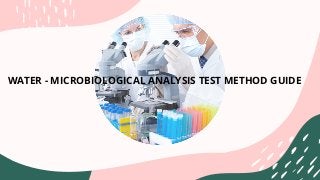
WATER - MICROBIOLOGICAL ANALYSIS TEST METHOD GUIDE
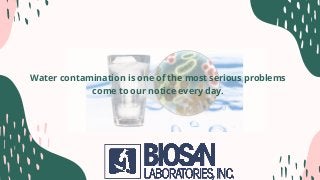
Water contamination is one of the most serious problems
come to our notice every day.
Microbiological analysis by a reputable
microbial laboratory is considered an
effective way to check the contaminated
water.
The laboratory undertakes different test methods
specifically designed for water and Environment.
Coliforms & Other Indicator Organisms


Coliforms are bacteria found in the digestive tracts of animals
including humans. They are found in fecal matter.
Such traits enable it for easy isolation, detection, and
enumeration in the microbiological lab and are the gold
standard for microbial water testing.
They are found at the time enteric
pathogens or viruses are spotted
during water testing.
But keep in mind a high 'total coliform' does not
always indicate faecal contamination. It further
requires test the faecal coliforms to from coliforms
present in the environment.
Rapid methods
Using the latest technology, eminent Microbiological Lab
Testing can produce results within 24 hours.
A colourimetric ONPG assay is used to detect coliforms
whereas a fluorescence MUG assay is used for E. coli.
Membrane filtration
For analysis of water, a typical membrane filtration method is
carried out by passing a specific volume of water through a
sterile membrane filter with a pore size small enough to
preserve bacterial cells.
After that the filter is transmitted to the surface of an agar
plate or something like an absorbent pad, which is saturated
with an appropriate selective medium and incubated.
The membrane filtration methods are quick and simple to
perform. The methods need little incubator space and manage
large volumes of water when required.
Culture media
For the detection of indicator organisms in water by
membrane filtration methods, much selective media have
been developed.
Most popular media for coliforms and E. coli are membrane
lactose glucuronide agar, membrane lauryl sulphate broth or
agar and MI agar and broth.
Traditional culture
Procedures using pour and spread plate count ways are not so
sensitive to detect pathogens and indicator organisms in
water.
Most probable number is a kind of technique had been widely
used for many years.
Conclusion
We have already discussed different methods of water
testing that could make our life and surrounding safety.
However, we should remain in touch with microbiologists
of reputable microbiological lab to avert any kind of
awkward situation.
www.biosan.com
Biosan Laboratories, Inc.
1950 Tobsal Court,
Warren, MI 48091-1351
USA


info@biosan.com

Microbiological Analysis Test Method Guide

  • 1.
    WATER - MICROBIOLOGICALANALYSIS TEST METHOD GUIDE
  • 2.
    Water contamination isone of the most serious problems come to our notice every day.
  • 3.
    Microbiological analysis bya reputable microbial laboratory is considered an effective way to check the contaminated water.
  • 4.
    The laboratory undertakesdifferent test methods specifically designed for water and Environment.
  • 5.
    Coliforms & OtherIndicator Organisms Coliforms are bacteria found in the digestive tracts of animals including humans. They are found in fecal matter. Such traits enable it for easy isolation, detection, and enumeration in the microbiological lab and are the gold standard for microbial water testing.
  • 6.
    They are foundat the time enteric pathogens or viruses are spotted during water testing. But keep in mind a high 'total coliform' does not always indicate faecal contamination. It further requires test the faecal coliforms to from coliforms present in the environment.
  • 7.
    Rapid methods Using thelatest technology, eminent Microbiological Lab Testing can produce results within 24 hours. A colourimetric ONPG assay is used to detect coliforms whereas a fluorescence MUG assay is used for E. coli.
  • 8.
    Membrane filtration For analysisof water, a typical membrane filtration method is carried out by passing a specific volume of water through a sterile membrane filter with a pore size small enough to preserve bacterial cells.
  • 9.
    After that thefilter is transmitted to the surface of an agar plate or something like an absorbent pad, which is saturated with an appropriate selective medium and incubated. The membrane filtration methods are quick and simple to perform. The methods need little incubator space and manage large volumes of water when required.
  • 10.
    Culture media For thedetection of indicator organisms in water by membrane filtration methods, much selective media have been developed. Most popular media for coliforms and E. coli are membrane lactose glucuronide agar, membrane lauryl sulphate broth or agar and MI agar and broth.
  • 11.
    Traditional culture Procedures usingpour and spread plate count ways are not so sensitive to detect pathogens and indicator organisms in water. Most probable number is a kind of technique had been widely used for many years.
  • 12.
    Conclusion We have alreadydiscussed different methods of water testing that could make our life and surrounding safety. However, we should remain in touch with microbiologists of reputable microbiological lab to avert any kind of awkward situation.
  • 13.
    www.biosan.com Biosan Laboratories, Inc. 1950Tobsal Court, Warren, MI 48091-1351 USA info@biosan.com