Challenging the March for Science
Dr Zuleyka Zevallos
@OtherSociology
OtherSociologist.com
Intersectionality at the Coal Face
Overview
• Background to the March
• Diversity
• Equity
• Inclusion
• Access
• Intersectionality
• Discourses
• Science
• Anti-diversity in the march
Background
• Announced 24 January 2017
• Protest on 22 April 2017
• Created and largely
promoted on social media
• No social movement
leadership experience
• Equity and diversity were
afterthoughts
Equity
• Equity: barriers, issues &
solutions to structural
disadvantage
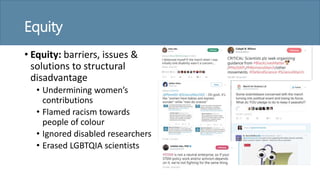
• Undermining women’s
contributions
• Flamed racism towards
people of colour
• Ignored disabled researchers
• Erased LGBTQIA scientists
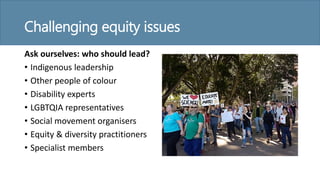
Challenging equity issues
Ask ourselves: who should lead?
• Indigenous leadership
• Other people of colour
• Disability experts
• LGBTQIA representatives
• Social movement organisers
• Equity & diversity practitioners
• Specialist members
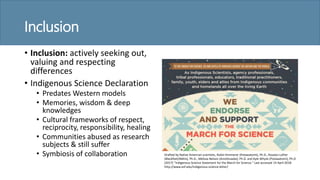
Inclusion
• Inclusion: actively seeking out,
valuing and respecting
differences
• Indigenous Science Declaration
• Predates Western models
• Memories, wisdom & deep
knowledges
• Cultural frameworks of respect,
reciprocity, responsibility, healing
• Communities abused as research
subjects & still suffer
• Symbiosis of collaboration Drafted by Native Amercian scientists, Robin Kimmerer (Potawatomi), Ph.D., Rosalyn LaPier
(Blackfeet/Métis), Ph.D., Melissa Nelson (Anishinaabe), Ph.D. and Kyle Whyte (Potawatomi), Ph.D
(2017) ”Indigenous Science Statement for the March for Science.” Last accessed 14 April 2018:
http://www.esf.edu/indigenous-science-letter/
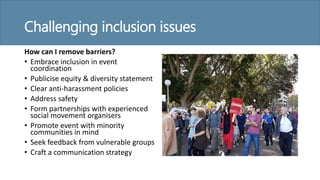
Challenging inclusion issues
How can I remove barriers?
• Embrace inclusion in event
coordination
• Publicise equity & diversity statement
• Clear anti-harassment policies
• Address safety
• Form partnerships with experienced
social movement organisers
• Promote event with minority
communities in mind
• Seek feedback from vulnerable groups
• Craft a communication strategy
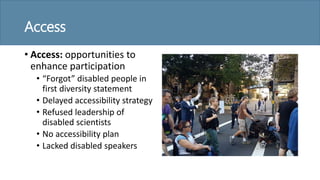
Access
• Access: opportunities to
enhance participation
• “Forgot” disabled people in
first diversity statement
• Delayed accessibility strategy
• Refused leadership of
disabled scientists
• No accessibility plan
• Lacked disabled speakers
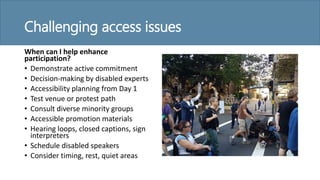
Challenging access issues
When can I help enhance
participation?
• Demonstrate active commitment
• Decision-making by disabled experts
• Accessibility planning from Day 1
• Test venue or protest path
• Consult diverse minority groups
• Accessible promotion materials
• Hearing loops, closed captions, sign
interpreters
• Schedule disabled speakers
• Consider timing, rest, quiet areas
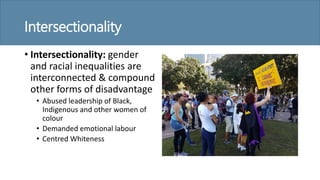
Intersectionality
• Intersectionality: gender
and racial inequalities are
interconnected & compound
other forms of disadvantage
• Abused leadership of Black,
Indigenous and other women of
colour
• Demanded emotional labour
• Centred Whiteness
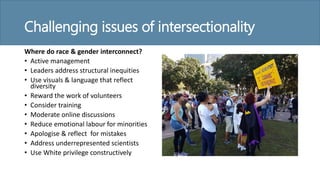
Challenging issues of intersectionality
Where do race & gender interconnect?
• Active management
• Leaders address structural inequities
• Use visuals & language that reflect
diversity
• Reward the work of volunteers
• Consider training
• Moderate online discussions
• Reduce emotional labour for minorities
• Apologise & reflect for mistakes
• Address underrepresented scientists
• Use White privilege constructively
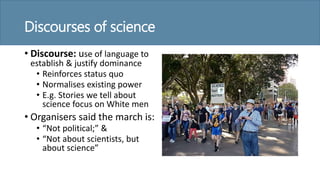
Discourses of science
• Discourse: use of language to
establish & justify dominance
• Reinforces status quo
• Normalises existing power
• E.g. Stories we tell about
science focus on White men
• Organisers said the march is:
• “Not political;” &
• “Not about scientists, but
about science”
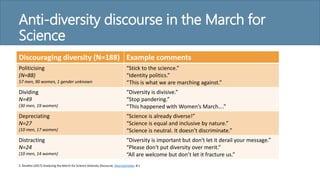
Anti-diversity discourse in the March for
Science
Discouraging diversity (N=188) Example comments
Politicising
(N=88)
57 men, 90 women, 1 gender unknown
“Stick to the science.”
“Identity politics.”
“This is what we are marching against.”
Dividing
N=49
(30 men, 19 women)
“Diversity is divisive.”
“Stop pandering.”
“This happened with Women’s March….”
Depreciating
N=27
(10 men, 17 women)
“Science is already diverse!”
“Science is equal and inclusive by nature.”
“Science is neutral. It doesn’t discriminate.”
Distracting
N=24
(10 men, 14 women)
“Diversity is important but don't let it derail your message.”
“Please don't put diversity over merit.”
“All are welcome but don’t let it fracture us.”
Z. Zevallos (2017) Analyzing the March for Science Diversity Discourse, DiverseScholar, 8:1
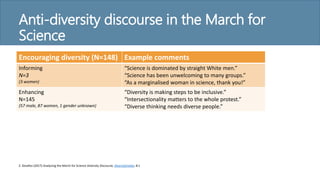
Anti-diversity discourse in the March for
Science
Encouraging diversity (N=148) Example comments
Informing
N=3
(3 women)
“Science is dominated by straight White men.”
“Science has been unwelcoming to many groups.”
“As a marginalised woman in science, thank you!”
Enhancing
N=145
(57 male, 87 women, 1 gender unknown)
“Diversity is making steps to be inclusive.”
“Intersectionality matters to the whole protest.”
“Diverse thinking needs diverse people.”
Z. Zevallos (2017) Analyzing the March for Science Diversity Discourse, DiverseScholar, 8:1
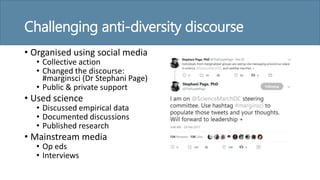
Challenging anti-diversity discourse
• Organised using social media
• Collective action
• Changed the discourse:
#marginsci (Dr Stephani Page)
• Public & private support
• Used science
• Discussed empirical data
• Documented discussions
• Published research
• Mainstream media
• Op eds
• Interviews
Challenging anti-diversity discourse
Peggy McIntosh (1989) 'White Privilege: Unpacking the Invisible Knapsack,' Peace and Freedom
Magazine, July/August, pp. 10-12.
Ijeoma Oluo [@ijeomaoluo] (2017) ‘Look for where your privilege intersects…' Twitter, 9 February.
Last accessed 14 April 2018: https://twitter.com/ijeomaoluo/status/829474539373359105
Questions for us
• Would I know true equity when I see it?
• How can I better support inclusion?
• How I can make my next event accessible?
• How can I begin to practice intersectionality in event planning?
• What discourse do I contribute to?
• What will I do to lesson racism inequity?
• Where does my privilege intersect with someone’s oppression?
Dr Zuleyka Zevallos/ @OtherSociology
OtherSociologist.com
Accessible version of handout: bit.ly/diversity-sci

Challenging the March for Science

  • 1.
    Challenging the Marchfor Science Dr Zuleyka Zevallos @OtherSociology OtherSociologist.com Intersectionality at the Coal Face
  • 2.
    Overview • Background tothe March • Diversity • Equity • Inclusion • Access • Intersectionality • Discourses • Science • Anti-diversity in the march
  • 3.
    Background • Announced 24January 2017 • Protest on 22 April 2017 • Created and largely promoted on social media • No social movement leadership experience • Equity and diversity were afterthoughts
  • 4.
    Equity • Equity: barriers,issues & solutions to structural disadvantage • Undermining women’s contributions • Flamed racism towards people of colour • Ignored disabled researchers • Erased LGBTQIA scientists
  • 5.
    Challenging equity issues Askourselves: who should lead? • Indigenous leadership • Other people of colour • Disability experts • LGBTQIA representatives • Social movement organisers • Equity & diversity practitioners • Specialist members
  • 6.
    Inclusion • Inclusion: activelyseeking out, valuing and respecting differences • Indigenous Science Declaration • Predates Western models • Memories, wisdom & deep knowledges • Cultural frameworks of respect, reciprocity, responsibility, healing • Communities abused as research subjects & still suffer • Symbiosis of collaboration Drafted by Native Amercian scientists, Robin Kimmerer (Potawatomi), Ph.D., Rosalyn LaPier (Blackfeet/Métis), Ph.D., Melissa Nelson (Anishinaabe), Ph.D. and Kyle Whyte (Potawatomi), Ph.D (2017) ”Indigenous Science Statement for the March for Science.” Last accessed 14 April 2018: http://www.esf.edu/indigenous-science-letter/
  • 7.
    Challenging inclusion issues Howcan I remove barriers? • Embrace inclusion in event coordination • Publicise equity & diversity statement • Clear anti-harassment policies • Address safety • Form partnerships with experienced social movement organisers • Promote event with minority communities in mind • Seek feedback from vulnerable groups • Craft a communication strategy
  • 8.
    Access • Access: opportunitiesto enhance participation • “Forgot” disabled people in first diversity statement • Delayed accessibility strategy • Refused leadership of disabled scientists • No accessibility plan • Lacked disabled speakers
  • 9.
    Challenging access issues Whencan I help enhance participation? • Demonstrate active commitment • Decision-making by disabled experts • Accessibility planning from Day 1 • Test venue or protest path • Consult diverse minority groups • Accessible promotion materials • Hearing loops, closed captions, sign interpreters • Schedule disabled speakers • Consider timing, rest, quiet areas
  • 10.
    Intersectionality • Intersectionality: gender andracial inequalities are interconnected & compound other forms of disadvantage • Abused leadership of Black, Indigenous and other women of colour • Demanded emotional labour • Centred Whiteness
  • 11.
    Challenging issues ofintersectionality Where do race & gender interconnect? • Active management • Leaders address structural inequities • Use visuals & language that reflect diversity • Reward the work of volunteers • Consider training • Moderate online discussions • Reduce emotional labour for minorities • Apologise & reflect for mistakes • Address underrepresented scientists • Use White privilege constructively
  • 12.
    Discourses of science •Discourse: use of language to establish & justify dominance • Reinforces status quo • Normalises existing power • E.g. Stories we tell about science focus on White men • Organisers said the march is: • “Not political;” & • “Not about scientists, but about science”
  • 13.
    Anti-diversity discourse inthe March for Science Discouraging diversity (N=188) Example comments Politicising (N=88) 57 men, 90 women, 1 gender unknown “Stick to the science.” “Identity politics.” “This is what we are marching against.” Dividing N=49 (30 men, 19 women) “Diversity is divisive.” “Stop pandering.” “This happened with Women’s March….” Depreciating N=27 (10 men, 17 women) “Science is already diverse!” “Science is equal and inclusive by nature.” “Science is neutral. It doesn’t discriminate.” Distracting N=24 (10 men, 14 women) “Diversity is important but don't let it derail your message.” “Please don't put diversity over merit.” “All are welcome but don’t let it fracture us.” Z. Zevallos (2017) Analyzing the March for Science Diversity Discourse, DiverseScholar, 8:1
  • 14.
    Anti-diversity discourse inthe March for Science Encouraging diversity (N=148) Example comments Informing N=3 (3 women) “Science is dominated by straight White men.” “Science has been unwelcoming to many groups.” “As a marginalised woman in science, thank you!” Enhancing N=145 (57 male, 87 women, 1 gender unknown) “Diversity is making steps to be inclusive.” “Intersectionality matters to the whole protest.” “Diverse thinking needs diverse people.” Z. Zevallos (2017) Analyzing the March for Science Diversity Discourse, DiverseScholar, 8:1
  • 15.
    Challenging anti-diversity discourse •Organised using social media • Collective action • Changed the discourse: #marginsci (Dr Stephani Page) • Public & private support • Used science • Discussed empirical data • Documented discussions • Published research • Mainstream media • Op eds • Interviews
  • 16.
    Challenging anti-diversity discourse PeggyMcIntosh (1989) 'White Privilege: Unpacking the Invisible Knapsack,' Peace and Freedom Magazine, July/August, pp. 10-12. Ijeoma Oluo [@ijeomaoluo] (2017) ‘Look for where your privilege intersects…' Twitter, 9 February. Last accessed 14 April 2018: https://twitter.com/ijeomaoluo/status/829474539373359105
  • 17.
    Questions for us •Would I know true equity when I see it? • How can I better support inclusion? • How I can make my next event accessible? • How can I begin to practice intersectionality in event planning? • What discourse do I contribute to? • What will I do to lesson racism inequity? • Where does my privilege intersect with someone’s oppression? Dr Zuleyka Zevallos/ @OtherSociology OtherSociologist.com Accessible version of handout: bit.ly/diversity-sci

Editor's Notes

  • #2 This talk was given on the 21 September 2017, at the University of Auckland. I was a guest of the The Women in Science Network Before I begin my talk, I hope you might allow me to start off with an Acknowledgement of Country, as this is the custom in Australia. I would like to pay respect to the traditional custodians of the land on which we meet, the Tāmaki Māori; and any elders, past, present and emerging in this room. It is upon their ancestral lands that we meet. As we share our own learning, research and equity practices may we also pay respect to the diversity of knowledge embedded forever within their Custodianship of Country.