00 Wnsdecisionpoint.com
wnsdecisionpoint.com
Managing Working Capital in Retail
A Framework for Retailers to Sustain Growth
11 Wnsdecisionpoint.com
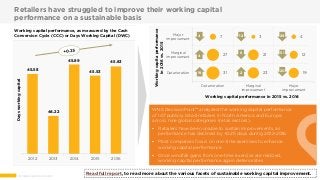
Retailers have struggled to improve their working capital
performance on a sustainable basis
45.58
44.22
45.89
45.53
45.83
2012 2013 2014 2015 2016
Daysworkingcapital
Working capital performance, as measured by the Cash
Conversion Cycle (CCC) or Days Working Capital (DWC)
31
27
7
23
21
3
19
12
4
Deterioration
Marginal
improvement
Major
improvement
Deterioration Marginal
improvement
Major
improvement
Workingcapitaperformance
in2016vs.2015
Working capital performance in 2015 vs. 2014
19 2
4
4
6
12
20
51
29
WNS DecisionPoint™ analyzed the working capital performance
of 147 publicly listed retailers in North America and Europe,
across nine global categories (retail sectors).
 Retailers have been unable to sustain improvements, as
performance has declined by +0.25 days during 2012-2016
 Most companies focus on one-time exercises to enhance
working capital performance
 Once windfall gains from one-time exercise are realized,
working capital performance again deteriorates
Read full report, to read more about the various facets of sustainable working capital improvement.
22 Wnsdecisionpoint.com
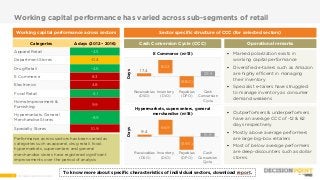
Working capital performance has varied across sub-segments of retail
Working capital performance across sectors
Categories Δ days (2012 – 2016)
Apparel Retail -4.5
Department Stores -0.4
Drug Retail -4.6
E Commerce 8.3
Electronics 4.8
Food Retail -4.1
Home Improvement &
Furnishing
9.9
Hypermarkets, General
Merchandise Stores
-8.9
Specialty Stores 10.9
Performance across sectors has been varied as
categories such as apparel, drug retail, food,
hypermarkets, supercenters and general
merchandise stores have registered significant
improvements over the period of analysis
To know more about specific characteristics of individual sectors, download report.
Operational remarks
 Marked polarization exists in
working capital performance
 Diversified e-tailers such as Amazon
are highly efficient in managing
their inventory
 Specialist e-tailers have struggled
to manage inventory as consumer
demand weakens
 Outperformers & underperformers
have an average CCC of -12 & 62
days respectively
 Mostly above average performers
are large big-box retailers
 Most of below average performers
are deep-discounters such as dollar
stores.
Cash Conversion Cycle (CCC)
29.8
17.4
80.3
(68.0)
Receivables
(DSO)
Inventory
(DIO)
Payables
(DPO)
Cash
Conversion
Cycle
E Commerce (n=13)
Days
16.8
9.4
66.9
(59.5)
Receivables
(DSO)
Inventory
(DIO)
Payables
(DPO)
Cash
Conversion
Cycle
Hypermarkets, supercenters, general
merchandise (n=18)Days
Sector specific structure of CCC (for selected sectors)
33 Wnsdecisionpoint.com
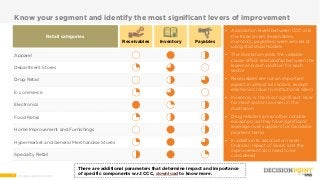
Know your segment and identify the most significant levers of improvement
Apparel
Department Stores
Drug Retail
E-commerce
Electronics
Food Retail
Home Improvement and Furnishings
Hypermarket and General Merchandise Stores
Specialty Retail
Retail categories
Receivables Inventory Payables
 Association levels between CCC and
the three levers (receivables,
inventory, payables) were arrived at
using statistical models
 The illustration plots the variable
cause-effect relationship between the
levers and cash position for each
sector
 Receivables are not an important
aspect in almost all sectors, except
electronics (due to institutional sales)
 Inventory is the most significant lever
for most sectors as seen in the
illustration
 Drug retailers are another notable
exception, as they have significant
leverage over suppliers for favorable
payment terms
 In addition to association levels,
financial impact of levers and the
improvement also need to be
considered
There are additional parameters that determine impact and importance
of specific components w.r.t CCC, download to know more.
44 Wnsdecisionpoint.com
Leverage analytics to identify major pain points, as inventory and
payables will be key pillars of your strategy
Retailers can generate USD 2.8 B in additional cash flow based on these
improvement initiatives, as per our Business Impact Quantification methodology.
Read report to know.
Real-time
Visibility &
Analytics
Supplier
Segmentation
to Allocate
Payments
Extension of
Net Payment
Terms
Assortment
Rationalization
4 Wnsdecisionpoint.com
55 Wnsdecisionpoint.com
A credible insights hub for companies looking to
transform their strategies and operations by aligning
with todays realities and tomorrow’s disruptions.
Email: perspectives@wnsdecisionpoint.com
Website: wnsdecisionpoint.com
@WNSDecisionPt
WNS DecisionPoint
WNS DecisionPoint

Managing working capital to unlock value in Retail industry - A framework for retailers to sustain growth

  • 1.
    00 Wnsdecisionpoint.com wnsdecisionpoint.com Managing WorkingCapital in Retail A Framework for Retailers to Sustain Growth
  • 2.
    11 Wnsdecisionpoint.com Retailers havestruggled to improve their working capital performance on a sustainable basis 45.58 44.22 45.89 45.53 45.83 2012 2013 2014 2015 2016 Daysworkingcapital Working capital performance, as measured by the Cash Conversion Cycle (CCC) or Days Working Capital (DWC) 31 27 7 23 21 3 19 12 4 Deterioration Marginal improvement Major improvement Deterioration Marginal improvement Major improvement Workingcapitaperformance in2016vs.2015 Working capital performance in 2015 vs. 2014 19 2 4 4 6 12 20 51 29 WNS DecisionPoint™ analyzed the working capital performance of 147 publicly listed retailers in North America and Europe, across nine global categories (retail sectors).  Retailers have been unable to sustain improvements, as performance has declined by +0.25 days during 2012-2016  Most companies focus on one-time exercises to enhance working capital performance  Once windfall gains from one-time exercise are realized, working capital performance again deteriorates Read full report, to read more about the various facets of sustainable working capital improvement.
  • 3.
    22 Wnsdecisionpoint.com Working capitalperformance has varied across sub-segments of retail Working capital performance across sectors Categories Δ days (2012 – 2016) Apparel Retail -4.5 Department Stores -0.4 Drug Retail -4.6 E Commerce 8.3 Electronics 4.8 Food Retail -4.1 Home Improvement & Furnishing 9.9 Hypermarkets, General Merchandise Stores -8.9 Specialty Stores 10.9 Performance across sectors has been varied as categories such as apparel, drug retail, food, hypermarkets, supercenters and general merchandise stores have registered significant improvements over the period of analysis To know more about specific characteristics of individual sectors, download report. Operational remarks  Marked polarization exists in working capital performance  Diversified e-tailers such as Amazon are highly efficient in managing their inventory  Specialist e-tailers have struggled to manage inventory as consumer demand weakens  Outperformers & underperformers have an average CCC of -12 & 62 days respectively  Mostly above average performers are large big-box retailers  Most of below average performers are deep-discounters such as dollar stores. Cash Conversion Cycle (CCC) 29.8 17.4 80.3 (68.0) Receivables (DSO) Inventory (DIO) Payables (DPO) Cash Conversion Cycle E Commerce (n=13) Days 16.8 9.4 66.9 (59.5) Receivables (DSO) Inventory (DIO) Payables (DPO) Cash Conversion Cycle Hypermarkets, supercenters, general merchandise (n=18)Days Sector specific structure of CCC (for selected sectors)
  • 4.
    33 Wnsdecisionpoint.com Know yoursegment and identify the most significant levers of improvement Apparel Department Stores Drug Retail E-commerce Electronics Food Retail Home Improvement and Furnishings Hypermarket and General Merchandise Stores Specialty Retail Retail categories Receivables Inventory Payables  Association levels between CCC and the three levers (receivables, inventory, payables) were arrived at using statistical models  The illustration plots the variable cause-effect relationship between the levers and cash position for each sector  Receivables are not an important aspect in almost all sectors, except electronics (due to institutional sales)  Inventory is the most significant lever for most sectors as seen in the illustration  Drug retailers are another notable exception, as they have significant leverage over suppliers for favorable payment terms  In addition to association levels, financial impact of levers and the improvement also need to be considered There are additional parameters that determine impact and importance of specific components w.r.t CCC, download to know more.
  • 5.
    44 Wnsdecisionpoint.com Leverage analyticsto identify major pain points, as inventory and payables will be key pillars of your strategy Retailers can generate USD 2.8 B in additional cash flow based on these improvement initiatives, as per our Business Impact Quantification methodology. Read report to know. Real-time Visibility & Analytics Supplier Segmentation to Allocate Payments Extension of Net Payment Terms Assortment Rationalization 4 Wnsdecisionpoint.com
  • 6.
    55 Wnsdecisionpoint.com A credibleinsights hub for companies looking to transform their strategies and operations by aligning with todays realities and tomorrow’s disruptions. Email: perspectives@wnsdecisionpoint.com Website: wnsdecisionpoint.com @WNSDecisionPt WNS DecisionPoint WNS DecisionPoint