Pau Garcia Quiles
Product Owner &Technical Project Manager
SUSE Manager
pau.garcia@suse.com
Uyuni
Introduction & how to do systems management
Pablo Suárez Hernández
Python & Salt Software Engineer
SUSE Manager
pablo.suarezhernandez@suse.com
About us
Pau Garcia Quiles
Product Owner & Technical Project Manager
SUSE Manager
pagarcia @ irc.freenode.org
pagarcia @ gitter.im
pau.garcia@suse.com
Pablo Suárez Hernández
Python & Salt Software Engineer
SUSE Manager
PabloS @ irc.freenode.org
meaksh @ gitter.im
pablo.suarezhernandez@suse.com
What?

Systems management solution

Deploy and manage all kind of workloads from a single place

Automate audit and reporting capabilities

Hardware and software inventories

Configuration management: automatically maintain standard
configurations
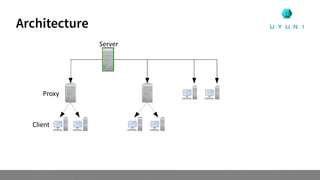
Architecture
Proxy
Server
Client
Origins: Spacewalk

Free & Open Source Systems Management

Around since 2008

Base for Red Hat Satellite 5 and SUSE Manager <= 3.2

Maintenance mode:
 No modern configuration management
 No clear plans for the future
“Salar de Uyuni” is the world's largest salt flat*
Uyuni
/uju: ni/ˈ
* https://en.wikipedia.org/wiki/Salar_de_Uyuni
Image: https://www.flickr.com/photos/madeleine_h/9468953452/
Attribution-ShareAlike 2.0 Generic (CC BY-SA 2.0)
Uyuni: fork of Spacewalk

Simple installation

Two stacks: traditional client (“spacewalk”) and Salt
 New development goes into Salt clients (“minions”)
 Traditional stack lets you continue using your Spacewalk/Satellite stack and knowledge in Uyuni. No need to convert to Salt.

Containers/Kubernetes integration

Scalability

Usability

React Web UI

Python 3 and JDK11 codebase

System deployment

Patch management

Service Pack migration

Configuration management

Bare-metal provisioning

Schedule action chains to be performed on systems

API
Features

Transparent integration with Salt

Content Lifecycle Management
 Define stages (DEV, TEST, PRO) for your software channels
 Apply filters to add/remove contents

Build container images

Compliance management: OpenSCAP and CVE Audit! Get alerts and fix in 1-click!

Subscription management

Formulas with Forms: create your own YAML automation templates, no programming skills
required

Virtualization

Monitoring (Prometheus & Grafana stack)
Cool features!
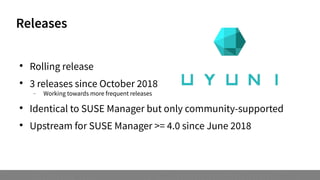
Releases

Rolling release

3 releases since October 2018
 Working towards more frequent releases

Identical to SUSE Manager but only community-supported

Upstream for SUSE Manager >= 4.0 since June 2018

Public repository and public development: upstream first policy

Mailing lists, IRC, Gitter

(Semi) Public CI

Newest release: 2020.01

Base OS: openSUSE Leap 15.1

Clients:
 RHEL 6/7/8 CentOS 6/7/8
 SLE11/12/15 openSUSE 15
 Ubuntu 16.04/18.04 (Debian 9/10)
 (Oracle Enterprise Linux)
Current situation

openSUSE Leap 15.2 as base system

Maintenance windows, recurring patch cycle and recurring
highstate

Cluster management

Multi-Server

More usability work

Continue building the community!
The future
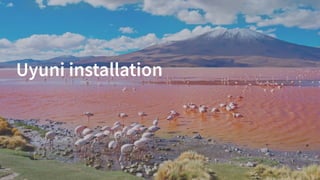
Uyuni installation
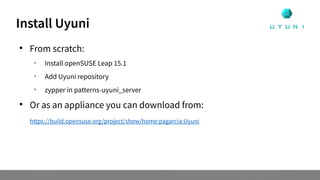
Install Uyuni

From scratch:

Install openSUSE Leap 15.1

Add Uyuni repository

zypper in patterns-uyuni_server

Or as an appliance you can download from:
https://build.opensuse.org/project/show/home:pagarcia:Uyuni
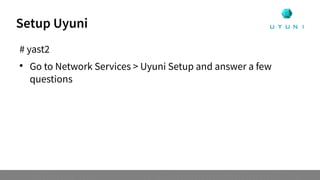
Setup Uyuni
# yast2

Go to Network Services > Uyuni Setup and answer a few
questions
openSUSE Leap with Uyuni
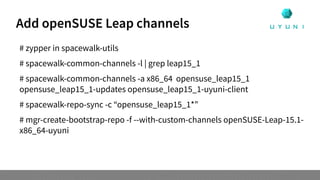
Add openSUSE Leap channels
# zypper in spacewalk-utils
# spacewalk-common-channels -l | grep leap15_1
# spacewalk-common-channels -a x86_64 opensuse_leap15_1
opensuse_leap15_1-updates opensuse_leap15_1-uyuni-client
# spacewalk-repo-sync -c “opensuse_leap15_1*”
# mgr-create-bootstrap-repo -f --with-custom-channels openSUSE-Leap-15.1-
x86_64-uyuni
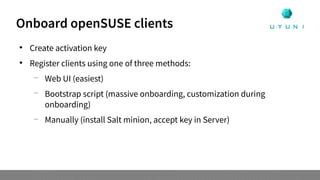
Onboard openSUSE clients

Create activation key

Register clients using one of three methods:
—
Web UI (easiest)
—
Bootstrap script (massive onboarding, customization during
onboarding)
—
Manually (install Salt minion, accept key in Server)
Patches

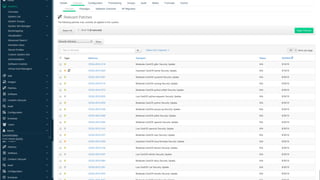
The openSUSE Leap Updates repository includes patch
information

Uyuni will use it for Patches and Audit
openSUSE Leap supported features

Check the docs for the full list of supported features:
https://www.uyuni-project.org/uyuni-docs/uyuni/client-config
uration/supported-features-sles.html

If in doubt, ask in the lists, IRC or Gitter!
CentOS with Uyuni
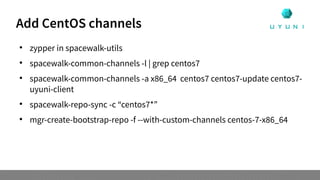
Add CentOS channels

zypper in spacewalk-utils

spacewalk-common-channels -l | grep centos7

spacewalk-common-channels -a x86_64 centos7 centos7-update centos7-
uyuni-client

spacewalk-repo-sync -c “centos7*”

mgr-create-bootstrap-repo -f --with-custom-channels centos-7-x86_64
Onboard CentOS clients

Create activation key

Register clients using one of three methods:
—
Web UI (easiest)
—
Bootstrap script (massive onboarding, customization during
onboarding)
—
Manually (install Salt minion, accept key in Server)
Errata

Use Steve Meier’s external service to get errata information for
CentOS

Uyuni will use it for Patches and Audit

Fully documented in Uyuni docs
CentOS supported features

Check the docs for the full list of supported features:
https://www.uyuni-project.org/uyuni-docs/uyuni/client-config
uration/supported-features-centos.html

If in doubt, ask in the lists, IRC or Gitter!
Q&A
A&Q

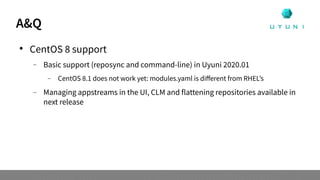
CentOS 8 support
 Basic support (reposync and command-line) in Uyuni 2020.01
 CentOS 8.1 does not work yet: modules.yaml is different from RHEL’s
 Managing appstreams in the UI, CLM and flattening repositories available in
next release
A&Q
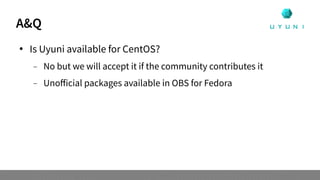
 Is Uyuni available for CentOS?
 No but we will accept it if the community contributes it
 Unofficial packages available in OBS for Fedora
Join Us at uyuni-project.org
/uyuni-project
/uyuni-project
/UyuniProject
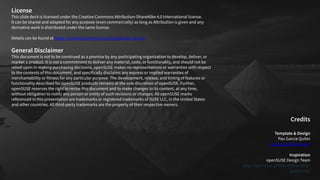
License
This slide deck is licensed under the Creative Commons Attribution-ShareAlike 4.0 International license.
It can be shared and adapted for any purpose (even commercially) as long as Attribution is given and any
derivative work is distributed under the same license.
Details can be found at https://creativecommons.org/licenses/by-sa/4.0/
General Disclaimer
This document is not to be construed as a promise by any participating organisation to develop, deliver, or
market a product. It is not a commitment to deliver any material, code, or functionality, and should not be
relied upon in making purchasing decisions. openSUSE makes no representations or warranties with respect
to the contents of this document, and specifically disclaims any express or implied warranties of
merchantability or fitness for any particular purpose. The development, release, and timing of features or
functionality described for openSUSE products remains at the sole discretion of openSUSE. Further,
openSUSE reserves the right to revise this document and to make changes to its content, at any time,
without obligation to notify any person or entity of such revisions or changes. All openSUSE marks
referenced in this presentation are trademarks or registered trademarks of SUSE LLC, in the United States
and other countries. All third-party trademarks are the property of their respective owners.
Credits
Template & Design
Pau Garcia Quiles
pau.garcia@suse.com
Inspiration
openSUSE Design Team
http://opensuse.github.io/branding-
guidelines/

Uyuni: Introduction & how to do systems management

  • 1.
    Pau Garcia Quiles ProductOwner &Technical Project Manager SUSE Manager pau.garcia@suse.com Uyuni Introduction & how to do systems management Pablo Suárez Hernández Python & Salt Software Engineer SUSE Manager pablo.suarezhernandez@suse.com
  • 2.
    About us Pau GarciaQuiles Product Owner & Technical Project Manager SUSE Manager pagarcia @ irc.freenode.org pagarcia @ gitter.im pau.garcia@suse.com Pablo Suárez Hernández Python & Salt Software Engineer SUSE Manager PabloS @ irc.freenode.org meaksh @ gitter.im pablo.suarezhernandez@suse.com
  • 3.
    What?  Systems management solution  Deployand manage all kind of workloads from a single place  Automate audit and reporting capabilities  Hardware and software inventories  Configuration management: automatically maintain standard configurations
  • 4.
  • 5.
    Origins: Spacewalk  Free &Open Source Systems Management  Around since 2008  Base for Red Hat Satellite 5 and SUSE Manager <= 3.2  Maintenance mode:  No modern configuration management  No clear plans for the future
  • 6.
    “Salar de Uyuni”is the world's largest salt flat* Uyuni /uju: ni/ˈ * https://en.wikipedia.org/wiki/Salar_de_Uyuni Image: https://www.flickr.com/photos/madeleine_h/9468953452/ Attribution-ShareAlike 2.0 Generic (CC BY-SA 2.0)
  • 7.
    Uyuni: fork ofSpacewalk  Simple installation  Two stacks: traditional client (“spacewalk”) and Salt  New development goes into Salt clients (“minions”)  Traditional stack lets you continue using your Spacewalk/Satellite stack and knowledge in Uyuni. No need to convert to Salt.  Containers/Kubernetes integration  Scalability  Usability  React Web UI  Python 3 and JDK11 codebase
  • 8.
     System deployment  Patch management  ServicePack migration  Configuration management  Bare-metal provisioning  Schedule action chains to be performed on systems  API Features
  • 9.
     Transparent integration withSalt  Content Lifecycle Management  Define stages (DEV, TEST, PRO) for your software channels  Apply filters to add/remove contents  Build container images  Compliance management: OpenSCAP and CVE Audit! Get alerts and fix in 1-click!  Subscription management  Formulas with Forms: create your own YAML automation templates, no programming skills required  Virtualization  Monitoring (Prometheus & Grafana stack) Cool features!
  • 10.
    Releases  Rolling release  3 releasessince October 2018  Working towards more frequent releases  Identical to SUSE Manager but only community-supported  Upstream for SUSE Manager >= 4.0 since June 2018
  • 11.
     Public repository andpublic development: upstream first policy  Mailing lists, IRC, Gitter  (Semi) Public CI  Newest release: 2020.01  Base OS: openSUSE Leap 15.1  Clients:  RHEL 6/7/8 CentOS 6/7/8  SLE11/12/15 openSUSE 15  Ubuntu 16.04/18.04 (Debian 9/10)  (Oracle Enterprise Linux) Current situation
  • 12.
     openSUSE Leap 15.2as base system  Maintenance windows, recurring patch cycle and recurring highstate  Cluster management  Multi-Server  More usability work  Continue building the community! The future
  • 13.
  • 14.
    Install Uyuni  From scratch:  InstallopenSUSE Leap 15.1  Add Uyuni repository  zypper in patterns-uyuni_server  Or as an appliance you can download from: https://build.opensuse.org/project/show/home:pagarcia:Uyuni
  • 15.
    Setup Uyuni # yast2  Goto Network Services > Uyuni Setup and answer a few questions
  • 16.
  • 17.
    Add openSUSE Leapchannels # zypper in spacewalk-utils # spacewalk-common-channels -l | grep leap15_1 # spacewalk-common-channels -a x86_64 opensuse_leap15_1 opensuse_leap15_1-updates opensuse_leap15_1-uyuni-client # spacewalk-repo-sync -c “opensuse_leap15_1*” # mgr-create-bootstrap-repo -f --with-custom-channels openSUSE-Leap-15.1- x86_64-uyuni
  • 18.
    Onboard openSUSE clients  Createactivation key  Register clients using one of three methods: — Web UI (easiest) — Bootstrap script (massive onboarding, customization during onboarding) — Manually (install Salt minion, accept key in Server)
  • 19.
    Patches  The openSUSE LeapUpdates repository includes patch information  Uyuni will use it for Patches and Audit
  • 20.
    openSUSE Leap supportedfeatures  Check the docs for the full list of supported features: https://www.uyuni-project.org/uyuni-docs/uyuni/client-config uration/supported-features-sles.html  If in doubt, ask in the lists, IRC or Gitter!
  • 21.
  • 22.
    Add CentOS channels  zypperin spacewalk-utils  spacewalk-common-channels -l | grep centos7  spacewalk-common-channels -a x86_64 centos7 centos7-update centos7- uyuni-client  spacewalk-repo-sync -c “centos7*”  mgr-create-bootstrap-repo -f --with-custom-channels centos-7-x86_64
  • 23.
    Onboard CentOS clients  Createactivation key  Register clients using one of three methods: — Web UI (easiest) — Bootstrap script (massive onboarding, customization during onboarding) — Manually (install Salt minion, accept key in Server)
  • 24.
    Errata  Use Steve Meier’sexternal service to get errata information for CentOS  Uyuni will use it for Patches and Audit  Fully documented in Uyuni docs
  • 25.
    CentOS supported features  Checkthe docs for the full list of supported features: https://www.uyuni-project.org/uyuni-docs/uyuni/client-config uration/supported-features-centos.html  If in doubt, ask in the lists, IRC or Gitter!
  • 31.
  • 32.
    A&Q  CentOS 8 support Basic support (reposync and command-line) in Uyuni 2020.01  CentOS 8.1 does not work yet: modules.yaml is different from RHEL’s  Managing appstreams in the UI, CLM and flattening repositories available in next release
  • 33.
    A&Q  Is Uyuniavailable for CentOS?  No but we will accept it if the community contributes it  Unofficial packages available in OBS for Fedora
  • 34.
    Join Us atuyuni-project.org /uyuni-project /uyuni-project /UyuniProject
  • 35.
    License This slide deckis licensed under the Creative Commons Attribution-ShareAlike 4.0 International license. It can be shared and adapted for any purpose (even commercially) as long as Attribution is given and any derivative work is distributed under the same license. Details can be found at https://creativecommons.org/licenses/by-sa/4.0/ General Disclaimer This document is not to be construed as a promise by any participating organisation to develop, deliver, or market a product. It is not a commitment to deliver any material, code, or functionality, and should not be relied upon in making purchasing decisions. openSUSE makes no representations or warranties with respect to the contents of this document, and specifically disclaims any express or implied warranties of merchantability or fitness for any particular purpose. The development, release, and timing of features or functionality described for openSUSE products remains at the sole discretion of openSUSE. Further, openSUSE reserves the right to revise this document and to make changes to its content, at any time, without obligation to notify any person or entity of such revisions or changes. All openSUSE marks referenced in this presentation are trademarks or registered trademarks of SUSE LLC, in the United States and other countries. All third-party trademarks are the property of their respective owners. Credits Template & Design Pau Garcia Quiles pau.garcia@suse.com Inspiration openSUSE Design Team http://opensuse.github.io/branding- guidelines/