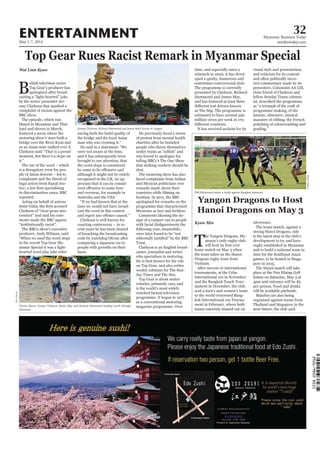
May 1-7, 2014
Myanmar Business Today
mmbiztoday.com
mmbiztoday.com May 1-7, 2014| Vol 2, Issue 17MYANMAR’S FIRST BILINGUAL BUSINESS JOURNAL
Myanmar Summary
Myanmar Summary
Contd. P 6... Contd. P 6...
Inside MBT
National Export Strategy to Be Ready
by 2014 .. p-4
Myanmar’s Palm Oil Industry: Chal-
lenges and Way Forward .. P-9
Myanmar’s Economic Prospects And
Its Real Potential .. P-21
Securing Myanmar
Hydrocarbon Investments
M
yanmar’s hydro-
carbon sector
is an attractive
target for foreign inves-
tors. Three major issues,
however, present a signif-
icant challenge to foreign
companies planning to
invest in Myanmar: oner-
ous government policies,
community resistance to
infrastructure projects,
and security concerns.
Companies are rela-
tively powerless to af-
fect government policy,
but by employing com-
munity engagement pro-
grams, they can mitigate
community resistance
and security concerns.
As shown by the experi-
ence of the Sino-Burmese
pipeline project, energy
sector investors should
engage with local com-
munities when carrying
out such programs, and
they should not rely sole-
ly upon interfacing with
government entities.
Hydrocarbon pros-
pects
As Myanmar continues
Nicholas Borroz its dramatic opening to
international markets, oil
and gas projects will be an
attractive investment tar-
get. There are numerous
media articles speculating
that Myanmar contains
vast oil reserves, with a
recent estimate that My-
anmar has potential re-
serves on par with Brazil.
There are also reports of
small-scale homegrown
oil extraction projects
that have transformed
local communities. The
country has yet to un-
dergo rigorous testing to
determine the exact size
of its reserves, but such
speculation and anecdo-
tal evidence is a tantalis-
ing prospect for foreign
businesses.
China’s development
panying Sino-Burmese
pipelines are the most
bon projects currently
underway in Myanmar.
After China, Thailand is
the most active player in
Myanmar’s hydrocarbon
sector. It is engaged in the
licence that covers much
Gulf of Martaban. Opera-
tions in Zawtika are due
to start shortly, with two
thirds of gas production
destined for the Thai mar-
ket. In March 2014, sever-
al Western majors joined
game; Shell, Chevron,
and Statoil all acquired
acreage in a highly publi-
Investment chal-
lenges
Despite the appeal of
Myanmar’s hydrocarbon
sector, government poli-
cies could decrease oil
and gas companies’ de-
sire to invest. There are
reports, for instance, that
Nay Pyi Taw will impose
onerous revenue-sharing
requirements well above
the international average,
channelling up to 85 per-
cent of earnings to gov-
more vocal about the
need to reserve some gas
jrefrmEdkifiH [dkuf'½dkumbGef
u@rSmEdkifiHjcm;om;&if;ESD;jr§KyfESH
olrsm;tm;qGJaqmifaeonfhu@
wpfckjzpfonf/odkYaomf tpdk;&
rl0g'? vlrI0ef;usiftajccHpDrH
udef;rsm;tm; qefYusifrIESifh vkHNcHK
a&;qdkif&m jyóemrsm;u EdkifiH
jcm;om;ukrÜPDrsm;tm; jrefrm
EdkifiHwGif &if;ESD;jr§KyfESH&ef pdefac:rI
wpf&yftjzpf wnf&Sdaeonf/
ukrÜPDrsm;taejzifhtpdk;&rl0g'
rsm;tm;oufa&mufEkdif&eftiftm;
r&Sdaomfvnf; vlrIaphpyfa&;tpD
tpOfrsm;tm;jzifh vlrI0ef;usif
qefYusifrIrsm;ESifh vkHNcHKa&;qdkif&m
jyóemrsm;tm; avsmhyg;apEdkif
onf/ vuf&Sdjzpfay:aeonfh
w½kwf-jrefrm"mwfaiGUydkufvdkif;
pDrHudef;tawGUtBuHKrsm;udk
Munfhjcif;tm;jzifh pGrf;tifqdkif&m
&if;ESD;jr§KyfESHolrsm;taejzifh jynf
wGif;vlrItzGJUtpnf;rsm;ESifh
tqdkygaphpyfa&;tpDtpOfrsm;
vkyfaqmifoifhNyD; tpdk;&tm; rSDcdk
tumtuG,fr,loifhaMumif;
awGU&onf/
jrefrmEdkifiHtaejzifh tjynfjynf
qdkif&maps;uGufodkY 0ifa&mufvm
FDI Almost Triples to
$4.1b in FY2013-14
M
yanmar bagged
$4.1 billion in
foreign direct in-
vestments in the 2013-14
in March, almost tripling
from $1.4 billion it re-
ceived in FY2012-13, the
Directorate of Investment
and Companies Admin-
istration’s (DICA) recent
data shows.
Injected by 34 countries,
the foreign investment
Pann Nu
into manufacturing, en-
ergy, oil and gas, mining,
hotels and tourism, real
and agriculture.
Total FDI from 34 coun-
tries in Myanmar now
stands at $46 billion, ac-
cording to DICA statistics.
China still stands as the
largest investor with $14
billion in investments in
the Southeast Asian coun-
try, followed by Thailand
($10 billion) and Hong
Kong ($6 billion).
The 71 foreign-invested
projects in 2013-14 up to
December last year has
created over 50,000 jobs
for local people, accord-
ing to DICA.
jrefrmEdkifiHtaejzifh 2013-14
b@ma&;ESpfwGif tar&duef
a':vm 4 'or 1 bDvD,Htm;
EdkifiHjcm;wdkuf½dkuf&if;ESD;jr§KyfESHrIrS
&&SdcJhNyD; 2012-13 wGif &&SdcJhonfh
tar&duefa':vm 1 'or 4
bDvD,Hxuf okH;qjrifhwufvm
aMumif; &if;ESD;jr§KyfESHrIESifhukrÜPD
rsm;ñTefMum;a&;rSL;½Hk; (DICA)
 pm&if;rsm;t& od&onf/
May 1-7, 2014
Myanmar Business Today
mmbiztoday.com
2LOCAL BIZ
MYANMAR’S FIRST BILINGUAL BUSINESS JOURNAL
Board of Editors
Editor-in-Chief - Sherpa Hossainy
Email - sherpa.hossainy@gmail.com
Ph - 09 42 110 8150
Editor-in-Charge - Wai Linn Kyaw
Email - linnkhant18@gmail.com
Ph - 09 40 157 9090
Reporters &Writers
Sherpa Hossainy, Kyaw Min,
Wai Linn Kyaw, Phyu Thit Lwin, Aye Myat,
Pann Nu, Htun Htun Min, May Soe San
Art & Design
Zarni Min Naing (Circle)
Email - zarni.circle@gmail.com
Ph - 09 7310 5793
Ko Naing
Email - nzlinn.13@gmail.com
Ph - 09 730 38114
DTP
May Su Hlaing
Translators
Wai Linn Kyaw, Phyu Maung,
Bone Pyae Sone
Advertising
Seint Seint Aye, Moe Hsann Pann, Htet Wai Yan, Zin Wai Oo
Advertising Hotline - 09 420 237 625, 09 4211 567 05,
09 31 450 345
Email - sales.mbtweekly@gmail.com
Managing Director
Prasert Lekavanichkajorn
pkajorn@hotmail.com
09421149720
Publisher
U Myo Oo (04622)
No. 1A-3, Myintha 11th
Street,
South Okkalapa Township, Yangon.
Tel: 951-850 0763,
Fax: 951-8603288 ext: 007
Shwe Naing Ngan Printing (04193)
Printing
Subscription & Circulation
Aung Khin Sint - aksint2008@gmail.com
09 20 435 59
Nilar Myint - manilarmyint76@gmail.com
09 4210 855 11
Khaing Zaw Hnin - snowkz34@gmail.com
09 4211 30133
Business News in Brief
Myanmar Investment Commission to become
independent
Arrangements are underway to make Myanmar In-
vestment Commission (MIC) an independent body,
local media reported, citing Aung Naing Oo, director
general of the Directorate of Investment and Company
Administration. Set up by former military government
in 1989 with intent to encourage local and foreign pri-
vate investment, the MIC is currently chaired by Win
Shein, minister for Finance and National Planning, and
based in capital Nay Pyi Taw. Another senior MIC of-
based in Yangon.
Five new tax laws enacted
cluding Revenue Law 2014, Income Tax Law, Commer-
cial Tax Law, Stamp Duty Law and Court Fee Act. For
personal taxes, top rate was increased from 20 percent
to 25 percent, while the income band was set higher
from K500,000 ($520) to K2 million ($2,080). Corpo-
rate income tax rate was unchanged at 25 percent.
Health ministry plans labs at border gates to
check imports
The Food and Drugs Administration department un-
der the Ministry of Health will open laboratories at all
15 border-trade gates to inspect food and goods legally
and illegally imported into the country, local media re-
ported, quoting Khin Chit, a director from the ministry.
Khin Chit said the general public would be informed
about unhealthy food and goods imported into the
country. In 2013, consumer rights activists demanded
a close and thorough inspection of ready-made snacks
illegally imported through the Chinese border.
Taw
na’s Yunnan Province, and Myanmar’s capital Nay Pyi
Taw twice a week, on Tuesdays and Thursdays, from
Pyi Taw airport. Currently, there are four local airlines
the only foreign airline. Air Asia suspended its sched-
due to low seat occupancy.
Consumer prices have risen by 25 to 100 percent af-
ter a hike in power supply fees and salary increases for
nancial year, making it harder for those who live from
hand to mouth, local media reported, citing data from
wholesale and retail outlets. Consumer prices normally
climb around the Myanmar New Year, which falls in the
middle of April, and then decline a few days later. But
prices of some consumer items remain high while oth-
ers are still rising.
Deforestation far higher than reforestation
Over 900,000 acres of forests are destroyed in Myan-
mar every year while only over 150,000 acres of forests
have been grown by private companies since private
forests grown by private companies include 107,543
acres of teak and 46,180 acres of hardwood, data re-
leased by the Ministry of Forest said.
EU extends arms embargo
EU’s sanctions against Myanmar by one year, until 30
April 2015. The sanctions comprise an arms embargo
and an embargo on equipment that may be used for in-
ternal repression, said the Council in a statement after
the end of its meeting in Luxembourg last month.
Myanmar’s 2014 nationwide census covered 10.719
million households except some restive areas in north-
ernmost Kachin state and western Rakhine state, said
a statement of the Ministry of Immigration and Popu-
lation. Myanmar’s national census from March 30 to
economic and social data, aimed at working out a na-
tional development plan.
Myanmar Summary
jrefrmh&if;ESD;jr§KyfESHrIaumfr&Sif (MIC) taejzifh vGwfvyfonfh
aumfr&Sifwpf&yfjzpfvmap&ef jyifqifvsuf&SdaMumif; &if;ESD;jr§KyfESHa&;
ESifh ukkefoG,fa&;OD;pD;Xme ñTefMum;a&;rIcsKyf OD;atmifEdkifOD;rS jynfwGif;
owif;XmewpfckodkY ajymMum;xm;onf/ MIC rS tBuD;wef;t&m&Sd
wpfOD;rSvnf;tqdkygjyifqifrItm;&efukefNrdKUwGiftajcjyKvkyfaqmif
rnfjzpfaMumif; xyfrHtwnffjyKcJhonf/
jrefrmEdkifiHtaejzifh 2014 taumuftcGefOya'? 0ifaiGcGefOya'?
ukefoG,fcGefOya'? wHqdyfacgif;cGefOya'ESifh w&m;½kH;cGefOya'tyg
t0if tcGefOya'ig;cktm; jy|mef;NyD;jzpfaMumif; od&onf/ 0ifaiGcGef
Oay't& trsm;qkH;taejzifh 20 &mcdkifEIef;rS 25 &mcdkifEIef;odkY
wdk;jrifhxm;NyD; 0ifaiGcGeftm;usyf ig;odef;txuf (tar&duefa':vm
520) rS usyfESpfoef; (tar&duefa':vm 2080) odkY wdk;jr§ifh
owfrSwfxm;onf/
Air China avaMumif;vdkif;taejzifh w½kwfEdkifiH ulrif;NrdKUESifh
jrefrmEdkifiHNrdKUawmf aejynfawmfodkY tywfpOf t*FgESifh Mumoyaw;
aeYrsm;wGif ysHoef;ajy;qGJoGm;rnfjzpfaMumif; od&NyD; {NyD 29 &uf
wGif pwifrnfjzpfonf/
May 1-7, 2014
Myanmar Business Today
mmbiztoday.com
3LOCAL BIZ
Myanmar Summary
Myanmar Summary
EnergyContractsSigningThisMonth
Gov’t says it will sign production sharing contracts for onshore energy exploration in mid-May
P
roduction sharing con-
tracts for energy compa-
nies tasked with exploring
Myanmar’s onshore reserves is
expected to be signed in May, a
last week.
This is later than an earlier
timeline planned for January.
The Ministry of Energy award-
ed 16 of the 18 onshore blocks
tober. Italy’s Eni, India’s ONGC
Videsh Ltd., Malaysia’s Petro-
Energy Hunt Corp., Pakistan’s
Petroleum Exploration (PVT)
Ltd and British Virgin Islands-
registered MRPL E&P Pte Ltd.
were each awarded 2 blocks.
The government also awarded
one block each to Thailand’s
PTTEP, Brunei National Petro-
leum Co, Luxembourg’s CAOG
and Russia’s JSOC Bashneft.
A total of 26 foreign compa-
nies bid for the onshore blocks,
the production sharing con-
tracts.
Khin Khin Aye, director of en-
ergy planning at the Ministry
Kyaw Min of Energy, said the government
was working according to nor-
mal procedures.
“We will sign the production
sharing contracts in the mid-
dle of May,” he told the energy
news website Rigzone.
International investors have
moved into the wake created
when Myanmar earned relief
from economic sanctions when
in 2010 it ended a long period
of military rule through general
elections.
Last month, the government
awarded some of the biggest
energy companies in the world
with exploration contracts for
mar coast.
ported from Myanmar in 1853,
though the country’s energy
sector was largely idled during
the long period of military rule.
French energy company Total, a
pioneer developer in Myanmar,
estimates the country produces
about 180,000 barrels of oil
equivalent per day and nearly
all of that is in the form of natu-
ral gas.
Investors Invited to Develop Yangon
Railway Station Complex
M
yanmar’s rail trans-
port authorities are
working on a massive
plan to transform the Yangon
Central Railway Station into
one of the city’s most sparkling
new projects, and are inviting
ideas and expression of interest
from local and international in-
vestors for the move.
The state-run Myanmar
Railways said it intends the
investors to undertake de-
sign-and-build work for the
comprehensive development of
the largest railway station in the
country, according to state-run
media.
The department called for de-
velopment of the colonial-era-
left station on 25.3 hectares of
land plot as a rail concerned
business including high-rise
buildings and hotels up to in-
ternational standards.
The authorities have set May
6 as the deadline for submission
of the expression of interest.
The rail transport authorities
have also planned to privatise
Yangon city circular trains as
run the rail transport busi-
Phyu THit Lwin ness under a build, operate and
transfer (BOT) system.
About 130,000 passengers
depend on rail transport in
Yangon daily, according to gov-
ernment estimates.
jrefrmhrD;&xm;vkyfief;tmPmydkifrsm;
taejzifh &efukefblwmBuD;tm; NrdKUawmf
txif&Sm;qkH;pDrHudef;wpfckjzpfvmap
&ef pDrHudef;a&;qGJvsuf&SdNyD; tqdkygpDrH
udef;twGuftBuHÓPfrsm;tm; jynfwGif;
jynfy&if;ESD;jr§KyfESHolrsm;?pdwf0ifpm;olrsm;
xHrS awmif;cHvsuf&SdaMumif; od&onf/
tpdk;&ydkif jrefrmhrD;&xm;taejzifh tqdk
ygblwm½kHtm; EdkifiHtBuD;qkH;aom
blwm½kHBuD;tjzpf&if;ESD;jr§KyfESHolrsm;tm;
'DZdkif;qGJ? aqmufvkyfap&ef qkH;jzwfxm;
aMumif; tpdk;&owif;pmrsm;u azmfjy
xm;onf/tus,ft0ef; 25 'or
3 [ufwm&Sdonfh tqdkygudkvdkeDacwf
blwm½kHwGif rD;&xm;vkyfief;ESifhqufpyf
onfhvkyfief;rsm;tjyif ½kH;cef;rsm;? [dkw,f
rsm;tm; tjynfjynfqdkif&mpHcsdefpHñTef;rsm;
jzifh vkyfudkifEdkif&ef zdwfac:oGm;rnfjzpf
aMumif;tqdkygXmerSajymMum;xm;onf/
wm0ef&Sdolrsm;taejzifh pdwf0ifpm;ol
rsm;tm; arv 6 &ufaeYaemufqkH;xm;
pm&if;oGif;&efzdwfac:xm;onf/
jrefrmhukef;wGif;ydkif; a&eH&SmazGwl;azmf
aeonfhukrÜPDrsm;taejzifh tpdk;&ESifh
xkwfvkyfrIqdkif&moabmwlnDrIpmcsKyf
tm; Zefe0g&DvwGif a&;xdk;&ef pDpOfcJh
aomfvnf; arvtwGif;wGif a&;xkd;
zG,f&SdaMumif; pGrff;tif0efMuD;XmerS wm0ef
&SdolwpfOD;rS ,ciftywfu ajymMum;
cJhonf/
pGrf;tif0efBuD;Xmetaejzifh atmufwdk
bmvv,fwGif ukef;wGif;a&eHvkyfuGuf
18 uGuf&Sdonfh teuf 16 uGuftm;
wif'gac:,lcJhonf/tDwvDrSEni,tdE´d,
rS ONGC Videsh Ltd., rav;&Sm;rS
Petronas Carigali, uae'grS
Energy Hunt Corp., ygupöwefrS
Petroleum Exploration (PVT) Ltd
ESifh British Virgin Islands-registered
MRPLE&PPteLtd wdkYonfvkyfuGuf
ESpfckpD vkyfydkifcGifh&&SdcJhjcif;jzpfonf/
tpdk;&taejzifh xdkif;EdkifiHrS PTTEP,
b½lEdkif;rS National Petroleum Co,
vlZifbwfrS CAOG ESifh ½k&Sm;rS
JSOC Bashneft wdkYudkvnf; wpfckpD
csxm;ay;cJhonf/ EdkifiHjcm;ukrÜPDaygif;
26 ckrS ukef;wGif;vkyfuGufrsm; twGuf
0ifa&muf,SOfNydKifcJhjcif;jzpfNyD; tpdk;&rS
ukrÜPD 10 cktm; a&G;cs,fcJhonf/
May 1-7, 2014
Myanmar Business Today
mmbiztoday.com
LOCAL BIZ 4
Myanmar Summary
Myanmar Summary
NationalExportStrategytoBeReadyby2014
T
he National Export Strat-
egy (NES) will be drafted
by this year in a bid to im-
prove trade and attract foreign
investments, according to U
Aung Min, in-charge of coordi-
nation of the NES.
Previously, the government
strategy by December last year,
but the Ministry of Commerce
later asked to include the trade
and commerce sectors along-
side export in the strategy.
-
ised by 2014. There are a total of
11 sectors in the draft and most
of them have been completed,”
he said.
“Both foreign investment and
trade will become more conven-
ient after we develop this plan.
drafting by this year.”
The UN’s World Food Pro-
gram (WFP) is assisting in the
drafting process with regards to
-
ery products. Operations such
as data sourcing, collecting
Htun Htun Min and processing are carried out
by separate teams and the in-
charge of trade information of
the NES, U Aung Min said.
He said the comprehensive
sectors will help foreign in-
vestors during their research.
-
ties in terms of gathering illegal
border trade data, he added. In
March, London-based Environ-
mental Investigation Agency
(EIA) said that Myanmar had
lost over $6 billion because of
illegal logging during 2000 to
2013.
President U Thein Sein initi-
ated the NES in 2012. At that
time, the plan focussed on rice,
rubber and tourism sectors on
the sidelines.
ukefoG,frIydkrdkwdk;jr§ifha&;ESifh EdkifiHjcm;
&if;ESD;jr§KyfESHrIrsm; ydkrdktqifajyap&ef
trsKd;om;ydkYukefr[mAsL[ma&;qGJa&;
tpDtpOfudk 2014 ckESpftwGif; tNyD;
a&;qGJoGm;rnfjzpfaMumif; trsKd;om;
ydkYukefr[mAsL[ma&;qGJa&;rS wm0efcH
n§dEIdif;a&;rSL; OD;atmifrif;u ajymonf/
trsKd;om;ydkYukefr[mAsL[ma&;qGJa&;
udk 2013 ckESpf 'DZifbmvtwGif; tNyD;
a&;qGJí pDpOfxm;aomfvnf; pD;yGm;a&;
ESifhul;oef;a&mif;0,fa&;0efBuD;XmerS
ukefoG,frIjr§ifhwifa&;twGufydkYukefomru
ukefoG,frIudkyg wdk;csJUa&;qGJ&ef pDpOfae
aomaMumifh 2014 ckESpfrSom tNyD;
qufajymonf/
]]a&;qGJwm t"du Sector 11 ck&Sd
w,f/'DtxJuawmfawmfrsm;rsm;NyD;ae
ygNyD/ EdkifiHjcm;&if;ESD;jr§KyfESHrIawGtwGuf
aum?ukefoG,frItwGufaum'DtpDtpOf
tjrefNyD;rS tqifajyEdkifr,f/ 'gaMumifh
u qufajymonf/
trsKd;om;ydkYukefr[mAsL[ma&;qGJjcif;
udk 2012 ckESpfrSpwifí EdkifiHawmf
or®wu ñTefMum;csufjzifh pwifjyKvkyf
cJhNyD; qefpyg;? yJtrsKd;rsKd;? t0wftxnf?
a&xGufypönf;ESifhopfESifhopfawmxGuf
ypönf;rsm;udk t"duydkYukeftjzpf owfrSwf
xm;um a&mfbmESifh EdkifiHjcm;om;c&D;
oGm;vmjcif;vkyfief;udk t&eftjzpf
owfrSwfum a&;qGJcJhjcif;jzpfonf/
MAPCO, Mitsui to Form Irrigated
Rice Complex Product JV
M
yanmar Agribusiness
Public Corp (MAPCO)
and Japanese con-
glomerate Mitsui Co will form
a joint venture in a bid to de-
velop Myanmar’s rice industry,
according to the Myanmar Rice
Federation (MRF).
According to the deal, MAP-
CO and Mitsui will establish
Myanmar-Japan Rice Industry
Co Ltd and start the initial im-
plementation of the Irrigated
Rice Complex Product (IRCP)
project in Twante township in
Yangon region.
The project, which will con-
tain value-added facilities for
crops including rice, will cost
-
ised by December 2015, MRF
said.
The project will play an im-
portant role in Myanmar’s
agriculture sector and will ac-
celerate the agricultural de-
velopment of Yangon and Ay-
eyarwaddy regions, MRF said.
The project will also facilitate
between Myanmar and Japan,
Phyu Thit Lwin the foundation added.
The joint venture company
will produce value-added prod-
ucts based on rice, generate
-
ment the production of paddy
seeds and distribute fertilisers,
in collaboration with farmers,
MRF said.
MAPCO ESifh *syefEdkifiHrS rpfql&D
ukrÜPDyl;aygif;aqmif&GufrIESifh Irrigation
Rice Complex Product (IRCP)
Project udkjrefrmEdkifiHqefpyg;avmu
zGHUNzdK;wdk;wufap&eftwGuf taumif
txnfazmfaqmif&GufoGm;rnfjzpfaMumif;
jrefrmEdkifiHqefpyg;vkyfief;toif;csKyf
rS od&onf/
tqdkygpDrHcsufaqmif&Guf&eftwGuf
MAPCO ESifh *syefEdkifiHrS rpfql&DukrÜPD
wdkYrS Myanmar-Japan Rice Industry
Co.,Ltd udkvnf; Joint Venture tae
jzifh wnfaxmifxm;NyD;jzpfaMumif; od&
onf/
Irragrated Rice Complex Product
(IRCPProject) udk &efukefwdkif;a'o
BuD; wHGaw;NrdKUe,fwGif yxrOD;qHk;
taumiftxnfazmfaqmif&GufoGm;rnf
jzpfonf/
Reuters
Reuters
May 1-7, 2014
Myanmar Business Today
mmbiztoday.com
LOCAL BIZ 5
Myanmar Summary
G
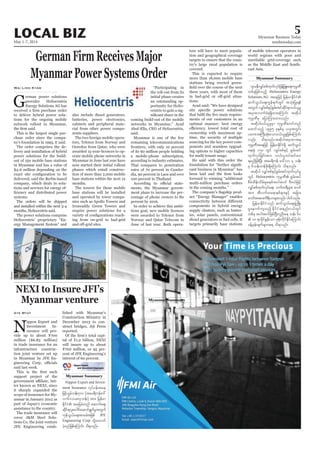
erman power solutions
provider Heliocentris
Energy Solutions AG has
to deliver hybrid power solu-
tions for the ongoing mobile
network rollout in Myanmar,
This is the largest single pur-
chase order since the compa-
ny’s foundation in 1995, it said.
The order comprises the de-
livery and installation of hybrid
power solutions for the build-
out of 150 mobile base stations
in Myanmar and has a value of
$4-6 million depending on the
delivered, said the Berlin-based
company, which deals in solu-
tions and services for energy ef-
systems.
The orders will be shipped
and installed within the next 3-4
months, Heliocentris said.
The power solutions comprise
Heliocentris’ proprietary “En-
ergy Management System” and
Wai Linn Kyaw
also include diesel generators,
batteries, power electronics,
cabinets and peripheral mate-
rial from other power compo-
nents suppliers.
The two foreign mobile opera-
tors, Telenor from Norway and
Ooredoo from Qatar, who were
awarded 15-year-licences to op-
erate mobile phone networks in
Myanmar in June last year have
now started their initial rollout
phases which entail construc-
tion of more than 2,000 mobile
base stations within the next 12
months.
The towers for these mobile
base stations will be installed
and operated by tower compa-
nies such as Apollo Towers and
Irrawaddy Green Towers and
require power solutions for a
-
ing from on-grid to bad-grid
“Participating in
the roll-out from its
initial phase creates
an outstanding op-
portunity for Helio-
centris to gain a sig-
coming build-out of the mobile
networks in Myanmar,” Ayad
Abul-Ella, CEO of Heliocentris,
said.
Myanmar is one of the few
remaining telecommunications
frontiers, with only 10 percent
of its 60 million people holding
a mobile-phone subscription,
according to industry estimates.
That compares to penetration
rates of 70 percent in Cambo-
dia, 90 percent in Laos and over
100 percent in Thailand.
-
ments, the Myanmar govern-
ment plans to increase the per-
centage of phone owners to 80
percent by 2016.
In order to achieve this ambi-
tious goal, new mobile licences
were awarded to Telenor from
Norway and Qatar Telecom in
June of last year. Both opera-
tors will have to meet popula-
tion and geographical coverage
targets to ensure that the coun-
try’s large rural population is
covered.
This is expected to require
more than 18,000 mobile base
stations being erected green-
three years, with most of them
-
tions.
Ayad said: “We have designed
-
ments of our customers in an
optimal manner: best energy
ownership with maximum up-
time, the security of multiple
sourcing for the key power com-
ponents and seamless upgrad-
ing options to higher capacities
for multi tenant usage.
He said with this order the
-
cant business in Myanmar” has
forward to winning “additional
multi-million purchase orders
in the coming months.”
-
uct “Energy Manager” enables
components in hybrid energy
supply clusters, such as batter-
ies, solar panels, conventional
diesel generators or fuel cells. It
targets primarily base stations
GermanFirmReceivesMajor
MyanmarPowerSystemsOrder
*smreDvQyfppfxkwfvkyfjzefYjzL;a&;ukrÜPD
wpfckjzpfonfh Heliocentris Energy
Solutions AG taejzifh jrefrmEdkifiH
qufoG,fa&;uGef&ufwGif tokH;jyK&ef
twGuf vQyfppfESifhpGrf;tifqdkif&m0,f,lrI
trSmpmvufcH&&Sdxm;aMumif; tqdkyg
ukrÜPDrS ajymMum;xm;onf/
tqdkyg0,f,lrIrSm ukrÜPDpwifwnf
axmifonfh 1995 ckESpfrS ,cktwGif;
yrmPtBuD;qkH;aom0,f,lrIjzpfaMumif;
vnf; od&onf/tqdkygtrSmpmt&
ukrÜPDtaejzifh jrefrmEdkifiH&Sd qufoG,f
a&;½Hk 150 wGif vQyfppfESifh pGrf;tif
xkwfvkyfjcif;tm; o,f,lwyfqifay;
&rnfjzpfNyD; tar&duef a':vm 4 oef;
rS 6oef;wefzdk;&SdaMumif; od&onf/
tqdkyg vQyfppfESifhpGrf;tifxkwfvkyfrI
wGif Heliocentris ukrÜPD pGrf;tif
pDrHxdef;odrf;rIpepftygt0if 'DZ,fjzifh
vQyfppfxkwfvkyfa&;? bufx&Drsm;? "mwf
tm; tDvufxa&mepfrsm;ESifh tjcm;
"mwftm;ay;ud&d,mrsm;vnf; yg0ifonf/
jrefrmEdkifiHonf qufoG,fa&;zGHUNzdK;
rIaemufusonfh EdkifiHtenf;i,fwGif
wpfck tygt0ifjzpfNyD;vlOD;a& oef; 60
 10 &mcdkifEIef;om zkef;udkifEdkifaMumif;
cefYrSef;csufrsm;t& od&onf/
of mobile telecom operators in
world regions with poor and
unreliable grid-coverage such
as the Middle East and South-
east Asia.
Myanmar Summary
NEXI to Insure JFI’s
Myanmar venture
N
ippon Export and
Investment In-
surance will pro-
vide up to about ¥700
million ($6.83 million)
in trade insurance for an
infrastructure construc-
tion joint venture set up
in Myanmar by JFE En-
said last week.
support project of the
-
ter known as NEXI, since
it sharply expanded the
scope of insurance for My-
anmar in January 2012 as
part of Japan’s economic
assistance to the country.
The trade insurance will
cover J&M Steel Solu-
tions Co, the joint venture
JFE Engineering estab-
Aye Myat lished with Myanmar’s
Construction Ministry in
December 2013 to con-
struct bridges, Jiji Press
reported.
-
tal of ¥1.2 billion, NEXI
will insure up to about
¥700 million, or 95 per-
cent of JFE Engineering’s
interest of 60 percent.
Myanmar Summary
Nippon Export and Invest-
ment Insurance vkyfief;tae
jzifh,Grfoef;700 (tar&duefa':
vm6'or83oef;) tm; jrefrm
EdkifiH tajccHwnf aqmufa&;
qdkif&myl;aygif;aqmif&GufrItwGuf
ukefoG,fa&;tmrcHtjzpf JFE
Engineering Corp odkYaxmuf
yHhrnfjzpfaMumif; od&onf/
Reuters
May 1-7, 2014
Myanmar Business Today
mmbiztoday.com
LOCAL BIZ 6
Myanmar Summary
production for domestic
consumption; the country
-
tricity access, a dilemma
it wishes to address with
gas-fuelled power plants.
Corporate social respon-
sibility requirements re-
main unclear, but they
will likely be implement-
ed, thereby siphoning fur-
community development
initiatives.
Another issue that
dampens Myanmar’s at-
tractiveness to energy
investors is local com-
munity resistance to in-
frastructure projects.
Communities fear los-
ing land, jobs, and liveli-
hoods, and this popular
discontent could pressure
the government to enact
measures against the in-
terests of investors. Chi-
na’s turbulent experience
with the Sino-Burmese
pipeline project best illus-
trates vocal community
resistance. There are sev-
eral local interest groups
in Myanmar, most nota-
bly the Shwe Gas Move-
ment, which regularly
demonstrates against the
project. Their discontent
is augmented by reports
that the Burmese govern-
ment has not distributed
funds intended to com-
communities.
A third factor that chal-
lenges investment pros-
pects in Myanmar is secu-
rity concerns, once again
illustrated by the Sino-
Burmese pipeline project
experience. In May 2013,
ethnic minority guerril-
las attacked a compound
owned by the Burmese
company involved in that
project, killing two peo-
ple. The compound was
located in Shan State near
the Chinese border, close
to the pipeline’s route. In
January 2014, clashes be-
tween Burmese and Chi-
nese workers at a work-
site along the pipelines’
route reportedly led to the
destruction of an oil stor-
age facility. Such security
concerns are likely at least
partially responsible for
delays in the project’s de-
velopment, which was to
become fully operational
in late 2013.
-
ment
Although energy com-
panies are relatively
-
erous government poli-
cies, they could employ
community engagement
programs in Myanmar to
overcome the challenges
of community resistance
and security concerns.
Community engagement
programs are driven by
comprehensive consul-
tations with community
leaders that identify their
concerns and grievances.
Those concerns and griev-
ances are then addressed
through negotiations and
local partnerships. Com-
munity engagement pro-
grams are directly driven
by business concerns;
by including local com-
munities as stakeholders
in an infrastructure pro-
ject, those communities
become invested in the
project’s success, thereby
eliminating community
resistance.
Equally important,
community engagement
provides an intangible
layer of security around
large infrastructure pro-
jects. In the chance that
an infrastructure project
is targeted by an impend-
ing attack, community
members will either ac-
tively protect the project,
or at the very least notify
authorities of the danger.
In some ways, commu-
nity engagement is simi-
lar to the strategies used
by development workers
to ensure their own safe-
ty; instead of protecting
themselves with weap-
onry or armed guards,
development workers in-
tegrate themselves into
local communities to en-
sure that other commu-
nity members will assist
them in a dangerous situ-
ation.
Although similar, com-
munity engagement is dis-
tinct from corporate so-
cial responsibility (CSR).
CSR is primarily driven
by a desire to do good, as
well as by an intention to
improve a company’s im-
age through community
development work, which
is vaguely expected to
improve the company’s
business prospects. The
problem is that, from a
business perspective, CSR
is unsustainable because
it doesn’t explicitly align
private company.
“There are reports, for instance, that Nay
Pyi Taw will impose onerous
revenue-sharing requirements well
above the international average, channel-
ling up to 85 percent of earnings to
government coffers.”
Lessons from the
pipelines
As previously men-
tioned, the Sino-Burmese
pipeline project has faced
communityresistanceand
security concerns. There
are indications, however,
that the consortium in
charge of the project has
attempted some form of
community engagement;
it has reportedly allotted
$20 million in “liveli-
hood security” for local
the project. The money
has been channelled into
numerous projects, in-
cluding schools, kinder-
gartens, hospitals, health
care centres, a reservoir,
and electricity transmis-
sion lines.
The consortium’s at-
tempts did not have the
for two reasons. First, the
consortium directed the
money through the Bur-
mese government, and it
wasn’t clear to local com-
munities that the con-
sortium was intending
communities. Second,
the Burmese government
reportedly withheld some
of the money and local
communities were there-
fore unaware that they
were intended to receive
any funding at all. This
experience highlights the
need for energy sector in-
vestors to directly engage
with local communities
in Myanmar, rather than
solely rely upon interfac-
ing with government enti-
ties. Investors should ac-
tively engage community
stakeholders and align
infrastructure projects to
meet their needs.
-
tributor an independent
analyst of energy geo-
politics with an emphasis
on oil and gas transpor-
tation infrastructure. He
works for a DC-based
risk consultancy and has
three years’ experiencing
working for the US gov-
ernment in international
on development, energy,
and macroeconomics.
onfESifhtrQ a&eHESifhobm0
"mwfaiGUpDrHudef;rsm;onf &if;ESD;
jr§KyfESHrItwGufqGJaqmifrIwpfckjzpf
vmonf/rMumao;rDujrefrmEdkifiH
wGif a&eHrsm;rsm;pGm&SdaeaMumif;
rD'D,mrsm;u azmfjycJhMuNyD; jrefrm
EdkifiH&Sda&eHwGif;xGufonf b&mZD;
EdkifiHuJhodkYrsm;jym;aMumif; cefYrSef;
xm;Muonf/xdkYtwl wpfEdkifwpf
ydkifa&eHxkwfvkyfjcif;rsm;vnf;&Sd
aMumif; azmfjyxm;Muonf/EdkifiH
taejzifh rnfrQyrmP&SdaMumif;
prf;oyfrIrsm;jyKvkyf&ef vdktyf
csuf&SdNyD; tqdkygykHjyifqefonfh
tcsufrsm;onfEdkifiHjcm;vkyfief;
rsm;twGuf ra&r&mjzpfaponf/
w½kwfEdkifiHa&T*wfpfpDrHudef;
ESifh w½kwf-jrefrmydkifvdkif;pDrHudef;
onf jrefrmEdkifiHwGif vuf&Sdvkyf
aqmifaeonfh [dkuf'½kdumbGef
pDrHudef;rsm;wGif xif&Sm;onfh pDrH
udef;jzpfonf/w½kwfEdkifiHaemuf
wGif xdkif;EdkifiHtaejzifh jrefrm
EdkifiH[dkuf'½dkumbGefu@wGif
'kwd,tBuD;qkH;vkyfaqmifaeonfh
EdkifiHjzpfonf/xdkif;EdkifiHtaejzifh
&wemESifh &JwHcGefurf;vGefwGif;
rsm;wGif vkyfudkifvsuf&SdNyD; rkwår
yifv,fauGU&Sd aZmwduvkyfuGuf
twGufvnf;vdkifpif&&Sdxm;onf/
ThePhilippinesSetsAirTalks
withMyanmarEyeingDirectLink
T
he Philippines will hold
air talks with Myanmar
and Canada next month,
followed by talks with Macau,
which could result in increased
those destinations and help
bolster the Philippines’ tourism
goals, according to a Filipino
The Philippines’ Civil Aero-
nautics Board executive direc-
tor Carmelo Arcilla said in an
interview recently that talks
from May 19 to 20, according to
Filipino media reports.
The move is set to result in the
-
ippines and Myanmar, often
frontier, and follows strength-
ened bilateral ties between both
countries late last year.
Kyaw Min There is strong potential for
tourism links with Myanmar
has expressed interest in serv-
Talks with Canada will be held
later in May aimed at expand-
Arcilla noted that the time
was right for talks with Myan-
mar given the potential for in-
creased tourism and business.
Among local carriers, he said
interest to operate in Myanmar.
“It’s a very young emerging
market and there are political
reforms being implemented,”
Arcilla was quoted as saying.
“For a while, Myanmar was at
the receiving end of economic
sanctions but now, there is rec-
ognition and support coming
from other ASEAN members.”
At present Philippines Air-
-
looking at doubling the maxi-
week, in the aviation agreement
to give more scope for growth in
the long-term.
Talks with Macau are set for
17 to 18 June, also to cater to
-
mand.
There is speculation that the
Philippines will seek talks with
Russia and African countries
like Ethiopia, South Africa and
Kenya to create more air links.
So far this year, the Philip-
pines has completed successful
air talks with New Zealand, Sin-
gapore and France.
Talks with France resulted in
-
vious four, which can be used
by Philippine Airlines, and also
the slots following its removal
from a European Union black-
list. However, both airlines
have not indicated if they are
prepared to increase services
to Europe until there are clear
signs of economic recovery to
to Southeast Asia.
zdvpfydkifavaMumif;tmPmydkifrsm;
taejzifh jrefrm? uae'gESifh rumtdk
tmPmydkifwdkYESifh avaMumif;qdkif&m
aqG;aEG;rIrsm;jyKvkyfvsuf&SdNyD; zdvpfydkif
EdkifiH c&D;oGm;vkyfief;tm; jr§ifhwif&ef
twGuf reDvmEdkifiHESifh tjcm;EdkifiHrsm;
odkY avaMumif;vrf;csJUxGif&ef pDpOfae
aMumif; ajymMum;cJhonf/
zdvpfydkifEdkifiH Civil Aeronautics
Board rS trIaqmif'g½dkufwm Carmelo
Arcilla rS vmrnfh ar 19-20 wGif
jrefrmEdkifiHESifhawGYqkHaqG;aEG;rnfjzpfaMumif;
zdvpfydkifEdkifiH owif;rD'D,mrsm;u azmfjy
xm;onf/tqdkygaqG;aEG;rIonf jrefrm
EdkifiHESifhzdvpfydkifEdkifiHtMum; wdkuf½ddkufav
aMumif;ajy;qGJ&efjzpfNyD;,cifESpfaESmif;ydkif;
u pwifcJhonfh ESpfEdkifiHqufqHa&;tm;
wdk;jr§ihfaprnfjzpfonf/
tqdkygaqG;aEG;rIonf jrefrmEdkifiHESifh
c&D;oGm;vkyfief;qdkif&mcdkifrmonfh tvm;
tvmjzpfNyD; rS &efukef
odkY aeYpOfajy;qGJvdkaMumif; xkwfazmf
ajymMum;cJhzl;onf/
Philippine Airlines Airbus A320.
MRadziDesa/WMC
May 1-7, 2014
Myanmar Business Today
mmbiztoday.com
7LOCAL BIZ
Myanmar Summary
Myanmar Summary
S
ingapore-based Wil-
mar International
Ltd announced last
into Myanmar’s sugar
market, forming a joint
venture with a local pro-
ducer.
The company said it
WilmarSeeksMyanmarSugarMarketEntryThroughJV
Phyu Thit Lwin has signed a joint ven-
ture agreement with My-
anmar’s Great Wall Food
and sell sugar and its by-
products in the emerging
Southeast Asian market.
Wilmar will hold a 55
percent stake in the joint
venture company, Great
Wall-Wilmar Holdings.
The deal will see the new
joint venture company
buying all of the existing
sugar-related business,
mills and plants Great
Wall and its associates.
That includes two sugar
mills with a total milling
capacity of 4,000 metric
tonnes of sugarcane per
day and a total production
capacity of 65,000 metric
tonnes of sugar per year, a
bio-ethanol plant and one
organic compound ferti-
liser plant.
Wilmar is the world’s
top palm oil processor,
but it has been steadily
growing its sugar busi-
ness through a series of
deals over the past four
years. In February it an-
nounced it was buying
a major stake in India’s
Shree Renuka Sugars for
up to $145 million.
Financial terms of the
deal were not announced
and Wilmar says it does
not expect the investment
to have a material impact
on its earnings for the
The joint venture is still
subject to regulatory ap-
proval.
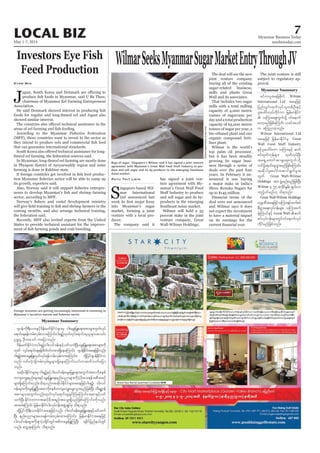
Bags of sugar. Singapore’s Wilmar said it has signed a joint venture
agreement with Myanmar’s Great Wall Food Stuff Industry to pro-
duce and sell sugar and its by-products in the emerging Southeast
Asian market.
JeanPierrePingoud/Bloomberg
pifumyltajcpdkuf Wilmar
International Ltd taejzifh
jynfwGif;xkwfvkyfolwpfOD;ESifh
yl;aygif;vkyfudkifum jrefrmEdkifiH
 oMum;aps;uGufodkY 0ifa&muf
awmhrnfjzpfaMumif; ,ciftywf
u aMunmcJhonf/
Wilmar International Ltd
taejzifh jrefrmEdkifiHrS Great
Wall Food Stuff Industry
ESifhyl;aygif;um oMum;ESifh quf
pyfxkwfukefrsm; xkwfvkyfNyD;
ta&SUawmiftm&Saps;uGufodkY
wifydkYa&mif;csoGm;rnfjzpfaMumif;?
tqdkygyl;aygif;aqmif&GufrIt
wGuf Great Wall-Wilmar
Holdings tm; zGJUpnf;rnfjzpfNyD;
Wilmar rS 55 &mcdkifEIef; &S,f,m
xnfh0ifrnf[k od&onf/
Great Wall-Wilmar Holdings
ukrÜPDtaejzifhoMum;ESifhqufpyf
pD;yGm;a&;vkyfief;rsm;? oMum;puf
½kH?BuHyifESifh Great Wall quf
pyfvkyfief;rsm;wGif0ifa&mufvkyf
udkifrnfjzpfonf/
Investors Eye Fish
Feed Production
Jchairman of Myanmar Eel Farming Entrepreneur
Association.
showed similar interest.
According to the Myanmar Fisheries Federation
(MFF), those countries want to invest in the sector as
that can guarantee international standards.
in Phyapon district of Ayeyarwaddy region and some
farming is done in Rakhine state.
its growth, exporters said.
sector, according to MFF.
coming months, and also arrange technical training,
the federation said.
Recently, MFF also invited experts from the United
States to provide technical assistant for the improve-
Kyaw Min
*syef?udk&D;,m;ESifh'def;rwfEdkifiHrsm;rS ig;arG;jrLa&;tpmrsm;xkwfvkyf
a&mif;cs&efurf;vSrf;vmaMumif;ig;&SOfhxkwfvkyfa&mif;csolrsm;toif;
Ouú| OD;baomf uajymonf/
'def;rwfEdkifiHuig;&SOfh?ig;vifAef;ESifhywfoufNyD;arG;jrLa&;tpmrsm;udk
xkwf vkyfa&mif;cs&efpdwf0ifwpm;&SdaeaMumif;? *syefEdkifiHtaejzifhvnf;
ig;&SOfhtpmarG;jrLxkwfvkyf&efurf;vSrf;xm;aMumif;? xdkYjyif*syefEdkifiHu
vnf; ,if;uJhodkYurf;vSrf;rIrsm;&SdaeaMumif;,if;uqufvufajym
onf/
tqdkygEdkifiHrsm;rS ig;&SOfhESifhig;vifAef;arG;jrLa&;twGuftpmudkpepf
wusauR;enf;rsm;ESifharG;jrLa&;enf;ynmrsm;udkyHhydk;ay;&eftpDtpOf
rsm;&SdaMumif;vnf;od&onf/tqdkygEdkifiHrsm;taejzifhig;&SOfh? ig;vif
Aef;rsm;udkarG;jrLNyD;tpmudkpepfwusauR;arG;oGm;rnfjzpfNyD; wd&pämef
tpmrsm;twGufvnf;xkwfvkyfa&mif;cscsifMuaMumif;?tpmESifhywf
oufNyD;EdkifiHwumtqifhrDt&nftaoG;&SdrnfjzpfaMumif;udkvnf;
tmrcHaMumif; jrefrmEdkifiHig;vkyfief;tzGJUcsKyfrS od&onf/
xdkYjyifudk&D;,m;EdkifiHtaejzifhvnf; ig;vifAef;arG;jrLa&;ESifhywfouf
NyD; enf;ynmrsm;ay;&efurf;vSrf;xm;aMumif;? jrefrmEdkifiHtaejzifh
ig;vifAef;rsm;udkzsmyHkc½dkifwGift"duarG;jrLMuNyD; &cdkifjynfe,fwGif
vnf; awGU&aMumif; od&onf/
Foreign investors are getting increasingly interested in investing in
Reuters
May 1-7, 2014
Myanmar Business Today
mmbiztoday.com
LOCAL BIZ 8
Myanmar Summary
ADB, Japan to Give $2m to Upgrade Youth Skills to Lift Economy
Grant to develop three month-long courses in construction, welding, and use and repair of rural machinery
T
he Asian Development
Bank (ADB) and Japan
are to help Myanmar
upgrade and modernise tech-
nical and vocational training
programs to meet the country’s
pressing need for skilled young
workers.
A $2 million Japan Fund for
Poverty Reduction grant, ad-
ministered by ADB, will be
used to develop and pilot three
month-long competency-based
courses in skills such as con-
struction, welding, and use and
repair of rural machinery, the
Manila-based lender said.
“Overhauling technical and
vocational training to make
them more relevant, modern
and accessible is critical for de-
veloping the foundational skills
needed to support Myanmar’s
economic transformation and
help cut poverty,” said Chris-
topher Spohr, senior education
economist based in Myanmar.
ADB said the target is to train
at least 1,000 young people,
and steps will be taken to en-
sure that places are reserved for
women and young adults from
Pann Nu poor and disadvantaged fami-
lies.
Courses will be launched in
Yangon, Mandalay, and Pakok-
ku starting this November, and
will be free of charge.
-
ings from Myanmar’s forth-
coming costed education sector
plan, which is helping pinpoint
gaps and “quick win” opportu-
nities in the country’s education
sector, ADB said.
Myanmar’s workforce lacks
well-trained workers to im-
mediately step into positions
opening up as a result of re-
cent reforms. Existing technical
training is focused on long-term
programs in urban niche skills,
such as operating computers,
with less than 2 percent of 16-
19 year olds engaged in skills
training courses.
In rural areas the situation is
even worse, ADB said, with less
than 0.5 percent of rural males
and females enrolled in technical
or vocational training programs.
The lender said as well as set-
ting up short courses, the tech-
nical assistance project will
help relevant government agen-
cies gain the necessary capacity
to develop and oversee youth
skills training programs.
ADB said the course outcomes
will also be assessed to provide
a potential model for replica-
tion in future.
Along with the grant sup-
port from Japan, Myanmar will
provide counterpart assistance
equivalent to $500,000 for a to-
tal project cost of $2.5 million.
DefTechTargetsMyanmarProjects
M
alaysia’s leading ar-
moured vehicle maker
DRB-Hicom Defence
Technologies Sdn Bhd (DefT-
ech) is in talks about new pro-
jects with the relevant authori-
ties in Myanmar, a top company
-
ing a deal with the Cambodian
government for a new main-
tenance, repair and overhaul
(MRO) contract for T-55 tanks,
Samsudin told Malaysia’s na-
tional news agency Bernama.
The project, which has an es-
timated worth of $50-$60 mil-
set to commence by October,
he said on the sidelines of the
Defence Services Asia Exhibi-
tion and Conference 2014 (DSA
2014).
DefTech was also in talks with
the authorities in Myanmar for
similar MRO contracts, he add-
ed.
Another Malaysia defence
-
gies Sdn Bhd is also reportedly
planning to make an overseas
foray this year.
Corporation Sdn Bhd has set its
sights closer to Malaysia, eye-
Kyaw Min ing ASEAN countries such as
Indonesia, Thailand and Brunei
for a further growth, Bernama
reported.
The four-day biennial DSA
2014 ushered in a total of
33,544 trade visitors from 77
countries and regions, up from
26,980 two years ago. A total of
1,000 companies from 60 coun-
-
ings at the exposition this year.
Myanmar Summary
Myanmar Summary
tm&SzGHUNzdK;a&;bPf (ADB) ESifh *syef
EdkifiHwdkYtaejzifh jrefrmEdkifiHuRrf;usif
tvkyform;vdktyfcsuftm; jznfhqnf;
Edkif&ef toufarG;0rf;ausmif;oifwef;
ESifh enf;ynmqdkif&mtultnDrsm; ay;
tyfoGm;rnfjzpfonf/
ADB rS BuD;Muyfrnfh *syefEdkifiH
qif;&JEGrf;yg;rIavQmhcsa&;&efykHaiG tar
&duefa':vm 2 oef;tm; aqmufvkyf
a&;?*a[qufjcif;ESifhpufrIjyifqifa&;
okH;voifwef;rsm;wGif okH;pGJoGm;rnfjzpf
aMumif; ADB  xkwfjyefcsuft&
od&onf/
ADB taejzifh tenf;qkH; vli,f
1000 tm; oifwef;ay;Edkif&ef &nfrSef;
xm;NyD; qif;&JEGrf;yg;onfh rdom;pkrsm;rS
vli,frsm;ESifh trsKd;orD;rsm;tm; oifwef;
ay;oGm;rnfjzpfonf/
rav;&Sm;EdkifiHppfokH;,mOfxkwfvkyf
a&;ukrÜPDBuD;wpfckjzpfonfh DRB-
Hicom Defence Technologies Sdn
Bhd (DefTech) onf jrefrmEdkkifiHrS
oufqdkif&mtmPmydkifrsm;ESifh pDrHudef;
topfwpfcktm; aqG;aEG;vsuf&SdaMumif;
ukrÜPD t&m&SdMuD;wpfOD;rS ajymMum;
cJhonf/
tqdkygpDrHudef;onf tar&duefa':vm
oef; 50 rS oef; 60 wefzdk;&SdrnfjzpfNyD;
oufwrf;tm;jzpf ig;ESpf&Sdrnfjzpfum
vmrnfhatmufwdkbmvwGif pwifzG,f
&SdaMumif; tqdkygt&m&Sdu Defence
Services Asia Exhibition and
Conference 2014 (DSA 2014) wGif
ajymMum;cJhjcif;jzpfonf/
DefTech onf jrefrmEdkifiHtmPmydkif
rsm;ESifh ppfzufokH;,mOfrsm;tm; xdef;
odrf;? jyifqifrGrf;rHonfh (MRO) uJhodkY
pmcsKyfrsm;csKyfqdka&;twGufaqG;aEG;cJh
aMumif; od&onf/
YongmaoBags$2.4-mMyanmarCranesOrder
C
hinese tower crane man-
ufacturer Yongmao has
sold ten cranes to Sin-
gapore crane sales and rental
house Erect Group, for an end
user in Myanmar.
The $2.39-million deal will
see Yongmao deliver 10 of its
STT cranes through 2014-2015.
It follows the manufacturer’s
start of this year.
As Myanmar democratises
and its economy opens up from
years of sanctions and restric-
tion, companies like Yongmao
are seeing new opportunities.
Yongmao executive director
and group general manager Sun
Tian said deals like this are an
important part of his company’s
export strategy.
the Myanmar market, we are
expanding our foothold in this
region. We foresee that urbani-
sation and economic develop-
ment will drive higher con-
struction activities to support
this progression.
“Eyeing the potential demand
for infrastructure across Asia,
we hope to continue to pro-
mote the Yongmao brand, qual-
ity and service in order to cater
to the need for quality tower
Aye Myat cranes. We believe our competi-
tive edge lies in our product and
service: our tower cranes have
obtained the relevant product
safety and design approval of
various countries and we pro-
vide premium after-sales ser-
vice.
“Moving ahead, we hope to
continue our push into Myan-
mar by securing more contract
wins with well-established tow-
Revenue from Asia, besides
China, contributes 25.1 percent
of Yongmao’s turnover for its
nine months ended 31 Decem-
ber 2013. Revenue from this
geographical segment has in-
creased 11.6 percent during this
time.
Yongmao is on the lookout
for collaborations with existing
customers who have plans to
enter the Southeast Asian mar-
ket. Such partnerships include
working with Singapore rental
companies and contractors to
provide towercranes in Myan-
mar, Vietnam and Indonesia.
The company also aims to par-
ticipate actively in various trade
fair and exhibition in Southeast
Asia.
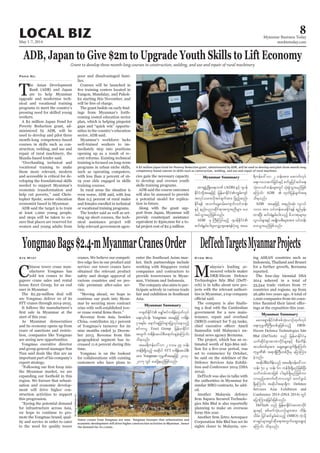
Tower cranes from Yongmao are seen. Yongmao foresees that urbanisation and
economic development will drive higher construction activities in Myanmar, hence
the demand for its cranes.
A $2 million Japan Fund for Poverty Reduction grant, administered by ADB, will be used to develop and pilot three month-long
competency-based courses in skills such as construction, welding, and use and repair of rural machiner.
SoeZeyaTun/Reuters
TatHongHoldingsLtd
w½kwfEdkifiH arQmfpifu&def;xkwfvkyf
a&;vkyfief; Yongmao taejzifh u&def;
iSm;&rf;? a&mif;csjcif;rsm;jyKvkyfaeonfh
pifumyl Erect Group jrefrmEdkifiH
twGuf u&def;q,fpD;a&mif;cscJhaMumif;
od&onf/
tar&duefa':vm 2 'or 39 oef;
wefzdk;&Sdonfh tqdkyg STT u&def;q,fpD;
tm; Yongmao ukrÜPDtaejzifh 2014-
2015 wGif ay;ydkY&rnfjzpfonf/
May 1-7, 2014
Myanmar Business Today
mmbiztoday.com
LOCAL BIZ 9
Myanmar Summary
Myanmar’s Palm Oil Industry: Challenges and Way Forward
P
alm oil as edible oil is the
second biggest important
food item after rice in an
average Myanmar household.
However, Myanmar’s domes-
tic edible oil production is not
enough to meet the demand, so
it imports palm oil from some
of the world’s largest palm oil
producing nations like Indone-
sia and Malaysia.
During the military rule palm
oil import was controlled by
state enterprises. But the recent
economic and democratic tran-
sition has resulted in a market-
based economy, which resulted
in the Ministry of Commerce
opening up the previously-re-
stricted palm oil import market
to local private players in April
palm olein, which is the liquid
form of palm kernel oil after a
process called fractionation,
Vijay Dhayal
and is used for cooking and fry-
ing.
In Year 2012 Myanmar im-
ported 400,000 tonnes of palm
Oil and which has grown to
485,000 tonnes in 2013. Market
is expected to expand further to
700,000 tonnes by 2017-18 due
to growing demand, rising in-
come of Myanmar households
and shifting from costlier pea-
nut oil.
One of the biggest challenges
for palm oil trade is the cargo
storage facility at Yangon port,
which results into long waiting
period for vessels at the port
to discharge the cargo, leading
majority of importers to face
demurrage claims from their
suppliers.
Due to shortage of storage
space, importers are pushed to
liquidate the cargo as soon as
possible. Another concern is
usage of delivery order mecha-
nism in the local market where
speculators and distributors
play with forward contracts,
creating speculation and de-
faults. Road infrastructure is
also underdeveloped in My-
anmar, so transportation cost
also becomes very high, hurting
margins and causing delays in
delivery of cargoes to northern
Myanmar.
Another major area of chal-
lenge is illegal border trade of
palm oil from Thailand to Mon
state and Tanintharyi region
which impacts importers who
are brining cargoes to Yangon
legally after paying customs
duty, commercial tax and in-
come tax.
Private players have invested
in palm plantation in southern
Myanmar to increase domes-
tic production but it will take
at least two to three years to
on the palm oil trade. Various
stake holders from government
and industry can pursue the
idea of promoting manufac-
turing industry for converting
oil which could create technical
know-how and employment.
Currently in the local mar-
ket palm oil is traded in loose
which results into quantity loss
and quality deterioration. How-
ever, that also provides great
opportunity for investors to set
up blowing units for jerry can
production and packaging and
distribution with right quantity
and quality.
modities market for more than
two years. He is an agri com-
modity trader by profession.
He can be contacted at vijay-
dhayal.eca@gmail.com. This
the author in his own person-
al capacity. The opinions and
views expressed here are his
own.
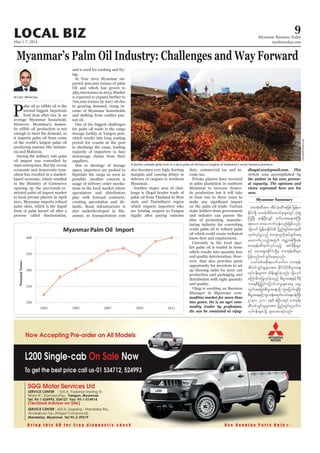
A worker unloads palm fruit at a local palm oil factory in Langkat of Indonesia’s north Sumatra province.
RoniBintang/Reuters
pm;tkH;qDtm; tdrfokH;qDDtjzpf jrefrm
EdkifiH&Sd omreftdrfaxmifpkrsm;wGif okH;pGJ
MuNyD; qefNyD;vQif 'kwd,ta&;tBuD;
qkH;aom pm;aomufukefvnf;jzpfonf/
odkYaomf jrefrmEdkifiH jynfwGif;pm;okH;qD
xkwfvkyfrIonf pm;okH;olvdktyfcsuft&
ravmufiSonfhtwGuf urÇmhtBuD;qkH;
pm;tkef;qDxkwfvkyfonfh tif'dkeD;&Sm;
ESifh rav;&Sm;EdkifiHwdkYrS pm;tkef;qDrsm;
jyefvnfwifoGif;ae&onf/
,cifppftpdk;&vufxufu pm;tkef;
qDwifoGif;rIrsm;tm; EdkifiHydkifpD;yGm;a&;
vkyfief;rsm;u xdef;csKyfcJhonf/ odkYaomf
rMumrDujyKvkyfcJhonfh pD;yGm;a&;ESifh'Drdk
ua&pDjyKjyifajymif;vJrIrsm;t& aps;
uGuftajccHpD;yGm;a&;odkY ul;ajymif;cJhNyD;
pD;yGm;a&;ESifhul;oef;a&mif;0,fa&;0efBuD;
Xmeu 2011 ckESpf {NyDvwGif pm;tkef;
qdDwifoGif;rIrsm;tm; jynfwGif;yk*¾vdu
vkyfief;rsm;odkY csxm;ay;cJhonf/
May 1-7, 2014
Myanmar Business Today
mmbiztoday.com
LOCAL BIZ 10
Myanmar Summary
Economic Opportunities Continue to Grow in Myanmar
This bulletin by Canadian law firm Davis LLP provides an update on the significant changes Myanmar is experiencing in government, legislation, trade and tourism
and outlines the opportunities in this growing country.
W
ith a population of
more than 60 million
people, opportunities
in Myanmar are not limited to
extractive industries, but also
exist in manufacturing and the
domestic market for consumer
goods. Even so, Myanmar’s
natural resources should not
be underestimated: natural gas,
petroleum, timber, zinc, cop-
per, lead, coal, precious stones,
and agricultural land exist in
abundance.
foreign investors
A general election is set to be
held in Myanmar in November
2015. These elections could see
Aung San Suu Kyi, Nobel lau-
reate and leader of Myanmar’s
main opposition party, the Na-
tional League for Democracy
(NLD), brought to power. Her
release in 2010 after almost
eleven years of house arrest
imposed by the previous mili-
tary regime, was instrumental
in opening up trade relations
with the West. Regardless of
whether the current ruling
Union Solidarity and Develop-
ment Party (USDP) or the NLD
forms a government next year,
it is expected that political and
begun in 2010 by current Presi-
dent, Thein Sein, will continue.
However, it is important to
note that at this time, Aung San
Suu Kyi is barred from becom-
ing President of Myanmar by
virtue of the country’s Consti-
tution, which prohibits anyone
with family members who are
citizens of another country from
holding the country’s highest
prevent her from being elected
to Parliament in 2012, when
vacancies in 8 percent of the
following by-elections, with
the NLD capturing all 43 seats
in which they ran candidates.
Another round of by-elections
is anticipated late in 2014, to
-
cancies. It remains to be seen
whether the Constitution will
be amended to enable Suu Kyi’s
candidacy for President prior to
the general election expected in
late 2015.
Other legal reform is ongo-
ing, making it more practical
for multi-national companies
to invest in Myanmar. It is an-
ticipated that a new Companies
Law will be introduced in 2014,
to replace the current law that
dates back 100 years. A draft
Trademark Law is before Par-
liament and a proposed Con-
dominium Law, that will allow
foreign citizens to own a form of
also placed before Parliament
in November 2013.
New incentives draw foreign
investment despite trade re-
strictions
The government of Myanmar
places restrictions on foreign
investment within the country.
The State-Owned Economic En-
terprises Law (1989), Foreign
Investment Law (2012) and
the Foreign Investment Rules
(January 2013) restrict certain
types of business activities from
occurring without government
approval. Foreign investment is
monitored and approved by the
Myanmar Investment Commis-
sion (MIC) which has published
a list of activities in which for-
eign investors are prohibited
from participating or which re-
quire a joint venture with a local
business.
At the same time, the country
is also providing incentives to
foreign investors. In January,
2014 a new Myanmar Special
Economic Zone Law (MSEZL)
was enacted, repealing earlier
legislation regarding special
economic zones. The MSEZL of-
fers up to seven years of income
tax exemptions for foreign in-
vestors, with further 50 percent
discounts on income tax for an-
law applies in Myanmar’s three
Special Economic Zones: Kyauk
Phyu, Dawei and Thilawa. The
MSELZ provides for the estab-
lishment of additional zones
and contains dispute resolution
procedures.
Economic sanctions
Domestic strife and ongoing
corruption issues have certainly
not disappeared. While Cana-
da’s Special Economic Measure
Regulations (sanctions) have
been relaxed in recent years,
Canadians are still prohibited
from dealing with certain busi-
nesses and individuals, includ-
ing the state banks of Myanmar.
Military shipments are also
prohibited. These sanctions are
enforced by the Export Controls
International Trade Canada,
of Foreign Assets Control. It is
worth noting, however, that the
Canadian list of restricted per-
sons is more limited than com-
parable US prohibitions.
While Japan did not impose
economic sanctions against My-
anmar, there was a pronounced
slowdown in government aid
and private sector investment
during the years that Aung San
Suu Kyi was under house arrest.
China expanded its economic
this period, but faces greater
competition now that other
countries, including Japan, are
investing heavily. The Japanese
government has pledged almost
$2 billion in loans and grants
since Prime Minister Shinzo
Abe was elected in December
2012.
Japan and Myanmar are
jointly developing the ambi-
tious Thilawa special economic
zone just outside of Yangon,
the country’s largest city. Plans
call for a deep sea port, a power
plant and waste water treat-
ment facility, all in support of a
2,400 hectare industrial park.
Construction began in Novem-
ber, 2013 and commercial op-
erations are expected to start in
mid-2015.
Financial growth: foreign
banks increase presence
in Myanmar
Despite some remaining trade
restrictions imposed by vari-
ous countries, growth of for-
eign investment in Myanmar
has been substantial. At least
14 banks in Myanmar now per-
mit foreign currency accounts.
Even though foreign banks are
currently permitted to only
conduct research in Myanmar,
35 foreign banks have opened
expected that some licences for
foreign branches may be ten-
dered within the year. Daiwa
Securities from Japan is one of
In late 2012, automated tell-
er machines (ATMs) linked to
the international payment sys-
tem were introduced in Myan-
mar. There are now hundreds
of ATMs around the country,
and while not as reliable as
similar-looking ATMs in North
America, they are providing
much needed convenience and
liquidity. On a visit this year,
one of the authors of this bul-
letin found it’s possible to ac-
cess funds held in Canadian ac-
counts using some ATMs.
Further bank reform is needed
and is on the way, with the IMF
assisting in changes to the cen-
tral bank and the launch of the
Yangon stock exchange planned
for 2015. Myanmar has also ac-
ceded to the New York Conven-
tion on the Recognition and
Enforcement of Foreign Arbi-
tral Awards, as of July 15, 2013.
This will allow multi-national
companies to settle commercial
disputes outside the domestic
legal system. Myanmar has also
drafted a new arbitration law,
expected to be enacted in 2014,
which is required to allow for
the enforcement of foreign ar-
bitration awards by the courts
of Myanmar.
At the end of 2013, Myanmar
became the 180th member of
the Multilateral Investment
Guarantee Agency (MIGA),
meaning MIGA guarantees are
now available for foreign direct
investments. The US Ex-Im
Bank also opened in Myanmar
support for short and medium-
term US export sales to Myan-
mar.
“The electricity grid is inadequate by western
standards. Companies offering a distributed
power generation model are taking up the chal-
lenge, particularly outside Yangon. Large scale
thermal and clean energy projects are also ex-
pected over in next few years.”
Reforms initiated by Myanmar’s quasi-civilian government have sparked growth in the poor Southeast Asian nation’s economy.
SoeZeyaTun/Reuters
vlOD;a& oef; 60 &Sdonfh jrefrmEdkifiH
wGif tcGifhtvrf;rsm;onf obm0wGif;
xGufrsm;twGufuefYowfrIr&Sdaomfvnf;
pm;aomufukefxkwfvkyfa&;ESifh jynfwGif;
aps;uGuftwGif;wGif wnf&Sdaeonf/
jrefrmEdkifiHonf obm0"mwfaiGU? a&eH?
opf? Zifh? aMu;eD? ausmufrD;aoG;? ausmuf
rsufESifh pdkufysKd;ajrrsm; tvQHty,f&Sdae
ao;onf/
jrefrmEdkifiHwGif taxGaxGa&G;aumufyGJ
tm; 2015 Edk0ifbmwGif usif;y&ef
owfrSwfxm;NyD; twdkuftcHacgif;aqmif
jzpfonfh Edkb,fqk&SiftrsKd;om;'Drdkua&pD
tzGJUcsKyf (NLD) acgif;aqmif a':atmif
qef;pkMunftaejzifhtmPm&&SdEdkifaMumif;
cefYrSef;&onf/olronf ,cifppftkyf
csKyfa&;umvtwGif; 11 ESpfeD;yg; aetdrf
tus,fcsKyfcsxm;jcif;cH&NyD; jyefvnf
vGwfajrmufvmonfh 2010 aemufydkif;
wGif taemufEdkifiHrsm;ESifh pD;yGm;a&;wHcg;
zGifhvSpf&ef aomhcsufwpfckjzpfvmcJhonf/
May 1-7, 2014
Myanmar Business Today
mmbiztoday.com
LOCAL BIZ 11
Myanmar Summary
LiuRui/GT
China’sBackyardPlatformforCooperation
W
hile Chinese enter-
prises are entering
the US “backyard,”
Latin America and the Carib-
bean, one after another and set-
tling down, the US also acceler-
ates its entrance into China’s
“backyard.”
Right before US President Ba-
rack Obama’s Asia trip, the US
Department of State announced
-
It has been widely noticed
that the US is back. However,
it isn’t back just for a new mar-
from China’s seeking develop-
ment drives across the world
or transferring competitive in-
dustries to other countries and
regions.
In January, the US embassy
in Myanmar provided techno-
logical training for 150 civil so-
ciety activists in Myanmar. And
in February, the US funded the
social activities of BarCamp, an
international network of open
online workshops, which has
attracted more than 5,000 par-
ticipants.
These moves have naturally
triggered China’s worries, and
some media outlets exclaimed
that Washington is nosing
around China’s backyard.
Ding Gang This is reminiscent of simi-
lar arguments from some US
media outlets during Chinese
President Xi Jinping’s Latin
America visit last year that Chi-
na was entering the backyard of
the US.
Certainly, compared with the
US, China is still a latecomer
and is way behind in terms of
soft power. Even with close
neighbours like Myanmar, Chi-
na still faces the challenge of
winning more trust from them.
In a recent interview with the
Beijing-based Caijing magazine,
Elizabeth Economy, director for
Asia studies at the Council on
Foreign Relations, said that ul-
timately who would lead Asia
would depend on the country’s
development route and its dip-
lomatic attitude in wider areas.
According to the historic logic
of a great power’s rise and espe-
cially when a new order is still
leadership may provide more
room for speculation about Si-
-
ly? Just as a Chinese poem once
quoted by Hillary Clinton goes,
“After endless mountains and
rivers that leave doubt whether
there is a path out, suddenly
one encounters the shade of
lovely village.”
If we see each other’s “back-
yard” as a platform to know
more about each other and con-
tribute more to that region, we
new order in the future.
Take Myanmar. Currently
what’s most urgently needed in
this country is to boost ethnic
reconciliation, without which
further realization of democrat-
ic politics and stable develop-
ment will be unlikely.
The stability of northern My-
anmar is very important for
China, and it is not meaningless
for Washington’s promotion of
its own human rights values in
Myanmar.
This is where the two sides’ in-
terests converge, and coopera-
tion on this point will enhance
mutual trust.
So far the US has started to
promote some activities facili-
tating the fostering of civil soci-
ety, which is helpful for Myan-
mar’s good governance in the
future. However, the arrange-
ment of similar projects should
ethnic reconciliation.
in this regard, such as collabo-
rating and arranging nego-
tiations between the Myanmar
government and ethnic minor-
ity independent armed forces
in northern Myanmar. It needs
to consider how to also bring
Washington in to promote such
negotiations.
If China and the US can
strengthen collaboration, com-
municate on these issues and
accumulate experience of co-
operation, this will be more im-
portant than increasing invest-
ment in Myanmar in the short
term.
There are more than a few
similarly thorny issues in the
China’s neighbourhood. If the
two powers can cooperate over
third parties in this region and
the construction of the future re-
gional order, and will provide a
future leadership.
China and the US have already
established diplomatic mecha-
and the situation in Myanmar
has been on the agenda. None-
theless, the two should not just
exchange information, but also
issues.
The author is a senior editor
w½kwfpD;yGm;a&;vkyfief;rsm;taejzifh
tar&duefEdkifiHtaemufbuf&Sd Latin
America ESifh Caribbean wdkYwGif
0ifa&mufvkyfudkifvmonfhenf;wkl
tar&duefEdkifiHonfvnf; w½kwf
taemufbufa'oodkY t&Sdeft[kefjzifh
0ifa&mufvmNyDjzpfonf/
tar&duefor®w Barack Obama 
tm&Sc&D;pOfrwdkifrDrSmyif US Department
of State rS jrefrmEdkifiHwGif yxrOD;qkH;
aom pD;yGm;a&;0efaqmifrI½kH;zGifhvSpfawmh
rnfjzpfaMumif;aMunmcJhonf/Zefe0g&Dv
wGif jrefrmEdkifiH&Sd tar&duefoH½kH;rS vlrI
vIyf&Sm;ol150tm;enf;ynmoifwef;
rsm;ay;cJhonf/azazmf0g&DvwGifvnf;
tar&dueftaejzifh ESpfpOf vl 5000
cefY wufa&mufonfh vlrIvIyf&Sm;wpfck
jzpfonfh BarCamp tm; &efykHaiG
axmufyHhay;cJhonf/
xdkodkYaqmif&GufrIrsm;onf w½kwfEdkifiH
tm; pdk;&drfrIrsm;jzpfay:apcJhNyD; tcsKdU
rD'D,mrsm;taejzifh0g&Sifwefonf w½kwf
taemufbufydkif;tm; a&S;½IaeaMumif;
xkwfazmfa&;om;vmMuonf/
jrefrmEdkifiHajrmufydkif;a'o wnfNidrf
at;csrf;a&;onf w½kwfEdkifiHtwGuf
ta&;ygouJhodkY 0g&Sifwef jrefrmEdkifiH
wGif; vlUtcGifhta&; jrifhwifrItwGuf
vnf;ta&;ygvsuf&Sdonf/
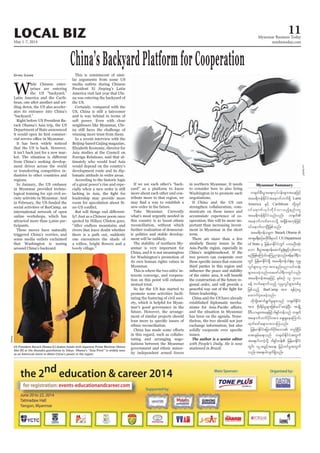
US President Barack Obama (L) shakes hands with Japanese Prime Minister Shinzo
Abe (R) at the Akasaka guesthouse in Tokyo. Obama’s “Asia Pivot” is widely seen
Xinhua
May 1-7, 2014
Myanmar Business Today
mmbiztoday.com
LOCAL BIZ 12
-
tential
The country is endowed with
of oil was exported in 1853 but
little production or explora-
tion took place during the past
50 years of military rule. How-
ever, Myanmar has 50 million
barrels of proven oil reserves
and 280 billion cubic meters of
natural gas. This is expected to
increase with the recent arrival
of foreign oil and gas compa-
nies. After a tender process for
16 on-shore blocks, Canadian
won two oil concessions in My-
anmar last year.
Even more recently, in March
the government announced
and gas blocks. Majors such as
Shell (in partnership with Mit-
sui) British Gas (with partner
Woodside Petroleum), Total,
Chevron and Statoil (in part-
nership with ConocoPhillips)
were among the successful bid-
ders.
In the manufacturing sector,
GM and Ford have both entered
Myanmar. Coca-Cola re-en-
tered the country in September
2013 after an absence of more
than 60 years. GE, VISA, and
MasterCard are all increasing
their presence in Myanmar.
Telenor (Norway) and Oore-
doo (Qatar) both received in-
vestment permits after winning
a tender in June 2013 for pro-
vision of telecom services. Sig-
growth is expected in the wire-
less sector.
In the garment industry,
H&M has started placing test
orders to explore possibilities,
and a group of 12 Hong Kong
garment manufacturers look to
-
awa special economic zone.
Tosustainongoinginvestment
in Myanmar, parallel growth
in infrastructure is required.
In addition to the ambitious
Thilawa special economic zone
project already mentioned, two
other major port development
projects are planned: a deep
sea port at Dawei, 300km west
of Bangkok, supported by Thai-
land and a smaller port on the
Bay of Bengal, a joint project
between India and Myanmar.
Completion of these projects
may not be imminent, but the
need for related bridges, roads,
highways and water systems
are major opportunities.
The electricity grid is inad-
equate by western standards.
-
ed power generation model are
taking up the challenge, par-
ticularly outside Yangon. Large
scale thermal and clean energy
projects are also expected over
in next few years. In March,
2014 the Japanese government
pledged approximately $450
-
nance additions to Myanmar’s
electrical system. Mitsubishi,
Marubeni, Fuji Electric, Toshi-
ba and Hitachi are among the
or actively pursuing involve-
ment in this sector.
The Environmental Conser-
vation Law was passed in 2012,
but implementing rules to gov-
ern environmental impact as-
sessments are still being draft-
the government are eagerly
awaited.
travellers bring economic
The tourism industry is grow-
ing at a rapid pace. Myanmar is
welcoming almost two million
tourists each year. While this is
less than 10 percent of the num-
ber of visits to neighbouring
Thailand, this gap is starting to
narrow. Those plane loads of
tourists are looking for a place
to stay, and hotel chains such as
Accor and Best Western are
responding to the opportunity
presented by nightly rates that
have tripled in recent years.
This also creates strong op-
into Myanmar. Expansion of
the country’s largest airport,
Yangon International, has
been announced, with a goal to
handle 3.3 million passengers
per year. A new international
airport is expected to open in
Bago in 2018, and expansion
projects at other airports are
expected. The private sector has
been encouraged to participate
but delays have hit some pro-
jects, particularly the planned
new $1.1 billion Hanthawaddy
International Airport, 100km
from Yangon International Air-
port.
There are eight domestic air
carriers operating in Myanmar,
with at least four more prepar-
ing to launch. However, these
carriers only operate a com-
bined total of 40 aircraft and
only two, Myanma Airways and
aircraft. Consolidation of do-
mestic airlines seems probable,
even as growth in domestic air
travel continues.
Myanmar is also looking out-
wards and is playing a more
active role in the international
economy. The country hosted
the East Asia World Economic
Forum in its new capital city,
Nay Pyi Taw, in June 2013. My-
anmar also hosted the Foreign
Ministers Meeting of the Asso-
ciation of Southeast Asian Na-
tions (ASEAN) in January 2014,
-
anmar is now chair of ASEAN.
The biggest newsmaker, how-
ever, was when the 27th South-
east Asian Games were held in
Myanmar just before Christmas
2013.
Other information to con-
sider
For those considering doing
business in Myanmar, the cost
reasonable accommodation in
Yangon can be daunting. Rents
currently surpass $100/square
foot, which is higher than the
average rental rate in Manhat-
tan. Relief may be on the way,
however, as construction cranes
are sprouting across the city.
Although the tight real estate
market seems to have delayed
the promised opening of Cana-
(it was intended to open in mid-
2013), Mark McDowell was
named last year as Canada’s
He and a small contingent of
of the British Embassy, but for
now Canadian citizens requir-
ing consular services are still
required to seek assistance at
the Australian Embassy. Cana-
da’s Embassy is now expected
to open in mid-2014.
Myanmar’s rich resources and
untapped market and labour
potential have made it a hot bed
of new international economic
development. Still, there re-
-
cial and legal systems. Caution
and careful planning is recom-
mended.
-
“Legal reform is ongoing, making it more
practical for multinational companies to invest in
Myanmar. It is anticipated that a new Companies
Law will be introduced in 2014, to replace the
current law that dates back 100 years.”
SoeZeyaTun/Reuters
Myanmar opposition leader Aung San Suu Kyi smiles after signing on the guest-
-
most eleven years of house arrest imposed by the previous military regime, was
instrumental in opening up trade relations with the West.
ZhangFan/Xinhua
aemufESpfwGif ,cktmPm&ygwDjzpfonfh
jynfaxmifpkBuHUcdkifa&;ESifhzGHUNzdK;a&;ygwD
(USDP) odkYr[kwf NLD rS tpdk;&
tzGJUonfjzpfap ,ck or®wOD;odef;pdef
2010 wGif pwifcJhonfh EdkifiHa&;ESifh
pD;yGm;a&;jyKjyifajymif;vJrIrsm;onf quf
vufwnf&Sdaernfjzpfonf/
tjcm;w&m;pD&ifa&;jyKjyifajymif;vJrI
rsm;vnf; vkyfaqmifvsuf&SdjyD; jrefrm
EdkifiHwGif EdkifiHpkHukrÜPDrsm; &if;ESD;jr§KyfESHrI
jyKEdkifa&;udk usifhokH;Edkif&eftwGuf vkyf
aqmifvsuf&Sdonf/,cifESpf 100 cefYu
a&;qGJxm;onfh ,ckvuf&SdOya'tm;
ukrÜPDrsm;qdkif&mOya'topftm; 2014
wGif jy|mef;Edkif&ef cefYrSef;&onf/ ukef
ypönf;trSwfwHqdyfOya'Murf;rSm vTwf
awmfodkY wifjyxm;NyD; EdkifiHjcm;om;rsm;
tm; yxrqkH;tjzpf tdrf&m0,f,lEdkif
rnfh uGef'dkrDeD,HOya'tm; vTwfawmfrS
2013 ckESpf Ekd0ifbmvwGif jy|mef;ay;
cJhonf/
jrefrmtpdk;&taejzifh EdkifiHwGif;&Sd EdkifiH
jcm;&if;ESD;jr§KyfESHrIrsm;twGuf uefYowf
csufrsm;vnf; xm;&Sdxm;onf/ EdkifiH
awmfydkif pD;yGm;a&;vkyfief;rsm;Oya'(1989)?
EdkifiHjcm;om;&if;ESD;jr§KyfESHrIOya' (2012)
ESifh EdkifiHjcm;om; &if;ESD;jr§KyfESHrIpnf;rsOf;
(2013 Zefe0g&D) wdkYwGif tpdk;&cGifhjyK
jcif;r&Sdonfh pD;yGm;a&;vkyfief;rsm; vkyf
udkifjcif;tm; uefYowfxm;onf/
May 1-7, 2014
Myanmar Business Today
mmbiztoday.com
REGIONAL BIZ 13
Myanmar Summary
Myanmar Summary
With an Eye on TPP, Garment Companies Flock to Vietnam
Lien Hoang
A
s China and its work-
ers get wealthier, glob-
al manufacturers are
looking south for less expen-
sive places to do business. But
Cambodia faces labour strikes.
endless protests and Myanmar
needs infrastructure updates.
As a result, many companies
are setting their sights on Viet-
nam.
Hundreds of them, in fact, de-
scended on Ho Chi Minh City
last month for Saigon Tex, a gar-
ment and textile expo. Sharing
a border with China, Vietnam
boasts geographic convenience,
as well as political stability and
low costs. Those attract compa-
nies like Spain-based Jeanolo-
on-denim technology at the
expo.
“It is becoming such an im-
portant hub for American and
European brands,” Jeanolo-
gia area manager Borja Trenor
Casanova said of Vietnam.
(TPP) helps, too. As one of 12
countries negotiating the trade
most from a clause that would
-
parel, which are among the na-
tion’s top exports.
To take advantage of the tax
reduction, foreign companies
are shifting their factories to
Vietnam. Nguyen Thi Cam Tu
is general manager at Thach
Anh Vang, which represents
manufacturers from Germany,
Turkey, the United States, and
others. She said the TPP is part
of the reason her company saw
a 50 percent increase in annual
turnover in 2013,
“I see a lot of investment go-
ing on, because we see quite a
lot of inquiries recently,” Cam
Tu said, as a giant yarn spinner
roared at the vendor slot next to
hers at the expo.
the country. Textile exports in-
quarter of 2014, compared with
the same period last year, ac-
cording to the General Statistics
While production and rev-
enues have risen steadily, Viet-
recognise a gaping weakness in
the garment industry: It buys
most of its materials from other
countries. The Vice Minister of
Industry and Trade Ho Thi Kim
Thoa told an audience at the
expo that Vietnam must set tar-
gets to produce more fabrics on
its own.
“These targets demonstrate
an urgent need for technologi-
cal innovation, improvement of
quality control, labour manage-
ment, environmental manage-
ment, as well as improvement
in the textile and garment sup-
ply chain in accordance with
international standards,” Kim
Thoa said.
If it doesn’t develop more lo-
cal suppliers, Vietnam won’t
be able to tap the full potential
-
ship. The agreement is likely
to include a yarn-forward rule,
which requires Vietnam to
make clothes with materials
from TPP member countries in
order to receive tax-free import
But people are looking to im-
prove the garment sector in
other ways, too. Casanova said
Jeanologia’s laser-printing is
one of the technologies that
could help Vietnam become a
value-adding step in the pro-
duction chain. The country,
which achieved lower middle
income status in2010, is still
very dependent on cheap la-
bour. But to avoid the middle-
ways to add value to its exports.
Casanova said it seems to want
technology for that purpose, as
well as to promote environmen-
tal sustainability in business.
“Vietnam is showing interest
in a change in the industry,” he
said.
Airasia to Launch Long-Haul Services to Thailand
John Ruwitch
T
hai AirAsia X, Thailand’s
airline, will take to the
skies in June despite the tour-
ism market being dragged
down by the country’s political
turmoil.
The new long-haul low-cost
an event in Bangkok last week,
with CEO Nadda Buranasiri
Operating from its home base
at Bangkok Don Mueang Inter-
national Airport, Thai AirAsia X
daily services to Seoul. It will
then expand its operations with
Tokyo and Osaka commencing
later in the year.
“We are absolutely thrilled
long-haul carrier,” said Nadda.
“While Thai AirAsia’s Airbus
the best connectivity for short-
haul destinations, Thai AirA-
sia X will be operating Airbus
A330-300 wide-body aircraft
to destinations that are further
from Bangkok.”
Nadda revealed that future
destinations could include Aus-
tralia and China, as long as the
airline’s strategy.
“We know that Thailand is a
preferred destination for Aus-
tralians,” Nadda told Travel
would [also] consider Chinese
destinations over four hours in
length.”
Thai AirA-
sia has already
established a
strong presence
in China, with
mainland cities.
And while Tas-
sapon Bijleveld,
CEO of Thai
AirAsia X will not take over any
routes from Thai AirAsia”, the
new airline’s four-to-nine-hour
destinations as Beijing.
Thai AirAsia X will also be
looking to use Thai AirAsia’s
network of short-haul routes to
-
tions for its passengers. For ex-
ample, passengers on inbound
Osaka will be able to connect to
a range of Thai domestic desti-
nations such as Phuket, Krabi
and Chiang Mai, or regional
hubs like Siem Reap and Yan-
gon, via Bangkok.
Thai AirAsia X will initially
operate two Airbus A330-300
– 12 in business class and 365
in economy.
Thai AirAsia X received its
last year, but delayed its launch
– initially planned for Febru-
ary 2014 – due to the impact of
Bangkok’s political protests on
the country’s travel industry.
But Nadda said he remained
-
cord load factors of up to 80
percent on both its new routes.
The CEO also predicted that
Japanese services would be a
50-50 mix between Thai and
international. The destinations
were selected in part due to the
fact that South Korea and Japan
Thai nationals.
Thai AirAsia X becomes the
seventh branch of the AirAsia
group, following AirAsia Malay-
sia, Indonesia, Thailand, Phil-
ippines and India, and AirAsia
X in Malaysia.
w½kwfEdkifiHonf tvkyform;<u,fvm
onfESifhtrQ urÇmhukefxkwfvkyfief;&Sif
rsm;onf pD;yGm;a&;vkyfief;rsm;twGuf
ukefusp&dwfoufomonfh awmifbuf
ydkif;odkY pdwf0ifpm;rIrsm;jyovmMuonf/
odkYaomf uarÇm'D;,m;wGifrl tvkyf
orm;qE´jyrIrsm;BuHKawGUae&NyD; xdkif;
EdkifiHwGif xdkif;tpdk;&taejzifh tqkH;
rowfEdkifonfh qE´jyrIrsm;ESifh BuHKawGUae
&onf/jrefrmEdkifiHtaejzifhvnf; tajccH
vdktyfcsufrsm;jr§ifhwif&efvdktyfaeao;
onfhtwGufukrÜPDtrsm;pkonf AD,uferf
tm; oabmusvmMujcif;jzpfonf/
&maygif;rsm;pGmaom vkyfief;&Sifrsm;
onf ,ck&ufowåywftwGif; NrdKUawmf
[dkcsDrif;odkY Saigon Tex txnfESifh
csnfrQifjyyGJBuD;twGufa&muf&SdaeMuNyDjzpf
onf/w½kwfEdkifiHESifh e,ferdwfcsif;xdpyf
aeonfh AD,uferfEdkifiHwGif yx0D0if
qdkif&m tqifajyrI? EdkifiHa&;wnfNidrfrI
ESifh ukefusp&dwfoufomrIwdkYu pydef
tajcpdkuf Jeanologia uJhodkYaom
ukrÜPDBuD;rsm;tm; qGJaqmifvsuf&Sdonf/
tqdkygwdk;wufrIrsm;rSm wpfEdkifiHvkH;
wGif jzpfay:vsuf&SdNyD; 2014 yxrokH;v
ywfwGif AD,uferfEdkifiHcsnfrQifwifydkYrI
rSm ,cifESpfxuf 20 &mcdkifEIef; ydkrdk
wdk;wufcJhaMumif; od&onf/xdkodkYxkwf
vkyfrIESifhtcGefaiGrsm; wnfNidrfpGmjrifhwuf
aeaomfvnf; AD,uferfukrÜPDrsm;ESifh
tpdk;&t&m&Sdrsm;onf EdkifiH txnf
csKyfvkyfief;twGuf tjcm;EdkifiHrS ukef
Murf;wifoGif;ae&onfh csKdU,Gif;csuftm;
aumif;pGmowdjyKrdaeMuNyDjzpfonf/
xdkif;EdkifiH AirAsia X taejzifh EdkifiH
a&;rwnfNidrfrIaMumifh c&D;oGm;aps;uGuf
usqif;aeaomfvnf; xdkif;EdkifiH yxr
qkH;wef;zdk;enf;c&D;a0;avaMumif;vdkif;
tm; ZGefvwGif pwifrnfjzpfaMumif;
aMunmvdkufonf/
tqdkygtpDtpOftm; befaumufNrdKU
wGif avaMumif;vdkif;trIaqmift&m&Sd
csKyf Nadda Buranasiri u w&m;0if
xkwfazmfajymMum;cJhjcif;jzpfNyD; avaMumif;
vdkif;yxrc&D;pOfESifh0efaqmifrIrsm;udk
yg xnfhoGif;aMunmcJhonf/
befaumufNrdKU Don Mueang tjynf
jynfqdkif&mavqdyfwGif tajcpdkufonfh
Thai AirAsia X taejzifh ZGefv 17
wGif awmifudk&D;,m;EdkifiH Seoul odkY
pwifysHoef;rnfjzpfNyD; ,ckESpfaemufydkif;
wGif *syefEdkifiH Tokyo ESifh Oska wdkY
udkyg ajy;qGJoGm;Edkif&ef pDpOfvsuf&Sdonf/
Reuters
May 1-7, 2014
Myanmar Business Today
mmbiztoday.com
REGIONAL BIZ 14
Myanmar Summary
Myanmar Summary
Myanmar Summary
IFCProbesHAGLInvestmentLinkedtoLand-Grabbing
Aye Myat
T
he International Finance
Corporation (IFC), the
World Bank’s private sec-
tor lending arm, has launched
an internal investigation into a
complaint lodged against the in-
stitution for investing in a Viet-
illegal logging and land grabbing
in Ratanakkiri, an NGO and a vil-
lager said last week, according to
Cambodian media reports.
Earlier in April, representa-
tives of the IFC’s Compliance
Advisor Ombudsman (CAO)
met with leaders from 17 indig-
enous communities in Andong
Meas and O’Chum districts,
along with representatives of
Vietnam-based Hoang Anh Gia
Lai (HAGL), which operates
rubber plantations on econom-
ic land concessions in the King-
dom’s northeast, according to
Eang Vuthy, executive director
at NGO Equitable Cambodia.
The IFC is accused of support-
ing HAGL’s actions by investing
millions through an intermedi-
ary fund called Dragon Capital
Group since 2002.
Last year, HAGL came under
Witness published a report ac-
cusing the rubber giant of ille-
gally logging outside concession
areas and being in possession of
at least 47,000 hectares of eco-
nomic land concessions – al-
ChinaActivistMissingAfterTryingtoHelpStrikingWorkers
John Ruwitch
A
prominent Chinese la-
bour activist has been
missing and his wife
suspects he was detained by
state security agents after try-
ing to help workers involved in
China’s biggest strike in years
organise their case.
Zhang Zhiru was last heard
from when he spoke to his wife,
Xiao Hongxia, by telephone
at around noon on April 22.
He told her he had been sum-
moned to a meeting with state
security agents from the indus-
trial southern city of Dongguan.
Workers at a Yue Yuen Indus-
trial Holdings Ltd shoe factory
complex with about 40,000
employees have been on strike
since April 14 over social insur-
ance payments.
Labour activists say the strike,
in the Dongguan town of Ga-
obu, is one of China’s biggest
since market reforms started in
the late 1970s.
“When he went out in the
morning he said he was meet-
ing Dongguan state security,”
Xiao said by telephone from
Shenzhen, where Zhang lives.
“Yesterday afternoon, and at
night when it was very late and
he had not come home, a lot of
us tried to call him, but couldn’t
get through.”
Zhang’s mobile telephone ap-
tried to call him.
The Ministry of State Security
(MSS) is the Chinese equivalent
of the KGB in the former Soviet
Union, an intelligence-gather-
ing agency that also suppresses
dissent and other activities it
deems threats to Communist
Party rule.
A man surnamed Wang who
answered the telephone at the
Dongguan branch of the MSS
said he had not heard of Zhang’s
possible detention.
“Nothing wrong”
Zhang had been closely fol-
lowing the Yue Yuen strike and
was working with other activ-
ists and lawyers to try to help
the workers organise to press
their demands.
Lin Dong, a colleague of
Zhang’s at the Shenzhen Chun-
feng Labour Dispute Service
Center, may also have been de-
tained, Xiao said. Calls to the
centre went unanswered.
On April 21, however, Zhang
and a lawyer involved in la-
bour issues went to Gaobu and
met several workers to discuss
their options, said Wang Jiang-
song, a Beijing-based labour re-
searcher.
“That’s why this has hap-
pened,” said Wang, referring to
Zhang’s possible detention.
“But there was nothing wrong
with what they did, trying to
help the workers.”
May Have Beat
BOJ: Kuroda
Deputy governor says Japan
can withstand tax hike pain
Leika Kihara
B
ank of Japan Governor
Haruhiko Kuroda said
exceed the central bank’s pro-
-
dence the world’s third-largest
economy continues to make
headway in meeting its price
target.
Deputy Governor Hiroshi Na-
kaso added to the optimism,
stressing that Japan can with-
stand the pain from a sales tax
as companies are increasing
hiring and wages due to bright-
er prospects for the economy.
was actually slightly higher
-
rent projection of 0.7 percent,”
Kuroda told a parliamentary
session last week.
“For now, we can say Japan is
making steady progress toward
His remarks suggest the BOJ
year’s price forecast and main-
tain its bullish projections for
subsequent years in its twice-
yearly outlook report due this
week.
But both Kuroda and Nakaso
reiterated the BOJ’s readiness
to “adjust policy” with addition-
al monetary stimulus should
risks threaten achievement of
the price target.
“There are various ways to
adjust policy. We will decide
what among these measures is
appropriate depending on eco-
nomic and price developments
at the time,” Kuroda said.
Reuters
w½kwfEdkifiHwGif xif&Sm;onfh tvkyf
orm;ta&;vIyf&Sm;olwpfOD;jzpfol
Zhang Zhiru onf aysmufqkH;vsuf&SdNyD;
xdef;odrf;jcif;cH&Edkifjcif;&SdaMumif; oHo,
&Sdaeonf/
Zhang Zhiru onf {NyD 22 &ufaeY
aeYv,fydkif; ZeD;jzpfol Xiao Hongxia
tm; EdkifiHawmfvkHNcHKa&;at;*sifhESifh awGUqkH
aeaMumif; zkef;qufajymMum;tNyD;wGif
tquftoG,fjywfawmufoGm;jcif;jzpf
Yue Yuen Industrial
Holdings Ltd zdeyfpuf½kHrS tvkyf
orm;aygif; 40ç000 yg0ifonfh {NyD
14&ufvlrItmrcHay;ajcrIqE´jyyGJtm;
ulnDay;cJholwpfOD;jzpfonf/
w½kwfEdkifiHGaobu a'o&Sd Dongguan
NrdKUwGif jyKvkyfcJhonfh tqdkygqE´jyyGJonf
1970 aemufydkif;wGif jyKvkyfcJhonhf qE´jy
yGJrsm;wGif tBuD;qkH;jzpfaMumif; tvkyf
orm; ta&;vIyf&Sm;olrsm;u ajymMum;
onf/
Japan bPfOuú| Haruhiko Kuroda
rS rwfvu NyD;qkH;cJhonfh b@ma&;ESpf
twGif; aiGaMu;azmif;yGrItaejzifh A[dk
bPf cefYrSef;csufxuf ausmfvGefcJh
aMumif; ajymMum;cJhonf/
'kwd,bPfOuú| Hiroshi Nakaso
rS ukrÜPDrsm; jrifhwufvmonfh tvkyf
cefYxm;rIESifh vkyfcwdk;jrifhvmrIwdkYonf
a&mif;cGefwdk;jrifhrItm; usm;uefxm;Edkif
NyD;pD;yGm;a&;ydkrdkwdk;wufvmjcif;jzpfaMumif;
&Sif;jyxm;onf/
*syefEdkifiH pD;yGm;a&;wdk;wufrIonf
,cifESpf ESpfukefydkif;rS pwifum aES;auG;
cJhNyD; wifydkYrItm; usqif;rIESifh tdrfokH;
ypönf;0,f,lrIwGif a&mif;cGefrsm;wdk;jr§ifh
rIwdkYaMumifh vmrnfhvrsm;wGif xyfrH
usqif;EdkifaMumif; okH;oyfolrsm;u owd
ay;xm;onf/
Workers protest during a strike as police stand guard at the factory area of Yue Yuen Industrial, in Dongguan, Guangdong
fears that they have been scammed by an opaque and convoluted welfare payment system.
Stringer/Reuters
SamrangPring/Reuters
tjynfjynfqdkif&maiGaMu;yl;aygif;
aqmif&Gufa&;tzGJU (IFC) taejzifh
AD,uferfEdkifiH Ratanakkiri a'owGif
w&m;r0ifopfxkwfvkyfjcif;ESifhajrodrf;
qnf;jcif;wdkYtwGuf pGyfpGJrIcHae&onfh
AD,uferf&mbmukrÜPDwGif &if;ESD;jr§KyfESH
xm;onfhtzGJUtpnf;wpf&yftm; pkHprf;
ppfaq;rIrsm;jyKvkyfvsuf&SdaMumif; uarÇm
'D;,m;owif;rsm;u a&;om;azmfjyxm;
onf/
,refESpftwGif; HAGL onf &mbm
pdkufysKd;rItwGuf ykHrSefw&m;0if owf
rSwfcsufxuf ig;qrsm;jym;onfh tenf;
qHk; ajr 47000 [ufwm odrf;,lcJh
aMumif; NGO wpfckjzpfonfh Global
Witness u tpD&ifcHa&;om;cJhonf/
IFC taejzifhvnf; 2002 ckESpfwGif
pwifcJhonfh Dragon Capital Group
wGif &if;ESD;jr§KyfESHcJhonfh HAGL tm;
axmufyHhay;onfhtwGuf pGyfpGJrIrsm;ESSifh
&ifqdkifae&jcif;jzpfonf/
May 1-7, 2014
Myanmar Business Today
mmbiztoday.com
REGIONAL BIZ 15
Myanmar Summary
IndonesiatoMakeItEvenHarderforForeignMiners
Clyde Russell
I
ndonesia’s decision to start
cancelling investment trea-
ties with 62 countries has
passed with little comment, but
the move may have a greater
impact than the recent banning
of mineral ore exports.
Indonesia in March kick-
started the process of terminat-
ing all of its bilateral treaties by
notifying the Netherlands that
its agreement to protect and
promote investment would end
in 2015, and signalling that the
others would end as soon as
possible.
The agreements, which are
common between states, pro-
tect the rights of investors in
each other’s country, and typi-
cally include clauses about fair
treatment, no expropriation
be repatriated.
Most importantly for many
investors in countries like In-
donesia, with its patchy record
on legal certainty, is the right
of appeal to the Washington-
based International Centre for
Settlement of Investment Dis-
putes (ICSID).
Among the countries that
have treaties with Indonesia
are major foreign investors in-
cluding China, India, Australia,
Britain, Singapore and Russia.
However, the United States and
Japan are among nations that
don’t have agreements.
Why would the Indonesian
government seek to end agree-
ments that were designed to
foster foreign investment and
economic development, as well
as protect Indonesian invest-
ments abroad?
The main argument seems to
be that their time has passed
and they belong to an earlier
era when foreigners feared as-
sets would be nationalised.
The treaties are seen favour-
ing foreigners over domestic
investors, something at odds
with the government’s drive to
ensure greater control of Indo-
nesia’s mineral resources.
This can be seen against the
backdrop of a raft of changes to
Indonesian law and regulations,
which among others enforced a
ban on exporting unprocessed
ores, mandated the building of
smelters and introduced laws to
force the sale of stakes to locals
of foreign-owned mines.
Indonesia is the world’s big-
gest exporter of nickel ore and
supplies about two-thirds of top
buyer China’s imported baux-
ite, the raw ingredient for mak-
ing aluminium.
London-traded nickel has
gained almost 32 percent so
far this year after the export
ban came into force in January,
with China’s imports of nickel
ore from Indonesia plunging 79
percent in March from a year
earlier and bauxite slumping 86
percent.
Indonesia is also the world’s
biggest exporter of thermal coal
used in power-stations, but the
impact on coal has been mut-
ed so far as it isn’t subject to a
ban, but foreign owners will be
caught by the need to divest.
The problem for many foreign
investors is that they will doubt
whether the need for invest-
ment protection has passed.
I doubt that any investor in
the Southeast Asian nation
would privately agree that his
company would get a fair hear-
ing in the legislative and court
processes, especially if the op-
ponent was the government or
a well-connected local.
It seems that the decision to
end investment treaties is part
of the ongoing process to ensure
that Indonesia’s resources are
controlled by the government,
and/or domestic investors.
The dispute between the gov-
ernment and London-listed
Churchill Mining provides a
short-term impetus for the end
of investment treaties.
of its dispute over coal assets
with the Indonesian govern-
ment in February at an ICSID
tribunal.
The Jakarta Globe reported
on February 28 that the govern-
ment will appeal the decision
and it doesn’t want to face the
risk of paying compensation to
Churchill, which the newspaper
said could be as much as $1.05
billion.
The risk for the Indonesian
government is that it could be
hit with dozens of cases in the
ICSID from disgruntled foreign
investors.
It’s not hard to imagine In-
dian or Australian coal miners
challenging the rule that they
have to sell half of their stake in
a mine once it has been produc-
ing for 10 years.
Ending the investment agree-
ments will mean foreign com-
panies having to take their
chances in Indonesian courts, a
far better prospect for the gov-
ernment.
However, cancelling the trea-
ties will take time, as some run
for extended periods and have
additional protection clauses
once notice of termination is
served.
This means the Indonesian
government may well have to
deal with foreigners in an inter-
national tribunal, but it’s a safe
bet they will play for time if this
is the case.
The trend still appears clear,
Indonesia is doing all it can to
get control of its natural re-
sources from foreign investors.
Clyde Russell is a Reuters col-
umnist. The views expressed
are his own.
owåK½dkif;wifydkYrItm; rMumao;rDu
wm;jrpfvdkufonfh tif'dkeD;&Sm;EdkifiHonf
EdkifiHaygif; 62 EdkifiHESifh &if;ESD;jr§KyfESHrIpmcsKyf
rsm;tm; zsufodrf;&ef qkH;jzwfvdkufonf/
tif'dkeD;&Sm;EdkifiHonf e,fomvefEdkifiH
ESifh csKyfqdkxm;aom ESpfEdkifiHoabmwl
pmcsKyfrsm;tm; tqkH;owf&eftwGuf
owday;csuftm; rwfvtwGif;wGif
ay;ydkYcJhNyD; &if;ESD;jr§KyfESHrIrsm;tm; 2015
wGif &yfqdkif;&ef vkyfaqmifvsuf&Sdonf/
tif'dkeD;&Sm;EdkifiHwGif &if;ESD;jr§KyfESHrIpmcsKyf
csKyfqdkonfhEdkifiHrsm;wGif w½kwf? tdEd´,?
MoaMw;vs? NAdwdef? pifumylESifh &S&Sm;wdkY
jzpfNyD; *syefESifh tar&duefwdkYrSm pmcsKyf
csKyfqdkxm;jcif;r&Sday/xdkodkYpmcsKyfzsufodrf;
onfhtwGuf &if;ESD;jr§KyfESHxm;olrsm;tae
jzifh 0g&Sifweftajcpdkuf International
CentreforSettlementofInvestment
Disputes (ICSID) wGif t,lcH0ifa&muf
Edkifonf/
tif'dkeD;&Sm;tpdk;&taejzifh Churchill
owåKwl;azmfa&;vkyfief;ESifhvnf; pmcsKyf
zsufodrf;a&;twGuf oabmxm;uGJvGJrI
jzihf&ifqdkifae&onf/tqdkygowåKwl;azmf
a&;vkyfief;onf azazmf0g&DvwGif tif'dk
eD;&Sm;tpdk;&ESifh ausmufrD;aoG;wefzdk;jzwf
rI tjiif;yGm;rItm; ICSID ckHorm"dwGif
tqkH;tjzwf&,l&mwGif tEdkif&&SdcJhonf/
tif'dkeD;&Sm;tpdk;&taejzifh tjcm;EdkifiH
jcm;&if;ESD;jr§KyfESHolrsm;ESifh ICSID wGif
xyfrHw&m;&ifqdkif&zG,f&SdaMumif;vnf;
od&onf/
A miner carries baskets of sulphur stones out of the crater at the Kawan Ijen volcano, Indonesia.
AngelNavarrete/Bloomberg
May 1-7, 2014
Myanmar Business Today
mmbiztoday.com
INTERNATIONAL BIZ 16
Myanmar Summary
Myanmar Summary
Underlying inflation surprisingly restrained in Q1 at 2.6pc
Awas surprisingly
tame last quar-
ter showing a modera-
tion that greatly lessened
the pressure for a hike in
interest rates this year
and sent the local dollar
sharply lower.
A key measure of un-
by only 0.5 percent in
percent for the year, well
below forecasts of 0.7 per-
cent and 2.9 percent re-
spectively.
That was a big relief fol-
lowing a high reading the
previous quarter and sup-
ported the Reserve Bank
-
stay consistent with its
long-term target of 2 to 3
percent.
“The coast is relatively
for the RBA to keep rates
low,” said Ben Jarman,
and economist at JPMor-
Wayne Cole
front itself, things look
relatively benign still.”
Investors reacted by
paring back the risk of a
hike in the 2.5 percent
cash rate at least until
very late in the year. That
in turn knocked the Aus-
tralian dollar down over
half a US cent to $0.9303,
though local yields still
remain high by rich-world
standards.
The anxiously awaited
report from the Austral-
ian Bureau of Statistics
showed the headline con-
sumer price index (CPI)
rose 0.6 percent in the
previous quarter when it
climbed 0.8 percent.
The annual pace did
edge up to 2.9 percent, the
highest since late 2011,
but that was well below
forecasts of 3.2 percent.
The quarterly increase
was driven in part by sea-
sonal increases in some
sectors such as health-
care, transport and school
fees, and by a large hike in
tobacco duties.
Education costs have
been one of the main driv-
by 5.1 percent in the year
to March.
That was balanced by
falls in the cost of cloth-
ing, furniture, holiday
travel and car mainte-
nance.
The RBA had argued the
last year was temporary
and that sluggish wage
growth would keep it
consistent with the target
band over time.
“That high Q4 reading
wage growth and rising
unemployment,” said Mi-
chael Turner, a strategist
at RBC Capital Markets.
“Today’s data show the
underlying pulse of in-
Market prices ex-volatiles
services moderated.”
Reuters
MopaMw;vsEdkifiH aiGaMu;
azmif;yGrIrSm,cifokH;vywftwGif;
tHMozG,f&mxdef;csKyfEdkifcJhNyD; ,ck
ESpfwGif twdk;EIef;jrifhwufjcif;tm;
avQmhcsEdkifcJhNyD; jynfwGif;a':vm
wefzdk;tm; avQmhcsEdkifcJhonf/
aiGaMu;azmif;yGrItm; yxr
okH;vywfwGif okn'or 7&mcdkif
EIef;ESifh wpfESpfvkH;twGuf 2 'or
9&mcdkifEIef;omjrifhwuf&efcefYrSef;
xm;aomfvnf; okn'or 5 &mcdkif
EIef;ESifh 2 'or 6 &mcdkifEIef;om
jrifhwufcJhonf/
Reserve Bank of Australia’s
(RBA) taejzifh aiGaMu;azmif;yG
rItm; a&&SnfwGif 2 &mcdkifEIef;rS
3 &mcdkifEIef;jzifh wnfNidrf&ef arQmf
rSef;xm;onf/ESpfpOf wefzdk;tm;
jzifh 3'or 2 &mcdkifEIef;jrifhwuf
EdkifaMumif; cefYrSef;xm;aomfvnf;
2 'or 9 &mcdkifEIef;jzifh 2011
ckESpfaemufydkif; tjrifhqkH;taejzifh
a&muf&SdcJhonf/
aiGaMu;azmif;yGrIrsm;onf
jynfolUusef;rma&;?o,f,lydkYaqmif
a&;? ausmif;vcESifh aq;&GufBuD;
tcGefwdkYaMumifhjzpfNyD; ausmif;p&dwf
rsm;onf rwfvtwGif; 5 'or
1 &mcdkifEIef; jrifhwufcJhonf/ odkY
aomf t0wftxnf? y&dabm*?
tm;vyf&uftyef;ajzp&dwfESifh
um;jyifqifrIp&dwfusqif;rIwdkY
aMumifh aiGaMu;azmif;yGrItm;
xdef;odrf;Edkifjcif;jzpfonf/
Mark Felsenthal and
Linda Sieg
U
S President Ba-
rack Obama as-
sured ally Japan
last week that Washing-
ton was committed to its
defence, including of tiny
isles at the heart of a row
with China, but denied he
had drawn any new “red
line” and urged peaceful
dialogue over the islands.
Obama also urged Ja-
pan to take “bold steps”
to clinch a two-way trade
pact seen as crucial to a
broad regional agreement
that is a central part of the
US leader’s “pivot” of mil-
itary, diplomatic and eco-
nomic resources towards
US and Japanese trade
negotiators failed to re-
for Obama and Prime
Minister Shinzo Abe to
shake hands on a deal at
the summit, but the two
leaders reported progress
and ordered their teams
to keep working.
Obama, on the start of
a four-nation tour, is be-
ing treated to a display
of pomp and ceremony
meant to show that the
US-Japan alliance, the
main pillar of America’s
security strategy in Asia,
is solid at a time of ris-
ing tensions over growing
Chinese assertiveness and
North Korean nuclear
threats.
“We don’t take a posi-
determinations with re-
spect to Senkaku, but his-
torically they have been
administered by Japan
and we do not believe that
they should be subject to
change unilaterally and
what is a consistent part
of the alliance is that the
treaty covers all territo-
ries administered by Ja-
pan,” Obama said.
“This is not a new posi-
tion, this is a consistent
one,” he told a joint news
conference after his sum-
mit with Abe, using the
Japanese name for the
islands that China, which
also claims sovereignty
over them, calls the Di-
aoyu.
“In our discussions, I em-
phasized with Prime Min-
ister Abe the importance of
resolving this issue peace-
fully,” Obama added.
Obama also said there
were opportunities to
work with China – which
complains that his real
aim is to contain its rise
– but called on the Asian
power to stick to interna-
tional rules.
“Whatwe’vealsoempha-
sised, and I will continue
to emphasise throughout
this trip, is that all of us
have responsibilities to
help maintain basic rules
of the world and interna-
tional order, so that large
countries, small countries,
all have to abide by what is
considered just and fair,”
he said.
Some of China’s neigh-
bours with territorial dis-
putes with Beijing worry
that Obama’s apparent
inability to rein in Russia,
which annexed Crimea
last month, could send a
message of weakness to
China.
Obama told the news
conference that additional
sanctions were “teed up”
against Russia if it does
not deliver on promises in
an agreement reached in
Geneva last week to ease
tensions in Ukraine.
The two leaders also
agreed that their top
trade aides, US Trade
Representative Michael
Froman and Japanese
Economy Minister Akira
Amari would keep trying
to narrow gaps in their
trade talks.
Abe has touted the TPP
as key to “Third Arrow”
reforms needed to gener-
ate growth in the world’s
third-biggest economy,
along with hyper-easy
-
cal spending.
Both sides have also
stressed that the TPP
would have strategic im-
plications by creating a
framework for business
that could entice China to
play by global rules.
But the talks have been
to protect politically pow-
erful agriculture sectors
such as beef, and disputes
over both countries’ auto
markets.
Pointing to restrictions
on access to Japan’s farm
and auto sectors, Obama
said: “Those are all issues
that people are all famil-
iar with and at some point
have to be resolved. I be-
lieve that point is now.”
Reuters
Pedestrians walk through a laneway lined with boutiques and street cafes in central Melbourne, Aus-
tralia.
CarlaGottgens/Bloomberg
A man with a mask of US President Barack Obama attends a protest against Obama’s visit to Japan, in
Tokyo. Obama assured ally Japan last week that Washington was committed to its defence, including of
YanLiang/Xinhua
tar&duefor®w bm;&uftdk
bm;rm;rS0g&Sifweftaejzifhw½kwf
EdkifiHESifhe,fajrjyóemrsm;twGuf
*syefEdkifiHESifhr[mrdwftjzpf quf
vufwnf&SdaernfjzpfaMumif;
,ciftywfu ajymMum;cJhNyD;
tqdkygjyóemrsm;tm; Nidrf;csrf;
pGm aqG;aEG;jcif;enf;jzifh tajz&Sm
&ef wdkufwGef;cJhonf/
tdkbm;rm;u *syefEdkifiHtm;
tar&duefEdkifiH tm&SESifhypdzdwf
a'oqdkif&m ppfa&;? oHwrefa&;
ESifh pD;yGm;a&;t&if;tjrpfrsm;
A[dkcsufjzpfonfhoabmwlpmcsKyf
ay:wGif tav;xm;&ef wdkufwGef;
cJhaMumif;vnf; od&onf/
May 1-7, 2014
Myanmar Business Today
mmbiztoday.com
INTERNATIONAL BIZ 17
Myanmar Summary
GM Seeks US Court Protection Against Ignition Lawsuits
Supriya Kurane and
Arnab Sen
G
eneral Motors Co
a US court to en-
force a bar on lawsuits
stemming from ignition
defects in cars sold before
its 2009 bankruptcy as it
-
tion litigation that seeks
to set aside the restriction.
-
class action lawsuit in
Manhattan bankruptcy
court last week, seeking
an order declaring that
GM cannot use the bank-
ruptcy protection to ab-
solve itself from liabilities.
The faulty ignition
switch has been linked to
at least 13 deaths and the
recall of 2.6 million GM
vehicles.
GM emerged from bank-
ruptcy protection in 2009
-
tity from the so-called old
GM. Under those terms,
the “new GM” shed liabil-
ity for incidents predating
its exit from bankruptcy,
and any lawsuit involv-
ing pre-bankruptcy issues
must be brought against
what remains of old GM.
“New GM’s recall cov-
enant does not create a
sue new GM for economic
damages relating to a ve-
hicle or part sold by old
GM,” the company said in
Court for the Southern
District of New York.
The motion did not ad-
dress claims stemming
from accidents, includ-
ing personal injury and
wrongful death. GM has
said it is committed to
replacing the defective
switches in cars.
“GM has taken respon-
sibility for its actions
and will keep doing so,”
spokesman Jim Cain said
in an emailed statement.
The company recognises
its “civil and legal obliga-
tions relating to injuries”
tied to the recall cars,
Cain said, adding that GM
has retained lawyer Ken-
neth Feinberg to advise it
of its legal options.
Feinberg is known for
his work in administering
special payment funds for
like the September 11,
2001 attacks and the BP
Plc oil spill.
Late last Tuesday, US
Bankruptcy Judge Rob-
ert Gerber in New York
issued an order setting
a procedural conference
for May 2 to determine
how the case should move
forward, saying that “no
substantive matters will
be decided.”
Also last Tuesday, GM
said it was restructuring
its engineering operations
to improve the quality
and safety of its vehicles.
Since it began to recall
vehicles in February, GM
has been hit by dozens of
lawsuits on behalf of indi-
viduals injured or killed in
crashes involving recalled
cars, as well as customers
who said their vehicles
had lost value as a result
of the company’s actions.
they bought or leased ve-
hicles that had the defec-
tive ignition switch and ac-
cused GM of fraudulently
concealing its knowledge
of the defect. As a result,
they said, the company was
not entitled to protection
from liability.
“GM’s argument sug-
gests that the US Govern-
ment would have agreed
to extend $40 billion of
taxpayer money for GM’s
restructuring, and sup-
ported shielding it from
liability through the sale
order, had it known of
GM’s intentional miscon-
in their lawsuit.
the court to direct the
new GM for claims that
are barred by the bank-
ruptcy sale order and the
injunction, and to dismiss
the earlier claims.
was a pre-emptive at-
tempt to dominate the
discussion about its so-
called concern for the
damages caused by de-
fects it has been aware
of for nearly ten years,”
Mark Robinson, a lawyer
statement. Reuters
FDA Moves to Ban Sales
of E-Cigarettes to Minors
T
he US Food and
Drug Adminis-
tration proposed
measures last week that
would ban the sale of
e-cigarettes to consum-
ers younger than 18, but
-
voured products, online
sales or TV advertising,
likely disappointing some
public health advocates.
Electronic cigarette ad-
vocates lobbied against
and advertising, saying
-
-
vours such as strawberry
and butterscotch appeal
to youngsters, while un-
restricted advertising
threatens to make the
products glamorous and
could act as a gateway to
traditional cigarettes.
awaited proposal would
subject the $2 billion e-
cigarette industry to fed-
eral regulation for the
Toni Clarke
in 2009 gave the FDA
authority to regulate ciga-
rettes, smokeless tobacco
and roll-your-own to-
bacco and stipulated the
agency could extend its
jurisdiction to other nico-
tine products after issuing
Reuters
for its negligent role that has led to accidents, injuries and also a “diminution in value” of the vehicles.
MartinBlanc/BidnessEtc
2009 ckESpf a'0gvDrcH&rD um;
rsm;tm; jyefvnfodrf;,lrIESifhywf
oufí w&m;pGJqdkrIESifh&ifqdkifae&
onfh General Motors ukrÜPD
taejzifh tar&duefw&m;½kH;wGif
tqdkygw&m;pGJqdkcH&rIrS umuG,f
Edkif&ef aqmif&GufcsufwpfckjyKvkyf
cJhaMumif; od&onf/
GM ukrÜPDtaejzifh 2009
ckESpfwGif tpdk;&a'0gvDcHjcif;
qdkif&m tumtuG,frsm;&,lum
jyefvnfay:xGufcJhjcif;jzpfNyD;
tqdkygtuG,ftumqdkif&m owf
rSwfcsufrsm;t& qufvufvkyf
udkifrnfh GM ukrÜPDtaejzifh
,cifvkyfudkifcJhonfh GM ukrÜPD
 a'0gvDrcH&rD &ifqdkif&onfh
rnfhonfudpö&yf?jzpf&yfudkrQwm0ef
,l&ef rvdktyfaMumif; azmfjyxm;
onf/
tar&dueftpm;taomufESifh
aq;0g;uGyfuJa&;tzGJUonf ,cif
tywfu 18 ESpfatmuf vli,f
rsm;tm; tDvufxa&mepf pD;u
&ufa&mif;csjcif;tm; ydwfyifa&;
tqdkwpf&yfwifoGif;cJhonf/
tDvufxa&mepfpD;u&ufrsm;
ESifh tjcm; “vaping” uJhodkUaom
ud&d,mrsm;onf tar&duefEdkifiH
wGifwpfESpfvQifa':vmESpfbDvD,H
cefY a&mif;csae&NyD; avhvmol
tcsKdUurl tDvufxa&mepfaiGU
&nfrsm;onf a':vm 85 bDvD,H
wefzdk;&Sd pD;u&ufvkyfief;tm;
q,fpkESpfwpfcktwGif; ausmfjzwf
oGm;EdkifaMumif; cefYrSef;xm;onf/
Myanmar Summary
May 1-7, 2014
Myanmar Business Today
mmbiztoday.com
INVESTMENT & FINANCE 18
Myanmar Summary
David Mayes
I
know that winter is not actu-
ally coming to Myanmar, lit-
erally speaking. Not now or
ever. However, the recent pre-
mier of that bloody soap opera
for men that, I waited so long
for, reminds me of the need to
be forward thinking even in an
age where winter is not the life
threatening yearly event it used
to be. It also reminds me that
the great oversized returns the
market has recently delivered
will not go on forever, as this
cycle will eventually come full
circle.
In colder climates than South-
east Asia, people used to have to
spend most of the nice months
of the year working very hard
to try and prepare for the brutal
winters that came every year re-
lentlessly. One never knew what
kind of winter was coming, so
every year they had to get ready
for the worst and hope for the
best. Being ill prepared meant
-
nitely fostered a forward look-
ing way of thinking.
Is Winter Coming?
Nowadays however, the only
winter most of us have to deal
with is the winter of our lives.
This modern winter is a time
outpace our ability to earn.
Finding a balance in life during
our working “summer” between
preparing for a future that isn’t
even guaranteed to come, and
enjoying our lives in the here
Many say there is only one here
and now so live for today, and
there is a lot of truth in it. Yet
the future can be a long and tir-
ing slog if you aren’t prepared
When I look at the state of the
-
cial life support the printing
presses of the central bankers
-
kets, one thing becomes very
clear to me. Winter is coming. It
is not a question of if, but when.
All Yellen has to do is open
her mouth and if market par-
ticipants view her comments as
dovish, markets go up. If they
view them as an indication in-
terest rates could rise sooner
rather than later, the markets
go down. Since we know how
this will eventually have to go
(interest rates cannot remain
low forever), many of those out
there making the quick gains
while this market pushes on to
new highs on a less than stable
world economy and political
scene are certainly living for the
day. We don’t know what kind
of winter the next crisis will be,
but one thing that is historically
certain is that it will come.
So yes, winter is coming. Your
earning potential will eventual-
ly wither and die and you need
to be spending some of your
earnings saving for what could
be a very long winter with all of
the advancements we are likely
of increasing human longevity.
Winter is also coming on this
six-year-old bull market, but it
is going to be the central bank-
ers who determine when it is
time to set the clocks back.
wealth management servic-
Myanmar Summary
ta&SUawmiftm&S&JUaqmif;&moDxuf
ydkat;wJha'ou vlawGrSmawmh ESpfpOf
aqmif;&moDrwdkifrDudk;vwmumvtwGif;
wpfESpfpmtvkyfawGudktpGrf;ukefvkyfudkif
NyD; jyif;xefvSwJhaqmif;&moDudk tefwk
Mu&ygw,f/ b,fvdkaqmif;&moDrsKd;
usa&mufvmr,fqdkwmrodMuwJhtwGuf
ESpfwdkif; aqmif;&moDtwGuf tqdk;qkH;
awGudk&ifqdkifzdkYtoifhjyifMu&NyD;taumif;
qkH;awGudk arQmfvifhaeMu&ygw,f/
'DaeYtcsdefrSmawmh uRefawmfwdkY &ifqdkif
&r,fh aqmif;&moD[m uRefawmfwdkYb0
es to expatriates throughout
be reached at david.m@fara-
mond.com. Faramond UK is
-
vides advice on pensions and
taxation.
&JUaqmif;&moDyJjzpfygw,f/acwfopf
aqmif;&moDqdkwmuawmh uRefawmf
wdkY &SmazGEdkifpGrf;xuf ausmfvGefaewJh
uRefawmfwdkY&JUb@ma&;qdkif&m vdktyf
csufawG&SdvmwJhtcsdefyJjzpfygw,f/vuf
&SdtcsdefrSmb0udkaysmf&GifpGmjzwfoef;jyD;
raocsmwJhtem*wftwGufb0aEG&m
oDrSmtvkyfawGvkyfaqmifaewmawGudk
csdefnd§zdkYqdkwmcufcJvSygw,f/ trsm;pk
ajymaeMuwJh'DaeY[mtaocsmqkH;jzpfwJh
twGuftaysmf&GifqkH;? taumif;qkH;ae&
r,fqdkwJhpum;[mtxdkuftavsmuf
rSefuefayr,fhoif[mb@ma&;qdkif&m
jyifqifrIawGvkyfrxm;bl;qdk&ifawmh
tem*wf[m&Snfvsm;yifyef;wJhc&D;Murf;
jzpfaeygvdrfhr,f/oifh&JUpGrf;&nfawG[m
vnf;wjznf;jznf;ukefqkH;vmawmhrSmjzpf
wJhtwGufaqmif;wGif;umvBuD;rSmt
oufqufzdkYt&ifu&SmazGpkaqmif;xm;
wmawGudk okH;pGJzdkY vdktyfvmygNyD/
Reuters
Amazon’sRevenueIncreasesEvenAsSpendingRises
Deepa Seetharaman
A
mazon.com Inc’s
revenue grew more
than expected for
in spending on technolo-
gy, content and new ware-
houses as the e-commerce
company branches into
new businesses.
Amazon’s international
unit, which accounts for
40 percent of sales, con-
tinued to be a drag as sales
growth slowed to 18 per-
cent during the quarter.
Global unit sales, a closely
watched measure of how
many items Amazon has
sold, also decelerated, ris-
ing only 23 percent.
The company is invest-
ing heavily in new mar-
kets abroad, particularly
China, where it faces
tough competition with
Chinese e-commerce
company Alibaba.
“A lot of the things that
we’ve done - making sure
that we have the right
pricing in place on behalf
of the customers, mak-
ing sure that our service
levels are where we need
them to be – those are
the things we continue to
work on in China,” Chief
-
kutak said during a con-
ference call.
“Is it a large investment?
Yes, it is. And that invest-
ment has increased over
the past several years.”
Szkutak added that Am-
azon was “encouraged”
by the weekly growth in
Prime users, even after
the company increased
the price of the service by
$20 last month.
Shares of Amazon,
which is also aggressive-
ly expanding its lineup
of devices and comput-
ing services to sustain its
growth pace, were little
changed in after-hours
trading. Reuters
Amazon.com Inc  yxr
okH;vywftjrwf&&SdrIrSm ukrÜPD
pD;yGm;a&;csJUYxGifrIukefavSmif½kHtopf?
ypönf;topfESifhenf;ynmjr§ifhwif
rIwdkYaMumifharQmfvifhonfxufydkrdk
wdk;wufcJhaMumif; od&onf/
a&mif;csrI 40 &mcdkifEIef;&Sd
onfh Amazon  tjynfjynf
qdkif&m tzGJUcGJonf tqdkygokH;v
ywftwGif;wdk;wufrIrSm18 &mcdkif
EIef;jzifh aES;auG;cJhNyD; urÇmwpf0Srf;
a&mif;cs&rnfrSm 23 &mcdkifEIef;
om jrifhwufcJhaMumif; od&onf/
ukrÜPDtaejzifhjynfyaps;uGuf
topf txl;ojzifh w½kwfEdkifiH
wGif BuD;rm;pGm &if;ESD;jr§KyfESHvsuf
&SdNyD; w½kwfEdkifiH e-commerce
ukrÜPDwpfckjzpfonfh Alibaba
ESifhtjyif;txef,SOfNydKifae&onf/
Amazon  &S,f,mrsm;rSm
rIrsm;tm; ukrÜPDwdk;wufrIESifh
udkufnD&ef jznf;n§if;pGm wdk;wuf
vsuf&Sdaomfvnf; tenf;i,f
tajymif;tvJ&SdcJhaMumif;od&onf/
Reuters
May 1-7, 2014
Myanmar Business Today
mmbiztoday.com
INVESTMENT & FINANCE 19
Myanmar Tourism Boom A Magnet for Gulf Investors
Arno Maierbrugger
T
ourism in Myan-
mar, the former-
ly most isolated
Southeast Asian country,
is witnessing an unprec-
edented boom with an
astounding surge in inter-
national tourist arrivals,
up 93 percent since 2012
as compared to 2013.
Tourism receipts were
also skyrocketing and
reached $926 million in
2013 against some $400
million in 2012, according
-
-
dent that visitor numbers
will more than double,
from 2 million in 2012
when the reclusive nation
started to make it gener-
ally easier for tourists to
visit and move around,
to 5 million by 2015, said
Myanmar’s President
Thein Sein at a speech
he gave earlier in April to
tourism organisations in
Yangon.
This is the upside of the
development. The down-
side is that the country
is in dire need of tour-
ism and hospitality infra-
structure and depends to
a great extent on foreign
investors to build enough
hotels, resorts and roads,
as well as develop for-
merly almost inaccessible
areas that hold enormous
potential for tourism such
as the southern island
in the Andaman Sea and
the northern mountain-
ous regions which boast
Southeast Asia’s highest
mountains but are practi-
cally out of reach for tour-
ists due to non-existing
roads or airports.
Thein Sein mentioned
that the Myanmar Tour-
ism Master Plan 2013
38 projects that require
$486 million of funding
to bring tourist attrac-
tions up to an interna-
tional standard, and this
is only the beginning.
Tourist arrivals are ex-
pected to reach over 7
million in 2020, and rev-
enue from the tourism
industry should reach
$10.18 billion in the same
year, which indeed indi-
cates explosive growth.
This is a window of op-
portunity for investors
and tourism developers
from the Gulf, as compa-
by the new open access
to the country, with the
two most remarkable de-
velopments being Qatar’s
Ooredoo investing bil-
lions of dollars in Myan-
mar’s telecom infrastruc-
ture and Qatar Airways
having opened direct
-
gon in October 2012.
Another Gulf company
that has already set up
shop in Myanmar is UAE
industrial group Al Mar-
wan, which wants to build
road infrastructure and
hotels and also set up
trade and marine services
in the country.
In the tourism segment,
basically everything is
needed, most of all, ho-
tels and related leisure
facilities, together with
appropriate infrastruc-
ture. Yangon, for exam-
strong undersupply in ho-
tel rooms which has led to
extreme price distortions
in the hospitality market.
Meanwhile, Novotel,
Best Western, Hilton,
Shangri-La and other
chains have already en-
tered Myanmar or have
signed agreements with
local partners.
What will also be needed
are resort developers for
high-end tourism project
on Myanmar’s southern
islands, which have been
beaten tourist track up to
now – apart from a few
diving sites accessible by
boat and special permit –
but are part of Myanmar’s
tourism master plan with
which is obviously wants
to compete with Thailand.
And the comparison is
not far-fetched: Experts
see Myanmar similar to
Thailand 30 years ago
with regards to tourism
development, and hav-
ing the same if not a bet-
ter potential. And it could
close up fast to its wealth-
ier neighbour. Gulf Times
Myanmar Summary
,cifu txD;usefpGm wnf&SdcJh
onfh jrefrmEdkifiH c&D;oGm;u@
rSm 2012 ckESpfrS pwifum ,cif
u rBuHKzl;onfh tjynfjynfqdkif
&mc&D;oGm;0ifa&mufrIEIef;wdk;wuf
vsuf&SdNyD; 2013 ckESpfESifh EIdif;,SOf
ygu 93 &mcdkifEIef;wdk;wufvm
aMumif; od&onf/
c&D;oGm;vkyfief;rS&&Sdonfh 0ifaiG
rSmvnf; jrifhwufvsuf&SdNyD; 2012
ckESpfwGif tar&duefa':vm oef;
400 ESifh 2013 ckESpfwGif tar
&duefa':vm 926 oef; &&SdcJh
aMumif; tpdk;&pm&if;Z,m;rsm;
t&od&Sd&onf/c&D;oGm;0ifa&muf
rIEIef;rSmvnf; 2012 ckESpfwGif
2 oef; &SdcJhNyD; 2015 ckESpfwGif
5 oef;cefY wdk;wufvmrnf[k
or®wOD;odef;pdefrS {NyDvtwGif;
ü &efukefwGif jyKvkyfcJhonfh c&D;
oGm;vkyfief;qdkif&mtpnf;ta0;
wGif ajymMum;cJhonf/
or®wOD;odef;pdefrS EdkifiHwum
tqifhrDc&D;oGm;rsm;tm; qGJaqmif
Edkif&eftwGuf vkyfaqmifvsuf&Sd
onfh jrefrmc&D;oGm;pDrHudef;
2013-2020 wGif pDrHudef;aygif;
38 ck&SdNyD; tar&duefa':vm
486 oef; vdktyfaMumif; ajym
Mum;cJhNyD; tqdkygpDrHudef;rSm pwif
aeNyDjzpfonf/
jrefrmEdkifiHodkYc&D;oGm;0ifa&muf
rIrSm 2020 ckESpfwGif 7 oef;
ausmfcefY 0ifa&mufvmEdkifaMumif;
cefYrSef;&NyD; tar&duefa':vm
10 'or 18 bDvD,HcefY tcGef
&&SdEdkifaMumif; cefYrSef;xm;onf/
odkYaomf c&D;oGm;u@tpdwf
tydkif;rsm;tajccHvkdtyfcsufrsm;
&Sdaeao;NyD; [dkw,frsm;ESifhtjcm;
tyef;ajzrIqdkif&mvkdtyfcsufrsm;
vnf; &Sdaeao;onf/
Tourists are seen at Myanmar’s ancient city of Bagan.
SherpaHossainy
May 1-7, 2014
Myanmar Business Today
mmbiztoday.com
INVESTMENT & FINANCE 20
Myanmar Summary
Myanmar’s Financial Opening: No Shock Therapy Please
M
yanmar, as
ASEAN Chair,
has done well
to ensure that achieving
the AEC 2015 goal has
remained a top priority
on the region’s agenda.
At the 18th ASEAN Fi-
nance Ministers’ Meeting
in Nay Pyi Taw recently,
commitment to realising
the goals of the ASEAN
Economic Community
(AEC). They also pledged
to maintain the stability
markets.
With the AEC deadline
looming, Myanmar is
modernising its economy.
The results have been
positive. For the previous
Myanmar’s economy at-
tracted $3.5 billion in
foreign direct investment,
and a GDP growth rate of
an estimated 7.5 percent.
The country expects to
receive $4 billion in FDI
year, and for its GDP to
hit 7.75 percent.
-
mar’s economy
The Myanmar govern-
ment has embarked on a
roadmap of speedy eco-
nomic reforms, starting
with the adoption of a
Kyat/US Dollar exchange
rate in April 2012.
Plans to liberalise and
modernise the country’s
banking sector have also
sped up. The Central Bank
of Myanmar announced
at the end of last year that
and 10 banks to enter the
market as wholly foreign-
owned entities. This latest
decision leapfrogs over its
original “tiered plan” that
required foreign banks to
enter into a joint venture
with local banks in 2014.
made to supervise and
-
nancial sector. The Cen-
tral Bank of Myanmar
is now an independent
body. This allows Myan-
mar to isolate monetary
policy from political in-
terference and electoral
pressure to deliver short-
term economic results at
the expense of the econ-
omy.
On the legal front, My-
anmar’s foreign invest-
and company adminis-
tration laws have been
dragged out of antiquity
into modernity.
growth
But in reality, the
country is experiencing
fundamental economic
challenges that could
hamper long-term posi-
leverage its rich endowments,” the Asian Development Bank said.
DarioPignatelli/Bloomberg
ta&SUawmiftm&SEdkifiHrsm;toif;
BuD; (tmqD,H)  Ouú|jzpfonfh
jrefrmEdkifiHtaejzifh 2015 wGif
tmqD,HpD;yGm;a&;todkuft0ef;
(AEC)wnfaqmufEdkifa&;onf
a'oqdkif&mta&;BuD;vkyfief;wpf&yf
tjzpf rSwf,laMumif; aejynfawmf
wGif usif;ycJhonfh 18 Budrfajrmuf
tmqD,Hb@ma&;0efBuD;rsm;tpnf;
ta0;yGJwGif 0efBuD;rsm;u xyfrH
twnfjyKum (AEC)  &nfrSef;
csufrsm;twGuf uwdu0wfrsm;
jyKcJhMuonf/
AEC zGJUpnf;a&; owfrSwf
csdeftm; OD;wnfum jrefrmEdkifiH
ajymif;vJrIrsm;tm; tpGrf;ukef
vkyfaqmifvsuf&Sdonf/xdkYtwGuf
vnf;aumif;rGefonfh&v'frsm;&&Sd
cJhNyD;jzpfonf/NyD;cJhonfh2013-14
b@ma&;ESpfwGif jrefrmEdkifiH
pD;yGm;a&;taejzifh EdkifiHjcm;&if;ESD;
jr§KyfESHrItar&duefa':vm3 'or
5 bDvD,HqGJaqmifEdkifcJhNyD; EdkifiH
 jynfwGif;tom;wifxkwfukef
(GDP) 7 'or 5 &mcdkifEIef;cefY
jrifhwufcJhonf/2014-15 b@m
a&;ESpfwGif EdkifiHjcm;&if;ESD;jr§KyfESHrI
tar&duefa':vm 4 bDvD,HESifh
jynfwGif;tom;wifxkwfukef(GDP)
7 'or 75 &mcdkifEIef;wdk;wuf
vmrnf[kvnf; cefYrSef;xm;onf/
jrefrmtpdk;&taejzifh pD;yGm;a&;
qdkif&m jyKjyifajymif;vJrIrsm;tm;
vrf;jyajrykHrsm; csrSwfum vkyf
aqmifcJhNyD; 2012 {NyDvwGif usyf
aiG-a':vmvJvS,frIpepftm;
pwifjyifqifcJhonf/tpdk;&tae
jzifh EdkifiHbPfvkyfief;rsm; acwfrD
wdk;wufa&;twGuf pDrHudef;rsm;
csrSwfaqmif&GufcJhonf/,cifESpf
rukefrDwGif jrefrmEdkifiHawmfA[kd
bPfrS yk*¾vdubPf 10 ckausmf
wdkYtm; vkyfudkifcGifhay;tyfcJhonf/
odkYaomf vufawGUwGifrl EdkifiH
taejzifh a&&Snfwdk;wufa&;tm;
xdcdkufapEdkifonfh tajccHpD;yGm;
a&;pdefac:rIrsm;ESifh &ifqdkif&vsuf
&Sdonf/zGJUpnf;rIt&vnf; jrefrm
EdkifiHpD;yGm;a&;onf jrefrmEdkifiH
wdk;wufa&;tm; axmufyHhay;
Edkif&ef vkHavmufao;jcif;r&Sday/
Reuters
tive growth. Structurally,
Myanmar’s economy is
still inadequate to sup-
port Myanmar’s growth
ideals. Aware of the limi-
tations of their country,
many government of-
a desire to avoid giving
Myanmar’s economy
“shock therapy”, adopting
instead, a framework of
reforms supporting “fast
but steady growth”.
A measured opening
will thus, give Myanmar
time to develop sectors
that have lagged behind
the country’s fast pace of
liberalisation. This means
getting the country’s ba-
sic infrastructure up to
speed, putting in place
proper regulation meas-
ures, and providing train-
ing and capacity building
programmes to develop a
skilled pool of human re-
sources to support Myan-
was in Yangon and
-
-
duct research interviews
opening, economic de-
sector reforms. The ar-
Singapore Institute of In-
-
gapore’s only independ-
ent and oldest think tank
founded in 1961, and is
dedicated to the research,
analysis and discussion
of international and re-
May 1-7, 2014
Myanmar Business Today
mmbiztoday.com
INVESTMENT & FINANCE 21
Myanmar Summary
Myanmar’s Economic Prospects And Its Real Potential
M
yanmar’s economic
potential has been
vastly enhanced by the
access to foreign resources – in
the form of new trading oppor-
investment, elevated levels of
bilateral and multilateral assis-
tance – that President U Thein
Sein’s commitment to political,
social and economic reform has
unleashed.
The relaxation of sanctions
and improved relations with the
major powers have both opened
a new opportunity for develop-
ment after years of economic
isolation and consequent eco-
nomic stagnation.
Already, over the past few
years, real growth has been
strong, but how strong is not
exactly clear. If one believed the
has been growing in excess of
10 percent per year for more
to reconcile the statistics with
the real world in which the peo-
ple of Myanmar live day by day.
The government has acknowl-
edged as much by winding back
the growth goal to a more real-
istic and achievable 7.7 percent
per annum in the current Five
Year Plan.
But how should Myanmar
set its development ambitions
now? By what standards should
we measure success in econom-
ic reform? And what are the key
ingredients to achieving Myan-
mar’s national growth poten-
tial?
Myanmar is still a very poor
country. Though the range of
error in the estimation may be
large, Myanmar’s per capita
GDP remains at only around
$850 a head, the poorest coun-
try in ASEAN – poorer even
than its neighbours in Laos and
Cambodia.
U Myint
The Asian Development Bank
(ADB) reckons that Myanmar,
on its current development
path can grow at 7 to 8 percent
a year and that it could main-
tain that growth rate at least
over the next couple of decades.
If it were to do that, GDP per
capita would reach $2,000 to
$3,000 by 2030 – more than
three times the current level –
propelling Myanmar comfort-
ably into the ranks of the mid-
dle-income countries. Even so,
if Myanmar more than trebled
its per capita income through
to 2030 as the ADB suggests,
it will hardly change its rank as
the poorest country in ASEAN.
And the bar to middle income
status keeps being raised. Per-
haps it could aim to replicate
China’s past long term 10.4 per-
cent growth (9.4 percent in per
capita terms) and thereby lift its
per capita income to $4,724 by
2030. That would still be lower
than per capita income in Sin-
gapore, Thailand, Malaysia and
Brunei two years ago.
Coming from behind, as it is,
Myanmar should have a bright-
er future, and a bolder ambition
for development. Its growth po-
tential is enormous as it sheds
the shackles of policies that
have condemned it to poverty
rich resource base that, properly
husbanded, can launch the mo-
bilisation of international and
domestic resources for catching
up with its neighbours in ASE-
AN. It has the population, prop-
erly invested with skills and
human capital, to upgrade its
trade and industrial structure.
And it is strategically located on
the land-bridge of Asia between
the emerging giants of China
and India, in a more and more
deeply integrated ASEAN eco-
nomic community. With these
advantages, Myanmar will need
to strive not only for growth in
the quantity of per capita GDP
but also to improve its quality,
as the overriding goals of the
economic and social reform to
which President U Thein Sein
has committed.
Foreign investment will,
of course, play a critical role
in achieving Myanmar’s real
growth potential, as it has in
China and elsewhere through-
out the East and Southeast
Asian region. But without fun-
damental reforms in the do-
mestic economy, foreign in-
vestment cannot be expected to
bring about economic miracles
independently of good policy at
home.
Unless Myanmar’s own policy
frameworks are robust and re-
liable, how will foreign inves-
tors be persuaded to put con-
know-how and capital, into the
country? Without stable macro-
economic policies and policy
-
tion regime and soundly based
social and capital expenditure
programs, why won’t foreign in-
vestors choose to go elsewhere?
And why would the ordinary
people of Myanmar be happy
-
ment are not spread widely via
-
tal and labour policies and in-
stitutions but rather captured
narrowly by special dealing and
the privileged few.
quickly the policy and legal
frameworks and an environ-
ment right across the country in
which foreign investors or the
people of Myanmar can have
That is why other economies,
like Singapore, China, Taiwan,
Malaysia and Vietnam estab-
lished special economic zones in
which trade could be freed up,
legal frameworks established,
and infrastructure developed
that were beachheads for test-
ing and demonstrating the path
to development more broadly.
Moving to establish special eco-
nomic zones near major centres
such as Yangon and Mandalay
is now an urgent national pri-
ority. Special economic zones
such as the Thilawa project
near Yangon will serve to boost
economic growth dramatically;
though they will not be the end
of the process which will come
across the country. With its
highly mobile population and
workforce, Myanmar is likely to
achieve this more rapidly than
have many other countries in
the region have before it.
Getting all this right is an
enormous challenge for poli-
cymakers and legislators in a
newly opened economy and so-
ciety. Getting it more right than
wrong is a realistic ambition
that will lift economic perfor-
mance and social welfare to its
real potential and see the birth
of another Asian tiger.
Chief, Centre for Economic and
-
anmar Development Resource
Institute.
“Even so, if Myanmar more than trebled its
per capita income through to 2030
as the ADB suggests, it will hardly change its
rank as the poorest country in ASEAN.
And the bar to middle income status
keeps being raised.”
-
SoeZeyaTun/Reuters
jrefrmhpD;yGm;a&;t&Sdeft[keftaejzifh
or®wOD;odef;pdef EdkifiHa&;? vlrIa&;ESifh
pD;yGm;a&;jyKjyifajymif;vJrIqdkif&m uwdjyK
csufrsm;ay:xGufvmNyD;aemufydkif;wGif
wdk;wufvmonfh EdkifiHwumESifh qufqH
a&;? EdkifiHjcm;&if;ESD;jr§KyfESHrIwdk;wufvm
jcif;wdkYjzifh ukefoG,frIqdkif&mtcGifhtvrf;
topfrsm; ay:xGufvmum EdkifiHjcm;
tquftoG,frsm;&,lvmEdkifNyDjzpfonf/
ESpfaygif;rsm;pGm pD;yGm;a&;ydwfqdkYrI?
cGJjcm;cH&rIwdkYudk ajzavsmhay;vdkufonf
ESifh EdkifiHtmPmydkifrsm;taejzifh pD;yGm;
zGHUNzdK;wdk;wufrItwGuf tcGifhtvrf;
topfrsm;vrf;zGifhjcif;ESifh urÇmhtiftm;
MuD;EdkifiHrsm;ESifh qufqHa&;jr§ifhwifjcif;
wdkYudk jyKvkyfcJhonf/
vGefcJhonfhESpftenf;i,ftwGif;rSmyif
pD;yGm;a&;zGHUNzdK;wdk;wufrIrsm;rSm cdkifrmcJh
aomfvnf; rnfrQcdkifrmvmonfqdkonf
rSm r&Sif;vif;ao;ay/tpdk;&pm&if;Z,m;
rsm;t& q,fpkESpfwpfcktwGif; wpfESpf
vQif 10 &mcdkifEIef; wdk;wufvmonf[k
qdkaomfvnf; jrefrmEdkifiHwGif aexdkif
onfh vlxktajctaeESifh EdIif;,SOfygu
udkufnDrIr&Sdao;aMumif; awGU&onf/
jrefrmEdkifiHtaejzifh qif;&JEGrf;yg;onfh
EdkifiHjzpfaeqJyifjzpfonf/ tcuftcJ
yrmPrSm cefYrSef;&ef BuD;rm;vsuf&SdjyD;
jrefrmEdkifiH wpfOD;csif; GDP tae
jzifh tar&duefa':vm 850 cefY&Sdaomf
vnf; tdrfeD;csif; vmtdkESifh uarÇm'D;
,m;EdkifiHwdkYxufyif enf;yg;um tmqD,H
wGif tqif;&JqkH;EdkifiHjzpfvsufyif &Sdae
ao;onf/
tm&SzGHUNzdK;a&;bPf (ADB) taejzifh
jrefrmEdkifiHtm; vuf&SdzGHUNzdK;wdk;wufrI
EIef;onf wpfESpfvQif 7 &mcdkifEIef;rS
8 &mcdkifEIef;txd wdk;wuf&ef cefYrSef;
xm;aomfvnf;tqdkygEIef;twdkif; aemuf
xyfq,fpkESpftenf;i,fMumatmif
xdef;xm;Edkif&ef vdktyfonf/ xdkYodkYxdef;
odrf;Edkifygu 2030 ckESpfwGif wpfOD;csif;
GDP taejzifh a':vm 2000 rS 3000
txd a&muf&SdEdkifrnfjzpfNyD; vuf&Sd
tqifhxuf okH;qcefYjrifhwufEdkifrnfjzpf
&m tv,ftvwf0ifaiG&Sdonfh EdkifiH
wpfEdkifiHjzpfvmrnfjzpfonf/
xdkodkY ADB rS tBuHjyKxm;onfh
twdkif; 2030 wGif wpfOD;csif;0ifaiGrsm;
wdk;onfhwdkifatmifjrefrmEdkifiHtm;tmqD,H
tqif;&JqkH;EdkifiHowfrSwfcsuftqifhrS
ajymif;vJ&ef cufcJaeao;onf/odkYaomf
EdkifiHtaejzifh w½kwfEdkifiH ,cifESpf
&Snf10'or4&mcdkifEIef;zGHUNzdK;wdk;wufrI
(wpfOD;csif; 9 'or 4 &mcdkifEIef; jrifh
wufrI)twdkif; twk,lvkyfaqmifEdkifygu
2030wGifwpfOD;csif;0ifaiGtaejzifha':vm
4724 odkY a&muf&SdEdkifrnfjzpfonf/
tqdkygEIef;xm;onfyifvQif vGefcJhonfh
ESpfESpfu pifumyl? xdkif;? rav;&Sm;ESifh
b½lEdkif;EdkifiHwdkYwpfOD;csif;0ifaiGatmuf
odkY edrfhusvsuf&SdqJyifjzpfonf/
May 1-7, 2014
Myanmar Business Today
mmbiztoday.com
INVESTMENT & FINANCE 22
Pirates Raid Oil Tanker Sailing from S’pore to Myanmar
Fears of piracy could drive up ship insurance premiums
A
rmed pirates raided an
Malaysia and took three
crew members with them, Ma-
on Wednesday last week, un-
derscoring increasing threats to
shipping in one of the world’s
busiest waterways.
The incident in the Malacca
Strait, a route for about a quar-
ter of the world’s seaborne oil
trade, has fuelled fears piracy
could be on the rise in the area
and drive up ship insurance
premiums.
Eight Indonesian pirates in
Naniwa Maru No.1 at 1am local
of west Malaysia while the ship
was sailing from Singapore to
Myanmar, the Malaysian Mari-
time Enforcement Agency said.
“We are very concerned,” said
Noel Choong, head of the In-
ternational Maritime Bureau’s
Malaysia-based Piracy Report-
ing Centre, who added the
ship was hijacked while sailing
near the Malaysia town of Port
Klang.
happened so far north in the
time they have kidnapped the
crew. It’s not an area where we
have seen the modus operandi
of ships hijacked for their car-
go,” he told Reuters.
The pirates pumped out about
3 million litres of the 4.5 million
Al-Zaquan Amer Hamzah
and Keith Wallis
litres of diesel carried by the
tanker into two waiting vessels
-
nesian crew members, includ-
ing the captain and chief engi-
neer, the agency said.
“There is a possibility that the
abducted crew was involved in
the hijack based on new leads
and that their personal docu-
ments, clothes and belongings
were taken along with then,”
the agency said in a statement.
The Saint Kitts and Nevis
registered oil tanker had been
towed to Malaysia’s Port Klang
for further investigations.
Malaysian authorities are now
working closely with their In-
donesian counterparts to track
down the two vessels and locate
the missing crew.
have previously told Reuters
that armed gangs prowling
the Malacca Strait may be part
of a syndicate that can either
have links to the crew on board
the hijacking target or inside
knowledge about the ship and
cargo.
Such intelligence-led hijacks
have involved seizing tankers so
that gasoil cargoes can be trans-
ferred and sold on the black
-
they are not authorised to speak
to the media, have said.
The stolen cargo is worth
about $2.5 million, based on
the average price of diesel this
year in Singapore, data from
Clarkson shows.
The tanker is managed by
Singapore company Pantec
Chartering which was unable
to comment when contacted by
Reuters. The 4,999-deadweight
tonne vessel had an 18 member
crew of Indonesian, Thai, My-
anmar and Indian nationals.
Insurance sources said the
incident was unlikely to spark
an immediate increase in pre-
miums, but insurers would be
concerned if there were several
more hijackings.
Previous tanker hijackings
and cargo thefts have taken
place closer to Singapore, with
2011 and 2013, according to
the government-to-government
body Regional Co-operation
Agreement on Combating Pira-
cy and Armed Robbery against
Ships in Asia (ReCAAP).
There were eight armed rob-
bery attacks in the Malacca
Strait and around Singapore
compared with one in the same
period last year, Singapore-
headquartered ReCAAP said,
although most were small
thefts. Reuters
Myanmar Summary
Myanmar Summary
MitsubishiTeamsUpWithFMI,YomaforElevatorBusiness
M
itsubishi Corp (MC)
has struck a deal with
First Myanmar Invest-
ment Co Ltd (FMI) and Yoma
Strategic Investments Ltd (YSI)
to venture into elevator busi-
ness in Myanmar in a bid to tap
the country’s booming housing
construction market, the Japa-
nese conglomerate said.
The companies established a
joint venture company, MC El-
evator (Myanmar) Ltd (MC El-
evator), where MC will hold 60
percent of shares, with FMI and
YSI holding 20 percent each.
Through the new company
MC will provide technical ser-
vices and solutions, installation,
testing and commissioning and
import and supply of elevators,
escalators and related products
in Myanmar, Mitsubishi said.
Urban development in My-
anmar has gained remarkable
Htun Htun Min momentum in recent years, fol-
lowing the government’s moves
towards democratisation.
This has led to increased for-
eign investment, particularly in
the construction and real estate
development sectors, where de-
mands for elevators and escala-
tors are projected to also grow.
MC Elevator is scheduled to
start operations this summer
after it completes setting up the
company according to Myan-
mar procedures.
MC has been applying its
trading functions in collabora-
tion with SPA group companies
for the distribution of Mitsubi-
shi Electric elevators, escalators
and related products in Myan-
mar since 1998.
Mitsubishi said the aim of
establishing MC Elevator is to
“further expand this business”
by strengthening capabilities
support and maintenance ser-
vices on the ground.
FMI and YSI are part of the
enlarged group of one of My-
anmar’s leading corporations,
Serge Pun & Associates (Myan-
mar) Ltd (SPA).
Mitsubishi said it will continue
collaborating with Mitsubishi
Electric in the elevator and escala-
tor business, particularly in devel-
oping countries with high growth
potential such as Myanmar.
Mitsubishi Corp (MC) taejzifh
wdk;wufvmonfh jrefrmhaqmufvkyfa&;
aps;uGufwGif "mwfavSum;ESifhpufavSum;
vkyfief;rsm;vkyfudkif&ef First Myanmar
Investment Co Ltd (FMI), Yoma
Strategic Investments Ltd (YSI) wdkY
ESifh tusKd;wlyl;aygif;rnfjzpfaMumif; od&
onf/
tqdkygukrÜPDrsm;taejzifh yl;aygif;
ukrÜPDwpfckjzpfonfh MC Elevator
(Myanmar) Ltd (MC Elevator)
tm;wnfaxmifxm;NyD; MC rS &S,f,m
60 &mcdkifEIef;xnfh0ifum FMI ESifh
YSI wdkYrS 20 &mcdkifEIef;pD &S,f,m
xnfh0ifoGm;rnfjzpfonf/
MC Elevator taejzifh "mwfavS
um;?pufavSum;ESifhqufpyfypönf;rsm;
tm; jrefrmEdkifiHwGif jzefYjzL;jcif;? wyfqif
jcif;ESifhenf;ynm0efaqmifrIay;jcif;rsm;tm;
aqmif&GufoGm;rnfjzpfaMumif; Mitsubishi
rS ajymMum;xm;onf/
MC Elevator ukrÜPDzGJUpnf;rItm;
jrefrmEdkifiH vkyfief;pOfrsm;twdkif;
vkyfaqmifvsuf&SdNyD; vkyfief;rsm;tm;
,ckESpf aEG&moDwGif pwifEdkif&ef pDpOf
xm;aMumif; od&onf/
Mitsubishi Corp (MC) taejzifh
"mwfavSum;? pufavSum;ESifh qufpyf
ypönf;rsm;tm; 1998 ckESpfrS pwifum
SPA ukrÜPDrsm;vkyfief;pkESifhyl;aygif;í
vkyfudkifcJhjcif;jzpfonf/
vufeufudkif"m;jywpfpkonf qDwif
oabFmwpfpif;tm; rav;&Sm;urf;½dk;
wef;wGif 0ifa&mufwdkufcdkufum oabFm
om;okH;OD;tm; zrf;qD;ac:aqmifoGm;
aMumif; rav;&Sm;a&aMumif;tmPmydkif
rsm;rS vGefcJhonfh Ak'¨[l;aeYu xkwf
azmfajymMum;cJhonf/
tqdkygjzpf&yfonf urÇmhqDukefoG,f
a&; yifv,fvrf;aMumif;jzpfonfh
rvuúma&vufMum;wGif jzpfyGm;cJhjcif;
jzpfNyD; "m;jytEÅ&m,fpdk;&GHUrIrsm;tm; ydkrdk
jzpfay:apcJhonf/
tif'dkeD;&Sm;yifv,f"m;jy&SpfOD; tae
jzifh t*FgaeYa'opHawmfcsdef 1 em&DwGif
rav;&Sm;taemufzufurf;½dk;wef;&Sd
Naniwa Maru wGif &Sdaejcif;jzpfjyD;
pifumylrS jrefrmEdkifiHodkY xGufcGgvmonfh
qDwifoabFmtm; 0ifa&mufwdkufcdkuf
cJhjcif;jzpfonf/
tqdkygqDwifoabFmtm; pifumyl
ukrÜPD Pantec Chartering rS BuD;Muyf
jcif;jzpfNyD; tav;csdef 4999 wef&Sdonfh
tqdkygoabFmwGif tif'dkeD;&Sm;? xdkif;?
jrefrmESifhtdEd´,EdkifiHom;oabFmom;rsm;
vdkufygvmjcif;jzpfonf/,ckESpfyxrokH;
vywftwGif; rvuúma&vufMum;ESifh
pifumylwpf0dkufwGifvufeufudkif"m;
jywdkufrI&SpfBudrf jzpfyGm;cJhonf/
A maritime police approaches the Japanese oil tanker which was raided by armed pirates at Port Klang, outside Kuala Lumpur.
SamsulSaid/Reuters
fastcompany.net
May 1-7, 2014
Myanmar Business Today
mmbiztoday.com
PROPERTY & REAL ESTATE 23
Myanmar Summary
MyanmarConstructionGrowthPotential
Needs“SpecialAttention”:Report
W
hile some of the
construction
industry has
tempered in parts of Asia,
special attention should be
made of the growth poten-
tial in Myanmar, UK-based
construction consultancy
company AECOM and its
Davis Langdon KPK group
said in a report.
The half-yearly Asia
Construction Outlook
2014 report, which pro-
vides review of, and fore-
cast for, the construction
markets in Asia, said in
the medium-term Myan-
as a country with poten-
growth in construction,”
along with the Philippines
in the near-term.
Although construction
spending growth in Indo-
nesia and China will re-
main the strongest in the
region, the report added.
Phyu Thit Lwin based on an analysis of
sector statistics combined
with the results of market
sentiment, showed the
residential sector in Asia
appears to be gathering
some momentum.
However, respondents
were slightly less opti-
mistic regarding the fu-
ture prospects for con-
struction in Asia, with
Indonesia being the top-
rated country in terms
of potential construction
spending growth in the
medium term.
A lack of investor con-
-
-
tion spending in the near
term, the report said.
“There is an increasing
downside risk shown in
our forecasts based on the
level of credit availability
in the region,” said Dato’
Sri Kandan, chairman,
Davis Langdon KPK.
The report said inte-
grated planning, design
and engineering solutions
will be the key to advance
the value of the project. As
market pressures mount
-
ability due to higher costs
and lower margins, in-
novation in procurement
such as the Integrated
Project Delivery process
should be considered, it
added.
“This, coupled with the
principles of Lean, such
as improving quality and
productivity, would seek
to deliver maximum value
to the owner, reduce waste
through all phases of de-
sign and construction.”
tm&Sa'owGif aqmufvkyfa&;
vkyfief;rsm; wdk;jr§ifhvkyfaqmifae
csdefwGifjrefrmEdkkifiHzGHUNzdK;wdk;wuf
vmrItm; txl;tm½kHpdkufoifh
aMumif; NAdwdefEdkifiHtajcpdkuf
aqmufvkyfa&;tBuHay;ukrÜPD
rsm;jzpfonfh AECOM ESifh
Davis Langdon KPK group
xnfhoGif;azmfjycJhonf/
2014 ckESpftwGuf tm&Sa'o
 aqmufvkyfa&;aps;uGuftm;
okH;oyfcefYrSef;xm;onfh tqdkyg
tpD&ifcHpmwGif jrefrmEdkifiHtm;
zdvpfydkifEdkifiHESifhwGJzufumtem*wf
wGif aqmufvkyfa&;zGHUNzdK;wdk;wuf
&ef tvm;tvm&Sdonfh EdkifiH
wpfEdkifiHtjzpf azmfjyxm;onf/
odkYaomf tif'dkeD;&Sm;EdkifiHtm;
tv,ftvwfumvwGif;twGuf
aqmufvkyfa&;vkyfief;rsm;wdk;wuf
&ef t&Sdeft[keft&SdqkH;EdkifiHtjzpf
owfrSwfxm;onf/
Myanmar’s Hotel Industry:
The Reality
I
n the past three years,
Myanmar has been
enjoying a hotel boom,
driven by surging tour-
ist arrivals as the country
opens up to economic and
political reforms. Tour-
ist arrivals to the Golden
Land increased by 160
percent, from 790,000 in
2010 to 2.04 million in
2013.
In Yangon, the limited
stock of international-
grade hotel rooms has
resulted in huge increases
in room rates and occu-
pancy levels and interna-
tional hotel chains such
as Best Western, Shangri-
La and Hilton are eyeing
Myanmar as the next eco-
nomic frontier in Asia for
expansion.
As with many emerging
markets, however, foreign
investors and developers
need to understand the
complexities and realities
of Myanmar’s real-estate
and hotel investment are-
na before jumping on the
bandwagon.
Wai Linn Kyaw Recently, London-based
-
lined some of the chal-
lenges in entering Myan-
mar’s hotel market. There
are many complexities
in the process from land
acquisition to hotel open-
“Foreign-owned entities
are not allowed to own
land, condos, apartments
or any type of property in
Myanmar under the cur-
rent law. However, they
are allowed to lease land
from the state or from
private land owners for an
initial period of 50 years
plus two 10-year exten-
sions, depending on the
business, industry and
the amount invested upon
approval from the Myan-
mar Investment Commis-
sion (MIC),” DLA Piper
“When we say that a
property or land is for-
eign owned, it means
that the foreign entity has
been granted the right to
use the land according to
a build, operate, trans-
fer (BOT) agreement,” it
added.
In central Yangon, land
plots are said to be scarce
and expensive, with some
reaching $1,000 per
increase the supply of ho-
tel rooms, the Myanmar
government is allocating
purpose-built hotel zones
with roads and infrastruc-
ture in areas such as Yan-
gon, Nay Pyi Taw, Man-
dalay, Bago and other
tourist destinations.
for investors to bid for
hotel developments, but
given the strong bidder
interest, prices have also
been high.
“Foreign investors have
called for land price regu-
lation and limits; howev-
er, to date the regime has
yet to come up with a na-
tional land-use plan and
strategy.
“Developers looking for
be prepared to negoti-
ate, wait and hold or walk
away if they perceive land
plot values to be unrealis-
tic.”
jrefrmEdkifiHtaejzifh vGefcJhonfh
oHk;ESpfrSpwifonfh EdkifiHpD;yGm;
a&;ESifhEdkifiHa&; jyKjyifajymif;vJrI
rsm; jyKvkyfcJhonfhtcsdefrSpwif
um [dkw,fvkyfief;rsm; wdk;wuf
vsuf&Sdonf/jrefrmEdkifiHodkY c&D;
onfa&muf&SdrIrSm 160 &mcdkifEIef;
wdk;wufvmNyD; 2010 wGif c&D;
onf 790ç000 &Sd&mrS 2013
ckESpfwGif 2 'or 04 oef;txd
jrifhwufcJhonf/
&efukefNrdKUwGif EdkifiHwumtqifhrD
[dkw,fcef;rSm tuefYtowfjzifh
Myanmar Summary om&SdaomaMumifh [dkw,fcef;c
rsm; jrifhwufvsuf&SdNyD; Best
Western, Shangri-La ESifh
Hilton ponfhtjynfjynfqdkif&m
[dkw,fvkyfief;rsm;taejzifhjrefrm
EdkifiHtm; tm&S pD;yGm;a&;e,f
ajrtjzpf0ifa&mufvmNyDjzpfonf/
odkYaomf zGHUNzdK;vmonfh aps;uGuf
rsm;uJhodkYyif EkdifiHjcm;om;&if;ESD;
jr§KyfESHolrsm;taejzifh a&yef;pm;
onfh [dkw,fzGHUNzdK;a&;vkyfief;odkY
0ifa&muf&if;ESD;jr§KyfESHjcif;rjyKrD
jrefrmEdkifiH tdrfNcHajraps;uGuf
tajctaeESifh[dkw,f&if;ESD;jrSKyfESH
rI? ,SOfNydKifrIwdkYY tajcaerSefESifh
jzpf&yfrSefwdkYtm; em;vnfxm;
&ef vdktyfonf/
&efukkefNrdKUv,fwGif ajraps;rsm;
tvGefjrifhwufvsuf&SdNyD; tcsKdU
ae&mrsm;wGif wpfayywfvnf
wefzdk;rSm tar&duefa':vm 1000
eD;yg;a&muf&Sdvsuf&Sdonf/[dkw,f
tcef;rsm;wdk;jr§ifhzefwD;Edkif&eft
wGufjrefrmtpdk;&taejzifh[kd
w,fZkefrsm;tm;vrf;rsm;?t
ajccHtaqmufttHkrsm;tm;
&efukef? aejynfawmf? rEÅav;?
yJcl;ESifhtjcm;ae&mrsm;wGif azmf
xkwfEdkif&efpDpOfvsuf&Sdonf/
Sedona Hotel in Mandalay.
Sedona
A hotel under construction in Mawlamyine.
KyawMin
May 1-7, 2014
Myanmar Business Today
mmbiztoday.com
24
Myanmar Summary
PROPERTY & REAL ESTATE
AmidConstructionBoom,MyanmarStartstoBuildDisasterResilience
T
he Sule Pagoda Road in
downtown Yangon is fa-
mous for its role in Myan-
mar’s turbulent recent history.
With its golden pagoda rising
at one end, it has always served
as a popular gathering point for
street protests.
These days the road is draw-
ing attention as the location
of some of the hottest proper-
ties in Yangon. According to
local businessmen and build-
ing owners, the cost of land
here has shot up to as much as
$1,500 per square foot (around
$16,000 per square metre).
This is roughly six times the
price of similar plots in the Thai
capital, Bangkok.
But experts warn that in the
midst of its boom, Myanmar
must build resiliently, with an
eye on the country’s vulnerabil-
ity to natural disasters.
Since political and economic
reforms were begun in Novem-
ber 2011 by the government of
President Thein Sein, capital
hotels and apartment complex-
es sprouting in the country’s
largest city.
Elsewhere, new economic
zones are being opened up,
such as the Thilawa Industrial
Zone near Yangon and the Da-
wei Special Economic Zone to
the south, near the border with
Thailand.
“We are building everywhere,”
said Ko Zaw Zaw, who operates
a vehicle dealership and owns
several buildings on Sule Pa-
goda road.
from these developments have
not forgotten the devastation
that can be wrought on people
and property alike by natural
disasters. Myanmar is extreme-
ly vulnerable to cyclones, in
particular, and the government
is responding with measures to
mitigate their impact.
In the three decades to 2010,
Myanmar experienced 27 natu-
ral disasters, which caused the
deaths of over 140,000 people
lion, according to an analysis
last year by the Myanmar Dis-
aster Risk Reduction (DRR)
Working Group.
Between 2002 and 2012,
more than half a million, and
Amantha Perera
20,000. The single most devas-
tating event was Cyclone Nargis
in May 2008, with a death toll
of 135,000.
Myanmar ranks close to the
bottom of the Notre Dame-
Global Adaptation Index, which
measures countries’ climate
vulnerability and readiness to
improve resilience. This “is as
exposure to climate change as it
is of the country’s low capacity
to manage climate risks”, ac-
cording to the DRR Working
Group.
It estimated that close to 2.6
million people live in areas vul-
nerable to disasters such as cy-
droughts.
A new disaster management
law was enacted in June last
year, and a National Natural
Disaster Preparedness Working
Committee was set up under
nate disaster preparedness and
mitigation work.
“They are taking this very se-
riously,” said Helena Mazarro,
who manages disaster risk re-
duction for Myanmar at the UN
According to Jaiganesh Muru-
gesan, a disaster risk reduction
specialist with the UN Human
Settlements Programme (UN-
Habitat) in Myanmar, the re-
newed attention to disaster risk
reduction was already apparent
in May 2013, when deaths and
damage from Cyclone Mahasen
were less than might have been
expected.
Around 200 lives were report-
ed lost, while over 140,000 peo-
ple living in vulnerable regions
in western Rakhine state were
evacuated before the storm
made landfall. The presence
of UN and other humanitarian
agencies that had worked with
the government to raise aware-
ness helped prepare people for
the storm.
The disaster management law
has been followed by a new con-
struction code, which was in-
troduced in March this year but
is still subject to consultation.
It sets standards on building
safety with regard to cyclones,
storms and earthquakes, and
establishes a regulatory body to
ensure standards are met.
“The update on the codes for
building construction (takes)
into account new knowledge
quakes and strong winds in the
country. The key question is
how much these better stand-
ards really get implemented at
the ground level,” said Peer-
anan Towashiraporn, director
of the Bangkok-based Asian
Disaster Preparedness Centre.
Another challenge faced by
the government is the range
of disasters that pose a threat.
While Myanmar’s southern
regions are prone to cyclones,
the northern parts sit on earth-
quake faultlines.
UN-Habitat’s Murugesan said
disaster preparedness at com-
munity level also needs rein-
forcement. “(At the) national
level they are better prepared
than before – of course, when
it goes down to (the) local level,
challenges remain.”
Given the lack of resources in
the country, disaster prepar-
edness programmes still need
substantial foreign funding and
specialised personnel, he added.
OCHA’s Mazarro said the UN
body is working closely with
the government to enhance and
streamline coordination with
foreign donors and aid agen-
cies. In the past, Myanmar’s
government has resisted wider
cooperation.
But according to Mazarro,
that is changing. “They are very
keen on engagement,” she said.
Zaw, the car dealer on Sule
Pagoda Road, is happy that at
least some action is being taken
on safety measures.
“I was here when Cyclone
Nargis blew over us, (and) it
was terrible. If something simi-
lar happens now, we should be
better prepared, because there
are more buildings, more vehi-
cles and more people here,” he
said.
contributor to the Thomson
Colombo, Sri Lanka, he focuses
sues, humanitarian disasters
and climate change. The article
Reuters Foundation’s website.
Thomson Reuters Foundation
&efukefNrdKU ql;avbk&m;vrf;onf
jrefrmEdkifiHvwfwavmordkif;aMumif;
wGif xif&Sm;vsuf&Sdonf/vrf;tqkH;
wpfzufwGif&Sdonfh a&Ta&mifapwDawmf
onf qE´jyrIrsm;twGuf vlpk&mt&yf
tjzpf xif&Sm;onfhae&mwpfckjzpfonf/
,cktcg tqdkygvrf;onf &efukefNrdKU
 taumif;qkH;aomae&mrsm;tjzpf
qGJaqmifvsuf&SdNyD; jynfwGif;vkyfief;&Sif
rsm;ESifhtaqmufttHkydkif&Sifrsm; ajymjy
csuft& tqdkygvrf;&Sd ajrae&mrsm;
wefzdk;onf wpfpwk&ef;ayvQif tar
&duefa':vm 1500 (wpfpwk&ef;rDwm
vQif a':vm 16000 cefY) aps;ayguf
vsuf&SdaMumif; od&onf/
xdkajraps;onf xdkif;EdkifiHNrdKUawmf
befaumufNrdKU vuf&Sdaygufaps;xuf
ajcmufqrQ&Sdonfh aps;EIef;jzpfonf/
or®wOD;odef;pdefacgif;aqmifonfh
tpdk;&tzGJUrS EdkifiHa&;ESifhpD;yGm;a&;jyKjyif
ajymif;vJrIrsm; pwifcJhonhf 2011 Edk0if
bmvrS pwifum EdkifiH tBuD;qkH;NrdKU
awmfwGif ½kH;cef;opfrsm;? [dkw,frsm;ESifh
txyfjrifhtaqmufttHkrsm; ay:xGuf
vmum oDv0gpufrIZkefESifh xm;0,f
txl;pD;yGm;a&;ZkefuJhodkYaom pufrIZkef
opfrsm;udkvnf; zGifhvSpfEkdifcJhonf/
odkYaomf jrefrmEdkifiHonf obm0
ab;tEÅ&m,fusa&mufcH&onfhEdkifiHrsm;
wGif yg0ifaeNyD; 2010 ckESpftxd q,f
pkESpfokH;pktwGif;wGifobm0ab;tEÅ&m,f
27 ck BuHKawGUcJh&um vlaygif; 140ç000
ausmfaoqkH;um 3 'or 9 oef;aom
vlxkonf ab;tEÅ&m,fESifh &ifqdkifcJh&
aMumif; Myanmar Disaster Risk
Reduction (DRR) Working Group
rS ,refESpfu xkwfjyefcJhonf/
xdkYtwGuf ab;tEÅ&m,fBuD;Muyfa&;
Oya'wpf&yftm; ,refESpf ZGefvu
jy|mef;cJhNyD; trsKd;om;obm0ab;tEÅ
&m,f MudKwifumuG,fa&;vkyfief;aumf
rwDwpf&yftm; or®w½kH;vufatmuf
wGif zGJUpnf;í ab;tEÅ&m,fumuG,fa&;
BudKwifjyifqifrIrsm;ESifh ab;tEÅ&m,f
avsmhyg;a&;vkyfief;rsm; vkyfaqmifvsuf
&Sdonf/
xdkab;tEÅ&m,fBuD;Muyfa&;Oya'
jy|mef;tNyD; vGefcJhonfh rwfvtwGif;
qdkifuvkef;? rkefwdkif;rsm;ESifh ivsif'PfcH
Edkifrnfhaqmufvkyfa&;pHcsdefpHñTefrsm;yg0if
onfh aqmufvkyfa&;pHowfrSwfcsufOya'
wpfckudk vTwfawmfü wifoGif;cJhonf/
tqdkygOya't& pHowfrSwfcsufrsm;
tm; vkdufemMu&eftwGuf pnf;urf;
xdef;odrf;BuD;Muyfa&;tzGJUtpnf;wpf&yf
tm; wnfaxmifrnfjzpfonf/
“The disaster management law has been fol-
lowed by a new construction code, which was
introduced in March this year but is still subject to
consultation. It sets standards on building safety
with regard to cyclones, storms and earthquakes,
and establishes a regulatory body to ensure
standards are met.”
ability to natural disasters.
SherpaHossainy
May 1-7, 2014
Myanmar Business Today
mmbiztoday.com
AUTOMOBILE 25
Myanmar Summary
Nissan chief placing bets on next hot car markets
David Pearson And
Jason Ng
N
issan Motor Co Chief
Executive Carlos Ghosn
said a planned joint
venture in Myanmar is another
step in a strategy to stake out
early market positions in coun-
tries with high-potential econo-
mies.
Nissan unveiled plans last
month to start assembling up
to 10,000 Nissan sedans a year
beginning in 2015 in Myan-
mar in a partnership with Tan
Chong Motor Holdings Bhd.
The investment will make Nis-
companies to manufacture cars
in one of the world’s poorest
countries.
Tan Chong expects to invest
three years for construction of
the plant and a showroom, the
company said. Total investment
by both companies is $74 mil-
lion.
Nissan and its French alliance
partner Renault SA are look-
ing beyond the so-called BRIC
countries – Brazil, Russia, India
and China – that have been the
focus of expansion for the past
decade and are targeting Myan-
mar, Indonesia, and Africa.
The Renault-Nissan alliance
reckons that it is already the
second-largest auto maker in
Africa, after having built up
strong positions in the north
and south of the continent. Sub-
Saharan markets are now on its
radar screen, as well as those
of other manufacturers, Ghosn
said.
“Obviously, we have a lot of
projects, but none of them have
materialized yet,” Ghosn said
in an interview with The Wall
Street Journal.
“Africa without any doubt is
an important prospect for the
future. Today, they are rela-
tively small markets, but with a
rates,” he said.
Demand for automobiles in
markets like India, Russia and
Brazil has sagged over the past
year as signals that the US Fed-
eral Reserve was about to tight-
en its policy siphoned liquidity
away from emerging markets.
will resume in these markets,
probably at a lower level, but it
will resume next year,” Ghosn
said.
He said the reversal in capital
that he said was widely antici-
pated – has reduced the percep-
tion of risk over how emerging
the removal of excess liquidity.
“In a way, it’s good, because
it eliminates one level of uncer-
tainty from the market today,
which is how much growth in
emerging markets would re-
main after the liquidity is with-
drawn.”
“New emerging markets like
Indonesia, Mexico, Myanmar
and Africa allow you to spread
your risks,” Ghosn said. “When
one is slowing down or has a
problem it will be compensated
by others. The overall picture
every single investment we’ve
made, and we’re going to have
to do more.”
The recent depreciation of
emerging market currencies is
encouraging moves to acceler-
ate localization, as this provides
a natural hedge against curren-
The alliance’s strategy in
emerging markets “is absolutely
not challenged” by the current
weakness of these economies,
he said, described the recent
declines as “a blip.”
Myanmar has high import du-
ties on new cars, making almost
all of the 2.63 million automo-
biles cars on the roads in Myan-
mar today imported used cars,
mainly from Japan, and most of
those are between 10 years and
20 years old.
Apart from the lack of a deal-
ership network for servicing and
maintenance, that can create
other safety problems. In My-
anmar, cars drive on the right
side of the road, while imports
from Japan, where cars drive
on the left, have their steering
wheels on the right side of the
car.
Ghosn said starting local pro-
duction with Tan Chong will
chance to buy a brand-new car
that is cheaper than the vehicles
in the secondhand market.
“Why would anyone want to
buy a used car that is more ex-
pensive than a car that is made
in your own country by Myan-
mar people?” he asked.
Only seven out of 1,000 house-
holds in Myanmar owns a vehi-
cle, compared with 45 in Indo-
nesia, where Nissan is making a
big manufacturing push.
“It’s a country that is poten-
tially extremely rich thanks to
its oil, natural gas and agricul-
ture resources,” Ghosn said.
A recent study by consultants
Frost & Sullivan predicted that
demand for new cars in Myan-
mar could grow at a compound
annual rate of 7.8 percent
through 2019, reaching 93,300
-
pared with other countries with
a population of more than 60
million. Car sales will be driven
by government spending to im-
prove the country’s dilapidated
road infrastructure, and rising
income levels as the economy
opens up to the outside. WSJ
Reuters/ChinaDaily
Reuters
“Why would anyone want to buy a used car
that is more expensive than
a car that is made in your own country by
Myanmar people?”
Nissan Motor ukrÜPD trIaqmif
csKyf Carlos Ghosn rS Nissan tae
jzifh jrefrmEdkifiHwGif tusKd;wlvkyfaqmif
jcif;onf pD;yGm;a&;tvm;tvm&Sdonfh
EdkifiHrsm; ueOD;aps;uGufxdk;azmufrI
twGuf aemufwpfqifhjzpfaMumif; ajym
Mum;vdkufonf/
,cifvu Nissan taejzifh jrefrm
EdkifiH&Sd Tan Chong Motor Holdings
Bhd ESifh yl;aygif;NyD; 2015 rSpwifum
wpfESpfvQif Nissan sedans tpD;
10000 xkwfvkyfrnfhtpDtpOftm;
xkwfazmfajymMum;cJhonf/
Tan Chong ukrÜPDtaejzifh
yxrokH;ESpftwGif; puf½kHESifh ta&mif;
jycef;wnfaqmufa&;twGuf a':vm
oef; 50 &if;ESD;jr§KyfESHrnfjzpfNyD; ukrÜPD
ESpfckaygif;pkpkaygif;&if;ESD;jr§KyfESHrIwefzdk;
rSm tar&duefa':vm 74 oef;jzpfonf/
Nissan ESifh 4if;yl;wGJvkyfief;azmf
jzpfonfh Renault SA wdkYonf BRIC
[ktrnfay;xm;onfh b&mZD;? ½k&Sm;?
tdE´d,ESifhw½kwfEdkifiHwdkYü aps;uGufcsJUxGif
&ef vGefcJhonfh q,fpkESpfrsm;u vkyf
aqmifcJhNyD; ,cktcgwGif jrefrm? tif'dkeD;
&Sm;ESifh tmz&duodkY aps;uGufcsJUxGifvsuf
&Sdonf/
jrefrmEdkifiHwGif um;topfwifoGif;rI
twGuf tcGeftcaps;EIef;rsm; BuD;rm;
vsuf&Sdonf/vuf&SdjrefrmEdkifiHwGif um;
tpD;a& 2 'or 63 oef;&SdNyD; trsm;pk
rSm *syefEdkifiHrS wifoGif;xm;onfh ouf
wrf; 10 ESpfESifh tESpf 20 &Sdonfhum;
rsm;jzpfonf/xdkYtjyif um;xdef;odrf;jyKjyif
a&;twGuf 0efaqmifrIvkyfief;rsm;tm;
enf;aeao;onfhtwGuf vkHNcHKa&;qdkif
&m jyoemrsm;vnf; &ifqdkifae&onf/
jrefrmEdkifiHwGif toHk;jyKvsuf&Sdonfh
um;trsm;pkrSm nmarmif;rsm;jzpfaomf
vnf; *syefEdkifiHrS wifoGif;vmonfh
um;rsm;rSm b,farmif;rsm;jzpfonf/
Ghosn onf jrefrmEdkifiHrS Tan Chong
ukrÜPDESifhwGJzufum jrefrmvlxktm;
secondhand um;rsm;xuf aps;EIef;
csKdomaom um;topfrsm; xkwfvkyf
a&mif;csay;rnfjzpfaMumif; ajymMum;
xm;onf/
Frost & Sullivan vwfwavm
xkwfjyefonfhavhvmcsufrsm;t& jrefrm
EdkifiHum;topf0,fvdktm;rSm jrifhwuf
vsuf&SdNyD; ESpfpOf 7 'or 8 &mcdkifEIef;
jzifh 2019 ckESpfwGif um;aygif; 93300
odkY a&muf&SdvmEdkifaMumif; cefYrSef;xm;
onf/
May 1-7, 2014
Myanmar Business Today
mmbiztoday.com
26
INTERNATIONALANDDOMESTICFLIGHTSCHEDULE
Fligghhtss ffroom Yanggon (RGNN) to Bangkok ((BKK) Fligghhtss ffroom Banggkok (BKKK) to Yaangon (RGN)
Flight No. DDayss From To ETD ETA Operated by: Flight No. DDayss From To ETD ETA Operated by:
PG 706 1 2 3 4 5 6 7 RGN BKK 7:15 9:30 Bangkok Airways DD4230 1 2 3 4 5 6 7 DMK RGN 06:30 07:55 NOK Airlines
DD4231 1 2 3 4 5 6 7 RGN DMK 8:00 9:45 NOK Airlines 8M336 1 2 3 4 5 6 7 BKK RGN 6:40 7:25 MAI
FD2752 1 2 3 4 5 6 7 RGN DMK 8:30 10:15 Thai AirAsia FD2751 1 2 3 4 5 6 7 DMK RGN 7:15 8:00 Thai AirAsia
8M335 1 2 3 4 5 6 7 RGN BKK 8:40 10:25 MAI TG303 1 2 3 4 5 6 7 BKK RGN 8:00 8:45 Thai Airways
TG304 1 2 3 4 5 6 7 RGN BKK 9:50 11:45 Thai Airways PG701 1 2 3 4 5 6 7 BKK RGN 8:50 9:40 Bangkok Airways
PG702 1 2 3 4 5 6 7 RGN BKK 10:45 12:40 Bangkok Airways FD2755 1 2 3 4 5 6 7 DMK RGN 11:35 12:20 Thai AirAsia
Y5-237 1 2 3 4 5 6 7 RGN BKK 18:05 19:50 Golden Myanmar Airlines PG707 1 2 3 4 5 6 7 BKK RGN 13:40 14:30 Bangkok Airways
TG302 1 2 3 4 5 6 7 RGN BKK 14:45 16:40 Thai Airways Y5-238 1 2 3 4 5 6 7 BKK RGN 21:10 21:55 Golden Myanmar Airlines
PG703 1 2 3 4 5 6 7 RGN BKK 15:20 17:15 Bangkok Airways FD2753 1 2 3 4 5 6 7 DMK RGN 16:35 17:20 Thai AirAsia
8M331 1 2 3 4 5 6 7 RGN BKK 16:30 18:15 MAI PG703 1 2 3 4 5 6 7 BKK RGN 16:45 17:35 Bangkok Airways
FD2754 1 2 3 4 5 6 7 RGN DMK 17:50 19:35 Thai AirAsia TG305 1 2 3 4 5 6 7 BKK RGN 17:55 18:40 Thai Airways
PG704 1 2 3 4 5 6 7 RGN BKK 18:25 20:20 Bangkok Airways DD4238 1 2 3 4 5 6 7 BKK RGN 19:30 20:15 NOK Airlines
TG306 1 2 3 4 5 6 7 RGN BKK 19:40 21:35 Thai Airways 8M332 1 2 3 4 5 6 7 BKK RGN 19:20 20:05 MAI
DD4239 1 2 3 4 5 6 7 RGN DMK 21:00 22:45 NOK Airlines PG705 1 2 3 4 5 6 7 BKK RGN 20:00 21:15 Bangkok Airways
FFligghhtss ffroomm Yangoon (RGN)) to Chiaang Maii (CNX) FFligghhtss ffroomm Chiangg Mai (CCNX) to YYangon (RGN)
W9-9607 4 7 RGN CNX 14:50 16:20 Air Bagan W9-9608 4 7 CNX RGN 17:20 17:50 Air Bagan
Flligghtss ffroom Yanggon (RGNN) to Sinngapore (SIN) Flligghtss ffroom Singaapore (SIN) to Yangon ((RGN)
Y5-233 1 2 3 4 5 6 7 RGN SIN 10:10 14:40 Golden Myanmar Airlines Y5-234 1 2 3 4 5 6 7 SIN RGN 15:35 17:05 Golden Myanmar Airlines
MI509 1 6 RGN SIN 0:25 5;00 SilkAir SQ998 1 2 3 4 5 6 7 SIN RGN 7:55 9:20 Singapore Airline
8M231 1 2 3 4 5 6 7 RGN SIN 8:30 13:00 MAI 8M6231/3K585 1 3 4 5 6 SIN RGN 9:10 10:40 Jetstar Asia
SQ997 1 2 3 4 5 6 7 RGN SIN 10:25 14:45 Singapore Airline 8M232 1 2 3 4 5 6 7 SIN RGN 14:10 15:40 MAI
8M6232/3K586 1 3 4 5 6 RGN SIN 11:30 16:05 Jetstar Asia MI518 1 2 3 4 5 6 7 SIN RGN 14:20 15:45 SilkAir
8M233 5 6 7 RGN SIN 13:45 18:15 MAI 8M235 5 6 7 SIN RGN 19:15 20:45 MAI
TR2827 1 6 7 RGN SIN 15:10 19:35 TigerAir TR2826 1 6 7 SIN RGN 13:00 14:30 TigerAir
TR2827 2 3 4 5 RGN SIN 17:10 21:35 TigerAir TR2826 2 3 4 5 SIN RGN 15:00 16:30 TigerAir
MI517 1 2 3 4 5 6 7 RGN SIN 16:40 21:15 SilkAir MI520 5 7 SIN RGN 22:10 23:35 SilkAir
FFliightts frromm Yangonn (RGN) tto Kualaa Lumpuur (KUL) Fligghtts frroomm Kuala LLumpur (KUL)too Yangonn (RGN)
AK1427 1 2 3 4 5 6 7 RGN KUL 8:30 12:50 AirAsia AK1426 1 2 3 4 5 6 7 KUL RGN 6:55 8:00 AirAsia
8M501 1 2 3 4 5 6 7 RGN KUL 8:55 12:55 MAI MH740 1 2 3 4 5 6 7 KUL RGN 10:05 11:15 Malaysia Airlines
MH741 1 2 3 4 5 6 7 RGN KUL 12:15 16:30 Malaysia Airlines 8M502 1 2 3 4 5 6 7 KUL RGN 14:00 15:00 MAI
Fligghtts frrom Yanngon (RGGN) to HHanoi (HHAN) Fligghtts frrom Hannoi (HANN) to Yanngon (RRGN)
VN956 1 3 5 6 7 RGN HAN 19:10 21:30 Vietnam Airlines VN957 1 3 5 6 7 HAN RGN 16:35 18:10 Vietnam Airlines
Flligghhtss ffroomm Yangon (RGN) to Ho CChi Minhh (SGN) Flligghhtss ffroomm Ho Chii Minh (SSGN) to Yangonn (RGN)
VN942 2 4 7 RGN SGN 14:25 17:10 Vietnam Airlines VN943 2 4 7 SGN RGN 11:40 13:25 Vietnam Airlines
Flligghtss ffrom Yanngon (RGGN) to TTaipei (TTPE) Flligghtss ffrom Taipei (TPEE) to Yanngon (RGN)
CI7916 1 2 3 4 5 6 RGN TPE 10:50 16:10 China Airline CI7915 1 2 3 4 5 6 7 TPE RGN 7:15 10:05 China Airline
BR288 2 5 6 RGN TPE 11:35 17:20 EVA Air BR287 2 5 6 TPE RGN 7:30 10:35 EVA Air
Flligghhtss ffroom Yanggon (RGNN) to Kunming(KMG) Flligghhtss ffroom Kunmming(KMMG) to Yangon ((RGN)
CA906 2 3 4 6 7 RGN KMG 14:15 17:35 Air China CA905 2 3 4 6 7 KMG RGN 12:40 13:15 Air China
MU2032 1 2 3 4 5 6 7 RGN KMG 14:40 17:55 China Eastern MU2031 1 2 3 4 5 6 7 KMG RGN 13:30 14:00 China Eastern
MU2012 3 6 RGN KMG 12:20 18:10 China Eastern (via NNG) MU2011 3 6 KMG RGN 8:25 11:30 China Eastern (via NNG)
Flligghtss from Yanngon (RGGN) to BBeijing (BJS) Flligghtss from Beijjing (BJSS) to Yanngon (RRGN)
CA906 2 3 4 6 7 RGN BJS 14:15 21:55 Air China (via KMG) CA905 2 3 4 6 7 BJS RGN 8:05 13:15 Air China (via KMG)
Fligghhtss ffroom Yanggon (RGNN) to Naanning (NNG) Fligghhtss ffroom Nannning (NNNG) to Yaangon ((RGN)
Flight No. DDayss From To ETD ETA Operated by: Flight No. DDayss From To ETD ETA Operated by:
MU2012 3 6 RGN NNG 12:20 16:25 China Eastern MU2011 3 6 NNG RGN 10:15 11:30 China Eastern
FFligghhtss ffroomm Yangoon (RGN)) to Honng Kong (HKG) HHonngg KKoong (HKG) Flights from Yaangon ((RGN)
KA251 1 2 4 6 RGN HKG 1:10 5:35 Dragon Air KA250 1 3 5 7 HKG RGN 21:50 23:45 Dragon Air
*PPleaasee noote thee dday change for the deparrture time too Hong Kongg.
Flligghhtss ffroomm Yangon (RGN) to Guanng Zhouu (CAN) Flligghhtss ffroomm Guang Zhou (CCAN) to Yangonn (RGN)
8M711 2 4 7 RGN CAN 8:40 13:15 MAI CZ3055 3 6 CAN RGN 8:40 10:30 China Southern Airlines
CZ3056 3 6 RGN CAN 11:20 15:50 China Southern Airline 8M712 2 4 7 CAN RGN 14:15 15:45 MAI
CZ3056 1 5 RGN CAN 17:40 22:15 China Southern Airline CZ3055 1 5 CAN RGN 14:45 16:35 China Southern Airlines
FFlighhts ffroom Yanggon (RGN) to Koolkata (CCCU) FFlighhts ffroom Kolkkata (CCUU) to Yaangon (RRGN)
Flight No. DDayss From To ETD ETA Operated by: Flight No. DDayss From To ETD ETA Operated by:
AI228 5 RGN CCU 18:45 19:45 Air India AI227 1 5 CCU RGN 10:35 13:20 Air India
AI234 1 5 RGN CCU 13:40 16:55 Air India (via GAY) AI233 5 CCU RGN 13:30 18:00 Air India (via GAY)
Fligghhtss ffrom Yanngon (RGGN) to GGaya (GAAY) Fligghhtss ffrom Gayya (GAY) to Yanngon (RGGN)
8M 601 1 3 5 6 RGN GAY 10:30 11:50 MAI 8M 602 1 3 5 6 GAY RGN 12:50 16:00 MAI
AI234 1 5 RGN GAY 13:40 15:00 Air India AI233 5 GAY RGN 15:00 18:00 Air India
Fligghtts frrom Yanngon (RGGN) to TTokyo (NNRT) FFliightts frrom Tokkyo (NRTT) to Yaangon (RRGN)
NH914 1 3 6 RGN NRT 22:00 06:40+1 ALL NIPPON Airways NH913 1 3 6 NRT RGN 11:10 17:05 ALL NIPPON Airways
FFligghhtss ffrom Yanngon (RGGN) to SSeoul (ICCN) FFligghhtss ffrom Seooul (ICN)) to Yanngon (RGGN)
KE472 1 3 5 7 RGN ICN 0:05 8:00 Korean Air KE471 1 2 3 4 5 6 7 ICN RGN 18:40 22:55 Korean Air
OZ7463 4 7 RGN ICN 0:50 8:50 Asiana OZ4753 3 6 ICN RGN 19:30 23:40 Asiana
Flligghtss ffrom Yanngon (RGGN) to DDoha (DOOH) Flightts frrom Dohha (DOH) to Yangon (RRGN)
QR619 1 2 3 4 5 6 7 RGN DOH 8:00 11:45 Qatar Airways QR618 1 2 3 4 5 6 7 DOH RGN 21:05 06:29+1 Qatar Airways
Flligghhtss ffroomm Yangon (RGN) to Nay Pyi Taww (NYT) Flligghhtss ffroomm Nay Pyyi Taw (NNYT) to Yangonn (RGN)
Flight No. DDayss From To ETD ETA Operated by: Flight No. DDayss From To ETD ETA Operated by:
FMI-A1 1 2 3 4 5 RGN NYT 7:30 8:30 FMI Air Charter FMI-A2 1 2 3 4 5 NYT RGN 8:50 9:50 FMI Air Charter
FMI-B1 1 2 3 4 5 RGN NYT 11:30 12:30 FMI Air Charter FMI-B2 1 2 3 4 5 NYT RGN 13:00 14:00 FMI Air Charter
FMI-C1 1 2 3 4 5 RGN NYT 16:30 17:30 FMI Air Charter FMI-C2 1 2 3 4 5 NYT RGN 18:00 19:00 FMI Air Charter
FMI-A1 6 RGN NYT 8:00 9:00 FMI Air Charter FMI-A2 6 NYT RGN 10:00 11:00 FMI Air Charter
FMI-A1 7 RGN NYT 15:30 16:30 FMI Air Charter FMI-A2 7 NYT RGN 17:00 18:00 FMI Air Charter
FFliightts frrom Yangoon (RGN) to Manndalay ((MDY) FFliightts frrom Manddalay (MDDY) to YYangon (RGN)
Y5-234 1 2 3 4 5 6 7 RGN MDY 6:15 7:30 Golden Myanmar Airlines Y5-233 1 2 3 4 5 6 7 MDY RGN 8:10 9:25 Golden Myanmar Airlines
YH 909 2 4 6 7 RGN MDY 6:30 8:10 Yangon Airways YH 910 1 3 MDY RGN 7:40 10:30 Yangon Airways
YH 917 1 2 3 4 5 6 7 RGN MDY 6:10 8:30 Yangon Airways YH 918 1 2 3 4 6 7 MDY RGN 8:30 10:25 Yangon Airways
YH 727 1 5 RGN MDY 11:15 13:25 Yangon Airways YH 728 1 5 MDY RGN 9:10 11:05 Yangon Airways
YH 731 1 2 3 4 5 6 7 RGN MDY 15:00 17:10 Yangon Airways YH 732 1 2 3 4 5 6 MDY RGN 17:10 19:15 Yangon Airways
W9 501 1 2 3 4 RGN MDY 6:00 7:25 Air Bagan W9 502 1 2 3 4 MDY RGN 16:10 18:15 Air Bagan
K7 222 1 2 3 4 5 6 7 RGN MDY 6:30 8:40 Air KBZ K7 223 1 2 3 4 5 6 7 MDY RGN 9:00 11:05 Air KBZ
YJ 201 1 2 3 4 5 6 7 RGN MDY 11:30 12:55 Asian Wings YJ 202 1 2 3 4 5 6 7 MDY RGN 16:00 17:25 Asian Wings
Days - (1) Monday (2) TTueesdaay (33) WWeddnessdaay (4) Thursdayy (5) Friday (6) SSaturday (7) Suunday Days - (1) Monday (2) TTueesdaay (33) WWeddnessdaay (4) Thursdayy (5) Friday (6) SSaturday (7) Suunday
May 1-7, 2014
Myanmar Business Today
mmbiztoday.com
IT & TELECOM 27
Myanmar Summary
Myanmar Summary
TPG Joins Ex-LightSquared CEO in Myanmar Telecom Tower Venture
T
PG Capital and former
LightSquared Inc Chief
-
jiv Ahuja are teaming up on a
telecommunications venture
a big-name US private-equity
emerged from military rule
three years ago.
The growth-equity unit of
Fort Worth, Texas-based TPG
invested about $40 million this
month in Apollo Towers Myan-
mar Ltd, said a person briefed
on the matter, who asked for
anonymity because the trans-
action was private. The money
will help Apollo, which is owned
by a Singapore-based company
Ahuja started last year, build
about 1,000 mobile-phone tow-
ers across Myanmar this year.
Foreign investment in the
former Burma’s real estate has
increased since Western gov-
ernments eased sanctions start-
ing in 2012. Corporate private-
equity deals remain rare in the
Southeast Asian country of
David Carey 60 million, which has set out
to modernise and regulate its
economy since President Thein
Sein took over in 2011. Large
Group LP, KKR & Co and Car-
from investing in the country.
“There are very few countries
left in this world where mobile
telecom infrastructure does not
exist or is so sparse and basic
like it is in Myanmar,” Ahuja
said in a telephone interview
from Yangon.
“This is a society which is
opening up and beginning to
connect with the rest of the
world. There is an insatiable
need for mobile connectivity.”
Lisa Baker, a spokeswoman
for TPG at Owen Blicksilver
Public Relations Inc, declined
to comment on the investment.
working with TPG on the ven-
ture while declining to disclose
terms.
Several decades
Ahuja, 57, an Indian-born
entrepreneur who has backed
tower startups in Bangladesh,
Pakistan and Africa since 2007,
called the Myanmar venture a
“once-in-a-several-decade op-
portunity.”
He resigned as CEO of Light-
Squared, a Reston, Virginia-
based wireless venture, in 2012
-
ruptcy after the US govern-
ment blocked its service, saying
it might interfere with civil-
ian and military frequencies.
Hedge-fund manager Philip
Falcone, who in 2013 agreed
to be banned from the securi-
misdeeds unrelated to the wire-
less company, is LightSquared’s
controlling shareholder.
Less than 10 percent of My-
anmar’s population has mobile
service, according to Ahuja.
That compares with more than
60 percent of the citizens in
Bangladesh, a country with
comparable per-capita income.
Government licence
Apollo is the only tower owner
to be given a government oper-
ating license to date, according
to Ahuja. Three other approvals
are pending. Ahuja estimated
that as many as 20,000 tow-
ers will go up in Myanmar in
the next few years, at a cost of
$100,000 apiece, or $2 billion.
He expects Apollo to build and
own several thousand of them.
In December, Apollo signed
an agreement with a unit of
Fornebu, Norway-based wire-
less-service giant Telenor ASA
(TEL) to operate its towers as
Telenor moves into Myanmar.
Myanmar’s economy may
quadruple to about $200 billion
by 2030 if the nation invests
more in technology, accord-
ing to a report last year by the
McKinsey Global Institute. Real
growth in gross domestic prod-
uct will be about 7.8 percent this
year and next, the International
Monetary Fund estimates.
TPG was an early investor in
Russia, Thailand and Indone-
sia. In May 2012, co-founder
David Bonderman met with
opposition leader Aung San Suu
Kyi and business executives in
Yangon to size up the invest-
TPG Capital ESifh LightSquared
Inc rS trIaqmift&m&SdcsKyfa[mif;
jzpfol Sanjiv Ahuja onf jrefrm
EdkifiHqufoG,fa&;vkyfief;wGif vkyfukdif
&ef yl;aygif;cJhaMumif; od&onf/
Texas tajcpdkuf TPG taejzifh
,ckvtwGif; ApolloTowersMyanmar
Ltd wGif tar&duefa':vm oef; 40
&if;ESD;jr§KyfESHrnfjzpfonf/pifumyltajc
pdkuf Apollo taejzifh tqdkyg&if;ESD;
jr§KyfESHrItm; ,ckESpftwGif; jrefrmEdkifiH
wGif wnfaqmufrnfh rdkbdkif;wm0gwdkif
1000 wnfaqmufa&;wGif tokH;jyK
oGm;rnfjzpfonf/
jrefrmEdkifiHodkY EdkifiHwumrS &if;ESD;jr§KyfESHrI
rsm;onf taemuftpdk;&rsm;rS ydwfqdkYrI
rsm; ajzavsmhay;vdkufonfh 2012 ckESpfrS
pwifum jrifhwufvmcJhonf/
Apple,GoogletoPay$324MilliontoSettleConspiracyLawsuit
F
our major tech compa-
nies including Apple and
Google have agreed to pay
a total of $324 million to settle
a lawsuit accusing them of con-
spiring to hold down salaries in
Silicon Valley, sources familiar
with the deal said, just weeks
been scheduled to begin.
-
tion lawsuit against Apple Inc,
Google Inc, Intel Inc and Adobe
Systems Inc in 2011, alleging
they conspired to refrain from
soliciting one another’s em-
ployees in order to avert a sal-
ary war. They planned to ask for
$3 billion in damages at trial,
could have tripled to $9 billion
under antitrust law.
The case has been closely
watched due to the potentially
high damages award and the op-
portunity to peek into the world
of Silicon Valley’s elite. The case
was based largely on emails in
which Apple’s late co-founder
Steve Jobs, former Google CEO
Eric Schmidt and some of their
Silicon Valley rivals hatched
plans to avoid poaching each
other’s prized engineers.
In one email exchange after
a Google recruiter solicited an
Apple employee, Schmidt told
Jobs that the recruiter would
Jobs then forwarded Schmidt’s
Dan Levine note to a top Apple human re-
sources executive with a smiley
face.
Another exchange shows
Google’s human resources di-
rector asking Schmidt about
sharing its no-cold call agree-
ments with competitors.
Schmidt, now the company’s
executive chairman, advised
discretion.
“Schmidt responded that he
preferred it be shared ‘verbally,
since I don’t want to create a pa-
per trail over which we can be
sued later?’” he said, according
-
tor agreed.
The companies had acknowl-
edged entering into some no-
hire agreements but disputed
the allegation that they had
conspired to drive down wages.
Moreover, they argued that the
employees should not be al-
lowed to sue as a group.
Rich Gray, a Silicon Valley an-
titrust expert in private practice,
said the companies had an incen-
tive to avoid trial because their
executives’ emails would make
them look extremely unsympa-
thetic to a jury. However, the
-
peals court saying the engineers
could not sue as a group at all.
“An appellate court could say,
‘Hey we just don’t buy that,’”
Gray said.
Trial had been scheduled to
begin at the end of May on be-
half of roughly 64,000 workers.
Spokespeople for Apple,
Google and Intel declined to
comment. An Adobe repre-
sentative said that the company
denies it engaged in any wrong-
doing, but settled “in order to
avoid the uncertainties, cost
and distraction of litigation.”
-
er Heimann & Bernstein, in a
statement called the deal “an
excellent resolution.”
Corporate defendants in an-
titrust cases often agree among
themselves what portion each
will contribute towards a set-
tlement, said Daniel Crane,
a professor at the University
of Michigan Law School. One
likely formula would be to di-
vide the damages based on how
many employees each company
has in the class, he said.
Apple, Google, Adobe and Intel
in 2010 settled a U.S. Depart-
ment of Justice probe by agree-
ing not to enter into such no-hire
deals in the future. The four com-
the civil antitrust class action.
Walt Disney Co’s Pixar and
had already agreed to a settle-
ment, with Disney paying about
$9 million and Intuit paying $11
million.
Some Silicon Valley compa-
nies refused to enter into no-hire
agreements. Facebook Chief Op-
from Google in 2008 that they
refrain from poaching each oth-
er’s employees.
Additionally, Apple’s Jobs
threatened Palm with a patent
lawsuit if Palm didn’t agree to
stop soliciting Apple employ-
ees. However, then Palm Chief
Executive Edward Colligan told
Jobs that the plan was “likely
illegal,” and that Palm was not
“intimidated” by the threat.
Reuters
ment and political climate.
TPG’s growth-equity unit, TPG
Growth, oversees about $3.7
$59 billion of total capital.
enf;ynmukrÜPDBuD;av;ckwGif yg0if
onfh Apple ESifh Google wdkYtaejzifh
avsmfaMu;aiG tar&duefa':vm 324
oef;tm; Silicon Valley wGif vpm
rsm;avsmhenf;atmifvkyfaqmifonfh
pGyfpGJcsuftm; ajz&Sif;&ef ay;avsmfcJh
aMumif; od&onf/
2011 ckESpftwGif; enf;ynmvkyfom;
rsm;onf Apple Inc, Google Inc,
Intel Inc ESifh Adobe Systems Inc
wdkYtm; vpmjyóemrsm;tm; a&SmifvTJ
&ef tjcm;ukrÜPDrS tvkyform;rsm;ESifh
yl;aygif;BuHpnfcJhonfhtwGuf w&m;pGJqdk
cJhonf/enf;ynmvkyfom;rsm;taejzifh
tqdkygukrÜPDrsm;xHrS w&m;a&;qdkif&m
epfemaMu;tjzpf a':vmoHk;bDvD,H
awmif;cHcJhNyD; antitrust Oya't&
tar&duefa':vm udk;bDvD,H awmif;cHcJh
onf/
tqdkygjyóemwGif ,cif Apple
CEO Steve Jobs, Google CEO Eric
Schmidt, Intel ESifh Adobe Systems
Inc wdkY yg0ifywfoufcJhjcif;jzpfonf/
Apple, Google, Adobe ESifh Intel
wdkYrS 2010 ckESpf U.S. Department
of Justice wGif xdkuJhodkYjyóemrsm;
aemifwGifjyKvkyfjcif;rjyK&ef uwdjyKcJhMu
onf/
JasonLee/Reuters
May 1-7, 2014
Myanmar Business Today
mmbiztoday.com
28IT & TELECOM
Myanmar Summary
Internet Freedom in Myanmar: A Curse Or An Opportunity?
With Myanmar’s recently acquired internet freedom, questions arise about hate speech and incitement to violence online
J
ust before former Tunisian
President Zine El Abidine
January 2011, he addressed his
citizens one last time in a sev-
en-minute speech in which he
promised “rejection of all forms
of censorship”. Sure enough,
within just a few hours, the in-
ternet – which had long been
heavily censored – was open
were able to access whatever
they wanted to freely.
Such a transition is rare. As
Reporters Without Borders’
recent publication on “enemies
of the Internet” shows, once a
country institutes controls on
the internet, it rarely goes back.
China, Iran, Uzbekistan, and
many other nations on the list
get worse every year, not bet-
ter. But there are exceptions:
The Maldives and Nepal, two of
down the internet, long before
Egypt’s Hosni Mubarak did so,
have reversed some controls, as
has Morocco.
Like Tunisia, Myanmar has
recently emerged from the
clutches of dictatorship and is
-
ward democracy. Nearly three
years ago, after decades of mili-
tary rule, the country began a
transition toward civilian rule.
A year later, prior restraint of
the media was abolished and
the internet - once among the
most restricted in the world -
opened up.
Today, the Burmese can ac-
cess whatever they want on-
line. Exiled news organisations
have moved into Yangon, their
online presence now accessible
from within the country. Web-
mail and social media, once
blocked, are now increasingly
popular despite low Internet
penetration. Facebook is ex-
tremely popular, home to more
than an estimated 80 percent of
the country’s million or so in-
ternet users.
speech
But such freedom has come
with a price. Nearly two years
Jillian C York
ago, the New York Times re-
ported that “hateful comments
a Muslim ethnic group, the
Rohingya”. Two years later, as
-
ingya (an ethnic Muslim minor-
ity unrecognised by the state)
and Buddhists has only grown
worse, so too has the rhetoric
online. On social networks, calls
for the Rohingya to be expelled
(or worse) abound.
On Facebook, propaganda
abounds, as do accusations of
hired commenters, paid to sway
opinion on the pages of local
publications. But, as some have
pointed out, so does moder-
ate speech calling for an end to
the violent incitement that has
plagued social networks in My-
anmar.
In a recent speech in Yangon,
opposition leader Aung San Suu
Kyi addressed a crowd of inter-
national journalists, discussing
the country’s media – which
she dubbed only partly free –
and stressing the responsibility
journalists have towards truth.
At the same time, when asked a
question about the plight of the
Rohingya, she demurred, pivot-
ing to comment on the impor-
tance of the rule of law. She did
not once utter the word “Roh-
ingya”.
Her comments were part of
what makes discussing free ex-
pression and the media in My-
anmar so complicated. While
it is often argued that the best
response to distasteful speech
is in fact more speech, the fact
that even an opposition leader
can’t bypass a strong taboo to
discuss such a controversial is-
sue means that such a strategy
is unlikely to work. And yet,
censorship often has the un-
-
gerous speech underground,
respond to.
Dr Cherian George, a profes-
sor and scholar of journalism,
has written extensively about
the regulation of hate speech.
Looking at the ways in which
many traditional societies – in-
cluding Myanmar – regulate
speech, he notes that “the low
threshold for censorship – in
the name of maintaining har-
mony – can be used by states
to silence dissent. Laws that
ban the wounding of feelings
also empower the least tolerant
groups to set the tone for the
whole society”.
At the same time, notes
George, the failure to protect
minority rights often “trans-
lates into impunity for right
wing groups that attack minori-
ties”.
It is for this reason that open
discussion, and an open media,
is imperative. If even Aung San
leader whose actions and rheto-
ric earned her a Nobel Peace
Prize, is unable to speak openly
about the ongoing violence in
Myanmar, then one cannot ex-
pect the government to do so.
And without strong leadership
falls to the fourth estate.
At the same event at which
Aung San Suu Kyi spoke, blog-
ger Nay Phone Latt – who was
imprisoned for four years under
the military regime – drew the
important distinction between
hate speech and incitement to
violence, articulating that while
regulating the latter is reason-
able, the former is more subjec-
tive.
Indeed, what constitutes “hate
-
risdiction to jurisdiction. While
some countries – such as Chile,
Canada, and the Netherlands –
have enacted broad laws that
criminalise speech that intends
to incite hatred against protect-
ed groups, other countries take
a looser approach. India, for ex-
ample, imposes restrictions on
speech that harms “public or-
der, decency or morality”, while
Poland’s laws punish those who
On a global internet, such reg-
ulations silo users. And when
access to information – albeit
often undesirable information
– varies from country to coun-
try, inequality grows. One might
argue, of course, that access to
hate speech isn’t a human right,
and would be correct. However,
never the only – content to fall
to state censors. In any case,
censoring hate speech – rather
than solving the underlying
problems that led to its prolif-
eration – is unlikely to have a
Jillian C York is a California-
based writer and free speech
activist, currently serving as
the Director for International
Freedom of Expression at the
Electronic Frontier Foundation
in San Francisco. Her work is
centred on the intersection of
technology and policy. The ar-
Jazeera website, and the views
expressed here are the author’s
own and do not necessarily
-
day’s editorial policy.
“Today, the Burmese can access whatever they
want online. Exiled news organisations have
moved into Yangon, their online presence now
accessible from within the country. Webmail and
social media, once blocked, are now increasingly
popular despite low Internet penetration.”
People use the internet at an internet cafe in Yangon.
SoeZeyaTun/Reuters
wleD;&Sm;or®w Zine El Abidine
BenAli onf wdkif;jynfrS xGufrajy;rD
2011 ckESpf Zefe0g&Dvü jynfolrsm;tm;
ckepfrdepfMum aemufqkH;rdefYcGef;wpf&yf
ajymMum;cJhNyD; qifqmjzwfawmufrIpepf
tm; ½kwfodrf;&ef uwdjyKcJhNyD;aemuf
rMumrDem&Dydkif;twGif;rSmyif tifwm
eufqifqmjzwfawmufrIrsm;tm; y,f
zsufcJhNyD; wleD;&Sm;jynfolrsm;wdkYonf tif
wmeufvGwfvyfcGifh&&SdcJhMuonf/
wleD&Sm;uJhodkYyif jrefrmEdkifiHonfvnf;
tmPm&SifpepfrS'Drdkua&pDpepfodkY rMumrD
ESpfrsm;twGif; odompGm ul;ajymif;vmcJh
NyDjzpfonf/q,fpkESpfrsm;pGm ppftkyfcsKyf
a&;pepfwGif &SifoefcJh&onfh jrefrmEdkifiH
taejzifh vGefcJhonhfokH;ESpfrS pwifum
t&yfom;tkyfcsKyfa&;pepfodkY ul;ajymif;
cJhjcif;jzpfonf/xdkodkYul;ajymif;NyD; wpfESpf
tMumwGifurÇmay:wGifqifqmwif;MuyfrI
tcH&qkH;jzpfonfh rD'D,mESifhtifwmeuf
qifqmwif;MuyfrIrsm;tm; ajzavsmh
wHcg;zGifhay;cJhonf/
odkYaomf xdkodkYajzavsmhay;rIvGwfvyf
cGifhay;rItwGuf ab;xGufqdk;usKd;wpfck
xGufay:vmcJhNyDjzpfonf/vGefcJhonfhESpfESpf
cefYwGif NewYork Times owif;pmrS
tGefvdkif;pmrsufESmrsm;ay:wGif rGwfpvif
vlenf;pkrsm;jzpfonfh ½dk[if*smrsm;tay:
wGifrkef;wD;a&;a0zefrIrsm;jyKvkyfvsuf&Sd
aMumif; xkwfazmfa&;om;cJhonf/ESpfESpf
tMumwGif tqdkygrGwfpviftenf;pkESifh
Ak'¨bmom0ifrsm;tMum; rkef;wD;a&;
tjiif;yGm;rIrsm; ydkrdkBuD;xGm;vmNyD; vlrI
uGef&ufrsm;wGif ½dk[if*smrsm;tm; wdkif;jynf
rS ESifxkwfa&;twGuf pnf;½kH;vIHUaqmfrI
rsm;yif jyKvkyfvsuf&Sdonf/
rkef;wD;a&;pum;onf w&m;pD&ifydkifcGifh
wGif BuD;rm;aomjcm;em;rIrsm;&Sdaeonf
rSm trSefjzpfaomfvnf; csDvD? uae'g ESifh
e,fomvefEdkifiHrsm;wGif 'kp½dkufESifhvlenf;pk
rsm;tm; trkef;w&m;rsm; jzefYa0onfh
pum;rsm;twGuf Oya'rsm; jyXmef;xm;
NyD; tdEd´,uJhodkYEdkifiHrsm;wGif ZmwfcGJjcm;
rIESifh udk,fusifhodu©mtm; xdyg;aponfh
pum;rsm;twGuf Oya'jy|mef;xm;um
ydkvefEdkifiHwGif bmoma&;ESdrfhcsrIqdkif&m
pum;rsm;twGuf Oya'rsm; jy|mef;xm;
onf/
May 1-7, 2014
Myanmar Business Today
mmbiztoday.com
IT & TELECOM 29
Myanmar Summary
Myanmar Summary
Myanmar Summary
TIMEJoinsConsortiumforAAE-1
MTIME dotCom Bhd
has joined a consor-
tium to build a new submarine
cable system that will link Asia
and Europe via the Middle East.
The Asia-Africa-Europe-1
(AAE-1) cable system will also
pass through Myanmar.
-
nent of our global expansion
plans. Our global network will
span Europe, the Middle East,
Asia, Japan and the United
States,” TIME CEO Afzal Abdul
Rahim said.
The allocation of capacity to
Mya nmar, Thailand, Cambodia
and Vietnam will further sup-
port TIME’s regional expansion
Together with 16 interna-
tional service providers, TIME
will construct and maintain
the 25,000km submarine ca-
ble system with landing sta-
tions planned for Hong Kong,
Vietnam, Cambodia, Malaysia,
Thailand, Myanmar, India,
Pakistan, Oman, UAE, Qatar,
Yemen, Djibouti, Saudi Arabia,
Egypt, Greece and France.
Construction is expected to
begin in the second quarter of
2014 and TIME’s gross invest-
ment of $44 million (which
includes the Malaysian cable
Aye Myat landing station) will see it se-
curing 1.88Tbps of capacity
in AAE-1 upon completion in
2016.
The AAE-1 participation
will also provide diversity for
(APG) submarine cable system
capacity between Malaysia and
Hong Kong.
TIME expects to fund the in-
vestment in AAE-1 with inter-
nally generated funds and bor-
rowings, if required.
Nokia Solutions Boosts Myanmar Presence
F
inland-based Nokia So-
lutions and Networks
(NSN) has opened two
networking and telecommu-
nications equipment company
said.
Through the move the com-
pany will be better equipped to
“enable domestic operators to
provide network coverage to a
vast majority of users across the
country,” NSN said.
With a permanent set-up to
execute its operations, NSN
said it will provide “optimum
support to customers in My-
anmar” and also support the
growth of the telecommunica-
tions industry here.
“Myanmar’s communications
industry is evolving at a rapid
pace, and NSN remains com-
mitted to hasten this evolution
by providing its technology and
expertise to local operators,”
said Raman Vattumalai, coun-
try head of Myanmar at NSN.
“The decision to open modern
Yangon underlines our promise
to deliver best-in-class services
Kyaw Min to our customers. This is in line
with our aim to help the govern-
network coverage across 90
percent of Myanmar by 2015.”
Ooredoo, one of the two for-
eign winners of coveted Myan-
mar telecoms licence, recently
selected NSN to supply its core
and radio infrastructure for its
3G network in Myanmar, mark-
ing NSN’s entry in Myanmar’s
telecommunications landscape.
In April, Swedish communi-
cations technology and services
for multivendor managed ser-
vices to support the other win-
ner Telenor’s nationwide roll-
out in the country.
NSN’s twin facilities in Myan-
mar will provide employment
opportunities to local youth
and empower the people of the
NSN operates in over 120
countries and had net sales of
approximately €11.3 billion in
2013.
NSN, formerly Nokia Siemens
Networks, is a wholly owned
subsidiary of telecommunica-
tions giant Nokia Corp. It was
a joint venture between Nokia
and Siemens of Germany, but
in 2013, Nokia acquired 100
percent of the company, with a
buy-out of Siemens AG.
A view shows the headquarters of Nokia Solutions and Networks (NSN), formerly known as Nokia Siemens Networks, in
Espoo, Finland.
AnttiAimo-Koivisto/Lehtikuva
rav;&Sm;EdkifiHenf;ynmukrÜPDwpfck
jzpfonfh TIME dotCom Bhd onf
ta&SUtv,fydkif;a'oodkYjzwfum tm&S
ESifh Oa&mytm;qufoG,frnfh a&atmuf
aub,fpepfopfwpfcktm;wnfaqmuf
&ef tusKd;wlyl;aygif;vdkufNyDjzpfonf/
Asia-Africa-Europe-1 (AAE-1)
[kac:qdkonfh tqdkygaub,fpepfonf
jrefrmEdkifiHudkvnf;jzwfausmfwnfaqmuf
oGm;&rnfjzpfonf/ jrefrm? xdkif;? uarÇm
'D;,m;ESifhAD,uferf EdkifiHwdkYtwGuf cGJa0
ay;rnfh owfrSwfcsuftm; TIME 
a'owGif; ueOD;csJUxGifonfhtcg vkyf
aqmifoGm;rnf[k tqdkygukrÜPDrSajym
Mum;cJhonf/
wnfaqmufa&;vkyfief;rsm;tm;
2014 'kwd,okH;vywfwGif pwifrnfjzpf
NyD; TIME taejzifh rav;&Sm;EdkifiH
ukef;wGif;aub,fpcef;tygt0if a':vm
44 oef; &if;ESD;jr§KyfESHoGm;rnfjzpfonf/
zifveftajcpdkuf Nokia Solutions
and Networks (NSN) onf &efukef
NrdKUwGif ½kH;cef;ESpfcef; zGifhvSpfNyD;jzpfaMumif;
tqdkygukrÜPDrS xkwfazmfajymMum;vdkuf
onf/
NSN taejzifh jrefrmEdkifiHrSokH;pGJolrsm;
udk taumif;qkH;tultnDrsm;ay;&efESifh
jrefrmEdkifiH qufoG,fa&;vkyfief;rsm;
zGHUNzdK;rItm; axmufyHhay;&eftwGuf tNrJ
wrf;½kH;zGifhvSpfum vkyfief;rsm;vkyfaqmif
aejcif;jzpfaMumif;udkvnf; NSN rS ajym
Mum;onf/
jrefrmEdkifiHwGif qufoG,fa&;vkyfief;
&&Sdonfh jynfyukrÜPDESpfckteufrS wpfck
jzpfonfh Ooredoo onf rMumao;rD
uyif NSN tm;jrefrmEdkifiHwGif0efaqmif
rIay;rnfh 3G uGef&uftwGuf vdktyf
onfh tajccHyifrESifh a&'D,dktajccH
vdktyfcsufrsm;tm; axmufyHhay;&ef
a&G;cs,fvdkufjcif;jzifh NSN taejzifh
jrefrmhqufoG,fa&;vkyfief;odkY 0ifa&muf
vmNyDjzpfonf/
FacebookCourtsJournalistsWithNewswireTool
F
acebook said last week
that it has created a news-
wire tool tailored to jour-
to be the go-to place for conver-
sation for its 1 billion users.
Called FB Newswire, it is de-
signed to help journalists share
and embed newsworthy Face-
book content that is made pub-
lic by its members such as pho-
tos, status updates and videos.
(www.facebook.com/FBNews-
wire)
Facebook is teaming up with
News Corp’s Storyful, the media
copyright of news and video
on social media platforms like
Twitter.
-
dience on Facebook than ever
before, and journalists and me-
dia organisations have become
an integral part of Facebook,”
wrote Andy Mitchell, director of
news and global media partner-
ship at Facebook, in a blog post
announcing FB Newswire.
Social media platforms have
become a gold mine for journal-
ists. Facebook, Twitter, Goog-
le’s YouTube and others are
rich in source material, as many
people around the world use
them to communicate, includ-
ing during periods of upheaval.
Jennifer Saba
Acknowledging that many
journalists use Twitter to un-
cover material, Facebook is also
providing a Twitter feed, @FB-
Newswire.
“We work closely with our
news partners and as we look at
the opportunities clearly Face-
book was being used as a place
to gather news,” Mitchell said in
an interview with Reuters.
Facebook’s newsfeed, where
people post stories, status up-
dates and photos, is an integral
part of the company’s revenue
growth and it injects paid mar-
keting messages straight into
the news stream.
On Wednesday last week, Fa-
cebook reported a 72 percent
increase in revenue to $2.5 bil-
-
cause of a surge in advertising.
Reuters
Facebook taejzifh okH;pGJol wpf
bDvD,H qufoG,fajymqdkrIrsm;tm;
taxmuftyHhay;onfhtpdwftydkif;wpfck
tjzpf *sme,fvpfrsm;twGuf owif;
zefwD;a&;pepfwpfcktm; zefwD;cJhaMumif;
,ciftywfwGif xkwfazmfajymMum;cJh
onf/
FB Newswire [kac:qdkonfh
tqdkygpepfrSm *sme,fvpfrsm;tm;
Facebook tm; ykHrsm;? a&;om;rIrsm;ESifh
AD'D,dkrsm;tm; tokH;jyKolxHodkY vGwfvyf
pGm wifjyEdkif&ef 'DZdkif;xkwfxm;jcif;jzpf
aMumif; od&onf/
DadoRuvic/Reuters
May 1-7, 2014
Myanmar Business Today
mmbiztoday.com
SOCIAL SCENES 30
Pisanu Suvanajata, ambassador of Thailand, gives his speech at the press conference. Phyu Thit
Lwin Chris Herink, national director of World Vision, gives his speech. Phyu Thit Lwin
Speech from an executive. Phyu Thit Lwin Guests at the press conference. Phyu Thit Lwin
Pang Yee Yan, CEO of Surbana International Consultants, speaks at the press conference.
Phyu Thit Lwin
Guests at the press conference. Phyu Thit Lwin
A Surbana official speaks. Phyu Thit Lwin
U Khin Maung Thein.Phyu Thit Lwin
Members of the public enjoy the first day of the
Thingyan festival at the first ever Coca-Cola Myan-
mar Summer Festival 2014 in Yangon, held at Myan-
mar Event Park.Coca-Cola Myanmar
People enjoying the fun activities and refreshing Coca-Cola on the first day of the Thingyan
celebrations at the Coca-Cola Myanmar Summer Festival 2014 which was held at Myanmar
Event Park in Yangon. Coca-Cola Myanmar
The Coca-Cola Happiness Journey kicked off in
Mandalay, between 26th
& 69th
Street. Coca-Cola
Myanmar
Revellers sharing happiness and enjoying music
performances, along with refreshing Coca-Cola
as part of the Coca-Cola Happiness Journey in
Mandalay. Coca-Cola Myanmar
Crowds of people enjoyed refreshing Coca-Cola
and fun activities at Myanmar Event Park as
part of the first ever Coca-Cola Myanmar Sum-
mer Festival in Yangon. Coca-Cola Myanmar
Members of the public enjoying water activities,
adventure games, a foam party, an indoor air-
conditioned rest area, great food and refresh-
ing ice-cold Coca-Cola during the Coca-Cola
Summer Festival 2014 in Yangon. Coca-Cola
Myanmar
The Coca-Cola Happiness Journey stopped at the
famous U Bein Bridge on the second day of the
Thingyan celebrations, bringing uplifting refresh-
ment and fun experiences to crowds of people.
Coca-Cola Myanmar
Performances by Jet San Tun and Me N Ma Girls entertained crowds of people at U Bein Bridge as part
of the Coca-Cola Myanmar Happiness Journey in Mandalay. Coca-Cola Myanmar
Performances by Jet San Tun and Me N Ma
Girls entertained crowds of people at U Bein
Bridge as part of the Coca-Cola Myanmar
Happiness Journey in Mandalay. Coca-Cola
Myanmar
Coca-Cola Myanmar brand ambassador Bobby
Soxer performed at the Coca-Cola Myanmar Sum-
mer Festival 2014 in Yangon.Coca-Cola Myanmar
The Brrr-meter attracted many revelers looking to
win themselves Coca-Cola branded prizes during
the Coca-Cola Myanmar Summer Festival 2014
being held at Myanmar Event Park.Coca-Cola
Myanmar
Members of the public took a break from the Thingyan festival celebrations to refresh themselves with
Coca-Cola at Mandalay Hill. Coca-Cola Myanmar
Coca-Cola Myanmar brought refreshment to thousands of people celebrating the last day of the
Thingyan festival at the Coca-Cola Myanmar Summer Festival 2014 in Yangon. Coca-Cola My-
anmar
The Coca-Cola Happiness Journey in Manda-
lay treated crowds to a full day of fun at 68th
Street (between 30th
& 31st
Street) on the last
day of the Thingyan festival. Coca-Cola My-
anmar
People in Mandalay got the chance to experience the
Coca-Cola Brrr-meter and win themselves Coca-
Cola branded prizes. Coca-Cola Myanmar
The Coca-Cola Happiness Journey brought
happiness to crowds at Mandalay Hill, in front
of Moehti Taike Monastery, as part of the third
day of Thingyan celebrations. Coca-Cola My-
anmar
Coca-Cola Myanmar Summer Festival 2014 in Yangon & Mandalay
P&Gcelebratesdonating10millionlitresofcleanwater
Surbana scholarship fund donation. Phyu Thit Lwin
A Surbana official gives a presentation. Phyu Thit Lwin
Delegates pose for a photo. Phyu Thit Lwin
Surbana Launching ceremony in Yangon
May 1-7, 2014
Myanmar Business Today
mmbiztoday.com
CLASSIFIEDS 31
May 1-7, 2014
Myanmar Business Today
mmbiztoday.com
32ENTERTAINMENT
Top Gear Rues Racist Remark in Myanmar Special
Wai Linn Kyaw
B
ritish television series
Top Gear’s producer has
apologised after broad-
casting a “light-hearted” joke
by the series’ presenter Jer-
emy Clarkson that sparked a
complaint of racism against the
BBC show.
The episode, which was
land and shown in March,
featured a scene where the
motoring show’s stars built a
bridge over the River Kwai and
as an Asian man walked over it
Clarkson said: “That is a proud
moment, but there’s a slope on
it.”
The use of the word – which
is a derogatory term for peo-
ple of Asian descent – led to
complaints and the threat of
legal action from Equal Jus-
in discrimination cases, BBC
reported.
Acting on behalf of actress
Clarkson of “clear gross mis-
conduct” and said his com-
ments made the BBC appear
“institutionally racist”.
The BBC2 show’s executive
producer, Andy Wilman, said:
“When we used the word slope
in the recent Top Gear My-
anmar Special it was a light-
hearted word play joke refer-
encing both the build quality of
the bridge and the local Asian
man who was crossing it.”
He said in a statement: “We
were not aware at the time,
and it has subsequently been
brought to our attention, that
the word slope is considered
although it might not be widely
recognised in the UK, we ap-
preciate that it can be consid-
and overseas, for example in
Australia and the USA.
“If we had known that at the
time we would not have broad-
cast the word in this context
Clarkson is well known for
courting controversy – in re-
cent years he has been cleared
of breaching the broadcasting
code by watchdog Ofcom after
comparing a Japanese car to
people with growths on their
faces.
He previously faced a storm
of protest from mental health
charities after he branded
people who throw themselves
was forced to apologise for
telling BBC1’s The One Show
that striking workers should be
shot.
The motoring show has also
faced complaints from Indian
and Mexican politicians over
remarks made about their
location. In 2011, the BBC
apologised for remarks on the
programme that characterised
Mexicans as lazy and feckless.
Comments likening the de-
sign of a camper van to people
following year, meanwhile,
were later found to be “not
Trust.
Clarkson is an English broad-
caster, journalist and writer
who specialises in motoring.
He is best known for his role
on Top Gear, and also writes
weekly columns for The Sun-
day Times and The Sun.
Top Gear is about motor
vehicles, primarily cars, and
is the world’s most widely
watched factual television
programme. It began in 1977
as a conventional motoring
magazine programme. Over
Jeremy Clarkson, Richard Hammond and James May’s lorries in Yangon.
Picture Shows: Jeremy Clarkson, James May and Richard Hammond heading north through
Myanmar.
time, and especially since a
relaunch in 2002, it has devel-
oped a quirky, humorous and
sometimes controversial style.
The programme is currently
presented by Clarkson, Richard
Hammond and James May,
and has featured at least three
as The Stig. The programme is
estimated to have around 350
million views per week in 170
It has received acclaim for its
visual style and presentation,
and criticism for its content
and often politically incor-
rect commentary made by its
presenters. Columnist AA Gill,
close friend of Clarkson and
fellow Sunday Times column-
ist, described the programme
as “a triumph of the craft of
programme making, of the
minute, obsessive, musical
masonry of editing, the French
polishing of colourwashing and
grading.”
Yangon Dragons to Host
Hanoi Dragons on May 3
Kyaw Min
T
he Yangon Dragons, My-
anmar’s only rugby club,
home match on May 3 when
the team takes on the Hanoi
Dragons rugby team from
Vietnam.
After success in international
tournaments, at the Cebu
International 10s in November
and the Bangkok Touch Tour-
nament in December, the club
sent a men’s and women’s team
to the world-renowned Bang-
kok International 10s Tourna-
ment in February, where both
teams narrowly missed out on
silverware.
The home match, against a
strong Hanoi Dragons, side
is the latest step in the club’s
development to try and have
rugby established in Myanmar
and to build a national team in
time for the Southeast Asian
games, to be hosted in Singa-
pore in 2015.
The Hanoi match will take
place at the Pun Hlaing Golf
Estate on Saturday, May 3 at
4pm and entrance will be $5
per person. Food and drinks
will be available pitchside.
Matches are also being
organised against teams from
Thailand and Singapore in the
near future, the club said.
Phil Blackwood makes a tackle against Bangkok Samurais.
EllisO’Brien
EllisO’Brien
YangonDragons

Myanmar Business Today - Vol 2, Issue 17

  • 1.
    May 1-7, 2014 MyanmarBusiness Today mmbiztoday.com mmbiztoday.com May 1-7, 2014| Vol 2, Issue 17MYANMAR’S FIRST BILINGUAL BUSINESS JOURNAL Myanmar Summary Myanmar Summary Contd. P 6... Contd. P 6... Inside MBT National Export Strategy to Be Ready by 2014 .. p-4 Myanmar’s Palm Oil Industry: Chal- lenges and Way Forward .. P-9 Myanmar’s Economic Prospects And Its Real Potential .. P-21 Securing Myanmar Hydrocarbon Investments M yanmar’s hydro- carbon sector is an attractive target for foreign inves- tors. Three major issues, however, present a signif- icant challenge to foreign companies planning to invest in Myanmar: oner- ous government policies, community resistance to infrastructure projects, and security concerns. Companies are rela- tively powerless to af- fect government policy, but by employing com- munity engagement pro- grams, they can mitigate community resistance and security concerns. As shown by the experi- ence of the Sino-Burmese pipeline project, energy sector investors should engage with local com- munities when carrying out such programs, and they should not rely sole- ly upon interfacing with government entities. Hydrocarbon pros- pects As Myanmar continues Nicholas Borroz its dramatic opening to international markets, oil and gas projects will be an attractive investment tar- get. There are numerous media articles speculating that Myanmar contains vast oil reserves, with a recent estimate that My- anmar has potential re- serves on par with Brazil. There are also reports of small-scale homegrown oil extraction projects that have transformed local communities. The country has yet to un- dergo rigorous testing to determine the exact size of its reserves, but such speculation and anecdo- tal evidence is a tantalis- ing prospect for foreign businesses. China’s development panying Sino-Burmese pipelines are the most bon projects currently underway in Myanmar. After China, Thailand is the most active player in Myanmar’s hydrocarbon sector. It is engaged in the licence that covers much Gulf of Martaban. Opera- tions in Zawtika are due to start shortly, with two thirds of gas production destined for the Thai mar- ket. In March 2014, sever- al Western majors joined game; Shell, Chevron, and Statoil all acquired acreage in a highly publi- Investment chal- lenges Despite the appeal of Myanmar’s hydrocarbon sector, government poli- cies could decrease oil and gas companies’ de- sire to invest. There are reports, for instance, that Nay Pyi Taw will impose onerous revenue-sharing requirements well above the international average, channelling up to 85 per- cent of earnings to gov- more vocal about the need to reserve some gas jrefrmEdkifiH [dkuf'½dkumbGef u@rSmEdkifiHjcm;om;&if;ESD;jr§KyfESH olrsm;tm;qGJaqmifaeonfhu@ wpfckjzpfonf/odkYaomf tpdk;& rl0g'? vlrI0ef;usiftajccHpDrH udef;rsm;tm; qefYusifrIESifh vkHNcHK a&;qdkif&m jyóemrsm;u EdkifiH jcm;om;ukrÜPDrsm;tm; jrefrm EdkifiHwGif &if;ESD;jr§KyfESH&ef pdefac:rI wpf&yftjzpf wnf&Sdaeonf/ ukrÜPDrsm;taejzifhtpdk;&rl0g' rsm;tm;oufa&mufEkdif&eftiftm; r&Sdaomfvnf; vlrIaphpyfa&;tpD tpOfrsm;tm;jzifh vlrI0ef;usif qefYusifrIrsm;ESifh vkHNcHKa&;qdkif&m jyóemrsm;tm; avsmhyg;apEdkif onf/ vuf&Sdjzpfay:aeonfh w½kwf-jrefrm"mwfaiGUydkufvdkif; pDrHudef;tawGUtBuHKrsm;udk Munfhjcif;tm;jzifh pGrf;tifqdkif&m &if;ESD;jr§KyfESHolrsm;taejzifh jynf wGif;vlrItzGJUtpnf;rsm;ESifh tqdkygaphpyfa&;tpDtpOfrsm; vkyfaqmifoifhNyD; tpdk;&tm; rSDcdk tumtuG,fr,loifhaMumif; awGU&onf/ jrefrmEdkifiHtaejzifh tjynfjynf qdkif&maps;uGufodkY 0ifa&mufvm FDI Almost Triples to $4.1b in FY2013-14 M yanmar bagged $4.1 billion in foreign direct in- vestments in the 2013-14 in March, almost tripling from $1.4 billion it re- ceived in FY2012-13, the Directorate of Investment and Companies Admin- istration’s (DICA) recent data shows. Injected by 34 countries, the foreign investment Pann Nu into manufacturing, en- ergy, oil and gas, mining, hotels and tourism, real and agriculture. Total FDI from 34 coun- tries in Myanmar now stands at $46 billion, ac- cording to DICA statistics. China still stands as the largest investor with $14 billion in investments in the Southeast Asian coun- try, followed by Thailand ($10 billion) and Hong Kong ($6 billion). The 71 foreign-invested projects in 2013-14 up to December last year has created over 50,000 jobs for local people, accord- ing to DICA. jrefrmEdkifiHtaejzifh 2013-14 b@ma&;ESpfwGif tar&duef a':vm 4 'or 1 bDvD,Htm; EdkifiHjcm;wdkuf½dkuf&if;ESD;jr§KyfESHrIrS &&SdcJhNyD; 2012-13 wGif &&SdcJhonfh tar&duefa':vm 1 'or 4 bDvD,Hxuf okH;qjrifhwufvm aMumif; &if;ESD;jr§KyfESHrIESifhukrÜPD rsm;ñTefMum;a&;rSL;½Hk; (DICA) pm&if;rsm;t& od&onf/
  • 2.
    May 1-7, 2014 MyanmarBusiness Today mmbiztoday.com 2LOCAL BIZ MYANMAR’S FIRST BILINGUAL BUSINESS JOURNAL Board of Editors Editor-in-Chief - Sherpa Hossainy Email - sherpa.hossainy@gmail.com Ph - 09 42 110 8150 Editor-in-Charge - Wai Linn Kyaw Email - linnkhant18@gmail.com Ph - 09 40 157 9090 Reporters &Writers Sherpa Hossainy, Kyaw Min, Wai Linn Kyaw, Phyu Thit Lwin, Aye Myat, Pann Nu, Htun Htun Min, May Soe San Art & Design Zarni Min Naing (Circle) Email - zarni.circle@gmail.com Ph - 09 7310 5793 Ko Naing Email - nzlinn.13@gmail.com Ph - 09 730 38114 DTP May Su Hlaing Translators Wai Linn Kyaw, Phyu Maung, Bone Pyae Sone Advertising Seint Seint Aye, Moe Hsann Pann, Htet Wai Yan, Zin Wai Oo Advertising Hotline - 09 420 237 625, 09 4211 567 05, 09 31 450 345 Email - sales.mbtweekly@gmail.com Managing Director Prasert Lekavanichkajorn pkajorn@hotmail.com 09421149720 Publisher U Myo Oo (04622) No. 1A-3, Myintha 11th Street, South Okkalapa Township, Yangon. Tel: 951-850 0763, Fax: 951-8603288 ext: 007 Shwe Naing Ngan Printing (04193) Printing Subscription & Circulation Aung Khin Sint - aksint2008@gmail.com 09 20 435 59 Nilar Myint - manilarmyint76@gmail.com 09 4210 855 11 Khaing Zaw Hnin - snowkz34@gmail.com 09 4211 30133 Business News in Brief Myanmar Investment Commission to become independent Arrangements are underway to make Myanmar In- vestment Commission (MIC) an independent body, local media reported, citing Aung Naing Oo, director general of the Directorate of Investment and Company Administration. Set up by former military government in 1989 with intent to encourage local and foreign pri- vate investment, the MIC is currently chaired by Win Shein, minister for Finance and National Planning, and based in capital Nay Pyi Taw. Another senior MIC of- based in Yangon. Five new tax laws enacted cluding Revenue Law 2014, Income Tax Law, Commer- cial Tax Law, Stamp Duty Law and Court Fee Act. For personal taxes, top rate was increased from 20 percent to 25 percent, while the income band was set higher from K500,000 ($520) to K2 million ($2,080). Corpo- rate income tax rate was unchanged at 25 percent. Health ministry plans labs at border gates to check imports The Food and Drugs Administration department un- der the Ministry of Health will open laboratories at all 15 border-trade gates to inspect food and goods legally and illegally imported into the country, local media re- ported, quoting Khin Chit, a director from the ministry. Khin Chit said the general public would be informed about unhealthy food and goods imported into the country. In 2013, consumer rights activists demanded a close and thorough inspection of ready-made snacks illegally imported through the Chinese border. Taw na’s Yunnan Province, and Myanmar’s capital Nay Pyi Taw twice a week, on Tuesdays and Thursdays, from Pyi Taw airport. Currently, there are four local airlines the only foreign airline. Air Asia suspended its sched- due to low seat occupancy. Consumer prices have risen by 25 to 100 percent af- ter a hike in power supply fees and salary increases for nancial year, making it harder for those who live from hand to mouth, local media reported, citing data from wholesale and retail outlets. Consumer prices normally climb around the Myanmar New Year, which falls in the middle of April, and then decline a few days later. But prices of some consumer items remain high while oth- ers are still rising. Deforestation far higher than reforestation Over 900,000 acres of forests are destroyed in Myan- mar every year while only over 150,000 acres of forests have been grown by private companies since private forests grown by private companies include 107,543 acres of teak and 46,180 acres of hardwood, data re- leased by the Ministry of Forest said. EU extends arms embargo EU’s sanctions against Myanmar by one year, until 30 April 2015. The sanctions comprise an arms embargo and an embargo on equipment that may be used for in- ternal repression, said the Council in a statement after the end of its meeting in Luxembourg last month. Myanmar’s 2014 nationwide census covered 10.719 million households except some restive areas in north- ernmost Kachin state and western Rakhine state, said a statement of the Ministry of Immigration and Popu- lation. Myanmar’s national census from March 30 to economic and social data, aimed at working out a na- tional development plan. Myanmar Summary jrefrmh&if;ESD;jr§KyfESHrIaumfr&Sif (MIC) taejzifh vGwfvyfonfh aumfr&Sifwpf&yfjzpfvmap&ef jyifqifvsuf&SdaMumif; &if;ESD;jr§KyfESHa&; ESifh ukkefoG,fa&;OD;pD;Xme ñTefMum;a&;rIcsKyf OD;atmifEdkifOD;rS jynfwGif; owif;XmewpfckodkY ajymMum;xm;onf/ MIC rS tBuD;wef;t&m&Sd wpfOD;rSvnf;tqdkygjyifqifrItm;&efukefNrdKUwGiftajcjyKvkyfaqmif rnfjzpfaMumif; xyfrHtwnffjyKcJhonf/ jrefrmEdkifiHtaejzifh 2014 taumuftcGefOya'? 0ifaiGcGefOya'? ukefoG,fcGefOya'? wHqdyfacgif;cGefOya'ESifh w&m;½kH;cGefOya'tyg t0if tcGefOya'ig;cktm; jy|mef;NyD;jzpfaMumif; od&onf/ 0ifaiGcGef Oay't& trsm;qkH;taejzifh 20 &mcdkifEIef;rS 25 &mcdkifEIef;odkY wdk;jrifhxm;NyD; 0ifaiGcGeftm;usyf ig;odef;txuf (tar&duefa':vm 520) rS usyfESpfoef; (tar&duefa':vm 2080) odkY wdk;jr§ifh owfrSwfxm;onf/ Air China avaMumif;vdkif;taejzifh w½kwfEdkifiH ulrif;NrdKUESifh jrefrmEdkifiHNrdKUawmf aejynfawmfodkY tywfpOf t*FgESifh Mumoyaw; aeYrsm;wGif ysHoef;ajy;qGJoGm;rnfjzpfaMumif; od&NyD; {NyD 29 &uf wGif pwifrnfjzpfonf/
  • 3.
    May 1-7, 2014 MyanmarBusiness Today mmbiztoday.com 3LOCAL BIZ Myanmar Summary Myanmar Summary EnergyContractsSigningThisMonth Gov’t says it will sign production sharing contracts for onshore energy exploration in mid-May P roduction sharing con- tracts for energy compa- nies tasked with exploring Myanmar’s onshore reserves is expected to be signed in May, a last week. This is later than an earlier timeline planned for January. The Ministry of Energy award- ed 16 of the 18 onshore blocks tober. Italy’s Eni, India’s ONGC Videsh Ltd., Malaysia’s Petro- Energy Hunt Corp., Pakistan’s Petroleum Exploration (PVT) Ltd and British Virgin Islands- registered MRPL E&P Pte Ltd. were each awarded 2 blocks. The government also awarded one block each to Thailand’s PTTEP, Brunei National Petro- leum Co, Luxembourg’s CAOG and Russia’s JSOC Bashneft. A total of 26 foreign compa- nies bid for the onshore blocks, the production sharing con- tracts. Khin Khin Aye, director of en- ergy planning at the Ministry Kyaw Min of Energy, said the government was working according to nor- mal procedures. “We will sign the production sharing contracts in the mid- dle of May,” he told the energy news website Rigzone. International investors have moved into the wake created when Myanmar earned relief from economic sanctions when in 2010 it ended a long period of military rule through general elections. Last month, the government awarded some of the biggest energy companies in the world with exploration contracts for mar coast. ported from Myanmar in 1853, though the country’s energy sector was largely idled during the long period of military rule. French energy company Total, a pioneer developer in Myanmar, estimates the country produces about 180,000 barrels of oil equivalent per day and nearly all of that is in the form of natu- ral gas. Investors Invited to Develop Yangon Railway Station Complex M yanmar’s rail trans- port authorities are working on a massive plan to transform the Yangon Central Railway Station into one of the city’s most sparkling new projects, and are inviting ideas and expression of interest from local and international in- vestors for the move. The state-run Myanmar Railways said it intends the investors to undertake de- sign-and-build work for the comprehensive development of the largest railway station in the country, according to state-run media. The department called for de- velopment of the colonial-era- left station on 25.3 hectares of land plot as a rail concerned business including high-rise buildings and hotels up to in- ternational standards. The authorities have set May 6 as the deadline for submission of the expression of interest. The rail transport authorities have also planned to privatise Yangon city circular trains as run the rail transport busi- Phyu THit Lwin ness under a build, operate and transfer (BOT) system. About 130,000 passengers depend on rail transport in Yangon daily, according to gov- ernment estimates. jrefrmhrD;&xm;vkyfief;tmPmydkifrsm; taejzifh &efukefblwmBuD;tm; NrdKUawmf txif&Sm;qkH;pDrHudef;wpfckjzpfvmap &ef pDrHudef;a&;qGJvsuf&SdNyD; tqdkygpDrH udef;twGuftBuHÓPfrsm;tm; jynfwGif; jynfy&if;ESD;jr§KyfESHolrsm;?pdwf0ifpm;olrsm; xHrS awmif;cHvsuf&SdaMumif; od&onf/ tpdk;&ydkif jrefrmhrD;&xm;taejzifh tqdk ygblwm½kHtm; EdkifiHtBuD;qkH;aom blwm½kHBuD;tjzpf&if;ESD;jr§KyfESHolrsm;tm; 'DZdkif;qGJ? aqmufvkyfap&ef qkH;jzwfxm; aMumif; tpdk;&owif;pmrsm;u azmfjy xm;onf/tus,ft0ef; 25 'or 3 [ufwm&Sdonfh tqdkygudkvdkeDacwf blwm½kHwGif rD;&xm;vkyfief;ESifhqufpyf onfhvkyfief;rsm;tjyif ½kH;cef;rsm;? [dkw,f rsm;tm; tjynfjynfqdkif&mpHcsdefpHñTef;rsm; jzifh vkyfudkifEdkif&ef zdwfac:oGm;rnfjzpf aMumif;tqdkygXmerSajymMum;xm;onf/ wm0ef&Sdolrsm;taejzifh pdwf0ifpm;ol rsm;tm; arv 6 &ufaeYaemufqkH;xm; pm&if;oGif;&efzdwfac:xm;onf/ jrefrmhukef;wGif;ydkif; a&eH&SmazGwl;azmf aeonfhukrÜPDrsm;taejzifh tpdk;&ESifh xkwfvkyfrIqdkif&moabmwlnDrIpmcsKyf tm; Zefe0g&DvwGif a&;xdk;&ef pDpOfcJh aomfvnf; arvtwGif;wGif a&;xkd; zG,f&SdaMumif; pGrff;tif0efMuD;XmerS wm0ef &SdolwpfOD;rS ,ciftywfu ajymMum; cJhonf/ pGrf;tif0efBuD;Xmetaejzifh atmufwdk bmvv,fwGif ukef;wGif;a&eHvkyfuGuf 18 uGuf&Sdonfh teuf 16 uGuftm; wif'gac:,lcJhonf/tDwvDrSEni,tdE´d, rS ONGC Videsh Ltd., rav;&Sm;rS Petronas Carigali, uae'grS Energy Hunt Corp., ygupöwefrS Petroleum Exploration (PVT) Ltd ESifh British Virgin Islands-registered MRPLE&PPteLtd wdkYonfvkyfuGuf ESpfckpD vkyfydkifcGifh&&SdcJhjcif;jzpfonf/ tpdk;&taejzifh xdkif;EdkifiHrS PTTEP, b½lEdkif;rS National Petroleum Co, vlZifbwfrS CAOG ESifh ½k&Sm;rS JSOC Bashneft wdkYudkvnf; wpfckpD csxm;ay;cJhonf/ EdkifiHjcm;ukrÜPDaygif; 26 ckrS ukef;wGif;vkyfuGufrsm; twGuf 0ifa&muf,SOfNydKifcJhjcif;jzpfNyD; tpdk;&rS ukrÜPD 10 cktm; a&G;cs,fcJhonf/
  • 4.
    May 1-7, 2014 MyanmarBusiness Today mmbiztoday.com LOCAL BIZ 4 Myanmar Summary Myanmar Summary NationalExportStrategytoBeReadyby2014 T he National Export Strat- egy (NES) will be drafted by this year in a bid to im- prove trade and attract foreign investments, according to U Aung Min, in-charge of coordi- nation of the NES. Previously, the government strategy by December last year, but the Ministry of Commerce later asked to include the trade and commerce sectors along- side export in the strategy. - ised by 2014. There are a total of 11 sectors in the draft and most of them have been completed,” he said. “Both foreign investment and trade will become more conven- ient after we develop this plan. drafting by this year.” The UN’s World Food Pro- gram (WFP) is assisting in the drafting process with regards to - ery products. Operations such as data sourcing, collecting Htun Htun Min and processing are carried out by separate teams and the in- charge of trade information of the NES, U Aung Min said. He said the comprehensive sectors will help foreign in- vestors during their research. - ties in terms of gathering illegal border trade data, he added. In March, London-based Environ- mental Investigation Agency (EIA) said that Myanmar had lost over $6 billion because of illegal logging during 2000 to 2013. President U Thein Sein initi- ated the NES in 2012. At that time, the plan focussed on rice, rubber and tourism sectors on the sidelines. ukefoG,frIydkrdkwdk;jr§ifha&;ESifh EdkifiHjcm; &if;ESD;jr§KyfESHrIrsm; ydkrdktqifajyap&ef trsKd;om;ydkYukefr[mAsL[ma&;qGJa&; tpDtpOfudk 2014 ckESpftwGif; tNyD; a&;qGJoGm;rnfjzpfaMumif; trsKd;om; ydkYukefr[mAsL[ma&;qGJa&;rS wm0efcH n§dEIdif;a&;rSL; OD;atmifrif;u ajymonf/ trsKd;om;ydkYukefr[mAsL[ma&;qGJa&; udk 2013 ckESpf 'DZifbmvtwGif; tNyD; a&;qGJí pDpOfxm;aomfvnf; pD;yGm;a&; ESifhul;oef;a&mif;0,fa&;0efBuD;XmerS ukefoG,frIjr§ifhwifa&;twGufydkYukefomru ukefoG,frIudkyg wdk;csJUa&;qGJ&ef pDpOfae aomaMumifh 2014 ckESpfrSom tNyD; qufajymonf/ ]]a&;qGJwm t"du Sector 11 ck&Sd w,f/'DtxJuawmfawmfrsm;rsm;NyD;ae ygNyD/ EdkifiHjcm;&if;ESD;jr§KyfESHrIawGtwGuf aum?ukefoG,frItwGufaum'DtpDtpOf tjrefNyD;rS tqifajyEdkifr,f/ 'gaMumifh u qufajymonf/ trsKd;om;ydkYukefr[mAsL[ma&;qGJjcif; udk 2012 ckESpfrSpwifí EdkifiHawmf or®wu ñTefMum;csufjzifh pwifjyKvkyf cJhNyD; qefpyg;? yJtrsKd;rsKd;? t0wftxnf? a&xGufypönf;ESifhopfESifhopfawmxGuf ypönf;rsm;udk t"duydkYukeftjzpf owfrSwf xm;um a&mfbmESifh EdkifiHjcm;om;c&D; oGm;vmjcif;vkyfief;udk t&eftjzpf owfrSwfum a&;qGJcJhjcif;jzpfonf/ MAPCO, Mitsui to Form Irrigated Rice Complex Product JV M yanmar Agribusiness Public Corp (MAPCO) and Japanese con- glomerate Mitsui Co will form a joint venture in a bid to de- velop Myanmar’s rice industry, according to the Myanmar Rice Federation (MRF). According to the deal, MAP- CO and Mitsui will establish Myanmar-Japan Rice Industry Co Ltd and start the initial im- plementation of the Irrigated Rice Complex Product (IRCP) project in Twante township in Yangon region. The project, which will con- tain value-added facilities for crops including rice, will cost - ised by December 2015, MRF said. The project will play an im- portant role in Myanmar’s agriculture sector and will ac- celerate the agricultural de- velopment of Yangon and Ay- eyarwaddy regions, MRF said. The project will also facilitate between Myanmar and Japan, Phyu Thit Lwin the foundation added. The joint venture company will produce value-added prod- ucts based on rice, generate - ment the production of paddy seeds and distribute fertilisers, in collaboration with farmers, MRF said. MAPCO ESifh *syefEdkifiHrS rpfql&D ukrÜPDyl;aygif;aqmif&GufrIESifh Irrigation Rice Complex Product (IRCP) Project udkjrefrmEdkifiHqefpyg;avmu zGHUNzdK;wdk;wufap&eftwGuf taumif txnfazmfaqmif&GufoGm;rnfjzpfaMumif; jrefrmEdkifiHqefpyg;vkyfief;toif;csKyf rS od&onf/ tqdkygpDrHcsufaqmif&Guf&eftwGuf MAPCO ESifh *syefEdkifiHrS rpfql&DukrÜPD wdkYrS Myanmar-Japan Rice Industry Co.,Ltd udkvnf; Joint Venture tae jzifh wnfaxmifxm;NyD;jzpfaMumif; od& onf/ Irragrated Rice Complex Product (IRCPProject) udk &efukefwdkif;a'o BuD; wHGaw;NrdKUe,fwGif yxrOD;qHk; taumiftxnfazmfaqmif&GufoGm;rnf jzpfonf/ Reuters Reuters
  • 5.
    May 1-7, 2014 MyanmarBusiness Today mmbiztoday.com LOCAL BIZ 5 Myanmar Summary G erman power solutions provider Heliocentris Energy Solutions AG has to deliver hybrid power solu- tions for the ongoing mobile network rollout in Myanmar, This is the largest single pur- chase order since the compa- ny’s foundation in 1995, it said. The order comprises the de- livery and installation of hybrid power solutions for the build- out of 150 mobile base stations in Myanmar and has a value of $4-6 million depending on the delivered, said the Berlin-based company, which deals in solu- tions and services for energy ef- systems. The orders will be shipped and installed within the next 3-4 months, Heliocentris said. The power solutions comprise Heliocentris’ proprietary “En- ergy Management System” and Wai Linn Kyaw also include diesel generators, batteries, power electronics, cabinets and peripheral mate- rial from other power compo- nents suppliers. The two foreign mobile opera- tors, Telenor from Norway and Ooredoo from Qatar, who were awarded 15-year-licences to op- erate mobile phone networks in Myanmar in June last year have now started their initial rollout phases which entail construc- tion of more than 2,000 mobile base stations within the next 12 months. The towers for these mobile base stations will be installed and operated by tower compa- nies such as Apollo Towers and Irrawaddy Green Towers and require power solutions for a - ing from on-grid to bad-grid “Participating in the roll-out from its initial phase creates an outstanding op- portunity for Helio- centris to gain a sig- coming build-out of the mobile networks in Myanmar,” Ayad Abul-Ella, CEO of Heliocentris, said. Myanmar is one of the few remaining telecommunications frontiers, with only 10 percent of its 60 million people holding a mobile-phone subscription, according to industry estimates. That compares to penetration rates of 70 percent in Cambo- dia, 90 percent in Laos and over 100 percent in Thailand. - ments, the Myanmar govern- ment plans to increase the per- centage of phone owners to 80 percent by 2016. In order to achieve this ambi- tious goal, new mobile licences were awarded to Telenor from Norway and Qatar Telecom in June of last year. Both opera- tors will have to meet popula- tion and geographical coverage targets to ensure that the coun- try’s large rural population is covered. This is expected to require more than 18,000 mobile base stations being erected green- three years, with most of them - tions. Ayad said: “We have designed - ments of our customers in an optimal manner: best energy ownership with maximum up- time, the security of multiple sourcing for the key power com- ponents and seamless upgrad- ing options to higher capacities for multi tenant usage. He said with this order the - cant business in Myanmar” has forward to winning “additional multi-million purchase orders in the coming months.” - uct “Energy Manager” enables components in hybrid energy supply clusters, such as batter- ies, solar panels, conventional diesel generators or fuel cells. It targets primarily base stations GermanFirmReceivesMajor MyanmarPowerSystemsOrder *smreDvQyfppfxkwfvkyfjzefYjzL;a&;ukrÜPD wpfckjzpfonfh Heliocentris Energy Solutions AG taejzifh jrefrmEdkifiH qufoG,fa&;uGef&ufwGif tokH;jyK&ef twGuf vQyfppfESifhpGrf;tifqdkif&m0,f,lrI trSmpmvufcH&&Sdxm;aMumif; tqdkyg ukrÜPDrS ajymMum;xm;onf/ tqdkyg0,f,lrIrSm ukrÜPDpwifwnf axmifonfh 1995 ckESpfrS ,cktwGif; yrmPtBuD;qkH;aom0,f,lrIjzpfaMumif; vnf; od&onf/tqdkygtrSmpmt& ukrÜPDtaejzifh jrefrmEdkifiH&Sd qufoG,f a&;½Hk 150 wGif vQyfppfESifh pGrf;tif xkwfvkyfjcif;tm; o,f,lwyfqifay; &rnfjzpfNyD; tar&duef a':vm 4 oef; rS 6oef;wefzdk;&SdaMumif; od&onf/ tqdkyg vQyfppfESifhpGrf;tifxkwfvkyfrI wGif Heliocentris ukrÜPD pGrf;tif pDrHxdef;odrf;rIpepftygt0if 'DZ,fjzifh vQyfppfxkwfvkyfa&;? bufx&Drsm;? "mwf tm; tDvufxa&mepfrsm;ESifh tjcm; "mwftm;ay;ud&d,mrsm;vnf; yg0ifonf/ jrefrmEdkifiHonf qufoG,fa&;zGHUNzdK; rIaemufusonfh EdkifiHtenf;i,fwGif wpfck tygt0ifjzpfNyD;vlOD;a& oef; 60 10 &mcdkifEIef;om zkef;udkifEdkifaMumif; cefYrSef;csufrsm;t& od&onf/ of mobile telecom operators in world regions with poor and unreliable grid-coverage such as the Middle East and South- east Asia. Myanmar Summary NEXI to Insure JFI’s Myanmar venture N ippon Export and Investment In- surance will pro- vide up to about ¥700 million ($6.83 million) in trade insurance for an infrastructure construc- tion joint venture set up in Myanmar by JFE En- said last week. support project of the - ter known as NEXI, since it sharply expanded the scope of insurance for My- anmar in January 2012 as part of Japan’s economic assistance to the country. The trade insurance will cover J&M Steel Solu- tions Co, the joint venture JFE Engineering estab- Aye Myat lished with Myanmar’s Construction Ministry in December 2013 to con- struct bridges, Jiji Press reported. - tal of ¥1.2 billion, NEXI will insure up to about ¥700 million, or 95 per- cent of JFE Engineering’s interest of 60 percent. Myanmar Summary Nippon Export and Invest- ment Insurance vkyfief;tae jzifh,Grfoef;700 (tar&duefa': vm6'or83oef;) tm; jrefrm EdkifiH tajccHwnf aqmufa&; qdkif&myl;aygif;aqmif&GufrItwGuf ukefoG,fa&;tmrcHtjzpf JFE Engineering Corp odkYaxmuf yHhrnfjzpfaMumif; od&onf/ Reuters
  • 6.
    May 1-7, 2014 MyanmarBusiness Today mmbiztoday.com LOCAL BIZ 6 Myanmar Summary production for domestic consumption; the country - tricity access, a dilemma it wishes to address with gas-fuelled power plants. Corporate social respon- sibility requirements re- main unclear, but they will likely be implement- ed, thereby siphoning fur- community development initiatives. Another issue that dampens Myanmar’s at- tractiveness to energy investors is local com- munity resistance to in- frastructure projects. Communities fear los- ing land, jobs, and liveli- hoods, and this popular discontent could pressure the government to enact measures against the in- terests of investors. Chi- na’s turbulent experience with the Sino-Burmese pipeline project best illus- trates vocal community resistance. There are sev- eral local interest groups in Myanmar, most nota- bly the Shwe Gas Move- ment, which regularly demonstrates against the project. Their discontent is augmented by reports that the Burmese govern- ment has not distributed funds intended to com- communities. A third factor that chal- lenges investment pros- pects in Myanmar is secu- rity concerns, once again illustrated by the Sino- Burmese pipeline project experience. In May 2013, ethnic minority guerril- las attacked a compound owned by the Burmese company involved in that project, killing two peo- ple. The compound was located in Shan State near the Chinese border, close to the pipeline’s route. In January 2014, clashes be- tween Burmese and Chi- nese workers at a work- site along the pipelines’ route reportedly led to the destruction of an oil stor- age facility. Such security concerns are likely at least partially responsible for delays in the project’s de- velopment, which was to become fully operational in late 2013. - ment Although energy com- panies are relatively - erous government poli- cies, they could employ community engagement programs in Myanmar to overcome the challenges of community resistance and security concerns. Community engagement programs are driven by comprehensive consul- tations with community leaders that identify their concerns and grievances. Those concerns and griev- ances are then addressed through negotiations and local partnerships. Com- munity engagement pro- grams are directly driven by business concerns; by including local com- munities as stakeholders in an infrastructure pro- ject, those communities become invested in the project’s success, thereby eliminating community resistance. Equally important, community engagement provides an intangible layer of security around large infrastructure pro- jects. In the chance that an infrastructure project is targeted by an impend- ing attack, community members will either ac- tively protect the project, or at the very least notify authorities of the danger. In some ways, commu- nity engagement is simi- lar to the strategies used by development workers to ensure their own safe- ty; instead of protecting themselves with weap- onry or armed guards, development workers in- tegrate themselves into local communities to en- sure that other commu- nity members will assist them in a dangerous situ- ation. Although similar, com- munity engagement is dis- tinct from corporate so- cial responsibility (CSR). CSR is primarily driven by a desire to do good, as well as by an intention to improve a company’s im- age through community development work, which is vaguely expected to improve the company’s business prospects. The problem is that, from a business perspective, CSR is unsustainable because it doesn’t explicitly align private company. “There are reports, for instance, that Nay Pyi Taw will impose onerous revenue-sharing requirements well above the international average, channel- ling up to 85 percent of earnings to government coffers.” Lessons from the pipelines As previously men- tioned, the Sino-Burmese pipeline project has faced communityresistanceand security concerns. There are indications, however, that the consortium in charge of the project has attempted some form of community engagement; it has reportedly allotted $20 million in “liveli- hood security” for local the project. The money has been channelled into numerous projects, in- cluding schools, kinder- gartens, hospitals, health care centres, a reservoir, and electricity transmis- sion lines. The consortium’s at- tempts did not have the for two reasons. First, the consortium directed the money through the Bur- mese government, and it wasn’t clear to local com- munities that the con- sortium was intending communities. Second, the Burmese government reportedly withheld some of the money and local communities were there- fore unaware that they were intended to receive any funding at all. This experience highlights the need for energy sector in- vestors to directly engage with local communities in Myanmar, rather than solely rely upon interfac- ing with government enti- ties. Investors should ac- tively engage community stakeholders and align infrastructure projects to meet their needs. - tributor an independent analyst of energy geo- politics with an emphasis on oil and gas transpor- tation infrastructure. He works for a DC-based risk consultancy and has three years’ experiencing working for the US gov- ernment in international on development, energy, and macroeconomics. onfESifhtrQ a&eHESifhobm0 "mwfaiGUpDrHudef;rsm;onf &if;ESD; jr§KyfESHrItwGufqGJaqmifrIwpfckjzpf vmonf/rMumao;rDujrefrmEdkifiH wGif a&eHrsm;rsm;pGm&SdaeaMumif; rD'D,mrsm;u azmfjycJhMuNyD; jrefrm EdkifiH&Sda&eHwGif;xGufonf b&mZD; EdkifiHuJhodkYrsm;jym;aMumif; cefYrSef; xm;Muonf/xdkYtwl wpfEdkifwpf ydkifa&eHxkwfvkyfjcif;rsm;vnf;&Sd aMumif; azmfjyxm;Muonf/EdkifiH taejzifh rnfrQyrmP&SdaMumif; prf;oyfrIrsm;jyKvkyf&ef vdktyf csuf&SdNyD; tqdkygykHjyifqefonfh tcsufrsm;onfEdkifiHjcm;vkyfief; rsm;twGuf ra&r&mjzpfaponf/ w½kwfEdkifiHa&T*wfpfpDrHudef; ESifh w½kwf-jrefrmydkifvdkif;pDrHudef; onf jrefrmEdkifiHwGif vuf&Sdvkyf aqmifaeonfh [dkuf'½kdumbGef pDrHudef;rsm;wGif xif&Sm;onfh pDrH udef;jzpfonf/w½kwfEdkifiHaemuf wGif xdkif;EdkifiHtaejzifh jrefrm EdkifiH[dkuf'½dkumbGefu@wGif 'kwd,tBuD;qkH;vkyfaqmifaeonfh EdkifiHjzpfonf/xdkif;EdkifiHtaejzifh &wemESifh &JwHcGefurf;vGefwGif; rsm;wGif vkyfudkifvsuf&SdNyD; rkwår yifv,fauGU&Sd aZmwduvkyfuGuf twGufvnf;vdkifpif&&Sdxm;onf/ ThePhilippinesSetsAirTalks withMyanmarEyeingDirectLink T he Philippines will hold air talks with Myanmar and Canada next month, followed by talks with Macau, which could result in increased those destinations and help bolster the Philippines’ tourism goals, according to a Filipino The Philippines’ Civil Aero- nautics Board executive direc- tor Carmelo Arcilla said in an interview recently that talks from May 19 to 20, according to Filipino media reports. The move is set to result in the - ippines and Myanmar, often frontier, and follows strength- ened bilateral ties between both countries late last year. Kyaw Min There is strong potential for tourism links with Myanmar has expressed interest in serv- Talks with Canada will be held later in May aimed at expand- Arcilla noted that the time was right for talks with Myan- mar given the potential for in- creased tourism and business. Among local carriers, he said interest to operate in Myanmar. “It’s a very young emerging market and there are political reforms being implemented,” Arcilla was quoted as saying. “For a while, Myanmar was at the receiving end of economic sanctions but now, there is rec- ognition and support coming from other ASEAN members.” At present Philippines Air- - looking at doubling the maxi- week, in the aviation agreement to give more scope for growth in the long-term. Talks with Macau are set for 17 to 18 June, also to cater to - mand. There is speculation that the Philippines will seek talks with Russia and African countries like Ethiopia, South Africa and Kenya to create more air links. So far this year, the Philip- pines has completed successful air talks with New Zealand, Sin- gapore and France. Talks with France resulted in - vious four, which can be used by Philippine Airlines, and also the slots following its removal from a European Union black- list. However, both airlines have not indicated if they are prepared to increase services to Europe until there are clear signs of economic recovery to to Southeast Asia. zdvpfydkifavaMumif;tmPmydkifrsm; taejzifh jrefrm? uae'gESifh rumtdk tmPmydkifwdkYESifh avaMumif;qdkif&m aqG;aEG;rIrsm;jyKvkyfvsuf&SdNyD; zdvpfydkif EdkifiH c&D;oGm;vkyfief;tm; jr§ifhwif&ef twGuf reDvmEdkifiHESifh tjcm;EdkifiHrsm; odkY avaMumif;vrf;csJUxGif&ef pDpOfae aMumif; ajymMum;cJhonf/ zdvpfydkifEdkifiH Civil Aeronautics Board rS trIaqmif'g½dkufwm Carmelo Arcilla rS vmrnfh ar 19-20 wGif jrefrmEdkifiHESifhawGYqkHaqG;aEG;rnfjzpfaMumif; zdvpfydkifEdkifiH owif;rD'D,mrsm;u azmfjy xm;onf/tqdkygaqG;aEG;rIonf jrefrm EdkifiHESifhzdvpfydkifEdkifiHtMum; wdkuf½ddkufav aMumif;ajy;qGJ&efjzpfNyD;,cifESpfaESmif;ydkif; u pwifcJhonfh ESpfEdkifiHqufqHa&;tm; wdk;jr§ihfaprnfjzpfonf/ tqdkygaqG;aEG;rIonf jrefrmEdkifiHESifh c&D;oGm;vkyfief;qdkif&mcdkifrmonfh tvm; tvmjzpfNyD; rS &efukef odkY aeYpOfajy;qGJvdkaMumif; xkwfazmf ajymMum;cJhzl;onf/ Philippine Airlines Airbus A320. MRadziDesa/WMC
  • 7.
    May 1-7, 2014 MyanmarBusiness Today mmbiztoday.com 7LOCAL BIZ Myanmar Summary Myanmar Summary S ingapore-based Wil- mar International Ltd announced last into Myanmar’s sugar market, forming a joint venture with a local pro- ducer. The company said it WilmarSeeksMyanmarSugarMarketEntryThroughJV Phyu Thit Lwin has signed a joint ven- ture agreement with My- anmar’s Great Wall Food and sell sugar and its by- products in the emerging Southeast Asian market. Wilmar will hold a 55 percent stake in the joint venture company, Great Wall-Wilmar Holdings. The deal will see the new joint venture company buying all of the existing sugar-related business, mills and plants Great Wall and its associates. That includes two sugar mills with a total milling capacity of 4,000 metric tonnes of sugarcane per day and a total production capacity of 65,000 metric tonnes of sugar per year, a bio-ethanol plant and one organic compound ferti- liser plant. Wilmar is the world’s top palm oil processor, but it has been steadily growing its sugar busi- ness through a series of deals over the past four years. In February it an- nounced it was buying a major stake in India’s Shree Renuka Sugars for up to $145 million. Financial terms of the deal were not announced and Wilmar says it does not expect the investment to have a material impact on its earnings for the The joint venture is still subject to regulatory ap- proval. Bags of sugar. Singapore’s Wilmar said it has signed a joint venture agreement with Myanmar’s Great Wall Food Stuff Industry to pro- duce and sell sugar and its by-products in the emerging Southeast Asian market. JeanPierrePingoud/Bloomberg pifumyltajcpdkuf Wilmar International Ltd taejzifh jynfwGif;xkwfvkyfolwpfOD;ESifh yl;aygif;vkyfudkifum jrefrmEdkifiH oMum;aps;uGufodkY 0ifa&muf awmhrnfjzpfaMumif; ,ciftywf u aMunmcJhonf/ Wilmar International Ltd taejzifh jrefrmEdkifiHrS Great Wall Food Stuff Industry ESifhyl;aygif;um oMum;ESifh quf pyfxkwfukefrsm; xkwfvkyfNyD; ta&SUawmiftm&Saps;uGufodkY wifydkYa&mif;csoGm;rnfjzpfaMumif;? tqdkygyl;aygif;aqmif&GufrIt wGuf Great Wall-Wilmar Holdings tm; zGJUpnf;rnfjzpfNyD; Wilmar rS 55 &mcdkifEIef; &S,f,m xnfh0ifrnf[k od&onf/ Great Wall-Wilmar Holdings ukrÜPDtaejzifhoMum;ESifhqufpyf pD;yGm;a&;vkyfief;rsm;? oMum;puf ½kH?BuHyifESifh Great Wall quf pyfvkyfief;rsm;wGif0ifa&mufvkyf udkifrnfjzpfonf/ Investors Eye Fish Feed Production Jchairman of Myanmar Eel Farming Entrepreneur Association. showed similar interest. According to the Myanmar Fisheries Federation (MFF), those countries want to invest in the sector as that can guarantee international standards. in Phyapon district of Ayeyarwaddy region and some farming is done in Rakhine state. its growth, exporters said. sector, according to MFF. coming months, and also arrange technical training, the federation said. Recently, MFF also invited experts from the United States to provide technical assistant for the improve- Kyaw Min *syef?udk&D;,m;ESifh'def;rwfEdkifiHrsm;rS ig;arG;jrLa&;tpmrsm;xkwfvkyf a&mif;cs&efurf;vSrf;vmaMumif;ig;&SOfhxkwfvkyfa&mif;csolrsm;toif; Ouú| OD;baomf uajymonf/ 'def;rwfEdkifiHuig;&SOfh?ig;vifAef;ESifhywfoufNyD;arG;jrLa&;tpmrsm;udk xkwf vkyfa&mif;cs&efpdwf0ifwpm;&SdaeaMumif;? *syefEdkifiHtaejzifhvnf; ig;&SOfhtpmarG;jrLxkwfvkyf&efurf;vSrf;xm;aMumif;? xdkYjyif*syefEdkifiHu vnf; ,if;uJhodkYurf;vSrf;rIrsm;&SdaeaMumif;,if;uqufvufajym onf/ tqdkygEdkifiHrsm;rS ig;&SOfhESifhig;vifAef;arG;jrLa&;twGuftpmudkpepf wusauR;enf;rsm;ESifharG;jrLa&;enf;ynmrsm;udkyHhydk;ay;&eftpDtpOf rsm;&SdaMumif;vnf;od&onf/tqdkygEdkifiHrsm;taejzifhig;&SOfh? ig;vif Aef;rsm;udkarG;jrLNyD;tpmudkpepfwusauR;arG;oGm;rnfjzpfNyD; wd&pämef tpmrsm;twGufvnf;xkwfvkyfa&mif;cscsifMuaMumif;?tpmESifhywf oufNyD;EdkifiHwumtqifhrDt&nftaoG;&SdrnfjzpfaMumif;udkvnf; tmrcHaMumif; jrefrmEdkifiHig;vkyfief;tzGJUcsKyfrS od&onf/ xdkYjyifudk&D;,m;EdkifiHtaejzifhvnf; ig;vifAef;arG;jrLa&;ESifhywfouf NyD; enf;ynmrsm;ay;&efurf;vSrf;xm;aMumif;? jrefrmEdkifiHtaejzifh ig;vifAef;rsm;udkzsmyHkc½dkifwGift"duarG;jrLMuNyD; &cdkifjynfe,fwGif vnf; awGU&aMumif; od&onf/ Foreign investors are getting increasingly interested in investing in Reuters
  • 8.
    May 1-7, 2014 MyanmarBusiness Today mmbiztoday.com LOCAL BIZ 8 Myanmar Summary ADB, Japan to Give $2m to Upgrade Youth Skills to Lift Economy Grant to develop three month-long courses in construction, welding, and use and repair of rural machinery T he Asian Development Bank (ADB) and Japan are to help Myanmar upgrade and modernise tech- nical and vocational training programs to meet the country’s pressing need for skilled young workers. A $2 million Japan Fund for Poverty Reduction grant, ad- ministered by ADB, will be used to develop and pilot three month-long competency-based courses in skills such as con- struction, welding, and use and repair of rural machinery, the Manila-based lender said. “Overhauling technical and vocational training to make them more relevant, modern and accessible is critical for de- veloping the foundational skills needed to support Myanmar’s economic transformation and help cut poverty,” said Chris- topher Spohr, senior education economist based in Myanmar. ADB said the target is to train at least 1,000 young people, and steps will be taken to en- sure that places are reserved for women and young adults from Pann Nu poor and disadvantaged fami- lies. Courses will be launched in Yangon, Mandalay, and Pakok- ku starting this November, and will be free of charge. - ings from Myanmar’s forth- coming costed education sector plan, which is helping pinpoint gaps and “quick win” opportu- nities in the country’s education sector, ADB said. Myanmar’s workforce lacks well-trained workers to im- mediately step into positions opening up as a result of re- cent reforms. Existing technical training is focused on long-term programs in urban niche skills, such as operating computers, with less than 2 percent of 16- 19 year olds engaged in skills training courses. In rural areas the situation is even worse, ADB said, with less than 0.5 percent of rural males and females enrolled in technical or vocational training programs. The lender said as well as set- ting up short courses, the tech- nical assistance project will help relevant government agen- cies gain the necessary capacity to develop and oversee youth skills training programs. ADB said the course outcomes will also be assessed to provide a potential model for replica- tion in future. Along with the grant sup- port from Japan, Myanmar will provide counterpart assistance equivalent to $500,000 for a to- tal project cost of $2.5 million. DefTechTargetsMyanmarProjects M alaysia’s leading ar- moured vehicle maker DRB-Hicom Defence Technologies Sdn Bhd (DefT- ech) is in talks about new pro- jects with the relevant authori- ties in Myanmar, a top company - ing a deal with the Cambodian government for a new main- tenance, repair and overhaul (MRO) contract for T-55 tanks, Samsudin told Malaysia’s na- tional news agency Bernama. The project, which has an es- timated worth of $50-$60 mil- set to commence by October, he said on the sidelines of the Defence Services Asia Exhibi- tion and Conference 2014 (DSA 2014). DefTech was also in talks with the authorities in Myanmar for similar MRO contracts, he add- ed. Another Malaysia defence - gies Sdn Bhd is also reportedly planning to make an overseas foray this year. Corporation Sdn Bhd has set its sights closer to Malaysia, eye- Kyaw Min ing ASEAN countries such as Indonesia, Thailand and Brunei for a further growth, Bernama reported. The four-day biennial DSA 2014 ushered in a total of 33,544 trade visitors from 77 countries and regions, up from 26,980 two years ago. A total of 1,000 companies from 60 coun- - ings at the exposition this year. Myanmar Summary Myanmar Summary tm&SzGHUNzdK;a&;bPf (ADB) ESifh *syef EdkifiHwdkYtaejzifh jrefrmEdkifiHuRrf;usif tvkyform;vdktyfcsuftm; jznfhqnf; Edkif&ef toufarG;0rf;ausmif;oifwef; ESifh enf;ynmqdkif&mtultnDrsm; ay; tyfoGm;rnfjzpfonf/ ADB rS BuD;Muyfrnfh *syefEdkifiH qif;&JEGrf;yg;rIavQmhcsa&;&efykHaiG tar &duefa':vm 2 oef;tm; aqmufvkyf a&;?*a[qufjcif;ESifhpufrIjyifqifa&; okH;voifwef;rsm;wGif okH;pGJoGm;rnfjzpf aMumif; ADB xkwfjyefcsuft& od&onf/ ADB taejzifh tenf;qkH; vli,f 1000 tm; oifwef;ay;Edkif&ef &nfrSef; xm;NyD; qif;&JEGrf;yg;onfh rdom;pkrsm;rS vli,frsm;ESifh trsKd;orD;rsm;tm; oifwef; ay;oGm;rnfjzpfonf/ rav;&Sm;EdkifiHppfokH;,mOfxkwfvkyf a&;ukrÜPDBuD;wpfckjzpfonfh DRB- Hicom Defence Technologies Sdn Bhd (DefTech) onf jrefrmEdkkifiHrS oufqdkif&mtmPmydkifrsm;ESifh pDrHudef; topfwpfcktm; aqG;aEG;vsuf&SdaMumif; ukrÜPD t&m&SdMuD;wpfOD;rS ajymMum; cJhonf/ tqdkygpDrHudef;onf tar&duefa':vm oef; 50 rS oef; 60 wefzdk;&SdrnfjzpfNyD; oufwrf;tm;jzpf ig;ESpf&Sdrnfjzpfum vmrnfhatmufwdkbmvwGif pwifzG,f &SdaMumif; tqdkygt&m&Sdu Defence Services Asia Exhibition and Conference 2014 (DSA 2014) wGif ajymMum;cJhjcif;jzpfonf/ DefTech onf jrefrmEdkifiHtmPmydkif rsm;ESifh ppfzufokH;,mOfrsm;tm; xdef; odrf;? jyifqifrGrf;rHonfh (MRO) uJhodkY pmcsKyfrsm;csKyfqdka&;twGufaqG;aEG;cJh aMumif; od&onf/ YongmaoBags$2.4-mMyanmarCranesOrder C hinese tower crane man- ufacturer Yongmao has sold ten cranes to Sin- gapore crane sales and rental house Erect Group, for an end user in Myanmar. The $2.39-million deal will see Yongmao deliver 10 of its STT cranes through 2014-2015. It follows the manufacturer’s start of this year. As Myanmar democratises and its economy opens up from years of sanctions and restric- tion, companies like Yongmao are seeing new opportunities. Yongmao executive director and group general manager Sun Tian said deals like this are an important part of his company’s export strategy. the Myanmar market, we are expanding our foothold in this region. We foresee that urbani- sation and economic develop- ment will drive higher con- struction activities to support this progression. “Eyeing the potential demand for infrastructure across Asia, we hope to continue to pro- mote the Yongmao brand, qual- ity and service in order to cater to the need for quality tower Aye Myat cranes. We believe our competi- tive edge lies in our product and service: our tower cranes have obtained the relevant product safety and design approval of various countries and we pro- vide premium after-sales ser- vice. “Moving ahead, we hope to continue our push into Myan- mar by securing more contract wins with well-established tow- Revenue from Asia, besides China, contributes 25.1 percent of Yongmao’s turnover for its nine months ended 31 Decem- ber 2013. Revenue from this geographical segment has in- creased 11.6 percent during this time. Yongmao is on the lookout for collaborations with existing customers who have plans to enter the Southeast Asian mar- ket. Such partnerships include working with Singapore rental companies and contractors to provide towercranes in Myan- mar, Vietnam and Indonesia. The company also aims to par- ticipate actively in various trade fair and exhibition in Southeast Asia. Tower cranes from Yongmao are seen. Yongmao foresees that urbanisation and economic development will drive higher construction activities in Myanmar, hence the demand for its cranes. A $2 million Japan Fund for Poverty Reduction grant, administered by ADB, will be used to develop and pilot three month-long competency-based courses in skills such as construction, welding, and use and repair of rural machiner. SoeZeyaTun/Reuters TatHongHoldingsLtd w½kwfEdkifiH arQmfpifu&def;xkwfvkyf a&;vkyfief; Yongmao taejzifh u&def; iSm;&rf;? a&mif;csjcif;rsm;jyKvkyfaeonfh pifumyl Erect Group jrefrmEdkifiH twGuf u&def;q,fpD;a&mif;cscJhaMumif; od&onf/ tar&duefa':vm 2 'or 39 oef; wefzdk;&Sdonfh tqdkyg STT u&def;q,fpD; tm; Yongmao ukrÜPDtaejzifh 2014- 2015 wGif ay;ydkY&rnfjzpfonf/
  • 9.
    May 1-7, 2014 MyanmarBusiness Today mmbiztoday.com LOCAL BIZ 9 Myanmar Summary Myanmar’s Palm Oil Industry: Challenges and Way Forward P alm oil as edible oil is the second biggest important food item after rice in an average Myanmar household. However, Myanmar’s domes- tic edible oil production is not enough to meet the demand, so it imports palm oil from some of the world’s largest palm oil producing nations like Indone- sia and Malaysia. During the military rule palm oil import was controlled by state enterprises. But the recent economic and democratic tran- sition has resulted in a market- based economy, which resulted in the Ministry of Commerce opening up the previously-re- stricted palm oil import market to local private players in April palm olein, which is the liquid form of palm kernel oil after a process called fractionation, Vijay Dhayal and is used for cooking and fry- ing. In Year 2012 Myanmar im- ported 400,000 tonnes of palm Oil and which has grown to 485,000 tonnes in 2013. Market is expected to expand further to 700,000 tonnes by 2017-18 due to growing demand, rising in- come of Myanmar households and shifting from costlier pea- nut oil. One of the biggest challenges for palm oil trade is the cargo storage facility at Yangon port, which results into long waiting period for vessels at the port to discharge the cargo, leading majority of importers to face demurrage claims from their suppliers. Due to shortage of storage space, importers are pushed to liquidate the cargo as soon as possible. Another concern is usage of delivery order mecha- nism in the local market where speculators and distributors play with forward contracts, creating speculation and de- faults. Road infrastructure is also underdeveloped in My- anmar, so transportation cost also becomes very high, hurting margins and causing delays in delivery of cargoes to northern Myanmar. Another major area of chal- lenge is illegal border trade of palm oil from Thailand to Mon state and Tanintharyi region which impacts importers who are brining cargoes to Yangon legally after paying customs duty, commercial tax and in- come tax. Private players have invested in palm plantation in southern Myanmar to increase domes- tic production but it will take at least two to three years to on the palm oil trade. Various stake holders from government and industry can pursue the idea of promoting manufac- turing industry for converting oil which could create technical know-how and employment. Currently in the local mar- ket palm oil is traded in loose which results into quantity loss and quality deterioration. How- ever, that also provides great opportunity for investors to set up blowing units for jerry can production and packaging and distribution with right quantity and quality. modities market for more than two years. He is an agri com- modity trader by profession. He can be contacted at vijay- dhayal.eca@gmail.com. This the author in his own person- al capacity. The opinions and views expressed here are his own. A worker unloads palm fruit at a local palm oil factory in Langkat of Indonesia’s north Sumatra province. RoniBintang/Reuters pm;tkH;qDtm; tdrfokH;qDDtjzpf jrefrm EdkifiH&Sd omreftdrfaxmifpkrsm;wGif okH;pGJ MuNyD; qefNyD;vQif 'kwd,ta&;tBuD; qkH;aom pm;aomufukefvnf;jzpfonf/ odkYaomf jrefrmEdkifiH jynfwGif;pm;okH;qD xkwfvkyfrIonf pm;okH;olvdktyfcsuft& ravmufiSonfhtwGuf urÇmhtBuD;qkH; pm;tkef;qDxkwfvkyfonfh tif'dkeD;&Sm; ESifh rav;&Sm;EdkifiHwdkYrS pm;tkef;qDrsm; jyefvnfwifoGif;ae&onf/ ,cifppftpdk;&vufxufu pm;tkef; qDwifoGif;rIrsm;tm; EdkifiHydkifpD;yGm;a&; vkyfief;rsm;u xdef;csKyfcJhonf/ odkYaomf rMumrDujyKvkyfcJhonfh pD;yGm;a&;ESifh'Drdk ua&pDjyKjyifajymif;vJrIrsm;t& aps; uGuftajccHpD;yGm;a&;odkY ul;ajymif;cJhNyD; pD;yGm;a&;ESifhul;oef;a&mif;0,fa&;0efBuD; Xmeu 2011 ckESpf {NyDvwGif pm;tkef; qdDwifoGif;rIrsm;tm; jynfwGif;yk*¾vdu vkyfief;rsm;odkY csxm;ay;cJhonf/
  • 10.
    May 1-7, 2014 MyanmarBusiness Today mmbiztoday.com LOCAL BIZ 10 Myanmar Summary Economic Opportunities Continue to Grow in Myanmar This bulletin by Canadian law firm Davis LLP provides an update on the significant changes Myanmar is experiencing in government, legislation, trade and tourism and outlines the opportunities in this growing country. W ith a population of more than 60 million people, opportunities in Myanmar are not limited to extractive industries, but also exist in manufacturing and the domestic market for consumer goods. Even so, Myanmar’s natural resources should not be underestimated: natural gas, petroleum, timber, zinc, cop- per, lead, coal, precious stones, and agricultural land exist in abundance. foreign investors A general election is set to be held in Myanmar in November 2015. These elections could see Aung San Suu Kyi, Nobel lau- reate and leader of Myanmar’s main opposition party, the Na- tional League for Democracy (NLD), brought to power. Her release in 2010 after almost eleven years of house arrest imposed by the previous mili- tary regime, was instrumental in opening up trade relations with the West. Regardless of whether the current ruling Union Solidarity and Develop- ment Party (USDP) or the NLD forms a government next year, it is expected that political and begun in 2010 by current Presi- dent, Thein Sein, will continue. However, it is important to note that at this time, Aung San Suu Kyi is barred from becom- ing President of Myanmar by virtue of the country’s Consti- tution, which prohibits anyone with family members who are citizens of another country from holding the country’s highest prevent her from being elected to Parliament in 2012, when vacancies in 8 percent of the following by-elections, with the NLD capturing all 43 seats in which they ran candidates. Another round of by-elections is anticipated late in 2014, to - cancies. It remains to be seen whether the Constitution will be amended to enable Suu Kyi’s candidacy for President prior to the general election expected in late 2015. Other legal reform is ongo- ing, making it more practical for multi-national companies to invest in Myanmar. It is an- ticipated that a new Companies Law will be introduced in 2014, to replace the current law that dates back 100 years. A draft Trademark Law is before Par- liament and a proposed Con- dominium Law, that will allow foreign citizens to own a form of also placed before Parliament in November 2013. New incentives draw foreign investment despite trade re- strictions The government of Myanmar places restrictions on foreign investment within the country. The State-Owned Economic En- terprises Law (1989), Foreign Investment Law (2012) and the Foreign Investment Rules (January 2013) restrict certain types of business activities from occurring without government approval. Foreign investment is monitored and approved by the Myanmar Investment Commis- sion (MIC) which has published a list of activities in which for- eign investors are prohibited from participating or which re- quire a joint venture with a local business. At the same time, the country is also providing incentives to foreign investors. In January, 2014 a new Myanmar Special Economic Zone Law (MSEZL) was enacted, repealing earlier legislation regarding special economic zones. The MSEZL of- fers up to seven years of income tax exemptions for foreign in- vestors, with further 50 percent discounts on income tax for an- law applies in Myanmar’s three Special Economic Zones: Kyauk Phyu, Dawei and Thilawa. The MSELZ provides for the estab- lishment of additional zones and contains dispute resolution procedures. Economic sanctions Domestic strife and ongoing corruption issues have certainly not disappeared. While Cana- da’s Special Economic Measure Regulations (sanctions) have been relaxed in recent years, Canadians are still prohibited from dealing with certain busi- nesses and individuals, includ- ing the state banks of Myanmar. Military shipments are also prohibited. These sanctions are enforced by the Export Controls International Trade Canada, of Foreign Assets Control. It is worth noting, however, that the Canadian list of restricted per- sons is more limited than com- parable US prohibitions. While Japan did not impose economic sanctions against My- anmar, there was a pronounced slowdown in government aid and private sector investment during the years that Aung San Suu Kyi was under house arrest. China expanded its economic this period, but faces greater competition now that other countries, including Japan, are investing heavily. The Japanese government has pledged almost $2 billion in loans and grants since Prime Minister Shinzo Abe was elected in December 2012. Japan and Myanmar are jointly developing the ambi- tious Thilawa special economic zone just outside of Yangon, the country’s largest city. Plans call for a deep sea port, a power plant and waste water treat- ment facility, all in support of a 2,400 hectare industrial park. Construction began in Novem- ber, 2013 and commercial op- erations are expected to start in mid-2015. Financial growth: foreign banks increase presence in Myanmar Despite some remaining trade restrictions imposed by vari- ous countries, growth of for- eign investment in Myanmar has been substantial. At least 14 banks in Myanmar now per- mit foreign currency accounts. Even though foreign banks are currently permitted to only conduct research in Myanmar, 35 foreign banks have opened expected that some licences for foreign branches may be ten- dered within the year. Daiwa Securities from Japan is one of In late 2012, automated tell- er machines (ATMs) linked to the international payment sys- tem were introduced in Myan- mar. There are now hundreds of ATMs around the country, and while not as reliable as similar-looking ATMs in North America, they are providing much needed convenience and liquidity. On a visit this year, one of the authors of this bul- letin found it’s possible to ac- cess funds held in Canadian ac- counts using some ATMs. Further bank reform is needed and is on the way, with the IMF assisting in changes to the cen- tral bank and the launch of the Yangon stock exchange planned for 2015. Myanmar has also ac- ceded to the New York Conven- tion on the Recognition and Enforcement of Foreign Arbi- tral Awards, as of July 15, 2013. This will allow multi-national companies to settle commercial disputes outside the domestic legal system. Myanmar has also drafted a new arbitration law, expected to be enacted in 2014, which is required to allow for the enforcement of foreign ar- bitration awards by the courts of Myanmar. At the end of 2013, Myanmar became the 180th member of the Multilateral Investment Guarantee Agency (MIGA), meaning MIGA guarantees are now available for foreign direct investments. The US Ex-Im Bank also opened in Myanmar support for short and medium- term US export sales to Myan- mar. “The electricity grid is inadequate by western standards. Companies offering a distributed power generation model are taking up the chal- lenge, particularly outside Yangon. Large scale thermal and clean energy projects are also ex- pected over in next few years.” Reforms initiated by Myanmar’s quasi-civilian government have sparked growth in the poor Southeast Asian nation’s economy. SoeZeyaTun/Reuters vlOD;a& oef; 60 &Sdonfh jrefrmEdkifiH wGif tcGifhtvrf;rsm;onf obm0wGif; xGufrsm;twGufuefYowfrIr&Sdaomfvnf; pm;aomufukefxkwfvkyfa&;ESifh jynfwGif; aps;uGuftwGif;wGif wnf&Sdaeonf/ jrefrmEdkifiHonf obm0"mwfaiGU? a&eH? opf? Zifh? aMu;eD? ausmufrD;aoG;? ausmuf rsufESifh pdkufysKd;ajrrsm; tvQHty,f&Sdae ao;onf/ jrefrmEdkifiHwGif taxGaxGa&G;aumufyGJ tm; 2015 Edk0ifbmwGif usif;y&ef owfrSwfxm;NyD; twdkuftcHacgif;aqmif jzpfonfh Edkb,fqk&SiftrsKd;om;'Drdkua&pD tzGJUcsKyf (NLD) acgif;aqmif a':atmif qef;pkMunftaejzifhtmPm&&SdEdkifaMumif; cefYrSef;&onf/olronf ,cifppftkyf csKyfa&;umvtwGif; 11 ESpfeD;yg; aetdrf tus,fcsKyfcsxm;jcif;cH&NyD; jyefvnf vGwfajrmufvmonfh 2010 aemufydkif; wGif taemufEdkifiHrsm;ESifh pD;yGm;a&;wHcg; zGifhvSpf&ef aomhcsufwpfckjzpfvmcJhonf/
  • 11.
    May 1-7, 2014 MyanmarBusiness Today mmbiztoday.com LOCAL BIZ 11 Myanmar Summary LiuRui/GT China’sBackyardPlatformforCooperation W hile Chinese enter- prises are entering the US “backyard,” Latin America and the Carib- bean, one after another and set- tling down, the US also acceler- ates its entrance into China’s “backyard.” Right before US President Ba- rack Obama’s Asia trip, the US Department of State announced - It has been widely noticed that the US is back. However, it isn’t back just for a new mar- from China’s seeking develop- ment drives across the world or transferring competitive in- dustries to other countries and regions. In January, the US embassy in Myanmar provided techno- logical training for 150 civil so- ciety activists in Myanmar. And in February, the US funded the social activities of BarCamp, an international network of open online workshops, which has attracted more than 5,000 par- ticipants. These moves have naturally triggered China’s worries, and some media outlets exclaimed that Washington is nosing around China’s backyard. Ding Gang This is reminiscent of simi- lar arguments from some US media outlets during Chinese President Xi Jinping’s Latin America visit last year that Chi- na was entering the backyard of the US. Certainly, compared with the US, China is still a latecomer and is way behind in terms of soft power. Even with close neighbours like Myanmar, Chi- na still faces the challenge of winning more trust from them. In a recent interview with the Beijing-based Caijing magazine, Elizabeth Economy, director for Asia studies at the Council on Foreign Relations, said that ul- timately who would lead Asia would depend on the country’s development route and its dip- lomatic attitude in wider areas. According to the historic logic of a great power’s rise and espe- cially when a new order is still leadership may provide more room for speculation about Si- - ly? Just as a Chinese poem once quoted by Hillary Clinton goes, “After endless mountains and rivers that leave doubt whether there is a path out, suddenly one encounters the shade of lovely village.” If we see each other’s “back- yard” as a platform to know more about each other and con- tribute more to that region, we new order in the future. Take Myanmar. Currently what’s most urgently needed in this country is to boost ethnic reconciliation, without which further realization of democrat- ic politics and stable develop- ment will be unlikely. The stability of northern My- anmar is very important for China, and it is not meaningless for Washington’s promotion of its own human rights values in Myanmar. This is where the two sides’ in- terests converge, and coopera- tion on this point will enhance mutual trust. So far the US has started to promote some activities facili- tating the fostering of civil soci- ety, which is helpful for Myan- mar’s good governance in the future. However, the arrange- ment of similar projects should ethnic reconciliation. in this regard, such as collabo- rating and arranging nego- tiations between the Myanmar government and ethnic minor- ity independent armed forces in northern Myanmar. It needs to consider how to also bring Washington in to promote such negotiations. If China and the US can strengthen collaboration, com- municate on these issues and accumulate experience of co- operation, this will be more im- portant than increasing invest- ment in Myanmar in the short term. There are more than a few similarly thorny issues in the China’s neighbourhood. If the two powers can cooperate over third parties in this region and the construction of the future re- gional order, and will provide a future leadership. China and the US have already established diplomatic mecha- and the situation in Myanmar has been on the agenda. None- theless, the two should not just exchange information, but also issues. The author is a senior editor w½kwfpD;yGm;a&;vkyfief;rsm;taejzifh tar&duefEdkifiHtaemufbuf&Sd Latin America ESifh Caribbean wdkYwGif 0ifa&mufvkyfudkifvmonfhenf;wkl tar&duefEdkifiHonfvnf; w½kwf taemufbufa'oodkY t&Sdeft[kefjzifh 0ifa&mufvmNyDjzpfonf/ tar&duefor®w Barack Obama tm&Sc&D;pOfrwdkifrDrSmyif US Department of State rS jrefrmEdkifiHwGif yxrOD;qkH; aom pD;yGm;a&;0efaqmifrI½kH;zGifhvSpfawmh rnfjzpfaMumif;aMunmcJhonf/Zefe0g&Dv wGif jrefrmEdkifiH&Sd tar&duefoH½kH;rS vlrI vIyf&Sm;ol150tm;enf;ynmoifwef; rsm;ay;cJhonf/azazmf0g&DvwGifvnf; tar&dueftaejzifh ESpfpOf vl 5000 cefY wufa&mufonfh vlrIvIyf&Sm;wpfck jzpfonfh BarCamp tm; &efykHaiG axmufyHhay;cJhonf/ xdkodkYaqmif&GufrIrsm;onf w½kwfEdkifiH tm; pdk;&drfrIrsm;jzpfay:apcJhNyD; tcsKdU rD'D,mrsm;taejzifh0g&Sifwefonf w½kwf taemufbufydkif;tm; a&S;½IaeaMumif; xkwfazmfa&;om;vmMuonf/ jrefrmEdkifiHajrmufydkif;a'o wnfNidrf at;csrf;a&;onf w½kwfEdkifiHtwGuf ta&;ygouJhodkY 0g&Sifwef jrefrmEdkifiH wGif; vlUtcGifhta&; jrifhwifrItwGuf vnf;ta&;ygvsuf&Sdonf/ US President Barack Obama (L) shakes hands with Japanese Prime Minister Shinzo Abe (R) at the Akasaka guesthouse in Tokyo. Obama’s “Asia Pivot” is widely seen Xinhua
  • 12.
    May 1-7, 2014 MyanmarBusiness Today mmbiztoday.com LOCAL BIZ 12 - tential The country is endowed with of oil was exported in 1853 but little production or explora- tion took place during the past 50 years of military rule. How- ever, Myanmar has 50 million barrels of proven oil reserves and 280 billion cubic meters of natural gas. This is expected to increase with the recent arrival of foreign oil and gas compa- nies. After a tender process for 16 on-shore blocks, Canadian won two oil concessions in My- anmar last year. Even more recently, in March the government announced and gas blocks. Majors such as Shell (in partnership with Mit- sui) British Gas (with partner Woodside Petroleum), Total, Chevron and Statoil (in part- nership with ConocoPhillips) were among the successful bid- ders. In the manufacturing sector, GM and Ford have both entered Myanmar. Coca-Cola re-en- tered the country in September 2013 after an absence of more than 60 years. GE, VISA, and MasterCard are all increasing their presence in Myanmar. Telenor (Norway) and Oore- doo (Qatar) both received in- vestment permits after winning a tender in June 2013 for pro- vision of telecom services. Sig- growth is expected in the wire- less sector. In the garment industry, H&M has started placing test orders to explore possibilities, and a group of 12 Hong Kong garment manufacturers look to - awa special economic zone. Tosustainongoinginvestment in Myanmar, parallel growth in infrastructure is required. In addition to the ambitious Thilawa special economic zone project already mentioned, two other major port development projects are planned: a deep sea port at Dawei, 300km west of Bangkok, supported by Thai- land and a smaller port on the Bay of Bengal, a joint project between India and Myanmar. Completion of these projects may not be imminent, but the need for related bridges, roads, highways and water systems are major opportunities. The electricity grid is inad- equate by western standards. - ed power generation model are taking up the challenge, par- ticularly outside Yangon. Large scale thermal and clean energy projects are also expected over in next few years. In March, 2014 the Japanese government pledged approximately $450 - nance additions to Myanmar’s electrical system. Mitsubishi, Marubeni, Fuji Electric, Toshi- ba and Hitachi are among the or actively pursuing involve- ment in this sector. The Environmental Conser- vation Law was passed in 2012, but implementing rules to gov- ern environmental impact as- sessments are still being draft- the government are eagerly awaited. travellers bring economic The tourism industry is grow- ing at a rapid pace. Myanmar is welcoming almost two million tourists each year. While this is less than 10 percent of the num- ber of visits to neighbouring Thailand, this gap is starting to narrow. Those plane loads of tourists are looking for a place to stay, and hotel chains such as Accor and Best Western are responding to the opportunity presented by nightly rates that have tripled in recent years. This also creates strong op- into Myanmar. Expansion of the country’s largest airport, Yangon International, has been announced, with a goal to handle 3.3 million passengers per year. A new international airport is expected to open in Bago in 2018, and expansion projects at other airports are expected. The private sector has been encouraged to participate but delays have hit some pro- jects, particularly the planned new $1.1 billion Hanthawaddy International Airport, 100km from Yangon International Air- port. There are eight domestic air carriers operating in Myanmar, with at least four more prepar- ing to launch. However, these carriers only operate a com- bined total of 40 aircraft and only two, Myanma Airways and aircraft. Consolidation of do- mestic airlines seems probable, even as growth in domestic air travel continues. Myanmar is also looking out- wards and is playing a more active role in the international economy. The country hosted the East Asia World Economic Forum in its new capital city, Nay Pyi Taw, in June 2013. My- anmar also hosted the Foreign Ministers Meeting of the Asso- ciation of Southeast Asian Na- tions (ASEAN) in January 2014, - anmar is now chair of ASEAN. The biggest newsmaker, how- ever, was when the 27th South- east Asian Games were held in Myanmar just before Christmas 2013. Other information to con- sider For those considering doing business in Myanmar, the cost reasonable accommodation in Yangon can be daunting. Rents currently surpass $100/square foot, which is higher than the average rental rate in Manhat- tan. Relief may be on the way, however, as construction cranes are sprouting across the city. Although the tight real estate market seems to have delayed the promised opening of Cana- (it was intended to open in mid- 2013), Mark McDowell was named last year as Canada’s He and a small contingent of of the British Embassy, but for now Canadian citizens requir- ing consular services are still required to seek assistance at the Australian Embassy. Cana- da’s Embassy is now expected to open in mid-2014. Myanmar’s rich resources and untapped market and labour potential have made it a hot bed of new international economic development. Still, there re- - cial and legal systems. Caution and careful planning is recom- mended. - “Legal reform is ongoing, making it more practical for multinational companies to invest in Myanmar. It is anticipated that a new Companies Law will be introduced in 2014, to replace the current law that dates back 100 years.” SoeZeyaTun/Reuters Myanmar opposition leader Aung San Suu Kyi smiles after signing on the guest- - most eleven years of house arrest imposed by the previous military regime, was instrumental in opening up trade relations with the West. ZhangFan/Xinhua aemufESpfwGif ,cktmPm&ygwDjzpfonfh jynfaxmifpkBuHUcdkifa&;ESifhzGHUNzdK;a&;ygwD (USDP) odkYr[kwf NLD rS tpdk;& tzGJUonfjzpfap ,ck or®wOD;odef;pdef 2010 wGif pwifcJhonfh EdkifiHa&;ESifh pD;yGm;a&;jyKjyifajymif;vJrIrsm;onf quf vufwnf&Sdaernfjzpfonf/ tjcm;w&m;pD&ifa&;jyKjyifajymif;vJrI rsm;vnf; vkyfaqmifvsuf&SdjyD; jrefrm EdkifiHwGif EdkifiHpkHukrÜPDrsm; &if;ESD;jr§KyfESHrI jyKEdkifa&;udk usifhokH;Edkif&eftwGuf vkyf aqmifvsuf&Sdonf/,cifESpf 100 cefYu a&;qGJxm;onfh ,ckvuf&SdOya'tm; ukrÜPDrsm;qdkif&mOya'topftm; 2014 wGif jy|mef;Edkif&ef cefYrSef;&onf/ ukef ypönf;trSwfwHqdyfOya'Murf;rSm vTwf awmfodkY wifjyxm;NyD; EdkifiHjcm;om;rsm; tm; yxrqkH;tjzpf tdrf&m0,f,lEdkif rnfh uGef'dkrDeD,HOya'tm; vTwfawmfrS 2013 ckESpf Ekd0ifbmvwGif jy|mef;ay; cJhonf/ jrefrmtpdk;&taejzifh EdkifiHwGif;&Sd EdkifiH jcm;&if;ESD;jr§KyfESHrIrsm;twGuf uefYowf csufrsm;vnf; xm;&Sdxm;onf/ EdkifiH awmfydkif pD;yGm;a&;vkyfief;rsm;Oya'(1989)? EdkifiHjcm;om;&if;ESD;jr§KyfESHrIOya' (2012) ESifh EdkifiHjcm;om; &if;ESD;jr§KyfESHrIpnf;rsOf; (2013 Zefe0g&D) wdkYwGif tpdk;&cGifhjyK jcif;r&Sdonfh pD;yGm;a&;vkyfief;rsm; vkyf udkifjcif;tm; uefYowfxm;onf/
  • 13.
    May 1-7, 2014 MyanmarBusiness Today mmbiztoday.com REGIONAL BIZ 13 Myanmar Summary Myanmar Summary With an Eye on TPP, Garment Companies Flock to Vietnam Lien Hoang A s China and its work- ers get wealthier, glob- al manufacturers are looking south for less expen- sive places to do business. But Cambodia faces labour strikes. endless protests and Myanmar needs infrastructure updates. As a result, many companies are setting their sights on Viet- nam. Hundreds of them, in fact, de- scended on Ho Chi Minh City last month for Saigon Tex, a gar- ment and textile expo. Sharing a border with China, Vietnam boasts geographic convenience, as well as political stability and low costs. Those attract compa- nies like Spain-based Jeanolo- on-denim technology at the expo. “It is becoming such an im- portant hub for American and European brands,” Jeanolo- gia area manager Borja Trenor Casanova said of Vietnam. (TPP) helps, too. As one of 12 countries negotiating the trade most from a clause that would - parel, which are among the na- tion’s top exports. To take advantage of the tax reduction, foreign companies are shifting their factories to Vietnam. Nguyen Thi Cam Tu is general manager at Thach Anh Vang, which represents manufacturers from Germany, Turkey, the United States, and others. She said the TPP is part of the reason her company saw a 50 percent increase in annual turnover in 2013, “I see a lot of investment go- ing on, because we see quite a lot of inquiries recently,” Cam Tu said, as a giant yarn spinner roared at the vendor slot next to hers at the expo. the country. Textile exports in- quarter of 2014, compared with the same period last year, ac- cording to the General Statistics While production and rev- enues have risen steadily, Viet- recognise a gaping weakness in the garment industry: It buys most of its materials from other countries. The Vice Minister of Industry and Trade Ho Thi Kim Thoa told an audience at the expo that Vietnam must set tar- gets to produce more fabrics on its own. “These targets demonstrate an urgent need for technologi- cal innovation, improvement of quality control, labour manage- ment, environmental manage- ment, as well as improvement in the textile and garment sup- ply chain in accordance with international standards,” Kim Thoa said. If it doesn’t develop more lo- cal suppliers, Vietnam won’t be able to tap the full potential - ship. The agreement is likely to include a yarn-forward rule, which requires Vietnam to make clothes with materials from TPP member countries in order to receive tax-free import But people are looking to im- prove the garment sector in other ways, too. Casanova said Jeanologia’s laser-printing is one of the technologies that could help Vietnam become a value-adding step in the pro- duction chain. The country, which achieved lower middle income status in2010, is still very dependent on cheap la- bour. But to avoid the middle- ways to add value to its exports. Casanova said it seems to want technology for that purpose, as well as to promote environmen- tal sustainability in business. “Vietnam is showing interest in a change in the industry,” he said. Airasia to Launch Long-Haul Services to Thailand John Ruwitch T hai AirAsia X, Thailand’s airline, will take to the skies in June despite the tour- ism market being dragged down by the country’s political turmoil. The new long-haul low-cost an event in Bangkok last week, with CEO Nadda Buranasiri Operating from its home base at Bangkok Don Mueang Inter- national Airport, Thai AirAsia X daily services to Seoul. It will then expand its operations with Tokyo and Osaka commencing later in the year. “We are absolutely thrilled long-haul carrier,” said Nadda. “While Thai AirAsia’s Airbus the best connectivity for short- haul destinations, Thai AirA- sia X will be operating Airbus A330-300 wide-body aircraft to destinations that are further from Bangkok.” Nadda revealed that future destinations could include Aus- tralia and China, as long as the airline’s strategy. “We know that Thailand is a preferred destination for Aus- tralians,” Nadda told Travel would [also] consider Chinese destinations over four hours in length.” Thai AirA- sia has already established a strong presence in China, with mainland cities. And while Tas- sapon Bijleveld, CEO of Thai AirAsia X will not take over any routes from Thai AirAsia”, the new airline’s four-to-nine-hour destinations as Beijing. Thai AirAsia X will also be looking to use Thai AirAsia’s network of short-haul routes to - tions for its passengers. For ex- ample, passengers on inbound Osaka will be able to connect to a range of Thai domestic desti- nations such as Phuket, Krabi and Chiang Mai, or regional hubs like Siem Reap and Yan- gon, via Bangkok. Thai AirAsia X will initially operate two Airbus A330-300 – 12 in business class and 365 in economy. Thai AirAsia X received its last year, but delayed its launch – initially planned for Febru- ary 2014 – due to the impact of Bangkok’s political protests on the country’s travel industry. But Nadda said he remained - cord load factors of up to 80 percent on both its new routes. The CEO also predicted that Japanese services would be a 50-50 mix between Thai and international. The destinations were selected in part due to the fact that South Korea and Japan Thai nationals. Thai AirAsia X becomes the seventh branch of the AirAsia group, following AirAsia Malay- sia, Indonesia, Thailand, Phil- ippines and India, and AirAsia X in Malaysia. w½kwfEdkifiHonf tvkyform;<u,fvm onfESifhtrQ urÇmhukefxkwfvkyfief;&Sif rsm;onf pD;yGm;a&;vkyfief;rsm;twGuf ukefusp&dwfoufomonfh awmifbuf ydkif;odkY pdwf0ifpm;rIrsm;jyovmMuonf/ odkYaomf uarÇm'D;,m;wGifrl tvkyf orm;qE´jyrIrsm;BuHKawGUae&NyD; xdkif; EdkifiHwGif xdkif;tpdk;&taejzifh tqkH; rowfEdkifonfh qE´jyrIrsm;ESifh BuHKawGUae &onf/jrefrmEdkifiHtaejzifhvnf; tajccH vdktyfcsufrsm;jr§ifhwif&efvdktyfaeao; onfhtwGufukrÜPDtrsm;pkonf AD,uferf tm; oabmusvmMujcif;jzpfonf/ &maygif;rsm;pGmaom vkyfief;&Sifrsm; onf ,ck&ufowåywftwGif; NrdKUawmf [dkcsDrif;odkY Saigon Tex txnfESifh csnfrQifjyyGJBuD;twGufa&muf&SdaeMuNyDjzpf onf/w½kwfEdkifiHESifh e,ferdwfcsif;xdpyf aeonfh AD,uferfEdkifiHwGif yx0D0if qdkif&m tqifajyrI? EdkifiHa&;wnfNidrfrI ESifh ukefusp&dwfoufomrIwdkYu pydef tajcpdkuf Jeanologia uJhodkYaom ukrÜPDBuD;rsm;tm; qGJaqmifvsuf&Sdonf/ tqdkygwdk;wufrIrsm;rSm wpfEdkifiHvkH; wGif jzpfay:vsuf&SdNyD; 2014 yxrokH;v ywfwGif AD,uferfEdkifiHcsnfrQifwifydkYrI rSm ,cifESpfxuf 20 &mcdkifEIef; ydkrdk wdk;wufcJhaMumif; od&onf/xdkodkYxkwf vkyfrIESifhtcGefaiGrsm; wnfNidrfpGmjrifhwuf aeaomfvnf; AD,uferfukrÜPDrsm;ESifh tpdk;&t&m&Sdrsm;onf EdkifiH txnf csKyfvkyfief;twGuf tjcm;EdkifiHrS ukef Murf;wifoGif;ae&onfh csKdU,Gif;csuftm; aumif;pGmowdjyKrdaeMuNyDjzpfonf/ xdkif;EdkifiH AirAsia X taejzifh EdkifiH a&;rwnfNidrfrIaMumifh c&D;oGm;aps;uGuf usqif;aeaomfvnf; xdkif;EdkifiH yxr qkH;wef;zdk;enf;c&D;a0;avaMumif;vdkif; tm; ZGefvwGif pwifrnfjzpfaMumif; aMunmvdkufonf/ tqdkygtpDtpOftm; befaumufNrdKU wGif avaMumif;vdkif;trIaqmift&m&Sd csKyf Nadda Buranasiri u w&m;0if xkwfazmfajymMum;cJhjcif;jzpfNyD; avaMumif; vdkif;yxrc&D;pOfESifh0efaqmifrIrsm;udk yg xnfhoGif;aMunmcJhonf/ befaumufNrdKU Don Mueang tjynf jynfqdkif&mavqdyfwGif tajcpdkufonfh Thai AirAsia X taejzifh ZGefv 17 wGif awmifudk&D;,m;EdkifiH Seoul odkY pwifysHoef;rnfjzpfNyD; ,ckESpfaemufydkif; wGif *syefEdkifiH Tokyo ESifh Oska wdkY udkyg ajy;qGJoGm;Edkif&ef pDpOfvsuf&Sdonf/ Reuters
  • 14.
    May 1-7, 2014 MyanmarBusiness Today mmbiztoday.com REGIONAL BIZ 14 Myanmar Summary Myanmar Summary Myanmar Summary IFCProbesHAGLInvestmentLinkedtoLand-Grabbing Aye Myat T he International Finance Corporation (IFC), the World Bank’s private sec- tor lending arm, has launched an internal investigation into a complaint lodged against the in- stitution for investing in a Viet- illegal logging and land grabbing in Ratanakkiri, an NGO and a vil- lager said last week, according to Cambodian media reports. Earlier in April, representa- tives of the IFC’s Compliance Advisor Ombudsman (CAO) met with leaders from 17 indig- enous communities in Andong Meas and O’Chum districts, along with representatives of Vietnam-based Hoang Anh Gia Lai (HAGL), which operates rubber plantations on econom- ic land concessions in the King- dom’s northeast, according to Eang Vuthy, executive director at NGO Equitable Cambodia. The IFC is accused of support- ing HAGL’s actions by investing millions through an intermedi- ary fund called Dragon Capital Group since 2002. Last year, HAGL came under Witness published a report ac- cusing the rubber giant of ille- gally logging outside concession areas and being in possession of at least 47,000 hectares of eco- nomic land concessions – al- ChinaActivistMissingAfterTryingtoHelpStrikingWorkers John Ruwitch A prominent Chinese la- bour activist has been missing and his wife suspects he was detained by state security agents after try- ing to help workers involved in China’s biggest strike in years organise their case. Zhang Zhiru was last heard from when he spoke to his wife, Xiao Hongxia, by telephone at around noon on April 22. He told her he had been sum- moned to a meeting with state security agents from the indus- trial southern city of Dongguan. Workers at a Yue Yuen Indus- trial Holdings Ltd shoe factory complex with about 40,000 employees have been on strike since April 14 over social insur- ance payments. Labour activists say the strike, in the Dongguan town of Ga- obu, is one of China’s biggest since market reforms started in the late 1970s. “When he went out in the morning he said he was meet- ing Dongguan state security,” Xiao said by telephone from Shenzhen, where Zhang lives. “Yesterday afternoon, and at night when it was very late and he had not come home, a lot of us tried to call him, but couldn’t get through.” Zhang’s mobile telephone ap- tried to call him. The Ministry of State Security (MSS) is the Chinese equivalent of the KGB in the former Soviet Union, an intelligence-gather- ing agency that also suppresses dissent and other activities it deems threats to Communist Party rule. A man surnamed Wang who answered the telephone at the Dongguan branch of the MSS said he had not heard of Zhang’s possible detention. “Nothing wrong” Zhang had been closely fol- lowing the Yue Yuen strike and was working with other activ- ists and lawyers to try to help the workers organise to press their demands. Lin Dong, a colleague of Zhang’s at the Shenzhen Chun- feng Labour Dispute Service Center, may also have been de- tained, Xiao said. Calls to the centre went unanswered. On April 21, however, Zhang and a lawyer involved in la- bour issues went to Gaobu and met several workers to discuss their options, said Wang Jiang- song, a Beijing-based labour re- searcher. “That’s why this has hap- pened,” said Wang, referring to Zhang’s possible detention. “But there was nothing wrong with what they did, trying to help the workers.” May Have Beat BOJ: Kuroda Deputy governor says Japan can withstand tax hike pain Leika Kihara B ank of Japan Governor Haruhiko Kuroda said exceed the central bank’s pro- - dence the world’s third-largest economy continues to make headway in meeting its price target. Deputy Governor Hiroshi Na- kaso added to the optimism, stressing that Japan can with- stand the pain from a sales tax as companies are increasing hiring and wages due to bright- er prospects for the economy. was actually slightly higher - rent projection of 0.7 percent,” Kuroda told a parliamentary session last week. “For now, we can say Japan is making steady progress toward His remarks suggest the BOJ year’s price forecast and main- tain its bullish projections for subsequent years in its twice- yearly outlook report due this week. But both Kuroda and Nakaso reiterated the BOJ’s readiness to “adjust policy” with addition- al monetary stimulus should risks threaten achievement of the price target. “There are various ways to adjust policy. We will decide what among these measures is appropriate depending on eco- nomic and price developments at the time,” Kuroda said. Reuters w½kwfEdkifiHwGif xif&Sm;onfh tvkyf orm;ta&;vIyf&Sm;olwpfOD;jzpfol Zhang Zhiru onf aysmufqkH;vsuf&SdNyD; xdef;odrf;jcif;cH&Edkifjcif;&SdaMumif; oHo, &Sdaeonf/ Zhang Zhiru onf {NyD 22 &ufaeY aeYv,fydkif; ZeD;jzpfol Xiao Hongxia tm; EdkifiHawmfvkHNcHKa&;at;*sifhESifh awGUqkH aeaMumif; zkef;qufajymMum;tNyD;wGif tquftoG,fjywfawmufoGm;jcif;jzpf Yue Yuen Industrial Holdings Ltd zdeyfpuf½kHrS tvkyf orm;aygif; 40ç000 yg0ifonfh {NyD 14&ufvlrItmrcHay;ajcrIqE´jyyGJtm; ulnDay;cJholwpfOD;jzpfonf/ w½kwfEdkifiHGaobu a'o&Sd Dongguan NrdKUwGif jyKvkyfcJhonfh tqdkygqE´jyyGJonf 1970 aemufydkif;wGif jyKvkyfcJhonhf qE´jy yGJrsm;wGif tBuD;qkH;jzpfaMumif; tvkyf orm; ta&;vIyf&Sm;olrsm;u ajymMum; onf/ Japan bPfOuú| Haruhiko Kuroda rS rwfvu NyD;qkH;cJhonfh b@ma&;ESpf twGif; aiGaMu;azmif;yGrItaejzifh A[dk bPf cefYrSef;csufxuf ausmfvGefcJh aMumif; ajymMum;cJhonf/ 'kwd,bPfOuú| Hiroshi Nakaso rS ukrÜPDrsm; jrifhwufvmonfh tvkyf cefYxm;rIESifh vkyfcwdk;jrifhvmrIwdkYonf a&mif;cGefwdk;jrifhrItm; usm;uefxm;Edkif NyD;pD;yGm;a&;ydkrdkwdk;wufvmjcif;jzpfaMumif; &Sif;jyxm;onf/ *syefEdkifiH pD;yGm;a&;wdk;wufrIonf ,cifESpf ESpfukefydkif;rS pwifum aES;auG; cJhNyD; wifydkYrItm; usqif;rIESifh tdrfokH; ypönf;0,f,lrIwGif a&mif;cGefrsm;wdk;jr§ifh rIwdkYaMumifh vmrnfhvrsm;wGif xyfrH usqif;EdkifaMumif; okH;oyfolrsm;u owd ay;xm;onf/ Workers protest during a strike as police stand guard at the factory area of Yue Yuen Industrial, in Dongguan, Guangdong fears that they have been scammed by an opaque and convoluted welfare payment system. Stringer/Reuters SamrangPring/Reuters tjynfjynfqdkif&maiGaMu;yl;aygif; aqmif&Gufa&;tzGJU (IFC) taejzifh AD,uferfEdkifiH Ratanakkiri a'owGif w&m;r0ifopfxkwfvkyfjcif;ESifhajrodrf; qnf;jcif;wdkYtwGuf pGyfpGJrIcHae&onfh AD,uferf&mbmukrÜPDwGif &if;ESD;jr§KyfESH xm;onfhtzGJUtpnf;wpf&yftm; pkHprf; ppfaq;rIrsm;jyKvkyfvsuf&SdaMumif; uarÇm 'D;,m;owif;rsm;u a&;om;azmfjyxm; onf/ ,refESpftwGif; HAGL onf &mbm pdkufysKd;rItwGuf ykHrSefw&m;0if owf rSwfcsufxuf ig;qrsm;jym;onfh tenf; qHk; ajr 47000 [ufwm odrf;,lcJh aMumif; NGO wpfckjzpfonfh Global Witness u tpD&ifcHa&;om;cJhonf/ IFC taejzifhvnf; 2002 ckESpfwGif pwifcJhonfh Dragon Capital Group wGif &if;ESD;jr§KyfESHcJhonfh HAGL tm; axmufyHhay;onfhtwGuf pGyfpGJrIrsm;ESSifh &ifqdkifae&jcif;jzpfonf/
  • 15.
    May 1-7, 2014 MyanmarBusiness Today mmbiztoday.com REGIONAL BIZ 15 Myanmar Summary IndonesiatoMakeItEvenHarderforForeignMiners Clyde Russell I ndonesia’s decision to start cancelling investment trea- ties with 62 countries has passed with little comment, but the move may have a greater impact than the recent banning of mineral ore exports. Indonesia in March kick- started the process of terminat- ing all of its bilateral treaties by notifying the Netherlands that its agreement to protect and promote investment would end in 2015, and signalling that the others would end as soon as possible. The agreements, which are common between states, pro- tect the rights of investors in each other’s country, and typi- cally include clauses about fair treatment, no expropriation be repatriated. Most importantly for many investors in countries like In- donesia, with its patchy record on legal certainty, is the right of appeal to the Washington- based International Centre for Settlement of Investment Dis- putes (ICSID). Among the countries that have treaties with Indonesia are major foreign investors in- cluding China, India, Australia, Britain, Singapore and Russia. However, the United States and Japan are among nations that don’t have agreements. Why would the Indonesian government seek to end agree- ments that were designed to foster foreign investment and economic development, as well as protect Indonesian invest- ments abroad? The main argument seems to be that their time has passed and they belong to an earlier era when foreigners feared as- sets would be nationalised. The treaties are seen favour- ing foreigners over domestic investors, something at odds with the government’s drive to ensure greater control of Indo- nesia’s mineral resources. This can be seen against the backdrop of a raft of changes to Indonesian law and regulations, which among others enforced a ban on exporting unprocessed ores, mandated the building of smelters and introduced laws to force the sale of stakes to locals of foreign-owned mines. Indonesia is the world’s big- gest exporter of nickel ore and supplies about two-thirds of top buyer China’s imported baux- ite, the raw ingredient for mak- ing aluminium. London-traded nickel has gained almost 32 percent so far this year after the export ban came into force in January, with China’s imports of nickel ore from Indonesia plunging 79 percent in March from a year earlier and bauxite slumping 86 percent. Indonesia is also the world’s biggest exporter of thermal coal used in power-stations, but the impact on coal has been mut- ed so far as it isn’t subject to a ban, but foreign owners will be caught by the need to divest. The problem for many foreign investors is that they will doubt whether the need for invest- ment protection has passed. I doubt that any investor in the Southeast Asian nation would privately agree that his company would get a fair hear- ing in the legislative and court processes, especially if the op- ponent was the government or a well-connected local. It seems that the decision to end investment treaties is part of the ongoing process to ensure that Indonesia’s resources are controlled by the government, and/or domestic investors. The dispute between the gov- ernment and London-listed Churchill Mining provides a short-term impetus for the end of investment treaties. of its dispute over coal assets with the Indonesian govern- ment in February at an ICSID tribunal. The Jakarta Globe reported on February 28 that the govern- ment will appeal the decision and it doesn’t want to face the risk of paying compensation to Churchill, which the newspaper said could be as much as $1.05 billion. The risk for the Indonesian government is that it could be hit with dozens of cases in the ICSID from disgruntled foreign investors. It’s not hard to imagine In- dian or Australian coal miners challenging the rule that they have to sell half of their stake in a mine once it has been produc- ing for 10 years. Ending the investment agree- ments will mean foreign com- panies having to take their chances in Indonesian courts, a far better prospect for the gov- ernment. However, cancelling the trea- ties will take time, as some run for extended periods and have additional protection clauses once notice of termination is served. This means the Indonesian government may well have to deal with foreigners in an inter- national tribunal, but it’s a safe bet they will play for time if this is the case. The trend still appears clear, Indonesia is doing all it can to get control of its natural re- sources from foreign investors. Clyde Russell is a Reuters col- umnist. The views expressed are his own. owåK½dkif;wifydkYrItm; rMumao;rDu wm;jrpfvdkufonfh tif'dkeD;&Sm;EdkifiHonf EdkifiHaygif; 62 EdkifiHESifh &if;ESD;jr§KyfESHrIpmcsKyf rsm;tm; zsufodrf;&ef qkH;jzwfvdkufonf/ tif'dkeD;&Sm;EdkifiHonf e,fomvefEdkifiH ESifh csKyfqdkxm;aom ESpfEdkifiHoabmwl pmcsKyfrsm;tm; tqkH;owf&eftwGuf owday;csuftm; rwfvtwGif;wGif ay;ydkYcJhNyD; &if;ESD;jr§KyfESHrIrsm;tm; 2015 wGif &yfqdkif;&ef vkyfaqmifvsuf&Sdonf/ tif'dkeD;&Sm;EdkifiHwGif &if;ESD;jr§KyfESHrIpmcsKyf csKyfqdkonfhEdkifiHrsm;wGif w½kwf? tdEd´,? MoaMw;vs? NAdwdef? pifumylESifh &S&Sm;wdkY jzpfNyD; *syefESifh tar&duefwdkYrSm pmcsKyf csKyfqdkxm;jcif;r&Sday/xdkodkYpmcsKyfzsufodrf; onfhtwGuf &if;ESD;jr§KyfESHxm;olrsm;tae jzifh 0g&Sifweftajcpdkuf International CentreforSettlementofInvestment Disputes (ICSID) wGif t,lcH0ifa&muf Edkifonf/ tif'dkeD;&Sm;tpdk;&taejzifh Churchill owåKwl;azmfa&;vkyfief;ESifhvnf; pmcsKyf zsufodrf;a&;twGuf oabmxm;uGJvGJrI jzihf&ifqdkifae&onf/tqdkygowåKwl;azmf a&;vkyfief;onf azazmf0g&DvwGif tif'dk eD;&Sm;tpdk;&ESifh ausmufrD;aoG;wefzdk;jzwf rI tjiif;yGm;rItm; ICSID ckHorm"dwGif tqkH;tjzwf&,l&mwGif tEdkif&&SdcJhonf/ tif'dkeD;&Sm;tpdk;&taejzifh tjcm;EdkifiH jcm;&if;ESD;jr§KyfESHolrsm;ESifh ICSID wGif xyfrHw&m;&ifqdkif&zG,f&SdaMumif;vnf; od&onf/ A miner carries baskets of sulphur stones out of the crater at the Kawan Ijen volcano, Indonesia. AngelNavarrete/Bloomberg
  • 16.
    May 1-7, 2014 MyanmarBusiness Today mmbiztoday.com INTERNATIONAL BIZ 16 Myanmar Summary Myanmar Summary Underlying inflation surprisingly restrained in Q1 at 2.6pc Awas surprisingly tame last quar- ter showing a modera- tion that greatly lessened the pressure for a hike in interest rates this year and sent the local dollar sharply lower. A key measure of un- by only 0.5 percent in percent for the year, well below forecasts of 0.7 per- cent and 2.9 percent re- spectively. That was a big relief fol- lowing a high reading the previous quarter and sup- ported the Reserve Bank - stay consistent with its long-term target of 2 to 3 percent. “The coast is relatively for the RBA to keep rates low,” said Ben Jarman, and economist at JPMor- Wayne Cole front itself, things look relatively benign still.” Investors reacted by paring back the risk of a hike in the 2.5 percent cash rate at least until very late in the year. That in turn knocked the Aus- tralian dollar down over half a US cent to $0.9303, though local yields still remain high by rich-world standards. The anxiously awaited report from the Austral- ian Bureau of Statistics showed the headline con- sumer price index (CPI) rose 0.6 percent in the previous quarter when it climbed 0.8 percent. The annual pace did edge up to 2.9 percent, the highest since late 2011, but that was well below forecasts of 3.2 percent. The quarterly increase was driven in part by sea- sonal increases in some sectors such as health- care, transport and school fees, and by a large hike in tobacco duties. Education costs have been one of the main driv- by 5.1 percent in the year to March. That was balanced by falls in the cost of cloth- ing, furniture, holiday travel and car mainte- nance. The RBA had argued the last year was temporary and that sluggish wage growth would keep it consistent with the target band over time. “That high Q4 reading wage growth and rising unemployment,” said Mi- chael Turner, a strategist at RBC Capital Markets. “Today’s data show the underlying pulse of in- Market prices ex-volatiles services moderated.” Reuters MopaMw;vsEdkifiH aiGaMu; azmif;yGrIrSm,cifokH;vywftwGif; tHMozG,f&mxdef;csKyfEdkifcJhNyD; ,ck ESpfwGif twdk;EIef;jrifhwufjcif;tm; avQmhcsEdkifcJhNyD; jynfwGif;a':vm wefzdk;tm; avQmhcsEdkifcJhonf/ aiGaMu;azmif;yGrItm; yxr okH;vywfwGif okn'or 7&mcdkif EIef;ESifh wpfESpfvkH;twGuf 2 'or 9&mcdkifEIef;omjrifhwuf&efcefYrSef; xm;aomfvnf; okn'or 5 &mcdkif EIef;ESifh 2 'or 6 &mcdkifEIef;om jrifhwufcJhonf/ Reserve Bank of Australia’s (RBA) taejzifh aiGaMu;azmif;yG rItm; a&&SnfwGif 2 &mcdkifEIef;rS 3 &mcdkifEIef;jzifh wnfNidrf&ef arQmf rSef;xm;onf/ESpfpOf wefzdk;tm; jzifh 3'or 2 &mcdkifEIef;jrifhwuf EdkifaMumif; cefYrSef;xm;aomfvnf; 2 'or 9 &mcdkifEIef;jzifh 2011 ckESpfaemufydkif; tjrifhqkH;taejzifh a&muf&SdcJhonf/ aiGaMu;azmif;yGrIrsm;onf jynfolUusef;rma&;?o,f,lydkYaqmif a&;? ausmif;vcESifh aq;&GufBuD; tcGefwdkYaMumifhjzpfNyD; ausmif;p&dwf rsm;onf rwfvtwGif; 5 'or 1 &mcdkifEIef; jrifhwufcJhonf/ odkY aomf t0wftxnf? y&dabm*? tm;vyf&uftyef;ajzp&dwfESifh um;jyifqifrIp&dwfusqif;rIwdkY aMumifh aiGaMu;azmif;yGrItm; xdef;odrf;Edkifjcif;jzpfonf/ Mark Felsenthal and Linda Sieg U S President Ba- rack Obama as- sured ally Japan last week that Washing- ton was committed to its defence, including of tiny isles at the heart of a row with China, but denied he had drawn any new “red line” and urged peaceful dialogue over the islands. Obama also urged Ja- pan to take “bold steps” to clinch a two-way trade pact seen as crucial to a broad regional agreement that is a central part of the US leader’s “pivot” of mil- itary, diplomatic and eco- nomic resources towards US and Japanese trade negotiators failed to re- for Obama and Prime Minister Shinzo Abe to shake hands on a deal at the summit, but the two leaders reported progress and ordered their teams to keep working. Obama, on the start of a four-nation tour, is be- ing treated to a display of pomp and ceremony meant to show that the US-Japan alliance, the main pillar of America’s security strategy in Asia, is solid at a time of ris- ing tensions over growing Chinese assertiveness and North Korean nuclear threats. “We don’t take a posi- determinations with re- spect to Senkaku, but his- torically they have been administered by Japan and we do not believe that they should be subject to change unilaterally and what is a consistent part of the alliance is that the treaty covers all territo- ries administered by Ja- pan,” Obama said. “This is not a new posi- tion, this is a consistent one,” he told a joint news conference after his sum- mit with Abe, using the Japanese name for the islands that China, which also claims sovereignty over them, calls the Di- aoyu. “In our discussions, I em- phasized with Prime Min- ister Abe the importance of resolving this issue peace- fully,” Obama added. Obama also said there were opportunities to work with China – which complains that his real aim is to contain its rise – but called on the Asian power to stick to interna- tional rules. “Whatwe’vealsoempha- sised, and I will continue to emphasise throughout this trip, is that all of us have responsibilities to help maintain basic rules of the world and interna- tional order, so that large countries, small countries, all have to abide by what is considered just and fair,” he said. Some of China’s neigh- bours with territorial dis- putes with Beijing worry that Obama’s apparent inability to rein in Russia, which annexed Crimea last month, could send a message of weakness to China. Obama told the news conference that additional sanctions were “teed up” against Russia if it does not deliver on promises in an agreement reached in Geneva last week to ease tensions in Ukraine. The two leaders also agreed that their top trade aides, US Trade Representative Michael Froman and Japanese Economy Minister Akira Amari would keep trying to narrow gaps in their trade talks. Abe has touted the TPP as key to “Third Arrow” reforms needed to gener- ate growth in the world’s third-biggest economy, along with hyper-easy - cal spending. Both sides have also stressed that the TPP would have strategic im- plications by creating a framework for business that could entice China to play by global rules. But the talks have been to protect politically pow- erful agriculture sectors such as beef, and disputes over both countries’ auto markets. Pointing to restrictions on access to Japan’s farm and auto sectors, Obama said: “Those are all issues that people are all famil- iar with and at some point have to be resolved. I be- lieve that point is now.” Reuters Pedestrians walk through a laneway lined with boutiques and street cafes in central Melbourne, Aus- tralia. CarlaGottgens/Bloomberg A man with a mask of US President Barack Obama attends a protest against Obama’s visit to Japan, in Tokyo. Obama assured ally Japan last week that Washington was committed to its defence, including of YanLiang/Xinhua tar&duefor®w bm;&uftdk bm;rm;rS0g&Sifweftaejzifhw½kwf EdkifiHESifhe,fajrjyóemrsm;twGuf *syefEdkifiHESifhr[mrdwftjzpf quf vufwnf&SdaernfjzpfaMumif; ,ciftywfu ajymMum;cJhNyD; tqdkygjyóemrsm;tm; Nidrf;csrf; pGm aqG;aEG;jcif;enf;jzifh tajz&Sm &ef wdkufwGef;cJhonf/ tdkbm;rm;u *syefEdkifiHtm; tar&duefEdkifiH tm&SESifhypdzdwf a'oqdkif&m ppfa&;? oHwrefa&; ESifh pD;yGm;a&;t&if;tjrpfrsm; A[dkcsufjzpfonfhoabmwlpmcsKyf ay:wGif tav;xm;&ef wdkufwGef; cJhaMumif;vnf; od&onf/
  • 17.
    May 1-7, 2014 MyanmarBusiness Today mmbiztoday.com INTERNATIONAL BIZ 17 Myanmar Summary GM Seeks US Court Protection Against Ignition Lawsuits Supriya Kurane and Arnab Sen G eneral Motors Co a US court to en- force a bar on lawsuits stemming from ignition defects in cars sold before its 2009 bankruptcy as it - tion litigation that seeks to set aside the restriction. - class action lawsuit in Manhattan bankruptcy court last week, seeking an order declaring that GM cannot use the bank- ruptcy protection to ab- solve itself from liabilities. The faulty ignition switch has been linked to at least 13 deaths and the recall of 2.6 million GM vehicles. GM emerged from bank- ruptcy protection in 2009 - tity from the so-called old GM. Under those terms, the “new GM” shed liabil- ity for incidents predating its exit from bankruptcy, and any lawsuit involv- ing pre-bankruptcy issues must be brought against what remains of old GM. “New GM’s recall cov- enant does not create a sue new GM for economic damages relating to a ve- hicle or part sold by old GM,” the company said in Court for the Southern District of New York. The motion did not ad- dress claims stemming from accidents, includ- ing personal injury and wrongful death. GM has said it is committed to replacing the defective switches in cars. “GM has taken respon- sibility for its actions and will keep doing so,” spokesman Jim Cain said in an emailed statement. The company recognises its “civil and legal obliga- tions relating to injuries” tied to the recall cars, Cain said, adding that GM has retained lawyer Ken- neth Feinberg to advise it of its legal options. Feinberg is known for his work in administering special payment funds for like the September 11, 2001 attacks and the BP Plc oil spill. Late last Tuesday, US Bankruptcy Judge Rob- ert Gerber in New York issued an order setting a procedural conference for May 2 to determine how the case should move forward, saying that “no substantive matters will be decided.” Also last Tuesday, GM said it was restructuring its engineering operations to improve the quality and safety of its vehicles. Since it began to recall vehicles in February, GM has been hit by dozens of lawsuits on behalf of indi- viduals injured or killed in crashes involving recalled cars, as well as customers who said their vehicles had lost value as a result of the company’s actions. they bought or leased ve- hicles that had the defec- tive ignition switch and ac- cused GM of fraudulently concealing its knowledge of the defect. As a result, they said, the company was not entitled to protection from liability. “GM’s argument sug- gests that the US Govern- ment would have agreed to extend $40 billion of taxpayer money for GM’s restructuring, and sup- ported shielding it from liability through the sale order, had it known of GM’s intentional miscon- in their lawsuit. the court to direct the new GM for claims that are barred by the bank- ruptcy sale order and the injunction, and to dismiss the earlier claims. was a pre-emptive at- tempt to dominate the discussion about its so- called concern for the damages caused by de- fects it has been aware of for nearly ten years,” Mark Robinson, a lawyer statement. Reuters FDA Moves to Ban Sales of E-Cigarettes to Minors T he US Food and Drug Adminis- tration proposed measures last week that would ban the sale of e-cigarettes to consum- ers younger than 18, but - voured products, online sales or TV advertising, likely disappointing some public health advocates. Electronic cigarette ad- vocates lobbied against and advertising, saying - - vours such as strawberry and butterscotch appeal to youngsters, while un- restricted advertising threatens to make the products glamorous and could act as a gateway to traditional cigarettes. awaited proposal would subject the $2 billion e- cigarette industry to fed- eral regulation for the Toni Clarke in 2009 gave the FDA authority to regulate ciga- rettes, smokeless tobacco and roll-your-own to- bacco and stipulated the agency could extend its jurisdiction to other nico- tine products after issuing Reuters for its negligent role that has led to accidents, injuries and also a “diminution in value” of the vehicles. MartinBlanc/BidnessEtc 2009 ckESpf a'0gvDrcH&rD um; rsm;tm; jyefvnfodrf;,lrIESifhywf oufí w&m;pGJqdkrIESifh&ifqdkifae& onfh General Motors ukrÜPD taejzifh tar&duefw&m;½kH;wGif tqdkygw&m;pGJqdkcH&rIrS umuG,f Edkif&ef aqmif&GufcsufwpfckjyKvkyf cJhaMumif; od&onf/ GM ukrÜPDtaejzifh 2009 ckESpfwGif tpdk;&a'0gvDcHjcif; qdkif&m tumtuG,frsm;&,lum jyefvnfay:xGufcJhjcif;jzpfNyD; tqdkygtuG,ftumqdkif&m owf rSwfcsufrsm;t& qufvufvkyf udkifrnfh GM ukrÜPDtaejzifh ,cifvkyfudkifcJhonfh GM ukrÜPD a'0gvDrcH&rD &ifqdkif&onfh rnfhonfudpö&yf?jzpf&yfudkrQwm0ef ,l&ef rvdktyfaMumif; azmfjyxm; onf/ tar&dueftpm;taomufESifh aq;0g;uGyfuJa&;tzGJUonf ,cif tywfu 18 ESpfatmuf vli,f rsm;tm; tDvufxa&mepf pD;u &ufa&mif;csjcif;tm; ydwfyifa&; tqdkwpf&yfwifoGif;cJhonf/ tDvufxa&mepfpD;u&ufrsm; ESifh tjcm; “vaping” uJhodkUaom ud&d,mrsm;onf tar&duefEdkifiH wGifwpfESpfvQifa':vmESpfbDvD,H cefY a&mif;csae&NyD; avhvmol tcsKdUurl tDvufxa&mepfaiGU &nfrsm;onf a':vm 85 bDvD,H wefzdk;&Sd pD;u&ufvkyfief;tm; q,fpkESpfwpfcktwGif; ausmfjzwf oGm;EdkifaMumif; cefYrSef;xm;onf/ Myanmar Summary
  • 18.
    May 1-7, 2014 MyanmarBusiness Today mmbiztoday.com INVESTMENT & FINANCE 18 Myanmar Summary David Mayes I know that winter is not actu- ally coming to Myanmar, lit- erally speaking. Not now or ever. However, the recent pre- mier of that bloody soap opera for men that, I waited so long for, reminds me of the need to be forward thinking even in an age where winter is not the life threatening yearly event it used to be. It also reminds me that the great oversized returns the market has recently delivered will not go on forever, as this cycle will eventually come full circle. In colder climates than South- east Asia, people used to have to spend most of the nice months of the year working very hard to try and prepare for the brutal winters that came every year re- lentlessly. One never knew what kind of winter was coming, so every year they had to get ready for the worst and hope for the best. Being ill prepared meant - nitely fostered a forward look- ing way of thinking. Is Winter Coming? Nowadays however, the only winter most of us have to deal with is the winter of our lives. This modern winter is a time outpace our ability to earn. Finding a balance in life during our working “summer” between preparing for a future that isn’t even guaranteed to come, and enjoying our lives in the here Many say there is only one here and now so live for today, and there is a lot of truth in it. Yet the future can be a long and tir- ing slog if you aren’t prepared When I look at the state of the - cial life support the printing presses of the central bankers - kets, one thing becomes very clear to me. Winter is coming. It is not a question of if, but when. All Yellen has to do is open her mouth and if market par- ticipants view her comments as dovish, markets go up. If they view them as an indication in- terest rates could rise sooner rather than later, the markets go down. Since we know how this will eventually have to go (interest rates cannot remain low forever), many of those out there making the quick gains while this market pushes on to new highs on a less than stable world economy and political scene are certainly living for the day. We don’t know what kind of winter the next crisis will be, but one thing that is historically certain is that it will come. So yes, winter is coming. Your earning potential will eventual- ly wither and die and you need to be spending some of your earnings saving for what could be a very long winter with all of the advancements we are likely of increasing human longevity. Winter is also coming on this six-year-old bull market, but it is going to be the central bank- ers who determine when it is time to set the clocks back. wealth management servic- Myanmar Summary ta&SUawmiftm&S&JUaqmif;&moDxuf ydkat;wJha'ou vlawGrSmawmh ESpfpOf aqmif;&moDrwdkifrDudk;vwmumvtwGif; wpfESpfpmtvkyfawGudktpGrf;ukefvkyfudkif NyD; jyif;xefvSwJhaqmif;&moDudk tefwk Mu&ygw,f/ b,fvdkaqmif;&moDrsKd; usa&mufvmr,fqdkwmrodMuwJhtwGuf ESpfwdkif; aqmif;&moDtwGuf tqdk;qkH; awGudk&ifqdkifzdkYtoifhjyifMu&NyD;taumif; qkH;awGudk arQmfvifhaeMu&ygw,f/ 'DaeYtcsdefrSmawmh uRefawmfwdkY &ifqdkif &r,fh aqmif;&moD[m uRefawmfwdkYb0 es to expatriates throughout be reached at david.m@fara- mond.com. Faramond UK is - vides advice on pensions and taxation. &JUaqmif;&moDyJjzpfygw,f/acwfopf aqmif;&moDqdkwmuawmh uRefawmf wdkY &SmazGEdkifpGrf;xuf ausmfvGefaewJh uRefawmfwdkY&JUb@ma&;qdkif&m vdktyf csufawG&SdvmwJhtcsdefyJjzpfygw,f/vuf &SdtcsdefrSmb0udkaysmf&GifpGmjzwfoef;jyD; raocsmwJhtem*wftwGufb0aEG&m oDrSmtvkyfawGvkyfaqmifaewmawGudk csdefnd§zdkYqdkwmcufcJvSygw,f/ trsm;pk ajymaeMuwJh'DaeY[mtaocsmqkH;jzpfwJh twGuftaysmf&GifqkH;? taumif;qkH;ae& r,fqdkwJhpum;[mtxdkuftavsmuf rSefuefayr,fhoif[mb@ma&;qdkif&m jyifqifrIawGvkyfrxm;bl;qdk&ifawmh tem*wf[m&Snfvsm;yifyef;wJhc&D;Murf; jzpfaeygvdrfhr,f/oifh&JUpGrf;&nfawG[m vnf;wjznf;jznf;ukefqkH;vmawmhrSmjzpf wJhtwGufaqmif;wGif;umvBuD;rSmt oufqufzdkYt&ifu&SmazGpkaqmif;xm; wmawGudk okH;pGJzdkY vdktyfvmygNyD/ Reuters Amazon’sRevenueIncreasesEvenAsSpendingRises Deepa Seetharaman A mazon.com Inc’s revenue grew more than expected for in spending on technolo- gy, content and new ware- houses as the e-commerce company branches into new businesses. Amazon’s international unit, which accounts for 40 percent of sales, con- tinued to be a drag as sales growth slowed to 18 per- cent during the quarter. Global unit sales, a closely watched measure of how many items Amazon has sold, also decelerated, ris- ing only 23 percent. The company is invest- ing heavily in new mar- kets abroad, particularly China, where it faces tough competition with Chinese e-commerce company Alibaba. “A lot of the things that we’ve done - making sure that we have the right pricing in place on behalf of the customers, mak- ing sure that our service levels are where we need them to be – those are the things we continue to work on in China,” Chief - kutak said during a con- ference call. “Is it a large investment? Yes, it is. And that invest- ment has increased over the past several years.” Szkutak added that Am- azon was “encouraged” by the weekly growth in Prime users, even after the company increased the price of the service by $20 last month. Shares of Amazon, which is also aggressive- ly expanding its lineup of devices and comput- ing services to sustain its growth pace, were little changed in after-hours trading. Reuters Amazon.com Inc yxr okH;vywftjrwf&&SdrIrSm ukrÜPD pD;yGm;a&;csJUYxGifrIukefavSmif½kHtopf? ypönf;topfESifhenf;ynmjr§ifhwif rIwdkYaMumifharQmfvifhonfxufydkrdk wdk;wufcJhaMumif; od&onf/ a&mif;csrI 40 &mcdkifEIef;&Sd onfh Amazon tjynfjynf qdkif&m tzGJUcGJonf tqdkygokH;v ywftwGif;wdk;wufrIrSm18 &mcdkif EIef;jzifh aES;auG;cJhNyD; urÇmwpf0Srf; a&mif;cs&rnfrSm 23 &mcdkifEIef; om jrifhwufcJhaMumif; od&onf/ ukrÜPDtaejzifhjynfyaps;uGuf topf txl;ojzifh w½kwfEdkifiH wGif BuD;rm;pGm &if;ESD;jr§KyfESHvsuf &SdNyD; w½kwfEdkifiH e-commerce ukrÜPDwpfckjzpfonfh Alibaba ESifhtjyif;txef,SOfNydKifae&onf/ Amazon &S,f,mrsm;rSm rIrsm;tm; ukrÜPDwdk;wufrIESifh udkufnD&ef jznf;n§if;pGm wdk;wuf vsuf&Sdaomfvnf; tenf;i,f tajymif;tvJ&SdcJhaMumif;od&onf/ Reuters
  • 19.
    May 1-7, 2014 MyanmarBusiness Today mmbiztoday.com INVESTMENT & FINANCE 19 Myanmar Tourism Boom A Magnet for Gulf Investors Arno Maierbrugger T ourism in Myan- mar, the former- ly most isolated Southeast Asian country, is witnessing an unprec- edented boom with an astounding surge in inter- national tourist arrivals, up 93 percent since 2012 as compared to 2013. Tourism receipts were also skyrocketing and reached $926 million in 2013 against some $400 million in 2012, according - - dent that visitor numbers will more than double, from 2 million in 2012 when the reclusive nation started to make it gener- ally easier for tourists to visit and move around, to 5 million by 2015, said Myanmar’s President Thein Sein at a speech he gave earlier in April to tourism organisations in Yangon. This is the upside of the development. The down- side is that the country is in dire need of tour- ism and hospitality infra- structure and depends to a great extent on foreign investors to build enough hotels, resorts and roads, as well as develop for- merly almost inaccessible areas that hold enormous potential for tourism such as the southern island in the Andaman Sea and the northern mountain- ous regions which boast Southeast Asia’s highest mountains but are practi- cally out of reach for tour- ists due to non-existing roads or airports. Thein Sein mentioned that the Myanmar Tour- ism Master Plan 2013 38 projects that require $486 million of funding to bring tourist attrac- tions up to an interna- tional standard, and this is only the beginning. Tourist arrivals are ex- pected to reach over 7 million in 2020, and rev- enue from the tourism industry should reach $10.18 billion in the same year, which indeed indi- cates explosive growth. This is a window of op- portunity for investors and tourism developers from the Gulf, as compa- by the new open access to the country, with the two most remarkable de- velopments being Qatar’s Ooredoo investing bil- lions of dollars in Myan- mar’s telecom infrastruc- ture and Qatar Airways having opened direct - gon in October 2012. Another Gulf company that has already set up shop in Myanmar is UAE industrial group Al Mar- wan, which wants to build road infrastructure and hotels and also set up trade and marine services in the country. In the tourism segment, basically everything is needed, most of all, ho- tels and related leisure facilities, together with appropriate infrastruc- ture. Yangon, for exam- strong undersupply in ho- tel rooms which has led to extreme price distortions in the hospitality market. Meanwhile, Novotel, Best Western, Hilton, Shangri-La and other chains have already en- tered Myanmar or have signed agreements with local partners. What will also be needed are resort developers for high-end tourism project on Myanmar’s southern islands, which have been beaten tourist track up to now – apart from a few diving sites accessible by boat and special permit – but are part of Myanmar’s tourism master plan with which is obviously wants to compete with Thailand. And the comparison is not far-fetched: Experts see Myanmar similar to Thailand 30 years ago with regards to tourism development, and hav- ing the same if not a bet- ter potential. And it could close up fast to its wealth- ier neighbour. Gulf Times Myanmar Summary ,cifu txD;usefpGm wnf&SdcJh onfh jrefrmEdkifiH c&D;oGm;u@ rSm 2012 ckESpfrS pwifum ,cif u rBuHKzl;onfh tjynfjynfqdkif &mc&D;oGm;0ifa&mufrIEIef;wdk;wuf vsuf&SdNyD; 2013 ckESpfESifh EIdif;,SOf ygu 93 &mcdkifEIef;wdk;wufvm aMumif; od&onf/ c&D;oGm;vkyfief;rS&&Sdonfh 0ifaiG rSmvnf; jrifhwufvsuf&SdNyD; 2012 ckESpfwGif tar&duefa':vm oef; 400 ESifh 2013 ckESpfwGif tar &duefa':vm 926 oef; &&SdcJh aMumif; tpdk;&pm&if;Z,m;rsm; t&od&Sd&onf/c&D;oGm;0ifa&muf rIEIef;rSmvnf; 2012 ckESpfwGif 2 oef; &SdcJhNyD; 2015 ckESpfwGif 5 oef;cefY wdk;wufvmrnf[k or®wOD;odef;pdefrS {NyDvtwGif; ü &efukefwGif jyKvkyfcJhonfh c&D; oGm;vkyfief;qdkif&mtpnf;ta0; wGif ajymMum;cJhonf/ or®wOD;odef;pdefrS EdkifiHwum tqifhrDc&D;oGm;rsm;tm; qGJaqmif Edkif&eftwGuf vkyfaqmifvsuf&Sd onfh jrefrmc&D;oGm;pDrHudef; 2013-2020 wGif pDrHudef;aygif; 38 ck&SdNyD; tar&duefa':vm 486 oef; vdktyfaMumif; ajym Mum;cJhNyD; tqdkygpDrHudef;rSm pwif aeNyDjzpfonf/ jrefrmEdkifiHodkYc&D;oGm;0ifa&muf rIrSm 2020 ckESpfwGif 7 oef; ausmfcefY 0ifa&mufvmEdkifaMumif; cefYrSef;&NyD; tar&duefa':vm 10 'or 18 bDvD,HcefY tcGef &&SdEdkifaMumif; cefYrSef;xm;onf/ odkYaomf c&D;oGm;u@tpdwf tydkif;rsm;tajccHvkdtyfcsufrsm; &Sdaeao;NyD; [dkw,frsm;ESifhtjcm; tyef;ajzrIqdkif&mvkdtyfcsufrsm; vnf; &Sdaeao;onf/ Tourists are seen at Myanmar’s ancient city of Bagan. SherpaHossainy
  • 20.
    May 1-7, 2014 MyanmarBusiness Today mmbiztoday.com INVESTMENT & FINANCE 20 Myanmar Summary Myanmar’s Financial Opening: No Shock Therapy Please M yanmar, as ASEAN Chair, has done well to ensure that achieving the AEC 2015 goal has remained a top priority on the region’s agenda. At the 18th ASEAN Fi- nance Ministers’ Meeting in Nay Pyi Taw recently, commitment to realising the goals of the ASEAN Economic Community (AEC). They also pledged to maintain the stability markets. With the AEC deadline looming, Myanmar is modernising its economy. The results have been positive. For the previous Myanmar’s economy at- tracted $3.5 billion in foreign direct investment, and a GDP growth rate of an estimated 7.5 percent. The country expects to receive $4 billion in FDI year, and for its GDP to hit 7.75 percent. - mar’s economy The Myanmar govern- ment has embarked on a roadmap of speedy eco- nomic reforms, starting with the adoption of a Kyat/US Dollar exchange rate in April 2012. Plans to liberalise and modernise the country’s banking sector have also sped up. The Central Bank of Myanmar announced at the end of last year that and 10 banks to enter the market as wholly foreign- owned entities. This latest decision leapfrogs over its original “tiered plan” that required foreign banks to enter into a joint venture with local banks in 2014. made to supervise and - nancial sector. The Cen- tral Bank of Myanmar is now an independent body. This allows Myan- mar to isolate monetary policy from political in- terference and electoral pressure to deliver short- term economic results at the expense of the econ- omy. On the legal front, My- anmar’s foreign invest- and company adminis- tration laws have been dragged out of antiquity into modernity. growth But in reality, the country is experiencing fundamental economic challenges that could hamper long-term posi- leverage its rich endowments,” the Asian Development Bank said. DarioPignatelli/Bloomberg ta&SUawmiftm&SEdkifiHrsm;toif; BuD; (tmqD,H) Ouú|jzpfonfh jrefrmEdkifiHtaejzifh 2015 wGif tmqD,HpD;yGm;a&;todkuft0ef; (AEC)wnfaqmufEdkifa&;onf a'oqdkif&mta&;BuD;vkyfief;wpf&yf tjzpf rSwf,laMumif; aejynfawmf wGif usif;ycJhonfh 18 Budrfajrmuf tmqD,Hb@ma&;0efBuD;rsm;tpnf; ta0;yGJwGif 0efBuD;rsm;u xyfrH twnfjyKum (AEC) &nfrSef; csufrsm;twGuf uwdu0wfrsm; jyKcJhMuonf/ AEC zGJUpnf;a&; owfrSwf csdeftm; OD;wnfum jrefrmEdkifiH ajymif;vJrIrsm;tm; tpGrf;ukef vkyfaqmifvsuf&Sdonf/xdkYtwGuf vnf;aumif;rGefonfh&v'frsm;&&Sd cJhNyD;jzpfonf/NyD;cJhonfh2013-14 b@ma&;ESpfwGif jrefrmEdkifiH pD;yGm;a&;taejzifh EdkifiHjcm;&if;ESD; jr§KyfESHrItar&duefa':vm3 'or 5 bDvD,HqGJaqmifEdkifcJhNyD; EdkifiH jynfwGif;tom;wifxkwfukef (GDP) 7 'or 5 &mcdkifEIef;cefY jrifhwufcJhonf/2014-15 b@m a&;ESpfwGif EdkifiHjcm;&if;ESD;jr§KyfESHrI tar&duefa':vm 4 bDvD,HESifh jynfwGif;tom;wifxkwfukef(GDP) 7 'or 75 &mcdkifEIef;wdk;wuf vmrnf[kvnf; cefYrSef;xm;onf/ jrefrmtpdk;&taejzifh pD;yGm;a&; qdkif&m jyKjyifajymif;vJrIrsm;tm; vrf;jyajrykHrsm; csrSwfum vkyf aqmifcJhNyD; 2012 {NyDvwGif usyf aiG-a':vmvJvS,frIpepftm; pwifjyifqifcJhonf/tpdk;&tae jzifh EdkifiHbPfvkyfief;rsm; acwfrD wdk;wufa&;twGuf pDrHudef;rsm; csrSwfaqmif&GufcJhonf/,cifESpf rukefrDwGif jrefrmEdkifiHawmfA[kd bPfrS yk*¾vdubPf 10 ckausmf wdkYtm; vkyfudkifcGifhay;tyfcJhonf/ odkYaomf vufawGUwGifrl EdkifiH taejzifh a&&Snfwdk;wufa&;tm; xdcdkufapEdkifonfh tajccHpD;yGm; a&;pdefac:rIrsm;ESifh &ifqdkif&vsuf &Sdonf/zGJUpnf;rIt&vnf; jrefrm EdkifiHpD;yGm;a&;onf jrefrmEdkifiH wdk;wufa&;tm; axmufyHhay; Edkif&ef vkHavmufao;jcif;r&Sday/ Reuters tive growth. Structurally, Myanmar’s economy is still inadequate to sup- port Myanmar’s growth ideals. Aware of the limi- tations of their country, many government of- a desire to avoid giving Myanmar’s economy “shock therapy”, adopting instead, a framework of reforms supporting “fast but steady growth”. A measured opening will thus, give Myanmar time to develop sectors that have lagged behind the country’s fast pace of liberalisation. This means getting the country’s ba- sic infrastructure up to speed, putting in place proper regulation meas- ures, and providing train- ing and capacity building programmes to develop a skilled pool of human re- sources to support Myan- was in Yangon and - - duct research interviews opening, economic de- sector reforms. The ar- Singapore Institute of In- - gapore’s only independ- ent and oldest think tank founded in 1961, and is dedicated to the research, analysis and discussion of international and re-
  • 21.
    May 1-7, 2014 MyanmarBusiness Today mmbiztoday.com INVESTMENT & FINANCE 21 Myanmar Summary Myanmar’s Economic Prospects And Its Real Potential M yanmar’s economic potential has been vastly enhanced by the access to foreign resources – in the form of new trading oppor- investment, elevated levels of bilateral and multilateral assis- tance – that President U Thein Sein’s commitment to political, social and economic reform has unleashed. The relaxation of sanctions and improved relations with the major powers have both opened a new opportunity for develop- ment after years of economic isolation and consequent eco- nomic stagnation. Already, over the past few years, real growth has been strong, but how strong is not exactly clear. If one believed the has been growing in excess of 10 percent per year for more to reconcile the statistics with the real world in which the peo- ple of Myanmar live day by day. The government has acknowl- edged as much by winding back the growth goal to a more real- istic and achievable 7.7 percent per annum in the current Five Year Plan. But how should Myanmar set its development ambitions now? By what standards should we measure success in econom- ic reform? And what are the key ingredients to achieving Myan- mar’s national growth poten- tial? Myanmar is still a very poor country. Though the range of error in the estimation may be large, Myanmar’s per capita GDP remains at only around $850 a head, the poorest coun- try in ASEAN – poorer even than its neighbours in Laos and Cambodia. U Myint The Asian Development Bank (ADB) reckons that Myanmar, on its current development path can grow at 7 to 8 percent a year and that it could main- tain that growth rate at least over the next couple of decades. If it were to do that, GDP per capita would reach $2,000 to $3,000 by 2030 – more than three times the current level – propelling Myanmar comfort- ably into the ranks of the mid- dle-income countries. Even so, if Myanmar more than trebled its per capita income through to 2030 as the ADB suggests, it will hardly change its rank as the poorest country in ASEAN. And the bar to middle income status keeps being raised. Per- haps it could aim to replicate China’s past long term 10.4 per- cent growth (9.4 percent in per capita terms) and thereby lift its per capita income to $4,724 by 2030. That would still be lower than per capita income in Sin- gapore, Thailand, Malaysia and Brunei two years ago. Coming from behind, as it is, Myanmar should have a bright- er future, and a bolder ambition for development. Its growth po- tential is enormous as it sheds the shackles of policies that have condemned it to poverty rich resource base that, properly husbanded, can launch the mo- bilisation of international and domestic resources for catching up with its neighbours in ASE- AN. It has the population, prop- erly invested with skills and human capital, to upgrade its trade and industrial structure. And it is strategically located on the land-bridge of Asia between the emerging giants of China and India, in a more and more deeply integrated ASEAN eco- nomic community. With these advantages, Myanmar will need to strive not only for growth in the quantity of per capita GDP but also to improve its quality, as the overriding goals of the economic and social reform to which President U Thein Sein has committed. Foreign investment will, of course, play a critical role in achieving Myanmar’s real growth potential, as it has in China and elsewhere through- out the East and Southeast Asian region. But without fun- damental reforms in the do- mestic economy, foreign in- vestment cannot be expected to bring about economic miracles independently of good policy at home. Unless Myanmar’s own policy frameworks are robust and re- liable, how will foreign inves- tors be persuaded to put con- know-how and capital, into the country? Without stable macro- economic policies and policy - tion regime and soundly based social and capital expenditure programs, why won’t foreign in- vestors choose to go elsewhere? And why would the ordinary people of Myanmar be happy - ment are not spread widely via - tal and labour policies and in- stitutions but rather captured narrowly by special dealing and the privileged few. quickly the policy and legal frameworks and an environ- ment right across the country in which foreign investors or the people of Myanmar can have That is why other economies, like Singapore, China, Taiwan, Malaysia and Vietnam estab- lished special economic zones in which trade could be freed up, legal frameworks established, and infrastructure developed that were beachheads for test- ing and demonstrating the path to development more broadly. Moving to establish special eco- nomic zones near major centres such as Yangon and Mandalay is now an urgent national pri- ority. Special economic zones such as the Thilawa project near Yangon will serve to boost economic growth dramatically; though they will not be the end of the process which will come across the country. With its highly mobile population and workforce, Myanmar is likely to achieve this more rapidly than have many other countries in the region have before it. Getting all this right is an enormous challenge for poli- cymakers and legislators in a newly opened economy and so- ciety. Getting it more right than wrong is a realistic ambition that will lift economic perfor- mance and social welfare to its real potential and see the birth of another Asian tiger. Chief, Centre for Economic and - anmar Development Resource Institute. “Even so, if Myanmar more than trebled its per capita income through to 2030 as the ADB suggests, it will hardly change its rank as the poorest country in ASEAN. And the bar to middle income status keeps being raised.” - SoeZeyaTun/Reuters jrefrmhpD;yGm;a&;t&Sdeft[keftaejzifh or®wOD;odef;pdef EdkifiHa&;? vlrIa&;ESifh pD;yGm;a&;jyKjyifajymif;vJrIqdkif&m uwdjyK csufrsm;ay:xGufvmNyD;aemufydkif;wGif wdk;wufvmonfh EdkifiHwumESifh qufqH a&;? EdkifiHjcm;&if;ESD;jr§KyfESHrIwdk;wufvm jcif;wdkYjzifh ukefoG,frIqdkif&mtcGifhtvrf; topfrsm; ay:xGufvmum EdkifiHjcm; tquftoG,frsm;&,lvmEdkifNyDjzpfonf/ ESpfaygif;rsm;pGm pD;yGm;a&;ydwfqdkYrI? cGJjcm;cH&rIwdkYudk ajzavsmhay;vdkufonf ESifh EdkifiHtmPmydkifrsm;taejzifh pD;yGm; zGHUNzdK;wdk;wufrItwGuf tcGifhtvrf; topfrsm;vrf;zGifhjcif;ESifh urÇmhtiftm; MuD;EdkifiHrsm;ESifh qufqHa&;jr§ifhwifjcif; wdkYudk jyKvkyfcJhonf/ vGefcJhonfhESpftenf;i,ftwGif;rSmyif pD;yGm;a&;zGHUNzdK;wdk;wufrIrsm;rSm cdkifrmcJh aomfvnf; rnfrQcdkifrmvmonfqdkonf rSm r&Sif;vif;ao;ay/tpdk;&pm&if;Z,m; rsm;t& q,fpkESpfwpfcktwGif; wpfESpf vQif 10 &mcdkifEIef; wdk;wufvmonf[k qdkaomfvnf; jrefrmEdkifiHwGif aexdkif onfh vlxktajctaeESifh EdIif;,SOfygu udkufnDrIr&Sdao;aMumif; awGU&onf/ jrefrmEdkifiHtaejzifh qif;&JEGrf;yg;onfh EdkifiHjzpfaeqJyifjzpfonf/ tcuftcJ yrmPrSm cefYrSef;&ef BuD;rm;vsuf&SdjyD; jrefrmEdkifiH wpfOD;csif; GDP tae jzifh tar&duefa':vm 850 cefY&Sdaomf vnf; tdrfeD;csif; vmtdkESifh uarÇm'D; ,m;EdkifiHwdkYxufyif enf;yg;um tmqD,H wGif tqif;&JqkH;EdkifiHjzpfvsufyif &Sdae ao;onf/ tm&SzGHUNzdK;a&;bPf (ADB) taejzifh jrefrmEdkifiHtm; vuf&SdzGHUNzdK;wdk;wufrI EIef;onf wpfESpfvQif 7 &mcdkifEIef;rS 8 &mcdkifEIef;txd wdk;wuf&ef cefYrSef; xm;aomfvnf;tqdkygEIef;twdkif; aemuf xyfq,fpkESpftenf;i,fMumatmif xdef;xm;Edkif&ef vdktyfonf/ xdkYodkYxdef; odrf;Edkifygu 2030 ckESpfwGif wpfOD;csif; GDP taejzifh a':vm 2000 rS 3000 txd a&muf&SdEdkifrnfjzpfNyD; vuf&Sd tqifhxuf okH;qcefYjrifhwufEdkifrnfjzpf &m tv,ftvwf0ifaiG&Sdonfh EdkifiH wpfEdkifiHjzpfvmrnfjzpfonf/ xdkodkY ADB rS tBuHjyKxm;onfh twdkif; 2030 wGif wpfOD;csif;0ifaiGrsm; wdk;onfhwdkifatmifjrefrmEdkifiHtm;tmqD,H tqif;&JqkH;EdkifiHowfrSwfcsuftqifhrS ajymif;vJ&ef cufcJaeao;onf/odkYaomf EdkifiHtaejzifh w½kwfEdkifiH ,cifESpf &Snf10'or4&mcdkifEIef;zGHUNzdK;wdk;wufrI (wpfOD;csif; 9 'or 4 &mcdkifEIef; jrifh wufrI)twdkif; twk,lvkyfaqmifEdkifygu 2030wGifwpfOD;csif;0ifaiGtaejzifha':vm 4724 odkY a&muf&SdEdkifrnfjzpfonf/ tqdkygEIef;xm;onfyifvQif vGefcJhonfh ESpfESpfu pifumyl? xdkif;? rav;&Sm;ESifh b½lEdkif;EdkifiHwdkYwpfOD;csif;0ifaiGatmuf odkY edrfhusvsuf&SdqJyifjzpfonf/
  • 22.
    May 1-7, 2014 MyanmarBusiness Today mmbiztoday.com INVESTMENT & FINANCE 22 Pirates Raid Oil Tanker Sailing from S’pore to Myanmar Fears of piracy could drive up ship insurance premiums A rmed pirates raided an Malaysia and took three crew members with them, Ma- on Wednesday last week, un- derscoring increasing threats to shipping in one of the world’s busiest waterways. The incident in the Malacca Strait, a route for about a quar- ter of the world’s seaborne oil trade, has fuelled fears piracy could be on the rise in the area and drive up ship insurance premiums. Eight Indonesian pirates in Naniwa Maru No.1 at 1am local of west Malaysia while the ship was sailing from Singapore to Myanmar, the Malaysian Mari- time Enforcement Agency said. “We are very concerned,” said Noel Choong, head of the In- ternational Maritime Bureau’s Malaysia-based Piracy Report- ing Centre, who added the ship was hijacked while sailing near the Malaysia town of Port Klang. happened so far north in the time they have kidnapped the crew. It’s not an area where we have seen the modus operandi of ships hijacked for their car- go,” he told Reuters. The pirates pumped out about 3 million litres of the 4.5 million Al-Zaquan Amer Hamzah and Keith Wallis litres of diesel carried by the tanker into two waiting vessels - nesian crew members, includ- ing the captain and chief engi- neer, the agency said. “There is a possibility that the abducted crew was involved in the hijack based on new leads and that their personal docu- ments, clothes and belongings were taken along with then,” the agency said in a statement. The Saint Kitts and Nevis registered oil tanker had been towed to Malaysia’s Port Klang for further investigations. Malaysian authorities are now working closely with their In- donesian counterparts to track down the two vessels and locate the missing crew. have previously told Reuters that armed gangs prowling the Malacca Strait may be part of a syndicate that can either have links to the crew on board the hijacking target or inside knowledge about the ship and cargo. Such intelligence-led hijacks have involved seizing tankers so that gasoil cargoes can be trans- ferred and sold on the black - they are not authorised to speak to the media, have said. The stolen cargo is worth about $2.5 million, based on the average price of diesel this year in Singapore, data from Clarkson shows. The tanker is managed by Singapore company Pantec Chartering which was unable to comment when contacted by Reuters. The 4,999-deadweight tonne vessel had an 18 member crew of Indonesian, Thai, My- anmar and Indian nationals. Insurance sources said the incident was unlikely to spark an immediate increase in pre- miums, but insurers would be concerned if there were several more hijackings. Previous tanker hijackings and cargo thefts have taken place closer to Singapore, with 2011 and 2013, according to the government-to-government body Regional Co-operation Agreement on Combating Pira- cy and Armed Robbery against Ships in Asia (ReCAAP). There were eight armed rob- bery attacks in the Malacca Strait and around Singapore compared with one in the same period last year, Singapore- headquartered ReCAAP said, although most were small thefts. Reuters Myanmar Summary Myanmar Summary MitsubishiTeamsUpWithFMI,YomaforElevatorBusiness M itsubishi Corp (MC) has struck a deal with First Myanmar Invest- ment Co Ltd (FMI) and Yoma Strategic Investments Ltd (YSI) to venture into elevator busi- ness in Myanmar in a bid to tap the country’s booming housing construction market, the Japa- nese conglomerate said. The companies established a joint venture company, MC El- evator (Myanmar) Ltd (MC El- evator), where MC will hold 60 percent of shares, with FMI and YSI holding 20 percent each. Through the new company MC will provide technical ser- vices and solutions, installation, testing and commissioning and import and supply of elevators, escalators and related products in Myanmar, Mitsubishi said. Urban development in My- anmar has gained remarkable Htun Htun Min momentum in recent years, fol- lowing the government’s moves towards democratisation. This has led to increased for- eign investment, particularly in the construction and real estate development sectors, where de- mands for elevators and escala- tors are projected to also grow. MC Elevator is scheduled to start operations this summer after it completes setting up the company according to Myan- mar procedures. MC has been applying its trading functions in collabora- tion with SPA group companies for the distribution of Mitsubi- shi Electric elevators, escalators and related products in Myan- mar since 1998. Mitsubishi said the aim of establishing MC Elevator is to “further expand this business” by strengthening capabilities support and maintenance ser- vices on the ground. FMI and YSI are part of the enlarged group of one of My- anmar’s leading corporations, Serge Pun & Associates (Myan- mar) Ltd (SPA). Mitsubishi said it will continue collaborating with Mitsubishi Electric in the elevator and escala- tor business, particularly in devel- oping countries with high growth potential such as Myanmar. Mitsubishi Corp (MC) taejzifh wdk;wufvmonfh jrefrmhaqmufvkyfa&; aps;uGufwGif "mwfavSum;ESifhpufavSum; vkyfief;rsm;vkyfudkif&ef First Myanmar Investment Co Ltd (FMI), Yoma Strategic Investments Ltd (YSI) wdkY ESifh tusKd;wlyl;aygif;rnfjzpfaMumif; od& onf/ tqdkygukrÜPDrsm;taejzifh yl;aygif; ukrÜPDwpfckjzpfonfh MC Elevator (Myanmar) Ltd (MC Elevator) tm;wnfaxmifxm;NyD; MC rS &S,f,m 60 &mcdkifEIef;xnfh0ifum FMI ESifh YSI wdkYrS 20 &mcdkifEIef;pD &S,f,m xnfh0ifoGm;rnfjzpfonf/ MC Elevator taejzifh "mwfavS um;?pufavSum;ESifhqufpyfypönf;rsm; tm; jrefrmEdkifiHwGif jzefYjzL;jcif;? wyfqif jcif;ESifhenf;ynm0efaqmifrIay;jcif;rsm;tm; aqmif&GufoGm;rnfjzpfaMumif; Mitsubishi rS ajymMum;xm;onf/ MC Elevator ukrÜPDzGJUpnf;rItm; jrefrmEdkifiH vkyfief;pOfrsm;twdkif; vkyfaqmifvsuf&SdNyD; vkyfief;rsm;tm; ,ckESpf aEG&moDwGif pwifEdkif&ef pDpOf xm;aMumif; od&onf/ Mitsubishi Corp (MC) taejzifh "mwfavSum;? pufavSum;ESifh qufpyf ypönf;rsm;tm; 1998 ckESpfrS pwifum SPA ukrÜPDrsm;vkyfief;pkESifhyl;aygif;í vkyfudkifcJhjcif;jzpfonf/ vufeufudkif"m;jywpfpkonf qDwif oabFmwpfpif;tm; rav;&Sm;urf;½dk; wef;wGif 0ifa&mufwdkufcdkufum oabFm om;okH;OD;tm; zrf;qD;ac:aqmifoGm; aMumif; rav;&Sm;a&aMumif;tmPmydkif rsm;rS vGefcJhonfh Ak'¨[l;aeYu xkwf azmfajymMum;cJhonf/ tqdkygjzpf&yfonf urÇmhqDukefoG,f a&; yifv,fvrf;aMumif;jzpfonfh rvuúma&vufMum;wGif jzpfyGm;cJhjcif; jzpfNyD; "m;jytEÅ&m,fpdk;&GHUrIrsm;tm; ydkrdk jzpfay:apcJhonf/ tif'dkeD;&Sm;yifv,f"m;jy&SpfOD; tae jzifh t*FgaeYa'opHawmfcsdef 1 em&DwGif rav;&Sm;taemufzufurf;½dk;wef;&Sd Naniwa Maru wGif &Sdaejcif;jzpfjyD; pifumylrS jrefrmEdkifiHodkY xGufcGgvmonfh qDwifoabFmtm; 0ifa&mufwdkufcdkuf cJhjcif;jzpfonf/ tqdkygqDwifoabFmtm; pifumyl ukrÜPD Pantec Chartering rS BuD;Muyf jcif;jzpfNyD; tav;csdef 4999 wef&Sdonfh tqdkygoabFmwGif tif'dkeD;&Sm;? xdkif;? jrefrmESifhtdEd´,EdkifiHom;oabFmom;rsm; vdkufygvmjcif;jzpfonf/,ckESpfyxrokH; vywftwGif; rvuúma&vufMum;ESifh pifumylwpf0dkufwGifvufeufudkif"m; jywdkufrI&SpfBudrf jzpfyGm;cJhonf/ A maritime police approaches the Japanese oil tanker which was raided by armed pirates at Port Klang, outside Kuala Lumpur. SamsulSaid/Reuters fastcompany.net
  • 23.
    May 1-7, 2014 MyanmarBusiness Today mmbiztoday.com PROPERTY & REAL ESTATE 23 Myanmar Summary MyanmarConstructionGrowthPotential Needs“SpecialAttention”:Report W hile some of the construction industry has tempered in parts of Asia, special attention should be made of the growth poten- tial in Myanmar, UK-based construction consultancy company AECOM and its Davis Langdon KPK group said in a report. The half-yearly Asia Construction Outlook 2014 report, which pro- vides review of, and fore- cast for, the construction markets in Asia, said in the medium-term Myan- as a country with poten- growth in construction,” along with the Philippines in the near-term. Although construction spending growth in Indo- nesia and China will re- main the strongest in the region, the report added. Phyu Thit Lwin based on an analysis of sector statistics combined with the results of market sentiment, showed the residential sector in Asia appears to be gathering some momentum. However, respondents were slightly less opti- mistic regarding the fu- ture prospects for con- struction in Asia, with Indonesia being the top- rated country in terms of potential construction spending growth in the medium term. A lack of investor con- - - tion spending in the near term, the report said. “There is an increasing downside risk shown in our forecasts based on the level of credit availability in the region,” said Dato’ Sri Kandan, chairman, Davis Langdon KPK. The report said inte- grated planning, design and engineering solutions will be the key to advance the value of the project. As market pressures mount - ability due to higher costs and lower margins, in- novation in procurement such as the Integrated Project Delivery process should be considered, it added. “This, coupled with the principles of Lean, such as improving quality and productivity, would seek to deliver maximum value to the owner, reduce waste through all phases of de- sign and construction.” tm&Sa'owGif aqmufvkyfa&; vkyfief;rsm; wdk;jr§ifhvkyfaqmifae csdefwGifjrefrmEdkkifiHzGHUNzdK;wdk;wuf vmrItm; txl;tm½kHpdkufoifh aMumif; NAdwdefEdkifiHtajcpdkuf aqmufvkyfa&;tBuHay;ukrÜPD rsm;jzpfonfh AECOM ESifh Davis Langdon KPK group xnfhoGif;azmfjycJhonf/ 2014 ckESpftwGuf tm&Sa'o aqmufvkyfa&;aps;uGuftm; okH;oyfcefYrSef;xm;onfh tqdkyg tpD&ifcHpmwGif jrefrmEdkifiHtm; zdvpfydkifEdkifiHESifhwGJzufumtem*wf wGif aqmufvkyfa&;zGHUNzdK;wdk;wuf &ef tvm;tvm&Sdonfh EdkifiH wpfEdkifiHtjzpf azmfjyxm;onf/ odkYaomf tif'dkeD;&Sm;EdkifiHtm; tv,ftvwfumvwGif;twGuf aqmufvkyfa&;vkyfief;rsm;wdk;wuf &ef t&Sdeft[keft&SdqkH;EdkifiHtjzpf owfrSwfxm;onf/ Myanmar’s Hotel Industry: The Reality I n the past three years, Myanmar has been enjoying a hotel boom, driven by surging tour- ist arrivals as the country opens up to economic and political reforms. Tour- ist arrivals to the Golden Land increased by 160 percent, from 790,000 in 2010 to 2.04 million in 2013. In Yangon, the limited stock of international- grade hotel rooms has resulted in huge increases in room rates and occu- pancy levels and interna- tional hotel chains such as Best Western, Shangri- La and Hilton are eyeing Myanmar as the next eco- nomic frontier in Asia for expansion. As with many emerging markets, however, foreign investors and developers need to understand the complexities and realities of Myanmar’s real-estate and hotel investment are- na before jumping on the bandwagon. Wai Linn Kyaw Recently, London-based - lined some of the chal- lenges in entering Myan- mar’s hotel market. There are many complexities in the process from land acquisition to hotel open- “Foreign-owned entities are not allowed to own land, condos, apartments or any type of property in Myanmar under the cur- rent law. However, they are allowed to lease land from the state or from private land owners for an initial period of 50 years plus two 10-year exten- sions, depending on the business, industry and the amount invested upon approval from the Myan- mar Investment Commis- sion (MIC),” DLA Piper “When we say that a property or land is for- eign owned, it means that the foreign entity has been granted the right to use the land according to a build, operate, trans- fer (BOT) agreement,” it added. In central Yangon, land plots are said to be scarce and expensive, with some reaching $1,000 per increase the supply of ho- tel rooms, the Myanmar government is allocating purpose-built hotel zones with roads and infrastruc- ture in areas such as Yan- gon, Nay Pyi Taw, Man- dalay, Bago and other tourist destinations. for investors to bid for hotel developments, but given the strong bidder interest, prices have also been high. “Foreign investors have called for land price regu- lation and limits; howev- er, to date the regime has yet to come up with a na- tional land-use plan and strategy. “Developers looking for be prepared to negoti- ate, wait and hold or walk away if they perceive land plot values to be unrealis- tic.” jrefrmEdkifiHtaejzifh vGefcJhonfh oHk;ESpfrSpwifonfh EdkifiHpD;yGm; a&;ESifhEdkifiHa&; jyKjyifajymif;vJrI rsm; jyKvkyfcJhonfhtcsdefrSpwif um [dkw,fvkyfief;rsm; wdk;wuf vsuf&Sdonf/jrefrmEdkifiHodkY c&D; onfa&muf&SdrIrSm 160 &mcdkifEIef; wdk;wufvmNyD; 2010 wGif c&D; onf 790ç000 &Sd&mrS 2013 ckESpfwGif 2 'or 04 oef;txd jrifhwufcJhonf/ &efukefNrdKUwGif EdkifiHwumtqifhrD [dkw,fcef;rSm tuefYtowfjzifh Myanmar Summary om&SdaomaMumifh [dkw,fcef;c rsm; jrifhwufvsuf&SdNyD; Best Western, Shangri-La ESifh Hilton ponfhtjynfjynfqdkif&m [dkw,fvkyfief;rsm;taejzifhjrefrm EdkifiHtm; tm&S pD;yGm;a&;e,f ajrtjzpf0ifa&mufvmNyDjzpfonf/ odkYaomf zGHUNzdK;vmonfh aps;uGuf rsm;uJhodkYyif EkdifiHjcm;om;&if;ESD; jr§KyfESHolrsm;taejzifh a&yef;pm; onfh [dkw,fzGHUNzdK;a&;vkyfief;odkY 0ifa&muf&if;ESD;jr§KyfESHjcif;rjyKrD jrefrmEdkifiH tdrfNcHajraps;uGuf tajctaeESifh[dkw,f&if;ESD;jrSKyfESH rI? ,SOfNydKifrIwdkYY tajcaerSefESifh jzpf&yfrSefwdkYtm; em;vnfxm; &ef vdktyfonf/ &efukkefNrdKUv,fwGif ajraps;rsm; tvGefjrifhwufvsuf&SdNyD; tcsKdU ae&mrsm;wGif wpfayywfvnf wefzdk;rSm tar&duefa':vm 1000 eD;yg;a&muf&Sdvsuf&Sdonf/[dkw,f tcef;rsm;wdk;jr§ifhzefwD;Edkif&eft wGufjrefrmtpdk;&taejzifh[kd w,fZkefrsm;tm;vrf;rsm;?t ajccHtaqmufttHkrsm;tm; &efukef? aejynfawmf? rEÅav;? yJcl;ESifhtjcm;ae&mrsm;wGif azmf xkwfEdkif&efpDpOfvsuf&Sdonf/ Sedona Hotel in Mandalay. Sedona A hotel under construction in Mawlamyine. KyawMin
  • 24.
    May 1-7, 2014 MyanmarBusiness Today mmbiztoday.com 24 Myanmar Summary PROPERTY & REAL ESTATE AmidConstructionBoom,MyanmarStartstoBuildDisasterResilience T he Sule Pagoda Road in downtown Yangon is fa- mous for its role in Myan- mar’s turbulent recent history. With its golden pagoda rising at one end, it has always served as a popular gathering point for street protests. These days the road is draw- ing attention as the location of some of the hottest proper- ties in Yangon. According to local businessmen and build- ing owners, the cost of land here has shot up to as much as $1,500 per square foot (around $16,000 per square metre). This is roughly six times the price of similar plots in the Thai capital, Bangkok. But experts warn that in the midst of its boom, Myanmar must build resiliently, with an eye on the country’s vulnerabil- ity to natural disasters. Since political and economic reforms were begun in Novem- ber 2011 by the government of President Thein Sein, capital hotels and apartment complex- es sprouting in the country’s largest city. Elsewhere, new economic zones are being opened up, such as the Thilawa Industrial Zone near Yangon and the Da- wei Special Economic Zone to the south, near the border with Thailand. “We are building everywhere,” said Ko Zaw Zaw, who operates a vehicle dealership and owns several buildings on Sule Pa- goda road. from these developments have not forgotten the devastation that can be wrought on people and property alike by natural disasters. Myanmar is extreme- ly vulnerable to cyclones, in particular, and the government is responding with measures to mitigate their impact. In the three decades to 2010, Myanmar experienced 27 natu- ral disasters, which caused the deaths of over 140,000 people lion, according to an analysis last year by the Myanmar Dis- aster Risk Reduction (DRR) Working Group. Between 2002 and 2012, more than half a million, and Amantha Perera 20,000. The single most devas- tating event was Cyclone Nargis in May 2008, with a death toll of 135,000. Myanmar ranks close to the bottom of the Notre Dame- Global Adaptation Index, which measures countries’ climate vulnerability and readiness to improve resilience. This “is as exposure to climate change as it is of the country’s low capacity to manage climate risks”, ac- cording to the DRR Working Group. It estimated that close to 2.6 million people live in areas vul- nerable to disasters such as cy- droughts. A new disaster management law was enacted in June last year, and a National Natural Disaster Preparedness Working Committee was set up under nate disaster preparedness and mitigation work. “They are taking this very se- riously,” said Helena Mazarro, who manages disaster risk re- duction for Myanmar at the UN According to Jaiganesh Muru- gesan, a disaster risk reduction specialist with the UN Human Settlements Programme (UN- Habitat) in Myanmar, the re- newed attention to disaster risk reduction was already apparent in May 2013, when deaths and damage from Cyclone Mahasen were less than might have been expected. Around 200 lives were report- ed lost, while over 140,000 peo- ple living in vulnerable regions in western Rakhine state were evacuated before the storm made landfall. The presence of UN and other humanitarian agencies that had worked with the government to raise aware- ness helped prepare people for the storm. The disaster management law has been followed by a new con- struction code, which was in- troduced in March this year but is still subject to consultation. It sets standards on building safety with regard to cyclones, storms and earthquakes, and establishes a regulatory body to ensure standards are met. “The update on the codes for building construction (takes) into account new knowledge quakes and strong winds in the country. The key question is how much these better stand- ards really get implemented at the ground level,” said Peer- anan Towashiraporn, director of the Bangkok-based Asian Disaster Preparedness Centre. Another challenge faced by the government is the range of disasters that pose a threat. While Myanmar’s southern regions are prone to cyclones, the northern parts sit on earth- quake faultlines. UN-Habitat’s Murugesan said disaster preparedness at com- munity level also needs rein- forcement. “(At the) national level they are better prepared than before – of course, when it goes down to (the) local level, challenges remain.” Given the lack of resources in the country, disaster prepar- edness programmes still need substantial foreign funding and specialised personnel, he added. OCHA’s Mazarro said the UN body is working closely with the government to enhance and streamline coordination with foreign donors and aid agen- cies. In the past, Myanmar’s government has resisted wider cooperation. But according to Mazarro, that is changing. “They are very keen on engagement,” she said. Zaw, the car dealer on Sule Pagoda Road, is happy that at least some action is being taken on safety measures. “I was here when Cyclone Nargis blew over us, (and) it was terrible. If something simi- lar happens now, we should be better prepared, because there are more buildings, more vehi- cles and more people here,” he said. contributor to the Thomson Colombo, Sri Lanka, he focuses sues, humanitarian disasters and climate change. The article Reuters Foundation’s website. Thomson Reuters Foundation &efukefNrdKU ql;avbk&m;vrf;onf jrefrmEdkifiHvwfwavmordkif;aMumif; wGif xif&Sm;vsuf&Sdonf/vrf;tqkH; wpfzufwGif&Sdonfh a&Ta&mifapwDawmf onf qE´jyrIrsm;twGuf vlpk&mt&yf tjzpf xif&Sm;onfhae&mwpfckjzpfonf/ ,cktcg tqdkygvrf;onf &efukefNrdKU taumif;qkH;aomae&mrsm;tjzpf qGJaqmifvsuf&SdNyD; jynfwGif;vkyfief;&Sif rsm;ESifhtaqmufttHkydkif&Sifrsm; ajymjy csuft& tqdkygvrf;&Sd ajrae&mrsm; wefzdk;onf wpfpwk&ef;ayvQif tar &duefa':vm 1500 (wpfpwk&ef;rDwm vQif a':vm 16000 cefY) aps;ayguf vsuf&SdaMumif; od&onf/ xdkajraps;onf xdkif;EdkifiHNrdKUawmf befaumufNrdKU vuf&Sdaygufaps;xuf ajcmufqrQ&Sdonfh aps;EIef;jzpfonf/ or®wOD;odef;pdefacgif;aqmifonfh tpdk;&tzGJUrS EdkifiHa&;ESifhpD;yGm;a&;jyKjyif ajymif;vJrIrsm; pwifcJhonhf 2011 Edk0if bmvrS pwifum EdkifiH tBuD;qkH;NrdKU awmfwGif ½kH;cef;opfrsm;? [dkw,frsm;ESifh txyfjrifhtaqmufttHkrsm; ay:xGuf vmum oDv0gpufrIZkefESifh xm;0,f txl;pD;yGm;a&;ZkefuJhodkYaom pufrIZkef opfrsm;udkvnf; zGifhvSpfEkdifcJhonf/ odkYaomf jrefrmEdkifiHonf obm0 ab;tEÅ&m,fusa&mufcH&onfhEdkifiHrsm; wGif yg0ifaeNyD; 2010 ckESpftxd q,f pkESpfokH;pktwGif;wGifobm0ab;tEÅ&m,f 27 ck BuHKawGUcJh&um vlaygif; 140ç000 ausmfaoqkH;um 3 'or 9 oef;aom vlxkonf ab;tEÅ&m,fESifh &ifqdkifcJh& aMumif; Myanmar Disaster Risk Reduction (DRR) Working Group rS ,refESpfu xkwfjyefcJhonf/ xdkYtwGuf ab;tEÅ&m,fBuD;Muyfa&; Oya'wpf&yftm; ,refESpf ZGefvu jy|mef;cJhNyD; trsKd;om;obm0ab;tEÅ &m,f MudKwifumuG,fa&;vkyfief;aumf rwDwpf&yftm; or®w½kH;vufatmuf wGif zGJUpnf;í ab;tEÅ&m,fumuG,fa&; BudKwifjyifqifrIrsm;ESifh ab;tEÅ&m,f avsmhyg;a&;vkyfief;rsm; vkyfaqmifvsuf &Sdonf/ xdkab;tEÅ&m,fBuD;Muyfa&;Oya' jy|mef;tNyD; vGefcJhonfh rwfvtwGif; qdkifuvkef;? rkefwdkif;rsm;ESifh ivsif'PfcH Edkifrnfhaqmufvkyfa&;pHcsdefpHñTefrsm;yg0if onfh aqmufvkyfa&;pHowfrSwfcsufOya' wpfckudk vTwfawmfü wifoGif;cJhonf/ tqdkygOya't& pHowfrSwfcsufrsm; tm; vkdufemMu&eftwGuf pnf;urf; xdef;odrf;BuD;Muyfa&;tzGJUtpnf;wpf&yf tm; wnfaxmifrnfjzpfonf/ “The disaster management law has been fol- lowed by a new construction code, which was introduced in March this year but is still subject to consultation. It sets standards on building safety with regard to cyclones, storms and earthquakes, and establishes a regulatory body to ensure standards are met.” ability to natural disasters. SherpaHossainy
  • 25.
    May 1-7, 2014 MyanmarBusiness Today mmbiztoday.com AUTOMOBILE 25 Myanmar Summary Nissan chief placing bets on next hot car markets David Pearson And Jason Ng N issan Motor Co Chief Executive Carlos Ghosn said a planned joint venture in Myanmar is another step in a strategy to stake out early market positions in coun- tries with high-potential econo- mies. Nissan unveiled plans last month to start assembling up to 10,000 Nissan sedans a year beginning in 2015 in Myan- mar in a partnership with Tan Chong Motor Holdings Bhd. The investment will make Nis- companies to manufacture cars in one of the world’s poorest countries. Tan Chong expects to invest three years for construction of the plant and a showroom, the company said. Total investment by both companies is $74 mil- lion. Nissan and its French alliance partner Renault SA are look- ing beyond the so-called BRIC countries – Brazil, Russia, India and China – that have been the focus of expansion for the past decade and are targeting Myan- mar, Indonesia, and Africa. The Renault-Nissan alliance reckons that it is already the second-largest auto maker in Africa, after having built up strong positions in the north and south of the continent. Sub- Saharan markets are now on its radar screen, as well as those of other manufacturers, Ghosn said. “Obviously, we have a lot of projects, but none of them have materialized yet,” Ghosn said in an interview with The Wall Street Journal. “Africa without any doubt is an important prospect for the future. Today, they are rela- tively small markets, but with a rates,” he said. Demand for automobiles in markets like India, Russia and Brazil has sagged over the past year as signals that the US Fed- eral Reserve was about to tight- en its policy siphoned liquidity away from emerging markets. will resume in these markets, probably at a lower level, but it will resume next year,” Ghosn said. He said the reversal in capital that he said was widely antici- pated – has reduced the percep- tion of risk over how emerging the removal of excess liquidity. “In a way, it’s good, because it eliminates one level of uncer- tainty from the market today, which is how much growth in emerging markets would re- main after the liquidity is with- drawn.” “New emerging markets like Indonesia, Mexico, Myanmar and Africa allow you to spread your risks,” Ghosn said. “When one is slowing down or has a problem it will be compensated by others. The overall picture every single investment we’ve made, and we’re going to have to do more.” The recent depreciation of emerging market currencies is encouraging moves to acceler- ate localization, as this provides a natural hedge against curren- The alliance’s strategy in emerging markets “is absolutely not challenged” by the current weakness of these economies, he said, described the recent declines as “a blip.” Myanmar has high import du- ties on new cars, making almost all of the 2.63 million automo- biles cars on the roads in Myan- mar today imported used cars, mainly from Japan, and most of those are between 10 years and 20 years old. Apart from the lack of a deal- ership network for servicing and maintenance, that can create other safety problems. In My- anmar, cars drive on the right side of the road, while imports from Japan, where cars drive on the left, have their steering wheels on the right side of the car. Ghosn said starting local pro- duction with Tan Chong will chance to buy a brand-new car that is cheaper than the vehicles in the secondhand market. “Why would anyone want to buy a used car that is more ex- pensive than a car that is made in your own country by Myan- mar people?” he asked. Only seven out of 1,000 house- holds in Myanmar owns a vehi- cle, compared with 45 in Indo- nesia, where Nissan is making a big manufacturing push. “It’s a country that is poten- tially extremely rich thanks to its oil, natural gas and agricul- ture resources,” Ghosn said. A recent study by consultants Frost & Sullivan predicted that demand for new cars in Myan- mar could grow at a compound annual rate of 7.8 percent through 2019, reaching 93,300 - pared with other countries with a population of more than 60 million. Car sales will be driven by government spending to im- prove the country’s dilapidated road infrastructure, and rising income levels as the economy opens up to the outside. WSJ Reuters/ChinaDaily Reuters “Why would anyone want to buy a used car that is more expensive than a car that is made in your own country by Myanmar people?” Nissan Motor ukrÜPD trIaqmif csKyf Carlos Ghosn rS Nissan tae jzifh jrefrmEdkifiHwGif tusKd;wlvkyfaqmif jcif;onf pD;yGm;a&;tvm;tvm&Sdonfh EdkifiHrsm; ueOD;aps;uGufxdk;azmufrI twGuf aemufwpfqifhjzpfaMumif; ajym Mum;vdkufonf/ ,cifvu Nissan taejzifh jrefrm EdkifiH&Sd Tan Chong Motor Holdings Bhd ESifh yl;aygif;NyD; 2015 rSpwifum wpfESpfvQif Nissan sedans tpD; 10000 xkwfvkyfrnfhtpDtpOftm; xkwfazmfajymMum;cJhonf/ Tan Chong ukrÜPDtaejzifh yxrokH;ESpftwGif; puf½kHESifh ta&mif; jycef;wnfaqmufa&;twGuf a':vm oef; 50 &if;ESD;jr§KyfESHrnfjzpfNyD; ukrÜPD ESpfckaygif;pkpkaygif;&if;ESD;jr§KyfESHrIwefzdk; rSm tar&duefa':vm 74 oef;jzpfonf/ Nissan ESifh 4if;yl;wGJvkyfief;azmf jzpfonfh Renault SA wdkYonf BRIC [ktrnfay;xm;onfh b&mZD;? ½k&Sm;? tdE´d,ESifhw½kwfEdkifiHwdkYü aps;uGufcsJUxGif &ef vGefcJhonfh q,fpkESpfrsm;u vkyf aqmifcJhNyD; ,cktcgwGif jrefrm? tif'dkeD; &Sm;ESifh tmz&duodkY aps;uGufcsJUxGifvsuf &Sdonf/ jrefrmEdkifiHwGif um;topfwifoGif;rI twGuf tcGeftcaps;EIef;rsm; BuD;rm; vsuf&Sdonf/vuf&SdjrefrmEdkifiHwGif um; tpD;a& 2 'or 63 oef;&SdNyD; trsm;pk rSm *syefEdkifiHrS wifoGif;xm;onfh ouf wrf; 10 ESpfESifh tESpf 20 &Sdonfhum; rsm;jzpfonf/xdkYtjyif um;xdef;odrf;jyKjyif a&;twGuf 0efaqmifrIvkyfief;rsm;tm; enf;aeao;onfhtwGuf vkHNcHKa&;qdkif &m jyoemrsm;vnf; &ifqdkifae&onf/ jrefrmEdkifiHwGif toHk;jyKvsuf&Sdonfh um;trsm;pkrSm nmarmif;rsm;jzpfaomf vnf; *syefEdkifiHrS wifoGif;vmonfh um;rsm;rSm b,farmif;rsm;jzpfonf/ Ghosn onf jrefrmEdkifiHrS Tan Chong ukrÜPDESifhwGJzufum jrefrmvlxktm; secondhand um;rsm;xuf aps;EIef; csKdomaom um;topfrsm; xkwfvkyf a&mif;csay;rnfjzpfaMumif; ajymMum; xm;onf/ Frost & Sullivan vwfwavm xkwfjyefonfhavhvmcsufrsm;t& jrefrm EdkifiHum;topf0,fvdktm;rSm jrifhwuf vsuf&SdNyD; ESpfpOf 7 'or 8 &mcdkifEIef; jzifh 2019 ckESpfwGif um;aygif; 93300 odkY a&muf&SdvmEdkifaMumif; cefYrSef;xm; onf/
  • 26.
    May 1-7, 2014 MyanmarBusiness Today mmbiztoday.com 26 INTERNATIONALANDDOMESTICFLIGHTSCHEDULE Fligghhtss ffroom Yanggon (RGNN) to Bangkok ((BKK) Fligghhtss ffroom Banggkok (BKKK) to Yaangon (RGN) Flight No. DDayss From To ETD ETA Operated by: Flight No. DDayss From To ETD ETA Operated by: PG 706 1 2 3 4 5 6 7 RGN BKK 7:15 9:30 Bangkok Airways DD4230 1 2 3 4 5 6 7 DMK RGN 06:30 07:55 NOK Airlines DD4231 1 2 3 4 5 6 7 RGN DMK 8:00 9:45 NOK Airlines 8M336 1 2 3 4 5 6 7 BKK RGN 6:40 7:25 MAI FD2752 1 2 3 4 5 6 7 RGN DMK 8:30 10:15 Thai AirAsia FD2751 1 2 3 4 5 6 7 DMK RGN 7:15 8:00 Thai AirAsia 8M335 1 2 3 4 5 6 7 RGN BKK 8:40 10:25 MAI TG303 1 2 3 4 5 6 7 BKK RGN 8:00 8:45 Thai Airways TG304 1 2 3 4 5 6 7 RGN BKK 9:50 11:45 Thai Airways PG701 1 2 3 4 5 6 7 BKK RGN 8:50 9:40 Bangkok Airways PG702 1 2 3 4 5 6 7 RGN BKK 10:45 12:40 Bangkok Airways FD2755 1 2 3 4 5 6 7 DMK RGN 11:35 12:20 Thai AirAsia Y5-237 1 2 3 4 5 6 7 RGN BKK 18:05 19:50 Golden Myanmar Airlines PG707 1 2 3 4 5 6 7 BKK RGN 13:40 14:30 Bangkok Airways TG302 1 2 3 4 5 6 7 RGN BKK 14:45 16:40 Thai Airways Y5-238 1 2 3 4 5 6 7 BKK RGN 21:10 21:55 Golden Myanmar Airlines PG703 1 2 3 4 5 6 7 RGN BKK 15:20 17:15 Bangkok Airways FD2753 1 2 3 4 5 6 7 DMK RGN 16:35 17:20 Thai AirAsia 8M331 1 2 3 4 5 6 7 RGN BKK 16:30 18:15 MAI PG703 1 2 3 4 5 6 7 BKK RGN 16:45 17:35 Bangkok Airways FD2754 1 2 3 4 5 6 7 RGN DMK 17:50 19:35 Thai AirAsia TG305 1 2 3 4 5 6 7 BKK RGN 17:55 18:40 Thai Airways PG704 1 2 3 4 5 6 7 RGN BKK 18:25 20:20 Bangkok Airways DD4238 1 2 3 4 5 6 7 BKK RGN 19:30 20:15 NOK Airlines TG306 1 2 3 4 5 6 7 RGN BKK 19:40 21:35 Thai Airways 8M332 1 2 3 4 5 6 7 BKK RGN 19:20 20:05 MAI DD4239 1 2 3 4 5 6 7 RGN DMK 21:00 22:45 NOK Airlines PG705 1 2 3 4 5 6 7 BKK RGN 20:00 21:15 Bangkok Airways FFligghhtss ffroomm Yangoon (RGN)) to Chiaang Maii (CNX) FFligghhtss ffroomm Chiangg Mai (CCNX) to YYangon (RGN) W9-9607 4 7 RGN CNX 14:50 16:20 Air Bagan W9-9608 4 7 CNX RGN 17:20 17:50 Air Bagan Flligghtss ffroom Yanggon (RGNN) to Sinngapore (SIN) Flligghtss ffroom Singaapore (SIN) to Yangon ((RGN) Y5-233 1 2 3 4 5 6 7 RGN SIN 10:10 14:40 Golden Myanmar Airlines Y5-234 1 2 3 4 5 6 7 SIN RGN 15:35 17:05 Golden Myanmar Airlines MI509 1 6 RGN SIN 0:25 5;00 SilkAir SQ998 1 2 3 4 5 6 7 SIN RGN 7:55 9:20 Singapore Airline 8M231 1 2 3 4 5 6 7 RGN SIN 8:30 13:00 MAI 8M6231/3K585 1 3 4 5 6 SIN RGN 9:10 10:40 Jetstar Asia SQ997 1 2 3 4 5 6 7 RGN SIN 10:25 14:45 Singapore Airline 8M232 1 2 3 4 5 6 7 SIN RGN 14:10 15:40 MAI 8M6232/3K586 1 3 4 5 6 RGN SIN 11:30 16:05 Jetstar Asia MI518 1 2 3 4 5 6 7 SIN RGN 14:20 15:45 SilkAir 8M233 5 6 7 RGN SIN 13:45 18:15 MAI 8M235 5 6 7 SIN RGN 19:15 20:45 MAI TR2827 1 6 7 RGN SIN 15:10 19:35 TigerAir TR2826 1 6 7 SIN RGN 13:00 14:30 TigerAir TR2827 2 3 4 5 RGN SIN 17:10 21:35 TigerAir TR2826 2 3 4 5 SIN RGN 15:00 16:30 TigerAir MI517 1 2 3 4 5 6 7 RGN SIN 16:40 21:15 SilkAir MI520 5 7 SIN RGN 22:10 23:35 SilkAir FFliightts frromm Yangonn (RGN) tto Kualaa Lumpuur (KUL) Fligghtts frroomm Kuala LLumpur (KUL)too Yangonn (RGN) AK1427 1 2 3 4 5 6 7 RGN KUL 8:30 12:50 AirAsia AK1426 1 2 3 4 5 6 7 KUL RGN 6:55 8:00 AirAsia 8M501 1 2 3 4 5 6 7 RGN KUL 8:55 12:55 MAI MH740 1 2 3 4 5 6 7 KUL RGN 10:05 11:15 Malaysia Airlines MH741 1 2 3 4 5 6 7 RGN KUL 12:15 16:30 Malaysia Airlines 8M502 1 2 3 4 5 6 7 KUL RGN 14:00 15:00 MAI Fligghtts frrom Yanngon (RGGN) to HHanoi (HHAN) Fligghtts frrom Hannoi (HANN) to Yanngon (RRGN) VN956 1 3 5 6 7 RGN HAN 19:10 21:30 Vietnam Airlines VN957 1 3 5 6 7 HAN RGN 16:35 18:10 Vietnam Airlines Flligghhtss ffroomm Yangon (RGN) to Ho CChi Minhh (SGN) Flligghhtss ffroomm Ho Chii Minh (SSGN) to Yangonn (RGN) VN942 2 4 7 RGN SGN 14:25 17:10 Vietnam Airlines VN943 2 4 7 SGN RGN 11:40 13:25 Vietnam Airlines Flligghtss ffrom Yanngon (RGGN) to TTaipei (TTPE) Flligghtss ffrom Taipei (TPEE) to Yanngon (RGN) CI7916 1 2 3 4 5 6 RGN TPE 10:50 16:10 China Airline CI7915 1 2 3 4 5 6 7 TPE RGN 7:15 10:05 China Airline BR288 2 5 6 RGN TPE 11:35 17:20 EVA Air BR287 2 5 6 TPE RGN 7:30 10:35 EVA Air Flligghhtss ffroom Yanggon (RGNN) to Kunming(KMG) Flligghhtss ffroom Kunmming(KMMG) to Yangon ((RGN) CA906 2 3 4 6 7 RGN KMG 14:15 17:35 Air China CA905 2 3 4 6 7 KMG RGN 12:40 13:15 Air China MU2032 1 2 3 4 5 6 7 RGN KMG 14:40 17:55 China Eastern MU2031 1 2 3 4 5 6 7 KMG RGN 13:30 14:00 China Eastern MU2012 3 6 RGN KMG 12:20 18:10 China Eastern (via NNG) MU2011 3 6 KMG RGN 8:25 11:30 China Eastern (via NNG) Flligghtss from Yanngon (RGGN) to BBeijing (BJS) Flligghtss from Beijjing (BJSS) to Yanngon (RRGN) CA906 2 3 4 6 7 RGN BJS 14:15 21:55 Air China (via KMG) CA905 2 3 4 6 7 BJS RGN 8:05 13:15 Air China (via KMG) Fligghhtss ffroom Yanggon (RGNN) to Naanning (NNG) Fligghhtss ffroom Nannning (NNNG) to Yaangon ((RGN) Flight No. DDayss From To ETD ETA Operated by: Flight No. DDayss From To ETD ETA Operated by: MU2012 3 6 RGN NNG 12:20 16:25 China Eastern MU2011 3 6 NNG RGN 10:15 11:30 China Eastern FFligghhtss ffroomm Yangoon (RGN)) to Honng Kong (HKG) HHonngg KKoong (HKG) Flights from Yaangon ((RGN) KA251 1 2 4 6 RGN HKG 1:10 5:35 Dragon Air KA250 1 3 5 7 HKG RGN 21:50 23:45 Dragon Air *PPleaasee noote thee dday change for the deparrture time too Hong Kongg. Flligghhtss ffroomm Yangon (RGN) to Guanng Zhouu (CAN) Flligghhtss ffroomm Guang Zhou (CCAN) to Yangonn (RGN) 8M711 2 4 7 RGN CAN 8:40 13:15 MAI CZ3055 3 6 CAN RGN 8:40 10:30 China Southern Airlines CZ3056 3 6 RGN CAN 11:20 15:50 China Southern Airline 8M712 2 4 7 CAN RGN 14:15 15:45 MAI CZ3056 1 5 RGN CAN 17:40 22:15 China Southern Airline CZ3055 1 5 CAN RGN 14:45 16:35 China Southern Airlines FFlighhts ffroom Yanggon (RGN) to Koolkata (CCCU) FFlighhts ffroom Kolkkata (CCUU) to Yaangon (RRGN) Flight No. DDayss From To ETD ETA Operated by: Flight No. DDayss From To ETD ETA Operated by: AI228 5 RGN CCU 18:45 19:45 Air India AI227 1 5 CCU RGN 10:35 13:20 Air India AI234 1 5 RGN CCU 13:40 16:55 Air India (via GAY) AI233 5 CCU RGN 13:30 18:00 Air India (via GAY) Fligghhtss ffrom Yanngon (RGGN) to GGaya (GAAY) Fligghhtss ffrom Gayya (GAY) to Yanngon (RGGN) 8M 601 1 3 5 6 RGN GAY 10:30 11:50 MAI 8M 602 1 3 5 6 GAY RGN 12:50 16:00 MAI AI234 1 5 RGN GAY 13:40 15:00 Air India AI233 5 GAY RGN 15:00 18:00 Air India Fligghtts frrom Yanngon (RGGN) to TTokyo (NNRT) FFliightts frrom Tokkyo (NRTT) to Yaangon (RRGN) NH914 1 3 6 RGN NRT 22:00 06:40+1 ALL NIPPON Airways NH913 1 3 6 NRT RGN 11:10 17:05 ALL NIPPON Airways FFligghhtss ffrom Yanngon (RGGN) to SSeoul (ICCN) FFligghhtss ffrom Seooul (ICN)) to Yanngon (RGGN) KE472 1 3 5 7 RGN ICN 0:05 8:00 Korean Air KE471 1 2 3 4 5 6 7 ICN RGN 18:40 22:55 Korean Air OZ7463 4 7 RGN ICN 0:50 8:50 Asiana OZ4753 3 6 ICN RGN 19:30 23:40 Asiana Flligghtss ffrom Yanngon (RGGN) to DDoha (DOOH) Flightts frrom Dohha (DOH) to Yangon (RRGN) QR619 1 2 3 4 5 6 7 RGN DOH 8:00 11:45 Qatar Airways QR618 1 2 3 4 5 6 7 DOH RGN 21:05 06:29+1 Qatar Airways Flligghhtss ffroomm Yangon (RGN) to Nay Pyi Taww (NYT) Flligghhtss ffroomm Nay Pyyi Taw (NNYT) to Yangonn (RGN) Flight No. DDayss From To ETD ETA Operated by: Flight No. DDayss From To ETD ETA Operated by: FMI-A1 1 2 3 4 5 RGN NYT 7:30 8:30 FMI Air Charter FMI-A2 1 2 3 4 5 NYT RGN 8:50 9:50 FMI Air Charter FMI-B1 1 2 3 4 5 RGN NYT 11:30 12:30 FMI Air Charter FMI-B2 1 2 3 4 5 NYT RGN 13:00 14:00 FMI Air Charter FMI-C1 1 2 3 4 5 RGN NYT 16:30 17:30 FMI Air Charter FMI-C2 1 2 3 4 5 NYT RGN 18:00 19:00 FMI Air Charter FMI-A1 6 RGN NYT 8:00 9:00 FMI Air Charter FMI-A2 6 NYT RGN 10:00 11:00 FMI Air Charter FMI-A1 7 RGN NYT 15:30 16:30 FMI Air Charter FMI-A2 7 NYT RGN 17:00 18:00 FMI Air Charter FFliightts frrom Yangoon (RGN) to Manndalay ((MDY) FFliightts frrom Manddalay (MDDY) to YYangon (RGN) Y5-234 1 2 3 4 5 6 7 RGN MDY 6:15 7:30 Golden Myanmar Airlines Y5-233 1 2 3 4 5 6 7 MDY RGN 8:10 9:25 Golden Myanmar Airlines YH 909 2 4 6 7 RGN MDY 6:30 8:10 Yangon Airways YH 910 1 3 MDY RGN 7:40 10:30 Yangon Airways YH 917 1 2 3 4 5 6 7 RGN MDY 6:10 8:30 Yangon Airways YH 918 1 2 3 4 6 7 MDY RGN 8:30 10:25 Yangon Airways YH 727 1 5 RGN MDY 11:15 13:25 Yangon Airways YH 728 1 5 MDY RGN 9:10 11:05 Yangon Airways YH 731 1 2 3 4 5 6 7 RGN MDY 15:00 17:10 Yangon Airways YH 732 1 2 3 4 5 6 MDY RGN 17:10 19:15 Yangon Airways W9 501 1 2 3 4 RGN MDY 6:00 7:25 Air Bagan W9 502 1 2 3 4 MDY RGN 16:10 18:15 Air Bagan K7 222 1 2 3 4 5 6 7 RGN MDY 6:30 8:40 Air KBZ K7 223 1 2 3 4 5 6 7 MDY RGN 9:00 11:05 Air KBZ YJ 201 1 2 3 4 5 6 7 RGN MDY 11:30 12:55 Asian Wings YJ 202 1 2 3 4 5 6 7 MDY RGN 16:00 17:25 Asian Wings Days - (1) Monday (2) TTueesdaay (33) WWeddnessdaay (4) Thursdayy (5) Friday (6) SSaturday (7) Suunday Days - (1) Monday (2) TTueesdaay (33) WWeddnessdaay (4) Thursdayy (5) Friday (6) SSaturday (7) Suunday
  • 27.
    May 1-7, 2014 MyanmarBusiness Today mmbiztoday.com IT & TELECOM 27 Myanmar Summary Myanmar Summary TPG Joins Ex-LightSquared CEO in Myanmar Telecom Tower Venture T PG Capital and former LightSquared Inc Chief - jiv Ahuja are teaming up on a telecommunications venture a big-name US private-equity emerged from military rule three years ago. The growth-equity unit of Fort Worth, Texas-based TPG invested about $40 million this month in Apollo Towers Myan- mar Ltd, said a person briefed on the matter, who asked for anonymity because the trans- action was private. The money will help Apollo, which is owned by a Singapore-based company Ahuja started last year, build about 1,000 mobile-phone tow- ers across Myanmar this year. Foreign investment in the former Burma’s real estate has increased since Western gov- ernments eased sanctions start- ing in 2012. Corporate private- equity deals remain rare in the Southeast Asian country of David Carey 60 million, which has set out to modernise and regulate its economy since President Thein Sein took over in 2011. Large Group LP, KKR & Co and Car- from investing in the country. “There are very few countries left in this world where mobile telecom infrastructure does not exist or is so sparse and basic like it is in Myanmar,” Ahuja said in a telephone interview from Yangon. “This is a society which is opening up and beginning to connect with the rest of the world. There is an insatiable need for mobile connectivity.” Lisa Baker, a spokeswoman for TPG at Owen Blicksilver Public Relations Inc, declined to comment on the investment. working with TPG on the ven- ture while declining to disclose terms. Several decades Ahuja, 57, an Indian-born entrepreneur who has backed tower startups in Bangladesh, Pakistan and Africa since 2007, called the Myanmar venture a “once-in-a-several-decade op- portunity.” He resigned as CEO of Light- Squared, a Reston, Virginia- based wireless venture, in 2012 - ruptcy after the US govern- ment blocked its service, saying it might interfere with civil- ian and military frequencies. Hedge-fund manager Philip Falcone, who in 2013 agreed to be banned from the securi- misdeeds unrelated to the wire- less company, is LightSquared’s controlling shareholder. Less than 10 percent of My- anmar’s population has mobile service, according to Ahuja. That compares with more than 60 percent of the citizens in Bangladesh, a country with comparable per-capita income. Government licence Apollo is the only tower owner to be given a government oper- ating license to date, according to Ahuja. Three other approvals are pending. Ahuja estimated that as many as 20,000 tow- ers will go up in Myanmar in the next few years, at a cost of $100,000 apiece, or $2 billion. He expects Apollo to build and own several thousand of them. In December, Apollo signed an agreement with a unit of Fornebu, Norway-based wire- less-service giant Telenor ASA (TEL) to operate its towers as Telenor moves into Myanmar. Myanmar’s economy may quadruple to about $200 billion by 2030 if the nation invests more in technology, accord- ing to a report last year by the McKinsey Global Institute. Real growth in gross domestic prod- uct will be about 7.8 percent this year and next, the International Monetary Fund estimates. TPG was an early investor in Russia, Thailand and Indone- sia. In May 2012, co-founder David Bonderman met with opposition leader Aung San Suu Kyi and business executives in Yangon to size up the invest- TPG Capital ESifh LightSquared Inc rS trIaqmift&m&SdcsKyfa[mif; jzpfol Sanjiv Ahuja onf jrefrm EdkifiHqufoG,fa&;vkyfief;wGif vkyfukdif &ef yl;aygif;cJhaMumif; od&onf/ Texas tajcpdkuf TPG taejzifh ,ckvtwGif; ApolloTowersMyanmar Ltd wGif tar&duefa':vm oef; 40 &if;ESD;jr§KyfESHrnfjzpfonf/pifumyltajc pdkuf Apollo taejzifh tqdkyg&if;ESD; jr§KyfESHrItm; ,ckESpftwGif; jrefrmEdkifiH wGif wnfaqmufrnfh rdkbdkif;wm0gwdkif 1000 wnfaqmufa&;wGif tokH;jyK oGm;rnfjzpfonf/ jrefrmEdkifiHodkY EdkifiHwumrS &if;ESD;jr§KyfESHrI rsm;onf taemuftpdk;&rsm;rS ydwfqdkYrI rsm; ajzavsmhay;vdkufonfh 2012 ckESpfrS pwifum jrifhwufvmcJhonf/ Apple,GoogletoPay$324MilliontoSettleConspiracyLawsuit F our major tech compa- nies including Apple and Google have agreed to pay a total of $324 million to settle a lawsuit accusing them of con- spiring to hold down salaries in Silicon Valley, sources familiar with the deal said, just weeks been scheduled to begin. - tion lawsuit against Apple Inc, Google Inc, Intel Inc and Adobe Systems Inc in 2011, alleging they conspired to refrain from soliciting one another’s em- ployees in order to avert a sal- ary war. They planned to ask for $3 billion in damages at trial, could have tripled to $9 billion under antitrust law. The case has been closely watched due to the potentially high damages award and the op- portunity to peek into the world of Silicon Valley’s elite. The case was based largely on emails in which Apple’s late co-founder Steve Jobs, former Google CEO Eric Schmidt and some of their Silicon Valley rivals hatched plans to avoid poaching each other’s prized engineers. In one email exchange after a Google recruiter solicited an Apple employee, Schmidt told Jobs that the recruiter would Jobs then forwarded Schmidt’s Dan Levine note to a top Apple human re- sources executive with a smiley face. Another exchange shows Google’s human resources di- rector asking Schmidt about sharing its no-cold call agree- ments with competitors. Schmidt, now the company’s executive chairman, advised discretion. “Schmidt responded that he preferred it be shared ‘verbally, since I don’t want to create a pa- per trail over which we can be sued later?’” he said, according - tor agreed. The companies had acknowl- edged entering into some no- hire agreements but disputed the allegation that they had conspired to drive down wages. Moreover, they argued that the employees should not be al- lowed to sue as a group. Rich Gray, a Silicon Valley an- titrust expert in private practice, said the companies had an incen- tive to avoid trial because their executives’ emails would make them look extremely unsympa- thetic to a jury. However, the - peals court saying the engineers could not sue as a group at all. “An appellate court could say, ‘Hey we just don’t buy that,’” Gray said. Trial had been scheduled to begin at the end of May on be- half of roughly 64,000 workers. Spokespeople for Apple, Google and Intel declined to comment. An Adobe repre- sentative said that the company denies it engaged in any wrong- doing, but settled “in order to avoid the uncertainties, cost and distraction of litigation.” - er Heimann & Bernstein, in a statement called the deal “an excellent resolution.” Corporate defendants in an- titrust cases often agree among themselves what portion each will contribute towards a set- tlement, said Daniel Crane, a professor at the University of Michigan Law School. One likely formula would be to di- vide the damages based on how many employees each company has in the class, he said. Apple, Google, Adobe and Intel in 2010 settled a U.S. Depart- ment of Justice probe by agree- ing not to enter into such no-hire deals in the future. The four com- the civil antitrust class action. Walt Disney Co’s Pixar and had already agreed to a settle- ment, with Disney paying about $9 million and Intuit paying $11 million. Some Silicon Valley compa- nies refused to enter into no-hire agreements. Facebook Chief Op- from Google in 2008 that they refrain from poaching each oth- er’s employees. Additionally, Apple’s Jobs threatened Palm with a patent lawsuit if Palm didn’t agree to stop soliciting Apple employ- ees. However, then Palm Chief Executive Edward Colligan told Jobs that the plan was “likely illegal,” and that Palm was not “intimidated” by the threat. Reuters ment and political climate. TPG’s growth-equity unit, TPG Growth, oversees about $3.7 $59 billion of total capital. enf;ynmukrÜPDBuD;av;ckwGif yg0if onfh Apple ESifh Google wdkYtaejzifh avsmfaMu;aiG tar&duefa':vm 324 oef;tm; Silicon Valley wGif vpm rsm;avsmhenf;atmifvkyfaqmifonfh pGyfpGJcsuftm; ajz&Sif;&ef ay;avsmfcJh aMumif; od&onf/ 2011 ckESpftwGif; enf;ynmvkyfom; rsm;onf Apple Inc, Google Inc, Intel Inc ESifh Adobe Systems Inc wdkYtm; vpmjyóemrsm;tm; a&SmifvTJ &ef tjcm;ukrÜPDrS tvkyform;rsm;ESifh yl;aygif;BuHpnfcJhonfhtwGuf w&m;pGJqdk cJhonf/enf;ynmvkyfom;rsm;taejzifh tqdkygukrÜPDrsm;xHrS w&m;a&;qdkif&m epfemaMu;tjzpf a':vmoHk;bDvD,H awmif;cHcJhNyD; antitrust Oya't& tar&duefa':vm udk;bDvD,H awmif;cHcJh onf/ tqdkygjyóemwGif ,cif Apple CEO Steve Jobs, Google CEO Eric Schmidt, Intel ESifh Adobe Systems Inc wdkY yg0ifywfoufcJhjcif;jzpfonf/ Apple, Google, Adobe ESifh Intel wdkYrS 2010 ckESpf U.S. Department of Justice wGif xdkuJhodkYjyóemrsm; aemifwGifjyKvkyfjcif;rjyK&ef uwdjyKcJhMu onf/ JasonLee/Reuters
  • 28.
    May 1-7, 2014 MyanmarBusiness Today mmbiztoday.com 28IT & TELECOM Myanmar Summary Internet Freedom in Myanmar: A Curse Or An Opportunity? With Myanmar’s recently acquired internet freedom, questions arise about hate speech and incitement to violence online J ust before former Tunisian President Zine El Abidine January 2011, he addressed his citizens one last time in a sev- en-minute speech in which he promised “rejection of all forms of censorship”. Sure enough, within just a few hours, the in- ternet – which had long been heavily censored – was open were able to access whatever they wanted to freely. Such a transition is rare. As Reporters Without Borders’ recent publication on “enemies of the Internet” shows, once a country institutes controls on the internet, it rarely goes back. China, Iran, Uzbekistan, and many other nations on the list get worse every year, not bet- ter. But there are exceptions: The Maldives and Nepal, two of down the internet, long before Egypt’s Hosni Mubarak did so, have reversed some controls, as has Morocco. Like Tunisia, Myanmar has recently emerged from the clutches of dictatorship and is - ward democracy. Nearly three years ago, after decades of mili- tary rule, the country began a transition toward civilian rule. A year later, prior restraint of the media was abolished and the internet - once among the most restricted in the world - opened up. Today, the Burmese can ac- cess whatever they want on- line. Exiled news organisations have moved into Yangon, their online presence now accessible from within the country. Web- mail and social media, once blocked, are now increasingly popular despite low Internet penetration. Facebook is ex- tremely popular, home to more than an estimated 80 percent of the country’s million or so in- ternet users. speech But such freedom has come with a price. Nearly two years Jillian C York ago, the New York Times re- ported that “hateful comments a Muslim ethnic group, the Rohingya”. Two years later, as - ingya (an ethnic Muslim minor- ity unrecognised by the state) and Buddhists has only grown worse, so too has the rhetoric online. On social networks, calls for the Rohingya to be expelled (or worse) abound. On Facebook, propaganda abounds, as do accusations of hired commenters, paid to sway opinion on the pages of local publications. But, as some have pointed out, so does moder- ate speech calling for an end to the violent incitement that has plagued social networks in My- anmar. In a recent speech in Yangon, opposition leader Aung San Suu Kyi addressed a crowd of inter- national journalists, discussing the country’s media – which she dubbed only partly free – and stressing the responsibility journalists have towards truth. At the same time, when asked a question about the plight of the Rohingya, she demurred, pivot- ing to comment on the impor- tance of the rule of law. She did not once utter the word “Roh- ingya”. Her comments were part of what makes discussing free ex- pression and the media in My- anmar so complicated. While it is often argued that the best response to distasteful speech is in fact more speech, the fact that even an opposition leader can’t bypass a strong taboo to discuss such a controversial is- sue means that such a strategy is unlikely to work. And yet, censorship often has the un- - gerous speech underground, respond to. Dr Cherian George, a profes- sor and scholar of journalism, has written extensively about the regulation of hate speech. Looking at the ways in which many traditional societies – in- cluding Myanmar – regulate speech, he notes that “the low threshold for censorship – in the name of maintaining har- mony – can be used by states to silence dissent. Laws that ban the wounding of feelings also empower the least tolerant groups to set the tone for the whole society”. At the same time, notes George, the failure to protect minority rights often “trans- lates into impunity for right wing groups that attack minori- ties”. It is for this reason that open discussion, and an open media, is imperative. If even Aung San leader whose actions and rheto- ric earned her a Nobel Peace Prize, is unable to speak openly about the ongoing violence in Myanmar, then one cannot ex- pect the government to do so. And without strong leadership falls to the fourth estate. At the same event at which Aung San Suu Kyi spoke, blog- ger Nay Phone Latt – who was imprisoned for four years under the military regime – drew the important distinction between hate speech and incitement to violence, articulating that while regulating the latter is reason- able, the former is more subjec- tive. Indeed, what constitutes “hate - risdiction to jurisdiction. While some countries – such as Chile, Canada, and the Netherlands – have enacted broad laws that criminalise speech that intends to incite hatred against protect- ed groups, other countries take a looser approach. India, for ex- ample, imposes restrictions on speech that harms “public or- der, decency or morality”, while Poland’s laws punish those who On a global internet, such reg- ulations silo users. And when access to information – albeit often undesirable information – varies from country to coun- try, inequality grows. One might argue, of course, that access to hate speech isn’t a human right, and would be correct. However, never the only – content to fall to state censors. In any case, censoring hate speech – rather than solving the underlying problems that led to its prolif- eration – is unlikely to have a Jillian C York is a California- based writer and free speech activist, currently serving as the Director for International Freedom of Expression at the Electronic Frontier Foundation in San Francisco. Her work is centred on the intersection of technology and policy. The ar- Jazeera website, and the views expressed here are the author’s own and do not necessarily - day’s editorial policy. “Today, the Burmese can access whatever they want online. Exiled news organisations have moved into Yangon, their online presence now accessible from within the country. Webmail and social media, once blocked, are now increasingly popular despite low Internet penetration.” People use the internet at an internet cafe in Yangon. SoeZeyaTun/Reuters wleD;&Sm;or®w Zine El Abidine BenAli onf wdkif;jynfrS xGufrajy;rD 2011 ckESpf Zefe0g&Dvü jynfolrsm;tm; ckepfrdepfMum aemufqkH;rdefYcGef;wpf&yf ajymMum;cJhNyD; qifqmjzwfawmufrIpepf tm; ½kwfodrf;&ef uwdjyKcJhNyD;aemuf rMumrDem&Dydkif;twGif;rSmyif tifwm eufqifqmjzwfawmufrIrsm;tm; y,f zsufcJhNyD; wleD;&Sm;jynfolrsm;wdkYonf tif wmeufvGwfvyfcGifh&&SdcJhMuonf/ wleD&Sm;uJhodkYyif jrefrmEdkifiHonfvnf; tmPm&SifpepfrS'Drdkua&pDpepfodkY rMumrD ESpfrsm;twGif; odompGm ul;ajymif;vmcJh NyDjzpfonf/q,fpkESpfrsm;pGm ppftkyfcsKyf a&;pepfwGif &SifoefcJh&onfh jrefrmEdkifiH taejzifh vGefcJhonhfokH;ESpfrS pwifum t&yfom;tkyfcsKyfa&;pepfodkY ul;ajymif; cJhjcif;jzpfonf/xdkodkYul;ajymif;NyD; wpfESpf tMumwGifurÇmay:wGifqifqmwif;MuyfrI tcH&qkH;jzpfonfh rD'D,mESifhtifwmeuf qifqmwif;MuyfrIrsm;tm; ajzavsmh wHcg;zGifhay;cJhonf/ odkYaomf xdkodkYajzavsmhay;rIvGwfvyf cGifhay;rItwGuf ab;xGufqdk;usKd;wpfck xGufay:vmcJhNyDjzpfonf/vGefcJhonfhESpfESpf cefYwGif NewYork Times owif;pmrS tGefvdkif;pmrsufESmrsm;ay:wGif rGwfpvif vlenf;pkrsm;jzpfonfh ½dk[if*smrsm;tay: wGifrkef;wD;a&;a0zefrIrsm;jyKvkyfvsuf&Sd aMumif; xkwfazmfa&;om;cJhonf/ESpfESpf tMumwGif tqdkygrGwfpviftenf;pkESifh Ak'¨bmom0ifrsm;tMum; rkef;wD;a&; tjiif;yGm;rIrsm; ydkrdkBuD;xGm;vmNyD; vlrI uGef&ufrsm;wGif ½dk[if*smrsm;tm; wdkif;jynf rS ESifxkwfa&;twGuf pnf;½kH;vIHUaqmfrI rsm;yif jyKvkyfvsuf&Sdonf/ rkef;wD;a&;pum;onf w&m;pD&ifydkifcGifh wGif BuD;rm;aomjcm;em;rIrsm;&Sdaeonf rSm trSefjzpfaomfvnf; csDvD? uae'g ESifh e,fomvefEdkifiHrsm;wGif 'kp½dkufESifhvlenf;pk rsm;tm; trkef;w&m;rsm; jzefYa0onfh pum;rsm;twGuf Oya'rsm; jyXmef;xm; NyD; tdEd´,uJhodkYEdkifiHrsm;wGif ZmwfcGJjcm; rIESifh udk,fusifhodu©mtm; xdyg;aponfh pum;rsm;twGuf Oya'jy|mef;xm;um ydkvefEdkifiHwGif bmoma&;ESdrfhcsrIqdkif&m pum;rsm;twGuf Oya'rsm; jy|mef;xm; onf/
  • 29.
    May 1-7, 2014 MyanmarBusiness Today mmbiztoday.com IT & TELECOM 29 Myanmar Summary Myanmar Summary Myanmar Summary TIMEJoinsConsortiumforAAE-1 MTIME dotCom Bhd has joined a consor- tium to build a new submarine cable system that will link Asia and Europe via the Middle East. The Asia-Africa-Europe-1 (AAE-1) cable system will also pass through Myanmar. - nent of our global expansion plans. Our global network will span Europe, the Middle East, Asia, Japan and the United States,” TIME CEO Afzal Abdul Rahim said. The allocation of capacity to Mya nmar, Thailand, Cambodia and Vietnam will further sup- port TIME’s regional expansion Together with 16 interna- tional service providers, TIME will construct and maintain the 25,000km submarine ca- ble system with landing sta- tions planned for Hong Kong, Vietnam, Cambodia, Malaysia, Thailand, Myanmar, India, Pakistan, Oman, UAE, Qatar, Yemen, Djibouti, Saudi Arabia, Egypt, Greece and France. Construction is expected to begin in the second quarter of 2014 and TIME’s gross invest- ment of $44 million (which includes the Malaysian cable Aye Myat landing station) will see it se- curing 1.88Tbps of capacity in AAE-1 upon completion in 2016. The AAE-1 participation will also provide diversity for (APG) submarine cable system capacity between Malaysia and Hong Kong. TIME expects to fund the in- vestment in AAE-1 with inter- nally generated funds and bor- rowings, if required. Nokia Solutions Boosts Myanmar Presence F inland-based Nokia So- lutions and Networks (NSN) has opened two networking and telecommu- nications equipment company said. Through the move the com- pany will be better equipped to “enable domestic operators to provide network coverage to a vast majority of users across the country,” NSN said. With a permanent set-up to execute its operations, NSN said it will provide “optimum support to customers in My- anmar” and also support the growth of the telecommunica- tions industry here. “Myanmar’s communications industry is evolving at a rapid pace, and NSN remains com- mitted to hasten this evolution by providing its technology and expertise to local operators,” said Raman Vattumalai, coun- try head of Myanmar at NSN. “The decision to open modern Yangon underlines our promise to deliver best-in-class services Kyaw Min to our customers. This is in line with our aim to help the govern- network coverage across 90 percent of Myanmar by 2015.” Ooredoo, one of the two for- eign winners of coveted Myan- mar telecoms licence, recently selected NSN to supply its core and radio infrastructure for its 3G network in Myanmar, mark- ing NSN’s entry in Myanmar’s telecommunications landscape. In April, Swedish communi- cations technology and services for multivendor managed ser- vices to support the other win- ner Telenor’s nationwide roll- out in the country. NSN’s twin facilities in Myan- mar will provide employment opportunities to local youth and empower the people of the NSN operates in over 120 countries and had net sales of approximately €11.3 billion in 2013. NSN, formerly Nokia Siemens Networks, is a wholly owned subsidiary of telecommunica- tions giant Nokia Corp. It was a joint venture between Nokia and Siemens of Germany, but in 2013, Nokia acquired 100 percent of the company, with a buy-out of Siemens AG. A view shows the headquarters of Nokia Solutions and Networks (NSN), formerly known as Nokia Siemens Networks, in Espoo, Finland. AnttiAimo-Koivisto/Lehtikuva rav;&Sm;EdkifiHenf;ynmukrÜPDwpfck jzpfonfh TIME dotCom Bhd onf ta&SUtv,fydkif;a'oodkYjzwfum tm&S ESifh Oa&mytm;qufoG,frnfh a&atmuf aub,fpepfopfwpfcktm;wnfaqmuf &ef tusKd;wlyl;aygif;vdkufNyDjzpfonf/ Asia-Africa-Europe-1 (AAE-1) [kac:qdkonfh tqdkygaub,fpepfonf jrefrmEdkifiHudkvnf;jzwfausmfwnfaqmuf oGm;&rnfjzpfonf/ jrefrm? xdkif;? uarÇm 'D;,m;ESifhAD,uferf EdkifiHwdkYtwGuf cGJa0 ay;rnfh owfrSwfcsuftm; TIME a'owGif; ueOD;csJUxGifonfhtcg vkyf aqmifoGm;rnf[k tqdkygukrÜPDrSajym Mum;cJhonf/ wnfaqmufa&;vkyfief;rsm;tm; 2014 'kwd,okH;vywfwGif pwifrnfjzpf NyD; TIME taejzifh rav;&Sm;EdkifiH ukef;wGif;aub,fpcef;tygt0if a':vm 44 oef; &if;ESD;jr§KyfESHoGm;rnfjzpfonf/ zifveftajcpdkuf Nokia Solutions and Networks (NSN) onf &efukef NrdKUwGif ½kH;cef;ESpfcef; zGifhvSpfNyD;jzpfaMumif; tqdkygukrÜPDrS xkwfazmfajymMum;vdkuf onf/ NSN taejzifh jrefrmEdkifiHrSokH;pGJolrsm; udk taumif;qkH;tultnDrsm;ay;&efESifh jrefrmEdkifiH qufoG,fa&;vkyfief;rsm; zGHUNzdK;rItm; axmufyHhay;&eftwGuf tNrJ wrf;½kH;zGifhvSpfum vkyfief;rsm;vkyfaqmif aejcif;jzpfaMumif;udkvnf; NSN rS ajym Mum;onf/ jrefrmEdkifiHwGif qufoG,fa&;vkyfief; &&Sdonfh jynfyukrÜPDESpfckteufrS wpfck jzpfonfh Ooredoo onf rMumao;rD uyif NSN tm;jrefrmEdkifiHwGif0efaqmif rIay;rnfh 3G uGef&uftwGuf vdktyf onfh tajccHyifrESifh a&'D,dktajccH vdktyfcsufrsm;tm; axmufyHhay;&ef a&G;cs,fvdkufjcif;jzifh NSN taejzifh jrefrmhqufoG,fa&;vkyfief;odkY 0ifa&muf vmNyDjzpfonf/ FacebookCourtsJournalistsWithNewswireTool F acebook said last week that it has created a news- wire tool tailored to jour- to be the go-to place for conver- sation for its 1 billion users. Called FB Newswire, it is de- signed to help journalists share and embed newsworthy Face- book content that is made pub- lic by its members such as pho- tos, status updates and videos. (www.facebook.com/FBNews- wire) Facebook is teaming up with News Corp’s Storyful, the media copyright of news and video on social media platforms like Twitter. - dience on Facebook than ever before, and journalists and me- dia organisations have become an integral part of Facebook,” wrote Andy Mitchell, director of news and global media partner- ship at Facebook, in a blog post announcing FB Newswire. Social media platforms have become a gold mine for journal- ists. Facebook, Twitter, Goog- le’s YouTube and others are rich in source material, as many people around the world use them to communicate, includ- ing during periods of upheaval. Jennifer Saba Acknowledging that many journalists use Twitter to un- cover material, Facebook is also providing a Twitter feed, @FB- Newswire. “We work closely with our news partners and as we look at the opportunities clearly Face- book was being used as a place to gather news,” Mitchell said in an interview with Reuters. Facebook’s newsfeed, where people post stories, status up- dates and photos, is an integral part of the company’s revenue growth and it injects paid mar- keting messages straight into the news stream. On Wednesday last week, Fa- cebook reported a 72 percent increase in revenue to $2.5 bil- - cause of a surge in advertising. Reuters Facebook taejzifh okH;pGJol wpf bDvD,H qufoG,fajymqdkrIrsm;tm; taxmuftyHhay;onfhtpdwftydkif;wpfck tjzpf *sme,fvpfrsm;twGuf owif; zefwD;a&;pepfwpfcktm; zefwD;cJhaMumif; ,ciftywfwGif xkwfazmfajymMum;cJh onf/ FB Newswire [kac:qdkonfh tqdkygpepfrSm *sme,fvpfrsm;tm; Facebook tm; ykHrsm;? a&;om;rIrsm;ESifh AD'D,dkrsm;tm; tokH;jyKolxHodkY vGwfvyf pGm wifjyEdkif&ef 'DZdkif;xkwfxm;jcif;jzpf aMumif; od&onf/ DadoRuvic/Reuters
  • 30.
    May 1-7, 2014 MyanmarBusiness Today mmbiztoday.com SOCIAL SCENES 30 Pisanu Suvanajata, ambassador of Thailand, gives his speech at the press conference. Phyu Thit Lwin Chris Herink, national director of World Vision, gives his speech. Phyu Thit Lwin Speech from an executive. Phyu Thit Lwin Guests at the press conference. Phyu Thit Lwin Pang Yee Yan, CEO of Surbana International Consultants, speaks at the press conference. Phyu Thit Lwin Guests at the press conference. Phyu Thit Lwin Guests at the press conference. Phyu Thit Lwin A Surbana official speaks. Phyu Thit Lwin U Khin Maung Thein.Phyu Thit Lwin Members of the public enjoy the first day of the Thingyan festival at the first ever Coca-Cola Myan- mar Summer Festival 2014 in Yangon, held at Myan- mar Event Park.Coca-Cola Myanmar People enjoying the fun activities and refreshing Coca-Cola on the first day of the Thingyan celebrations at the Coca-Cola Myanmar Summer Festival 2014 which was held at Myanmar Event Park in Yangon. Coca-Cola Myanmar The Coca-Cola Happiness Journey kicked off in Mandalay, between 26th & 69th Street. Coca-Cola Myanmar Revellers sharing happiness and enjoying music performances, along with refreshing Coca-Cola as part of the Coca-Cola Happiness Journey in Mandalay. Coca-Cola Myanmar Crowds of people enjoyed refreshing Coca-Cola and fun activities at Myanmar Event Park as part of the first ever Coca-Cola Myanmar Sum- mer Festival in Yangon. Coca-Cola Myanmar Members of the public enjoying water activities, adventure games, a foam party, an indoor air- conditioned rest area, great food and refresh- ing ice-cold Coca-Cola during the Coca-Cola Summer Festival 2014 in Yangon. Coca-Cola Myanmar The Coca-Cola Happiness Journey stopped at the famous U Bein Bridge on the second day of the Thingyan celebrations, bringing uplifting refresh- ment and fun experiences to crowds of people. Coca-Cola Myanmar Performances by Jet San Tun and Me N Ma Girls entertained crowds of people at U Bein Bridge as part of the Coca-Cola Myanmar Happiness Journey in Mandalay. Coca-Cola Myanmar Performances by Jet San Tun and Me N Ma Girls entertained crowds of people at U Bein Bridge as part of the Coca-Cola Myanmar Happiness Journey in Mandalay. Coca-Cola Myanmar Coca-Cola Myanmar brand ambassador Bobby Soxer performed at the Coca-Cola Myanmar Sum- mer Festival 2014 in Yangon.Coca-Cola Myanmar The Brrr-meter attracted many revelers looking to win themselves Coca-Cola branded prizes during the Coca-Cola Myanmar Summer Festival 2014 being held at Myanmar Event Park.Coca-Cola Myanmar Members of the public took a break from the Thingyan festival celebrations to refresh themselves with Coca-Cola at Mandalay Hill. Coca-Cola Myanmar Coca-Cola Myanmar brought refreshment to thousands of people celebrating the last day of the Thingyan festival at the Coca-Cola Myanmar Summer Festival 2014 in Yangon. Coca-Cola My- anmar The Coca-Cola Happiness Journey in Manda- lay treated crowds to a full day of fun at 68th Street (between 30th & 31st Street) on the last day of the Thingyan festival. Coca-Cola My- anmar People in Mandalay got the chance to experience the Coca-Cola Brrr-meter and win themselves Coca- Cola branded prizes. Coca-Cola Myanmar The Coca-Cola Happiness Journey brought happiness to crowds at Mandalay Hill, in front of Moehti Taike Monastery, as part of the third day of Thingyan celebrations. Coca-Cola My- anmar Coca-Cola Myanmar Summer Festival 2014 in Yangon & Mandalay P&Gcelebratesdonating10millionlitresofcleanwater Surbana scholarship fund donation. Phyu Thit Lwin A Surbana official gives a presentation. Phyu Thit Lwin Delegates pose for a photo. Phyu Thit Lwin Surbana Launching ceremony in Yangon
  • 31.
    May 1-7, 2014 MyanmarBusiness Today mmbiztoday.com CLASSIFIEDS 31
  • 32.
    May 1-7, 2014 MyanmarBusiness Today mmbiztoday.com 32ENTERTAINMENT Top Gear Rues Racist Remark in Myanmar Special Wai Linn Kyaw B ritish television series Top Gear’s producer has apologised after broad- casting a “light-hearted” joke by the series’ presenter Jer- emy Clarkson that sparked a complaint of racism against the BBC show. The episode, which was land and shown in March, featured a scene where the motoring show’s stars built a bridge over the River Kwai and as an Asian man walked over it Clarkson said: “That is a proud moment, but there’s a slope on it.” The use of the word – which is a derogatory term for peo- ple of Asian descent – led to complaints and the threat of legal action from Equal Jus- in discrimination cases, BBC reported. Acting on behalf of actress Clarkson of “clear gross mis- conduct” and said his com- ments made the BBC appear “institutionally racist”. The BBC2 show’s executive producer, Andy Wilman, said: “When we used the word slope in the recent Top Gear My- anmar Special it was a light- hearted word play joke refer- encing both the build quality of the bridge and the local Asian man who was crossing it.” He said in a statement: “We were not aware at the time, and it has subsequently been brought to our attention, that the word slope is considered although it might not be widely recognised in the UK, we ap- preciate that it can be consid- and overseas, for example in Australia and the USA. “If we had known that at the time we would not have broad- cast the word in this context Clarkson is well known for courting controversy – in re- cent years he has been cleared of breaching the broadcasting code by watchdog Ofcom after comparing a Japanese car to people with growths on their faces. He previously faced a storm of protest from mental health charities after he branded people who throw themselves was forced to apologise for telling BBC1’s The One Show that striking workers should be shot. The motoring show has also faced complaints from Indian and Mexican politicians over remarks made about their location. In 2011, the BBC apologised for remarks on the programme that characterised Mexicans as lazy and feckless. Comments likening the de- sign of a camper van to people following year, meanwhile, were later found to be “not Trust. Clarkson is an English broad- caster, journalist and writer who specialises in motoring. He is best known for his role on Top Gear, and also writes weekly columns for The Sun- day Times and The Sun. Top Gear is about motor vehicles, primarily cars, and is the world’s most widely watched factual television programme. It began in 1977 as a conventional motoring magazine programme. Over Jeremy Clarkson, Richard Hammond and James May’s lorries in Yangon. Picture Shows: Jeremy Clarkson, James May and Richard Hammond heading north through Myanmar. time, and especially since a relaunch in 2002, it has devel- oped a quirky, humorous and sometimes controversial style. The programme is currently presented by Clarkson, Richard Hammond and James May, and has featured at least three as The Stig. The programme is estimated to have around 350 million views per week in 170 It has received acclaim for its visual style and presentation, and criticism for its content and often politically incor- rect commentary made by its presenters. Columnist AA Gill, close friend of Clarkson and fellow Sunday Times column- ist, described the programme as “a triumph of the craft of programme making, of the minute, obsessive, musical masonry of editing, the French polishing of colourwashing and grading.” Yangon Dragons to Host Hanoi Dragons on May 3 Kyaw Min T he Yangon Dragons, My- anmar’s only rugby club, home match on May 3 when the team takes on the Hanoi Dragons rugby team from Vietnam. After success in international tournaments, at the Cebu International 10s in November and the Bangkok Touch Tour- nament in December, the club sent a men’s and women’s team to the world-renowned Bang- kok International 10s Tourna- ment in February, where both teams narrowly missed out on silverware. The home match, against a strong Hanoi Dragons, side is the latest step in the club’s development to try and have rugby established in Myanmar and to build a national team in time for the Southeast Asian games, to be hosted in Singa- pore in 2015. The Hanoi match will take place at the Pun Hlaing Golf Estate on Saturday, May 3 at 4pm and entrance will be $5 per person. Food and drinks will be available pitchside. Matches are also being organised against teams from Thailand and Singapore in the near future, the club said. Phil Blackwood makes a tackle against Bangkok Samurais. EllisO’Brien EllisO’Brien YangonDragons