Lifelong learner: (n)Someone who, is motivated to keep
learning actively on an ongoing basis…
aka. someone who will be able to thrive even when
everything around them is changing.
3.
Being a Life-LongLearner!! -------------------------------------------
------------------------When I was a kid, my grandmother used to
joke about my desire to be a lifelong student. I wanted to learn
dance, I wanted to learn Volleyball, I wanted to learn Science
and I wanted to learn Economics. Like me, she also was a PhD.
But she was much much more--in addition to her masters and
PhD in History, she had a parallel set of qualifications in Hindi
Literature. The original lifelong learner! So I am delighted to
bring to you this new series 20 WAYS TO BE A LIFELONG
LEARNER! Each weekday for the next few weeks, I will share
one tip on becoming a lifelong learner--and no better time for
this, as we prepare ourselves for knowledge that gets obsolete
not long after it gets printed!! And if you would like a copy of
the entire 20--just add your email address in the comments
below (or DM your email to me)--and I shall share the complete
set once it is public. Enjoy reading. AND share, like, download
any of the pages!
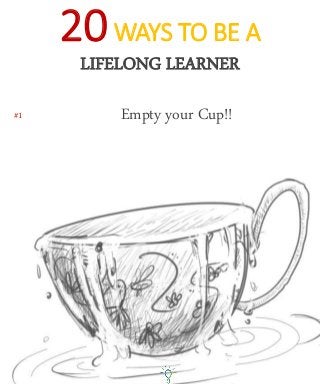
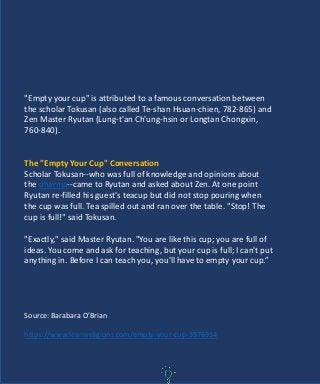
"Empty your cup"is attributed to a famous conversation between
the scholar Tokusan (also called Te-shan Hsuan-chien, 782-865) and
Zen Master Ryutan (Lung-t'an Ch'ung-hsin or Longtan Chongxin,
760-840).
The "Empty Your Cup" Conversation
Scholar Tokusan--who was full of knowledge and opinions about
the dharma--came to Ryutan and asked about Zen. At one point
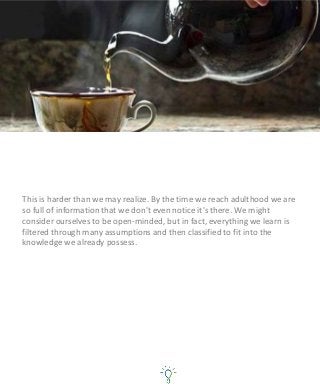
Ryutan re-filled his guest's teacup but did not stop pouring when
the cup was full. Tea spilled out and ran over the table. "Stop! The
cup is full!" said Tokusan.
"Exactly," said Master Ryutan. "You are like this cup; you are full of
ideas. You come and ask for teaching, but your cup is full; I can't put
anything in. Before I can teach you, you'll have to empty your cup.”
Source: Barabara O’Brian
https://www.learnreligions.com/empty-your-cup-3976934
6.
This is harderthan we may realize. By the time we reach adulthood we are
so full of information that we don't even notice it's there. We might
consider ourselves to be open-minded, but in fact, everything we learn is
filtered through many assumptions and then classified to fit into the
knowledge we already possess.
7.
There is away out—but it is difficult.
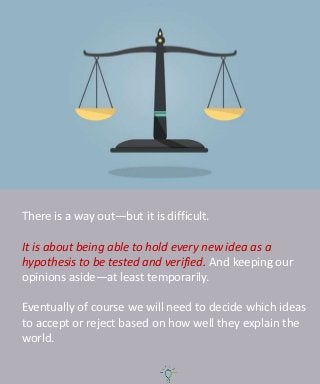
It is about being able to hold every new idea as a
hypothesis to be tested and verified. And keeping our
opinions aside—at least temporarily.
Eventually of course we will need to decide which ideas
to accept or reject based on how well they explain the
world.
8.
#2
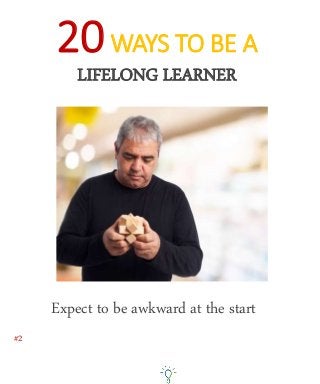
Expect to beawkward at the start
20WAYS TO BE A
LIFELONG LEARNER
9.
Remember how hardit was when you started
driving —there was so much to remember – all at
once…
10.
And today youcan comfortably sip your
coffee, listen to music, all while driving
with ease…
11.
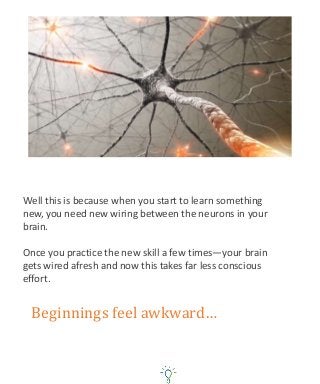
Well this isbecause when you start to learn something
new, you need new wiring between the neurons in your
brain.
Once you practice the new skill a few times—your brain
gets wired afresh and now this takes far less conscious
effort.
Beginnings feel awkward…
12.
20WAYS TO BEA
LIFELONG LEARNER
https://www.youtube.com/watch?v=vnqcVsLgdsU
Persistence is your friend
#3
13.
20WAYS TO BEA
LIFELONG LEARNER
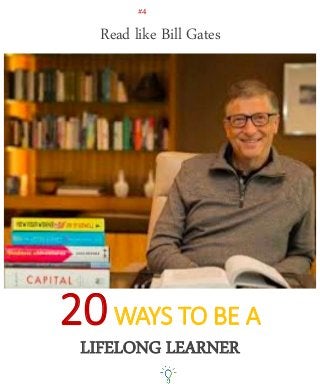
Read like Bill Gates
#4
14.
Did you knowthat Bill Gates reads
about 50 books a year?
How does he do this?
1.Keeps an hour aside every evening for
reading.
2.Takes notes in the margins as he reads
so that he is actively engaged and
focused.
3.Never starts a book he wont finish.
15.
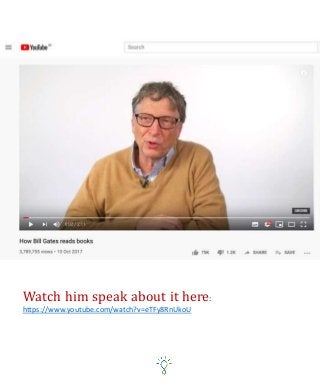
Watch him speakabout it here:
https://www.youtube.com/watch?v=eTFy8RnUkoU
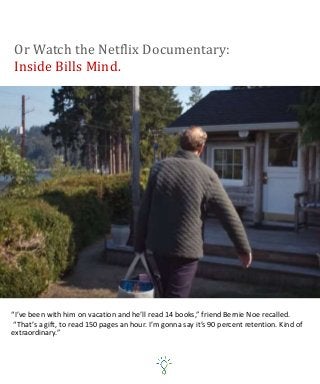
Or Watch theNetflix Documentary:
Inside Bills Mind.
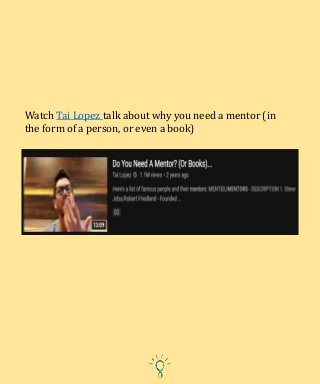
“I’ve been with him on vacation and he’ll read 14 books,” friend Bernie Noe recalled.
“That’s a gift, to read 150 pages an hour. I’m gonna say it’s 90 percent retention. Kind of
extraordinary.”
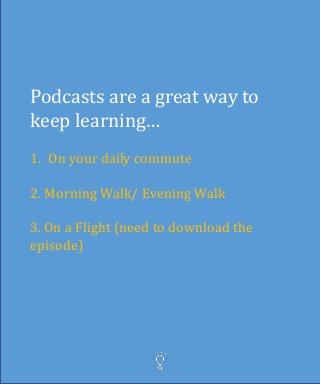
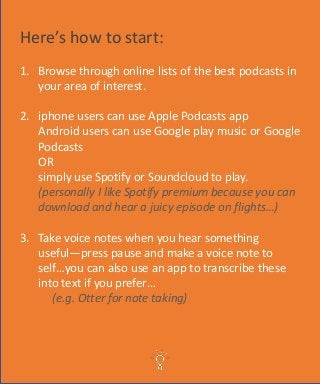
Podcasts are agreat way to
keep learning…
1. On your daily commute
2. Morning Walk/ Evening Walk
3. On a Flight (need to download the
episode)
23.
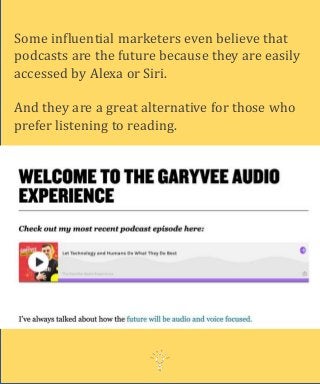
Some influential marketerseven believe that
podcasts are the future because they are easily
accessed by Alexa or Siri.
And they are a great alternative for those who
prefer listening to reading.
Here’s how tostart:
1. Browse through online lists of the best podcasts in
your area of interest.
2. iphone users can use Apple Podcasts app
Android users can use Google play music or Google
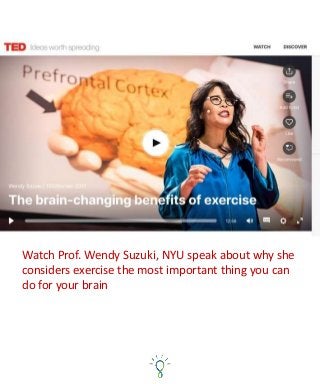
Podcasts
OR
simply use Spotify or Soundcloud to play.
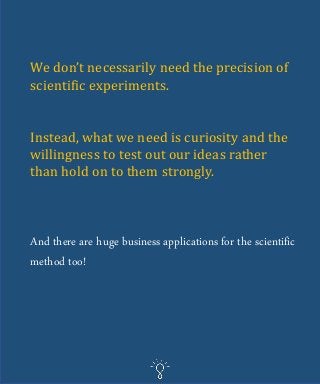
(personally I like Spotify premium because you can
download and hear a juicy episode on flights…)
3. Take voice notes when you hear something
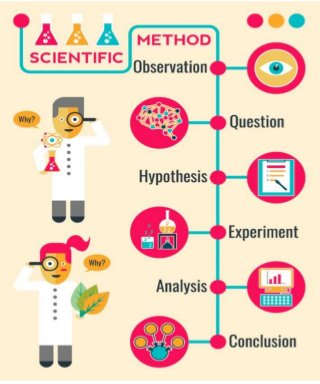
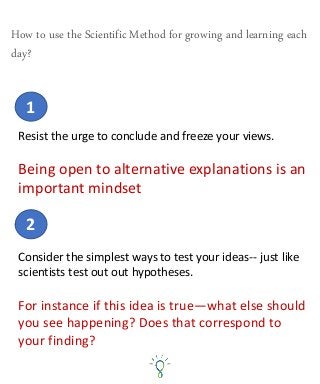
useful—press pause and make a voice note to
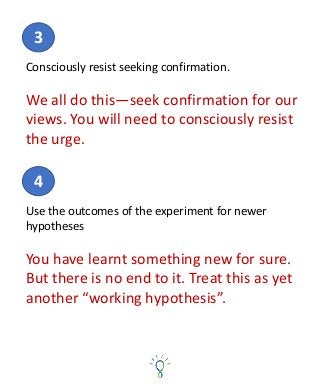
self…you can also use an app to transcribe these
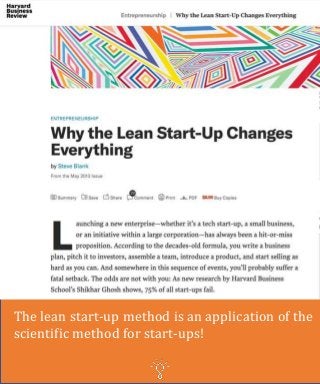
into text if you prefer…
(e.g. Otter for note taking)
Online Courses aregreat when you want to learn a
topic in a structured format.
There is such a wide variety of online courses
available today. From University Courses to Private
Instructors.
If you are interested in a topic that many others are
also interested in—there is likely a course online.
Here are some to get started…
33.
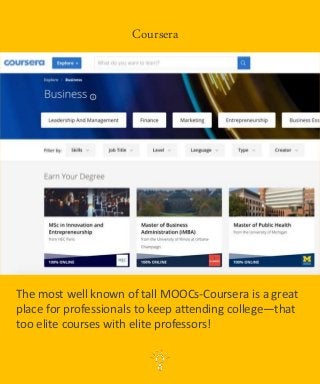
The most wellknown of tall MOOCs-Coursera is a great
place for professionals to keep attending college—that
too elite courses with elite professors!
Coursera
34.
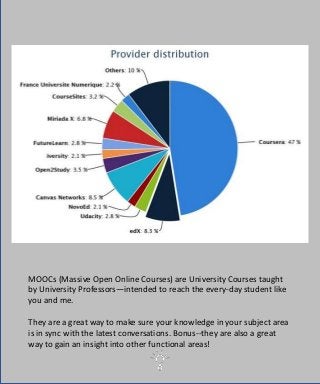
MOOCs (Massive OpenOnline Courses) are University Courses taught
by University Professors—intended to reach the every-day student like
you and me.
They are a great way to make sure your knowledge in your subject area
is in sync with the latest conversations. Bonus--they are also a great
way to gain an insight into other functional areas!
35.
LinkedIn Learning
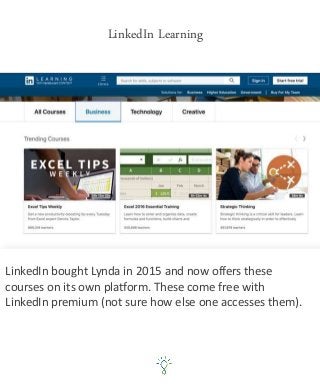
LinkedIn boughtLynda in 2015 and now offers these
courses on its own platform. These come free with
LinkedIn premium (not sure how else one accesses them).
36.
Masterclass
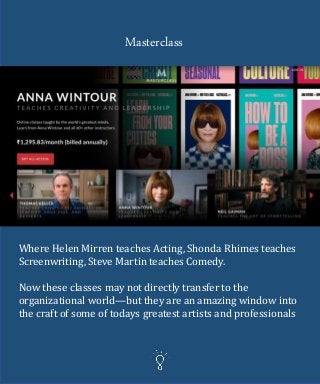
Where Helen Mirrenteaches Acting, Shonda Rhimes teaches
Screenwriting, Steve Martin teaches Comedy.
Now these classes may not directly transfer to the
organizational world—but they are an amazing window into
the craft of some of todays greatest artists and professionals
37.
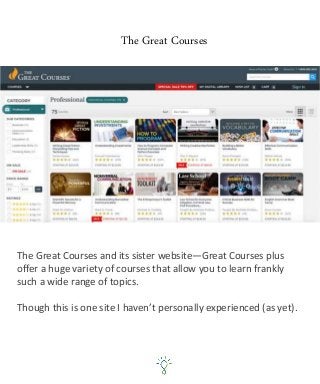
The Great Courses
TheGreat Courses and its sister website—Great Courses plus
offer a huge variety of courses that allow you to learn frankly
such a wide range of topics.
Though this is one site I haven’t personally experienced (as yet).
38.
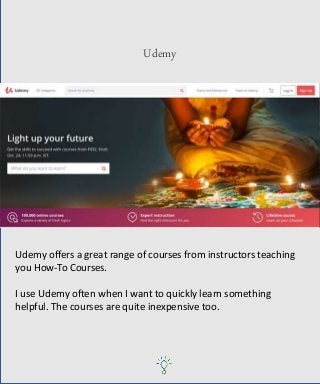
Udemy
Udemy offers agreat range of courses from instructors teaching
you How-To Courses.
I use Udemy often when I want to quickly learn something
helpful. The courses are quite inexpensive too.
39.
But that isnot all—the list is endless.
Private Instructors, Your Favorite Teacher—It is likely that
each of them either has (or will soon have) their own
course online.
With the flexibility of time and very affordable
prices—there are few excuses to not keep
learning.
40.
The Worldwide e-learningmarket is predicted to be $325 Bn
by 2025.
That is Huge!!
What are you learning next?
41.
20WAYS TO BEA
LIFELONG LEARNER
Executive Education
#7
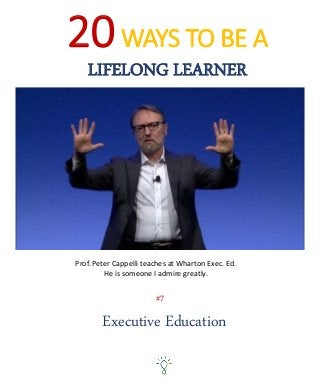
Prof. Peter Cappelli teaches at Wharton Exec. Ed.
He is someone I admire greatly.
42.
No matter whichcollege you studied at, there
may come a time when you want another shot
at sitting in the classroom and listening to
what some amazing professors have to say.
If that is you—then take a look at the Executive Education programs
in your field.
43.
What you canlearn goes way beyond just the
class lectures.
You learn from other participants to the
program, and you learn from the guest
speakers.
Executive Education gives you an
opportunity to interact with the best and
brightest in your field!
44.
Just Remember--
The mostprestigious programs can
be somewhat competitive in their
selection.
AND can come with a BIG price tag.
45.
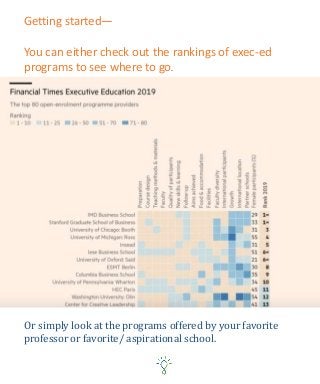
Getting started—
You caneither check out the rankings of exec-ed
programs to see where to go.
Or simply look at the programs offered by your favorite
professor or favorite/ aspirational school.
46.
The most popularIIM Courses in
India—
1. Executive Program in Business Analytics.
2. Executive Program in Leadership and
Management.
3. Executive Program in Sales and Marketing
4. Executive Program in Human Resource
Management
5. Executive Program in Business Finance
6. Executive Program in Advanced Business
Analytics
source: https://www.hugheseducation.com/blogs/Most-popular-IIM-
courses-in-India-for-professionals
Many prestigious InternationalUniversities today are
actively seeking participation from Indian executives.
Some even have a tie-up with an Indian partner for deeper
outreach.
When the time is right—seek out the best!
49.
20WAYS TO BEA
LIFELONG LEARNER
Learning from everyday experiences#8
50.
The most agilelearners are those
who can learn the most from their
experiences each day.
When it really matters--
51.
Experiential learning isactually the most natural form of learning for our
species.
From the time we were little children, experiential
learning helped us to learn “How To” make sense of
the world around us and navigate it better.
As we become adults, for some of us—the process of
conscious seeking out of new experiences and making
sense of them—may slow down.
This slow down can be because we are very busy and
have no time to really try and extract learnings from
each experience.
Or it could slow down because we no longer feel as
driven to keep learning.
Yet, the most successful careers over the long term-–
belong to people who are consciously learning—each
day.
53.
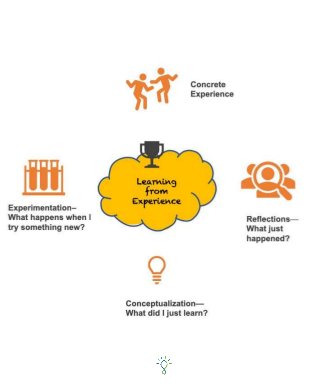
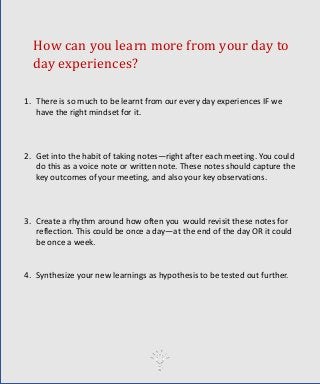
How can youlearn more from your day to
day experiences?
1. There is so much to be learnt from our every day experiences IF we
have the right mindset for it.
2. Get into the habit of taking notes—right after each meeting. You could
do this as a voice note or written note. These notes should capture the
key outcomes of your meeting, and also your key observations.
3. Create a rhythm around how often you would revisit these notes for
reflection. This could be once a day—at the end of the day OR it could
be once a week.
4. Synthesize your new learnings as hypothesis to be tested out further.
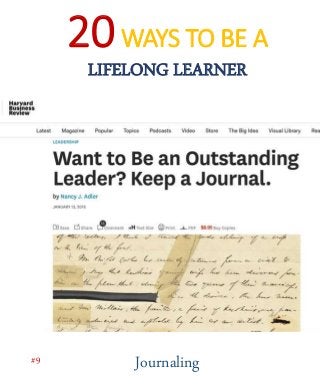
Journaling allows youquiet
time for the most important
step of learning---
Reflection!
56.
Just 15 minutesa day can allow you
to reflect on and capture your most
important experiences from the day.
Building your “learning agility”– a key
indicator of leadership potential.
Journaling also allowsyou to:
1. De-stress
2. Become more creative
3. Record progress through life’s goals
4. Reconnect with your bigger goals.
59.
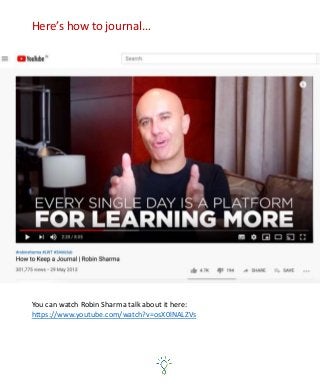
You can watchRobin Sharma talk about it here:
https://www.youtube.com/watch?v=osX0lNALZVs
Here’s how to journal…
60.
20WAYS TO BEA
LIFELONG LEARNER
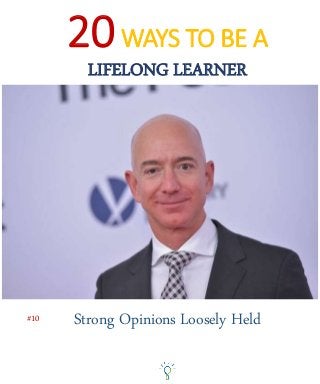
Strong Opinions Loosely Held#10
61.
Some years ago,in an interview, Bezos described a
characteristic of people who were “right a lot”—
The people who changed their minds
He had observed that the smartest people are
constantly revising their understanding, reconsidering
a problem they thought they had already solved.
They are open to new information, new ideas and new
ways of looking at a problem
62.
Originally credited toStanford Professor Paul Saffo,
“Strong Opinions, Loosely Held” is a philosophy that
permeates how many of the smartest people think.
Since you often have incomplete information on any
forecast or decision. Go through what you have and then
come up with a point of view—quickly.
But then (and this is the hard part)—think of all the ways
this can be wrong. And keep revising your views based on
the information you get.
Strong Opinions, Loosely Held
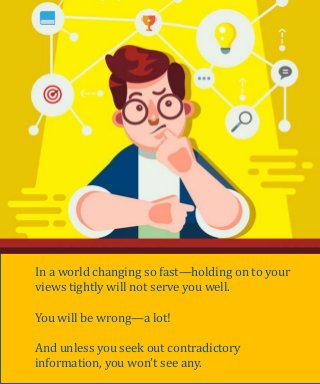
In a world changing so fast—holding on to your
views tightly will not serve you well.
You will be wrong—a lot!
And unless you seek out contradictory
information, you won’t see any.
63.
“What gets usinto trouble is not what we don't
know. It's what we know for sure that just ain't
so.”
― Mark Twain
Strong Opinions allow you to move ahead
decisively.
Loosely Held allows you to keep revising
your course as you uncover new
information
64.
20WAYS TO BEA
LIFELONG LEARNER
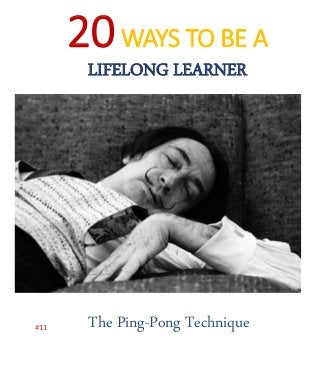
The Ping-Pong Technique#11
65.
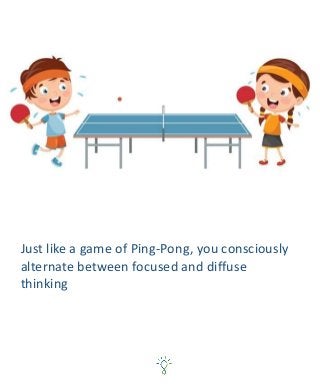
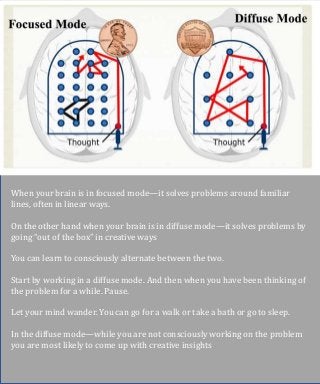
The Ping Pongtechnique is about alternating
between two different modes of thinking:
1. The Focused Mode: When you are directly
tackling the problem at hand, thinking of
solutions in a well, focused manner.
2. The Diffuse Mode: When you allow your mind
to wander around. The problem is in the
background.
66.
Just like agame of Ping-Pong, you consciously
alternate between focused and diffuse
thinking
67.
When your brainis in focused mode—it solves problems around familiar
lines, often in linear ways.
On the other hand when your brain is in diffuse mode—it solves problems by
going “out of the box” in creative ways
You can learn to consciously alternate between the two.
Start by working in a diffuse mode. And then when you have been thinking of
the problem for a while. Pause.
Let your mind wander. You can go for a walk or take a bath or go to sleep.
In the diffuse mode—while you are not consciously working on the problem
you are most likely to come up with creative insights
68.
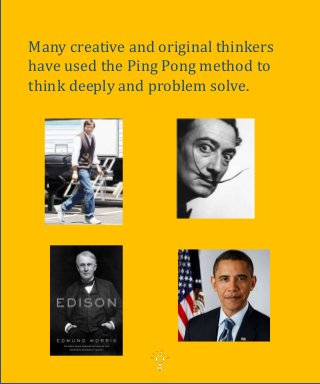
Many creative andoriginal thinkers
have used the Ping Pong method to
think deeply and problem solve.
69.
Learn more inthis very interesting video
https://www.youtube.com/watch?v=WTr12dK2Se0
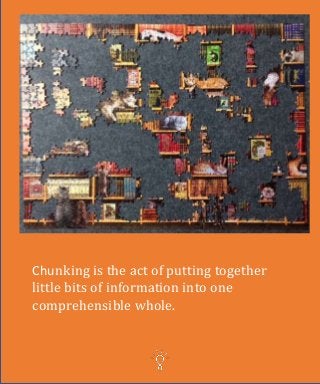
When learning somethingnew---
practice it in small chunks—and then
combine these to learn even very
large skills!
77.
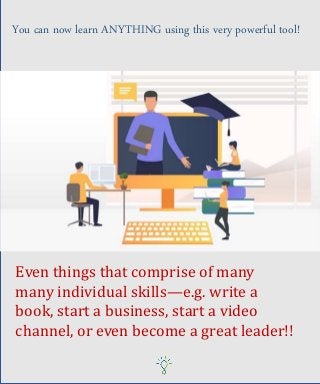
You can nowlearn ANYTHING using this very powerful tool!
Even things that comprise of many
many individual skills—e.g. write a
book, start a business, start a video
channel, or even become a great leader!!
20WAYS TO BEA
LIFELONG LEARNER
Build Diverse Networks
#13
The strength of weak ties
80.
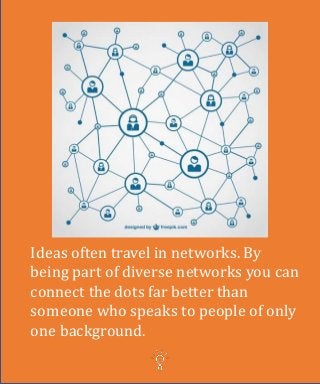
Ideas often travelin networks. By
being part of diverse networks you can
connect the dots far better than
someone who speaks to people of only
one background.
81.
One of themost powerful ideas of all time in the
field of Sociology is the strength of weak ties! About
4 decades ago, Granovetter studied what kinds of
networks helped people develop better careers.
He discovered that it was better to be part of many
diverse networks than deeply embedded within a
single one.
The diversity of your network is now more
important than ever—it reflects the many sources of
your ideas.
you can read more here--
https://www.cs.cmu.edu/~jure/pub/papers/granovetter73ties.pdf
“The Strength of Weak Ties!!”
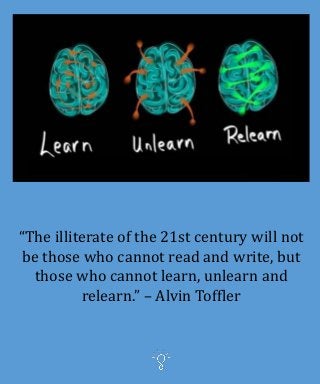
“The illiterate ofthe 21st century will not
be those who cannot read and write, but
those who cannot learn, unlearn and
relearn.” – Alvin Toffler
84.
Now strictly speakingthere is no such thing as
“unlearning”.
Neural connections once made do not simply get
disconnected.
What does happen is that when you make a
conscious choice to explore alternative perspectives,
you are able to develop alternate pathways.
And over time what is a default perspective today,
becomes one of many other alternative perspectives.
86.
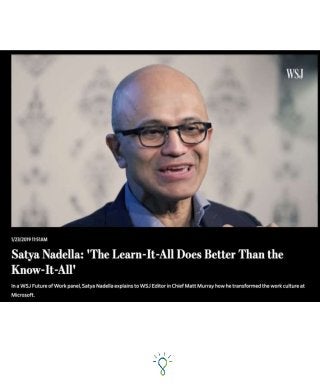
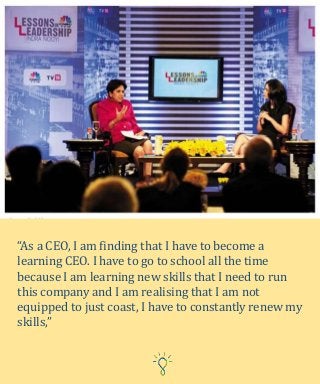
“As a CEO,I am finding that I have to become a
learning CEO. I have to go to school all the time
because I am learning new skills that I need to run
this company and I am realising that I am not
equipped to just coast, I have to constantly renew my
skills,”
87.
A Simple ApproachTo Unlearning
Here’s the simple, ingenious approach to safely transform
your old learning or habit super quickly: Simply “flood” or
overwhelm the old action with the newly desired action or
habit!
This approach works much like a full immersion approach
to learning a foreign language.
It's a bit daunting at first, but you quickly improve since all
the learning is fresh and new. You’ll move from a rank
beginner to minimally competent fairly quickly and then
progress to proficient, simply because all your focus is on the
newly desired learning rather than the old action.
Total immersion into a society where daily activities depend
upon the proper use of the language provides the key here.
You can read more here at -
https://www.forbes.com/sites/forbescoachescouncil/2018/08/02/why-learning-to-
unlearn-is-so-important/#45e39e612444
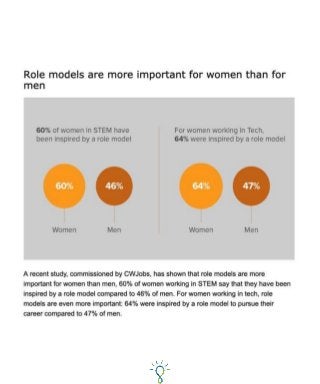
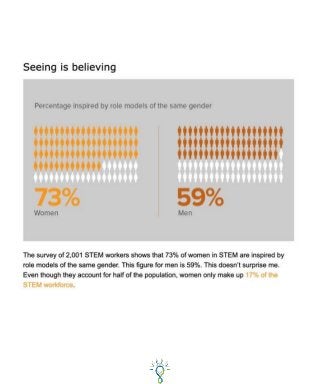
Humans are learningand social animals.
We learn so much about what is possible and how
to get there—simply by watching others.
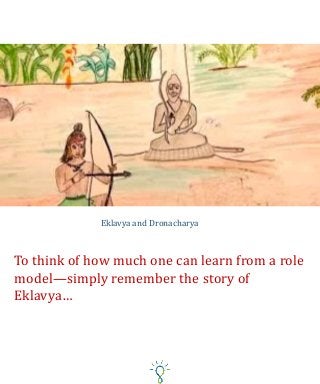
90.
Eklavya and Dronacharya
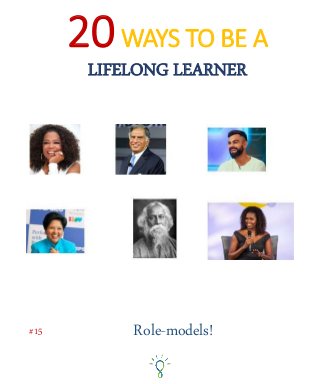
Tothink of how much one can learn from a role
model—simply remember the story of
Eklavya…
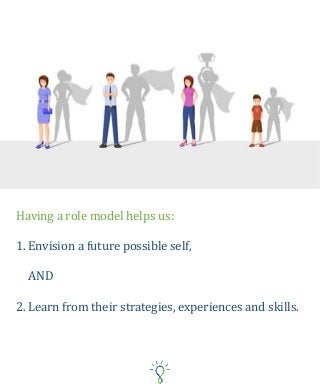
93.
Having a rolemodel helps us:
1. Envision a future possible self,
AND
2. Learn from their strategies, experiences and skills.
94.
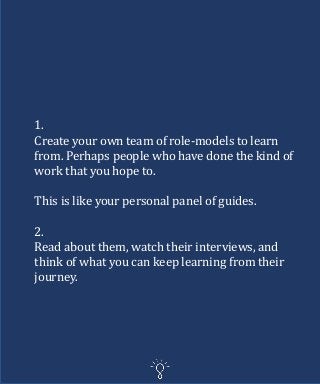
1.
Create your ownteam of role-models to learn
from. Perhaps people who have done the kind of
work that you hope to.
This is like your personal panel of guides.
2.
Read about them, watch their interviews, and
think of what you can keep learning from their
journey.
95.
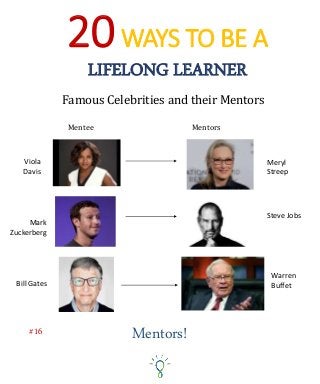
Mentors!#16
20WAYS TO BEA
LIFELONG LEARNER
Famous Celebrities and their Mentors
Mentee Mentors
Viola
Davis
Bill Gates
Mark
Zuckerberg
Meryl
Streep
Steve Jobs
Warren
Buffet
96.
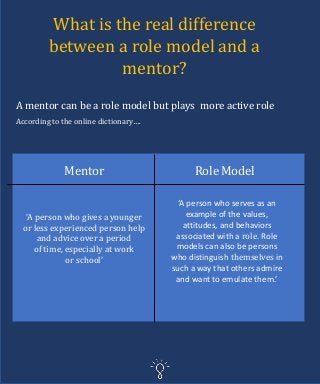
What is thereal difference
between a role model and a
mentor?
A mentor can be a role model but plays more active role
According to the online dictionary….
Mentor Role Model
‘A person who gives a younger
or less experienced person help
and advice over a period
of time, especially at work
or school’
‘A person who serves as an
example of the values,
attitudes, and behaviors
associated with a role. Role
models can also be persons
who distinguish themselves in
such a way that others admire
and want to emulate them.’
97.
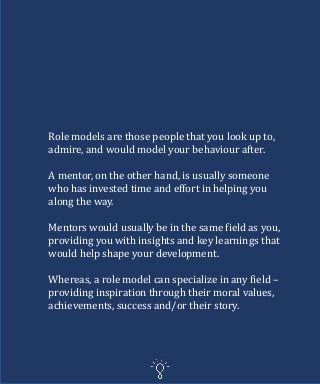
Role models arethose people that you look up to,
admire, and would model your behaviour after.
A mentor, on the other hand, is usually someone
who has invested time and effort in helping you
along the way.
Mentors would usually be in the same field as you,
providing you with insights and key learnings that
would help shape your development.
Whereas, a role model can specialize in any field –
providing inspiration through their moral values,
achievements, success and/or their story.
98.
Watch Tai Lopeztalk about why you need a mentor (in
the form of a person, or even a book)
99.
Yet…Good mentors arevery hard to come
by, because quite honestly—why should
anyone at the top of their game—give so
much of their time.
100.
How To FindA Mentor
Here are some tips for finding a good mentor…
1. Do not ask strangers to be your mentors –
As Sheryl Sandberg says, “If someone has to ask the question,
the answer is probably no. When someone finds the right
mentor, it is obvious.”
Strangers (especially celebrities or famous businesspersons)
will virtually always have to say "no" to mentoring requests
from strangers.
This is probably because they have no interpersonal
relationship with you, they are unaware of your
abilities/potential, they are constantly bombarded with this
question, and they most likely just don’t have the time.
2. If you do want to be mentored by a stranger you
admire, rather than asking for mentorship, Ask for their
views on a specific subject. Many people will spare 15 mins
to help you out. follow their work, be helpful and supportive.
3. Be someone who is enjoyable to mentor
- Be great at what you do
- Promote the success of your mentor.
- Be positive and helpful yourself.
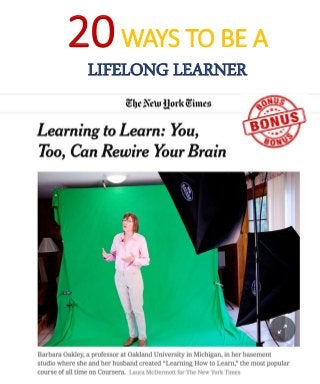
Who would haveimagined that the
MOST popular course on Coursera is
on “Learning to Learn”.
103.
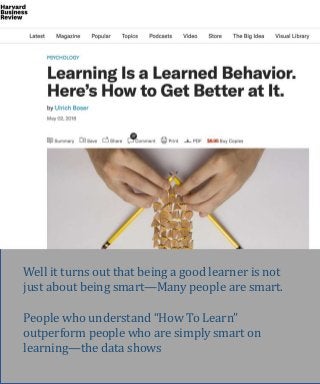
Well it turnsout that being a good learner is not
just about being smart—Many people are smart.
People who understand “How To Learn”
outperform people who are simply smart on
learning—the data shows
104.
“Here’s how tobe better at learning:
1. Have goals for learning.
2. Become conscious of how you are learning.
3. Reflect on your learning
By being a “deliberate learner” you will
also become a better learner.
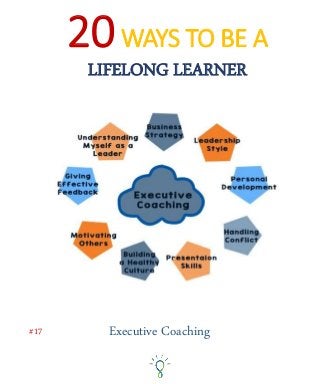
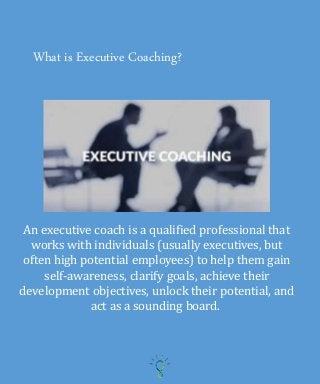
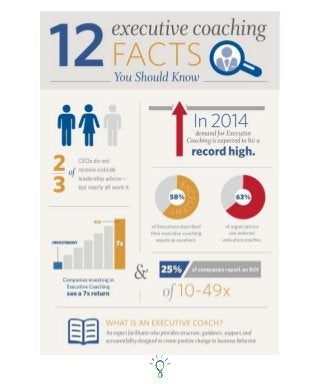
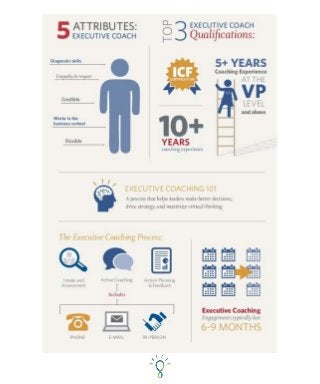
What is ExecutiveCoaching?
An executive coach is a qualified professional that
works with individuals (usually executives, but
often high potential employees) to help them gain
self-awareness, clarify goals, achieve their
development objectives, unlock their potential, and
act as a sounding board.
107.
As opposed tojust advising the
clients, through a process of inquiry,
dialogue, and other tools, the coach
serves as a thought partner to help
the client examine and develop his
or her decision-making, experiment
with new ways of thinking and
being, and commit to action steps
that help achieve the client’s goals.
"Coaching is not telling people
what to do; it's giving them a
chance to examine what they are
doing in light of their intentions."
108.
Why do clientshire an
Executive Coach?
• To develop the leadership skills of high-
potential individuals.
• To improve the odds that newly
promoted managers would be successful.
• To develop management and leadership
skills among their technical people.
• To correct behavioral problems at the
management level.
• To help leaders resolve interpersonal
conflicts among employees.
Executive Coaches are usually hired for one of
the following purposes,
110.
How do youknow if you’re ready
for an Executive Coach?
If upon asking yourself the following questions, the
answer to most is yes, then it may be time to seek a
professional coach,
1. Do You Know What You Don't Know?
2. Do You Know Where You’d Like To Be?
3. Do You Have Clear Professional Goals?
4. Can You Focus On The Present?
5. Are You Interested In Developing Yourself?
6. Do You Face A Critical Decision About Your Life Or
Career?
7. Are You Hearing You Need to Change But Aren't Sure
How?
8. Do You Have the Time and Resources to Invest?
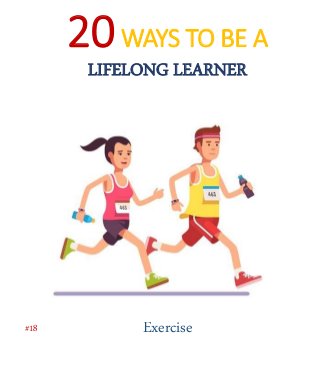
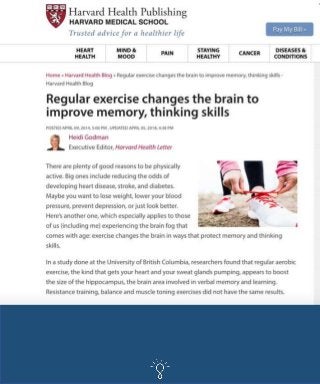
Believe it ornot—exercise can be the
single most important thing we do to
look after our brains
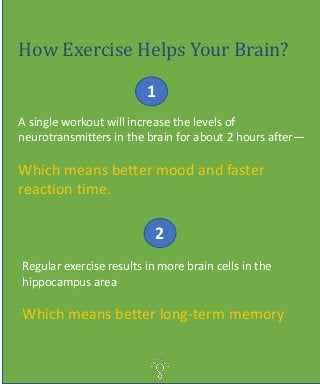
116.
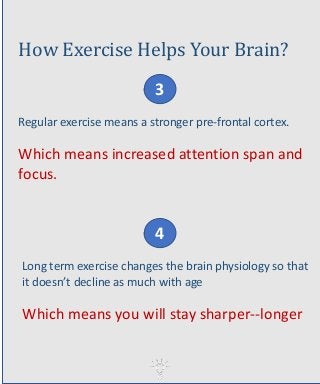
How Exercise HelpsYour Brain?
A single workout will increase the levels of
neurotransmitters in the brain for about 2 hours after—
Which means better mood and faster
reaction time.
1
2
Regular exercise results in more brain cells in the
hippocampus area
Which means better long-term memory
117.
How Exercise HelpsYour Brain?
Regular exercise means a stronger pre-frontal cortex.
Which means increased attention span and
focus.
4
3
Long term exercise changes the brain physiology so that
it doesn’t decline as much with age
Which means you will stay sharper--longer
118.
Watch Prof. WendySuzuki, NYU speak about why she
considers exercise the most important thing you can
do for your brain
119.
It seems thatthe old saying
”all work and no play make jack a very dull boy”
may be true after all
120.
20WAYS TO BEA
LIFELONG LEARNER
A Scientific Temperament#19
121.
A scientific temperamentis about wanting
to test out your ideas in the real world—
and being open to whatever the outcomes.
123.
We don’t necessarilyneed the precision of
scientific experiments.
Instead, what we need is curiosity and the
willingness to test out our ideas rather
than hold on to them strongly.
And there are huge business applications for the scientific
method too!
124.
Resist the urgeto conclude and freeze your views.
Being open to alternative explanations is an
important mindset
1
How to use the Scientific Method for growing and learning each
day?
2
Consider the simplest ways to test your ideas-- just like
scientists test out out hypotheses.
For instance if this idea is true—what else should
you see happening? Does that correspond to
your finding?
125.
Consciously resist seekingconfirmation.
We all do this—seek confirmation for our
views. You will need to consciously resist
the urge.
3
Use the outcomes of the experiment for newer
hypotheses
You have learnt something new for sure.
But there is no end to it. Treat this as yet
another “working hypothesis”.
4
126.
And there arehuge business applications for the scientific
method too!
127.
The lean start-upmethod is an application of the
scientific method for start-ups!
It turns outthat simply being awake—
releases toxins in the brain.
BUT Sleep allows our brain cells to shrink
and these toxins to be released
That feeling of having a clear head—
Well that’s real!!
What’s more---
Sleep iscritical for the consolidation of
memories and insights gained during the
day!
133.
The Impact ofSleep Deprivation
on Learning and Performance
When we are sleep deprived, our focus, attention, and
vigilance drift, making it more difficult to receive information.
Without adequate sleep and rest, over-worked neurons can
no longer function to coordinate information properly, and
we lose our ability to access previously learned information.
We lose our ability to make sound decisions because we can
no longer accurately assess the situation, plan accordingly,
and choose the correct behavior. Judgment becomes
impaired.
Although chronic sleep deprivation affects different
individuals in a variety of ways (and the effects are not
entirely known), it is clear that a good night’s rest has a
strong impact on learning and memory.
134.
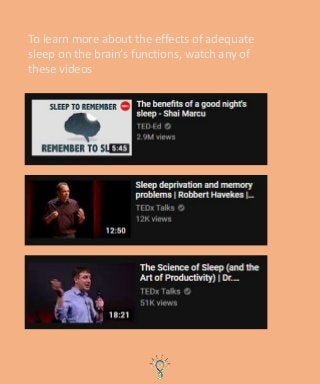
To learn moreabout the effects of adequate
sleep on the brain’s functions, watch any of
these videos
135.
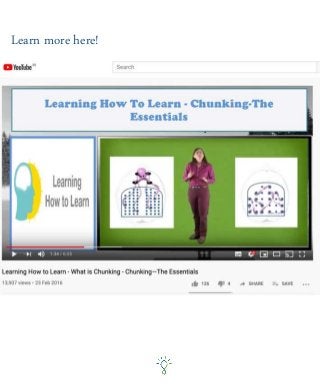
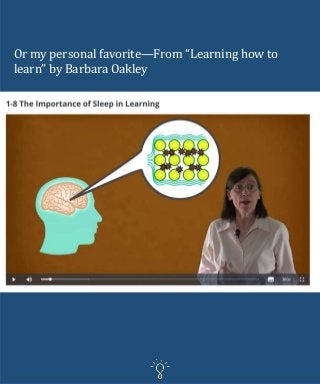
Or my personalfavorite—From “Learning how to
learn” by Barbara Oakley
136.
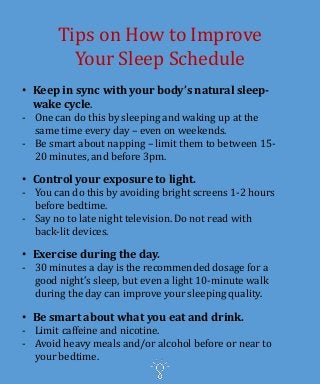
Tips on Howto Improve
Your Sleep Schedule
• Keep in sync with your body’s natural sleep-
wake cycle.
- One can do this by sleeping and waking up at the
same time every day – even on weekends.
- Be smart about napping – limit them to between 15-
20 minutes, and before 3pm.
• Control your exposure to light.
- You can do this by avoiding bright screens 1-2 hours
before bedtime.
- Say no to late night television. Do not read with
back-lit devices.
• Exercise during the day.
- 30 minutes a day is the recommended dosage for a
good night’s sleep, but even a light 10-minute walk
during the day can improve your sleeping quality.
• Be smart about what you eat and drink.
- Limit caffeine and nicotine.
- Avoid heavy meals and/or alcohol before or near to
your bedtime.
138.
And with thiswe come to an end of our series on
20 ways to become a lifelong learner!
If you want this slide deck as a keepsake—
write to me at Shalini@infinityod.com
139.
20WAYS TO BEA
LIFELONG LEARNER
Learn how to Learn on Coursera
BONUS!!
Editor's Notes
#129 Viola Davis and Meryl Streep
Bill Gates and Warren Buffet
Mark Zuckerberg and Steve Jobs