

Measure what attributes are most important when making a
purchase decision & by how much
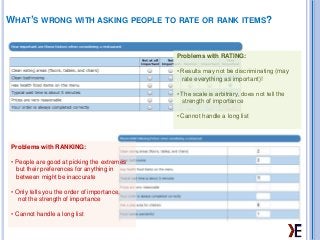
WHAT’S WRONG WITH ASKING PEOPLE TO RATE OR RANK ITEMS?
Problems with RATING:
• Results may not be discriminating (may
rate everything as important)!
• The scale is arbitrary, does not tell the
strength of importance
• Cannot handle a long list
Problems with RANKING:
• People are good at picking the extremes
but their preferences for anything in
between might be inaccurate
• Only tells you the order of importance,
not the strength of importance
• Cannot handle a long list
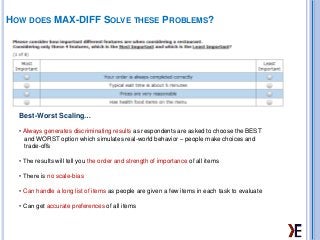
HOW DOES MAX-DIFF SOLVE THESE PROBLEMS?
Best-Worst Scaling…
• Always generates discriminating results as respondents are asked to choose the BEST
and WORST option which simulates real-world behavior – people make choices and
trade-offs
• The results will tell you the order and strength of importance of all items
• There is no scale-bias
• Can handle a long list of items as people are given a few items in each task to evaluate
• Can get accurate preferences of all items
TYPES OF MAX-DIFF
Standard Max Diff
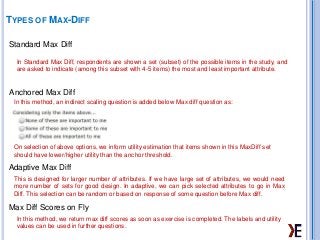
Anchored Max Diff
Adaptive Max Diff
Max Diff Scores on Fly
In Standard Max Diff, respondents are shown a set (subset) of the possible items in the study, and
are asked to indicate (among this subset with 4-5 items) the most and least important attribute.
In this method, an indirect scaling question is added below Max diff question as:
On selection of above options, we inform utility estimation that items shown in this MaxDiff set
should have lower/higher utility than the anchor threshold.
This is designed for larger number of attributes. If we have large set of attributes, we would need
more number of sets for good design. In adaptive, we can pick selected attributes to go in Max
Diff. This selection can be random or based on response of some question before Max diff.
In this method, we return max diff scores as soon as exercise is completed. The labels and utility
values can be used in further questions.
OUTPUTS OF MAX-DIFF
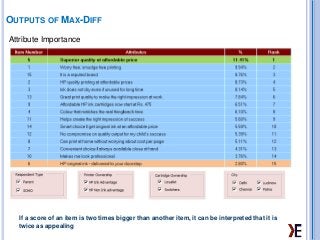
Attribute Importance
If a score of an item is two times bigger than another item, it can be interpreted that it is
twice as appealing
OUTPUTS OF MAX-DIFF
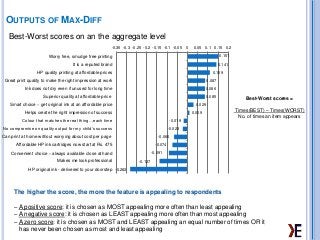
Best-Worst scores on an the aggregate level
0.151
0.141
0.109
0.087
0.086
0.085
0.029
0.009
-0.019
-0.023
-0.066
-0.074
-0.091
-0.137
-0.282
-0.35 -0.3 -0.25 -0.2 -0.15 -0.1 -0.05 0 0.05 0.1 0.15 0.2
Worry free, smudge free printing
It is a reputed brand
HP quality printing at affordable prices
Great print quality to make the right impression at work
Ink does not dry even if unused for long time
Superior quality at affordable price
Smart choice – get original ink at an affordable price
Helps create the right impression of success
Colour that matches the real thing…each time
No compromise on quality output for my child’s success
Can print at home without worrying about cost per page
Affordable HP ink cartridges now start at Rs. 475
Convenient choice – always available close at hand
Makes me look professional
HP original ink - delivered to your doorstep
Best-Worst scores =
Times(BEST) – Times(WORST)
No. of times an item appears
The higher the score, the more the feature is appealing to respondents
– A positive score: it is chosen as MOST appealing more often than least appealing
– A negative score: it is chosen as LEAST appealing more often than most appealing
– A zero score: it is chosen as MOST and LEAST appealing an equal number of times OR it
has never been chosen as most and least appealing
BEYOND MAX-DIFF
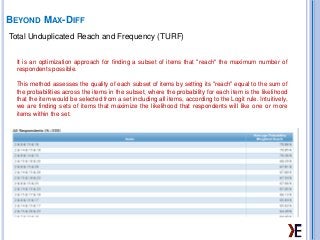
Total Unduplicated Reach and Frequency (TURF)
It is an optimization approach for finding a subset of items that "reach" the maximum number of
respondents possible.
This method assesses the quality of each subset of items by setting its "reach" equal to the sum of
the probabilities across the items in the subset, where the probability for each item is the likelihood
that the item would be selected from a set including all items, according to the Logit rule. Intuitively,
we are finding sets of items that maximize the likelihood that respondents will like one or more
items within the set.
MAX-DIFF DEMO LINKS
Standard Max Diff
Standard Max Diff with Images
Anchored Max Diff
Adaptive Max Diff
Max Diff with Scores on Fly
For any additional questions, write us at contactus@knowledgexcel.com
Visit us at http://knowledgexcel.com

Introduction to Max Diff - Approach and Demo

  • 1.
    Measure what attributesare most important when making a purchase decision & by how much
  • 2.
    WHAT’S WRONG WITHASKING PEOPLE TO RATE OR RANK ITEMS? Problems with RATING: • Results may not be discriminating (may rate everything as important)! • The scale is arbitrary, does not tell the strength of importance • Cannot handle a long list Problems with RANKING: • People are good at picking the extremes but their preferences for anything in between might be inaccurate • Only tells you the order of importance, not the strength of importance • Cannot handle a long list
  • 3.
    HOW DOES MAX-DIFFSOLVE THESE PROBLEMS? Best-Worst Scaling… • Always generates discriminating results as respondents are asked to choose the BEST and WORST option which simulates real-world behavior – people make choices and trade-offs • The results will tell you the order and strength of importance of all items • There is no scale-bias • Can handle a long list of items as people are given a few items in each task to evaluate • Can get accurate preferences of all items
  • 4.
    TYPES OF MAX-DIFF StandardMax Diff Anchored Max Diff Adaptive Max Diff Max Diff Scores on Fly In Standard Max Diff, respondents are shown a set (subset) of the possible items in the study, and are asked to indicate (among this subset with 4-5 items) the most and least important attribute. In this method, an indirect scaling question is added below Max diff question as: On selection of above options, we inform utility estimation that items shown in this MaxDiff set should have lower/higher utility than the anchor threshold. This is designed for larger number of attributes. If we have large set of attributes, we would need more number of sets for good design. In adaptive, we can pick selected attributes to go in Max Diff. This selection can be random or based on response of some question before Max diff. In this method, we return max diff scores as soon as exercise is completed. The labels and utility values can be used in further questions.
  • 5.
    OUTPUTS OF MAX-DIFF AttributeImportance If a score of an item is two times bigger than another item, it can be interpreted that it is twice as appealing
  • 6.
    OUTPUTS OF MAX-DIFF Best-Worstscores on an the aggregate level 0.151 0.141 0.109 0.087 0.086 0.085 0.029 0.009 -0.019 -0.023 -0.066 -0.074 -0.091 -0.137 -0.282 -0.35 -0.3 -0.25 -0.2 -0.15 -0.1 -0.05 0 0.05 0.1 0.15 0.2 Worry free, smudge free printing It is a reputed brand HP quality printing at affordable prices Great print quality to make the right impression at work Ink does not dry even if unused for long time Superior quality at affordable price Smart choice – get original ink at an affordable price Helps create the right impression of success Colour that matches the real thing…each time No compromise on quality output for my child’s success Can print at home without worrying about cost per page Affordable HP ink cartridges now start at Rs. 475 Convenient choice – always available close at hand Makes me look professional HP original ink - delivered to your doorstep Best-Worst scores = Times(BEST) – Times(WORST) No. of times an item appears The higher the score, the more the feature is appealing to respondents – A positive score: it is chosen as MOST appealing more often than least appealing – A negative score: it is chosen as LEAST appealing more often than most appealing – A zero score: it is chosen as MOST and LEAST appealing an equal number of times OR it has never been chosen as most and least appealing
  • 7.
    BEYOND MAX-DIFF Total UnduplicatedReach and Frequency (TURF) It is an optimization approach for finding a subset of items that "reach" the maximum number of respondents possible. This method assesses the quality of each subset of items by setting its "reach" equal to the sum of the probabilities across the items in the subset, where the probability for each item is the likelihood that the item would be selected from a set including all items, according to the Logit rule. Intuitively, we are finding sets of items that maximize the likelihood that respondents will like one or more items within the set.
  • 8.
    MAX-DIFF DEMO LINKS StandardMax Diff Standard Max Diff with Images Anchored Max Diff Adaptive Max Diff Max Diff with Scores on Fly
  • 9.
    For any additionalquestions, write us at contactus@knowledgexcel.com Visit us at http://knowledgexcel.com