Middle Tennessee
Home Inspection FAQs
Buying a new home is an exciting experience.
Because it’s such a large purchase, a lot of
paperwork and inspections are conducted to
protect the new investment. Home inspections are
a part of the home buying process, and should be
considered an educational asset to help buyers learn
more about the house they are purchasing. Here are
some of the most common questions associated
with home inspections in Middle Tennessee.
What is a home inspection?Q:
Simply put, the home inspection is a visual
evaluation of the physical property by a third
party. Property buyers hire home inspectors.
They have no affiliation with your realtor or
mortgage lender. It looks at the foundation,
roof, and other structural aspects of the home.
Each inspection concludes with a detailed
report explaining areas of the house that
require immediate repair or could become
problematic in the future.
What is a home inspection?
A:
Do I have to have a home
inspection?
Q:
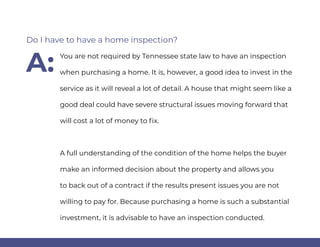
You are not required by Tennessee state law to have an inspection
when purchasing a home. It is, however, a good idea to invest in the
service as it will reveal a lot of detail. A house that might seem like a
good deal could have severe structural issues moving forward that
will cost a lot of money to fix.
A full understanding of the condition of the home helps the buyer
make an informed decision about the property and allows you
to back out of a contract if the results present issues you are not
willing to pay for. Because purchasing a home is such a substantial
investment, it is advisable to have an inspection conducted.
Do I have to have a home inspection?
A:
What does the inspector
look for?
Q:
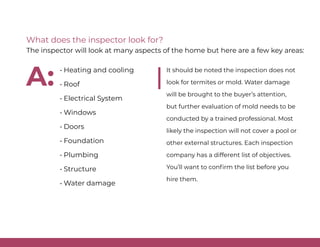
• Heating and cooling
• Roof
• Electrical System
• Windows
• Doors
• Foundation
• Plumbing
• Structure
• Water damage
It should be noted the inspection does not
look for termites or mold. Water damage
will be brought to the buyer’s attention,
but further evaluation of mold needs to be
conducted by a trained professional. Most
likely the inspection will not cover a pool or
other external structures. Each inspection
company has a different list of objectives.
You’ll want to confirm the list before you
hire them.
What does the inspector look for?
The inspector will look at many aspects of the home but here are a few key areas:
A:
How long does the
inspection take?
Q:
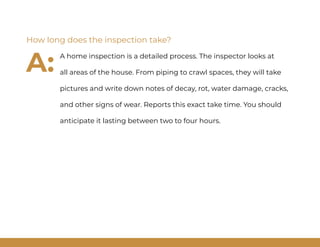
A home inspection is a detailed process. The inspector looks at
all areas of the house. From piping to crawl spaces, they will take
pictures and write down notes of decay, rot, water damage, cracks,
and other signs of wear. Reports this exact take time. You should
anticipate it lasting between two to four hours.
How long does the inspection take?
A:
When does the
inspection take place?
Q:
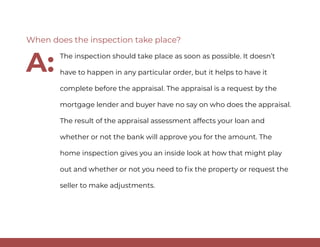
The inspection should take place as soon as possible. It doesn’t
have to happen in any particular order, but it helps to have it
complete before the appraisal. The appraisal is a request by the
mortgage lender and buyer have no say on who does the appraisal.
The result of the appraisal assessment affects your loan and
whether or not the bank will approve you for the amount. The
home inspection gives you an inside look at how that might play
out and whether or not you need to fix the property or request the
seller to make adjustments.
When does the inspection take place?
A:
Who pays for the home
inspection?
Q:
The purpose of the inspection is to protect the buyer. Therefore, the
buyer will make the payment. In very rare cases would the seller
pay for the examination of the property.
Who pays for the home inspection?
A:
Can I conduct the
inspection myself?
Q:
The state of Tennessee requires you to be a licensed home inspector to
conduct this type of service. These individuals have been trained on the
different elements of the home with a thorough understanding of the
construction, maintenance, installations, and home safety. You do not
want to leave this kind of information to chance.
Buyers may find it challenging to remain unbiased. Glossing over
critical information that could become hazardous down the line is not
how you want to invest in your new property. Home inspectors are
impartial third parties whose only job is to obtain the most accurate
information.
Can I conduct the inspection myself?
A:
Do I need to be there for the
inspection?
Q:
Ideally, you will be present during the
inspection. It’s an educational opportunity for
you to learn more about the property you are
buying. While it’s not required, it is a chance
for you to see first hand any issues, damages,
cracks, or decay that you might have to repair
later.
Do I need to be there for the inspection?
A:
What happens if problems
are identified during the
inspection?
Q:
As a buyer, you can use the information as leverage during the sale
of the home. The seller is not obligated to fix any of the repairs. If,
however, the damages are extensive enough, the buyer could use
the information to back out of the contract or negotiate a fairer
price. Sometimes, issues in the inspection also affect the appraisal.
A damaged roof or other mitigating factors that reduce the overall
value of the home could cause your lender not to approve the loan
until the repairs are made.
Most home inspection companies have a grading scale. The scale
will tell you what needs immediate attention and what needs
monitoring. As the buyer, you can use this information to negotiate
or back out of a contract.
What happens if problems are identified during the inspection?
A:
Can a house fail a home
inspection?
Q:
A home cannot fail an inspection. There isn’t a passing grade.
The report gives you detailed information on the state and
quality of the house. The paperwork should have complete
details about the issue, when it needs to be fixed, and photos
of any problems.
Can a house fail a home inspection?
A:
Do I need the inspection
to get a mortgage?
Q:
No. Sometimes the inspection is confused with the appraisal. The
home inspection is for the buyer’s benefit only. The mortgage
lender requests the appraisal. Often, the buyer doesn’t have much
say in who appraises the home, but the appraisal is a requirement.
However, the buyer can choose their home inspector. The appraisal
and home inspection may have some overlapping inspections such
as the foundation, structure, roof and so on.
Do I need the inspection to get a mortgage?
A:
How much does an
inspection cost?
Q:
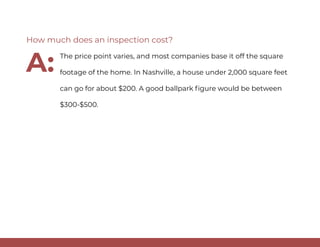
The price point varies, and most companies base it off the square
footage of the home. In Nashville, a house under 2,000 square feet
can go for about $200. A good ballpark figure would be between
$300-$500.
How much does an inspection cost?
A:
5517 Charlotte Pike Nashville, TN 37209
InsuringNashville.com
615.356.4800

Home Inspection FAQs

  • 1.
  • 2.
    Buying a newhome is an exciting experience. Because it’s such a large purchase, a lot of paperwork and inspections are conducted to protect the new investment. Home inspections are a part of the home buying process, and should be considered an educational asset to help buyers learn more about the house they are purchasing. Here are some of the most common questions associated with home inspections in Middle Tennessee.
  • 3.
    What is ahome inspection?Q:
  • 4.
    Simply put, thehome inspection is a visual evaluation of the physical property by a third party. Property buyers hire home inspectors. They have no affiliation with your realtor or mortgage lender. It looks at the foundation, roof, and other structural aspects of the home. Each inspection concludes with a detailed report explaining areas of the house that require immediate repair or could become problematic in the future. What is a home inspection? A:
  • 5.
    Do I haveto have a home inspection? Q:
  • 6.
    You are notrequired by Tennessee state law to have an inspection when purchasing a home. It is, however, a good idea to invest in the service as it will reveal a lot of detail. A house that might seem like a good deal could have severe structural issues moving forward that will cost a lot of money to fix. A full understanding of the condition of the home helps the buyer make an informed decision about the property and allows you to back out of a contract if the results present issues you are not willing to pay for. Because purchasing a home is such a substantial investment, it is advisable to have an inspection conducted. Do I have to have a home inspection? A:
  • 7.
    What does theinspector look for? Q:
  • 8.
    • Heating andcooling • Roof • Electrical System • Windows • Doors • Foundation • Plumbing • Structure • Water damage It should be noted the inspection does not look for termites or mold. Water damage will be brought to the buyer’s attention, but further evaluation of mold needs to be conducted by a trained professional. Most likely the inspection will not cover a pool or other external structures. Each inspection company has a different list of objectives. You’ll want to confirm the list before you hire them. What does the inspector look for? The inspector will look at many aspects of the home but here are a few key areas: A:
  • 9.
    How long doesthe inspection take? Q:
  • 10.
    A home inspectionis a detailed process. The inspector looks at all areas of the house. From piping to crawl spaces, they will take pictures and write down notes of decay, rot, water damage, cracks, and other signs of wear. Reports this exact take time. You should anticipate it lasting between two to four hours. How long does the inspection take? A:
  • 11.
  • 12.
    The inspection shouldtake place as soon as possible. It doesn’t have to happen in any particular order, but it helps to have it complete before the appraisal. The appraisal is a request by the mortgage lender and buyer have no say on who does the appraisal. The result of the appraisal assessment affects your loan and whether or not the bank will approve you for the amount. The home inspection gives you an inside look at how that might play out and whether or not you need to fix the property or request the seller to make adjustments. When does the inspection take place? A:
  • 13.
    Who pays forthe home inspection? Q:
  • 14.
    The purpose ofthe inspection is to protect the buyer. Therefore, the buyer will make the payment. In very rare cases would the seller pay for the examination of the property. Who pays for the home inspection? A:
  • 15.
    Can I conductthe inspection myself? Q:
  • 16.
    The state ofTennessee requires you to be a licensed home inspector to conduct this type of service. These individuals have been trained on the different elements of the home with a thorough understanding of the construction, maintenance, installations, and home safety. You do not want to leave this kind of information to chance. Buyers may find it challenging to remain unbiased. Glossing over critical information that could become hazardous down the line is not how you want to invest in your new property. Home inspectors are impartial third parties whose only job is to obtain the most accurate information. Can I conduct the inspection myself? A:
  • 17.
    Do I needto be there for the inspection? Q:
  • 18.
    Ideally, you willbe present during the inspection. It’s an educational opportunity for you to learn more about the property you are buying. While it’s not required, it is a chance for you to see first hand any issues, damages, cracks, or decay that you might have to repair later. Do I need to be there for the inspection? A:
  • 19.
    What happens ifproblems are identified during the inspection? Q:
  • 20.
    As a buyer,you can use the information as leverage during the sale of the home. The seller is not obligated to fix any of the repairs. If, however, the damages are extensive enough, the buyer could use the information to back out of the contract or negotiate a fairer price. Sometimes, issues in the inspection also affect the appraisal. A damaged roof or other mitigating factors that reduce the overall value of the home could cause your lender not to approve the loan until the repairs are made. Most home inspection companies have a grading scale. The scale will tell you what needs immediate attention and what needs monitoring. As the buyer, you can use this information to negotiate or back out of a contract. What happens if problems are identified during the inspection? A:
  • 21.
    Can a housefail a home inspection? Q:
  • 22.
    A home cannotfail an inspection. There isn’t a passing grade. The report gives you detailed information on the state and quality of the house. The paperwork should have complete details about the issue, when it needs to be fixed, and photos of any problems. Can a house fail a home inspection? A:
  • 23.
    Do I needthe inspection to get a mortgage? Q:
  • 24.
    No. Sometimes theinspection is confused with the appraisal. The home inspection is for the buyer’s benefit only. The mortgage lender requests the appraisal. Often, the buyer doesn’t have much say in who appraises the home, but the appraisal is a requirement. However, the buyer can choose their home inspector. The appraisal and home inspection may have some overlapping inspections such as the foundation, structure, roof and so on. Do I need the inspection to get a mortgage? A:
  • 25.
    How much doesan inspection cost? Q:
  • 26.
    The price pointvaries, and most companies base it off the square footage of the home. In Nashville, a house under 2,000 square feet can go for about $200. A good ballpark figure would be between $300-$500. How much does an inspection cost? A:
  • 27.
    5517 Charlotte PikeNashville, TN 37209 InsuringNashville.com 615.356.4800