OLIGOPOLY
RP Pamplona
OLIGOPOLY
 Etymology
 Oligo meaning small number; few
 Monopoly
OLIGOPOLY
 An oligopoly is a market form in which a
market or industry is dominated by a small
number of sellers (oligopolists). Oligopolies
can result from various forms of collusion
which reduce competition and lead to higher
prices for consumers. ©Wikipedia
OLIGOPOLY
 Number of Sellers
 “Few” – a “handful” of sellers.
 There are so few firms that the actions of one firm
can influence the actions of the other firms.
OLIGOPOLY
 Nature of Product Differentiation
 Homogenous (steel/aluminum)
 Differentiated (automobiles)
OLIGOPOLY
 Ability to Enter and Exit the Industry
 Barriers to entry are high such as government
licenses, economies of scale, access to
expensive and complex technology, and strategic
actions.
 Additional sources of barriers to entry often result
from government regulation favoring existing
firms making it difficult for new firms to enter the
market.
OLIGOPOLY
 Degree of Control on Product Price
 Oligopolies are price setters rather than price
takers.
OLIGOPOLY
 Promotions (Non-price competition)
 Oligopolies tend to compete on terms other than price.
 Loyalty schemes
 Advertisements
 Product Differentiation
OLIGOPOLY
 Cartel (collusion)
 an agreement between competing firms to control
prices or exclude entry of a new competitor in the
market. It is a formal organization of sellers or
buyers that agree to fix selling prices, purchase
prices, or reduce production using a variety of
tactics.
 It usually arises in oligopolistic industry, where the
number of sellers is small and the products being
traded are usually commodities.
 The aim of such collusion is to increase individual
members’ profits by reducing competition.
OLIGOPOLY
 Government is
involved to enforce
the cartel agreement,
and the
government’s
sovereignty shields
such cartel from legal
actions.
 Work to pass on
benefits to the
populace as a whole.
 Private cartels are
subject to legal
liability under the
antitrust laws.
 Purpose is to benefit
only those individuals
who constitute it.
Public cartel Private cartel
OLIGOPOLY
 Price Leadership
 There may be an acknowledged market leader
which informally sets prices to which other
producers respond.
 Interdependence
 Oligopolies are typically composed of large firms
that the actions of one firm affect market
conditions.
 Each firm must be intelligent enough to guess
what will be the possible responses and
countermoves of their competitors.
OLIGOPOLY
 Examples
 Worlwide
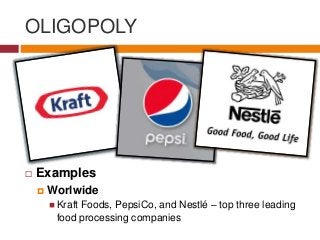
 Kraft Foods, PepsiCo, and Nestlé – top three leading
food processing companies
OLIGOPOLY
 Nestlé, The Hershey Company, and Mars,
Incorporated – make most of the confectionery made
worldwide
OLIGOPOLY
 Microsoft, Sony, and Nintendo – dominate the video game
console market
OLIGOPOLY

Econ oligopoly

  • 1.
  • 2.
    OLIGOPOLY  Etymology  Oligomeaning small number; few  Monopoly
  • 3.
    OLIGOPOLY  An oligopolyis a market form in which a market or industry is dominated by a small number of sellers (oligopolists). Oligopolies can result from various forms of collusion which reduce competition and lead to higher prices for consumers. ©Wikipedia
  • 4.
    OLIGOPOLY  Number ofSellers  “Few” – a “handful” of sellers.  There are so few firms that the actions of one firm can influence the actions of the other firms.
  • 5.
    OLIGOPOLY  Nature ofProduct Differentiation  Homogenous (steel/aluminum)  Differentiated (automobiles)
  • 6.
    OLIGOPOLY  Ability toEnter and Exit the Industry  Barriers to entry are high such as government licenses, economies of scale, access to expensive and complex technology, and strategic actions.  Additional sources of barriers to entry often result from government regulation favoring existing firms making it difficult for new firms to enter the market.
  • 7.
    OLIGOPOLY  Degree ofControl on Product Price  Oligopolies are price setters rather than price takers.
  • 8.
    OLIGOPOLY  Promotions (Non-pricecompetition)  Oligopolies tend to compete on terms other than price.  Loyalty schemes  Advertisements  Product Differentiation
  • 9.
    OLIGOPOLY  Cartel (collusion) an agreement between competing firms to control prices or exclude entry of a new competitor in the market. It is a formal organization of sellers or buyers that agree to fix selling prices, purchase prices, or reduce production using a variety of tactics.  It usually arises in oligopolistic industry, where the number of sellers is small and the products being traded are usually commodities.  The aim of such collusion is to increase individual members’ profits by reducing competition.
  • 10.
    OLIGOPOLY  Government is involvedto enforce the cartel agreement, and the government’s sovereignty shields such cartel from legal actions.  Work to pass on benefits to the populace as a whole.  Private cartels are subject to legal liability under the antitrust laws.  Purpose is to benefit only those individuals who constitute it. Public cartel Private cartel
  • 11.
    OLIGOPOLY  Price Leadership There may be an acknowledged market leader which informally sets prices to which other producers respond.  Interdependence  Oligopolies are typically composed of large firms that the actions of one firm affect market conditions.  Each firm must be intelligent enough to guess what will be the possible responses and countermoves of their competitors.
  • 12.
    OLIGOPOLY  Examples  Worlwide Kraft Foods, PepsiCo, and Nestlé – top three leading food processing companies
  • 13.
    OLIGOPOLY  Nestlé, TheHershey Company, and Mars, Incorporated – make most of the confectionery made worldwide
  • 14.
    OLIGOPOLY  Microsoft, Sony,and Nintendo – dominate the video game console market
  • 15.