IMAGES OF
KURSK
HISTORY'S
GREATEST
TANK BATTLE
JULY 1943
NIK C O R N I S H
BRASSEY'S, INC.
First published in the United States ofAmerica by
Brassey's, Inc.
22841 Quicksilver Drive
Dulles, Virginia 20166
Copyright © 2002 Brown Partworks Limited
ISBN 1-57488-576-6
All rights reserved. No part of this work may be reproduced by any form
or by any means — electronic, electrostatic, magnetic tape,
mechanical, photocopying, recording, or otherwise — without
written permission of the copyright holder.
Brassey's books are available at special discounts for bulk purchases
for sales promotions, fund raising or educational use.
First Edition
10 9 8 7 6 5 4 3 2 1
This book is dedicated to James, Alex and Charlotte
Editorial and design:
Brown Partworks Ltd
8 Chapel Place
Rivington Street
London
EC2A 3DQ
UK
Editors: Peter Darman, Vanessa Unwin, Anne-Lucie Norton
Picture Research: Andrew Webb
Design: Seth Grimbly
Maps: Darren Awuah
Production: Matt Weyland
Printed in Hong Kong
PICTURE CREDITS
CENTRAL MUSEUM OF THEARMED FORCES, Moscow: Jl (top), 12 (both), 14, 16 (both), 17, 18, 19, 20, 25, 26, 50, 51 (both), 53, 54, 55 (both),
62, 64 (both), 65, 66, 67, 68 (both), 69, 72, 73 (top), 74, 76 (top), 78, 81, 84 (top), 85 (bottom), 88, 91 (both), 95 (bottom), 97 (top), 98 (top),
100 (both), 101 (both), 102 (bottom), 103, 104 (both), 105 (both), 110 (both), 112, 113 (bottom), 114 (both), 116 (top), 119 (top), 120 (top),
121, 122, 123, 124 (both), 125 (top), 126, 128, 129, 130 (both), 131 (both), 132, 133 (top), 134 (both), 136 (both), 137, 138 (bottom), 139, 140
(top), 141 (bottom), 142, 146, 147 (both), 148 (both), 149 (both), 150, 152 (top), 153 (both), 154 (both), 157 (both), 158 (bottom), 159
(bottom), 159 (bottom), 176, 177 (both), 178 (top), 180, 183 (both), 184 (both), 185 (bottom), 186 (top), 187, 188 (both), 190, 191 (both), 192,
193 (both), 194, 195, 196 (both), 197 (top), 198, 199 (both), 200, 201 (both), 202, 203, 204, 205 (bottom), 206 (top), 207 (both), 208 (both),
209, 211, 212 (top), 213 (both), 214 (both), 215, 216.
FROM THE FONDS OF THE RGAKFD IN KRASNOGORSK: 7 (top), 13 (both), 21 (bottom), 24, 29 (bottom), 56, 57, 59, 63, 70, 75, 76 (bottom), 79
(both), 84 (bottom), 89, 90 (both), 92, 94 (both), 95 (top), 96, 98 (bottom), 99 (top), 102 (top), 107 (bottom), 111 (top), 113 (top), 115, 116
(bottom), 117 (both), 127 (top), 135 (bottom), 138 (top), 140 (bottom), 141 (top), 144, 145 (both), 152 (bottom), 155, 156, 158 (top), 159 (top),
178 (bottom), 179 (both), 181 (both), 186 (bottom), 189, 197 (bottom), 205 (top), 206 (bottom), 210, 212 (bottom).
NIK CORNISH AT STAVKA MILITARY RESEARCH: 15 (bottom), 120 (bottom), 125 (bottom), 127 (bottom), 143 (top).
Robert Hunt Library: 6, 7 (bottom), 8 (both), 9, 10, 11 (bottom), 15 (top), 21 (top), 22 (both), 23, 27, 28, 29 (top), 30, 31, 32 (both), 33, 34,
35, 36, 37, 39, 40, 41, 42, 43 (both), 44 (both), 45, 46, 46-47, 48, 49 (both), 58 (both), 71 (both), 73 (bottom), 80 (both), 82, 83, 85 (top), 86,
93 (both), 97 (bottom), 99 (bottom), 106, 107 (top), 108 (both), 109 (both), 111 (bottom), 118, 119 (bottom), 133 (bottom), 135 (top), 143
(bottom), 151 (both), 160, 161 (bottom), 162, 16,3, 165, 166, 167, 168, 169, 170, 173, 174, 175, 182, 185 (top).
TRH PICTURES: 161 (top).
Contents
Introduction 6
Chapter 1 Rearming the Wehrmacht 30
Chapter2 Soviet Preparations 50
Chapter 3 The First Day 70
Chapter4 Northern Deadlock 92
Chapter5 Target Oboyan 106
Chapter 6 The Air Battle 118
Chapter7 Slaughter at Ponyri 132
Chapter8 Crisis in the Salient 146
Chapter9 SS Spearhead 160
Chapter 10 Tanks Burning Like Torches 176
Chapter 11 Withdrawal 190
Chapter 12 Aftermath 204
Appendices German Army formations committed
to Citadel 217
Major Red Army formations committed
to Citadel 218
Losses at Kursk 219
German tank aces at Kursk 220
Bibliography 221
Index 222
IMAGES OF KURSK
Introduction
The destruction ofthe Sixth Army at Stalingrad at the beginning of 1943 was a
disasterfor Germany. However, Manstein was able to restore thefront in southern
Russia, which allowed Hitler to plan for a new offensive on the Eastern Front.
We have only to kick in the door and the
whole rotten structure will come
tumbling down."
Hitler's well-known comment, made on the eve
of the invasion of the Soviet Union was, by the
summer of 1943, sounding ominously hollow.
When, in the early hours of 22 June 1941,
Germany and her allies had unleashed Operation
Barbarossa, the codename for the invasion of the
Soviet Union, success looked like a foregone
conclusion as the panzers tore across the vast, open
steppes. By the end of November 1941 Leningrad
and Sebastopol (base of the Soviet Black Sea Fleet)
were under siege, the Ukraine and the Baltic States
were occupied, and Moscow itself was in the
frontline. In theory the vast bulk of the Soviet
Union's Army and Air Force had been destroyed,
captured or so badly disrupted as to be of little or
no fighting value. However, the theory was at odds
with the facts of the situation. Germany's lack of
preparedness for a winter campaign and the Soviet
Union's seemingly limitless supplies of men and
equipment were factors that had been overlooked
in the euphoria of the rapid advances of the
summer. The horrors of campaigning in the depths
of a Russian winter with no antifreeze, protective
clothing or roads worthy of the name came home
The Hammer and Sickle flies over the ruins
of Stalingrad after Axis forces surrender at
the beginning of February 1943. Some
250,000 German troops had been killed or
captured following the city's encirclement by
the Red Army in November 1942.
with a vengeance to the men of the Wehrmacht. As
Colonel-General Heinz Guderian, the panzer genius,
wrote to his wife "this is the revenge of reality." With
their men and machines a shadow of their former
strength, the overstretched units ofArmy Group
Centre faced the power of the Soviet counterattack,
launched on 5 December 1941. During the winter
of 1941 the temperature fell as low as minus 43 °C.
Such was the force of the Soviet counterattack that
Army Group Centre appealed to be on the verge of
collapse, as position after position was overwhelmed
by Red Army men used to the harsh conditions and
equipped with machines and weapons designed for
winter warfare.
Disgusted with the advice of his generals to
withdraw from the outskirts of Moscow, Hitler
demanded that they stand firm and give no ground
without fighting. Replacing senior officers who
dared to question his orders, Hitler took command
of the army on the Eastern Front on 17 December
1941. Army Group Centre's line, although
punctured and severely weakened, held and its
fighting withdrawal did not degenerate into a rout.
Both Army Group North, facing Leningrad, and
Army Group South, completing the line down to
the Black Sea, fell back to more defensible lines.
Although the Russians pressed hard they were
unable to achieve their objective of driving the
Germans back behind the River Dnieper. The onset
of the thaw forced both sides to suspend their
operations and take advantage of the time to rebuild
their forces. The Soviet Union had survived the
Blitzkrieg of 1941 bloodied, but unbroken. It was
therefore essential to the Germans and their allies to
defeat the Soviet Union during 1942 before Russian
munitions factories, particularly those relocated
beyond the Ural Mountains, increased production
and outstripped those of the Axis powers.
Lack of fuel immobilized the majority of
the Sixth Army's motor vehicles, priority
being given to tanks and ambulances. These
armoured cars, an Sd Kfz 222 with its 20mm
gun pointed skywards and an eight-wheeled
Sd Kfz 232 Funk (radio), had been abandoned
for just that reason.
The Russian counteroffensive had saved
Moscow and crippled Hitlers plans for crushing
the Soviet Union with one mighty blow. But
despite its losses in men and materiel, the
Wehrmacht was by no means a spent force. The
objective for the German summer offensive of
The grisly harvest of Stalingrad: a field of
Axis corpses on the outskirts of the city.
Many of the bodies have had their clothing
removed by civilians to tailor for their own
use. In the background a Soviet-produced Gaz
lorry delivers another grim cargo.
7
IMAGES OF KURSK
G.K. Zhukov, who in August 1942 was
named Deputy Commissar of Defence and
First Deputy Commander-in-Chief of Soviet
Armed Forces. He planned and directed the
counteroffensive that encircled the German
Sixth Army at Stalingrad.
S.K. Timoshenko. Created a Marshal of the
Soviet Union and Commissar for Defence in
May 1940, his offensive in southern Russia in
May 1942 to retake Kharkov was a total
disaster. Forbidden by Stalin to withdraw his
forces, he lost over 200,000 men.
1942 was to be limited in scope when compared
with Barbarossa, but highly ambitious in terms of
its territorial and economic aspirations. Instead of
an offensive from the Baltic to the Black Sea, only
Army Group South would be totally committed.
Operation Blau (Blue)
The outline of the German plan for the summer of
1942 was laid down in Hitler's Directive 41 dated
5 April 1942. Essentially Hitler set his forces the
task of clearing the Soviets from the region of the
River Don, the Donbass industrial area, taking the
Caucasian oilfields and occupying the passes
through the Caucasus Mountains, thus accessing
the Trans-Caucasian lands. It was anticipated that
operations south of the Caucasus would bring
neutral Turkey into the war on the side of the Axis.
Operation Blau, the codename for Army Group
Souths general offensive, was to begin after
Sebastopol had fallen and the Soviets' Izyum
bridgehead on the right bank of the River Donets
had been eliminated. Army Group South, in effect,
was to become two commands, Army Group B to
the north and connecting with Army Group
Centre, and Army Group A completing the line to
the Black Sea.
The operation was to be split into several
phases. Phases one and two involved the north
flank ofArmy Group South moving from Kursk to
Voronezh, advancing down the River Don to link
up with the Sixth Army, and encircling all Soviet
forces -within these two arms of a pincer before
taking out the Izyum bridgehead. Phase three
involved the right flank of Army Group South
forcing the defences along the River Donets in the
Voroshilovgrad area and moving up the River Don
to meet up with other elements of Army Group
South. At this point the designations Army Group
A and B would be activated. This second pincer
movement would close on Stalingrad and take the
city or at least neutralize it as an industrial and
communications centre. Stalingrad, standing on
the banks of the River Volga, controlled river
traffic, was an important industrial centre and, as
such, was the major objective of Directive 41. The
advance into the Caucasus was not dependent on
Stalingrad's capture.
The date chosen to begin the first phase was 18
May. However, at dawn on 12 May, Field Marshal
INTRODUCTION
Fedor von Bock, commander of Army Group
South, was informed that his Sixth Army was
under attack in the Kharkov area. It swiftly became
clear that this was not a small-scale operation but
one that involved dozens of infantry divisions and
hundreds of tanks. Kharkov, fourth city in the
Soviet Union, was the objective for the Red Army.
The German counteroffensive was launched on 17
May with an attack on the Soviet left flank.
Marshal S. K. Timoshenko, commanding the
Soviet forces in the area, requested permission to
withdraw and call off the attempt to retake
Kharkov, but his request was refused by Stalin.
Consequently the Red Army lost more than
200,000 men, some 1200 tanks and a little over
2000 guns. In practical terms, Operation Blau was
now under way as the Izyum bridgehead was
overrun by 28 May and a foothold had been
established on the left bank of the River Donets.
The following week the final push against
Sebastopol began, and by 4 July it had fallen.
Following the fall of Sebastopol, the Eleventh Army
was thus released for inclusion in Operation Blau.
From Kursk to the Crimea, the Germans and
their allies could muster some 73 divisions, of
which 9 were armoured, 7 motorized (including 2
A German panzer nears a burning Russian
village during Operation Blau, the German
summer offensive in Russia in 1942. At first
the Blitzkrieg carried all before it. The First
Panzer Army, for example, drove 400km (25O
miles) from its start line on 28 June and
captured Rostov on 23 July.
Waffen-SS) and 26 were allies, mainly Romanian
and Italian. Although alerted by spies in
Switzerland during April and by the recovery of
German plans from a plane crash behind Soviet
lines on 20 June (just eight days before the start
date), Stalin refused to believe the evidence of a
forthcoming Axis offensive. He was convinced that
the main attack would be directed at Moscow and
that any operations in the south would be feints.
On 28 June Army Group B attacked on a
140km (90-mile) front south of Orel with 23
divisions, including 3 armoured and 2 motorized.
Two days later Colonel-General Friedrich Paulus'
Sixth Army extended the offensive by another
80km (50 miles) with 18 divisions, including 2
armoured and 1 motorized. This northern pincer
closed at Voronezh, trapping some 30,000 Soviet
troops before the end of the first week in July.
9
IMAGES OF KURSK
A Field Marshal Wilhelm List, commander of
Army Group A during Operation Blau. He was
dismissed by Hitler for displaying a lack of
energy in pressing the offensive. In fact, the
slow progress was due more to the exhaustion
of the infantry divisions and losses in vehicles
than bad leadership.
On 7 July Timoshenko gave orders to his
South-Western Front to withdraw as the threat
from the Sixth Army was now obvious. Therefore
when the leading units of Army Group A attacked
two days later they met only Soviet rearguards
when crossing the River Don. As Paulus advanced
towards Rossosh, Army Group A began its part of
Operation Blau and by 12 July the whole of the
front was moving forwards in an attempt to
encircle the retreating Soviet forces. On 17 July
Voroshilovgrad fell and Stalin gave permission to
the commander of South Front to fall back. It was
at that point Hitler intervened. XL Army Corps
was relocated from the drive on Stalingrad, leaving
that area of operations to the Sixth Army alone
instead of the two army groups originally allocated.
Paulus was forced to mark time as the Soviets did
everything in their power to organize their newly
created Stalingrad Front.
The drive to Stalingrad
By 15 July units ofArmy Group South were half
way to Stalingrad, having taken Millerovo. Rostov
fell to the Germans on 23 July but without netting
the hoped-for bag of prisoners. The Red Army was
trading space for time and the Wehrmacht marched
on into the seemingly endless steppes of the River
Don lands, and the Sixth Army towards its
appointment with destiny. On 23 July Hitler
issued Directive 45 from his forward headquarters
at Vinnitsa in the western Ukraine. The orders in
Directive 45 launched Army Group A into the
Caucasus and Army Group B into Stalingrad and
along the banks of the Rivers Don and Volga to
the north and south of the city. Thus Hitler was
attempting to achieve both objectives
simultaneously, and by doing so hoped to draw
Japan as well as Turkey into the war with the
USSR. To further complicate his generals'
problems, Hitler removed several key units from
Army Group South, including the SS
Panzergrenadier Divisions Totenkopf and
Leibstandarte, the 9th and llth Panzer Divisions,
and the recently upgraded Panzergrenadier
Division Grossdeutschland. The majority of the
Eleventh Army was distributed across the Eastern
Front but, by way of compensation, a further 10
allied divisions had been drafted in (although most
of them were incapable of more than garrison or
security duties). The rapidity of the German
advance had meant that fuel for the vehicles was
taking so long to reach frontline units that Paulus
was unable to exploit his successful action at
Kalach on 4 August until 21 August.
Paulus' orders of 19 August assigned the south
and centre of Stalingrad to LI Corps and the
northern districts to XIV Corps. However, the first
street fighting demonstrated how well the Soviets
had organized the Stalingrad Front, and resistance
was stronger and more determined than the
Germans had anticipated.
10
As the push into the Caucasus continued, even
more difficult to resolve than the worsening supply
problem was that ofexhausted men and worn-out
vehicles. As a propaganda exercise, on 21 August a
detachment ofGerman mountain troops planted a
swastika flag at the top of Mount Elbrus in the
A Soviet infantrymen were notoriously ill-
disposed to wearing helmets, believing them
to be an indication of cowardice. They
preferred the pilotka (side cap). This group of
men are worming their way towards a German
position through the debris of one of the many
ruined factories in Stalingrad. The men are all
armed with the PPSh submachine gun, an
ideal weapon for close-quarter fighting.
Caucasus range, one of the highest peaks in
Europe. Angered by what he perceived as a lack of
energy, Hitler replaced Field Marshal List as
commander ofArmy Group A and took the
responsibility upon himself. Progress was not made
and the winter was fast approaching. In Stalingrad
the fighting had taken on all the characteristics of a
battle ofattrition. Both sides committed men and
Fires rage in Stalingrad as the Germans
and Soviets battle for control of the city. The
defenders, the Soviet Sixty-Second Army
under Lieutenant-General V.l. Chuikov, had
been driven almost to the Volga by mid-
October 1942, but managed to hold on.
11
IMAGES OF KURSK
The crew of this 37mm antiaircraft gun,
probably men of the 9th Flak Division, fell
victim to the rapid advance of the Soviet
forces which overran Gumrak airfield on the
morning of 22 January. The poor quality of
their winter clothing is obvious.
The ghastly conditions of the Russian Front
during winter are vividly depicted in this
stunning image of an unidentified artillery unit
closing in on Stalingrad during December
1942.The gun is a 76mm ZiS-3 divisional
piece, which was introduced in 1942. The
relaxed manner in which the crew is perched
on obviously freezing metal is testament to
the quality of their winter clothing.
equipment to gain the advantage. Slowly and
bloodily the Sixth Army fought its way towards the
banks of the Volga. On 20 September German
infantry pushed through to the river but were
unable to hold more than a small part of the bank.
The Red Army found that it could neutralize the
air and artillery support enjoyed by the German
ground forces by keeping in close contact with
them and denying the Germans a clear target.
Heavy bombing by General Wolfram von
Richthofen's Air Fleet IV further exacerbated
conditions on the ground by simply creating large
areas of rubble which the infantry had to negotiate
inch by inch. Conventional armoured vehicles were
almost useless as their speed was reduced to a
crawl, at which point they became ideal targets for
Soviet infantry armed with Molotov cocktails,
grenades and antitank rifles. To support the Sixth
Army's efforts five battalions of combat engineers
were airlifted in, and although their expertise was
useful, their casualty rate necessitated them being
amalgamated into one battalion. Soviet
reinforcements were ferried into the city at night.
However, by mid-November, some units of the
Sixty-Second Army, Stalingrad's garrison
commanded by Lieutenant-General V.I. Chuikov,
had been driven back to within 200m (220yd) of
the Volga. It seemed that one final effort would
give Paulus victory.
On 15 November Army Group B had, on its
order of battle, 76 divisions, but of these, 36 were
allied (Romanian and Italian) formations that were
low in infantry and antitank weapons. These allied
troops were placed on the flanks of the Sixth Army
following the orders contained in Directive 41.
Unfortunately these divisions were occupying
positions of great responsibility for which they
were entirely ill-equipped. As the daily slaughter
in Stalingrad continued and the weather
deteriorated, the Soviets began to assemble their
forces for a counterattack which was designed to
trap the Sixth Army.
The Soviet counteroffensive was codenamed
Uranus and was to be commanded by Marshal
G.A. Zhukov. Its aim was simply to encircle all
Axis forces within its grasp by a gigantic pincer
movement. The first pincer was to be launched by
the South-West and Don Fronts to the north of
Stalingrad on 19 November. The second pincer, to
the south of the city, was Colonel-General
Eremenko's Stalingrad Front, which was to attack
on 20 November.
The northern pincer struck the Romanian
Third Army, which rapidly collapsed and thus
allowed a Soviet cavalry corps to pour into the
breach. A similar breakthrough took place on the
following day as the southern pincer attacked. The
next day Eremenko's cavalry cut the
Novorossisk—Stalingrad railwayline. So rapidwere
the movements of the Soviet pincers that they
linked up at the village of Sovietskiy during the
morning of 23 November. Paulus and his men
were encircled. That afternoon Hitler ordered
Paulus to "take up a hedgehog position and await
help from outside." During the evening of 23
This T-34/76 Model 1943, of an unidentified
unit, is one of a group firing on a column of
German vehicles, some of which are just
visible in the distance. The hastily applied
whitewash camouflage is clearly beginning to
wear thin. The open nature of the frozen
steppe was ideal tank country, with almost
limitless visibility.
An Italian L6/40 light tank, one of the 55
available to the Italian Eighth Army on the
Don Front at the time of Operation Saturn.
The light armour and 47mm main gun were
totally inadequate in the face of the massed
T-34/76 tanks that poured across the frozen
River Don.
IMAGES OF KURSK
November Paulus requested permission to break
out, as he reasoned that the "enemy has not yet
succeeded in closing the gap to west and south-
west. But his preparations for attack are
becoming evident."
Convinced by Hermann Göring, commander
of the Luftwaffe, that it was possible to airlift at
least 508 tonnes (500 tons) of the 711 tonnes (700
tons) of supplies required daily by the Sixth Army,
Hitler did not rescind his stand-fast orders, despite
the protests of several of his senior officers.
Following discussions with his staff, Paulus ordered
his men to dig in, and the Stalingrad pocket —
some 45km (37 miles) from the city to its western
extremity and 30km (25 miles) from north to
south — was created. Inside the pocket were some
250,000 Axis troops.
To deal with this crisis Hitler created Army
Group Don, commanded by Field Marshal Erich
von Manstein, specifically to drive through the
Soviet lines and relieve the Sixth Army. On 12
December Manstein's attack went in, but its
spearhead only reached to within 55km (40 miles)
of Stalingrad and, to avoid encirclement, Army
Group Don began to withdraw on Christmas Eve.
The Red Army relied on cavalry to act as
scouts on the vast, open steppes of southern
Russia. These two men are part of the screen
searching for the small groups of Germans
that attempted to break out of the Stalingrad
pocket. Russian horses were renowned for
their stamina and capacity to survive under
the most extreme conditions.
74
INTRODUCTION
Some of the extensive Soviet antiaircraft
batteries that ringed Stalingrad. One of the
reasons Hitler forbade the Sixth Army to
retreat was Göring's promise that his
Luftwaffe aircraft could supply the encircled
troops, but Goring was woefully wrong.
Warmly clad in ushanka (fur cap),
sheepskin coat and fur-lined mittens, this Red
Air Force man is checking the ammunition of
the main armament for the legendary Il-2
Shturmovik ground-attack aircraft, two 23mm
cannon. Strangely, given the snow-covered
terrain, the aircraft does not appear to be
camouflaged for winter operations.
A further Soviet offensive, this time aimed at the
Italian Eighth Army and the remnants of the
Romanian Fifth Army, began on 16 December.
Within 48 hours the Axis front had collapsed and
again the Red Army poured in to exploit the
breach. Moreover what little chance the Luftwaffe
had had of supplying the Sixth Army was reduced
even further by the loss of its forward airfields, and
each transport plane's journey increased to a round
trip of some 480km (300 miles) through
75
IMAGES OF KURSK
•4 The face of defeat. Field Marshal Friedrich
Paulus pictured on the day of his surrender to
the victorious Red Army following the
crushing defeat at Stalingrad. Paulus was
suffering from depression and dysentery at
this time. His promotion from Colonel-General
had been announced on the day he went into
captivity, 31 January 1943. He apologized to
his Russian interrogators that circumstances
made it impossible for him to change his
uniform to reflect his promotion.
increasingly effective Soviet air defences. The fate
of the Sixth Army was sealed. Now it remained to
be seen how long it could occupy the attention of
the Red Army and allow Axis forces in the
Caucasus time to escape as the Soviets prepared to
drive farther to the west. Abandoning Krasnodar,
Field Marshal Ewald von Kleists Army Group A
withdrew into the Taman peninsula, situated
opposite to the Crimea, nursing the hope of
renewing their Caucasian ambitions at a later date.
A mixed bag of German and Romanian
prisoners. The Germans had cut the rations of
the Romanians in order to give their own
troops more supplies. The lack of winter
equipment, other than fur caps, can be seen
clearly from this photograph, as can the
apathetic mood of the men.
Chuikov offered Paulus the opportunity to
surrender but this was not taken, and on 22
January the final Soviet attack began. Inexorably,
and in bitter weather, the Red Army advanced and
the pocket became smaller. In a futile effort to
prevent surrender, as no German field marshal had
ever been taken prisoner, Hitler promoted Paulus
to the rank of field marshal on 31 January, but on
that day he was captured. Two days later the last
German detachments in the city surrendered. To
the west Manstein was desperately creating a
defence line along the banks of the River Mius,
having abandoned Rostov on 14 February.
Now the Soviets began to overreach themselves.
Flushed with success, they launched Operation
Gallop, commanded by General M.M. Popov, on
29 January. Gallop was a large-scale raid
undertaken by several tank corps moving in
different directions, with the objective of exploiting
the empty spaces and confusion behind the Axis
lines and keeping them off balance. Scraping
For many Germans their first sighting of
the River Volga was as a frozen bridge into
captivity. Later in the year POWs were used to
raise vessels that had been sunk by the
Luftwaffe. The likelihood of any of the
prisoners attempting to escape is slight, as
the number of guards reflects.
together what little armour he could, Manstein
succeeded in driving back Popov's main force and
destroying another tank corps which had almost
reached the River Dnieper at Zaporozhye, near
Mansteins headquarters, during the last days of
February 1943.
The Soviets opened a second improvised
offensive, Operation Star, on 2 February, with the
cities of Belgorod, Kursk and Kharkov as its
objectives. Following the surrender of Stalingrad
six Soviet armies were released for use elsewhere.
These troops were to be deployed as part of an
ambitious plan to encircle German forces in and
77
around the city of Orel. When this had been
achieved the next objective was to link up with
other Soviet,forces in a pincer movement and trap
the Germans between Smolensk and Briansk. The
ultimate goal of all these actions was to reach the
River Dnieper by the middle of March and thus
destroy the remains of Army Group Don, the
southernmost part of Army Group South.
Colonel-General K.K. Rokossovsky was to
command the Central Front, which was to be
created from formations that had fought at
Stalingrad. However, the difficulties in moving
men and equipment some 200km (150 miles)
along a single track railway led to Rokossovsky's
participation in the offensive being postponed
until 25 February. The Briansk and Western Fronts
had attacked before Rokossovsky's arrival and ran
into solid resistance. Rokossovsky's men, arriving
and attacking piecemeal, broke through German
and Hungarian units on 25 February allowing XI
Tank Corps to exploit the gap. XI Tank Corps,
operating with cavalry and partisans, penetrated
over 200km (125 miles) into the German rear,
Ambush! A pair of T-34/76s in fading
whitewash camouflage wait in hiding for any
panzers unwary enough to drive incautiously
into this small village during the advance
after the fall of Stalingrad. Attached to the
turret is the standard Russian rifle, the Mosin-
Nagant 7.62mm. The radio aerial indicates
that the vehicle is probably the troop
commander's tank.
reaching the River Desna on 7 March. By this time
Rokossovsky's forces were spread out along the few
serviceable roads, presenting a clear target for the
counteroffensive that the Germans were developing
from the south.
Manstein had concluded that the Red Army
could be held and then driven back by adopting a
mobile defensive strategy. This involved allowing
the Soviets to advance until they had outrun their
supply lines and then confronting them from
prepared defensive positions. Inevitably this
doctrine meant giving up ground, which was
anathema to Hitler. However, Manstein felt
18
INTRODUCTION
confident that Hitler would find his ideas
acceptable. The two met on 6 February and Hitler
grudgingly gave his permission for a withdrawal to
the line of the River Mius. Now Manstein could
go ahead and assemble his forces in the western
Donbass for a counteroffensive. German divisions,
including SS Panzer Corps, which comprised the
three SS Panzergrenadier Divisions, Leibstandarte
AdolfHitler, Das Reich and Totenkopf, had been
moving to the Eastern Front from the west since
early January. SS Panzer Corps had then been used
to cover the retreat ofAxis forces east of the River
Donets before retiring in turn to take up positions
in preparation for Manstein's counterblow.
In such a fluid situation the Germans formed
short-lived battle groups from whatever forces were
available to stem the Soviet advance. For their part
the Red Army commanders viewed the Axis
movements as the prelude to a wholesale
withdrawal from the eastern Ukraine. Nothing
suggested that Manstein was methodically
regrouping his armoured forces. By the middle of
February Kharkov was in imminent danger of
falling to the Russians. Hitler issued yet another
stand-fast older, directing SS Panzer Corps not to
retire from the city. SS-Obergruppenfuhrer Paul
Hausser, SS Panzer Corps' commander, decided
that he must disobey his Führer and withdraw in
order to save his men and their equipment.
Kharkov was taken by the Russians on 15 February
and SS Panzer Corps regrouped at Krasnograd.
With Hitler's agreement, Manstein proceeded
with further regrouping and preparations for the
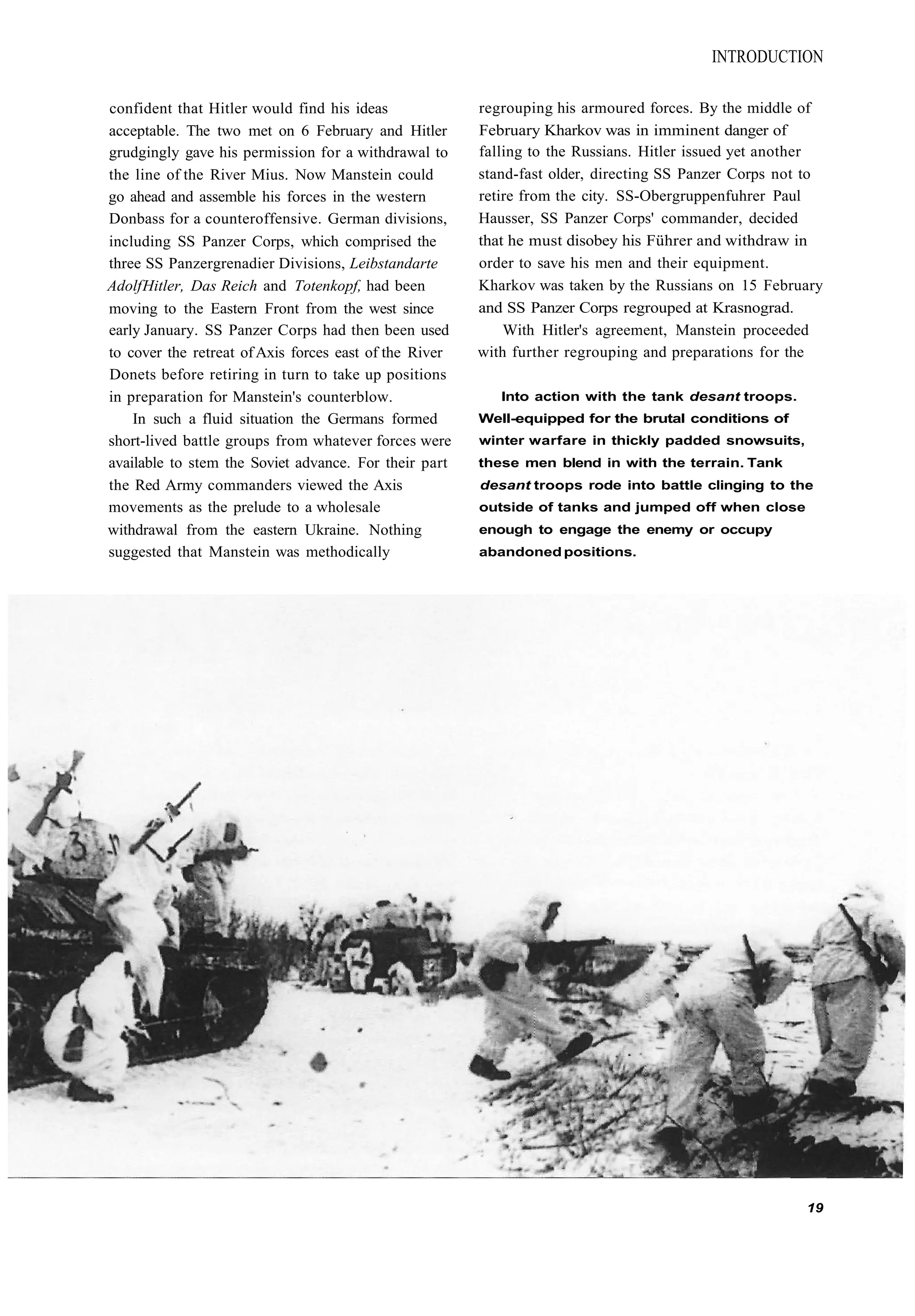
Into action with the tank desant troops.
Well-equipped for the brutal conditions of
winter warfare in thickly padded snowsuits,
these men blend in with the terrain. Tank
desant troops rode into battle clinging to the
outside of tanks and jumped off when close
enough to engage the enemy or occupy
abandoned positions.
19
counteroffensive, which was to consist of three
clearly defined phases:
1. SS Panzer Corps was to regroup near
Krasnograd, XL and LVII Panzer Corps near
Krasnomeyskoye, and XLVIII Panzer Corps near
Zaporozhye, from where they would converge
against the right flank of South-Western Front and
hurl it back over the northern River Donets.
2. They would then regroup south-west of
Kharkov, and strike at Voronezh Front, pushing it
back across the northern Donets before recapturing
Kharkov and Belgorod.
3. The offensive would continue towards
Kursk, and Second Panzer Army, from Army
Group Centre, would collaborate by striking
southwards from the Orel area to meet Manstein's
troops coming up from the south.
The counteroffensive was to be under the
control of the staff of the Fourth Panzer Army. The
forces assembled included seven panzer divisions,
These Soviet cavalrymen, riding past an
abandoned German Model 35/36 37mm
antitank gun, are part of VII Guard Cavalry
Corps. Involved in the rapid, confused pursuit
of the Axis forces towards the River Donets,
VII Guard Cavalry Corps was isolated and
severely mauled by SS Panzer Corps during
February 1943.
the 5th SS Wiking Motorized Infantry Division,
whose personnel were mainly Scandinavian and
western European volunteers, and four army
infantrydivisions.
Manstein launched SS Panzer Corps at
Kharkov on 6 March. The Soviet leadership was
slow to realize the seriousness of their situation.
Initially two of Rokossovsky's armies (Sixty-Second
and Sixty-Fourth) were sent to reinforce the
Voronezh and South-Western Fronts in the
Kharkov region and along the Donets respectively.
20
A view of Kharkov's Red Square. This great
prize was the second city of the Ukraine and
the fourth largest in the Soviet Union, and its
liberation was a major coup for the Red Army.
However, Manstein's brilliant counteroffensive
not only recaptured the city in March, it also
meant that the Germans had regained the
Donets-Mius line.
The liberation of Kharkov on 15 February
1943. The Soviet reoccupation lasted one
month. Here, two T-34/76s drive through the
city's central plaza's Red Square. The Germans
had withdrawn swiftly, hence the relatively
undamaged appearance of the buildings. The
architecture is typical of the Soviet municipal
style of the period.
IMAGES OF KURSK
A StuG III assault gun armed with a long-
barrelled 75mm gun on the outskirts of
Kharkov in March 1943. This vehicle belongs
to General Paul Hausser's SS Panzer Corps
which, by 10 March, was to the east of the
city and ready to batter its way in.
The SS rolls into Kharkov: infantry and a
Panzer III of the Leibstandarte Division move
through the suburbs. The SS men had been
forced to abandon the city in February 1943,
but a month later were back to exact a bloody
revenge on the Red Army.
INTRODUCTION
New orders were issued to Rokossovsky to reduce
the depth of the planned encirclement around
Briansk. The Soviet attack began on 7 March,
coinciding with the German Second Army's attack
on the River Desna. On 17 March the Fourth
Panzer Army and Second Army advanced on
Belgorod, Kharkov having been taken by the SS on
15 March. By the end of March, the Voronezh
Front was back on the eastern bank of the Donets.
Manstein's master stroke
On 14 Match Stalin, concerned by the deteriorating
situation in the south, summoned Deputy Supreme
Commander, Marshal of the Soviet Union G.K.
Zhukov, to Moscow. Zhukov was despatched to the
HQ of Voronezh Front to assess the situation. In his
report to Stalin, Zhukov was blunt.
"We must move everything we can from the
STAVKA [Soviet equivalent of combined chiefs of
staff] Reserve and the reserves of the neighbouring
Fronts at once, because if we do not the Germans
will capture Belgorod and develop their offensive
towards Kursk."
Within hours the Twenty-First and Sixty-
Fourth Armies were moving towards Belgorod, but
they were too late to prevent its capture. Belgorod
fell on 18 March, confirming Zhukov's predictions.
The Twenty-First and Sixty-Fourth Armies
established strong defensive positions to the east of
the city. The speed of the Soviet redeployment had
frustrated one of Manstein's objectives: the move
on Kursk.
However, Manstein had the bit between his
teeth and did not care to surrender the initiative in
the Kharkov-Kursk-Orel region. Although his men
and machines were reaching the end of their
capacities Manstein attempted to persuade Field
Marshal Günther von Kluge, commander of Army
Group Centre, to cooperate in an attack on
Rokossovsky's forces in the newly formed Kursk
salient. Kluge, insisting that his men were in no fit
condition to do more, refused. Indeed Army
Group Centre had been involved in its own
operation, the withdrawal from the Rzhev salient
in front of Moscow, which shortened the line by
some 300km (200 miles). This area had been the
focus of Zhukov's attention for several months and
he had planned an operation, codenamed Mars,
which was designed to emulate the success of
Field Marshal Erich von Manstein, one of
the finest German commanders. His mastery
of mobile warfare saved the southern wing in
early 1943, but Hitler's insistence on not
yielding ground led to his dismissal in 1944.
Operation Uranus (the encirclement of Stalingrad).
Operation Mars began on 25 November 1942.
However, Army Group Centre was in far better
shape than Army Group South and Mars was a
failure that cost the Red Army some 300,000 men
and 1400 tanks. On the Soviet side of the line,
Rokossovsky's opportunity to advance on Orel
passed as troops were diverted south and STAVKA
cancelled all further offensives other than those of
a purely local nature.
With the onset of the April thaw, both sides
settled down to consider their next move. The Axis
forces were back in almost the positions they had
held before Operation Blau, but the Red Army had
proven itself capable of inflicting a large-scale,
unprecedented defeat on the once-invincible
23
IMAGES OF KURSK
Wehrmacht. The ingredients were mixing that
would give rise to what promised to be an
interesting summer in Russia. As the troops of
both sides drew breath, their commanders began to
plan. Both STAVKA and OKH (Oberkommando
des Heeres, the headquarters responsible for the
Eastern Front) were aware that the summer
campaign of 1943 would be decisive. The
Germans had particular need to worry. It was
essential that Germany kept a firm grip of the
initiative on the Eastern Front to retain Nazi
influence over the neutrals of Europe.
The defeat at Stalingrad had lost Germany the
tungsten of Portugal and the chrome of Turkey,
both vital elements in munitions production and
thus a highly significant factor in Hitler's strategic
thinking (which placed the possession of such raw
With its winter whitewash fading fast, a
T-34/76 moves at speed across country during
the spring of 1943. To extend its operating
range theT-34 was often fitted with
supplementary external fuel tanks. The
handles on the turret are grips for tank
desant men. Casualties amongst these troops
were consistently high and the relationship
between them and their tank crews was
particularly close.
materials at the top of his military agenda).
Furthermore Sweden, a major supplier of iron ore
which had until this point pursued a policy of
"benevolent neutrality", now adopted a less
compliant stance. Indeed, such was Hitler's
concern in respect of Swedish raw materials that
24
INTRODUCTION
reinforcements were sent to Norway in case the
situation should require the occupation of Sweden.
Hitler had hoped that Turkey would invade the
Soviet Union through the Caucasus. In the
aftermath of Stalingrad, Germany's recovery
notwithstanding, it became clear that this would
not happen. The support of Germany's partners on
the Eastern Front was also becoming less than
wholehearted. Both Italian confidence in
Germany's ability to win the war and Mussolini's
faith in Hitler had been seriously eroded. Finland,
regarding itself as Germany's ally more by chance
than choice, was in need of peace and now made
no secret of that fact. Romania, having sustained
heavy casualties as a result of the Soviet
breakthroughs around Stalingrad, requested that its
remaining troops in Russia be withdrawn from the
frontline. The Hungarian forces became less
amenable to following German orders and their
role was restricted to security duties in the rear.
With the beginnings of the thaw in April
1943, conditions deteriorated rapidly, the
melting of the frozen ground causing problems
even for the wide-tracked T-34/76s and the
KV-1s of the Red Army. The tracks of the T-34
were 478mm (19in) wide, which gave them a
distinct advantage over their opponents.
IMAGES OF KURSK
Finally, Japan was now highly unlikely to violate
the non-aggression pact with Stalin and move into
the Soviet Far Eastern provinces and Siberia.
Therefore it was with a sense of increasing urgency
that the German High Command began planning
the summer campaign.
As early as 13 March OKH had issued
Operation Order 5. This order, for security
reasons, had only a circulation of five copies. The
earlier sections of Order 5 called for the
construction of strong lines of defence along areas
of the front that would not be involved in
offensive activity and against which: "We must let
them crash, and bloody them."
Part one of this document dealt with the
Kuban bridgehead and the Crimea, that were to
remain passive. Part four covered the defensive
preparations on the Leningrad front. It is parts two
to four that are particularly relevant:
2. Army Group South.
A strong panzer army has to be formed on the
northern flank of the army group immediately and
no later than mid-April so that it will be ready for
The rasputitsa, or muddy season, posed
problems for the Russians as well as the
Germans. The troops of both the Wehrmacht
and the Red Army relied heavily on horse-
drawn transport, and extensive use was made
of the peasant wagon, which was ideally
suited for the local conditions.
commitment at the end of the mud period, before
the Russian offensive. The objective of this
offensive is the destruction of enemy forces in
front of Second Army by attacking out of the
Kharkov area in conjunction with an attack group
from Second Panzer Army.
3. Army Group Centre.
First, the situation between Second and Second
Panzer Armies must be straightened out; then the
defensive fronts are to be strengthened and
equipped with antitank weapons as planned. This
is especially important near Kirov, in the region
north and north-west of Smolensk, as well as
Velikie Luki. Then an attack group is to be formed
to attack in conjunction with the northern flank of
26
Army Group South. The forces are to be obtained
by theBeuffelbewegung(the operation to abandon
the Rzhev salient).
4. Army Group North.
Since there is no plan for a major offensive
operation during the first half of the summer in
the Army Group North area of operations, the
main effort will be applied to the defence ...
An operation against Leningrad is planned for
the second half of the summer (after the beginning
ofJuly).
From this order it is clear that the Kursk salient
was to be the object of a panzer-led pincer
movement. Later in March operations to drive the
Red Army from the industrial areas of the Donets,
south-west of Kharkov, were considered, but these
were later shelved in favour of concentrating on
Operation Citadel, or Fall Zitadelle as it was called
by the Germans.
INTRODUCTION
On 15 April, Operation Order 6 was issued
and this was with a less-restricted circulation of 13
copies (perhaps an ominous omen). The order
begins, "I have decided to conduct Citadel, the
first offensive of the year, as soon as the weather
permits." The purpose of Operation Citadel was
clearly defined in a detailed list of numbered
objectives:
1. The objective of this offensive is to encircle
enemy forces located in the Kursk area by means of
rapid and concentrated attacks of shock armies
German wounded from the fighting in
southern Russia in early 1943. The disaster at
Stalingrad and its aftermath had cost the Axis
war effort in the East five armies, one of
which, the German Sixth, had been
particularly formidable. In addition, the Red
Army had become more effective and its
commanders more able than in 1941.
27
IMAGES OF KURSK
from the Belgorod area and south of Orel and to
annihilate the enemy in concentrated attacks.
During the offensive a new, abbreviated front,
which will save strength, will be established.
2. We must ensure that:
a. The element of surprise is preserved and the
enemy be kept in the dark as to when the attack
will begin.
b. The attack forces are concentrated on a
narrow axis, in order to provide local
overwhelming superiority of all attack means ... to
ensure contact between the two attacking armies
and the closure of the pocket.
c. The attack wedge is followed by forces from
the depths to protect the flanks, so that the attack
wedge itself will only have to be concerned with
advancing.
d. By prompt compression of the pocket, the
enemy will be given no respite and will be
destroyed.
e. The attack is conducted so quickly that the
enemy will be denied the opportunity of either
breaking out of the encirclement or of deploying
strong reserves from other fronts.
f. Additional forces, particularly mobile
formations, are freed up by quickly constructing a
new front.
Adolf Hitler (left) with Benito Mussolini in
happier times for the Axis alliance. Stalingrad
had shaken the Italian dictator's faith in his
pact with Germany. Hitler desperately needed
a victory in the East in 1943 to reassure
Mussolini and other wavering allies.
3. Army Group South will jump offwith
strongly concentrated forces from the
Belgorod—Tomarovka line, break through the
Prilery—Oboyan line, and link up with the
attacking armies of Army Group Centre at east of
Kursk.
4. Army Group Centre will launch a
concentrated attack from the line Trossna north of
Maloarkhangelsk with the main effort on the
eastern flank, break through the line
Fatezh-Veretenovo, and establish contact with the
attacking army from Army Group South near and
east of Kursk ... The line Tim-east of
Shchigry—Sosna sector is to be reached as soon as
possible.
5. The earliest dare for the attack will be 3 May.
12. The final objectives of the operation are:
a. The shifting of the boundary line between
28
INTRODUCTION
Army Groups South and Centre to the general line
Konotop (South)—Kursk (South)—Dolgoe (Centre).
b. The transfer of the Second Army with three
corps and nine infantry divisions, as well as the
attached Army troops, from Army Group Centre
to Army Group South.
c. The assembly of three additional infantry
divisions from Army Group Centre to be made
available to the OKH in the area north-west of
Kursk.
d. The removal of all mobile formations from
the front for use elsewhere.
Thus was the die cast. All that now remained
for Germany was to build up the strength of the
Wehrmacht, and in particular its panzer arm, in
preparation for the titanic struggle that would
soon burst over the Eastern Front like a
summer thunderstorm.
As both armies recuperated after the
fighting of early 1943, fresh men and
machines were brought in. Here, a British-
built Churchill Mark 3 drives past a wrecked
Wehrmacht Sd Kfz 232 sporting the remains
of its winter camouflage scheme. The
Churchill was unpopular with its Soviet crews
as it was weakly armed and slow in
comparison with their own tanks.
Soviet dictator Josef Stalin. Totally
ruthless, he did at least take the advice of his
subordinates at times. Prior to Kursk, for
example. General N.F. Vatutin persuaded him
that the German Army could be ground down
in a series of defensive battles in the salient.
29
IMAGES OF KURSK
Rearming the
Wehrmacht
Despite the losses incurred by the Wehrmacht during Operation Barbarossa in 1941
and the defeat at Stalingrad between 1942 and 1943, the German Army was able to
rearmfor Operation Citadel and field a number ofnew weapon systems.
At the outbreak of war in September 1939
German military theory was dominated by the
concept of Blitzkrieg: Lightning War. Blitzkrieg as
implemented by the German Army involved the
use of speed, firepower and mobility, especially
tanks, mobile artillery and aircraft, to inflict a total
defeat on the enemy. Attacking forces avoided areas
of strong resistance to sustain the momentum of
the assault, which concentrated on the enemy's rear
areas to sever his lines of communication and
supply. Having achieved this, less mobile forces -
infantry — could then surround and destroy
isolated pockets of resistance.
In a series of short, sharp campaigns, first
Poland, then Denmark and Norway, and finally
France and the Low Countries had been overcome.
The operations in Yugoslavia and Greece had been
fought in a similar manner but not on such a
grand scale or over ground that was as suited to
Much was expected of the new Panzer V
Panther that the Germans rushed off the
production line to take part in the Kursk
offensive. Designed as a result of German
experiences with theT-34, the Panther had
well-sloped hull and turret armour.
tank warfare. Naturally men and materiel were lost
during these years but Germany's armaments
industry was able to make good the losses. During
the campaign in France the armoured forces of
Germany had been outnumbered but, by
supplementing their own machines with Czech
38(t) tanks and superior tactics, the Germans had
nevertheless emerged victorious.
When Operation Barbarossa began the
Germans deployed 17 panzer divisions with a total
strength of just over 3000 tanks. The tanks ranged
from the Panzer I, which was little more than a
machine-gun carrier and clearly obsolete, the
Panzer II, lightly armed with a 20mm gun and
again obsolete, through the various marks of
Panzer III and IV that were the vehicles on which
the Germans relied in tank-to-tank actions.
With the element of surprise, total air
superiority, tactical ingenuity and two years of
successful campaigning behind them, it is hardly
surprising that the panzer forces achieved such
spectacular results as they did in 1941. But the
essence of Hitler's earlier conquests had been
speed; rapid drives through countries with clearly
defined borders and highly developed road and rail
systems that could be easily integrated into those
of the Reich and facilitate the smooth flow of
weapons from its factories. By contrast, the Soviet
A German Sturmgeschütz (assault gun) III -
StuG III - on the edge of the Kursk salient in
the spring of 1943. Originally designed as a
armoured self-propelled gun to support
infantry attacks, the StuG III was later used in
the antitank role.
Union that the Wehrmacht and its allies set out to
crush covered one-sixth of the earth's land mass,
was possessed of a much more primitive transport
network, and was considerably farther from the
essential munitions plants. Indeed, the Soviet rail-
track gauge was broader than those elsewhere in
western Europe, and this in itself was to create
delays in a land where roads were little more than
well-defined cart tracks that dissolved into mud
after any rainfall.
As a result of pre-Barbarossa battle experience,
production of both Panzers I and II had been
ended other than for the manufacture of self-
propelled guns and specialist antitank vehicles
which used their chassis. The majority of Panzer
IIIs had had their main armament upgraded from
37mm to 50mm guns. The heavy tank, the Panzer
IV, retained its short-barrelled 75mm gun.
Although adequate for the campaigns before the
invasion of the Soviet Union, these weapons were
found to be at a great disadvantage when faced
31
IMAGES OF KURSK
with the heavily armoured Soviet T-34 and KV-1
tanks which they first encountered in July 1941. In
June 1941 the Red Army fielded over 900 T-34
and 500 KV-1 tanks, many of which were lost due
to inexperienced crews and faulty tactical
deployment. When they were used properly they
created terror amongst the Axis troops, who had no
antitank guns capable ofpenetrating their armour,
particularly the sloping front-plate of the T-34. One
gun that could stop them was the legendary 88mm,
an antiaircraft gun which the Germans discovered to
be a highly effective tank killer. The other was the
long 75mm antitank gun, but this was not
available in large numbers at the time.
By the autumn of 1941 the Germans had
recognized the fact the Panzer III and IV were in
need of further improvement if they were to retain
the edge over the Soviet tank forces that their
training and experience had given them. Both
types were to be produced with thicker armour
and the Panzer IV was to have the long 75mm gun
as its main armament; the turret of the Panzer III
was too small to accommodate this piece.
Useful as these measures were in improving the
quality of the tank arm, they were only stop gaps;
it was vital that these vehicles were produced in
sufficient quantities to match the Red Army in
numbers. Soviet tank production was greater than
that of the Axis, even when disrupted by the
German advances between 1941 and 1942. Tank
factories were evacuated by rail to locations beyond
the Ural Mountains, off-loaded and back in
production within an incredibly short space of
time, though what the cost was in human terms
can never be calculated. The Panzer IVs lost during
1941 had been replaced by April 1942, but there
had been no real increase in numbers overall. The
Colonel-General Heinz Guderian was
created Inspector of Armoured Forces in
February 1943. Working closely with Albert
Speer, he increased the rate of monthly
panzer production. He also initiated many
corrections to panzers in person, travelling
around factories and tank-shooting ranges.
Minister of Armaments, Albert Speer, who
was responsible not only for armaments
production, transportation and placement, but
also for raw materials and industrial
production. He kept the German war machine
going, but only by using slave labour.
32
REARMING THE Wehrmacht
low rate ofproduction was, in part, due to Hitler's
desire not to allow any radical disruption of
German civilian life, in particular the employment
of German women in munitions factories.
However, during the second half of 1942, with the
Wehrmacht crying out for more men and
munitions of all sorts, there was only one way to
overcome the labour shortfall: the employment of
"volunteer" workers recruited from the conquered
territories of Europe. Initially this workforce was
assembled voluntarily, but rapidly it became a
matter of conscription and coercion. The effects of
such workers being taken on by the most sensitive
and essential of Germany's industries can only be
judged by the number of defective weapons that
found their way into the hands of the unsuspecting
combat troops. But the importation of foreign
labour did allow Germany to finally abandon one-
shift working in many armament factories. Even
with the increases in production, only 100 Panzer
IVs were produced in November 1942, a drop in
the ocean beside the 1000 T-34s that rolled off the
line during the same month.
Administrative changes
Another factor that improved Germany's industrial
production was the replacement of Fritz Todt as
Minister ofArmaments by Albert Speer. Speer
demonstrated a flair for organization and was
primarily responsible for the rapid increase in
munitions production that began in 1942 and was
to continue until well into 1944. The other
significant appointment that Hitler made during his
period of post-Stalingrad rationality was that of
General of Panzer Troops Heinz Guderian as
Inspector ofArmoured Forces. Guderian had been
ordered into retirement by Hitler, along with other
senior officers ofArmy Group Centre, for failing to
take Moscow in late 1941. On 17 February 1943
Guderian was summoned to meet Hitler at Vinnitsa
in the Ukraine. Guderian broke his journey at
Rastenburg to discuss the terms of his possible
reinstatement with Hitler's adjutant, Colonel Rudolf
Schmundt, and found them acceptable.
Following a meeting with Hitler, Guderian was
officially appointed to his new post on 28 February
1943. He was horrified at the condition into
which the armoured forces had sunk. Returns for
the 18 panzer divisions on the Eastern Front gave
The mighty Tiger entered production in
August 1942. Heavily armoured and armed
with the formidable KwK 36 88mm gun, it
could engage and knock out any Soviet tank
before the latter could get within firing range.
However, the Tiger was slow and was very
expensive to build.
the number of 495 battleworthy tanks, just over
twice the number of tanks in a fully equipped
panzer division at the start of Barbarossa. Guderian
was granted wide-ranging powers and would work
closely with Speer. It was expected that together
they would bring order and good sense to the
33
apparent chaos that dogged German tank
development and production. However, even these
measures did not prevent the absurd request by
OKH, early in 1943, to end all tank production
except that ofTigers and Panthers. At a meeting
on 9 March Guderian ruled out such suggestions
and it was decreed that production of the Panzer
IV should continue as it was the backbone of the
armoured forces. Panzer III production facilities
had been turned over to the assault guns, the
Sturmgeschütz (StuG) III, on the express order of
Hitler himself in December 1942.
1943 was to see the introduction of new
German tanks that had been under consideration
for some time. The two German tanks most closely
associated with the battle of Kursk are the Tiger
and the Panther. Of these, the Tiger had been
"blooded" in action on the Leningrad Front in late
1942 where it had performed badly in country
unsuited for armoured warfare. The Tiger was the
culmination of several years of development
influenced by battlefield experience gained in
Russia. Two designs had been commissioned, one
from Porsche (of Beetle and sports car fame) and
one from the Henschel company. On Hitler's
birthday, 20 April 1942, both prototypes were
demonstrated and the Henschel design was chosen.
An order was placed and production was to begin
The debut of the Panther at Kursk was
inauspicious. Because of technical problems
associated with the gearbox, transmission '
and suspension, plus a number of engine
fires, many broke down before and during the
battle. From the original 250 Panthers, only
43 were still in service by 1O August 1943.
in August. The vehicle was designated Panzer
Kampfwagen VI Tiger Ausf H (Sd Kfz 181).
The Tiger
Experience had taught the Germans that the
weapon which was most effective against all Soviet
armour was the 88mm KwK 36, a derivative of the
legendary Flak 88. This gun was chosen to be the
Tiger's main armament. Thus armed, a Tiger could
stand off and destroy Soviet tanks at ranges over
1500m (1200yd), which put them out of danger
from the Soviet tank guns. Co-axially mounted with
the 88 was a 7.92mm MG 34, with a similar
machine gun in a ball mounting on the front
vertical plate for use by the radio operator/machine
gunner. Armour plate was up to 100mm (4in) thick
with the belly armoured to 26mm (1 in) to reduce
damage by mines and exploding dogs. The tracks
were wide to distribute the vehicle's 57 tonnes (56
tons) evenly over soft ground and snow. The
34
REARMING THE Wehrmacht
maximum road speed was 36km/h (23mph); off-
road this was reduced to 19km/h (12.5mph). The
five-man crew consisted of the commander, gunner,
loader, radio operator/machine gunner and driver.
However, the Tiger was expensive in labour
terms, requiring more than 300,000 man hours to
make; also, if disabled, it was difficult to recover. A
version of the Tiger was produced specifically to
recover disabled Tigers and other heavy vehicles.
The Tiger was designated a "breakthrough tank"
(Durbruchswagen) and in this role it was to prove
its worth. In the hands of a tank ace such as
Michael Wittmann it would demonstrate time and
time again its combat power.
The Panther was almost a direct result of the
Wehrmacht's early encounters with the T-34;
consequently its design was a radical departure
from those of the Panzer III and IV. With a
sloping front-plate 80mm (3in) thick, its long
overhanging gun and road speed of 54km/h
(34mph), the Panther was clearly a product of the
T-34 theory of combining armament, armour and
mobility. Again two competing designs were
produced, one by MAN and one by Daimler-Benz.
It was the MAN design that was adopted and, in
November 1942, Panther production began with
the official designation of Panzer Kampfwagen V
Panther Ausf D (Sd KFz 171). Such was the mood
of desperation to get the Panther into frontline
service that the initial production programme
called for an output of 250 per month from the
outset. This sense of urgency was rewarded with a
rapid display of teething troubles, due in part to
the increased weight which was greater than the
original specification laid down. This led to
excessive wear of gears and a more powerful engine
that stretched the transmission to its limits. These
Soldiers of the Grossdeutschland
Panzergrenadier Division prior to their
participation in the Battle of Kursk. One of the
elite units in the German Army, the division
was liberally equipped with tanks, assault guns
and armoured personnel carriers.
IMAGES OF KURSK
problems and defects in the suspension were the
major weaknesses of the early production Panthers,
but these were the vehicles that were used at Kursk.
At the March meeting, Guderian had
emphasized that under no circumstances could the
Panther be expected to enter service earlier than
July 1943. This statement was confirmed by trials
held in Germany, where mechanical breakdowns
and engine fires occurred with monotonous and
disturbing regularity. However disconcerting the
field tests had proved to be, and despite the
warnings of the experts as voiced by Guderian,
Panthers could be produced twice as quickly as
Tigers and had a gun that was capable of knocking
out Soviet armour almost as easily as the Tiger's 88.
The main armament was the 75mm 42L/70, an
improved version of the gun fitted to the Panzer IV
model G. In addition there were two MG 34s, one
co-axially mounted in the gun mantlet and one on
the front-plate. The crew numbered five but, due to
its poor test performance and reputation for
spontaneous combustion, the tank was regarded by
the armoured troops with little optimism.
The chassis of the Porsche contender in the
Tiger competition was adopted in a modified form
as the basis for a self-propelled carriage for the 88
L/71. The final official designation was 88mm
43/2 L/71 Ausf PanzerJäger Tiger (P) Elefant
Früher Ferdinand. This 69-tonne (68-ton) unit was
not a subtle weapon: lacking a turret, the gun was
mounted in a high, box-like superstructure. The
gun, a longer-barrelled version of the 88, was the
only armament. The lack of a machine gun proved
to be a severe weakness at Kursk, leaving the slow-
moving Elefant prey to Soviet tank-hunting
infantry squads. Some 76 Elefants were used during
Citadel by the Ninth Army in the 653rd and
654th Heavy Tank Destroyer Detachments.
Panzer IVs equipped with armoured side
skirts.These tanks are Ausf H models, which
differed from the Ausf G variant in having the
SSG77 transmission and a host of minor
modifications including all-steel rollers and
external air filters. A total of 3774 H models
were built starting in April 1943.
36
To extend the combat life of the Panzer IIIs
and IVs, armoured side skirts (schürzen) were
issued to protect the running gear, tracks and
turret against light antitank weapons. A total of
841 Panzer IV Model Gs constituted the mainstay
of the panzer arm at Kursk. This upgunned version
was capable of dealing with the T-34 at battlefield
ranges. Some 432 Panzer IIIs were also available
for Citadel, rearmed with the long 50mm gun
which, again at close quarters, could penetrate the
heavy front-plate of the T-34. These tanks
provided a useful supplement to the heavier types.
Some 60 Panzer IIIs were converted to
flamethrower tanks, and these vehicles were used
German troops hitch a lift aboard a Panzer
III. The Panzer III was outclassed by the T-34
on the Eastern Front from the end of 1941,
but because of armour shortages it remained
in service. At Kursk, for example, panzer units
were equipped with 155 Ausf IM models.
with particularly deadly effect, as the hot weather
had thoroughly dried the vegetation.
In addition to the various tanks, both old and
new, considerable reliance was placed on the
assault guns (Sturmgeschütz). Guderian had no
influence on the design and production of these as
they remained under the control of the artillery
37
IMAGES OF KURSK
chain of command, which jealously guarded its
power. Originally the majority of assault guns
were based on the proven Panzer III chassis. The
basic concept behind the assault gun was to
provide close, mobile artillery support for the
infantry. The original armament was the short-
barrelled 75mm gun housed in a turretless
structure with limited traverse. By 1943 assault
guns had proved to be highly effective tank
destroyers, particularly the up-gunned version
which was armed with the long 75mm 40L/48
gun. The addition of 5mm (0.19in) thick armour
plates to protect the tracks and wheels gave these
vehicles a rather boxlike appearance.
Finally, Citadel saw the first widespread use of
tank destroyers and self-propelled guns based on
different panzer chassis. These vehicles included
the "Grizzly Bear" (Brummbär), which was a
Panzer IV chassis with a heavily armoured
superstructure that protected a short-barrelled
150mm howitzer. Produced to destroy
fortifications, this self-propelled gun served with
Panzer Battalion 216 as a part of the Ninth Army.
Another adaptation of the Panzer IV chassis was
the "Rhinoceros" (Nashorn), a tank
hunter/destroyer with a similar boxy appearance to
the Grizzly Bear. The Rhino's main armament was
the 88mm gun, a more than adequate weapon
when faced with T-34s. The Rhino was earlier
known as the "Hornet" (Hornisse). The Panzer IV
chassis was also used for the "Bumble Bee"
(Hummel), a self-propelled gun that carried a long-
barrelled 150mm howitzer in an open-topped
armoured body. The Bumble Bee was employed as
mobile artillery support for the 20th and other
panzerdivisions.
The obsolete Czech-made Panzer 38(t) chassis
was given a new lease of life as the basis for the
"Wasp" (Wespe) self-propelled 105mm light
howitzer, another piece of artillery support for the
tanks. Neither was the chassis of the Panzer II
ignored. A long 75mm antitank gun was mounted
in a simple body and another effective tank
hunter/destroyer was available to the Wehrmacht. It
was known as the "Marten" (Marder II).
Greater production, repair and refurbishment
increased most panzer divisions' strength to
approximately 100—130 tanks each by June 1943.
But there had been a change in the priorities of
allocation. The campaign in Russia had
demonstrated the courage, skill and fighting
efficiency of the Waffen-SS, Nazi Germany's
"Imperial Guard". The rewards for the Waffen-SS
came during 1942 when Hitler ordered that they
receive the latest equipment, from tanks and assault
guns to armoured troop carriers. In the teeth of
Wehrmacht opposition, the three original Waffen-SS
divisions, Leibstandarte AdolfHitler, Das Reich and
Totenkopf, although officially designated
panzergrenadier divisions, were increasingly
equipped and used as panzer formations.
Luftwaffe support
A little over two-thirds of the aircraft available on
the Eastern Front, some 1800 machines, were
scheduled for use in the Citadel operation. In
order to allow the increasingly vulnerable Stuka to
carry out its classic dive-bomber role unimpeded
by the Red Air Force, large numbers of
Messerschmitt Bf 109 G-6s and Focke-Wulf Fw
190 A-5s were assigned to provide fighter cover. In
terms of expertise and the quality of its machines,
the Luftwaffe still maintained an edge, even though
the Soviets had achieved numerical and qualitative
parity at least. Operation Citadel was supported by
two Luftflotte (air fleets), one operating in support
of the northern pincer, one in support of the
southern pincer.
The Luftwaffe was to deploy — for the first time
in large numbers — the Henschel Hs 129 B-2R2
antitank aircraft. This machine was the first
purpose-built German "tank buster". The Hs 129
carried an impressive array ofweapons, including
two 7.92mm machine guns and two 20mm cannon
in the nose, but the main armament was a 30mm
cannon mounted in a gondola under the cockpit.
German ground-attack units (Schlachtsgeschwader)
also used the Focke-Wulf Fw 190 carrying anti-
personnel fragmentation bombs, in addition to their
wing-mounted 20mm cannons and machine guns.
A StuG III coated with Zimmerit anti-
magnetic paste and protected by armoured
side skirts. Zimmerit was first used in mid-
1943 to defeat the Soviet tactic of sticking
magnetic mines to the vertical surfaces of
panzers. It worked by putting a barrier
between the mine and the tank's surface.
38
IMAGES OF KURSK
The bomber force utilized the tried and trusted
Heinkel He III and Junkers Ju 88, as well as small
numbers of the long-range Heinkel He 177. Some
bombing of Soviet positions was carried out prior
to the opening of Citadel, as were several raids on
tank production facilities beyond the Ural
Mountains. However, the pre-offensive Luftwaffe
effort was not impressive. In part this was due to a
shortage of aviation fuel that was being conserved
for the major ground-support operations.
As well as carrying out their dive-bombing role,
many Stukas had been armed with two underwing,
pod-mounted 37mm cannons which, when used
against the more vulnerable areas of Soviet armour
such as the engine compartment, could destroy
their target with relative ease. But whatever the
achievements of the tank and aircraft units might
be, the Wehrmacht still had to contend with the
formidable Soviet infantry, and it was to be the
Landser, the German infantryman, who would
pick up this challenge.
Waffen-SS troops on board Panzer Ills. By
July 1943 II SS Panzer Corps had been built
into a powerful formation. The three divisions
of the corps - Leibstandarte, Totenkopf and
Das Reich - fielded a total of 390 tanks and
104 assault guns.
German infantry divisions had been
restructured during the course of 1942. The new
organization led to a reduction in strength that was
not compensated for by increased firepower. The
infantry divisions were cut from nine to six rifle
battalions and the artillery component by a
quarter. The effective strength was thus between
6000-8000 men. From the early days of
Barbarossa, it had become common practice for
many Axis units on the Eastern Front to enlist
former members of the Red Army in non-
combatant roles such as cooks and labourers.
Collectively known as Hiwis (helpers) these men,
technically deserters, were under no illusions as to
40
REARMING THE Wehrmacht
their fate and that of their families should they be
recaptured or the Soviet Union prove victorious.
Therefore it was in their interest that Germany
prevail. Aside from the Cossacks and other
nationalist combat formations, there are numerous
instances of Hiwis being armed and fighting
alongside the Germans. However, it is unclear if
Hiwis fought during Operation Citadel.
Provision of antitank guns was poor. Although
many infantry divisions had been issued with a
small number of the effective 75mm guns, the main
weapon was still the 37mm model, which was of
little or no use against the T-34. Operation Citadel
was notable for the introduction of the Panzerfaust,
a highly potent antitank weapon. Between 1943 and
1945, thousands of these weapons were produced
and used with great effect, proving deadly in the
hands of an experienced operator.
Manpower, following the loss of over 200,000
troops as a result of the Stalingrad debacle, was at a
premium. On 13 January 1943, Hitler had issued
an order, "On general mobilization of men and
women for the defence of the Reich", which
extended total mobilization to all men between 16
and 45 and all women between 17 and 45. The
number of reserved occupations was reduced and
men within the age-range were drafted into the
armed forces, being replaced by older folk or labour
from other sources. By 30 May 1943 these efforts
had increased the strength of Germany's armed
forces to 9.5 million, their highest of the war.
Theoretically a 1943 panzer division had
130—180 tanks, organized into a two- or three-
battalion tank regiment, a panzergrenadier brigade,
an artillery regiment and divisional support units.
However, practice did not match theory, certainly
in the case of the Wehrmacht panzer divisions,
which were lucky if they counted 100 tanks on
their establishment. The condition of the Waffen-
SS formations was rather better. The three units
that formed II SS Panzer Corps were very well
provided for, as was the elite Grossdeutschland
Panzergrenadier Division of the Wehrmacht.
The unit returns for 5 July 1943 noted the
Waffen-SS divisions averaged 130 tanks and 35
assault guns each, with Grossdeutschlandweighing
in with 160 tanks and 35 assault guns. Each of
these divisions was provided with a "heavy" tank
The Hummel self-propelled howitzer first
entered service in March 1943. Some 100
were in service by the time of Citadel, in the
heavy self-propelled howitzer batteries in the
panzer divisions. Each Hummel carried only
18 rounds of ammunition, and so special
Hummel ammunition carriers were built.
41
IMAGES OF KURSK
company of 14 Tigers; the remaining Tigers were
issued to specialist Heavy Tank Battalions allocated
at army or corps level and used where and when
the necessity arose. Grossdeutschland's 1st Tank
Battalion was equipped with Panthers, as were two
other army battalions that combined to form the
10th Panzer Brigade. The Waffen-SS divisions
operated small numbers of Panthers.
Some 533 assault guns were made available for
Citadel. Many were integrated into the panzer
divisions, but the majority went into separate
assault gun brigades of, on average, 30 vehicles.
However, as OKH was very well aware, it was not
simply a matter of quality or quantity of tanks and
aircraft but the methods which they employed that
would determine the battle's outcome.
The Marder III self-propelled antitank gun
comprised the 75mm Pak 40/3 gun mounted
on a Panzer 38(t) chassis. From May 1943
onwards they were deployed to the antitank
detachments of both infantry and panzer
divisions. Production of the Marder III began
in February 1943 and ended in May 1944.
With the introduction of new models such as
the Tiger and the Panther, it looked - certainly at
least when outlined on paper — that once again
German tactics would prevail, even in the face of a
more numerous enemy. Consequently, the basic
application of Blitzkrieg methods would, with
slight modifications, again be used during
Operation Citadel.
42
The tactics that had proved so successful
throughout four years of war had depended on
bombing, artillery bombardment and a powerful
attack by tanks against a specific point of the
enemy's line. Once a breach was made the tanks
and motorized infantry would drive on, regardless
of danger to their flanks, to keep the foe off-
balance and preceded by Stukas acting as flying
artillery support until the objective was reached.
The changes made for Operation Citadel were
mainly to do with using the Tigers in their role of
breakthrough tanks at the point ofan armoured
wedge (Panzerkeil), but care was to be taken that
the wedge did not disregard its flanks or advance
The Wespe was a light self-propelled gun
armed with a 105mm field howitzer. Its task
was to provide mobile formations with
indirect artillery support. Wespes operated
behind the front and avoided engagements,
though they carried armour-piercing shells in
case of an encounter with enemy tanks.
The Sturmpanzer IV (Brummbär) assault
infantry gun was armed with a 150mm gun. It
was very effective against dug-in infantry
positions, buildings and strongholds. The first
Brummbärs were issued to Sturmpanzer
Abteilung (Battalion) 216 just before Kursk.
A Heinkel He 111 medium bomber
photographed in the skies over Orel in 1943.
This twin-engined aircraft was used
extensively at Kursk, but by mid-1943 was
obsolete. It was very vulnerable to enemy
fighters when lacking an escort.
The Focke-Wulf Fw 190 A-5 was an
excellent fighter. It had superb
manoeuvrability, good speed, and its range
and endurance were markedly superior to the
Bf 109. In addition, visibility with the full-
view canopy was also exceptional for the pilot.
REARMING THE Wehrmacht
too far beyond infantry and artillery support. The
flanks of the wedge would be Panzer IVs supported
by Panzer IIIs. Panzergrenadiers, mounted in
armoured personnel carriers, would be in close
support with mortars and light artillery. The wedge
was intended to bludgeon its way through the
Soviet defensive zones supported by selective air
strikes and artillery barrages. Orders were issued to
tank commanders that immobilized vehicles were
to be left behind; these would then act as fire
support for the mobile elements and await recovery
after the offensive had rolled forward. The need to
maintain the impetus was essential to the success
of the operation. Interestingly, the tactics adopted
by Colonel-General Walter Model, commander of
the Ninth Army, and Manstein differed from one
another. To the north of the salient Model wished
to conserve his tanks to exploit, not create, a
breakthrough. This is unsurprising as his
reputation was founded on his skill as a defensive
The Junkers Ju 87 G-2. Nicknamed the
"tank cracker" (Panzerknacker) or "cannon
bird" (Kanaonenvogel), it was armed with a
pair of underwing Flak 18 37mm guns, with
12 rounds of ammunition per gun. The 37mm
guns proved capable of destroying all but the
heaviest Soviet tanks with their tungsten-
cored rounds.
general. Manstein, at the south of the salient, was
determined to use the juggernaut of the wedge
from the outset. In the environment of Operation
Citadel, Model was more keenly aware of the
formidable strength of the Red Army's defensive
system. Furthermore, STAVKA had devoted
marginally more to the defences of its northern
flank as it had anticipated that it would have to
bear the brunt of the German onslaught there.
The process of assembling the large number of
tanks required for Operation Citadel led to its
45
IMAGES OF KURSK
The Heinkel He 177 Greif was a long-range
bomber that had a poor combat record. The
aircraft was overweight, had structural
weaknesses and frequently suffered from
engine fires. Around 20 were used during the
Stalingrad relief operation.
opening being postponed several times. Five armies
were allocated to Citadel under the authority of
Army Group Centre (Kluge) and Army Group
South (Manstein).
Army Group Centre
The offensive on the northern shoulder of the
salient was to be carried out by the Ninth Army,
under the command of Colonel-General Model.
Model's forces numbered some 335,000 men,
and these men formed 21 German and 3
Hungarian divisions. The Hungarian divisions
were used for anti-partisan and security duties and
therefore were not regarded as part of the offensive
force. Of the 21 German divisions, six — the 2nd,
4th, 9th, 12th, 18th and 20th - were panzer
formations, the 10th Panzergrenadier Division and
14 infantry divisions completing the line-up. The
divisions were allocated to army corps for the
purpose of higher command.
46
REARMING THE Wehrmacht
XLVII Corps
2nd, 9th and 20th Panzer Divisions, 6th Infantry
Division, and 21st Panzer Brigade. The armoured
divisions of this corps were equipped with Panzer
IIIs and IVs and StuG IIIs, but the 21st Brigade
had 3 Tiger companies in the 505th Panzer
Detachment with 45 Tigers and 15 Panzer IIIs,
and the 909th Assault Gun Detachment, which
was equipped with a total of 36 vehicles.
XLVI Corps
This comprised the 4th and 12th Panzer Divisions,
as well as the 10th Panzergrenadier Division with a
total of 184 tanks. At the outset of Citadel, this
corps was held in reserve.
XLI Corps
This comprised the 18th Panzer Division, as well
as the 86th and 292nd Infantry Divisions. It also
comprised the 653rd and 654th Heavy Tank
Destroyer detachments, recently formed and
equipped with the entire production run, to date,
of Porsche Ferdinands and a small number of
Panzer IVs. Additional firepower was provided by
the StuG IIIs of the 177th and 244th Assault Gun
Brigades, and the 66 Grizzly Bears of 216th Panzer
Battalion.
XX Corps
To the west; it consisted of four infantry divisions.
XXIII Corps
To the east; it consisted of three and one-third
infantrydivisions.
The Junkers Ju 88 was one of the most
versatile aircraft of World War II. It began as a
dive-bomber and reconnaissance aircraft, and
was later used as a torpedo-bomber, night
fighter, day fighter and antitank aircraft. A
total of 10,774 were built, including 104
prototypes and experimental versions.
47
IMAGES OF KURSK
In total the Ninth Army fielded 590 tanks and 424
assault guns.
The forces that connected Army Group South
and Army Group Centre consisted of eight
infantry divisions, three antitank detachments, four
security divisions and the 8th SS Cavalry Division
Florian Geyer. All these units were short of heavy
weapons, armoured fighting vehicles and antitank
weapons. However, these formations, collectively
known as Second Army, were to remain on the
defensive throughout Citadel under the command
of Colonel-General Walter Weiss.
Army Group South
On the southern shoulder was an altogether more
powerful German force. Fourth Panzer Army,
commanded by Colonel-General Hermann Hoth,
and Army Detachment Kempf, commanded by
General Walter Kempf, constituted the main
striking power. The strength of Mansteins
command was nearly 350,000 men, 1269 tanks
and 245 assault guns, and these huge numbers
excluded the reserves.
LII Corps, on the left, consisted of three
infantry divisions, which would assume a mainly
defensiveposture.
A battery of Hummels in a rear assembly
area prior to Operation Citadel. As can be
seen, crews of these tanks travelled in open-
topped, high-silhouette compartments with all
their weather-related disadvantages.
XLVIII Panzer Corps, in the centre, comprised
the 3rd and llth Panzer Divisions, the 167th
Infantry Division, and the Grossdeutschland
Panzergrenadier Division, which included the 200
Panthers of the 10th Panzer Brigade; in all some
535 tanks and 66 assault guns.
II SS Panzer Corps, to the south, was made up
ofthe three SS Panzergrenadier Divisions —
Leibstandarte, Das Reich and Totenkopf— with 390
tanks and 104 assault guns, including 42 of Army
Group South's 102 Tigers.
Army Detachment Kempf was tasked with
guarding the right flank of the Fourth Panzer
Army, and consisted of three army corps.
Ill Panzer Corps
This was made up of the 6th, 7th, and 19th Panzer
Divisions with 299 tanks; 228th Assault Gun
Detachment with 25 StuG IIIs; and the 168th
48
Infantry Division. The cutting edge of III Panzer
Corps was the 503rd Panzer Detachment which
numbered 45 Tigers.
XI Corps (Corps Rauss)
This corps consisted of the 106th and 320th
Infantry Divisions and the 905th and 393rd assault
gun detachments with 25 StuG IIIs each.
XLII Corps
The 39th, 161st and 282nd Infantry Divisions
plus the Hornet-equipped 560th Heavy Panzer
Destroyer Detachment with 40 tank destroyers,
and Heavy Tank Destroyer Detachment C with
approximately 40 assault guns.
In support of this mighty array was XXIV Panzer
Corps, a force which included the 17th Panzer
Division and the 5th SS Motorized Division Wiking,
equipped with 112 tanks. Yet even with this
formidable assembly of men and machines at his
disposal, Hitler still had sufficient qualms about the
success of Operation Citadel to declare, prior to the
battle, that the very thought ofwhat was to come
"turned my stomach". Well it might, since the period
before the opening shots were fired had not been
wasted by the commanders of the Red Army.
By the end of June 1943 Wehrmacht forces
around the Kursk salient were in a high state
of readiness. Morale and equipment levels
were strong among the infantry and panzer
divisions, as were expectations of victory. But
the troops did not realize the depth of the
Soviet defences they were facing.
A German machine-gun team scans enemy
frontline positions. The weapon is a tripod-
mounted MG 34, the standard German infantry
squad machine gun of World War II. It fired
between 800 and 900 rounds per minute.
49
IMAGES OF KURSK
Soviet Preparations
Hundreds ofthousands ofcivilian workers were drafted to work on the Soviet
defences in the Kursk salient, where they constructed trenches, antitank ditches and
other field fortifications to turn the area into a vast killing ground.
The victory at Stalingrad shattered the myth of
the Wehrmachts invincibility and imbued the
Red Army with a new-found sense of faith in its
own capabilities: defeat no longer seemed
inevitable. The morale of both the armed forces
and the Russian people had been given a huge
fillip. Slowly at first, but with gathering
momentum, the Soviet propaganda machinery
churned out less Communist Party exhortations
and more appeals to Russian patriotism, love of the
Rodina (motherland) and family. To further
reinforce the sense ofpatriotism and fighting for
Russia, the Red Army re-introduced traditional
Russian items of uniform and insignia, discredited
since the years of revolution and civil war, namely
the peasant style shirt - the gymnastiorka — and the
pogoni, or shoulder straps. The shoulder straps had
been banned as symbols of counter-revolution and
Tsarist oppression during 1918, and their
rehabilitation was not greeted favourably by all.
However, these changes were accepted, albeit with
reservations in some quarters.
Although chastened by the success of the
Wehrmacht in recapturing Kharkov and stabilizing
the front of Army Group South, Stalin and some
A mainly female working party labours
to repair a railway line near the station
at Ashkoljava. During the rasputitsa, the
muddy season that followed the thaw, the
railways proved the most effective method of
transportation.
of his more optimistic senior officers, such as Army
General N.F. Vatutin (commander of the Voronezh
Front), wanted to resume the offensive to pre-empt
any further German activity. However, the more
restrained arguments of Marshal of the Soviet
Union G.K. Zhukov, Deputy Supreme
Commander and second only to Stalin himself, as
well as others, won the day. The Red Army halted
and began to consolidate its positions and assess
the situation.
One look at the map would draw the observer's
eye to the most prominent feature on the Eastern
Front, the vast salient that bit into the Axis line
south of Orel and north of Kharkov, both
occupied by the Germans, with its centre the
Russian-held city of Kursk. All three cities were
important railway junctions, and railways were the
mainstay of the transport infrastructure in the
Soviet Union; without them it would be
impossible to wage a victorious campaign,
whatever the season. With the ending of serious
operations by the Red Army in late March, the
Soviet formations that held the perimeter of the
Kursk salient were, from north to south, as follows:
above Orel lay the Western Front (Colonel-General
V.D. Sokolovsky), facing Orel the Briansk Front
(Colonel -General M.M. Popov). The northern
SOVIET PREPARATIONS
Armed with grenade and rifle, a Mosin-
Nagant Model 1930 7.62mm piece, this
formidable fighter is typical of the thousands
of partisans operating behind the German
lines in central Russia. Great numbers of Axis
troops were tied down in an attempt to
contain the activities of the highly organized
partisan formations during the build-up to
Operation Citadel.
flank of the salient was held by the Central Front
(Colonel-General K.K. Rokossovsky) and the
southern flank by the Voronezh Front (Army
General N.F. Vatutin). The head of the salient was
defended by formations of both Central and
Voronezh Fronts. To the south of the salient was
South-Western Front (Colonel-General R.I.
Malinovsky).
Intelligence reports poured in to Moscow, and
these indicated very clearly that the Germans were
planning to launch a powerful offensive aimed at
the Kursk salient. The source of these reports was
either the Red Army, the Red Air Force or partisan
groups operating behind the Axis lines. Further
evidence was provided for Stalin by the Soviet spy,
the so-called "Lucy" operating from neutral
Switzerland, who had access to the discussions of
The Red Air Force in the Kursk area was
built up massively in an effort to deprive the
Wehrmacht of the air cover essential to its
operations. Here, Lavochkin La 5 fighters are
being moved by rail. Interestingly, their only
protection seems to be from the weather as
no camouflage is in evidence.
51
IMAGES OF KURSK
the German High Command (OKW) through
anti-Nazi elements. As a result of "Lucy's" activities
Stalin was appraised of the contents of Hitler's
Operation Order 6, the Citadel order. The British
Military Mission in Moscow also provided
information regarding the German's offensive
intentions culled from the monitoring of Luftwaffe
radio transmissions and decoded using the captured
Enigma machine at Bletchley Park in England.
With these reports of the Wehrmacht assembling
large forces — particularly to the north of the salient
- in mind, Stalin ordered his Front commanders
and advisers to prepare their own analyses of
German intentions. Furthermore, during the first
week ofApril, orders were issued to intensify Soviet
intelligence-gathering operations from both in front
of and behind the German lines. The behind-the-
lines operations were coordinated by the office of
the Central Partisan HQ in Moscow.
STAVKA'S intelligence
Strategic assessment reports from members of
STAVKA demonstrate a remarkably accurate
picture of German intentions: a pincer movement
from north and south that would amputate the
Kursk salient and destroy the Soviet forces trapped
inside, thus shortening the German line by some
250km (160 miles). Almost all were agreed that
the German offensive would begin during the early
days of May. However, the Kursk salient was such
an inviting target that it was almost too obvious.
Consequently, in order to avoid being caught
unawares by activity elsewhere, STAVKA carefully
monitored Axis movements along the entirety of
the Eastern Front. The weight of evidence was
such that Stalin agreed to the Red Army adopting
a defensive stance to await the forthcoming attack.
Zhukov's report to Stalin on 8 April contained
the following words:
"I consider that it would be pointless for our
forces to go over to the offensive in the near future
in order to pre-empt the enemy. It would be better
for us to wear out the enemy on our defences, to
smash his tanks and then by introducing fresh
reserves and going over to a general offensive to
beat the main enemy force once and for all."
On 12 April the decision was taken that Kursk
was to be defended from the outset and in so
much depth that it would be virtually
The Eastern Front on the eve of the Battle
of Kursk. By destroying Red Army forces
around Kursk, Hitler believed he could
forestall any future Soviet offensives and win
a much-needed victory in the East.
impregnable. In the words of Major-General S.M.
Shtemenko, First Deputy of the General Staff's
Operational Directorate, written after the
momentous events of 1943:
"Ultimately it was decided to concentrate our
main forces in the Kursk area, to bleed the enemy
forces here in a defensive operation, and then to
switch to the offensive and achieve their full
destruction. To provide against eventualities, it was
considered necessary to build deep and secure
defences along the whole strategic front, making
them particularly powerful in the Kursk area."
On 21 April, in an order to all fronts
concerned, which was signed by Stalin, STAVKA
instructed them to:
1. Establish a frontal zone ... and, by the 10th
of May of this year complete the evacuation of the
entire civilian population to the rear beyond the
bounds of a 25km [15.5 miles] zone from the
formerly occupied frontlines ...
52
Establish the rear boundary of the frontal zone.
2. Immediately set about constructing two (to)
three military defensive lines, following one after
another, in the frontal zone and accommodate all
population points in this zone for defence.
Prepare all towns and population points in the
frontal zone from which the civilian population
must have been evacuated for defence irrespective
of their distance from the frontlines ...
3. Immediately report fulfilment of this
directive.
The defensive belts of trenches and other
earthworks that were to be constructed to absorb
the German attack were remarkable for their sheer
size. It was on these fortifications as much as the
tanks, aircraft and guns that the success or failure
of the Red Army would rest. A major part of the
provision for Shtemenko's "eventualities" was the
creation, on 15 April, of a large strategic reserve
(known initially as Steppe Military District) and
commanded by Colonel-General I.S. Konev.
On 23 April Konev received his instructions:
1. During the period of its formulation,
simultaneous with its missions of combat training,
Steppe Military District forces are assigned the
followingmissions.
The officer addressing the civilian
labourers is Lieutenant Krenitz. Motivational
speeches on the need to construct the
defensive belts were frequently given by
combat troops to emphasize the urgency of
the task and to foster a bond of solidarity
between soldiers and civilians.
a. In the event the enemy assumes the offensive
before the District's forces are ready, care must be
taken to cover firmly the following axes ...
In accordance with the force grouping the
commander of district forces will organize careful
study by unit and formation commanders and
their staffs of these axes and the capabilities for
developing positions.
b. Undertake, study and prepare to defend a
line along the left bank of the Don River from
Voeikovo, through Lebedan', Zadorsk, Voronezh,
Liski and Pavlovsk to Bochugar. The line must be
ready by 15 June 1943.
c. Carry out reconnaissance of a defensive line
along the line of the Efremov ... to the Northern
Donets River to determine the state of defensive
installations along it... and to select that line
correctly.
53
IMAGES OF KURSK
2. Forces, HQ and commanders will prepare
mainly for offensive battle and operations, for
penetrating enemy defensive zones as well as
executing powerful counterstrokes with our forces,
for rapidly fortifying positions which we have
captured, for repelling enemy counterstrokes, for
countering massive tank and air strikes and for
night operations.
Thus was Steppe Military District instructed to
cover all potential lines of German attack for
Operation Citadel. It was also to provide the main
line of defence should the Germans break through
and threaten to encircle the Soviet forces in the
salient and feed in reserves as necessary during the
comingoffensive.
The Soviet fronts that were expecting to bear
the brunt of German fury were Voronezh, Central,
South-Western and Briansk, and they too planned
to build up their defences in such depth that the
panzers would be a spent force before reaching
open country. Once Stalin and STAVKA had
decided on an initial defensive stance it was a
question of how long they had to prepare their
defences before the Wehrmacht's onslaught began.
With the consensus of opinion being a May
deadline, it was imperative that work began
immediately. Any time beyond the supposed
An unidentified unit of women marches to
a position near Kursk itself. Female soldiers
were not new in Russia. During World War I
several battalions of women were formed and
this practice was continued, albeit on a larger
scale, during World War II. Many women were
employed as snipers and tank drivers and saw
widespread combat.
deadline would be a bonus that could only work in
the favour of the Soviets.
The RedArmy
The ghastly losses that the Russians had suffered
between 1941 and 1942 had taught costly lessons
from which they learnt and went on to profit
during 1943. The purges of the 1930s had created
a mentality amongst the officer corps that abhorred
flexibility of thinking and tactical creativity. It was
these attributes that in part contributed to the
slaughter of men and the destruction of vast
quantities of equipment during the first 18 months
of the war in the East; initiative was not a quality
that Stalin encouraged in his subordinates. Stalin,
though possessed of almost limitless powers of life
and death in both the military and civilian
domains, was a realist if only as a result of the
54
military reverses the Soviet Union had endured.
Unlike Hitler, Stalin was prepared to listen and,
more and more as success bred success, take the
advice of his senior commanders as to the conduct
of the war. The blunt approach of men like
Zhukov and Lieutenant-General P.A. Rotmistrov
(commander of the Fifth Guards Tank Army) who
dared to place reality in Stalin's lap, had its own
rewards with the successes at Moscow in 1941 and
Stalingrad in 1942. That the operations which
followed in the wake of these achievements were
not as successful as their overly ambitious planners
had hoped led in turn to analysis of their
shortcomings. Such consideration was to bear fruit
at Kursk. However, the analysis of defeat and
victory can be of little value without the men and
machines to fight, and it was numerically, in the
latter particularly, that the Russians were beginning
to gain the upper hand.
Driven by philosophy and pragmatism, Russian
tank design was consolidated into the refinement
of a limited number of proven vehicles. Of all the
different tanks employed by the Red Army the T-
34 medium tank and the KV-1 heavy tank were
clearly superior to anything fielded by the Axis
between 1941 and 1942. Thanks to the foresight
of its designers the T-34 was, with minor
modifications but significant up-gunning, to
remain virtually unchanged throughout the war.
The result of this concentration on one main
vehicle was that a massive increase in tank
production took place. Indeed, despite the cruel
losses in 1941, the number of Russian tanks, of all
available types, rose from 7700 in January 1942 to
20,600 in early 1943. The cornerstone of the
Russian tank armada was the T-34 armed with a
Infantry reinforcements, many armed with
the legendary PPSh ("Pee Pee Sha")
submachine gun, make their way to positions
"somewhere in the Kursk salient" TheT-34/76
model 1942 nearest to the camera bears the
legend "For the Motherland" and would appear
to have recently arrived from the factory.
To increase their mobility and the scope of
their operations, many partisan formations
"saddled up" In an attempt to curb these
horsemen the Germans committed the 8th SS
Cavalry Division Florian Geyer which had been
commanded by Hermann Fegelein, the
brother-in-law of Hitler's mistress, Eva Braun.
55
76.2mm gun and two 7.62mm machine guns.
With its sloping front and side armour — 45mm
(1.75in) and 60mm (2.3in) respectively — and a
top speed of 55km/h (31 mph), theT-34 provided
veryeffectiveprotectionforits four — man crew, as
well as a relatively stable gun platform.
Conversely the KV-1, although heavily
armoured and carrying the 76.2mm gun, was
relegated to an infantry support role. Thought was
given to ending the production of the KV-1 in
favour of the T-34 in late 1942, but the idea was
shelved. Again, during 1942, time was given to
considering a combination of the best features of
the T-34 and the KV-1. However, with the
appearance of the Tiger at the end of 1942 this
plan was promptly cancelled. The KV-1 was not
popular with Soviet tankers (tank crews) due to its
lack of mobility, poor obstacle-crossing capabilities
and its weight: at 44.7 tonnes (44 tons) it had a
tendency to destroy bridges as it rolled over them.
Furthermore, the KV-1was felt to provide little
return in terms of firepower to compensate for its
many shortcomings.
The chassis of the KV-1 was adapted for use
with the 152mm gun-howitzer, which it was hoped
would prove powerful enough to take on the
Tiger's 88mm gun and thick armour at long range.
From design to production took a mere 25 days
during January 1943, and the SU-152
Picturedherearetwoofthe1386Lend—LeaseM3A5Leetanks
Inadequate in performance, armour and
weaponry, these tanks gained a poor
reputation with their Russian crews. The
distribution of these machines during
Operation Citadel has been difficult to analyze.
(samokhadnaia ustanovka — mechanized mounting)
was born. By May 1943 the first four tank
destroyer units were issued with 12 SU-152s each.
The Russian troops' nickname for this vehicle,
following the Kursk battles, was Zveroboi (animal
hunter) because of its success in action against
Tigers, Panthers and Elephants. The Germans
nicknamed the SU-152 the Dosenoffer (can
opener), as one hit from its gun could take the
turret off a Tiger. Its 60mm (2.5in) of armour
plating proved, too strong for the majority of
German antitank weapons.
The futility of producing light tanks such as
the T-60 and the slightly improved T-70 had been
recognizedtowardstheendof1942. Lend —Lease
types produced by Britain and the USA,
particularly the Anglo—Canadian Valentine,
adequately filled their role as reconnaissance
vehicles. The industrial capacity released was given
over to producing the Red Army's first assault gun,
the SU-76M, which married the 76.2mm ZiS-3
56
SOVIET PREPARATIONS
divisional gun to the T-70 chassis in a simple,
thickly armoured superstructure. Initially these
vehicles were unpopular with the tankers who
derisively named them "crippled tanks". However,
events were to prove the efficacy of this marriage as
the SU-76 proved its capabilities as an antitank
weapon, as well as an infantry support piece.
Lend— Lease vehicleswereviewedasamixed
blessing by the Soviet troops who were issued with
them. On the one hand, the tens of thousands of
American lorries such as the Studebaker and
Chevrolet and the Willys Jeep ensured the Red
Army's mobility as well as freeing up production
lines. By mid-1943 over 100,000 soft-skinned
vehicles had been supplied to the USSR by the
USA alone. On the other hand, tanks such as the
Churchill Mark 3 and the M3 Lee had acquired a
poor reputation with Russian tank men. Indeed,
such was their dread of the American M3 that it
was ghoulishly nicknamed "the grave for seven
brothers" or "the field crematorium". Nevertheless,
in 1943 some 20 percent of Soviet tank brigades
wereusing Lend — Lease machinesandover10
percent were equipped entirely with them.
Assault guns and tank destroyers were being
produced, though not in such quantities as tanks.
The first such Russian vehicle was the massive,
slab-sided KV-2 produced from 1940 that weighed
in at 52.8 tonnes (52 tons). Built on a standard
KV chassis, the KV-2 was basically a monstrous
turret that gave it an overall height of 3m (lift),
carrying either a 122mm or 152mm gun that was
intended to give fire support for infantry or
armoured formations. The abysmal combat record
of this dinosaur was such that production ended,
with little regret, in 1941. At approximately the
same time as the SU-152 was introduced,
production began of the SU-122 which mounted a
short-barrelled 122mm howitzer on aT-34 chassis.
Another British vehicle, in this instance the
Universal Carrier, was used in the
reconnaissance role. Armed with an antitank
rifle and open-topped, the value of such
machines in a combat situation would have
been marginal. The troops pictured here are
involved in surveying potential sites for
antitank defences.
Soviet KV-1 heavy tanks. At the beginning
of the war against Germany the Red Army
possessed 639 KV-1s. Armed with a 76.2mm
main gun, the KV-1 could knock out all but
the heaviest German tanks. However, because
of mechanical problems, it was unreliable.
The Soviet 45mm antitank gun Model
1942. Each Red Army rifle regiment in a rifle
division had an antitank battery equipped
with six 45mm guns. Its armour-penetration
was only adequate at best, though it
remained in service for the rest of the war.
58
SOVIET PREPARATIONS
The superstructure was boxlike in shape but with
the advantage of a smoothly sloped front-plate
which caused shells to bounce off. This design was
to remain a feature of such Soviet vehicles. Again
the dual role of infantry support and antitank fire
was envisaged, but its performance in the latter
role was marred by the antitank round proving to
be lacklustre at best.
The tank units of 1942 had undergone
reorganization during the early months of 1943.
On 28 January 1943 the State Defence
Committee, the ultimate military authority, issued
Decree 2791 ordering the creation of Tank Armies
composed of units that had the same cross-
country ability as one another to enable all vehicles
to perform equally well in all terrain.
Theoretically a tank army was made up of two
tank corps, one mechanized corps and supporting
units, which gave a strength of 450—560 tanks and
48,000 men. In practice the composition of the
five tank armies varied, often considerably,
depending on the nature of their mission or the
supply situation. The success of the long-range
tank raids following the fall of Stalingrad had
Freshly dug mounds of soil, bare bushes
and trees suggest that these mortar
emplacements were being prepared during the
spring of 1943. The mortars are the 82mm
Model 1941. Two men moved these weapons
on a two-wheeled carriage similar to a
modern golf trolley; the wheels are just
visible. The barrel is protected from the
elements by a dust cap.
demonstrated how effective such forces could be in
wrong-footing even the most experienced foe.
A tank corps consisted of three tank brigades, a
motorized rifle brigade and various technical
troops. Self-propelled guns were often included in
their own units. Tank brigades numbered 53-65
tanks in 2 or 3 battalions, giving a tank corps
200-230 tanks.
The Soviets fielded their new self-propelled
guns in a variety of configurations. The heavy self-
propelled artillery regiments included 12 SU-152s,
the medium regiments 16 SU-122s and 1 T-34
tank, the light regiments 21 SU-76s or 16 SU-85s
and 1 T-34, and the older composite regiments 17
59
IMAGES OF KURSK
SU-76s and 8 SU-122s. The 152mm-equipped
regiments were normally assigned to armies
undertaking breakthrough operations and to
selected tank armies. The 76mm and 85mm self-
propelled gun regiments were assigned to tank corps
and the composite (mixed calibre) regiments to
mechanized corps. This system was not completely
in place at the beginning of Operation Citadel.
Soviet artillery
Losses suffered by the Red Army during 1941 had
led to the amalgamation of such specialist units as
antiaircraft, antitank, infantry support tanks,
engineer and field artillery simply to preserve
them. Control of these formations was held at
army level. The increased production of the
weapons needed by these branches of service led to
a similar expansion, in much the same proportions,
as that of the tank forces. During the spring and
early summer of 1943 antiaircraft, antitank and
artillery penetration divisions were being formed.
Such multi-battalion units could bring colossal
firepower to bear in support of either attack or
defence. Field artillery pieces such as the 76.2mm
F22 and its successor from 1942, the 76.2mm ZiS-
3, were fine weapons, as were the ML-20 152mm
and the 122mm A-19, but the most devastatingly
effective weapon on the Red Army's artillery
register was the multiple rocket launcher, known to
the Soviet troops as Katyusha (Katy) and to the
Germans as "Stalin's Organ". The Katyusha was
available in heavy and light versions, the M-30 and
the M-13 respectively, and fired salvos which had a
terrifying effect on enemy morale. The launch
frames for the rockets were mounted on the backs
of lightly armoured trucks and, like so much Soviet
weaponry, were simple to produce and maintain
but highly effective. The basic formation was eight
rocket launchers.
Antitank guns were a weak area for the Red
Army and it was not until the late summer of 1943
that antitank units began to receive supplies of the
57mm ZiS-2 antitank gun. Prior to that the main
weapon was the 45mm gun of 1932 vintage which,
although modified between 1942 and 1943, was a
wholly inadequate piece. Great reliance was placed
on the PTRD 14.5mm antitank rifle, which was
capable of damaging the more thinly armoured,
older German tanks. The Red Army employed
specially trained dogs to run underneath tanks
with packs of explosives strapped to their backs.
The resulting inevitable explosion was usually fatal
for both tank and dog.
Red Army infantry formations were known as
"rifles" and a rifle division numbered, at full
strength, a little over 9000 officers and men. The
elite Guards rifle divisions were stronger, with an
establishment of over 10,000 officers and men.
Remarkably, the majority of rifle divisions in July
1943 stood at almost these levels. However, as the
Soviet General Staff Study of the Kursk battles
testifies, the strength of many formations had been
made up by new recruits and trawling through the
rear echelons and hospitals. The returns for the
Voronezh Front are cited as an example:
"Thus 27 percent of the Voronezh Front's total
requirement for replacements was satisfied by
mobilization of those eligible for military service in
liberated territory, 9 percent by return to duty of
those who had recovered and were released from
army and front hospitals, 33 percent by taking
those fit for duty in rear units and installations and
31 percent by march replacements [those who had
been called to the colours in the normal manner]."
Aside from the military build-up, a huge army of
civilians was mobilized to create the vast network
of trenches, antitank ditches, bunkers and artillery
positions. Operating under the guidance of army
engineers, by the end of June 1943 there were
some 300,000 civilians, mostly women and
children, working feverishly on defence lines.
The defensive web that they created was truly
awesome and based on minefields and antitank
positions. A typical antitank strongpoint included
an antitank company or battalion armed with
antitank rifles, an engineer platoon with explosives,
an antitank gun company with up to six guns and
two or three tanks or self-propelled guns. The
heavier German tanks were to be dealt with by
carefully emplaced 85mm antiaircraft guns, with
122mm and 152mm howitzers providing rapid
and heavy direct fire support. Furthermore, some
strongpoints concealed dug-in T-34s exposing only
their turrets. The troops manning these positions
were given special training to deal with the new
German tanks and would chant in unison the
methods of destroying Tigers and their weak spots.
As Nikita Khrushchev (at this time the Political
60
SOVIET PREPARATIONS
Commissar for the Voronezh Front) said, these
facts would be as well-known as the Lord's Prayer
had been in pre-communist days.
At points noted by the Soviet planners as
particularly vulnerable, "Pakfronts" concealing up
to a dozen antitank guns were dug to give
concentrated fire against armour that had been
channelled in their direction by the minefields.
"Operation Citadel emerged as the most
important in a series of limited offensives
designed to consolidate the German defenses
while inflicting sufficient damage on the Red
Army to delay any Soviet offensive. Citadel in
particular was expected to destroy two Soviet
fronts while shortening the German defensive
line by 120 kilometers" (David Glantz)
61
IMAGES OF KURSK
Three or four of these strongpoints were to co-
operate and cover a single axis of approach and
formed an antitank region. Rifle regiments
constructed 3 or 4 such strongpoints, giving 9—12
for each division. Thousands of miles of trenches
connected the strongpoints to give protection to
riflemen, machine gunners and parties of
engineers. It is appropriate to quote the figures for
the Voronezh Front as noted in the Soviet study of
the Kursk operations:
"On the Voronezh Front alone, from 1 April
through 1 July, more than 4200 kilometres [2610
miles] of trenches, communications trenches, and
ditches were dug ... and around 500 kilometres [310
miles] of antitank obstacles were constructed."
On the Voronezh and Central Fronts the
results of these massive works was as follows:
Music while you work! The civilian
population was mobilized in huge numbers
and generally employed in building defences
in and around their homes. The vast majority
of the labourers were women and young men
not yet conscripted into the Red Army.
"During the three months [April—June] of
preparation, three army defensive belts, three
principal front defensive lines, and several
intermediate and cut-off positions were established
in the Central and Voronezh Fronts.
"Thus up to six defensive lines, successively
echeloned into the depth, were created within the
fronts along the assumed enemy attack axes
[Maloarkhangelsk and Schigry in the Central
Front, and Belgorod and Oboyan in the Voronezh
62
SOVIET PREPARATIONS
Front]. The least-developed defensive system was at
the junction of the Central and Voronezh Front, in
the heights of the Kursk bulge [the Russian
expression for the Kursk salient], where the
distance between the army rear belt and the first
front defensive line reached 60km [40 miles], while
at the same time in other sectors of the bulge, the
Dressed in their new 1943 uniforms,
complete with the controversial throwback to
the Tsarist officer corps shoulder boards, a
group of officers from different branches of
the Red Army listen intently to a Guards
officer lecturing them on the complexities of
the defensive belts on the Voronezh Front.
IMAGES OF KURSK
Due to the repressive anti-partisan
activities of the Axis forces, entire
communities took to the countryside and
joined in the widespread guerrilla warfare
being waged. Armed with a variety of Soviet
and captured weapons, the value of the
partisans' contribution to the Red Army's
success during the summer of 1943 has yet to
be fully explored.
The gathering of information was carried
out ceaselessly.These Russian reconnaissance
troops, dressed in their specialist camouflage
suits, are bringing in a recently taken German
prisoner. Missions were carried out to capture
what the Russians termed "tongues',' men
captured with the specific purpose of being
made to talk.
SOVIET PREPARATIONS
distance between defensive lines on average did not
exceed 15-20km [12-17 miles]."
As much advantage as possible was taken of the
terrain. The rivers Psel, Seim, Svapa, Northern
Donets, Tim, Kshen' and Don were all
incorporated into the defensive works, even though
they were generally not very wide, little more than
130m (100yd) and up to only 3m (10ft) deep. The
marshy nature of many of the river banks was
another asset. The hilly ground on the northern
shoulder of the salient reached heights of up to
290m (1000ft); the region was also sharply cut by
a large number of ravines that reached depths of
40-70m (100-200ft), again valuable assets.
It was in the use of mines, both antipersonnel
and antitank, that the Russians demonstrated a
lethal flair. Hundreds of thousands ofmines were
carefully laid to channel tank attacks into artillery
killing zones. Any ground that apparently offered
some security would be mined, with devastating
results for the foot soldiers who took shelter there.
Similar traps were laid for tanks.
The figures for minefields are staggering. Up to
2400 antitank and 2700 antipersonnel mines were
laid per mile in the Sixth Guards Army sector,
which amounted to 69,688, and 64,340 mines in
Partisans interrogating a German prisoner.
This photograph is typical of the crudest type
of Soviet propaganda. The "feel" of the image
is wrong and it is very obviously posed. For
example, the alleged prisoner is wearing his
Iron Cross in the wrong place, and why are
the men positioned on a slope?
IMAGES OF KURSK
its first line of defence alone. In the second and
subsequent defence belts the density of mines fell
off sharply, but the basic principle of channelling
the advancing tanks was not ignored. On the
Voronezh Front alone were laid 60,000 mines of
all types. Interestingly, the Soviet analysts,
following the battle, calculated that it took
350-400 mines to blow up one tank in the
frontline, but only 120-150 in the rear areas. The
discrepancy being due, apparently, to the fact that
"mining during the process of withdrawal occurred
along already designated axes, while along the
forward edge a considerable proportion of the
minefields were in sectors where no enemy tanks
operated at all."
The length of the frontline was close to
450km (300 miles) but the depth was almost
190km (110 miles), dividing roughly into eight
lines. Across the "neck" of the salient, the line to
The dogs of war gather. One of the
stranger antitank "weapons" that the Red
Army experimented with was a specially
trained dog, of no particular breed, which
would run under an approaching German tank
with an explosive charge strapped to its back.
The explosion would disable the tank, easily
penetrating the thin belly armour. The effect
on the dog was predictable.
be held by Steppe Military District, lay another
defensive belt with yet another running along the
River Don to the north and south of Voronezh.
Over 20,000 guns and mortars, 6000 antitank
guns and hundreds of Katyusha rocket launchers
were distributed throughout the Red Army's
warren-like defences.
Attention was given to training the soldiers, of
all branches of service, in the methods of defence
66
SOVIET PREPARATIONS
that were to be used. This was an essential feature
of Soviet preparations, given the large numbers of
recently enrolled, raw and nervous troops.
Infantry training took place every other day;
alternate days were given over to construction
work as they were for other branches of service,
and was focused on "overcoming the soldiers' fear
of tanks and on the ability to control antitank
rifles, grenades and Molotov cocktails to
perfection and boldly enter battle against enemy
infantry following behind the tanks, isolate them
from the tanks and destroy them."
In the meantime, the tankers were engaged in
practising night marches, defensive fire, planned
counterattack routes and "participated in exercises
with rifle units". Sapper (combat engineer) forces
trained newly formed detachments to lay and
remove mines and mobile obstacles, all the while
carrying out such work for real. Chemical warfare
training was also given, with troops spending up to
eight hours a day in gas masks.
As the anticipated date of the German attack
approached, there were those in the higher
echelons of the Soviet command who counselled
for a pre-emptive attack. However, again the
arguments of Zhukov prevailed and the defensive
preparations continued. Hitler was not the only
one who hoped that postponing the start date for
Operation Citadel would enhance its chances of
success. Every day the Red Army continued to
A vital role undertaken by women soldiers
was traffic control. This smartly clad traffic
control officer stands in front of her sentry
box which is decorated with a picture of
Molotov, the Soviet Commissar for Foreign
Affairs during World War II. The man is filling
his cup with boiled water.
IMAGES OF KURSK
Dressed in a mixture of military and
civilian dress, this group of female partisans
relaxes for the camera. Even though they
undertook the traditional female activities
such as cooking, nursing the wounded and
child care, the women were also expected to
fight alongside the men when circumstances
required. The weapons on show are the
ubiquitous PPSh and Nagant pistols.
The larger partisan formations were guided
in their political thinking by a Politruk or
political officer. The Politruk in this
group is casually rolling a cigarette. The man
on the right is armed with a German Mauser
modified to take a box magazine; such field
alterations were common amongst the
partisans, some establishing underground
workshops to carry out such work.
SOVIETPREPARATIONS
pour men and materiel into the salient as quickly
as possible. Nature itself lent a hand to the
Russians by covering the spoil heaps and trench
lines in fresh plant growth, thus aiding the Soviet
efforts at Maskirovka (deception and camouflage),
which included the establishment of hundreds of
false gun positions complete with dummy (mock-
up) guns. Again the Voronezh Front statistics for
the huge Maskirovka preparations are interesting:
"Special engineer units carried out the
following measures: prepared 883 prefabricated
dummy tanks and 220 prefabricated dummy
aircraft; organized three false tank concentration
regions with 95 dummy tanks erected in them; and
constructed 13 false airfields with dummy aircraft
constructed in them."
Attrition was to be the order of the day as the
Soviet defences absorbed the impetus of the
German attack. The countryside over which the
fighting was to take place was mainly grassy,
undulating steppe with wheat and sunflower fields
near the built-up areas. It was good tank country,
if only the panzers could break through the
defensive belts and take full advantage of it.
Three generations of partisans: a
bemedalled veteran of World War I, his
daughter and granddaughter. During the
months before the opening of the Kursk
battles, Moscow would begin to take a firmer
grip on partisan operations as the numbers
and the usefulness of such forces became
more apparent.
The Red Air Force
As with the ground forces, the Red Air Force had
made significant progress in preparing for the
Battle of Kursk. Large numbers of Ilyushin 11-2
Shturmovik armoured ground-attack aircraft were
deployed, along with the Lavochkin La 5FN and
Yakovlev Yak 9 fighters. However, although the
numerically inferior Luftwaffe was hampered by a
lack of fuel, as an airborne force it still retained an
edge, primarily by virtue of its "Freya" radar
system, but also through the outstanding skill of its
pilots. However, the Wehrmacht could no longer
take air superiority for granted over the Eastern
Front, even though Red Air Force losses suffered at
its hands were enormous.
69
IMAGES OF KURSK
The First Day
The Battle ofKursk began with the Germans making heavy and sustained assaults
in the north and south. But commanders on the ground soon realized that the
defences in front ofthem were much moreformidable than they had expected.
During the weeks of May and June Soviet
partisan activity to the rear ofArmy Group
Centre had been stepped up, as had the efforts of
the Red Air Force. Hundreds of locomotives and
thousands of items of rolling stock had been
destroyed or disabled. Axis attempts to control the
partisans appear to have achieved little, other than
alienate further an already restive population. The
tension and foreboding aroused in the troops
moving up to the front on increasingly insecure
railway lines was in no way alleviated by their
The empty shell cases scattered by the
ammunition feeders holding the next rounds
testify to the work of this 76.2mm antitank
gun, nicknamed the ratsch bumm by the
Germans on account of the noises it made on
firing and impact respectively. These weapons
were highly regarded by the Wehrmacht, which
pressed many captured pieces into service,
since they were capable of destroying theT-34
at a time when it was the scourge of their own
inadequately equipped antitank units.
StuG Ills and Sd Kfz 251 armoured
personnel carriers of the Leibstandarte
Division advance on the first day of Kursk.
Commanded by SS-BrigadeführerTheodor
Wisch, Leibstandarte smashed through the
positions of the 151st Guards Rifle Regiment.
SS grenadiers, possibly of the Totenkopf
Division, aboard a Panzer III. Paul Hausser's II
SS Panzer Corps was very powerful, having a
strength of 356 tanks and 95 assault guns
and being supported by a Nebelwerfer
multiple rocket launcher brigade.
77
IMAGES OF KURSK
going into action. They could only sit in their
trenches and consider the task confronting them.
After several postponements, Hitler announced,
on 25 June, that Operation Citadel would begin in
the early hours of 5 July. On 4 July, on the eve of
the attack, he issued his order of the day to be read
out to his forces and then destroyed.
"Soldiers! Today you begin a great offensive
whose outcome can have decisive significance for
the war. Your victory must even more than before
reinforce throughout the world the fact that, in the
final analysis, it is useless to render any resistance
whatsoever against the German Army ... Until now
it was Russian tanks, first and foremost, which
helped them to achieve some success. The colossal
attack, which this morning will strike the Soviet
armies, must shatter them to their very foundation.
And you must know that everything depends on
the success of this engagement."
The Russians had been warned by "Lucy" that
the offensive would begin between 3 and 6 July
but the time was not given. Rokossovsky and
Vatutin immediately put their fronts on full alert.
Instructions were issued to watch for any German
activity, particularly mine-clearance operations.
Now both sides could only sit and wait for the
Although the value of armoured trains had
diminished with the advent of air power, they
were still capable of delivering a useful
weight of fire. Later models used obsolete
tank turrets in the interests of
standardization and ammunition supply.
colossal events that were about to unfold. The Red
Army men and their opponents could almost feel
the tension in the hot summer air.
The tension was particularly noticeable in the
forward outposts located in front of the first line of
Soviet defences. The troops manning these
positions, referred to in the Red Army as "combat
security points", would be the tripwire that alerted
the Russians to the fact that the Germans were on
the move; theirs would be the red-rimmed eyes
that saw the Germans break cover, and move
through the dust and haze, firing as they came.
These outposts were not expected to do more than
gain enough time for the main defences to wake
up and man their guns, after which they would fall
back should they survive the initial contact. The
Russians were, by this point in the war, well aware
of the methods employed by the Germans at the
opening of an offensive, as they followed the
72
successful formula that had reaped such spectacular
rewards during the early years of the war. The
Soviet commanders were waiting for the Germans
to drive in their outposts with small units, often
the reconnaissance battalions, locating and clearing
the minefields with engineers as they advanced.
When contact with the first line of Soviet defences
was made, the Getmans would halt their advance
and move the bulk of their attacking formations into
their "jump-off" positions. Whilst these men and
vehicles were taking their places, the German artillery
would open fire. Happily for the Russians, the
Wehrmacht did not deviate from its usual pattern.
On 4 July the Russians were presented with
evidence that the attack was imminent. A Slovene
deserter from a German engineer platoon informed
The Red Army's rapid but highly effective
response to the armour of the German Tiger:
the SU-152.The "animal hunter", as the SU-
152 was nicknamed, was simply an ML-20
152mm gun-howitzer mounted in a heavily
armoured superstructure, on a KV-1 chassis.
The aerial indicates a formation commander's
vehicle, as the use of radio was still in its
infancy in the Soviet tank force.
German artillery near the frontline at
Kursk. During the early hours of 5 July
Red Army artillery shelled known German
artillery positions, causing death and
destruction to German gunners preparing to
support their offensive.
IMAGES OF KURSK
his Soviet interrogators that his unit had been
ordered to clear lanes through the minefields and
barbed wire in front of their lines. Furthermore,
they had been issued with vodka and rations for
five days, while the opening of the offensive had
been set for 03:00 hours on 5 July. This
information related to the southern flank of the
salient. Late on the afternoon of 4 July the
Germans made the move that confirmed that the
storm was about to break. Several battalions of
XLVIII Panzer Corps, to the south of the salient,
began a reconnaissance in force, moving against
the outposts of the Soviet 52nd Guards Rifle
Division on Vatutin's Voronezh Front.
The heavy fighting that the Germans became
embroiled in was an ominous portent of what was
to come. Although the grenadiers of the
Grossdeutschland, 11th Panzer and 3rd Panzer
Divisions had, by 21:00 hours, managed to push
back the Russian outposts, the mission had not
been an easy one. The next phase, XLVIII Panzer
Corps' assembly, now took place. The
Grossdeutschland's.fusilier and grenadier regiments
were supported by the division's panzer regiment
and the Panthers of 10th Panzer Brigade. To the
With an expression that reflects both
apprehension and determination, a Red Army
man stands guard over the field gun he may
soon be operating against the Germans as
dawn breaks over the Kursk salient.
left and right of Grossdeutschland, the 3rd and 11th
Panzer Divisions, respectively, gathered as silently
as armoured troops can.
At 01:15 hours II SS Panzer Corps began its
reconnaissance-in-force and, a little less than two
hours later, had achieved its objectives. Again the
assembly of tanks and men took place; however, it
was hampered by a violent thunderstorm, the
torrential rain turning the area's famous "Black
Earth" into a muddy soup which clogged the tracks
and wheels of many vehicles.
The junction of XLVIII Panzer Corps and II
SS Panzer Corps was covered by the 167th
Infantry Division. On the Leibstandarte?, right
flank lay the tanks of Das Reich and to their right
was the third division of Hausser's SS Panzer
Corps, the Tofcw/^o^/Tanzergrenadier Division.
Further to the south-east, German reconnaissance
had little effect due to the Soviet positions
74
THE FIRST DAY
following the eastern bank of the River Northern
Donets. Unfortunately for the Germans, during
the reconnaissance phase on III Panzer Corps' front,
an infantryman from the 168th Infantry Division
was captured and revealed that the main attack was
scheduled for dawn on the morning of 5 July. Dawn
comes early — 03:00-04:00 hours — in Russia during
the summer. Vatutin was now convinced that the
great moment was at hand. Marshal A.M. Vasilevsky,
Chief of the Red Army General Staff and STAVKA
representative on the southern flank of the salient,
gave permission to Vatutin to begin his
counterpreparations and informed Zhukov, his
counterpart to the north, of the situation.
German preparations
To the north of the salient, Model had not been
idle. Mine-clearance and reconnaissance operations
had been under way all along the front of the
Ninth Army for much of the evening of 4 July.
However, during the course of that evening Soviet
combat patrols had struck lucky and, having
observed and engaged a party of engineers, took a
prisoner. Any lingering doubts that the Russians
may have harboured as to the timing of Operation
Citadel were completely dispelled by the "tongue"
of Lance-Corporal Bruno Fermello of the 6th
Infantry Division, who claimed that the attack was
to begin at 03:00 hours on 5 July 1943. Swiftly
this intelligence was passed on to Zhukov, who
immediately ordered Rokossovsky to begin a pre-
emptive bombardment and then informed Stalin
in Moscow that battle was about to be joined.
Stalin had already spoken to Vasilevsky and
approved Zhukov's decision requiring him to keep
in regular contact.
The artillery of the Voronezh Front opened fire
at 01:10 hours and that of Central Front at 02:20
hours. Stalin telephoned Zhukov shortly after
02:20 hours for an update. The targets were pre-
planned, being known or suspected German
assembly points and artillery positions. The
fortunes of the Russian gunners were mixed but
undoubtedly their efforts caused disruption. When
informed of the Russian countermeasures, OKH
responded by postponing the jump-off time by
two and a half hours for Army Group Centre and
three hours for Army Group South. So before the
offensive proper had begun, the Germans had been
The contrast between the simple
technology of this windmill, unchanged for
centuries, and the mechanized warfare raging
within a few miles, is stark. Buildings such as
this were very obvious observation points and
inevitably drew fire from the enemy eager to
deprive them of any vantage point.
75
IMAGES OF KURSK
forced to alter their plans by the Soviets; it was a
pattern that was to be repeated many times during
the following days, an ominous omen for Hitler
and his generals.
In addition to their artillery's efforts, the
Russians undertook a massive air strike with the
aim of hitting the Luftwaffe aircraft on the ground
immediately prior to take-off, when they would be
fully fuelled and armed but totally vulnerable.
Flying at heights of 2133-3048m (7000-10,000ft)
in tightly maintained formations, due to the
inadequacy of their night-flying capabilities, the
Soviet bombers lunged towards the Luftwaffes
airfields in the early hours of the morning. The
operation was to be undertaken by the forces of
the Second and Seventeenth Air Armies. A total of
417 aircraft took part.
However, thanks to the recent installation of
the "Freya" radar system, the Germans were given
just sufficient warning of the Red Air Force's
approach and were able to scramble enough fighter
cover to intercept the Russian bomber force before
it could do much damage. The Soviets claimed to
have destroyed or damaged 60 enemy aircraft as a
The crew of this ML-20 152mm gun is seen
completing application forms to become
members of the Communist Party. Family
members of soldiers killed in battle were only
informed of their loss if the soldier had been
a party member. This fact encouraged the less
idealistic troops to sign on the dotted line
before going into action.
On careful inspection, the depth of this
antitank ditch becomes very clear when
compared with the height of the man towards
the top of the picture. The length of the grass
provides ideal, natural camouflage, hiding the
trench until the last possible moment. Such
simple devices took their toll of the more
careless German tank drivers.
The crews of these PBHM Model 1938
mortars await the order to open fire. The Red
Army placed great emphasis on the use of
mortars, regarding them as equal in
importance to their "big brothers',' the
artillery. Their simplicity of manufacture,
maintenance and operation, and mobility
were clear assets in the close-support role.
IMAGES OF KURSK
result of these raids on the airfields south of the
salient. German claims, for the southern area,
amount to 432 for the first day. It seems, from the
Soviet General Staff Study of the Kursk operations,
that the Red Air Force over the Central Front did
not become active until the Luftwaffe appeared:
"During this initial period of the defensive
operation, however, our air operations had an
episodic rather than a planned character." Laconic
words, but the airmen's orders stated that they
should "combat enemy aircraft as they appeared
over our territory". The instructions were followed
to the letter, if not the spirit.
Following this action there can have been little
doubt at OKH that the Russians were well aware
of German intentions and that perhaps their
optimistic outlook was not justified. But by this
stage it was simply too late to reappraise the
situation; for better or worse, Operation Citadel
would not be postponed again.
78
Clearly extemporized and definitely
optimistic use of both the PTRD (left) and the
PTRS (right) antitank rifles in the antiaircraft
role. What the likelihood was of success for
these gunners in shooting clown anything
faster than an observation balloon would be
difficult to imagine!
Following the cessation of the Soviet artillery
strike, the German artillery preparation began at
04:30 hours. It was to last for 80 minutes and the
targets were within the first 4km (2.5 miles) of the
Russian defences. The Soviet artillery, using over
900 weapons of all types and calibres, followed 5
minutes later with counterbattery fire that lasted
for 30 minutes. Luftwaffe strikes paralleled those of
the artillery. The hideous cacophony of exploding
shells, whistling bombs and the banshee-like wail
of diving Stukas must surely have stretched the
already taught nerves of many of the recently
recruited Russian troops to breaking point. Then,
at 05:30 hours, the first German ground forces
advanced, the infantry closely supported by a
limited number of tanks. The initial move was
made by Freissner's XXIII Corps on the right flank
of the Ninth Army. This attack was aimed at the
junction of the Thirteenth and Forty-Eighth
Armies and designed to draw the Soviets' attention
from the main German effort farther to the west.
The strength of the Soviet defences rapidly became
apparent. Antipersonnel mines took a high toll of
the men of the 78th, 216th and 38th Infantry
Divisions. In the face of stiff opposition, even with
close air and armoured support, little headway —
no more than 1.5km (1.2 miles) — was made
towards their objective, the town of
Maloarkhangelsk.
Greater success rewarded the efforts of Model's
main attack that was to be undertaken by elements
of XLVII Panzer and XLI Panzer Corps. Model
had only committed the 20th Panzer Division to
the first wave of the attack and its Panzer III and
IV tanks kept close to their accompanying
engineers, who were to clear lanes through the
lethal Russian minefields. By 09:00 hours the 20th
Panzer Division had reached the village of Bobrik
and clawed into the defensive positions of the
Pictured under camouflage netting -
somewhat skimpy protection from the
prowling bands of Luftwaffe ground-attack
aircraft - the commander of a formation of
KV-Is scans the countryside for signs of the
advancing German panzers.
Precise observation was an essential
feature of accurate artillery fire. This was
particularly true when the combat was close.
These forward observation officers are using
binoculars and a stereoscopic rangefinder to
check the fall of shells as the signaller reports
their findings by telephone. All are members
of a Guards artillery unit.
79
The photographs on this page are a
selection from a series which depicts the
actions of the Grossdeutschland
Panzergrenadier Division during the Battle of
Kursk (note the divisional symbol of a German
helmet on the rear of the vehicle above).
Led by Lieutenant-General Walter Hoernlein,
the Grossdeutschland was an elite unit.
Equipped with its own panzer regiment, it
boasted 132 tanks and 35 assault guns. It was
part of Lieutenant-General Otto von
Knobelsdorff's XLVIII Panzer Corps.
80
THE FIRST DAY
Soviet 15th Rifle Division to a depth of some 5km
(3 miles). By late morning the Tigers of Heavy
Tank Battalion 505 had taken Butyrkin and
threatened the flank of the Soviet 81st Rifle
Division. Further penetrations, along the rail line
running to the south in the direction of Ponyri,
were achieved by Jagdpanzer (Tank Hunter)
Battalion 653 operating Ferdinands. Yet more
success had been gained by another Ferdinand unit
which had taken control of Alexandrovka, but this
force was cut off from its supporting infantry.
Firefight at Ponyri
With his Thirteenth Army under mounting
pressure, Rokossovsky sent in two antitank
brigades, an artillery brigade and the 21st Separate
Mortar Brigade, equipped with 82mm and
120mm mortars from the front reserve. Pukhov,
commanding Thirteenth Army, committed his
reserve 27th Guards Tank Regiment, mobile
obstacle detachments and combat engineers to
hold German infantry pushing towards Ponyri.
Rokossovsky provided air support, some 350
planes, to support Pukhov's men. In the words of
the commander of the German 6th Infantry
Division: "The Russians used aircraft in numbers
such as we have never seen in the East."
During the afternoon the 15th Rifle Division
was driven back to the line of ridges west of
Ponyri. This withdrawal exposed the right flank of
the Seventieth Army, the easternmost unit of
which, the 132nd Rifle Division, was also pushed
back. The advancing Germans were finally halted
by minefields and artillery fire. Further attacks by
Ferdinands, supported by Goliath remote-control
demolition machines, broke into the defence zone
around Maloarkhangelsk but were held by the
In the early hours of 5 July, both Soviet
and German artillery fire lit up the sky along
the frontline. Caught in the glare of the
shellfire, this evocative painting shows Red
Army engineers carrying out the hazardous
and delicate task of mine-laying in the rear of
the first defensive belt. Note the DP light
machine gun to the right.
Russian 129th Armoured Brigade. On this sector
of the front alone, Soviet engineers, often working
under heavy small-arms fire, succeeded in laying
over 6000 new mines, creating further hazards for
Model's tanks and infantry. A German's comments
on the tactics of the Russian infantry are apposite:
"The Soviet infantry refused to panic in the
face of the roaring Tiger and Ferdinand tanks ...
Everything had been done to inoculate the troops
against the notorious 'tank panic'. The result was
inevitable." The quote continues:
"The Russian infantrymen allowed the tanks to
rumble past their well-camouflaged foxholes and
then came out to deal with the German grenadiers
in their wake. Thus the battle continued to rage on
in sectors that the forward tank commanders
believed had already been won.
"Tanks and assault guns had to be brought
back to relieve the grenadiers ... By evening the
grenadiers were exhausted, and the tanks and
assault guns were out of fuel."
Here and there groups of armoured vehicles
had pushed deeper into the Russian lines but were
isolated. Cut off from their supporting infantry,
they found it necessary to pull back. By the end of
5 July Model's troops had advanced 8km (6 miles)
into the Soviets' first belt of defences, west of
Ponyri, on a front of almost 15km (12 miles).
81
However, the attackers had sustained 20 percent
losses in their panzer units, approximately 200 out
of the 300 tanks and assault guns committed, and
nearly 20,000 men. At Ninth Army headquarters
the outlook was cautiously optimistic; the first day
had gone well but the Red Army was a tenacious
defensive foe and its positions were as substantial
as Model's reconnaissance had foretold. The battle
of attrition that the Russians had anticipated was
unfolding. As one commentator put it:
"Nowhere had the enemy been taken by
surprise. Nowhere has he been soft. He had clearly
German infantrymen positioning a
Granatwerfer 34 (GrW 34 ) 81mm mortar. The
GrW 34 was well regarded by the soldiers that
used it, being sturdy, reliable and accurate.
Normal assignment was six 81mm mortars
per mortar platoon within each rifle company.
A German flamethrower team rushes
forward on the morning of 5 July.
Flamethrowers were useful for dealing with
enemy infantry in trenches and bunkers. The
Germans also used tank flamethrowers.
82
THE FIRST DAY
83
A happy group of German prisoners,
mainly pilots and aircrew, stand around
awaiting interrogation. Their apparent
cheerfulness was doubtless caused by their
conviction that their captivity would be brief
and liberation would shortly arrive in the
shape of the triumphant German panzers.
The Red Army used two types of antitank
rifle. Shown here is the more complicated
PTRS, a weapon which utilized a clip-fed
magazine instead of the bolt-action of the
simpler PTRD. The calibre of both was
14.5mm. There was little difference in the
performanceofthese two — man weapons.
THE FIRST DAY
Colonel-General Hermann Hoth (front)
commanded the Fourth Panzer Army. This
aristocratic Prussian officer had some of the
best divisions that Germany had at Kursk,
including the Grossdeutschland.
These Red Army men are prepared for
antitank fighting. To the rear of the position is
a PTRD antitank rifle. Only marginally
effective against tanks, it was still useful
against lightly armoured vehicles. The grenade
to the right of the submachine gunner is an
RPG-40 antitank grenade that was dropped on
engine covers or through any open hatches,
with devastating effect.
IMAGES OF KURSK
been expecting the attack and numerous
statements by Russian prisoners of war have
confirmed this."
Rokossovsky, basing his plans on those drawn
up in the weeks before the fighting began, ordered
a counterattack for the following day. The
objective of the attack was simple: the restoration
86
Tiger tanks of the 2nd SS Panzergrenadier
Division Das Reich at Kursk.The division,
commandedbySS-GruppenführerWalter
Kruger, was the strongest of the three
divisions of II SS Panzer Corps, fielding 145
tanks and 34 assault guns. The strike force of
this unit was the 2nd SS Panzer Regiment.
THE FIRST DAY
of the first defensive belt. The attack was to be
carried out by XVII Guards and XVIII Guards
Rifle Corps, supported by II Tank Corps' 3rd and
16th Tank Brigades. XIX Separate Tank Corps was
to cover the Seventieth Army's endangered right
flank and IX Tank Corps was to be brought up
from the front reserve, north of Kursk, and take up
positions from which it could support II Tank
Corps. It was, given the strength of the German
forces arrayed in front of them, an overly
ambitious plan.
Day One: Army Group South
Army Group Kempf and Hoth's Fourth Panzer
Army began their contributions to Operation
Citadel three hours later than scheduled. The main
objective of the Fourth Panzer Army was to seize
bridgeheads over the River Psel, south of Oboyan,
by the end of 6 July.
To achieve the objective, XLVIII Panzer Corps
and II SS Panzer Corps made their attacks up two
converging roads leading north through Pokrovka
(not to be confused with Prokhorovka) and
Oboyan towards Kursk itself. The immediate
objective for XLVIII Panzer Corps was the village
of Cherkasskoe, a major point in the first Soviet
defensive belt on the southern bank of the River
Pena. The centre of the thrust was to be the
Grossdeutschland Panzergrenadier Division,
flanked to the left by the 3rd Panzer Division
and to the right by the 11th Panzer Division.
The flanks of the panzer thrust were to be
covered by the 332nd and 167th Infantry
Divisions to left and right respectively.
The 3rd Panzer Division and 332nd Infantry
Division were faced by the 71st Guards Rifle
Division and, after intense fighting, punched
through the Soviet first and second defensive belts,
driving the Russian soldiers before them.
Fortunately for the Russians, the Germans were
moving northwards and this allowed the 71st
Guards Rifle Division to establish defences facing
eastwards from their original line. By nightfall the
3rd Panzer Division had reached the banks of the
River Pena.
The Grossdeutschland Division had moved off
at 05:00 hours, led by its own Tiger company,
aiming directly for Cherkasskoe. Almost
immediately the 10th Panzer Brigade, attached to
the Grossdeutschlands left flank and equipped with
200 Panthers, ran into an undiscovered minefield
near an area of marshy ravines. The bogged and
damaged vehicles gave the Russian artillery just the
target the mines had been intended to provide, and
the storm of shells, fired over open sights, caused
heavy casualties, particularly to the German
engineers. In the ensuing confusion some 36
Panthers were lost. This chaotic situation was
almost beyond the resources of the
Grossdeutschland^ engineers, who laboured
frantically for almost 12 hours before the way was
clear and the tanks could move forward to support
the flagging infantry. Interestingly, when the tanks
did move forward a Grossdeutschland artillery
officer commented:
"Where are our tanks? ... they're stuck in the
mud ... Suddenly tanks appear behind us, more
and more of them: they have a very long gun, a
completely new type. Oh yes, the new Panther!
Once again, however, our enthusiasm is dampened
straight away."
It was thanks to the furious attacks launched
by 11th Panzer Division, cutting through the
Soviet defences and reaching the village of
Cherkasskoe, that the Panthers could extract
themselves from the marsh.
Grossdeutschland's Tiger company, at the tip of
the wedge, had forced its way through the Soviet
lines, leaving the clearance of the trenches to the
supporting grenadiers. Fighting all the way, the
67th Guards Rifle Division was driven from its
positions. Despite being reinforced by antitank
guns and self-propelled artillery, the guardsmen fell
back to the relative safety of the 90th Guards Rifle
Division's trenches along the River Pena. However,
the ferocious tenacity of the Soviet troops and the
strength of their defences had thrown Hoth's
schedule into disarray and, by nightfall, XLVIII
Panzer Corps had fallen short of its objectives.
Hausser's II SS Panzer Corps, having
successfully negotiated the minefields, launched its
356 tanks and 195 assault guns along the main
road towards Bykovka. The firepower of the SS
divisions' integral artillery batteries was
supplemented by the aircraft of VIII Air Corps and
the weight of an entire Nebelwerfer brigade. The
Nebelwerfer was a multi-barrelled rocket launcher
capable of delivering six rockets with 2.5kg (5.51b)
87
warhead. The three SS divisions were deployed in a
parallel echelon to the right. Each division
possessed its own Tiger formations which formed
the tip of the armoured wedge. The opposition to
the SS consisted of the 52nd Guards Rifle Division
and 375th Rifle Division, both veteran formations;
the positions that they occupied were amongst the
strongest in the salient, as the Soviet leadership was
well aware of the fighting prowess of the elite
troops that would be facing them.
As the advance guard of the Leibstandarte
pushed towards Bykovka, it encountered the 5th
Guards Mortar Regiment which included several
batteries of Katyusha, multiple rocket launchers in
its strength. In what was to become a common
practice, the Katyusha crews dropped the angle of
the launch ramps and fired straight over open
sights at the advancing Germans. In many areas
specially designed ramps had been built to provide
just this facility. Bykovka fell to the Leibstandarte at
16:10 hours; with barely time to draw breath, it
was ordered to keep going and break through the
"second enemy lines ... and to establish a
bridgehead across the Psel". However, having run
into stiff resistance, the Leibstandarte halted for the
night "to resume its attack in the morning". Das
Reich, having met with easy successes during the
early hours of the offensive, and having cut the
The artillery duel that began in the early
hours of 5 July continued for hours. This
battery of 76.2mm ZiS-3 divisional guns are of
the 1942 type which was a development of
the 1939 model with an extra muzzle-brake
and a split trail. The maximum range of this
gun was 13,300m (14,545yd). Further
development of this excellent weapon
continued into the 1970s.
Oboyan—Belgorod road, found its way barred by
the 96th Tank Brigade. Totenkopf had driven the
155th Guards Rifle Regiment into the right flank
of the 375th Rifle Division, but was unable to
complete its destruction.
The effectiveness of the Soviets' defensive
flexibility prevented the Germans from breaking
through the Russian defensive positions north of
Belgorod, causing problems for Hoth's forces in the
days to come. However, by the end of the first day
Hausser's men had advanced almost 20km (16
miles), broken into the second Soviet defensive^belt
and, in the process, sliced the 52nd Rifle Division
in two. The southernmost German force to attack
on 5 July was Army Detachment Kempf. The main
task allocated to Kempf's troops was the protection
of Hoth's right flank, and this role would prove to
be one of vital importance.
88
THE FIRST DAY
In the wake of a short artillery barrage, the
infantry and tanks belonging to Army Detachment
Kempf rolled forward across the Northern Donets
River before breaking out from their bridgehead at
Mikhailovka near Belgorod. Facing them was the
Seventh Guards Army. The Russians defended
ferociously, so much so that Kempf was forced to
redeploy the 6th Panzer Division.
At 11:00 hours the 19th Panzer Division broke
into the Soviet positions across the River Northern
Donets. During the course of the day, the 19th
Panzer Division's panzergrenadiers drove the 228th
Guards Rifle Regiment back and began to bring
its tanks across the river. During the early
afternoon the 6th and 7th Panzergrenadier
Regiments of the 7th Panzer Division managed to
crash through the defences of the Soviet 78th
Guards Rifle Division and unleash their tanks,
before hurling the Russians back along high
ground for 6km (4.5 miles). By taking this high
ground, the Germans dominated the area on the
left of the river for more than 10km (8 miles). As
night fell the bridgehead had been expanded to
1.5-2.5km deep and 7km wide (2—4 miles deep,
10 miles wide). This expansion gave Kempf the
chance to employ the 6th Panzer Division, which
was moved to act in concert with the other
armoured formations.
The damage that had been inflicted on the
Seventh Guards Army was serious. However, its
sacrifices had not been in vain, as Army
Detachment Kempf had fallen behind its schedule.
The consequences for the armoured formations
under Hoth and Hausser's command were to prove
Onthehorizonsitsa knocked —out
Sturmgeschütz (StuG) III assault gun that had
penetrated the second defensive belt, only to
fall victim to a Soviet minefield.The Russians
in the foreground illustrate the mix of
weapons in use by the infantry during the
Kursk battles. The machine gun is the Soviet
version of the Maxim Model 1910, as used by
the Imperial Army during World War I. The
familiar two-wheeled Sokolov mounting is
hidden by the foxhole.
more and more problematic as the gap between
them and Kempf's troops that should have been
covering their flank widened, and they were forced
to use troops that should have been advancing in a
defensive role to protect their increasingly vulnerable
eastern flank. However, although slower progress
had been made than the Germans anticipated in
their planning, on the southern flank of the salient
the outlook was not too bad, and greater success was
anticipated during the following days.
Vatutin's responses, during the course of the
day, had been to move his reserves to block the
German axes of advance. Russian plans that were
made for counterattacks were rendered obsolete
T-34/76 tanks moving out from their
camouflaged positions into the dust and
smoke of battle. At the rear of the hull can be
seen the spare, external fuel tanks. Their
position on the vehicles proved to be a deadly
liability as they were unarmoured. The smoke
and dust of combat during the summer
months severely restricted visibility from the
inside of a closed-down tank.
almost before the ink was dry due to the speed of
the German advance. Therefore the First Tank
Army was instructed to hold a line east of the
River Pena, supporting the infantry already in
place there. The Fifth Guards Tank Army was
moved up to positions in the rear of the 51st
Guards Rifle Division; XXXI Tank Corps was held
as a rapid-response force waiting to react to any
threat that arose. Elsewhere on the line the 93rd
Draped in camouflage, men and equipment,
this heavy gun moves into position. The
majority of Soviet heavy artillery was tractor-
drawn. The most common tractor was the
Stalinets S-6O, produced in the Soviet Union
under licence from the American Caterpillar
company. The gun's tube is protected by a
chekol (dust cover), as the sandy soil could
seriously impair its performance.
90
The air battle that took place in the early
hours of the Kursk offensive was the largest
that was seen during World War II.
Furthermore, it marked the coming of age of
the Red Air Force in terms of men and
machinery. Numerically the Red Air Force
enjoyed a clear advantage; its success at
Kursk provided the pilots with the moral fillip
to have more confidence in their abilities.
Guards Rifle Division was moved to occupy
defensive positions east of the Lipovyi Donets
River, south-west of Prokhorovka, in order to
prevent the troops of II SS Panzer Corps and Army
Detachment Kempf linking up. The manner in
which Vatutin would deploy and use his tanks -
these vehicles numbering almost 1000 — aroused
criticism from both Stalin and Zhukov.
However, Vasilevsky and Khrushchev, who
were both on the spot at that time, supported
Vatutin's performance. The lack of counterattacks
notwithstanding, Vatutin's methods were to
characterize armoured operations in the days that
followed. To their front, the panzer troops would
face tanks that engaged them in vicious —
sometimes almost suicidal — defensive battles,
while their eastern flank became ever longer and
more exposed to increasingly powerful Soviet
armoured attacks. So powerful were these Soviet
attacks that they threatened to cut through, and
isolate, the German spearhead.
Vatutin spent the entire night pouring much-
needed reinforcements into the area. These forces
included the 27th Antitank Brigade, with 72 guns.
The power of the German onslaught against the
Voronezh Front had taken the Russians
completely by surprise. Consequently, much of
their armoured force had been committed in an
infantry support role. However, the nature of the
German advance had exposed the Wehrmacht^
eastern flank, thereby offering a prime
opportunity, one that the Russians could not
afford to let slip through their fingers.
Russian infantry counterattack during the
afternoon of 5 July. Covering fire is provided
by a 7.62mm Degataryev light machine gun,
nicknamed the "record player" because of its
top-mounted magazine. The dry, dusty
conditions, well illustrated in this photograph,
taxed the endurance of the men and efficiency
of their equipment to the limit; during battle,
water became as essential as ammunition.
91
IMAGES OF KURSK
Northern Deadlock
As the tanks and assault guns of Model's Ninth Army tried to batter their way
through the Soviet defences in the north ofthe salient, Rokossovskyfed in reserves to
stem the German tide, then launched a devastating counterattack.
okossovsky ordered his staff to prepare for a
counterattack, which had the sole objective of
restoring the first defensive belt. On the night of 5
July, he submitted a report to Josef Stalin:
"The Supreme Commander told me that the
Front was being reinforced with Lieutenant-
General S.T. Trofimenko's Twenty-Seventh Army,
taken from the reserve. This was good news
indeed, and I sent several staff officers out to
meet the Army. However, our joy was short-lived
and next morning we received new orders: in
view of the threatening situation in the
neighbourhood of Oboyan the Twenty-Seventh
Army was to proceed to the Voronezh Front.
GHQ went on to say that we could count only
on our own forces, adding that we were assigned
the additional task of defending Kursk in the
Grimly determined to defend to the last
round, these Red Army men await the German
assault on the positions of the Central Front.
The light machine gun is the Degatyarev DP
squad automatic weapon - the "record
player". The ammunition drum held 47
rounds and was capable of firing at a rate of
550 shots per minute.
R
event of an enemy breakthrough on the Voronezh
Front to the south."
Stalin replied: "Your neighbour on the left is in
a grave situation, and the enemy may strike at your
rear from there." Consequently Rokossovsky was
forced to turn for troops to the Sixtieth Army,
commanded by General I.D. Chernyakhovsky,
defending the "snout" of the salient, which
provided a reserve formation. However, greater
strength than this would be needed to achieve
Rokossovsky's purpose, so to this end several units
were set in motion.
XIX Separate Tank Corps was moved up to
support the right flank of the Seventieth Army, and
IX Corps from the Front Reserve north of Kursk
was to support the Second Tank Army. XIX
Separate Tank Corps was to join the attack when it
arrived and III Tank Corps was to defend Ponyri
Station. The divisions of XVII Guards and XVIII
Guards Rifle Corps were to attack out of their
positions in the second defence belt supported by III
Tank and XVI Tank Corps of the Second Tank
Army. Unfortunately only the 17th Guards Rifle
Division and XVI Tank Corps were in their
designated jump-off positions by the appointed
time. Consequently less than half of the Second
Tank Army's 465 tanks were available for the attack.
Notwithstanding this shortfall, the fresh input of
Russian armour raised the numbers — when added
to those committed by the Germans — to over 1000
tanks and other armoured fighting vehicles.
The scene was now set for the mighty struggle
that was to rage for four days along the ridges
stretching between Ponyri and the heavily
defended villages of Olkhovatka and Samodurovka.
A German Army artillery on the north of the
salient. Many German artillery pieces were
knocked out during the battle by effective
Red Army counterbattery fire, thereby
weakening Wehrmacht assaults.
T K.K. Rokossovsky, commander of the
Central Front. The son of a railroad engineer,
he served in the Imperial Army as a non-
commissioned officer in World War I. In 1918
he joined the Red Army and served in the Civil
War, rising through the ranks to various Far
Eastern commands.
93
A
T
The hot, arid conditions that prevailed
throughout much of the summer of 1943 are
highlighted by the dried-out vegetation and
suntanned infantryman nearest to the camera.
The defensive position is typical of those
facing Model's troops as they tried to wrest
control of the heights that faced them.
The ZiS-3 76mm divisional gun proved its
worth during the summer of 1943. It was
frequently used as an antitank gun. One of its
advantages was that it was small enough to
be manhandled, as has happened here. The
surrounding cereal crop was typical of the
ungathered harvest in the battle zone.
94
It was clear to both Model and Rokossovsky that
the line of ridges held by the Russians was the key
to the northern route to Kursk. In this region the
engineers of the Red Army, ably assisted by many
hundreds of civilian labourers, had created one of
the densest and most sophisticated defensive
systems in the salient. The main topographical
feature, dominating the ridge line, was Hill 274
close by the village of Olkhovatka, which itself had
been turned into a veritable fortress. It was the Red
Army that was to make the first move on the
second day.
The guns of IV Artillery Penetration Corps
opened fire at 03:50 hours on 6 July onto pre-
registered targets. In order to confuse the German
artillery observers, the Russians exploded canisters
of dynamite, located well away from the actual
artillery positions, simultaneously with the fire of
real guns. Thirty minutes later Russian bombers
were intercepted on their way to attack German
tanks and infantry forming up in anticipation of
the Soviet attack. A vicious air battle ensued.
Soviet losses on 5 July were calculated at some 100
aircraft, and the Red Air Force claimed to have
shot down 106 German planes, but these losses did
not greatly reduce aerial activity on 6 July.
The 107th and 164th Tank Brigades of XVI
Tank Corps attacked at 04:00 hours in the
direction of Step' and Butyrki with some 100 T-34
and T-70 tanks. The Soviet 107th Tank Brigade
attacked first, but German artillery fire cut the
Russian infantry off from their tanks. After two
hours of intensive fighting, tanks of the 107th
Tank Brigade succeeded in driving the Germans
backto thelinePonyri 1—Step'—Saborovka.
Looking down over the approaches to a
village on the line Samdurovka-Ponyri, a well-
camouflaged Soviet artillery battery prepares
to add its firepower to the Red Army's
defensive effort, showing the daunting nature
of the task facing Model's troops attacking
such positions across open ground.
A group of unidentified staff officers hurry
across the railway line running south from
Ponyri to Kursk. The gauge of track in the
USSR was wider than that elsewhere in
Europe and necessitated considerable work on
the part of the Wehrmacht's engineer corps to
render it compatible with their gauge.
95
IMAGES OF KURSK
The next phase of the Soviet advance fell foul
of a well-prepared German ambush. Model had
moved up his 2nd Panzer Division, attached to
which was Heavy Tank Battalion 505 equipped
with Tigers. In a few minutes the 107th Tank
Brigade lost 46 out of 50 tanks to 16 dug-in Tigers
and Panzer IVs, and withdrew behind its infantry.
The 164th Tank Brigade lost 23 tanks and also
withdrew behind its infantry screen. Instead of the
powerful counterattack Rokossovsky had
envisaged, a piecemeal thrust had achieved little.
In his memoirs Rokossovsky describes the
activities ofXVII Guards Rifle Corps:
"... XVII Corps advanced two kilometres,
where they were joined by elements of the 15th
and 18th Divisions which had been fighting in
encirclement for the second day. Holding out on
various sectors were two battalions, seven
companies, eleven platoons and a number of
smaller groups headed by officers. Occupying
advantageous positions, they did not falter when
enveloped by enemy panzers. On the contrary, by
striking from their rear these brave men forced
them to slow down their advance. The Nazis threw
large forces against them, but they stood firm,
repelling panzer and infantry attacks and greatly
helping our counterattacking troops, which
reached them in time. Now these officers and men
joined the advancing units and forged ahead."
However, the activities of XVII Guards Rifle Corps
were curtailed by their lack of armoured support,
and they were forced onto the defensive.
The Russian withdrawals were followed closely
by tanks of XLVII Panzer Corps advancing to the
second defensive belt held by XVII Guards Rifle
Corps' 70th and 75th Guards Rifle Divisions.
Again to quote Rokossovsky:
Surrounded by men of his artillery
regiment, a political officer delivers an
inspirational speech. Interestingly, the political
officer is the only man wearing the previously
proscribed shoulder boards (pogoni). All the
tunics are of the pre-1943 type.
96
Pictured immediately prior to take-off, this
Ilyushin Il-2m3 shows very clearly the rear-
gunner introduced with this model. The Red
Air Force rarely tallied "kills'/ but the three
stars on the tailplane indicate three victories,
probably ground-attack targets. The writing on
the fuselage indicates that this aircraft is part
of a Guards formation.
Colonel-General Walther Model commanded
the German Ninth Army. He concentrated his
Tigers and Ferdinands in small but powerful
battalions whose task was literally to smash
their way through the enemy's defences.
"An enemy attempt to break into the second
line of defence on the heels of the retreating troops
was repelled. In view of the enemy's superiority in
tanks, especially in heavy ones, our troops were
ordered to reinforce their lines with tanks dug in to
carry on firing from stationary positions. It was
permitted to use tanks for counterattacks only
against infantry or light enemy armour, and then
only after his battle formations had been disarrayed
by fire.
"This order had been prompted by
circumstances. I remembered only too well the
time when our tankmen had hastily launched a
head-on attack against Tigers. They had suffered
substantial casualties and had been hurled back
97
IMAGES OF KURSK
Dramatically captured on film, a Tiger of
Heavy Tank Battalion 505 "brews up"To the
right of the picture a Ferdinand moves
steadily forward towards the outskirts of
Olkhovatka on 9 July 1943.
behind the infantry lines. The situation had been
saved by our artillery, which had stopped the
enemy with well-aimed, direct fire."
The flexibility of the Red Army's artillery was
an important feature of its defensive strength. One
particular example is the movement of the 23rd
Guards Mortar Brigade equipped with M-30
Katyusha rocket launchers. The M-30 units were
rarely used in defence because of their low
mobility, the necessity for extended fire
preparations, and the impossibility of rapidly
turning the launchers for a salvo in a new
direction. The 23rd Guards Mortar Brigade carried
out a shift to fire against a new German thrust in
45 minutes, an operation that should have taken
between two and three hours, all the while under
air and artillery attack. Direct fire from ramps and
over open sights became an increasingly common
phenomenon carried out mainly by the lighter,
more manoeuvrable M-13 Katyushas.
From behind the German lines could be seen
the dusty settlement of Olkhovatka, Hill 274 and
the low ridges that stood on the road to Kursk.
Pausing to regroup after their failure to penetrate
the Russian second defensive belt in the wake of
the Soviet withdrawal, the troops of XLVII Panzer
Corps drank deeply from their canteens as the sun
rose higher above the open fields. The assault was
to be launched during the late morning and the
spearheads of the panzer wedges were to be the
Tigers of Heavy Tank Battalion 505. Overhead
screamed ground-attack and fighter aircraft of both
One of the hundreds of 85mm Model 1939
antiaircraft guns deployed in the Kursk salient
by the Red Army during the battle. In
performance this gun compared favourably
with the famous German 88mm. However, it
seems to have rarely been deployed in the
antitank role. Antiaircraft guns were often
crewed by women.
98
Panzer front! A 45mm Model 37 antitank
gun makes ready to fire. This gun was a
derivative of the German 37mm antitank
piece. The Soviets had increased the calibre to
take larger, high-explosive shells to enable it
to be used as an infantry support weapon. A
new version, the Model 1942, was introduced
before Operation Citadel.
The German Nebelwerfer multi-barrel
rocket launcher was a fearsome weapon.
Mobile Nebelwerfer batteries were able to lay
down heavy and unexpected concentrations
of fire. It was known as the "Screaming
Meemie" or "Moaning Minnie" for the sound
made by the incoming rockets. Maximum
range was 5500m (6014yd).
99
IMAGES OF KURSK
Carrying only their weapons, this antitank
rifle squad dash forward. They are passing a
pair of shattered Panzer Ills, possibly knocked
out by Soviet air strikes during the early
hours of the fighting. The men have replaced
their standard issue knee boots with puttees,
which was a not uncommon practice by this
stage of the war.
Pictured here, awaiting orders, are two
Red Army engineers. In front of them are
some of the mobile antitank defences that
proved to be highly effective during Operation
Citadel. Constructed from girders and easily
moved, these latter-day chevaux-de-frise were
another useful part of the Soviet defensive
belts.
sides, rockets from Nebelwerfers and Katyushas
adding their characteristic howling and, as a final
note to this soundtrack from hell, the perpetual
drumming of the artillery. Inside their gently
simmering steel vehicles, Soviet and German
tank crews waited. At last the order was given,
"Panzer marsch"
Supported on their flanks by the lighter
tanks and assault guns, the Tigers rolled forward
into an inferno of Russian fire coming from
weapons of all calibres. The hamlet of Soborovka
fell. Model ordered the 9th Panzer Division into
the fray to reinforce this success, but his losses
were mounting inexorably.
A The work of forward artillery observation
officers was, by its very proximity to the
enemy line, hazardous. The men here are
under heavy German counterbattery fire but
continue to report the fall of their own shot
by landline.
A KV-1 - the Red Army's main heavy tank
at the time of the Operation Citadel - goes
into action supported by infantry on the
Central Front. A little over 200 KV-Is were
used at Kursk. An interesting feature of the
KV-1 was the ball-mounted 7.62mm machine
gun in the rear of the turret.
707
IMAGES OF KURSK
The bolt-action of the single-shot PTRD
antitank rifle is clearly shown in this
photograph. With a calibre of 14.5mm, the
PTRD packed a formidable punch and was
much valued as a sniping weapon. Stability
was provided by a metal bipod.
Grinding slowly forwards, the Germans were
becoming more and more enmeshed in the
complex web of the Russian defences. As superbly
camouflaged and sited Soviet antitank gun
batteries caught their tanks, so the German
infantry were shot down in their hundreds as the
Russian machine guns took their toll. From behind
the forward trenches, Russian mortar crews fired
off hundreds of rounds to further dislocate the
German attack. For the German troops on the
ground, the main objective became one of survival,
but nowhere was safe. Seeking cover in a
depression could result in the loss of a limb or
worse, as the Soviet engineers had foreseen this
eventuality and liberally scattered antipersonnel
mines in such, apparently, safe havens. Nor were
the German rear positions secure; Soviet troops
appeared, as if by magic, from hiding places where
they had stayed patiently waiting as the tanks
drove past them, only to emerge and wreak havoc.
Snipers, too, carefully targeted officers and other
important personnel such as mine-clearing parties
as they moved forward, causing the Germans to
divert men to mopping-up duties who could have
been better employed elsewhere.
Time and again the Tigers reformed and
pushed forward; time and again the Russians drove
them back. The unharvested cereal crops, now
crushed flat beneath the tank tracks and soldiers'
This scout unit, recognizable by its
specialist camouflage suits, is capable of
delivering a colossal weight of fire. The man
in the foreground is armed with the PPSh
Model 1942 with a curved box magazine that
held 35 rounds. At full power, fire at a rate of
2000 rounds per minute could be delivered by
the guns pictured here.
boots, began to stain with the blood of thousands
of men. Over this grim spectacle, the smoke from
hundreds of burning vehicles darkened the blue
summer skies. Finally exhaustion put an end to the
merciless fighting and, as evening fell, both sides
paused to count the cost.
Wherever possible, tank recovery units came
forward to rescue damaged vehicles and repair
them for the next round. Fresh supplies of
ammunition were brought forward, as was fuel for
the tanks. Casualties were evacuated to the rear
and the sounds of shot and shell were replaced by
the sighs and moans of the wounded of both sides
as they lay, untended and thirst-wracked, amidst
the carnage.
No way through for the panzers
To the east of the line General Josef Harpe's XLI
Panzer Corps again tried to split the Thirteenth
and Forty-Eighth Armies. The tank component of
the Panzer Corps was the 18th Panzer Division,
which was equipped with fewer than 100 tanks,
the majority of which were poorly armed Panzer
IIIs and IVs. The weight of the attack was to be
delivered by the Landser of the 292nd and 86th
Infantry Divisions. In their support, the Germans
had deployed the "Grizzly Bears" of the 216th
Panzer Battalion which would provide mobile
heavy artillery support. Fighting desperately, the
Germans pushed forward and gained ground in
the village of Ponyri. The momentum of the
German advance was checked by troops of the
The bitter price of failure. German infantry
lie dead before the barbed wire of the Russian
defences outside Ponyri. These men are
possibly from the 10th Panzergrenadier
Division committed by Model during the night
10/11 July in a last, desperate attempt to
breach the Soviet lines.
307th Rifle Division who tenaciously defended
their positions in and around the station. The
307th held the second line of the positions allotted
to XXIX Rifle Corps.
The final area, which was attacked by the
Germans, was the settlement of Maloarkhangelsk
to the extreme east of the northern shoulder. The
forces engaged here were again mainly infantry, the
216th Infantry Division and the 78th Assault
Division, supported by the 72 StuG IIIs of the
185th and 189th Assault Gun Detachments.
Despite these German efforts, the solidity of the
Soviet defences and the resolute stolidity of the
troops manning them again bested the Germans.
Finally, by 18:30 hours the Soviet XIX Tank
Corps was ready to go into the attack. The delay
resulted from the time the corps had taken
negotiating the infantry positions and cautiously
feeling its way through friendly minefields. The
general direction of the attack was towards
Podolian'. The 150 tanks of XIX Tank Corps
struck directly at the tip of the German 20th and
2nd Panzer Divisions in the Bobrik-Samodurovka
sector. Once again, however, dug-in tanks
703
IMAGES OF KURSK
supplemented by heavy artillery fire and air
support met the Soviet armour. The casualties that
ensued forced the Russians to retire.
Although the Russians had contained the
German advance, they had paid a high price in
men and materiel. But the Germans had suffered a
bloody day as well; by the time XLVII Panzer
Corps had called a halt, the Tigers of the 505th
Battalion had been severely mauled, many beyond
repair. The Germans were allowed little respite that
night as the presence of so many Soviet troops
within the German lines — where such could be
said to have existed — necessitated extensive
patrolling to ensure some chance of sleep for the
men who would be taking up the cudgels again the
following day. Throughout the hours of darkness,
German engineers laboured frantically to clear
routes across the Soviet minefields for their reserves
to cautiously navigate. All the while Russian
engineers worked to sow more mines, repair
bunkers and trenches, and shift mobile antitank
obstacles. Those men that could snatched precious
minutes of sleep as their commanders prepared
fresh orders for the coming struggle.
Rokossovsky could draw consolation for the
losses in his ground forces, however, as the
situation overhead was slowly shifting in the
Soviets' favour. The intensity of the aerial combat
was such that the Luftwaffe was forced to call on
fresh units from other parts of the front to meet
the Soviet air armada. The technical superiority
The lack of foliage indicates that this
image predates the Kursk battles. However,
the SU-76s pictured here were widely used
during Operation Citadel. Although originally
intended to provide direct, mobile fire
support for the infantry, the SU-76 played a
very valuable part as a tank destroyer.
A Red Army 45mm Model 1932 antitank
gun is towed to the frontline by a six-horse
team. The location is possibly Kursk itself. The
limber was generally used to carry two crew
members and ammunition; this one seems
rather overloaded.
704
NORTHERN DEADLOCK
and skill of the German pilots that had for so long
rendered the Red Air force impotent was gradually
falling victim to a battle of attrition from which
the largest force would emerge triumphant. Soviet
fighter squadrons were proving that it was possible
for them to suppress the Messerschmitts and
Focke-Wulfs for long enough to enable their
ground-attack and bomber aircraft to do their
work. From this day forward, the Red Air Force, in
this sector of the salient, would become
increasingly dominant. Soviet claims for 6 July are
113 enemy aircraft for 90 of their own.
On the other side of the line, Model had cause
for concern: the Soviet defences were as strong as,
if not stronger than, predicted. Although the
Ninth Army had made progress, it was minimal,
and at the cost of some 25,000 men killed or
wounded and about 150 tanks and assault guns.
Aerial reconnaissance reported strong Russian
columns moving westward, south of
Maloarkhangelsk, towards Olkovatka and Ponyri.
Obviously the Soviets were reinforcing as fast as
they could.
The pattern of the fighting on the northern
shoulder of the Kursk salient had been set. The
Germans had to advance to achieve any sort of
success; the Russians, having paid the bloody price
of lessons in ill-prepared counterattacks, would
defend. Numbers and tenacity would deliver
victory to whichever protagonist was well supplied
with both.
Exhausted Red Army infantrymen take a
well-deserved nap en route to the front. As
the war progressed, more and more lorries,
many provided by the USA, would carry the
Soviet troops into battle, thus saving them
tiring foot marches. The junior officer just
visible to the left of the picture keeps watch
over his men.
Russian cavalry ride through the dust
towards the frontline. Despite the
increasingly mechanized nature of warfare,
both Axis and Soviet forces used horses on a
grand scale. Much of the Axis artillery was
horse-drawn, and the Red Army used cavalry
in great numbers.
IMAGES OF KURSK
Target Oboyan
Hoth launched his Fourth Panzer Army against the defences ofthe Voronezh Front,
and at first success seemed at hand. But Soviet tenacity and strong defences began to
deplete the strength ofthe attacking panzer divisions.
The drive on Oboyan did not resume until the
mid-morning of 6 July. Oboyan was the
headquarters ofVatutin's Voronezh Front, and the
site of an all-important crossing bridging the River
Psel. As such, it had to be held.
Hoth deployed the 3rd Panzer, 11th Panzer and
Grossdeutschland Divisions for the attack, which
was launched after a 90-minute period of artillery
preparation. The Luftwaffe flew some 200 ground-
attack missions and, in a short space of time, the
Soviet forward positions had been overrun. The
67th Guards Rifle Division was pushed back until
it was fighting with its back against the 52nd
Guards Rifle Division that was facing II SS Panzer
Corps farther to the east. However, by the late
afternoon, the Russian Guardsmen were
withdrawn to positions in and behind the second
Soviet defensive belt.
Infantry of the Das Reich Division on the
advance across the grassy steppe south of
Oboyan. The lead soldier is shouldering an MG
42 machine gun, which had a cyclic rate of
fire of over 1OOO rounds per minute.
106
The depth of the second Soviet defensive belt
and the tenacity of the men holding it thwarted
eight attacks by elements of Knobelsdorff's XLVIII
Panzer Corps. Consequently, having failed to force
their way up the Oboyan road, the Germans
refocused their efforts.
A slow and bloody advance
Reconnaissance units of the 3rd Panzer Division
probed towards the River Pena near Rakovo.
Unfortunately, the shallowness of the river belied the
swampy terrain nearby and the abrupt, muddy
banks made the area unfavourable for tanks.
Following an assessment of the situation, it was
decided to redirect the tanks of the 3rd and 11th
Panzer Divisions and Grossdeutschlandalong a more
suitable axis of advance. The route chosen ran
north-eastwards, past Alekseevka, Lukhanino and
Syrtsevo, following the Tomarovka-Oboyan road.
Pushing forward vigorously from Cherkasskoe,
the leading troops of 11th Panzer and
Grossdeutschland came into contact with the Soviet
90th Guards Rifle Division and III Mechanized
Corps along the River Lukhanino. Russian
reinforcements, including the 35th Antitank
Regiment, were moved into place as the German
attacks increased in ferocity. A German writer
described the situation in the following terms:
"On the left flank, the attacks by the 3rd
Panzer Division against Zavydovka were as
unsuccessful as those of Grossdeutschlandagainst
Alekseevka and Lukhanino. The entire area had
been infested with mines, and tanks operating with
Panzer IVs of II SS Panzer Corps during the
early phase of the Kursk offensive. These
tanks, equipped with armoured skirts and
additional turret armour, are obviously some
way from the frontline judging by their wide
spacing, open hatches, empty skies and
undisturbed terrain.
Wearing the recently introduced Model
1943 gymnastiorka (blouse) with stand-up
collar and shoulder boards, the Guards
artillery officer pictured here keeps watch for
the advancing Germans. The pilotka forage
cap was designed during World War I for
wearing under the steel helmet, as seen here.
707
IMAGES OF KURSK
A photograph of men and machines of II
SS Panzer Corps taken considerably closer to
the action. The men in the foreground are
riding in an Sd Kfz 251 armoured personnel
carrier, while the tank at right is a Panzer III.
all the advantages of high ground supported the
Russian defence along the whole line. Our assault
troops suffered considerable casualties, and the 3rd
Panzer Division had to beat off counterattacks. In
spite of several massive bombing attacks by the
Luftwaffe against battery positions, the Russian
defences did not decrease to any extent."
The Grossdeutschland Division was up against the
dug-in 1st and 3rd Mechanized Brigades of Major-
General S.M. Krivoshein's III Mechanized Corps,
reinforced by a regiment of the 90th Guards Rifle
Division and the remains of the 67th Guards Rifle
Division. The Russian tanks numbered 100 or so;
however, they were only part of the defensive belt, a
clear picture ofwhich can be gained from the extract
from the Grossdeutschland's history:
A Panzer IV medium support tank of II SS
Panzer Corps at Kursk, possibly of the
Totenkopf Division. The short-barrelled 75mm
gun had excellent penetration capabilities,
though this tank has no additional armour.
708
TARGET OBOYAN
/
These T-34s are gathering prior to
counterattacking II SS Panzer Corps. The log
on the tank nearest to the camera is an
unditching beam for placing under the tracks
should the going be too soft for them to grip.
The metal drums along the sides are for
carrying extra fuel.
V
An excellent photograph of infantry and
halftracks of II SS Panzer Corps at Kursk.
Hausser's corps only had three divisions but
boasted 451 tanks on 4 July. It is an
indication of the severity of the fighting
during the battle that on 9 July this had been
reduced to 249.
109
IMAGES OF KURSK
" ...the panzers reported that the advance was
proceeding smoothly and that the area south of
Dubrova (on the Lukhanino River) could be taken.
However, a heavy tank battle developed in the
broad cornfields and flat terrain there against the
Bolsheviks grimly defending their second line of
resistance. Earth bunkers, deep positions with
built-in flamethrowers, and especially well dug-in
T-34s excellently camouflaged made the advance
extremely difficult. German losses mounted,
especially among the panzers. The infantry fought
their way grimly through the indepth defence
<
Cavalry scouts who, apart from their sub-
machine guns and wrist watch, could date
from the wars of the nineteenth century,
look for the Germans. Both men are wearing
camouflage trousers over their breeches
and carry Cossack-pattern sabres which lack a
hand guard. The sabres are carried
in the traditional Russian manner, with the
edge upwards.
V
This photograph shows the most up-to-
date Soviet specialist antitank gun, the 57mm
Model 1943, fielded during the Battle of
Kursk. Interestingly, the performance of this
piece was enhanced by its ability to fire
tungsten-cored ammunition, which had much
more effect than the standard steel round
against enemy tanks.
/
Equipped with entrenching tool, breadbag
and their trademark rolled greatcoat, Russian
infantry jog forward in the wake of aT-34
carrying a squad of tank desant men. The
speed of the tank is apparent from the dust
kicked up by its tracks. Overhead circles an
unidentified aircraft. Given the open terrain, it
is to be hoped that it is a Soviet aircraft.
zone, trying to clear the way for the panzers.
Finally that evening the brave panzergrenadiers of I
Battalion under Major Remer were able to advance
by Dubrova and take Hill 247.2 where they dug in
... it appeared that the breakthrough had not yet
succeeded, instead the attackers were still sitting in
the midst of the enemy defence zone.
"Numerous Panthers had already been put out
of action: the panzer regiment was forced to
abandon many of its tanks on account of hits or
track damage inflicted by mines and leave them ...
for repairs."
The Soviets claim that by 17:00 hours the
Germans lost 74 tanks in the River Pena fighting:
"All attempts by the Germans to continue the
offensive in a northern direction were thwarted by
the stubborn resistance by units of Colonel V.G.
Chernov's 90th Rifle Division, and by First Tank
Army's VI Tank and III Mechanized Corps, which
had occupied prepared defences in the second line.
V
The strain of battle is clearly etched on the
face of this panzergrenadier of the
Grossdeutschland Division, whose infantry
often had to fight without tank support as
the vehicles got stuck in mud and minefields.
777
IMAGES OF KURSK
"In the Lukhanino, Syrtsevo, Hill 247.2 sector,
the enemy undertook eight attacks during the
course of the day; simultaneously throwing in up
to 250 tanks and infantry ... In the region of Hill
247.2 separate groups of tanks succeeded in
penetrating into our defences and filtered through
the combat formation of Colonel A.K.
Babadzhonian's 3rd Mechanized Brigade. While
separating the infantry from the tanks, the
brigade's soldiers did nor waver and, by means at
hand, they destroyed the penetrating machines."
Panzers forward
Once again the Germans had been held by defence
in depth, and the judicious use of reserves; again
they had fallen short of the River Psel. However,
the German position was a good one, although the
Soviets were proving to be an even tougher nut to
crack than had been anticipated.
Rested and refuelled in the early hours of6 July,
Hausser's II SS Panzer Corps was once again ready to
attack. Late in the morning, after an artillery barrage,
with the Leibstandarte Adolf Hitler on the left, and
/
A sight to gladden the heart of any hard-
pressed Soviet infantrymen: a line of T-34s
rolling across the steppe. With a top speed of
51 km/h (32mph), when operating in dry
conditions the dust thrown up meant that
charging into action necessitated tanks
spreading out to see where they were going.
Das Reich on the right, the panzers advanced up the
Belgorod—Oboyan road. Smashing through the 51st
Rifle Division, the leading Tigers came up against
the T-34s ofV Guards Tank Corps south of
Iakovlevo. As one German commentator put it:
"On separate slopes, some 1000m [1094yd]
apart the forces faced one another like figures on a
chess board, trying to influence fate, move by
move, in their own favour. All the Tigers fired. The
combat escalated into an ecstasy of roaring engines.
The humans who directed and serviced them had
to be calm; very calm, they aimed rapidly, they
loaded rapidly, they gave orders quickly. They
rolled ahead a few metres, pulled right,
manoeuvred to escape the enemy crosshairs and
772
TARGET OBOYAN
bring the enemy into their own fire. We counted
the torches of every tank which would never
again fire on German soldiers. After one hour, 12
T-34s were in flames. The other 30 curved wildly
back and forth, firing as rapidly as their barrels
would deliver. They aimed well but our armour
was very strong."
Despite their bravery, the Guard tanks were
thrust aside and withdrew to the east and the
south-east with the remains of two Guards Rifles
divisions. Elements of III Mechanized Corps' 1st
Guards Tank Brigade and 51st Guards Rifle
^ A squad of Russian infantry pass the
disembowelled remains of a Panther which
has clearly been abandoned for some time.
Although a highly effective tank, the initial
production-run of Panthers, as used at Kursk,
was still plagued by mechanical problems. The
German Balkan cross marking can be made
out at the front of the side armour.
V
Yakovlev fighters peel away from escorting
a bomber group. The Red Air Force marked
their aircraft clearly with large red stars
outlined in white. The numbers on the
fuselage indicate the machine's number in a
particular squadron.
113
IMAGES OF KURSK
Division held our in Pokrovka and Bol'shie
Maiachki on the left flank of II SS Panzer Corps.
Now Hausser found himself in an interesting
position. Having penetrated the second Soviet
defensive belt, the route to Prokhorovka was open.
However, his orders were clear: to proceed north to
Oboyan. Furthermore, his flanks were becoming
more and more exposed, as the infantry tasked
with protecting those areas had not yet arrived.
<
In a scene reminiscent of World War I,
Russian infantry advance across the open
steppe. Their weapons are held in the
regulation position. Despite the technology
involved, the infantry of both sides still
fought and died in large numbers at Kursk
because they had to occupy and hold the
ground after the tanks had pushed on.
Therefore Hausser chose to cover his flanks and
not advance towards Prokhorovka.
In the event, Hausser's decision was justified as,
in the early evening, the Soviet II Tank Corps
launched an attack across the Lipovyi Donets River
against the corps' right flank, which coincided with
another by 96th Tank Brigade farther south, aimed
at cutting into the SS rear echelons. The attack by
the Guards tanks was halted by the ground-attack
aircraft of the Luftwaffe, but it had underlined how
vulnerable Hausser's flanks were. SS
Panzergrenadier Division Totenkopf"was derailed to
V
Leading specially trained antitank dogs
towards the front, and the dogs' inevitable
doom. One can only wonder at the thoughts
of the handlers as they led their charges
towards their fate.
774
/
In the heat and dust of a Russian summer
it was more comfortable for tank crews to
drive, in non-combat zones, with all the
hatches open. Russian tanks were notorious
for their lack of crew consideration at the
basic design stage. The twin turret hatches
show this to be aT-34/76 Model 1943.
protect the corps' eastern flank, having made little
forward progress during the course of the day.
To the south of the German line, Army
Detachment Kempf was making good progress,
crashing out of its bridgehead over the River
Northern Donets. Leading the way were the tanks
of the 7th and 19th Panzer Divisions, that were
joined late in the afternoon by the 6th Panzer
Division. The 19th Panzer Division took Belovskoe
but was halted by the last available reserves of the
81st Guards Rifle Division near Iastrebovo.
The 7th Panzer Division was engaged in
desperate fighting with the recently arrived 73rd
Guards Rifle Division, which was supported by
two tank regiments, a self-propelled artillery
regiment and the 72-gun 31st Antitank Brigade.
With the arrival of the 6th Panzer Division the
Russians were driven back to a low ridge running
from Gremiachii to Batratskaia Dacha, where they
consolidated their positions.
Kempf's dilemma
Once again the tanks had broken into the Russian
defences and pushed them back, but now it was
Kempf's turn to face a dilemma similar to that of
Hausser: protect his flanks or drive northwards.
Again the hunt was up for infantry to protect the
panzers' march. By nightfall, a total of 30 percent of
Manstein's armour was being used as flank guards.
However, there was cause for optimism at
Army Group Souths headquarters. The lead
elements of XLVIII Panzer Corps had established a
link with those of II SS Panzer Corps near
Iakovlevo, establishing a clear threat to Oboyan.
Despite grievous losses and a creaking schedule,
the Germans were still advancing.
775
IMAGES OF KURSK
<
The radio team of a scouting formation
communicates the intelligence it has
gathered. During the Kursk operations, scout
troops often worked closely with partisan
groups and civilians, making use of their local
knowledge to add to the Germans'
difficulties.
Vatutin was now confronted by a gaping hole
in his forces' front, and consequently by nightfall
he had committed much of Central Front's
reserves.That evening he requested four tank corps
and two aviation corps.
Vasilevsky, STAVKA representative at the
Voronezh Front, added his own comments to
Vatutin's request:
V
A mixed formation of Soviet armour
advances in support of an infantry attack. The
lead vehicle is aT-34/76 Model 1941, which
can be identified by the large, one-piece
turret hatch. The second vehicle is a Model
1943. The spongy nature of the ground is
typical of the damper areas in the salient.
776
"I consider it expedient ... to reinforce the front
with two tank corps, sending one of them to the
Prokhorovka region and the other to the Korocha
region ... In addition, I consider it necessary to move
Rotmistrov's [Fifth Guards Tank Army] to the Oskol
River and to the region south of Staryi Oskol."
Stalin replied to Vatutin by telephone. He
agreed to release the two tank corps, and further
ordered him to:
"exhaust the enemy at prepared positions and
prevent his penetrations until our active operations
begin on the Western, Briansk and other fronts."
The commander of Steppe Front, General I.S.
Konev, was ordered to bring forward V Tank
Corps. Major-General A.F. Popov's II Tank Corps
was set in motion, and the two corps moved
towards Prokhorovka and Kovocha.
Vatutin's change of plan
Vatutin revised his plans with the aim of holding
the Germans with his present forces and then
destroying them with the two new tank corps
when they arrived. The air force of the Voronezh
Front was to be used against the Oboyan axis and
that of the South-Western Front against Army
Detachment Kempf.
XXXI Tank Corps would advance towards the
right flank of II SS Panzer Corps. II Tank Corps
and V Tank Corps would threaten the SS left
flank, while VI Tank Corps and III Mechanized
Corps would halt XLVIII Panzer Corps' progress
up the Oboyan road.
A The Red Army had, during the early months
of the war, sent lorry-borne infantry into
battle in support of their armoured
formations. The results of such a
transportation method was frequently
disastrous. The use of tank desant troops was
another method of providing tanks with close
support, albeit uncomfortable for the infantry.
V
STAVKA was continually moving
reinforcements to threatened areas of the
front. The camouflage was a precautionary
measure though, in this case, possibly a token
gesture. The gun, a 122mm Model 1930
howitzer, is being towed by a caterpillar
tractor, a vehicle much favoured by the Red
Army for its cross-country capabilities.
777
IMAGES OF KURSK
The Air Battle
Though the Battle ofKursk is rightly considered a tank engagement, the struggle in
the skies was no less important. The Luftwaffe gave the panzer divisions excellent
aerial support, but the Red Air Force was to prove the eventual master in the air.
The Luftwaffe commitment at the beginning of
Operation Citadel was 1800 aircraft. This
figure represented some two-thirds of the machines
deployed on the entire Eastern Front. The bulk of
this force was concentrated to support the southern
pincer under VIII Air Corps commanded by
General Otto Dessloch. A squadron commander
during World War I, Dessloch had vast experience,
having led various Luftwaffe units prior to the
Kursk operation. Under Dessloch's leadership, VIII
Air Corps controlled the flying units of 4th Air
Fleet, 1st Hungarian Air Division and I FlaK
(antiaircraft artillery) Corps, disposing a total of
1100 aircraft. Included amongst these flying
formations were seven units of dive-bombers, the
infamous Ju 87D Stuka.
The Stukas were expected to carry out their
classic role, established during four years ofwar, as
flying artillery plunging out of the skies to bomb
and strafe the enemy immediately ahead of the
panzer wedges. The near-vertical dive that
preceded bomb release was accompanied by a
howling wail, as the pilot aimed his aircraft at the
target, a wail that froze the blood of the men on
the ground, convincing them that they as
individuals had been specially chosen for death.
V
By 1943 Soviet aircraft such as the
Lavochkin La-5 could match these Focke-Wulf
Fw 190s in terms of speed. In addition. Soviet
fighters tended to have better performance at
low altitudes.
Operation Citadel was the last time the Stuka
would be employed in this manner, as its
performance no longer matched the demands of
the Eastern Front. When their dive-bomber role
was rescinded, all the remaining Stukas were
transferred to low-level ground-attack duties, and it
was during the Kursk operation that Stuka "tank
busters" were employed on a wide scale for the first
time. A 37mm antitank gun was fitted under each
wing, and this weight of fire in the hands of an
expert such as Flight-Lieutenant Hans-Ulrich
Rudel was to wreak havoc in the Soviet tank fleets.
It is claimed that Rudel destroyed 12 tanks on the
first day of Citadel alone.
Another first for the Luftwaffe at Kursk was the
employment ofSchlactsgeschwaders (ground-attack
wings) utilizing Focke-Wulf Fw 190 A-4s and
Henschel Hs 129 B-2/R2s in large numbers. The
Henschel Hs 129 had been designed specifically as
a "tank buster". In its nose were two 7.92mm
machine guns and two 20mm cannons, but its real
power was in its main armament, a single 30mm
Mark 101 or 103 cannon housed in a gondola
beneath the fuselage. When brought to bear on the
thin engine housing at the real of a tank,
unarmoured lorries or the timber-built Soviet
bunkers, this weight of fire was usually fatal. The
Fw 190s operated closely with the Hs 129s,
dropping SD1 and SD2 fragmentation bombs to
disrupt the Soviet infantry attack lines.
A "Scramble!" Soviet pilots, weighed down
by their parachutes, run for their Lavochkin
La-5s. The La-5 had an air speed of 648km/h
(4O3mph), which was faster than the
Messerschmitts and Focke-Wulfs that it faced.
Armament consisted of two 20mm fixed,
forward-firing cannons in the upper part of
the forward fuselage.
V
The Bf 109 was an excellent fighter and, in
the hands of an ace pilot, could outfight any
Soviet aircraft. However, by mid-1943 the
Luftwaffe was stretched thin in the East,
while the Red Air Force was growing in size.
779
A A flight of Pe-2s proceeds steadily towards
its target. The range of the Pe-2, with a bomb
load of 10OOkg (2205lb), was 1500km (932
miles), which gave it an unlimited operational
capacity over the Kursk salient. The 7.62mm
machine gun located in the belly is clearly
visible. The nose glazing was intended to
increase the accuracy of bomb runs.
The slow speed of the ground-attack aircraft
such as the Hs 129 and the Stuka necessitated
close fighter cooperation to allow their crews to
concentrate on the job in hand, and this was to be
provided by the Messerschmitt Bf 109 G-6 and
Focke-Wulf Fw 190 A-5s. The armament of the
Fw 190 — four 20mm cannon in the wings and
two 7.92mm machine guns in the forward fuselage
— coupled with a speed of 605km/h (382mph),
made it a fighter to be reckoned with. The
weaponry and performance of the Bf 109 was
similar. Heavier bombing operations were to be
conducted by other tried and trusted aircraft, such
as the Heinkel He III and the Junkers Ju 88.
The Luftwaffe supported the northern pincer
with Colonel-General Ritter von Greim's 6th Air
Fleet, which consisted of the 1st Air Division, the
12th FlaK Division and the 10th FlaK Brigade.
The mixed bag of antitank fighter and bomber
aircraft numbered 730. Amongst these were three
Stuka groups. The guns of the FlaK units were
highly effective weapons, particularly the 88mm.
However, such was the effectiveness of the 88
against Soviet tanks that many FlaK batteries were
assigned to the Wehrmacht to bolster the antitank
gun formations which had less effective weapons.
The consequence was that the protection available
to Axis airfields was severely curtailed.
<
This Shturmovik's rear-gunner carefully
checks each cartridge in an ammunition belt.
The 12.7mm machine gun was a clear asset,
as the II-2 series had a maximum speed of
only 415km/h (258mph), due to their armour
plating, and consequently were at the mercy
of roving Axis fighters.
120
THE Am BATTLE
The Luftwaffe that now geared up for
Operation Citadel was not the one that had
dominated the Russian skies for almost two years.
Commander of the Luftwaffe, Hermann Göring,
had promised that no bombs would fall on the
Reich. By early 1943 the emptiness of his words
was proven daily by the Anglo-American bomber
offensive that damaged Germany's industrial
output and chiselled away at the people's morale.
To counter this, Göring had withdrawn many
fighter squadrons from the Eastern Front and
diverted aircraft output to the West, with the
consequence that the Eastern Front fought with
diminished assets. To further compound this
difficult situation, the Western air war was given
priority in the allocation of fuel, so that the fuel
allowance for the Battle of Kursk was 30 percent
below its actual requirement.
However, the experience of the aircrews, the
efficiency of the ground crews and the superiority
of the machines were all factors that the ordinary
German soldier took for granted; after all, had not
the Wehrmacht enjoyed almost total air superiority
over the Red Air force since the first hours of
Operation Barbarossa? What the Landser in their
trenches were unaware of was that the Red Air
Force was now not, as it had been for so long,
mere target practice for the Red Baron's proteges,
but a real force to be reckoned with, and one to be
taken very seriously indeed.
The Red Air Force
On the eve of 22 June 1941 the Red Air Force
(RAF) on the western frontier of the USSR had
numbered 2770 aircraft. During the opening days
of Operation Barbarossa, astronomic claims were
made by the Luftwaffe for the numbers of Soviet
aircraft destroyed: 1811 by the end of day one, of
which 1489 were caught in neat rows on the
ground. As one anonymous Russian pilot was
brave enough to advise the Party Central
Committee in writing in June 1941:
"our camps adjoining the frontier are set out as
if for inspection with white tents in rows, clearly
visible from the air."
V
These flights of Pe-2s are returning,
apparently without fighter escort, from a
mission over the Kursk salient to a base in
the rear. Although they had ceiling of 8800m
(28,870ft), these aircraft appear to be flying
considerably lower than that.
IMAGES OF KURSK
To compound this "target highlighting",
aircraft were being delivered to frontline squadrons
in factory finish, often-reflective silver, with little
or no attempt being made to disguise them. On
Stalin's orders, work was put in hand to devise
camouflage schemes. Unfortunately, it was too
little, too late. Also, the aerodromes used by the
RAF were generally located much nearer to the
fighting line than their counterparts in the
Luftwaffe, and losses were suffered due to the
effects of German artillery fire on bases that had
been targeted before 22 June.
Furthermore, training had been a very
unimaginative process and following the textbook
was the standard by which young Soviet pilots
were judged. Maintaining formation in the teeth of
enemy ground and air fire was encouraged, as was
the practice of using large, unwieldy bomber
formations, sending wave upon wave into a
maelstrom of FlaK, with the inevitable result that
they were blown from the sky in vast numbers.
Aircraft design in the USSR had not progressed
as a rapidly as in Germany, and the RAF was
equipped with many hundreds of obsolescent
machines that were no match for the experienced
and well-equipped Luftwaffe. One of the
consequences of this situation was that Soviet
pilots reverted to the desperate expedient of
ramming their enemies in mid-air! Interestingly,
the Russian leadership did not discourage such acts
as long as the exchange was one obsolete Russian
machine for a modern German one. The survival
rate of Russian pilots who engaged in this risky
form of combat, known as taran, seems to have
been quite good - as long as they bailed out at a
sensible altitude. Amongst Luftwaffe personnel, the
rumour quickly spread that Soviet aircraft were
manufactured with special armoured propellers in
order to facilitate such actions.
In line with the Red Army and Navy, from
December 1941, the honorific title of Guards was
awarded to formations of the RAF that had
distinguished themselves in action. Each man was
issued with a small red and white enamel badge,
with the inscription "Guards", that was to be worn
on the right breast pocket. This emblem was also
V
These women of the 47th Squadron are
dressed in both the new and old styles of Red
Air Force uniform. The officer on the right is
wearing the new, 1943-style blouse, or
gymnastiorka, and shoulder boards. The
others retain the pre-war, more proletarian
style of uniform. The enamelled badge worn
on the right breast indicates that this
squadron was part of a Guards formation.
painted on the fuselage of aircraft and the Turrets
of tanks. To symbolize this recognition of elite
status, an elaborate ceremony took place. The
proclamation from the People's Commissariat for
Defence was read aloud to the assembled unit, with
officers and men kneeling while their commander
received and kissed the new colours. They then
repeated the oath word for word after him:
"In the terrible years of the Great Patriotic War,
I swear to you my country and to you my Party to
fight to the last drop of blood and my last breath -
and to conquer. Such is the Guard's creed. Forward
to victory! Glory to the Party of Lenin."
Guards units (of whichever branch of the
armed forces) were usually issued with the latest
equipment and were often larger in size than
conventional formations. They were expected to
serve as shock spearheads and it was anticipated
they would set an example to others in overcoming
the once-dreaded Wehrmacht and Luftwaffe.
But even such desperate measures as taran, no
matter how well publicized in the Soviet media or
how richly the pilots were rewarded, posthumously
or not, could disguise the fact that the RAF lagged
far behind the Luftwaffe in terms of Training,
experience and machines. The skies over Russia
were to be a happy hunting ground for the Axis for
almost the next two years, even though Soviet
A With their aircraft warming up in the
background, the crew of this Ilyushin 11-2
prepare for yet another ground-attack
mission. The 11-2 was better known as the
Shturmovik. The Shturmovik was responsible
for the destruction of hundreds of Axis
armoured and unarmoured vehicles during the
summer of 1943, and was a classic ground-
attack aircraft.
aircraft production rose steeply as relocated
factories returned to production. Unlike the Red
Army's tank armada, the RAF suffered from a
plethora of designs that inevitably diffused
production. But as combat experience taught the
Red Army, so the RAF learnt as well.
By 1943 the RAF was receiving fighter aircraft
such as the Lavochkin La-5FN, which matched the
German Fw 190 A-4 and Bf 109 G-4 for speed.
The Yakovlev design team came up with the Yak-9
fighter, which was available for use at Kursk and
performed equally well. Furthermore, Britain and
the USA, under the Lend-Lease scheme, had
provided large numbers of aircraft. Of particular
note was the Bell P-39 Airacobra (4000 were sent
to the Russians) as flown by the second highest-
scoring Soviet fighter ace, Alexander Pokryshkin,
who was credited with 59 victories.
723
IMAGES OF KURSK
/
A variant on the Tupolev SB-2 series was
the SB-2bis which had uprated, different
engines and greater fuel capacity than the
original SB-2. Defensive armament consisted
of twin 7.62mm machine guns in the nose and
one 7.62mm machine gun in the dorsal and
belly turrets.
V
The Petyakov Pe-2 was built in a host of
varieties, but the majority of the 11,427
constructed were designated as attack
bombers. With a crew of three, it could carry
an internal and external bomb load of 1600kg
(3527lb).Two 7.62mm fixed, forward-firing
machine guns were located in the nose.
The P-39 was nicknamed britchik (little shaver)
by the RAF and proved to be an ideal fighter-
Shturmovik (literally ground-attack) aircraft
because of its 37mm cannon firing through the
propeller hub. This propeller hub cannon position
was later emulated in Soviet designs like the
LaGG-3, and eventually on the Yak-9T.
Of all the Soviet aircraft operating over the
Kursk salient during Operation Citadel, one stands
out: the 11-2 Shturmovik "Special Purposes Ground
Attack" plane. Combining the ability to carry a
terrifying weapons package with an armoured
fuselage to protect it from light ground fire, the 11-2
was a truly formidable machine that struck fear
into the hearts of the Führers panzer forces. When
the decision to defend Kursk in depth was made,
care was taken to plan the role of the RAF with a
much higher level of thoroughness than had been
the case prior to previous operations.
By May 1943, the RAF was three times as large
as it had been but a year before, with over 8000
aircraft. During the weeks preceding Operation
Citadel the RAF conducted night raids by planes
of the ADD (Aviatsiya dal'nevo deistviya - Long
^ The skilled, hard work of Soviet ground
crews is often overshadowed by the glamour
that is attached to the pilots. However,
without the careful, painstaking efforts of the
men on the ground, the pilots would have
been unable to function. The careful packing
of ammunition belts was an essential feature
of this crucial work.
/
Yak fighters prepare to take off in the early
morning. Judging by the lightness of the
camouflage, enemy air attack was deemed
unlikely. Apart from its fighter capabilities,
the Yak series of machines could carry an
extremely useful external bomb and rocket
load of up to 200kg (441 lb).
725
Range Air Arm) flying I1-4 and Lend-Lease North
American B-25 Mitchell bombers against the most
important rail centres serving the Germans in
Russia. On 3 May, over 100 ADD bombers
attacked the rail junction at Minsk, followed by
raids on Gomel, Briansk and Orsha. On these
occasions partisan groups were directed to sabotage
lines outside of the towns, causing the trains to
stack up and thus present an ideal target for the
RAF bombers to attack.
When the German troops and their equipment
finally reached their frontline assembly points, they
were battered nightly by formations of
Nahmaschinen ("Sewing machines", the German
nickname, on account of its engine's sound) of U-2
bombers. One of the U-2 formations was the 46th
Guards Women's Night-Bomber Regiment, which
was an all-female regiment. The RAF had a total of
three all-female regiments by 1945.
Luftwaffe bases were also kept under constant
surveillance. Between 6 and 8 May, a concerted
series of strikes on 17 airfields was made by 112
day-bombers, 156 Shturmoviks and 166 fighters.
Six Soviet air armies contributed to this operation,
extending over five army fronts, in which a leading
part was played by the Sixteenth and Second Air
Armies on the Central and Voronezh Fronts.
Intermittent intruder raids against forward
Luftwaffe airfields were kept up by these two air
armies throughout the next two months. Both
were commanded by men whose experience had
been acquired in the Battle of Stalingrad: General
S.I. Rudenko retaining command of the Sixteenth
/
A Tupolev SB-2 being manhandled by its
crew and their helpers. The SB-2 design dated
from the mid-1930s, when it had been
designated a light bomber. The internal bomb
load was 600kg (1323lb).The ability of the
SB-2 to operate from rough-ground airfields
was a distinct advantage.
Air Army; and General S.A. Krasovski replacing
General Smirnov in the command of the Second
Air Army after handing over the Seventeenth Air
Army on the South-Western Front to General V.A.
Sudets. To their immediate rear lay Konev's Reserve
(later re-titled Steppe) Front, where five armies
were supported by General S.K. Gorynov's Fifth
Air Army, reconstituted after its move from the
North Caucasus, where most of its air regiments
had been transferred to K.A. Vershnin's Fourth Air
Army or the Black Sea Fleet Air Force.
Rudenko and Krasovski were also reinforced by
air corps from the GKO (Gosudaarstvenny Komitet
Obovony — State Committee for Defence) Air
Reserve, the Sixteenth Air Army receiving
Yumashev's VI Fighter Corps, Karavitski's III
Bomber Corps and Antoshkin's VI Composite Air
Corps, while the Second Air Army was bolstered
by Podgorny's IV Fighter Corps, Polbin's I Bomber
Corps and Ryazanov's I Shturmovik Corps.
Together with the flanking Seventeenth Air Army
and some supporting ADD corps, a total of
2500-3000 Soviet aircraft had been prepared, and
they were ready and waiting for the moment when
the German offensive would at last begin.
726
THE AIR BATTLE
In one respect, however, the Soviets were
unprepared. The most threatening thrust was
expected from the north, but Luftflotte 6, with
bases in the Orel-Briansk region, had only 730
aircraft. However, the Red Air Force held a clear
numerical superiority, possessing twice as many
fighters as the Luftwaffe - largely due to Zhukov's
insistence that fighter strength should be
substantially increased to meet the German
offensive — and with many times the German
number of ground-attack aircraft. Only in its day
bombers was the Red Air Force inferior to the
Luftwaffe. The Soviet air operations were to rely
heavily on the newer, better armed and better
engined Ilyushas (II-2s) for their success.
As at Stalingrad, overall coordination of air
operation was the responsibility ofAir Marshal
Novikov, subordinate to Zhukov as Stalin's deputy,
assisted by his First Deputy, General A.V.
Vorozheikin, and his newly appointed Chief ofAir
V
A pilot and fitter of an unidentified unit
discuss the finer points of aircraft tuning
during the Kursk battles. The machine is a
MiG-3. Capable of speeds of up to 640km/h
(398mph) and with a range of 1195km (742
miles), the MiG-3 was very useful in the
fighter-bomber role, and could carry 200kg
(44Olb) of rockets and bombs.
A The Mikoyan-Curevich MiG-3 was an
aircraft of very high performance, but one
that was difficult to fly. Although originally
designed as a high-altitude fighter armed with
one 12.7mm and one 7.62mm fixed, forward-
firing machine guns in the upper part of the
forward fuselage, the MiG-3 could also carry
external bomb and rocket loads for ground-
attack missions.
Straff, General Khudyakov. A network of secondary
command and control centres was set up inside the
salient, and deputy air commanders were posted to
the headquarters of those ground armies primarily
involved in meeting the first onslaught of the
German offensive. Rudenko's deputy, Major-
General Kosykh, was stationed with the
headquarters of Pukhov's Thirteenth Army
confronting Model, with first priority in
summoning air support and allocating strikes in
the interests of Pukhov's army.
Large numbers of auxiliary and emergency
airstrips were prepared and existing airfields
enlarged, one-third of these as decoy or dummy
fields to deceive the Luftwaffe. On the whole,
Soviet tactical fields were farther back than those
prepared by the Luftwaffe, and while German
Staffeln flew into airfields which were situated
18-20km (11-12 miles) behind the frontline on 4
July, with some advanced fighter strips only 5km
(3 miles) from the front, the Soviet fighters were
based 25-49km (15.5-30.6 miles) behind the
front, while Shturmoviks were stationed 60—70km
(37-43.5 miles) and bombers 120-130km
(74.5—81 miles) to the rear of the frontline.
Although this was in accordance with the
planned Soviet defence, it also showed a clear
respect for the Luftwaffe's talent in hitting forward
airfields unexpectedly and hard, and it was
preferred to maintain patrols of 18-30 fighters
over the front, rather than run the risk of losing
fighters waiting on standby on frontal airstrips.
Final preparations included the designation and
timing of rendezvous for fighter escorts,
A A Shturmovik prepares to take off from a
forward airfield during the last days of the
Kursk fighting. This is the II-2M with a
12.7mm rear-facing machine gun in the
heavily armoured cockpit area, in addition to
the two 23mm forward-firing cannon in the
leading edges of the wings. Rockets and
bombs weighing up to 1000kg (2205lb)
completed the formidable range of munitions
carried by this remarkable aircraft.
arrangements for cooperative support between
neighbouring air armies, the allocation of call-signs
and the readying of repair and recovery services.
In general, the subdued level of Luftwaffe
activity immediately prior to the breaking of
Citadel enabled a good deal of preparatory work to
be done, although, as events proved, not enough to
prevent breakdowns in effective air control under
pressure. In the waiting air regiments, the political
officers tuned the fighting spirit of their aircrews.
When one pilot received a letter from relatives in
recently reoccupied territory recounting the
atrocities committed by the SS, the politruk read it
aloud to the assembled unit and exhorted everyone
to avenge themselves in the coming battle. Many
aircraft carried slogans painted on the side of the
fuselage in which the words "vengeance" and
"damned fascists" figured more frequently than
expressions of patriotic zeal.
On 5 July the day dawned bright and warm.
On the dusty runways of Belgorod, Kharkov,
Poltava and Dnepropetrovsk the Ju 88 and He 11 ]
bombers of VIII Air Corps lined up for take-off as
128
THE AIR BATTLE
the first waves of the Citadel air offensive, when
the wireless monitoring service reported a
considerable increase in Soviet air traffic, and soon
afterwards the "Freya" radar at Kharkov detected
the approach of large air formations from the east.
These formations contained 132 Shturmoviks and
285 fighters of the Second and Seventeenth Air
Armies, detailed to destroy the German bombers
on the ground when their fighter escorts were not
yet airborne. But this pre-emptive strike was not to
succeed. The Soviet regiments were intercepted by
the Bf 109 Gs ofJagdgeschwader (hunting
formations) 3 "Udet" and JG 52 scrambled from
Kharkov East and Mikoyanovka, which claimed
120 air victories in the opening air battle.
In the northern sector, the Germans reported
that Soviet fighter reaction to 1st Airborne Division
operations began only in the late afternoon, and the
Fw 190 fighters ofJG 51 and JG 54 had claimed
115 Soviet aircraft by nightfall. The committal of
fighters to the abortive pre-emptive strike in the
early morning left the RAF unable to contest
Luftwaffe air supremacy on the southern flank of
the salient, and in the north, Soviet replies to the
Luftwaffe attacks were tardy and ineffectual. The
two fighter corps designated to give frontline cover,
Yumashev's VI Fighter Corps over the Central
Front and Klimov's V Fighter Corps over the
Voronezh Front, were unable to cope. Without
adequate air cover, the Soviet ground forces lost
confidence and the Wehrmacht began to make
headway. Novikov had to give his attention first to
the failings of his fighters and, as a result of his
investigations, Yumashev and Klimov were both
replaced, VI Fighter Corps being taken over by
Major-General Yerlykin and V Fighter Corps by
Major-General Galunov.
Nor were the Soviet attacks on German armour
initially successful. Despite new antitank bombs,
their RS-82 rockets and more formidable 37mm
cannon, the 11-2 Shturmoviks failed to get through
and stop the panzers rolling forward. Flying in
small groups, the Il-2s and Pe-2s often lacked
fighter escort or they were abandoned when the
very first sign of trouble appeared.
On Khudyakov's orders, the Shturmoviks began
to fly in much larger formations of regimental size
to make escort easier, and to enable the Il-2s to
break through and suppress ground fire by sheer
weight of numbers and the persistence of attack.
Flying in pelang formation - staggered line abreast
— the Il-2s no longer made hasty passes at low level
under favourable conditions, but carried out
calculated dive approaches from under 1000m
V
The shattered remains of this Stuka
ground-attack aircraft symbolize the failure of
the Luftwaffe to maintain its air superiority
over the Eastern Front. Underpowered and
underarmed, the Stuka, when deprived of
fighter cover, was a vulnerable target for the
increasingly confident Soviet fighter pilots.
129
/
The model of Shturmovik shown here is
the II-2M3, which carried the 37mrn antitank
cannon in its wings. In addition, and also
wing-mounted, the 11-2 series carried two
7.62mm machine guns. The Red Air Force
officers are discussing bullet holes in a
parachute that belonged to one of their
comrades, whose life it saved.
(3280ft) at angles of 30-40 degrees, releasing their
bombs and rockets when 200-300m (656-984ft)
from their target, and making repeated passes with
cannon and machine guns.
At the end of the second day, in the north of
the salient, the RAF had overcome its problems
and was able to contain the German fighters, if not
the bombers. But from 7 July the Sixteenth Air
Army got into its stride and began to wear down
the Luftwaffe. By 8 July Khudyakov was able to
report on the improvement in Shturmovik potency,
and the Luftwaffes power to control air space over
the battle areas declined. The Luftwaffe was
running out of replacements to maintain its
squadrons at full strength, and the RAF began to
range more freely over the German lines.
<
The despondency of this captured
Luftwaffe man is evident. The Axis had taken
air superiority for granted for so long that the
improved performance of the Red Air Force
over the Kursk salient was a deeply traumatic
experience for German pilots.
130
Although the Germans could still mount
effective ground-support missions, in specific areas
if not along the entire combat zone, their
superiority was being eroded at an alarming rate.
By the end of effective ground-offensive operations
in the northern sector, the power of the Luftwaffe
was much reduced.
The picture to the south was much the same.
Soviet weight of numbers and the increasingly
efficient use of machines whittled away at the
numerically inferior Germans, and by 11 July the
Luftwaffe was only able to achieve success in
narrow areas such as supporting the thrust of II SS
Panzer Corps towards Prokhorovka. As Rotmistrov
described the scene over the battlefield of
Prokhorovka from his command post:
"At the same time, furious aerial combats
developed over the battlefield. Soviet as well as
German airmen tried to help their ground forces
to win the battle. The bombers, ground-support
aircraft and fighters seemed to be permanently
suspended in the sky over Prokhorovka. One aerial
combat followed another. Soon the whole sky was
shrouded by the thick smoke of the burning
wrecks."
If Prokhorovka was, as Konev described it, "the
swansong of the German armour", then Operation
Citadel would mark the coming of age of the Red
Air Force. For the first time since the outbreak of
war, the RAF had met the Luftwaffe on almost
equal terms, and although there was a long way to
go before they reached the final victory, the Soviet
air fleets had clipped the wings of Hitler's
Luftwaffe and had gained control of their own skies
once more.
A Appraising the results. These Soviet
aircraft are pictured flying over a heavily
bombed area "somewhere in the Kursk
theatre of operations'/ It was over this ground
that the Red Air Force, for the first time,
wrested air superiority from the Luftwaffe.
Once gained, this achievement
was not surrendered.
V
Although a decade old in 1943, the
Polikarpov 1-16 was still widely used as a
frontline fighter-bomber by the Red Air Force.
Its speed of 489km/h (304mph) put the 1-16 at
a distinct disadvantage when faced by the
faster, more manoeuvrable German fighters.
Losses of this type over the Kursk battlefields
were very heavy and it was subsequently
withdrawn from operational service.
IMAGES OF KURSK
Slaughter at Ponyri
In the north ofthe salient the Germans launched an all-out attack to seize the
village of Ponyri, which was the hub of road and rail links with Kursk itself, in an
attempt to penetrate the Central Front's second defensive belt.
The objective for the Germans operating on the
northern shoulder of the Kursk salient was
very clear. They had to break through the Central
Front's second defensive belt around the village of
Ponyri and to the north of Olkhovatka, some
10km (6 miles) to the west. The tactical
significance of Ponyri was obvious to all
concerned: it controlled the road and rail links
with Kursk from the north. In the words of the
Soviet General Staff study of the battle of Kursk:
"The most intense fighting on 7 July took
place for Ponyri, which the defending 307th
Rifle Division had controlled with a strong
defensive centre."
It was a position from which it was clear that:
...by defending it, it was possible for our
forces to deliver flank attacks against the enemy
groupings advancing along the Maloarkhangelsk
V
Go, Go, Go! Red Army men breaking from
the cover of a ruined building. The junior
officer, with his PPSh submachine gun, is
about to give covering fire. This scene
allegedly took place in "a village to the east
of Ponyri" during the afternoon of 10 July.
The privates are all wearing the popular
pilotka side cap, and the officer wears a
furashka or peaked cap.
SLAUGHTER AT PONYRI
and Ol'khovatka axes. Understanding the
significance of this centre, the Germans decided to
capture it all costs on 7 July so that they could
freely advance to the south.''
Units of the German 292nd Infantry Division
had captured the railway embankment and
established a foothold on the northern outskirts of
the village on the first day. However, despite
receiving reinforcements on 6 July, the Germans
had made little progress in the teeth of determined
opposition. Bitter experience had taught the Soviet
commanders that long-range firefights against the
88mm guns of the Tiger were futile. Consequently,
all Soviet armour on the line was ordered to dig in
and leave only their turrets showing and "conduct
only a positional [in place] struggle against infantry
and light tanks."
A torrent of steel
As the sun rose, so came the Wehrmacht.
Supported by tanks of the 18th Panzer Division,
the men of the 292nd Infantry Division launched
fierce, headlong attacks on the lines held by the
307th Rifle Division. On each occasion, small
gains were made, but their losses mounted.
Intricately woven barbed-wire entanglements,
liberally seeded with mines, tote bloody gaps in the
ranks of the German infantry. Yet mote mines tore
the tracks from the Panzer IIIs and Vis as their
crews strove to make headway amidst the steel
torrent of rockets, antitank shells and bullets that
the Soviet forces unleashed.
As the morning drew on, the sky was
blackened with the oily smoke from dozens of
burning tanks. Overhead, the Shturmoviks and
Stukas performed a deadly aerial ballet, a danse
macabre, that spelt death for the anonymous men
and vehicles beneath them. Screaming through the
smoke of battle, with split seconds to pick a target,
it would be difficult to guarantee hitting definite
enemy targets. It is open to speculation how many
men and tanks fell victim to friendly fire when the
operational area was so restricted.
Finally, at 10:00 hours, a dust-coated group of
German infantry, red-eyed with exhaustion and
stress and supported by 50 tanks, broke into the
southern outskirts of Ponyri. But this success was
short-lived. Like spectres from the crumbling
ruins, Major-General M.A. Enshin's men of the
/
A remarkable image of a Katyusha
formation at the moment of firing. The
simplicity of these weapons, coupled with the
awesome weight of shot that they could
deliver, made them one of the Red Army's
most formidable tools. These are firing the
132mm rocket with an 18kg (40lb) warhead.
V
Behind the Soviet defence lines and armies
in the Kursk salient lay the forces of Army
General I.S. Konev's massive Steppe Front,
which provided reinforcements and extra
depth to the Red Army's defences.
733
IMAGES OF KURSK
307th Rifle Division rose and drove back the
Germans. Step by bloody step, building by
shattered building, the Germans retreated, past the
torn, fiery shells of their tanks until they reached
their start line, and relative safety.
At midday Hoth received cheering news. To
the east of Ponyri, the 1st May State Farm had
fallen to a battle group of a dozen tanks and two
battalions of infantry that had pressed on into the
suburbs of Ponyri itself. To the west the 9th Panzer
Division had driven back the 6th Guards Rifle
Division to occupy part of the forest.
<
Grim-faced tank desant men await the
order to attack. The commander of the T-34
Model 1943 stands surveying the situation.
Just visible on the side of the turret is part of
a unit marking or patriotic slogan. A broad
white band across the top of the turret
identified Soviet tanks to the air forces of
both sides during the Kursk fighting. Use of
the national symbol, the red star, was, at this
stage of the war, rare.
V
The soldier on the left is a Guards private
named Kuznetsov. Here, Kuznetsov is seen
having his application for membership of the
Communist Party checked by his unit's
political officer. Happily Kuznetsov survived
the action he was about to participate in and
was awarded a medal for bravery.
SLAUGHTER AT PONYRI
/
A Tiger crew takes a well-earned break
during the attack on Ponyri. Judging by the
shell mark on the turret, this vehicle has been
in action. The Tiger was an excellent tank, but
was available in only limited numbers. The
Ninth Army, for example, had a total of only
31 Tiger tanks at the beginning of the battle.
V
An infantry squad moves cautiously past
an abandoned StuG III Ausf G. This StuG
variant was armed with a 105mm
Sturmhaubitze 42. For close defence, an MG
34 with 6OO rounds was mounted on the top
of the superstructure. The thinness of the
armoured side skirts is apparent.
735
/
These five grizzled partisans are reportedly
the "oldest members of the Orel region
partisan organization." The men are all
well-armed with the later-model PPSh. Their
varied clothing is a mixture of civilian and
military items. The fur caps all appear to be
decorated with a strip of red cloth to indicate
their political leaning.
Refusing to be concerned with these threats to
both flanks, Enshin fed in the 1023rd Rifle
Regiment to hold the German tide. Further Soviet
forces were committed during the course of the
afternoon: tanks of the 129th Tank Brigade,
batteries from the 13th Antitank Brigade, and the
1442nd Self-Propelled Artillery Regiment.
The see-saw battle for Ponyri raged throughout
that summer's afternoon, burning buildings and
vehicles only adding to the discomfort of the men
sweating to operate their increasingly hot weapons.
<
The nervousness of these German
prisoners is obvious from their body
language, particularly the senior NCO on the
right. Prisoners of war, as can be seen here,
frequently had their boots removed to prevent
them from escaping. The central figure is
wearing the Model 1942 reed-green summer
field uniform.
736
SLAUGHTER AT PONYRI
Fresh water was at a premium, as was ammunition
supply to the men on both sides who endured in
the rubble. Often urine was the only available
source of coolant for the barrels of guns that
poured out their torrent of death. As the afternoon
lapsed into evening, the Germans counted
themselves lucky to have wrested half of the village
from its defenders. As a German later wrote:
"Ponyri, a strung-out village, and Hill 253.5
were the Stalingrad of the Kursk salient. The most
fiercely contested points were the tractor station,
the railway station, the school and the water
tower."
However savage the battle for Ponyri, that for
Olkhovatka was no less important, certainly in
General Model's eyes. The high ground here fell
away to the south, Kursk itself being some 150m
(133yd) below Olkovatka and within its sight. To
take these commanding ridges, Model, having
decided to reduce the pressure on Ponyri, launched
the 2nd Panzer Division with the Tigers of the
505th Panzer Detachment and the 20th Panzer
Division on the right against the Soviet lines
between Samodurovka and Olkhovatka. This
position, the second defensive belt of the Soviet
Thirteenth Army, had been reinforced during the
previous day and night. Once more the Luftwaffe
and artillery hammered the Soviet defenders as the
panzers massed. However, powerful as the attack
was, it was attended only by local success.The
Soviets described the action thus:
"A large group of tanks penetrated into and
captured Teploe. However, the neighbouring 70th
and 175th Divisions firmly held on to their
positions and closed the penetration by
introducing their reserves into combat in the
V
Two very smartly turned out female
snipers. Both are armed with Mosin-Nagant
91/30 rifles with PU sniper sights. The
camouflage suits are worn over the 1943-
pattern gymnastiorka (blouse). Snipers were
frequently recruited from the members of
civilian rifle clubs. In the fluid conditions of
the Kursk fighting, Russian snipers were
greatly feared by their German targets.
A Rifle-armed Soviet infantry dash through
an overgrown garden. The usually carefully
tended plots in Russian villages grew wild
when their owners were evacuated from
threatened districts. Visibility in such areas
was limited by the heights to which the
plants grew. It was usual for infantry attacks
to be covered by machine-gun teams.
V
Captured on film charging into the attack.
Although many Soviet photographs are
clearly posed, Russian combat camera men
took as many risks as their counterparts in
other armies and suffered high casualties as a
result. The general release of many images of
war was officially suppressed in the interests
of security.
direction of Samodurovka, cutring off the tanks
and infantry which had infiltrated from the main
enemy forces. German tanks in the Teploe region
repeatedly attempted to link up with their forces
near Samodurovka, but they were unable to do so
and were destroyed by our antitank units."
Cut off from their Waffenbruder (brothers in
arms), German tanks and infantry tried to break
out from this encirclement. Russian infantry
engineers with Molotov cocktails, grenades and
mines played a deadly game, hunting down their
foes as the shadows grew longer.
The fighting died down. The Ninth Army had
advanced, but at a heavy cost in men and machines.
But Model still held an ace up his sleeve: the 101
tanks of 4th Panzer Division, a fresh unit
commanded by General Dietrich von Saucken,
with which he hoped to break through the Russian
lines. The blow was to fall on Samodurovka.
However, it was Rokossovsky, not Model,
whose men attacked first. At dawn on 8 July the
men of 307th Rifle Division poured across the
debris that had once been Ponyri station. The 51st
and 103rd Tank Brigades simultaneously struck at
the 1st May State Farm, which they took after
three hours of fighting. The Soviets claimed to
have knocked out "16 Tigers and 24 medium tanks
in the attack." Their force numbered 140 tanks.
/
The Model 1937 45mm antitank gun was a
light, manoeuvrable weapon that doubled as
an infantry support gun. Consequently it was
an ideal piece to use in rough or built-up
terrain, such as that pictured here. The thin
armoured shield provided the crew with a
modicum of protection from small-arms fire.
Taking advantage of every scrap of cover, be it
metal, stone or human debris, and fighting like
men possessed, the Russian infantry gradually
drove back their foes. In the brutal, close-quarter
street fighting, men hacked and slashed at one
another with sharpened entrenching tools, knives
and anything that came to hand. Having regained
part of the town, the Russians faced renewed
German counterattacks, but despite these, they
conceded barely a metre.
Both Model and Lieutenant-General N.P.
Pukhov, commander of the Thirteenth Army, fed
in reserves. During the next 48 hours the
paratroopers of the elite Soviet 3rd and 4th Guards
Airborne Divisions and the fresh German 10th
Panzergrenadier Division and 31st Infantry
Division were poured into the maelstrom. On 9
July the German 508th Grenadier Regiment,
supported by six Ferdinands, were employed to
attack Hill 253.3. The Germans trusted in the
139
/
Encapsulated in this small area are all the
factors that made fighting in ruined zones so
testing. The Russians are all armed with PPSh
submachine guns, weapons that were ideal
for conditions where the rate of fire was
more important than accuracy. In Ponyri the
street fighting was so vicious that it was
dubbed the "Stalingrad of Kursk".
V
Just visible, left of centre, is a sign in
German indicating that the building housed a
command post. The low-level visibility has
been caused by the dust raised by collapsing
masonry, a very real hazard when fighting in
built-up areas. The number of incidents of
casualties caused by friendly fire in
conditions such as these was very high.
S LAUGHTER AT PONYRI
heavy armour of the Ferdinands to carry them
through the Russian lines and create a gap that the
supporting infantry could exploit. Hill 253.2 was
carried by the Germans, but they lacked the
strength to build on this achievement.
During the early hours of 11 July, Model
played his last card, the 10th Panzergrenadier
Division, which launched a series of desperate
attacks into the wreckage of Ponyri. Although the
Germans now held most of the town, it was
impossible to move forward as their losses had
been too great.To the west the Soviet XVII Guards
Rifle Corps took the full force of the German
attack. Wave after wave of German tanks in groups
of 60—100, closely supported by infantry, moved
^- Gefallen: "killed in action". These German
corpses in Ponyri bear mute testament to the
fighting in and around the "Stalingrad of
Kursk". The building in the background is
possibly the school, one of the Germans'
main objectives. The SU-76 has sustained
damage to its right track guard and the glacis
plate has an unpleasant stain.
V
This squad machine-gun team is caught on
camera moving through Ponyri railway
station during the see-saw fighting of 9-12
July. By 12 July, the Germans held the main
street of the village. However, they were
unable to effect a breakthrough, due to the
strength of the Russian defences.
IMAGES OF KURSK
against the ridge north of Olkhovatka,
Samodurovka and Hill 257. A German eyewitness
reported the course of the battle:
"The grenadiers of 20th Panzer Division fought
a ... furious battle on 8 July near the village of
Samodurovka under a scorching sun. Within an
hour, all the officers of 5th Company, 112th
Panzergrenadier Regiment, had been killed or
wounded. Nevertheless the grenadiers swept
through cornfields, capturing trenches and
excavating new ones. The battalions melted away."
Within sound of this ferocious encounter, the
4th Panzer Division broke through the defensive
belt at the junction of the 175th and 70th Guards
Rifle Divisions and took Teploe.
"The battalion had already lost 100 men. But
the divisional commander did not want to give the
Russians time to gather their wits. The 3rd and
35th Panzer Regiments were lined up on the edge
of the village [Teploe]. Armoured troop-carrying
vehicles joined them. Dive-bombers shrieked
overhead towards Russian positions.
"Now!
"On the opposite slope were the 3rd Antitank
Artillery Brigade. Moreover, T-34s had been dug
in. Their flank was covered by a Soviet rifle
battalion with antitank rifles, simple but highly
effective weapons against tanks at short range ...
"After a few hundred yards, the German
grenadiers lay pinned to the ground. It was
/
A Red Army platoon rushes to launch a
counterattack on an unidentified village. The
mixture of thatch and shingle roofing is
typical of village buildings in this part of the
Soviet Union. Most of the men appear to be
counterattacking armed with rifles.
impossible to get through the Soviet fire of a few
hundred guns concentrated on a very narrow
sector. Only the tanks moved forward into the wall
of fire.
"The Soviet artillerymen let them come within
500, then 400 yards. At that range even the Tigers
were set on fire by the heavy Russian antitank guns.
"But then three Mark IVs overran the first
Soviet gun position. The Grenadiers followed.
They seized the high ground. They were thrown
back by an immediate Russian counterattack.
"For three days the battle raged in the field in
front ofTeploe. The 33rd Panzergrenadier
Regiment stormed the ground. They were
dislodged again.
"The neighbouring 6th Infantry Division
similarly only got to the slope of the hotly
contested Hill 274 at Olkhovatka."
From the Russian perspective, Hill 257 was the
key to XVII Guards Rifle Corps' defensive sector.
...the enemy again shifted to the offensive
and attempted to penetrate our defence on a front
from Ponyri to Samodurovka. The Germans
742
SLAUGHTER AT PONYRI
^- The pilot of a Mikoyan-Gurevich MiG-3 of
an unidentified Red Air Force squadron
checks grid references pre-take-off. At this
time, the Red Air Force was more lavish in its
use of markings than the Red Army. The
pilot's sidearm is the standard Soviet issue
Nagant 7.62mm model of 1895.
V
Panzer IV tanks storm forward during
Colonel-General Walther Model's all-out assault
on Olkhovatka. He massed the tanks and
assault guns of the 2nd, 4th and 20th Panzer
Divisions, supported by fighter-bombers and
infantry, in an attempt to shatter the Soviet
line. However, once again the Germans failed to
pierce enemy defences, though at a terrible
cost to the Red Army. Citadel's northern pincer
was slowly but surely grinding to a bloody halt.
743
IMAGES OF KURSK
attacked four times here, but each time
encountered all types of organized fire.
"The fiercest battles took place on Hill 257.0
... Three times in groups of 60—100 tank, each
simultaneously from the north-east and the north,
the enemy attacked the hill; German infantry,
despite fire from defending units, attempted to
advance behind tanks to the hill. By 17:00 hours
the enemy had successfully occupied it, this further
advance was stopped. The enemy was completely
unsuccessful in the remaining front sectors of XVII
Guards Rifle Corps.
"Thus on 8 July, after fierce battles along this
axis, German forces were unable to achieve
significant success. The final attempt to penetrate
Olkhovatka failed."
A latter-day Verdun
A Soviet officer's report in this area is revealing:
"The enemy has occupied Kashara, Kutyurka,
Pogorelovtsy and Samodurovka and, preparing for
a second frontal attack, is moving up 200 tanks
and motorized infantry in the direction ofTeploe.
"The 1st and 7th Batteries have perished, but
they have not withdrawn a step. Forty tanks have
been destroyed. There have been 70 percent losses
in the first battalion of the antitank rifles.
"The 2nd and 3rd Batteries and the second
battalion of antitank rifles have prepared to meet
the enemy. I have communications with them.
There will be a struggle. We will either stand or
perish. I need all types of ammunition. I have
committed all my reserves. I await your orders."
The concerns expressed here are tinged with a
determination to hold the line, whatever the cost,
and hold it the Russians did.
Lack of real success on 8 July forced Model to
waste precious time the following morning
regrouping his forces for an all-out assault on
Olkhovatka. Once again the Germans would push
forward, past the charred human and mechanical
evidence of their earlier failures in an attempt to
achieve their goal.
Numbering almost 300, the massed tanks and
assault guns of the 2nd, 4th and 20th Panzer
Divisions prepared to make a last bid to break
through the Russian defensive belt. The men of
the 6th Infantry Division who were to provide the
support for the armour listened as waves of Stuka
dive-bombers delivered tonnes of high explosives
onto the Soviet defence lines on the lower slopes
of Hill 274. Thousands of German shells and
mortar rounds churned up the ground into a
latter-day Verdun.
Under the weight of explosives that hammered
at the Russian positions, it seemed to the German
infantry that nothing could survive to block their
way. As the last shell exploded and the Stukas
withdrew, the momentary silence was broken by
the roaring of panzer engines exploding into life
and metallic grinding as hundreds of tank tracks
signalled that, once again, the Germans were
attacking. The Russian artillerymen stood to,
staring at the lines of "Hitlerite Bandits" moving
towards them.
V
A heavily camouflaged convoy of artillery
heads for new positions. The guns are being
towed by American-supplied US-6 Studebaker
2.54-tonne (2.5-ton) lorries. The Red Army's
artillery was almost fully motorized, thanks to
Lend-Lease vehicles such as these.
/
Wrapped in their greatcoats against the
evening chill, an artillery crew waits patiently
to move forward.The tractor unit is based on
an American design of pre-1920 vintage. The
huge scale of the traffic movements within
the Russian defensive areas involved a
colossal feat of logistics.
Within minutes the first German infantry
relived the experiences of their fathers on the
Western Front in World War I, learning that
artillery fire makes a poor wire cutter. Everywhere
men were falling to Russian mines and bullets, yet
they pushed on. Through the afternoon, the men
of the German 6th Infantry Division hurled
themselves at the Soviet defences, lunging into the
labyrinth of trenches, barbed wire and infantry.
Model's regrouping had given the Soviets time to
bring up reserves, the 162nd Infantry Division. It
was against these fresh troops that the Germans
failed. It was apparent that Operation Citadel's
northern pincer was not sharp enough to cut
through the Red Army. Zhukov and Stalin were sure
that on 12 July, troops of the Briansk and Western
Fronts should move against the Orel Bulge.
A Soviet report noted: "On 11 July the enemy
went on to the defence along the entire front and
began to gather his threadbare panzer divisions in
the immediate rear for their subsequent transfer
against Briansk Front Forces."
The German Ninth Army had totally failed in
its attempt to breach the Soviet lines. Now all
Germany's hopes lay with Manstein and Army
Group South.
V
The use of captured weapons is as old as
warfare itself. The squad of Soviet infantry is
advancing into a typical central Russian
village, which has a mixture of crops and
houses. The supporting weapon is a captured
German MG 34, which was capable of firing
80O rounds per minute.
745
IMAGES OF KURSK
Crisis in the Salient
In the south, Hausser's II SS Panzer Corps and Knobelsdorff's XLVIII Panzer Corps
reached the last defensive belt of Vatutins Voronezh Front. Unless they were stopped,
they would break through and give AdolfHitler victory.
Vatutin's plan to contain the seemingly
inexorable march of Hoth's tanks was built on
the foundation that placed First Tank Army's XXXI
Tank Corps on the right flank of Hausser's II SS
Panzer Corps, and II and V Guards Tank Corps on
Hausser's left flank. In this position, the SS panzers
would be trapped between two fires. To the west,
XLVIII Panzer Corps' progress along the Oboyan
road was to be curtailed by VI Tank and III
Mechanized Corps.
Driving as hard as they could to the support of
the Voronezh Front were II and X Tank Corps and
Fifth Guards Tank Army. It was vital that Vatutin's
forces held the Germans until such time as these
reserves came up. The time of the reserves' arrival
would be crucial to the success, or not, of Vatutin's
operations. If the hard-pressed men of Voronezh
Front broke, then they would expose those coming
up to all the hazards of fighting an encounter
battle, straight from the march, surrounded and
V
Patience, sharp eyes and single-minded
concentration were essential assets for any
scout formations. The scouts were the
forerunners of the present-day Russian
Special Forces, the Spesnatz. During the
Kursk fighting, specialist troops, such as this
man, often fought behind the German front-
lines, attacking supply columns and
ammunition dumps.
impeded by the detritus of those retreating in the
face of the men of the swastika. Indeed, the longer
the Voronezh Front presented the Germans with a
cohesive defence, then the greater the opportunity
for the reserves to arrive, refuel, rest and deploy
their tanks for the imminent titanic struggle.
XLVIII Panzer Corps' objectives
Lieutenant-General I.M. Chistiakov's Sixth Guards
Army and the mobile corps of Lieutenant-General
M.E. Katukov's First Tank Army were in strong
defensive positions along the Rivers Pena and
Lukhanino and south-east of Pokrovka. These forces
had been supplemented with all Vatutin's remaining
armour, antitank and fighter aviation units.
Following often vigorous conversations with
STAVKA, Vatutin had received reluctant
permission to dig in his tanks, as had been done by
Rokossovsky in the north, rather than fritter them
away in attacking the Germans' longer-range
weapons. With over 600 armoured fighting
vehicles, Katukov's Tank Army and Chistiakov's
Guardsmen were aware that their mettle •would
soon be put to the test. In fact, that testing process
began more swiftly than Vatutin had anticipated.
The day of 7 July started with a series of
German attacks along the whole of the Fourth
Panzer Army's front. As dawn broke in the east, so
XLVIII Panzer Corps rolled forwards. The task
facing Knobelsdorff's men was twofold: to
continue their march on Oboyan, and to clear and
protect the left flank of II SS Panzer Corps. A third
task would rapidly emerge: that as it progressed
A One of the heaviest weapons in the Soviet
arsenal, the 203mm B-4 Model 1931 howitzer.
The projectile weighed 100kg (220lb) and one
can be seen being loaded by crane in the
centre of the picture. The B-4 was towed into
position by a tractor unit, its tracked carriage
proving an immense advantage in muddy or
roughconditions.
V
Under fire these Soviet engineers work at
laying mines behind their barbed wire
defences.The alteration of safe zones through
the minefields was carried out at all times of
the day and often behind German lines.The
heroic story of these brave men remains, to
this day, very much unknown.
747
IMAGES OF KURSK
/
Major-General Senchilov is seen here
distributing medals to a group of Guards non-
commissioned officers. Rank was indicated by
stripes, stars and embroidery on the recently
re-introduced shoulder straps. The tunics are
of the pre-1943 type. The rakish angle at
which the forage caps are worn is typical.
northwards, the left flank of XLVIII Panzer Corps
would in its turn be exposed.
When the Luftwaffe and the artillery had done
their work, the tanks of the Grossdeutschland and
11th Panzer Divisions cut their way into First
Army's defensive positions astride the Oboyan
road. A total of 300 tanks, including nearly 40
Panthers, were on the move between Sirtsev and
Iakovlevo. Dubrova fell, despite heroic resistance
from the Soviet forces. The next target was Syrtsevo,
as Soviet records state:
"During the repeatedattacks, byintroducing
fresh forces, the enemy penetrated the defensive
front and began to spread in a northern and north-
V
Like soldiers all over the world. Red Army
men enjoyed their periods of rest and
relaxation. Here, a concert party entertains an
unidentified Guards formation to a selection
of popular melodies. The accordion is a
popular instrument in Russia. As the
propaganda emphasis moved closer to
promoting patriotism than political cliches,
the political officers became responsible for
organizing entertainment such as this.
CRISIS IN THE SALIENT
A In a scene that, but for the 1940-pattern
helmet, could be directly from the trenches of
World War I, Soviet troops eat their dinner.
The defensive belts in the salient were built
along World War I lines, with duckboards and
timber revetments. Here, entire silver birch
trunks have been used to reinforce the sides
of the trench.
westward direction. The brigades [1st and 3rd
Mechanized] withdrew in bitter fighting. A platoon
of the 3rd Battery, 35th Antitank Artillery Regiment,
occupied firing positions at a fork in the road at Hill
254.5. A group of enemy tanks, including Tigers,
advanced on the artillery's positions. Permitting the
tanks to approach within 200—300 metres, the
artillery opened accurate fire and over the course of
several minutes set fire to five heavy Tiger tanks. The
remaining tanks turned back."
Elements of the 11 th Panzer Division thrust to
the north of Syrtsevo, and Grossdeutschland to the
north-east; both were hilly areas. It fell to the tanks
of Grossdeutschland to make a frontal attack on the
V
Intimations of mortality? Yet another
applicant for the Communist Party of the
Soviet Union fills in the forms before going
into action. In this case it is a Yefreitor, lance-
corporal. On his wrist he appears to be
wearing a compass.
749
IMAGES OF KURSK
town itself. The official history of the
Grossdeutschland provides a vivid picture ofwhat
happened next.
"Unfortunately for the attackers, at this point
the Panthers suffered enormous losses in tanks
knocked out and the fully deployed Strachwitz
panzer group drove into a minefield which had
not been identified, frustrating all further
movement. An advance by I Battalion
Panzergrenadier Regiment Grossdeutschland was
thus stopped for the time being. The panzers and
panzergrenadiers tried to maintain their positions
under very heavy fire, and the lack of mobility of
the tanks cost them further losses ... finally the
remaining tanks of I Battalion, as well as the few
remaining Panthers, succeeded in crossing the
minefield, in the course of which they became
involved in a sharp tank-versus-tank engagement
late in the morning.
"Meanwhile, farther to the north II Battalion
Panzergrenadier Regiment Grossdeutschland
launched an attack in the direction of Sirtsev but
progress was slow ... Very heavy attacks by enemy
close-support aircraft disrupted these movements
considerably; in some places the fighting entailed
/
Snipers Nomokonov and Kanatov are the
best in their division." So reads the original
caption to this photograph. The patience and
attention to detail demanded a particular
mentality and sniping was a highly regarded
skill in the Red Army. It was a sniper who
killed the commander of 6th Panzer Division,
General von Hunersdorff, on 14 July on the
River Northern Donets.
very heavy losses. The advance proved to be slow
and laborious; heavy close-quarters fighting broke
out over every single position."
A similar picture is drawn by the Soviet
account of the fighting.
"North of Syrtsevo, in the area of Hill 230.1,
the tankists of Colonel M.T Leonov's 112th Tank
Brigade stood heroically in their defensive
positions. Heavy battles raged here until late
evening during which the Hitlerites lost 15 tanks,
including 6 Tigers. The brigade also suffered heavy
losses, losing 15 tanks."
Sirtsev fell to the Germans, and the Russian
formations fell back towards Syrtsevo,
Gremiuchii and Verkhopen'e.
150
CRISIS IN THE SALIENT
The Chief of Staff of XLVTII Panzer Corps,
writing after the war, describes the Soviet
withdrawal:
"The fleeing masses were caught by German
artillery fire and suffered very heavy casualties; our
tanks gained momentum and wheeled to the
north-east."
The timely arrival of reserves propped up the
sagging Russian lines as, in the late afternoon,
tanks of the 112th Tank Brigade at last began to
arrive. At nightfall, some 60 tanks of the 112th
went into the attack against the Grossdeutschlands
armoured reconnaissance and assault gun
battalions. The Germans claim to have destroyed
35 Soviet tanks, while the Russians were
responsible for destroying " ... 21 enemy tanks
including 6 Tigers."
V
Troops of the Grossdeutschland Division,
probably of the Antitank Battalion, prepare a
50mm Panzerabwehrkanone (Pak) antitank
gun for action. It could knock out a T-34 up
to a range of 5OOm (547yd).
/
StuG III assault guns of II SS Panzer Corps
on the road to Prokhorovka. At Kursk these
vehicles provided valuable direct-fire support
for infantry attacks, and with their long-
barrelled 75mm guns could also fight tanks.
757
IMAGES OF KURSK
The Grossdeutschland had pushed these units
ahead as the result of an error by some
panzergrenadiers, who mistakenly reported their
location, as General EW. von Mellenthin wrote:
"The grenadiers were under the illusion that
they were in Nowosselowka [Novoselovka] and
could not believe that they were only in
Gremutschy [Gremiuchii]. Thus the report of the
so-called success of the grenadiers was proved
wrong; things like that happen in every war and
particularly in Russia."
Soviet realignments took place. Katukov, to
support Krivoshein when his defences gave way,
had ordered Major-General A.L. Getman's VI Tank
Corps to shift into new positions facing eastwards
A Clearly an anachronism by 1943, but a
sight that would have stirred the hearts of
ordinary Soviet fighting men, a tachanka.
Basically a light country carriage with a
Maxim machine gun mounted on the back,
the tachanka had gained a legendary
reputation during the Russian Civil War and it
was to continue in service with the Red Army
during World War II.
across the River Pena to the south of Verkhopen'e.
This was to be followed by a counterattack to
cover the withdrawal of III Mechanized Corps; this
attack went in at nightfall. As darkness descended,
Hoth's men also made adjustments to their
positions as the fighting drew to an end. The
panzergrenadiers of Grossdeutschland, under heavy
fire from the Russians on the east bank, cleared the
last vestiges of Soviet resistance from the west bank
of the River Pena.
<
Two T-34/76s await their turn to join the
fight. On the turret of the tank farthest from
the camera is the vehicle's formation marking.
The marking is diamond-shaped, which was
the Red Army's map symbol for a tank. The
symbol was stencilled on in white or yellow
paint. However, the numbering system
identifying brigade, battalion, company or
corps was at this time not standardized.
752
CRISIS IN THE SALIENT
^ A Soviet machine-gun team rushes to a
new position, towing their Maxim gun behind
them. As well as the familiar Sokolov
wheeled mounting, the Maxim could also be
fired from a tripod. However, the water-
cooled, armour-shielded Maxim was an
awkward gun to move and consequently the
wheeled mounting was preferred.
V
A Katyusha rocket-launcher which,
judging by the crew clinging on, is moving
quite rapidly. The smoke thrown up by a
battery of these weapons provided an ideal
target marker for German artillery or
Luftwaffe countermeasures. Above the
windscreen is a thin piece of armour plate
which was fitted to protect the glass from
the heat of the rocket's propellant.
753
Rest that night was difficult for the men of
both armies, as a German soldier noted:
"The sky was fire-red, heavy artillery shells
shook the earth, rocket batteries fired at the last
identified targets. Soon the Soviet 'crows' were in
the air dropping large numbers of bombs on the
fires and other targets."
Just as they had caught the Russians the
previous day, now it was the turn of the Germans
to be pre-empted. Over 40 Russian tanks of III
Mechanized Corps sallied out from Syrtsevo in an
attempt to stop the Germans. Unfortunately, they
almost immediately drove into the sights of the
Tiger company of Grossdeutschland and lost 10
tanks in quick succession. Grossdeutschlands history
describes the subsequent operations:
A A section of machine gunners towing their
guns past a burnt-out Soviet truck on the
road to Prokhorovka in the days before the
battle. The open nature of the ground is
obvious from the background beyond the dust
track that serves as a road.
...I Battalion Panzergrenadier Division GD
together with the tanks advanced on Syrtsevo from
the east. The attackers broke into the village at
about 12.30 [14:30 hours Moscow time] in the
face of heavy antitank fire from the west bank,
after which they mopped up the remaining Soviet
defenders in Syrtsevo. The 3rd Panzer Regiment
assisted in this attack from the west."
The Soviet account draws a similar picture:
"Up until 13:00 hours, the 10th Mechanized
Brigade, the remains of the 1st Mechanized
Brigade and the 112th Tank Brigade held off the
German attack by a force of up to 2 infantry
regiments and 70 tanks, while suffering heavy
losses from aviation and artillery fire. In the light
of his great losses, at 13:00 hours VI Tank Corps'
commander gave permission to his brigade to
withdraw across the River Pena [from Syrtsevo]
and dig in."
<
A pause during their march to the front.
Soviet infantrymen break ranks to drink from
a drum of boiled water carried by a pack-
horse, visible to the rear of the picture. The
action of sun and dust on the men's clothing
is plain to see, its khaki hue has been lost
and faded almost to white.
754
CRISIS IN THE SALIENT
North along the River Pena, Grossdeutschland!B
panzergrenadiers were recorded by their historians
as being:
...involved in heavy fighting with fresh Soviet
tank reserves at the eastern end ofVerkhopen'e ...
That evening, after refuelling, the Gottberg Panzer
Battalion (II Battalion) was pulled out of Syrtsevo
and likewise sent in the direction of Verkhopen'e ...
Extending for a kilometre along the Pena in a
north-south direction, it was a tough nut to crack.
The effect of enemy fire from the west bank of the
Pena on the mass of panzergrenadiers attacking
from the south and east was especially
uncomfortable and disruptive."
The significance of this apparently tiny
settlement lay in the load-bearing capacity of its
bridge across the River Pena, which the Soviets were
determined to hold. The official history continues:
"The 200th Tank Brigade did not succeed in
entrenching itself along its designated lines and
suffered considerable losses from enemy air attacks.
During the course of the day the brigade held off
12 enemy attacks, but, by the day's end, withdrew
behind the River Pena, where it set about digging
in its tanks."
Invigorated by the achievements of his men
during 7 and 8 July, Knobelsdorff felt that he was
in reach of the River Psel, and indeed it looked as
if XLVIII Panzer Corps was poised to burst the
central sector ofVatutin's defences. But what of
Knobelsdorff's right flank, II SS Panzer Corps?
The men of Hausser's II SS Panzer Corps had,
during the first two days of the offensive, been
drawn towards Prokhorovka by following the
Soviets' least line of defence. It was to be in this
direction that the SS headed again on the morning
of 7 July. Totenkopfpushed into the valley of the
River Lipovyi Donets on II SS Panzer Corps' left
flank, whilst the Leibstandartes two
panzergrenadier regiments attacked Pokrovka and
Bol'shie Maiachki. Thus reads the Soviet account:
"In the Pogrelovka and Mikhailovka region the
enemy attacked the 1st Guards Tank Brigade. Up
to 100 enemy aircraft bombed it from the skies.
All enemy attempts to penetrate into the brigade's
defences failed. Simultaneously, the Hitlerite
command threw up to 30 tanks and an infantry
battalion against Pokrovka and captured it. This
V
A motorized reconnaissance troop moves
towards the front. The vehicles are W13A1
White scout cars provided by the USA under
the Lend-Lease agreement. Imported vehicles
were usually left in the paint scheme
provided by the country of origin, in this case
American olive-drab. The weapon is a
Browning .30-calibre medium machine gun,
again of American manufacture.
IMAGES OF KURSK
created a threat to the brigade's left flank.
Lieutenant-Colonel A.F. Burdov's 49th Tank
Brigade was rushed to the Pokrovka region to
restore the situation. He drove the enemy from
Pokrovka, but during the subsequent battles, he fell
back to the north and the enemy again occupied
Pokrovka."
Leibstandarte s 1st SS Panzer Regiment and Das
Reich's 2nd SS Panzer Regiment advanced up the
Prokhorovka road, driving parts of V Guards Tank
Corps ahead of them, through and past Teterevino.
The momentum of the SS tanks was slowed by the
need to detach two panzergrernadier regiments to
deal with Soviet forces on their flanks.
Further detachments of panzergrenadiers were
dispatched to expand the wafer-thin flank screen
provided by the Totenkopf. However, hard fighting
at the tip of the Panzerkeil (armoured wedge)
meant that the flanks were crucial and had to be
held inviolate. The records show that the
Leibstandarte claimed Soviet losses in their sector
for 7 July to be 41 (later raised to 75) tanks, 12
aircraft, 23 artillery pieces, 13 deserters and 244
prisoners. II SS Panzer Corps gathered the tanks of
the Leibstandarte and Das Reich Divisions during
the evening in preparation for the operations the
following day:
A Scout infantrymen occupy a recently
captured German foxhole. The sacks carried
on the men's backs contain the bulk of their
equipment and food, as well as all their
personal possessions. In the summer heat,
corpses deteriorated very rapidly, a strong
inducement to bury them quickly.
"After assembling its attack forces by 06:00
hours with the main point of concentration on the
right wing of its sector as far as the road from
Belgorod to Obajan [Oboyan], the LAH
[Leibstandarte] is to move left of DR [Das Reich}
and is to establish contact with XLVIII Panzer
Corps north of Nowososselowka [Novososlevka].
Elements should also be moved out of the
Lutschiki area, turned from the west to the south,
and be deployed to capture Bol Majatschki
[Bol'shie Maiachki]. The completion of the
preparations should be reported to the Corps. The
start of the attack will be given by order."
Leibstandartes panzergrenadiers took Bol'shie
Maiachki, whilst its panzer regiment moved against
the Soviet 242nd Tank Brigade nearby. Totenkopfs
two panzergrenadier regiments succeeded in
pushing the 237th Tank Brigade from Gresnoe up
to the River Psel.
756
CRISIS IN THE SALIENT
^ It is sometimes forgotten that the rivers
threading through the Russian landscape
provided a vital element in any defensive
lines due to the absence of significantly high
ground. In the early morning mist, a small
Russian unit carries out a security mission on
a waterway in the Kursk area. The slow
punting method of propulsion was preferred
to the noise of an outboard motor.
The Russians, however, had plans of their own.
Totenkopf2J& Das Reich advanced straight into the
path of Major-General V.G. Burkov's XTank
Corps, fielding 185 tanks and self-propelled guns.
Burkov's force was meant to have formed part of a
Soviet spoiling attack against the right flank of II
SS Panzer Corps, timed to coincide with a similar
blow at the left flank of XLVIII Panzer Corps. X
Tank Corps launched a series of piecemeal attacks
during the course of the morning, but all were
bloodilyrebuffed.
V
A well-entrenched Soviet antiaircraft gun,
an 85mm Model 1939, is prepared for action.
The almost cloudless sky is ideal for air
operations at any altitude. The conditions are
equally good for the ground forces. The
gunners are wearing the Model 1936 helmet
and the pre-1943 tunics. Soviet artillery
pieces were generally left in their factory-
finish khaki paint scheme.
II Tank Corps of General A.F. Popov arrived in
the late afternoon, too late to support Burkov, and
suffered a similar bloody repulse. The 100 tanks of
V Guards Tank Corps were badly mauled in and
around Kalinin and Iasnaia Poliana. But it was
Burdeiny's II Guards Tank Corps that was to take
the most vicious pounding.
The Soviet tanks, emerging from the woods
where they had spent the night, were spotted by a
flight of Henschel Hs 129s, led by Hauptmann
Meyer. Meyer called up four squadrons of
Henschels and, with their 30mm antitank guns,
proceeded to riddle the thinly armoured engine
covers of the T-34s. Within an hour, some 50
Soviet tanks were in flames, a blazing monument
to the first occasion in history when an armoured
attack was defeated by airpower alone. Fw 190s
peppered the Russian infantry with antipersonnel
bombs to complete this vista from hell. Vatutin's
hope of carving a wide swathe through the rear of
Hausser's advance was burning on the steppe.
II SS Panzer Corps claimed to have destroyed
no less than 121 Soviet tanks on 8 July. The SS
forged ahead, linking up with XLVII1 Panzer
Corps at Sukho-Solotino. However, Hausser was
forced to use Das Reich as the right flank guard
until such time as III Panzer Corps should arrive
and offer assistance.
Army Detachment Kempf was engaged in a
fight to protect its own flank as the Soviets
launched violent counterattacks on the 106th and
320th Infantry Divisions near Maslova Pristan.
This action tied down the 7th Panzer Division,
which the 106th should have been able to release
from flank guard.
However, early on 7 July, elements of the 7th
Panzer Division went into the attack. With the 45
Tigers of 503rd Heavy Panzer Derachment to the
A More reserves, for the slaughter house
that Operation Citadel had developed into,
march towards the front. Soviet officers
usually rode on horseback, and their task
was to marshal the troops and deliver orders
by riding to and fro. The regimental
commander had the luxury of a staff car.
fore, the 6th Panzer Division and those parts of the
7th Panzer Division which were free to do so
advanced towards the vital road junction of
Miasoedovo. That evening, the Soviets
committed two divisions of XXXV Guards Rifle
Corps to support the collapsing defences which
were east of Belgorod.
On the left flank of III Panzer Corps, the 19th
Panzer Division took Blizhniaia Igumenka in the
rear of the 81th Guards Rifle Division, but failed
to cross the River Northern Donets. Worryingly
for Kempf, the 168th Infantry Division was
making poor inroads against the Soviet defences
east of the River Northern Donets and Belgorod.
On 8 July, with the Tigers in the lead, 6th
Panzer Division pushed on 8km (4.9 miles) and
<
A heavily camouflaged artillery piece
drives past a group of fascinated locals near
to Kursk itself. The very cheerful gunner
seated to the right of the photograph is
mounted on a tracked prime mover. The Red
Army had pioneered the use of halftracked
vehicles during the Russo-Polish War of 1920.
158
CRISIS IN THE SALIENT
took the next key road junction at Melikhovo,
east of the River Lipovyi Donets. But both the
19th and 7th Panzer Divisions had failed to keep
up. Although III Panzer Corps was clear through
the first Soviet defensive belt east of the River
Northern Donets, it could not break through the
line of the River Lipovyi Donets and into the rear
of the Russians, east of Belgorod.
The countermeasures which were adopted by
Lieutenant-General M.S. Shumilov, commanding
the Seventh Guards Army, were extremely effective,
and they served to reinforce defensive areas whilst
simultaneously continuing to attack Army
Detachment Kempf's right flank.
Throughout 7 and 8 July, Vatutin's men had
held, but this had been achieved at a price. Nearly
all of the Voronezh Front's reserves had been
committed, as well as units drawn up from
elsewhere. At a meeting which took place during
the evening of 7 July, with the front of the Sixth
Guards Army in ribbons, Khrushchev addressed
his assembled commanders. He expressed himself
in the following terms, and it was clear that he
would brook no failure:
"The next two or three days will be terrible.
Either we will hold out or the Germans will take
Kursk. They are staking everything on this one
card. For them it is a matter life or death. We must
see to it that they break their necks."
A In a hastily prepared position, an antitank
gun crew awaits the commander's order to
play its part in the battle.
This bald statement was as true, if not more so
24 hours later, but by then the tanks from Steppe
Front were even closer than they had been before.
V
Dressed in the pre-1943 tunics a group of
replacement infantrymen are briefed on their
new position by another soldier. The
simplicity of the equipment carried by Red
Army men of all branches of service is
evident from this photograph.
759
IMAGES OF KURSK
SS Spearhead
As the German northern pincer ground to a halt, all hopes ofvictory at Kursk rested
with theforces ofArmy Group South. In II SS Panzer Corps Manstein had an elite
force that was capable of giving the Führer his victory.
During the night 8/9 July, STAVKA speeded
up the assembly of strategic reserves by
ordering Rotmistrov's Fifth Guards Tank Army of
three mobile corps, totalling 593 tanks and 37 self-
propelled guns, to accelerate his march towards the
region of Prokhovka, and subordinating him to
Vatutin's Voronezh Front. At the same time,
General A.S. Zhadov's Fifth Guards Army was
transferred to Voronezh Front control, and ordered
to deploy its two Guards rifle corps along the River
Psel from Oboyan to Prokhorovka. It would take
several days to position Zhadov's 80,000 men.
Simultaneously, Vatutin was orchestrating
further movement within the Voronezh Front to
consolidate the defences along the Oboyan road.
The result of this rejigging gave Katukov's Fourth
Tank Army another two tank corps: Burkov's X
and Major-General A.G. Kravchenko's V Guards.
New tanks would be provided on the march and it
was anticipated that both corps would be in position
early on 10 July, providing additional support for
the First Tank Army's Oboyan road defences, or for
an attack on Knobelsdorff's XLVIII Panzer Corps'
left flank along the River Pena. As well as the tanks,
infantry, antitank and artillery regiments from
various, more secure locations and STAVKA reserves
were put at Katukov's disposal.
On the German side of the line, Hoth had not
been idle. It was decided to clear the threat to
XLVIII Panzer Corps' left flank once and for all.
V
Two grenadiers of the Totenkopf Division
prepare for another assault at Kursk. As well
as a panzer regiment, the division had two
panzergrenadier regiments, an artillery
regiment, and antiaircraft and antitank units.
/
II SS Panzer Corps was equipped with the
Ferdinand tank destroyer. This metal monster
was armed with the 88mm Pak 43/2 L/71 gun,
which could knock out any Soviet tank with
ease. However, its lack of any secondary
armament put it at a distinct disadvantage
against Soviet antitank infantry.
To this end, the Grossdeutschland, 3rd Panzer-
Division and 332nd Infantry Division would deal
with the Russians to their west, while some
elements of the Grossdeutschland and llth Panzer
Division would continue to drive against Oboyan.
The bulk of Grossdeutschland, having dealt with the
flank problem, would then proceed north again.
However, Knobelsdorff had underestimated the
resilience of the Russian troops which had been
positioned on his left flank.
II SS Panzer Corps would attack north with
the Totenkopf 'and Leibstandarte Divisions, while
the Das Reich and 167th Infantry Divisions
covered their eastern flank along the River Lipovyi-
Donets to Prokhorovka. The thrust on Kursk
would rest on the shoulders of Hausser's 283 tank
and assault gun crews. Manstein himself allocated
all available close air support to bolster the force of
the Waffen-SS attack.
^ The commander of Army Group South,
Field Marshal Erich von Manstein. Writing in
his memoirs after the war, he described Army
Group South's work at Kursk thus: "Difficult
enough and made only slow progress."
767
A T-34 tanks and infantry of Rotmistrov's
Fifth Guards Tank Army make their way
towards the Prokhorovka region. Made up of
V Guards Mechanized Corps and XXIX Tank
Corps, its 170 tanks and 21 self-propelled
guns would prove crucial in defeating the
southern wing of the German offensive.
The objective of XLVIII Panzer Corps on 9
July was Novoselovka, which was defended by
Krivoshein's III Mechanized Corps and Baksov's
67th Guards Rifle Division. Verkhopen'e fell
during the morning, its defenders going down
under a welter of German armour, aircraft and
artillery fire. As Grossdeutschlands history states:
"At about the same time, about 07:00 hours,
the panzergrenadiers again set out against
Verkhopen'e with II and III Battalions in an effort
to finally take possession of the town in spite of
heavy flanking fire from the west. Battle Group
von Strachwitz supported the advance from the
southern tip ofVerkhopen'e with about 19 Panzer
IVs [long], 10 Tigers and about 10 of the surviving
Panthers. At the same time, in a massed attack,
Stuka wings dropped their bombs on recognized
targets in the town and on the west bank of the
River Pena in order to soften up the objective.
Finally, at about 08:35 hours, the commander of II
Battalion, Panzergrenadier Regiment
Grossdeutschland, reported that he was in the last
houses in the northern part of Verkhopen'e, which
meant as much as the capture of the hotly contested
town. The strong flanking fire from the west
continued, an indication that our left neighbour had
been unable to keep up with our advance; he was
still farther to the south-west and was heavily
engaged with enemy tank concentrations."
Stuka dive-bomber support
Elsewhere progress was equally good. The official
history continues:
"The morning of 9 July saw the Panzer Fusilier
Regiment Grossdeutschland advancing beneath a
cloudy sky past Verkhopen'e to the east towards
Novoselovka and Point 240.4 [just west of
Novoselovka]. There, however, it was halted by a
very strong defence of antitank guns and tanks. At
about the same time — about 06:00 hours [08:00
hours Moscow time] - the Armoured
Reconnaissance Battalion, bolstered by the Assault
Gun Battalion Grossdeutschland, was carrying out
the division order for an advance towards Point
260.8 along the road to Oboyan.
"The attack was preceded by Stuka attacks on
what appeared to be enemy armoured spearheads
and troop concentrations farther to the north.
Waves of dive-bombers dropped their loads with
precision on the Russian tanks. A tall pillar of flame
erupted each time a crew was sent to 'commissar
and Red Army heaven'. Under cover of this really
outstanding air support the battle group of
Armoured Reconnaissance Battalion
Grossdeutschlandapproached Point 260.8.
Observations revealed that to the east the 11th
Panzer Division, which was still partially equipped
with the Panzer III, was preparing to attack along
the road to the north ...
"With the good progress of the panzer fusiliers
in the direction of Novoselovka and the reinforced
Armoured Reconnaissance Battalion towards Point
260.8, the Strachwitz Panzer Group was pulled out
of the area south of Verkhopen'e as quickly as
possible and sent to the north-east. It soon reached
Point 240.8. The Strachwitz Panzer Group then
drove through the Armoured Reconnaissance
762
SS SPEARHEAD
Battalion Battle Group in the direction of Point
240.4. Our tanks soon ran into the enemy tank
concentration [86th Tank Brigade], however,
which were sighted from a distance of 2500—3000
metres [2734—3280yd]. A major tank-versus-tank
battle developed, with the Stukas providing
continuous support. Hill 243 was reached after
heavy fighting and the panzers halted there
initially. On the horizon were burning and
smoking enemy tanks. Unfortunately three of 6th
Company's tanks had been knocked out as well ...
In the further course of the engagement
Hauptmann von Wietersheim succeeded in
carrying the attack as far as the antitank defences
at the village of Novoselovka and reached the hill."
"Extremely heavy fighting"
But the situation for the 3rd Panzer Division was
far from good, as the report continues:
"However, the difficult situation of the 3rd Panzer
Division on the left forced the division command to
change its plans. The Panzer Fusilier Regiment
Grossdeutschlandheld farther north and north-east of
Novoselovka and south of Point 244.8. The 1st and
2nd Battalions and the regimental command of the
PanzergrenadierRegimentGrossdeutschlandwerenow
committed west and north-west of Novoselovka and
screened the front to the north and north-east. Panzer
Group Strachwitz had to turn almost 90 degrees in
order to leave its former location on the road to
Oboyan and head for points 251.4 and 247-0 [north-
west ofVerkhopen'e]. Its orders were to make a
frontal attack on the enemy tanks in that area which
were holding up 3rd [Panzer] Divisions advance. The
reinforced Armoured Reconnaissance Battalion
followed this movement while screening the flanks to
the south-west."
Grossdeutschland's turn through a right angle to
face west was noted in its divisional history:
"These movements, the result of the difficult
situation in which the 3rd Panzer Division found
itself, brought the division's units to Point 244.8
on the road to Oboyan, which was obviously the
deepest penetration into the Kursk pocket by
Grossdeutschland. It was possible only at the cost of
extremely heavy fighting and in some cases
considerable losses."
Grossdeutschlandwas to spend the following days
embroiled in a ferocious battle with the Soviet VI
Tank Corps, which meant that although the
GrossdeutschlandDivisionwouldemergevictorious,
XLVIII Panzer Corps was deprived of the extra
strength it needed to break through to Oboyan.
Vatutin was acutely aware of the choice presented to
him. Rapidly forces were moved to the western flank
oftheVoronezh Front to ensure the Grossdeutschland
and 3rd Panzer Division, along with their supporting
infantry, would not have the opportunity to rejoin
the drive on Oboyan, let alone Kursk. By the
morning of 10 July, Grossdeutschlandand 10th Panzer
Brigade were reduced to some 87 tanks and assault
guns, including 30 Panthers. Nevertheless, they and
the 3rd Panzer Division launched themselves at the
junction of the Soviets' VI Tank and III Mechanized
Corps. The 11th Panzer Division alone would now
undertake the march on Oboyan. A classified Soviet
account describes the clash:
"Isolated and broken-up tank groups of the
200th and 112th Tank Brigades were encircled in
the region north of Berezovka, where, during the
V
One of the thousands of Soviet tank crew
members who fought at Kursk. This man is
taking ammunition on board for the tank's
main gun. Note the machine-gun ammunition
magazines scattered on the hull.
163
IMAGES OF KURSK
course of the day, they fought with enemy tanks
and infantry. Only at night were they able to link
up with the main force of VI Tank Corps. As a
result of the combat on 10 July, VI Tank Corps
suffered heavy losses and counted in its ranks only
35 tanks and 10 antitank guns. Having withdrawn
to the line Novoselovka to Noven'koe, the corps
halved its defensive front [20-10km/12.4-6.2
miles] and again restored its smashed defences."
This success, however, did not move XLVIII
Panzer Corps towards Oboyan, as General
Getman, commander of VI Tank Corps, wrote:
"Nevertheless, the Corps continued to resist the
enemy. Having littered the field of battle with
hundreds of his burned and destroyed tanks and
guns and thousands of bodies, the enemy
succeeded in pushing our lines back several
kilometres. His attempt to seize fully the village of
Noven'koe and advance further in a northern
direction failed. Meeting organized fire resistance,
he ceased his attacks at nightfall."
Mellenthin's summary of the day rather
contradicted this. The 11th Panzer Division's
progress towards Oboyan had been slow, pushing
into, but not breaking, the Soviet defences, and all
the while extending its right flank to relieve units
of the Leibstandarte.
Late on 11 July, Knobelsdorff put into practice
his plan for a thrust on Oboyan by
Grossdeutschland and the llth Panzer Division:
"With 11th Panzer Division waiting for
Grossdeutschland to take up its place on the left the
Germans could see far into the valley of the River
Psel, the last natural barrier this side of Kursk. With
field glasses the towers of Oboyan could be made out
in the fine haze. Oboyan was the objective.
"It seemed within arm's reach. Barely 12 miles
away. No distance at all under normal
circumstances for a fast formation. Would XLVIII
Panzer Corps make this last leap?
"According to Hoth's carefully worked out
timetable, the following should now have
happened: XLVIII Panzer Corps to strike towards
Oboyan and seize the crossings over the Psel. Its
bulk to wheel eastward and before thrusting on
Kursk — to defeat, jointly with Hausser's SS Panzer
Corps, the enemy strategic armoured forces
approaching across the strip of land of
Prokhorovka. That was Hoth's plan."
Although this was Hoth's plan for XLVIII
Panzer Corps, Vatutin had other ideas. He simply
ordered Katukov's VI Tank Corps and the battered
remnants of his tank army to:
"prevent the enemy from penetrating
northward of the Kruglik-Ol'khovatka line, and
with your main forces, attack from the line
Alexandrovka—Noven'koe in general south-eastern
direction in cooperation with the Sixth Guards
Army with the mission of seizing Iakovlevo and
Pokrovka and, jointly with the Sixth Guards and
Fifth Guards Tank Armies, encircle the penetrating
[enemy] mobile group and subsequently exploit
success to the south and south-west."
With his tanks, Katukov was to counterattack
the left flank of XLVIII Panzer Corps.
II SS Panzer Corps
The main advance of II SS Panzer Corps on 9 July
was to be undertaken by the Leibstandarte and
Totenkopf. Totenkopf, now completely detached
from its flank cover activities, had been moved
across the rear of Das Reich and Leibstandarte.
Attacking in line abreast, it drove back Krivoshein's
crippled III Mechanized Corps and Chernienko's
XXXI Tank Corps to Kochetovka.
To the north of the Leibstandarte, Totenkopf
reached the banks of the River Psel and captured
the village of Krasni Oktiabr. The fall of Krasni
Oktiabr signified the breaching of the last
defensive barrier in front of Kursk: the River Psel
was bridged and the Germans had the opportunity
to wheel northwards into the Soviet rear. The
Leibstandarte, having linked up with the 11th
Panzer Division, crossed the River Solotinka, but
the division was held on the outskirts of
Kochetovka by the Soviet X Tank Corps.
The relative ease with which the Leibstandarte
and Totenkopfcut through the Soviet lines was at
odds with the bitter fighting that Das Reich was
engaged in on the eastern flank alone theD O O
Prokhorovka road. The success of the Leibstandarte
and Totenkopfwas in stark contrast with the lack of
progress by III Panzer Corps to the south. The 6th
Panzer Division had regrouped near Melikhovo
and reconnoitred to the north. Meanwhile, the 7th
Panzer and 19th Panzer Divisions held their
ground east of the River Northern Donets. Kempf
sought vainly for infantry to release his precious
764
SS SPEARHEAD
tanks to march on Korocha and intercept
Rotmistrov's Fifth Guards Tank Army and secure
the eastern flank of Hoth's thrust. This was
something that Kempf had so far been unable to
do. Concerned for his flanks, alert to the need to
open up the rear of the Soviet defences facing
Army Detachment Kempf, Hoth had learnt from
aerial reconnaissance that large armoured forces
were moving towards the front from the north-
east. In Hoth's own words:
"It is better first to dispose of the enemy who is
to be expected at Prokhorovka before the thrust
northwards to Kursk is set in motion."
The order to shift the axis of advance for II SS
Panzer Corps was issued late in the evening of 9
July. It has subsequently become known as the
Prokhorovka Order. The essential parts are sections
two and three, and they indicate exactly what the
German forces were expected to achieve:
V
Troops of II SS Panzer Corps on the Kursk
battlefield, 9 July 1943. On that day the
Waffen-SS divisions breached the last
defensive barrier in front of Kursk. The price
in heavy casualties and knocked-out tanks
was vindicated: victory appeared at hand.
IMAGES OF KURSK
1. Enemy forces prepared for defence are
equipped with antitank weapons and tanks and are
standing in a line from the western edge of the
forest at Swch. Komsomolets to the railway line at
Ivanovskii Vyselok.
2. II SS Panzer Corps is to move out on 10
July 1943 with the Leibstandarte to the right and
SS Panzergrenadier Division Totenkopfto the left
on both sides of the River Psel and head north-
east. Attack objective: Prokhorovka/East - Hill
252.4 [2.5km/1.5 miles north-east of there] —
Beregovoe - Hill 243.5 [2km/1.2 miles north-west
ofKoritnoe] —Kartashevka.
3. The reinforced LSSAH [Leibstandarte] is to
move out at 06:00 hours on 10 July 1943 after the
barrage by the entire Artillery Regiment/LSSAH
and Werfer-regiment 55. After the Luftwaffes,
preparation, the LSSAH is to move along the road
from Teterevino to Prokhorovka, capture the latter
town, and hold it. First attack objective:
Prokhorovka and Hill 252.4. SS Panzergrenadier
Division Das Reich is to set out with LSSAH and
to capture the high ground 2km [1.2 miles] south-
east ofIwanowskij Wysselok. SS Panzergrenadier
Division Totenkopf s to move forward from the
Kliuchi bridgehead to the north-east."
During the short hours of darkness that
typified a summer's night on the Russian steppe,
both the Red Army and the Wehrmacht adjusted
their positions. But far away on the sun-soaked
beaches of the Mediterranean island of Sicily,
events were shaping that would profoundly
influence German operations on the Eastern Front.
The Western Allies had opened a new front on
Hitler's vulnerable southern flank by invading
Sicily on 10 July. With American and British
troops pouring onto Italian beaches, the very
foundations of the Axis were under threat. Hitler's
nightmare, a repetition of what had occurred in
during World War I, was quickly becoming a
reality: war on two fronts had finally come to pass.
The Führer now had to reconsider where his
V
The mighty Tiger proved a great success at
Kursk, and the skill of the panzer crews
resulted in staggering victories. The 1st SS
Panzer Regiment, for example, destroyed 90
enemy tanks in three hours on one day.
priorities lay, as he knew that his limited strategic
reserves would be stretched almost to their
breaking points.
Hitler received better news from Army Group
South during the course of 10 July. Hausser's II SS
Corps regrouped with considerable difficulty
during the night 9/10 July. Indeed, such were the
problems it faced that the attack was launched in
an uncharacteristically piecemeal fashion,
employing the forces immediately to hand. Shortly
before dawn, the panzergrenadiers of the Totenkopf
struck across the River Psel and attempted to storm
Hill 226.6. The failure of this attack forced him to
postpone his twin attack south of the river, and the
efforts of the SS were delayed until 10:45 hours.
However, this time the River Psel was crossed and
a bridgehead secured on its northern bank east of
Kliuchi, and the northern slopes of Hill 226.6
were taken.
Meanwhile, the Leibstandarte was making
greater progress, advancing up the Prokhorovka
road. Fighting all the way and warding off almost
continual attacks by T-34s, the Leibstandarte 's
panzergrenadiers had, by the early afternoon, taken
the Komsomolets State Farm and were engaged inO O
vicious fighting for Hill 241.6. Although defended
by summer thunderstorms and emplaced Russian
tanks, Hill 241.6 was taken just after night fell.
The Leibstandarte's claim for the day's fighting was
53 Soviet tanks and 23 antitank guns.
The advance of Das Reich was, in comparison,
lacklustre. Operating south of the Prokhorovka
road across the railway line towards Storozhevka 1,
it met heavy resistance. After a gruelling battle of
attrition, Das Reich had gained but part of the
/
Panzer Ills of the Totenkopf Division
advance towards the frontline. The division
started the battle with 63 Panzer Ills; by 10
July, this figure had fallen to 48. Note the
swastika flag draped on the back of the right-
hand tank for aerial recognition purposes.
small village of Ivanovskii Vyselok. Once again,
Das Reich's performance had been blunted by its
need to protect its right flank, a situation that was
imposed by the regrouping of elements of the
167th Infantry Division, which freed more of Das
Reich's panzergrenadiers. Hausser's men had made
slow progress, but they had nonetheless pushed
ahead far enough for Hitler to order that
Operation Citadel be continued.
From Vatutins point of view, the German
advance came at a most inopportune moment, just
as his forces were carrying out their complex
regrouping. The greater part of Major-General
V.G. Bukov's XTank Corps had withdrawn to join
First Tank Army on the Oboyan road, leaving
behind its llth Motorized Rifle Brigade, which
resisted Totenkopf & advance throughout the day.
The three tank brigades - 26th, 169th and
99th - of General A.F. Popov's II Tank Corps had
replaced Bukov's men across the Prokhorovka road
and, at dawn on 10 July, launched themselves
against the leading elements of Leibstandarte and
Das Reich, engaging both divisions in the hot
contest for Komsomolets State Farm and Hill
241.6. But, despite their best efforts, Popov's tanks
were driven back. However, by nightfall
reinforcements in the shape of the Fifth Guards
Army began to reach Prokhorovka, the first being
767
the elite 9th Guards Division, commanded by
Colonel A.M. Sazonov. These rroops, although
weary and in need of rest, took up their defensive
positions east of Prokhorovka.
More and more of Zhadov's Fifth Cuards Army
streamed through and around Prokhorovka during
10 July. By the end of the day, the 95th and 97th
Guards Rifle Divisions had occupied the defences
along the River Psel, reinforcing the battered
remains of the 51st and 52nd Rifle Divisions in
preparation for the next phase of Hausser's
onslaught. These dispositions led in turn to the
183rd Rifle Division marching off to relieve V
Guards Tank Corps forces that in their turn moved
to bolster the First Tank Army farther to the west.
As Kravchenko's tanks moved out, so Burdeiny's II
Guards Tank Corps disengaged from its flank
attack missions, on the right of II SS Panzer Corps,
for re-equipping in preparation for its future role
in support of the Fifth Guards Tank Army.
With all the skill and poise of a seasoned juggler,
Vatutin had succeeded in regrouping his armoured
forces and their supporting troops whilst contending
with non-stop German attacks. What would the
outcome have been for his carefully laid plans had
the Panzerkeils ofthe SS broken through the sorely
pressed Russian lines? The effect on vast convoys of
vehicles and men struck in the flank by the long-
range artillery of the Tigers can only be imagined.
However, Vatutins faith in his methods and men was
paying off. Now he had the time to carry out the
/
Throughout the battle II SS Panzer Corps
operated with close air support, mainly
cannon-armed Stuka dive-bombers. Such
close cooperation meant that it was
imperative for panzer crews and German
infantry to designate themselves as being
friendly forces, hence the swastika flag.
most significant placement in his complex jigsaw,
that of the Fifth Guards Tank Army of General P. A.
Rotmistrovs. This powerful force, having driven
100km (65 miles) by road, began to occupy
assembly areas in the Fifth Guards Army's rear.
On 10 July Rotmistrov met with Vatutin and
Chief of the General Staff A.M. Vasilevky in
Oboyan. It is well worth quoting Rotmistrov's
account of the conversation:
"The front commander invited me closer to the
map, and pointing with a pencil at the
Prokhorovka region, said:
" 'Having failed to penetrate to Kursk through
Oboyan, clearly the Hitlerites have decided to shift
the axis of their main blow farther east along the
rail line to Prokhorovka. There, the forces of II
Panzer Corps have assembled, which must attack
along the Prokhorovka axis in cooperation with
XLVIII Panzer Corps and tank formations of
Group Kempf.'
"N.F. Vatutin glanced at A.M. Vasilevsky and
then, turning to me, he continued: 'Thus Pavel
Alekseevich, we have decided to oppose the SS
768
SS SPEARHEAD
tank divisions with your tank guardsmen — to
deliver a counterstroke against the enemy with
Fifth Guards Tank Army, reinforced by a further
two tank corps.'
" 'Incidentally,' said A.M. Vasilevsky, 'the
German tank divisions possess heavy Tiger tanks
and Ferdinand self-propelled guns. Katukov's tank
army has suffered considerably from them. Do you
know anything about this equipment and how do
you feel about fighting with them?'
' 'We know, Comrade Marshal. We received
tactical-technical information about them from the
Steppe Front staff. We have also thought about
means for combating them.'
" 'Interesting!' added Vatutin and, nodding to
me, said, 'continue.'
' 'The fact is that the Tigers and Ferdinands
not only have strong frontal armour, but also a
powerful 88mm with direct fire range. In that
regard they ate superior to our tanks, which are
armed with 76mm guns. Successful struggle with
them is possible only in circumstances of close-in
combat, with exploitation of the T-34's greater
manoeuvrability, and by flanking fire against the
side armour of the heavy German machines.'
" 'In other words, engage in hand-to-hand
fighting and board them,' said the Front
commander, and again he turned to conversation
about the forthcoming counterstroke, in which the
First Tank Army, Sixth, Seventh and Fifth Guards
Armies were to take part."
Rotmistrov's army was strengthened with the
addition of II Tank and II Guards Tank Corps; the
1529th Self-propelled, 522nd, and 148th Howitzer
and 148th, 93rd Gun Artillery Regiments; and the
16th and 80th Guards Mortar Regiments. With
these powerful forces gathering, Vatutin's order was
passed on to Rotmistrov's troops:
"On the morning of 12 July, together with the
First Tank Army and Fifth Guards Army, launch a
decisive offensive to destroy the enemy south-west
of Prokhorovka and, by the end of the day, reach
the line Krasnaia Dubrova [north-east of Syrtsevo]
to Iakovlevo."
The jumping-off positions for the Fifth Guards
Tank Army was a 15km (12-mile) wide swathe of
open ground that spread west and south-west of
V
At Kursk even the "supermen" of the
Waffen-SS were halted by the tenacity of the
Soviet defenders. II SS Panzer Corps suffered
horrendous casualties as its offensive
unfolded. The Leibstandarte, for example, had
181 killed and 9O6 wounded in two days.
SS SPEARHEAD
Prokhorovka from north of the River Psel south
across the road and rail link to Storozhevoe. On
this ground of his choosing, Rotmistrov would
commit a total of 500 tanks and self-propelled
guns in his initial attack.
Then, on 11 July at 05:00 hours, the SS struck
its first blow, and the Leibstandarte's panzers
lunged forward along both sides of the
Prokhorovka road. The Luftwaffe, which once
more achieved a threadbare, local air superiority,
unleashed wave upon wave of bombers to blaze a
path into the Soviet defences. Driving the elements
of the already depleted Soviet II Tank Corps before
it, the Leibstandarte Division was subjected to
flank attacks and artillery fire. German
reinforcements were pushed forward as the sun
rose, but then the Leibstandarte crashed straight
into the 9th Guards Airborne Division. The 26th
and 28th Guards Airborne Regiments were to feel
the full weight of Hitler's crack guards.
An important point in the Soviet defences was
Hill 252.2. The area was subjected to a torrent of
bombs, rockets and shells as the Germans
attempted to soften up the target. A battalion of
panzergrenadiers, supported by Tigers and assault
guns, moved towards the high ground. Finally,
after three hours of intense combat, the
Leibstandarte took the crest of the hill and pushed
on to capture the Oktiabr'skii State Farm.
From the Soviet account of the Guards
Airborne Division, the following extract describes
the main events of the day:
"On the morning of 11 July, when the
formations of the Fifth Guards Army had still
not firmly occupied their positions, having
completed their regrouping, the enemy renewed
their offensive.
"It was an overcast day. A fresh breeze
disturbed the boundless sea of ripened grain
between Prokhorovka, Prelestnoe and Pravorot.
"Up to a battalion of infantry, supported by 40
tanks and self-propelled guns, among them heavy
<
Equipped with side skirts and additional
turret armour, a Panzer IV tank halts while its
commander and crew scan the horizon for the
enemy. The vehicle is probably a Panzer IV
Ausf H model, which first rolled off the
production lines in April 1943.
Tigers and Panthers, and by hundreds of Ju 87 and
Ju 88 aircraft, attacked the junction of the 9th
Guards Airborne and 95th Guards Rifle Divisions.
The main attack was against the 3rd Battalion,
26th Guards Airborne Regiment, which was
defending Oktiabr'skii State Farm. A short but
powerful artillery preparation and strong
bomber strikes preceded the enemy infantry and
tank attack. Armoured transporters carrying
motorized infantry followed the tanks and self-
propelled guns."
A storm of steel
The commander of the 3rd Battalion, Guards
Major D.I. Boriskin, reported on the situation to
his regimental commander, Guards Lieutenant-
Colonel G.M. Kashpersky, and ordered the
commanders of his rifle companies to open massive
fire as the tanks and infantry neared their
positions.
"Oktiabr'skii State Farm, Hill 252.2, and
Lutovo [village] shuddered from exploding bombs,
shells and mines. The soldiers attentively observed
the approaching enemy from the foxholes they had
dug the night before.
"When only several hundred metres remained
to the edge of the state farm, infantry poured out
of the armoured transporters. Submachine gunners
opened fire on the run, and concealing themselves
behind the tanks, they began the assault. The
distorted faces of the Fascists bore witness to the
fact that their warlike ardour was roused by a fairly
large dose of schnapps.
" 'Fire!' ordered the battery commander. A
squall of 3rd Battalion fire met the Fascists. The
long bursts of I.V. Khoroshikh's and P. N.
Lyznikov's heavy machine guns struck the infantry
in the flanks and were echoed by the Guardsmen's
light machine guns and submachine guns.
Divisional artillery and supporting battalions of
the RGK [Reserve of the High Command] 3rd
Artillery Penetration Division laid down an
immovable defensive fire in front of Oktiabr'skii
State Farm. The battalion and regimental artillery
of Guards Lieutenants I.H. Samykin and AT
Shestakov delivered fire over open sights.
"The infantry were separated from the tanks,
and facing a hurricane of fire from the state farm,
they withdrew to the reverse slopes of Hill 215.4.
777
IMAGES OF KURSK
/
A Waffen-SS grenadier leaves the safety of
a ditch to advance once again. It was
unfortunate for the Germans that on 9 July
torrential rain slowed the momentum of their
attack. However, by this time the Soviets were
launching counterattacks against the front
and flanks of the panzer spearheads.
The Fascists attacked the 3rd Battalion two more
times before 14:00 hours. However, these were
only reconnaissances in force."
An unequal struggle
The report continues: "At 14:00 hours up to 100
enemy tanks and up to a regiment of infantry
riding in armoured transporters attacked
Oktiabrskii State Farm and Hill 252.2. Around 40
tanks and up to a regiment of motorized infantry
attacked the neighbouring 287th Guards Rifle
Regiment of the 95th Guards Rifle Division.
772
Discovering the junction between the 95th Guards
and 9th Airborne Divisions, the Fascists tried to
drive a wedge between them. One hundred and
forty tanks were attacking along a front of 3km
[1.8 miles] in the sector from Oamki Farm to
Andreevka. A powerful fire raid and bombing
strikes by 50 dive-bombers preceded the assault.
Once again fierce battle raged, but the effort was
unequal. The enemy possessed absolute numerical
superiority and displayed special obstinacy at the
junction of the 26th and 287th Regiments ...
"Having pressed back the 26th and 287th
Regiments, up to 40 enemy tanks concentrated
against Prelestnoe and the southern edge of Petrovka
and up to 60 tanks — across Hill 252.2 and along the
rail line — towards Prokhorovka. The 26th Regiment
withdrew to the positions of the 23rd Guards
Airborne Regiment, on the south-western slopes of
Hill 252.4 [lkm/0.6 miles west of Prokhorovka]."
Another version of the situation was recorded
in the Leibsta.nda.rtes history:
"The line captured by this point (17:00 hours on
11 July) ran from Storozhevoe, the western and
eastern edges of the forest north of there [held by the
1st Regiment], along the road as far as a point 500
metres north-west of Hill 252.2 [held by the 2nd
Regiment], the hill just west of Swch. Oktjabrskij
[held by the panzer group], to the eastern edge of
Hill 252.2 [held by the Reconnaissance Battalion].
That line's position was reported to the corps, and it
was not crossed again that day. The reason for
stopping was the positions of adjacent units on both
sides. They were so far behind the division's advance
that we were outflanked on two sides. A frontal
attack on Prokhorovka would have resulted in very
heavy losses because of the strong enemy antitank
and defensive artillery on the south-eastern edge of
Prokhorovka and at the commanding position on
Hill 252.4 north-west of the Psel [should read
Prokhorovka]. This situation was reported to the
commanding general at about 17:00 hours at the
divisional headquarters in North Lutschki. A
suggestion was made to him to concentrate all the
artillery available to corps and to focus on the
Totenkopf Divisions attack on Hill 226.2 on 12. 7.
43. Only after the capture of this hill should the
attack by Panzergrenadier Division Das Reich and
Panzergrenadier Division Leibstandarte on
Prokhorovka be continued. After conferring with
SS SPEARHEAD
the Chief of the General Staff, Colonel Ostendorf,
Lieutenant-General Hausser declared himself in
agreement with this plan."
"General, they are not our tanks"
Despite their exposed position, the progress of the
Leibstandarte had been good. A wedge had been
driven into the Russian lines in front of
Prokhorovka and II Tank Corps' defences were in
disarray. In company with STAVKA representative
Marshal Vasilevsky, Rotmistrov inspected the area,
as he later recorded:
"Sufficient daylight still remained and the
marshal proposed an inspection of the jumping-off
positions which I had selected for XXIX and XVIII
Tank Corps. Our route passed through
Prokhorovka to Belenikhino, and the quick-
moving Willies [Willys jeep], bobbing up and
down over the potholes, skirted round vehicles
with ammunition and fuel, which were heading to
the front. Transports with wounded slowly went
past us. Here and there destroyed trucks and
transports stood by the roadside ...
"There, along the northern edge of the forest,
were the jumping-off positions of XXIX Tank
Corps. XVIII Tank Corps would attack to the
right, I explained to A.M. Vasilevsky ...
"The agricultural installations of Komsomolets
State Farm could be seen two kilometres distant to
the right.
"Suddenly, Vasilevsky ordered the driver to
stop. The vehicle turned off the road and abruptly
halted amid the dust-covered roadside brush. We
opened the doors and went several steps to the
side. The rumble of tank engines could be clearly
heard. Then the very same tanks came into sight ...
"Instantly, I raised my binoculars. Indeed, tens
of tanks in combat formation, firing from the
march from their short-barrelled guns, were
crossing the field and stirring up the ripened grain ...
" 'Comrade General, they are not our tanks,
they are German ..."
" 'So, the enemy has penetrated somewhere.
He wants to pre-empt us and seize Prokhorovka.'
' 'We cannot permit that,' I said to A.M.
Vasilevsky, and by radio I gave the command to
General Kirichenko to move without delay two
tank brigades to meet the German tanks and halt
their advance ...
"Thus the situation suddenly became
complicated. The jumping-off positions that we
had earlier selected for the counterstroke were in
the hands of the Hitlerites."
Again, II SS Panzer Corps recorded the heavy
losses suffered by their opponents: 99 tanks and 29
assault guns destroyed. But the SS had not escaped
unscathed. The armoured strength of the
Leibstandarte fell to 60 tanks, 10 assault guns and
20 self-propelled tank destroyers. The tanks
included 4 Panzer Hs, 5 Panzer IIIs, 47 Panzer IVs,
and 4 Tigers with, possibly, 10 captured T-34s.
During the evening Hausser issued his orders for
the following day, according the Leibstandarte the
honour of the most important task:
V
A Stuka ground crew at work. The Stuka
crews were much admired by the army. The War
Diary of the 3rd Panzer Division noted the
Stukas "attacking the Russian tanks
uninterruptedly and with wonderful precision"
773
IMAGES OF KURSK
"The reinforced 1st Panzergrenadier Regiment
with the Panzer Battalion subordinated to it is to
set out at 04:50 hours and capture Storozhevoe
and Jamki. It is to establish a position adjacent to
the 1st Battalion, 2nd SS Panzergrenadier
Regiment, at the road beside Hill 252.2.
"The reinforced 2nd Panzergrenadier
Regiment, the Panzer Group and the reinforced
reconnaissance battalion are to stand ready to move
in conjunction with elements of the Totenkopf
Division, as soon as that division has neutralized
the enemy attacks on our flank along the River
Psel, and to capture Prokhorovka and Hill 252.4.
"The Artillery Regiment Leibstandarte is to
send an Artillery Liaison Command to the
Totenkopf Division in order to support the attack
by that division on hill 226.6."
On the right flank of this operation, the Das
Reich Division was responsible for taking
Storozhovoe 1 and Vinogradovka, and then
opening up the southern route which led to the
crucial target of Prokhorovka.
Army Detachment Kempf's III Panzer Corps
was to provide all possible support and, ideally, to
join up with II SS Panzer Corps in Prokhorovka.
Failing that, Kempf was to syphon off as much of
the Soviet armour as possible from Hausser's front
and flanks. The final part of the German plan
involved XLVIII Panzer Corps taking the vital
crossing points on the River Psel, south of
Oboyan. When Prokhorovka was taken and the
River Psel crossed, the two panzer corps would
then push on across the steppe to Oboyan and
Kursk, with III Panzer Corps covering the eastern
flank. Vatutin and Rotmistrov deployed their
forces rapidly to prevent this eventuality. To the
west, spoiling attacks were to made against XLVIII
Panzer Corps. The orders which Rotmistrov's
issued to Vatutin were clear and utterly single-
minded:
"At 10:00 hours on 12 July, deliver a
counterstroke in the direction of Komsomolets
State Farm and Pokrovka and, in cooperation with
Fifth Guards Army and First Tank Army, destroy
the enemy in the Kochetovka, Pokrovka, and
Gresnoe regions and do not permit him to
withdraw in a southern direction." Infantry
support for Rotmistrov's tanks was to be provided
by the 9th Guards Airborne Division.
Alarmed by the German attack on 11 July,
Rotmistrov advanced the start of his attack,
scheduling it to begin at 08:30 hours, Moscow
time, which was two hours ahead of Berlin.
Deprived of Popov's tanks as a result of their losses
on 11 July, he decided on taking the following
course of action:
"To strike a blow with the forces of XVIII,
XXIX and II Guards Tatsinskaia [an honorific
title] Tank Corps in the sector to the right —
Beregovoe, Andreevka and Iasnaia Poliana; to the
left - Pravorot', Belenikhino, Marker 232.0 and,
by the end of the day, reach the line Krasnaia
V
Typical scene at Kursk: a panzer tank,
accompanying infantry and smoke and
flames. By 12 July the initiative in the south
had passed to Rotmistrov and his hundreds of
T-34s and self-propelled guns.
SS SPEARHEAD
Dubrova to Iakovlevo. The V Guards
Zimovnikovskii [honorific tide] Mechanized Corps,
located in army second echelon, received the
mission of being prepared to exploit the success of
XXIX Tank Corps and II Guards Tatsinskaia Tank
Corps in the general direction of Luchki and
Pogorelovka. The tank corps had to occupy
jumping-offpositions from Prelestnoe through
Storozhevoe to Mai. lablononovo by 24:00 hours
on 11 July and be ready to attack by 03:00 hours
on 12 July."
Last stand at Prokhorovka
The jumping-off points were now right in the very
suburbs ofProkhorovka itself. Rotmistrov's centre,
astride the Prokhorovka road, was XXIX Tank
Corps. XXIX Tank Corps consisted of the 31st,
32nd and 25th Tank Brigades, and the 1446th
Self-propelled Artillery Regiment, and had a total
of 191 tanks and self-propelled guns. Their task
would be undertaken with the help of the 1529th
Self-propelled Artillery Regiment's self-propelled
guns, which numbered 21.
These troops would lead the Russian attack on
the German lines between the Oktiabr'skii State
Farm and Storozhevoe, and their efforts would be
supported by the 28th Guards Airborne Regiment
and 53rd Motorized Brigade. II Guards Tank Corps
had 120 tanks, divided between the 4th, 25th and
26th Tank Brigades, and these were to strike at Das
Reich's positions from west ofVinogradovka along
the railway line to Belenikhino, with support from
the remains of II Tank Corps.
To Popov's rear lay the 53rd Guards Tank
Regiment with 21 KV-1 tanks. A further 228 tanks
and self-propelled guns of General B.M.
Skvortsov's V Guards Mechanized Corps waited in
the wings as a reserve force. A final, small
armoured reserve, which was commanded by
General K.G. Trufanov, occupied positions near
Pravorot. Vatutin was tasked with providing
supplementary artillery support, and his
supporting force would include the 17th Artillery
Brigade and 26th Antiaircraft Artillery Division, as
well as five other mortar or artillery regiments.
In all, Rotmistrov was to open the attack with
some 430 tanks and self-propelled guns, followed
by another 70. Roughly half of these tanks were
lightly armed and armoured T-70s. In order to
/
A tired panzergrenadier stocks up with
grenades for yet another day's fighting.The
Stielgranate had a time delay of 4.5 seconds,
giving the thrower time to take cover before
the fragmentation warhead exploded.
counter the long range of the German tank guns,
Rotmistrov specified to his tankers that they were
to close with the Germans at high speed before
swamping them, particularly the Tigers, by sheer
weight of numbers.
By 02:00 hours on 12 July, Rotmistrov's forces
were in place. It was a magnificent achievement,
splendidly supported by the efforts of STAVKA.
The days of movement had taken their toll on the
men, but the effective number of tanks was due to
their replacement and non-stop maintenance en
route. There appeared to be very little left for the
Russians to do but wait - praying was not part of
the Soviet soldier's creed.
775
IMAGES OF KURSK
Tanks Burning
LikeTorches
Operation Citadel, Hitler's last great offensive on the Eastern Front, was decided
around the village of Prokhorovka on 12 July 1943 when hundreds of tanks clashed
in the greatest armoured battle in the history ofwarfare.
The tank battles that took place along the
southern pincer of the Kursk salient on 12
July were to mark the beginning of the end for
Hitler's ambitious Operation Citadel.
In the main, the attention of historians
chronicling the Battle of Kursk has focused on the
bloody fields to the south-west of Prokhorovka,
where Hitler's black-garbed guardsmen locked
horns with Stalin's elite tankers. But events to the
south-east and west of this armoured carnage
should not be overlooked, as they too proved to be
key factors in the overall equation. What took
place on 12 July should be viewed as a whole, and
not as a single, climactic tank battle.
Manstein and Hoth were attempting to weave
three strands into a single thread that would give
them the strength to wear down the Soviet
defensive belts and finally burst through to Kursk
and victory. The Russian commanders were equally
V
A Soviet ROKS-2 flamethrower team in
action. This model was intended to be used
almost like a rifle; it featured a butt and was
fired from the shoulder. The propellant was
stored in the cylinder beneath the rectangular
fuel tank. The weapon's shape made its
operator less of an obvious target than other,
more orthodox, flamethrower designs.
alive to the threats that hung over them. Vatutin's
instructions for 12 July placed the main emphasis
on the attacks of Katukov's First Tank, Chistakov's
Sixth Guards, Rotmistrov's Fifth Guards Tank and
Zhadov's Fifth Guatds Armies against the most
immediate German threat: Hausser's II SS Panzer
Corps and Knobelsdorff's XLVIII Panzer Corps.
Orders for an attack into the right flank of
Army Detachment Kempf east of Razumnoe were
given to Seventh Guards Army's XL Rifle Corps.
This attack was intended to prevent III Panzer
Corps from making progress in its drive to link up
with Hausser's men.However, the Russians were
taken by surprise during the night of 11/12 July by
a daring operation undertaken by elements of
Kempf's 6th Panzer Division.
"All hell was let loose"
Headed by a captured T-34, a small group of tanks
and halftrack troop carriers were sent forward to
capture Rzhavets and the vital crossing points on
the River Northern Donets. Under strict orders not
to open fire or speak German, this battle group
drove into Soviet territory a little after nightfall on
11 July. In the words of a German account:
"They moved past manned and well-established
emplacements of antitank guns and multiple
rockets. The moon shed a dim light. The Russians
did not budge. Sleepily they were leaning in their
positions along the road. They were used to such
columns. All day long Soviet formations had been
rumbling past them. Bake [the German
commander] overtook an enemy infantry column.
Fortunately no Soviet soldier thought of hitching a
tide on the tanks."
Despite the loss of the lead T-34, the column
pushed on to teach Rzhavets. But now fighting
broke out:
...all hell was let loose. The ghost journey was
over. The Russians fired flares. Machine-gun fire
rattled wildly from all sides.
"Bäke's tanks and armoured infantry carriers
raced into the village. Antitank gun positions were
overrun. Engineers captured a troop of multiple
mortars.
"From the direction of the river came several
dull thuds. The bridge! Bake thought in alarm.
"A moment later his tank stood at the bridge
over the Donets. The bridge had been blown. The
A Turned against its own, this captured
German Nebelwerfer (literally smokethrower) is
speedily reloaded by its Soviet crew in an
operation that will take approximately 90
seconds. Each high-explosive rocket weighed
some 34kg (75lb).The angle of the tubes would
suggest that the target is an armoured vehicle
approaching over the crest of the ridge. The
white star indicates an earlier "kill" possibly by
this unorthodox method of firing.
combat group had missed the turn in the village
which led to it.
"However, engineers and grenadiers managed
to reach the far bank by a foot bridge. And the
surprise among the Russians was such that the
Germans succeeded in forming a bridgehead. At
V
A typical village in the Prokhorovka area.
The lives of the population were soon to be
turned upside down by one of the greatest
battles of all time. When the inhabitants
eventually returned, it would be to a lunar
landscape littered with the detritus of human
savagery and mechanical destruction.
777
IMAGES OF KURSK
A Major-General G.V. Baklanov, pictured
right, receives instructions to move his troops
to join the Voronezh Front on 8 July. Baklanov
commanded the 13th Guards Rifle Division,
part of the Fifth Guards Army.
daybreak Bakes vanguard detachment of the 6th
Panzer Division was firmly established on the
northern bank of the Donets."
The bridge was repaired swiftly and III Panzer
Corps began to cross. Vatutin received word of the
fall of Rzhavets at 04:00 hours on 12 July and
realized the implications for his plans. In quick
succession, Rotmistrov was alerted, and he in turn
contacted Trufanov and issued him with the orders
to use his reserve formation to:
...destroy the enemy in Rydvika, Rzhavets
region and reach the line Shakhovo—Shchelovkovo
by the end of the first day."
Trufanovs force included some 60 T-34 and 30
T-70 tanks. Communications were established with
the Soviet forces already engaged in the area, and
the leading elements ofTrufanov's group went into
action late on 12 July. Further Soviet attacks had
forced Hunersdorff to withdraw the greater part of
the 6th Panzer Division back across the River
Northern Donets and contained the modest
bridgehead held by the 19th Panzer Division.
The prompt, decisive reaction of Vatutin and
Rotmistrov had restored the Soviet line along the
River Northern Donets and had also prevented III
Panzer Corps from driving on to Prokhorovka on
12 July. But even as Trufanov's men went south,
events were shaping nearer to Rotmistrov's HQ
that would demand his concentrated attention.
V
A Red Army Guards tank colonel gives a
crew instructions. The tank formation to the
left of the picture shows a pair of T-34s at
rest. Navigation in underdeveloped areas
such as these could pose great problems for
tank units, and accurate communications
were vital, particularly if enemy minefields
were to be avoided.
The battle that became known as Prokhorovka
took place in a constricted arena. From the
German lines the northern boundary was the
winding River Psel. To the south-east unharvested
fields of rye and wheat rolled gently away and
4.8km (3 miles) further east lay Prokhorovka itself,
with its skyline dominated by a tall grain silo.
Only four miles from the River Psel was the
southern extremity of the battleground, the railway
cutting of the Kursk—Belgorod line, beyond which
the ground was marked by hills and cut by ravines,
a terrain which was totally unsuitable for any kind
of tank-to-tank combat.
As the sun rose over the steppe, it began to dry
out the ground, which had been dampened by the
night's showers. A cool east wind blew clouds
across the dull sky as the panzergrenadiers of the
Leibstandarte drove into the first rays of the sun.
They had one immediate objective: to capture
Stovozhevoe. It was 06:50 hours. At just after
08:00 hours, 67 tanks of the Leibstandarte began
to roll forward in support of their infantry.
Suddenly, in the words of an SS panzer officer who
was positioned in the van of the advance:
"A purple wall of smoke rose into the air,
produced by smoke shells. It meant: tank warning!
"The same signals were to be seen all along the
crest of the slope. The threatening violent danger
signals also appeared farther to the right at the
railway embankment.
" The small valley extended to our left, and as
we drove down the forward slope we spotted the
first T-34s, which were apparently attempting to
outflank us from the left.
/
Lieutenant-General A.F. Popov's II Tank
Corps moved from the South-Western Front
on 8 July to join the Fifth Guards Tank Army
on 11 July. The original caption reads, "Lt-Gen
A.F. Popov speaking into the radio with a tank
crew in action."
"We halted on the slope and opened fire,
hitting several of the enemy. A number of Russian
tanks were left burning. For a good gunner 800o ö O
metres [874yd] was the ideal range.
V
"P.T. Brud's gun team who destroyed seven
tanks, one a Tiger. Junior Sergeant M.T.
Finogim and Privates D.M. Chernoff and P.V.
Zhitkilkh." Thus reads the original caption
extolling the heroism of these men. The Red
Army propaganda machine took many such
opportunities to boost civilian morale by
demonstrating the good use which was made
of the weapons they produced.
779
"We halted on the slope and opened fire,
hitting several of the enemy. A number of Russian
tanks were left burning. For a good gunner 800o ö O
metres [874yd] was the ideal range.
IMAGES OF KURSK
"As we waited to see if further enemy tanks
were going to appear, I looked around, as was my
habit. What I saw left me speechless. From beyond
the shallow rise about 150-200 metres
[164-218yd] in front of me appeared 15, then 30,
then 40 tanks. Finally there were too many to
count. The T-34s were rolling towards us at high
speed, carrying mounted infantry."
These were the tanks of the Soviet XXIX Tank
Corps' 31st and 32nd Tank Brigades. At the same
moment, the left flank of the Leibstandartes panzer
formation was hit by at least 60 Soviet tanks which
it engaged at 600-lOOOm (646-9144yd). For the
next three hours, a deadly battle raged, as related
by an SS NCO:
"They attacked us in the morning. They were
around us, on top of us, and between us. We
fought man to man, jumping out of our foxholes
to lob our magnetic hollow-charge grenades at the
enemy tanks, leaping on our
Schützenpanzerwagens [APCs] to take on any
enemy vehicle or man we spotted. It was hell! At
09:00 hours [11:00 hours Moscow time] the
battlefield was once again firmly in our hands.
Our panzers had helped us mightily. My company
alone had destroyed 15 Russian tanks."
All along the front of II SS Panzer Corps, the
same scene was re-enacted again and again. As
another SS soldier recounted:
A Immobilized, this Panther Model D has
become yet another Russian trophy. It appears
to have fallen victim to the mechanical
problems that beset the Panthers at Kursk.
Judging by the tow wire and broken track,
this Panther was abandoned while being
recovered. The Model D had a flap in the
glacis plate for the machine gun and a drum-
type commander's cupola.
" ...over the hill to the left of the embankment
came three ... five ... ten ... But what was the use of
counting? Racing at full speed and firing from all
barrels, T-34 after T-34 rolled over the hill, right
into the middle of our infantry positions We
opened fire with our five guns as soon as we saw
the first tank, and it was only seconds before the
first T-34s stood shrouded in black smoke.
Sometimes we had to take care of the Russian
infantry riding on top of the tank in hand-to-hand
fighting.
"Then, suddenly, there were 40 or 50 T-34s
coming at us from the right. We had to turn and
open fire on them...
"A T-34 appeared right in front of me when my
assistant gunner yelled so loud that I could hear
him without the headphones. 'Last shell in the
barrel.' On top of everything else! I swivelled
around to face the T-34 facing towards us at a
180
TANKS BURNING LIKE TORCHES
distance of about 150 metres [164yd] when the
next tragedy struck. The rear support for the gun
collapsed and the barrel swung up to point at the
sky. I used the force of swivelling the turret to
bring the barrel of my 75mm gun down, managed
to get the T-34's turret in my sights, and fired. A
hit! The hatch opened and two men jumped out.
One stayed put while the other hopped across the
road between the houses. About 30 metres [33yd]
in front of me, I hit the T-34 again.
"Everywhere, there were the shells of burning
tanks, standing in a sector about 1500 metres
[1640yd] wide; about 10 or 12 artillery pieces
smouldering there, too. One hundred and twenty
were supposed to have been in the attack, but there
could have been more. Who counted!"
This was not the situation that the Germans
had anticipated — a Russian attack had not been
included in their plans.
From a command post, on a small hill south-
west of Prokhorovka, Rotmistrov, Vasilevsky, the
STAVKA tepresentative and Kirichenko,
commander of XXIX Tank Corps, had panoramic
views of the battlefield. Having watched the air
V
Pictured here on its way to the killing
grounds of Prokhorovka, a mixed group of T-
34s of 1941 and 1943 vintage halts to check
directions and take a breath of fresh air.
Checking the tracks, as can be seen on the
nearest tank to the camera, was essential
during such a period of rapid movement.
/
Senior-Lieutenant G.V. Ivanov whose
antiaircraft gun crew shot down two
Luftwaffe aircraft. By this stage, the soldiers
of the Red Army were becoming more
accustomed to the activities of
photographers and their poses were
consequently less stylized.
IMAGES OF KURSK
battle from 06:30 hours and the 15-minute
artillery bombardment from 08:00 hours, at
exactly 08:30 hours Rotmistrov issued the
codeword for the tank attack to begin.
With the words "Stal, stal, stal (steel) ringing
in their ears, Rotmistrov's formation commanders
unleashed 500 tanks and self-propelled guns
carrying tank desant men from the 9th Guards
Airborne Division directly at the advancing
Germans. The scene is graphically described in the
Soviet official history:
"The battlefield seemed too small for the
hundreds of armoured machines. Groups of
tanks moved over the steppe, taking cover
behind the isolated groves and orchards. The
detonations of the guns merged into a
continuous menacing growl.
"The tanks of the Fifth Guards Tank Army cut
into the Nazi deployment at full speed. This attack
was so fast that the enemy did not have time to
prepare to meet it, and the leading ranks of the
Soviet tanks passed right through the enemy's
entire first echelon, destroying his leading units
and sub-units. The Tigers, deprived in close
combat of the advantages which their powerful
gun and thick armour conferred, were successfully
shot up by T-34s at close range. The immense
number of tanks was mixed up all over the
battlefield, and there was neither time nor space to
disengage and reform the ranks. Shells fired at
short range penetrated both the front and side
armour of the tanks. While this was going on there
were frequent explosions as ammunition blew up,
while tank turrets, blown off by the force of the
explosions, were thrown dozens of yards away from
the twisted machines.
"Soon the whole sky was overhung with heavy
smoke from the fires. On the scorched black earth,
smashed tanks were blazing like torches. It was
hard to determine who was attacking and who was
V
AT-34 "brews up" on the Kursk battlefield.
The Red Army tank crews displayed a reckless
bravery during the battle, especially at
Prokhorovka, where they fought the panzers
at close quarters.
TANKS BURNING LIKE TORCHES
defending. The battle was going differently in the
varioussectors."
Rotmistrov later commented:
"Our tanks were destroying the Tigers at close
range ... We knew their vulnerable spots, so our
tank crews were firing at their sides. The shells
fired from very short distances tore large holes in
the armour of the Tigers.
...it turned out that both we and the
Germans went over to the offensive
simultaneously."
During the course of the morning the panzers
of the Leibstandarte were driven back towards
Oktiabr'skii, but the Soviet losses were grievous,
approaching 50 percent. The incredible bravery of
the tank desant men can only be marvelled at.
Clinging to the metal grips on the turret of a
bucking tank in a bullet-seared environment,
gagging on the stench of exhaust fumes and
cordite, then jumping off to fight on solid ground
once more, their casualties were immense. Such
fanatical bravery was equalled by the Soviet tank
crews.To quote from the official Soviet history:
^ The long 50mm gun, pictured here, was
the largest that the Panzer III could carry-The
Panzer Ills were to follow up the "panzer
wedge" formed by the Tigers. However, the
vicious, see-saw fighting at Prokhorovka was
not a neat training ground exercise, and the
Panzer Ills suffered heavy losses.
A The material losses. Taken shortly after
the SS armoured units had been bloodily
thrust aside, the Red Army photographed
the battleground. The tanks here are mainly
Panzer IVs, although to the left is a Marder
III tank hunter which married a
rechambered Russian 76.2mm gun with a
Czech Panzer 38 (t) chassis.
183
IMAGES OF KURSK
"The 2nd Battalion of the 181st Brigade,
XVIII Tank Corps, attacking along the left bank of
the Psel, clashed with a group of Tigers, which met
the Soviet tanks with fire from the halt ... Several
Tigers opened fire on Skripkin's tank
simultaneously. One enemy shell punctured the
side, another wounded the commander. The
driver-mechanic and radio operator dragged him
out of the tank and hid him in a shell hole. But
one of the Tigers was heading straight for them.
The driver-mechanic, Alexander Nikolayev,
jumped back into his damaged and burning tank,
started the engine and rushed headlong at the
enemy. It was as if a ball of fire careered over the
battlefield. The Tigers stopped, hesitated, began to
turn away. But it was too late. At full speed the
burning KV smashed into the German tank. The
<
The human cost of victory or defeat: the
dead. Neither Stalin or Hitler had any interest
in their men as individuals; they were simply
the means to an end.
explosion shook the earth. This ramming so shook
the Nazis that they began a hasty withdrawal."
By the early afternoon the Soviet 170th Tank
Brigade, despite having lost 30 of its 60 tanks, was
heavily engaged with the Leibstandartes armoured
reconnaissance battalion, which was fighting
desperately to deny the Russians access to the
division's rear. The Soviet pressure in this area
threatened, by the late afternoon, to cut the
Totenkopfs links with the Leibstandarte, but a
timely counterattack by Totenkopf & Tiger
Company restored the situation. By then the
Leibstandarte had abandoned Oktiabr'skii and
fallen back a further 1km (0.6 miles) to regroup.
As the day came to an end, the Soviets began
to dig in. Kirichenko's men had held the SS before
Prokhorovka, but the price had been high: the
Leibstandarte alone claimed to have destroyed 192
V
A Hanomag Sd Kfz 251/1O variant that,
judging by the warped, split-side armour, has
suffered an internal explosion. The gun, a Pak
36/37 37mm piece, indicates that this was the
vehicle of a platoon leader in a panzer-
grenadier formation. The mounting towards
the rear is for an antiaircraft machine gun.
The tactical numbers are just visible on the
upper-side plate.
Soviet tanks and 19 antitank guns for the loss of as
little as 30 tanks.
Elsewhere, the Germans had achieved more,
particularly on the Totenkopf Divisions front, south
of the River Psel. Employing 121 tanks and assault
guns the Totenkopf3A, by midday, captured Hill
226, greatly weakening Rotmistrov's right flank.
Happily for the Russians, Totenkopfwas unable to
advance further than Polezhaev, but in the thrust to
Prokhorovka it had taken the longest stride.
On the Leibstandarte s right flank stood Das
Reich, with 95 tanks and assault guns; included in
this figure were eight T-34s. A history of the
division records its activities:
/
A knocked-out Panzer IV smoulders on the
battlefield near Prokhorovka. Manstein's
panzer crews had done their best, but the
Soviets had held and destroyed Hitler's
dreams of final victory in the East.
V
Outgunned and underarmoured, these
Panzer Ills paid the ultimate price in a battle
that made no allowances for such
weaknesses. The violence of the shelling has
torn the schürzen, or side-armoured plates,
away. Evidently the foremost tank was
attempting to reverse out of danger when the
track was ripped off.
IMAGES OF KURSK
"Deutschland Regiment [one of the division's
two panzergrenadier regiments] continued to
protect the flank of the advancing Leibstandarte,
while the rest of Das Reich, still on the defensive,
flung back a succession of infantry and tank
attacks. One interesting incident was the
employment against the Russians of T-34s,
which Das Reich had seized from a factory in
Kharkov. During the day a column of 50
Russian vehicles was seen driving along one of
the balkas or valleys ... The direction of the
column's advance showed that it was moving to
attack Der Führer [the second of the division's
panzergrenadier regiments].
A Victims of the Shturmovik. As the battle
drew on, the panzers could no longer rely on
the Luftwaffe to command the Russian skies.
These three Panzer IVs have been
spectacularly gutted in what is very clearly
open country. With its combination of 37mm
cannons and 82mm rockets, the Shturmovik
was lethal.
"On the high ground above the Russian
column stood the division's group ofT-34s, which
opened up a destructive fire upon the Russian
tanks. The panzerman's tactic was one which they
had learned early in the war with Russia: kill the
enemy's command tank first. It was the only
machine fitted with both a radio receiver and
transmitter. The other vehicles had only receivers
and could not communicate by wireless with one
another. This was yet another weakness in the Red
Army's tactics. Russian tanks carried on their rear
decks a metal drum containing the reserve fuel
<
Another classic piece of German military
hardware, this time an 88mm, lies wrecked
and abandoned in the wake of the Red Army's
success at Prokhorovka. On the tube it is
possible to make out 10 white "kill" rings.
The tyres appear to have been removed,
possibly for use on another gun chassis, as
Germany was experiencing a chronic shortage
of rubber.
786
TANKS BURNING LIKE TORCHES
supplies. A hit on the drum ignited the fuel and
caused the tank to 'brew up'."
At 08:30 hours 120 tanks of General
Burdeiny's II Guards Tank Corps went into the
attack, effectively eliminating Das Reich from
supporting the Leibstandartes. assault on
Prokhorovka and, more seriously, preventing it
from defending the Leibstandarte's right flank.
"Heavy fighting developed on the right flank of
Das Reich Division. There the Soviet II Guards
Tank Corps attacked repeatedly from the gap
between Hausser's corps and Breith's divisions,
which had not yet arrived. That accursed gap! 'The
Russian attacks on our flanks are tying down half
our effectives and taking the steam out of our
operation against the enemy at Prokhorovka,'
growled the regimental commander, Sylvester
Stadler."
The Russian attacks against Das Reich ended in
the afternoon, when a downpour turned the
ground into a quagmire. Later on, the 26th Guards
Tank Brigade was dispatched south to support
Trufanov's group against III Panzer Corps.
As these mighty battles raged in the
Prokhorovka cauldron, the German situation to
the west was also deteriorating. With XLVIII
Panzer Corps poised to cross the River Psel and
push on to Oboyan, yet another of Vatutin's
spoiling attacks burst over the Fourth Panzer Army.
Katukov's XXII Guards Rifle Corps had
completed its hasty redeployment and placed 100
tanks in a position from which, at 09:00 hours,
they burst through the 332nd Infantry Division's
positions. By 17:00 hours, Kravchenko's V Guards
Tank Corps, with 70 tanks, had reached Rakovo,
and Burkov's X Tank Corps had driven the 3rd
Panzer Division back towards Verkhopen'e and
Berezovka.
The 3rd Panzer Division, reduced to less than
50 tanks, needed assistance if the western flank of
the entire southern pincer were not to collapse. To
counter this threat, Grossdeutschlands-is re-deployed
to meet it. The knock-on effect of this move was to
leave the llth Panzer Division, itself only 50 tanks
strong, in no position to do more than probe the
Soviet defences. Then, late in the afternoon, the
11th Panzer Division was itself attacked by Russian
tanks. Although the Soviets made some inroads, the
11th Panzer held firm, and finally Vatutin called off
the attack as, once again, the skies opened and the
ground became impassable.
V
A Russian infantry squad inspects the
shattered ruin of a Panther with curious
caution. The much-vaunted Panther made
an unspectacular debut during Operation
Citadel. A Balkan cross is visible between the
twin exhausts.
187
IMAGES OF KURSK
A Russian infantrymen look at the results of
the awesome destructive power unleashed by
their artillery, tube and rocket units during
the battle of Prokhorovka. Just visible
through the distorted remains of this Panzer
IV is the rear of the Russians' Willys Jeep.
A day that had begun with a situation balanced
on a knife's edge was concluded by forces outside
any human control. By nature's intervention, the
fighting was over. Heavy rain washed the surface
clean of the blood spilt and cooled the heads of the
wounded. All across the ruined fields of
Prokhorovka lay the smouldering, torn remains of
hundreds of tanks, self-propelled guns and the
other detritus of mechanized warfare. Hundreds of
grotesquely twisted and charred corpses stared
sightlessly upwards, victims of their Führers
ruthless and obsessive ambitions.
But for those who remained alive after the
fighting, there was still the next day's carnage to
prepare for, as the epic of Kursk had not run its
course in the charnel house of Prokhorovka.
Wehrmacht and Red Army leaders took stock of the
day's results. Vasilevsky agreed with Vatutin that
the seriousness of the situation demanded only one
course of concerted action: Soviet forces would
continue to maintain the pressure all along the
front. Vatutin subsequently ordered that all front
forces should:
...prevent further enemy movement on
Prokhorovka from the west and the south;
liquidate the enemy groupings that had penetrated
to the north bank of the River Psel by the joint
operations of part of the forces of the Fifth Guards
Tank Army and two brigades of V Guards
Mechanized Corps [meaning the 5th Guards Tank
Army]; liquidate units of the German III Panzer
V
The vast slab-sided shape of the Ferdinand
is evident from this photograph. To the right
of the missing rear hatch is an unidentified
tactical marking. With the Germans being
held at bay on the northern shoulder of the
salient, it was possible for the Red Army's
intelligence staff to inspect some of the new
German weapons that had fallen into their
hands during the fighting.
TANKS BURNING LIKE TORCHES
Corps that had penetrated to the Rzhavets region;
and continue the offensive of the First Tank and
Sixth Guards Armies, and the right flank of the
Fifth Guards Army."
Meanwhile, the Second Air Army was
instructed to support Trufanov's forces in their
determined thrust. Rotmistrov had ordered his
men to prepare defences in anticipation of renewed
German attacks, and these were expected to take
place the following day. In the meantime, Trufanov
was making preparations for an attack on III
Panzer Corps. This would be a wholehearted
attempt to stop III Panzer Corps' progress
northwards, and to stop it once and for all.
That same evening, Vasilevsky was transferred
to the South-Western Front in order to coordinate
the forthcoming offensive, and Zhukov flew to
join Vatutin for a similar purpose. The Russians
were now moving into the offensive phase of their
plan for the Battle of Kursk.
However, on the German side, the situation
was now much less clear. The Anglo-American
landings in Sicily and the opening of a Soviet
offensive, Operation Kutuzov, which was aimed
clearly at Orel, had that morning resurrected the
doubts as to the value of Operation Citadel.
Consequently Hoth ordered that offensive
operations for the following day be considerably
reduced, with the intention of closing the noose
around those Soviet forces in the salient which had
been formed between II SS Panzer Corps and III
A The Panzer III Ausf N, as seen here being
towed into captivity, had been fitted with
the short 75mm L/24 gun to enable it to
carry out a close-support role. The barrel on
this tank has a cover to protect it from the
deleterious effects of dust. Production of the
Panzer III ended immediately after the Kursk
operation finished.
Panzer Corps. Both the Leibstandarte and Das
Reich were to hold their positions, although the
men from the Totenkopfwete ordered to carry on
the offensive in the following way:
...continue its right wing attack in the Psel
valley to the north-east and is to move forces as
strong as possible [at least one armoured force]
onto the ridge of hills north of the Psel as far as the
road from Beregowoje to Kartschewka. It is to
force a crossing over the Psel in the south-east and
to destroy the enemy forces south-east and south-
west of Petrovka in cooperation with the
Leibstandarte"
In an attempt at morale boosting, Hoth passed
on a message to the troops from Manstein, who
stated that that he wanted to:
...express his thanks to and admiration for the
divisions of II SS Panzer Corps for their
outstanding success and exemplary behaviour in
this fighting."
Heartening words for the survivors, but of little
consolation to the dead.
189
IMAGES OF KURSK
Withdrawal
Kursk had been fought and lost. Now the German armies on the Eastern Front were
faced with a defensive war against a vastly numerically superiorfoe. For the Soviets,
the battle marked a turningpoint in their war against Nazi Germany.
The dare 13 July 1943 was a critical one for the
Third Reich. Hitler summoned Manstein and
Kluge to a conference at his headquarters, the
Wolfsschanze (wolf's lair) in East Prussia.
As a result of the Anglo-American landings in
Sicily, the possibility now existed that the Allies
would invade somewhere else in the south of
Europe. Consequently, Hitler received the
commanders of Army Group South and Army
Group Centre with a simple declaration of intent:
"I must prevent that. And so I need divisions
for Italy and the Balkans. And since they can't be
taken from any other place, apart form the
transfer of the 1st Panzer Division from France to
the Peloponnese, they will have to be released
from the Kursk Front. Therefore I am forced to
stop Citadel."
However, Hitler was also concerned about
Operation Kutuzov, the Soviet offensive into the
Orel salient. Model's Ninth Army had suffered
20,000 casualties and the panzer divisions were
severely degraded. Kluge eagerly agreed with his
Führers decision to cancel Operation Citadel. On
the other hand, Manstein was more optimistic, and
spoke with the support of both Hoth and Kempf
V
As the Russians advanced in the wake of
the German withdrawal, scenes of destruction
such as this became more familiar. With
diminishing support from the Luftwaffe and
the more confident and experienced efforts of
the Red Air Force, panzers on the open steppe
became prime targets for Soviet ground-
attack aircraft.
when he requested that Citadel continue and ruled
out the prospect of a Soviet attack south of
Kharkov. Indeed, such was his conviction that
Army Group South would succeed that Manstein
had already moved XXIV Panzer Corps —
consisting of the 5th SS Wiking Panzergrenadier
Division and 23rd'Panzer Division — into assembly
areas around Kharkov in preparation for
continuing the offensive. XXIV Panzer Corps
would provide a further 104 tanks and 7 assault
guns and, in Manstein's opinion, restore the
momentum of the German attack.
At the very least, Manstein argued, his forces
could inflict ruinous losses on the Red Army's
strategic reserves. Interestingly in his postwar
writings, he claimed Soviet losses at Kursk were
four times those of his own, and that all Soviet
reserves had been committed. Despite these
arguments, Hitler remained adamant: Operation
Citadel would be cancelled. But he conceded that
Army Group South could continue operations of a
reduced nature, with the aim of destroying the
Russians' operational reserves and thus preventing
them from undertaking any offensive operations
that summer. Manstein retired to his headquarters,
determined to render the Soviets incapable of
taking major offensive action.
The reports from the southern edge of the
Kursk salient were mixed. In the Prokhorovka
region, the fighting was negligible. II SS Panzer
Corps noted its tank strength as 250 tanks and
assault guns, including 4 Tigers and 12 T-34s.
Totenkopf'wzs under severe pressure from the 10th
/
These two photographs combine to form
a searing image of the reality of war. Dead
men, lying before uncut barbed wire
defences, had been channelled into fields of
fire and scythed down like chaff. In many
ways, the Kursk salient resembled the
battlefields of World War I
V
The Nebelwerfer was the most widely
used of the rocket launchers developed by the
Germans. Each of the six barrels had a calibre
of 150mm. The weight of shot that could be
laid down was heavy in comparison with
conventional artillery, but even so, it was far
less accurate. However, the object was to
saturate an area and demoralize the enemy.
The range of a Nebelwerfer was 7000m
(7330yd).
737
Guards Mechanized Brigade and 24th Guards
Tank Brigade, and was not capable of making
progress towards Prokhorovka. Nor had a
supporting attack by the Leibstandarte made any
significant progress. Soviet counterattacks were
equally as unsuccessful:
"At 12:40 hours [14:40 Moscow time], the
enemy attack collapsed at our main battle line.
Our defensive success is to be ascribed primarily to
the Artillery Regiment LAH, the 55th Rocket
Launcher Regiment, and the concentrated fire of
our heavy infantry weapons."
Although Leibstandarte and Totenkopf had
failed, Das Reich, having regained its position, had
recaptured Storozkvoe before going on to reach the
outskirts of Vinogradovka. Das Reich at least was
making some progress and moving towards the
leading units of III Panzer Corps.
A These two Soviet soldiers are members of
specialized Razvedchik advance
reconnaissance units. Here, they are taking
directions from a local. The Razvedchik often
worked with the increasingly large numbers
of Soviet partisan units, and were well-versed
in the use of captured Axis weapons.
Trufanov's attacks had gone in as planned, but
had coincided, in part, with the 19th Panzer
Division's attempt to expand its bridgehead.
Fighting raged for the whole of the day, with
Trufanov's 26th Guards Tank Brigade and the 11th
Guards Mechanized Brigade both sustaining heavy
losses while attempting to contain Breith's panzers.
However, by the end of 13 July the 7th Panzer
Division was ready to join the 19th Panzer
Division in a joint attack towards Prokhorovka at
792
WITHDRAWAL
first light the next day. Manstein's limited
continuation strategy still looked feasible. The
name given to Army Group Souths scaled-down
activities was Operation Roland.
To the west, Grossdeutschlandhad finally
completed its regrouping and, on 14 July, in
concert with 3rd Panzer Division, counterattacked
the Soviet V Guards and X Tank Corps, which had
been reinforced by VI Tank Corps.The German
counterattack drove the Russians back and, on 15
July, Vatutin asked Katukov to assume a defensive
posture. Mellenthin would keep a balanced record
of the efforts ofXLVIII Panzer Corps, describing
them in the following manner:
"All of this was certainly a success of some
sorts; the dangerous situation on the left wing had
been rectified, and the 3rd Panzer Division had
V
These twin windmills overlooked the land
running towards Belgorod. Here, a Red Army
security unit scrambles back to friendly
lines, having completed a fruitless sweep for
German stragglers.
/
These trenches could be anywhere in the
Kursk salient.The dry, sandy soil would be
difficult to dig and maintain. However, they
had served their purpose well, and it only
remained for the local population to return
the land to its proper use.
793
IMAGES OF KURSK
been given some support. But Grossdeutschland was
dangerously weak after heavy fighting lasting for
10 days, while the Russian striking power had not
appreciably diminished. In fact, it seemed to have
increased ... By the evening of 14 July it was
obvious that the timetable of the German attack
had been completely upset. Of the 80 Panthers
available when battle was joined, only a few were
left on 14 July."
During the evening of 13 July orders were
issued by Army Group South for Operation
Roland, the objective of which was to establish a
continuous front in the Prokhorovka area and
damage the Russians as severely as possible. In
essence, III Panzer Corps and Das Reich were to
link up, trapping as many Soviet troops as possible
in the resultant pocket between the River Lipovyi-
Donets and River Northern Donets. Mopping up
of the encircled Russians would be left to the men
of the 167th and 168th Infantry Divisions.
Zhukov and Vatutin accurately predicted the
German course of action and took preventative
steps. Strong forces were left to cover Prokhorovka
A Getting out and talking to the men was an
essential morale-boosting exercise. In this
picture, Army-General K.K. Rokossovsky and
the Central Front's Political Commissar,
Major-General K.F. Telegin, chat with a
distinctly nervous enlisted man.
and all available armoured reserves were sent to
relieve Trufanov and give General V.D.
Kryuchevkin's Sixty-Ninth Army time to extract
itself from the pocket.
Das Reich's attack began at 04:00 hours on 14
July; and the fighting was intense, as the history of
Das Reich testifies:
"Stolidly they accepted casualties from the
extensive minefields, across which they marched to
gain the high ground south-west of Pravorot. The
first houses in Belenichino, a village at the foot of
the high ground, were taken by midday, when the
fighting was from house-to-house and hand-to-
hand. Twelve of the Russian tanks which
intervened in the battle were destroyed by
grenadiers using hollow-charge grenades, while
794
WITHDRAWAL
overhead Stukas dive-bombed the Russians,
destroying their resistance inside and outside the
village. With Belenichino at last in German hands,
the grenadier battalions regrouped under the
protection of the panzer regiment whose
counterattacks threw the Russians back in
confusion. The panzer regiment then led the
division's attack for what remained of the day and
continued this throughout. But the attack which
began with good success during the night of the
15th lost momentum as heavy rain washed away
the road surfaces. Corps' other order, to regain
touch with III Corps, was accomplished when the
panzer regiment met the leading elements of 7th
Panzer. That junction surrounded the enemy forces
in the Gostischevo-Leski area and destroyed them."
But this optimism is followed by a much less
positive outlook:
"Despite this successful operation it was clear
that Citadel could not succeed, for on both the
northern and southern flanks the German advances
had not gained the ground expected of them and
there was still more than 130 kilometres (80 miles)
of trenches, minefields and Russian armour."
Although the Germans had sealed the pocket,
the greater part of the Soviet forces escaped and
the ranks of the panzer divisions were even thinner
than before. The Leibstandarte, for instance, on 15
July counted 57 tanks and 28 assault guns.
V
In the centre of this trio is Army-General
I.S. Konev, commander of the Steppe Front,
and to the right is Marshal G.K. Zhukov. It
was Steppe Front, acting in concert with
Voronezh Front, that was to strike at Army
Group South in Operation Rumiantsev.
195
IMAGES OF KURSK
V
Guards Scout Sergeant Frolchenko is a
typical veteran Frontovik, the Russian
infantrymen who gave so much during the
Kursk fighting. The summer of 1943 was a hot
one, hence the leathery tan. However,
Frolchenko seems more interested in lighting
up than being photographed for posterity.
/
Pictured here, consulting a map with a
local commander. General IM.F. Vatutin is
pondering his next move. Vatutin was highly
regarded by both Stalin and Zhukov. During
1944 Vatutin was killed by Ukrainian
nationalists.
Now Mansrein had his continuous front and
looked forward to shattering any Soviet riposte.
Indeed, behind the Russian lines the Twenty-
Seventh and Fifty-Third Armies of Konev's Steppe
Front, plus the 400 tanks of XXXIV Guards Tank
and I Mechanized Corps, began assembling near
Oboyan and Prokhorovka, and the Forty-Seventh
Army moved into position behind Shumalov's
Seventh Guards Army. Zhukov and Vatutin were
preparing to go over to the offensive, and this
attack was timed to start on 17 July.
However, Hitler spared the Red Army the
effort. At midday on 17 July he issued an order
that II SS Panzer Corps should be withdrawn and
await transfer to Italy. Thus Operation Roland and
Manstein's hopes ended.
It was on 17 July that the Soviets launched
their next offensive against the eastern extremity of
Army Group Souths defences along the Rivers
Mius and Northern Donets near Izyum. The
purpose ofthis operation was to distract German
attention away from the arrangements being made
for the major Soviet summer offensive, Operation
Rumiantsev. The Donets—Mius operation was
extremely successful in achieving its objectives as the
SS divisions Das Reich and TotenkopfvrsK sent to
the Mius, but the Leibstandarte departed to Italy.
However, it was the Soviet activities in front of
Orel that posed the clearest immediate threat.
Operation Kutuzov had begun on 12 July,
conducted by the Briansk Front attacking the nose
and southern flank of the salient, and the left wing
of the Western Front attacking along the northern
flank ofthe salient. Central Front was scheduled to
join in on 15 July, having rested and re-equipped
after its exhausting struggle with Model's Ninth
Army. The German defence ofthe Orel salient
rested on the shoulders of Lieutenant-General
A Surrounded by cameramen and reporters,
Major-General A.G. Kravchenko, commander of
V GuardsTank Corps, is presented with a medal
by Army General IM.F. Vatutin. To Vatutin's rear is
Nikita Khrushchev, future Soviet Premier, who
was at that time Member of the Military
Council for the Voronezh Front. Khrushchev had
played a significant, ruthless role during the
Kursk fighting.
V
This Guards tank crew, commanded by
Junior-Lieutenant A.F. Nilov, is proudly
walking to a medal award ceremony. The
enamel badge worn over the right pocket of
the gymnastiorka denotes the Guards status.
To the men's left is aT-34 Model 1941, with its
hatches and engine covers open for cleaning
and maintenance.
IMAGES OF KURSK
Rudolf Schmidt's Second Panzer Army. The title
Second Panzer Army was impressive, but its three
army corps, XXXV, LIII and LV, consisted of 14
infantry divisions with the 5th Panzer Division in
reserve, in total approximately 160,000 men and
350 tanks and assault guns. This was a drop in the
ocean when compared with the Soviet forces
ranged against them.
Whilst Operation Citadel had raged, General
VD. Sokolovsky, commanding the Western Front,
and General M.M. Popov, commanding Briansk
Front, had quietly gathered their forces to mount
attacks against the Orel salient. Western Front had
built up to 211,458 men, 4285 guns and mortars
and 745 tanks and self-propelled guns. The Briansk
Front had a spearhead of 170,000 men and over
350 tanks and self-propelled guns. Another newly
formed tank army, Third Guards, with 731 tanks
and self-propelled guns, was held in reserve. Stalin
and his advisors decided it was time to launch
Operation Kutuzov while the pressure on the
Voronezh and Central Fronts was at its height.
At 03:30 hours on 12 July, Soviet artillery
battered the German lines with a hurricane of fire.
Complemented by air attacks, the guns and
mortars of the Western and Briansk Fronts kept at
their work until just after 06:00 hours. By the
afternoon, the Eleventh Guards Army had pushed
into the German lines, only to be held up by the
5th Panzer Division. Nevertheless, by nightfall the
Soviets had forged 10km (7 miles) into the
V
A very smartly turned-out group of Russian
staff officers, looking more Tsarist than
proletarian, listen as Army General K.K.
Rokossovsky offers his thoughts on a
captured Ferdinand.The efficacy of the
Ferdinand's armour is apparent from the
three strikes it has taken. The broken track
had meant the end for this vehicle.
/
This mine-detector operator is clearly an
optimist considering his highly dangerous
trade! As well as their own minefields, the
advancing Red Army had to deal with freshly
seeded German minefields. Many of the
German mine cases were made of glass,
plastic or wood to avoid magnetic detection.
German lines. Rokossovsky's order of the day on
12 July read:
"The soldiers of the Central Front who met the
enemy with a rampart of murderous steel and truly
Russian grit and tenacity have exhausted him.
After a week of unrelenting and unremitting
fighting they have contained the enemy's drive.
The first phase of the battle is over."
Fighting resumed the following day and further
success attended the Russians' efforts. Although
fighting desperately, the Germans had fallen back
15km (12 miles) along a front of 23km (17 miles).
The northern flank of the German line in the Orel
salient was in imminent danger of collapse.
Happily for Kluge, his local commander east of
Orel, Major-General Lothar Rendulic
commanding XXXV Corps, had prepared his
defences well, and deployed: "6 of his 24 infantry
battalions, 18 of his 42 artillery batteries, and 24
of his 48 heavy antitank guns opposite the narrow
V
A female combat engineer team cuts
through barbed wire defences during the Red
Army's pursuit of the Wehrmacht. The PPSh
submachine gun lies in readiness for action.
799
IMAGES OF KURSK
attack sector." Radio intercepts and aerial
reconnaissance had provided Rendulic with an
extremely accurate picture of the Soviets' axis of
advance. The result of Rendulic's preparations was
the destruction of 60 Soviet tanks on 12 July for
the loss of 3 antitank guns. As the Briansk Front's
Chief of Staff later wrote:
"The first day of the offensive did not produce
appreciable success in the Briansk Front. In spite of
the powerful artillery and aviation support of the
attacking forces, on 12 July the front shock groups
penetrated only5—8 kilometres [3.1—4.9 miles]
into the depths. The almost two years of enemy
preparation of the Orel salient had a telling effect.
Behind the first captured trench was a second, after
each occupied position there was another, and
A German prisoners as far as the eye can
see. Stalin decreed that no German prisoner
of war would return to Germany until
Stalingrad was rebuilt. Millions of Axis POWs
were engaged on reconstruction projects
throughout the USSR.
beyond each line another appeared. We did not
succeed in introducing the tank corps to battle on
July 12."
Model, now commanding the Second Panzer
Army as well as the Ninth Army, disengaged four
divisions - including the 12th, 18th, and 20th
Panzer Divisions — from his sector of Operation
Citadel, and redeployed them to contain the Soviet
breakthroughs.
200
On 15 July Rokossovsky's Central Front, rested
and refitted, went over to the attack, and, although
unsuccessful, proved yet another drain on Model's
diminishing resources. The next day Model
ordered work to begin on fortifying the River
V
For these Aryan supermen the war is over,
and the Soviet Untermensch (subhumans) are
triumphant. The Wehrmacht's infantry were
overstretched and outnumbered; surrender
was preferable to a hero's death.
/
An essential element of the rearguard were
the antitank batteries. This is an interesting
gun as it is a hybrid Franco-German weapon.
The gun itself is the French Model 97 married
to the carriage of a German Pak (antitank
gun). The shell could penetrate 83mm (3.Bin)
of armour plate at 822m (900yd).
Manhandling was eased by the use of a castor
wheel at the rear of the chassis. The
perforated, drum-type muzzle brake was an
instant identifying feature.
.•-..
IMAGES OF KURSK
Desna at the base of the Orel salient to cover the
vital rail junction of Briansk. This defence was to
be known as the Hagen Line.
However, further difficulties were to come
Model's way just two days afterwards. On 17 July
the fresh Soviet XXV Tank Corps threatened the
rear of his defences at Bolkhov. Two days after this,
the forces of Rybalko's XII and XV Tank Corps
attacked from the march and crossed the River
Oleshen. In the process, Rybalko's two corps had
gained a further 12km (9 miles) of territory on
behalf of the Soviet Union.
In order to stiffen the Wehrmacht's tesolve,
Hitler forbade any further withdrawals by Model's
forces, issuing his directives in a Führer order dated
20 July. The absurdity of Hitler's instruction was
made even more apparent when yet another Soviet
army, Fediuninsky's Eleventh, began to batter away
at the crumbling German line north of Orel on 21
July. On 22 July, Hitler's made a slight concession,
and offered Model the power to conduct a mobile
defence. With so many holes to plug, Model had
A This group of refugees is one of the luckier
ones. The village to which they have returned
looks relatively unscathed, and the Red Army
appears to have lent a hand. There is a
distinct lack of men, as the Red Army
recruited all the males from liberated areas
almost immediately after it had arrived.
already thrown into the line the 441st and 707th
Security Divisions, but both of these units were
incapable of resisting tanks.
By 25 July, the Third Tank Army had cut the
Orel-Kursk railway and was probing for a weak
spot in the German defences. However, STAVKA
was forced to modify its plans as a result of
Model's successful defensive operations. The
direction of the Russian thrust to envelop Orel was
changed from north and west to south-west.
Rybalko's Third Tank Army, with over 450 T-34s,
was redeployed to carry out this mission.
However, once again events in Italy intervened.
On 25 July Mussolini was arrested. Hitler,
202
WITHDRAWAL
determined to act rapidly, called Kluge once again
to the Wolfsschanze on 26 July, where he
announced that II SS Panzer Corps would leave for
Italy immediately, and that several other divisions
would follow on after it. To release these troops,
the Orel salient was to be evacuated as quickly as
possible. Despite Kluges protestations, Operation
Herbstreise, or Autumn Journey, would be
authorized on 28 July.
Supported by the recently arrived
Grossdeutschland Division, the Germans began to
pull back to the Hagen Line. Despite innumerable
partisan raids, the Germans managed to evacuate
trains full of the wounded and fresh supplies.
There was little threat from the Soviets at this
point. The plethora of Soviet formations involved
in Operation Kutuzov had led to a confusion in
the command and control system, and the
reorganization of their forces gave the Germans a
small, but valuable, breathing space. On 5 August,
Orel was finally evacuated.
Amidst the explosions of German demolition
charges, the city of Orel once more became Soviet.
Ten days later, the Germans had completed their
withdrawal behind the Hagen line. As a result of
Operation Kutuzov, the Red Army had eliminated
the Orel salient, but had failed to trap Army
Group Centre in what the Soviets had hoped
would be a "Super Stalingrad".
Now Stalin and his staff could turn their
attention to the main Russian offensive for the
post-defensive phases of the Kursk battles. This
offensive was called Operation Rumiantsev, and it
was to be a far more ambitious project than
Operation Kutuzov.
V
As the Red Army liberated more and more
of the Soviet Union, scenes like this were to
become a familiar sight. The young soldier is
holding his sisters whose village he has
helped to free. On the original caption he has
just been informed that his parents have died.
IMAGES OF KURSK
Aftermath
Defeat at Kursk meant Army Group South had no option hut to retreat to the
Dnieper. Despite the Führer's rantings that they not yield an inch of ground,
German troops fled west, with hundreds ofSoviet tanks in pursuit.
Hitler'sremovalofIISSPanzerCorpsfromthe
line allowed Manstein to shorten his front by
returning to the positions occupied on 5 July.
When the 3rd Panzer Division was sent south to
support the River Mius' defences, the German
forces before Belgorod and Kharkov were stretched
perilously thin. With Manstein distracted by the
Izium-Mius offensives, which had also drawn in
the Das Reich and Totenkopf Divisions, the stage
was set for Operation Rumiantsev.
The objectives for Operation Rumiantsev were
breathtaking in scale, amounting to the total
destruction of both the Fourth Panzer Army and
Sixth Army by reaching the Black Sea coast behind
them. The attacks by the Red armies were to be
phased over a period of time to prevent the
V
Armoured trains, although almost obsolete
due to airpower, still played an important part
by providing highly mobile fire support.
Dressed for cold weather in greatcoats and
fur caps, Russian infantry hurry past the
remains of one of their own trains captured
during 1941. The Red Army maintained the
largest fleet of these weapons systems well
into the Cold War era.
AFTERMATH
A Despite the vast increase in the availability
of motor transport, the Red Army still used
large numbers of horses. Drawing the panji
wagons, common throughout eastern Europe,
the redoubtable Russian horses could survive,
whereas those from the West perished in their
thousands. This picture features a ford across
the River Oka in central Orel.
^- Following elaborate preparations.
Operation Rumiantsev opened on 3 August.
Three weeks of savage fighting later, Kharkov
was once again in Russian hands. Here, a light
tank drives beneath a banner whose
proclamation reads: "Let us live in military
harmony the USA, UK, USSR."
205
IMAGES OF KURSK
Wehrmacht from drawing breath. The Soviet Union
was now possessed of the men, equipment and
experience to carry out such a rolling programme
of attacks. The immediate tasks were to recapture
Belgorod and Kharkov, and these devolved on the
Voronezh and Steppe Fronts. The method of
execution was to be simple; once again "Zhukov's
/
Often forgotten or overlooked is the
suffering of children in war. Here, a group
of young boys, all pre-teens, and probably
orphaned, tell tales of derring-do amidst the
ruins. Many such boys became members of
the Red Army simply to gain food and
companionship.
bludgeon" was to be employed: massive hammer
blows by artillery, tanks and infantry applied in
such overwhelming numbers that no technological
or tactical subtlety could stand against them. Stalin
had hoped to launch Operation Rumiantsev on 23
July, by which time the Wehrmacht was back at the
pre-Citadel jumping-off positions, but was
persuaded otherwise by Zhukov, who argued that
an eight-day delay was necessary to bring Vatutin's
and Konev's forces up to strength.
<
Yet more Lend-Lease vehicles, this time
American White IV13A1 scout cars manned
by paratroopers of the 3rd Guards Airborne
Division. This Red Army reconnaissance
unit is about to move off towards the
ephemeral German defences west of Orel -
the Hagen Line.
206
A Orel was successfully evacuated, despite
the best efforts of the Central Partisan
Bureau to coordinate sabotage activities
during the first week of August. Orel was
liberated, but many of the population had
been forcibly evacuated by the Germans,
along with 20,000 of their own wounded. The
Russians made the most of the occasion,
parading with flags and flowers.
The postponement was granted and the time
was used efficiently. Of the seven Soviet armies,
four had been heavily degraded during the Kursk
battles. The tank armies were now brought up to
over 500 tanks each, and infantry replacements
poured in. When Operation Rumiantsev began,
Voronezh and Steppe Fronts had over 980,000
men, 2439 tanks and self-propelled guns, 12,627
guns and mortars and nearly 1300 aircraft, against
300,000 men, 250 tanks and assault guns, 3000
guns and mortars, and less than 1000 aircraft.
^ When the Red Army moved into Orel, they
were led to this mass grave. The decaying
corpses bear mute testimony to the brutality
of the Gestapo's operations in occupied
Eastern Europe.
To further distract the Wehrmacht's
intelligence-gatherers, maskirovka. (deception
operations) were undertaken along the south-
western flank of the Kursk salient. Dummy
IMAGES OF KURSK
/
Collaborators? Fascist sympathizers? These
men, all civilians, have been summarily
executed for allegedly giving succour to the
Germans. The advance of the Red Army
provided an opportunity for some elements of
the population to exact revenge on those who
had worked for the Nazi authorities.
V
A mine-clearance team moves cautiously
through the rubble. The man on the left has a
"prodder" which it is hoped will detect non-
metal cased mines. The Germans were adept
at littering areas with booby traps, as well as
mines. The casualty rate amongst engineers
such as these was unpleasantly high.
208
positions, false radio transmissions and increased
railway traffic diverted the 7th Panzer Division and
78th Infantry Division to the area, further
weakening the already truly threatened part of the
German line.
On 3 August, at 05:00 hours, the Russian
artillery overture began playing along the German
frontline. Three hours later, the Soviet artillery
rolled on to bombard the German rear and allow
the first ground attacks to go in. By the early
afternoon, the German lines had been penetrated
sufficiently for Vatutin to commit four tank
brigades to exploit the breach, which they did to a
depth of 25km (21 miles). By the end of the first
day, the Russians had driven a 10km (7-mile)
wedge between the Fourth Army and Army
Detachment Kempf.
However, Steppe Front had not been so
successful. Konev requested and received
reinforcements — V Guards Mechanized Corps — to
add weight to his attack. However, Manstein's
reaction was swift. The SS panzer divisions Das
Reich and Totenkopf were brought back from the
River Mius and, along with the battered 3rd
Panzer Division, were placed under III Panzer
Corps. This force was given instructions to halt the
Soviet armour north-west of Kharkov. Army
Detachment Kempf was reinforced by the 5th SS
Panzergrenadier Division Wiking.
A The only really effective natural defence
lines in the Ukraine were the waterways. This
section of scouts are keeping well under
cover. The western bank is noticeably higher
than the eastern, giving the German
defenders a considerable advantage. However,
the speed of the Russian pursuit seldom
allowed the Wehrmacht time to dig in.
If the Kursk battles had exhausted the
Wehrmacht, so too had they the Red Army.
Consequently, as the Soviet tanks pushed ahead
while their infantry plodded in their wake,
German formations dug in and fought the Red
infantry. Gradually, the gap between the Soviet
infantry and their tanks expanded dangerously.
Nevertheless, on 5 August Belgorod was liberated.
Coinciding as this event did with the recapture of
Orel, Stalin ordered a salute to be fired by the guns
of the Moscow garrison to celebrate these
triumphs. This tradition was to continue with
increasing regularity until the end of the war.
By 6 August the Sixth Guards Army had
broken through in the west, and the ripple effect of
Zhukov's plan spread wider. On 7 August
Bogodukov was taken by the Soviets, as was
Grayvoron. These penetrations threatened to
encircle the 19th Panzer Division and the remains
of the 57th, 255th and 332nd Infantry Divisions.
209
IMAGES OF KURSK
Lieutenant-General Gustav Schmidt, commanding
the 19th Panzer Division, was aware of the 50km
(35-mile) gap between the Fourth Panzer Army and
Army Detachment Kempf, but was unaware ofjust
how deep the Soviet penetrations were. Schmidts
force moved out to realign between Grayvoron and
Akhtyrka in a column several kilometres long. The
column was covered by the Luftwaffe, which
mounted mock attacks to convince any observers
that it was a Soviet tank force.
The ruse worked for some time, but finally
General Trofimenko, commanding the Twenty-
Seventh Army in Grayvoron, realized that there
were no Soviet forces in that area. Immediately an
ambush was prepared in some woods through
which the column had to pass. Varentsov,
commanding Voronezh Front's artillery, directed
the guns of the Twenty-Seventh Army and, with
the aid of ground-attack aircraft, proceeded to
destroy Schmidt s force.
By mid-afternoon the road was a mass of
tangled lorries, tanks and guns shattered by the
Soviets. Red Army men ranged through the woods,
gathering prisoners. Schmidt was counted amongst
the dead. Only a few survivors made their way
through to link up with the elements of the
Grossdeutschlandwhich had returned from its "fire
brigade" activities in the Orel salient.
A Here, a Land-Lease British Valentine tank
escorts lorry-borne infantry to a crossing point.
Finally, in the last days of September 1943, the
Red Army once again stood on the eastern bank
of the Dnieper River. The Wehrmacht hoped to
defend this great river and gain time to rest and
rebuild its strength, but the Red Army was not
prepared to grant this respite.
On 8 August Manstein was visited by Chief of
the Army General Staff Colonel-General Zeitzler. To
Manstein, the only issue now was the Soviet attempt
to destroy Army Group South. To deny the Russians
this result, territory had to be given up and the line
drastically reduced to enable the Wehrmacht to retain
control of the southern River Dnieper. Zeitzler
reported this viewpoint to the Führer.
Hitler's reply was to release the 3rd Panzer
Division from the south as the Russian offences
there had ended by 3 August. The 3rd Panzer
Division joined the Eighth Army, formerly Army
Detachment Kempf. The eastern suburbs of
Kharkov were penetrated by tanks of the Seventh
Guards Army, causing Manstein to consider the
Roman punishment of decimation for the men of
the 282nd Infantry Division that had collapsed and
allowed the Soviet incursion. The 6th Panzer
Division restored the situation. However, a similar
270
AFTERMATH
breakdown in discipline took place on 18 August,
when the 57th Infantry Division broke under
Soviet artillery fire.
The Totenkopf had, by 12-13 August, arrived in
sufficient strength to take on the overextended
troops of Katukov's First Tank Army, and in the
ensuing clash the First Tank Army lost 100 tanks.
Although the SS panzers had suffered considerably
at Kursk and the River Mius, Das Reich had
received all of the Leibstandarte's armour before the
latter went to Italy. The increasing strength of the
German forces kept open the roads and railway to
Kharkov, and these Manstein hoped to use to
evacuate the city. However, Hitler would not agree
to let Kharkov go, as, he said:
"The fall of the city could have serious political
repercussions ... the attitude of the Turks depends
on it. So does that of Bulgaria. If we give up
Kharkov, we lose face in Ankara and Sofia."
Manstein was not prepared to, as he put it,
...sacrifice six divisions for doubtful political
reasons ... I would sooner lose a city than an
army."
In the face of Hitler's disapproval, Manstein
ordered the evacuation of Kharkov on 22 August,
along with the destruction of the city. Konev, in
order to trap as many Germans as possible and to
curtail the vandalism, ordered a night attack, but it
was too late. The Soviets liberated only blackened
ruins and took a handful of shell-shocked
prisoners. But, symbolic as Kharkov was to Stalin
and Hitler, to Manstein it was a concrete reality.
V
Not the Andrews Sisters! These Guards
tank men have just been awarded decorations
for bravery. The curly hair effect is achieved
by pulling down the sheepskin lining of their
tank helmets.
277
IMAGES OF KURSK
/
The happy faces of these Russian children
in a newly liberated village on the way to
Belgorod need no further explanation. Two
years of Axis occupation were now over.
There was now nothing substantial to defend until
the River Dnieper and Kiev. Now, Army Group
South was faced with two grim choices: its men
could either defend where they stood; or they could
retreat as far as they could, all the while hoping that
the much-vaunted Eastern Rampart was not simply
an illusion which had been conjured up by Josef
Goebbels' propaganda wizards.
The Eastern Rampart was the name given to a
theoretically solid line of defences running from
Melitopol on the Black Sea to beyond Gomel,
some 800km (600 miles) to the north. For the
greater part ofthat distance, it followed waterways,
mainly the River Dnieper. It was described on
propaganda leaflets thus:
"Germany has clad the west bank of the
Dnieper in concrete and shod it with iron. We
have created an Eastern Rampart there,
impregnable as our Western Rampart on the
V
Throughout the autumn the Russians
pressed on into the Ukraine. However, not
everyone in the liberated regions welcomed
the return of the Russians. Anti-Soviet
Ukrainian forces continued partisan
operations for almost a decade after the end
of World War II.
272
AFTERMATH
Atlantic. You [the Red Army] are being sent to
your deaths. Death awaits you on the Dnieper.
Stop before it is too late."
The section that ran from the Black Sea to the
River Dnieper was known as the Wotan Line and
protected access to the Crimea. However, although
construction work had been carried out, mainly by
forced, deported labour, it was the military
engineering of fantasy, but one to which the
scurrying Wehrmacht would cling with more and
more desperation during the next few weeks.
With Kharkov back in Russian hands, the
Soviets once more attacked along the River Mius,
and this time the Germans did not hold. To the
north, on the front of Army Group Centre
opposite Smolensk, the Western and Kalinin
Fronts opened their offensive, Operation Suvorov,
^- K.K. Rokossovsky had served as a cavalry
officer under the Tsar. During the years
following the revolution, he rose to command a
cavalry division, but was arrested as part of
Stalin's purge of the Red Army in 1937. On his
release from the Gulag in 1941, Rokossovsky
was given command of a mechanized corps.
The skillful leadership he demonstrated
between 1941 and 1942 drew him to the notice
of Stalin and Zhukov. However, his work at
Stalingrad and Kursk brought him to
international prominence. After the war, he
was appointed Poland's Minister of National
Defence between 1949 and 1956.
^ G.K. Zhukov had served in the Tsar's
cavalry. A firm supporter of communism, he
rose steadily through the ranks, avoiding the
horrors of the purges. Zhukov's military
reputation was made by his crushing defeat
of the Japanese in 1939. In 1941 he organized
the defence of Leningrad and led the Moscow
counteroffensive. Although Zhukov's
offensives of 1942 were failures, the fighting
at Stalingrad restored his reputation, and the
success achieved by the Red Army at Kursk
put him in an almost unassailable position of
influence. Although regarded as one of the
most successful leaders of World War II,
Zhukov was marginalized by Stalin, who was
jealous of his fame and popularity.
273
IMAGES OF KURSK
A In a scene that could be taken from
Tolstoy's War and Peace, sabre-wielding
Cossacks charge across the snow-covered
steppe to harry retreating Axis troops. In the
right circumstances, cavalry could prove
surprisingly effective, particularly against
groups of cold, hungry stragglers in the open.
V
In the depths of the forest a pair of
demolition experts lay charges to damage
German communications. Throughout the
latter months of 1943, partisan activities
became more widespread, coordinated and
effective. The Axis was forced to deploy more
and more troops to counter such operations.
214
AFTERMATH
A Abandoned German vehicles litter the
streets of liberated Russian towns and cities.
The speed of the Red Army's advance was, at
times, so rapid that the Germans had no time
to do more than abandon vehicles which
could otherwise have been salvaged. The StuG
III has been fitted with the wide Ostketten
(east tracks) which provided better weight-
distribution in mud or snow.
on 7 August, to add even greater pressure to the
now hard-pressed Wehrmacht.
On 27 August Hitler travelled to Vinnista in
the Ukraine, where he was briefed by Manstein,
and agreed to the transfer of troops from Army
Group Centre to Army Group South. However,
the situation of Army Group Centre made any
transfers impossible. During the night of 27/28
August, two Soviet Corps broke through the Sixth
Army's defences and struck south towards
Mariupol which was on the Black Sea.
The date 3 September was the fourth
anniversary of the outbreak of war, and also the
day that Anglo-American forces landed on the
mainland of Italy. It was also the day on which
Manstein and Kluge met Hitler in East Prussia.
The results of the conference were limited: Kluge
was allowed to withdraw part of Army Group
Centre to the River Desna; and Manstein was
permitted to evacuate the Kuban bridgehead - the
one German foothold in the Caucasus — and so
abandon the River Mius line
Three days later, the Soviet Third Guards Army
ripped a 36km (31-mile) wide hole between the
First Panzer Army and Sixth Army, and the Central
Front drove into the junction of Army Group
South and Army Group Centre. It was at this
point on 7 September that Manstein demanded
"forces or a free hand for further withdrawal to
shorter and more favourable sectors."
The next day Hitler arrived at Zaporozhye,
Manstein's headquarters on the banks of the River
Dnieper. Manstein suggested to the Führer the
withdrawal of Army Group Centre across the River
Dnieper to free troops that could man the Wotan
Line. Hitler refused this proposal, but he did agree
to transfer troops from Army Group Centre. Kluge
promptly vetoed this. Communications from
Manstein and Kluge to Hitler became increasingly
pessimistic. Finally, on 15 September, Hitler
capitulated and allowed Manstein and Kluge to
withdraw behind the Rivers Desna and Dnieper.
Only the Sixth Army would remain east of these
rivers and engage in holding the Wotan Line.
From the moment the order to retreat to the
rivers went out, the race to get across them was on.
On foot, in lorries, by any manner of means, the
Landser headed for the River Dnieper. Isolated
German units were washed away like sandcastles
on a beach by the flood tide of Russian armour.
275
IMAGES OF KURSK
It is perhaps fitting that the honour of reaching
the eastern bank of the River Dnieper first went to
men of Vatutin's 51st Guards Tank Brigade, who
arrived there late on 21 September. Four
Guardsmen paddled across and established a toehold
which expanded during the next three days to a
bridgehead of 31sq km (12 square miles). Men of
Rokossovsky's Thirteenth Army reached the river
north of Kiev on 22 September. During the next few
weeks the Red Army busied itself with dispatching
the last German pockets of resistance east of the
River Dnieper, redeploying their by now depleted
tank forces. Positions were established along the
eastern bank of the River Dnieper and further
bridgeheads set up on the western bank. At the end
of October, Field Marshal von Kleists Army Group
in the Crimea was cut off from Army Group South
as the River Shivash was crossed by Soviet troops.
The prize of Kiev
The next glittering prize for the Red Army was the
Ukrainian capital of Kiev. Since the beginning of
Russian history in the 11th century, Kiev had been
a centre of Slav culture, and Stalin was determined
that it should be returned to Soviet rule in time for
the 26th anniversary of the Bolshevik Revolution
on 7 November.
Kiev fell to the Russians in the early hours of 6
November. Men under Vatutin's command drove
the T-34s that moved cautiously into the city. Four
months and a day had passed since the opening of
Operation Citadel. During that time, the Red
Army had fought the cream of the Wehrmacht to a
bloody standstill on ground of its own choosing,
destroying forever the myth of German
invincibility, and liberating vast tracts of Soviet
territory from Nazi domination. The final German
comments come from Heinz Guderian, Inspector
General of Panzer Forces at this time:
"By the failure of Citadel we had suffered a
decisive defeat. The armoured formations,
reformed and re-equipped with.so much effort,
had lost heavily both in men and equipment and
would now be unemployable for a long time to
come. It was problematical whether they could be
rehabilitated in time to defend the Eastern Front;
as for being able to use them in defence of the
Western Front against Allied landings that
threatened for next spring, this was even more
/
Josef Stalin, pictured here in 1946, was
the undisputed leader of the USSR
throughout World War II. Unlike Hitler, Stalin
had no frontline military experience to colour
his strategic thinking, and furthermore, he
placed more trust in his commanders,
allowing them a greater degree of latitude in
their operation, particularly after the crushing
defeat they had managed to inflict on the
Wehrmacht at Kursk.
questionable. Needless to say the Russians
exploited their victory to the full. There were to be
no more periods of quiet on the Eastern Front.
From now on the enemy was in undisputed
possession of the initiative."
Stalin's comment, made in a speech celebrating
the 26th Anniversary of the Bolshevik Revolution
on 7 November 1943, was equally apposite:
"If the Battle of Stalingrad signalled the
twilight of the German-Fascist Army, then the
Battle of Kursk confronted it with catastrophe."
The road to Berlin and ultimate victory was a
long, hard one, and the men of the Red Army paid
a shocking toll to take their first steps along it. The
Battle of Kursk marked, to paraphrase Winston
Churchill: "the end of the beginning."
276
APPENDICES
German Army formations
committed to Citadel
Army Group Centre (Field Marshal
von Kluge)
Ninth Army (Colonel-General W. Model)
XX Army Corps (General of Infantry Freiherr von Roman)
45th Infantry Division (Major-General Freiherr von
Falkenstein)
72nd Infantry Division (Lieutenant-General
Muller-Gebhard)
137th Infantry Division (Lieutenant-General
Kamecke)
251st Infantry Division (Major-General Felzmann)
XXIII Army Corps (General of Infantry Freissner)
78th Assault Division (Lieutenant-General Traut)
216th Infantry Division (Major-General Schack)
383rd infantry Division (Major-General Hoffmeister)
XLVI Panzer Corps (General of Infantry Zorn)
7th Infantry Division (Lieutenant-General von
Rappard)
31st Infantry Division (Lieutenant-General Hassbach)
102nd Infantry Division (Major-General Hitzfeld)
258th infantry Division (Lieutenant-General Hocher)
XLVII Panzer Corps (General of Panzer Troops Lemelson)
2nd Panzer Division (Lieutenant-General Lubbe)
6th Infantry Division (Lieutenant-General
Grossmann)
9th Panzer Division (Lieutenant-General Scheller)
20th Panzer Division (Major-General von Kessel)
XLI Panzer Corps (General of Panzer Troops Harpe)
18th Panzer Division ( Major-General von Schleiben)
86th Infantry Division (Lieutenant-General Weidling)
292nd Infantry Division (Lieutenant-General von
Kluge)
Luftflotte 6 (Colonel-General von Greim)
1st Air Division (Lieutenant-General Deichmann)
Army Group South (Field Marshal von
Manstein)
Army Detachment Kempf (General ofPanzer Troops
Kempf)
XI Army Corps (General of Panzer Troops Raus)
106th Infantry Division (Lieutenant-General Forst)
320th Infantry Division (Major-General Postel)
XLII Army Corps (General of Infantry Mattenklott)
39th Infantry Division (Lieutenant-General
Loenweneck)
161st Infantry Division (Lieutenant-General Recke)
282nd Infantry Division (Major-General Kohler)
III Panzer Corps (General of Panzer Troops Breith)
6th Panzer Division (Major-General von Hunersdorff)
7th Panzer Division (Lieutenant-General Freiherr von
Funck)
19th Panzer Division (Lieutenant-General G.
Schmidt)
168th Infantry Division (Major-General C. De
Beaulieu)
4th Panzer Army (Colonel-General Hoth)
II SS Panzer Corps (SS-Obergruppenfuhrer Hausser)
1st SS Panzergrenadier Division Leibstandarte
Adolf Hitler (SS-Brigadeführer Wisch)
2nd SS Panzergrenadier Division Das Reich
(SS-GruppenführerKruger)
3rd SS Panzergrenadier Division Totenkopf
(SS-Brigadeführer Priess)
XLVIII Panzer Corps (General of Panzer Troops von
Knobelsdorff)
3rd Panzer Division (Lieutenant-General Westhoeven)
llth Panzer Division (Major-General Mickl)
167th Infantry Division (Lieutenant-General
Trierenburg)
Panzergrenadier Division Grossdeutschland
(Lieutenant-General Hoerlich)
LII Army Corps (General of Infantry Ott)
57th Infantry Division (Major-General Fretter-Pico)
255th Infantry Division (Lieutenant-General Poppe)
332nd Infantry Division (Lieutenant-General
Schaeffer)
Luftflotte 4 (General of the Luftwaffe Dessloch)
277
IMAGES OF KURSK
Major Red Army formations
committed to Citadel
Western Front (Colonel-General V. D.
Sokolovsky)
Fiftieth Army (Lieutenant-General I. V. Boldin)
Eleventh Guards Army (Lieutenant-General I. K.
Bagramian)
First Air Army (Lieutenant-General M. M. Gromov)
Front strength: 211,458 men, 4285 guns and mortars,
144 rocket launchers, 745 tanks and self-propelled guns
and 1300 aircraft
Briansk Front (Colonel-General M. M.
Popov)
Third Army (Lieutenant-General A. V. Gorbatov)
Sixty-First Army (Lieutenant-General P. A. Belov)
Sixty-Third Army (Lieutenant-General V. A. Kolpakchi)
Fifteenth Air Army Lieutenant-General N. F.
Naumenko)
Front strength: 433,616 men, 7642 guns and mortars, 160
rocket launchers, 794 tanks and self-propelled guns and
1000 aircraft.
Southwestern Front (Army General R.
I. Malinovsky)
Fifty-Seventh Army (Lieutenant-General N. A. Gagen)
Seventeenth Air Army (Lieutenant-General V. A. Sudets)
Front strength: 65,000 men and 80 tanks. The number of
aircraft is unavailable.
Central Front (General of the Army K.
R. Rokossovsky)
Forty-Eighth Army (Lieutenant-General P. L.
Romanenko)
Thirteenth Army (Lieutenant-General N. P. Pukhov)
Seventieth Army (Lieutenant-General L V. Galanin)
Sixty-Fifth Army (Lieutenant-General P. I. Batov)
Sixtieth Army (Lieutenant-General I. D.
Chernyahovsky)
Second Tank Army (Lieutenant-General A. G. Rodin)
Sixteenth Air Army (Lieutenant-General Rudenko)
Front strengths 711,575 men, 11,076guns and mortars,
246 rocket launchers, 1785 tanks and self-propelled guns
and 1000 aircraft
Voronezh Front (General of the Army
N. F.Vatutin)
Thirty-Eighth Army (Lieutenant-General N. E.
Chibisov)
Fortieth Army (Lieutenant-General K. S. Moskalenko)
First Tank Army (Lieutenant-General M. E. Katukov)
Sixth Guards Army (Lieutenant-General I. M.
Chistyakov)
Seventh Guards Army (Lieutenant-General M. S.
Shumilov)
Sixty-Ninth Army (Lieutenant-General V. D.
Kriuchenkin)
Second Air Army (Lieutenant-General S. A. Krasovsky)
Front strength: 625,591 men, 8718 guns and mortars, 272
rocket launchers, 1704 tanks and self-propelledguns and
900 aircraft
Steppe Military District (Steppe Front
from 9 July) (Colonel-General I. S.
Konev)
Fifth Guards Tank Army (Lieutenant-General P. A.
Rotmistrov)
Fifth Guards Army (Lieutenant-General A. S. Zhadov)
Fourth Guards Tank Army Lieutenant-General G. I.
Kulik
Twenty-Seventh Army (Lieutenant-General S. G.
Trofimenko)
Forty-Seventh Army (Lieutenant-General P. M. Khozlov)
Fifty-Third Army (Lieutenant-General I. M. Mangarov)
Fifth Air Army (Colonel-General S. K. Goryunov)
Front strength: 573,195 men, 8510 guns and mortars,
1639 tanks and self-propelled guns. The number of aircraft
is unavailable.
The numbers quoted do not include Front reserves and
are taken from the returns for 1 July, four days before
the offensive began.
218
APPENDICES
Losses at Kursk
The vast array of statistics that claim to represent
accurate measurements of the losses suffered by both
sides make for a study in their own right. I readily
acknowledge my debt to David Glantz and Jonathan
House for plundering their highly scholarly work,
The Battle ofKursk, in pursuit of recent, well-
researched figures.
Glantz and House quote, with reservations, from
Soviet and German records and freely state: "no
comprehensive tally has been made on the German
side...", and "...the circumstances of Soviet record
keeping were so chaotic that actual loss figures may
never be fully known." With these points in mind
readers are left to judge for themselves as the figures
provided can only be treated with circumspection.
Soviet Front
Central
Voronezh
Steppe
Total
Establishment
738,000
534,000
1,272,700
Losses
33,897
73,892
70,058
177,847
The above figures include formations not directly
engaged in battle. When these formations are discounted
the percentage increases from 14 percent to between
20-70 percent in some heavily engaged formations.
When assessing tank and self-propelled gun losses the
Soviet sources give a figure of 1614 lost out of 5035
committed to action.
German losses between 5 and 20 July are:
Ninth Army: 20,720 men
Army Group South: 29,102 men
giving a total of 49,822. Again, the formation
commitment alters actual unit percentage losses.
German tank losses are also calculated by the calendar.
II SS Panzer Corps' tank and assault gun strength fell
form 494 on 5 July to 251 on 13 July, 50-60 being lost
at Prokhorovka alone.
By 13 July XLVIII Panzer Corps numbers, again
including assault guns, had dropped from 601 to 173.
Those of Army Detachment Kempf during the same
period fell from 326 to 83.
These figures can be deceptive, as not all armoured
vehicles were "total losses": many were recovered and
repaired. A rule of thumb calculation suggests that
between 15 and 20 percent would be actual write-offs.
Thus, Fourth Panzer Army had 629 damaged armoured
vehicles of which about 126 would be total losses and
Army Detachment Kempf would have suffered 336
damaged and 67 total losses. Ninth Army figures would
read as 647 damaged and 130 destroyed.
The total German panzer loss for Operation Citadel,
using the method outlined above, would be 1612
damaged and 323 irreparable losses.
Calculated in the same manner, Soviet tank and self-
propelled gun total losses would be 1614, five times
those of the Wehrmacht.
Losses for both sides during the post-Kursk operations
were roughly in the same proportions: one German for
five Russians. However, the Soviet Union was far more
capable of sustaining this ratio than the Third Reich.
219
IMAGES OF KURSK
German tank aces at Kursk
That the German panzer force was technologically more
advanced than that of the Red Army is beyond doubt.
The capacity of the Tiger to absorb punishment.
combined with the range of its main gun, provided the
men who operated it with the opportunity to achieve
great things. The battle for Kharkov during the early
months of 1943 had earned the SS panzer troops an
excellent reputation. Kursk and the subsequent fighting
during the Soviet counteroffensives from August to
November 1943 confirmed their status as an elite
fighting force. From the ranks of these men there were
many who found fame and glory, but there were a few
who were elevated to the pedestal of tank ace. There is
no similar section for Russian tank heroes as theirs is a
story that remains To be told.
Michael Wittmann
Of all the German tank aces, one stands as first among
equals: SS-Untersturmführer (Second-Lieutenant)
Michael Wittmann, who commanded a Tiger troop of
the Leibstandarte during Operation Citadel. On the first
day of Citadel Wittmann's Tiger destroyed eight Soviet
tanks. It was Wittmanns troop that shattered the attack
of the 181st Tank Brigade at Prokhorovka on 12 July, a
remarkable achievement. During the Kursk battles
Wittmann and his crew claimed to have destroyed 30
tanks and 28 antitank guns. Before his death in
Normandy on 8 August 1944, Wittmann had accounted
for 138 tanks and 132 antitank guns, almost 20 percent
of which were gained during Operation Citadel.
Manfred von Ribbentrop
SS-Obersturmführer (Lieutenant) Manfred von
Ribbentrop, son of Hitler's Foreign Minister, fought in
the Leibstandartes panzer regiment at Prokhorovka. On
12 July Ribbentrop's tanks were attacked by a large
group ofT-34s. As the range reduced to less than 175m
(200yd) the effectiveness of the German guns was
neutralized. The fighting was vicious and carried out at
close quarters. The claim of Ribbentrop and his crew, for
that day alone, was 14 Soviet tanks.
Franz Staudegger
It is to SS-Unterscharführer (Sergeant) Franz Staudegger
that the most remarkable performance in the Kursk
salient must be credited.
On 8 July Staudegger's Tiger was under repair at
Teterevino. A report arrived that some 50-60 Soviet
tanks were approaching. Staudegger and his men hurried
the repairs and set off to meet the Russians. During the
course of the morning this lone Tiger fought for two
hours, destroying 17 enemy tanks. The Soviets withdrew
to regroup. Staudegger followed and, catching the
Russians bunched in a gully, proceeded to destroy a
further five T-34s. With his ammunition gone
Staudegger withdrew. On 10 July Staudegger became the
first Waffen-SS Tiger commander to be awarded the
Knight's Cross.
220
Bibliography
Ailsby, Christopher. Images of Barbarossa. London: Ian Allan, 2001.
Bartov, Omer. Hitler's Army: Soldiers, Nazis and War in the Third Reich.
Oxford: Oxford University Press, 1992.
Brett-Smith, Richard. Hitler's Generals. London: Osprey, 1976.
Carell, Paul. Hitler Moves East, 1941-1943. Boston: Little, Brown & Co., 1964.
Carell, Paul. Scorched Earth. New York: Ballantine, 1971.
Cooper, Matthew, and Lucas, James. Hitler's Elite, London: Grafton, 1990.
Cooper, Matthew, and Lucas, James. Panzer. London: Macdonald, 1976.
Cooper, Matthew, and Lucas, James. Panzergrenadier. London: Macdonald and Jane's, 1977.
Dunnigan, James. The Russian Front. London: Arms and Armour, 1978.
Forty, George. German Tanks ofWorld War Two. London: Blandford Press, 1987.
Glantz, David M., and House, Jonathon. When Titans Clashed: How the Red Army Stopped Hitler.
Lawrence, KS: University of Kansas Press, 1995.
Glantz, David M., and House, Jonathan. The Battle of Kursk. London: Ian Allan, 1999.
Glantz, David M., and Orenstein, Harold S. (translated and edited). The Battle of Kursk 1943: Soviet
General Staff Study. London and Portland: Frank Cass, 1999.
Guderian, Heinz (translated by Christopher Duffy). Achtung-Panzer! London: Arms & Armour, 1992.
Guderian, Heinz. Panzer Leader. London: Joseph, 1952.
Haupt, Werner. Army Group Center. Atglen, PA: Schiffer, 1998.
Healy, M. Kursk 1943. London: Osprey, 1993.
Jentz, Thomas, Doyle, Hilary, and Sarson, Peter. Tiger I. London: Osprey, 1993.
Jukes, G. Kursk: The Clash ofArmour. London: Purnell's History of the Second World War,
Battle Book No 7, 1968.
Lehman, Rudolf. The Leibstandarte. Manitoba: JJ Fedorowicz, 1990.
Lucas, James. Grossdeutschland. London: MacDonald and Jane's, 1978.
Lucas, James. War on the Eastern Front: The German Soldier in Russia 1941—45- London: Greenhill, 1979.
Luck, Colonel Hans von. Panzer Commander: The Memoirs of Hans von Luck. Westport, CT: Praeger, 1989.
Mellenthin, F.W. von. Panzer Battles 1939--45: A Study in the Employment ofArmor. London: Cassell, 1955.
Newton, Steven H. German Battle Tactics on the Russian Front 1941-45. Atglen, PA: Schiffer, 1994.
Nipe, George. Decision in the Ukraine. Manitoba: JJ Fedorowicz, 1996.
Reynolds, Michael. Men ofSteel. Staplehurst: Spellmount, 1999.
Rokossovsky, K., A Soldier's Duty. Moscow: Progress Publishers, 1985.
Sadarananda, Dana. Beyond Stalingrad. New York: Praeger, 1990.
Seaton, Albert. The German Army, 1933-1945. London: Weidenfeld & Nicolson, 1982.
Sydnor, Charles. Soldiers of Destruction: The SS Death's Head Division, 1933—1945.
Princeton, NJ: Princeton University Press, 1977.
Williamson, Gordon. The SS: Hitler's Instrument ofTerror. London: Sidgwick and Jackson, 1994.
Ziemke, Earl E Stalingrad to Berlin. Washington, D.C.: US Government Printing Office, 1968.
227
IMAGES OF KURSK
Index
Italic page numbers refer to illustrations.
antiaircraftguns
German 12, 32, 34, 38, 41, 120,
151, 186
Soviet 98, 157
antitank guns
German 31-2, 38, 41, 42, 70
Soviet 56-7, 58, 60-2, 99, 104,
110, 139
antitank rifles 78, 84, 85, 100, 102
artillery 81
German 73, 76, 93
Soviet 60, 88, 90, 95, 98, 145
Baklanov, Major-General G.V. 178
Barbarossa, Operation 6-7, 30-1, 121
Belgorod 17-18,20,23, 209
Bell P-39 Airacobra 123-5
Blau (Blue), Operation 8-17, 9
Blitzkrieg 30, 42-3
Bobrik 79-81, 103-4
Bol'shie Maiachki 114, 155, 156
Bumble Bee (Hummel) 38, 41, 48
Burdeiny, General 168, 187
Burkov, Major-General V.G. 157, 160,
187
cavalry 14, 20, 55, 105, 110, 214
Chuikov, Lieutenant-General V.I. 11,
12, 17
Churchill Mark 3 29, 57
Degatyarev DP light machine gun 81,
91,92
Dnieper, River 7, 17, 18, 212-13,
215-16
Donets, River 8, 9, 19, 20, 23
Eastern Rampart 212-13
Elefants 36
Enshin, Major-General M.A. 133-6
Ferdinand^, 47, 81, 98, 139-41, 161,
169, 188, 198
flamethrowers 37, 83, 176
Focke-Wulf Fw 190 38, 44, 118, 119,
120, 123, 129, 157
German armies
First Panzer Army 9, 215
Fourth Panzer Army 20, 23, 48,
85, 87-91, 106-17, 146-59, 187,
204, 209-10
Ninth Army 45-8, 75, 79-86,
92-105, 132-45, 135, 190
Second Panzer Army 20, 23, 26-7,
48,198-202
Sixth Army 8-10, 12-17, 204,
215
German corps
II SS Panzer Corps 40, 48, 71,
107-9, 146-8, 155-9, 191-7
Kharkov 19-23
Oboyan 112-15
Prokhorovka 160-75, 180-9
start of Citadel 74-5, 87-91
withdrawal 203
III Panzer Corps 48-9, 158,
162-4, 174, 177-8, 187-9,
192-5,209
XLI Panzer Corps 47, 79, 103
XLVII Panzer Corps 79, 96-7,
98-103, 104
XLVIII Panzer Corps 20, 48, 74,
80, 87, 107, 115, 117, 146-58,
160-4, 174, 187, 193-4
XXIII Corps 47, 79
XXIV Panzer Corps 49, 191
XXXV Corps 198-200
German divisions
1st SS Panzergrenadier Division
Leibstandarte Adolf Hitler 38, 161,
195-7
Kharkov 9, 22
Oboyan 112-13
Prokhorovka155-6,
164-74, 179-89, 192
start of Citadel 74, 88
2nd Panzer Division 47, 96,
103-4, 137, 144
2nd SS Panzergrenadier Division
Das Reich 19, 38, 86, 189, 192-7
Oboyan 106, 112-13
Prokhorovka 156-8, 161,
164-7, 174, 185-7
start of Citadel 74, 88
3rd Panzer Division 48, 74, 87,
106-8,161, 163,187, 193, 204,210
3rd SS Panzergrenadier Division
Totenkopf'38, 160, 161, 767,
191-2, 197
Kharkov 19, 211
Oboyan114-15
Prokhorovka155-7,
164-74, 184-5, 189
start of Citadel 74, 88
4th Panzer Division 47, 139, 142,
144
5th SS Motorized Infantry
Division Wiking 20, 49, 191, 209
6th Infantry Division 47, 81, 142,
144-5
6th Panzer Division 48, 89, 115,
158-9, 164, 177-8, 210-11
7th Panzer Division 48, 89, 115,
158-9, 164, 192-3, 195, 209
9th Panzer Division 10, 47, 101
10th Panzergrenadier Division 47,
103, 139, 141
11th Panzer Division 10, 48, 74,
87, 106-8, 148-50, 161, 163-4,
187
18th Panzer Division 47, 103, 133
19th Panzer Division 48, 89, 115,
158-9, 164, 178, 192-3, 209
20th Panzer Division 47, 79-81,
103-4, 137, 142, 144
86th Infantry Division 47, 103
167th Infantry Division 48, 74,
87, 161
168th Infantry Division 48-9, 158
282nd Infantry Division 49,
210-11
292nd Infantry Division 47, 103,
133
332nd Infantry Division 87, 161,
187
503rd Heavy Panzer Detachment
49, 158
505th Heavy Tank Battalion 47,
81, 96, 98
Army Detachment Kempf 48-9,
87-9, 91, 115, 117, 158-9,
164-5, 174, 177-8, 209-10
Grossdeutschland Panzergrenadier
Division 10, 35, 41-2, 48, 74, 80,
87, 106-12, 148-55, 151, 161-4,
187, 193-4
Getman, Major-General A.L. 152, 164
Göring, Hermann 14, 121
Gorynov, General S.K. 126
Grizzly Bear (Brummbär) 38, 43, 47,
103
Guderian, Colonel-General Heinz 7,
32, 33-4, 36, 216
Hagen Line 202, 203
Hausser, Paul 19, 71, 87-90, 114, 158,
161, 173-4
Heinkel He 111 40, 44, 120, 128-9
Heinkel He 177 40, 46
Henschel Hs 129 38, 119-20, 157
Hill 247.2 111-12
222
INDEX
Hill 252.2 171, 172, 174
Hill 253.3 139-41
Hill 257 142-4
Hill 274 95, 98, 142, 144
Hitler, Adolf 18-19, 24-5, 28, 210-11
Barbarossa 6, 7
Blau 8, 10, 11
Orel 202
preparations for Citadel 41, 49
Sicily 166-7
Stalingrad13-14, 17
start of Citadel 72
tank production 33, 34
withdrawal 190-1, 196, 202-3,
215
Hornet (Rhinoceros) 38, 49
Hoth, Colonel-General Hermann 48,
85, 87-90, 106, 134, 164-5, 176,
189-91
howitzers 38, 41, 43, 117, 147
Hummel (Bumble Bee) 38, 41, 48
Ilyushin 11-2 (Shturmovik) 15, 69, 97,
120,123,125,127-30,128,130,
186
Ilyushin 11-4 126
Junkers Ju 87 Stuka 38, 40, 45,
118-20,129,173
Junkers Ju 88 40, 47, 120, 128-9
Katukov, Lieutenant-General M.E. 147,
152, 160, 164, 169, 177, 187,
193,211
Katyusha rocket launchers 60, 66, 88,
98, 133, 153
Kempf, General Walter 48-9, 164-5,
190-1
Kharkov 8, 9, 17-18, 19-23, 21-2, 26,
50, 191,205, 206, 209-11
Khrushchev, Nikita 60-1, 91, 159, 197
Khudyakov, General 128, 129, 130
Kluge, Field Marshal Günther von 23,
46, 190, 215
Knobelsdorff, Lieutenant-General Otto
von80,107,146,147,155,160,
161,164
Konev, General I.S. 53, 117, 130, 133,
195,211
Kravchenko, Major-General A.G. 160,
168, 187, 197
Krivoshein, Major-General S.M. 108,
152, 162, 164
Kutuzov, Operation 189, 190,
197-200, 203
KV-1 heavy ranks 25, 32, 55-6, 58,
101
KV-2 assault gun 57
L6/40 light tanks 13
Lavochkin La-5 51, 69, 118, 119, 123
Lend-Lease scheme 56-7, 123, 155,
206
Leningrad 6, 7, 26, 27
List, Field Marshal Wilhelm 10
"Lucy" 51-2, 72
Luftwaffe 14, 15, 38-40, 75-8, 104-5,
106, 118-31
Lukhanino 107-8, 112
M3 Lee tank 56, 57
M3A1 White scout cars 755, 206
machine guns
German 49, 106, 145
Soviet 11, 55, 68, 81, 89, 91-2,
102,132,136,140,152-3
Maloarkhangelsk 62, 79, 81, 103, 105,
132-3
Manstein, Field Marshal Erich von
18-23,23,48, 161, 161, 209-11
Operation Roland 196
Prokhorovka 176, 189
Stalingrad 14, 17
tactics 45
withdrawal 190-1, 204, 215
Marder III 38, 42, 183
Mars, Operation 23
Maxim machine gun 89, 152, 153
Mellenthin, General FW. von 152,
193-4
Messerschmitt Bf 109 38, 119, 120,
123, 129
MG 34 machine gun 49, 145
MG 42 machine gun 106
Mikoyan-Gurevich MiG-3 727, 143
mines 65-6, 72-4, 81, 81, 87, 102,
147,199,208
Mius, River 17, 19, 204, 209, 213, 215
Model, Colonel-General Walther 95-6,
97, 101, 105, 190
Olkhovatka 144
Orel 200-2
Ponyri 137, 139-41
start of Citadel 75,79
tactics 45
mortars 59, 77, 82
Mosin-Nagant rifle 18, 51, 137
Mussolini, Benito 25, 28
Nebelwerfer rocket launcher 87—8, 99,
177,191
Northern Donets, River 75, 89, 177-8
Oboyan 62, 87, 92, 106-17, 146-8,
160-4, 168, 174, 187
Olkhovatka 93, 95, 98, 98, 105, 132-3,
137, 142-4
Orel 18, 20, 23, 51, 189, 190,
197-203, 207, 209
Panzer II 31, 38
Panzer III 37, 40, 71, 108, 167
Kharkov 22
preparations for Citadel 47
production 31-2, 34, 37, 189
Prokhorovka 183, 185
tactics 45
Panzer IV 31-4, 36, 37-8, 45, 47,
107-8,143,170,185
Panzer V Panther 30, 34-6, 34, 42, 48,
87, 773, 180
Panzerfaust 41
partisans 57, 55, 64, 65, 68, 70, 126,
736"
Paulus, Colonel-General Friedrich
9-10, 12-14, 16, 17
Pe-2 720, 727, 724, 129
Pena, River 107, 154-5, 160, 162
Pokrovka 87, 114, 147, 155-6, 164
PolikarpovI-16 737
Ponyri 81, 93, 95, 103, 703, 105,
132-45
Popov, Major-General A.F. 117, 157,
167, 175,779
Popov, General M.M. 17, 51, 198
PPSh submachine gun 77, 55, 68, 102,
132,136, 140
Prokhorovka 91, 114, 117, 130, 154,
155-6, 160, 762, 164-89
Psel, River 164, 166-8, 171, 174, 179,
184, 187
PTRD antitank rifle 60, 78, 84, 85,
102
PTRS antitank rifle 78, 84
Pukhov, Lieutenant-General N.P. 81,
128, 139
Rendulic, Major-General Lothar
199-200
Rhinoceros (Nashorn) (Hornet) 38, 49
rocket launchers 60, 66, 87-8, 98, 99,
133, 753, 777, 191
Rokossovsky, General K.K. 18, 20-3,
51,53, 194, 198,213
Olkhovatka 92-8, 104
Orel 199
Ponyri 139
start of Citadel 72, 75, 81, 86-7
Roland, Operation 193, 194, 196
Romanian unirs 13, 15, 76", 25
Rostov 9, 10, 17
Rotmistrov, Lieutenant-General P.A. 55,
117, 160, 165, 168-71, 173-5,
177-8, 181-3, 185, 189
Rumiantsev, Operation 7.95, 197, 203,
204-10
Rzhavets 177-8, 189
Samodurovka93,95, 103-4, 137, 139,
142, 144
223
IMAGES OF KURSK
Schmidt, Lieutenant-General Gustav
210
Schmidt, Rudolf 198
Sd KFz 222 atmouted car 7
Sd Kfz 232 7, 29
Sd Kfz 251 armoured personnel carrier
71, 108, 184
Shtemenko, Major-General S.M. 52—3
Shumilov, Lieutenant-General M.S. 158
Smolensk 18, 26-7
Sokolovsky, Colonel-General V.D. 51,
198
Soviet armies
FiFth Guards Army 160, 167-71,
177, 189
Fifth Guards Tank Army 90, 146,
160, 162, 164-5, 168-75, 177,
182,188
Fifty-Third Army 196
First Tank Army 90, 146-7, 160,
168-9, 177, 189,211
Forty-Eighth Army 79, 103
Forty-Seventh Army 196
Fourth Tank Army 160
Seventh Guards Army 89, 177
Seventieth Army 81, 87, 93
Sixth Guards Army 147, 159, 164,
177, 189, 209
Sixty-Fourth Army 20, 23
Sixty-Second Army 11, 12, 20
Third Guards Tank Army 198,
202,215
Thirteenth Army 79, 81, 103,
128, 137, 139, 216
Twenty-Seventh Army 92, 196,
210
Sovietcorps
II Guards Tank Corps 146, 168,
169, 174-5, 187
II Tank Corps 87, 114, 117, 146,
157, 167, 169-71
III Mechanized Corps 107-14,
117, 146, 152-4, 162-4
IX Tank Corps 87, 93
V Guards Mechanized Corps 175,
209
V Guards Tank Corps 112-13,
146, 156-7, 160, 168, 187, 193
VI Tank Corps 111, 146, 152,
163-4, 193
VII Guard Cavalry Corps 20
XTank Corps 146, 157, 160, 164,
167, 187, 193
XIX Tank Corps 93, 103-4
XL Rifle Corps 177
XVI Tank Corps 93, 95-6
XVII Guards Rifle Corps 87, 93,
96-7, 141-4
XVIII Guards Rifle Corps 87, 93
224
XVIII Tank Corps 173, 174, 184
XXII Guards Rifle Corps 187
XXIXTank Corps 173, 174-5,
180-2
XXXI Tank Corps 90, 117, 146,
164
XXXV Guards Rifle Corps 158
Soviet divisions
3rd Guards Airborne Division 139
4th Guards Airborne Division 139
9th Guards Airborne Division
168, 171-2, 174, 182
13rh Guards Rifle Division 178
15th Rifle Division 81, 96
51st Guards Rifle Division 90,
112, 113-14, 168
52nd Guards Rifle Division 88,
106, 168
67th Guards Rifle Division 87,
106, 108, 162
70rh Guards Rifle Division 96-7,
137, 142
71st Guards Rifle Division 87
73rd Guards Rifle Division 115
75th Guards Rifle Division 96-7
81sr Guards Rifle Division 115,
158
90rh Guards Rifle Division 87,
107, 108, 111
93rd Guards Rifle Division 90-1
95rh Guards Rifle Division 168,
171, 172
97th Guards Rifle Division 168
106th Infantry Division 158
162nd Infantry Division 145
175th Guards Rifle Division 137,
142
307th Rifle Division 103, 132,
133-6,139
320th Infantry Division 158
375th Guards Rifle Division 88
Speer, Albert 32, 33-4
Stalin, Josef 29, 92-3, 216
Belgorod 23, 209
Blau 9, 10
Oboyan 117
Orel Bulge 145
preparations for Citadel 50-5
Rumiantsev 206
starr of Citadel 75, 91
Stalingrad 6, 6, 7, 8, 10, 11-17, 11,
24-5, 50
Sturmgeshütz HI (SruG III) 22, 31, 34,
37-8, 39, 47-9, 71, 135, 151, 215
SU-76 56-7, 59-60, 104, 141
SU-122 57-60
SU-15256, 59, 73
Suvorov, Operation 213-15
Syrtsevo 112, 148, 150, 154
T-3418,24-5,90,109,112
Kharkov 21
markings 152
Model 1941 116
Model 1942 55
Model 1943 13, 115, 116, 134
Oboyan 112-13
production 32, 33, 55—6
Prokhorovka 162, 181, 182
rank troop organizarion 59
tank desant troops 19,24, 111, 117,
182, 183
Telegin, Major-Gneeral K.F. 194
Teploe 137, 139, 142, 144
Tiger 33, 34-5, 98, 166
Oboyan 112-13
Ponyri 135
preparations for Citadel 42, 47
Soviet defences against 56, 60—1,
169
start of Citadel 86, 87
tactics 43-5
Timoshenko, Marshal S. K. 8,9,10
Trufanov, General K.G. 175, 178, 187,
189, 192, 194
Tupolev SB-2 124, 126
Uranus, Operation 13, 23
Valentine 56,210
Vasilevsky, Marshal A.M. 75, 91,
116-17, 168-9, 173, 181-2,
188-9
Vatutin, General N.F. 29,51, 146-7,
164, 193-4, 196-7
Kiev 216
Oboyan 106, 116-17
Operarion Rumiantsev 209
Prokhorovka 167-9, 174, 177,
187-8
starr of Citadel 72, 75, 90, 91
Verkhopen'e 155, 162
Wasp (Wespe) 38, 43
Yakovlev Yak-9 69, 113, 123, 125, 125
Zhadov, General A.S. 160, 168, 177
Zhukov, Marshal G.K. 8, 23, 189, 194,
195, 213
air force 127
Operarion Rumianrsev 206
Orel Bulge 145
prepararions for Ciradel 51, 52,
55,67
starr of Citadel 75, 91
Utanus 13
ZiS-3 guns 60, 88, 94
Images of Kursk historys greatest tank battle-july1943

Images of Kursk historys greatest tank battle-july1943

  • 2.
    IMAGES OF KURSK HISTORY'S GREATEST TANK BATTLE JULY1943 NIK C O R N I S H BRASSEY'S, INC.
  • 3.
    First published inthe United States ofAmerica by Brassey's, Inc. 22841 Quicksilver Drive Dulles, Virginia 20166 Copyright © 2002 Brown Partworks Limited ISBN 1-57488-576-6 All rights reserved. No part of this work may be reproduced by any form or by any means — electronic, electrostatic, magnetic tape, mechanical, photocopying, recording, or otherwise — without written permission of the copyright holder. Brassey's books are available at special discounts for bulk purchases for sales promotions, fund raising or educational use. First Edition 10 9 8 7 6 5 4 3 2 1 This book is dedicated to James, Alex and Charlotte Editorial and design: Brown Partworks Ltd 8 Chapel Place Rivington Street London EC2A 3DQ UK Editors: Peter Darman, Vanessa Unwin, Anne-Lucie Norton Picture Research: Andrew Webb Design: Seth Grimbly Maps: Darren Awuah Production: Matt Weyland Printed in Hong Kong PICTURE CREDITS CENTRAL MUSEUM OF THEARMED FORCES, Moscow: Jl (top), 12 (both), 14, 16 (both), 17, 18, 19, 20, 25, 26, 50, 51 (both), 53, 54, 55 (both), 62, 64 (both), 65, 66, 67, 68 (both), 69, 72, 73 (top), 74, 76 (top), 78, 81, 84 (top), 85 (bottom), 88, 91 (both), 95 (bottom), 97 (top), 98 (top), 100 (both), 101 (both), 102 (bottom), 103, 104 (both), 105 (both), 110 (both), 112, 113 (bottom), 114 (both), 116 (top), 119 (top), 120 (top), 121, 122, 123, 124 (both), 125 (top), 126, 128, 129, 130 (both), 131 (both), 132, 133 (top), 134 (both), 136 (both), 137, 138 (bottom), 139, 140 (top), 141 (bottom), 142, 146, 147 (both), 148 (both), 149 (both), 150, 152 (top), 153 (both), 154 (both), 157 (both), 158 (bottom), 159 (bottom), 159 (bottom), 176, 177 (both), 178 (top), 180, 183 (both), 184 (both), 185 (bottom), 186 (top), 187, 188 (both), 190, 191 (both), 192, 193 (both), 194, 195, 196 (both), 197 (top), 198, 199 (both), 200, 201 (both), 202, 203, 204, 205 (bottom), 206 (top), 207 (both), 208 (both), 209, 211, 212 (top), 213 (both), 214 (both), 215, 216. FROM THE FONDS OF THE RGAKFD IN KRASNOGORSK: 7 (top), 13 (both), 21 (bottom), 24, 29 (bottom), 56, 57, 59, 63, 70, 75, 76 (bottom), 79 (both), 84 (bottom), 89, 90 (both), 92, 94 (both), 95 (top), 96, 98 (bottom), 99 (top), 102 (top), 107 (bottom), 111 (top), 113 (top), 115, 116 (bottom), 117 (both), 127 (top), 135 (bottom), 138 (top), 140 (bottom), 141 (top), 144, 145 (both), 152 (bottom), 155, 156, 158 (top), 159 (top), 178 (bottom), 179 (both), 181 (both), 186 (bottom), 189, 197 (bottom), 205 (top), 206 (bottom), 210, 212 (bottom). NIK CORNISH AT STAVKA MILITARY RESEARCH: 15 (bottom), 120 (bottom), 125 (bottom), 127 (bottom), 143 (top). Robert Hunt Library: 6, 7 (bottom), 8 (both), 9, 10, 11 (bottom), 15 (top), 21 (top), 22 (both), 23, 27, 28, 29 (top), 30, 31, 32 (both), 33, 34, 35, 36, 37, 39, 40, 41, 42, 43 (both), 44 (both), 45, 46, 46-47, 48, 49 (both), 58 (both), 71 (both), 73 (bottom), 80 (both), 82, 83, 85 (top), 86, 93 (both), 97 (bottom), 99 (bottom), 106, 107 (top), 108 (both), 109 (both), 111 (bottom), 118, 119 (bottom), 133 (bottom), 135 (top), 143 (bottom), 151 (both), 160, 161 (bottom), 162, 16,3, 165, 166, 167, 168, 169, 170, 173, 174, 175, 182, 185 (top). TRH PICTURES: 161 (top).
  • 4.
    Contents Introduction 6 Chapter 1Rearming the Wehrmacht 30 Chapter2 Soviet Preparations 50 Chapter 3 The First Day 70 Chapter4 Northern Deadlock 92 Chapter5 Target Oboyan 106 Chapter 6 The Air Battle 118 Chapter7 Slaughter at Ponyri 132 Chapter8 Crisis in the Salient 146 Chapter9 SS Spearhead 160 Chapter 10 Tanks Burning Like Torches 176 Chapter 11 Withdrawal 190 Chapter 12 Aftermath 204 Appendices German Army formations committed to Citadel 217 Major Red Army formations committed to Citadel 218 Losses at Kursk 219 German tank aces at Kursk 220 Bibliography 221 Index 222
  • 5.
    IMAGES OF KURSK Introduction Thedestruction ofthe Sixth Army at Stalingrad at the beginning of 1943 was a disasterfor Germany. However, Manstein was able to restore thefront in southern Russia, which allowed Hitler to plan for a new offensive on the Eastern Front. We have only to kick in the door and the whole rotten structure will come tumbling down." Hitler's well-known comment, made on the eve of the invasion of the Soviet Union was, by the summer of 1943, sounding ominously hollow. When, in the early hours of 22 June 1941, Germany and her allies had unleashed Operation Barbarossa, the codename for the invasion of the Soviet Union, success looked like a foregone conclusion as the panzers tore across the vast, open steppes. By the end of November 1941 Leningrad and Sebastopol (base of the Soviet Black Sea Fleet) were under siege, the Ukraine and the Baltic States were occupied, and Moscow itself was in the frontline. In theory the vast bulk of the Soviet Union's Army and Air Force had been destroyed, captured or so badly disrupted as to be of little or no fighting value. However, the theory was at odds with the facts of the situation. Germany's lack of preparedness for a winter campaign and the Soviet Union's seemingly limitless supplies of men and equipment were factors that had been overlooked in the euphoria of the rapid advances of the summer. The horrors of campaigning in the depths of a Russian winter with no antifreeze, protective clothing or roads worthy of the name came home The Hammer and Sickle flies over the ruins of Stalingrad after Axis forces surrender at the beginning of February 1943. Some 250,000 German troops had been killed or captured following the city's encirclement by the Red Army in November 1942.
  • 6.
    with a vengeanceto the men of the Wehrmacht. As Colonel-General Heinz Guderian, the panzer genius, wrote to his wife "this is the revenge of reality." With their men and machines a shadow of their former strength, the overstretched units ofArmy Group Centre faced the power of the Soviet counterattack, launched on 5 December 1941. During the winter of 1941 the temperature fell as low as minus 43 °C. Such was the force of the Soviet counterattack that Army Group Centre appealed to be on the verge of collapse, as position after position was overwhelmed by Red Army men used to the harsh conditions and equipped with machines and weapons designed for winter warfare. Disgusted with the advice of his generals to withdraw from the outskirts of Moscow, Hitler demanded that they stand firm and give no ground without fighting. Replacing senior officers who dared to question his orders, Hitler took command of the army on the Eastern Front on 17 December 1941. Army Group Centre's line, although punctured and severely weakened, held and its fighting withdrawal did not degenerate into a rout. Both Army Group North, facing Leningrad, and Army Group South, completing the line down to the Black Sea, fell back to more defensible lines. Although the Russians pressed hard they were unable to achieve their objective of driving the Germans back behind the River Dnieper. The onset of the thaw forced both sides to suspend their operations and take advantage of the time to rebuild their forces. The Soviet Union had survived the Blitzkrieg of 1941 bloodied, but unbroken. It was therefore essential to the Germans and their allies to defeat the Soviet Union during 1942 before Russian munitions factories, particularly those relocated beyond the Ural Mountains, increased production and outstripped those of the Axis powers. Lack of fuel immobilized the majority of the Sixth Army's motor vehicles, priority being given to tanks and ambulances. These armoured cars, an Sd Kfz 222 with its 20mm gun pointed skywards and an eight-wheeled Sd Kfz 232 Funk (radio), had been abandoned for just that reason. The Russian counteroffensive had saved Moscow and crippled Hitlers plans for crushing the Soviet Union with one mighty blow. But despite its losses in men and materiel, the Wehrmacht was by no means a spent force. The objective for the German summer offensive of The grisly harvest of Stalingrad: a field of Axis corpses on the outskirts of the city. Many of the bodies have had their clothing removed by civilians to tailor for their own use. In the background a Soviet-produced Gaz lorry delivers another grim cargo. 7
  • 7.
    IMAGES OF KURSK G.K.Zhukov, who in August 1942 was named Deputy Commissar of Defence and First Deputy Commander-in-Chief of Soviet Armed Forces. He planned and directed the counteroffensive that encircled the German Sixth Army at Stalingrad. S.K. Timoshenko. Created a Marshal of the Soviet Union and Commissar for Defence in May 1940, his offensive in southern Russia in May 1942 to retake Kharkov was a total disaster. Forbidden by Stalin to withdraw his forces, he lost over 200,000 men. 1942 was to be limited in scope when compared with Barbarossa, but highly ambitious in terms of its territorial and economic aspirations. Instead of an offensive from the Baltic to the Black Sea, only Army Group South would be totally committed. Operation Blau (Blue) The outline of the German plan for the summer of 1942 was laid down in Hitler's Directive 41 dated 5 April 1942. Essentially Hitler set his forces the task of clearing the Soviets from the region of the River Don, the Donbass industrial area, taking the Caucasian oilfields and occupying the passes through the Caucasus Mountains, thus accessing the Trans-Caucasian lands. It was anticipated that operations south of the Caucasus would bring neutral Turkey into the war on the side of the Axis. Operation Blau, the codename for Army Group Souths general offensive, was to begin after Sebastopol had fallen and the Soviets' Izyum bridgehead on the right bank of the River Donets had been eliminated. Army Group South, in effect, was to become two commands, Army Group B to the north and connecting with Army Group Centre, and Army Group A completing the line to the Black Sea. The operation was to be split into several phases. Phases one and two involved the north flank ofArmy Group South moving from Kursk to Voronezh, advancing down the River Don to link up with the Sixth Army, and encircling all Soviet forces -within these two arms of a pincer before taking out the Izyum bridgehead. Phase three involved the right flank of Army Group South forcing the defences along the River Donets in the Voroshilovgrad area and moving up the River Don to meet up with other elements of Army Group South. At this point the designations Army Group A and B would be activated. This second pincer movement would close on Stalingrad and take the city or at least neutralize it as an industrial and communications centre. Stalingrad, standing on the banks of the River Volga, controlled river traffic, was an important industrial centre and, as such, was the major objective of Directive 41. The advance into the Caucasus was not dependent on Stalingrad's capture. The date chosen to begin the first phase was 18 May. However, at dawn on 12 May, Field Marshal
  • 8.
    INTRODUCTION Fedor von Bock,commander of Army Group South, was informed that his Sixth Army was under attack in the Kharkov area. It swiftly became clear that this was not a small-scale operation but one that involved dozens of infantry divisions and hundreds of tanks. Kharkov, fourth city in the Soviet Union, was the objective for the Red Army. The German counteroffensive was launched on 17 May with an attack on the Soviet left flank. Marshal S. K. Timoshenko, commanding the Soviet forces in the area, requested permission to withdraw and call off the attempt to retake Kharkov, but his request was refused by Stalin. Consequently the Red Army lost more than 200,000 men, some 1200 tanks and a little over 2000 guns. In practical terms, Operation Blau was now under way as the Izyum bridgehead was overrun by 28 May and a foothold had been established on the left bank of the River Donets. The following week the final push against Sebastopol began, and by 4 July it had fallen. Following the fall of Sebastopol, the Eleventh Army was thus released for inclusion in Operation Blau. From Kursk to the Crimea, the Germans and their allies could muster some 73 divisions, of which 9 were armoured, 7 motorized (including 2 A German panzer nears a burning Russian village during Operation Blau, the German summer offensive in Russia in 1942. At first the Blitzkrieg carried all before it. The First Panzer Army, for example, drove 400km (25O miles) from its start line on 28 June and captured Rostov on 23 July. Waffen-SS) and 26 were allies, mainly Romanian and Italian. Although alerted by spies in Switzerland during April and by the recovery of German plans from a plane crash behind Soviet lines on 20 June (just eight days before the start date), Stalin refused to believe the evidence of a forthcoming Axis offensive. He was convinced that the main attack would be directed at Moscow and that any operations in the south would be feints. On 28 June Army Group B attacked on a 140km (90-mile) front south of Orel with 23 divisions, including 3 armoured and 2 motorized. Two days later Colonel-General Friedrich Paulus' Sixth Army extended the offensive by another 80km (50 miles) with 18 divisions, including 2 armoured and 1 motorized. This northern pincer closed at Voronezh, trapping some 30,000 Soviet troops before the end of the first week in July. 9
  • 9.
    IMAGES OF KURSK AField Marshal Wilhelm List, commander of Army Group A during Operation Blau. He was dismissed by Hitler for displaying a lack of energy in pressing the offensive. In fact, the slow progress was due more to the exhaustion of the infantry divisions and losses in vehicles than bad leadership. On 7 July Timoshenko gave orders to his South-Western Front to withdraw as the threat from the Sixth Army was now obvious. Therefore when the leading units of Army Group A attacked two days later they met only Soviet rearguards when crossing the River Don. As Paulus advanced towards Rossosh, Army Group A began its part of Operation Blau and by 12 July the whole of the front was moving forwards in an attempt to encircle the retreating Soviet forces. On 17 July Voroshilovgrad fell and Stalin gave permission to the commander of South Front to fall back. It was at that point Hitler intervened. XL Army Corps was relocated from the drive on Stalingrad, leaving that area of operations to the Sixth Army alone instead of the two army groups originally allocated. Paulus was forced to mark time as the Soviets did everything in their power to organize their newly created Stalingrad Front. The drive to Stalingrad By 15 July units ofArmy Group South were half way to Stalingrad, having taken Millerovo. Rostov fell to the Germans on 23 July but without netting the hoped-for bag of prisoners. The Red Army was trading space for time and the Wehrmacht marched on into the seemingly endless steppes of the River Don lands, and the Sixth Army towards its appointment with destiny. On 23 July Hitler issued Directive 45 from his forward headquarters at Vinnitsa in the western Ukraine. The orders in Directive 45 launched Army Group A into the Caucasus and Army Group B into Stalingrad and along the banks of the Rivers Don and Volga to the north and south of the city. Thus Hitler was attempting to achieve both objectives simultaneously, and by doing so hoped to draw Japan as well as Turkey into the war with the USSR. To further complicate his generals' problems, Hitler removed several key units from Army Group South, including the SS Panzergrenadier Divisions Totenkopf and Leibstandarte, the 9th and llth Panzer Divisions, and the recently upgraded Panzergrenadier Division Grossdeutschland. The majority of the Eleventh Army was distributed across the Eastern Front but, by way of compensation, a further 10 allied divisions had been drafted in (although most of them were incapable of more than garrison or security duties). The rapidity of the German advance had meant that fuel for the vehicles was taking so long to reach frontline units that Paulus was unable to exploit his successful action at Kalach on 4 August until 21 August. Paulus' orders of 19 August assigned the south and centre of Stalingrad to LI Corps and the northern districts to XIV Corps. However, the first street fighting demonstrated how well the Soviets had organized the Stalingrad Front, and resistance was stronger and more determined than the Germans had anticipated. 10
  • 10.
    As the pushinto the Caucasus continued, even more difficult to resolve than the worsening supply problem was that ofexhausted men and worn-out vehicles. As a propaganda exercise, on 21 August a detachment ofGerman mountain troops planted a swastika flag at the top of Mount Elbrus in the A Soviet infantrymen were notoriously ill- disposed to wearing helmets, believing them to be an indication of cowardice. They preferred the pilotka (side cap). This group of men are worming their way towards a German position through the debris of one of the many ruined factories in Stalingrad. The men are all armed with the PPSh submachine gun, an ideal weapon for close-quarter fighting. Caucasus range, one of the highest peaks in Europe. Angered by what he perceived as a lack of energy, Hitler replaced Field Marshal List as commander ofArmy Group A and took the responsibility upon himself. Progress was not made and the winter was fast approaching. In Stalingrad the fighting had taken on all the characteristics of a battle ofattrition. Both sides committed men and Fires rage in Stalingrad as the Germans and Soviets battle for control of the city. The defenders, the Soviet Sixty-Second Army under Lieutenant-General V.l. Chuikov, had been driven almost to the Volga by mid- October 1942, but managed to hold on. 11
  • 11.
    IMAGES OF KURSK Thecrew of this 37mm antiaircraft gun, probably men of the 9th Flak Division, fell victim to the rapid advance of the Soviet forces which overran Gumrak airfield on the morning of 22 January. The poor quality of their winter clothing is obvious. The ghastly conditions of the Russian Front during winter are vividly depicted in this stunning image of an unidentified artillery unit closing in on Stalingrad during December 1942.The gun is a 76mm ZiS-3 divisional piece, which was introduced in 1942. The relaxed manner in which the crew is perched on obviously freezing metal is testament to the quality of their winter clothing. equipment to gain the advantage. Slowly and bloodily the Sixth Army fought its way towards the banks of the Volga. On 20 September German infantry pushed through to the river but were unable to hold more than a small part of the bank. The Red Army found that it could neutralize the air and artillery support enjoyed by the German ground forces by keeping in close contact with them and denying the Germans a clear target. Heavy bombing by General Wolfram von Richthofen's Air Fleet IV further exacerbated conditions on the ground by simply creating large areas of rubble which the infantry had to negotiate inch by inch. Conventional armoured vehicles were almost useless as their speed was reduced to a crawl, at which point they became ideal targets for Soviet infantry armed with Molotov cocktails, grenades and antitank rifles. To support the Sixth Army's efforts five battalions of combat engineers were airlifted in, and although their expertise was useful, their casualty rate necessitated them being amalgamated into one battalion. Soviet reinforcements were ferried into the city at night. However, by mid-November, some units of the Sixty-Second Army, Stalingrad's garrison commanded by Lieutenant-General V.I. Chuikov, had been driven back to within 200m (220yd) of the Volga. It seemed that one final effort would give Paulus victory. On 15 November Army Group B had, on its order of battle, 76 divisions, but of these, 36 were
  • 12.
    allied (Romanian andItalian) formations that were low in infantry and antitank weapons. These allied troops were placed on the flanks of the Sixth Army following the orders contained in Directive 41. Unfortunately these divisions were occupying positions of great responsibility for which they were entirely ill-equipped. As the daily slaughter in Stalingrad continued and the weather deteriorated, the Soviets began to assemble their forces for a counterattack which was designed to trap the Sixth Army. The Soviet counteroffensive was codenamed Uranus and was to be commanded by Marshal G.A. Zhukov. Its aim was simply to encircle all Axis forces within its grasp by a gigantic pincer movement. The first pincer was to be launched by the South-West and Don Fronts to the north of Stalingrad on 19 November. The second pincer, to the south of the city, was Colonel-General Eremenko's Stalingrad Front, which was to attack on 20 November. The northern pincer struck the Romanian Third Army, which rapidly collapsed and thus allowed a Soviet cavalry corps to pour into the breach. A similar breakthrough took place on the following day as the southern pincer attacked. The next day Eremenko's cavalry cut the Novorossisk—Stalingrad railwayline. So rapidwere the movements of the Soviet pincers that they linked up at the village of Sovietskiy during the morning of 23 November. Paulus and his men were encircled. That afternoon Hitler ordered Paulus to "take up a hedgehog position and await help from outside." During the evening of 23 This T-34/76 Model 1943, of an unidentified unit, is one of a group firing on a column of German vehicles, some of which are just visible in the distance. The hastily applied whitewash camouflage is clearly beginning to wear thin. The open nature of the frozen steppe was ideal tank country, with almost limitless visibility. An Italian L6/40 light tank, one of the 55 available to the Italian Eighth Army on the Don Front at the time of Operation Saturn. The light armour and 47mm main gun were totally inadequate in the face of the massed T-34/76 tanks that poured across the frozen River Don.
  • 13.
    IMAGES OF KURSK NovemberPaulus requested permission to break out, as he reasoned that the "enemy has not yet succeeded in closing the gap to west and south- west. But his preparations for attack are becoming evident." Convinced by Hermann Göring, commander of the Luftwaffe, that it was possible to airlift at least 508 tonnes (500 tons) of the 711 tonnes (700 tons) of supplies required daily by the Sixth Army, Hitler did not rescind his stand-fast orders, despite the protests of several of his senior officers. Following discussions with his staff, Paulus ordered his men to dig in, and the Stalingrad pocket — some 45km (37 miles) from the city to its western extremity and 30km (25 miles) from north to south — was created. Inside the pocket were some 250,000 Axis troops. To deal with this crisis Hitler created Army Group Don, commanded by Field Marshal Erich von Manstein, specifically to drive through the Soviet lines and relieve the Sixth Army. On 12 December Manstein's attack went in, but its spearhead only reached to within 55km (40 miles) of Stalingrad and, to avoid encirclement, Army Group Don began to withdraw on Christmas Eve. The Red Army relied on cavalry to act as scouts on the vast, open steppes of southern Russia. These two men are part of the screen searching for the small groups of Germans that attempted to break out of the Stalingrad pocket. Russian horses were renowned for their stamina and capacity to survive under the most extreme conditions. 74
  • 14.
    INTRODUCTION Some of theextensive Soviet antiaircraft batteries that ringed Stalingrad. One of the reasons Hitler forbade the Sixth Army to retreat was Göring's promise that his Luftwaffe aircraft could supply the encircled troops, but Goring was woefully wrong. Warmly clad in ushanka (fur cap), sheepskin coat and fur-lined mittens, this Red Air Force man is checking the ammunition of the main armament for the legendary Il-2 Shturmovik ground-attack aircraft, two 23mm cannon. Strangely, given the snow-covered terrain, the aircraft does not appear to be camouflaged for winter operations. A further Soviet offensive, this time aimed at the Italian Eighth Army and the remnants of the Romanian Fifth Army, began on 16 December. Within 48 hours the Axis front had collapsed and again the Red Army poured in to exploit the breach. Moreover what little chance the Luftwaffe had had of supplying the Sixth Army was reduced even further by the loss of its forward airfields, and each transport plane's journey increased to a round trip of some 480km (300 miles) through 75
  • 15.
    IMAGES OF KURSK •4The face of defeat. Field Marshal Friedrich Paulus pictured on the day of his surrender to the victorious Red Army following the crushing defeat at Stalingrad. Paulus was suffering from depression and dysentery at this time. His promotion from Colonel-General had been announced on the day he went into captivity, 31 January 1943. He apologized to his Russian interrogators that circumstances made it impossible for him to change his uniform to reflect his promotion. increasingly effective Soviet air defences. The fate of the Sixth Army was sealed. Now it remained to be seen how long it could occupy the attention of the Red Army and allow Axis forces in the Caucasus time to escape as the Soviets prepared to drive farther to the west. Abandoning Krasnodar, Field Marshal Ewald von Kleists Army Group A withdrew into the Taman peninsula, situated opposite to the Crimea, nursing the hope of renewing their Caucasian ambitions at a later date. A mixed bag of German and Romanian prisoners. The Germans had cut the rations of the Romanians in order to give their own troops more supplies. The lack of winter equipment, other than fur caps, can be seen clearly from this photograph, as can the apathetic mood of the men.
  • 16.
    Chuikov offered Paulusthe opportunity to surrender but this was not taken, and on 22 January the final Soviet attack began. Inexorably, and in bitter weather, the Red Army advanced and the pocket became smaller. In a futile effort to prevent surrender, as no German field marshal had ever been taken prisoner, Hitler promoted Paulus to the rank of field marshal on 31 January, but on that day he was captured. Two days later the last German detachments in the city surrendered. To the west Manstein was desperately creating a defence line along the banks of the River Mius, having abandoned Rostov on 14 February. Now the Soviets began to overreach themselves. Flushed with success, they launched Operation Gallop, commanded by General M.M. Popov, on 29 January. Gallop was a large-scale raid undertaken by several tank corps moving in different directions, with the objective of exploiting the empty spaces and confusion behind the Axis lines and keeping them off balance. Scraping For many Germans their first sighting of the River Volga was as a frozen bridge into captivity. Later in the year POWs were used to raise vessels that had been sunk by the Luftwaffe. The likelihood of any of the prisoners attempting to escape is slight, as the number of guards reflects. together what little armour he could, Manstein succeeded in driving back Popov's main force and destroying another tank corps which had almost reached the River Dnieper at Zaporozhye, near Mansteins headquarters, during the last days of February 1943. The Soviets opened a second improvised offensive, Operation Star, on 2 February, with the cities of Belgorod, Kursk and Kharkov as its objectives. Following the surrender of Stalingrad six Soviet armies were released for use elsewhere. These troops were to be deployed as part of an ambitious plan to encircle German forces in and 77
  • 17.
    around the cityof Orel. When this had been achieved the next objective was to link up with other Soviet,forces in a pincer movement and trap the Germans between Smolensk and Briansk. The ultimate goal of all these actions was to reach the River Dnieper by the middle of March and thus destroy the remains of Army Group Don, the southernmost part of Army Group South. Colonel-General K.K. Rokossovsky was to command the Central Front, which was to be created from formations that had fought at Stalingrad. However, the difficulties in moving men and equipment some 200km (150 miles) along a single track railway led to Rokossovsky's participation in the offensive being postponed until 25 February. The Briansk and Western Fronts had attacked before Rokossovsky's arrival and ran into solid resistance. Rokossovsky's men, arriving and attacking piecemeal, broke through German and Hungarian units on 25 February allowing XI Tank Corps to exploit the gap. XI Tank Corps, operating with cavalry and partisans, penetrated over 200km (125 miles) into the German rear, Ambush! A pair of T-34/76s in fading whitewash camouflage wait in hiding for any panzers unwary enough to drive incautiously into this small village during the advance after the fall of Stalingrad. Attached to the turret is the standard Russian rifle, the Mosin- Nagant 7.62mm. The radio aerial indicates that the vehicle is probably the troop commander's tank. reaching the River Desna on 7 March. By this time Rokossovsky's forces were spread out along the few serviceable roads, presenting a clear target for the counteroffensive that the Germans were developing from the south. Manstein had concluded that the Red Army could be held and then driven back by adopting a mobile defensive strategy. This involved allowing the Soviets to advance until they had outrun their supply lines and then confronting them from prepared defensive positions. Inevitably this doctrine meant giving up ground, which was anathema to Hitler. However, Manstein felt 18
  • 18.
    INTRODUCTION confident that Hitlerwould find his ideas acceptable. The two met on 6 February and Hitler grudgingly gave his permission for a withdrawal to the line of the River Mius. Now Manstein could go ahead and assemble his forces in the western Donbass for a counteroffensive. German divisions, including SS Panzer Corps, which comprised the three SS Panzergrenadier Divisions, Leibstandarte AdolfHitler, Das Reich and Totenkopf, had been moving to the Eastern Front from the west since early January. SS Panzer Corps had then been used to cover the retreat ofAxis forces east of the River Donets before retiring in turn to take up positions in preparation for Manstein's counterblow. In such a fluid situation the Germans formed short-lived battle groups from whatever forces were available to stem the Soviet advance. For their part the Red Army commanders viewed the Axis movements as the prelude to a wholesale withdrawal from the eastern Ukraine. Nothing suggested that Manstein was methodically regrouping his armoured forces. By the middle of February Kharkov was in imminent danger of falling to the Russians. Hitler issued yet another stand-fast older, directing SS Panzer Corps not to retire from the city. SS-Obergruppenfuhrer Paul Hausser, SS Panzer Corps' commander, decided that he must disobey his Führer and withdraw in order to save his men and their equipment. Kharkov was taken by the Russians on 15 February and SS Panzer Corps regrouped at Krasnograd. With Hitler's agreement, Manstein proceeded with further regrouping and preparations for the Into action with the tank desant troops. Well-equipped for the brutal conditions of winter warfare in thickly padded snowsuits, these men blend in with the terrain. Tank desant troops rode into battle clinging to the outside of tanks and jumped off when close enough to engage the enemy or occupy abandoned positions. 19
  • 19.
    counteroffensive, which wasto consist of three clearly defined phases: 1. SS Panzer Corps was to regroup near Krasnograd, XL and LVII Panzer Corps near Krasnomeyskoye, and XLVIII Panzer Corps near Zaporozhye, from where they would converge against the right flank of South-Western Front and hurl it back over the northern River Donets. 2. They would then regroup south-west of Kharkov, and strike at Voronezh Front, pushing it back across the northern Donets before recapturing Kharkov and Belgorod. 3. The offensive would continue towards Kursk, and Second Panzer Army, from Army Group Centre, would collaborate by striking southwards from the Orel area to meet Manstein's troops coming up from the south. The counteroffensive was to be under the control of the staff of the Fourth Panzer Army. The forces assembled included seven panzer divisions, These Soviet cavalrymen, riding past an abandoned German Model 35/36 37mm antitank gun, are part of VII Guard Cavalry Corps. Involved in the rapid, confused pursuit of the Axis forces towards the River Donets, VII Guard Cavalry Corps was isolated and severely mauled by SS Panzer Corps during February 1943. the 5th SS Wiking Motorized Infantry Division, whose personnel were mainly Scandinavian and western European volunteers, and four army infantrydivisions. Manstein launched SS Panzer Corps at Kharkov on 6 March. The Soviet leadership was slow to realize the seriousness of their situation. Initially two of Rokossovsky's armies (Sixty-Second and Sixty-Fourth) were sent to reinforce the Voronezh and South-Western Fronts in the Kharkov region and along the Donets respectively. 20
  • 20.
    A view ofKharkov's Red Square. This great prize was the second city of the Ukraine and the fourth largest in the Soviet Union, and its liberation was a major coup for the Red Army. However, Manstein's brilliant counteroffensive not only recaptured the city in March, it also meant that the Germans had regained the Donets-Mius line. The liberation of Kharkov on 15 February 1943. The Soviet reoccupation lasted one month. Here, two T-34/76s drive through the city's central plaza's Red Square. The Germans had withdrawn swiftly, hence the relatively undamaged appearance of the buildings. The architecture is typical of the Soviet municipal style of the period.
  • 21.
    IMAGES OF KURSK AStuG III assault gun armed with a long- barrelled 75mm gun on the outskirts of Kharkov in March 1943. This vehicle belongs to General Paul Hausser's SS Panzer Corps which, by 10 March, was to the east of the city and ready to batter its way in. The SS rolls into Kharkov: infantry and a Panzer III of the Leibstandarte Division move through the suburbs. The SS men had been forced to abandon the city in February 1943, but a month later were back to exact a bloody revenge on the Red Army.
  • 22.
    INTRODUCTION New orders wereissued to Rokossovsky to reduce the depth of the planned encirclement around Briansk. The Soviet attack began on 7 March, coinciding with the German Second Army's attack on the River Desna. On 17 March the Fourth Panzer Army and Second Army advanced on Belgorod, Kharkov having been taken by the SS on 15 March. By the end of March, the Voronezh Front was back on the eastern bank of the Donets. Manstein's master stroke On 14 Match Stalin, concerned by the deteriorating situation in the south, summoned Deputy Supreme Commander, Marshal of the Soviet Union G.K. Zhukov, to Moscow. Zhukov was despatched to the HQ of Voronezh Front to assess the situation. In his report to Stalin, Zhukov was blunt. "We must move everything we can from the STAVKA [Soviet equivalent of combined chiefs of staff] Reserve and the reserves of the neighbouring Fronts at once, because if we do not the Germans will capture Belgorod and develop their offensive towards Kursk." Within hours the Twenty-First and Sixty- Fourth Armies were moving towards Belgorod, but they were too late to prevent its capture. Belgorod fell on 18 March, confirming Zhukov's predictions. The Twenty-First and Sixty-Fourth Armies established strong defensive positions to the east of the city. The speed of the Soviet redeployment had frustrated one of Manstein's objectives: the move on Kursk. However, Manstein had the bit between his teeth and did not care to surrender the initiative in the Kharkov-Kursk-Orel region. Although his men and machines were reaching the end of their capacities Manstein attempted to persuade Field Marshal Günther von Kluge, commander of Army Group Centre, to cooperate in an attack on Rokossovsky's forces in the newly formed Kursk salient. Kluge, insisting that his men were in no fit condition to do more, refused. Indeed Army Group Centre had been involved in its own operation, the withdrawal from the Rzhev salient in front of Moscow, which shortened the line by some 300km (200 miles). This area had been the focus of Zhukov's attention for several months and he had planned an operation, codenamed Mars, which was designed to emulate the success of Field Marshal Erich von Manstein, one of the finest German commanders. His mastery of mobile warfare saved the southern wing in early 1943, but Hitler's insistence on not yielding ground led to his dismissal in 1944. Operation Uranus (the encirclement of Stalingrad). Operation Mars began on 25 November 1942. However, Army Group Centre was in far better shape than Army Group South and Mars was a failure that cost the Red Army some 300,000 men and 1400 tanks. On the Soviet side of the line, Rokossovsky's opportunity to advance on Orel passed as troops were diverted south and STAVKA cancelled all further offensives other than those of a purely local nature. With the onset of the April thaw, both sides settled down to consider their next move. The Axis forces were back in almost the positions they had held before Operation Blau, but the Red Army had proven itself capable of inflicting a large-scale, unprecedented defeat on the once-invincible 23
  • 23.
    IMAGES OF KURSK Wehrmacht.The ingredients were mixing that would give rise to what promised to be an interesting summer in Russia. As the troops of both sides drew breath, their commanders began to plan. Both STAVKA and OKH (Oberkommando des Heeres, the headquarters responsible for the Eastern Front) were aware that the summer campaign of 1943 would be decisive. The Germans had particular need to worry. It was essential that Germany kept a firm grip of the initiative on the Eastern Front to retain Nazi influence over the neutrals of Europe. The defeat at Stalingrad had lost Germany the tungsten of Portugal and the chrome of Turkey, both vital elements in munitions production and thus a highly significant factor in Hitler's strategic thinking (which placed the possession of such raw With its winter whitewash fading fast, a T-34/76 moves at speed across country during the spring of 1943. To extend its operating range theT-34 was often fitted with supplementary external fuel tanks. The handles on the turret are grips for tank desant men. Casualties amongst these troops were consistently high and the relationship between them and their tank crews was particularly close. materials at the top of his military agenda). Furthermore Sweden, a major supplier of iron ore which had until this point pursued a policy of "benevolent neutrality", now adopted a less compliant stance. Indeed, such was Hitler's concern in respect of Swedish raw materials that 24
  • 24.
    INTRODUCTION reinforcements were sentto Norway in case the situation should require the occupation of Sweden. Hitler had hoped that Turkey would invade the Soviet Union through the Caucasus. In the aftermath of Stalingrad, Germany's recovery notwithstanding, it became clear that this would not happen. The support of Germany's partners on the Eastern Front was also becoming less than wholehearted. Both Italian confidence in Germany's ability to win the war and Mussolini's faith in Hitler had been seriously eroded. Finland, regarding itself as Germany's ally more by chance than choice, was in need of peace and now made no secret of that fact. Romania, having sustained heavy casualties as a result of the Soviet breakthroughs around Stalingrad, requested that its remaining troops in Russia be withdrawn from the frontline. The Hungarian forces became less amenable to following German orders and their role was restricted to security duties in the rear. With the beginnings of the thaw in April 1943, conditions deteriorated rapidly, the melting of the frozen ground causing problems even for the wide-tracked T-34/76s and the KV-1s of the Red Army. The tracks of the T-34 were 478mm (19in) wide, which gave them a distinct advantage over their opponents.
  • 25.
    IMAGES OF KURSK Finally,Japan was now highly unlikely to violate the non-aggression pact with Stalin and move into the Soviet Far Eastern provinces and Siberia. Therefore it was with a sense of increasing urgency that the German High Command began planning the summer campaign. As early as 13 March OKH had issued Operation Order 5. This order, for security reasons, had only a circulation of five copies. The earlier sections of Order 5 called for the construction of strong lines of defence along areas of the front that would not be involved in offensive activity and against which: "We must let them crash, and bloody them." Part one of this document dealt with the Kuban bridgehead and the Crimea, that were to remain passive. Part four covered the defensive preparations on the Leningrad front. It is parts two to four that are particularly relevant: 2. Army Group South. A strong panzer army has to be formed on the northern flank of the army group immediately and no later than mid-April so that it will be ready for The rasputitsa, or muddy season, posed problems for the Russians as well as the Germans. The troops of both the Wehrmacht and the Red Army relied heavily on horse- drawn transport, and extensive use was made of the peasant wagon, which was ideally suited for the local conditions. commitment at the end of the mud period, before the Russian offensive. The objective of this offensive is the destruction of enemy forces in front of Second Army by attacking out of the Kharkov area in conjunction with an attack group from Second Panzer Army. 3. Army Group Centre. First, the situation between Second and Second Panzer Armies must be straightened out; then the defensive fronts are to be strengthened and equipped with antitank weapons as planned. This is especially important near Kirov, in the region north and north-west of Smolensk, as well as Velikie Luki. Then an attack group is to be formed to attack in conjunction with the northern flank of 26
  • 26.
    Army Group South.The forces are to be obtained by theBeuffelbewegung(the operation to abandon the Rzhev salient). 4. Army Group North. Since there is no plan for a major offensive operation during the first half of the summer in the Army Group North area of operations, the main effort will be applied to the defence ... An operation against Leningrad is planned for the second half of the summer (after the beginning ofJuly). From this order it is clear that the Kursk salient was to be the object of a panzer-led pincer movement. Later in March operations to drive the Red Army from the industrial areas of the Donets, south-west of Kharkov, were considered, but these were later shelved in favour of concentrating on Operation Citadel, or Fall Zitadelle as it was called by the Germans. INTRODUCTION On 15 April, Operation Order 6 was issued and this was with a less-restricted circulation of 13 copies (perhaps an ominous omen). The order begins, "I have decided to conduct Citadel, the first offensive of the year, as soon as the weather permits." The purpose of Operation Citadel was clearly defined in a detailed list of numbered objectives: 1. The objective of this offensive is to encircle enemy forces located in the Kursk area by means of rapid and concentrated attacks of shock armies German wounded from the fighting in southern Russia in early 1943. The disaster at Stalingrad and its aftermath had cost the Axis war effort in the East five armies, one of which, the German Sixth, had been particularly formidable. In addition, the Red Army had become more effective and its commanders more able than in 1941. 27
  • 27.
    IMAGES OF KURSK fromthe Belgorod area and south of Orel and to annihilate the enemy in concentrated attacks. During the offensive a new, abbreviated front, which will save strength, will be established. 2. We must ensure that: a. The element of surprise is preserved and the enemy be kept in the dark as to when the attack will begin. b. The attack forces are concentrated on a narrow axis, in order to provide local overwhelming superiority of all attack means ... to ensure contact between the two attacking armies and the closure of the pocket. c. The attack wedge is followed by forces from the depths to protect the flanks, so that the attack wedge itself will only have to be concerned with advancing. d. By prompt compression of the pocket, the enemy will be given no respite and will be destroyed. e. The attack is conducted so quickly that the enemy will be denied the opportunity of either breaking out of the encirclement or of deploying strong reserves from other fronts. f. Additional forces, particularly mobile formations, are freed up by quickly constructing a new front. Adolf Hitler (left) with Benito Mussolini in happier times for the Axis alliance. Stalingrad had shaken the Italian dictator's faith in his pact with Germany. Hitler desperately needed a victory in the East in 1943 to reassure Mussolini and other wavering allies. 3. Army Group South will jump offwith strongly concentrated forces from the Belgorod—Tomarovka line, break through the Prilery—Oboyan line, and link up with the attacking armies of Army Group Centre at east of Kursk. 4. Army Group Centre will launch a concentrated attack from the line Trossna north of Maloarkhangelsk with the main effort on the eastern flank, break through the line Fatezh-Veretenovo, and establish contact with the attacking army from Army Group South near and east of Kursk ... The line Tim-east of Shchigry—Sosna sector is to be reached as soon as possible. 5. The earliest dare for the attack will be 3 May. 12. The final objectives of the operation are: a. The shifting of the boundary line between 28
  • 28.
    INTRODUCTION Army Groups Southand Centre to the general line Konotop (South)—Kursk (South)—Dolgoe (Centre). b. The transfer of the Second Army with three corps and nine infantry divisions, as well as the attached Army troops, from Army Group Centre to Army Group South. c. The assembly of three additional infantry divisions from Army Group Centre to be made available to the OKH in the area north-west of Kursk. d. The removal of all mobile formations from the front for use elsewhere. Thus was the die cast. All that now remained for Germany was to build up the strength of the Wehrmacht, and in particular its panzer arm, in preparation for the titanic struggle that would soon burst over the Eastern Front like a summer thunderstorm. As both armies recuperated after the fighting of early 1943, fresh men and machines were brought in. Here, a British- built Churchill Mark 3 drives past a wrecked Wehrmacht Sd Kfz 232 sporting the remains of its winter camouflage scheme. The Churchill was unpopular with its Soviet crews as it was weakly armed and slow in comparison with their own tanks. Soviet dictator Josef Stalin. Totally ruthless, he did at least take the advice of his subordinates at times. Prior to Kursk, for example. General N.F. Vatutin persuaded him that the German Army could be ground down in a series of defensive battles in the salient. 29
  • 29.
    IMAGES OF KURSK Rearmingthe Wehrmacht Despite the losses incurred by the Wehrmacht during Operation Barbarossa in 1941 and the defeat at Stalingrad between 1942 and 1943, the German Army was able to rearmfor Operation Citadel and field a number ofnew weapon systems. At the outbreak of war in September 1939 German military theory was dominated by the concept of Blitzkrieg: Lightning War. Blitzkrieg as implemented by the German Army involved the use of speed, firepower and mobility, especially tanks, mobile artillery and aircraft, to inflict a total defeat on the enemy. Attacking forces avoided areas of strong resistance to sustain the momentum of the assault, which concentrated on the enemy's rear areas to sever his lines of communication and supply. Having achieved this, less mobile forces - infantry — could then surround and destroy isolated pockets of resistance. In a series of short, sharp campaigns, first Poland, then Denmark and Norway, and finally France and the Low Countries had been overcome. The operations in Yugoslavia and Greece had been fought in a similar manner but not on such a grand scale or over ground that was as suited to Much was expected of the new Panzer V Panther that the Germans rushed off the production line to take part in the Kursk offensive. Designed as a result of German experiences with theT-34, the Panther had well-sloped hull and turret armour.
  • 30.
    tank warfare. Naturallymen and materiel were lost during these years but Germany's armaments industry was able to make good the losses. During the campaign in France the armoured forces of Germany had been outnumbered but, by supplementing their own machines with Czech 38(t) tanks and superior tactics, the Germans had nevertheless emerged victorious. When Operation Barbarossa began the Germans deployed 17 panzer divisions with a total strength of just over 3000 tanks. The tanks ranged from the Panzer I, which was little more than a machine-gun carrier and clearly obsolete, the Panzer II, lightly armed with a 20mm gun and again obsolete, through the various marks of Panzer III and IV that were the vehicles on which the Germans relied in tank-to-tank actions. With the element of surprise, total air superiority, tactical ingenuity and two years of successful campaigning behind them, it is hardly surprising that the panzer forces achieved such spectacular results as they did in 1941. But the essence of Hitler's earlier conquests had been speed; rapid drives through countries with clearly defined borders and highly developed road and rail systems that could be easily integrated into those of the Reich and facilitate the smooth flow of weapons from its factories. By contrast, the Soviet A German Sturmgeschütz (assault gun) III - StuG III - on the edge of the Kursk salient in the spring of 1943. Originally designed as a armoured self-propelled gun to support infantry attacks, the StuG III was later used in the antitank role. Union that the Wehrmacht and its allies set out to crush covered one-sixth of the earth's land mass, was possessed of a much more primitive transport network, and was considerably farther from the essential munitions plants. Indeed, the Soviet rail- track gauge was broader than those elsewhere in western Europe, and this in itself was to create delays in a land where roads were little more than well-defined cart tracks that dissolved into mud after any rainfall. As a result of pre-Barbarossa battle experience, production of both Panzers I and II had been ended other than for the manufacture of self- propelled guns and specialist antitank vehicles which used their chassis. The majority of Panzer IIIs had had their main armament upgraded from 37mm to 50mm guns. The heavy tank, the Panzer IV, retained its short-barrelled 75mm gun. Although adequate for the campaigns before the invasion of the Soviet Union, these weapons were found to be at a great disadvantage when faced 31
  • 31.
    IMAGES OF KURSK withthe heavily armoured Soviet T-34 and KV-1 tanks which they first encountered in July 1941. In June 1941 the Red Army fielded over 900 T-34 and 500 KV-1 tanks, many of which were lost due to inexperienced crews and faulty tactical deployment. When they were used properly they created terror amongst the Axis troops, who had no antitank guns capable ofpenetrating their armour, particularly the sloping front-plate of the T-34. One gun that could stop them was the legendary 88mm, an antiaircraft gun which the Germans discovered to be a highly effective tank killer. The other was the long 75mm antitank gun, but this was not available in large numbers at the time. By the autumn of 1941 the Germans had recognized the fact the Panzer III and IV were in need of further improvement if they were to retain the edge over the Soviet tank forces that their training and experience had given them. Both types were to be produced with thicker armour and the Panzer IV was to have the long 75mm gun as its main armament; the turret of the Panzer III was too small to accommodate this piece. Useful as these measures were in improving the quality of the tank arm, they were only stop gaps; it was vital that these vehicles were produced in sufficient quantities to match the Red Army in numbers. Soviet tank production was greater than that of the Axis, even when disrupted by the German advances between 1941 and 1942. Tank factories were evacuated by rail to locations beyond the Ural Mountains, off-loaded and back in production within an incredibly short space of time, though what the cost was in human terms can never be calculated. The Panzer IVs lost during 1941 had been replaced by April 1942, but there had been no real increase in numbers overall. The Colonel-General Heinz Guderian was created Inspector of Armoured Forces in February 1943. Working closely with Albert Speer, he increased the rate of monthly panzer production. He also initiated many corrections to panzers in person, travelling around factories and tank-shooting ranges. Minister of Armaments, Albert Speer, who was responsible not only for armaments production, transportation and placement, but also for raw materials and industrial production. He kept the German war machine going, but only by using slave labour. 32
  • 32.
    REARMING THE Wehrmacht lowrate ofproduction was, in part, due to Hitler's desire not to allow any radical disruption of German civilian life, in particular the employment of German women in munitions factories. However, during the second half of 1942, with the Wehrmacht crying out for more men and munitions of all sorts, there was only one way to overcome the labour shortfall: the employment of "volunteer" workers recruited from the conquered territories of Europe. Initially this workforce was assembled voluntarily, but rapidly it became a matter of conscription and coercion. The effects of such workers being taken on by the most sensitive and essential of Germany's industries can only be judged by the number of defective weapons that found their way into the hands of the unsuspecting combat troops. But the importation of foreign labour did allow Germany to finally abandon one- shift working in many armament factories. Even with the increases in production, only 100 Panzer IVs were produced in November 1942, a drop in the ocean beside the 1000 T-34s that rolled off the line during the same month. Administrative changes Another factor that improved Germany's industrial production was the replacement of Fritz Todt as Minister ofArmaments by Albert Speer. Speer demonstrated a flair for organization and was primarily responsible for the rapid increase in munitions production that began in 1942 and was to continue until well into 1944. The other significant appointment that Hitler made during his period of post-Stalingrad rationality was that of General of Panzer Troops Heinz Guderian as Inspector ofArmoured Forces. Guderian had been ordered into retirement by Hitler, along with other senior officers ofArmy Group Centre, for failing to take Moscow in late 1941. On 17 February 1943 Guderian was summoned to meet Hitler at Vinnitsa in the Ukraine. Guderian broke his journey at Rastenburg to discuss the terms of his possible reinstatement with Hitler's adjutant, Colonel Rudolf Schmundt, and found them acceptable. Following a meeting with Hitler, Guderian was officially appointed to his new post on 28 February 1943. He was horrified at the condition into which the armoured forces had sunk. Returns for the 18 panzer divisions on the Eastern Front gave The mighty Tiger entered production in August 1942. Heavily armoured and armed with the formidable KwK 36 88mm gun, it could engage and knock out any Soviet tank before the latter could get within firing range. However, the Tiger was slow and was very expensive to build. the number of 495 battleworthy tanks, just over twice the number of tanks in a fully equipped panzer division at the start of Barbarossa. Guderian was granted wide-ranging powers and would work closely with Speer. It was expected that together they would bring order and good sense to the 33
  • 33.
    apparent chaos thatdogged German tank development and production. However, even these measures did not prevent the absurd request by OKH, early in 1943, to end all tank production except that ofTigers and Panthers. At a meeting on 9 March Guderian ruled out such suggestions and it was decreed that production of the Panzer IV should continue as it was the backbone of the armoured forces. Panzer III production facilities had been turned over to the assault guns, the Sturmgeschütz (StuG) III, on the express order of Hitler himself in December 1942. 1943 was to see the introduction of new German tanks that had been under consideration for some time. The two German tanks most closely associated with the battle of Kursk are the Tiger and the Panther. Of these, the Tiger had been "blooded" in action on the Leningrad Front in late 1942 where it had performed badly in country unsuited for armoured warfare. The Tiger was the culmination of several years of development influenced by battlefield experience gained in Russia. Two designs had been commissioned, one from Porsche (of Beetle and sports car fame) and one from the Henschel company. On Hitler's birthday, 20 April 1942, both prototypes were demonstrated and the Henschel design was chosen. An order was placed and production was to begin The debut of the Panther at Kursk was inauspicious. Because of technical problems associated with the gearbox, transmission ' and suspension, plus a number of engine fires, many broke down before and during the battle. From the original 250 Panthers, only 43 were still in service by 1O August 1943. in August. The vehicle was designated Panzer Kampfwagen VI Tiger Ausf H (Sd Kfz 181). The Tiger Experience had taught the Germans that the weapon which was most effective against all Soviet armour was the 88mm KwK 36, a derivative of the legendary Flak 88. This gun was chosen to be the Tiger's main armament. Thus armed, a Tiger could stand off and destroy Soviet tanks at ranges over 1500m (1200yd), which put them out of danger from the Soviet tank guns. Co-axially mounted with the 88 was a 7.92mm MG 34, with a similar machine gun in a ball mounting on the front vertical plate for use by the radio operator/machine gunner. Armour plate was up to 100mm (4in) thick with the belly armoured to 26mm (1 in) to reduce damage by mines and exploding dogs. The tracks were wide to distribute the vehicle's 57 tonnes (56 tons) evenly over soft ground and snow. The 34
  • 34.
    REARMING THE Wehrmacht maximumroad speed was 36km/h (23mph); off- road this was reduced to 19km/h (12.5mph). The five-man crew consisted of the commander, gunner, loader, radio operator/machine gunner and driver. However, the Tiger was expensive in labour terms, requiring more than 300,000 man hours to make; also, if disabled, it was difficult to recover. A version of the Tiger was produced specifically to recover disabled Tigers and other heavy vehicles. The Tiger was designated a "breakthrough tank" (Durbruchswagen) and in this role it was to prove its worth. In the hands of a tank ace such as Michael Wittmann it would demonstrate time and time again its combat power. The Panther was almost a direct result of the Wehrmacht's early encounters with the T-34; consequently its design was a radical departure from those of the Panzer III and IV. With a sloping front-plate 80mm (3in) thick, its long overhanging gun and road speed of 54km/h (34mph), the Panther was clearly a product of the T-34 theory of combining armament, armour and mobility. Again two competing designs were produced, one by MAN and one by Daimler-Benz. It was the MAN design that was adopted and, in November 1942, Panther production began with the official designation of Panzer Kampfwagen V Panther Ausf D (Sd KFz 171). Such was the mood of desperation to get the Panther into frontline service that the initial production programme called for an output of 250 per month from the outset. This sense of urgency was rewarded with a rapid display of teething troubles, due in part to the increased weight which was greater than the original specification laid down. This led to excessive wear of gears and a more powerful engine that stretched the transmission to its limits. These Soldiers of the Grossdeutschland Panzergrenadier Division prior to their participation in the Battle of Kursk. One of the elite units in the German Army, the division was liberally equipped with tanks, assault guns and armoured personnel carriers.
  • 35.
    IMAGES OF KURSK problemsand defects in the suspension were the major weaknesses of the early production Panthers, but these were the vehicles that were used at Kursk. At the March meeting, Guderian had emphasized that under no circumstances could the Panther be expected to enter service earlier than July 1943. This statement was confirmed by trials held in Germany, where mechanical breakdowns and engine fires occurred with monotonous and disturbing regularity. However disconcerting the field tests had proved to be, and despite the warnings of the experts as voiced by Guderian, Panthers could be produced twice as quickly as Tigers and had a gun that was capable of knocking out Soviet armour almost as easily as the Tiger's 88. The main armament was the 75mm 42L/70, an improved version of the gun fitted to the Panzer IV model G. In addition there were two MG 34s, one co-axially mounted in the gun mantlet and one on the front-plate. The crew numbered five but, due to its poor test performance and reputation for spontaneous combustion, the tank was regarded by the armoured troops with little optimism. The chassis of the Porsche contender in the Tiger competition was adopted in a modified form as the basis for a self-propelled carriage for the 88 L/71. The final official designation was 88mm 43/2 L/71 Ausf PanzerJäger Tiger (P) Elefant Früher Ferdinand. This 69-tonne (68-ton) unit was not a subtle weapon: lacking a turret, the gun was mounted in a high, box-like superstructure. The gun, a longer-barrelled version of the 88, was the only armament. The lack of a machine gun proved to be a severe weakness at Kursk, leaving the slow- moving Elefant prey to Soviet tank-hunting infantry squads. Some 76 Elefants were used during Citadel by the Ninth Army in the 653rd and 654th Heavy Tank Destroyer Detachments. Panzer IVs equipped with armoured side skirts.These tanks are Ausf H models, which differed from the Ausf G variant in having the SSG77 transmission and a host of minor modifications including all-steel rollers and external air filters. A total of 3774 H models were built starting in April 1943. 36
  • 36.
    To extend thecombat life of the Panzer IIIs and IVs, armoured side skirts (schürzen) were issued to protect the running gear, tracks and turret against light antitank weapons. A total of 841 Panzer IV Model Gs constituted the mainstay of the panzer arm at Kursk. This upgunned version was capable of dealing with the T-34 at battlefield ranges. Some 432 Panzer IIIs were also available for Citadel, rearmed with the long 50mm gun which, again at close quarters, could penetrate the heavy front-plate of the T-34. These tanks provided a useful supplement to the heavier types. Some 60 Panzer IIIs were converted to flamethrower tanks, and these vehicles were used German troops hitch a lift aboard a Panzer III. The Panzer III was outclassed by the T-34 on the Eastern Front from the end of 1941, but because of armour shortages it remained in service. At Kursk, for example, panzer units were equipped with 155 Ausf IM models. with particularly deadly effect, as the hot weather had thoroughly dried the vegetation. In addition to the various tanks, both old and new, considerable reliance was placed on the assault guns (Sturmgeschütz). Guderian had no influence on the design and production of these as they remained under the control of the artillery 37
  • 37.
    IMAGES OF KURSK chainof command, which jealously guarded its power. Originally the majority of assault guns were based on the proven Panzer III chassis. The basic concept behind the assault gun was to provide close, mobile artillery support for the infantry. The original armament was the short- barrelled 75mm gun housed in a turretless structure with limited traverse. By 1943 assault guns had proved to be highly effective tank destroyers, particularly the up-gunned version which was armed with the long 75mm 40L/48 gun. The addition of 5mm (0.19in) thick armour plates to protect the tracks and wheels gave these vehicles a rather boxlike appearance. Finally, Citadel saw the first widespread use of tank destroyers and self-propelled guns based on different panzer chassis. These vehicles included the "Grizzly Bear" (Brummbär), which was a Panzer IV chassis with a heavily armoured superstructure that protected a short-barrelled 150mm howitzer. Produced to destroy fortifications, this self-propelled gun served with Panzer Battalion 216 as a part of the Ninth Army. Another adaptation of the Panzer IV chassis was the "Rhinoceros" (Nashorn), a tank hunter/destroyer with a similar boxy appearance to the Grizzly Bear. The Rhino's main armament was the 88mm gun, a more than adequate weapon when faced with T-34s. The Rhino was earlier known as the "Hornet" (Hornisse). The Panzer IV chassis was also used for the "Bumble Bee" (Hummel), a self-propelled gun that carried a long- barrelled 150mm howitzer in an open-topped armoured body. The Bumble Bee was employed as mobile artillery support for the 20th and other panzerdivisions. The obsolete Czech-made Panzer 38(t) chassis was given a new lease of life as the basis for the "Wasp" (Wespe) self-propelled 105mm light howitzer, another piece of artillery support for the tanks. Neither was the chassis of the Panzer II ignored. A long 75mm antitank gun was mounted in a simple body and another effective tank hunter/destroyer was available to the Wehrmacht. It was known as the "Marten" (Marder II). Greater production, repair and refurbishment increased most panzer divisions' strength to approximately 100—130 tanks each by June 1943. But there had been a change in the priorities of allocation. The campaign in Russia had demonstrated the courage, skill and fighting efficiency of the Waffen-SS, Nazi Germany's "Imperial Guard". The rewards for the Waffen-SS came during 1942 when Hitler ordered that they receive the latest equipment, from tanks and assault guns to armoured troop carriers. In the teeth of Wehrmacht opposition, the three original Waffen-SS divisions, Leibstandarte AdolfHitler, Das Reich and Totenkopf, although officially designated panzergrenadier divisions, were increasingly equipped and used as panzer formations. Luftwaffe support A little over two-thirds of the aircraft available on the Eastern Front, some 1800 machines, were scheduled for use in the Citadel operation. In order to allow the increasingly vulnerable Stuka to carry out its classic dive-bomber role unimpeded by the Red Air Force, large numbers of Messerschmitt Bf 109 G-6s and Focke-Wulf Fw 190 A-5s were assigned to provide fighter cover. In terms of expertise and the quality of its machines, the Luftwaffe still maintained an edge, even though the Soviets had achieved numerical and qualitative parity at least. Operation Citadel was supported by two Luftflotte (air fleets), one operating in support of the northern pincer, one in support of the southern pincer. The Luftwaffe was to deploy — for the first time in large numbers — the Henschel Hs 129 B-2R2 antitank aircraft. This machine was the first purpose-built German "tank buster". The Hs 129 carried an impressive array ofweapons, including two 7.92mm machine guns and two 20mm cannon in the nose, but the main armament was a 30mm cannon mounted in a gondola under the cockpit. German ground-attack units (Schlachtsgeschwader) also used the Focke-Wulf Fw 190 carrying anti- personnel fragmentation bombs, in addition to their wing-mounted 20mm cannons and machine guns. A StuG III coated with Zimmerit anti- magnetic paste and protected by armoured side skirts. Zimmerit was first used in mid- 1943 to defeat the Soviet tactic of sticking magnetic mines to the vertical surfaces of panzers. It worked by putting a barrier between the mine and the tank's surface. 38
  • 39.
    IMAGES OF KURSK Thebomber force utilized the tried and trusted Heinkel He III and Junkers Ju 88, as well as small numbers of the long-range Heinkel He 177. Some bombing of Soviet positions was carried out prior to the opening of Citadel, as were several raids on tank production facilities beyond the Ural Mountains. However, the pre-offensive Luftwaffe effort was not impressive. In part this was due to a shortage of aviation fuel that was being conserved for the major ground-support operations. As well as carrying out their dive-bombing role, many Stukas had been armed with two underwing, pod-mounted 37mm cannons which, when used against the more vulnerable areas of Soviet armour such as the engine compartment, could destroy their target with relative ease. But whatever the achievements of the tank and aircraft units might be, the Wehrmacht still had to contend with the formidable Soviet infantry, and it was to be the Landser, the German infantryman, who would pick up this challenge. Waffen-SS troops on board Panzer Ills. By July 1943 II SS Panzer Corps had been built into a powerful formation. The three divisions of the corps - Leibstandarte, Totenkopf and Das Reich - fielded a total of 390 tanks and 104 assault guns. German infantry divisions had been restructured during the course of 1942. The new organization led to a reduction in strength that was not compensated for by increased firepower. The infantry divisions were cut from nine to six rifle battalions and the artillery component by a quarter. The effective strength was thus between 6000-8000 men. From the early days of Barbarossa, it had become common practice for many Axis units on the Eastern Front to enlist former members of the Red Army in non- combatant roles such as cooks and labourers. Collectively known as Hiwis (helpers) these men, technically deserters, were under no illusions as to 40
  • 40.
    REARMING THE Wehrmacht theirfate and that of their families should they be recaptured or the Soviet Union prove victorious. Therefore it was in their interest that Germany prevail. Aside from the Cossacks and other nationalist combat formations, there are numerous instances of Hiwis being armed and fighting alongside the Germans. However, it is unclear if Hiwis fought during Operation Citadel. Provision of antitank guns was poor. Although many infantry divisions had been issued with a small number of the effective 75mm guns, the main weapon was still the 37mm model, which was of little or no use against the T-34. Operation Citadel was notable for the introduction of the Panzerfaust, a highly potent antitank weapon. Between 1943 and 1945, thousands of these weapons were produced and used with great effect, proving deadly in the hands of an experienced operator. Manpower, following the loss of over 200,000 troops as a result of the Stalingrad debacle, was at a premium. On 13 January 1943, Hitler had issued an order, "On general mobilization of men and women for the defence of the Reich", which extended total mobilization to all men between 16 and 45 and all women between 17 and 45. The number of reserved occupations was reduced and men within the age-range were drafted into the armed forces, being replaced by older folk or labour from other sources. By 30 May 1943 these efforts had increased the strength of Germany's armed forces to 9.5 million, their highest of the war. Theoretically a 1943 panzer division had 130—180 tanks, organized into a two- or three- battalion tank regiment, a panzergrenadier brigade, an artillery regiment and divisional support units. However, practice did not match theory, certainly in the case of the Wehrmacht panzer divisions, which were lucky if they counted 100 tanks on their establishment. The condition of the Waffen- SS formations was rather better. The three units that formed II SS Panzer Corps were very well provided for, as was the elite Grossdeutschland Panzergrenadier Division of the Wehrmacht. The unit returns for 5 July 1943 noted the Waffen-SS divisions averaged 130 tanks and 35 assault guns each, with Grossdeutschlandweighing in with 160 tanks and 35 assault guns. Each of these divisions was provided with a "heavy" tank The Hummel self-propelled howitzer first entered service in March 1943. Some 100 were in service by the time of Citadel, in the heavy self-propelled howitzer batteries in the panzer divisions. Each Hummel carried only 18 rounds of ammunition, and so special Hummel ammunition carriers were built. 41
  • 41.
    IMAGES OF KURSK companyof 14 Tigers; the remaining Tigers were issued to specialist Heavy Tank Battalions allocated at army or corps level and used where and when the necessity arose. Grossdeutschland's 1st Tank Battalion was equipped with Panthers, as were two other army battalions that combined to form the 10th Panzer Brigade. The Waffen-SS divisions operated small numbers of Panthers. Some 533 assault guns were made available for Citadel. Many were integrated into the panzer divisions, but the majority went into separate assault gun brigades of, on average, 30 vehicles. However, as OKH was very well aware, it was not simply a matter of quality or quantity of tanks and aircraft but the methods which they employed that would determine the battle's outcome. The Marder III self-propelled antitank gun comprised the 75mm Pak 40/3 gun mounted on a Panzer 38(t) chassis. From May 1943 onwards they were deployed to the antitank detachments of both infantry and panzer divisions. Production of the Marder III began in February 1943 and ended in May 1944. With the introduction of new models such as the Tiger and the Panther, it looked - certainly at least when outlined on paper — that once again German tactics would prevail, even in the face of a more numerous enemy. Consequently, the basic application of Blitzkrieg methods would, with slight modifications, again be used during Operation Citadel. 42
  • 42.
    The tactics thathad proved so successful throughout four years of war had depended on bombing, artillery bombardment and a powerful attack by tanks against a specific point of the enemy's line. Once a breach was made the tanks and motorized infantry would drive on, regardless of danger to their flanks, to keep the foe off- balance and preceded by Stukas acting as flying artillery support until the objective was reached. The changes made for Operation Citadel were mainly to do with using the Tigers in their role of breakthrough tanks at the point ofan armoured wedge (Panzerkeil), but care was to be taken that the wedge did not disregard its flanks or advance The Wespe was a light self-propelled gun armed with a 105mm field howitzer. Its task was to provide mobile formations with indirect artillery support. Wespes operated behind the front and avoided engagements, though they carried armour-piercing shells in case of an encounter with enemy tanks. The Sturmpanzer IV (Brummbär) assault infantry gun was armed with a 150mm gun. It was very effective against dug-in infantry positions, buildings and strongholds. The first Brummbärs were issued to Sturmpanzer Abteilung (Battalion) 216 just before Kursk.
  • 43.
    A Heinkel He111 medium bomber photographed in the skies over Orel in 1943. This twin-engined aircraft was used extensively at Kursk, but by mid-1943 was obsolete. It was very vulnerable to enemy fighters when lacking an escort. The Focke-Wulf Fw 190 A-5 was an excellent fighter. It had superb manoeuvrability, good speed, and its range and endurance were markedly superior to the Bf 109. In addition, visibility with the full- view canopy was also exceptional for the pilot.
  • 44.
    REARMING THE Wehrmacht toofar beyond infantry and artillery support. The flanks of the wedge would be Panzer IVs supported by Panzer IIIs. Panzergrenadiers, mounted in armoured personnel carriers, would be in close support with mortars and light artillery. The wedge was intended to bludgeon its way through the Soviet defensive zones supported by selective air strikes and artillery barrages. Orders were issued to tank commanders that immobilized vehicles were to be left behind; these would then act as fire support for the mobile elements and await recovery after the offensive had rolled forward. The need to maintain the impetus was essential to the success of the operation. Interestingly, the tactics adopted by Colonel-General Walter Model, commander of the Ninth Army, and Manstein differed from one another. To the north of the salient Model wished to conserve his tanks to exploit, not create, a breakthrough. This is unsurprising as his reputation was founded on his skill as a defensive The Junkers Ju 87 G-2. Nicknamed the "tank cracker" (Panzerknacker) or "cannon bird" (Kanaonenvogel), it was armed with a pair of underwing Flak 18 37mm guns, with 12 rounds of ammunition per gun. The 37mm guns proved capable of destroying all but the heaviest Soviet tanks with their tungsten- cored rounds. general. Manstein, at the south of the salient, was determined to use the juggernaut of the wedge from the outset. In the environment of Operation Citadel, Model was more keenly aware of the formidable strength of the Red Army's defensive system. Furthermore, STAVKA had devoted marginally more to the defences of its northern flank as it had anticipated that it would have to bear the brunt of the German onslaught there. The process of assembling the large number of tanks required for Operation Citadel led to its 45
  • 45.
    IMAGES OF KURSK TheHeinkel He 177 Greif was a long-range bomber that had a poor combat record. The aircraft was overweight, had structural weaknesses and frequently suffered from engine fires. Around 20 were used during the Stalingrad relief operation. opening being postponed several times. Five armies were allocated to Citadel under the authority of Army Group Centre (Kluge) and Army Group South (Manstein). Army Group Centre The offensive on the northern shoulder of the salient was to be carried out by the Ninth Army, under the command of Colonel-General Model. Model's forces numbered some 335,000 men, and these men formed 21 German and 3 Hungarian divisions. The Hungarian divisions were used for anti-partisan and security duties and therefore were not regarded as part of the offensive force. Of the 21 German divisions, six — the 2nd, 4th, 9th, 12th, 18th and 20th - were panzer formations, the 10th Panzergrenadier Division and 14 infantry divisions completing the line-up. The divisions were allocated to army corps for the purpose of higher command. 46
  • 46.
    REARMING THE Wehrmacht XLVIICorps 2nd, 9th and 20th Panzer Divisions, 6th Infantry Division, and 21st Panzer Brigade. The armoured divisions of this corps were equipped with Panzer IIIs and IVs and StuG IIIs, but the 21st Brigade had 3 Tiger companies in the 505th Panzer Detachment with 45 Tigers and 15 Panzer IIIs, and the 909th Assault Gun Detachment, which was equipped with a total of 36 vehicles. XLVI Corps This comprised the 4th and 12th Panzer Divisions, as well as the 10th Panzergrenadier Division with a total of 184 tanks. At the outset of Citadel, this corps was held in reserve. XLI Corps This comprised the 18th Panzer Division, as well as the 86th and 292nd Infantry Divisions. It also comprised the 653rd and 654th Heavy Tank Destroyer detachments, recently formed and equipped with the entire production run, to date, of Porsche Ferdinands and a small number of Panzer IVs. Additional firepower was provided by the StuG IIIs of the 177th and 244th Assault Gun Brigades, and the 66 Grizzly Bears of 216th Panzer Battalion. XX Corps To the west; it consisted of four infantry divisions. XXIII Corps To the east; it consisted of three and one-third infantrydivisions. The Junkers Ju 88 was one of the most versatile aircraft of World War II. It began as a dive-bomber and reconnaissance aircraft, and was later used as a torpedo-bomber, night fighter, day fighter and antitank aircraft. A total of 10,774 were built, including 104 prototypes and experimental versions. 47
  • 47.
    IMAGES OF KURSK Intotal the Ninth Army fielded 590 tanks and 424 assault guns. The forces that connected Army Group South and Army Group Centre consisted of eight infantry divisions, three antitank detachments, four security divisions and the 8th SS Cavalry Division Florian Geyer. All these units were short of heavy weapons, armoured fighting vehicles and antitank weapons. However, these formations, collectively known as Second Army, were to remain on the defensive throughout Citadel under the command of Colonel-General Walter Weiss. Army Group South On the southern shoulder was an altogether more powerful German force. Fourth Panzer Army, commanded by Colonel-General Hermann Hoth, and Army Detachment Kempf, commanded by General Walter Kempf, constituted the main striking power. The strength of Mansteins command was nearly 350,000 men, 1269 tanks and 245 assault guns, and these huge numbers excluded the reserves. LII Corps, on the left, consisted of three infantry divisions, which would assume a mainly defensiveposture. A battery of Hummels in a rear assembly area prior to Operation Citadel. As can be seen, crews of these tanks travelled in open- topped, high-silhouette compartments with all their weather-related disadvantages. XLVIII Panzer Corps, in the centre, comprised the 3rd and llth Panzer Divisions, the 167th Infantry Division, and the Grossdeutschland Panzergrenadier Division, which included the 200 Panthers of the 10th Panzer Brigade; in all some 535 tanks and 66 assault guns. II SS Panzer Corps, to the south, was made up ofthe three SS Panzergrenadier Divisions — Leibstandarte, Das Reich and Totenkopf— with 390 tanks and 104 assault guns, including 42 of Army Group South's 102 Tigers. Army Detachment Kempf was tasked with guarding the right flank of the Fourth Panzer Army, and consisted of three army corps. Ill Panzer Corps This was made up of the 6th, 7th, and 19th Panzer Divisions with 299 tanks; 228th Assault Gun Detachment with 25 StuG IIIs; and the 168th 48
  • 48.
    Infantry Division. Thecutting edge of III Panzer Corps was the 503rd Panzer Detachment which numbered 45 Tigers. XI Corps (Corps Rauss) This corps consisted of the 106th and 320th Infantry Divisions and the 905th and 393rd assault gun detachments with 25 StuG IIIs each. XLII Corps The 39th, 161st and 282nd Infantry Divisions plus the Hornet-equipped 560th Heavy Panzer Destroyer Detachment with 40 tank destroyers, and Heavy Tank Destroyer Detachment C with approximately 40 assault guns. In support of this mighty array was XXIV Panzer Corps, a force which included the 17th Panzer Division and the 5th SS Motorized Division Wiking, equipped with 112 tanks. Yet even with this formidable assembly of men and machines at his disposal, Hitler still had sufficient qualms about the success of Operation Citadel to declare, prior to the battle, that the very thought ofwhat was to come "turned my stomach". Well it might, since the period before the opening shots were fired had not been wasted by the commanders of the Red Army. By the end of June 1943 Wehrmacht forces around the Kursk salient were in a high state of readiness. Morale and equipment levels were strong among the infantry and panzer divisions, as were expectations of victory. But the troops did not realize the depth of the Soviet defences they were facing. A German machine-gun team scans enemy frontline positions. The weapon is a tripod- mounted MG 34, the standard German infantry squad machine gun of World War II. It fired between 800 and 900 rounds per minute. 49
  • 49.
    IMAGES OF KURSK SovietPreparations Hundreds ofthousands ofcivilian workers were drafted to work on the Soviet defences in the Kursk salient, where they constructed trenches, antitank ditches and other field fortifications to turn the area into a vast killing ground. The victory at Stalingrad shattered the myth of the Wehrmachts invincibility and imbued the Red Army with a new-found sense of faith in its own capabilities: defeat no longer seemed inevitable. The morale of both the armed forces and the Russian people had been given a huge fillip. Slowly at first, but with gathering momentum, the Soviet propaganda machinery churned out less Communist Party exhortations and more appeals to Russian patriotism, love of the Rodina (motherland) and family. To further reinforce the sense ofpatriotism and fighting for Russia, the Red Army re-introduced traditional Russian items of uniform and insignia, discredited since the years of revolution and civil war, namely the peasant style shirt - the gymnastiorka — and the pogoni, or shoulder straps. The shoulder straps had been banned as symbols of counter-revolution and Tsarist oppression during 1918, and their rehabilitation was not greeted favourably by all. However, these changes were accepted, albeit with reservations in some quarters. Although chastened by the success of the Wehrmacht in recapturing Kharkov and stabilizing the front of Army Group South, Stalin and some A mainly female working party labours to repair a railway line near the station at Ashkoljava. During the rasputitsa, the muddy season that followed the thaw, the railways proved the most effective method of transportation.
  • 50.
    of his moreoptimistic senior officers, such as Army General N.F. Vatutin (commander of the Voronezh Front), wanted to resume the offensive to pre-empt any further German activity. However, the more restrained arguments of Marshal of the Soviet Union G.K. Zhukov, Deputy Supreme Commander and second only to Stalin himself, as well as others, won the day. The Red Army halted and began to consolidate its positions and assess the situation. One look at the map would draw the observer's eye to the most prominent feature on the Eastern Front, the vast salient that bit into the Axis line south of Orel and north of Kharkov, both occupied by the Germans, with its centre the Russian-held city of Kursk. All three cities were important railway junctions, and railways were the mainstay of the transport infrastructure in the Soviet Union; without them it would be impossible to wage a victorious campaign, whatever the season. With the ending of serious operations by the Red Army in late March, the Soviet formations that held the perimeter of the Kursk salient were, from north to south, as follows: above Orel lay the Western Front (Colonel-General V.D. Sokolovsky), facing Orel the Briansk Front (Colonel -General M.M. Popov). The northern SOVIET PREPARATIONS Armed with grenade and rifle, a Mosin- Nagant Model 1930 7.62mm piece, this formidable fighter is typical of the thousands of partisans operating behind the German lines in central Russia. Great numbers of Axis troops were tied down in an attempt to contain the activities of the highly organized partisan formations during the build-up to Operation Citadel. flank of the salient was held by the Central Front (Colonel-General K.K. Rokossovsky) and the southern flank by the Voronezh Front (Army General N.F. Vatutin). The head of the salient was defended by formations of both Central and Voronezh Fronts. To the south of the salient was South-Western Front (Colonel-General R.I. Malinovsky). Intelligence reports poured in to Moscow, and these indicated very clearly that the Germans were planning to launch a powerful offensive aimed at the Kursk salient. The source of these reports was either the Red Army, the Red Air Force or partisan groups operating behind the Axis lines. Further evidence was provided for Stalin by the Soviet spy, the so-called "Lucy" operating from neutral Switzerland, who had access to the discussions of The Red Air Force in the Kursk area was built up massively in an effort to deprive the Wehrmacht of the air cover essential to its operations. Here, Lavochkin La 5 fighters are being moved by rail. Interestingly, their only protection seems to be from the weather as no camouflage is in evidence. 51
  • 51.
    IMAGES OF KURSK theGerman High Command (OKW) through anti-Nazi elements. As a result of "Lucy's" activities Stalin was appraised of the contents of Hitler's Operation Order 6, the Citadel order. The British Military Mission in Moscow also provided information regarding the German's offensive intentions culled from the monitoring of Luftwaffe radio transmissions and decoded using the captured Enigma machine at Bletchley Park in England. With these reports of the Wehrmacht assembling large forces — particularly to the north of the salient - in mind, Stalin ordered his Front commanders and advisers to prepare their own analyses of German intentions. Furthermore, during the first week ofApril, orders were issued to intensify Soviet intelligence-gathering operations from both in front of and behind the German lines. The behind-the- lines operations were coordinated by the office of the Central Partisan HQ in Moscow. STAVKA'S intelligence Strategic assessment reports from members of STAVKA demonstrate a remarkably accurate picture of German intentions: a pincer movement from north and south that would amputate the Kursk salient and destroy the Soviet forces trapped inside, thus shortening the German line by some 250km (160 miles). Almost all were agreed that the German offensive would begin during the early days of May. However, the Kursk salient was such an inviting target that it was almost too obvious. Consequently, in order to avoid being caught unawares by activity elsewhere, STAVKA carefully monitored Axis movements along the entirety of the Eastern Front. The weight of evidence was such that Stalin agreed to the Red Army adopting a defensive stance to await the forthcoming attack. Zhukov's report to Stalin on 8 April contained the following words: "I consider that it would be pointless for our forces to go over to the offensive in the near future in order to pre-empt the enemy. It would be better for us to wear out the enemy on our defences, to smash his tanks and then by introducing fresh reserves and going over to a general offensive to beat the main enemy force once and for all." On 12 April the decision was taken that Kursk was to be defended from the outset and in so much depth that it would be virtually The Eastern Front on the eve of the Battle of Kursk. By destroying Red Army forces around Kursk, Hitler believed he could forestall any future Soviet offensives and win a much-needed victory in the East. impregnable. In the words of Major-General S.M. Shtemenko, First Deputy of the General Staff's Operational Directorate, written after the momentous events of 1943: "Ultimately it was decided to concentrate our main forces in the Kursk area, to bleed the enemy forces here in a defensive operation, and then to switch to the offensive and achieve their full destruction. To provide against eventualities, it was considered necessary to build deep and secure defences along the whole strategic front, making them particularly powerful in the Kursk area." On 21 April, in an order to all fronts concerned, which was signed by Stalin, STAVKA instructed them to: 1. Establish a frontal zone ... and, by the 10th of May of this year complete the evacuation of the entire civilian population to the rear beyond the bounds of a 25km [15.5 miles] zone from the formerly occupied frontlines ... 52
  • 52.
    Establish the rearboundary of the frontal zone. 2. Immediately set about constructing two (to) three military defensive lines, following one after another, in the frontal zone and accommodate all population points in this zone for defence. Prepare all towns and population points in the frontal zone from which the civilian population must have been evacuated for defence irrespective of their distance from the frontlines ... 3. Immediately report fulfilment of this directive. The defensive belts of trenches and other earthworks that were to be constructed to absorb the German attack were remarkable for their sheer size. It was on these fortifications as much as the tanks, aircraft and guns that the success or failure of the Red Army would rest. A major part of the provision for Shtemenko's "eventualities" was the creation, on 15 April, of a large strategic reserve (known initially as Steppe Military District) and commanded by Colonel-General I.S. Konev. On 23 April Konev received his instructions: 1. During the period of its formulation, simultaneous with its missions of combat training, Steppe Military District forces are assigned the followingmissions. The officer addressing the civilian labourers is Lieutenant Krenitz. Motivational speeches on the need to construct the defensive belts were frequently given by combat troops to emphasize the urgency of the task and to foster a bond of solidarity between soldiers and civilians. a. In the event the enemy assumes the offensive before the District's forces are ready, care must be taken to cover firmly the following axes ... In accordance with the force grouping the commander of district forces will organize careful study by unit and formation commanders and their staffs of these axes and the capabilities for developing positions. b. Undertake, study and prepare to defend a line along the left bank of the Don River from Voeikovo, through Lebedan', Zadorsk, Voronezh, Liski and Pavlovsk to Bochugar. The line must be ready by 15 June 1943. c. Carry out reconnaissance of a defensive line along the line of the Efremov ... to the Northern Donets River to determine the state of defensive installations along it... and to select that line correctly. 53
  • 53.
    IMAGES OF KURSK 2.Forces, HQ and commanders will prepare mainly for offensive battle and operations, for penetrating enemy defensive zones as well as executing powerful counterstrokes with our forces, for rapidly fortifying positions which we have captured, for repelling enemy counterstrokes, for countering massive tank and air strikes and for night operations. Thus was Steppe Military District instructed to cover all potential lines of German attack for Operation Citadel. It was also to provide the main line of defence should the Germans break through and threaten to encircle the Soviet forces in the salient and feed in reserves as necessary during the comingoffensive. The Soviet fronts that were expecting to bear the brunt of German fury were Voronezh, Central, South-Western and Briansk, and they too planned to build up their defences in such depth that the panzers would be a spent force before reaching open country. Once Stalin and STAVKA had decided on an initial defensive stance it was a question of how long they had to prepare their defences before the Wehrmacht's onslaught began. With the consensus of opinion being a May deadline, it was imperative that work began immediately. Any time beyond the supposed An unidentified unit of women marches to a position near Kursk itself. Female soldiers were not new in Russia. During World War I several battalions of women were formed and this practice was continued, albeit on a larger scale, during World War II. Many women were employed as snipers and tank drivers and saw widespread combat. deadline would be a bonus that could only work in the favour of the Soviets. The RedArmy The ghastly losses that the Russians had suffered between 1941 and 1942 had taught costly lessons from which they learnt and went on to profit during 1943. The purges of the 1930s had created a mentality amongst the officer corps that abhorred flexibility of thinking and tactical creativity. It was these attributes that in part contributed to the slaughter of men and the destruction of vast quantities of equipment during the first 18 months of the war in the East; initiative was not a quality that Stalin encouraged in his subordinates. Stalin, though possessed of almost limitless powers of life and death in both the military and civilian domains, was a realist if only as a result of the 54
  • 54.
    military reverses theSoviet Union had endured. Unlike Hitler, Stalin was prepared to listen and, more and more as success bred success, take the advice of his senior commanders as to the conduct of the war. The blunt approach of men like Zhukov and Lieutenant-General P.A. Rotmistrov (commander of the Fifth Guards Tank Army) who dared to place reality in Stalin's lap, had its own rewards with the successes at Moscow in 1941 and Stalingrad in 1942. That the operations which followed in the wake of these achievements were not as successful as their overly ambitious planners had hoped led in turn to analysis of their shortcomings. Such consideration was to bear fruit at Kursk. However, the analysis of defeat and victory can be of little value without the men and machines to fight, and it was numerically, in the latter particularly, that the Russians were beginning to gain the upper hand. Driven by philosophy and pragmatism, Russian tank design was consolidated into the refinement of a limited number of proven vehicles. Of all the different tanks employed by the Red Army the T- 34 medium tank and the KV-1 heavy tank were clearly superior to anything fielded by the Axis between 1941 and 1942. Thanks to the foresight of its designers the T-34 was, with minor modifications but significant up-gunning, to remain virtually unchanged throughout the war. The result of this concentration on one main vehicle was that a massive increase in tank production took place. Indeed, despite the cruel losses in 1941, the number of Russian tanks, of all available types, rose from 7700 in January 1942 to 20,600 in early 1943. The cornerstone of the Russian tank armada was the T-34 armed with a Infantry reinforcements, many armed with the legendary PPSh ("Pee Pee Sha") submachine gun, make their way to positions "somewhere in the Kursk salient" TheT-34/76 model 1942 nearest to the camera bears the legend "For the Motherland" and would appear to have recently arrived from the factory. To increase their mobility and the scope of their operations, many partisan formations "saddled up" In an attempt to curb these horsemen the Germans committed the 8th SS Cavalry Division Florian Geyer which had been commanded by Hermann Fegelein, the brother-in-law of Hitler's mistress, Eva Braun. 55
  • 55.
    76.2mm gun andtwo 7.62mm machine guns. With its sloping front and side armour — 45mm (1.75in) and 60mm (2.3in) respectively — and a top speed of 55km/h (31 mph), theT-34 provided veryeffectiveprotectionforits four — man crew, as well as a relatively stable gun platform. Conversely the KV-1, although heavily armoured and carrying the 76.2mm gun, was relegated to an infantry support role. Thought was given to ending the production of the KV-1 in favour of the T-34 in late 1942, but the idea was shelved. Again, during 1942, time was given to considering a combination of the best features of the T-34 and the KV-1. However, with the appearance of the Tiger at the end of 1942 this plan was promptly cancelled. The KV-1 was not popular with Soviet tankers (tank crews) due to its lack of mobility, poor obstacle-crossing capabilities and its weight: at 44.7 tonnes (44 tons) it had a tendency to destroy bridges as it rolled over them. Furthermore, the KV-1was felt to provide little return in terms of firepower to compensate for its many shortcomings. The chassis of the KV-1 was adapted for use with the 152mm gun-howitzer, which it was hoped would prove powerful enough to take on the Tiger's 88mm gun and thick armour at long range. From design to production took a mere 25 days during January 1943, and the SU-152 Picturedherearetwoofthe1386Lend—LeaseM3A5Leetanks Inadequate in performance, armour and weaponry, these tanks gained a poor reputation with their Russian crews. The distribution of these machines during Operation Citadel has been difficult to analyze. (samokhadnaia ustanovka — mechanized mounting) was born. By May 1943 the first four tank destroyer units were issued with 12 SU-152s each. The Russian troops' nickname for this vehicle, following the Kursk battles, was Zveroboi (animal hunter) because of its success in action against Tigers, Panthers and Elephants. The Germans nicknamed the SU-152 the Dosenoffer (can opener), as one hit from its gun could take the turret off a Tiger. Its 60mm (2.5in) of armour plating proved, too strong for the majority of German antitank weapons. The futility of producing light tanks such as the T-60 and the slightly improved T-70 had been recognizedtowardstheendof1942. Lend —Lease types produced by Britain and the USA, particularly the Anglo—Canadian Valentine, adequately filled their role as reconnaissance vehicles. The industrial capacity released was given over to producing the Red Army's first assault gun, the SU-76M, which married the 76.2mm ZiS-3 56
  • 56.
    SOVIET PREPARATIONS divisional gunto the T-70 chassis in a simple, thickly armoured superstructure. Initially these vehicles were unpopular with the tankers who derisively named them "crippled tanks". However, events were to prove the efficacy of this marriage as the SU-76 proved its capabilities as an antitank weapon, as well as an infantry support piece. Lend— Lease vehicleswereviewedasamixed blessing by the Soviet troops who were issued with them. On the one hand, the tens of thousands of American lorries such as the Studebaker and Chevrolet and the Willys Jeep ensured the Red Army's mobility as well as freeing up production lines. By mid-1943 over 100,000 soft-skinned vehicles had been supplied to the USSR by the USA alone. On the other hand, tanks such as the Churchill Mark 3 and the M3 Lee had acquired a poor reputation with Russian tank men. Indeed, such was their dread of the American M3 that it was ghoulishly nicknamed "the grave for seven brothers" or "the field crematorium". Nevertheless, in 1943 some 20 percent of Soviet tank brigades wereusing Lend — Lease machinesandover10 percent were equipped entirely with them. Assault guns and tank destroyers were being produced, though not in such quantities as tanks. The first such Russian vehicle was the massive, slab-sided KV-2 produced from 1940 that weighed in at 52.8 tonnes (52 tons). Built on a standard KV chassis, the KV-2 was basically a monstrous turret that gave it an overall height of 3m (lift), carrying either a 122mm or 152mm gun that was intended to give fire support for infantry or armoured formations. The abysmal combat record of this dinosaur was such that production ended, with little regret, in 1941. At approximately the same time as the SU-152 was introduced, production began of the SU-122 which mounted a short-barrelled 122mm howitzer on aT-34 chassis. Another British vehicle, in this instance the Universal Carrier, was used in the reconnaissance role. Armed with an antitank rifle and open-topped, the value of such machines in a combat situation would have been marginal. The troops pictured here are involved in surveying potential sites for antitank defences.
  • 57.
    Soviet KV-1 heavytanks. At the beginning of the war against Germany the Red Army possessed 639 KV-1s. Armed with a 76.2mm main gun, the KV-1 could knock out all but the heaviest German tanks. However, because of mechanical problems, it was unreliable. The Soviet 45mm antitank gun Model 1942. Each Red Army rifle regiment in a rifle division had an antitank battery equipped with six 45mm guns. Its armour-penetration was only adequate at best, though it remained in service for the rest of the war. 58
  • 58.
    SOVIET PREPARATIONS The superstructurewas boxlike in shape but with the advantage of a smoothly sloped front-plate which caused shells to bounce off. This design was to remain a feature of such Soviet vehicles. Again the dual role of infantry support and antitank fire was envisaged, but its performance in the latter role was marred by the antitank round proving to be lacklustre at best. The tank units of 1942 had undergone reorganization during the early months of 1943. On 28 January 1943 the State Defence Committee, the ultimate military authority, issued Decree 2791 ordering the creation of Tank Armies composed of units that had the same cross- country ability as one another to enable all vehicles to perform equally well in all terrain. Theoretically a tank army was made up of two tank corps, one mechanized corps and supporting units, which gave a strength of 450—560 tanks and 48,000 men. In practice the composition of the five tank armies varied, often considerably, depending on the nature of their mission or the supply situation. The success of the long-range tank raids following the fall of Stalingrad had Freshly dug mounds of soil, bare bushes and trees suggest that these mortar emplacements were being prepared during the spring of 1943. The mortars are the 82mm Model 1941. Two men moved these weapons on a two-wheeled carriage similar to a modern golf trolley; the wheels are just visible. The barrel is protected from the elements by a dust cap. demonstrated how effective such forces could be in wrong-footing even the most experienced foe. A tank corps consisted of three tank brigades, a motorized rifle brigade and various technical troops. Self-propelled guns were often included in their own units. Tank brigades numbered 53-65 tanks in 2 or 3 battalions, giving a tank corps 200-230 tanks. The Soviets fielded their new self-propelled guns in a variety of configurations. The heavy self- propelled artillery regiments included 12 SU-152s, the medium regiments 16 SU-122s and 1 T-34 tank, the light regiments 21 SU-76s or 16 SU-85s and 1 T-34, and the older composite regiments 17 59
  • 59.
    IMAGES OF KURSK SU-76sand 8 SU-122s. The 152mm-equipped regiments were normally assigned to armies undertaking breakthrough operations and to selected tank armies. The 76mm and 85mm self- propelled gun regiments were assigned to tank corps and the composite (mixed calibre) regiments to mechanized corps. This system was not completely in place at the beginning of Operation Citadel. Soviet artillery Losses suffered by the Red Army during 1941 had led to the amalgamation of such specialist units as antiaircraft, antitank, infantry support tanks, engineer and field artillery simply to preserve them. Control of these formations was held at army level. The increased production of the weapons needed by these branches of service led to a similar expansion, in much the same proportions, as that of the tank forces. During the spring and early summer of 1943 antiaircraft, antitank and artillery penetration divisions were being formed. Such multi-battalion units could bring colossal firepower to bear in support of either attack or defence. Field artillery pieces such as the 76.2mm F22 and its successor from 1942, the 76.2mm ZiS- 3, were fine weapons, as were the ML-20 152mm and the 122mm A-19, but the most devastatingly effective weapon on the Red Army's artillery register was the multiple rocket launcher, known to the Soviet troops as Katyusha (Katy) and to the Germans as "Stalin's Organ". The Katyusha was available in heavy and light versions, the M-30 and the M-13 respectively, and fired salvos which had a terrifying effect on enemy morale. The launch frames for the rockets were mounted on the backs of lightly armoured trucks and, like so much Soviet weaponry, were simple to produce and maintain but highly effective. The basic formation was eight rocket launchers. Antitank guns were a weak area for the Red Army and it was not until the late summer of 1943 that antitank units began to receive supplies of the 57mm ZiS-2 antitank gun. Prior to that the main weapon was the 45mm gun of 1932 vintage which, although modified between 1942 and 1943, was a wholly inadequate piece. Great reliance was placed on the PTRD 14.5mm antitank rifle, which was capable of damaging the more thinly armoured, older German tanks. The Red Army employed specially trained dogs to run underneath tanks with packs of explosives strapped to their backs. The resulting inevitable explosion was usually fatal for both tank and dog. Red Army infantry formations were known as "rifles" and a rifle division numbered, at full strength, a little over 9000 officers and men. The elite Guards rifle divisions were stronger, with an establishment of over 10,000 officers and men. Remarkably, the majority of rifle divisions in July 1943 stood at almost these levels. However, as the Soviet General Staff Study of the Kursk battles testifies, the strength of many formations had been made up by new recruits and trawling through the rear echelons and hospitals. The returns for the Voronezh Front are cited as an example: "Thus 27 percent of the Voronezh Front's total requirement for replacements was satisfied by mobilization of those eligible for military service in liberated territory, 9 percent by return to duty of those who had recovered and were released from army and front hospitals, 33 percent by taking those fit for duty in rear units and installations and 31 percent by march replacements [those who had been called to the colours in the normal manner]." Aside from the military build-up, a huge army of civilians was mobilized to create the vast network of trenches, antitank ditches, bunkers and artillery positions. Operating under the guidance of army engineers, by the end of June 1943 there were some 300,000 civilians, mostly women and children, working feverishly on defence lines. The defensive web that they created was truly awesome and based on minefields and antitank positions. A typical antitank strongpoint included an antitank company or battalion armed with antitank rifles, an engineer platoon with explosives, an antitank gun company with up to six guns and two or three tanks or self-propelled guns. The heavier German tanks were to be dealt with by carefully emplaced 85mm antiaircraft guns, with 122mm and 152mm howitzers providing rapid and heavy direct fire support. Furthermore, some strongpoints concealed dug-in T-34s exposing only their turrets. The troops manning these positions were given special training to deal with the new German tanks and would chant in unison the methods of destroying Tigers and their weak spots. As Nikita Khrushchev (at this time the Political 60
  • 60.
    SOVIET PREPARATIONS Commissar forthe Voronezh Front) said, these facts would be as well-known as the Lord's Prayer had been in pre-communist days. At points noted by the Soviet planners as particularly vulnerable, "Pakfronts" concealing up to a dozen antitank guns were dug to give concentrated fire against armour that had been channelled in their direction by the minefields. "Operation Citadel emerged as the most important in a series of limited offensives designed to consolidate the German defenses while inflicting sufficient damage on the Red Army to delay any Soviet offensive. Citadel in particular was expected to destroy two Soviet fronts while shortening the German defensive line by 120 kilometers" (David Glantz) 61
  • 61.
    IMAGES OF KURSK Threeor four of these strongpoints were to co- operate and cover a single axis of approach and formed an antitank region. Rifle regiments constructed 3 or 4 such strongpoints, giving 9—12 for each division. Thousands of miles of trenches connected the strongpoints to give protection to riflemen, machine gunners and parties of engineers. It is appropriate to quote the figures for the Voronezh Front as noted in the Soviet study of the Kursk operations: "On the Voronezh Front alone, from 1 April through 1 July, more than 4200 kilometres [2610 miles] of trenches, communications trenches, and ditches were dug ... and around 500 kilometres [310 miles] of antitank obstacles were constructed." On the Voronezh and Central Fronts the results of these massive works was as follows: Music while you work! The civilian population was mobilized in huge numbers and generally employed in building defences in and around their homes. The vast majority of the labourers were women and young men not yet conscripted into the Red Army. "During the three months [April—June] of preparation, three army defensive belts, three principal front defensive lines, and several intermediate and cut-off positions were established in the Central and Voronezh Fronts. "Thus up to six defensive lines, successively echeloned into the depth, were created within the fronts along the assumed enemy attack axes [Maloarkhangelsk and Schigry in the Central Front, and Belgorod and Oboyan in the Voronezh 62
  • 62.
    SOVIET PREPARATIONS Front]. Theleast-developed defensive system was at the junction of the Central and Voronezh Front, in the heights of the Kursk bulge [the Russian expression for the Kursk salient], where the distance between the army rear belt and the first front defensive line reached 60km [40 miles], while at the same time in other sectors of the bulge, the Dressed in their new 1943 uniforms, complete with the controversial throwback to the Tsarist officer corps shoulder boards, a group of officers from different branches of the Red Army listen intently to a Guards officer lecturing them on the complexities of the defensive belts on the Voronezh Front.
  • 63.
    IMAGES OF KURSK Dueto the repressive anti-partisan activities of the Axis forces, entire communities took to the countryside and joined in the widespread guerrilla warfare being waged. Armed with a variety of Soviet and captured weapons, the value of the partisans' contribution to the Red Army's success during the summer of 1943 has yet to be fully explored. The gathering of information was carried out ceaselessly.These Russian reconnaissance troops, dressed in their specialist camouflage suits, are bringing in a recently taken German prisoner. Missions were carried out to capture what the Russians termed "tongues',' men captured with the specific purpose of being made to talk.
  • 64.
    SOVIET PREPARATIONS distance betweendefensive lines on average did not exceed 15-20km [12-17 miles]." As much advantage as possible was taken of the terrain. The rivers Psel, Seim, Svapa, Northern Donets, Tim, Kshen' and Don were all incorporated into the defensive works, even though they were generally not very wide, little more than 130m (100yd) and up to only 3m (10ft) deep. The marshy nature of many of the river banks was another asset. The hilly ground on the northern shoulder of the salient reached heights of up to 290m (1000ft); the region was also sharply cut by a large number of ravines that reached depths of 40-70m (100-200ft), again valuable assets. It was in the use of mines, both antipersonnel and antitank, that the Russians demonstrated a lethal flair. Hundreds of thousands ofmines were carefully laid to channel tank attacks into artillery killing zones. Any ground that apparently offered some security would be mined, with devastating results for the foot soldiers who took shelter there. Similar traps were laid for tanks. The figures for minefields are staggering. Up to 2400 antitank and 2700 antipersonnel mines were laid per mile in the Sixth Guards Army sector, which amounted to 69,688, and 64,340 mines in Partisans interrogating a German prisoner. This photograph is typical of the crudest type of Soviet propaganda. The "feel" of the image is wrong and it is very obviously posed. For example, the alleged prisoner is wearing his Iron Cross in the wrong place, and why are the men positioned on a slope?
  • 65.
    IMAGES OF KURSK itsfirst line of defence alone. In the second and subsequent defence belts the density of mines fell off sharply, but the basic principle of channelling the advancing tanks was not ignored. On the Voronezh Front alone were laid 60,000 mines of all types. Interestingly, the Soviet analysts, following the battle, calculated that it took 350-400 mines to blow up one tank in the frontline, but only 120-150 in the rear areas. The discrepancy being due, apparently, to the fact that "mining during the process of withdrawal occurred along already designated axes, while along the forward edge a considerable proportion of the minefields were in sectors where no enemy tanks operated at all." The length of the frontline was close to 450km (300 miles) but the depth was almost 190km (110 miles), dividing roughly into eight lines. Across the "neck" of the salient, the line to The dogs of war gather. One of the stranger antitank "weapons" that the Red Army experimented with was a specially trained dog, of no particular breed, which would run under an approaching German tank with an explosive charge strapped to its back. The explosion would disable the tank, easily penetrating the thin belly armour. The effect on the dog was predictable. be held by Steppe Military District, lay another defensive belt with yet another running along the River Don to the north and south of Voronezh. Over 20,000 guns and mortars, 6000 antitank guns and hundreds of Katyusha rocket launchers were distributed throughout the Red Army's warren-like defences. Attention was given to training the soldiers, of all branches of service, in the methods of defence 66
  • 66.
    SOVIET PREPARATIONS that wereto be used. This was an essential feature of Soviet preparations, given the large numbers of recently enrolled, raw and nervous troops. Infantry training took place every other day; alternate days were given over to construction work as they were for other branches of service, and was focused on "overcoming the soldiers' fear of tanks and on the ability to control antitank rifles, grenades and Molotov cocktails to perfection and boldly enter battle against enemy infantry following behind the tanks, isolate them from the tanks and destroy them." In the meantime, the tankers were engaged in practising night marches, defensive fire, planned counterattack routes and "participated in exercises with rifle units". Sapper (combat engineer) forces trained newly formed detachments to lay and remove mines and mobile obstacles, all the while carrying out such work for real. Chemical warfare training was also given, with troops spending up to eight hours a day in gas masks. As the anticipated date of the German attack approached, there were those in the higher echelons of the Soviet command who counselled for a pre-emptive attack. However, again the arguments of Zhukov prevailed and the defensive preparations continued. Hitler was not the only one who hoped that postponing the start date for Operation Citadel would enhance its chances of success. Every day the Red Army continued to A vital role undertaken by women soldiers was traffic control. This smartly clad traffic control officer stands in front of her sentry box which is decorated with a picture of Molotov, the Soviet Commissar for Foreign Affairs during World War II. The man is filling his cup with boiled water.
  • 67.
    IMAGES OF KURSK Dressedin a mixture of military and civilian dress, this group of female partisans relaxes for the camera. Even though they undertook the traditional female activities such as cooking, nursing the wounded and child care, the women were also expected to fight alongside the men when circumstances required. The weapons on show are the ubiquitous PPSh and Nagant pistols. The larger partisan formations were guided in their political thinking by a Politruk or political officer. The Politruk in this group is casually rolling a cigarette. The man on the right is armed with a German Mauser modified to take a box magazine; such field alterations were common amongst the partisans, some establishing underground workshops to carry out such work.
  • 68.
    SOVIETPREPARATIONS pour men andmateriel into the salient as quickly as possible. Nature itself lent a hand to the Russians by covering the spoil heaps and trench lines in fresh plant growth, thus aiding the Soviet efforts at Maskirovka (deception and camouflage), which included the establishment of hundreds of false gun positions complete with dummy (mock- up) guns. Again the Voronezh Front statistics for the huge Maskirovka preparations are interesting: "Special engineer units carried out the following measures: prepared 883 prefabricated dummy tanks and 220 prefabricated dummy aircraft; organized three false tank concentration regions with 95 dummy tanks erected in them; and constructed 13 false airfields with dummy aircraft constructed in them." Attrition was to be the order of the day as the Soviet defences absorbed the impetus of the German attack. The countryside over which the fighting was to take place was mainly grassy, undulating steppe with wheat and sunflower fields near the built-up areas. It was good tank country, if only the panzers could break through the defensive belts and take full advantage of it. Three generations of partisans: a bemedalled veteran of World War I, his daughter and granddaughter. During the months before the opening of the Kursk battles, Moscow would begin to take a firmer grip on partisan operations as the numbers and the usefulness of such forces became more apparent. The Red Air Force As with the ground forces, the Red Air Force had made significant progress in preparing for the Battle of Kursk. Large numbers of Ilyushin 11-2 Shturmovik armoured ground-attack aircraft were deployed, along with the Lavochkin La 5FN and Yakovlev Yak 9 fighters. However, although the numerically inferior Luftwaffe was hampered by a lack of fuel, as an airborne force it still retained an edge, primarily by virtue of its "Freya" radar system, but also through the outstanding skill of its pilots. However, the Wehrmacht could no longer take air superiority for granted over the Eastern Front, even though Red Air Force losses suffered at its hands were enormous. 69
  • 69.
    IMAGES OF KURSK TheFirst Day The Battle ofKursk began with the Germans making heavy and sustained assaults in the north and south. But commanders on the ground soon realized that the defences in front ofthem were much moreformidable than they had expected. During the weeks of May and June Soviet partisan activity to the rear ofArmy Group Centre had been stepped up, as had the efforts of the Red Air Force. Hundreds of locomotives and thousands of items of rolling stock had been destroyed or disabled. Axis attempts to control the partisans appear to have achieved little, other than alienate further an already restive population. The tension and foreboding aroused in the troops moving up to the front on increasingly insecure railway lines was in no way alleviated by their The empty shell cases scattered by the ammunition feeders holding the next rounds testify to the work of this 76.2mm antitank gun, nicknamed the ratsch bumm by the Germans on account of the noises it made on firing and impact respectively. These weapons were highly regarded by the Wehrmacht, which pressed many captured pieces into service, since they were capable of destroying theT-34 at a time when it was the scourge of their own inadequately equipped antitank units.
  • 70.
    StuG Ills andSd Kfz 251 armoured personnel carriers of the Leibstandarte Division advance on the first day of Kursk. Commanded by SS-BrigadeführerTheodor Wisch, Leibstandarte smashed through the positions of the 151st Guards Rifle Regiment. SS grenadiers, possibly of the Totenkopf Division, aboard a Panzer III. Paul Hausser's II SS Panzer Corps was very powerful, having a strength of 356 tanks and 95 assault guns and being supported by a Nebelwerfer multiple rocket launcher brigade. 77
  • 71.
    IMAGES OF KURSK goinginto action. They could only sit in their trenches and consider the task confronting them. After several postponements, Hitler announced, on 25 June, that Operation Citadel would begin in the early hours of 5 July. On 4 July, on the eve of the attack, he issued his order of the day to be read out to his forces and then destroyed. "Soldiers! Today you begin a great offensive whose outcome can have decisive significance for the war. Your victory must even more than before reinforce throughout the world the fact that, in the final analysis, it is useless to render any resistance whatsoever against the German Army ... Until now it was Russian tanks, first and foremost, which helped them to achieve some success. The colossal attack, which this morning will strike the Soviet armies, must shatter them to their very foundation. And you must know that everything depends on the success of this engagement." The Russians had been warned by "Lucy" that the offensive would begin between 3 and 6 July but the time was not given. Rokossovsky and Vatutin immediately put their fronts on full alert. Instructions were issued to watch for any German activity, particularly mine-clearance operations. Now both sides could only sit and wait for the Although the value of armoured trains had diminished with the advent of air power, they were still capable of delivering a useful weight of fire. Later models used obsolete tank turrets in the interests of standardization and ammunition supply. colossal events that were about to unfold. The Red Army men and their opponents could almost feel the tension in the hot summer air. The tension was particularly noticeable in the forward outposts located in front of the first line of Soviet defences. The troops manning these positions, referred to in the Red Army as "combat security points", would be the tripwire that alerted the Russians to the fact that the Germans were on the move; theirs would be the red-rimmed eyes that saw the Germans break cover, and move through the dust and haze, firing as they came. These outposts were not expected to do more than gain enough time for the main defences to wake up and man their guns, after which they would fall back should they survive the initial contact. The Russians were, by this point in the war, well aware of the methods employed by the Germans at the opening of an offensive, as they followed the 72
  • 72.
    successful formula thathad reaped such spectacular rewards during the early years of the war. The Soviet commanders were waiting for the Germans to drive in their outposts with small units, often the reconnaissance battalions, locating and clearing the minefields with engineers as they advanced. When contact with the first line of Soviet defences was made, the Getmans would halt their advance and move the bulk of their attacking formations into their "jump-off" positions. Whilst these men and vehicles were taking their places, the German artillery would open fire. Happily for the Russians, the Wehrmacht did not deviate from its usual pattern. On 4 July the Russians were presented with evidence that the attack was imminent. A Slovene deserter from a German engineer platoon informed The Red Army's rapid but highly effective response to the armour of the German Tiger: the SU-152.The "animal hunter", as the SU- 152 was nicknamed, was simply an ML-20 152mm gun-howitzer mounted in a heavily armoured superstructure, on a KV-1 chassis. The aerial indicates a formation commander's vehicle, as the use of radio was still in its infancy in the Soviet tank force. German artillery near the frontline at Kursk. During the early hours of 5 July Red Army artillery shelled known German artillery positions, causing death and destruction to German gunners preparing to support their offensive.
  • 73.
    IMAGES OF KURSK hisSoviet interrogators that his unit had been ordered to clear lanes through the minefields and barbed wire in front of their lines. Furthermore, they had been issued with vodka and rations for five days, while the opening of the offensive had been set for 03:00 hours on 5 July. This information related to the southern flank of the salient. Late on the afternoon of 4 July the Germans made the move that confirmed that the storm was about to break. Several battalions of XLVIII Panzer Corps, to the south of the salient, began a reconnaissance in force, moving against the outposts of the Soviet 52nd Guards Rifle Division on Vatutin's Voronezh Front. The heavy fighting that the Germans became embroiled in was an ominous portent of what was to come. Although the grenadiers of the Grossdeutschland, 11th Panzer and 3rd Panzer Divisions had, by 21:00 hours, managed to push back the Russian outposts, the mission had not been an easy one. The next phase, XLVIII Panzer Corps' assembly, now took place. The Grossdeutschland's.fusilier and grenadier regiments were supported by the division's panzer regiment and the Panthers of 10th Panzer Brigade. To the With an expression that reflects both apprehension and determination, a Red Army man stands guard over the field gun he may soon be operating against the Germans as dawn breaks over the Kursk salient. left and right of Grossdeutschland, the 3rd and 11th Panzer Divisions, respectively, gathered as silently as armoured troops can. At 01:15 hours II SS Panzer Corps began its reconnaissance-in-force and, a little less than two hours later, had achieved its objectives. Again the assembly of tanks and men took place; however, it was hampered by a violent thunderstorm, the torrential rain turning the area's famous "Black Earth" into a muddy soup which clogged the tracks and wheels of many vehicles. The junction of XLVIII Panzer Corps and II SS Panzer Corps was covered by the 167th Infantry Division. On the Leibstandarte?, right flank lay the tanks of Das Reich and to their right was the third division of Hausser's SS Panzer Corps, the Tofcw/^o^/Tanzergrenadier Division. Further to the south-east, German reconnaissance had little effect due to the Soviet positions 74
  • 74.
    THE FIRST DAY followingthe eastern bank of the River Northern Donets. Unfortunately for the Germans, during the reconnaissance phase on III Panzer Corps' front, an infantryman from the 168th Infantry Division was captured and revealed that the main attack was scheduled for dawn on the morning of 5 July. Dawn comes early — 03:00-04:00 hours — in Russia during the summer. Vatutin was now convinced that the great moment was at hand. Marshal A.M. Vasilevsky, Chief of the Red Army General Staff and STAVKA representative on the southern flank of the salient, gave permission to Vatutin to begin his counterpreparations and informed Zhukov, his counterpart to the north, of the situation. German preparations To the north of the salient, Model had not been idle. Mine-clearance and reconnaissance operations had been under way all along the front of the Ninth Army for much of the evening of 4 July. However, during the course of that evening Soviet combat patrols had struck lucky and, having observed and engaged a party of engineers, took a prisoner. Any lingering doubts that the Russians may have harboured as to the timing of Operation Citadel were completely dispelled by the "tongue" of Lance-Corporal Bruno Fermello of the 6th Infantry Division, who claimed that the attack was to begin at 03:00 hours on 5 July 1943. Swiftly this intelligence was passed on to Zhukov, who immediately ordered Rokossovsky to begin a pre- emptive bombardment and then informed Stalin in Moscow that battle was about to be joined. Stalin had already spoken to Vasilevsky and approved Zhukov's decision requiring him to keep in regular contact. The artillery of the Voronezh Front opened fire at 01:10 hours and that of Central Front at 02:20 hours. Stalin telephoned Zhukov shortly after 02:20 hours for an update. The targets were pre- planned, being known or suspected German assembly points and artillery positions. The fortunes of the Russian gunners were mixed but undoubtedly their efforts caused disruption. When informed of the Russian countermeasures, OKH responded by postponing the jump-off time by two and a half hours for Army Group Centre and three hours for Army Group South. So before the offensive proper had begun, the Germans had been The contrast between the simple technology of this windmill, unchanged for centuries, and the mechanized warfare raging within a few miles, is stark. Buildings such as this were very obvious observation points and inevitably drew fire from the enemy eager to deprive them of any vantage point. 75
  • 75.
    IMAGES OF KURSK forcedto alter their plans by the Soviets; it was a pattern that was to be repeated many times during the following days, an ominous omen for Hitler and his generals. In addition to their artillery's efforts, the Russians undertook a massive air strike with the aim of hitting the Luftwaffe aircraft on the ground immediately prior to take-off, when they would be fully fuelled and armed but totally vulnerable. Flying at heights of 2133-3048m (7000-10,000ft) in tightly maintained formations, due to the inadequacy of their night-flying capabilities, the Soviet bombers lunged towards the Luftwaffes airfields in the early hours of the morning. The operation was to be undertaken by the forces of the Second and Seventeenth Air Armies. A total of 417 aircraft took part. However, thanks to the recent installation of the "Freya" radar system, the Germans were given just sufficient warning of the Red Air Force's approach and were able to scramble enough fighter cover to intercept the Russian bomber force before it could do much damage. The Soviets claimed to have destroyed or damaged 60 enemy aircraft as a The crew of this ML-20 152mm gun is seen completing application forms to become members of the Communist Party. Family members of soldiers killed in battle were only informed of their loss if the soldier had been a party member. This fact encouraged the less idealistic troops to sign on the dotted line before going into action. On careful inspection, the depth of this antitank ditch becomes very clear when compared with the height of the man towards the top of the picture. The length of the grass provides ideal, natural camouflage, hiding the trench until the last possible moment. Such simple devices took their toll of the more careless German tank drivers. The crews of these PBHM Model 1938 mortars await the order to open fire. The Red Army placed great emphasis on the use of mortars, regarding them as equal in importance to their "big brothers',' the artillery. Their simplicity of manufacture, maintenance and operation, and mobility were clear assets in the close-support role.
  • 77.
    IMAGES OF KURSK resultof these raids on the airfields south of the salient. German claims, for the southern area, amount to 432 for the first day. It seems, from the Soviet General Staff Study of the Kursk operations, that the Red Air Force over the Central Front did not become active until the Luftwaffe appeared: "During this initial period of the defensive operation, however, our air operations had an episodic rather than a planned character." Laconic words, but the airmen's orders stated that they should "combat enemy aircraft as they appeared over our territory". The instructions were followed to the letter, if not the spirit. Following this action there can have been little doubt at OKH that the Russians were well aware of German intentions and that perhaps their optimistic outlook was not justified. But by this stage it was simply too late to reappraise the situation; for better or worse, Operation Citadel would not be postponed again. 78 Clearly extemporized and definitely optimistic use of both the PTRD (left) and the PTRS (right) antitank rifles in the antiaircraft role. What the likelihood was of success for these gunners in shooting clown anything faster than an observation balloon would be difficult to imagine! Following the cessation of the Soviet artillery strike, the German artillery preparation began at 04:30 hours. It was to last for 80 minutes and the targets were within the first 4km (2.5 miles) of the Russian defences. The Soviet artillery, using over 900 weapons of all types and calibres, followed 5 minutes later with counterbattery fire that lasted for 30 minutes. Luftwaffe strikes paralleled those of the artillery. The hideous cacophony of exploding shells, whistling bombs and the banshee-like wail of diving Stukas must surely have stretched the already taught nerves of many of the recently
  • 78.
    recruited Russian troopsto breaking point. Then, at 05:30 hours, the first German ground forces advanced, the infantry closely supported by a limited number of tanks. The initial move was made by Freissner's XXIII Corps on the right flank of the Ninth Army. This attack was aimed at the junction of the Thirteenth and Forty-Eighth Armies and designed to draw the Soviets' attention from the main German effort farther to the west. The strength of the Soviet defences rapidly became apparent. Antipersonnel mines took a high toll of the men of the 78th, 216th and 38th Infantry Divisions. In the face of stiff opposition, even with close air and armoured support, little headway — no more than 1.5km (1.2 miles) — was made towards their objective, the town of Maloarkhangelsk. Greater success rewarded the efforts of Model's main attack that was to be undertaken by elements of XLVII Panzer and XLI Panzer Corps. Model had only committed the 20th Panzer Division to the first wave of the attack and its Panzer III and IV tanks kept close to their accompanying engineers, who were to clear lanes through the lethal Russian minefields. By 09:00 hours the 20th Panzer Division had reached the village of Bobrik and clawed into the defensive positions of the Pictured under camouflage netting - somewhat skimpy protection from the prowling bands of Luftwaffe ground-attack aircraft - the commander of a formation of KV-Is scans the countryside for signs of the advancing German panzers. Precise observation was an essential feature of accurate artillery fire. This was particularly true when the combat was close. These forward observation officers are using binoculars and a stereoscopic rangefinder to check the fall of shells as the signaller reports their findings by telephone. All are members of a Guards artillery unit. 79
  • 79.
    The photographs onthis page are a selection from a series which depicts the actions of the Grossdeutschland Panzergrenadier Division during the Battle of Kursk (note the divisional symbol of a German helmet on the rear of the vehicle above). Led by Lieutenant-General Walter Hoernlein, the Grossdeutschland was an elite unit. Equipped with its own panzer regiment, it boasted 132 tanks and 35 assault guns. It was part of Lieutenant-General Otto von Knobelsdorff's XLVIII Panzer Corps. 80
  • 80.
    THE FIRST DAY Soviet15th Rifle Division to a depth of some 5km (3 miles). By late morning the Tigers of Heavy Tank Battalion 505 had taken Butyrkin and threatened the flank of the Soviet 81st Rifle Division. Further penetrations, along the rail line running to the south in the direction of Ponyri, were achieved by Jagdpanzer (Tank Hunter) Battalion 653 operating Ferdinands. Yet more success had been gained by another Ferdinand unit which had taken control of Alexandrovka, but this force was cut off from its supporting infantry. Firefight at Ponyri With his Thirteenth Army under mounting pressure, Rokossovsky sent in two antitank brigades, an artillery brigade and the 21st Separate Mortar Brigade, equipped with 82mm and 120mm mortars from the front reserve. Pukhov, commanding Thirteenth Army, committed his reserve 27th Guards Tank Regiment, mobile obstacle detachments and combat engineers to hold German infantry pushing towards Ponyri. Rokossovsky provided air support, some 350 planes, to support Pukhov's men. In the words of the commander of the German 6th Infantry Division: "The Russians used aircraft in numbers such as we have never seen in the East." During the afternoon the 15th Rifle Division was driven back to the line of ridges west of Ponyri. This withdrawal exposed the right flank of the Seventieth Army, the easternmost unit of which, the 132nd Rifle Division, was also pushed back. The advancing Germans were finally halted by minefields and artillery fire. Further attacks by Ferdinands, supported by Goliath remote-control demolition machines, broke into the defence zone around Maloarkhangelsk but were held by the In the early hours of 5 July, both Soviet and German artillery fire lit up the sky along the frontline. Caught in the glare of the shellfire, this evocative painting shows Red Army engineers carrying out the hazardous and delicate task of mine-laying in the rear of the first defensive belt. Note the DP light machine gun to the right. Russian 129th Armoured Brigade. On this sector of the front alone, Soviet engineers, often working under heavy small-arms fire, succeeded in laying over 6000 new mines, creating further hazards for Model's tanks and infantry. A German's comments on the tactics of the Russian infantry are apposite: "The Soviet infantry refused to panic in the face of the roaring Tiger and Ferdinand tanks ... Everything had been done to inoculate the troops against the notorious 'tank panic'. The result was inevitable." The quote continues: "The Russian infantrymen allowed the tanks to rumble past their well-camouflaged foxholes and then came out to deal with the German grenadiers in their wake. Thus the battle continued to rage on in sectors that the forward tank commanders believed had already been won. "Tanks and assault guns had to be brought back to relieve the grenadiers ... By evening the grenadiers were exhausted, and the tanks and assault guns were out of fuel." Here and there groups of armoured vehicles had pushed deeper into the Russian lines but were isolated. Cut off from their supporting infantry, they found it necessary to pull back. By the end of 5 July Model's troops had advanced 8km (6 miles) into the Soviets' first belt of defences, west of Ponyri, on a front of almost 15km (12 miles). 81
  • 81.
    However, the attackershad sustained 20 percent losses in their panzer units, approximately 200 out of the 300 tanks and assault guns committed, and nearly 20,000 men. At Ninth Army headquarters the outlook was cautiously optimistic; the first day had gone well but the Red Army was a tenacious defensive foe and its positions were as substantial as Model's reconnaissance had foretold. The battle of attrition that the Russians had anticipated was unfolding. As one commentator put it: "Nowhere had the enemy been taken by surprise. Nowhere has he been soft. He had clearly German infantrymen positioning a Granatwerfer 34 (GrW 34 ) 81mm mortar. The GrW 34 was well regarded by the soldiers that used it, being sturdy, reliable and accurate. Normal assignment was six 81mm mortars per mortar platoon within each rifle company. A German flamethrower team rushes forward on the morning of 5 July. Flamethrowers were useful for dealing with enemy infantry in trenches and bunkers. The Germans also used tank flamethrowers. 82
  • 82.
  • 83.
    A happy groupof German prisoners, mainly pilots and aircrew, stand around awaiting interrogation. Their apparent cheerfulness was doubtless caused by their conviction that their captivity would be brief and liberation would shortly arrive in the shape of the triumphant German panzers. The Red Army used two types of antitank rifle. Shown here is the more complicated PTRS, a weapon which utilized a clip-fed magazine instead of the bolt-action of the simpler PTRD. The calibre of both was 14.5mm. There was little difference in the performanceofthese two — man weapons.
  • 84.
    THE FIRST DAY Colonel-GeneralHermann Hoth (front) commanded the Fourth Panzer Army. This aristocratic Prussian officer had some of the best divisions that Germany had at Kursk, including the Grossdeutschland. These Red Army men are prepared for antitank fighting. To the rear of the position is a PTRD antitank rifle. Only marginally effective against tanks, it was still useful against lightly armoured vehicles. The grenade to the right of the submachine gunner is an RPG-40 antitank grenade that was dropped on engine covers or through any open hatches, with devastating effect.
  • 85.
    IMAGES OF KURSK beenexpecting the attack and numerous statements by Russian prisoners of war have confirmed this." Rokossovsky, basing his plans on those drawn up in the weeks before the fighting began, ordered a counterattack for the following day. The objective of the attack was simple: the restoration 86 Tiger tanks of the 2nd SS Panzergrenadier Division Das Reich at Kursk.The division, commandedbySS-GruppenführerWalter Kruger, was the strongest of the three divisions of II SS Panzer Corps, fielding 145 tanks and 34 assault guns. The strike force of this unit was the 2nd SS Panzer Regiment.
  • 86.
    THE FIRST DAY ofthe first defensive belt. The attack was to be carried out by XVII Guards and XVIII Guards Rifle Corps, supported by II Tank Corps' 3rd and 16th Tank Brigades. XIX Separate Tank Corps was to cover the Seventieth Army's endangered right flank and IX Tank Corps was to be brought up from the front reserve, north of Kursk, and take up positions from which it could support II Tank Corps. It was, given the strength of the German forces arrayed in front of them, an overly ambitious plan. Day One: Army Group South Army Group Kempf and Hoth's Fourth Panzer Army began their contributions to Operation Citadel three hours later than scheduled. The main objective of the Fourth Panzer Army was to seize bridgeheads over the River Psel, south of Oboyan, by the end of 6 July. To achieve the objective, XLVIII Panzer Corps and II SS Panzer Corps made their attacks up two converging roads leading north through Pokrovka (not to be confused with Prokhorovka) and Oboyan towards Kursk itself. The immediate objective for XLVIII Panzer Corps was the village of Cherkasskoe, a major point in the first Soviet defensive belt on the southern bank of the River Pena. The centre of the thrust was to be the Grossdeutschland Panzergrenadier Division, flanked to the left by the 3rd Panzer Division and to the right by the 11th Panzer Division. The flanks of the panzer thrust were to be covered by the 332nd and 167th Infantry Divisions to left and right respectively. The 3rd Panzer Division and 332nd Infantry Division were faced by the 71st Guards Rifle Division and, after intense fighting, punched through the Soviet first and second defensive belts, driving the Russian soldiers before them. Fortunately for the Russians, the Germans were moving northwards and this allowed the 71st Guards Rifle Division to establish defences facing eastwards from their original line. By nightfall the 3rd Panzer Division had reached the banks of the River Pena. The Grossdeutschland Division had moved off at 05:00 hours, led by its own Tiger company, aiming directly for Cherkasskoe. Almost immediately the 10th Panzer Brigade, attached to the Grossdeutschlands left flank and equipped with 200 Panthers, ran into an undiscovered minefield near an area of marshy ravines. The bogged and damaged vehicles gave the Russian artillery just the target the mines had been intended to provide, and the storm of shells, fired over open sights, caused heavy casualties, particularly to the German engineers. In the ensuing confusion some 36 Panthers were lost. This chaotic situation was almost beyond the resources of the Grossdeutschland^ engineers, who laboured frantically for almost 12 hours before the way was clear and the tanks could move forward to support the flagging infantry. Interestingly, when the tanks did move forward a Grossdeutschland artillery officer commented: "Where are our tanks? ... they're stuck in the mud ... Suddenly tanks appear behind us, more and more of them: they have a very long gun, a completely new type. Oh yes, the new Panther! Once again, however, our enthusiasm is dampened straight away." It was thanks to the furious attacks launched by 11th Panzer Division, cutting through the Soviet defences and reaching the village of Cherkasskoe, that the Panthers could extract themselves from the marsh. Grossdeutschland's Tiger company, at the tip of the wedge, had forced its way through the Soviet lines, leaving the clearance of the trenches to the supporting grenadiers. Fighting all the way, the 67th Guards Rifle Division was driven from its positions. Despite being reinforced by antitank guns and self-propelled artillery, the guardsmen fell back to the relative safety of the 90th Guards Rifle Division's trenches along the River Pena. However, the ferocious tenacity of the Soviet troops and the strength of their defences had thrown Hoth's schedule into disarray and, by nightfall, XLVIII Panzer Corps had fallen short of its objectives. Hausser's II SS Panzer Corps, having successfully negotiated the minefields, launched its 356 tanks and 195 assault guns along the main road towards Bykovka. The firepower of the SS divisions' integral artillery batteries was supplemented by the aircraft of VIII Air Corps and the weight of an entire Nebelwerfer brigade. The Nebelwerfer was a multi-barrelled rocket launcher capable of delivering six rockets with 2.5kg (5.51b) 87
  • 87.
    warhead. The threeSS divisions were deployed in a parallel echelon to the right. Each division possessed its own Tiger formations which formed the tip of the armoured wedge. The opposition to the SS consisted of the 52nd Guards Rifle Division and 375th Rifle Division, both veteran formations; the positions that they occupied were amongst the strongest in the salient, as the Soviet leadership was well aware of the fighting prowess of the elite troops that would be facing them. As the advance guard of the Leibstandarte pushed towards Bykovka, it encountered the 5th Guards Mortar Regiment which included several batteries of Katyusha, multiple rocket launchers in its strength. In what was to become a common practice, the Katyusha crews dropped the angle of the launch ramps and fired straight over open sights at the advancing Germans. In many areas specially designed ramps had been built to provide just this facility. Bykovka fell to the Leibstandarte at 16:10 hours; with barely time to draw breath, it was ordered to keep going and break through the "second enemy lines ... and to establish a bridgehead across the Psel". However, having run into stiff resistance, the Leibstandarte halted for the night "to resume its attack in the morning". Das Reich, having met with easy successes during the early hours of the offensive, and having cut the The artillery duel that began in the early hours of 5 July continued for hours. This battery of 76.2mm ZiS-3 divisional guns are of the 1942 type which was a development of the 1939 model with an extra muzzle-brake and a split trail. The maximum range of this gun was 13,300m (14,545yd). Further development of this excellent weapon continued into the 1970s. Oboyan—Belgorod road, found its way barred by the 96th Tank Brigade. Totenkopf had driven the 155th Guards Rifle Regiment into the right flank of the 375th Rifle Division, but was unable to complete its destruction. The effectiveness of the Soviets' defensive flexibility prevented the Germans from breaking through the Russian defensive positions north of Belgorod, causing problems for Hoth's forces in the days to come. However, by the end of the first day Hausser's men had advanced almost 20km (16 miles), broken into the second Soviet defensive^belt and, in the process, sliced the 52nd Rifle Division in two. The southernmost German force to attack on 5 July was Army Detachment Kempf. The main task allocated to Kempf's troops was the protection of Hoth's right flank, and this role would prove to be one of vital importance. 88
  • 88.
    THE FIRST DAY Inthe wake of a short artillery barrage, the infantry and tanks belonging to Army Detachment Kempf rolled forward across the Northern Donets River before breaking out from their bridgehead at Mikhailovka near Belgorod. Facing them was the Seventh Guards Army. The Russians defended ferociously, so much so that Kempf was forced to redeploy the 6th Panzer Division. At 11:00 hours the 19th Panzer Division broke into the Soviet positions across the River Northern Donets. During the course of the day, the 19th Panzer Division's panzergrenadiers drove the 228th Guards Rifle Regiment back and began to bring its tanks across the river. During the early afternoon the 6th and 7th Panzergrenadier Regiments of the 7th Panzer Division managed to crash through the defences of the Soviet 78th Guards Rifle Division and unleash their tanks, before hurling the Russians back along high ground for 6km (4.5 miles). By taking this high ground, the Germans dominated the area on the left of the river for more than 10km (8 miles). As night fell the bridgehead had been expanded to 1.5-2.5km deep and 7km wide (2—4 miles deep, 10 miles wide). This expansion gave Kempf the chance to employ the 6th Panzer Division, which was moved to act in concert with the other armoured formations. The damage that had been inflicted on the Seventh Guards Army was serious. However, its sacrifices had not been in vain, as Army Detachment Kempf had fallen behind its schedule. The consequences for the armoured formations under Hoth and Hausser's command were to prove Onthehorizonsitsa knocked —out Sturmgeschütz (StuG) III assault gun that had penetrated the second defensive belt, only to fall victim to a Soviet minefield.The Russians in the foreground illustrate the mix of weapons in use by the infantry during the Kursk battles. The machine gun is the Soviet version of the Maxim Model 1910, as used by the Imperial Army during World War I. The familiar two-wheeled Sokolov mounting is hidden by the foxhole.
  • 89.
    more and moreproblematic as the gap between them and Kempf's troops that should have been covering their flank widened, and they were forced to use troops that should have been advancing in a defensive role to protect their increasingly vulnerable eastern flank. However, although slower progress had been made than the Germans anticipated in their planning, on the southern flank of the salient the outlook was not too bad, and greater success was anticipated during the following days. Vatutin's responses, during the course of the day, had been to move his reserves to block the German axes of advance. Russian plans that were made for counterattacks were rendered obsolete T-34/76 tanks moving out from their camouflaged positions into the dust and smoke of battle. At the rear of the hull can be seen the spare, external fuel tanks. Their position on the vehicles proved to be a deadly liability as they were unarmoured. The smoke and dust of combat during the summer months severely restricted visibility from the inside of a closed-down tank. almost before the ink was dry due to the speed of the German advance. Therefore the First Tank Army was instructed to hold a line east of the River Pena, supporting the infantry already in place there. The Fifth Guards Tank Army was moved up to positions in the rear of the 51st Guards Rifle Division; XXXI Tank Corps was held as a rapid-response force waiting to react to any threat that arose. Elsewhere on the line the 93rd Draped in camouflage, men and equipment, this heavy gun moves into position. The majority of Soviet heavy artillery was tractor- drawn. The most common tractor was the Stalinets S-6O, produced in the Soviet Union under licence from the American Caterpillar company. The gun's tube is protected by a chekol (dust cover), as the sandy soil could seriously impair its performance. 90
  • 90.
    The air battlethat took place in the early hours of the Kursk offensive was the largest that was seen during World War II. Furthermore, it marked the coming of age of the Red Air Force in terms of men and machinery. Numerically the Red Air Force enjoyed a clear advantage; its success at Kursk provided the pilots with the moral fillip to have more confidence in their abilities. Guards Rifle Division was moved to occupy defensive positions east of the Lipovyi Donets River, south-west of Prokhorovka, in order to prevent the troops of II SS Panzer Corps and Army Detachment Kempf linking up. The manner in which Vatutin would deploy and use his tanks - these vehicles numbering almost 1000 — aroused criticism from both Stalin and Zhukov. However, Vasilevsky and Khrushchev, who were both on the spot at that time, supported Vatutin's performance. The lack of counterattacks notwithstanding, Vatutin's methods were to characterize armoured operations in the days that followed. To their front, the panzer troops would face tanks that engaged them in vicious — sometimes almost suicidal — defensive battles, while their eastern flank became ever longer and more exposed to increasingly powerful Soviet armoured attacks. So powerful were these Soviet attacks that they threatened to cut through, and isolate, the German spearhead. Vatutin spent the entire night pouring much- needed reinforcements into the area. These forces included the 27th Antitank Brigade, with 72 guns. The power of the German onslaught against the Voronezh Front had taken the Russians completely by surprise. Consequently, much of their armoured force had been committed in an infantry support role. However, the nature of the German advance had exposed the Wehrmacht^ eastern flank, thereby offering a prime opportunity, one that the Russians could not afford to let slip through their fingers. Russian infantry counterattack during the afternoon of 5 July. Covering fire is provided by a 7.62mm Degataryev light machine gun, nicknamed the "record player" because of its top-mounted magazine. The dry, dusty conditions, well illustrated in this photograph, taxed the endurance of the men and efficiency of their equipment to the limit; during battle, water became as essential as ammunition. 91
  • 91.
    IMAGES OF KURSK NorthernDeadlock As the tanks and assault guns of Model's Ninth Army tried to batter their way through the Soviet defences in the north ofthe salient, Rokossovskyfed in reserves to stem the German tide, then launched a devastating counterattack. okossovsky ordered his staff to prepare for a counterattack, which had the sole objective of restoring the first defensive belt. On the night of 5 July, he submitted a report to Josef Stalin: "The Supreme Commander told me that the Front was being reinforced with Lieutenant- General S.T. Trofimenko's Twenty-Seventh Army, taken from the reserve. This was good news indeed, and I sent several staff officers out to meet the Army. However, our joy was short-lived and next morning we received new orders: in view of the threatening situation in the neighbourhood of Oboyan the Twenty-Seventh Army was to proceed to the Voronezh Front. GHQ went on to say that we could count only on our own forces, adding that we were assigned the additional task of defending Kursk in the Grimly determined to defend to the last round, these Red Army men await the German assault on the positions of the Central Front. The light machine gun is the Degatyarev DP squad automatic weapon - the "record player". The ammunition drum held 47 rounds and was capable of firing at a rate of 550 shots per minute. R
  • 92.
    event of anenemy breakthrough on the Voronezh Front to the south." Stalin replied: "Your neighbour on the left is in a grave situation, and the enemy may strike at your rear from there." Consequently Rokossovsky was forced to turn for troops to the Sixtieth Army, commanded by General I.D. Chernyakhovsky, defending the "snout" of the salient, which provided a reserve formation. However, greater strength than this would be needed to achieve Rokossovsky's purpose, so to this end several units were set in motion. XIX Separate Tank Corps was moved up to support the right flank of the Seventieth Army, and IX Corps from the Front Reserve north of Kursk was to support the Second Tank Army. XIX Separate Tank Corps was to join the attack when it arrived and III Tank Corps was to defend Ponyri Station. The divisions of XVII Guards and XVIII Guards Rifle Corps were to attack out of their positions in the second defence belt supported by III Tank and XVI Tank Corps of the Second Tank Army. Unfortunately only the 17th Guards Rifle Division and XVI Tank Corps were in their designated jump-off positions by the appointed time. Consequently less than half of the Second Tank Army's 465 tanks were available for the attack. Notwithstanding this shortfall, the fresh input of Russian armour raised the numbers — when added to those committed by the Germans — to over 1000 tanks and other armoured fighting vehicles. The scene was now set for the mighty struggle that was to rage for four days along the ridges stretching between Ponyri and the heavily defended villages of Olkhovatka and Samodurovka. A German Army artillery on the north of the salient. Many German artillery pieces were knocked out during the battle by effective Red Army counterbattery fire, thereby weakening Wehrmacht assaults. T K.K. Rokossovsky, commander of the Central Front. The son of a railroad engineer, he served in the Imperial Army as a non- commissioned officer in World War I. In 1918 he joined the Red Army and served in the Civil War, rising through the ranks to various Far Eastern commands. 93 A T
  • 93.
    The hot, aridconditions that prevailed throughout much of the summer of 1943 are highlighted by the dried-out vegetation and suntanned infantryman nearest to the camera. The defensive position is typical of those facing Model's troops as they tried to wrest control of the heights that faced them. The ZiS-3 76mm divisional gun proved its worth during the summer of 1943. It was frequently used as an antitank gun. One of its advantages was that it was small enough to be manhandled, as has happened here. The surrounding cereal crop was typical of the ungathered harvest in the battle zone. 94
  • 94.
    It was clearto both Model and Rokossovsky that the line of ridges held by the Russians was the key to the northern route to Kursk. In this region the engineers of the Red Army, ably assisted by many hundreds of civilian labourers, had created one of the densest and most sophisticated defensive systems in the salient. The main topographical feature, dominating the ridge line, was Hill 274 close by the village of Olkhovatka, which itself had been turned into a veritable fortress. It was the Red Army that was to make the first move on the second day. The guns of IV Artillery Penetration Corps opened fire at 03:50 hours on 6 July onto pre- registered targets. In order to confuse the German artillery observers, the Russians exploded canisters of dynamite, located well away from the actual artillery positions, simultaneously with the fire of real guns. Thirty minutes later Russian bombers were intercepted on their way to attack German tanks and infantry forming up in anticipation of the Soviet attack. A vicious air battle ensued. Soviet losses on 5 July were calculated at some 100 aircraft, and the Red Air Force claimed to have shot down 106 German planes, but these losses did not greatly reduce aerial activity on 6 July. The 107th and 164th Tank Brigades of XVI Tank Corps attacked at 04:00 hours in the direction of Step' and Butyrki with some 100 T-34 and T-70 tanks. The Soviet 107th Tank Brigade attacked first, but German artillery fire cut the Russian infantry off from their tanks. After two hours of intensive fighting, tanks of the 107th Tank Brigade succeeded in driving the Germans backto thelinePonyri 1—Step'—Saborovka. Looking down over the approaches to a village on the line Samdurovka-Ponyri, a well- camouflaged Soviet artillery battery prepares to add its firepower to the Red Army's defensive effort, showing the daunting nature of the task facing Model's troops attacking such positions across open ground. A group of unidentified staff officers hurry across the railway line running south from Ponyri to Kursk. The gauge of track in the USSR was wider than that elsewhere in Europe and necessitated considerable work on the part of the Wehrmacht's engineer corps to render it compatible with their gauge. 95
  • 95.
    IMAGES OF KURSK Thenext phase of the Soviet advance fell foul of a well-prepared German ambush. Model had moved up his 2nd Panzer Division, attached to which was Heavy Tank Battalion 505 equipped with Tigers. In a few minutes the 107th Tank Brigade lost 46 out of 50 tanks to 16 dug-in Tigers and Panzer IVs, and withdrew behind its infantry. The 164th Tank Brigade lost 23 tanks and also withdrew behind its infantry screen. Instead of the powerful counterattack Rokossovsky had envisaged, a piecemeal thrust had achieved little. In his memoirs Rokossovsky describes the activities ofXVII Guards Rifle Corps: "... XVII Corps advanced two kilometres, where they were joined by elements of the 15th and 18th Divisions which had been fighting in encirclement for the second day. Holding out on various sectors were two battalions, seven companies, eleven platoons and a number of smaller groups headed by officers. Occupying advantageous positions, they did not falter when enveloped by enemy panzers. On the contrary, by striking from their rear these brave men forced them to slow down their advance. The Nazis threw large forces against them, but they stood firm, repelling panzer and infantry attacks and greatly helping our counterattacking troops, which reached them in time. Now these officers and men joined the advancing units and forged ahead." However, the activities of XVII Guards Rifle Corps were curtailed by their lack of armoured support, and they were forced onto the defensive. The Russian withdrawals were followed closely by tanks of XLVII Panzer Corps advancing to the second defensive belt held by XVII Guards Rifle Corps' 70th and 75th Guards Rifle Divisions. Again to quote Rokossovsky: Surrounded by men of his artillery regiment, a political officer delivers an inspirational speech. Interestingly, the political officer is the only man wearing the previously proscribed shoulder boards (pogoni). All the tunics are of the pre-1943 type. 96
  • 96.
    Pictured immediately priorto take-off, this Ilyushin Il-2m3 shows very clearly the rear- gunner introduced with this model. The Red Air Force rarely tallied "kills'/ but the three stars on the tailplane indicate three victories, probably ground-attack targets. The writing on the fuselage indicates that this aircraft is part of a Guards formation. Colonel-General Walther Model commanded the German Ninth Army. He concentrated his Tigers and Ferdinands in small but powerful battalions whose task was literally to smash their way through the enemy's defences. "An enemy attempt to break into the second line of defence on the heels of the retreating troops was repelled. In view of the enemy's superiority in tanks, especially in heavy ones, our troops were ordered to reinforce their lines with tanks dug in to carry on firing from stationary positions. It was permitted to use tanks for counterattacks only against infantry or light enemy armour, and then only after his battle formations had been disarrayed by fire. "This order had been prompted by circumstances. I remembered only too well the time when our tankmen had hastily launched a head-on attack against Tigers. They had suffered substantial casualties and had been hurled back 97
  • 97.
    IMAGES OF KURSK Dramaticallycaptured on film, a Tiger of Heavy Tank Battalion 505 "brews up"To the right of the picture a Ferdinand moves steadily forward towards the outskirts of Olkhovatka on 9 July 1943. behind the infantry lines. The situation had been saved by our artillery, which had stopped the enemy with well-aimed, direct fire." The flexibility of the Red Army's artillery was an important feature of its defensive strength. One particular example is the movement of the 23rd Guards Mortar Brigade equipped with M-30 Katyusha rocket launchers. The M-30 units were rarely used in defence because of their low mobility, the necessity for extended fire preparations, and the impossibility of rapidly turning the launchers for a salvo in a new direction. The 23rd Guards Mortar Brigade carried out a shift to fire against a new German thrust in 45 minutes, an operation that should have taken between two and three hours, all the while under air and artillery attack. Direct fire from ramps and over open sights became an increasingly common phenomenon carried out mainly by the lighter, more manoeuvrable M-13 Katyushas. From behind the German lines could be seen the dusty settlement of Olkhovatka, Hill 274 and the low ridges that stood on the road to Kursk. Pausing to regroup after their failure to penetrate the Russian second defensive belt in the wake of the Soviet withdrawal, the troops of XLVII Panzer Corps drank deeply from their canteens as the sun rose higher above the open fields. The assault was to be launched during the late morning and the spearheads of the panzer wedges were to be the Tigers of Heavy Tank Battalion 505. Overhead screamed ground-attack and fighter aircraft of both One of the hundreds of 85mm Model 1939 antiaircraft guns deployed in the Kursk salient by the Red Army during the battle. In performance this gun compared favourably with the famous German 88mm. However, it seems to have rarely been deployed in the antitank role. Antiaircraft guns were often crewed by women. 98
  • 98.
    Panzer front! A45mm Model 37 antitank gun makes ready to fire. This gun was a derivative of the German 37mm antitank piece. The Soviets had increased the calibre to take larger, high-explosive shells to enable it to be used as an infantry support weapon. A new version, the Model 1942, was introduced before Operation Citadel. The German Nebelwerfer multi-barrel rocket launcher was a fearsome weapon. Mobile Nebelwerfer batteries were able to lay down heavy and unexpected concentrations of fire. It was known as the "Screaming Meemie" or "Moaning Minnie" for the sound made by the incoming rockets. Maximum range was 5500m (6014yd). 99
  • 99.
    IMAGES OF KURSK Carryingonly their weapons, this antitank rifle squad dash forward. They are passing a pair of shattered Panzer Ills, possibly knocked out by Soviet air strikes during the early hours of the fighting. The men have replaced their standard issue knee boots with puttees, which was a not uncommon practice by this stage of the war. Pictured here, awaiting orders, are two Red Army engineers. In front of them are some of the mobile antitank defences that proved to be highly effective during Operation Citadel. Constructed from girders and easily moved, these latter-day chevaux-de-frise were another useful part of the Soviet defensive belts.
  • 100.
    sides, rockets fromNebelwerfers and Katyushas adding their characteristic howling and, as a final note to this soundtrack from hell, the perpetual drumming of the artillery. Inside their gently simmering steel vehicles, Soviet and German tank crews waited. At last the order was given, "Panzer marsch" Supported on their flanks by the lighter tanks and assault guns, the Tigers rolled forward into an inferno of Russian fire coming from weapons of all calibres. The hamlet of Soborovka fell. Model ordered the 9th Panzer Division into the fray to reinforce this success, but his losses were mounting inexorably. A The work of forward artillery observation officers was, by its very proximity to the enemy line, hazardous. The men here are under heavy German counterbattery fire but continue to report the fall of their own shot by landline. A KV-1 - the Red Army's main heavy tank at the time of the Operation Citadel - goes into action supported by infantry on the Central Front. A little over 200 KV-Is were used at Kursk. An interesting feature of the KV-1 was the ball-mounted 7.62mm machine gun in the rear of the turret. 707
  • 101.
    IMAGES OF KURSK Thebolt-action of the single-shot PTRD antitank rifle is clearly shown in this photograph. With a calibre of 14.5mm, the PTRD packed a formidable punch and was much valued as a sniping weapon. Stability was provided by a metal bipod. Grinding slowly forwards, the Germans were becoming more and more enmeshed in the complex web of the Russian defences. As superbly camouflaged and sited Soviet antitank gun batteries caught their tanks, so the German infantry were shot down in their hundreds as the Russian machine guns took their toll. From behind the forward trenches, Russian mortar crews fired off hundreds of rounds to further dislocate the German attack. For the German troops on the ground, the main objective became one of survival, but nowhere was safe. Seeking cover in a depression could result in the loss of a limb or worse, as the Soviet engineers had foreseen this eventuality and liberally scattered antipersonnel mines in such, apparently, safe havens. Nor were the German rear positions secure; Soviet troops appeared, as if by magic, from hiding places where they had stayed patiently waiting as the tanks drove past them, only to emerge and wreak havoc. Snipers, too, carefully targeted officers and other important personnel such as mine-clearing parties as they moved forward, causing the Germans to divert men to mopping-up duties who could have been better employed elsewhere. Time and again the Tigers reformed and pushed forward; time and again the Russians drove them back. The unharvested cereal crops, now crushed flat beneath the tank tracks and soldiers' This scout unit, recognizable by its specialist camouflage suits, is capable of delivering a colossal weight of fire. The man in the foreground is armed with the PPSh Model 1942 with a curved box magazine that held 35 rounds. At full power, fire at a rate of 2000 rounds per minute could be delivered by the guns pictured here.
  • 102.
    boots, began tostain with the blood of thousands of men. Over this grim spectacle, the smoke from hundreds of burning vehicles darkened the blue summer skies. Finally exhaustion put an end to the merciless fighting and, as evening fell, both sides paused to count the cost. Wherever possible, tank recovery units came forward to rescue damaged vehicles and repair them for the next round. Fresh supplies of ammunition were brought forward, as was fuel for the tanks. Casualties were evacuated to the rear and the sounds of shot and shell were replaced by the sighs and moans of the wounded of both sides as they lay, untended and thirst-wracked, amidst the carnage. No way through for the panzers To the east of the line General Josef Harpe's XLI Panzer Corps again tried to split the Thirteenth and Forty-Eighth Armies. The tank component of the Panzer Corps was the 18th Panzer Division, which was equipped with fewer than 100 tanks, the majority of which were poorly armed Panzer IIIs and IVs. The weight of the attack was to be delivered by the Landser of the 292nd and 86th Infantry Divisions. In their support, the Germans had deployed the "Grizzly Bears" of the 216th Panzer Battalion which would provide mobile heavy artillery support. Fighting desperately, the Germans pushed forward and gained ground in the village of Ponyri. The momentum of the German advance was checked by troops of the The bitter price of failure. German infantry lie dead before the barbed wire of the Russian defences outside Ponyri. These men are possibly from the 10th Panzergrenadier Division committed by Model during the night 10/11 July in a last, desperate attempt to breach the Soviet lines. 307th Rifle Division who tenaciously defended their positions in and around the station. The 307th held the second line of the positions allotted to XXIX Rifle Corps. The final area, which was attacked by the Germans, was the settlement of Maloarkhangelsk to the extreme east of the northern shoulder. The forces engaged here were again mainly infantry, the 216th Infantry Division and the 78th Assault Division, supported by the 72 StuG IIIs of the 185th and 189th Assault Gun Detachments. Despite these German efforts, the solidity of the Soviet defences and the resolute stolidity of the troops manning them again bested the Germans. Finally, by 18:30 hours the Soviet XIX Tank Corps was ready to go into the attack. The delay resulted from the time the corps had taken negotiating the infantry positions and cautiously feeling its way through friendly minefields. The general direction of the attack was towards Podolian'. The 150 tanks of XIX Tank Corps struck directly at the tip of the German 20th and 2nd Panzer Divisions in the Bobrik-Samodurovka sector. Once again, however, dug-in tanks 703
  • 103.
    IMAGES OF KURSK supplementedby heavy artillery fire and air support met the Soviet armour. The casualties that ensued forced the Russians to retire. Although the Russians had contained the German advance, they had paid a high price in men and materiel. But the Germans had suffered a bloody day as well; by the time XLVII Panzer Corps had called a halt, the Tigers of the 505th Battalion had been severely mauled, many beyond repair. The Germans were allowed little respite that night as the presence of so many Soviet troops within the German lines — where such could be said to have existed — necessitated extensive patrolling to ensure some chance of sleep for the men who would be taking up the cudgels again the following day. Throughout the hours of darkness, German engineers laboured frantically to clear routes across the Soviet minefields for their reserves to cautiously navigate. All the while Russian engineers worked to sow more mines, repair bunkers and trenches, and shift mobile antitank obstacles. Those men that could snatched precious minutes of sleep as their commanders prepared fresh orders for the coming struggle. Rokossovsky could draw consolation for the losses in his ground forces, however, as the situation overhead was slowly shifting in the Soviets' favour. The intensity of the aerial combat was such that the Luftwaffe was forced to call on fresh units from other parts of the front to meet the Soviet air armada. The technical superiority The lack of foliage indicates that this image predates the Kursk battles. However, the SU-76s pictured here were widely used during Operation Citadel. Although originally intended to provide direct, mobile fire support for the infantry, the SU-76 played a very valuable part as a tank destroyer. A Red Army 45mm Model 1932 antitank gun is towed to the frontline by a six-horse team. The location is possibly Kursk itself. The limber was generally used to carry two crew members and ammunition; this one seems rather overloaded. 704
  • 104.
    NORTHERN DEADLOCK and skillof the German pilots that had for so long rendered the Red Air force impotent was gradually falling victim to a battle of attrition from which the largest force would emerge triumphant. Soviet fighter squadrons were proving that it was possible for them to suppress the Messerschmitts and Focke-Wulfs for long enough to enable their ground-attack and bomber aircraft to do their work. From this day forward, the Red Air Force, in this sector of the salient, would become increasingly dominant. Soviet claims for 6 July are 113 enemy aircraft for 90 of their own. On the other side of the line, Model had cause for concern: the Soviet defences were as strong as, if not stronger than, predicted. Although the Ninth Army had made progress, it was minimal, and at the cost of some 25,000 men killed or wounded and about 150 tanks and assault guns. Aerial reconnaissance reported strong Russian columns moving westward, south of Maloarkhangelsk, towards Olkovatka and Ponyri. Obviously the Soviets were reinforcing as fast as they could. The pattern of the fighting on the northern shoulder of the Kursk salient had been set. The Germans had to advance to achieve any sort of success; the Russians, having paid the bloody price of lessons in ill-prepared counterattacks, would defend. Numbers and tenacity would deliver victory to whichever protagonist was well supplied with both. Exhausted Red Army infantrymen take a well-deserved nap en route to the front. As the war progressed, more and more lorries, many provided by the USA, would carry the Soviet troops into battle, thus saving them tiring foot marches. The junior officer just visible to the left of the picture keeps watch over his men. Russian cavalry ride through the dust towards the frontline. Despite the increasingly mechanized nature of warfare, both Axis and Soviet forces used horses on a grand scale. Much of the Axis artillery was horse-drawn, and the Red Army used cavalry in great numbers.
  • 105.
    IMAGES OF KURSK TargetOboyan Hoth launched his Fourth Panzer Army against the defences ofthe Voronezh Front, and at first success seemed at hand. But Soviet tenacity and strong defences began to deplete the strength ofthe attacking panzer divisions. The drive on Oboyan did not resume until the mid-morning of 6 July. Oboyan was the headquarters ofVatutin's Voronezh Front, and the site of an all-important crossing bridging the River Psel. As such, it had to be held. Hoth deployed the 3rd Panzer, 11th Panzer and Grossdeutschland Divisions for the attack, which was launched after a 90-minute period of artillery preparation. The Luftwaffe flew some 200 ground- attack missions and, in a short space of time, the Soviet forward positions had been overrun. The 67th Guards Rifle Division was pushed back until it was fighting with its back against the 52nd Guards Rifle Division that was facing II SS Panzer Corps farther to the east. However, by the late afternoon, the Russian Guardsmen were withdrawn to positions in and behind the second Soviet defensive belt. Infantry of the Das Reich Division on the advance across the grassy steppe south of Oboyan. The lead soldier is shouldering an MG 42 machine gun, which had a cyclic rate of fire of over 1OOO rounds per minute. 106
  • 106.
    The depth ofthe second Soviet defensive belt and the tenacity of the men holding it thwarted eight attacks by elements of Knobelsdorff's XLVIII Panzer Corps. Consequently, having failed to force their way up the Oboyan road, the Germans refocused their efforts. A slow and bloody advance Reconnaissance units of the 3rd Panzer Division probed towards the River Pena near Rakovo. Unfortunately, the shallowness of the river belied the swampy terrain nearby and the abrupt, muddy banks made the area unfavourable for tanks. Following an assessment of the situation, it was decided to redirect the tanks of the 3rd and 11th Panzer Divisions and Grossdeutschlandalong a more suitable axis of advance. The route chosen ran north-eastwards, past Alekseevka, Lukhanino and Syrtsevo, following the Tomarovka-Oboyan road. Pushing forward vigorously from Cherkasskoe, the leading troops of 11th Panzer and Grossdeutschland came into contact with the Soviet 90th Guards Rifle Division and III Mechanized Corps along the River Lukhanino. Russian reinforcements, including the 35th Antitank Regiment, were moved into place as the German attacks increased in ferocity. A German writer described the situation in the following terms: "On the left flank, the attacks by the 3rd Panzer Division against Zavydovka were as unsuccessful as those of Grossdeutschlandagainst Alekseevka and Lukhanino. The entire area had been infested with mines, and tanks operating with Panzer IVs of II SS Panzer Corps during the early phase of the Kursk offensive. These tanks, equipped with armoured skirts and additional turret armour, are obviously some way from the frontline judging by their wide spacing, open hatches, empty skies and undisturbed terrain. Wearing the recently introduced Model 1943 gymnastiorka (blouse) with stand-up collar and shoulder boards, the Guards artillery officer pictured here keeps watch for the advancing Germans. The pilotka forage cap was designed during World War I for wearing under the steel helmet, as seen here. 707
  • 107.
    IMAGES OF KURSK Aphotograph of men and machines of II SS Panzer Corps taken considerably closer to the action. The men in the foreground are riding in an Sd Kfz 251 armoured personnel carrier, while the tank at right is a Panzer III. all the advantages of high ground supported the Russian defence along the whole line. Our assault troops suffered considerable casualties, and the 3rd Panzer Division had to beat off counterattacks. In spite of several massive bombing attacks by the Luftwaffe against battery positions, the Russian defences did not decrease to any extent." The Grossdeutschland Division was up against the dug-in 1st and 3rd Mechanized Brigades of Major- General S.M. Krivoshein's III Mechanized Corps, reinforced by a regiment of the 90th Guards Rifle Division and the remains of the 67th Guards Rifle Division. The Russian tanks numbered 100 or so; however, they were only part of the defensive belt, a clear picture ofwhich can be gained from the extract from the Grossdeutschland's history: A Panzer IV medium support tank of II SS Panzer Corps at Kursk, possibly of the Totenkopf Division. The short-barrelled 75mm gun had excellent penetration capabilities, though this tank has no additional armour. 708
  • 108.
    TARGET OBOYAN / These T-34sare gathering prior to counterattacking II SS Panzer Corps. The log on the tank nearest to the camera is an unditching beam for placing under the tracks should the going be too soft for them to grip. The metal drums along the sides are for carrying extra fuel. V An excellent photograph of infantry and halftracks of II SS Panzer Corps at Kursk. Hausser's corps only had three divisions but boasted 451 tanks on 4 July. It is an indication of the severity of the fighting during the battle that on 9 July this had been reduced to 249. 109
  • 109.
    IMAGES OF KURSK "...the panzers reported that the advance was proceeding smoothly and that the area south of Dubrova (on the Lukhanino River) could be taken. However, a heavy tank battle developed in the broad cornfields and flat terrain there against the Bolsheviks grimly defending their second line of resistance. Earth bunkers, deep positions with built-in flamethrowers, and especially well dug-in T-34s excellently camouflaged made the advance extremely difficult. German losses mounted, especially among the panzers. The infantry fought their way grimly through the indepth defence < Cavalry scouts who, apart from their sub- machine guns and wrist watch, could date from the wars of the nineteenth century, look for the Germans. Both men are wearing camouflage trousers over their breeches and carry Cossack-pattern sabres which lack a hand guard. The sabres are carried in the traditional Russian manner, with the edge upwards. V This photograph shows the most up-to- date Soviet specialist antitank gun, the 57mm Model 1943, fielded during the Battle of Kursk. Interestingly, the performance of this piece was enhanced by its ability to fire tungsten-cored ammunition, which had much more effect than the standard steel round against enemy tanks.
  • 110.
    / Equipped with entrenchingtool, breadbag and their trademark rolled greatcoat, Russian infantry jog forward in the wake of aT-34 carrying a squad of tank desant men. The speed of the tank is apparent from the dust kicked up by its tracks. Overhead circles an unidentified aircraft. Given the open terrain, it is to be hoped that it is a Soviet aircraft. zone, trying to clear the way for the panzers. Finally that evening the brave panzergrenadiers of I Battalion under Major Remer were able to advance by Dubrova and take Hill 247.2 where they dug in ... it appeared that the breakthrough had not yet succeeded, instead the attackers were still sitting in the midst of the enemy defence zone. "Numerous Panthers had already been put out of action: the panzer regiment was forced to abandon many of its tanks on account of hits or track damage inflicted by mines and leave them ... for repairs." The Soviets claim that by 17:00 hours the Germans lost 74 tanks in the River Pena fighting: "All attempts by the Germans to continue the offensive in a northern direction were thwarted by the stubborn resistance by units of Colonel V.G. Chernov's 90th Rifle Division, and by First Tank Army's VI Tank and III Mechanized Corps, which had occupied prepared defences in the second line. V The strain of battle is clearly etched on the face of this panzergrenadier of the Grossdeutschland Division, whose infantry often had to fight without tank support as the vehicles got stuck in mud and minefields. 777
  • 111.
    IMAGES OF KURSK "Inthe Lukhanino, Syrtsevo, Hill 247.2 sector, the enemy undertook eight attacks during the course of the day; simultaneously throwing in up to 250 tanks and infantry ... In the region of Hill 247.2 separate groups of tanks succeeded in penetrating into our defences and filtered through the combat formation of Colonel A.K. Babadzhonian's 3rd Mechanized Brigade. While separating the infantry from the tanks, the brigade's soldiers did nor waver and, by means at hand, they destroyed the penetrating machines." Panzers forward Once again the Germans had been held by defence in depth, and the judicious use of reserves; again they had fallen short of the River Psel. However, the German position was a good one, although the Soviets were proving to be an even tougher nut to crack than had been anticipated. Rested and refuelled in the early hours of6 July, Hausser's II SS Panzer Corps was once again ready to attack. Late in the morning, after an artillery barrage, with the Leibstandarte Adolf Hitler on the left, and / A sight to gladden the heart of any hard- pressed Soviet infantrymen: a line of T-34s rolling across the steppe. With a top speed of 51 km/h (32mph), when operating in dry conditions the dust thrown up meant that charging into action necessitated tanks spreading out to see where they were going. Das Reich on the right, the panzers advanced up the Belgorod—Oboyan road. Smashing through the 51st Rifle Division, the leading Tigers came up against the T-34s ofV Guards Tank Corps south of Iakovlevo. As one German commentator put it: "On separate slopes, some 1000m [1094yd] apart the forces faced one another like figures on a chess board, trying to influence fate, move by move, in their own favour. All the Tigers fired. The combat escalated into an ecstasy of roaring engines. The humans who directed and serviced them had to be calm; very calm, they aimed rapidly, they loaded rapidly, they gave orders quickly. They rolled ahead a few metres, pulled right, manoeuvred to escape the enemy crosshairs and 772
  • 112.
    TARGET OBOYAN bring theenemy into their own fire. We counted the torches of every tank which would never again fire on German soldiers. After one hour, 12 T-34s were in flames. The other 30 curved wildly back and forth, firing as rapidly as their barrels would deliver. They aimed well but our armour was very strong." Despite their bravery, the Guard tanks were thrust aside and withdrew to the east and the south-east with the remains of two Guards Rifles divisions. Elements of III Mechanized Corps' 1st Guards Tank Brigade and 51st Guards Rifle ^ A squad of Russian infantry pass the disembowelled remains of a Panther which has clearly been abandoned for some time. Although a highly effective tank, the initial production-run of Panthers, as used at Kursk, was still plagued by mechanical problems. The German Balkan cross marking can be made out at the front of the side armour. V Yakovlev fighters peel away from escorting a bomber group. The Red Air Force marked their aircraft clearly with large red stars outlined in white. The numbers on the fuselage indicate the machine's number in a particular squadron. 113
  • 113.
    IMAGES OF KURSK Divisionheld our in Pokrovka and Bol'shie Maiachki on the left flank of II SS Panzer Corps. Now Hausser found himself in an interesting position. Having penetrated the second Soviet defensive belt, the route to Prokhorovka was open. However, his orders were clear: to proceed north to Oboyan. Furthermore, his flanks were becoming more and more exposed, as the infantry tasked with protecting those areas had not yet arrived. < In a scene reminiscent of World War I, Russian infantry advance across the open steppe. Their weapons are held in the regulation position. Despite the technology involved, the infantry of both sides still fought and died in large numbers at Kursk because they had to occupy and hold the ground after the tanks had pushed on. Therefore Hausser chose to cover his flanks and not advance towards Prokhorovka. In the event, Hausser's decision was justified as, in the early evening, the Soviet II Tank Corps launched an attack across the Lipovyi Donets River against the corps' right flank, which coincided with another by 96th Tank Brigade farther south, aimed at cutting into the SS rear echelons. The attack by the Guards tanks was halted by the ground-attack aircraft of the Luftwaffe, but it had underlined how vulnerable Hausser's flanks were. SS Panzergrenadier Division Totenkopf"was derailed to V Leading specially trained antitank dogs towards the front, and the dogs' inevitable doom. One can only wonder at the thoughts of the handlers as they led their charges towards their fate. 774
  • 114.
    / In the heatand dust of a Russian summer it was more comfortable for tank crews to drive, in non-combat zones, with all the hatches open. Russian tanks were notorious for their lack of crew consideration at the basic design stage. The twin turret hatches show this to be aT-34/76 Model 1943. protect the corps' eastern flank, having made little forward progress during the course of the day. To the south of the German line, Army Detachment Kempf was making good progress, crashing out of its bridgehead over the River Northern Donets. Leading the way were the tanks of the 7th and 19th Panzer Divisions, that were joined late in the afternoon by the 6th Panzer Division. The 19th Panzer Division took Belovskoe but was halted by the last available reserves of the 81st Guards Rifle Division near Iastrebovo. The 7th Panzer Division was engaged in desperate fighting with the recently arrived 73rd Guards Rifle Division, which was supported by two tank regiments, a self-propelled artillery regiment and the 72-gun 31st Antitank Brigade. With the arrival of the 6th Panzer Division the Russians were driven back to a low ridge running from Gremiachii to Batratskaia Dacha, where they consolidated their positions. Kempf's dilemma Once again the tanks had broken into the Russian defences and pushed them back, but now it was Kempf's turn to face a dilemma similar to that of Hausser: protect his flanks or drive northwards. Again the hunt was up for infantry to protect the panzers' march. By nightfall, a total of 30 percent of Manstein's armour was being used as flank guards. However, there was cause for optimism at Army Group Souths headquarters. The lead elements of XLVIII Panzer Corps had established a link with those of II SS Panzer Corps near Iakovlevo, establishing a clear threat to Oboyan. Despite grievous losses and a creaking schedule, the Germans were still advancing. 775
  • 115.
    IMAGES OF KURSK < Theradio team of a scouting formation communicates the intelligence it has gathered. During the Kursk operations, scout troops often worked closely with partisan groups and civilians, making use of their local knowledge to add to the Germans' difficulties. Vatutin was now confronted by a gaping hole in his forces' front, and consequently by nightfall he had committed much of Central Front's reserves.That evening he requested four tank corps and two aviation corps. Vasilevsky, STAVKA representative at the Voronezh Front, added his own comments to Vatutin's request: V A mixed formation of Soviet armour advances in support of an infantry attack. The lead vehicle is aT-34/76 Model 1941, which can be identified by the large, one-piece turret hatch. The second vehicle is a Model 1943. The spongy nature of the ground is typical of the damper areas in the salient. 776
  • 116.
    "I consider itexpedient ... to reinforce the front with two tank corps, sending one of them to the Prokhorovka region and the other to the Korocha region ... In addition, I consider it necessary to move Rotmistrov's [Fifth Guards Tank Army] to the Oskol River and to the region south of Staryi Oskol." Stalin replied to Vatutin by telephone. He agreed to release the two tank corps, and further ordered him to: "exhaust the enemy at prepared positions and prevent his penetrations until our active operations begin on the Western, Briansk and other fronts." The commander of Steppe Front, General I.S. Konev, was ordered to bring forward V Tank Corps. Major-General A.F. Popov's II Tank Corps was set in motion, and the two corps moved towards Prokhorovka and Kovocha. Vatutin's change of plan Vatutin revised his plans with the aim of holding the Germans with his present forces and then destroying them with the two new tank corps when they arrived. The air force of the Voronezh Front was to be used against the Oboyan axis and that of the South-Western Front against Army Detachment Kempf. XXXI Tank Corps would advance towards the right flank of II SS Panzer Corps. II Tank Corps and V Tank Corps would threaten the SS left flank, while VI Tank Corps and III Mechanized Corps would halt XLVIII Panzer Corps' progress up the Oboyan road. A The Red Army had, during the early months of the war, sent lorry-borne infantry into battle in support of their armoured formations. The results of such a transportation method was frequently disastrous. The use of tank desant troops was another method of providing tanks with close support, albeit uncomfortable for the infantry. V STAVKA was continually moving reinforcements to threatened areas of the front. The camouflage was a precautionary measure though, in this case, possibly a token gesture. The gun, a 122mm Model 1930 howitzer, is being towed by a caterpillar tractor, a vehicle much favoured by the Red Army for its cross-country capabilities. 777
  • 117.
    IMAGES OF KURSK TheAir Battle Though the Battle ofKursk is rightly considered a tank engagement, the struggle in the skies was no less important. The Luftwaffe gave the panzer divisions excellent aerial support, but the Red Air Force was to prove the eventual master in the air. The Luftwaffe commitment at the beginning of Operation Citadel was 1800 aircraft. This figure represented some two-thirds of the machines deployed on the entire Eastern Front. The bulk of this force was concentrated to support the southern pincer under VIII Air Corps commanded by General Otto Dessloch. A squadron commander during World War I, Dessloch had vast experience, having led various Luftwaffe units prior to the Kursk operation. Under Dessloch's leadership, VIII Air Corps controlled the flying units of 4th Air Fleet, 1st Hungarian Air Division and I FlaK (antiaircraft artillery) Corps, disposing a total of 1100 aircraft. Included amongst these flying formations were seven units of dive-bombers, the infamous Ju 87D Stuka. The Stukas were expected to carry out their classic role, established during four years ofwar, as flying artillery plunging out of the skies to bomb and strafe the enemy immediately ahead of the panzer wedges. The near-vertical dive that preceded bomb release was accompanied by a howling wail, as the pilot aimed his aircraft at the target, a wail that froze the blood of the men on the ground, convincing them that they as individuals had been specially chosen for death. V By 1943 Soviet aircraft such as the Lavochkin La-5 could match these Focke-Wulf Fw 190s in terms of speed. In addition. Soviet fighters tended to have better performance at low altitudes.
  • 118.
    Operation Citadel wasthe last time the Stuka would be employed in this manner, as its performance no longer matched the demands of the Eastern Front. When their dive-bomber role was rescinded, all the remaining Stukas were transferred to low-level ground-attack duties, and it was during the Kursk operation that Stuka "tank busters" were employed on a wide scale for the first time. A 37mm antitank gun was fitted under each wing, and this weight of fire in the hands of an expert such as Flight-Lieutenant Hans-Ulrich Rudel was to wreak havoc in the Soviet tank fleets. It is claimed that Rudel destroyed 12 tanks on the first day of Citadel alone. Another first for the Luftwaffe at Kursk was the employment ofSchlactsgeschwaders (ground-attack wings) utilizing Focke-Wulf Fw 190 A-4s and Henschel Hs 129 B-2/R2s in large numbers. The Henschel Hs 129 had been designed specifically as a "tank buster". In its nose were two 7.92mm machine guns and two 20mm cannons, but its real power was in its main armament, a single 30mm Mark 101 or 103 cannon housed in a gondola beneath the fuselage. When brought to bear on the thin engine housing at the real of a tank, unarmoured lorries or the timber-built Soviet bunkers, this weight of fire was usually fatal. The Fw 190s operated closely with the Hs 129s, dropping SD1 and SD2 fragmentation bombs to disrupt the Soviet infantry attack lines. A "Scramble!" Soviet pilots, weighed down by their parachutes, run for their Lavochkin La-5s. The La-5 had an air speed of 648km/h (4O3mph), which was faster than the Messerschmitts and Focke-Wulfs that it faced. Armament consisted of two 20mm fixed, forward-firing cannons in the upper part of the forward fuselage. V The Bf 109 was an excellent fighter and, in the hands of an ace pilot, could outfight any Soviet aircraft. However, by mid-1943 the Luftwaffe was stretched thin in the East, while the Red Air Force was growing in size. 779
  • 119.
    A A flightof Pe-2s proceeds steadily towards its target. The range of the Pe-2, with a bomb load of 10OOkg (2205lb), was 1500km (932 miles), which gave it an unlimited operational capacity over the Kursk salient. The 7.62mm machine gun located in the belly is clearly visible. The nose glazing was intended to increase the accuracy of bomb runs. The slow speed of the ground-attack aircraft such as the Hs 129 and the Stuka necessitated close fighter cooperation to allow their crews to concentrate on the job in hand, and this was to be provided by the Messerschmitt Bf 109 G-6 and Focke-Wulf Fw 190 A-5s. The armament of the Fw 190 — four 20mm cannon in the wings and two 7.92mm machine guns in the forward fuselage — coupled with a speed of 605km/h (382mph), made it a fighter to be reckoned with. The weaponry and performance of the Bf 109 was similar. Heavier bombing operations were to be conducted by other tried and trusted aircraft, such as the Heinkel He III and the Junkers Ju 88. The Luftwaffe supported the northern pincer with Colonel-General Ritter von Greim's 6th Air Fleet, which consisted of the 1st Air Division, the 12th FlaK Division and the 10th FlaK Brigade. The mixed bag of antitank fighter and bomber aircraft numbered 730. Amongst these were three Stuka groups. The guns of the FlaK units were highly effective weapons, particularly the 88mm. However, such was the effectiveness of the 88 against Soviet tanks that many FlaK batteries were assigned to the Wehrmacht to bolster the antitank gun formations which had less effective weapons. The consequence was that the protection available to Axis airfields was severely curtailed. < This Shturmovik's rear-gunner carefully checks each cartridge in an ammunition belt. The 12.7mm machine gun was a clear asset, as the II-2 series had a maximum speed of only 415km/h (258mph), due to their armour plating, and consequently were at the mercy of roving Axis fighters. 120
  • 120.
    THE Am BATTLE TheLuftwaffe that now geared up for Operation Citadel was not the one that had dominated the Russian skies for almost two years. Commander of the Luftwaffe, Hermann Göring, had promised that no bombs would fall on the Reich. By early 1943 the emptiness of his words was proven daily by the Anglo-American bomber offensive that damaged Germany's industrial output and chiselled away at the people's morale. To counter this, Göring had withdrawn many fighter squadrons from the Eastern Front and diverted aircraft output to the West, with the consequence that the Eastern Front fought with diminished assets. To further compound this difficult situation, the Western air war was given priority in the allocation of fuel, so that the fuel allowance for the Battle of Kursk was 30 percent below its actual requirement. However, the experience of the aircrews, the efficiency of the ground crews and the superiority of the machines were all factors that the ordinary German soldier took for granted; after all, had not the Wehrmacht enjoyed almost total air superiority over the Red Air force since the first hours of Operation Barbarossa? What the Landser in their trenches were unaware of was that the Red Air Force was now not, as it had been for so long, mere target practice for the Red Baron's proteges, but a real force to be reckoned with, and one to be taken very seriously indeed. The Red Air Force On the eve of 22 June 1941 the Red Air Force (RAF) on the western frontier of the USSR had numbered 2770 aircraft. During the opening days of Operation Barbarossa, astronomic claims were made by the Luftwaffe for the numbers of Soviet aircraft destroyed: 1811 by the end of day one, of which 1489 were caught in neat rows on the ground. As one anonymous Russian pilot was brave enough to advise the Party Central Committee in writing in June 1941: "our camps adjoining the frontier are set out as if for inspection with white tents in rows, clearly visible from the air." V These flights of Pe-2s are returning, apparently without fighter escort, from a mission over the Kursk salient to a base in the rear. Although they had ceiling of 8800m (28,870ft), these aircraft appear to be flying considerably lower than that.
  • 121.
    IMAGES OF KURSK Tocompound this "target highlighting", aircraft were being delivered to frontline squadrons in factory finish, often-reflective silver, with little or no attempt being made to disguise them. On Stalin's orders, work was put in hand to devise camouflage schemes. Unfortunately, it was too little, too late. Also, the aerodromes used by the RAF were generally located much nearer to the fighting line than their counterparts in the Luftwaffe, and losses were suffered due to the effects of German artillery fire on bases that had been targeted before 22 June. Furthermore, training had been a very unimaginative process and following the textbook was the standard by which young Soviet pilots were judged. Maintaining formation in the teeth of enemy ground and air fire was encouraged, as was the practice of using large, unwieldy bomber formations, sending wave upon wave into a maelstrom of FlaK, with the inevitable result that they were blown from the sky in vast numbers. Aircraft design in the USSR had not progressed as a rapidly as in Germany, and the RAF was equipped with many hundreds of obsolescent machines that were no match for the experienced and well-equipped Luftwaffe. One of the consequences of this situation was that Soviet pilots reverted to the desperate expedient of ramming their enemies in mid-air! Interestingly, the Russian leadership did not discourage such acts as long as the exchange was one obsolete Russian machine for a modern German one. The survival rate of Russian pilots who engaged in this risky form of combat, known as taran, seems to have been quite good - as long as they bailed out at a sensible altitude. Amongst Luftwaffe personnel, the rumour quickly spread that Soviet aircraft were manufactured with special armoured propellers in order to facilitate such actions. In line with the Red Army and Navy, from December 1941, the honorific title of Guards was awarded to formations of the RAF that had distinguished themselves in action. Each man was issued with a small red and white enamel badge, with the inscription "Guards", that was to be worn on the right breast pocket. This emblem was also V These women of the 47th Squadron are dressed in both the new and old styles of Red Air Force uniform. The officer on the right is wearing the new, 1943-style blouse, or gymnastiorka, and shoulder boards. The others retain the pre-war, more proletarian style of uniform. The enamelled badge worn on the right breast indicates that this squadron was part of a Guards formation.
  • 122.
    painted on thefuselage of aircraft and the Turrets of tanks. To symbolize this recognition of elite status, an elaborate ceremony took place. The proclamation from the People's Commissariat for Defence was read aloud to the assembled unit, with officers and men kneeling while their commander received and kissed the new colours. They then repeated the oath word for word after him: "In the terrible years of the Great Patriotic War, I swear to you my country and to you my Party to fight to the last drop of blood and my last breath - and to conquer. Such is the Guard's creed. Forward to victory! Glory to the Party of Lenin." Guards units (of whichever branch of the armed forces) were usually issued with the latest equipment and were often larger in size than conventional formations. They were expected to serve as shock spearheads and it was anticipated they would set an example to others in overcoming the once-dreaded Wehrmacht and Luftwaffe. But even such desperate measures as taran, no matter how well publicized in the Soviet media or how richly the pilots were rewarded, posthumously or not, could disguise the fact that the RAF lagged far behind the Luftwaffe in terms of Training, experience and machines. The skies over Russia were to be a happy hunting ground for the Axis for almost the next two years, even though Soviet A With their aircraft warming up in the background, the crew of this Ilyushin 11-2 prepare for yet another ground-attack mission. The 11-2 was better known as the Shturmovik. The Shturmovik was responsible for the destruction of hundreds of Axis armoured and unarmoured vehicles during the summer of 1943, and was a classic ground- attack aircraft. aircraft production rose steeply as relocated factories returned to production. Unlike the Red Army's tank armada, the RAF suffered from a plethora of designs that inevitably diffused production. But as combat experience taught the Red Army, so the RAF learnt as well. By 1943 the RAF was receiving fighter aircraft such as the Lavochkin La-5FN, which matched the German Fw 190 A-4 and Bf 109 G-4 for speed. The Yakovlev design team came up with the Yak-9 fighter, which was available for use at Kursk and performed equally well. Furthermore, Britain and the USA, under the Lend-Lease scheme, had provided large numbers of aircraft. Of particular note was the Bell P-39 Airacobra (4000 were sent to the Russians) as flown by the second highest- scoring Soviet fighter ace, Alexander Pokryshkin, who was credited with 59 victories. 723
  • 123.
    IMAGES OF KURSK / Avariant on the Tupolev SB-2 series was the SB-2bis which had uprated, different engines and greater fuel capacity than the original SB-2. Defensive armament consisted of twin 7.62mm machine guns in the nose and one 7.62mm machine gun in the dorsal and belly turrets. V The Petyakov Pe-2 was built in a host of varieties, but the majority of the 11,427 constructed were designated as attack bombers. With a crew of three, it could carry an internal and external bomb load of 1600kg (3527lb).Two 7.62mm fixed, forward-firing machine guns were located in the nose.
  • 124.
    The P-39 wasnicknamed britchik (little shaver) by the RAF and proved to be an ideal fighter- Shturmovik (literally ground-attack) aircraft because of its 37mm cannon firing through the propeller hub. This propeller hub cannon position was later emulated in Soviet designs like the LaGG-3, and eventually on the Yak-9T. Of all the Soviet aircraft operating over the Kursk salient during Operation Citadel, one stands out: the 11-2 Shturmovik "Special Purposes Ground Attack" plane. Combining the ability to carry a terrifying weapons package with an armoured fuselage to protect it from light ground fire, the 11-2 was a truly formidable machine that struck fear into the hearts of the Führers panzer forces. When the decision to defend Kursk in depth was made, care was taken to plan the role of the RAF with a much higher level of thoroughness than had been the case prior to previous operations. By May 1943, the RAF was three times as large as it had been but a year before, with over 8000 aircraft. During the weeks preceding Operation Citadel the RAF conducted night raids by planes of the ADD (Aviatsiya dal'nevo deistviya - Long ^ The skilled, hard work of Soviet ground crews is often overshadowed by the glamour that is attached to the pilots. However, without the careful, painstaking efforts of the men on the ground, the pilots would have been unable to function. The careful packing of ammunition belts was an essential feature of this crucial work. / Yak fighters prepare to take off in the early morning. Judging by the lightness of the camouflage, enemy air attack was deemed unlikely. Apart from its fighter capabilities, the Yak series of machines could carry an extremely useful external bomb and rocket load of up to 200kg (441 lb). 725
  • 125.
    Range Air Arm)flying I1-4 and Lend-Lease North American B-25 Mitchell bombers against the most important rail centres serving the Germans in Russia. On 3 May, over 100 ADD bombers attacked the rail junction at Minsk, followed by raids on Gomel, Briansk and Orsha. On these occasions partisan groups were directed to sabotage lines outside of the towns, causing the trains to stack up and thus present an ideal target for the RAF bombers to attack. When the German troops and their equipment finally reached their frontline assembly points, they were battered nightly by formations of Nahmaschinen ("Sewing machines", the German nickname, on account of its engine's sound) of U-2 bombers. One of the U-2 formations was the 46th Guards Women's Night-Bomber Regiment, which was an all-female regiment. The RAF had a total of three all-female regiments by 1945. Luftwaffe bases were also kept under constant surveillance. Between 6 and 8 May, a concerted series of strikes on 17 airfields was made by 112 day-bombers, 156 Shturmoviks and 166 fighters. Six Soviet air armies contributed to this operation, extending over five army fronts, in which a leading part was played by the Sixteenth and Second Air Armies on the Central and Voronezh Fronts. Intermittent intruder raids against forward Luftwaffe airfields were kept up by these two air armies throughout the next two months. Both were commanded by men whose experience had been acquired in the Battle of Stalingrad: General S.I. Rudenko retaining command of the Sixteenth / A Tupolev SB-2 being manhandled by its crew and their helpers. The SB-2 design dated from the mid-1930s, when it had been designated a light bomber. The internal bomb load was 600kg (1323lb).The ability of the SB-2 to operate from rough-ground airfields was a distinct advantage. Air Army; and General S.A. Krasovski replacing General Smirnov in the command of the Second Air Army after handing over the Seventeenth Air Army on the South-Western Front to General V.A. Sudets. To their immediate rear lay Konev's Reserve (later re-titled Steppe) Front, where five armies were supported by General S.K. Gorynov's Fifth Air Army, reconstituted after its move from the North Caucasus, where most of its air regiments had been transferred to K.A. Vershnin's Fourth Air Army or the Black Sea Fleet Air Force. Rudenko and Krasovski were also reinforced by air corps from the GKO (Gosudaarstvenny Komitet Obovony — State Committee for Defence) Air Reserve, the Sixteenth Air Army receiving Yumashev's VI Fighter Corps, Karavitski's III Bomber Corps and Antoshkin's VI Composite Air Corps, while the Second Air Army was bolstered by Podgorny's IV Fighter Corps, Polbin's I Bomber Corps and Ryazanov's I Shturmovik Corps. Together with the flanking Seventeenth Air Army and some supporting ADD corps, a total of 2500-3000 Soviet aircraft had been prepared, and they were ready and waiting for the moment when the German offensive would at last begin. 726
  • 126.
    THE AIR BATTLE Inone respect, however, the Soviets were unprepared. The most threatening thrust was expected from the north, but Luftflotte 6, with bases in the Orel-Briansk region, had only 730 aircraft. However, the Red Air Force held a clear numerical superiority, possessing twice as many fighters as the Luftwaffe - largely due to Zhukov's insistence that fighter strength should be substantially increased to meet the German offensive — and with many times the German number of ground-attack aircraft. Only in its day bombers was the Red Air Force inferior to the Luftwaffe. The Soviet air operations were to rely heavily on the newer, better armed and better engined Ilyushas (II-2s) for their success. As at Stalingrad, overall coordination of air operation was the responsibility ofAir Marshal Novikov, subordinate to Zhukov as Stalin's deputy, assisted by his First Deputy, General A.V. Vorozheikin, and his newly appointed Chief ofAir V A pilot and fitter of an unidentified unit discuss the finer points of aircraft tuning during the Kursk battles. The machine is a MiG-3. Capable of speeds of up to 640km/h (398mph) and with a range of 1195km (742 miles), the MiG-3 was very useful in the fighter-bomber role, and could carry 200kg (44Olb) of rockets and bombs. A The Mikoyan-Curevich MiG-3 was an aircraft of very high performance, but one that was difficult to fly. Although originally designed as a high-altitude fighter armed with one 12.7mm and one 7.62mm fixed, forward- firing machine guns in the upper part of the forward fuselage, the MiG-3 could also carry external bomb and rocket loads for ground- attack missions.
  • 127.
    Straff, General Khudyakov.A network of secondary command and control centres was set up inside the salient, and deputy air commanders were posted to the headquarters of those ground armies primarily involved in meeting the first onslaught of the German offensive. Rudenko's deputy, Major- General Kosykh, was stationed with the headquarters of Pukhov's Thirteenth Army confronting Model, with first priority in summoning air support and allocating strikes in the interests of Pukhov's army. Large numbers of auxiliary and emergency airstrips were prepared and existing airfields enlarged, one-third of these as decoy or dummy fields to deceive the Luftwaffe. On the whole, Soviet tactical fields were farther back than those prepared by the Luftwaffe, and while German Staffeln flew into airfields which were situated 18-20km (11-12 miles) behind the frontline on 4 July, with some advanced fighter strips only 5km (3 miles) from the front, the Soviet fighters were based 25-49km (15.5-30.6 miles) behind the front, while Shturmoviks were stationed 60—70km (37-43.5 miles) and bombers 120-130km (74.5—81 miles) to the rear of the frontline. Although this was in accordance with the planned Soviet defence, it also showed a clear respect for the Luftwaffe's talent in hitting forward airfields unexpectedly and hard, and it was preferred to maintain patrols of 18-30 fighters over the front, rather than run the risk of losing fighters waiting on standby on frontal airstrips. Final preparations included the designation and timing of rendezvous for fighter escorts, A A Shturmovik prepares to take off from a forward airfield during the last days of the Kursk fighting. This is the II-2M with a 12.7mm rear-facing machine gun in the heavily armoured cockpit area, in addition to the two 23mm forward-firing cannon in the leading edges of the wings. Rockets and bombs weighing up to 1000kg (2205lb) completed the formidable range of munitions carried by this remarkable aircraft. arrangements for cooperative support between neighbouring air armies, the allocation of call-signs and the readying of repair and recovery services. In general, the subdued level of Luftwaffe activity immediately prior to the breaking of Citadel enabled a good deal of preparatory work to be done, although, as events proved, not enough to prevent breakdowns in effective air control under pressure. In the waiting air regiments, the political officers tuned the fighting spirit of their aircrews. When one pilot received a letter from relatives in recently reoccupied territory recounting the atrocities committed by the SS, the politruk read it aloud to the assembled unit and exhorted everyone to avenge themselves in the coming battle. Many aircraft carried slogans painted on the side of the fuselage in which the words "vengeance" and "damned fascists" figured more frequently than expressions of patriotic zeal. On 5 July the day dawned bright and warm. On the dusty runways of Belgorod, Kharkov, Poltava and Dnepropetrovsk the Ju 88 and He 11 ] bombers of VIII Air Corps lined up for take-off as 128
  • 128.
    THE AIR BATTLE thefirst waves of the Citadel air offensive, when the wireless monitoring service reported a considerable increase in Soviet air traffic, and soon afterwards the "Freya" radar at Kharkov detected the approach of large air formations from the east. These formations contained 132 Shturmoviks and 285 fighters of the Second and Seventeenth Air Armies, detailed to destroy the German bombers on the ground when their fighter escorts were not yet airborne. But this pre-emptive strike was not to succeed. The Soviet regiments were intercepted by the Bf 109 Gs ofJagdgeschwader (hunting formations) 3 "Udet" and JG 52 scrambled from Kharkov East and Mikoyanovka, which claimed 120 air victories in the opening air battle. In the northern sector, the Germans reported that Soviet fighter reaction to 1st Airborne Division operations began only in the late afternoon, and the Fw 190 fighters ofJG 51 and JG 54 had claimed 115 Soviet aircraft by nightfall. The committal of fighters to the abortive pre-emptive strike in the early morning left the RAF unable to contest Luftwaffe air supremacy on the southern flank of the salient, and in the north, Soviet replies to the Luftwaffe attacks were tardy and ineffectual. The two fighter corps designated to give frontline cover, Yumashev's VI Fighter Corps over the Central Front and Klimov's V Fighter Corps over the Voronezh Front, were unable to cope. Without adequate air cover, the Soviet ground forces lost confidence and the Wehrmacht began to make headway. Novikov had to give his attention first to the failings of his fighters and, as a result of his investigations, Yumashev and Klimov were both replaced, VI Fighter Corps being taken over by Major-General Yerlykin and V Fighter Corps by Major-General Galunov. Nor were the Soviet attacks on German armour initially successful. Despite new antitank bombs, their RS-82 rockets and more formidable 37mm cannon, the 11-2 Shturmoviks failed to get through and stop the panzers rolling forward. Flying in small groups, the Il-2s and Pe-2s often lacked fighter escort or they were abandoned when the very first sign of trouble appeared. On Khudyakov's orders, the Shturmoviks began to fly in much larger formations of regimental size to make escort easier, and to enable the Il-2s to break through and suppress ground fire by sheer weight of numbers and the persistence of attack. Flying in pelang formation - staggered line abreast — the Il-2s no longer made hasty passes at low level under favourable conditions, but carried out calculated dive approaches from under 1000m V The shattered remains of this Stuka ground-attack aircraft symbolize the failure of the Luftwaffe to maintain its air superiority over the Eastern Front. Underpowered and underarmed, the Stuka, when deprived of fighter cover, was a vulnerable target for the increasingly confident Soviet fighter pilots. 129
  • 129.
    / The model ofShturmovik shown here is the II-2M3, which carried the 37mrn antitank cannon in its wings. In addition, and also wing-mounted, the 11-2 series carried two 7.62mm machine guns. The Red Air Force officers are discussing bullet holes in a parachute that belonged to one of their comrades, whose life it saved. (3280ft) at angles of 30-40 degrees, releasing their bombs and rockets when 200-300m (656-984ft) from their target, and making repeated passes with cannon and machine guns. At the end of the second day, in the north of the salient, the RAF had overcome its problems and was able to contain the German fighters, if not the bombers. But from 7 July the Sixteenth Air Army got into its stride and began to wear down the Luftwaffe. By 8 July Khudyakov was able to report on the improvement in Shturmovik potency, and the Luftwaffes power to control air space over the battle areas declined. The Luftwaffe was running out of replacements to maintain its squadrons at full strength, and the RAF began to range more freely over the German lines. < The despondency of this captured Luftwaffe man is evident. The Axis had taken air superiority for granted for so long that the improved performance of the Red Air Force over the Kursk salient was a deeply traumatic experience for German pilots. 130
  • 130.
    Although the Germanscould still mount effective ground-support missions, in specific areas if not along the entire combat zone, their superiority was being eroded at an alarming rate. By the end of effective ground-offensive operations in the northern sector, the power of the Luftwaffe was much reduced. The picture to the south was much the same. Soviet weight of numbers and the increasingly efficient use of machines whittled away at the numerically inferior Germans, and by 11 July the Luftwaffe was only able to achieve success in narrow areas such as supporting the thrust of II SS Panzer Corps towards Prokhorovka. As Rotmistrov described the scene over the battlefield of Prokhorovka from his command post: "At the same time, furious aerial combats developed over the battlefield. Soviet as well as German airmen tried to help their ground forces to win the battle. The bombers, ground-support aircraft and fighters seemed to be permanently suspended in the sky over Prokhorovka. One aerial combat followed another. Soon the whole sky was shrouded by the thick smoke of the burning wrecks." If Prokhorovka was, as Konev described it, "the swansong of the German armour", then Operation Citadel would mark the coming of age of the Red Air Force. For the first time since the outbreak of war, the RAF had met the Luftwaffe on almost equal terms, and although there was a long way to go before they reached the final victory, the Soviet air fleets had clipped the wings of Hitler's Luftwaffe and had gained control of their own skies once more. A Appraising the results. These Soviet aircraft are pictured flying over a heavily bombed area "somewhere in the Kursk theatre of operations'/ It was over this ground that the Red Air Force, for the first time, wrested air superiority from the Luftwaffe. Once gained, this achievement was not surrendered. V Although a decade old in 1943, the Polikarpov 1-16 was still widely used as a frontline fighter-bomber by the Red Air Force. Its speed of 489km/h (304mph) put the 1-16 at a distinct disadvantage when faced by the faster, more manoeuvrable German fighters. Losses of this type over the Kursk battlefields were very heavy and it was subsequently withdrawn from operational service.
  • 131.
    IMAGES OF KURSK Slaughterat Ponyri In the north ofthe salient the Germans launched an all-out attack to seize the village of Ponyri, which was the hub of road and rail links with Kursk itself, in an attempt to penetrate the Central Front's second defensive belt. The objective for the Germans operating on the northern shoulder of the Kursk salient was very clear. They had to break through the Central Front's second defensive belt around the village of Ponyri and to the north of Olkhovatka, some 10km (6 miles) to the west. The tactical significance of Ponyri was obvious to all concerned: it controlled the road and rail links with Kursk from the north. In the words of the Soviet General Staff study of the battle of Kursk: "The most intense fighting on 7 July took place for Ponyri, which the defending 307th Rifle Division had controlled with a strong defensive centre." It was a position from which it was clear that: ...by defending it, it was possible for our forces to deliver flank attacks against the enemy groupings advancing along the Maloarkhangelsk V Go, Go, Go! Red Army men breaking from the cover of a ruined building. The junior officer, with his PPSh submachine gun, is about to give covering fire. This scene allegedly took place in "a village to the east of Ponyri" during the afternoon of 10 July. The privates are all wearing the popular pilotka side cap, and the officer wears a furashka or peaked cap.
  • 132.
    SLAUGHTER AT PONYRI andOl'khovatka axes. Understanding the significance of this centre, the Germans decided to capture it all costs on 7 July so that they could freely advance to the south.'' Units of the German 292nd Infantry Division had captured the railway embankment and established a foothold on the northern outskirts of the village on the first day. However, despite receiving reinforcements on 6 July, the Germans had made little progress in the teeth of determined opposition. Bitter experience had taught the Soviet commanders that long-range firefights against the 88mm guns of the Tiger were futile. Consequently, all Soviet armour on the line was ordered to dig in and leave only their turrets showing and "conduct only a positional [in place] struggle against infantry and light tanks." A torrent of steel As the sun rose, so came the Wehrmacht. Supported by tanks of the 18th Panzer Division, the men of the 292nd Infantry Division launched fierce, headlong attacks on the lines held by the 307th Rifle Division. On each occasion, small gains were made, but their losses mounted. Intricately woven barbed-wire entanglements, liberally seeded with mines, tote bloody gaps in the ranks of the German infantry. Yet mote mines tore the tracks from the Panzer IIIs and Vis as their crews strove to make headway amidst the steel torrent of rockets, antitank shells and bullets that the Soviet forces unleashed. As the morning drew on, the sky was blackened with the oily smoke from dozens of burning tanks. Overhead, the Shturmoviks and Stukas performed a deadly aerial ballet, a danse macabre, that spelt death for the anonymous men and vehicles beneath them. Screaming through the smoke of battle, with split seconds to pick a target, it would be difficult to guarantee hitting definite enemy targets. It is open to speculation how many men and tanks fell victim to friendly fire when the operational area was so restricted. Finally, at 10:00 hours, a dust-coated group of German infantry, red-eyed with exhaustion and stress and supported by 50 tanks, broke into the southern outskirts of Ponyri. But this success was short-lived. Like spectres from the crumbling ruins, Major-General M.A. Enshin's men of the / A remarkable image of a Katyusha formation at the moment of firing. The simplicity of these weapons, coupled with the awesome weight of shot that they could deliver, made them one of the Red Army's most formidable tools. These are firing the 132mm rocket with an 18kg (40lb) warhead. V Behind the Soviet defence lines and armies in the Kursk salient lay the forces of Army General I.S. Konev's massive Steppe Front, which provided reinforcements and extra depth to the Red Army's defences. 733
  • 133.
    IMAGES OF KURSK 307thRifle Division rose and drove back the Germans. Step by bloody step, building by shattered building, the Germans retreated, past the torn, fiery shells of their tanks until they reached their start line, and relative safety. At midday Hoth received cheering news. To the east of Ponyri, the 1st May State Farm had fallen to a battle group of a dozen tanks and two battalions of infantry that had pressed on into the suburbs of Ponyri itself. To the west the 9th Panzer Division had driven back the 6th Guards Rifle Division to occupy part of the forest. < Grim-faced tank desant men await the order to attack. The commander of the T-34 Model 1943 stands surveying the situation. Just visible on the side of the turret is part of a unit marking or patriotic slogan. A broad white band across the top of the turret identified Soviet tanks to the air forces of both sides during the Kursk fighting. Use of the national symbol, the red star, was, at this stage of the war, rare. V The soldier on the left is a Guards private named Kuznetsov. Here, Kuznetsov is seen having his application for membership of the Communist Party checked by his unit's political officer. Happily Kuznetsov survived the action he was about to participate in and was awarded a medal for bravery.
  • 134.
    SLAUGHTER AT PONYRI / ATiger crew takes a well-earned break during the attack on Ponyri. Judging by the shell mark on the turret, this vehicle has been in action. The Tiger was an excellent tank, but was available in only limited numbers. The Ninth Army, for example, had a total of only 31 Tiger tanks at the beginning of the battle. V An infantry squad moves cautiously past an abandoned StuG III Ausf G. This StuG variant was armed with a 105mm Sturmhaubitze 42. For close defence, an MG 34 with 6OO rounds was mounted on the top of the superstructure. The thinness of the armoured side skirts is apparent. 735
  • 135.
    / These five grizzledpartisans are reportedly the "oldest members of the Orel region partisan organization." The men are all well-armed with the later-model PPSh. Their varied clothing is a mixture of civilian and military items. The fur caps all appear to be decorated with a strip of red cloth to indicate their political leaning. Refusing to be concerned with these threats to both flanks, Enshin fed in the 1023rd Rifle Regiment to hold the German tide. Further Soviet forces were committed during the course of the afternoon: tanks of the 129th Tank Brigade, batteries from the 13th Antitank Brigade, and the 1442nd Self-Propelled Artillery Regiment. The see-saw battle for Ponyri raged throughout that summer's afternoon, burning buildings and vehicles only adding to the discomfort of the men sweating to operate their increasingly hot weapons. < The nervousness of these German prisoners is obvious from their body language, particularly the senior NCO on the right. Prisoners of war, as can be seen here, frequently had their boots removed to prevent them from escaping. The central figure is wearing the Model 1942 reed-green summer field uniform. 736
  • 136.
    SLAUGHTER AT PONYRI Freshwater was at a premium, as was ammunition supply to the men on both sides who endured in the rubble. Often urine was the only available source of coolant for the barrels of guns that poured out their torrent of death. As the afternoon lapsed into evening, the Germans counted themselves lucky to have wrested half of the village from its defenders. As a German later wrote: "Ponyri, a strung-out village, and Hill 253.5 were the Stalingrad of the Kursk salient. The most fiercely contested points were the tractor station, the railway station, the school and the water tower." However savage the battle for Ponyri, that for Olkhovatka was no less important, certainly in General Model's eyes. The high ground here fell away to the south, Kursk itself being some 150m (133yd) below Olkovatka and within its sight. To take these commanding ridges, Model, having decided to reduce the pressure on Ponyri, launched the 2nd Panzer Division with the Tigers of the 505th Panzer Detachment and the 20th Panzer Division on the right against the Soviet lines between Samodurovka and Olkhovatka. This position, the second defensive belt of the Soviet Thirteenth Army, had been reinforced during the previous day and night. Once more the Luftwaffe and artillery hammered the Soviet defenders as the panzers massed. However, powerful as the attack was, it was attended only by local success.The Soviets described the action thus: "A large group of tanks penetrated into and captured Teploe. However, the neighbouring 70th and 175th Divisions firmly held on to their positions and closed the penetration by introducing their reserves into combat in the V Two very smartly turned out female snipers. Both are armed with Mosin-Nagant 91/30 rifles with PU sniper sights. The camouflage suits are worn over the 1943- pattern gymnastiorka (blouse). Snipers were frequently recruited from the members of civilian rifle clubs. In the fluid conditions of the Kursk fighting, Russian snipers were greatly feared by their German targets.
  • 137.
    A Rifle-armed Sovietinfantry dash through an overgrown garden. The usually carefully tended plots in Russian villages grew wild when their owners were evacuated from threatened districts. Visibility in such areas was limited by the heights to which the plants grew. It was usual for infantry attacks to be covered by machine-gun teams. V Captured on film charging into the attack. Although many Soviet photographs are clearly posed, Russian combat camera men took as many risks as their counterparts in other armies and suffered high casualties as a result. The general release of many images of war was officially suppressed in the interests of security.
  • 138.
    direction of Samodurovka,cutring off the tanks and infantry which had infiltrated from the main enemy forces. German tanks in the Teploe region repeatedly attempted to link up with their forces near Samodurovka, but they were unable to do so and were destroyed by our antitank units." Cut off from their Waffenbruder (brothers in arms), German tanks and infantry tried to break out from this encirclement. Russian infantry engineers with Molotov cocktails, grenades and mines played a deadly game, hunting down their foes as the shadows grew longer. The fighting died down. The Ninth Army had advanced, but at a heavy cost in men and machines. But Model still held an ace up his sleeve: the 101 tanks of 4th Panzer Division, a fresh unit commanded by General Dietrich von Saucken, with which he hoped to break through the Russian lines. The blow was to fall on Samodurovka. However, it was Rokossovsky, not Model, whose men attacked first. At dawn on 8 July the men of 307th Rifle Division poured across the debris that had once been Ponyri station. The 51st and 103rd Tank Brigades simultaneously struck at the 1st May State Farm, which they took after three hours of fighting. The Soviets claimed to have knocked out "16 Tigers and 24 medium tanks in the attack." Their force numbered 140 tanks. / The Model 1937 45mm antitank gun was a light, manoeuvrable weapon that doubled as an infantry support gun. Consequently it was an ideal piece to use in rough or built-up terrain, such as that pictured here. The thin armoured shield provided the crew with a modicum of protection from small-arms fire. Taking advantage of every scrap of cover, be it metal, stone or human debris, and fighting like men possessed, the Russian infantry gradually drove back their foes. In the brutal, close-quarter street fighting, men hacked and slashed at one another with sharpened entrenching tools, knives and anything that came to hand. Having regained part of the town, the Russians faced renewed German counterattacks, but despite these, they conceded barely a metre. Both Model and Lieutenant-General N.P. Pukhov, commander of the Thirteenth Army, fed in reserves. During the next 48 hours the paratroopers of the elite Soviet 3rd and 4th Guards Airborne Divisions and the fresh German 10th Panzergrenadier Division and 31st Infantry Division were poured into the maelstrom. On 9 July the German 508th Grenadier Regiment, supported by six Ferdinands, were employed to attack Hill 253.3. The Germans trusted in the 139
  • 139.
    / Encapsulated in thissmall area are all the factors that made fighting in ruined zones so testing. The Russians are all armed with PPSh submachine guns, weapons that were ideal for conditions where the rate of fire was more important than accuracy. In Ponyri the street fighting was so vicious that it was dubbed the "Stalingrad of Kursk". V Just visible, left of centre, is a sign in German indicating that the building housed a command post. The low-level visibility has been caused by the dust raised by collapsing masonry, a very real hazard when fighting in built-up areas. The number of incidents of casualties caused by friendly fire in conditions such as these was very high.
  • 140.
    S LAUGHTER ATPONYRI heavy armour of the Ferdinands to carry them through the Russian lines and create a gap that the supporting infantry could exploit. Hill 253.2 was carried by the Germans, but they lacked the strength to build on this achievement. During the early hours of 11 July, Model played his last card, the 10th Panzergrenadier Division, which launched a series of desperate attacks into the wreckage of Ponyri. Although the Germans now held most of the town, it was impossible to move forward as their losses had been too great.To the west the Soviet XVII Guards Rifle Corps took the full force of the German attack. Wave after wave of German tanks in groups of 60—100, closely supported by infantry, moved ^- Gefallen: "killed in action". These German corpses in Ponyri bear mute testament to the fighting in and around the "Stalingrad of Kursk". The building in the background is possibly the school, one of the Germans' main objectives. The SU-76 has sustained damage to its right track guard and the glacis plate has an unpleasant stain. V This squad machine-gun team is caught on camera moving through Ponyri railway station during the see-saw fighting of 9-12 July. By 12 July, the Germans held the main street of the village. However, they were unable to effect a breakthrough, due to the strength of the Russian defences.
  • 141.
    IMAGES OF KURSK againstthe ridge north of Olkhovatka, Samodurovka and Hill 257. A German eyewitness reported the course of the battle: "The grenadiers of 20th Panzer Division fought a ... furious battle on 8 July near the village of Samodurovka under a scorching sun. Within an hour, all the officers of 5th Company, 112th Panzergrenadier Regiment, had been killed or wounded. Nevertheless the grenadiers swept through cornfields, capturing trenches and excavating new ones. The battalions melted away." Within sound of this ferocious encounter, the 4th Panzer Division broke through the defensive belt at the junction of the 175th and 70th Guards Rifle Divisions and took Teploe. "The battalion had already lost 100 men. But the divisional commander did not want to give the Russians time to gather their wits. The 3rd and 35th Panzer Regiments were lined up on the edge of the village [Teploe]. Armoured troop-carrying vehicles joined them. Dive-bombers shrieked overhead towards Russian positions. "Now! "On the opposite slope were the 3rd Antitank Artillery Brigade. Moreover, T-34s had been dug in. Their flank was covered by a Soviet rifle battalion with antitank rifles, simple but highly effective weapons against tanks at short range ... "After a few hundred yards, the German grenadiers lay pinned to the ground. It was / A Red Army platoon rushes to launch a counterattack on an unidentified village. The mixture of thatch and shingle roofing is typical of village buildings in this part of the Soviet Union. Most of the men appear to be counterattacking armed with rifles. impossible to get through the Soviet fire of a few hundred guns concentrated on a very narrow sector. Only the tanks moved forward into the wall of fire. "The Soviet artillerymen let them come within 500, then 400 yards. At that range even the Tigers were set on fire by the heavy Russian antitank guns. "But then three Mark IVs overran the first Soviet gun position. The Grenadiers followed. They seized the high ground. They were thrown back by an immediate Russian counterattack. "For three days the battle raged in the field in front ofTeploe. The 33rd Panzergrenadier Regiment stormed the ground. They were dislodged again. "The neighbouring 6th Infantry Division similarly only got to the slope of the hotly contested Hill 274 at Olkhovatka." From the Russian perspective, Hill 257 was the key to XVII Guards Rifle Corps' defensive sector. ...the enemy again shifted to the offensive and attempted to penetrate our defence on a front from Ponyri to Samodurovka. The Germans 742
  • 142.
    SLAUGHTER AT PONYRI ^-The pilot of a Mikoyan-Gurevich MiG-3 of an unidentified Red Air Force squadron checks grid references pre-take-off. At this time, the Red Air Force was more lavish in its use of markings than the Red Army. The pilot's sidearm is the standard Soviet issue Nagant 7.62mm model of 1895. V Panzer IV tanks storm forward during Colonel-General Walther Model's all-out assault on Olkhovatka. He massed the tanks and assault guns of the 2nd, 4th and 20th Panzer Divisions, supported by fighter-bombers and infantry, in an attempt to shatter the Soviet line. However, once again the Germans failed to pierce enemy defences, though at a terrible cost to the Red Army. Citadel's northern pincer was slowly but surely grinding to a bloody halt. 743
  • 143.
    IMAGES OF KURSK attackedfour times here, but each time encountered all types of organized fire. "The fiercest battles took place on Hill 257.0 ... Three times in groups of 60—100 tank, each simultaneously from the north-east and the north, the enemy attacked the hill; German infantry, despite fire from defending units, attempted to advance behind tanks to the hill. By 17:00 hours the enemy had successfully occupied it, this further advance was stopped. The enemy was completely unsuccessful in the remaining front sectors of XVII Guards Rifle Corps. "Thus on 8 July, after fierce battles along this axis, German forces were unable to achieve significant success. The final attempt to penetrate Olkhovatka failed." A latter-day Verdun A Soviet officer's report in this area is revealing: "The enemy has occupied Kashara, Kutyurka, Pogorelovtsy and Samodurovka and, preparing for a second frontal attack, is moving up 200 tanks and motorized infantry in the direction ofTeploe. "The 1st and 7th Batteries have perished, but they have not withdrawn a step. Forty tanks have been destroyed. There have been 70 percent losses in the first battalion of the antitank rifles. "The 2nd and 3rd Batteries and the second battalion of antitank rifles have prepared to meet the enemy. I have communications with them. There will be a struggle. We will either stand or perish. I need all types of ammunition. I have committed all my reserves. I await your orders." The concerns expressed here are tinged with a determination to hold the line, whatever the cost, and hold it the Russians did. Lack of real success on 8 July forced Model to waste precious time the following morning regrouping his forces for an all-out assault on Olkhovatka. Once again the Germans would push forward, past the charred human and mechanical evidence of their earlier failures in an attempt to achieve their goal. Numbering almost 300, the massed tanks and assault guns of the 2nd, 4th and 20th Panzer Divisions prepared to make a last bid to break through the Russian defensive belt. The men of the 6th Infantry Division who were to provide the support for the armour listened as waves of Stuka dive-bombers delivered tonnes of high explosives onto the Soviet defence lines on the lower slopes of Hill 274. Thousands of German shells and mortar rounds churned up the ground into a latter-day Verdun. Under the weight of explosives that hammered at the Russian positions, it seemed to the German infantry that nothing could survive to block their way. As the last shell exploded and the Stukas withdrew, the momentary silence was broken by the roaring of panzer engines exploding into life and metallic grinding as hundreds of tank tracks signalled that, once again, the Germans were attacking. The Russian artillerymen stood to, staring at the lines of "Hitlerite Bandits" moving towards them. V A heavily camouflaged convoy of artillery heads for new positions. The guns are being towed by American-supplied US-6 Studebaker 2.54-tonne (2.5-ton) lorries. The Red Army's artillery was almost fully motorized, thanks to Lend-Lease vehicles such as these.
  • 144.
    / Wrapped in theirgreatcoats against the evening chill, an artillery crew waits patiently to move forward.The tractor unit is based on an American design of pre-1920 vintage. The huge scale of the traffic movements within the Russian defensive areas involved a colossal feat of logistics. Within minutes the first German infantry relived the experiences of their fathers on the Western Front in World War I, learning that artillery fire makes a poor wire cutter. Everywhere men were falling to Russian mines and bullets, yet they pushed on. Through the afternoon, the men of the German 6th Infantry Division hurled themselves at the Soviet defences, lunging into the labyrinth of trenches, barbed wire and infantry. Model's regrouping had given the Soviets time to bring up reserves, the 162nd Infantry Division. It was against these fresh troops that the Germans failed. It was apparent that Operation Citadel's northern pincer was not sharp enough to cut through the Red Army. Zhukov and Stalin were sure that on 12 July, troops of the Briansk and Western Fronts should move against the Orel Bulge. A Soviet report noted: "On 11 July the enemy went on to the defence along the entire front and began to gather his threadbare panzer divisions in the immediate rear for their subsequent transfer against Briansk Front Forces." The German Ninth Army had totally failed in its attempt to breach the Soviet lines. Now all Germany's hopes lay with Manstein and Army Group South. V The use of captured weapons is as old as warfare itself. The squad of Soviet infantry is advancing into a typical central Russian village, which has a mixture of crops and houses. The supporting weapon is a captured German MG 34, which was capable of firing 80O rounds per minute. 745
  • 145.
    IMAGES OF KURSK Crisisin the Salient In the south, Hausser's II SS Panzer Corps and Knobelsdorff's XLVIII Panzer Corps reached the last defensive belt of Vatutins Voronezh Front. Unless they were stopped, they would break through and give AdolfHitler victory. Vatutin's plan to contain the seemingly inexorable march of Hoth's tanks was built on the foundation that placed First Tank Army's XXXI Tank Corps on the right flank of Hausser's II SS Panzer Corps, and II and V Guards Tank Corps on Hausser's left flank. In this position, the SS panzers would be trapped between two fires. To the west, XLVIII Panzer Corps' progress along the Oboyan road was to be curtailed by VI Tank and III Mechanized Corps. Driving as hard as they could to the support of the Voronezh Front were II and X Tank Corps and Fifth Guards Tank Army. It was vital that Vatutin's forces held the Germans until such time as these reserves came up. The time of the reserves' arrival would be crucial to the success, or not, of Vatutin's operations. If the hard-pressed men of Voronezh Front broke, then they would expose those coming up to all the hazards of fighting an encounter battle, straight from the march, surrounded and V Patience, sharp eyes and single-minded concentration were essential assets for any scout formations. The scouts were the forerunners of the present-day Russian Special Forces, the Spesnatz. During the Kursk fighting, specialist troops, such as this man, often fought behind the German front- lines, attacking supply columns and ammunition dumps.
  • 146.
    impeded by thedetritus of those retreating in the face of the men of the swastika. Indeed, the longer the Voronezh Front presented the Germans with a cohesive defence, then the greater the opportunity for the reserves to arrive, refuel, rest and deploy their tanks for the imminent titanic struggle. XLVIII Panzer Corps' objectives Lieutenant-General I.M. Chistiakov's Sixth Guards Army and the mobile corps of Lieutenant-General M.E. Katukov's First Tank Army were in strong defensive positions along the Rivers Pena and Lukhanino and south-east of Pokrovka. These forces had been supplemented with all Vatutin's remaining armour, antitank and fighter aviation units. Following often vigorous conversations with STAVKA, Vatutin had received reluctant permission to dig in his tanks, as had been done by Rokossovsky in the north, rather than fritter them away in attacking the Germans' longer-range weapons. With over 600 armoured fighting vehicles, Katukov's Tank Army and Chistiakov's Guardsmen were aware that their mettle •would soon be put to the test. In fact, that testing process began more swiftly than Vatutin had anticipated. The day of 7 July started with a series of German attacks along the whole of the Fourth Panzer Army's front. As dawn broke in the east, so XLVIII Panzer Corps rolled forwards. The task facing Knobelsdorff's men was twofold: to continue their march on Oboyan, and to clear and protect the left flank of II SS Panzer Corps. A third task would rapidly emerge: that as it progressed A One of the heaviest weapons in the Soviet arsenal, the 203mm B-4 Model 1931 howitzer. The projectile weighed 100kg (220lb) and one can be seen being loaded by crane in the centre of the picture. The B-4 was towed into position by a tractor unit, its tracked carriage proving an immense advantage in muddy or roughconditions. V Under fire these Soviet engineers work at laying mines behind their barbed wire defences.The alteration of safe zones through the minefields was carried out at all times of the day and often behind German lines.The heroic story of these brave men remains, to this day, very much unknown. 747
  • 147.
    IMAGES OF KURSK / Major-GeneralSenchilov is seen here distributing medals to a group of Guards non- commissioned officers. Rank was indicated by stripes, stars and embroidery on the recently re-introduced shoulder straps. The tunics are of the pre-1943 type. The rakish angle at which the forage caps are worn is typical. northwards, the left flank of XLVIII Panzer Corps would in its turn be exposed. When the Luftwaffe and the artillery had done their work, the tanks of the Grossdeutschland and 11th Panzer Divisions cut their way into First Army's defensive positions astride the Oboyan road. A total of 300 tanks, including nearly 40 Panthers, were on the move between Sirtsev and Iakovlevo. Dubrova fell, despite heroic resistance from the Soviet forces. The next target was Syrtsevo, as Soviet records state: "During the repeatedattacks, byintroducing fresh forces, the enemy penetrated the defensive front and began to spread in a northern and north- V Like soldiers all over the world. Red Army men enjoyed their periods of rest and relaxation. Here, a concert party entertains an unidentified Guards formation to a selection of popular melodies. The accordion is a popular instrument in Russia. As the propaganda emphasis moved closer to promoting patriotism than political cliches, the political officers became responsible for organizing entertainment such as this.
  • 148.
    CRISIS IN THESALIENT A In a scene that, but for the 1940-pattern helmet, could be directly from the trenches of World War I, Soviet troops eat their dinner. The defensive belts in the salient were built along World War I lines, with duckboards and timber revetments. Here, entire silver birch trunks have been used to reinforce the sides of the trench. westward direction. The brigades [1st and 3rd Mechanized] withdrew in bitter fighting. A platoon of the 3rd Battery, 35th Antitank Artillery Regiment, occupied firing positions at a fork in the road at Hill 254.5. A group of enemy tanks, including Tigers, advanced on the artillery's positions. Permitting the tanks to approach within 200—300 metres, the artillery opened accurate fire and over the course of several minutes set fire to five heavy Tiger tanks. The remaining tanks turned back." Elements of the 11 th Panzer Division thrust to the north of Syrtsevo, and Grossdeutschland to the north-east; both were hilly areas. It fell to the tanks of Grossdeutschland to make a frontal attack on the V Intimations of mortality? Yet another applicant for the Communist Party of the Soviet Union fills in the forms before going into action. In this case it is a Yefreitor, lance- corporal. On his wrist he appears to be wearing a compass. 749
  • 149.
    IMAGES OF KURSK townitself. The official history of the Grossdeutschland provides a vivid picture ofwhat happened next. "Unfortunately for the attackers, at this point the Panthers suffered enormous losses in tanks knocked out and the fully deployed Strachwitz panzer group drove into a minefield which had not been identified, frustrating all further movement. An advance by I Battalion Panzergrenadier Regiment Grossdeutschland was thus stopped for the time being. The panzers and panzergrenadiers tried to maintain their positions under very heavy fire, and the lack of mobility of the tanks cost them further losses ... finally the remaining tanks of I Battalion, as well as the few remaining Panthers, succeeded in crossing the minefield, in the course of which they became involved in a sharp tank-versus-tank engagement late in the morning. "Meanwhile, farther to the north II Battalion Panzergrenadier Regiment Grossdeutschland launched an attack in the direction of Sirtsev but progress was slow ... Very heavy attacks by enemy close-support aircraft disrupted these movements considerably; in some places the fighting entailed / Snipers Nomokonov and Kanatov are the best in their division." So reads the original caption to this photograph. The patience and attention to detail demanded a particular mentality and sniping was a highly regarded skill in the Red Army. It was a sniper who killed the commander of 6th Panzer Division, General von Hunersdorff, on 14 July on the River Northern Donets. very heavy losses. The advance proved to be slow and laborious; heavy close-quarters fighting broke out over every single position." A similar picture is drawn by the Soviet account of the fighting. "North of Syrtsevo, in the area of Hill 230.1, the tankists of Colonel M.T Leonov's 112th Tank Brigade stood heroically in their defensive positions. Heavy battles raged here until late evening during which the Hitlerites lost 15 tanks, including 6 Tigers. The brigade also suffered heavy losses, losing 15 tanks." Sirtsev fell to the Germans, and the Russian formations fell back towards Syrtsevo, Gremiuchii and Verkhopen'e. 150
  • 150.
    CRISIS IN THESALIENT The Chief of Staff of XLVTII Panzer Corps, writing after the war, describes the Soviet withdrawal: "The fleeing masses were caught by German artillery fire and suffered very heavy casualties; our tanks gained momentum and wheeled to the north-east." The timely arrival of reserves propped up the sagging Russian lines as, in the late afternoon, tanks of the 112th Tank Brigade at last began to arrive. At nightfall, some 60 tanks of the 112th went into the attack against the Grossdeutschlands armoured reconnaissance and assault gun battalions. The Germans claim to have destroyed 35 Soviet tanks, while the Russians were responsible for destroying " ... 21 enemy tanks including 6 Tigers." V Troops of the Grossdeutschland Division, probably of the Antitank Battalion, prepare a 50mm Panzerabwehrkanone (Pak) antitank gun for action. It could knock out a T-34 up to a range of 5OOm (547yd). / StuG III assault guns of II SS Panzer Corps on the road to Prokhorovka. At Kursk these vehicles provided valuable direct-fire support for infantry attacks, and with their long- barrelled 75mm guns could also fight tanks. 757
  • 151.
    IMAGES OF KURSK TheGrossdeutschland had pushed these units ahead as the result of an error by some panzergrenadiers, who mistakenly reported their location, as General EW. von Mellenthin wrote: "The grenadiers were under the illusion that they were in Nowosselowka [Novoselovka] and could not believe that they were only in Gremutschy [Gremiuchii]. Thus the report of the so-called success of the grenadiers was proved wrong; things like that happen in every war and particularly in Russia." Soviet realignments took place. Katukov, to support Krivoshein when his defences gave way, had ordered Major-General A.L. Getman's VI Tank Corps to shift into new positions facing eastwards A Clearly an anachronism by 1943, but a sight that would have stirred the hearts of ordinary Soviet fighting men, a tachanka. Basically a light country carriage with a Maxim machine gun mounted on the back, the tachanka had gained a legendary reputation during the Russian Civil War and it was to continue in service with the Red Army during World War II. across the River Pena to the south of Verkhopen'e. This was to be followed by a counterattack to cover the withdrawal of III Mechanized Corps; this attack went in at nightfall. As darkness descended, Hoth's men also made adjustments to their positions as the fighting drew to an end. The panzergrenadiers of Grossdeutschland, under heavy fire from the Russians on the east bank, cleared the last vestiges of Soviet resistance from the west bank of the River Pena. < Two T-34/76s await their turn to join the fight. On the turret of the tank farthest from the camera is the vehicle's formation marking. The marking is diamond-shaped, which was the Red Army's map symbol for a tank. The symbol was stencilled on in white or yellow paint. However, the numbering system identifying brigade, battalion, company or corps was at this time not standardized. 752
  • 152.
    CRISIS IN THESALIENT ^ A Soviet machine-gun team rushes to a new position, towing their Maxim gun behind them. As well as the familiar Sokolov wheeled mounting, the Maxim could also be fired from a tripod. However, the water- cooled, armour-shielded Maxim was an awkward gun to move and consequently the wheeled mounting was preferred. V A Katyusha rocket-launcher which, judging by the crew clinging on, is moving quite rapidly. The smoke thrown up by a battery of these weapons provided an ideal target marker for German artillery or Luftwaffe countermeasures. Above the windscreen is a thin piece of armour plate which was fitted to protect the glass from the heat of the rocket's propellant. 753
  • 153.
    Rest that nightwas difficult for the men of both armies, as a German soldier noted: "The sky was fire-red, heavy artillery shells shook the earth, rocket batteries fired at the last identified targets. Soon the Soviet 'crows' were in the air dropping large numbers of bombs on the fires and other targets." Just as they had caught the Russians the previous day, now it was the turn of the Germans to be pre-empted. Over 40 Russian tanks of III Mechanized Corps sallied out from Syrtsevo in an attempt to stop the Germans. Unfortunately, they almost immediately drove into the sights of the Tiger company of Grossdeutschland and lost 10 tanks in quick succession. Grossdeutschlands history describes the subsequent operations: A A section of machine gunners towing their guns past a burnt-out Soviet truck on the road to Prokhorovka in the days before the battle. The open nature of the ground is obvious from the background beyond the dust track that serves as a road. ...I Battalion Panzergrenadier Division GD together with the tanks advanced on Syrtsevo from the east. The attackers broke into the village at about 12.30 [14:30 hours Moscow time] in the face of heavy antitank fire from the west bank, after which they mopped up the remaining Soviet defenders in Syrtsevo. The 3rd Panzer Regiment assisted in this attack from the west." The Soviet account draws a similar picture: "Up until 13:00 hours, the 10th Mechanized Brigade, the remains of the 1st Mechanized Brigade and the 112th Tank Brigade held off the German attack by a force of up to 2 infantry regiments and 70 tanks, while suffering heavy losses from aviation and artillery fire. In the light of his great losses, at 13:00 hours VI Tank Corps' commander gave permission to his brigade to withdraw across the River Pena [from Syrtsevo] and dig in." < A pause during their march to the front. Soviet infantrymen break ranks to drink from a drum of boiled water carried by a pack- horse, visible to the rear of the picture. The action of sun and dust on the men's clothing is plain to see, its khaki hue has been lost and faded almost to white. 754
  • 154.
    CRISIS IN THESALIENT North along the River Pena, Grossdeutschland!B panzergrenadiers were recorded by their historians as being: ...involved in heavy fighting with fresh Soviet tank reserves at the eastern end ofVerkhopen'e ... That evening, after refuelling, the Gottberg Panzer Battalion (II Battalion) was pulled out of Syrtsevo and likewise sent in the direction of Verkhopen'e ... Extending for a kilometre along the Pena in a north-south direction, it was a tough nut to crack. The effect of enemy fire from the west bank of the Pena on the mass of panzergrenadiers attacking from the south and east was especially uncomfortable and disruptive." The significance of this apparently tiny settlement lay in the load-bearing capacity of its bridge across the River Pena, which the Soviets were determined to hold. The official history continues: "The 200th Tank Brigade did not succeed in entrenching itself along its designated lines and suffered considerable losses from enemy air attacks. During the course of the day the brigade held off 12 enemy attacks, but, by the day's end, withdrew behind the River Pena, where it set about digging in its tanks." Invigorated by the achievements of his men during 7 and 8 July, Knobelsdorff felt that he was in reach of the River Psel, and indeed it looked as if XLVIII Panzer Corps was poised to burst the central sector ofVatutin's defences. But what of Knobelsdorff's right flank, II SS Panzer Corps? The men of Hausser's II SS Panzer Corps had, during the first two days of the offensive, been drawn towards Prokhorovka by following the Soviets' least line of defence. It was to be in this direction that the SS headed again on the morning of 7 July. Totenkopfpushed into the valley of the River Lipovyi Donets on II SS Panzer Corps' left flank, whilst the Leibstandartes two panzergrenadier regiments attacked Pokrovka and Bol'shie Maiachki. Thus reads the Soviet account: "In the Pogrelovka and Mikhailovka region the enemy attacked the 1st Guards Tank Brigade. Up to 100 enemy aircraft bombed it from the skies. All enemy attempts to penetrate into the brigade's defences failed. Simultaneously, the Hitlerite command threw up to 30 tanks and an infantry battalion against Pokrovka and captured it. This V A motorized reconnaissance troop moves towards the front. The vehicles are W13A1 White scout cars provided by the USA under the Lend-Lease agreement. Imported vehicles were usually left in the paint scheme provided by the country of origin, in this case American olive-drab. The weapon is a Browning .30-calibre medium machine gun, again of American manufacture.
  • 155.
    IMAGES OF KURSK createda threat to the brigade's left flank. Lieutenant-Colonel A.F. Burdov's 49th Tank Brigade was rushed to the Pokrovka region to restore the situation. He drove the enemy from Pokrovka, but during the subsequent battles, he fell back to the north and the enemy again occupied Pokrovka." Leibstandarte s 1st SS Panzer Regiment and Das Reich's 2nd SS Panzer Regiment advanced up the Prokhorovka road, driving parts of V Guards Tank Corps ahead of them, through and past Teterevino. The momentum of the SS tanks was slowed by the need to detach two panzergrernadier regiments to deal with Soviet forces on their flanks. Further detachments of panzergrenadiers were dispatched to expand the wafer-thin flank screen provided by the Totenkopf. However, hard fighting at the tip of the Panzerkeil (armoured wedge) meant that the flanks were crucial and had to be held inviolate. The records show that the Leibstandarte claimed Soviet losses in their sector for 7 July to be 41 (later raised to 75) tanks, 12 aircraft, 23 artillery pieces, 13 deserters and 244 prisoners. II SS Panzer Corps gathered the tanks of the Leibstandarte and Das Reich Divisions during the evening in preparation for the operations the following day: A Scout infantrymen occupy a recently captured German foxhole. The sacks carried on the men's backs contain the bulk of their equipment and food, as well as all their personal possessions. In the summer heat, corpses deteriorated very rapidly, a strong inducement to bury them quickly. "After assembling its attack forces by 06:00 hours with the main point of concentration on the right wing of its sector as far as the road from Belgorod to Obajan [Oboyan], the LAH [Leibstandarte] is to move left of DR [Das Reich} and is to establish contact with XLVIII Panzer Corps north of Nowososselowka [Novososlevka]. Elements should also be moved out of the Lutschiki area, turned from the west to the south, and be deployed to capture Bol Majatschki [Bol'shie Maiachki]. The completion of the preparations should be reported to the Corps. The start of the attack will be given by order." Leibstandartes panzergrenadiers took Bol'shie Maiachki, whilst its panzer regiment moved against the Soviet 242nd Tank Brigade nearby. Totenkopfs two panzergrenadier regiments succeeded in pushing the 237th Tank Brigade from Gresnoe up to the River Psel. 756
  • 156.
    CRISIS IN THESALIENT ^ It is sometimes forgotten that the rivers threading through the Russian landscape provided a vital element in any defensive lines due to the absence of significantly high ground. In the early morning mist, a small Russian unit carries out a security mission on a waterway in the Kursk area. The slow punting method of propulsion was preferred to the noise of an outboard motor. The Russians, however, had plans of their own. Totenkopf2J& Das Reich advanced straight into the path of Major-General V.G. Burkov's XTank Corps, fielding 185 tanks and self-propelled guns. Burkov's force was meant to have formed part of a Soviet spoiling attack against the right flank of II SS Panzer Corps, timed to coincide with a similar blow at the left flank of XLVIII Panzer Corps. X Tank Corps launched a series of piecemeal attacks during the course of the morning, but all were bloodilyrebuffed. V A well-entrenched Soviet antiaircraft gun, an 85mm Model 1939, is prepared for action. The almost cloudless sky is ideal for air operations at any altitude. The conditions are equally good for the ground forces. The gunners are wearing the Model 1936 helmet and the pre-1943 tunics. Soviet artillery pieces were generally left in their factory- finish khaki paint scheme. II Tank Corps of General A.F. Popov arrived in the late afternoon, too late to support Burkov, and suffered a similar bloody repulse. The 100 tanks of V Guards Tank Corps were badly mauled in and around Kalinin and Iasnaia Poliana. But it was Burdeiny's II Guards Tank Corps that was to take the most vicious pounding. The Soviet tanks, emerging from the woods where they had spent the night, were spotted by a flight of Henschel Hs 129s, led by Hauptmann Meyer. Meyer called up four squadrons of Henschels and, with their 30mm antitank guns, proceeded to riddle the thinly armoured engine covers of the T-34s. Within an hour, some 50 Soviet tanks were in flames, a blazing monument to the first occasion in history when an armoured attack was defeated by airpower alone. Fw 190s peppered the Russian infantry with antipersonnel bombs to complete this vista from hell. Vatutin's hope of carving a wide swathe through the rear of Hausser's advance was burning on the steppe.
  • 157.
    II SS PanzerCorps claimed to have destroyed no less than 121 Soviet tanks on 8 July. The SS forged ahead, linking up with XLVII1 Panzer Corps at Sukho-Solotino. However, Hausser was forced to use Das Reich as the right flank guard until such time as III Panzer Corps should arrive and offer assistance. Army Detachment Kempf was engaged in a fight to protect its own flank as the Soviets launched violent counterattacks on the 106th and 320th Infantry Divisions near Maslova Pristan. This action tied down the 7th Panzer Division, which the 106th should have been able to release from flank guard. However, early on 7 July, elements of the 7th Panzer Division went into the attack. With the 45 Tigers of 503rd Heavy Panzer Derachment to the A More reserves, for the slaughter house that Operation Citadel had developed into, march towards the front. Soviet officers usually rode on horseback, and their task was to marshal the troops and deliver orders by riding to and fro. The regimental commander had the luxury of a staff car. fore, the 6th Panzer Division and those parts of the 7th Panzer Division which were free to do so advanced towards the vital road junction of Miasoedovo. That evening, the Soviets committed two divisions of XXXV Guards Rifle Corps to support the collapsing defences which were east of Belgorod. On the left flank of III Panzer Corps, the 19th Panzer Division took Blizhniaia Igumenka in the rear of the 81th Guards Rifle Division, but failed to cross the River Northern Donets. Worryingly for Kempf, the 168th Infantry Division was making poor inroads against the Soviet defences east of the River Northern Donets and Belgorod. On 8 July, with the Tigers in the lead, 6th Panzer Division pushed on 8km (4.9 miles) and < A heavily camouflaged artillery piece drives past a group of fascinated locals near to Kursk itself. The very cheerful gunner seated to the right of the photograph is mounted on a tracked prime mover. The Red Army had pioneered the use of halftracked vehicles during the Russo-Polish War of 1920. 158
  • 158.
    CRISIS IN THESALIENT took the next key road junction at Melikhovo, east of the River Lipovyi Donets. But both the 19th and 7th Panzer Divisions had failed to keep up. Although III Panzer Corps was clear through the first Soviet defensive belt east of the River Northern Donets, it could not break through the line of the River Lipovyi Donets and into the rear of the Russians, east of Belgorod. The countermeasures which were adopted by Lieutenant-General M.S. Shumilov, commanding the Seventh Guards Army, were extremely effective, and they served to reinforce defensive areas whilst simultaneously continuing to attack Army Detachment Kempf's right flank. Throughout 7 and 8 July, Vatutin's men had held, but this had been achieved at a price. Nearly all of the Voronezh Front's reserves had been committed, as well as units drawn up from elsewhere. At a meeting which took place during the evening of 7 July, with the front of the Sixth Guards Army in ribbons, Khrushchev addressed his assembled commanders. He expressed himself in the following terms, and it was clear that he would brook no failure: "The next two or three days will be terrible. Either we will hold out or the Germans will take Kursk. They are staking everything on this one card. For them it is a matter life or death. We must see to it that they break their necks." A In a hastily prepared position, an antitank gun crew awaits the commander's order to play its part in the battle. This bald statement was as true, if not more so 24 hours later, but by then the tanks from Steppe Front were even closer than they had been before. V Dressed in the pre-1943 tunics a group of replacement infantrymen are briefed on their new position by another soldier. The simplicity of the equipment carried by Red Army men of all branches of service is evident from this photograph. 759
  • 159.
    IMAGES OF KURSK SSSpearhead As the German northern pincer ground to a halt, all hopes ofvictory at Kursk rested with theforces ofArmy Group South. In II SS Panzer Corps Manstein had an elite force that was capable of giving the Führer his victory. During the night 8/9 July, STAVKA speeded up the assembly of strategic reserves by ordering Rotmistrov's Fifth Guards Tank Army of three mobile corps, totalling 593 tanks and 37 self- propelled guns, to accelerate his march towards the region of Prokhovka, and subordinating him to Vatutin's Voronezh Front. At the same time, General A.S. Zhadov's Fifth Guards Army was transferred to Voronezh Front control, and ordered to deploy its two Guards rifle corps along the River Psel from Oboyan to Prokhorovka. It would take several days to position Zhadov's 80,000 men. Simultaneously, Vatutin was orchestrating further movement within the Voronezh Front to consolidate the defences along the Oboyan road. The result of this rejigging gave Katukov's Fourth Tank Army another two tank corps: Burkov's X and Major-General A.G. Kravchenko's V Guards. New tanks would be provided on the march and it was anticipated that both corps would be in position early on 10 July, providing additional support for the First Tank Army's Oboyan road defences, or for an attack on Knobelsdorff's XLVIII Panzer Corps' left flank along the River Pena. As well as the tanks, infantry, antitank and artillery regiments from various, more secure locations and STAVKA reserves were put at Katukov's disposal. On the German side of the line, Hoth had not been idle. It was decided to clear the threat to XLVIII Panzer Corps' left flank once and for all. V Two grenadiers of the Totenkopf Division prepare for another assault at Kursk. As well as a panzer regiment, the division had two panzergrenadier regiments, an artillery regiment, and antiaircraft and antitank units.
  • 160.
    / II SS PanzerCorps was equipped with the Ferdinand tank destroyer. This metal monster was armed with the 88mm Pak 43/2 L/71 gun, which could knock out any Soviet tank with ease. However, its lack of any secondary armament put it at a distinct disadvantage against Soviet antitank infantry. To this end, the Grossdeutschland, 3rd Panzer- Division and 332nd Infantry Division would deal with the Russians to their west, while some elements of the Grossdeutschland and llth Panzer Division would continue to drive against Oboyan. The bulk of Grossdeutschland, having dealt with the flank problem, would then proceed north again. However, Knobelsdorff had underestimated the resilience of the Russian troops which had been positioned on his left flank. II SS Panzer Corps would attack north with the Totenkopf 'and Leibstandarte Divisions, while the Das Reich and 167th Infantry Divisions covered their eastern flank along the River Lipovyi- Donets to Prokhorovka. The thrust on Kursk would rest on the shoulders of Hausser's 283 tank and assault gun crews. Manstein himself allocated all available close air support to bolster the force of the Waffen-SS attack. ^ The commander of Army Group South, Field Marshal Erich von Manstein. Writing in his memoirs after the war, he described Army Group South's work at Kursk thus: "Difficult enough and made only slow progress." 767
  • 161.
    A T-34 tanksand infantry of Rotmistrov's Fifth Guards Tank Army make their way towards the Prokhorovka region. Made up of V Guards Mechanized Corps and XXIX Tank Corps, its 170 tanks and 21 self-propelled guns would prove crucial in defeating the southern wing of the German offensive. The objective of XLVIII Panzer Corps on 9 July was Novoselovka, which was defended by Krivoshein's III Mechanized Corps and Baksov's 67th Guards Rifle Division. Verkhopen'e fell during the morning, its defenders going down under a welter of German armour, aircraft and artillery fire. As Grossdeutschlands history states: "At about the same time, about 07:00 hours, the panzergrenadiers again set out against Verkhopen'e with II and III Battalions in an effort to finally take possession of the town in spite of heavy flanking fire from the west. Battle Group von Strachwitz supported the advance from the southern tip ofVerkhopen'e with about 19 Panzer IVs [long], 10 Tigers and about 10 of the surviving Panthers. At the same time, in a massed attack, Stuka wings dropped their bombs on recognized targets in the town and on the west bank of the River Pena in order to soften up the objective. Finally, at about 08:35 hours, the commander of II Battalion, Panzergrenadier Regiment Grossdeutschland, reported that he was in the last houses in the northern part of Verkhopen'e, which meant as much as the capture of the hotly contested town. The strong flanking fire from the west continued, an indication that our left neighbour had been unable to keep up with our advance; he was still farther to the south-west and was heavily engaged with enemy tank concentrations." Stuka dive-bomber support Elsewhere progress was equally good. The official history continues: "The morning of 9 July saw the Panzer Fusilier Regiment Grossdeutschland advancing beneath a cloudy sky past Verkhopen'e to the east towards Novoselovka and Point 240.4 [just west of Novoselovka]. There, however, it was halted by a very strong defence of antitank guns and tanks. At about the same time — about 06:00 hours [08:00 hours Moscow time] - the Armoured Reconnaissance Battalion, bolstered by the Assault Gun Battalion Grossdeutschland, was carrying out the division order for an advance towards Point 260.8 along the road to Oboyan. "The attack was preceded by Stuka attacks on what appeared to be enemy armoured spearheads and troop concentrations farther to the north. Waves of dive-bombers dropped their loads with precision on the Russian tanks. A tall pillar of flame erupted each time a crew was sent to 'commissar and Red Army heaven'. Under cover of this really outstanding air support the battle group of Armoured Reconnaissance Battalion Grossdeutschlandapproached Point 260.8. Observations revealed that to the east the 11th Panzer Division, which was still partially equipped with the Panzer III, was preparing to attack along the road to the north ... "With the good progress of the panzer fusiliers in the direction of Novoselovka and the reinforced Armoured Reconnaissance Battalion towards Point 260.8, the Strachwitz Panzer Group was pulled out of the area south of Verkhopen'e as quickly as possible and sent to the north-east. It soon reached Point 240.8. The Strachwitz Panzer Group then drove through the Armoured Reconnaissance 762
  • 162.
    SS SPEARHEAD Battalion BattleGroup in the direction of Point 240.4. Our tanks soon ran into the enemy tank concentration [86th Tank Brigade], however, which were sighted from a distance of 2500—3000 metres [2734—3280yd]. A major tank-versus-tank battle developed, with the Stukas providing continuous support. Hill 243 was reached after heavy fighting and the panzers halted there initially. On the horizon were burning and smoking enemy tanks. Unfortunately three of 6th Company's tanks had been knocked out as well ... In the further course of the engagement Hauptmann von Wietersheim succeeded in carrying the attack as far as the antitank defences at the village of Novoselovka and reached the hill." "Extremely heavy fighting" But the situation for the 3rd Panzer Division was far from good, as the report continues: "However, the difficult situation of the 3rd Panzer Division on the left forced the division command to change its plans. The Panzer Fusilier Regiment Grossdeutschlandheld farther north and north-east of Novoselovka and south of Point 244.8. The 1st and 2nd Battalions and the regimental command of the PanzergrenadierRegimentGrossdeutschlandwerenow committed west and north-west of Novoselovka and screened the front to the north and north-east. Panzer Group Strachwitz had to turn almost 90 degrees in order to leave its former location on the road to Oboyan and head for points 251.4 and 247-0 [north- west ofVerkhopen'e]. Its orders were to make a frontal attack on the enemy tanks in that area which were holding up 3rd [Panzer] Divisions advance. The reinforced Armoured Reconnaissance Battalion followed this movement while screening the flanks to the south-west." Grossdeutschland's turn through a right angle to face west was noted in its divisional history: "These movements, the result of the difficult situation in which the 3rd Panzer Division found itself, brought the division's units to Point 244.8 on the road to Oboyan, which was obviously the deepest penetration into the Kursk pocket by Grossdeutschland. It was possible only at the cost of extremely heavy fighting and in some cases considerable losses." Grossdeutschlandwas to spend the following days embroiled in a ferocious battle with the Soviet VI Tank Corps, which meant that although the GrossdeutschlandDivisionwouldemergevictorious, XLVIII Panzer Corps was deprived of the extra strength it needed to break through to Oboyan. Vatutin was acutely aware of the choice presented to him. Rapidly forces were moved to the western flank oftheVoronezh Front to ensure the Grossdeutschland and 3rd Panzer Division, along with their supporting infantry, would not have the opportunity to rejoin the drive on Oboyan, let alone Kursk. By the morning of 10 July, Grossdeutschlandand 10th Panzer Brigade were reduced to some 87 tanks and assault guns, including 30 Panthers. Nevertheless, they and the 3rd Panzer Division launched themselves at the junction of the Soviets' VI Tank and III Mechanized Corps. The 11th Panzer Division alone would now undertake the march on Oboyan. A classified Soviet account describes the clash: "Isolated and broken-up tank groups of the 200th and 112th Tank Brigades were encircled in the region north of Berezovka, where, during the V One of the thousands of Soviet tank crew members who fought at Kursk. This man is taking ammunition on board for the tank's main gun. Note the machine-gun ammunition magazines scattered on the hull. 163
  • 163.
    IMAGES OF KURSK courseof the day, they fought with enemy tanks and infantry. Only at night were they able to link up with the main force of VI Tank Corps. As a result of the combat on 10 July, VI Tank Corps suffered heavy losses and counted in its ranks only 35 tanks and 10 antitank guns. Having withdrawn to the line Novoselovka to Noven'koe, the corps halved its defensive front [20-10km/12.4-6.2 miles] and again restored its smashed defences." This success, however, did not move XLVIII Panzer Corps towards Oboyan, as General Getman, commander of VI Tank Corps, wrote: "Nevertheless, the Corps continued to resist the enemy. Having littered the field of battle with hundreds of his burned and destroyed tanks and guns and thousands of bodies, the enemy succeeded in pushing our lines back several kilometres. His attempt to seize fully the village of Noven'koe and advance further in a northern direction failed. Meeting organized fire resistance, he ceased his attacks at nightfall." Mellenthin's summary of the day rather contradicted this. The 11th Panzer Division's progress towards Oboyan had been slow, pushing into, but not breaking, the Soviet defences, and all the while extending its right flank to relieve units of the Leibstandarte. Late on 11 July, Knobelsdorff put into practice his plan for a thrust on Oboyan by Grossdeutschland and the llth Panzer Division: "With 11th Panzer Division waiting for Grossdeutschland to take up its place on the left the Germans could see far into the valley of the River Psel, the last natural barrier this side of Kursk. With field glasses the towers of Oboyan could be made out in the fine haze. Oboyan was the objective. "It seemed within arm's reach. Barely 12 miles away. No distance at all under normal circumstances for a fast formation. Would XLVIII Panzer Corps make this last leap? "According to Hoth's carefully worked out timetable, the following should now have happened: XLVIII Panzer Corps to strike towards Oboyan and seize the crossings over the Psel. Its bulk to wheel eastward and before thrusting on Kursk — to defeat, jointly with Hausser's SS Panzer Corps, the enemy strategic armoured forces approaching across the strip of land of Prokhorovka. That was Hoth's plan." Although this was Hoth's plan for XLVIII Panzer Corps, Vatutin had other ideas. He simply ordered Katukov's VI Tank Corps and the battered remnants of his tank army to: "prevent the enemy from penetrating northward of the Kruglik-Ol'khovatka line, and with your main forces, attack from the line Alexandrovka—Noven'koe in general south-eastern direction in cooperation with the Sixth Guards Army with the mission of seizing Iakovlevo and Pokrovka and, jointly with the Sixth Guards and Fifth Guards Tank Armies, encircle the penetrating [enemy] mobile group and subsequently exploit success to the south and south-west." With his tanks, Katukov was to counterattack the left flank of XLVIII Panzer Corps. II SS Panzer Corps The main advance of II SS Panzer Corps on 9 July was to be undertaken by the Leibstandarte and Totenkopf. Totenkopf, now completely detached from its flank cover activities, had been moved across the rear of Das Reich and Leibstandarte. Attacking in line abreast, it drove back Krivoshein's crippled III Mechanized Corps and Chernienko's XXXI Tank Corps to Kochetovka. To the north of the Leibstandarte, Totenkopf reached the banks of the River Psel and captured the village of Krasni Oktiabr. The fall of Krasni Oktiabr signified the breaching of the last defensive barrier in front of Kursk: the River Psel was bridged and the Germans had the opportunity to wheel northwards into the Soviet rear. The Leibstandarte, having linked up with the 11th Panzer Division, crossed the River Solotinka, but the division was held on the outskirts of Kochetovka by the Soviet X Tank Corps. The relative ease with which the Leibstandarte and Totenkopfcut through the Soviet lines was at odds with the bitter fighting that Das Reich was engaged in on the eastern flank alone theD O O Prokhorovka road. The success of the Leibstandarte and Totenkopfwas in stark contrast with the lack of progress by III Panzer Corps to the south. The 6th Panzer Division had regrouped near Melikhovo and reconnoitred to the north. Meanwhile, the 7th Panzer and 19th Panzer Divisions held their ground east of the River Northern Donets. Kempf sought vainly for infantry to release his precious 764
  • 164.
    SS SPEARHEAD tanks tomarch on Korocha and intercept Rotmistrov's Fifth Guards Tank Army and secure the eastern flank of Hoth's thrust. This was something that Kempf had so far been unable to do. Concerned for his flanks, alert to the need to open up the rear of the Soviet defences facing Army Detachment Kempf, Hoth had learnt from aerial reconnaissance that large armoured forces were moving towards the front from the north- east. In Hoth's own words: "It is better first to dispose of the enemy who is to be expected at Prokhorovka before the thrust northwards to Kursk is set in motion." The order to shift the axis of advance for II SS Panzer Corps was issued late in the evening of 9 July. It has subsequently become known as the Prokhorovka Order. The essential parts are sections two and three, and they indicate exactly what the German forces were expected to achieve: V Troops of II SS Panzer Corps on the Kursk battlefield, 9 July 1943. On that day the Waffen-SS divisions breached the last defensive barrier in front of Kursk. The price in heavy casualties and knocked-out tanks was vindicated: victory appeared at hand.
  • 165.
    IMAGES OF KURSK 1.Enemy forces prepared for defence are equipped with antitank weapons and tanks and are standing in a line from the western edge of the forest at Swch. Komsomolets to the railway line at Ivanovskii Vyselok. 2. II SS Panzer Corps is to move out on 10 July 1943 with the Leibstandarte to the right and SS Panzergrenadier Division Totenkopfto the left on both sides of the River Psel and head north- east. Attack objective: Prokhorovka/East - Hill 252.4 [2.5km/1.5 miles north-east of there] — Beregovoe - Hill 243.5 [2km/1.2 miles north-west ofKoritnoe] —Kartashevka. 3. The reinforced LSSAH [Leibstandarte] is to move out at 06:00 hours on 10 July 1943 after the barrage by the entire Artillery Regiment/LSSAH and Werfer-regiment 55. After the Luftwaffes, preparation, the LSSAH is to move along the road from Teterevino to Prokhorovka, capture the latter town, and hold it. First attack objective: Prokhorovka and Hill 252.4. SS Panzergrenadier Division Das Reich is to set out with LSSAH and to capture the high ground 2km [1.2 miles] south- east ofIwanowskij Wysselok. SS Panzergrenadier Division Totenkopf s to move forward from the Kliuchi bridgehead to the north-east." During the short hours of darkness that typified a summer's night on the Russian steppe, both the Red Army and the Wehrmacht adjusted their positions. But far away on the sun-soaked beaches of the Mediterranean island of Sicily, events were shaping that would profoundly influence German operations on the Eastern Front. The Western Allies had opened a new front on Hitler's vulnerable southern flank by invading Sicily on 10 July. With American and British troops pouring onto Italian beaches, the very foundations of the Axis were under threat. Hitler's nightmare, a repetition of what had occurred in during World War I, was quickly becoming a reality: war on two fronts had finally come to pass. The Führer now had to reconsider where his V The mighty Tiger proved a great success at Kursk, and the skill of the panzer crews resulted in staggering victories. The 1st SS Panzer Regiment, for example, destroyed 90 enemy tanks in three hours on one day.
  • 166.
    priorities lay, ashe knew that his limited strategic reserves would be stretched almost to their breaking points. Hitler received better news from Army Group South during the course of 10 July. Hausser's II SS Corps regrouped with considerable difficulty during the night 9/10 July. Indeed, such were the problems it faced that the attack was launched in an uncharacteristically piecemeal fashion, employing the forces immediately to hand. Shortly before dawn, the panzergrenadiers of the Totenkopf struck across the River Psel and attempted to storm Hill 226.6. The failure of this attack forced him to postpone his twin attack south of the river, and the efforts of the SS were delayed until 10:45 hours. However, this time the River Psel was crossed and a bridgehead secured on its northern bank east of Kliuchi, and the northern slopes of Hill 226.6 were taken. Meanwhile, the Leibstandarte was making greater progress, advancing up the Prokhorovka road. Fighting all the way and warding off almost continual attacks by T-34s, the Leibstandarte 's panzergrenadiers had, by the early afternoon, taken the Komsomolets State Farm and were engaged inO O vicious fighting for Hill 241.6. Although defended by summer thunderstorms and emplaced Russian tanks, Hill 241.6 was taken just after night fell. The Leibstandarte's claim for the day's fighting was 53 Soviet tanks and 23 antitank guns. The advance of Das Reich was, in comparison, lacklustre. Operating south of the Prokhorovka road across the railway line towards Storozhevka 1, it met heavy resistance. After a gruelling battle of attrition, Das Reich had gained but part of the / Panzer Ills of the Totenkopf Division advance towards the frontline. The division started the battle with 63 Panzer Ills; by 10 July, this figure had fallen to 48. Note the swastika flag draped on the back of the right- hand tank for aerial recognition purposes. small village of Ivanovskii Vyselok. Once again, Das Reich's performance had been blunted by its need to protect its right flank, a situation that was imposed by the regrouping of elements of the 167th Infantry Division, which freed more of Das Reich's panzergrenadiers. Hausser's men had made slow progress, but they had nonetheless pushed ahead far enough for Hitler to order that Operation Citadel be continued. From Vatutins point of view, the German advance came at a most inopportune moment, just as his forces were carrying out their complex regrouping. The greater part of Major-General V.G. Bukov's XTank Corps had withdrawn to join First Tank Army on the Oboyan road, leaving behind its llth Motorized Rifle Brigade, which resisted Totenkopf & advance throughout the day. The three tank brigades - 26th, 169th and 99th - of General A.F. Popov's II Tank Corps had replaced Bukov's men across the Prokhorovka road and, at dawn on 10 July, launched themselves against the leading elements of Leibstandarte and Das Reich, engaging both divisions in the hot contest for Komsomolets State Farm and Hill 241.6. But, despite their best efforts, Popov's tanks were driven back. However, by nightfall reinforcements in the shape of the Fifth Guards Army began to reach Prokhorovka, the first being 767
  • 167.
    the elite 9thGuards Division, commanded by Colonel A.M. Sazonov. These rroops, although weary and in need of rest, took up their defensive positions east of Prokhorovka. More and more of Zhadov's Fifth Cuards Army streamed through and around Prokhorovka during 10 July. By the end of the day, the 95th and 97th Guards Rifle Divisions had occupied the defences along the River Psel, reinforcing the battered remains of the 51st and 52nd Rifle Divisions in preparation for the next phase of Hausser's onslaught. These dispositions led in turn to the 183rd Rifle Division marching off to relieve V Guards Tank Corps forces that in their turn moved to bolster the First Tank Army farther to the west. As Kravchenko's tanks moved out, so Burdeiny's II Guards Tank Corps disengaged from its flank attack missions, on the right of II SS Panzer Corps, for re-equipping in preparation for its future role in support of the Fifth Guards Tank Army. With all the skill and poise of a seasoned juggler, Vatutin had succeeded in regrouping his armoured forces and their supporting troops whilst contending with non-stop German attacks. What would the outcome have been for his carefully laid plans had the Panzerkeils ofthe SS broken through the sorely pressed Russian lines? The effect on vast convoys of vehicles and men struck in the flank by the long- range artillery of the Tigers can only be imagined. However, Vatutins faith in his methods and men was paying off. Now he had the time to carry out the / Throughout the battle II SS Panzer Corps operated with close air support, mainly cannon-armed Stuka dive-bombers. Such close cooperation meant that it was imperative for panzer crews and German infantry to designate themselves as being friendly forces, hence the swastika flag. most significant placement in his complex jigsaw, that of the Fifth Guards Tank Army of General P. A. Rotmistrovs. This powerful force, having driven 100km (65 miles) by road, began to occupy assembly areas in the Fifth Guards Army's rear. On 10 July Rotmistrov met with Vatutin and Chief of the General Staff A.M. Vasilevky in Oboyan. It is well worth quoting Rotmistrov's account of the conversation: "The front commander invited me closer to the map, and pointing with a pencil at the Prokhorovka region, said: " 'Having failed to penetrate to Kursk through Oboyan, clearly the Hitlerites have decided to shift the axis of their main blow farther east along the rail line to Prokhorovka. There, the forces of II Panzer Corps have assembled, which must attack along the Prokhorovka axis in cooperation with XLVIII Panzer Corps and tank formations of Group Kempf.' "N.F. Vatutin glanced at A.M. Vasilevsky and then, turning to me, he continued: 'Thus Pavel Alekseevich, we have decided to oppose the SS 768
  • 168.
    SS SPEARHEAD tank divisionswith your tank guardsmen — to deliver a counterstroke against the enemy with Fifth Guards Tank Army, reinforced by a further two tank corps.' " 'Incidentally,' said A.M. Vasilevsky, 'the German tank divisions possess heavy Tiger tanks and Ferdinand self-propelled guns. Katukov's tank army has suffered considerably from them. Do you know anything about this equipment and how do you feel about fighting with them?' ' 'We know, Comrade Marshal. We received tactical-technical information about them from the Steppe Front staff. We have also thought about means for combating them.' " 'Interesting!' added Vatutin and, nodding to me, said, 'continue.' ' 'The fact is that the Tigers and Ferdinands not only have strong frontal armour, but also a powerful 88mm with direct fire range. In that regard they ate superior to our tanks, which are armed with 76mm guns. Successful struggle with them is possible only in circumstances of close-in combat, with exploitation of the T-34's greater manoeuvrability, and by flanking fire against the side armour of the heavy German machines.' " 'In other words, engage in hand-to-hand fighting and board them,' said the Front commander, and again he turned to conversation about the forthcoming counterstroke, in which the First Tank Army, Sixth, Seventh and Fifth Guards Armies were to take part." Rotmistrov's army was strengthened with the addition of II Tank and II Guards Tank Corps; the 1529th Self-propelled, 522nd, and 148th Howitzer and 148th, 93rd Gun Artillery Regiments; and the 16th and 80th Guards Mortar Regiments. With these powerful forces gathering, Vatutin's order was passed on to Rotmistrov's troops: "On the morning of 12 July, together with the First Tank Army and Fifth Guards Army, launch a decisive offensive to destroy the enemy south-west of Prokhorovka and, by the end of the day, reach the line Krasnaia Dubrova [north-east of Syrtsevo] to Iakovlevo." The jumping-off positions for the Fifth Guards Tank Army was a 15km (12-mile) wide swathe of open ground that spread west and south-west of V At Kursk even the "supermen" of the Waffen-SS were halted by the tenacity of the Soviet defenders. II SS Panzer Corps suffered horrendous casualties as its offensive unfolded. The Leibstandarte, for example, had 181 killed and 9O6 wounded in two days.
  • 170.
    SS SPEARHEAD Prokhorovka fromnorth of the River Psel south across the road and rail link to Storozhevoe. On this ground of his choosing, Rotmistrov would commit a total of 500 tanks and self-propelled guns in his initial attack. Then, on 11 July at 05:00 hours, the SS struck its first blow, and the Leibstandarte's panzers lunged forward along both sides of the Prokhorovka road. The Luftwaffe, which once more achieved a threadbare, local air superiority, unleashed wave upon wave of bombers to blaze a path into the Soviet defences. Driving the elements of the already depleted Soviet II Tank Corps before it, the Leibstandarte Division was subjected to flank attacks and artillery fire. German reinforcements were pushed forward as the sun rose, but then the Leibstandarte crashed straight into the 9th Guards Airborne Division. The 26th and 28th Guards Airborne Regiments were to feel the full weight of Hitler's crack guards. An important point in the Soviet defences was Hill 252.2. The area was subjected to a torrent of bombs, rockets and shells as the Germans attempted to soften up the target. A battalion of panzergrenadiers, supported by Tigers and assault guns, moved towards the high ground. Finally, after three hours of intense combat, the Leibstandarte took the crest of the hill and pushed on to capture the Oktiabr'skii State Farm. From the Soviet account of the Guards Airborne Division, the following extract describes the main events of the day: "On the morning of 11 July, when the formations of the Fifth Guards Army had still not firmly occupied their positions, having completed their regrouping, the enemy renewed their offensive. "It was an overcast day. A fresh breeze disturbed the boundless sea of ripened grain between Prokhorovka, Prelestnoe and Pravorot. "Up to a battalion of infantry, supported by 40 tanks and self-propelled guns, among them heavy < Equipped with side skirts and additional turret armour, a Panzer IV tank halts while its commander and crew scan the horizon for the enemy. The vehicle is probably a Panzer IV Ausf H model, which first rolled off the production lines in April 1943. Tigers and Panthers, and by hundreds of Ju 87 and Ju 88 aircraft, attacked the junction of the 9th Guards Airborne and 95th Guards Rifle Divisions. The main attack was against the 3rd Battalion, 26th Guards Airborne Regiment, which was defending Oktiabr'skii State Farm. A short but powerful artillery preparation and strong bomber strikes preceded the enemy infantry and tank attack. Armoured transporters carrying motorized infantry followed the tanks and self- propelled guns." A storm of steel The commander of the 3rd Battalion, Guards Major D.I. Boriskin, reported on the situation to his regimental commander, Guards Lieutenant- Colonel G.M. Kashpersky, and ordered the commanders of his rifle companies to open massive fire as the tanks and infantry neared their positions. "Oktiabr'skii State Farm, Hill 252.2, and Lutovo [village] shuddered from exploding bombs, shells and mines. The soldiers attentively observed the approaching enemy from the foxholes they had dug the night before. "When only several hundred metres remained to the edge of the state farm, infantry poured out of the armoured transporters. Submachine gunners opened fire on the run, and concealing themselves behind the tanks, they began the assault. The distorted faces of the Fascists bore witness to the fact that their warlike ardour was roused by a fairly large dose of schnapps. " 'Fire!' ordered the battery commander. A squall of 3rd Battalion fire met the Fascists. The long bursts of I.V. Khoroshikh's and P. N. Lyznikov's heavy machine guns struck the infantry in the flanks and were echoed by the Guardsmen's light machine guns and submachine guns. Divisional artillery and supporting battalions of the RGK [Reserve of the High Command] 3rd Artillery Penetration Division laid down an immovable defensive fire in front of Oktiabr'skii State Farm. The battalion and regimental artillery of Guards Lieutenants I.H. Samykin and AT Shestakov delivered fire over open sights. "The infantry were separated from the tanks, and facing a hurricane of fire from the state farm, they withdrew to the reverse slopes of Hill 215.4. 777
  • 171.
    IMAGES OF KURSK / AWaffen-SS grenadier leaves the safety of a ditch to advance once again. It was unfortunate for the Germans that on 9 July torrential rain slowed the momentum of their attack. However, by this time the Soviets were launching counterattacks against the front and flanks of the panzer spearheads. The Fascists attacked the 3rd Battalion two more times before 14:00 hours. However, these were only reconnaissances in force." An unequal struggle The report continues: "At 14:00 hours up to 100 enemy tanks and up to a regiment of infantry riding in armoured transporters attacked Oktiabrskii State Farm and Hill 252.2. Around 40 tanks and up to a regiment of motorized infantry attacked the neighbouring 287th Guards Rifle Regiment of the 95th Guards Rifle Division. 772 Discovering the junction between the 95th Guards and 9th Airborne Divisions, the Fascists tried to drive a wedge between them. One hundred and forty tanks were attacking along a front of 3km [1.8 miles] in the sector from Oamki Farm to Andreevka. A powerful fire raid and bombing strikes by 50 dive-bombers preceded the assault. Once again fierce battle raged, but the effort was unequal. The enemy possessed absolute numerical superiority and displayed special obstinacy at the junction of the 26th and 287th Regiments ... "Having pressed back the 26th and 287th Regiments, up to 40 enemy tanks concentrated against Prelestnoe and the southern edge of Petrovka and up to 60 tanks — across Hill 252.2 and along the rail line — towards Prokhorovka. The 26th Regiment withdrew to the positions of the 23rd Guards Airborne Regiment, on the south-western slopes of Hill 252.4 [lkm/0.6 miles west of Prokhorovka]." Another version of the situation was recorded in the Leibsta.nda.rtes history: "The line captured by this point (17:00 hours on 11 July) ran from Storozhevoe, the western and eastern edges of the forest north of there [held by the 1st Regiment], along the road as far as a point 500 metres north-west of Hill 252.2 [held by the 2nd Regiment], the hill just west of Swch. Oktjabrskij [held by the panzer group], to the eastern edge of Hill 252.2 [held by the Reconnaissance Battalion]. That line's position was reported to the corps, and it was not crossed again that day. The reason for stopping was the positions of adjacent units on both sides. They were so far behind the division's advance that we were outflanked on two sides. A frontal attack on Prokhorovka would have resulted in very heavy losses because of the strong enemy antitank and defensive artillery on the south-eastern edge of Prokhorovka and at the commanding position on Hill 252.4 north-west of the Psel [should read Prokhorovka]. This situation was reported to the commanding general at about 17:00 hours at the divisional headquarters in North Lutschki. A suggestion was made to him to concentrate all the artillery available to corps and to focus on the Totenkopf Divisions attack on Hill 226.2 on 12. 7. 43. Only after the capture of this hill should the attack by Panzergrenadier Division Das Reich and Panzergrenadier Division Leibstandarte on Prokhorovka be continued. After conferring with
  • 172.
    SS SPEARHEAD the Chiefof the General Staff, Colonel Ostendorf, Lieutenant-General Hausser declared himself in agreement with this plan." "General, they are not our tanks" Despite their exposed position, the progress of the Leibstandarte had been good. A wedge had been driven into the Russian lines in front of Prokhorovka and II Tank Corps' defences were in disarray. In company with STAVKA representative Marshal Vasilevsky, Rotmistrov inspected the area, as he later recorded: "Sufficient daylight still remained and the marshal proposed an inspection of the jumping-off positions which I had selected for XXIX and XVIII Tank Corps. Our route passed through Prokhorovka to Belenikhino, and the quick- moving Willies [Willys jeep], bobbing up and down over the potholes, skirted round vehicles with ammunition and fuel, which were heading to the front. Transports with wounded slowly went past us. Here and there destroyed trucks and transports stood by the roadside ... "There, along the northern edge of the forest, were the jumping-off positions of XXIX Tank Corps. XVIII Tank Corps would attack to the right, I explained to A.M. Vasilevsky ... "The agricultural installations of Komsomolets State Farm could be seen two kilometres distant to the right. "Suddenly, Vasilevsky ordered the driver to stop. The vehicle turned off the road and abruptly halted amid the dust-covered roadside brush. We opened the doors and went several steps to the side. The rumble of tank engines could be clearly heard. Then the very same tanks came into sight ... "Instantly, I raised my binoculars. Indeed, tens of tanks in combat formation, firing from the march from their short-barrelled guns, were crossing the field and stirring up the ripened grain ... " 'Comrade General, they are not our tanks, they are German ..." " 'So, the enemy has penetrated somewhere. He wants to pre-empt us and seize Prokhorovka.' ' 'We cannot permit that,' I said to A.M. Vasilevsky, and by radio I gave the command to General Kirichenko to move without delay two tank brigades to meet the German tanks and halt their advance ... "Thus the situation suddenly became complicated. The jumping-off positions that we had earlier selected for the counterstroke were in the hands of the Hitlerites." Again, II SS Panzer Corps recorded the heavy losses suffered by their opponents: 99 tanks and 29 assault guns destroyed. But the SS had not escaped unscathed. The armoured strength of the Leibstandarte fell to 60 tanks, 10 assault guns and 20 self-propelled tank destroyers. The tanks included 4 Panzer Hs, 5 Panzer IIIs, 47 Panzer IVs, and 4 Tigers with, possibly, 10 captured T-34s. During the evening Hausser issued his orders for the following day, according the Leibstandarte the honour of the most important task: V A Stuka ground crew at work. The Stuka crews were much admired by the army. The War Diary of the 3rd Panzer Division noted the Stukas "attacking the Russian tanks uninterruptedly and with wonderful precision" 773
  • 173.
    IMAGES OF KURSK "Thereinforced 1st Panzergrenadier Regiment with the Panzer Battalion subordinated to it is to set out at 04:50 hours and capture Storozhevoe and Jamki. It is to establish a position adjacent to the 1st Battalion, 2nd SS Panzergrenadier Regiment, at the road beside Hill 252.2. "The reinforced 2nd Panzergrenadier Regiment, the Panzer Group and the reinforced reconnaissance battalion are to stand ready to move in conjunction with elements of the Totenkopf Division, as soon as that division has neutralized the enemy attacks on our flank along the River Psel, and to capture Prokhorovka and Hill 252.4. "The Artillery Regiment Leibstandarte is to send an Artillery Liaison Command to the Totenkopf Division in order to support the attack by that division on hill 226.6." On the right flank of this operation, the Das Reich Division was responsible for taking Storozhovoe 1 and Vinogradovka, and then opening up the southern route which led to the crucial target of Prokhorovka. Army Detachment Kempf's III Panzer Corps was to provide all possible support and, ideally, to join up with II SS Panzer Corps in Prokhorovka. Failing that, Kempf was to syphon off as much of the Soviet armour as possible from Hausser's front and flanks. The final part of the German plan involved XLVIII Panzer Corps taking the vital crossing points on the River Psel, south of Oboyan. When Prokhorovka was taken and the River Psel crossed, the two panzer corps would then push on across the steppe to Oboyan and Kursk, with III Panzer Corps covering the eastern flank. Vatutin and Rotmistrov deployed their forces rapidly to prevent this eventuality. To the west, spoiling attacks were to made against XLVIII Panzer Corps. The orders which Rotmistrov's issued to Vatutin were clear and utterly single- minded: "At 10:00 hours on 12 July, deliver a counterstroke in the direction of Komsomolets State Farm and Pokrovka and, in cooperation with Fifth Guards Army and First Tank Army, destroy the enemy in the Kochetovka, Pokrovka, and Gresnoe regions and do not permit him to withdraw in a southern direction." Infantry support for Rotmistrov's tanks was to be provided by the 9th Guards Airborne Division. Alarmed by the German attack on 11 July, Rotmistrov advanced the start of his attack, scheduling it to begin at 08:30 hours, Moscow time, which was two hours ahead of Berlin. Deprived of Popov's tanks as a result of their losses on 11 July, he decided on taking the following course of action: "To strike a blow with the forces of XVIII, XXIX and II Guards Tatsinskaia [an honorific title] Tank Corps in the sector to the right — Beregovoe, Andreevka and Iasnaia Poliana; to the left - Pravorot', Belenikhino, Marker 232.0 and, by the end of the day, reach the line Krasnaia V Typical scene at Kursk: a panzer tank, accompanying infantry and smoke and flames. By 12 July the initiative in the south had passed to Rotmistrov and his hundreds of T-34s and self-propelled guns.
  • 174.
    SS SPEARHEAD Dubrova toIakovlevo. The V Guards Zimovnikovskii [honorific tide] Mechanized Corps, located in army second echelon, received the mission of being prepared to exploit the success of XXIX Tank Corps and II Guards Tatsinskaia Tank Corps in the general direction of Luchki and Pogorelovka. The tank corps had to occupy jumping-offpositions from Prelestnoe through Storozhevoe to Mai. lablononovo by 24:00 hours on 11 July and be ready to attack by 03:00 hours on 12 July." Last stand at Prokhorovka The jumping-off points were now right in the very suburbs ofProkhorovka itself. Rotmistrov's centre, astride the Prokhorovka road, was XXIX Tank Corps. XXIX Tank Corps consisted of the 31st, 32nd and 25th Tank Brigades, and the 1446th Self-propelled Artillery Regiment, and had a total of 191 tanks and self-propelled guns. Their task would be undertaken with the help of the 1529th Self-propelled Artillery Regiment's self-propelled guns, which numbered 21. These troops would lead the Russian attack on the German lines between the Oktiabr'skii State Farm and Storozhevoe, and their efforts would be supported by the 28th Guards Airborne Regiment and 53rd Motorized Brigade. II Guards Tank Corps had 120 tanks, divided between the 4th, 25th and 26th Tank Brigades, and these were to strike at Das Reich's positions from west ofVinogradovka along the railway line to Belenikhino, with support from the remains of II Tank Corps. To Popov's rear lay the 53rd Guards Tank Regiment with 21 KV-1 tanks. A further 228 tanks and self-propelled guns of General B.M. Skvortsov's V Guards Mechanized Corps waited in the wings as a reserve force. A final, small armoured reserve, which was commanded by General K.G. Trufanov, occupied positions near Pravorot. Vatutin was tasked with providing supplementary artillery support, and his supporting force would include the 17th Artillery Brigade and 26th Antiaircraft Artillery Division, as well as five other mortar or artillery regiments. In all, Rotmistrov was to open the attack with some 430 tanks and self-propelled guns, followed by another 70. Roughly half of these tanks were lightly armed and armoured T-70s. In order to / A tired panzergrenadier stocks up with grenades for yet another day's fighting.The Stielgranate had a time delay of 4.5 seconds, giving the thrower time to take cover before the fragmentation warhead exploded. counter the long range of the German tank guns, Rotmistrov specified to his tankers that they were to close with the Germans at high speed before swamping them, particularly the Tigers, by sheer weight of numbers. By 02:00 hours on 12 July, Rotmistrov's forces were in place. It was a magnificent achievement, splendidly supported by the efforts of STAVKA. The days of movement had taken their toll on the men, but the effective number of tanks was due to their replacement and non-stop maintenance en route. There appeared to be very little left for the Russians to do but wait - praying was not part of the Soviet soldier's creed. 775
  • 175.
    IMAGES OF KURSK TanksBurning LikeTorches Operation Citadel, Hitler's last great offensive on the Eastern Front, was decided around the village of Prokhorovka on 12 July 1943 when hundreds of tanks clashed in the greatest armoured battle in the history ofwarfare. The tank battles that took place along the southern pincer of the Kursk salient on 12 July were to mark the beginning of the end for Hitler's ambitious Operation Citadel. In the main, the attention of historians chronicling the Battle of Kursk has focused on the bloody fields to the south-west of Prokhorovka, where Hitler's black-garbed guardsmen locked horns with Stalin's elite tankers. But events to the south-east and west of this armoured carnage should not be overlooked, as they too proved to be key factors in the overall equation. What took place on 12 July should be viewed as a whole, and not as a single, climactic tank battle. Manstein and Hoth were attempting to weave three strands into a single thread that would give them the strength to wear down the Soviet defensive belts and finally burst through to Kursk and victory. The Russian commanders were equally V A Soviet ROKS-2 flamethrower team in action. This model was intended to be used almost like a rifle; it featured a butt and was fired from the shoulder. The propellant was stored in the cylinder beneath the rectangular fuel tank. The weapon's shape made its operator less of an obvious target than other, more orthodox, flamethrower designs.
  • 176.
    alive to thethreats that hung over them. Vatutin's instructions for 12 July placed the main emphasis on the attacks of Katukov's First Tank, Chistakov's Sixth Guards, Rotmistrov's Fifth Guards Tank and Zhadov's Fifth Guatds Armies against the most immediate German threat: Hausser's II SS Panzer Corps and Knobelsdorff's XLVIII Panzer Corps. Orders for an attack into the right flank of Army Detachment Kempf east of Razumnoe were given to Seventh Guards Army's XL Rifle Corps. This attack was intended to prevent III Panzer Corps from making progress in its drive to link up with Hausser's men.However, the Russians were taken by surprise during the night of 11/12 July by a daring operation undertaken by elements of Kempf's 6th Panzer Division. "All hell was let loose" Headed by a captured T-34, a small group of tanks and halftrack troop carriers were sent forward to capture Rzhavets and the vital crossing points on the River Northern Donets. Under strict orders not to open fire or speak German, this battle group drove into Soviet territory a little after nightfall on 11 July. In the words of a German account: "They moved past manned and well-established emplacements of antitank guns and multiple rockets. The moon shed a dim light. The Russians did not budge. Sleepily they were leaning in their positions along the road. They were used to such columns. All day long Soviet formations had been rumbling past them. Bake [the German commander] overtook an enemy infantry column. Fortunately no Soviet soldier thought of hitching a tide on the tanks." Despite the loss of the lead T-34, the column pushed on to teach Rzhavets. But now fighting broke out: ...all hell was let loose. The ghost journey was over. The Russians fired flares. Machine-gun fire rattled wildly from all sides. "Bäke's tanks and armoured infantry carriers raced into the village. Antitank gun positions were overrun. Engineers captured a troop of multiple mortars. "From the direction of the river came several dull thuds. The bridge! Bake thought in alarm. "A moment later his tank stood at the bridge over the Donets. The bridge had been blown. The A Turned against its own, this captured German Nebelwerfer (literally smokethrower) is speedily reloaded by its Soviet crew in an operation that will take approximately 90 seconds. Each high-explosive rocket weighed some 34kg (75lb).The angle of the tubes would suggest that the target is an armoured vehicle approaching over the crest of the ridge. The white star indicates an earlier "kill" possibly by this unorthodox method of firing. combat group had missed the turn in the village which led to it. "However, engineers and grenadiers managed to reach the far bank by a foot bridge. And the surprise among the Russians was such that the Germans succeeded in forming a bridgehead. At V A typical village in the Prokhorovka area. The lives of the population were soon to be turned upside down by one of the greatest battles of all time. When the inhabitants eventually returned, it would be to a lunar landscape littered with the detritus of human savagery and mechanical destruction. 777
  • 177.
    IMAGES OF KURSK AMajor-General G.V. Baklanov, pictured right, receives instructions to move his troops to join the Voronezh Front on 8 July. Baklanov commanded the 13th Guards Rifle Division, part of the Fifth Guards Army. daybreak Bakes vanguard detachment of the 6th Panzer Division was firmly established on the northern bank of the Donets." The bridge was repaired swiftly and III Panzer Corps began to cross. Vatutin received word of the fall of Rzhavets at 04:00 hours on 12 July and realized the implications for his plans. In quick succession, Rotmistrov was alerted, and he in turn contacted Trufanov and issued him with the orders to use his reserve formation to: ...destroy the enemy in Rydvika, Rzhavets region and reach the line Shakhovo—Shchelovkovo by the end of the first day." Trufanovs force included some 60 T-34 and 30 T-70 tanks. Communications were established with the Soviet forces already engaged in the area, and the leading elements ofTrufanov's group went into action late on 12 July. Further Soviet attacks had forced Hunersdorff to withdraw the greater part of the 6th Panzer Division back across the River Northern Donets and contained the modest bridgehead held by the 19th Panzer Division. The prompt, decisive reaction of Vatutin and Rotmistrov had restored the Soviet line along the River Northern Donets and had also prevented III Panzer Corps from driving on to Prokhorovka on 12 July. But even as Trufanov's men went south, events were shaping nearer to Rotmistrov's HQ that would demand his concentrated attention. V A Red Army Guards tank colonel gives a crew instructions. The tank formation to the left of the picture shows a pair of T-34s at rest. Navigation in underdeveloped areas such as these could pose great problems for tank units, and accurate communications were vital, particularly if enemy minefields were to be avoided.
  • 178.
    The battle thatbecame known as Prokhorovka took place in a constricted arena. From the German lines the northern boundary was the winding River Psel. To the south-east unharvested fields of rye and wheat rolled gently away and 4.8km (3 miles) further east lay Prokhorovka itself, with its skyline dominated by a tall grain silo. Only four miles from the River Psel was the southern extremity of the battleground, the railway cutting of the Kursk—Belgorod line, beyond which the ground was marked by hills and cut by ravines, a terrain which was totally unsuitable for any kind of tank-to-tank combat. As the sun rose over the steppe, it began to dry out the ground, which had been dampened by the night's showers. A cool east wind blew clouds across the dull sky as the panzergrenadiers of the Leibstandarte drove into the first rays of the sun. They had one immediate objective: to capture Stovozhevoe. It was 06:50 hours. At just after 08:00 hours, 67 tanks of the Leibstandarte began to roll forward in support of their infantry. Suddenly, in the words of an SS panzer officer who was positioned in the van of the advance: "A purple wall of smoke rose into the air, produced by smoke shells. It meant: tank warning! "The same signals were to be seen all along the crest of the slope. The threatening violent danger signals also appeared farther to the right at the railway embankment. " The small valley extended to our left, and as we drove down the forward slope we spotted the first T-34s, which were apparently attempting to outflank us from the left. / Lieutenant-General A.F. Popov's II Tank Corps moved from the South-Western Front on 8 July to join the Fifth Guards Tank Army on 11 July. The original caption reads, "Lt-Gen A.F. Popov speaking into the radio with a tank crew in action." "We halted on the slope and opened fire, hitting several of the enemy. A number of Russian tanks were left burning. For a good gunner 800o ö O metres [874yd] was the ideal range. V "P.T. Brud's gun team who destroyed seven tanks, one a Tiger. Junior Sergeant M.T. Finogim and Privates D.M. Chernoff and P.V. Zhitkilkh." Thus reads the original caption extolling the heroism of these men. The Red Army propaganda machine took many such opportunities to boost civilian morale by demonstrating the good use which was made of the weapons they produced. 779 "We halted on the slope and opened fire, hitting several of the enemy. A number of Russian tanks were left burning. For a good gunner 800o ö O metres [874yd] was the ideal range.
  • 179.
    IMAGES OF KURSK "Aswe waited to see if further enemy tanks were going to appear, I looked around, as was my habit. What I saw left me speechless. From beyond the shallow rise about 150-200 metres [164-218yd] in front of me appeared 15, then 30, then 40 tanks. Finally there were too many to count. The T-34s were rolling towards us at high speed, carrying mounted infantry." These were the tanks of the Soviet XXIX Tank Corps' 31st and 32nd Tank Brigades. At the same moment, the left flank of the Leibstandartes panzer formation was hit by at least 60 Soviet tanks which it engaged at 600-lOOOm (646-9144yd). For the next three hours, a deadly battle raged, as related by an SS NCO: "They attacked us in the morning. They were around us, on top of us, and between us. We fought man to man, jumping out of our foxholes to lob our magnetic hollow-charge grenades at the enemy tanks, leaping on our Schützenpanzerwagens [APCs] to take on any enemy vehicle or man we spotted. It was hell! At 09:00 hours [11:00 hours Moscow time] the battlefield was once again firmly in our hands. Our panzers had helped us mightily. My company alone had destroyed 15 Russian tanks." All along the front of II SS Panzer Corps, the same scene was re-enacted again and again. As another SS soldier recounted: A Immobilized, this Panther Model D has become yet another Russian trophy. It appears to have fallen victim to the mechanical problems that beset the Panthers at Kursk. Judging by the tow wire and broken track, this Panther was abandoned while being recovered. The Model D had a flap in the glacis plate for the machine gun and a drum- type commander's cupola. " ...over the hill to the left of the embankment came three ... five ... ten ... But what was the use of counting? Racing at full speed and firing from all barrels, T-34 after T-34 rolled over the hill, right into the middle of our infantry positions We opened fire with our five guns as soon as we saw the first tank, and it was only seconds before the first T-34s stood shrouded in black smoke. Sometimes we had to take care of the Russian infantry riding on top of the tank in hand-to-hand fighting. "Then, suddenly, there were 40 or 50 T-34s coming at us from the right. We had to turn and open fire on them... "A T-34 appeared right in front of me when my assistant gunner yelled so loud that I could hear him without the headphones. 'Last shell in the barrel.' On top of everything else! I swivelled around to face the T-34 facing towards us at a 180
  • 180.
    TANKS BURNING LIKETORCHES distance of about 150 metres [164yd] when the next tragedy struck. The rear support for the gun collapsed and the barrel swung up to point at the sky. I used the force of swivelling the turret to bring the barrel of my 75mm gun down, managed to get the T-34's turret in my sights, and fired. A hit! The hatch opened and two men jumped out. One stayed put while the other hopped across the road between the houses. About 30 metres [33yd] in front of me, I hit the T-34 again. "Everywhere, there were the shells of burning tanks, standing in a sector about 1500 metres [1640yd] wide; about 10 or 12 artillery pieces smouldering there, too. One hundred and twenty were supposed to have been in the attack, but there could have been more. Who counted!" This was not the situation that the Germans had anticipated — a Russian attack had not been included in their plans. From a command post, on a small hill south- west of Prokhorovka, Rotmistrov, Vasilevsky, the STAVKA tepresentative and Kirichenko, commander of XXIX Tank Corps, had panoramic views of the battlefield. Having watched the air V Pictured here on its way to the killing grounds of Prokhorovka, a mixed group of T- 34s of 1941 and 1943 vintage halts to check directions and take a breath of fresh air. Checking the tracks, as can be seen on the nearest tank to the camera, was essential during such a period of rapid movement. / Senior-Lieutenant G.V. Ivanov whose antiaircraft gun crew shot down two Luftwaffe aircraft. By this stage, the soldiers of the Red Army were becoming more accustomed to the activities of photographers and their poses were consequently less stylized.
  • 181.
    IMAGES OF KURSK battlefrom 06:30 hours and the 15-minute artillery bombardment from 08:00 hours, at exactly 08:30 hours Rotmistrov issued the codeword for the tank attack to begin. With the words "Stal, stal, stal (steel) ringing in their ears, Rotmistrov's formation commanders unleashed 500 tanks and self-propelled guns carrying tank desant men from the 9th Guards Airborne Division directly at the advancing Germans. The scene is graphically described in the Soviet official history: "The battlefield seemed too small for the hundreds of armoured machines. Groups of tanks moved over the steppe, taking cover behind the isolated groves and orchards. The detonations of the guns merged into a continuous menacing growl. "The tanks of the Fifth Guards Tank Army cut into the Nazi deployment at full speed. This attack was so fast that the enemy did not have time to prepare to meet it, and the leading ranks of the Soviet tanks passed right through the enemy's entire first echelon, destroying his leading units and sub-units. The Tigers, deprived in close combat of the advantages which their powerful gun and thick armour conferred, were successfully shot up by T-34s at close range. The immense number of tanks was mixed up all over the battlefield, and there was neither time nor space to disengage and reform the ranks. Shells fired at short range penetrated both the front and side armour of the tanks. While this was going on there were frequent explosions as ammunition blew up, while tank turrets, blown off by the force of the explosions, were thrown dozens of yards away from the twisted machines. "Soon the whole sky was overhung with heavy smoke from the fires. On the scorched black earth, smashed tanks were blazing like torches. It was hard to determine who was attacking and who was V AT-34 "brews up" on the Kursk battlefield. The Red Army tank crews displayed a reckless bravery during the battle, especially at Prokhorovka, where they fought the panzers at close quarters.
  • 182.
    TANKS BURNING LIKETORCHES defending. The battle was going differently in the varioussectors." Rotmistrov later commented: "Our tanks were destroying the Tigers at close range ... We knew their vulnerable spots, so our tank crews were firing at their sides. The shells fired from very short distances tore large holes in the armour of the Tigers. ...it turned out that both we and the Germans went over to the offensive simultaneously." During the course of the morning the panzers of the Leibstandarte were driven back towards Oktiabr'skii, but the Soviet losses were grievous, approaching 50 percent. The incredible bravery of the tank desant men can only be marvelled at. Clinging to the metal grips on the turret of a bucking tank in a bullet-seared environment, gagging on the stench of exhaust fumes and cordite, then jumping off to fight on solid ground once more, their casualties were immense. Such fanatical bravery was equalled by the Soviet tank crews.To quote from the official Soviet history: ^ The long 50mm gun, pictured here, was the largest that the Panzer III could carry-The Panzer Ills were to follow up the "panzer wedge" formed by the Tigers. However, the vicious, see-saw fighting at Prokhorovka was not a neat training ground exercise, and the Panzer Ills suffered heavy losses. A The material losses. Taken shortly after the SS armoured units had been bloodily thrust aside, the Red Army photographed the battleground. The tanks here are mainly Panzer IVs, although to the left is a Marder III tank hunter which married a rechambered Russian 76.2mm gun with a Czech Panzer 38 (t) chassis. 183
  • 183.
    IMAGES OF KURSK "The2nd Battalion of the 181st Brigade, XVIII Tank Corps, attacking along the left bank of the Psel, clashed with a group of Tigers, which met the Soviet tanks with fire from the halt ... Several Tigers opened fire on Skripkin's tank simultaneously. One enemy shell punctured the side, another wounded the commander. The driver-mechanic and radio operator dragged him out of the tank and hid him in a shell hole. But one of the Tigers was heading straight for them. The driver-mechanic, Alexander Nikolayev, jumped back into his damaged and burning tank, started the engine and rushed headlong at the enemy. It was as if a ball of fire careered over the battlefield. The Tigers stopped, hesitated, began to turn away. But it was too late. At full speed the burning KV smashed into the German tank. The < The human cost of victory or defeat: the dead. Neither Stalin or Hitler had any interest in their men as individuals; they were simply the means to an end. explosion shook the earth. This ramming so shook the Nazis that they began a hasty withdrawal." By the early afternoon the Soviet 170th Tank Brigade, despite having lost 30 of its 60 tanks, was heavily engaged with the Leibstandartes armoured reconnaissance battalion, which was fighting desperately to deny the Russians access to the division's rear. The Soviet pressure in this area threatened, by the late afternoon, to cut the Totenkopfs links with the Leibstandarte, but a timely counterattack by Totenkopf & Tiger Company restored the situation. By then the Leibstandarte had abandoned Oktiabr'skii and fallen back a further 1km (0.6 miles) to regroup. As the day came to an end, the Soviets began to dig in. Kirichenko's men had held the SS before Prokhorovka, but the price had been high: the Leibstandarte alone claimed to have destroyed 192 V A Hanomag Sd Kfz 251/1O variant that, judging by the warped, split-side armour, has suffered an internal explosion. The gun, a Pak 36/37 37mm piece, indicates that this was the vehicle of a platoon leader in a panzer- grenadier formation. The mounting towards the rear is for an antiaircraft machine gun. The tactical numbers are just visible on the upper-side plate.
  • 184.
    Soviet tanks and19 antitank guns for the loss of as little as 30 tanks. Elsewhere, the Germans had achieved more, particularly on the Totenkopf Divisions front, south of the River Psel. Employing 121 tanks and assault guns the Totenkopf3A, by midday, captured Hill 226, greatly weakening Rotmistrov's right flank. Happily for the Russians, Totenkopfwas unable to advance further than Polezhaev, but in the thrust to Prokhorovka it had taken the longest stride. On the Leibstandarte s right flank stood Das Reich, with 95 tanks and assault guns; included in this figure were eight T-34s. A history of the division records its activities: / A knocked-out Panzer IV smoulders on the battlefield near Prokhorovka. Manstein's panzer crews had done their best, but the Soviets had held and destroyed Hitler's dreams of final victory in the East. V Outgunned and underarmoured, these Panzer Ills paid the ultimate price in a battle that made no allowances for such weaknesses. The violence of the shelling has torn the schürzen, or side-armoured plates, away. Evidently the foremost tank was attempting to reverse out of danger when the track was ripped off.
  • 185.
    IMAGES OF KURSK "DeutschlandRegiment [one of the division's two panzergrenadier regiments] continued to protect the flank of the advancing Leibstandarte, while the rest of Das Reich, still on the defensive, flung back a succession of infantry and tank attacks. One interesting incident was the employment against the Russians of T-34s, which Das Reich had seized from a factory in Kharkov. During the day a column of 50 Russian vehicles was seen driving along one of the balkas or valleys ... The direction of the column's advance showed that it was moving to attack Der Führer [the second of the division's panzergrenadier regiments]. A Victims of the Shturmovik. As the battle drew on, the panzers could no longer rely on the Luftwaffe to command the Russian skies. These three Panzer IVs have been spectacularly gutted in what is very clearly open country. With its combination of 37mm cannons and 82mm rockets, the Shturmovik was lethal. "On the high ground above the Russian column stood the division's group ofT-34s, which opened up a destructive fire upon the Russian tanks. The panzerman's tactic was one which they had learned early in the war with Russia: kill the enemy's command tank first. It was the only machine fitted with both a radio receiver and transmitter. The other vehicles had only receivers and could not communicate by wireless with one another. This was yet another weakness in the Red Army's tactics. Russian tanks carried on their rear decks a metal drum containing the reserve fuel < Another classic piece of German military hardware, this time an 88mm, lies wrecked and abandoned in the wake of the Red Army's success at Prokhorovka. On the tube it is possible to make out 10 white "kill" rings. The tyres appear to have been removed, possibly for use on another gun chassis, as Germany was experiencing a chronic shortage of rubber. 786
  • 186.
    TANKS BURNING LIKETORCHES supplies. A hit on the drum ignited the fuel and caused the tank to 'brew up'." At 08:30 hours 120 tanks of General Burdeiny's II Guards Tank Corps went into the attack, effectively eliminating Das Reich from supporting the Leibstandartes. assault on Prokhorovka and, more seriously, preventing it from defending the Leibstandarte's right flank. "Heavy fighting developed on the right flank of Das Reich Division. There the Soviet II Guards Tank Corps attacked repeatedly from the gap between Hausser's corps and Breith's divisions, which had not yet arrived. That accursed gap! 'The Russian attacks on our flanks are tying down half our effectives and taking the steam out of our operation against the enemy at Prokhorovka,' growled the regimental commander, Sylvester Stadler." The Russian attacks against Das Reich ended in the afternoon, when a downpour turned the ground into a quagmire. Later on, the 26th Guards Tank Brigade was dispatched south to support Trufanov's group against III Panzer Corps. As these mighty battles raged in the Prokhorovka cauldron, the German situation to the west was also deteriorating. With XLVIII Panzer Corps poised to cross the River Psel and push on to Oboyan, yet another of Vatutin's spoiling attacks burst over the Fourth Panzer Army. Katukov's XXII Guards Rifle Corps had completed its hasty redeployment and placed 100 tanks in a position from which, at 09:00 hours, they burst through the 332nd Infantry Division's positions. By 17:00 hours, Kravchenko's V Guards Tank Corps, with 70 tanks, had reached Rakovo, and Burkov's X Tank Corps had driven the 3rd Panzer Division back towards Verkhopen'e and Berezovka. The 3rd Panzer Division, reduced to less than 50 tanks, needed assistance if the western flank of the entire southern pincer were not to collapse. To counter this threat, Grossdeutschlands-is re-deployed to meet it. The knock-on effect of this move was to leave the llth Panzer Division, itself only 50 tanks strong, in no position to do more than probe the Soviet defences. Then, late in the afternoon, the 11th Panzer Division was itself attacked by Russian tanks. Although the Soviets made some inroads, the 11th Panzer held firm, and finally Vatutin called off the attack as, once again, the skies opened and the ground became impassable. V A Russian infantry squad inspects the shattered ruin of a Panther with curious caution. The much-vaunted Panther made an unspectacular debut during Operation Citadel. A Balkan cross is visible between the twin exhausts. 187
  • 187.
    IMAGES OF KURSK ARussian infantrymen look at the results of the awesome destructive power unleashed by their artillery, tube and rocket units during the battle of Prokhorovka. Just visible through the distorted remains of this Panzer IV is the rear of the Russians' Willys Jeep. A day that had begun with a situation balanced on a knife's edge was concluded by forces outside any human control. By nature's intervention, the fighting was over. Heavy rain washed the surface clean of the blood spilt and cooled the heads of the wounded. All across the ruined fields of Prokhorovka lay the smouldering, torn remains of hundreds of tanks, self-propelled guns and the other detritus of mechanized warfare. Hundreds of grotesquely twisted and charred corpses stared sightlessly upwards, victims of their Führers ruthless and obsessive ambitions. But for those who remained alive after the fighting, there was still the next day's carnage to prepare for, as the epic of Kursk had not run its course in the charnel house of Prokhorovka. Wehrmacht and Red Army leaders took stock of the day's results. Vasilevsky agreed with Vatutin that the seriousness of the situation demanded only one course of concerted action: Soviet forces would continue to maintain the pressure all along the front. Vatutin subsequently ordered that all front forces should: ...prevent further enemy movement on Prokhorovka from the west and the south; liquidate the enemy groupings that had penetrated to the north bank of the River Psel by the joint operations of part of the forces of the Fifth Guards Tank Army and two brigades of V Guards Mechanized Corps [meaning the 5th Guards Tank Army]; liquidate units of the German III Panzer V The vast slab-sided shape of the Ferdinand is evident from this photograph. To the right of the missing rear hatch is an unidentified tactical marking. With the Germans being held at bay on the northern shoulder of the salient, it was possible for the Red Army's intelligence staff to inspect some of the new German weapons that had fallen into their hands during the fighting.
  • 188.
    TANKS BURNING LIKETORCHES Corps that had penetrated to the Rzhavets region; and continue the offensive of the First Tank and Sixth Guards Armies, and the right flank of the Fifth Guards Army." Meanwhile, the Second Air Army was instructed to support Trufanov's forces in their determined thrust. Rotmistrov had ordered his men to prepare defences in anticipation of renewed German attacks, and these were expected to take place the following day. In the meantime, Trufanov was making preparations for an attack on III Panzer Corps. This would be a wholehearted attempt to stop III Panzer Corps' progress northwards, and to stop it once and for all. That same evening, Vasilevsky was transferred to the South-Western Front in order to coordinate the forthcoming offensive, and Zhukov flew to join Vatutin for a similar purpose. The Russians were now moving into the offensive phase of their plan for the Battle of Kursk. However, on the German side, the situation was now much less clear. The Anglo-American landings in Sicily and the opening of a Soviet offensive, Operation Kutuzov, which was aimed clearly at Orel, had that morning resurrected the doubts as to the value of Operation Citadel. Consequently Hoth ordered that offensive operations for the following day be considerably reduced, with the intention of closing the noose around those Soviet forces in the salient which had been formed between II SS Panzer Corps and III A The Panzer III Ausf N, as seen here being towed into captivity, had been fitted with the short 75mm L/24 gun to enable it to carry out a close-support role. The barrel on this tank has a cover to protect it from the deleterious effects of dust. Production of the Panzer III ended immediately after the Kursk operation finished. Panzer Corps. Both the Leibstandarte and Das Reich were to hold their positions, although the men from the Totenkopfwete ordered to carry on the offensive in the following way: ...continue its right wing attack in the Psel valley to the north-east and is to move forces as strong as possible [at least one armoured force] onto the ridge of hills north of the Psel as far as the road from Beregowoje to Kartschewka. It is to force a crossing over the Psel in the south-east and to destroy the enemy forces south-east and south- west of Petrovka in cooperation with the Leibstandarte" In an attempt at morale boosting, Hoth passed on a message to the troops from Manstein, who stated that that he wanted to: ...express his thanks to and admiration for the divisions of II SS Panzer Corps for their outstanding success and exemplary behaviour in this fighting." Heartening words for the survivors, but of little consolation to the dead. 189
  • 189.
    IMAGES OF KURSK Withdrawal Kurskhad been fought and lost. Now the German armies on the Eastern Front were faced with a defensive war against a vastly numerically superiorfoe. For the Soviets, the battle marked a turningpoint in their war against Nazi Germany. The dare 13 July 1943 was a critical one for the Third Reich. Hitler summoned Manstein and Kluge to a conference at his headquarters, the Wolfsschanze (wolf's lair) in East Prussia. As a result of the Anglo-American landings in Sicily, the possibility now existed that the Allies would invade somewhere else in the south of Europe. Consequently, Hitler received the commanders of Army Group South and Army Group Centre with a simple declaration of intent: "I must prevent that. And so I need divisions for Italy and the Balkans. And since they can't be taken from any other place, apart form the transfer of the 1st Panzer Division from France to the Peloponnese, they will have to be released from the Kursk Front. Therefore I am forced to stop Citadel." However, Hitler was also concerned about Operation Kutuzov, the Soviet offensive into the Orel salient. Model's Ninth Army had suffered 20,000 casualties and the panzer divisions were severely degraded. Kluge eagerly agreed with his Führers decision to cancel Operation Citadel. On the other hand, Manstein was more optimistic, and spoke with the support of both Hoth and Kempf V As the Russians advanced in the wake of the German withdrawal, scenes of destruction such as this became more familiar. With diminishing support from the Luftwaffe and the more confident and experienced efforts of the Red Air Force, panzers on the open steppe became prime targets for Soviet ground- attack aircraft.
  • 190.
    when he requestedthat Citadel continue and ruled out the prospect of a Soviet attack south of Kharkov. Indeed, such was his conviction that Army Group South would succeed that Manstein had already moved XXIV Panzer Corps — consisting of the 5th SS Wiking Panzergrenadier Division and 23rd'Panzer Division — into assembly areas around Kharkov in preparation for continuing the offensive. XXIV Panzer Corps would provide a further 104 tanks and 7 assault guns and, in Manstein's opinion, restore the momentum of the German attack. At the very least, Manstein argued, his forces could inflict ruinous losses on the Red Army's strategic reserves. Interestingly in his postwar writings, he claimed Soviet losses at Kursk were four times those of his own, and that all Soviet reserves had been committed. Despite these arguments, Hitler remained adamant: Operation Citadel would be cancelled. But he conceded that Army Group South could continue operations of a reduced nature, with the aim of destroying the Russians' operational reserves and thus preventing them from undertaking any offensive operations that summer. Manstein retired to his headquarters, determined to render the Soviets incapable of taking major offensive action. The reports from the southern edge of the Kursk salient were mixed. In the Prokhorovka region, the fighting was negligible. II SS Panzer Corps noted its tank strength as 250 tanks and assault guns, including 4 Tigers and 12 T-34s. Totenkopf'wzs under severe pressure from the 10th / These two photographs combine to form a searing image of the reality of war. Dead men, lying before uncut barbed wire defences, had been channelled into fields of fire and scythed down like chaff. In many ways, the Kursk salient resembled the battlefields of World War I V The Nebelwerfer was the most widely used of the rocket launchers developed by the Germans. Each of the six barrels had a calibre of 150mm. The weight of shot that could be laid down was heavy in comparison with conventional artillery, but even so, it was far less accurate. However, the object was to saturate an area and demoralize the enemy. The range of a Nebelwerfer was 7000m (7330yd). 737
  • 191.
    Guards Mechanized Brigadeand 24th Guards Tank Brigade, and was not capable of making progress towards Prokhorovka. Nor had a supporting attack by the Leibstandarte made any significant progress. Soviet counterattacks were equally as unsuccessful: "At 12:40 hours [14:40 Moscow time], the enemy attack collapsed at our main battle line. Our defensive success is to be ascribed primarily to the Artillery Regiment LAH, the 55th Rocket Launcher Regiment, and the concentrated fire of our heavy infantry weapons." Although Leibstandarte and Totenkopf had failed, Das Reich, having regained its position, had recaptured Storozkvoe before going on to reach the outskirts of Vinogradovka. Das Reich at least was making some progress and moving towards the leading units of III Panzer Corps. A These two Soviet soldiers are members of specialized Razvedchik advance reconnaissance units. Here, they are taking directions from a local. The Razvedchik often worked with the increasingly large numbers of Soviet partisan units, and were well-versed in the use of captured Axis weapons. Trufanov's attacks had gone in as planned, but had coincided, in part, with the 19th Panzer Division's attempt to expand its bridgehead. Fighting raged for the whole of the day, with Trufanov's 26th Guards Tank Brigade and the 11th Guards Mechanized Brigade both sustaining heavy losses while attempting to contain Breith's panzers. However, by the end of 13 July the 7th Panzer Division was ready to join the 19th Panzer Division in a joint attack towards Prokhorovka at 792
  • 192.
    WITHDRAWAL first light thenext day. Manstein's limited continuation strategy still looked feasible. The name given to Army Group Souths scaled-down activities was Operation Roland. To the west, Grossdeutschlandhad finally completed its regrouping and, on 14 July, in concert with 3rd Panzer Division, counterattacked the Soviet V Guards and X Tank Corps, which had been reinforced by VI Tank Corps.The German counterattack drove the Russians back and, on 15 July, Vatutin asked Katukov to assume a defensive posture. Mellenthin would keep a balanced record of the efforts ofXLVIII Panzer Corps, describing them in the following manner: "All of this was certainly a success of some sorts; the dangerous situation on the left wing had been rectified, and the 3rd Panzer Division had V These twin windmills overlooked the land running towards Belgorod. Here, a Red Army security unit scrambles back to friendly lines, having completed a fruitless sweep for German stragglers. / These trenches could be anywhere in the Kursk salient.The dry, sandy soil would be difficult to dig and maintain. However, they had served their purpose well, and it only remained for the local population to return the land to its proper use. 793
  • 193.
    IMAGES OF KURSK beengiven some support. But Grossdeutschland was dangerously weak after heavy fighting lasting for 10 days, while the Russian striking power had not appreciably diminished. In fact, it seemed to have increased ... By the evening of 14 July it was obvious that the timetable of the German attack had been completely upset. Of the 80 Panthers available when battle was joined, only a few were left on 14 July." During the evening of 13 July orders were issued by Army Group South for Operation Roland, the objective of which was to establish a continuous front in the Prokhorovka area and damage the Russians as severely as possible. In essence, III Panzer Corps and Das Reich were to link up, trapping as many Soviet troops as possible in the resultant pocket between the River Lipovyi- Donets and River Northern Donets. Mopping up of the encircled Russians would be left to the men of the 167th and 168th Infantry Divisions. Zhukov and Vatutin accurately predicted the German course of action and took preventative steps. Strong forces were left to cover Prokhorovka A Getting out and talking to the men was an essential morale-boosting exercise. In this picture, Army-General K.K. Rokossovsky and the Central Front's Political Commissar, Major-General K.F. Telegin, chat with a distinctly nervous enlisted man. and all available armoured reserves were sent to relieve Trufanov and give General V.D. Kryuchevkin's Sixty-Ninth Army time to extract itself from the pocket. Das Reich's attack began at 04:00 hours on 14 July; and the fighting was intense, as the history of Das Reich testifies: "Stolidly they accepted casualties from the extensive minefields, across which they marched to gain the high ground south-west of Pravorot. The first houses in Belenichino, a village at the foot of the high ground, were taken by midday, when the fighting was from house-to-house and hand-to- hand. Twelve of the Russian tanks which intervened in the battle were destroyed by grenadiers using hollow-charge grenades, while 794
  • 194.
    WITHDRAWAL overhead Stukas dive-bombedthe Russians, destroying their resistance inside and outside the village. With Belenichino at last in German hands, the grenadier battalions regrouped under the protection of the panzer regiment whose counterattacks threw the Russians back in confusion. The panzer regiment then led the division's attack for what remained of the day and continued this throughout. But the attack which began with good success during the night of the 15th lost momentum as heavy rain washed away the road surfaces. Corps' other order, to regain touch with III Corps, was accomplished when the panzer regiment met the leading elements of 7th Panzer. That junction surrounded the enemy forces in the Gostischevo-Leski area and destroyed them." But this optimism is followed by a much less positive outlook: "Despite this successful operation it was clear that Citadel could not succeed, for on both the northern and southern flanks the German advances had not gained the ground expected of them and there was still more than 130 kilometres (80 miles) of trenches, minefields and Russian armour." Although the Germans had sealed the pocket, the greater part of the Soviet forces escaped and the ranks of the panzer divisions were even thinner than before. The Leibstandarte, for instance, on 15 July counted 57 tanks and 28 assault guns. V In the centre of this trio is Army-General I.S. Konev, commander of the Steppe Front, and to the right is Marshal G.K. Zhukov. It was Steppe Front, acting in concert with Voronezh Front, that was to strike at Army Group South in Operation Rumiantsev. 195
  • 195.
    IMAGES OF KURSK V GuardsScout Sergeant Frolchenko is a typical veteran Frontovik, the Russian infantrymen who gave so much during the Kursk fighting. The summer of 1943 was a hot one, hence the leathery tan. However, Frolchenko seems more interested in lighting up than being photographed for posterity. / Pictured here, consulting a map with a local commander. General IM.F. Vatutin is pondering his next move. Vatutin was highly regarded by both Stalin and Zhukov. During 1944 Vatutin was killed by Ukrainian nationalists. Now Mansrein had his continuous front and looked forward to shattering any Soviet riposte. Indeed, behind the Russian lines the Twenty- Seventh and Fifty-Third Armies of Konev's Steppe Front, plus the 400 tanks of XXXIV Guards Tank and I Mechanized Corps, began assembling near Oboyan and Prokhorovka, and the Forty-Seventh Army moved into position behind Shumalov's Seventh Guards Army. Zhukov and Vatutin were preparing to go over to the offensive, and this attack was timed to start on 17 July. However, Hitler spared the Red Army the effort. At midday on 17 July he issued an order that II SS Panzer Corps should be withdrawn and await transfer to Italy. Thus Operation Roland and Manstein's hopes ended. It was on 17 July that the Soviets launched their next offensive against the eastern extremity of Army Group Souths defences along the Rivers Mius and Northern Donets near Izyum. The
  • 196.
    purpose ofthis operationwas to distract German attention away from the arrangements being made for the major Soviet summer offensive, Operation Rumiantsev. The Donets—Mius operation was extremely successful in achieving its objectives as the SS divisions Das Reich and TotenkopfvrsK sent to the Mius, but the Leibstandarte departed to Italy. However, it was the Soviet activities in front of Orel that posed the clearest immediate threat. Operation Kutuzov had begun on 12 July, conducted by the Briansk Front attacking the nose and southern flank of the salient, and the left wing of the Western Front attacking along the northern flank ofthe salient. Central Front was scheduled to join in on 15 July, having rested and re-equipped after its exhausting struggle with Model's Ninth Army. The German defence ofthe Orel salient rested on the shoulders of Lieutenant-General A Surrounded by cameramen and reporters, Major-General A.G. Kravchenko, commander of V GuardsTank Corps, is presented with a medal by Army General IM.F. Vatutin. To Vatutin's rear is Nikita Khrushchev, future Soviet Premier, who was at that time Member of the Military Council for the Voronezh Front. Khrushchev had played a significant, ruthless role during the Kursk fighting. V This Guards tank crew, commanded by Junior-Lieutenant A.F. Nilov, is proudly walking to a medal award ceremony. The enamel badge worn over the right pocket of the gymnastiorka denotes the Guards status. To the men's left is aT-34 Model 1941, with its hatches and engine covers open for cleaning and maintenance.
  • 197.
    IMAGES OF KURSK RudolfSchmidt's Second Panzer Army. The title Second Panzer Army was impressive, but its three army corps, XXXV, LIII and LV, consisted of 14 infantry divisions with the 5th Panzer Division in reserve, in total approximately 160,000 men and 350 tanks and assault guns. This was a drop in the ocean when compared with the Soviet forces ranged against them. Whilst Operation Citadel had raged, General VD. Sokolovsky, commanding the Western Front, and General M.M. Popov, commanding Briansk Front, had quietly gathered their forces to mount attacks against the Orel salient. Western Front had built up to 211,458 men, 4285 guns and mortars and 745 tanks and self-propelled guns. The Briansk Front had a spearhead of 170,000 men and over 350 tanks and self-propelled guns. Another newly formed tank army, Third Guards, with 731 tanks and self-propelled guns, was held in reserve. Stalin and his advisors decided it was time to launch Operation Kutuzov while the pressure on the Voronezh and Central Fronts was at its height. At 03:30 hours on 12 July, Soviet artillery battered the German lines with a hurricane of fire. Complemented by air attacks, the guns and mortars of the Western and Briansk Fronts kept at their work until just after 06:00 hours. By the afternoon, the Eleventh Guards Army had pushed into the German lines, only to be held up by the 5th Panzer Division. Nevertheless, by nightfall the Soviets had forged 10km (7 miles) into the V A very smartly turned-out group of Russian staff officers, looking more Tsarist than proletarian, listen as Army General K.K. Rokossovsky offers his thoughts on a captured Ferdinand.The efficacy of the Ferdinand's armour is apparent from the three strikes it has taken. The broken track had meant the end for this vehicle.
  • 198.
    / This mine-detector operatoris clearly an optimist considering his highly dangerous trade! As well as their own minefields, the advancing Red Army had to deal with freshly seeded German minefields. Many of the German mine cases were made of glass, plastic or wood to avoid magnetic detection. German lines. Rokossovsky's order of the day on 12 July read: "The soldiers of the Central Front who met the enemy with a rampart of murderous steel and truly Russian grit and tenacity have exhausted him. After a week of unrelenting and unremitting fighting they have contained the enemy's drive. The first phase of the battle is over." Fighting resumed the following day and further success attended the Russians' efforts. Although fighting desperately, the Germans had fallen back 15km (12 miles) along a front of 23km (17 miles). The northern flank of the German line in the Orel salient was in imminent danger of collapse. Happily for Kluge, his local commander east of Orel, Major-General Lothar Rendulic commanding XXXV Corps, had prepared his defences well, and deployed: "6 of his 24 infantry battalions, 18 of his 42 artillery batteries, and 24 of his 48 heavy antitank guns opposite the narrow V A female combat engineer team cuts through barbed wire defences during the Red Army's pursuit of the Wehrmacht. The PPSh submachine gun lies in readiness for action. 799
  • 199.
    IMAGES OF KURSK attacksector." Radio intercepts and aerial reconnaissance had provided Rendulic with an extremely accurate picture of the Soviets' axis of advance. The result of Rendulic's preparations was the destruction of 60 Soviet tanks on 12 July for the loss of 3 antitank guns. As the Briansk Front's Chief of Staff later wrote: "The first day of the offensive did not produce appreciable success in the Briansk Front. In spite of the powerful artillery and aviation support of the attacking forces, on 12 July the front shock groups penetrated only5—8 kilometres [3.1—4.9 miles] into the depths. The almost two years of enemy preparation of the Orel salient had a telling effect. Behind the first captured trench was a second, after each occupied position there was another, and A German prisoners as far as the eye can see. Stalin decreed that no German prisoner of war would return to Germany until Stalingrad was rebuilt. Millions of Axis POWs were engaged on reconstruction projects throughout the USSR. beyond each line another appeared. We did not succeed in introducing the tank corps to battle on July 12." Model, now commanding the Second Panzer Army as well as the Ninth Army, disengaged four divisions - including the 12th, 18th, and 20th Panzer Divisions — from his sector of Operation Citadel, and redeployed them to contain the Soviet breakthroughs. 200
  • 200.
    On 15 JulyRokossovsky's Central Front, rested and refitted, went over to the attack, and, although unsuccessful, proved yet another drain on Model's diminishing resources. The next day Model ordered work to begin on fortifying the River V For these Aryan supermen the war is over, and the Soviet Untermensch (subhumans) are triumphant. The Wehrmacht's infantry were overstretched and outnumbered; surrender was preferable to a hero's death. / An essential element of the rearguard were the antitank batteries. This is an interesting gun as it is a hybrid Franco-German weapon. The gun itself is the French Model 97 married to the carriage of a German Pak (antitank gun). The shell could penetrate 83mm (3.Bin) of armour plate at 822m (900yd). Manhandling was eased by the use of a castor wheel at the rear of the chassis. The perforated, drum-type muzzle brake was an instant identifying feature. .•-..
  • 201.
    IMAGES OF KURSK Desnaat the base of the Orel salient to cover the vital rail junction of Briansk. This defence was to be known as the Hagen Line. However, further difficulties were to come Model's way just two days afterwards. On 17 July the fresh Soviet XXV Tank Corps threatened the rear of his defences at Bolkhov. Two days after this, the forces of Rybalko's XII and XV Tank Corps attacked from the march and crossed the River Oleshen. In the process, Rybalko's two corps had gained a further 12km (9 miles) of territory on behalf of the Soviet Union. In order to stiffen the Wehrmacht's tesolve, Hitler forbade any further withdrawals by Model's forces, issuing his directives in a Führer order dated 20 July. The absurdity of Hitler's instruction was made even more apparent when yet another Soviet army, Fediuninsky's Eleventh, began to batter away at the crumbling German line north of Orel on 21 July. On 22 July, Hitler's made a slight concession, and offered Model the power to conduct a mobile defence. With so many holes to plug, Model had A This group of refugees is one of the luckier ones. The village to which they have returned looks relatively unscathed, and the Red Army appears to have lent a hand. There is a distinct lack of men, as the Red Army recruited all the males from liberated areas almost immediately after it had arrived. already thrown into the line the 441st and 707th Security Divisions, but both of these units were incapable of resisting tanks. By 25 July, the Third Tank Army had cut the Orel-Kursk railway and was probing for a weak spot in the German defences. However, STAVKA was forced to modify its plans as a result of Model's successful defensive operations. The direction of the Russian thrust to envelop Orel was changed from north and west to south-west. Rybalko's Third Tank Army, with over 450 T-34s, was redeployed to carry out this mission. However, once again events in Italy intervened. On 25 July Mussolini was arrested. Hitler, 202
  • 202.
    WITHDRAWAL determined to actrapidly, called Kluge once again to the Wolfsschanze on 26 July, where he announced that II SS Panzer Corps would leave for Italy immediately, and that several other divisions would follow on after it. To release these troops, the Orel salient was to be evacuated as quickly as possible. Despite Kluges protestations, Operation Herbstreise, or Autumn Journey, would be authorized on 28 July. Supported by the recently arrived Grossdeutschland Division, the Germans began to pull back to the Hagen Line. Despite innumerable partisan raids, the Germans managed to evacuate trains full of the wounded and fresh supplies. There was little threat from the Soviets at this point. The plethora of Soviet formations involved in Operation Kutuzov had led to a confusion in the command and control system, and the reorganization of their forces gave the Germans a small, but valuable, breathing space. On 5 August, Orel was finally evacuated. Amidst the explosions of German demolition charges, the city of Orel once more became Soviet. Ten days later, the Germans had completed their withdrawal behind the Hagen line. As a result of Operation Kutuzov, the Red Army had eliminated the Orel salient, but had failed to trap Army Group Centre in what the Soviets had hoped would be a "Super Stalingrad". Now Stalin and his staff could turn their attention to the main Russian offensive for the post-defensive phases of the Kursk battles. This offensive was called Operation Rumiantsev, and it was to be a far more ambitious project than Operation Kutuzov. V As the Red Army liberated more and more of the Soviet Union, scenes like this were to become a familiar sight. The young soldier is holding his sisters whose village he has helped to free. On the original caption he has just been informed that his parents have died.
  • 203.
    IMAGES OF KURSK Aftermath Defeatat Kursk meant Army Group South had no option hut to retreat to the Dnieper. Despite the Führer's rantings that they not yield an inch of ground, German troops fled west, with hundreds ofSoviet tanks in pursuit. Hitler'sremovalofIISSPanzerCorpsfromthe line allowed Manstein to shorten his front by returning to the positions occupied on 5 July. When the 3rd Panzer Division was sent south to support the River Mius' defences, the German forces before Belgorod and Kharkov were stretched perilously thin. With Manstein distracted by the Izium-Mius offensives, which had also drawn in the Das Reich and Totenkopf Divisions, the stage was set for Operation Rumiantsev. The objectives for Operation Rumiantsev were breathtaking in scale, amounting to the total destruction of both the Fourth Panzer Army and Sixth Army by reaching the Black Sea coast behind them. The attacks by the Red armies were to be phased over a period of time to prevent the V Armoured trains, although almost obsolete due to airpower, still played an important part by providing highly mobile fire support. Dressed for cold weather in greatcoats and fur caps, Russian infantry hurry past the remains of one of their own trains captured during 1941. The Red Army maintained the largest fleet of these weapons systems well into the Cold War era.
  • 204.
    AFTERMATH A Despite thevast increase in the availability of motor transport, the Red Army still used large numbers of horses. Drawing the panji wagons, common throughout eastern Europe, the redoubtable Russian horses could survive, whereas those from the West perished in their thousands. This picture features a ford across the River Oka in central Orel. ^- Following elaborate preparations. Operation Rumiantsev opened on 3 August. Three weeks of savage fighting later, Kharkov was once again in Russian hands. Here, a light tank drives beneath a banner whose proclamation reads: "Let us live in military harmony the USA, UK, USSR." 205
  • 205.
    IMAGES OF KURSK Wehrmachtfrom drawing breath. The Soviet Union was now possessed of the men, equipment and experience to carry out such a rolling programme of attacks. The immediate tasks were to recapture Belgorod and Kharkov, and these devolved on the Voronezh and Steppe Fronts. The method of execution was to be simple; once again "Zhukov's / Often forgotten or overlooked is the suffering of children in war. Here, a group of young boys, all pre-teens, and probably orphaned, tell tales of derring-do amidst the ruins. Many such boys became members of the Red Army simply to gain food and companionship. bludgeon" was to be employed: massive hammer blows by artillery, tanks and infantry applied in such overwhelming numbers that no technological or tactical subtlety could stand against them. Stalin had hoped to launch Operation Rumiantsev on 23 July, by which time the Wehrmacht was back at the pre-Citadel jumping-off positions, but was persuaded otherwise by Zhukov, who argued that an eight-day delay was necessary to bring Vatutin's and Konev's forces up to strength. < Yet more Lend-Lease vehicles, this time American White IV13A1 scout cars manned by paratroopers of the 3rd Guards Airborne Division. This Red Army reconnaissance unit is about to move off towards the ephemeral German defences west of Orel - the Hagen Line. 206
  • 206.
    A Orel wassuccessfully evacuated, despite the best efforts of the Central Partisan Bureau to coordinate sabotage activities during the first week of August. Orel was liberated, but many of the population had been forcibly evacuated by the Germans, along with 20,000 of their own wounded. The Russians made the most of the occasion, parading with flags and flowers. The postponement was granted and the time was used efficiently. Of the seven Soviet armies, four had been heavily degraded during the Kursk battles. The tank armies were now brought up to over 500 tanks each, and infantry replacements poured in. When Operation Rumiantsev began, Voronezh and Steppe Fronts had over 980,000 men, 2439 tanks and self-propelled guns, 12,627 guns and mortars and nearly 1300 aircraft, against 300,000 men, 250 tanks and assault guns, 3000 guns and mortars, and less than 1000 aircraft. ^ When the Red Army moved into Orel, they were led to this mass grave. The decaying corpses bear mute testimony to the brutality of the Gestapo's operations in occupied Eastern Europe. To further distract the Wehrmacht's intelligence-gatherers, maskirovka. (deception operations) were undertaken along the south- western flank of the Kursk salient. Dummy
  • 207.
    IMAGES OF KURSK / Collaborators?Fascist sympathizers? These men, all civilians, have been summarily executed for allegedly giving succour to the Germans. The advance of the Red Army provided an opportunity for some elements of the population to exact revenge on those who had worked for the Nazi authorities. V A mine-clearance team moves cautiously through the rubble. The man on the left has a "prodder" which it is hoped will detect non- metal cased mines. The Germans were adept at littering areas with booby traps, as well as mines. The casualty rate amongst engineers such as these was unpleasantly high. 208
  • 208.
    positions, false radiotransmissions and increased railway traffic diverted the 7th Panzer Division and 78th Infantry Division to the area, further weakening the already truly threatened part of the German line. On 3 August, at 05:00 hours, the Russian artillery overture began playing along the German frontline. Three hours later, the Soviet artillery rolled on to bombard the German rear and allow the first ground attacks to go in. By the early afternoon, the German lines had been penetrated sufficiently for Vatutin to commit four tank brigades to exploit the breach, which they did to a depth of 25km (21 miles). By the end of the first day, the Russians had driven a 10km (7-mile) wedge between the Fourth Army and Army Detachment Kempf. However, Steppe Front had not been so successful. Konev requested and received reinforcements — V Guards Mechanized Corps — to add weight to his attack. However, Manstein's reaction was swift. The SS panzer divisions Das Reich and Totenkopf were brought back from the River Mius and, along with the battered 3rd Panzer Division, were placed under III Panzer Corps. This force was given instructions to halt the Soviet armour north-west of Kharkov. Army Detachment Kempf was reinforced by the 5th SS Panzergrenadier Division Wiking. A The only really effective natural defence lines in the Ukraine were the waterways. This section of scouts are keeping well under cover. The western bank is noticeably higher than the eastern, giving the German defenders a considerable advantage. However, the speed of the Russian pursuit seldom allowed the Wehrmacht time to dig in. If the Kursk battles had exhausted the Wehrmacht, so too had they the Red Army. Consequently, as the Soviet tanks pushed ahead while their infantry plodded in their wake, German formations dug in and fought the Red infantry. Gradually, the gap between the Soviet infantry and their tanks expanded dangerously. Nevertheless, on 5 August Belgorod was liberated. Coinciding as this event did with the recapture of Orel, Stalin ordered a salute to be fired by the guns of the Moscow garrison to celebrate these triumphs. This tradition was to continue with increasing regularity until the end of the war. By 6 August the Sixth Guards Army had broken through in the west, and the ripple effect of Zhukov's plan spread wider. On 7 August Bogodukov was taken by the Soviets, as was Grayvoron. These penetrations threatened to encircle the 19th Panzer Division and the remains of the 57th, 255th and 332nd Infantry Divisions. 209
  • 209.
    IMAGES OF KURSK Lieutenant-GeneralGustav Schmidt, commanding the 19th Panzer Division, was aware of the 50km (35-mile) gap between the Fourth Panzer Army and Army Detachment Kempf, but was unaware ofjust how deep the Soviet penetrations were. Schmidts force moved out to realign between Grayvoron and Akhtyrka in a column several kilometres long. The column was covered by the Luftwaffe, which mounted mock attacks to convince any observers that it was a Soviet tank force. The ruse worked for some time, but finally General Trofimenko, commanding the Twenty- Seventh Army in Grayvoron, realized that there were no Soviet forces in that area. Immediately an ambush was prepared in some woods through which the column had to pass. Varentsov, commanding Voronezh Front's artillery, directed the guns of the Twenty-Seventh Army and, with the aid of ground-attack aircraft, proceeded to destroy Schmidt s force. By mid-afternoon the road was a mass of tangled lorries, tanks and guns shattered by the Soviets. Red Army men ranged through the woods, gathering prisoners. Schmidt was counted amongst the dead. Only a few survivors made their way through to link up with the elements of the Grossdeutschlandwhich had returned from its "fire brigade" activities in the Orel salient. A Here, a Land-Lease British Valentine tank escorts lorry-borne infantry to a crossing point. Finally, in the last days of September 1943, the Red Army once again stood on the eastern bank of the Dnieper River. The Wehrmacht hoped to defend this great river and gain time to rest and rebuild its strength, but the Red Army was not prepared to grant this respite. On 8 August Manstein was visited by Chief of the Army General Staff Colonel-General Zeitzler. To Manstein, the only issue now was the Soviet attempt to destroy Army Group South. To deny the Russians this result, territory had to be given up and the line drastically reduced to enable the Wehrmacht to retain control of the southern River Dnieper. Zeitzler reported this viewpoint to the Führer. Hitler's reply was to release the 3rd Panzer Division from the south as the Russian offences there had ended by 3 August. The 3rd Panzer Division joined the Eighth Army, formerly Army Detachment Kempf. The eastern suburbs of Kharkov were penetrated by tanks of the Seventh Guards Army, causing Manstein to consider the Roman punishment of decimation for the men of the 282nd Infantry Division that had collapsed and allowed the Soviet incursion. The 6th Panzer Division restored the situation. However, a similar 270
  • 210.
    AFTERMATH breakdown in disciplinetook place on 18 August, when the 57th Infantry Division broke under Soviet artillery fire. The Totenkopf had, by 12-13 August, arrived in sufficient strength to take on the overextended troops of Katukov's First Tank Army, and in the ensuing clash the First Tank Army lost 100 tanks. Although the SS panzers had suffered considerably at Kursk and the River Mius, Das Reich had received all of the Leibstandarte's armour before the latter went to Italy. The increasing strength of the German forces kept open the roads and railway to Kharkov, and these Manstein hoped to use to evacuate the city. However, Hitler would not agree to let Kharkov go, as, he said: "The fall of the city could have serious political repercussions ... the attitude of the Turks depends on it. So does that of Bulgaria. If we give up Kharkov, we lose face in Ankara and Sofia." Manstein was not prepared to, as he put it, ...sacrifice six divisions for doubtful political reasons ... I would sooner lose a city than an army." In the face of Hitler's disapproval, Manstein ordered the evacuation of Kharkov on 22 August, along with the destruction of the city. Konev, in order to trap as many Germans as possible and to curtail the vandalism, ordered a night attack, but it was too late. The Soviets liberated only blackened ruins and took a handful of shell-shocked prisoners. But, symbolic as Kharkov was to Stalin and Hitler, to Manstein it was a concrete reality. V Not the Andrews Sisters! These Guards tank men have just been awarded decorations for bravery. The curly hair effect is achieved by pulling down the sheepskin lining of their tank helmets. 277
  • 211.
    IMAGES OF KURSK / Thehappy faces of these Russian children in a newly liberated village on the way to Belgorod need no further explanation. Two years of Axis occupation were now over. There was now nothing substantial to defend until the River Dnieper and Kiev. Now, Army Group South was faced with two grim choices: its men could either defend where they stood; or they could retreat as far as they could, all the while hoping that the much-vaunted Eastern Rampart was not simply an illusion which had been conjured up by Josef Goebbels' propaganda wizards. The Eastern Rampart was the name given to a theoretically solid line of defences running from Melitopol on the Black Sea to beyond Gomel, some 800km (600 miles) to the north. For the greater part ofthat distance, it followed waterways, mainly the River Dnieper. It was described on propaganda leaflets thus: "Germany has clad the west bank of the Dnieper in concrete and shod it with iron. We have created an Eastern Rampart there, impregnable as our Western Rampart on the V Throughout the autumn the Russians pressed on into the Ukraine. However, not everyone in the liberated regions welcomed the return of the Russians. Anti-Soviet Ukrainian forces continued partisan operations for almost a decade after the end of World War II. 272
  • 212.
    AFTERMATH Atlantic. You [theRed Army] are being sent to your deaths. Death awaits you on the Dnieper. Stop before it is too late." The section that ran from the Black Sea to the River Dnieper was known as the Wotan Line and protected access to the Crimea. However, although construction work had been carried out, mainly by forced, deported labour, it was the military engineering of fantasy, but one to which the scurrying Wehrmacht would cling with more and more desperation during the next few weeks. With Kharkov back in Russian hands, the Soviets once more attacked along the River Mius, and this time the Germans did not hold. To the north, on the front of Army Group Centre opposite Smolensk, the Western and Kalinin Fronts opened their offensive, Operation Suvorov, ^- K.K. Rokossovsky had served as a cavalry officer under the Tsar. During the years following the revolution, he rose to command a cavalry division, but was arrested as part of Stalin's purge of the Red Army in 1937. On his release from the Gulag in 1941, Rokossovsky was given command of a mechanized corps. The skillful leadership he demonstrated between 1941 and 1942 drew him to the notice of Stalin and Zhukov. However, his work at Stalingrad and Kursk brought him to international prominence. After the war, he was appointed Poland's Minister of National Defence between 1949 and 1956. ^ G.K. Zhukov had served in the Tsar's cavalry. A firm supporter of communism, he rose steadily through the ranks, avoiding the horrors of the purges. Zhukov's military reputation was made by his crushing defeat of the Japanese in 1939. In 1941 he organized the defence of Leningrad and led the Moscow counteroffensive. Although Zhukov's offensives of 1942 were failures, the fighting at Stalingrad restored his reputation, and the success achieved by the Red Army at Kursk put him in an almost unassailable position of influence. Although regarded as one of the most successful leaders of World War II, Zhukov was marginalized by Stalin, who was jealous of his fame and popularity. 273
  • 213.
    IMAGES OF KURSK AIn a scene that could be taken from Tolstoy's War and Peace, sabre-wielding Cossacks charge across the snow-covered steppe to harry retreating Axis troops. In the right circumstances, cavalry could prove surprisingly effective, particularly against groups of cold, hungry stragglers in the open. V In the depths of the forest a pair of demolition experts lay charges to damage German communications. Throughout the latter months of 1943, partisan activities became more widespread, coordinated and effective. The Axis was forced to deploy more and more troops to counter such operations. 214
  • 214.
    AFTERMATH A Abandoned Germanvehicles litter the streets of liberated Russian towns and cities. The speed of the Red Army's advance was, at times, so rapid that the Germans had no time to do more than abandon vehicles which could otherwise have been salvaged. The StuG III has been fitted with the wide Ostketten (east tracks) which provided better weight- distribution in mud or snow. on 7 August, to add even greater pressure to the now hard-pressed Wehrmacht. On 27 August Hitler travelled to Vinnista in the Ukraine, where he was briefed by Manstein, and agreed to the transfer of troops from Army Group Centre to Army Group South. However, the situation of Army Group Centre made any transfers impossible. During the night of 27/28 August, two Soviet Corps broke through the Sixth Army's defences and struck south towards Mariupol which was on the Black Sea. The date 3 September was the fourth anniversary of the outbreak of war, and also the day that Anglo-American forces landed on the mainland of Italy. It was also the day on which Manstein and Kluge met Hitler in East Prussia. The results of the conference were limited: Kluge was allowed to withdraw part of Army Group Centre to the River Desna; and Manstein was permitted to evacuate the Kuban bridgehead - the one German foothold in the Caucasus — and so abandon the River Mius line Three days later, the Soviet Third Guards Army ripped a 36km (31-mile) wide hole between the First Panzer Army and Sixth Army, and the Central Front drove into the junction of Army Group South and Army Group Centre. It was at this point on 7 September that Manstein demanded "forces or a free hand for further withdrawal to shorter and more favourable sectors." The next day Hitler arrived at Zaporozhye, Manstein's headquarters on the banks of the River Dnieper. Manstein suggested to the Führer the withdrawal of Army Group Centre across the River Dnieper to free troops that could man the Wotan Line. Hitler refused this proposal, but he did agree to transfer troops from Army Group Centre. Kluge promptly vetoed this. Communications from Manstein and Kluge to Hitler became increasingly pessimistic. Finally, on 15 September, Hitler capitulated and allowed Manstein and Kluge to withdraw behind the Rivers Desna and Dnieper. Only the Sixth Army would remain east of these rivers and engage in holding the Wotan Line. From the moment the order to retreat to the rivers went out, the race to get across them was on. On foot, in lorries, by any manner of means, the Landser headed for the River Dnieper. Isolated German units were washed away like sandcastles on a beach by the flood tide of Russian armour. 275
  • 215.
    IMAGES OF KURSK Itis perhaps fitting that the honour of reaching the eastern bank of the River Dnieper first went to men of Vatutin's 51st Guards Tank Brigade, who arrived there late on 21 September. Four Guardsmen paddled across and established a toehold which expanded during the next three days to a bridgehead of 31sq km (12 square miles). Men of Rokossovsky's Thirteenth Army reached the river north of Kiev on 22 September. During the next few weeks the Red Army busied itself with dispatching the last German pockets of resistance east of the River Dnieper, redeploying their by now depleted tank forces. Positions were established along the eastern bank of the River Dnieper and further bridgeheads set up on the western bank. At the end of October, Field Marshal von Kleists Army Group in the Crimea was cut off from Army Group South as the River Shivash was crossed by Soviet troops. The prize of Kiev The next glittering prize for the Red Army was the Ukrainian capital of Kiev. Since the beginning of Russian history in the 11th century, Kiev had been a centre of Slav culture, and Stalin was determined that it should be returned to Soviet rule in time for the 26th anniversary of the Bolshevik Revolution on 7 November. Kiev fell to the Russians in the early hours of 6 November. Men under Vatutin's command drove the T-34s that moved cautiously into the city. Four months and a day had passed since the opening of Operation Citadel. During that time, the Red Army had fought the cream of the Wehrmacht to a bloody standstill on ground of its own choosing, destroying forever the myth of German invincibility, and liberating vast tracts of Soviet territory from Nazi domination. The final German comments come from Heinz Guderian, Inspector General of Panzer Forces at this time: "By the failure of Citadel we had suffered a decisive defeat. The armoured formations, reformed and re-equipped with.so much effort, had lost heavily both in men and equipment and would now be unemployable for a long time to come. It was problematical whether they could be rehabilitated in time to defend the Eastern Front; as for being able to use them in defence of the Western Front against Allied landings that threatened for next spring, this was even more / Josef Stalin, pictured here in 1946, was the undisputed leader of the USSR throughout World War II. Unlike Hitler, Stalin had no frontline military experience to colour his strategic thinking, and furthermore, he placed more trust in his commanders, allowing them a greater degree of latitude in their operation, particularly after the crushing defeat they had managed to inflict on the Wehrmacht at Kursk. questionable. Needless to say the Russians exploited their victory to the full. There were to be no more periods of quiet on the Eastern Front. From now on the enemy was in undisputed possession of the initiative." Stalin's comment, made in a speech celebrating the 26th Anniversary of the Bolshevik Revolution on 7 November 1943, was equally apposite: "If the Battle of Stalingrad signalled the twilight of the German-Fascist Army, then the Battle of Kursk confronted it with catastrophe." The road to Berlin and ultimate victory was a long, hard one, and the men of the Red Army paid a shocking toll to take their first steps along it. The Battle of Kursk marked, to paraphrase Winston Churchill: "the end of the beginning." 276
  • 216.
    APPENDICES German Army formations committedto Citadel Army Group Centre (Field Marshal von Kluge) Ninth Army (Colonel-General W. Model) XX Army Corps (General of Infantry Freiherr von Roman) 45th Infantry Division (Major-General Freiherr von Falkenstein) 72nd Infantry Division (Lieutenant-General Muller-Gebhard) 137th Infantry Division (Lieutenant-General Kamecke) 251st Infantry Division (Major-General Felzmann) XXIII Army Corps (General of Infantry Freissner) 78th Assault Division (Lieutenant-General Traut) 216th Infantry Division (Major-General Schack) 383rd infantry Division (Major-General Hoffmeister) XLVI Panzer Corps (General of Infantry Zorn) 7th Infantry Division (Lieutenant-General von Rappard) 31st Infantry Division (Lieutenant-General Hassbach) 102nd Infantry Division (Major-General Hitzfeld) 258th infantry Division (Lieutenant-General Hocher) XLVII Panzer Corps (General of Panzer Troops Lemelson) 2nd Panzer Division (Lieutenant-General Lubbe) 6th Infantry Division (Lieutenant-General Grossmann) 9th Panzer Division (Lieutenant-General Scheller) 20th Panzer Division (Major-General von Kessel) XLI Panzer Corps (General of Panzer Troops Harpe) 18th Panzer Division ( Major-General von Schleiben) 86th Infantry Division (Lieutenant-General Weidling) 292nd Infantry Division (Lieutenant-General von Kluge) Luftflotte 6 (Colonel-General von Greim) 1st Air Division (Lieutenant-General Deichmann) Army Group South (Field Marshal von Manstein) Army Detachment Kempf (General ofPanzer Troops Kempf) XI Army Corps (General of Panzer Troops Raus) 106th Infantry Division (Lieutenant-General Forst) 320th Infantry Division (Major-General Postel) XLII Army Corps (General of Infantry Mattenklott) 39th Infantry Division (Lieutenant-General Loenweneck) 161st Infantry Division (Lieutenant-General Recke) 282nd Infantry Division (Major-General Kohler) III Panzer Corps (General of Panzer Troops Breith) 6th Panzer Division (Major-General von Hunersdorff) 7th Panzer Division (Lieutenant-General Freiherr von Funck) 19th Panzer Division (Lieutenant-General G. Schmidt) 168th Infantry Division (Major-General C. De Beaulieu) 4th Panzer Army (Colonel-General Hoth) II SS Panzer Corps (SS-Obergruppenfuhrer Hausser) 1st SS Panzergrenadier Division Leibstandarte Adolf Hitler (SS-Brigadeführer Wisch) 2nd SS Panzergrenadier Division Das Reich (SS-GruppenführerKruger) 3rd SS Panzergrenadier Division Totenkopf (SS-Brigadeführer Priess) XLVIII Panzer Corps (General of Panzer Troops von Knobelsdorff) 3rd Panzer Division (Lieutenant-General Westhoeven) llth Panzer Division (Major-General Mickl) 167th Infantry Division (Lieutenant-General Trierenburg) Panzergrenadier Division Grossdeutschland (Lieutenant-General Hoerlich) LII Army Corps (General of Infantry Ott) 57th Infantry Division (Major-General Fretter-Pico) 255th Infantry Division (Lieutenant-General Poppe) 332nd Infantry Division (Lieutenant-General Schaeffer) Luftflotte 4 (General of the Luftwaffe Dessloch) 277
  • 217.
    IMAGES OF KURSK MajorRed Army formations committed to Citadel Western Front (Colonel-General V. D. Sokolovsky) Fiftieth Army (Lieutenant-General I. V. Boldin) Eleventh Guards Army (Lieutenant-General I. K. Bagramian) First Air Army (Lieutenant-General M. M. Gromov) Front strength: 211,458 men, 4285 guns and mortars, 144 rocket launchers, 745 tanks and self-propelled guns and 1300 aircraft Briansk Front (Colonel-General M. M. Popov) Third Army (Lieutenant-General A. V. Gorbatov) Sixty-First Army (Lieutenant-General P. A. Belov) Sixty-Third Army (Lieutenant-General V. A. Kolpakchi) Fifteenth Air Army Lieutenant-General N. F. Naumenko) Front strength: 433,616 men, 7642 guns and mortars, 160 rocket launchers, 794 tanks and self-propelled guns and 1000 aircraft. Southwestern Front (Army General R. I. Malinovsky) Fifty-Seventh Army (Lieutenant-General N. A. Gagen) Seventeenth Air Army (Lieutenant-General V. A. Sudets) Front strength: 65,000 men and 80 tanks. The number of aircraft is unavailable. Central Front (General of the Army K. R. Rokossovsky) Forty-Eighth Army (Lieutenant-General P. L. Romanenko) Thirteenth Army (Lieutenant-General N. P. Pukhov) Seventieth Army (Lieutenant-General L V. Galanin) Sixty-Fifth Army (Lieutenant-General P. I. Batov) Sixtieth Army (Lieutenant-General I. D. Chernyahovsky) Second Tank Army (Lieutenant-General A. G. Rodin) Sixteenth Air Army (Lieutenant-General Rudenko) Front strengths 711,575 men, 11,076guns and mortars, 246 rocket launchers, 1785 tanks and self-propelled guns and 1000 aircraft Voronezh Front (General of the Army N. F.Vatutin) Thirty-Eighth Army (Lieutenant-General N. E. Chibisov) Fortieth Army (Lieutenant-General K. S. Moskalenko) First Tank Army (Lieutenant-General M. E. Katukov) Sixth Guards Army (Lieutenant-General I. M. Chistyakov) Seventh Guards Army (Lieutenant-General M. S. Shumilov) Sixty-Ninth Army (Lieutenant-General V. D. Kriuchenkin) Second Air Army (Lieutenant-General S. A. Krasovsky) Front strength: 625,591 men, 8718 guns and mortars, 272 rocket launchers, 1704 tanks and self-propelledguns and 900 aircraft Steppe Military District (Steppe Front from 9 July) (Colonel-General I. S. Konev) Fifth Guards Tank Army (Lieutenant-General P. A. Rotmistrov) Fifth Guards Army (Lieutenant-General A. S. Zhadov) Fourth Guards Tank Army Lieutenant-General G. I. Kulik Twenty-Seventh Army (Lieutenant-General S. G. Trofimenko) Forty-Seventh Army (Lieutenant-General P. M. Khozlov) Fifty-Third Army (Lieutenant-General I. M. Mangarov) Fifth Air Army (Colonel-General S. K. Goryunov) Front strength: 573,195 men, 8510 guns and mortars, 1639 tanks and self-propelled guns. The number of aircraft is unavailable. The numbers quoted do not include Front reserves and are taken from the returns for 1 July, four days before the offensive began. 218
  • 218.
    APPENDICES Losses at Kursk Thevast array of statistics that claim to represent accurate measurements of the losses suffered by both sides make for a study in their own right. I readily acknowledge my debt to David Glantz and Jonathan House for plundering their highly scholarly work, The Battle ofKursk, in pursuit of recent, well- researched figures. Glantz and House quote, with reservations, from Soviet and German records and freely state: "no comprehensive tally has been made on the German side...", and "...the circumstances of Soviet record keeping were so chaotic that actual loss figures may never be fully known." With these points in mind readers are left to judge for themselves as the figures provided can only be treated with circumspection. Soviet Front Central Voronezh Steppe Total Establishment 738,000 534,000 1,272,700 Losses 33,897 73,892 70,058 177,847 The above figures include formations not directly engaged in battle. When these formations are discounted the percentage increases from 14 percent to between 20-70 percent in some heavily engaged formations. When assessing tank and self-propelled gun losses the Soviet sources give a figure of 1614 lost out of 5035 committed to action. German losses between 5 and 20 July are: Ninth Army: 20,720 men Army Group South: 29,102 men giving a total of 49,822. Again, the formation commitment alters actual unit percentage losses. German tank losses are also calculated by the calendar. II SS Panzer Corps' tank and assault gun strength fell form 494 on 5 July to 251 on 13 July, 50-60 being lost at Prokhorovka alone. By 13 July XLVIII Panzer Corps numbers, again including assault guns, had dropped from 601 to 173. Those of Army Detachment Kempf during the same period fell from 326 to 83. These figures can be deceptive, as not all armoured vehicles were "total losses": many were recovered and repaired. A rule of thumb calculation suggests that between 15 and 20 percent would be actual write-offs. Thus, Fourth Panzer Army had 629 damaged armoured vehicles of which about 126 would be total losses and Army Detachment Kempf would have suffered 336 damaged and 67 total losses. Ninth Army figures would read as 647 damaged and 130 destroyed. The total German panzer loss for Operation Citadel, using the method outlined above, would be 1612 damaged and 323 irreparable losses. Calculated in the same manner, Soviet tank and self- propelled gun total losses would be 1614, five times those of the Wehrmacht. Losses for both sides during the post-Kursk operations were roughly in the same proportions: one German for five Russians. However, the Soviet Union was far more capable of sustaining this ratio than the Third Reich. 219
  • 219.
    IMAGES OF KURSK Germantank aces at Kursk That the German panzer force was technologically more advanced than that of the Red Army is beyond doubt. The capacity of the Tiger to absorb punishment. combined with the range of its main gun, provided the men who operated it with the opportunity to achieve great things. The battle for Kharkov during the early months of 1943 had earned the SS panzer troops an excellent reputation. Kursk and the subsequent fighting during the Soviet counteroffensives from August to November 1943 confirmed their status as an elite fighting force. From the ranks of these men there were many who found fame and glory, but there were a few who were elevated to the pedestal of tank ace. There is no similar section for Russian tank heroes as theirs is a story that remains To be told. Michael Wittmann Of all the German tank aces, one stands as first among equals: SS-Untersturmführer (Second-Lieutenant) Michael Wittmann, who commanded a Tiger troop of the Leibstandarte during Operation Citadel. On the first day of Citadel Wittmann's Tiger destroyed eight Soviet tanks. It was Wittmanns troop that shattered the attack of the 181st Tank Brigade at Prokhorovka on 12 July, a remarkable achievement. During the Kursk battles Wittmann and his crew claimed to have destroyed 30 tanks and 28 antitank guns. Before his death in Normandy on 8 August 1944, Wittmann had accounted for 138 tanks and 132 antitank guns, almost 20 percent of which were gained during Operation Citadel. Manfred von Ribbentrop SS-Obersturmführer (Lieutenant) Manfred von Ribbentrop, son of Hitler's Foreign Minister, fought in the Leibstandartes panzer regiment at Prokhorovka. On 12 July Ribbentrop's tanks were attacked by a large group ofT-34s. As the range reduced to less than 175m (200yd) the effectiveness of the German guns was neutralized. The fighting was vicious and carried out at close quarters. The claim of Ribbentrop and his crew, for that day alone, was 14 Soviet tanks. Franz Staudegger It is to SS-Unterscharführer (Sergeant) Franz Staudegger that the most remarkable performance in the Kursk salient must be credited. On 8 July Staudegger's Tiger was under repair at Teterevino. A report arrived that some 50-60 Soviet tanks were approaching. Staudegger and his men hurried the repairs and set off to meet the Russians. During the course of the morning this lone Tiger fought for two hours, destroying 17 enemy tanks. The Soviets withdrew to regroup. Staudegger followed and, catching the Russians bunched in a gully, proceeded to destroy a further five T-34s. With his ammunition gone Staudegger withdrew. On 10 July Staudegger became the first Waffen-SS Tiger commander to be awarded the Knight's Cross. 220
  • 220.
    Bibliography Ailsby, Christopher. Imagesof Barbarossa. London: Ian Allan, 2001. Bartov, Omer. Hitler's Army: Soldiers, Nazis and War in the Third Reich. Oxford: Oxford University Press, 1992. Brett-Smith, Richard. Hitler's Generals. London: Osprey, 1976. Carell, Paul. Hitler Moves East, 1941-1943. Boston: Little, Brown & Co., 1964. Carell, Paul. Scorched Earth. New York: Ballantine, 1971. Cooper, Matthew, and Lucas, James. Hitler's Elite, London: Grafton, 1990. Cooper, Matthew, and Lucas, James. Panzer. London: Macdonald, 1976. Cooper, Matthew, and Lucas, James. Panzergrenadier. London: Macdonald and Jane's, 1977. Dunnigan, James. The Russian Front. London: Arms and Armour, 1978. Forty, George. German Tanks ofWorld War Two. London: Blandford Press, 1987. Glantz, David M., and House, Jonathon. When Titans Clashed: How the Red Army Stopped Hitler. Lawrence, KS: University of Kansas Press, 1995. Glantz, David M., and House, Jonathan. The Battle of Kursk. London: Ian Allan, 1999. Glantz, David M., and Orenstein, Harold S. (translated and edited). The Battle of Kursk 1943: Soviet General Staff Study. London and Portland: Frank Cass, 1999. Guderian, Heinz (translated by Christopher Duffy). Achtung-Panzer! London: Arms & Armour, 1992. Guderian, Heinz. Panzer Leader. London: Joseph, 1952. Haupt, Werner. Army Group Center. Atglen, PA: Schiffer, 1998. Healy, M. Kursk 1943. London: Osprey, 1993. Jentz, Thomas, Doyle, Hilary, and Sarson, Peter. Tiger I. London: Osprey, 1993. Jukes, G. Kursk: The Clash ofArmour. London: Purnell's History of the Second World War, Battle Book No 7, 1968. Lehman, Rudolf. The Leibstandarte. Manitoba: JJ Fedorowicz, 1990. Lucas, James. Grossdeutschland. London: MacDonald and Jane's, 1978. Lucas, James. War on the Eastern Front: The German Soldier in Russia 1941—45- London: Greenhill, 1979. Luck, Colonel Hans von. Panzer Commander: The Memoirs of Hans von Luck. Westport, CT: Praeger, 1989. Mellenthin, F.W. von. Panzer Battles 1939--45: A Study in the Employment ofArmor. London: Cassell, 1955. Newton, Steven H. German Battle Tactics on the Russian Front 1941-45. Atglen, PA: Schiffer, 1994. Nipe, George. Decision in the Ukraine. Manitoba: JJ Fedorowicz, 1996. Reynolds, Michael. Men ofSteel. Staplehurst: Spellmount, 1999. Rokossovsky, K., A Soldier's Duty. Moscow: Progress Publishers, 1985. Sadarananda, Dana. Beyond Stalingrad. New York: Praeger, 1990. Seaton, Albert. The German Army, 1933-1945. London: Weidenfeld & Nicolson, 1982. Sydnor, Charles. Soldiers of Destruction: The SS Death's Head Division, 1933—1945. Princeton, NJ: Princeton University Press, 1977. Williamson, Gordon. The SS: Hitler's Instrument ofTerror. London: Sidgwick and Jackson, 1994. Ziemke, Earl E Stalingrad to Berlin. Washington, D.C.: US Government Printing Office, 1968. 227
  • 221.
    IMAGES OF KURSK Index Italicpage numbers refer to illustrations. antiaircraftguns German 12, 32, 34, 38, 41, 120, 151, 186 Soviet 98, 157 antitank guns German 31-2, 38, 41, 42, 70 Soviet 56-7, 58, 60-2, 99, 104, 110, 139 antitank rifles 78, 84, 85, 100, 102 artillery 81 German 73, 76, 93 Soviet 60, 88, 90, 95, 98, 145 Baklanov, Major-General G.V. 178 Barbarossa, Operation 6-7, 30-1, 121 Belgorod 17-18,20,23, 209 Bell P-39 Airacobra 123-5 Blau (Blue), Operation 8-17, 9 Blitzkrieg 30, 42-3 Bobrik 79-81, 103-4 Bol'shie Maiachki 114, 155, 156 Bumble Bee (Hummel) 38, 41, 48 Burdeiny, General 168, 187 Burkov, Major-General V.G. 157, 160, 187 cavalry 14, 20, 55, 105, 110, 214 Chuikov, Lieutenant-General V.I. 11, 12, 17 Churchill Mark 3 29, 57 Degatyarev DP light machine gun 81, 91,92 Dnieper, River 7, 17, 18, 212-13, 215-16 Donets, River 8, 9, 19, 20, 23 Eastern Rampart 212-13 Elefants 36 Enshin, Major-General M.A. 133-6 Ferdinand^, 47, 81, 98, 139-41, 161, 169, 188, 198 flamethrowers 37, 83, 176 Focke-Wulf Fw 190 38, 44, 118, 119, 120, 123, 129, 157 German armies First Panzer Army 9, 215 Fourth Panzer Army 20, 23, 48, 85, 87-91, 106-17, 146-59, 187, 204, 209-10 Ninth Army 45-8, 75, 79-86, 92-105, 132-45, 135, 190 Second Panzer Army 20, 23, 26-7, 48,198-202 Sixth Army 8-10, 12-17, 204, 215 German corps II SS Panzer Corps 40, 48, 71, 107-9, 146-8, 155-9, 191-7 Kharkov 19-23 Oboyan 112-15 Prokhorovka 160-75, 180-9 start of Citadel 74-5, 87-91 withdrawal 203 III Panzer Corps 48-9, 158, 162-4, 174, 177-8, 187-9, 192-5,209 XLI Panzer Corps 47, 79, 103 XLVII Panzer Corps 79, 96-7, 98-103, 104 XLVIII Panzer Corps 20, 48, 74, 80, 87, 107, 115, 117, 146-58, 160-4, 174, 187, 193-4 XXIII Corps 47, 79 XXIV Panzer Corps 49, 191 XXXV Corps 198-200 German divisions 1st SS Panzergrenadier Division Leibstandarte Adolf Hitler 38, 161, 195-7 Kharkov 9, 22 Oboyan 112-13 Prokhorovka155-6, 164-74, 179-89, 192 start of Citadel 74, 88 2nd Panzer Division 47, 96, 103-4, 137, 144 2nd SS Panzergrenadier Division Das Reich 19, 38, 86, 189, 192-7 Oboyan 106, 112-13 Prokhorovka 156-8, 161, 164-7, 174, 185-7 start of Citadel 74, 88 3rd Panzer Division 48, 74, 87, 106-8,161, 163,187, 193, 204,210 3rd SS Panzergrenadier Division Totenkopf'38, 160, 161, 767, 191-2, 197 Kharkov 19, 211 Oboyan114-15 Prokhorovka155-7, 164-74, 184-5, 189 start of Citadel 74, 88 4th Panzer Division 47, 139, 142, 144 5th SS Motorized Infantry Division Wiking 20, 49, 191, 209 6th Infantry Division 47, 81, 142, 144-5 6th Panzer Division 48, 89, 115, 158-9, 164, 177-8, 210-11 7th Panzer Division 48, 89, 115, 158-9, 164, 192-3, 195, 209 9th Panzer Division 10, 47, 101 10th Panzergrenadier Division 47, 103, 139, 141 11th Panzer Division 10, 48, 74, 87, 106-8, 148-50, 161, 163-4, 187 18th Panzer Division 47, 103, 133 19th Panzer Division 48, 89, 115, 158-9, 164, 178, 192-3, 209 20th Panzer Division 47, 79-81, 103-4, 137, 142, 144 86th Infantry Division 47, 103 167th Infantry Division 48, 74, 87, 161 168th Infantry Division 48-9, 158 282nd Infantry Division 49, 210-11 292nd Infantry Division 47, 103, 133 332nd Infantry Division 87, 161, 187 503rd Heavy Panzer Detachment 49, 158 505th Heavy Tank Battalion 47, 81, 96, 98 Army Detachment Kempf 48-9, 87-9, 91, 115, 117, 158-9, 164-5, 174, 177-8, 209-10 Grossdeutschland Panzergrenadier Division 10, 35, 41-2, 48, 74, 80, 87, 106-12, 148-55, 151, 161-4, 187, 193-4 Getman, Major-General A.L. 152, 164 Göring, Hermann 14, 121 Gorynov, General S.K. 126 Grizzly Bear (Brummbär) 38, 43, 47, 103 Guderian, Colonel-General Heinz 7, 32, 33-4, 36, 216 Hagen Line 202, 203 Hausser, Paul 19, 71, 87-90, 114, 158, 161, 173-4 Heinkel He 111 40, 44, 120, 128-9 Heinkel He 177 40, 46 Henschel Hs 129 38, 119-20, 157 Hill 247.2 111-12 222
  • 222.
    INDEX Hill 252.2 171,172, 174 Hill 253.3 139-41 Hill 257 142-4 Hill 274 95, 98, 142, 144 Hitler, Adolf 18-19, 24-5, 28, 210-11 Barbarossa 6, 7 Blau 8, 10, 11 Orel 202 preparations for Citadel 41, 49 Sicily 166-7 Stalingrad13-14, 17 start of Citadel 72 tank production 33, 34 withdrawal 190-1, 196, 202-3, 215 Hornet (Rhinoceros) 38, 49 Hoth, Colonel-General Hermann 48, 85, 87-90, 106, 134, 164-5, 176, 189-91 howitzers 38, 41, 43, 117, 147 Hummel (Bumble Bee) 38, 41, 48 Ilyushin 11-2 (Shturmovik) 15, 69, 97, 120,123,125,127-30,128,130, 186 Ilyushin 11-4 126 Junkers Ju 87 Stuka 38, 40, 45, 118-20,129,173 Junkers Ju 88 40, 47, 120, 128-9 Katukov, Lieutenant-General M.E. 147, 152, 160, 164, 169, 177, 187, 193,211 Katyusha rocket launchers 60, 66, 88, 98, 133, 153 Kempf, General Walter 48-9, 164-5, 190-1 Kharkov 8, 9, 17-18, 19-23, 21-2, 26, 50, 191,205, 206, 209-11 Khrushchev, Nikita 60-1, 91, 159, 197 Khudyakov, General 128, 129, 130 Kluge, Field Marshal Günther von 23, 46, 190, 215 Knobelsdorff, Lieutenant-General Otto von80,107,146,147,155,160, 161,164 Konev, General I.S. 53, 117, 130, 133, 195,211 Kravchenko, Major-General A.G. 160, 168, 187, 197 Krivoshein, Major-General S.M. 108, 152, 162, 164 Kutuzov, Operation 189, 190, 197-200, 203 KV-1 heavy ranks 25, 32, 55-6, 58, 101 KV-2 assault gun 57 L6/40 light tanks 13 Lavochkin La-5 51, 69, 118, 119, 123 Lend-Lease scheme 56-7, 123, 155, 206 Leningrad 6, 7, 26, 27 List, Field Marshal Wilhelm 10 "Lucy" 51-2, 72 Luftwaffe 14, 15, 38-40, 75-8, 104-5, 106, 118-31 Lukhanino 107-8, 112 M3 Lee tank 56, 57 M3A1 White scout cars 755, 206 machine guns German 49, 106, 145 Soviet 11, 55, 68, 81, 89, 91-2, 102,132,136,140,152-3 Maloarkhangelsk 62, 79, 81, 103, 105, 132-3 Manstein, Field Marshal Erich von 18-23,23,48, 161, 161, 209-11 Operation Roland 196 Prokhorovka 176, 189 Stalingrad 14, 17 tactics 45 withdrawal 190-1, 204, 215 Marder III 38, 42, 183 Mars, Operation 23 Maxim machine gun 89, 152, 153 Mellenthin, General FW. von 152, 193-4 Messerschmitt Bf 109 38, 119, 120, 123, 129 MG 34 machine gun 49, 145 MG 42 machine gun 106 Mikoyan-Gurevich MiG-3 727, 143 mines 65-6, 72-4, 81, 81, 87, 102, 147,199,208 Mius, River 17, 19, 204, 209, 213, 215 Model, Colonel-General Walther 95-6, 97, 101, 105, 190 Olkhovatka 144 Orel 200-2 Ponyri 137, 139-41 start of Citadel 75,79 tactics 45 mortars 59, 77, 82 Mosin-Nagant rifle 18, 51, 137 Mussolini, Benito 25, 28 Nebelwerfer rocket launcher 87—8, 99, 177,191 Northern Donets, River 75, 89, 177-8 Oboyan 62, 87, 92, 106-17, 146-8, 160-4, 168, 174, 187 Olkhovatka 93, 95, 98, 98, 105, 132-3, 137, 142-4 Orel 18, 20, 23, 51, 189, 190, 197-203, 207, 209 Panzer II 31, 38 Panzer III 37, 40, 71, 108, 167 Kharkov 22 preparations for Citadel 47 production 31-2, 34, 37, 189 Prokhorovka 183, 185 tactics 45 Panzer IV 31-4, 36, 37-8, 45, 47, 107-8,143,170,185 Panzer V Panther 30, 34-6, 34, 42, 48, 87, 773, 180 Panzerfaust 41 partisans 57, 55, 64, 65, 68, 70, 126, 736" Paulus, Colonel-General Friedrich 9-10, 12-14, 16, 17 Pe-2 720, 727, 724, 129 Pena, River 107, 154-5, 160, 162 Pokrovka 87, 114, 147, 155-6, 164 PolikarpovI-16 737 Ponyri 81, 93, 95, 103, 703, 105, 132-45 Popov, Major-General A.F. 117, 157, 167, 175,779 Popov, General M.M. 17, 51, 198 PPSh submachine gun 77, 55, 68, 102, 132,136, 140 Prokhorovka 91, 114, 117, 130, 154, 155-6, 160, 762, 164-89 Psel, River 164, 166-8, 171, 174, 179, 184, 187 PTRD antitank rifle 60, 78, 84, 85, 102 PTRS antitank rifle 78, 84 Pukhov, Lieutenant-General N.P. 81, 128, 139 Rendulic, Major-General Lothar 199-200 Rhinoceros (Nashorn) (Hornet) 38, 49 rocket launchers 60, 66, 87-8, 98, 99, 133, 753, 777, 191 Rokossovsky, General K.K. 18, 20-3, 51,53, 194, 198,213 Olkhovatka 92-8, 104 Orel 199 Ponyri 139 start of Citadel 72, 75, 81, 86-7 Roland, Operation 193, 194, 196 Romanian unirs 13, 15, 76", 25 Rostov 9, 10, 17 Rotmistrov, Lieutenant-General P.A. 55, 117, 160, 165, 168-71, 173-5, 177-8, 181-3, 185, 189 Rumiantsev, Operation 7.95, 197, 203, 204-10 Rzhavets 177-8, 189 Samodurovka93,95, 103-4, 137, 139, 142, 144 223
  • 223.
    IMAGES OF KURSK Schmidt,Lieutenant-General Gustav 210 Schmidt, Rudolf 198 Sd KFz 222 atmouted car 7 Sd Kfz 232 7, 29 Sd Kfz 251 armoured personnel carrier 71, 108, 184 Shtemenko, Major-General S.M. 52—3 Shumilov, Lieutenant-General M.S. 158 Smolensk 18, 26-7 Sokolovsky, Colonel-General V.D. 51, 198 Soviet armies FiFth Guards Army 160, 167-71, 177, 189 Fifth Guards Tank Army 90, 146, 160, 162, 164-5, 168-75, 177, 182,188 Fifty-Third Army 196 First Tank Army 90, 146-7, 160, 168-9, 177, 189,211 Forty-Eighth Army 79, 103 Forty-Seventh Army 196 Fourth Tank Army 160 Seventh Guards Army 89, 177 Seventieth Army 81, 87, 93 Sixth Guards Army 147, 159, 164, 177, 189, 209 Sixty-Fourth Army 20, 23 Sixty-Second Army 11, 12, 20 Third Guards Tank Army 198, 202,215 Thirteenth Army 79, 81, 103, 128, 137, 139, 216 Twenty-Seventh Army 92, 196, 210 Sovietcorps II Guards Tank Corps 146, 168, 169, 174-5, 187 II Tank Corps 87, 114, 117, 146, 157, 167, 169-71 III Mechanized Corps 107-14, 117, 146, 152-4, 162-4 IX Tank Corps 87, 93 V Guards Mechanized Corps 175, 209 V Guards Tank Corps 112-13, 146, 156-7, 160, 168, 187, 193 VI Tank Corps 111, 146, 152, 163-4, 193 VII Guard Cavalry Corps 20 XTank Corps 146, 157, 160, 164, 167, 187, 193 XIX Tank Corps 93, 103-4 XL Rifle Corps 177 XVI Tank Corps 93, 95-6 XVII Guards Rifle Corps 87, 93, 96-7, 141-4 XVIII Guards Rifle Corps 87, 93 224 XVIII Tank Corps 173, 174, 184 XXII Guards Rifle Corps 187 XXIXTank Corps 173, 174-5, 180-2 XXXI Tank Corps 90, 117, 146, 164 XXXV Guards Rifle Corps 158 Soviet divisions 3rd Guards Airborne Division 139 4th Guards Airborne Division 139 9th Guards Airborne Division 168, 171-2, 174, 182 13rh Guards Rifle Division 178 15th Rifle Division 81, 96 51st Guards Rifle Division 90, 112, 113-14, 168 52nd Guards Rifle Division 88, 106, 168 67th Guards Rifle Division 87, 106, 108, 162 70rh Guards Rifle Division 96-7, 137, 142 71st Guards Rifle Division 87 73rd Guards Rifle Division 115 75th Guards Rifle Division 96-7 81sr Guards Rifle Division 115, 158 90rh Guards Rifle Division 87, 107, 108, 111 93rd Guards Rifle Division 90-1 95rh Guards Rifle Division 168, 171, 172 97th Guards Rifle Division 168 106th Infantry Division 158 162nd Infantry Division 145 175th Guards Rifle Division 137, 142 307th Rifle Division 103, 132, 133-6,139 320th Infantry Division 158 375th Guards Rifle Division 88 Speer, Albert 32, 33-4 Stalin, Josef 29, 92-3, 216 Belgorod 23, 209 Blau 9, 10 Oboyan 117 Orel Bulge 145 preparations for Citadel 50-5 Rumiantsev 206 starr of Citadel 75, 91 Stalingrad 6, 6, 7, 8, 10, 11-17, 11, 24-5, 50 Sturmgeshütz HI (SruG III) 22, 31, 34, 37-8, 39, 47-9, 71, 135, 151, 215 SU-76 56-7, 59-60, 104, 141 SU-122 57-60 SU-15256, 59, 73 Suvorov, Operation 213-15 Syrtsevo 112, 148, 150, 154 T-3418,24-5,90,109,112 Kharkov 21 markings 152 Model 1941 116 Model 1942 55 Model 1943 13, 115, 116, 134 Oboyan 112-13 production 32, 33, 55—6 Prokhorovka 162, 181, 182 rank troop organizarion 59 tank desant troops 19,24, 111, 117, 182, 183 Telegin, Major-Gneeral K.F. 194 Teploe 137, 139, 142, 144 Tiger 33, 34-5, 98, 166 Oboyan 112-13 Ponyri 135 preparations for Citadel 42, 47 Soviet defences against 56, 60—1, 169 start of Citadel 86, 87 tactics 43-5 Timoshenko, Marshal S. K. 8,9,10 Trufanov, General K.G. 175, 178, 187, 189, 192, 194 Tupolev SB-2 124, 126 Uranus, Operation 13, 23 Valentine 56,210 Vasilevsky, Marshal A.M. 75, 91, 116-17, 168-9, 173, 181-2, 188-9 Vatutin, General N.F. 29,51, 146-7, 164, 193-4, 196-7 Kiev 216 Oboyan 106, 116-17 Operarion Rumiantsev 209 Prokhorovka 167-9, 174, 177, 187-8 starr of Citadel 72, 75, 90, 91 Verkhopen'e 155, 162 Wasp (Wespe) 38, 43 Yakovlev Yak-9 69, 113, 123, 125, 125 Zhadov, General A.S. 160, 168, 177 Zhukov, Marshal G.K. 8, 23, 189, 194, 195, 213 air force 127 Operarion Rumianrsev 206 Orel Bulge 145 prepararions for Ciradel 51, 52, 55,67 starr of Citadel 75, 91 Utanus 13 ZiS-3 guns 60, 88, 94