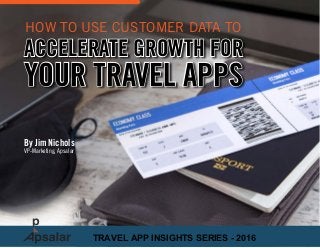
HOW TO USE CUSTOMER DATA TO
By Jim Nichols
VP-Marketing, Apsalar
ACCELERATE GROWTH FOR
YOUR TRAVEL APPS
TRAVEL APP INSIGHTS SERIES - 2016
Introduction
Apps are rapidly transforming the
ways that people interact and trans-
act in digital, especially in the travel
category. While just a few years ago
the app space was completely
dominated by games, now travel
apps are becoming very popular.
More and more travel businesses
around the world are relying on apps
to drive engagement and sales.
2
>>>
TRAVEL APP INSIGHTS SERIES - 2016
THE BREADTH AND DEPTH OF
CONSUMER TRAVEL PREFERENCES
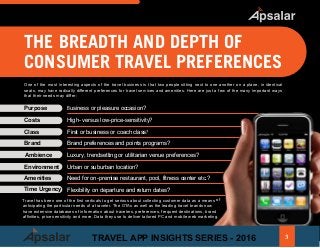
One of the most interesting aspects of the travel business is that two people sitting next to one another on a plane, in identical
seats, may have radically different preferences for travel services and amenities. Here are just a few of the many important ways
that their needs may differ:
Business or pleasure occasion?
High- versus low-price-sensitivity?
First or business or coach class?
Brand preferences and points programs?
Luxury, trendsetting or utilitarian venue preferences?
Urban or suburban location?
Need for on-premise restaurant, pool, fitness center etc.?
Flexibility on departure and return dates?
Purpose
Costs
Class
Brand
Ambience
Amenities
FlexibilityTravel has been one of the first verticals to get serious about collecting customer data as a means of
anticipating the particular needs of a traveler. The OTAs as well as the leading travel brands now
have extensive databases of information about travelers, preferences, frequent destinations, brand
affinities, price sensitivity and more. Data they use to deliver tailored PC and mobile web marketing.
Environment
Time Urgency
3TRAVEL APP INSIGHTS SERIES - 2016
MAKING TRAVEL APP
MARKETING CONSUMER-CENTRIC
By contrast, data-driven travel app marketing is only in its infancy.
Techniques that are common online are only now becoming
available in the app arena. But now that they are available,
travel companies should start taking the same sorts of
data-driven approaches to app marketing that they take with
consumer touchpoints that take place on other screens.
In the pages that follow, we will be providng ideas and tips to
do just that. We hope that these insights and recommendations
will help you make your travel app marketing more effective through a
focus on leveraging the power of data to create richer and more
personal customer relationships
>>>
4TRAVEL APP INSIGHTS SERIES - 2016
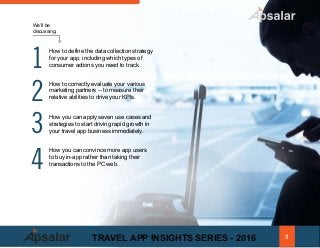
How to define the data collection strategy
for your app, including which types of
consumer actions you need to track.
How to correctly evaluate your various
marketing partners -- to measure their
relative abilities to drive your KPIs.
How you can apply seven use cases and
strategies to start driving rapid growth in
your travel app business immediately.
How you can convince more app users
to buy in-app rather than taking their
transactions to the PC web.
We’ll be
discussing:
1
2
3
4
5TRAVEL APP INSIGHTS SERIES - 2016
When you are just getting started with in-app measure-
ment, the most important things you need to decide are
which consumer actions to track. In the mobile app
measurement industry, we call in-app consumer actions
'events'. By tracking events, we gather the data
necessary to understand the effectiveness of your
marketing programs. We also gain a granular view of
exactly what each consumer does inside your apps.
1Travel App
Data Collection Strategy
		
At Apsalar, we classify in-app user events into four big "buckets":
1. Validation Events: Actions that help identify the user (anonymously, of course.)		
2. Engagement Events: Actions that indicate "involvement" with the app,		
and presage long-term usage.
3.	 Intent Events:		 Actions that indicate that the user is considering and 						
preparing for a purchase.			
4. Conversion Events: Completed transactions. 						
6TRAVEL APP INSIGHTS SERIES - 2016
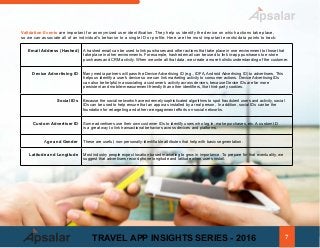
Email Address (Hashed) A hashed email can be used to link purchases and other actions that take place in one environment to those that
take place in other environments. For example, hashed email can be used to link in-app purchases to e-store
purchases and CRM activity. When we unite all that data, we create a more holistic understanding of the customer.
Device Advertising ID Many media partners will pass the Device Advertising ID (e.g., IDFA, Android Advertising ID) to advertisers. This
helps us identify a user's device so we can link marketing activity to consumer actions. Device Advertising IDs
can also be helpful in associating a customer’s activity across devices, because Device IDs are far more
persistent and mobile-measurement-friendly than other identifiers, like third-party cookies.
Social IDs Because the social networks have extremely sophisticated algorithms to spot fraudulent users and activity, social
IDs can be used to help ensure that an app was installed by a real person, In addition, social IDs can be the
foundation for retargeting and other re-engagement efforts on social networks.
Custom Advertiser ID Some advertisers use their own customer IDs to identify users who log in, make purchases, etc. A custom ID
is a great way to link transactional behaviors across devices and platforms.
Age and Gender These are useful, non-personally-identifiable attributes that help with basic segmentation.
Latitude and Longitude Most industry people expect location-based marketing to grow in importance. To prepare for that eventuality, we
suggest that advertisers record phone longitude and latitude when users install.
Validation Events are important for anonymized user identification. They help us identify the device on which actions take place,
so we can associate all of an individual's behavior to a single ID or profile. Here are the most important events/data points to track:
7TRAVEL APP INSIGHTS SERIES - 2016
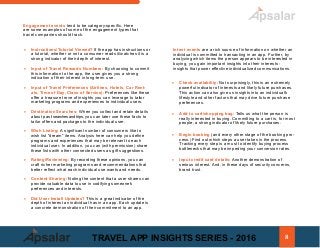
Engagement events tend to be category-specific. Here
are some examples of some of the engagement types that
travel companies should track.
• Instructions/Tutorial Viewed? If the app has instructions or
a tutorial, whether or not a consumer reads it/watches it is a
strong indicator of their depth of interest.
• Input of Travel Rewards Numbers: By choosing to commit
this information to the app, the user gives you a strong
indication of their interest in long-term use.
• Input of Travel Preferences (Airlines, Hotels, Car Rent-
als, Time of Day, Class of Service): Preferences like these
offer a treasure trove of insights you can leverage to tailor
marketing programs and experiences to individual users.
• Destination Searches: When you collect and retain details
about past searchesandtrips,you can later use these facts to
tailor offers and packages to the individual user.
• Wish Listing: A significant number of consumers like to
wish list "dream" items. Analysis here can help you define
programs and experiences that may be relevant to each
individual user. In addition, you can (with permission) share
these lists with other connected users as gift suggestions.
• Rating/Reviewing: By recording these opinions, you can
craft richer marketing programs and recommendations that
better reflect what each individual use wants and needs.
• Content Sharing: Noting the content that a user shares can
provide valuable data to use in codifying someone's
preferences and interests.
• Did User Install Updates? This is a great indicator of the
depth of interest an individual has in an app. Each update is
a concrete demonstration of their commitment to an app.
Intent events are a rich source of information on whether an
individual is committed to transacting in an app. Further, by
analyzing which items the person appears to be interested in
buying, you gain important insights into their interests -
insights that power effective individualized communications.
• Check availability: Not surprisingly, this is an extremely
powerful indicator of interests and likely future purchases.
This action can also give us insights into an individual's
lifestyle and other factors that may drive future purchase
preferences.
• Add to cart/shopping bag: Tells us what the person is
really interested in buying. Committing to a cart is, for most
people, a strong indicator of likely future purchases.
• Begin booking (and every other stage of the booking pro-
cess.) Find out which steps a user takes in the process.
Tracking every step is a must to identify buying process
bottlenecks that may be impeding your conversion rates.
• Input credit card details: Another demonstration of
serious interest. And, in these days of security concerns,
brand trust.
8TRAVEL APP INSIGHTS SERIES - 2016
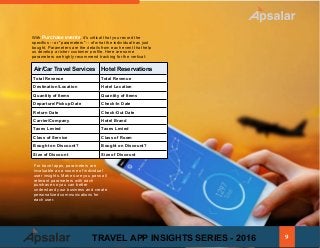
With Purchase events, it's critical that you record the
specifics -- or "parameters" -- of what the individual has just
bought. Parameters are the details from each event that help
us develop a richer customer profile. Here are some
parameters we highly recommend tracking for the vertical:
Air/Car Travel Services Hotel Reservations
Total Revenue Total Revenue
Destination/Location Hotel Location
Quantity of Items Quantity of Items
Departure/Pickup Date Check-In Date
Return Date Check-Out Date
Carrier/Company Hotel Brand
Taxes Levied Taxes Levied
Class of Service Class of Room
Bought on Discount? Bought on Discount?
Size of Discount Size of Discount
For travel apps, parameters are
invaluable as a source of individual
user insights. Make sure you pass all
relevant parameters with each
purchase so you can better
understand your business and create
personalized communications for
each user.
9TRAVEL APP INSIGHTS SERIES - 2016
You and your brand probably expect more from your app than
"just" a colossal number of installs. You likely need to drive
strong bookings and realized revenue. Given that, it's a bad idea
to just use install counts and CPI as the only measures of media
partner effectiveness.
Media companies that drive dirt-cheap installs often deliver the
lowest quality users. That’s because the least expensive ways to
drive an install (like incentivized downloads, side-loading and
APK) tend to garner lots of "users" who actually have no interest
in what you sell.
An example: If I agreed to download your app in exchange for
an hour of free Wi-Fi, am I likely to be a high-potential-revenue-
user? Probably not. If it sounds too good to be true from a CPI
perspective, it probably is.
That’s not to say that every incentivized install program is bad.
But you should dig deep to find out whether its realistic to expect
quality users from a program before you sign the contract.
One of the most frustrating things we see from our view into
hundreds of app businesses is that lots of mcommerce
companies still optimize to cost per install instead of revenue per
marketing sollar invested.. Doing so often drives exactly the
wrong allocation decisions.
Here's an example. According to Liftoff’s Mobile App
Engagement Index, the average travel app CPI in the US is
about $6 - $5.58 for a male user and $6.42 for a female.
Given this, should travel apps then focus solely on men? NO!
Liftoff reports that women buy the majority of travel offerings, so
acquiring female users may make more sense. They may cost a
little more to acquire, but they will generate lots more revenue.
Net: always evaluate vendors based upon the extent to which
they help deliver your KPIs, not surrogate measures. Ensure that
the measurement tool that you choose can provide a precise
measure of the return on ad spend for vendors and campaigns,
not just basic CPI metrics.
2Evaluating Your Vendors Based
Upon Revenue KPIs, Not Installs
10TRAVEL APP INSIGHTS SERIES - 2016
Once you are collecting the right data on key customer events,
it’s time to put that data to work. Use individual and audience
insights to power segmented and customized marketing
programs. Here are seven key use cases in which customer
event data can play a huge role in improving revenue,
customer engagement rates and profitability: ƒ
ƒ	 Optimized Vendor Allocationƒ
ƒ	 Broad-Based Mobile Retargetingƒ
ƒ	 Broad-Based Cross-Device Retargetingƒ
ƒ	 Reactivating Cart Abandonersƒ
ƒ	 Bringing Lapsed Customers Back to Buyƒ
ƒ	 Advanced Lookalike Modelingƒ
ƒ	 App Cross-Marketing
Seven Data-Driven App
Marketing Use Cases3
11TRAVEL APP INSIGHTS SERIES - 2016
21
INSIGHTS “FROM THE FIELD”
Apsalar clients have used this technique to
radically increase the size of their customer
bases. The payback from ROAS-optimized vendor
allocations is immediate AND lasting.
Deduplication also offers immediate ROI benefits.
It usually reveals that high quality media vendors
are far more efficient than those that seem to offer
remarkably efficient CPIs.
Broad-based mobile retargeting: Retargeting is
the fastest growing sector of app marketing, and
among the fastest growing for digital and mobile
marketing in general. And the reason is because it
works outstandingly well. By concentrating on high-
potential segments, you increase your share of voice
with these "consumers that matter," and can deliver
customized messages geared to need states.
Here are two examples specific to travel apps:
• Apps can target segments of their users who
explore destination information but have not
demonstrated intent to transact. This engagement
state often represents a very big chunk of travel
app users - one that can be cost-effectively
reached with tailored messages that drive deeper
engagements.
• OTA apps can target users who have transacted
for a low margin item, like an airline ticket, but
have never used the app to make a higher-
margin hotel or rental car reservation.
INSIGHTS “FROM THE FIELD”
Our data show that travel apps were among the
first movers for broad-based mobile retargeting.
Early interest was focused on using retargeting to
drive more high-margin events, like hotel
bookings. Now the use of retargeting is growing to
encompass more event types, including some that
relate to increasing exploration and search
engagement rather than driving immediate
revenue.
Optimized vendor allocation: Collecting data on all
of the paid and organic events that drive installs and
other desirable actions is the first step toward having
the information you need to assess vendor
performance and efficiency.
Analyze the results of each of your media partners so
you can delvier the right mix of media to maximize
return on ad spend.
In addition to enabling you to allocate your spend in
the ways that are most accretive to your revenue goals
or other KPIs, you can also ensure that you don't pay
multiple vendors for the same install. "Deduplication"
can drive a savings of 20% or more on your overall
CPI. The more partners you use, the greater the
potential for duplication.
12TRAVEL APP INSIGHTS SERIES - 2016
Cross-device mobile retargeting: Through partner-
ships with device graph companies, it is now possible
to anonymously target individuals across screens by
connecting third-party cookies from the PC and mobile
web with device advertising IDs from the app world.
The number of companies doing this at the time of
this writing is small, but we expect these figures to
climb rapidly in Q4 2015 and 2016.
INSIGHTS “FROM THE FIELD”
Pioneers in cross-screen app user targeting
tell us that they do so to avail themselves of
the low costs per impression in PC (and
mobile web) Display. Device graphs also help
these clients gain a richer understanding
of customer interests and behavior that they
also can put to use in remarketing.
Cart abandon reactivation: This use case is one of
the key drivers of the effectiveness of retargeting. By
reaching out to users who have demonstrated strong in-
tent signals but have not yet transacted, it is possible to
drive a significant portion of these users back to transact.
Thepercentagewhoreturndependsonatleastsixcriteria:
Category dynamics		
ing begins
-	 Price point							 Size of discount offer
(if any) 	
- Whether it would be a user’s
first or a repeat purchase			
INSIGHTS “FROM THE FIELD”
Cart abandoner targeting works if your app has
sufficient scale to accumulate enough abandoner
IDs to meet the audience targeting minimums for
your preferred vendor(s). IIf you do not have that
scale, you would do well to focus on broad-based
retargeting until your business has achieved
greater scale.
3 4
How many retargeting
messages are received
How fast retargeting
starts after abandon
13TRAVEL APP INSIGHTS SERIES - 2016
a)	 Bringing lapsed users back to buy: As we all know, the
number of apps on a typical mobile device far exceeds the
number that are used regularly. Recent figures from
Nielsen in the US show that the average smartphone bears
about 100 apps, of which about 15 are used regularly.
Many apps lose more than 80% of their customers in just
the first month after the install. Given those dynamics, it is
critical to keep your app top-of-mind, and one way to do
that is to remind users after N days of inactivity.
Understanding past travel exploration and booking patterns
is critical here; it obviously makes a lot more sense to re-
mind a lapsed user who books a trip every week than one
who only books a few times a year.
INSIGHTS “FROM THE FIELD”
This tactic works for driving re-engagement with an
app as well as encouraging incremental purchases.
Care should be taken to understand the typical
buying patterns of your app users so that you know
when and how often to deliver your messages.
Driving sustained use of companion apps is a fairly
uncommon tactic thus far in the industry, because
there is little direct revenue attributable to those
apps. But as more and more travel companies seek
to replace labor with self-service apps, the financial
case may become more enticing.
f.			 Advanced lookalike modeling: Travel companies have
been leveraging lookalike modeling for acquisition efforts in
the PC realm for years, so it should come as no surprise
that it is a fast-growing area for app marketing. Likely, many
of the app media partners you work with are already
leveraging lookalike models on your behalf.
Lookalike modeling is most effective when a brand collects
and analyzes all of its installs and customers FROM
ACROSS ALL MEDIA VENDORS, in order to understand
the complete picture of its customer base. While
sophisticated media partners can do a good job with
lookalike modeling using only the installs that they drive,
there is no substitute for the broadest possible view.
Another key element of brand-centered lookalike modeling
is the opportunity to identify more target audience seg-
ments. By arming your media partners with ALL the
segments, you will empower them to drive even better
results for your brand.
INSIGHTS “FROM THE FIELD”
While more brands are taking steps to collect and
leverage all of their customer data, too many punt
on this challenge, with the result that they limit the
scale that they can obtain for their app business.
By creating a common data store of customer
profiles from across all vendors, a brand can not
only safeguard its information and prevent data
leaks, it can also ensure that all of its marketing
programs are informed by the best possible
customer insights.
5 6
14TRAVEL APP INSIGHTS SERIES - 2016
ƒ
ƒƒ Interests
ƒƒ Lifestyles
ƒƒ Propensity to make in-app purchases
INSIGHTS “FROM THE FIELD”
In our interviews with marketers,
we heard that sometimes there is
territoriality tension between
marketing teams for different apps.
App cross-sell: Users of your related apps are a
natural place to start prospecting for new users/
customers. First, the cost to acquire them for the
second app will likely be much lower. Second, the
strong customer profiles that you have for the first
app will help you segment users to identify ideal
targets for your new app. You’ll be able to do so by
examining:
ƒ	 App usage patterns
7
Really try and break this down. In addition,
it’s helpful to explore ways to get creative
in messaging to attract cross-users. While
the users of one app are likely a good
prospect base for another, you need to
unlock your teams’ creativity in order to
make the best use of resources and drive
the highest response rates.
15TRAVEL APP INSIGHTS SERIES - 2016
1. Travel tends to be a high ticket item, and
people have security concerns regarding
mobile transactions.
2. Travel is often a well-considered pur-
chase, and users avail themselves of
many different types of connections to
access information. But for transacting,
consumers still like to use a PC to
comparison shop.
3. Travel booking sometimes requires sig-
nificant data entry, which is made easier
with the fill-sized keyboard of a PC.
4How you can convince more app
users to transact in-app rather than
taking their transaction to the PC web
Many users of travel apps switch to the PC web to
complete their transactions.
Lots of experts have theories about why this is so
common. Some of the most popular are outlined below:
Communicate Available Offers: Make sure that you
communicate available offers clearly and prominently.
Create Urgency: If offers are set to expire, give
consumers a reason to transact now by communicating
deadlines aggressively.
Allay Safety Concerns: Make sure you provide
assurances that transacting in-app is very safe. If you
work with assurance solutions like TRUSTe, make sure
you feature those relationships in your checkout process.
Simplify the Data Entry: Make sure that your buying
experience leverages any contact information you have
already in pre-fill forms etc.
Pricing Guarantees: Very few of us have relied on only
one website for travel pricing. We check around, or use
services that do this for us. If you offer a price guarantee,
this can likely improve your chances of in-app conversion.
Get Creative About Differentiating In-App Purchases:
You and your team may be able to identify ways to
differentiate the value of buying in-app.
Here are a few ideas to improve your chances of success:
16TRAVEL APP INSIGHTS SERIES - 2016
FINAL
THOUGHTS
Travel marketers are among the most
creative business leaders around. After all,
the need to romance experiences and
optimize buying processes is part and
parcel for success in your industry. Few
industry analysts disagree with the idea
that apps will become an increasingly
critical channel for the travel industry. The
time is now for travel marketers to devote
their strategic and tactical acumen to the
challenges inherent data-driven in-app
promotion and business building.
17TRAVEL APP INSIGHTS SERIES - 2016
ABOUT THE AUTHOR
Jim Nichols is VP of Marketing for
Apsalar. Jim has 20+ years experience
in over 80 different categories,
including developing successful
positioning and go-to-market plans
for more than 40 adtech and martech
companies. He joins Apsalar after
several years as VP of Marketing for
Conversant, where he led various
efforts in the successful rebrand of
the company from ValueClick, Inc.
The rebrand and associated industry
attention for the company contributed
to the $2.3B sale of Conversant to
Alliance Data in December, 2014. He is a
prolific writer for digital trades on brand
marketing, mobile, video, data, and
customer profiling. Publications include
iMedia Connection, Inside Radio,
VentureBeat, ad:tech, ShellyPalmer.
com, Jack Myers, and many consumer
publications. He holds a B.A. in
U.S. History from the University of
Pennsylvania and an MBA in Marketing
from the University of Chicago.
ABOUT APSALAR
Apsalar, the leader in mobile data management, helps direct marketing brands get
better marketing effectiveness by providing a mobile data management platform
that delivers a true understanding of customer behavior in apps and across other
marketing channels.
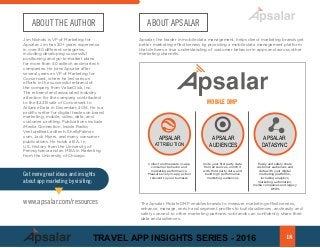
The Apsalar Mobile DMP enables brands to measure marketing effectiveness,
enhance, manage, enrich and segment profiles to build audiences, and easily and
safely connect to other marketing partners so brands can confidently share their
data and audiences.
APSALAR
ATTRIBUTION
APSALAR
AUDIENCES
APSALAR
DATASYNC
MOBILE DMP
Collect and measure in-app
consumer behavior and
marketing performance.
Measure every in-app action
relevent to your buinesss
Unite your first party data
from all sources, enrich it
with third party data, and
build high performance
marketing audiences
Easily and safely share
customer audiences and
data with your digital
marketing platforms,
including analytics,
marketing automation,
media companies and legacy
DMPs
Get more great ideas and insights
about app marketing by visiting:
www.apsalar.com/resources
18TRAVEL APP INSIGHTS SERIES - 2016

Apsalar grow your travel apps final

  • 1.
    HOW TO USECUSTOMER DATA TO By Jim Nichols VP-Marketing, Apsalar ACCELERATE GROWTH FOR YOUR TRAVEL APPS TRAVEL APP INSIGHTS SERIES - 2016
  • 2.
    Introduction Apps are rapidlytransforming the ways that people interact and trans- act in digital, especially in the travel category. While just a few years ago the app space was completely dominated by games, now travel apps are becoming very popular. More and more travel businesses around the world are relying on apps to drive engagement and sales. 2 >>> TRAVEL APP INSIGHTS SERIES - 2016
  • 3.
    THE BREADTH ANDDEPTH OF CONSUMER TRAVEL PREFERENCES One of the most interesting aspects of the travel business is that two people sitting next to one another on a plane, in identical seats, may have radically different preferences for travel services and amenities. Here are just a few of the many important ways that their needs may differ: Business or pleasure occasion? High- versus low-price-sensitivity? First or business or coach class? Brand preferences and points programs? Luxury, trendsetting or utilitarian venue preferences? Urban or suburban location? Need for on-premise restaurant, pool, fitness center etc.? Flexibility on departure and return dates? Purpose Costs Class Brand Ambience Amenities FlexibilityTravel has been one of the first verticals to get serious about collecting customer data as a means of anticipating the particular needs of a traveler. The OTAs as well as the leading travel brands now have extensive databases of information about travelers, preferences, frequent destinations, brand affinities, price sensitivity and more. Data they use to deliver tailored PC and mobile web marketing. Environment Time Urgency 3TRAVEL APP INSIGHTS SERIES - 2016
  • 4.
    MAKING TRAVEL APP MARKETINGCONSUMER-CENTRIC By contrast, data-driven travel app marketing is only in its infancy. Techniques that are common online are only now becoming available in the app arena. But now that they are available, travel companies should start taking the same sorts of data-driven approaches to app marketing that they take with consumer touchpoints that take place on other screens. In the pages that follow, we will be providng ideas and tips to do just that. We hope that these insights and recommendations will help you make your travel app marketing more effective through a focus on leveraging the power of data to create richer and more personal customer relationships >>> 4TRAVEL APP INSIGHTS SERIES - 2016
  • 5.
    How to definethe data collection strategy for your app, including which types of consumer actions you need to track. How to correctly evaluate your various marketing partners -- to measure their relative abilities to drive your KPIs. How you can apply seven use cases and strategies to start driving rapid growth in your travel app business immediately. How you can convince more app users to buy in-app rather than taking their transactions to the PC web. We’ll be discussing: 1 2 3 4 5TRAVEL APP INSIGHTS SERIES - 2016
  • 6.
    When you arejust getting started with in-app measure- ment, the most important things you need to decide are which consumer actions to track. In the mobile app measurement industry, we call in-app consumer actions 'events'. By tracking events, we gather the data necessary to understand the effectiveness of your marketing programs. We also gain a granular view of exactly what each consumer does inside your apps. 1Travel App Data Collection Strategy At Apsalar, we classify in-app user events into four big "buckets": 1. Validation Events: Actions that help identify the user (anonymously, of course.) 2. Engagement Events: Actions that indicate "involvement" with the app, and presage long-term usage. 3. Intent Events: Actions that indicate that the user is considering and preparing for a purchase. 4. Conversion Events: Completed transactions. 6TRAVEL APP INSIGHTS SERIES - 2016
  • 7.
    Email Address (Hashed)A hashed email can be used to link purchases and other actions that take place in one environment to those that take place in other environments. For example, hashed email can be used to link in-app purchases to e-store purchases and CRM activity. When we unite all that data, we create a more holistic understanding of the customer. Device Advertising ID Many media partners will pass the Device Advertising ID (e.g., IDFA, Android Advertising ID) to advertisers. This helps us identify a user's device so we can link marketing activity to consumer actions. Device Advertising IDs can also be helpful in associating a customer’s activity across devices, because Device IDs are far more persistent and mobile-measurement-friendly than other identifiers, like third-party cookies. Social IDs Because the social networks have extremely sophisticated algorithms to spot fraudulent users and activity, social IDs can be used to help ensure that an app was installed by a real person, In addition, social IDs can be the foundation for retargeting and other re-engagement efforts on social networks. Custom Advertiser ID Some advertisers use their own customer IDs to identify users who log in, make purchases, etc. A custom ID is a great way to link transactional behaviors across devices and platforms. Age and Gender These are useful, non-personally-identifiable attributes that help with basic segmentation. Latitude and Longitude Most industry people expect location-based marketing to grow in importance. To prepare for that eventuality, we suggest that advertisers record phone longitude and latitude when users install. Validation Events are important for anonymized user identification. They help us identify the device on which actions take place, so we can associate all of an individual's behavior to a single ID or profile. Here are the most important events/data points to track: 7TRAVEL APP INSIGHTS SERIES - 2016
  • 8.
    Engagement events tendto be category-specific. Here are some examples of some of the engagement types that travel companies should track. • Instructions/Tutorial Viewed? If the app has instructions or a tutorial, whether or not a consumer reads it/watches it is a strong indicator of their depth of interest. • Input of Travel Rewards Numbers: By choosing to commit this information to the app, the user gives you a strong indication of their interest in long-term use. • Input of Travel Preferences (Airlines, Hotels, Car Rent- als, Time of Day, Class of Service): Preferences like these offer a treasure trove of insights you can leverage to tailor marketing programs and experiences to individual users. • Destination Searches: When you collect and retain details about past searchesandtrips,you can later use these facts to tailor offers and packages to the individual user. • Wish Listing: A significant number of consumers like to wish list "dream" items. Analysis here can help you define programs and experiences that may be relevant to each individual user. In addition, you can (with permission) share these lists with other connected users as gift suggestions. • Rating/Reviewing: By recording these opinions, you can craft richer marketing programs and recommendations that better reflect what each individual use wants and needs. • Content Sharing: Noting the content that a user shares can provide valuable data to use in codifying someone's preferences and interests. • Did User Install Updates? This is a great indicator of the depth of interest an individual has in an app. Each update is a concrete demonstration of their commitment to an app. Intent events are a rich source of information on whether an individual is committed to transacting in an app. Further, by analyzing which items the person appears to be interested in buying, you gain important insights into their interests - insights that power effective individualized communications. • Check availability: Not surprisingly, this is an extremely powerful indicator of interests and likely future purchases. This action can also give us insights into an individual's lifestyle and other factors that may drive future purchase preferences. • Add to cart/shopping bag: Tells us what the person is really interested in buying. Committing to a cart is, for most people, a strong indicator of likely future purchases. • Begin booking (and every other stage of the booking pro- cess.) Find out which steps a user takes in the process. Tracking every step is a must to identify buying process bottlenecks that may be impeding your conversion rates. • Input credit card details: Another demonstration of serious interest. And, in these days of security concerns, brand trust. 8TRAVEL APP INSIGHTS SERIES - 2016
  • 9.
    With Purchase events,it's critical that you record the specifics -- or "parameters" -- of what the individual has just bought. Parameters are the details from each event that help us develop a richer customer profile. Here are some parameters we highly recommend tracking for the vertical: Air/Car Travel Services Hotel Reservations Total Revenue Total Revenue Destination/Location Hotel Location Quantity of Items Quantity of Items Departure/Pickup Date Check-In Date Return Date Check-Out Date Carrier/Company Hotel Brand Taxes Levied Taxes Levied Class of Service Class of Room Bought on Discount? Bought on Discount? Size of Discount Size of Discount For travel apps, parameters are invaluable as a source of individual user insights. Make sure you pass all relevant parameters with each purchase so you can better understand your business and create personalized communications for each user. 9TRAVEL APP INSIGHTS SERIES - 2016
  • 10.
    You and yourbrand probably expect more from your app than "just" a colossal number of installs. You likely need to drive strong bookings and realized revenue. Given that, it's a bad idea to just use install counts and CPI as the only measures of media partner effectiveness. Media companies that drive dirt-cheap installs often deliver the lowest quality users. That’s because the least expensive ways to drive an install (like incentivized downloads, side-loading and APK) tend to garner lots of "users" who actually have no interest in what you sell. An example: If I agreed to download your app in exchange for an hour of free Wi-Fi, am I likely to be a high-potential-revenue- user? Probably not. If it sounds too good to be true from a CPI perspective, it probably is. That’s not to say that every incentivized install program is bad. But you should dig deep to find out whether its realistic to expect quality users from a program before you sign the contract. One of the most frustrating things we see from our view into hundreds of app businesses is that lots of mcommerce companies still optimize to cost per install instead of revenue per marketing sollar invested.. Doing so often drives exactly the wrong allocation decisions. Here's an example. According to Liftoff’s Mobile App Engagement Index, the average travel app CPI in the US is about $6 - $5.58 for a male user and $6.42 for a female. Given this, should travel apps then focus solely on men? NO! Liftoff reports that women buy the majority of travel offerings, so acquiring female users may make more sense. They may cost a little more to acquire, but they will generate lots more revenue. Net: always evaluate vendors based upon the extent to which they help deliver your KPIs, not surrogate measures. Ensure that the measurement tool that you choose can provide a precise measure of the return on ad spend for vendors and campaigns, not just basic CPI metrics. 2Evaluating Your Vendors Based Upon Revenue KPIs, Not Installs 10TRAVEL APP INSIGHTS SERIES - 2016
  • 11.
    Once you arecollecting the right data on key customer events, it’s time to put that data to work. Use individual and audience insights to power segmented and customized marketing programs. Here are seven key use cases in which customer event data can play a huge role in improving revenue, customer engagement rates and profitability: ƒ ƒ Optimized Vendor Allocationƒ ƒ Broad-Based Mobile Retargetingƒ ƒ Broad-Based Cross-Device Retargetingƒ ƒ Reactivating Cart Abandonersƒ ƒ Bringing Lapsed Customers Back to Buyƒ ƒ Advanced Lookalike Modelingƒ ƒ App Cross-Marketing Seven Data-Driven App Marketing Use Cases3 11TRAVEL APP INSIGHTS SERIES - 2016
  • 12.
    21 INSIGHTS “FROM THEFIELD” Apsalar clients have used this technique to radically increase the size of their customer bases. The payback from ROAS-optimized vendor allocations is immediate AND lasting. Deduplication also offers immediate ROI benefits. It usually reveals that high quality media vendors are far more efficient than those that seem to offer remarkably efficient CPIs. Broad-based mobile retargeting: Retargeting is the fastest growing sector of app marketing, and among the fastest growing for digital and mobile marketing in general. And the reason is because it works outstandingly well. By concentrating on high- potential segments, you increase your share of voice with these "consumers that matter," and can deliver customized messages geared to need states. Here are two examples specific to travel apps: • Apps can target segments of their users who explore destination information but have not demonstrated intent to transact. This engagement state often represents a very big chunk of travel app users - one that can be cost-effectively reached with tailored messages that drive deeper engagements. • OTA apps can target users who have transacted for a low margin item, like an airline ticket, but have never used the app to make a higher- margin hotel or rental car reservation. INSIGHTS “FROM THE FIELD” Our data show that travel apps were among the first movers for broad-based mobile retargeting. Early interest was focused on using retargeting to drive more high-margin events, like hotel bookings. Now the use of retargeting is growing to encompass more event types, including some that relate to increasing exploration and search engagement rather than driving immediate revenue. Optimized vendor allocation: Collecting data on all of the paid and organic events that drive installs and other desirable actions is the first step toward having the information you need to assess vendor performance and efficiency. Analyze the results of each of your media partners so you can delvier the right mix of media to maximize return on ad spend. In addition to enabling you to allocate your spend in the ways that are most accretive to your revenue goals or other KPIs, you can also ensure that you don't pay multiple vendors for the same install. "Deduplication" can drive a savings of 20% or more on your overall CPI. The more partners you use, the greater the potential for duplication. 12TRAVEL APP INSIGHTS SERIES - 2016
  • 13.
    Cross-device mobile retargeting:Through partner- ships with device graph companies, it is now possible to anonymously target individuals across screens by connecting third-party cookies from the PC and mobile web with device advertising IDs from the app world. The number of companies doing this at the time of this writing is small, but we expect these figures to climb rapidly in Q4 2015 and 2016. INSIGHTS “FROM THE FIELD” Pioneers in cross-screen app user targeting tell us that they do so to avail themselves of the low costs per impression in PC (and mobile web) Display. Device graphs also help these clients gain a richer understanding of customer interests and behavior that they also can put to use in remarketing. Cart abandon reactivation: This use case is one of the key drivers of the effectiveness of retargeting. By reaching out to users who have demonstrated strong in- tent signals but have not yet transacted, it is possible to drive a significant portion of these users back to transact. Thepercentagewhoreturndependsonatleastsixcriteria: Category dynamics ing begins - Price point Size of discount offer (if any) - Whether it would be a user’s first or a repeat purchase INSIGHTS “FROM THE FIELD” Cart abandoner targeting works if your app has sufficient scale to accumulate enough abandoner IDs to meet the audience targeting minimums for your preferred vendor(s). IIf you do not have that scale, you would do well to focus on broad-based retargeting until your business has achieved greater scale. 3 4 How many retargeting messages are received How fast retargeting starts after abandon 13TRAVEL APP INSIGHTS SERIES - 2016
  • 14.
    a) Bringing lapsedusers back to buy: As we all know, the number of apps on a typical mobile device far exceeds the number that are used regularly. Recent figures from Nielsen in the US show that the average smartphone bears about 100 apps, of which about 15 are used regularly. Many apps lose more than 80% of their customers in just the first month after the install. Given those dynamics, it is critical to keep your app top-of-mind, and one way to do that is to remind users after N days of inactivity. Understanding past travel exploration and booking patterns is critical here; it obviously makes a lot more sense to re- mind a lapsed user who books a trip every week than one who only books a few times a year. INSIGHTS “FROM THE FIELD” This tactic works for driving re-engagement with an app as well as encouraging incremental purchases. Care should be taken to understand the typical buying patterns of your app users so that you know when and how often to deliver your messages. Driving sustained use of companion apps is a fairly uncommon tactic thus far in the industry, because there is little direct revenue attributable to those apps. But as more and more travel companies seek to replace labor with self-service apps, the financial case may become more enticing. f. Advanced lookalike modeling: Travel companies have been leveraging lookalike modeling for acquisition efforts in the PC realm for years, so it should come as no surprise that it is a fast-growing area for app marketing. Likely, many of the app media partners you work with are already leveraging lookalike models on your behalf. Lookalike modeling is most effective when a brand collects and analyzes all of its installs and customers FROM ACROSS ALL MEDIA VENDORS, in order to understand the complete picture of its customer base. While sophisticated media partners can do a good job with lookalike modeling using only the installs that they drive, there is no substitute for the broadest possible view. Another key element of brand-centered lookalike modeling is the opportunity to identify more target audience seg- ments. By arming your media partners with ALL the segments, you will empower them to drive even better results for your brand. INSIGHTS “FROM THE FIELD” While more brands are taking steps to collect and leverage all of their customer data, too many punt on this challenge, with the result that they limit the scale that they can obtain for their app business. By creating a common data store of customer profiles from across all vendors, a brand can not only safeguard its information and prevent data leaks, it can also ensure that all of its marketing programs are informed by the best possible customer insights. 5 6 14TRAVEL APP INSIGHTS SERIES - 2016
  • 15.
    ƒ ƒƒ Interests ƒƒ Lifestyles ƒƒPropensity to make in-app purchases INSIGHTS “FROM THE FIELD” In our interviews with marketers, we heard that sometimes there is territoriality tension between marketing teams for different apps. App cross-sell: Users of your related apps are a natural place to start prospecting for new users/ customers. First, the cost to acquire them for the second app will likely be much lower. Second, the strong customer profiles that you have for the first app will help you segment users to identify ideal targets for your new app. You’ll be able to do so by examining: ƒ App usage patterns 7 Really try and break this down. In addition, it’s helpful to explore ways to get creative in messaging to attract cross-users. While the users of one app are likely a good prospect base for another, you need to unlock your teams’ creativity in order to make the best use of resources and drive the highest response rates. 15TRAVEL APP INSIGHTS SERIES - 2016
  • 16.
    1. Travel tendsto be a high ticket item, and people have security concerns regarding mobile transactions. 2. Travel is often a well-considered pur- chase, and users avail themselves of many different types of connections to access information. But for transacting, consumers still like to use a PC to comparison shop. 3. Travel booking sometimes requires sig- nificant data entry, which is made easier with the fill-sized keyboard of a PC. 4How you can convince more app users to transact in-app rather than taking their transaction to the PC web Many users of travel apps switch to the PC web to complete their transactions. Lots of experts have theories about why this is so common. Some of the most popular are outlined below: Communicate Available Offers: Make sure that you communicate available offers clearly and prominently. Create Urgency: If offers are set to expire, give consumers a reason to transact now by communicating deadlines aggressively. Allay Safety Concerns: Make sure you provide assurances that transacting in-app is very safe. If you work with assurance solutions like TRUSTe, make sure you feature those relationships in your checkout process. Simplify the Data Entry: Make sure that your buying experience leverages any contact information you have already in pre-fill forms etc. Pricing Guarantees: Very few of us have relied on only one website for travel pricing. We check around, or use services that do this for us. If you offer a price guarantee, this can likely improve your chances of in-app conversion. Get Creative About Differentiating In-App Purchases: You and your team may be able to identify ways to differentiate the value of buying in-app. Here are a few ideas to improve your chances of success: 16TRAVEL APP INSIGHTS SERIES - 2016
  • 17.
    FINAL THOUGHTS Travel marketers areamong the most creative business leaders around. After all, the need to romance experiences and optimize buying processes is part and parcel for success in your industry. Few industry analysts disagree with the idea that apps will become an increasingly critical channel for the travel industry. The time is now for travel marketers to devote their strategic and tactical acumen to the challenges inherent data-driven in-app promotion and business building. 17TRAVEL APP INSIGHTS SERIES - 2016
  • 18.
    ABOUT THE AUTHOR JimNichols is VP of Marketing for Apsalar. Jim has 20+ years experience in over 80 different categories, including developing successful positioning and go-to-market plans for more than 40 adtech and martech companies. He joins Apsalar after several years as VP of Marketing for Conversant, where he led various efforts in the successful rebrand of the company from ValueClick, Inc. The rebrand and associated industry attention for the company contributed to the $2.3B sale of Conversant to Alliance Data in December, 2014. He is a prolific writer for digital trades on brand marketing, mobile, video, data, and customer profiling. Publications include iMedia Connection, Inside Radio, VentureBeat, ad:tech, ShellyPalmer. com, Jack Myers, and many consumer publications. He holds a B.A. in U.S. History from the University of Pennsylvania and an MBA in Marketing from the University of Chicago. ABOUT APSALAR Apsalar, the leader in mobile data management, helps direct marketing brands get better marketing effectiveness by providing a mobile data management platform that delivers a true understanding of customer behavior in apps and across other marketing channels. The Apsalar Mobile DMP enables brands to measure marketing effectiveness, enhance, manage, enrich and segment profiles to build audiences, and easily and safely connect to other marketing partners so brands can confidently share their data and audiences. APSALAR ATTRIBUTION APSALAR AUDIENCES APSALAR DATASYNC MOBILE DMP Collect and measure in-app consumer behavior and marketing performance. Measure every in-app action relevent to your buinesss Unite your first party data from all sources, enrich it with third party data, and build high performance marketing audiences Easily and safely share customer audiences and data with your digital marketing platforms, including analytics, marketing automation, media companies and legacy DMPs Get more great ideas and insights about app marketing by visiting: www.apsalar.com/resources 18TRAVEL APP INSIGHTS SERIES - 2016