GENERAL FEATURES
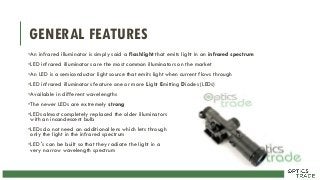
•An infraredilluminator is simply said a flashlight that emits light in an infrared spectrum
•LED infrared illuminators are the most common illuminators on the market
•An LED is a semiconductor light source that emits light when current flows through
•LED infrared illuminators feature one or more Light Emitting Diodes (LEDs)
•Available in different wavelengths
•The newer LEDs are extremely strong
•LEDs almost completely replaced the older illuminators
with an incandescent bulb
•LEDs do not need an additional lens which lets through
only the light in the infrared spectrum
•LED 's can be built so that they radiate the light in a
very narrow wavelength spectrum
3.
ADVANTAGES
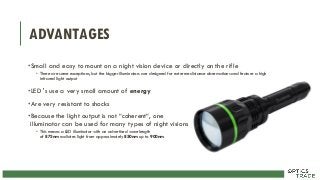
•Small and easyto mount on a night vision device or directly on the rifle
• There are some exceptions, but the bigger illuminators are designed for extreme distance observations and feature a high
infrared light output
•LED 's use a very small amount of energy
•Are very resistant to shocks
•Because the light output is not “coherent“, one
illuminator can be used for many types of night visions
• This means a LED illuminator with an advertised wavelength
of 875nm radiates light from approximately 850nm up to 900nm
4.
DISADVANTAGES
•Because the lightout of an LED illuminator is not “coherent“, this can also be a
disadvantage
• For example, an LED illuminator with a given wavelength of 850nm can radiate light from approximately 825nm up to 875nm. As
we know, some animals can detect the light up to 850nm wavelength, so for them, it could be visible.
•This is especially noticeable on cheap infrared illuminators,
where the radiation has a much bigger spectrum, for
example from 800nm up to 900nm.
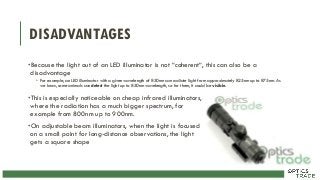
•On adjustable beam illuminators, when the light is focused
on a small point for long-distance observations, the light
gets a square shape
5.
WHICH IR ILLUMINATORFOR WHICH
NIGHT VISION OPTIC
•When buying an infrared illuminator, you have to be cautious what is the maximal
wavelength your night vision device can detect
•If the emitted light of your infrared illuminator is beyond the spectrum, it is invisible
for such a device
•We recommend:
• For Gen. 1 NV devices an IR illuminator with a wavelength between 750nm and 780nm,
• For Gen. 2 an illuminator with a wavelength of 850nm, or even higher (up to 900nm) if you own a
high-quality IIT in your device
• For Gen. 3 an IR illuminator is mostly not needed, but one with a wavelength of 850nm - 900nm would
work perfectly
• For a digital night vision device an IR illuminator with a wavelength between 850nm and 980nm
6.
MOUNTING OF IRILLUMINATORS
•Because the most night vision devices are designed for hunting purposes, the
manufacturers came up with different mounting solutions for the IR illuminators
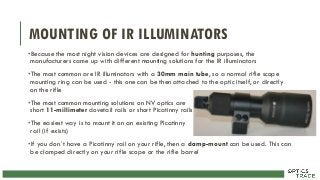
•The most common are IR illuminators with a 30mm main tube, so a normal rifle scope
mounting ring can be used - this one can be then attached to the optic itself, or directly
on the rifle
•The most common mounting solutions on NV optics are
short 11-millimeter dovetail rails or short Picatinny rails
•The easiest way is to mount it on an existing Picatinny
rail (if exists)
•If you don´t have a Picatinny rail on your rifle, then a clamp-mount can be used. This can
be clamped directly on your rifle scope or the rifle barrel




![5G Explained! A High Level Overview [Introduction]](https://cdn.slidesharecdn.com/ss_thumbnails/5gexplainedahighleveloverview-260119165306-cc137a3e-thumbnail.jpg?width=640&height=640&fit=bounds)

