March, 2020HUNTING BINOCULARS
HUNTING BINOCULARS
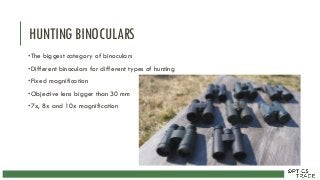
•The biggest category of binoculars
•Different binoculars for different types of hunting
•Fixed magnification
•Objective lens bigger than 30 mm
•7x, 8x and 10x magnification
HUNTING BINOCULARS FOR LOW LIGHT USE
•Hunting in the dark is very popular in Europe
•Binoculars for low light use:
• High light transmittance
• 7x or 8x magnification
• 50 or 56mm objective lens diameter
• Big exit pupil
• Porro or Abbe-Koenig prisms
• Higher price range
ALL-ROUND USEFUL HUNTING BINOCULARS 8X42
•8x42 is one of the best configurations for hunting binoculars
•Compact binoculars, but still bright enough
•Excellent combination between size and weight, light transmission, field of view, and
useful magnification
•This configuration is very common  high competition among manufacturers
•Also used by Birdwatchers
•To learn more read our Buying Guide
HUNTING BINOCULARS FOR STALKING 10X42
•10x42 are less bright than 8x42 but offer better details and resolution
•Suitable for hunting in the mountains and generally for hunting in the bright daytime
•Common choice of birdwatchers
•In the last years, the 10x50 binoculars started to become trendy  behave better
in low light situations  but they are heavier and therefore not very suitable for
stalking in the mountains
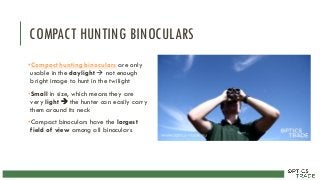
COMPACT HUNTING BINOCULARS
•Compact hunting binoculars are only
usable in the daylight  not enough
bright image to hunt in the twilight
•Small in size, which means they are
very light  the hunter can easily carry
them around its neck
•Compact binoculars have the largest
field of view among all binoculars
ROOF PRISM USED IN HUNTING BINOCULARS
•Roof prisms are very common in the hunting binoculars
•Central focusing system
•Binculars with Roof prisms are more compact than binoculars that feature Porro
prisms
•The most commonly used type of Roof prism is Schmidt Pechan type 
the smallest and the lightest type
•Abbe-Koening prisms are not used very often  provide bright images, but
binoculars are more massive and longer in size
PROTECTION OF HUNTING BINOCULARS AGAINST
ROUGH WEATHER CONDITIONS
•During hunting, binoculars are exposed to harsh weather conditions
•Only Marine binoculars are exposed to similar hard conditions  can compare to
hunting binoculars
•Waterproof  filled with Nitrogen or Argon  prevent dew from accumulating at
the sudden temperature changes
•Many have a thick rubber armor
•Premium binoculars have a housing made of magnesium  for maximal protection
•Only the most premium brands also offer special protective coatings on external
lenses
BEST HUNTING BINOCULARS
•Decision depends on the purpose  Binoculars that are great for stalking do not perform
well in low light conditions
•It is crucial to choose binoculars that are best for its user needs
•Zeiss, Leica, Swarovski  currently dominate the market
•Some manufacturers in the middle price range provide good quality binoculars for
more affordable prices
Short Presentation | Hunting Binoculars | Optics Trade

Short Presentation | Hunting Binoculars | Optics Trade

  • 1.
  • 2.
    HUNTING BINOCULARS •The biggestcategory of binoculars •Different binoculars for different types of hunting •Fixed magnification •Objective lens bigger than 30 mm •7x, 8x and 10x magnification
  • 3.
    HUNTING BINOCULARS FORLOW LIGHT USE •Hunting in the dark is very popular in Europe •Binoculars for low light use: • High light transmittance • 7x or 8x magnification • 50 or 56mm objective lens diameter • Big exit pupil • Porro or Abbe-Koenig prisms • Higher price range
  • 4.
    ALL-ROUND USEFUL HUNTINGBINOCULARS 8X42 •8x42 is one of the best configurations for hunting binoculars •Compact binoculars, but still bright enough •Excellent combination between size and weight, light transmission, field of view, and useful magnification •This configuration is very common  high competition among manufacturers •Also used by Birdwatchers •To learn more read our Buying Guide
  • 5.
    HUNTING BINOCULARS FORSTALKING 10X42 •10x42 are less bright than 8x42 but offer better details and resolution •Suitable for hunting in the mountains and generally for hunting in the bright daytime •Common choice of birdwatchers •In the last years, the 10x50 binoculars started to become trendy  behave better in low light situations  but they are heavier and therefore not very suitable for stalking in the mountains
  • 6.
    COMPACT HUNTING BINOCULARS •Compacthunting binoculars are only usable in the daylight  not enough bright image to hunt in the twilight •Small in size, which means they are very light  the hunter can easily carry them around its neck •Compact binoculars have the largest field of view among all binoculars
  • 7.
    ROOF PRISM USEDIN HUNTING BINOCULARS •Roof prisms are very common in the hunting binoculars •Central focusing system •Binculars with Roof prisms are more compact than binoculars that feature Porro prisms •The most commonly used type of Roof prism is Schmidt Pechan type  the smallest and the lightest type •Abbe-Koening prisms are not used very often  provide bright images, but binoculars are more massive and longer in size
  • 8.
    PROTECTION OF HUNTINGBINOCULARS AGAINST ROUGH WEATHER CONDITIONS •During hunting, binoculars are exposed to harsh weather conditions •Only Marine binoculars are exposed to similar hard conditions  can compare to hunting binoculars •Waterproof  filled with Nitrogen or Argon  prevent dew from accumulating at the sudden temperature changes •Many have a thick rubber armor •Premium binoculars have a housing made of magnesium  for maximal protection •Only the most premium brands also offer special protective coatings on external lenses
  • 9.
    BEST HUNTING BINOCULARS •Decisiondepends on the purpose  Binoculars that are great for stalking do not perform well in low light conditions •It is crucial to choose binoculars that are best for its user needs •Zeiss, Leica, Swarovski  currently dominate the market •Some manufacturers in the middle price range provide good quality binoculars for more affordable prices