April, 2020
Digital Night Vision
Optics
HISTORY
•Digital night vision is the newest technology on the market for night observations
•No image intensifier tube
•Consists of the following parts:
• objective lens, a light-sensitive sensor (CCD or CMOS),
blocks of electronics for image processing and control,
a display, and an eyepiece
•First devices were introduced in 2013 by Pulsar
and 2014 by ATN
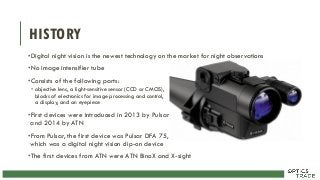
•From Pulsar, the first device was Pulsar DFA 75,
which was a digital night vision clip-on device
•The first devices from ATN were ATN BinoX and X-sight
ADVANTAGES OF DIGITAL NIGHT VISION
•An amplified picture with great details for a reasonable price
•A lot cheaper than Gen. 2 and 3 NV devices, sometimes even cheaper than Gen. 1 NV devices
•Better image quality, detail recognition, and observation range
than with Gen. 1 analog NV devices
•Can be used during the day
•Many products offer also a full-color mode for daytime observations
•Possibility to take photos and videos
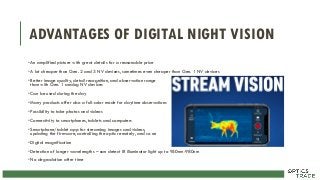
•Connectivity to smartphones, tablets and computers
•Smartphone/tablet app for streaming images and videos,
updating the firmware, controlling the optic remotely, and so on
•Digital magnification
•Detection of longer wavelengths – can detect IR illuminator light up to 950nm-980nm
•No degradation after time
DISADVANTAGES OF DIGITAL NIGHT
VISION
•Lower resolution
•Lower light amplification than Gen. 2 and 3 analog devices
•Higher battery consumption
•Refresh rate
•Bright display
INFRARED ILLUMINATORS SUITABLE FOR
DIGITAL NIGHT VISION DEVICES
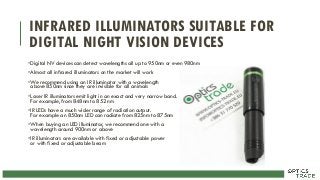
•Digital NV devices can detect wavelengths all up to 950nm or even 980nm
•Almost all infrared illuminators on the market will work
•We recommend using an IR illuminator with a wavelength
above 850nm since they are invisible for all animals
•Laser IR illuminators emit light in an exact and very narrow band.
For example, from 848nm to 852 nm
•IR LEDs have a much wider range of radiation output.
For example an 850nm LED can radiate from 825nm to 875nm
•When buying an LED illuminator, we recommend one with a
wavelength around 900nm or above
•IR illuminators are available with fixed or adjustable power
or with fixed or adjustable beam
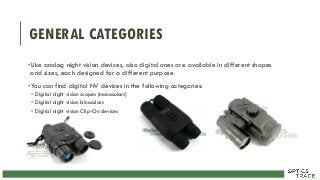
GENERAL CATEGORIES
•Like analog night vision devices, also digital ones are available in different shapes
and sizes, each designed for a different purpose
•You can find digital NV devices in the following categories:
• Digital night vision scopes (monoculars)
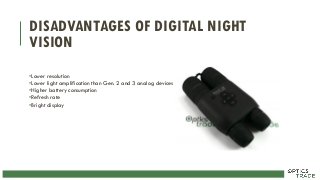
• Digital night vision binoculars
• Digital night vision Clip-On devices

Short Presentation | Digital Night Vision Optics | Optics Trade

Short Presentation | Digital Night Vision Optics | Optics Trade

  • 1.
  • 2.
    HISTORY •Digital night visionis the newest technology on the market for night observations •No image intensifier tube •Consists of the following parts: • objective lens, a light-sensitive sensor (CCD or CMOS), blocks of electronics for image processing and control, a display, and an eyepiece •First devices were introduced in 2013 by Pulsar and 2014 by ATN •From Pulsar, the first device was Pulsar DFA 75, which was a digital night vision clip-on device •The first devices from ATN were ATN BinoX and X-sight
  • 3.
    ADVANTAGES OF DIGITALNIGHT VISION •An amplified picture with great details for a reasonable price •A lot cheaper than Gen. 2 and 3 NV devices, sometimes even cheaper than Gen. 1 NV devices •Better image quality, detail recognition, and observation range than with Gen. 1 analog NV devices •Can be used during the day •Many products offer also a full-color mode for daytime observations •Possibility to take photos and videos •Connectivity to smartphones, tablets and computers •Smartphone/tablet app for streaming images and videos, updating the firmware, controlling the optic remotely, and so on •Digital magnification •Detection of longer wavelengths – can detect IR illuminator light up to 950nm-980nm •No degradation after time
  • 4.
    DISADVANTAGES OF DIGITALNIGHT VISION •Lower resolution •Lower light amplification than Gen. 2 and 3 analog devices •Higher battery consumption •Refresh rate •Bright display
  • 5.
    INFRARED ILLUMINATORS SUITABLEFOR DIGITAL NIGHT VISION DEVICES •Digital NV devices can detect wavelengths all up to 950nm or even 980nm •Almost all infrared illuminators on the market will work •We recommend using an IR illuminator with a wavelength above 850nm since they are invisible for all animals •Laser IR illuminators emit light in an exact and very narrow band. For example, from 848nm to 852 nm •IR LEDs have a much wider range of radiation output. For example an 850nm LED can radiate from 825nm to 875nm •When buying an LED illuminator, we recommend one with a wavelength around 900nm or above •IR illuminators are available with fixed or adjustable power or with fixed or adjustable beam
  • 6.
    GENERAL CATEGORIES •Like analognight vision devices, also digital ones are available in different shapes and sizes, each designed for a different purpose •You can find digital NV devices in the following categories: • Digital night vision scopes (monoculars) • Digital night vision binoculars • Digital night vision Clip-On devices