March, 2020
Angled Spotting Scopes
ANGLED SPOTTING SCOPES FOR HUNTING
• Appropriate for hunting in the mountains
• No need to overstretch the neck while using it
• Can be used without a tripod  The user simply puts the scope on the top of a
shoulder bag or a backpack
ANGLED SPOTTING SCOPES FOR BIRDWATCHING
Birdwatching
Activity that involves a more extensive group of people participating
at the same time  easy observation for people of all heights
•Scopes are often used with a tripod
•Crucial factor: lightweight
ANGLED SPOTTING SCOPES FOR DIGISCOPING
• Phone or a camera connects with a spotting scope
Angled spotting scopes vs. straight spotting scopes:
•Angled spotting scopes are more compact due to their shorter lengths;
•They provide better support of the digiscoping setup;
•No difference in the quality of the material between angled and straight spotting
scopes
•Supporting rails provide stability  they are shorter and less bulky
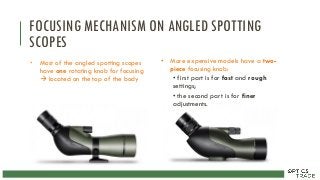
FOCUSING MECHANISM ON ANGLED SPOTTING
SCOPES
• Most of the angled spotting scopes
have one rotating knob for focusing
 located on the top of the body
• More expensive models have a two-
piece focusing knob:
• first part is for fast and rough
settings;
• the second part is for finer
adjustments.
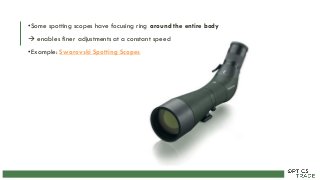
•Some spotting scopes have focusing ring around the entire body
 enables finer adjustments at a constant speed
•Example: Swarovski Spotting Scopes
WATERPROOFNESS OF ANGLED SPOTTING SCOPES
•Most spotting scopes are waterproof and filled with either nitrogen or argon
•The only weakness is the bayonet mount (part of the most premium angled spotting
scopes)
•More affordable spotting scopes have fixed eyepiece  better protection against
water intrusion
•No permanent damage if the water comes in the middle space (it can be dried)
•The problem: removing eyepiece while exposed to rain (unclear images)
•Recommendation: fixing the eyepiece somewhere in a dry space
RED DOT SIGHTS ON ANGLED SPOTTING SCOPES
•One or more small Picatinny rails are used as a platform for mounting a red dot
sight on the spotting scope
•Hunters and long-range shooters use this setup for rapid target acquisition
Different purposes of using red dots:
•Shooting competition: the shooter points to the correct target and ensures he is
looking at the right one
•Hunting in the mountains: the guide and the hunter can quickly locate a specific
animal in the herd
•Birdwatching: one person of the group finds a specific bird in the flock of birds so
the others can see it too

Short Presentation | Angled Spotting Scopes | Optics Trade

Short Presentation | Angled Spotting Scopes | Optics Trade

  • 1.
  • 2.
    ANGLED SPOTTING SCOPESFOR HUNTING • Appropriate for hunting in the mountains • No need to overstretch the neck while using it • Can be used without a tripod  The user simply puts the scope on the top of a shoulder bag or a backpack
  • 3.
    ANGLED SPOTTING SCOPESFOR BIRDWATCHING Birdwatching Activity that involves a more extensive group of people participating at the same time  easy observation for people of all heights •Scopes are often used with a tripod •Crucial factor: lightweight
  • 4.
    ANGLED SPOTTING SCOPESFOR DIGISCOPING • Phone or a camera connects with a spotting scope Angled spotting scopes vs. straight spotting scopes: •Angled spotting scopes are more compact due to their shorter lengths; •They provide better support of the digiscoping setup; •No difference in the quality of the material between angled and straight spotting scopes •Supporting rails provide stability  they are shorter and less bulky
  • 5.
    FOCUSING MECHANISM ONANGLED SPOTTING SCOPES • Most of the angled spotting scopes have one rotating knob for focusing  located on the top of the body • More expensive models have a two- piece focusing knob: • first part is for fast and rough settings; • the second part is for finer adjustments.
  • 6.
    •Some spotting scopeshave focusing ring around the entire body  enables finer adjustments at a constant speed •Example: Swarovski Spotting Scopes
  • 7.
    WATERPROOFNESS OF ANGLEDSPOTTING SCOPES •Most spotting scopes are waterproof and filled with either nitrogen or argon •The only weakness is the bayonet mount (part of the most premium angled spotting scopes) •More affordable spotting scopes have fixed eyepiece  better protection against water intrusion •No permanent damage if the water comes in the middle space (it can be dried) •The problem: removing eyepiece while exposed to rain (unclear images) •Recommendation: fixing the eyepiece somewhere in a dry space
  • 8.
    RED DOT SIGHTSON ANGLED SPOTTING SCOPES •One or more small Picatinny rails are used as a platform for mounting a red dot sight on the spotting scope •Hunters and long-range shooters use this setup for rapid target acquisition Different purposes of using red dots: •Shooting competition: the shooter points to the correct target and ensures he is looking at the right one •Hunting in the mountains: the guide and the hunter can quickly locate a specific animal in the herd •Birdwatching: one person of the group finds a specific bird in the flock of birds so the others can see it too