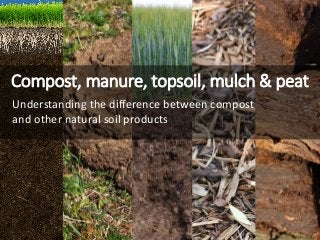
Understanding the difference between compost
and other natural soil products
Compost, manure, topsoil, mulch & peat
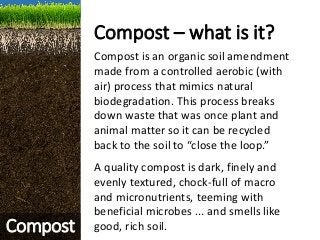
Compost – what is it?
Compost is an organic soil amendment
made from a controlled aerobic (with
air) process that mimics natural
biodegradation. This process breaks
down waste that was once plant and
animal matter so it can be recycled
back to the soil to “close the loop.”
A quality compost is dark, finely and
evenly textured, chock-full of macro
and micronutrients, teeming with
beneficial microbes ... and smells like
good, rich soil.Compost
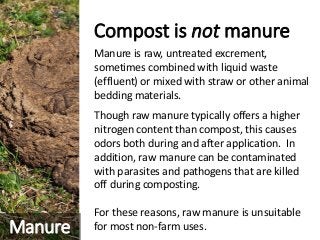
Compost is not manure
Manure is raw, untreated excrement,
sometimes combined with liquid waste
(effluent) or mixed with straw or other animal
bedding materials.
Though raw manure typically offers a higher
nitrogen content than compost, this causes
odors both during and after application. In
addition, raw manure can be contaminated
with parasites and pathogens that are killed
off during composting.
For these reasons, raw manure is unsuitable
for most non-farm uses.Manure
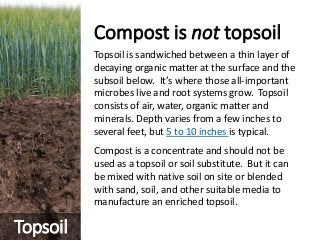
Compost is not topsoil
Topsoil is sandwiched between a thin layer of
decaying organic matter at the surface and the
subsoil below. It’s where those all-important
microbes live and root systems grow. Topsoil
consists of air, water, organic matter and
minerals. Depth varies from a few inches to
several feet, but 5 to 10 inches is typical.
Compost is a concentrate and should not be
used as a topsoil or soil substitute. But it can
be mixed with native soil on site or blended
with sand, soil, and other suitable media to
manufacture an enriched topsoil.
Topsoil
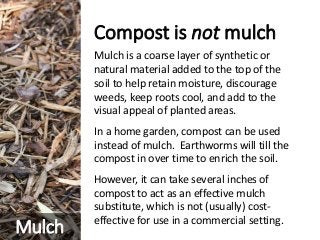
Compost is not mulch
Mulch is a coarse layer of synthetic or
natural material added to the top of the
soil to help retain moisture, discourage
weeds, keep roots cool, and add to the
visual appeal of planted areas.
In a home garden, compost can be used
instead of mulch. Earthworms will till the
compost in over time to enrich the soil.
However, it can take several inches of
compost to act as an effective mulch
substitute, which is not (usually) cost-
effective for use in a commercial setting.
Mulch
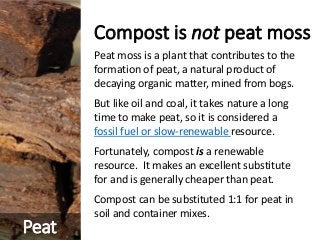
Compost is not peat moss
Peat moss is a plant that contributes to the
formation of peat, a natural product of
decaying organic matter, mined from bogs.
But like oil and coal, it takes nature a long
time to make peat, so it is considered a
fossil fuel or slow-renewable resource.
Fortunately, compost is a renewable
resource. It makes an excellent substitute
for and is generally cheaper than peat.
Compost can be substituted 1:1 for peat in
soil and container mixes.
Peat
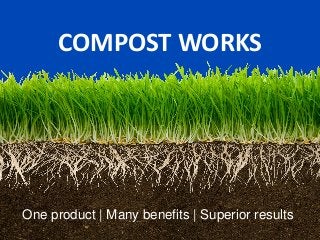
One product | Many benefits | Superior results
COMPOST WORKS
View more titles about
compost and healthy soil
here.
Production costs for this title were underwritten by
McGill. Its use is permitted for educational purposes if
presented in its entirety and without editing or other
alteration. ©McGill Environmental Systems of N.C. Inc.
Questions? Call McGill HQ at 919-362-1161 or use a
contact form at www.mcgillcompost.com.

Compost, manure, topsoil, mulch, and peat

  • 1.
    Understanding the differencebetween compost and other natural soil products Compost, manure, topsoil, mulch & peat
  • 2.
    Compost – whatis it? Compost is an organic soil amendment made from a controlled aerobic (with air) process that mimics natural biodegradation. This process breaks down waste that was once plant and animal matter so it can be recycled back to the soil to “close the loop.” A quality compost is dark, finely and evenly textured, chock-full of macro and micronutrients, teeming with beneficial microbes ... and smells like good, rich soil.Compost
  • 3.
    Compost is notmanure Manure is raw, untreated excrement, sometimes combined with liquid waste (effluent) or mixed with straw or other animal bedding materials. Though raw manure typically offers a higher nitrogen content than compost, this causes odors both during and after application. In addition, raw manure can be contaminated with parasites and pathogens that are killed off during composting. For these reasons, raw manure is unsuitable for most non-farm uses.Manure
  • 4.
    Compost is nottopsoil Topsoil is sandwiched between a thin layer of decaying organic matter at the surface and the subsoil below. It’s where those all-important microbes live and root systems grow. Topsoil consists of air, water, organic matter and minerals. Depth varies from a few inches to several feet, but 5 to 10 inches is typical. Compost is a concentrate and should not be used as a topsoil or soil substitute. But it can be mixed with native soil on site or blended with sand, soil, and other suitable media to manufacture an enriched topsoil. Topsoil
  • 5.
    Compost is notmulch Mulch is a coarse layer of synthetic or natural material added to the top of the soil to help retain moisture, discourage weeds, keep roots cool, and add to the visual appeal of planted areas. In a home garden, compost can be used instead of mulch. Earthworms will till the compost in over time to enrich the soil. However, it can take several inches of compost to act as an effective mulch substitute, which is not (usually) cost- effective for use in a commercial setting. Mulch
  • 6.
    Compost is notpeat moss Peat moss is a plant that contributes to the formation of peat, a natural product of decaying organic matter, mined from bogs. But like oil and coal, it takes nature a long time to make peat, so it is considered a fossil fuel or slow-renewable resource. Fortunately, compost is a renewable resource. It makes an excellent substitute for and is generally cheaper than peat. Compost can be substituted 1:1 for peat in soil and container mixes. Peat
  • 7.
    One product |Many benefits | Superior results COMPOST WORKS
  • 8.
    View more titlesabout compost and healthy soil here. Production costs for this title were underwritten by McGill. Its use is permitted for educational purposes if presented in its entirety and without editing or other alteration. ©McGill Environmental Systems of N.C. Inc. Questions? Call McGill HQ at 919-362-1161 or use a contact form at www.mcgillcompost.com.