Kashan is a city locates in central Iran with high potential for
the tourism industry. It is mainly renowned for its historic
houses and mosques, which are highly attractive to tourists.
A majority of these tourism points locates in two connected
neighborhoods, which we can define as a “tourism precinct.”
The tourists usually desire to walk in the precinct between
these historical key-points to experience the city’s
authenticity. However, this area doesn’t contain a network
of lively places and paths. This issue negatively affects the
city’s tourism and, accordingly, the city’s economy.
Also, it doesn’t encourage physical and social activities,
which are vital to people’s health.
I had two central questions in this study:
1. How the local communities can influence the place-
shaping process in the tourism precinct?
2. what are the fundamental principles that we should take
into account in place-shaping in tourism precincts?
Background and key challenges of the
case study
case study
Thisresearch wasatrytounderstandhowanurbandesigner
should take the concept of participation into account in
place-shaping processes.
This thesis aims to find the indicators of the procedural
and non-procedural dimensions of place-shaping, benefit
the local community’s potentials in the tourist precincts by
using the descriptive method.
The literature review consists of four area background
studies:
place, place-shaping, tourism precinct, and participation.
A review of the literature reveals two major dimensions
related to shaping the places: procedural and non-
procedural. Based on the thesis’ conceptual framework,
there are six critical areas for shaping successful places in a
tourism precinct.
Methodology and Litereture Review
Place shaping design guidelines
Place-Shaping in
Tourism Precincts
Place shaping design guidelines
Urban Design Master’s Thesis
Location: Kashan Tourism precincts,
central Iran
Year: April 2018
Supervisor: Dr. Kamran Zekavat,
zekavat.k@gmail.com, +98 21 26115793
Final Grade: Excellent (19.25/20.00)
Place shaping design guidelines
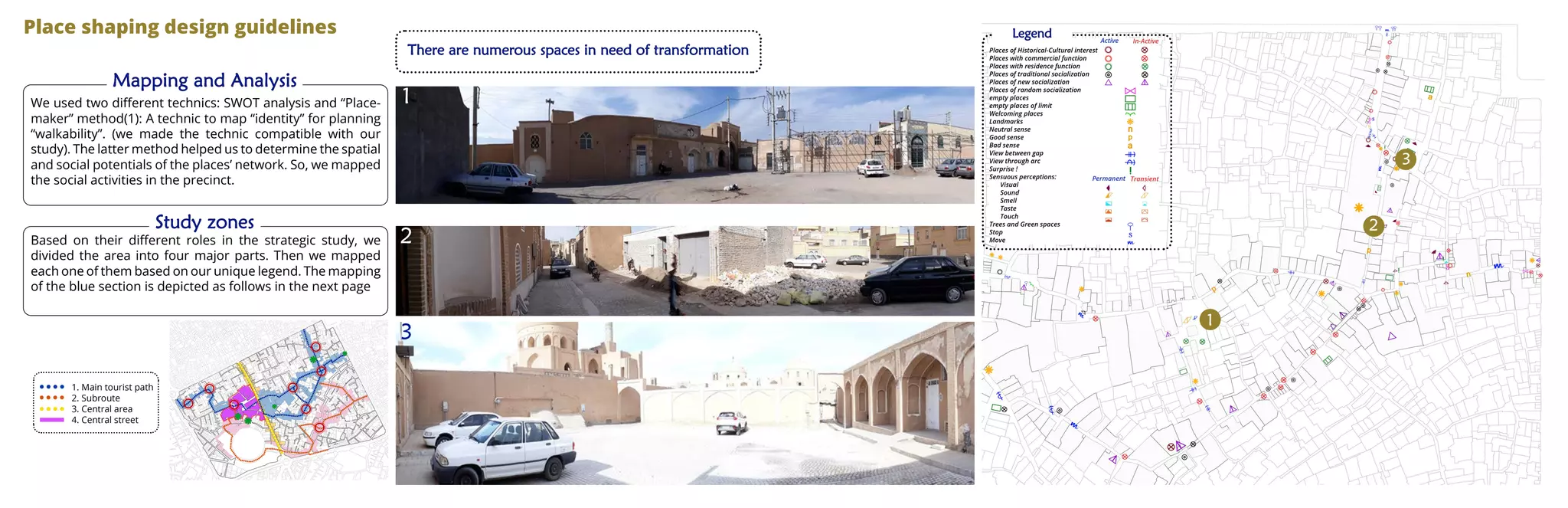
We used two different technics: SWOT analysis and “Place-
maker” method(1): A technic to map “identity” for planning
“walkability”. (we made the technic compatible with our
study). The latter method helped us to determine the spatial
and social potentials of the places’ network. So, we mapped
the social activities in the precinct.
Based on their different roles in the strategic study, we
divided the area into four major parts. Then we mapped
each one of them based on our unique legend. The mapping
of the blue section is depicted as follows in the next page
Mapping and Analysis
There are numerous spaces in need of transformation
Legend
Legend
Study zones
Study zones
3
2
1
3
2
1
Place shaping design guidelines
Based on our analysis and vision, we showed on maps, how
should we take advantage of the local potentials. So, we
introduce six areas in need of promoting their characters.
Promoting commercial/tourism role of the place
Promoting local/commercial role of the place
The opportunity of developing an economeuseum.
In need of qualitative public realm (open or semi-open)
In need of qualitative public realm (closed)
Ab anbar(historical Persian water reservoir): an opportunity
for developing new activities.
Place-based Guides for future
place-shaping
place-shaping
The guidelines for the historical tourism precinct are presenting in two procedural and non-procedural dimensions. It helps
the local authorities to achieve the goals of the local community’s perspective. We derived this vision from the “place check”
technique.
Visioning and guidlines

Place-Shaping in Tourism Precincts

  • 1.
    Kashan is acity locates in central Iran with high potential for the tourism industry. It is mainly renowned for its historic houses and mosques, which are highly attractive to tourists. A majority of these tourism points locates in two connected neighborhoods, which we can define as a “tourism precinct.” The tourists usually desire to walk in the precinct between these historical key-points to experience the city’s authenticity. However, this area doesn’t contain a network of lively places and paths. This issue negatively affects the city’s tourism and, accordingly, the city’s economy. Also, it doesn’t encourage physical and social activities, which are vital to people’s health. I had two central questions in this study: 1. How the local communities can influence the place- shaping process in the tourism precinct? 2. what are the fundamental principles that we should take into account in place-shaping in tourism precincts? Background and key challenges of the Background and key challenges of the case study case study Thisresearch wasatrytounderstandhowanurbandesigner should take the concept of participation into account in place-shaping processes. This thesis aims to find the indicators of the procedural and non-procedural dimensions of place-shaping, benefit the local community’s potentials in the tourist precincts by using the descriptive method. The literature review consists of four area background studies: place, place-shaping, tourism precinct, and participation. A review of the literature reveals two major dimensions related to shaping the places: procedural and non- procedural. Based on the thesis’ conceptual framework, there are six critical areas for shaping successful places in a tourism precinct. Methodology and Litereture Review Methodology and Litereture Review Methodology and Litereture Review Methodology and Litereture Review Place shaping design guidelines Place-Shaping in Tourism Precincts Place shaping design guidelines Urban Design Master’s Thesis Location: Kashan Tourism precincts, central Iran Year: April 2018 Supervisor: Dr. Kamran Zekavat, zekavat.k@gmail.com, +98 21 26115793 Final Grade: Excellent (19.25/20.00)
  • 2.
    Place shaping designguidelines We used two different technics: SWOT analysis and “Place- maker” method(1): A technic to map “identity” for planning “walkability”. (we made the technic compatible with our study). The latter method helped us to determine the spatial and social potentials of the places’ network. So, we mapped the social activities in the precinct. Based on their different roles in the strategic study, we divided the area into four major parts. Then we mapped each one of them based on our unique legend. The mapping of the blue section is depicted as follows in the next page Mapping and Analysis Mapping and Analysis There are numerous spaces in need of transformation There are numerous spaces in need of transformation Legend Legend Study zones Study zones 3 2 1 3 2 1
  • 3.
    Place shaping designguidelines Based on our analysis and vision, we showed on maps, how should we take advantage of the local potentials. So, we introduce six areas in need of promoting their characters. Promoting commercial/tourism role of the place Promoting local/commercial role of the place The opportunity of developing an economeuseum. In need of qualitative public realm (open or semi-open) In need of qualitative public realm (closed) Ab anbar(historical Persian water reservoir): an opportunity for developing new activities. Place-based Guides for future Place-based Guides for future place-shaping place-shaping The guidelines for the historical tourism precinct are presenting in two procedural and non-procedural dimensions. It helps the local authorities to achieve the goals of the local community’s perspective. We derived this vision from the “place check” technique. Visioning and guidlines Visioning and guidlines