Commodities Market
• What is a commodity market
• What is commodities derivative markets
• What is difference between commodity spot and
derivatives markets
• Important functions of commodities futures trading
• Commodity futures markets in India
What is a commodity?
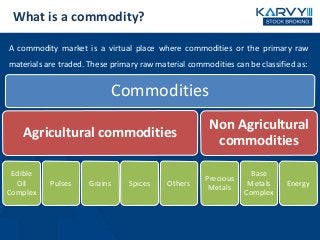
A commodity market is a virtual place where commodities or the primary raw
materials are traded. These primary raw material commodities can be classified as:
Commodities
Agricultural commodities
Edible
Oil
Complex
Pulses Grains Spices Others
Non Agricultural
commodities
Precious
Metals
Base
Metals
Complex
Energy
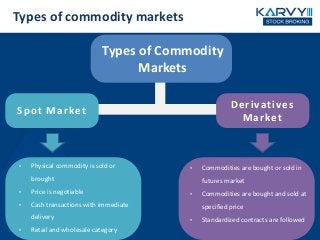
Types of commodity markets
Derivatives
Market
Spot Market
Types of Commodity
Markets
• Physical commodity is sold or
brought
• Price is negotiable
• Cash transactions with immediate
delivery
• Retail and wholesale category
• Commodities are bought or sold in
futures market
• Commodities are bought and sold at
specified price
• Standardized contracts are followed
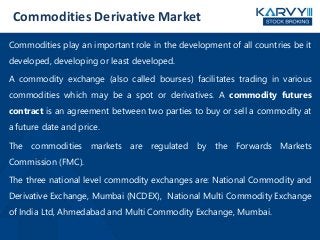
Commodities Derivative Market
Commodities play an important role in the development of all countries be it
developed, developing or least developed.
A commodity exchange (also called bourses) facilitates trading in various
commodities which may be a spot or derivatives. A commodity futures
contract is an agreement between two parties to buy or sell a commodity at
a future date and price.
The commodities markets are regulated by the Forwards Markets
Commission (FMC).
The three national level commodity exchanges are: National Commodity and
Derivative Exchange, Mumbai (NCDEX), National Multi Commodity Exchange
of India Ltd, Ahmedabad and Multi Commodity Exchange, Mumbai.
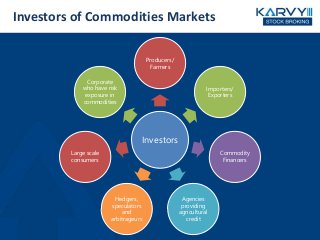
Investors of Commodities Markets
Investors
Producers/
Farmers
Importers/
Exporters
Commodity
Financers
Agencies
providing
agricultural
credit
Hedgers,
speculators
and
arbitrageurs
Large scale
consumers
Corporate
who have risk
exposure in
commodities
In Commodities future, participants agree upon a price, which is a
market estimate for the future price of the underlying commodity. This
price, also know Commodity Future Price, reflects the expectations of
both buyers and sellers for a time of delivery in the future. It may be
higher or lower than the spot price of the commodity in the spot
market
However, futures prices keep fluctuating till the last date of the futures
contract, subject to additional information about demand and supply.
This leads to two primary economic functions of commodity futures:
Price Risk Management (Hedging) and Price Discovery (Speculation).
Commodities Futures Market
Hedger hedge price risk by transferring the same to other investors
who are willing to bear such risks. Ideally, hedgers buy futures contracts
for protection against rising commodity prices and sell futures for
protection against falling prices.
Speculators trade futures contracts strictly to make profits in short run
by betting on price movements. They have no interest in taking
possession of the underlying commodity.
Commodity Futures Market in India
Commodity futures trading in India is still at its nascent stage. With multi-
commodities exchanges being set-up, a new means of investments are
open for Indian investors.
Trading in commodity futures consist of three simple steps. These include:
• Choose a right broker who can assist you accordingly. The broker
should be a member of the listed exchanges and should provide research
and analysis to its clients.
• Secure a margin amount with the broker to start investment. Margin
again is of two types: initial margin and maintenance margin.
• Stay informed and always follow a trading plan. As these investments
are basically short-term, it requires strict monitoring.
THANK YOU!
Open an Account in 15 mins
Start investing in Commodities
Visit: www.karvyonline.com

Commodities Market

  • 1.
  • 2.
    • What isa commodity market • What is commodities derivative markets • What is difference between commodity spot and derivatives markets • Important functions of commodities futures trading • Commodity futures markets in India
  • 3.
    What is acommodity? A commodity market is a virtual place where commodities or the primary raw materials are traded. These primary raw material commodities can be classified as: Commodities Agricultural commodities Edible Oil Complex Pulses Grains Spices Others Non Agricultural commodities Precious Metals Base Metals Complex Energy
  • 4.
    Types of commoditymarkets Derivatives Market Spot Market Types of Commodity Markets • Physical commodity is sold or brought • Price is negotiable • Cash transactions with immediate delivery • Retail and wholesale category • Commodities are bought or sold in futures market • Commodities are bought and sold at specified price • Standardized contracts are followed
  • 5.
    Commodities Derivative Market Commoditiesplay an important role in the development of all countries be it developed, developing or least developed. A commodity exchange (also called bourses) facilitates trading in various commodities which may be a spot or derivatives. A commodity futures contract is an agreement between two parties to buy or sell a commodity at a future date and price. The commodities markets are regulated by the Forwards Markets Commission (FMC). The three national level commodity exchanges are: National Commodity and Derivative Exchange, Mumbai (NCDEX), National Multi Commodity Exchange of India Ltd, Ahmedabad and Multi Commodity Exchange, Mumbai.
  • 6.
    Investors of CommoditiesMarkets Investors Producers/ Farmers Importers/ Exporters Commodity Financers Agencies providing agricultural credit Hedgers, speculators and arbitrageurs Large scale consumers Corporate who have risk exposure in commodities
  • 7.
    In Commodities future,participants agree upon a price, which is a market estimate for the future price of the underlying commodity. This price, also know Commodity Future Price, reflects the expectations of both buyers and sellers for a time of delivery in the future. It may be higher or lower than the spot price of the commodity in the spot market However, futures prices keep fluctuating till the last date of the futures contract, subject to additional information about demand and supply. This leads to two primary economic functions of commodity futures: Price Risk Management (Hedging) and Price Discovery (Speculation). Commodities Futures Market
  • 8.
    Hedger hedge pricerisk by transferring the same to other investors who are willing to bear such risks. Ideally, hedgers buy futures contracts for protection against rising commodity prices and sell futures for protection against falling prices. Speculators trade futures contracts strictly to make profits in short run by betting on price movements. They have no interest in taking possession of the underlying commodity.
  • 9.
    Commodity Futures Marketin India Commodity futures trading in India is still at its nascent stage. With multi- commodities exchanges being set-up, a new means of investments are open for Indian investors. Trading in commodity futures consist of three simple steps. These include: • Choose a right broker who can assist you accordingly. The broker should be a member of the listed exchanges and should provide research and analysis to its clients. • Secure a margin amount with the broker to start investment. Margin again is of two types: initial margin and maintenance margin. • Stay informed and always follow a trading plan. As these investments are basically short-term, it requires strict monitoring.
  • 10.
    THANK YOU! Open anAccount in 15 mins Start investing in Commodities Visit: www.karvyonline.com