Unit 4: Requirement Management
and Analysis
Certified Business
Analyst
Private and Confidential 2
Agenda
In this session, you will learn about:
• Creating and Using a Requirement Work Plan
• Components of a RWP
• Detailed Case Study on RWP
Private and Confidential 3
Req Analysis
& Mgmnt
Basics of Requirements
Enterprise
Analysis
Develop
BRD &
validate
sol.
BA
Planning,
Scope,
and vision
Req
Elicitation
1 2
6
5
4
3
Step 4: Requirement Management & Analysis
Private and Confidential 4
Requirement Work Plan (RWP)
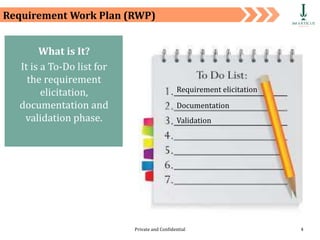
What is It?
It is a To-Do list for
the requirement
elicitation,
documentation and
validation phase.
Requirement elicitation
Documentation
Validation
Private and Confidential 5
Why Do We Need a RWP?
This plan helps the business
analyst identify all sources of
requirements, along with the
best way to elicit
requirements from these
various sources.
With this list of activities, Business Analysts
can confidently estimate tasks.
Private and Confidential 6
Requirement Work Plan (RWP)
Project Type Project Scope
Project
stakeholders
and their
role on the
project
Requirements
activities/tasks/
deliverables and
time and
duration
estimates
Identify
milestones in the
above activities
for development
and delivery of
requirements
01 02 03
04 05
Requirements
assumptions and
risks
06
Private and Confidential 7
Components Towards Drafting RWP – WBS
Work Breakdown Structure (WBS)
• It is a list of all tasks and activities to be performed.
• It defines and groups a project's discrete work elements
in a way that helps organize and define the total work
scope of the project.
Private and Confidential 8
Components Towards Drafting RWP – WBS
RESOURCES SKILLS EFFORT
What does WBS Helps Identify?
Make it as Detailed as Possible
The more
granular you
make your WBS
The easier it is to
estimate and manage
the work.
Private and Confidential 9
Components Towards Drafting RWP – WBS
It is a tree structure, which shows a subdivision of effort required to achieve an
objective; for example a program, project, and contract.
If it is to be
done, it
has to be
in WBS.
Private and Confidential 10
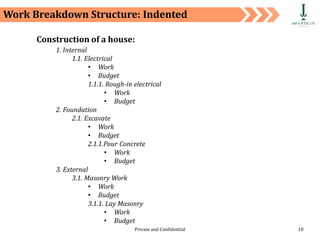
Construction of a house:
Work Breakdown Structure: Indented
1. Internal
1.1. Electrical
• Work
• Budget
1.1.1. Rough-in electrical
• Work
• Budget
2. Foundation
2.1. Excavate
• Work
• Budget
2.1.1.Pour Concrete
• Work
• Budget
3. External
3.1. Masonry Work
• Work
• Budget
3.1.1. Lay Masonry
• Work
• Budget
Private and Confidential 11
WBS Design Principles
• Includes100% of the work defined by the project scope
• Captures all deliverables – internal, external, interim (in terms
of work)
100% Rule
• No overlap in scope definition between two elements of a work
breakdown structure
Mutually Exclusive
Elements
• Not overly prescriptive of methods, allowing for greater ingenuity
and creative thinking on the part of the project participants.
• Product breakdown structure. Feature-driven software projects
Plan Outcomes;
not Actions
• No activity or series of activities should be longer than a single
reporting period
• "if it makes sense" rule.
Level of Details
• Indented
• Graphical
Coding Schemes
Requirement
Traceability and
Management
Private and Confidential 13
Requirements Traceability Definition
Business needs
with vision and
scope
Demonstrates a
clear
connection
between the
captured
requirement &
corresponding
developed
artifact
One way of
maintaining
documentation
Validates that a
requirement is
fulfilled
throughout the
development
phases
The ability to capture a requirement and then
validate that it is carried forward and implemented
Private and Confidential 14
Types of Traceability
Forward Vertical
Backward Horizontal
To map all
decomposed
components of
a work product
To map a work
product to
other work
products that
initiated it
To map all work
products to the
requirements
throughout the
Software
Development Life
Cycle (SDLC)
To map one
work product
to another one
that it initiated
Private and Confidential 15
Grade A
Requirements
Version 1
• Requirement
• Unique
Identifier
• Name
Requirements
Traceability
Traceability Matrix Flow
Requirements
Evolution
Project
Phases
Requirement
Definition
High Level
Design
Detailed
Design Implementation
Testing Deployment
Grade B Grade C Grade D Grade E
Requirements
Version 2
Requirements
Version 3-5
Requirements
Version 6
Requirements
Version 7
Final Baseline
Requirements
• Design
Documentatio
n Reference
• Business Rule
Reference
• Design
Documentation
Reference
• Business Rule
Reference
• User Acceptance
Test
• Implementation
Reference
• Testing
Reference
• UAT Tested
Reference
• Testing
Reference
• Confirmation for
complete trace
of each
requirement
Private and Confidential 16
Example of Traceability Matrix
Private and Confidential 17
Example Requirements Traceability Matrix
TRACEABILITY MATRIX
Requirement Source
Business
Need
Business
Rule
Model Test Scenario Test Case
1.1.1
Business
Strategy
X BR-054 X X
1.1.2 CEO X BR-043 X X X
1.1.3 Supplier X BR-302 X X
1.1.4 Customer X BR-129 X X X
1.1.5
Vision and
Scope
Report
X BR-137 X X
Private and Confidential 18
Traceability Links
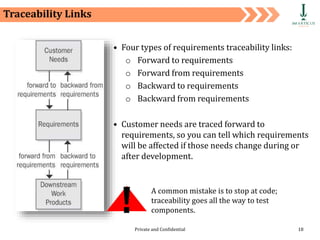
• Four types of requirements traceability links:
o Forward to requirements
o Forward from requirements
o Backward to requirements
o Backward from requirements
• Customer needs are traced forward to
requirements, so you can tell which requirements
will be affected if those needs change during or
after development.
! A common mistake is to stop at code;
traceability goes all the way to test
components.
Private and Confidential 19
Requirements Traceability Benefits
• Provides added assurance that all approved requirements have
been addressed and implemented
• Protects firms with formal documentation of tasks, issues, and
resolutions
• Facilitates the impact analysis of a change in a work product
• Aids in resolving errors that are found during testing
• Build greater efficiency in testing by identifying redundant testing
• Helps to build credibility with stakeholders and project sponsors
by ensuring the project meets their needs
Private and Confidential 20
Requirements Traceability Benefits (Contd.)
• Helps to streamline the flow of information between the user and
the development team
• Builds clarity in processes
• Improves impact analysis by reducing the probability of overlooking
a system element that would be affected by adding, deleting, or
modifying a requirement
• Facilitates making changes correctly during maintenance.
Private and Confidential 21
Requirements Traceability – Keep in Mind
Please keep in mind the following points:
Captures a
requirement and
then validates that
it is carried
forward and
implemented
Validates that a
requirement is
fulfilled
throughout the
development
phases
Demonstrates a
clear connection
between the
captured
requirement and
its corresponding
developed artifact
Maintains
documentation of
requirements
Private and Confidential 22
Requirements Management Process
The following depicts requirements development and management activities at a
high-level against the major development life cycle phases
Deploy
Analyze Design Build Test
Plan
Requirements
Baseline
Gather
Requirements
Validate
Requirements
Control Changes
Capture & Analyze Metrics
Maintain Documentation
Documentation
Metrics
Requirements Definition, Implementation Tracking and Change Control
Private and Confidential 23
Requirements Dependencies
23
Requirements evolve
throughout the project life
cycle and are refined
during the iterative
process.
Requirements
Dependencies
Private and Confidential 24
Requirements Dependencies
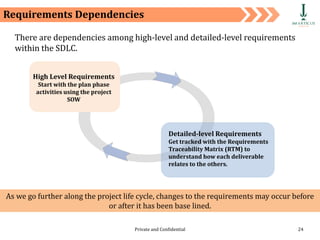
There are dependencies among high-level and detailed-level requirements
within the SDLC.
Detailed-level Requirements
Get tracked with the Requirements
Traceability Matrix (RTM) to
understand how each deliverable
relates to the others.
High Level Requirements
Start with the plan phase
activities using the project
SOW
As we go further along the project life cycle, changes to the requirements may occur before
or after it has been base lined.
Stakeholder
Management
Private and Confidential 26
Who Is A Stakeholder?
Managing the
program of
work
Working within
the program of
work
Directly or
indirectly
contributing to the
program of work
Affected by the
program of
work or its
outcomes
A Stakeholder is
anyone who is:
Private and Confidential 27
What Is Stakeholder Management?
In its simplest form, stakeholder management is the process by which an individual
establishes and maintains support from internal staff members and external parties for a
new product or project or change within the organization.
Private and Confidential 28
What Is Stakeholder Management?
Stakeholder management is the process of managing the expectation of anyone
that has an interest in a project or will be effected by its deliverables or outputs.
Private and Confidential 29
Why Do You Need to Manage?
Remember:
Most people
don’t like
change.
It’s human nature, whether
we like it or not, and we need
to work with that.
Private and Confidential 30
Why Do You Need to Manage?
We’re not managing systems here,
we’re managing human beings and
they’re made up of all sorts!
Private and Confidential 31
Why Do You Need to Manage?
Others won’t care
less about your
programme until
the day they realise
it has an affect on
them
Some will see an
opportunity and want to
see you succeed
Others will see a threat
and prefer to see your
failure
Private and Confidential 32
Stakeholder Management Process
1. Stakeholders
Identification
2. Stakeholders’
Analysis
3. Stakeholder
Matrix
4. Stakeholder
Engagement
5. Communicating
Information
Private and Confidential 33
Stakeholder Identification – Key Questions
• Who is threatening the target of this project?
• Who is most dependent on this project?
• Has there been a similar project in the market? If so, to what
extent did it succeed? Who was in charge and how did local
stakeholders respond?
• Who possesses claims – including legal jurisdiction and
customary use – over the project/resources at stake?
• Is any government departments to be involved in this project?
Private and Confidential 34
Stakeholder Identification – Few Examples
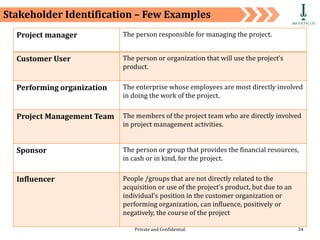
Project manager The person responsible for managing the project.
Customer User The person or organization that will use the project’s
product.
Performing organization The enterprise whose employees are most directly involved
in doing the work of the project.
Project Management Team The members of the project team who are directly involved
in project management activities.
Sponsor The person or group that provides the financial resources,
in cash or in kind, for the project.
Influencer People /groups that are not directly related to the
acquisition or use of the project’s product, but due to an
individual’s position in the customer organization or
performing organization, can influence, positively or
negatively, the course of the project
Private and Confidential 35
Stakeholder Matrix: RACI Matrix
Change Request Process RACI
Executive Sponsor A
Business Analyst R
Project Manager C
Developer I
Tester I
Application Architect C
Database Analyst C
Business Architect R
SME C
R: Responsible – does the work
A: Approver / Accountable – decision maker (CAN BE ONLY ONE)
C: Consulted – must be consulted prior to the work, provides the inputs
I: Informed – they must be notified of the outcome
Private and Confidential 36
Stakeholder Matrix (Contd.)
Power/Influence
of
Stakeholder
Interest of Stakeholder
Context Setters
Ensure Stakeholder remains
satisfied
Players
Work Closely to ensure that
they are in agreement with and
support the change
Crowd
Monitor to ensure
stakeholders interest or
influence do not change
Subjects
Keep informed; stakeholder is
likely to be very concerned and
may feel anxious about lack of
control
.
The Power/Influence vs. Interest Grid
Private and Confidential 37
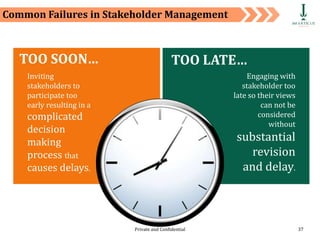
TOO SOON… TOO LATE…
Engaging with
stakeholder too
late so their views
can not be
considered
without
substantial
revision
and delay.
Common Failures in Stakeholder Management
Inviting
stakeholders to
participate too
early resulting in a
complicated
decision
making
process that
causes delays.
Private and Confidential 38
Common Failures in Stakeholder Management
Inviting the wrong
stakeholders
Treating the
participation of
stakeholders as
insignificant &
inconsequential
Inviting the wrong stakeholders to
participate thereby reducing the
value of the contribution and leaving
the door open to damaging external
criticism Resulting in poor stakeholder “buy-
in” at the implementation stage
Private and Confidential 39
Stakeholder Matrix
Stakeholder matrix are only for you and is strictly confidential
The stakeholder
analysis matrix
provides a useful
framework for plotting
stakeholders and how
best to approach them-
to persuade, influence,
or empower their
participation.
Private and Confidential 40
Objective
To describe the BA’s activities on the
project including the plans for
analyzing, communicating and
managing requirements. The aim is to
clearly communicate the activities of
the BA to the stakeholders.
Requirement Work Plan
Case study on Exploding Entire Requirement Work Plan
Insurance Claims Management System Project
Private and Confidential 41
Project Overview
The CEO of ‘ Insurance from Us ’
Ltd. believes that improved
information management will lead
to increased efficiency and
effectiveness, as well as continue to
provide outstanding customer
service.
Private and Confidential 42
Project Overview
• This is a corporate-wide strategic
initiative, involving stakeholders
and representatives from all
functional areas within the
company.
• It is referred to as the Insurance
Claims Management System
(ICMS) Project.
Private and Confidential 43
Project Overview
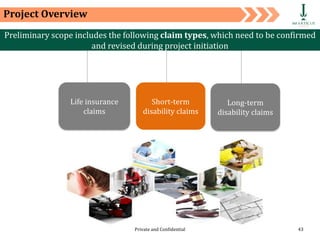
Life insurance
claims
Short-term
disability claims
Long-term
disability claims
Preliminary scope includes the following claim types, which need to be confirmed
and revised during project initiation
Private and Confidential 44
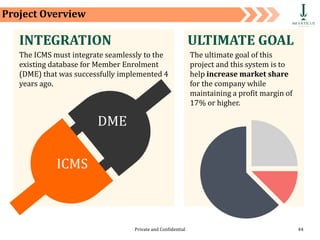
ULTIMATE GOAL
Project Overview
ICMS
DME
INTEGRATION
The ICMS must integrate seamlessly to the
existing database for Member Enrolment
(DME) that was successfully implemented 4
years ago.
The ultimate goal of this
project and this system is to
help increase market share
for the company while
maintaining a profit margin of
17% or higher.
Private and Confidential 45
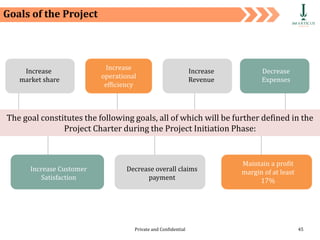
The goal constitutes the following goals, all of which will be further defined in the
Project Charter during the Project Initiation Phase:
Goals of the Project
Increase
market share
Increase
operational
efficiency
Increase
Revenue
Decrease
Expenses
Increase Customer
Satisfaction
Decrease overall claims
payment
Maintain a profit
margin of at least
17%
Private and Confidential 46
Project Overview
The CEO of
the company
will serve as
the Project
Sponsor.
The Project Manager assigned to lead
this project is Peter Parker and he
will report to Project Director
Private and Confidential 47
Project Overview
BUDGET:
$1 million
PROJECT
DURATION:
18 Months
COVERS:
Costs, including labour,
equipment and expenses
relating to the planning and
delivery of this project
PROJECT TIMELINE:
Commence on 1st
January of this year
and must complete on
31st July.
Private and Confidential 48
Organization Structure
• Project Sponsor (CEO)
• Project Director
• Project Manager
• Senior Business Analyst
plus a Junior Business
Analyst
• System Architect
• Developers
• Testers
• Trainers
• Subject Matter Experts
• Software Vendor for
software product
Private and Confidential 49
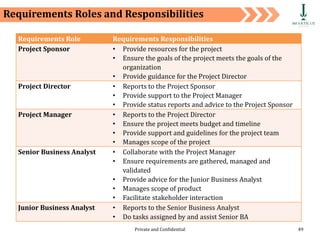
Requirements Roles and Responsibilities
Requirements Role Requirements Responsibilities
Project Sponsor • Provide resources for the project
• Ensure the goals of the project meets the goals of the
organization
• Provide guidance for the Project Director
Project Director • Reports to the Project Sponsor
• Provide support to the Project Manager
• Provide status reports and advice to the Project Sponsor
Project Manager • Reports to the Project Director
• Ensure the project meets budget and timeline
• Provide support and guidelines for the project team
• Manages scope of the project
Senior Business Analyst • Collaborate with the Project Manager
• Ensure requirements are gathered, managed and
validated
• Provide advice for the Junior Business Analyst
• Manages scope of product
• Facilitate stakeholder interaction
Junior Business Analyst • Reports to the Senior Business Analyst
• Do tasks assigned by and assist Senior BA
Private and Confidential 50
Requirements Roles and Responsibilities
Requirements Role Requirements Responsibilities
System Architect • Reports to the Project Manager
• Design the changes to the software from the COTS Vendor
to meet the requirements
• Inform the trainers on the system
Developers • Reports to the Project Manager
• Develop the project based on the architect’s solution
Testers • Reports to the Project Manager
• Provide relevant information about the software
Trainers • Reports to the Project Manager
• Train end users on how to use the
product Create training materials
Subject Matter Experts • Reports to the Project Manager
• Provide relevant information about the subject matter to
the Business Analyst and Project Manager Provide
requirements
Software Vendor • Reports to the Project Manager
• Provide the off-the-shelf software that the project
requires
Private and Confidential 51
Requirements Schedule
Phase Activity Start
Date
End
Date
Inception Elicit scope, stakeholder roles,
vision, constraints, goals
Write Vision Document
Get approval for Vision Document
Elaboration Elicit Requirements
Write Business Requirements
Document
Get approval for Business
Requirements Document
Construction Managing change
Develop test plans
Create roll-out plans
Transition Managing change
Train and support trainers *
Post-project review
Private and Confidential 52
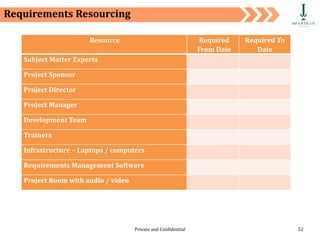
Resource Required
From Date
Required To
Date
Subject Matter Experts
Project Sponsor
Project Director
Project Manager
Development Team
Trainers
Infrastructure – Laptops / computers
Requirements Management Software
Project Room with audio / video
Requirements Resourcing
Private and Confidential 53
Below is a detailed breakdown by
phase (columns) and discipline (rows).
Inception Elaboration Construction Transition Totals
Business Modeling
Requirements
Analysis & Design
Implementation
Test
Deployment
Totals: $350,000
Budget
The total budget for all
requirements
management activities
on this project is:
$350,000
Private and Confidential 54
Tools, Techniques and Methodologies
Waterfall
Methodology
TOOLS:
• Requirements Management
Software
• Productivity Tools
(Microsoft Office Suite)
TECHNIQUES:
• Interviews
• Workshops
• Job Shadowing/Training
• Focus Groups discussions
• Document skimming
Private and Confidential 55
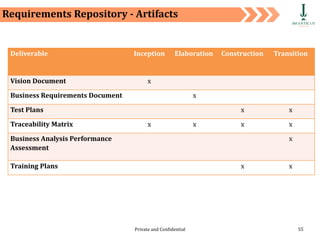
Deliverable Inception Elaboration Construction Transition
Vision Document x
Business Requirements Document x
Test Plans x x
Traceability Matrix x x x x
Business Analysis Performance
Assessment
x
Training Plans x x
Requirements Repository - Artifacts
Private and Confidential 56
Requirement Type Applicable? Rationale
Functional Requirements Y Basic reqt on Must do what it needs to
do
NFR: Look and Feel
Requirements
Y Must make users feel welcome
NFR: Usability Requirements Y Must be usable by the common user
NFR: Performance Requirements Y Bad performance frustrates users
NFR: Operational Requirements Y Must interface with existing Member
Enrolment Management System
NFR: Security Requirements Y Must keep peoples claims secure
NFR: Legal Requirements Y Must adhere to all laws
Requirements - Types
Private and Confidential 57
Requirement # Risk # Business Use
Case #
Product
Use Case
#
Sequence
Diagram
Subsystem
#
Code
Snippet
#
GUI
#
Test
Case
Requirements Traceability
Risk Management Plan
Private and Confidential 59
Risk Management Plan
Purpose:
To acknowledge that
there is risk and that
it can be dealt with.
Aim:
To plan how the risks
will be dealt with
when they occur.
Private and Confidential 60
Risk Management Strategy
• Risk identification will be done collaboratively by all members of the
project development team.
• Risks will be assigned by the Project Manager to specific individuals to
monitor and manage.
Private and Confidential 61
Responsibility and Accountability
• Risks will be assigned by the Project
Manager to specific individuals to
monitor and manage.
• The risk owner is responsible for
monitoring and managing the risk.
Private and Confidential 62
Risk
ID
Risk Type Description Consequence
(Short Term)
Business Impact
(Long Term)
Likelih
ood
Impact Level Status Risk
Mgmt
Strategy
Risk
Owner
1 Contract The vendor
is not able
to
provide
the
software at
the agreed
upon price.
The
company
would have
to find
another
vendor or
buy it at the
increased
price.
Some
requirement
might not
be able to
be put into
the product
because of
less budget
space
available.
Low Low 4 Monitoring Accept
2 Design The
product is
not used
by
customers.
The
company
loses money
on the
project.
The company
may suffer
in the stock
market
Low High 3 Monitoring Mitigate
Impact High High Low Low
Likelihood High Low High Low
Level 1 2 3 4
:
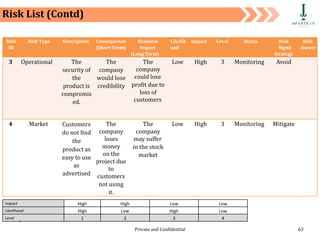
Risk List
Private and Confidential 63
Risk
ID
Risk Type Description Consequence
(Short Term)
Business
Impact
(Long Term)
Likelih
ood
Impact Level Status Risk
Mgmt
Strategy
Risk
Owner
3 Operational The
security of
the
product is
compromis
ed.
The
company
would lose
credibility
The
company
could lose
profit due to
loss of
customers
Low High 3 Monitoring Avoid
4 Market Customers
do not find
the
product as
easy to use
as
advertised
The
company
loses
money
on the
project due
to
customers
not using
it.
The
company
may suffer
in the stock
market
Low High 3 Monitoring Mitigate
Impact High High Low Low
Likelihood High Low High Low
Level 1 2 3 4
:
Risk List (Contd)
Requirements
Acceptance Plan
Private and Confidential 65
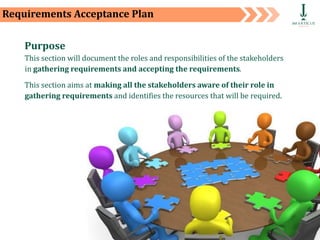
Requirements Acceptance Plan
Purpose
This section will document the roles and responsibilities of the stakeholders
in gathering requirements and accepting the requirements.
This section aims at making all the stakeholders aware of their role in
gathering requirements and identifies the resources that will be required.
Private and Confidential 66
Requirements Acceptance Responsibilities
For each of the categories on the next slide, consider filling in one or
more of the letters below as appropriate:
RESPONSIBLE
A
R
ACCOUNTABLE
S SUPPORT
C
CONSULTED
I
INFORMED
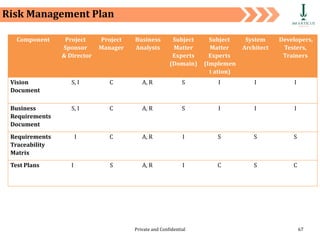
Private and Confidential 67
Component Project
Sponsor
& Director
Project
Manager
Business
Analysts
Subject
Matter
Experts
(Domain)
Subject
Matter
Experts
(Implemen
t ation)
System
Architect
Developers,
Testers,
Trainers
Vision
Document
S, I C A, R S I I I
Business
Requirements
Document
S, I C A, R S I I I
Requirements
Traceability
Matrix
I C A, R I S S S
Test Plans I S A, R I C S C
Risk Management Plan
Private and Confidential 68
Acceptance Criteria Comments
Each requirement shall be measurable To determine if the requirement has been met
Each requirement will be unique, that is,
not duplicated
To save time in development by avoiding
Duplicity
Each requirement shall be unambiguous No ambiguity in the interpretation of the
requirement
Each requirement shall be tied to a project
goal
Each requirement must aid the project goal
Each requirement shall be logged in the
traceability matrix
To know that the requirement has been
implemented
The BRD shall be approved before build
begins
Sufficient understanding of the project and
what it needs to do
The BRD shall be completed before being
submitted for approval
No requirement will be missed in being
approved
Requirements Acceptance Criteria & Schedule
Private and Confidential 69
Component Target
Sign-Off
Date
Sign-Off By
(Name)
Vision & Scope Document Project Sponsor
Business Requirements
Document
Project Sponsor
Test Plans Project Manager
Requirements Acceptance Criteria & Schedule
Change Management Plan
Private and Confidential 71
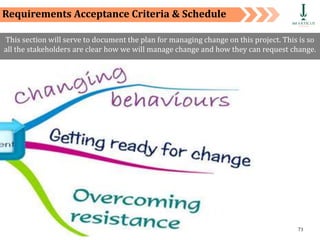
Requirements Acceptance Criteria & Schedule
This section will serve to document the plan for managing change on this project. This is so
all the stakeholders are clear how we will manage change and how they can request change.
Private and Confidential 72
The responsibilities of the stakeholders and Change Control Board members in
the change management process include:
Role Duties
Change Control Board (CCB) • Conduct an initial impact assessment
• Make decisions to approve or reject changes
• Assure that change requests are processed in a timely manner
Project Manager (Chair of the
CCB)
• Performs duties of the CCB (see above)
• Chair the CCB
• Resolve disputes over change approval
• Assess emergency change requests, with input from the other CCB
members
Business Analyst (Member of
CCB)
• Performs duties of the CCB
• Take CCB MOM and log change requests
• Perform impact assessments assigned by the CCB
Business • Identify potential change
• Complete and submit change request form
Change Request Roles and Responsibilities
Private and Confidential 73
Change Request Procedure
Procedure for submitting, assessing and approving change requests:
The change is identified
Business will complete and submit a
change request form to the CCB
The BA will log the change request in
the change request register
If the CCB assigns someone to
perform a more in-depth
assessment, the person will bring
the results to the next CCB
meeting.
The CCB will make a decision
based on the in-depth assessment.
CCB will process change requests
as soon as possible.*
The CCB will
perform an initial
assessment of the
request and take 1
of 3 actions:
• Approve the
request
• Reject the request
Assign a specific
CCB member to
perform a more
in-depth impact
assessment
* However, they reserve the right to prioritize change requests
and defer specific change decisions to allow a timelier
processing of urgent requests.
Requirement
Management
Metrics Plan
Private and Confidential 75
Requirements Acceptance Criteria & Schedule
The purpose is to plan out how we are going to measure our work.
The purpose of this
planning is to ensure that
work is measured and
stakeholders are informed
on how we will measure
ourselves.
Private and Confidential 76
Requirements Management Goals
Goal Rationale Measurement
Define requirements
completely
So that no requirement of
the system is missed
Compare what the sponsor
wanted it to do with what it
does
Define requirements
clearly
So that the requirements are
clearly understood
Count how many times
requirements must be
rewritten
Minimize scope creep So that the project remains
in scope
If you are able to fully trace
a requirement backwards
and forwards
Work within budget So that the project budget is
not compromised by the BA
budget being over
Compare the actual budget
to the planned budget
Work within schedule
estimates
To keep the project on
schedule and time
constraints
Compare the time taken to
the scheduled time
The overall goals for collecting metrics:
Communication Plan
Private and Confidential 78
Communication Plan
Questions to consider to develop a plan for communication of any sort
What
What’s your
purpose?
What’s your
message?
Who
Who’s your
audience?
How
How will you
actually
distribute your
message?
Private and Confidential 79
Communication Plan
Constituents of a Communication Plan
The project team
will use a mix of
verbal and written
communication.
Consider what type
of communication
to use to reduce
misunderstandings
and wasted time.
The business analyst
will monitor the
internal and external
communication plan.
Private and Confidential 80
Communications Management Approach
• The project team is going to use a mix of verbal and written
communication, verbal being in the form of face-to-face and telephone.
• We plan to carefully consider what type of communication to use to reduce
misunderstandings and wasted time.
• The senior business analyst will monitor the communication plan.
Private and Confidential 81
External Communication
Type Purpose Responsibility Distribution Media Timing /
Freq.
Templates
Workshop
Invitation
Invite
attendees
Junior
Business
Analysts
All attendees Word &
Mail
(possible
phone
follow-up)
As needed Invitation
template,
letter
format
Private and Confidential 82
Name Position Escalation
Point
Area of Focus Contact
Information
Dicky Johnson Director, Benefit
Programs &
Services
Project Manager Benefit
Programs &
Services
780.454.5454
Ian Flaming Director,
Corporate
Services
Project Manager Corporate
Services
780.444.1000
Escalation Contacts
Private and Confidential 83
Communications Management Approach
Type Purpose Responsibility Distribution Media Timing / Freq. Templates
Vision
Document
Defines scope
and vision
Senior
Business
Analyst
All
Stakeholders
Word
Documenta
tion &
Email
Inception Phase Vision
Document
Template
Business
Requirements
Document
Defines
project
requirements
Senior
Business
Analyst
All
stakeholders
Word
Documenta
tion &
Email
Elaboration
Phase
BRD
Template
Requirements
Work Plan
Defines how
the
requirements
will be
gathered
Senior
Business
Analyst
Project
Manager,
Sponsor, BA
Team
Word
Documenta
tion
& Email
Inception Phase Requiremen
ts
Work Plan
Template
Communications Management Approach – Internal Communications
Private and Confidential 84
Communications Management Approach
Type Purpose Responsibility Distribution Media Timing / Freq. Templates
Traceability
Matrix
Shows the
relationship of
requirements to
other objects
Senior
Business
Analyst
Team
members
Email,
Online
Repository
Throughout the
project
Traceability
Table
Meeting
Requests
Invite attendees Junior
Business
Analyst
Meeting
attendees
Email As needed None
Meeting
Minutes
Define what
happened in the
meeting
Junior
Business
Analyst
Meeting
attendees
Email As needed None
Meeting
Agendas
Define what is
planned for a
meeting
Junior
Business
Analyst
Meeting
attendees
Word
Documenta
tion, Email
As needed None
Requirements
Status Reports
To report the
status of
requirements
Junior
Business
Analyst
Team
members
Online
Repository
Throughout the
project
Requiremen
ts Status
Table
Communications Management Approach – Internal Communications
&
Thank
You
For Your
Attention

Req.Management & Analysis.pptx

  • 1.
    Unit 4: RequirementManagement and Analysis Certified Business Analyst
  • 2.
    Private and Confidential2 Agenda In this session, you will learn about: • Creating and Using a Requirement Work Plan • Components of a RWP • Detailed Case Study on RWP
  • 3.
    Private and Confidential3 Req Analysis & Mgmnt Basics of Requirements Enterprise Analysis Develop BRD & validate sol. BA Planning, Scope, and vision Req Elicitation 1 2 6 5 4 3 Step 4: Requirement Management & Analysis
  • 4.
    Private and Confidential4 Requirement Work Plan (RWP) What is It? It is a To-Do list for the requirement elicitation, documentation and validation phase. Requirement elicitation Documentation Validation
  • 5.
    Private and Confidential5 Why Do We Need a RWP? This plan helps the business analyst identify all sources of requirements, along with the best way to elicit requirements from these various sources. With this list of activities, Business Analysts can confidently estimate tasks.
  • 6.
    Private and Confidential6 Requirement Work Plan (RWP) Project Type Project Scope Project stakeholders and their role on the project Requirements activities/tasks/ deliverables and time and duration estimates Identify milestones in the above activities for development and delivery of requirements 01 02 03 04 05 Requirements assumptions and risks 06
  • 7.
    Private and Confidential7 Components Towards Drafting RWP – WBS Work Breakdown Structure (WBS) • It is a list of all tasks and activities to be performed. • It defines and groups a project's discrete work elements in a way that helps organize and define the total work scope of the project.
  • 8.
    Private and Confidential8 Components Towards Drafting RWP – WBS RESOURCES SKILLS EFFORT What does WBS Helps Identify? Make it as Detailed as Possible The more granular you make your WBS The easier it is to estimate and manage the work.
  • 9.
    Private and Confidential9 Components Towards Drafting RWP – WBS It is a tree structure, which shows a subdivision of effort required to achieve an objective; for example a program, project, and contract. If it is to be done, it has to be in WBS.
  • 10.
    Private and Confidential10 Construction of a house: Work Breakdown Structure: Indented 1. Internal 1.1. Electrical • Work • Budget 1.1.1. Rough-in electrical • Work • Budget 2. Foundation 2.1. Excavate • Work • Budget 2.1.1.Pour Concrete • Work • Budget 3. External 3.1. Masonry Work • Work • Budget 3.1.1. Lay Masonry • Work • Budget
  • 11.
    Private and Confidential11 WBS Design Principles • Includes100% of the work defined by the project scope • Captures all deliverables – internal, external, interim (in terms of work) 100% Rule • No overlap in scope definition between two elements of a work breakdown structure Mutually Exclusive Elements • Not overly prescriptive of methods, allowing for greater ingenuity and creative thinking on the part of the project participants. • Product breakdown structure. Feature-driven software projects Plan Outcomes; not Actions • No activity or series of activities should be longer than a single reporting period • "if it makes sense" rule. Level of Details • Indented • Graphical Coding Schemes
  • 12.
  • 13.
    Private and Confidential13 Requirements Traceability Definition Business needs with vision and scope Demonstrates a clear connection between the captured requirement & corresponding developed artifact One way of maintaining documentation Validates that a requirement is fulfilled throughout the development phases The ability to capture a requirement and then validate that it is carried forward and implemented
  • 14.
    Private and Confidential14 Types of Traceability Forward Vertical Backward Horizontal To map all decomposed components of a work product To map a work product to other work products that initiated it To map all work products to the requirements throughout the Software Development Life Cycle (SDLC) To map one work product to another one that it initiated
  • 15.
    Private and Confidential15 Grade A Requirements Version 1 • Requirement • Unique Identifier • Name Requirements Traceability Traceability Matrix Flow Requirements Evolution Project Phases Requirement Definition High Level Design Detailed Design Implementation Testing Deployment Grade B Grade C Grade D Grade E Requirements Version 2 Requirements Version 3-5 Requirements Version 6 Requirements Version 7 Final Baseline Requirements • Design Documentatio n Reference • Business Rule Reference • Design Documentation Reference • Business Rule Reference • User Acceptance Test • Implementation Reference • Testing Reference • UAT Tested Reference • Testing Reference • Confirmation for complete trace of each requirement
  • 16.
    Private and Confidential16 Example of Traceability Matrix
  • 17.
    Private and Confidential17 Example Requirements Traceability Matrix TRACEABILITY MATRIX Requirement Source Business Need Business Rule Model Test Scenario Test Case 1.1.1 Business Strategy X BR-054 X X 1.1.2 CEO X BR-043 X X X 1.1.3 Supplier X BR-302 X X 1.1.4 Customer X BR-129 X X X 1.1.5 Vision and Scope Report X BR-137 X X
  • 18.
    Private and Confidential18 Traceability Links • Four types of requirements traceability links: o Forward to requirements o Forward from requirements o Backward to requirements o Backward from requirements • Customer needs are traced forward to requirements, so you can tell which requirements will be affected if those needs change during or after development. ! A common mistake is to stop at code; traceability goes all the way to test components.
  • 19.
    Private and Confidential19 Requirements Traceability Benefits • Provides added assurance that all approved requirements have been addressed and implemented • Protects firms with formal documentation of tasks, issues, and resolutions • Facilitates the impact analysis of a change in a work product • Aids in resolving errors that are found during testing • Build greater efficiency in testing by identifying redundant testing • Helps to build credibility with stakeholders and project sponsors by ensuring the project meets their needs
  • 20.
    Private and Confidential20 Requirements Traceability Benefits (Contd.) • Helps to streamline the flow of information between the user and the development team • Builds clarity in processes • Improves impact analysis by reducing the probability of overlooking a system element that would be affected by adding, deleting, or modifying a requirement • Facilitates making changes correctly during maintenance.
  • 21.
    Private and Confidential21 Requirements Traceability – Keep in Mind Please keep in mind the following points: Captures a requirement and then validates that it is carried forward and implemented Validates that a requirement is fulfilled throughout the development phases Demonstrates a clear connection between the captured requirement and its corresponding developed artifact Maintains documentation of requirements
  • 22.
    Private and Confidential22 Requirements Management Process The following depicts requirements development and management activities at a high-level against the major development life cycle phases Deploy Analyze Design Build Test Plan Requirements Baseline Gather Requirements Validate Requirements Control Changes Capture & Analyze Metrics Maintain Documentation Documentation Metrics Requirements Definition, Implementation Tracking and Change Control
  • 23.
    Private and Confidential23 Requirements Dependencies 23 Requirements evolve throughout the project life cycle and are refined during the iterative process. Requirements Dependencies
  • 24.
    Private and Confidential24 Requirements Dependencies There are dependencies among high-level and detailed-level requirements within the SDLC. Detailed-level Requirements Get tracked with the Requirements Traceability Matrix (RTM) to understand how each deliverable relates to the others. High Level Requirements Start with the plan phase activities using the project SOW As we go further along the project life cycle, changes to the requirements may occur before or after it has been base lined.
  • 25.
  • 26.
    Private and Confidential26 Who Is A Stakeholder? Managing the program of work Working within the program of work Directly or indirectly contributing to the program of work Affected by the program of work or its outcomes A Stakeholder is anyone who is:
  • 27.
    Private and Confidential27 What Is Stakeholder Management? In its simplest form, stakeholder management is the process by which an individual establishes and maintains support from internal staff members and external parties for a new product or project or change within the organization.
  • 28.
    Private and Confidential28 What Is Stakeholder Management? Stakeholder management is the process of managing the expectation of anyone that has an interest in a project or will be effected by its deliverables or outputs.
  • 29.
    Private and Confidential29 Why Do You Need to Manage? Remember: Most people don’t like change. It’s human nature, whether we like it or not, and we need to work with that.
  • 30.
    Private and Confidential30 Why Do You Need to Manage? We’re not managing systems here, we’re managing human beings and they’re made up of all sorts!
  • 31.
    Private and Confidential31 Why Do You Need to Manage? Others won’t care less about your programme until the day they realise it has an affect on them Some will see an opportunity and want to see you succeed Others will see a threat and prefer to see your failure
  • 32.
    Private and Confidential32 Stakeholder Management Process 1. Stakeholders Identification 2. Stakeholders’ Analysis 3. Stakeholder Matrix 4. Stakeholder Engagement 5. Communicating Information
  • 33.
    Private and Confidential33 Stakeholder Identification – Key Questions • Who is threatening the target of this project? • Who is most dependent on this project? • Has there been a similar project in the market? If so, to what extent did it succeed? Who was in charge and how did local stakeholders respond? • Who possesses claims – including legal jurisdiction and customary use – over the project/resources at stake? • Is any government departments to be involved in this project?
  • 34.
    Private and Confidential34 Stakeholder Identification – Few Examples Project manager The person responsible for managing the project. Customer User The person or organization that will use the project’s product. Performing organization The enterprise whose employees are most directly involved in doing the work of the project. Project Management Team The members of the project team who are directly involved in project management activities. Sponsor The person or group that provides the financial resources, in cash or in kind, for the project. Influencer People /groups that are not directly related to the acquisition or use of the project’s product, but due to an individual’s position in the customer organization or performing organization, can influence, positively or negatively, the course of the project
  • 35.
    Private and Confidential35 Stakeholder Matrix: RACI Matrix Change Request Process RACI Executive Sponsor A Business Analyst R Project Manager C Developer I Tester I Application Architect C Database Analyst C Business Architect R SME C R: Responsible – does the work A: Approver / Accountable – decision maker (CAN BE ONLY ONE) C: Consulted – must be consulted prior to the work, provides the inputs I: Informed – they must be notified of the outcome
  • 36.
    Private and Confidential36 Stakeholder Matrix (Contd.) Power/Influence of Stakeholder Interest of Stakeholder Context Setters Ensure Stakeholder remains satisfied Players Work Closely to ensure that they are in agreement with and support the change Crowd Monitor to ensure stakeholders interest or influence do not change Subjects Keep informed; stakeholder is likely to be very concerned and may feel anxious about lack of control . The Power/Influence vs. Interest Grid
  • 37.
    Private and Confidential37 TOO SOON… TOO LATE… Engaging with stakeholder too late so their views can not be considered without substantial revision and delay. Common Failures in Stakeholder Management Inviting stakeholders to participate too early resulting in a complicated decision making process that causes delays.
  • 38.
    Private and Confidential38 Common Failures in Stakeholder Management Inviting the wrong stakeholders Treating the participation of stakeholders as insignificant & inconsequential Inviting the wrong stakeholders to participate thereby reducing the value of the contribution and leaving the door open to damaging external criticism Resulting in poor stakeholder “buy- in” at the implementation stage
  • 39.
    Private and Confidential39 Stakeholder Matrix Stakeholder matrix are only for you and is strictly confidential The stakeholder analysis matrix provides a useful framework for plotting stakeholders and how best to approach them- to persuade, influence, or empower their participation.
  • 40.
    Private and Confidential40 Objective To describe the BA’s activities on the project including the plans for analyzing, communicating and managing requirements. The aim is to clearly communicate the activities of the BA to the stakeholders. Requirement Work Plan Case study on Exploding Entire Requirement Work Plan Insurance Claims Management System Project
  • 41.
    Private and Confidential41 Project Overview The CEO of ‘ Insurance from Us ’ Ltd. believes that improved information management will lead to increased efficiency and effectiveness, as well as continue to provide outstanding customer service.
  • 42.
    Private and Confidential42 Project Overview • This is a corporate-wide strategic initiative, involving stakeholders and representatives from all functional areas within the company. • It is referred to as the Insurance Claims Management System (ICMS) Project.
  • 43.
    Private and Confidential43 Project Overview Life insurance claims Short-term disability claims Long-term disability claims Preliminary scope includes the following claim types, which need to be confirmed and revised during project initiation
  • 44.
    Private and Confidential44 ULTIMATE GOAL Project Overview ICMS DME INTEGRATION The ICMS must integrate seamlessly to the existing database for Member Enrolment (DME) that was successfully implemented 4 years ago. The ultimate goal of this project and this system is to help increase market share for the company while maintaining a profit margin of 17% or higher.
  • 45.
    Private and Confidential45 The goal constitutes the following goals, all of which will be further defined in the Project Charter during the Project Initiation Phase: Goals of the Project Increase market share Increase operational efficiency Increase Revenue Decrease Expenses Increase Customer Satisfaction Decrease overall claims payment Maintain a profit margin of at least 17%
  • 46.
    Private and Confidential46 Project Overview The CEO of the company will serve as the Project Sponsor. The Project Manager assigned to lead this project is Peter Parker and he will report to Project Director
  • 47.
    Private and Confidential47 Project Overview BUDGET: $1 million PROJECT DURATION: 18 Months COVERS: Costs, including labour, equipment and expenses relating to the planning and delivery of this project PROJECT TIMELINE: Commence on 1st January of this year and must complete on 31st July.
  • 48.
    Private and Confidential48 Organization Structure • Project Sponsor (CEO) • Project Director • Project Manager • Senior Business Analyst plus a Junior Business Analyst • System Architect • Developers • Testers • Trainers • Subject Matter Experts • Software Vendor for software product
  • 49.
    Private and Confidential49 Requirements Roles and Responsibilities Requirements Role Requirements Responsibilities Project Sponsor • Provide resources for the project • Ensure the goals of the project meets the goals of the organization • Provide guidance for the Project Director Project Director • Reports to the Project Sponsor • Provide support to the Project Manager • Provide status reports and advice to the Project Sponsor Project Manager • Reports to the Project Director • Ensure the project meets budget and timeline • Provide support and guidelines for the project team • Manages scope of the project Senior Business Analyst • Collaborate with the Project Manager • Ensure requirements are gathered, managed and validated • Provide advice for the Junior Business Analyst • Manages scope of product • Facilitate stakeholder interaction Junior Business Analyst • Reports to the Senior Business Analyst • Do tasks assigned by and assist Senior BA
  • 50.
    Private and Confidential50 Requirements Roles and Responsibilities Requirements Role Requirements Responsibilities System Architect • Reports to the Project Manager • Design the changes to the software from the COTS Vendor to meet the requirements • Inform the trainers on the system Developers • Reports to the Project Manager • Develop the project based on the architect’s solution Testers • Reports to the Project Manager • Provide relevant information about the software Trainers • Reports to the Project Manager • Train end users on how to use the product Create training materials Subject Matter Experts • Reports to the Project Manager • Provide relevant information about the subject matter to the Business Analyst and Project Manager Provide requirements Software Vendor • Reports to the Project Manager • Provide the off-the-shelf software that the project requires
  • 51.
    Private and Confidential51 Requirements Schedule Phase Activity Start Date End Date Inception Elicit scope, stakeholder roles, vision, constraints, goals Write Vision Document Get approval for Vision Document Elaboration Elicit Requirements Write Business Requirements Document Get approval for Business Requirements Document Construction Managing change Develop test plans Create roll-out plans Transition Managing change Train and support trainers * Post-project review
  • 52.
    Private and Confidential52 Resource Required From Date Required To Date Subject Matter Experts Project Sponsor Project Director Project Manager Development Team Trainers Infrastructure – Laptops / computers Requirements Management Software Project Room with audio / video Requirements Resourcing
  • 53.
    Private and Confidential53 Below is a detailed breakdown by phase (columns) and discipline (rows). Inception Elaboration Construction Transition Totals Business Modeling Requirements Analysis & Design Implementation Test Deployment Totals: $350,000 Budget The total budget for all requirements management activities on this project is: $350,000
  • 54.
    Private and Confidential54 Tools, Techniques and Methodologies Waterfall Methodology TOOLS: • Requirements Management Software • Productivity Tools (Microsoft Office Suite) TECHNIQUES: • Interviews • Workshops • Job Shadowing/Training • Focus Groups discussions • Document skimming
  • 55.
    Private and Confidential55 Deliverable Inception Elaboration Construction Transition Vision Document x Business Requirements Document x Test Plans x x Traceability Matrix x x x x Business Analysis Performance Assessment x Training Plans x x Requirements Repository - Artifacts
  • 56.
    Private and Confidential56 Requirement Type Applicable? Rationale Functional Requirements Y Basic reqt on Must do what it needs to do NFR: Look and Feel Requirements Y Must make users feel welcome NFR: Usability Requirements Y Must be usable by the common user NFR: Performance Requirements Y Bad performance frustrates users NFR: Operational Requirements Y Must interface with existing Member Enrolment Management System NFR: Security Requirements Y Must keep peoples claims secure NFR: Legal Requirements Y Must adhere to all laws Requirements - Types
  • 57.
    Private and Confidential57 Requirement # Risk # Business Use Case # Product Use Case # Sequence Diagram Subsystem # Code Snippet # GUI # Test Case Requirements Traceability
  • 58.
  • 59.
    Private and Confidential59 Risk Management Plan Purpose: To acknowledge that there is risk and that it can be dealt with. Aim: To plan how the risks will be dealt with when they occur.
  • 60.
    Private and Confidential60 Risk Management Strategy • Risk identification will be done collaboratively by all members of the project development team. • Risks will be assigned by the Project Manager to specific individuals to monitor and manage.
  • 61.
    Private and Confidential61 Responsibility and Accountability • Risks will be assigned by the Project Manager to specific individuals to monitor and manage. • The risk owner is responsible for monitoring and managing the risk.
  • 62.
    Private and Confidential62 Risk ID Risk Type Description Consequence (Short Term) Business Impact (Long Term) Likelih ood Impact Level Status Risk Mgmt Strategy Risk Owner 1 Contract The vendor is not able to provide the software at the agreed upon price. The company would have to find another vendor or buy it at the increased price. Some requirement might not be able to be put into the product because of less budget space available. Low Low 4 Monitoring Accept 2 Design The product is not used by customers. The company loses money on the project. The company may suffer in the stock market Low High 3 Monitoring Mitigate Impact High High Low Low Likelihood High Low High Low Level 1 2 3 4 : Risk List
  • 63.
    Private and Confidential63 Risk ID Risk Type Description Consequence (Short Term) Business Impact (Long Term) Likelih ood Impact Level Status Risk Mgmt Strategy Risk Owner 3 Operational The security of the product is compromis ed. The company would lose credibility The company could lose profit due to loss of customers Low High 3 Monitoring Avoid 4 Market Customers do not find the product as easy to use as advertised The company loses money on the project due to customers not using it. The company may suffer in the stock market Low High 3 Monitoring Mitigate Impact High High Low Low Likelihood High Low High Low Level 1 2 3 4 : Risk List (Contd)
  • 64.
  • 65.
    Private and Confidential65 Requirements Acceptance Plan Purpose This section will document the roles and responsibilities of the stakeholders in gathering requirements and accepting the requirements. This section aims at making all the stakeholders aware of their role in gathering requirements and identifies the resources that will be required.
  • 66.
    Private and Confidential66 Requirements Acceptance Responsibilities For each of the categories on the next slide, consider filling in one or more of the letters below as appropriate: RESPONSIBLE A R ACCOUNTABLE S SUPPORT C CONSULTED I INFORMED
  • 67.
    Private and Confidential67 Component Project Sponsor & Director Project Manager Business Analysts Subject Matter Experts (Domain) Subject Matter Experts (Implemen t ation) System Architect Developers, Testers, Trainers Vision Document S, I C A, R S I I I Business Requirements Document S, I C A, R S I I I Requirements Traceability Matrix I C A, R I S S S Test Plans I S A, R I C S C Risk Management Plan
  • 68.
    Private and Confidential68 Acceptance Criteria Comments Each requirement shall be measurable To determine if the requirement has been met Each requirement will be unique, that is, not duplicated To save time in development by avoiding Duplicity Each requirement shall be unambiguous No ambiguity in the interpretation of the requirement Each requirement shall be tied to a project goal Each requirement must aid the project goal Each requirement shall be logged in the traceability matrix To know that the requirement has been implemented The BRD shall be approved before build begins Sufficient understanding of the project and what it needs to do The BRD shall be completed before being submitted for approval No requirement will be missed in being approved Requirements Acceptance Criteria & Schedule
  • 69.
    Private and Confidential69 Component Target Sign-Off Date Sign-Off By (Name) Vision & Scope Document Project Sponsor Business Requirements Document Project Sponsor Test Plans Project Manager Requirements Acceptance Criteria & Schedule
  • 70.
  • 71.
    Private and Confidential71 Requirements Acceptance Criteria & Schedule This section will serve to document the plan for managing change on this project. This is so all the stakeholders are clear how we will manage change and how they can request change.
  • 72.
    Private and Confidential72 The responsibilities of the stakeholders and Change Control Board members in the change management process include: Role Duties Change Control Board (CCB) • Conduct an initial impact assessment • Make decisions to approve or reject changes • Assure that change requests are processed in a timely manner Project Manager (Chair of the CCB) • Performs duties of the CCB (see above) • Chair the CCB • Resolve disputes over change approval • Assess emergency change requests, with input from the other CCB members Business Analyst (Member of CCB) • Performs duties of the CCB • Take CCB MOM and log change requests • Perform impact assessments assigned by the CCB Business • Identify potential change • Complete and submit change request form Change Request Roles and Responsibilities
  • 73.
    Private and Confidential73 Change Request Procedure Procedure for submitting, assessing and approving change requests: The change is identified Business will complete and submit a change request form to the CCB The BA will log the change request in the change request register If the CCB assigns someone to perform a more in-depth assessment, the person will bring the results to the next CCB meeting. The CCB will make a decision based on the in-depth assessment. CCB will process change requests as soon as possible.* The CCB will perform an initial assessment of the request and take 1 of 3 actions: • Approve the request • Reject the request Assign a specific CCB member to perform a more in-depth impact assessment * However, they reserve the right to prioritize change requests and defer specific change decisions to allow a timelier processing of urgent requests.
  • 74.
  • 75.
    Private and Confidential75 Requirements Acceptance Criteria & Schedule The purpose is to plan out how we are going to measure our work. The purpose of this planning is to ensure that work is measured and stakeholders are informed on how we will measure ourselves.
  • 76.
    Private and Confidential76 Requirements Management Goals Goal Rationale Measurement Define requirements completely So that no requirement of the system is missed Compare what the sponsor wanted it to do with what it does Define requirements clearly So that the requirements are clearly understood Count how many times requirements must be rewritten Minimize scope creep So that the project remains in scope If you are able to fully trace a requirement backwards and forwards Work within budget So that the project budget is not compromised by the BA budget being over Compare the actual budget to the planned budget Work within schedule estimates To keep the project on schedule and time constraints Compare the time taken to the scheduled time The overall goals for collecting metrics:
  • 77.
  • 78.
    Private and Confidential78 Communication Plan Questions to consider to develop a plan for communication of any sort What What’s your purpose? What’s your message? Who Who’s your audience? How How will you actually distribute your message?
  • 79.
    Private and Confidential79 Communication Plan Constituents of a Communication Plan The project team will use a mix of verbal and written communication. Consider what type of communication to use to reduce misunderstandings and wasted time. The business analyst will monitor the internal and external communication plan.
  • 80.
    Private and Confidential80 Communications Management Approach • The project team is going to use a mix of verbal and written communication, verbal being in the form of face-to-face and telephone. • We plan to carefully consider what type of communication to use to reduce misunderstandings and wasted time. • The senior business analyst will monitor the communication plan.
  • 81.
    Private and Confidential81 External Communication Type Purpose Responsibility Distribution Media Timing / Freq. Templates Workshop Invitation Invite attendees Junior Business Analysts All attendees Word & Mail (possible phone follow-up) As needed Invitation template, letter format
  • 82.
    Private and Confidential82 Name Position Escalation Point Area of Focus Contact Information Dicky Johnson Director, Benefit Programs & Services Project Manager Benefit Programs & Services 780.454.5454 Ian Flaming Director, Corporate Services Project Manager Corporate Services 780.444.1000 Escalation Contacts
  • 83.
    Private and Confidential83 Communications Management Approach Type Purpose Responsibility Distribution Media Timing / Freq. Templates Vision Document Defines scope and vision Senior Business Analyst All Stakeholders Word Documenta tion & Email Inception Phase Vision Document Template Business Requirements Document Defines project requirements Senior Business Analyst All stakeholders Word Documenta tion & Email Elaboration Phase BRD Template Requirements Work Plan Defines how the requirements will be gathered Senior Business Analyst Project Manager, Sponsor, BA Team Word Documenta tion & Email Inception Phase Requiremen ts Work Plan Template Communications Management Approach – Internal Communications
  • 84.
    Private and Confidential84 Communications Management Approach Type Purpose Responsibility Distribution Media Timing / Freq. Templates Traceability Matrix Shows the relationship of requirements to other objects Senior Business Analyst Team members Email, Online Repository Throughout the project Traceability Table Meeting Requests Invite attendees Junior Business Analyst Meeting attendees Email As needed None Meeting Minutes Define what happened in the meeting Junior Business Analyst Meeting attendees Email As needed None Meeting Agendas Define what is planned for a meeting Junior Business Analyst Meeting attendees Word Documenta tion, Email As needed None Requirements Status Reports To report the status of requirements Junior Business Analyst Team members Online Repository Throughout the project Requiremen ts Status Table Communications Management Approach – Internal Communications
  • 85.