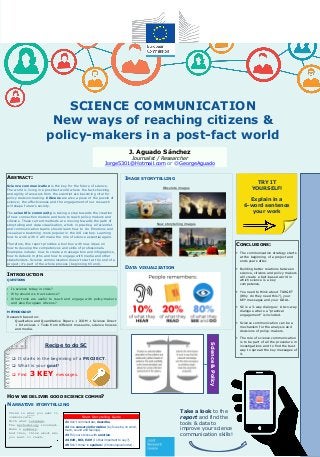
This is the poster made for the report: “Science communication: New ways to target citizens and policy-makers in the post-fact world”. It won the best prize in the meeting of the Joint Research Centre Alumni at Brussels in 2018.
IMAGE STORYTELLING
DATA VISUALIZATION
SCIENCECOMMUNICATION
New ways of reaching citizens &
policy-makers in a post-fact world
J. Aguado Sánchez
Journalist / Researcher
Jorge5301@Hotmail.com or @GeorgeAguado
ABSTRACT:
Science communication is the key for the future of science.
The world is living in a post-fact world where the fact-checking
and agility of answers from the scientist are becoming vital for
policy decision-making. Citizens are also a piece of the puzzle of
science; the effectiveness and the engagement of our research
will shape future’s society.
The scientific community is taking a step towards the creation
of new connection models and tools to reach policy-makers and
citizens. These current methods are moving towards the path of
storytelling and data visualisation, which in practise, all scientist
and communication teams should learn how to do. Emotions and
visuals are becoming more popular in the XXI century. Learning
how to work with it will make the role of science essential again.
Therefore, this report provides a tool box with new ideas on
how to develop the competences and skills of professionals.
Examples include: how to create a message box and infographics,
how to debunk myths and how to engage with media and other
stakeholders. Science communication doesn’t start at the end of a
project; it’s part of the whole process (beginning till end).
INTRODUCTION
QUESTIONS
• Is science today in crisis?
• Why should we trust science?
• What tools are useful to reach and engage with policy-makers
and also European citizens?
METHODOLOGY
Research based on:
Qualitative and Quantitative Papers + JCOM + Science Direct
+ Interviews + Tools from different museums, science houses
and media.
Short STORYTELLING guide
#1 Don’t commentate; describe.
#2 Use sensory information (by focusing on smell,
touch, sound and feelings).
#3 Fill your stories with emotion.
#4 Edit, Edit, Edit! (Is that important to say?).
#5 Don’t throw in spoilers! (Chronological order).
Short Storytelling Guide
Obsolete images
New storytelling images
HOW WE DELIVER GOOD SCIENCE COMMS?
TRY IT
YOURSELF!
Explain in a
6-word sentence
your work
Think in what you want to
communicate.
With what language.
The methodology involved.
Make a summary.
And then, think about who
you want to reach.
Recipe to do SC
It starts in the beginning of a PROJECT.
What is your goal?
Find 3 KEY messages.
NARRATIVE STORYTELLING
Science&Policy
Take a look to the
report and find the
tools & data to
improve your science
communication skills!
CONCLUSIONS:
The communication strategy starts
at the beginning of a project and
ends years after.
Building better relations between
science, citizens and policy makers
will create a fact-based world in
which science is a key
competence.
You need to think about TARGET
(Why do they need this?), your
KEY messages and your GOAL.
SC is a 3-way dialogue: A two-way
dialogue where a “practical
engagement” is included.
Science communication can be a
mechanism for the analysis and
decisions of policy-makers.
The role of science communication
is to be part of all the procedure in
investigations and to find the best
way to spread the key messages of
it.