ATTRIBUTIONGAP
ATTRIBUTIONGAP
Identificaton and
prioritisation for
community contingency
planning
Output: Community Action
and Adaptation Plans
(CAAPs) developed
Community and diaspora
support for development
of innovative financing
mechanisms for CAAPs
Provision of skills,
inputs and resources for
livelihood diversification
leveraging agricultural
and business value
chains
Output:
Innovative
and diverse
financing
mechanisms
for CAAPs
established
Output:
Improved
extensive
livestock and
agricultural
production
systems
Natural
resource
management
plans
developed and
implemented
Output:
Community
safety nets in
place through
savings groups
and community
social protection
system
Intermediary Outcome 1:
Enhanced risk management
and disaster preparedness
through community action
and contingency planning
Intermediary Outcome 3:
Enhanced livelihood
diversification for men,
women, and youth through the
restoration and protection of
productive assets, value chains
and the uptake and adoption of
agricultural technologies
Intermediary Outcome 4:
Enhanced management
and governance of natural
resources, including soil
and water systems to
support sustainable pastoral
livelihoods
Specific Objective/Outcome:
Sustainably improve food
security and livelihoods and
build resilience through
effective risk management,
protection of productive
assets and governance of
natural resources for pastoral,
agro-pastoral and peri-urban
communities in Puntland and
Somaliland.
PROJECT-LEVEL MONITORING IMPACT-LEVEL MONITORING
7-15 YEAR MONITORING PERIOD
ACTIONS OUTPUTS
INTERMEDIARY
OUTCOME
TRANSFORMATIVE
CAPACITY
Output: Cash-based food
assistance programming
mechanisms in place and
linked to Village Savings
and Loan Associations
Output: Youth
equipped
with skills
for livelihood
diversification
3 YEAR PROJECT CYCLE
PROJECT CYCLE 1 PROJECT CYCLE 2
3-7 YEAR PROJECT CYCLE
Further development of
livestock and climate
smart nutrient dense crop
agricultural value chains
Overall Objective/Impact:
To contribute to the
resilience of already
vulnerable communities
in Northern Somalia, and
reduce the effects of forced
displacement and irregular
migration in the region
ABSORPTIVE
CAPACITY
↑↓ in resilience capacities:
•	Psychosocial measures of resilience capacity
•	People’s aspirations and confidence to adapt
•	Access to social capital
•	Livelihood diversity, productive assets and access to
financial resources
•	Access to markets, services, infrastructure and
information
•	Availability of disaster planning and response services
ADAPTIVE CAPACITY
ACTIONS OUTPUTS
↑↓ IN
RESILIENCE
CAPACIT Y
SUSTAINED
↑↓ IN
SYSTEMS
SUSTAINED
↑↓ IN
DEVELOPMENT
INDICES
1
2
3
Village Savings and
Loan Associations and
Behavioural Community
Change established for
food and social security
Intermediary Outcome 2:
Enhanced food and social
security through sustainable
cash-based assistance
mechanisms and improved
access to social capital
Cash for Work
projects identified
from CAAPs
CAAPs managed,
implemented and funded
by the community acting as
sole agent
Community-managed safety
nets linked to government
social protection mechanisms
(social security and welfare
system)
↓↑ in:
Indicators of
rangeland conditions
Indicators of herd
dynamics
Indicators of trade
Indicators of peace
and security
↓↑ in:
Empowerment
Education
Health
Reproductive
health
Living standards
Labour markets
Sustainable increases in living
standards and incomes have a
direct effect on household and
individual well-being indicators
- impact can therefore be
measured in terms of progress
towards SDGs and other
development impact indicators.
The attribution gap highlights the problem that many
(confounding) factors are at play in effecting the
changes observed at a highly-aggregated level, and
these changes cannot be reliably and proportionately
traced back to any one intervention or program. This
“distance” between inputs and impact, can, however,
often be overcome by a good results model, making
the case for causal plausibility and attributed positive
change at a higher level.
Enabling regulatory frameworks
and governance mechanisms
in place for management of
natural resource systems
linked to government budgeting
and expenditure monitoring
resulting in institutionalization
of NRM plans
Development of strategies
and plans for rehibilation
of degraded rangelands,
sustainable water use and
prevention of soil erosion and
grazing management
Multi-stakeholder
consultative process for
development of Early
Warning Early Action
plans underway, including
contingency planning and
disaster risk reduction
strategies.
Early Warning Early
Action Plans in place
to mitigate risks and
protect lives and
livelihoods.

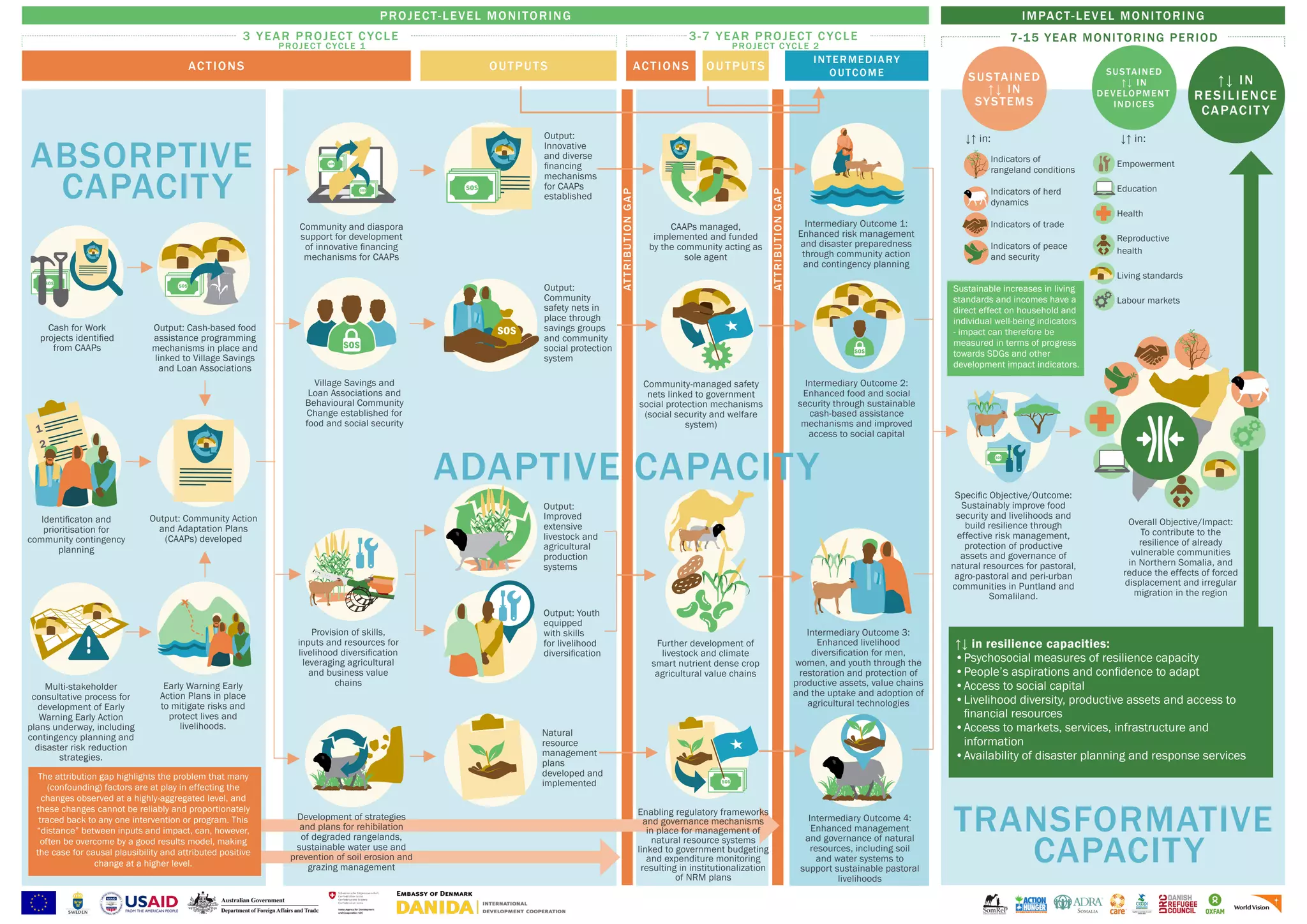
Overall diagram

  • 1.
    ATTRIBUTIONGAP ATTRIBUTIONGAP Identificaton and prioritisation for communitycontingency planning Output: Community Action and Adaptation Plans (CAAPs) developed Community and diaspora support for development of innovative financing mechanisms for CAAPs Provision of skills, inputs and resources for livelihood diversification leveraging agricultural and business value chains Output: Innovative and diverse financing mechanisms for CAAPs established Output: Improved extensive livestock and agricultural production systems Natural resource management plans developed and implemented Output: Community safety nets in place through savings groups and community social protection system Intermediary Outcome 1: Enhanced risk management and disaster preparedness through community action and contingency planning Intermediary Outcome 3: Enhanced livelihood diversification for men, women, and youth through the restoration and protection of productive assets, value chains and the uptake and adoption of agricultural technologies Intermediary Outcome 4: Enhanced management and governance of natural resources, including soil and water systems to support sustainable pastoral livelihoods Specific Objective/Outcome: Sustainably improve food security and livelihoods and build resilience through effective risk management, protection of productive assets and governance of natural resources for pastoral, agro-pastoral and peri-urban communities in Puntland and Somaliland. PROJECT-LEVEL MONITORING IMPACT-LEVEL MONITORING 7-15 YEAR MONITORING PERIOD ACTIONS OUTPUTS INTERMEDIARY OUTCOME TRANSFORMATIVE CAPACITY Output: Cash-based food assistance programming mechanisms in place and linked to Village Savings and Loan Associations Output: Youth equipped with skills for livelihood diversification 3 YEAR PROJECT CYCLE PROJECT CYCLE 1 PROJECT CYCLE 2 3-7 YEAR PROJECT CYCLE Further development of livestock and climate smart nutrient dense crop agricultural value chains Overall Objective/Impact: To contribute to the resilience of already vulnerable communities in Northern Somalia, and reduce the effects of forced displacement and irregular migration in the region ABSORPTIVE CAPACITY ↑↓ in resilience capacities: • Psychosocial measures of resilience capacity • People’s aspirations and confidence to adapt • Access to social capital • Livelihood diversity, productive assets and access to financial resources • Access to markets, services, infrastructure and information • Availability of disaster planning and response services ADAPTIVE CAPACITY ACTIONS OUTPUTS ↑↓ IN RESILIENCE CAPACIT Y SUSTAINED ↑↓ IN SYSTEMS SUSTAINED ↑↓ IN DEVELOPMENT INDICES 1 2 3 Village Savings and Loan Associations and Behavioural Community Change established for food and social security Intermediary Outcome 2: Enhanced food and social security through sustainable cash-based assistance mechanisms and improved access to social capital Cash for Work projects identified from CAAPs CAAPs managed, implemented and funded by the community acting as sole agent Community-managed safety nets linked to government social protection mechanisms (social security and welfare system) ↓↑ in: Indicators of rangeland conditions Indicators of herd dynamics Indicators of trade Indicators of peace and security ↓↑ in: Empowerment Education Health Reproductive health Living standards Labour markets Sustainable increases in living standards and incomes have a direct effect on household and individual well-being indicators - impact can therefore be measured in terms of progress towards SDGs and other development impact indicators. The attribution gap highlights the problem that many (confounding) factors are at play in effecting the changes observed at a highly-aggregated level, and these changes cannot be reliably and proportionately traced back to any one intervention or program. This “distance” between inputs and impact, can, however, often be overcome by a good results model, making the case for causal plausibility and attributed positive change at a higher level. Enabling regulatory frameworks and governance mechanisms in place for management of natural resource systems linked to government budgeting and expenditure monitoring resulting in institutionalization of NRM plans Development of strategies and plans for rehibilation of degraded rangelands, sustainable water use and prevention of soil erosion and grazing management Multi-stakeholder consultative process for development of Early Warning Early Action plans underway, including contingency planning and disaster risk reduction strategies. Early Warning Early Action Plans in place to mitigate risks and protect lives and livelihoods.