Flexible
Sigmoidoscopy
Procedure
Risk, Preparation & Results
What is a Flexible
Sigmoidoscopy?
• A flexible sigmoidoscopy is an examination used to assess the
lower part of the large intestine (colon). During a flexible
sigmoidoscopy examination, a thin, flexible tube
(sigmoidoscope) is inserted into the rectum.
• A small video camera at the tip of the tube enables the doctor
or primary care physician to view the inside of the rectum, the
sigmoid colon, and most of the descending colon just under
the last two feet (about fifty centimeters) of the large
intestine. If required, tissue samples (biopsies) could be taken
through the scope during a flexible sigmoidoscopy
examination.
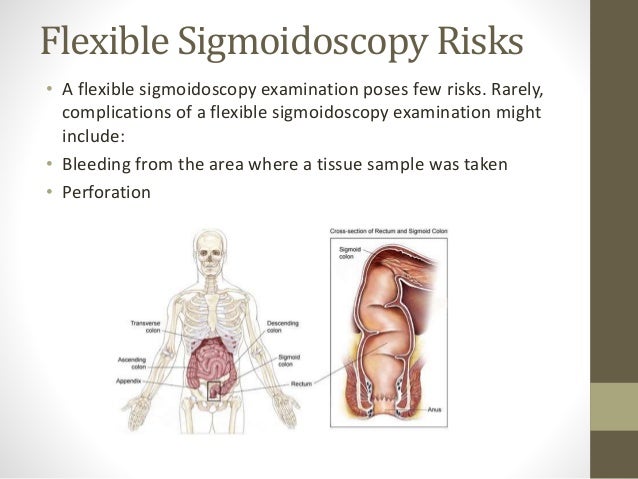
Flexible Sigmoidoscopy Risks
• A flexible sigmoidoscopy examination poses few risks. Rarely,
complications of a flexible sigmoidoscopy examination might
include:
• Bleeding from the area where a tissue sample was taken
• Perforation
Flexible Sigmoidoscopy
Preparation
• Before a flexible sigmoidoscopy examination, you will be
required to empty your colon. Any residue in your colon might
obscure the view of your colon and rectum during the
examination.
• To empty your colon, follow your doctor's or primary care
physician’s instructions carefully. You might be asked to:
• Follow a special diet the day before the examination - Your
doctor or primary care physician might ask you not to eat the
day before the examination. Beverages might be limited to
clear liquids like plain water, broth, soft drinks, and tea and
coffee without milk or cream. You might be asked not to eat or
drink anything after midnight the night before the
examination.
Flexible Sigmoidoscopy
Preparation
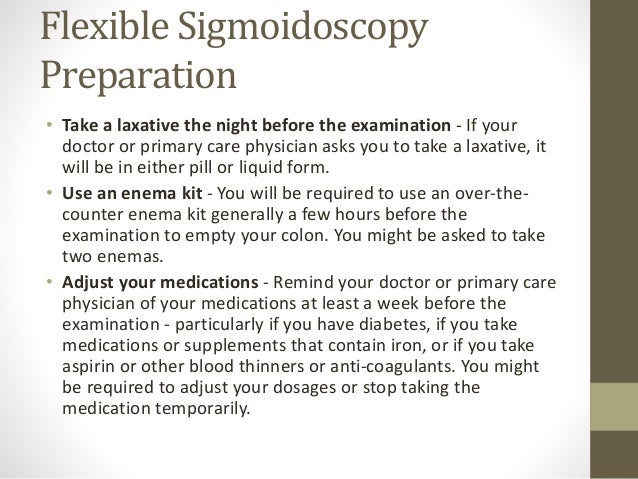
• Take a laxative the night before the examination - If your
doctor or primary care physician asks you to take a laxative, it
will be in either pill or liquid form.
• Use an enema kit - You will be required to use an over-the-
counter enema kit generally a few hours before the
examination to empty your colon. You might be asked to take
two enemas.
• Adjust your medications - Remind your doctor or primary care
physician of your medications at least a week before the
examination - particularly if you have diabetes, if you take
medications or supplements that contain iron, or if you take
aspirin or other blood thinners or anti-coagulants. You might
be required to adjust your dosages or stop taking the
medication temporarily.
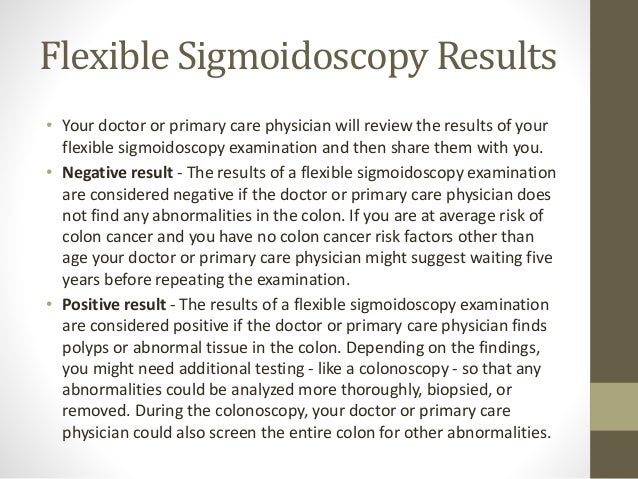
Flexible Sigmoidoscopy Results
• Your doctor or primary care physician will review the results of your
flexible sigmoidoscopy examination and then share them with you.
• Negative result - The results of a flexible sigmoidoscopy examination
are considered negative if the doctor or primary care physician does
not find any abnormalities in the colon. If you are at average risk of
colon cancer and you have no colon cancer risk factors other than
age your doctor or primary care physician might suggest waiting five
years before repeating the examination.
• Positive result - The results of a flexible sigmoidoscopy examination
are considered positive if the doctor or primary care physician finds
polyps or abnormal tissue in the colon. Depending on the findings,
you might need additional testing - like a colonoscopy - so that any
abnormalities could be analyzed more thoroughly, biopsied, or
removed. During the colonoscopy, your doctor or primary care
physician could also screen the entire colon for other abnormalities.
• Website : https://www.hillregionalhospital.com
• Address : 101 Circle Drive Hillsboro, TX 76645
• Phone No : 254-580-8500
• Email Id : psheldon@hillrh.com
THANK YOU

Flexible sigmoidoscopy procedure

  • 1.
  • 2.
    What is aFlexible Sigmoidoscopy? • A flexible sigmoidoscopy is an examination used to assess the lower part of the large intestine (colon). During a flexible sigmoidoscopy examination, a thin, flexible tube (sigmoidoscope) is inserted into the rectum. • A small video camera at the tip of the tube enables the doctor or primary care physician to view the inside of the rectum, the sigmoid colon, and most of the descending colon just under the last two feet (about fifty centimeters) of the large intestine. If required, tissue samples (biopsies) could be taken through the scope during a flexible sigmoidoscopy examination.
  • 3.
    Flexible Sigmoidoscopy Risks •A flexible sigmoidoscopy examination poses few risks. Rarely, complications of a flexible sigmoidoscopy examination might include: • Bleeding from the area where a tissue sample was taken • Perforation
  • 4.
    Flexible Sigmoidoscopy Preparation • Beforea flexible sigmoidoscopy examination, you will be required to empty your colon. Any residue in your colon might obscure the view of your colon and rectum during the examination. • To empty your colon, follow your doctor's or primary care physician’s instructions carefully. You might be asked to: • Follow a special diet the day before the examination - Your doctor or primary care physician might ask you not to eat the day before the examination. Beverages might be limited to clear liquids like plain water, broth, soft drinks, and tea and coffee without milk or cream. You might be asked not to eat or drink anything after midnight the night before the examination.
  • 5.
    Flexible Sigmoidoscopy Preparation • Takea laxative the night before the examination - If your doctor or primary care physician asks you to take a laxative, it will be in either pill or liquid form. • Use an enema kit - You will be required to use an over-the- counter enema kit generally a few hours before the examination to empty your colon. You might be asked to take two enemas. • Adjust your medications - Remind your doctor or primary care physician of your medications at least a week before the examination - particularly if you have diabetes, if you take medications or supplements that contain iron, or if you take aspirin or other blood thinners or anti-coagulants. You might be required to adjust your dosages or stop taking the medication temporarily.
  • 6.
    Flexible Sigmoidoscopy Results •Your doctor or primary care physician will review the results of your flexible sigmoidoscopy examination and then share them with you. • Negative result - The results of a flexible sigmoidoscopy examination are considered negative if the doctor or primary care physician does not find any abnormalities in the colon. If you are at average risk of colon cancer and you have no colon cancer risk factors other than age your doctor or primary care physician might suggest waiting five years before repeating the examination. • Positive result - The results of a flexible sigmoidoscopy examination are considered positive if the doctor or primary care physician finds polyps or abnormal tissue in the colon. Depending on the findings, you might need additional testing - like a colonoscopy - so that any abnormalities could be analyzed more thoroughly, biopsied, or removed. During the colonoscopy, your doctor or primary care physician could also screen the entire colon for other abnormalities.
  • 7.
    • Website :https://www.hillregionalhospital.com • Address : 101 Circle Drive Hillsboro, TX 76645 • Phone No : 254-580-8500 • Email Id : psheldon@hillrh.com
  • 8.