C Standard Library
i
AbouttheTutorial
C is a general-purpose, procedural, imperative computer programming language
developed in 1972 by Dennis M. Ritchie at the Bell Telephone Laboratories to develop the
Unix operating system.
C is the most widely used computer language that keeps fluctuating at number one scale
of popularity along with Java programming language which is also equally popular and
most widely used among modern software programmers.
The C Standard Library is a set of C built-in functions, constants and header files
like <assert.h>, <ctype.h>, etc. This library will work as a reference manual for C
programmers.
Audience
The C Standard Library is a reference for C programmers to help them in their projects
related to system programming. All the C functions have been explained in a user-friendly
way and they can be copied and pasted in your C projects.
Prerequisites
A basic understanding of the C Programming language will help you in understanding the
C built-in functions covered in this library.
Copyright&Disclaimer
 Copyright 2014 by Tutorials Point (I) Pvt. Ltd.
All the content and graphics published in this e-book are the property of Tutorials Point (I)
Pvt. Ltd. The user of this e-book is prohibited to reuse, retain, copy, distribute or republish
any contents or a part of contents of this e-book in any manner without written consent
of the publisher.
We strive to update the contents of our website and tutorials as timely and as precisely as
possible, however, the contents may contain inaccuracies or errors. Tutorials Point (I) Pvt.
Ltd. provides no guarantee regarding the accuracy, timeliness or completeness of our
website or its contents including this tutorial. If you discover any errors on our website or
in this tutorial, please notify us at contact@tutorialspoint.com
C Standard Library
ii
TableofContents
About the Tutorial....................................................................................................................................i
Audience..................................................................................................................................................i
Prerequisites............................................................................................................................................i
Copyright & Disclaimer.............................................................................................................................i
Table of Contents....................................................................................................................................ii
1. C LIBRARY ─ <ASSERT.H> .....................................................................................................1
Introduction............................................................................................................................................1
Library Macros ........................................................................................................................................1
2. C LIBRARY ─ <CTYPE.H> .......................................................................................................3
Introduction............................................................................................................................................3
Library Functions.....................................................................................................................................3
Character Classes ..................................................................................................................................24
3. C LIBRARY ─ <ERRNO.H>....................................................................................................26
Introduction..........................................................................................................................................26
Library Macros ......................................................................................................................................26
4. C LIBRARY ─ <FLOAT.H>.....................................................................................................31
Introduction..........................................................................................................................................31
Library Macros ......................................................................................................................................31
5. C LIBRARY ─ <LIMITS.H> ....................................................................................................34
Introduction..........................................................................................................................................34
Library Macros ......................................................................................................................................34
6. C LIBRARY ─ <LOCALE.H>...................................................................................................37
Introduction..........................................................................................................................................37
Library Macros ......................................................................................................................................37
C Standard Library
iii
Library Functions...................................................................................................................................38
Library Structure ...................................................................................................................................42
7. C LIBRARY ─ <MATH.H>.....................................................................................................45
Introduction..........................................................................................................................................45
Library Macros ......................................................................................................................................45
Library Functions...................................................................................................................................45
8. C LIBRARY ─ <SETJMP.H>...................................................................................................68
Introduction..........................................................................................................................................68
Library Variables ...................................................................................................................................68
Library Macros ......................................................................................................................................68
Library Functions...................................................................................................................................70
9. C LIBRARY ─ <SIGNAL.H> ...................................................................................................72
Introduction..........................................................................................................................................72
Library Variables ...................................................................................................................................72
Library Macros ......................................................................................................................................72
Library Functions...................................................................................................................................73
10. C LIBRARY ─ <STDARG.H> ..................................................................................................78
Introduction..........................................................................................................................................78
Library Variables ...................................................................................................................................78
Library Macros ......................................................................................................................................78
11. C LIBRARY ─ <STDDEF.H>...................................................................................................83
Introduction..........................................................................................................................................83
Library Variables ...................................................................................................................................83
Library Macros ......................................................................................................................................83
C Standard Library
iv
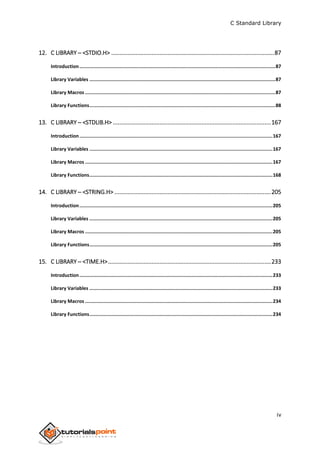
12. C LIBRARY ─ <STDIO.H> .....................................................................................................87
Introduction..........................................................................................................................................87
Library Variables ...................................................................................................................................87
Library Macros ......................................................................................................................................87
Library Functions...................................................................................................................................88
13. C LIBRARY ─ <STDLIB.H> ..................................................................................................167
Introduction........................................................................................................................................167
Library Variables .................................................................................................................................167
Library Macros ....................................................................................................................................167
Library Functions.................................................................................................................................168
14. C LIBRARY ─ <STRING.H> .................................................................................................205
Introduction........................................................................................................................................205
Library Variables .................................................................................................................................205
Library Macros ....................................................................................................................................205
Library Functions.................................................................................................................................205
15. C LIBRARY ─ <TIME.H>.....................................................................................................233
Introduction........................................................................................................................................233
Library Variables .................................................................................................................................233
Library Macros ....................................................................................................................................234
Library Functions.................................................................................................................................234
C Standard Library
5
Introduction
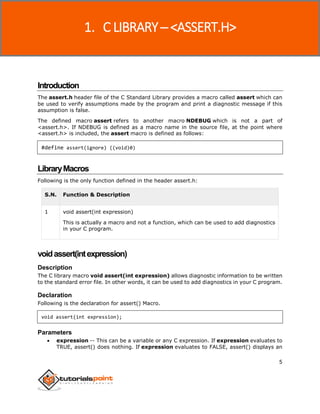
The assert.h header file of the C Standard Library provides a macro called assert which can
be used to verify assumptions made by the program and print a diagnostic message if this
assumption is false.
The defined macro assert refers to another macro NDEBUG which is not a part of
<assert.h>. If NDEBUG is defined as a macro name in the source file, at the point where
<assert.h> is included, the assert macro is defined as follows:
#define assert(ignore) ((void)0)
LibraryMacros
Following is the only function defined in the header assert.h:
S.N. Function & Description
1 void assert(int expression)
This is actually a macro and not a function, which can be used to add diagnostics
in your C program.
voidassert(intexpression)
Description
The C library macro void assert(int expression) allows diagnostic information to be written
to the standard error file. In other words, it can be used to add diagnostics in your C program.
Declaration
Following is the declaration for assert() Macro.
void assert(int expression);
Parameters
 expression -- This can be a variable or any C expression. If expression evaluates to
TRUE, assert() does nothing. If expression evaluates to FALSE, assert() displays an
1. C LIBRARY ─ <ASSERT.H>
C Standard Library
6
error message on stderr (standard error stream to display error messages and
diagnostics) and aborts program execution.
Return Value
This macro does not return any value.
Example
The following example shows the usage of assert() macro:
#include <assert.h>
#include <stdio.h>
int main()
{
int a;
char str[50];
printf("Enter an integer value: ");
scanf("%dn", &a);
assert(a >= 10);
printf("Integer entered is %dn", a);
printf("Enter string: ");
scanf("%sn", &str);
assert(str != NULL);
printf("String entered is: %sn", str);
return(0);
}
Let us compile and run the above program in the interactive mode as shown below:
Enter an integer value: 11
Integer entered is 11
Enter string: tutorialspoint
String entered is: tutorialspoint
C Standard Library
7
Introduction
The ctype.h header file of the C Standard Library declares several functions that are useful
for testing and mapping characters.
All the functions accepts int as a parameter, whose value must be EOF or representable as
an unsigned char.
All the functions return non-zero (true) if the argument c satisfies the condition described,
and zero (false) if not.
LibraryFunctions
Following are the functions defined in the header ctype.h:
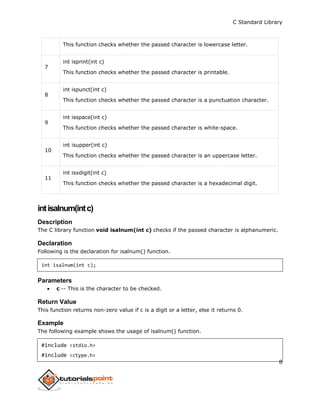
S.N. Function & Description
1
int isalnum(int c)
This function checks whether the passed character is alphanumeric.
2
int isalpha(int c)
This function checks whether the passed character is alphabetic.
3
int iscntrl(int c)
This function checks whether the passed character is control character.
4
int isdigit(int c)
This function checks whether the passed character is decimal digit.
5
int isgraph(int c)
This function checks whether the passed character has graphical representation
using locale.
6 int islower(int c)
2. C LIBRARY ─ <CTYPE.H>
C Standard Library
8
This function checks whether the passed character is lowercase letter.
7
int isprint(int c)
This function checks whether the passed character is printable.
8
int ispunct(int c)
This function checks whether the passed character is a punctuation character.
9
int isspace(int c)
This function checks whether the passed character is white-space.
10
int isupper(int c)
This function checks whether the passed character is an uppercase letter.
11
int isxdigit(int c)
This function checks whether the passed character is a hexadecimal digit.
intisalnum(intc)
Description
The C library function void isalnum(int c) checks if the passed character is alphanumeric.
Declaration
Following is the declaration for isalnum() function.
int isalnum(int c);
Parameters
 c -- This is the character to be checked.
Return Value
This function returns non-zero value if c is a digit or a letter, else it returns 0.
Example
The following example shows the usage of isalnum() function.
#include <stdio.h>
#include <ctype.h>
C Standard Library
9
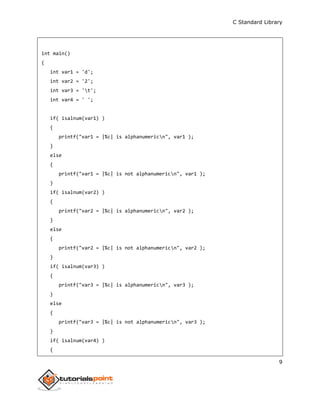
int main()
{
int var1 = 'd';
int var2 = '2';
int var3 = 't';
int var4 = ' ';
if( isalnum(var1) )
{
printf("var1 = |%c| is alphanumericn", var1 );
}
else
{
printf("var1 = |%c| is not alphanumericn", var1 );
}
if( isalnum(var2) )
{
printf("var2 = |%c| is alphanumericn", var2 );
}
else
{
printf("var2 = |%c| is not alphanumericn", var2 );
}
if( isalnum(var3) )
{
printf("var3 = |%c| is alphanumericn", var3 );
}
else
{
printf("var3 = |%c| is not alphanumericn", var3 );
}
if( isalnum(var4) )
{
C Standard Library
10
printf("var4 = |%c| is alphanumericn", var4 );
}
else
{
printf("var4 = |%c| is not alphanumericn", var4 );
}
return(0);
}
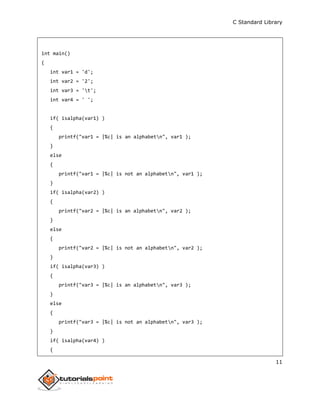
Let us compile and run the above program to produce the following result:
var1 = |d| is alphanumeric
var2 = |2| is alphanumeric
var3 = | | is not alphanumeric
var4 = | | is not alphanumeric
intisalpha(intc)
Description
The C library function void isalpha(int c) checks if the passed character is alphabetic.
Declaration
Following is the declaration for isalpha() function.
int isalpha(int c);
Parameters
 c -- This is the character to be checked.
Return Value
This function returns non-zero value if c is an alphabet, else it returns 0.
Example
The following example shows the usage of isalpha() function.
#include <stdio.h>
#include <ctype.h>
C Standard Library
11
int main()
{
int var1 = 'd';
int var2 = '2';
int var3 = 't';
int var4 = ' ';
if( isalpha(var1) )
{
printf("var1 = |%c| is an alphabetn", var1 );
}
else
{
printf("var1 = |%c| is not an alphabetn", var1 );
}
if( isalpha(var2) )
{
printf("var2 = |%c| is an alphabetn", var2 );
}
else
{
printf("var2 = |%c| is not an alphabetn", var2 );
}
if( isalpha(var3) )
{
printf("var3 = |%c| is an alphabetn", var3 );
}
else
{
printf("var3 = |%c| is not an alphabetn", var3 );
}
if( isalpha(var4) )
{
C Standard Library
12
printf("var4 = |%c| is an alphabetn", var4 );
}
else
{
printf("var4 = |%c| is not an alphabetn", var4 );
}
return(0);
}
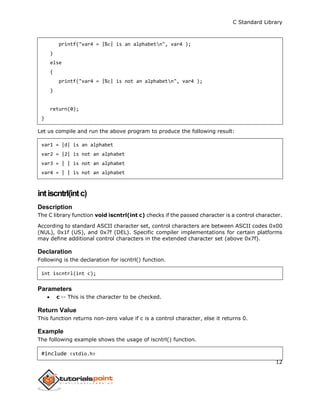
Let us compile and run the above program to produce the following result:
var1 = |d| is an alphabet
var2 = |2| is not an alphabet
var3 = | | is not an alphabet
var4 = | | is not an alphabet
intiscntrl(intc)
Description
The C library function void iscntrl(int c) checks if the passed character is a control character.
According to standard ASCII character set, control characters are between ASCII codes 0x00
(NUL), 0x1f (US), and 0x7f (DEL). Specific compiler implementations for certain platforms
may define additional control characters in the extended character set (above 0x7f).
Declaration
Following is the declaration for iscntrl() function.
int iscntrl(int c);
Parameters
 c -- This is the character to be checked.
Return Value
This function returns non-zero value if c is a control character, else it returns 0.
Example
The following example shows the usage of iscntrl() function.
#include <stdio.h>
C Standard Library
13
#include <ctype.h>
int main ()
{
int i = 0, j = 0;
char str1[] = "all a about t programming";
char str2[] = "tutorials n point";
/* Prints string till control character a */
while( !iscntrl(str1[i]) )
{
putchar(str1[i]);
i++;
}
/* Prints string till control character n */
while( !iscntrl(str2[j]) )
{
putchar(str2[j]);
j++;
}
return(0);
}
Let us compile and run the above program to produce the following result:
all tutorials
intisdigit(intc)
Description
The C library function void isdigit(int c) checks if the passed character is a decimal digit
character.
Decimal digits are (numbers): 0 1 2 3 4 5 6 7 8 9.
C Standard Library
14
Declaration
Following is the declaration for isdigit() function.
int isdigit(int c);
Parameters
 c -- This is the character to be checked.
Return Value
This function returns non-zero value if c is a digit, else it returns 0.
Example
The following example shows the usage of isdigit() function.
#include <stdio.h>
#include <ctype.h>
int main()
{
int var1 = 'h';
int var2 = '2';
if( isdigit(var1) )
{
printf("var1 = |%c| is a digitn", var1 );
}
else
{
printf("var1 = |%c| is not a digitn", var1 );
}
if( isdigit(var2) )
{
printf("var2 = |%c| is a digitn", var2 );
}
else
{
printf("var2 = |%c| is not a digitn", var2 );
C Standard Library
15
}
return(0);
}
Let us compile and run the above program to produce the following result:
var1 = |h| is not a digit
var2 = |2| is a digit
intisgraph(intc)
Description
The C library function void isgraph(int c) checks if the character has graphical
representation.
The characters with graphical representations are all those characters that can be printed
except for whitespace characters (like ' '), which is not considered as isgraph characters.
Declaration
Following is the declaration for isgraph() function.
int isgraph(int c);
Parameters
 c -- This is the character to be checked.
Return Value
This function returns non-zero value if c has a graphical representation as character, else it
returns 0.
Example
The following example shows the usage of isgraph() function.
#include <stdio.h>
#include <ctype.h>
int main()
{
int var1 = '3';
C Standard Library
16
int var2 = 'm';
int var3 = ' ';
if( isgraph(var1) )
{
printf("var1 = |%c| can be printedn", var1 );
}
else
{
printf("var1 = |%c| can't be printedn", var1 );
}
if( isgraph(var2) )
{
printf("var2 = |%c| can be printedn", var2 );
}
else
{
printf("var2 = |%c| can't be printedn", var2 );
}
if( isgraph(var3) )
{
printf("var3 = |%c| can be printedn", var3 );
}
else
{
printf("var3 = |%c| can't be printedn", var3 );
}
return(0);
}
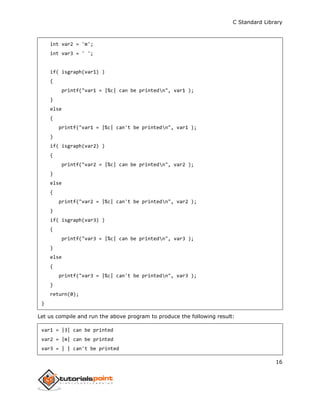
Let us compile and run the above program to produce the following result:
var1 = |3| can be printed
var2 = |m| can be printed
var3 = | | can't be printed
C Standard Library
17
intislower(intc)
Description
The C library function int islower(int c) checks whether the passed character is a lowercase
letter.
Declaration
Following is the declaration for islower() function.
int islower(int c);
Parameters
 c -- This is the character to be checked.
Return Value
This function returns a non-zero value(true) if c is a lowercase alphabetic letter else, zero
(false).
Example
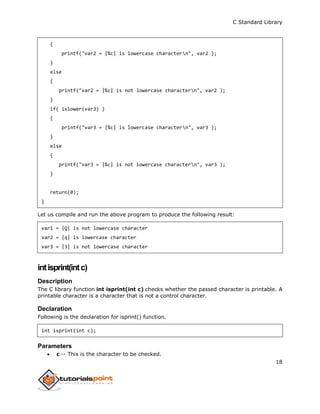
The following example shows the usage of islower() function.
#include <stdio.h>
#include <ctype.h>
int main()
{
int var1 = 'Q';
int var2 = 'q';
int var3 = '3';
if( islower(var1) )
{
printf("var1 = |%c| is lowercase charactern", var1 );
}
else
{
printf("var1 = |%c| is not lowercase charactern", var1 );
}
if( islower(var2) )
C Standard Library
18
{
printf("var2 = |%c| is lowercase charactern", var2 );
}
else
{
printf("var2 = |%c| is not lowercase charactern", var2 );
}
if( islower(var3) )
{
printf("var3 = |%c| is lowercase charactern", var3 );
}
else
{
printf("var3 = |%c| is not lowercase charactern", var3 );
}
return(0);
}
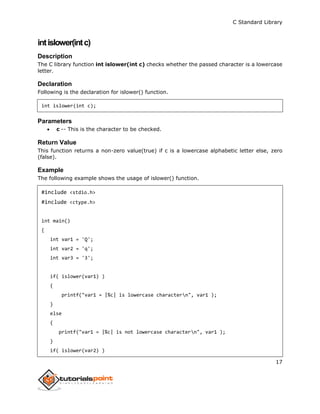
Let us compile and run the above program to produce the following result:
var1 = |Q| is not lowercase character
var2 = |q| is lowercase character
var3 = |3| is not lowercase character
intisprint(intc)
Description
The C library function int isprint(int c) checks whether the passed character is printable. A
printable character is a character that is not a control character.
Declaration
Following is the declaration for isprint() function.
int isprint(int c);
Parameters
 c -- This is the character to be checked.
C Standard Library
19
Return Value
This function returns a non-zero value(true) if c is a printable character else, zero (false).
Example
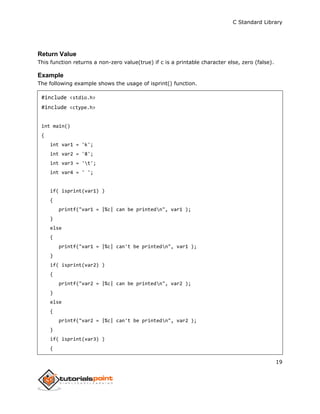
The following example shows the usage of isprint() function.
#include <stdio.h>
#include <ctype.h>
int main()
{
int var1 = 'k';
int var2 = '8';
int var3 = 't';
int var4 = ' ';
if( isprint(var1) )
{
printf("var1 = |%c| can be printedn", var1 );
}
else
{
printf("var1 = |%c| can't be printedn", var1 );
}
if( isprint(var2) )
{
printf("var2 = |%c| can be printedn", var2 );
}
else
{
printf("var2 = |%c| can't be printedn", var2 );
}
if( isprint(var3) )
{
C Standard Library
20
printf("var3 = |%c| can be printedn", var3 );
}
else
{
printf("var3 = |%c| can't be printedn", var3 );
}
if( isprint(var4) )
{
printf("var4 = |%c| can be printedn", var4 );
}
else
{
printf("var4 = |%c| can't be printedn", var4 );
}
return(0);
}
Let us compile and run the above program to produce the following result:
var1 = |k| can be printed
var2 = |8| can be printed
var3 = | | can't be printed
var4 = | | can be printed
intispunct(intc)
Description
The C library function int ispunct(int c) checks whether the passed character is a
punctuation character. A punctuation character is any graphic character (as in isgraph) that
is not alphanumeric (as in isalnum).
Declaration
Following is the declaration for ispunct() function.
int ispunct(int c);
Parameters
C Standard Library
21
 c -- This is the character to be checked.
Return Value
This function returns a non-zero value(true) if c is a punctuation character else, zero (false).
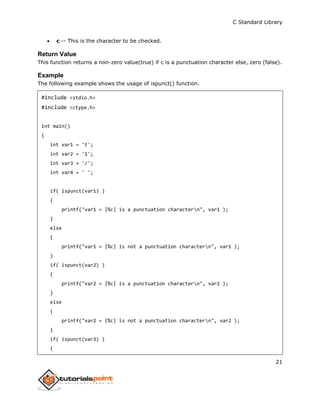
Example
The following example shows the usage of ispunct() function.
#include <stdio.h>
#include <ctype.h>
int main()
{
int var1 = 't';
int var2 = '1';
int var3 = '/';
int var4 = ' ';
if( ispunct(var1) )
{
printf("var1 = |%c| is a punctuation charactern", var1 );
}
else
{
printf("var1 = |%c| is not a punctuation charactern", var1 );
}
if( ispunct(var2) )
{
printf("var2 = |%c| is a punctuation charactern", var2 );
}
else
{
printf("var2 = |%c| is not a punctuation charactern", var2 );
}
if( ispunct(var3) )
{
C Standard Library
22
printf("var3 = |%c| is a punctuation charactern", var3 );
}
else
{
printf("var3 = |%c| is not a punctuation charactern", var3 );
}
if( ispunct(var4) )
{
printf("var4 = |%c| is a punctuation charactern", var4 );
}
else
{
printf("var4 = |%c| is not a punctuation charactern", var4 );
}
return(0);
}
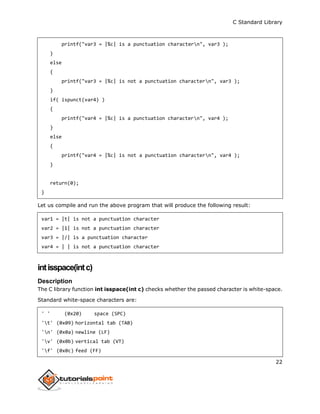
Let us compile and run the above program that will produce the following result:
var1 = |t| is not a punctuation character
var2 = |1| is not a punctuation character
var3 = |/| is a punctuation character
var4 = | | is not a punctuation character
intisspace(intc)
Description
The C library function int isspace(int c) checks whether the passed character is white-space.
Standard white-space characters are:
' ' (0x20) space (SPC)
't' (0x09) horizontal tab (TAB)
'n' (0x0a) newline (LF)
'v' (0x0b) vertical tab (VT)
'f' (0x0c) feed (FF)
C Standard Library
23
'r' (0x0d) carriage return (CR)
Declaration
Following is the declaration for isspace() function.
int isspace(int c);
Parameters
 c -- This is the character to be checked.
Return Value
This function returns a non-zero value(true) if c is a white-space character else, zero (false).
C Standard Library
24
End of ebook preview
If you liked what you saw…
Buy it from our store @ https://store.tutorialspoint.com

C standard library_tutorial

  • 2.
    C Standard Library i AbouttheTutorial Cis a general-purpose, procedural, imperative computer programming language developed in 1972 by Dennis M. Ritchie at the Bell Telephone Laboratories to develop the Unix operating system. C is the most widely used computer language that keeps fluctuating at number one scale of popularity along with Java programming language which is also equally popular and most widely used among modern software programmers. The C Standard Library is a set of C built-in functions, constants and header files like <assert.h>, <ctype.h>, etc. This library will work as a reference manual for C programmers. Audience The C Standard Library is a reference for C programmers to help them in their projects related to system programming. All the C functions have been explained in a user-friendly way and they can be copied and pasted in your C projects. Prerequisites A basic understanding of the C Programming language will help you in understanding the C built-in functions covered in this library. Copyright&Disclaimer  Copyright 2014 by Tutorials Point (I) Pvt. Ltd. All the content and graphics published in this e-book are the property of Tutorials Point (I) Pvt. Ltd. The user of this e-book is prohibited to reuse, retain, copy, distribute or republish any contents or a part of contents of this e-book in any manner without written consent of the publisher. We strive to update the contents of our website and tutorials as timely and as precisely as possible, however, the contents may contain inaccuracies or errors. Tutorials Point (I) Pvt. Ltd. provides no guarantee regarding the accuracy, timeliness or completeness of our website or its contents including this tutorial. If you discover any errors on our website or in this tutorial, please notify us at contact@tutorialspoint.com
  • 3.
    C Standard Library ii TableofContents Aboutthe Tutorial....................................................................................................................................i Audience..................................................................................................................................................i Prerequisites............................................................................................................................................i Copyright & Disclaimer.............................................................................................................................i Table of Contents....................................................................................................................................ii 1. C LIBRARY ─ <ASSERT.H> .....................................................................................................1 Introduction............................................................................................................................................1 Library Macros ........................................................................................................................................1 2. C LIBRARY ─ <CTYPE.H> .......................................................................................................3 Introduction............................................................................................................................................3 Library Functions.....................................................................................................................................3 Character Classes ..................................................................................................................................24 3. C LIBRARY ─ <ERRNO.H>....................................................................................................26 Introduction..........................................................................................................................................26 Library Macros ......................................................................................................................................26 4. C LIBRARY ─ <FLOAT.H>.....................................................................................................31 Introduction..........................................................................................................................................31 Library Macros ......................................................................................................................................31 5. C LIBRARY ─ <LIMITS.H> ....................................................................................................34 Introduction..........................................................................................................................................34 Library Macros ......................................................................................................................................34 6. C LIBRARY ─ <LOCALE.H>...................................................................................................37 Introduction..........................................................................................................................................37 Library Macros ......................................................................................................................................37
  • 4.
    C Standard Library iii LibraryFunctions...................................................................................................................................38 Library Structure ...................................................................................................................................42 7. C LIBRARY ─ <MATH.H>.....................................................................................................45 Introduction..........................................................................................................................................45 Library Macros ......................................................................................................................................45 Library Functions...................................................................................................................................45 8. C LIBRARY ─ <SETJMP.H>...................................................................................................68 Introduction..........................................................................................................................................68 Library Variables ...................................................................................................................................68 Library Macros ......................................................................................................................................68 Library Functions...................................................................................................................................70 9. C LIBRARY ─ <SIGNAL.H> ...................................................................................................72 Introduction..........................................................................................................................................72 Library Variables ...................................................................................................................................72 Library Macros ......................................................................................................................................72 Library Functions...................................................................................................................................73 10. C LIBRARY ─ <STDARG.H> ..................................................................................................78 Introduction..........................................................................................................................................78 Library Variables ...................................................................................................................................78 Library Macros ......................................................................................................................................78 11. C LIBRARY ─ <STDDEF.H>...................................................................................................83 Introduction..........................................................................................................................................83 Library Variables ...................................................................................................................................83 Library Macros ......................................................................................................................................83
  • 5.
    C Standard Library iv 12.C LIBRARY ─ <STDIO.H> .....................................................................................................87 Introduction..........................................................................................................................................87 Library Variables ...................................................................................................................................87 Library Macros ......................................................................................................................................87 Library Functions...................................................................................................................................88 13. C LIBRARY ─ <STDLIB.H> ..................................................................................................167 Introduction........................................................................................................................................167 Library Variables .................................................................................................................................167 Library Macros ....................................................................................................................................167 Library Functions.................................................................................................................................168 14. C LIBRARY ─ <STRING.H> .................................................................................................205 Introduction........................................................................................................................................205 Library Variables .................................................................................................................................205 Library Macros ....................................................................................................................................205 Library Functions.................................................................................................................................205 15. C LIBRARY ─ <TIME.H>.....................................................................................................233 Introduction........................................................................................................................................233 Library Variables .................................................................................................................................233 Library Macros ....................................................................................................................................234 Library Functions.................................................................................................................................234
  • 6.
    C Standard Library 5 Introduction Theassert.h header file of the C Standard Library provides a macro called assert which can be used to verify assumptions made by the program and print a diagnostic message if this assumption is false. The defined macro assert refers to another macro NDEBUG which is not a part of <assert.h>. If NDEBUG is defined as a macro name in the source file, at the point where <assert.h> is included, the assert macro is defined as follows: #define assert(ignore) ((void)0) LibraryMacros Following is the only function defined in the header assert.h: S.N. Function & Description 1 void assert(int expression) This is actually a macro and not a function, which can be used to add diagnostics in your C program. voidassert(intexpression) Description The C library macro void assert(int expression) allows diagnostic information to be written to the standard error file. In other words, it can be used to add diagnostics in your C program. Declaration Following is the declaration for assert() Macro. void assert(int expression); Parameters  expression -- This can be a variable or any C expression. If expression evaluates to TRUE, assert() does nothing. If expression evaluates to FALSE, assert() displays an 1. C LIBRARY ─ <ASSERT.H>
  • 7.
    C Standard Library 6 errormessage on stderr (standard error stream to display error messages and diagnostics) and aborts program execution. Return Value This macro does not return any value. Example The following example shows the usage of assert() macro: #include <assert.h> #include <stdio.h> int main() { int a; char str[50]; printf("Enter an integer value: "); scanf("%dn", &a); assert(a >= 10); printf("Integer entered is %dn", a); printf("Enter string: "); scanf("%sn", &str); assert(str != NULL); printf("String entered is: %sn", str); return(0); } Let us compile and run the above program in the interactive mode as shown below: Enter an integer value: 11 Integer entered is 11 Enter string: tutorialspoint String entered is: tutorialspoint
  • 8.
    C Standard Library 7 Introduction Thectype.h header file of the C Standard Library declares several functions that are useful for testing and mapping characters. All the functions accepts int as a parameter, whose value must be EOF or representable as an unsigned char. All the functions return non-zero (true) if the argument c satisfies the condition described, and zero (false) if not. LibraryFunctions Following are the functions defined in the header ctype.h: S.N. Function & Description 1 int isalnum(int c) This function checks whether the passed character is alphanumeric. 2 int isalpha(int c) This function checks whether the passed character is alphabetic. 3 int iscntrl(int c) This function checks whether the passed character is control character. 4 int isdigit(int c) This function checks whether the passed character is decimal digit. 5 int isgraph(int c) This function checks whether the passed character has graphical representation using locale. 6 int islower(int c) 2. C LIBRARY ─ <CTYPE.H>
  • 9.
    C Standard Library 8 Thisfunction checks whether the passed character is lowercase letter. 7 int isprint(int c) This function checks whether the passed character is printable. 8 int ispunct(int c) This function checks whether the passed character is a punctuation character. 9 int isspace(int c) This function checks whether the passed character is white-space. 10 int isupper(int c) This function checks whether the passed character is an uppercase letter. 11 int isxdigit(int c) This function checks whether the passed character is a hexadecimal digit. intisalnum(intc) Description The C library function void isalnum(int c) checks if the passed character is alphanumeric. Declaration Following is the declaration for isalnum() function. int isalnum(int c); Parameters  c -- This is the character to be checked. Return Value This function returns non-zero value if c is a digit or a letter, else it returns 0. Example The following example shows the usage of isalnum() function. #include <stdio.h> #include <ctype.h>
  • 10.
    C Standard Library 9 intmain() { int var1 = 'd'; int var2 = '2'; int var3 = 't'; int var4 = ' '; if( isalnum(var1) ) { printf("var1 = |%c| is alphanumericn", var1 ); } else { printf("var1 = |%c| is not alphanumericn", var1 ); } if( isalnum(var2) ) { printf("var2 = |%c| is alphanumericn", var2 ); } else { printf("var2 = |%c| is not alphanumericn", var2 ); } if( isalnum(var3) ) { printf("var3 = |%c| is alphanumericn", var3 ); } else { printf("var3 = |%c| is not alphanumericn", var3 ); } if( isalnum(var4) ) {
  • 11.
    C Standard Library 10 printf("var4= |%c| is alphanumericn", var4 ); } else { printf("var4 = |%c| is not alphanumericn", var4 ); } return(0); } Let us compile and run the above program to produce the following result: var1 = |d| is alphanumeric var2 = |2| is alphanumeric var3 = | | is not alphanumeric var4 = | | is not alphanumeric intisalpha(intc) Description The C library function void isalpha(int c) checks if the passed character is alphabetic. Declaration Following is the declaration for isalpha() function. int isalpha(int c); Parameters  c -- This is the character to be checked. Return Value This function returns non-zero value if c is an alphabet, else it returns 0. Example The following example shows the usage of isalpha() function. #include <stdio.h> #include <ctype.h>
  • 12.
    C Standard Library 11 intmain() { int var1 = 'd'; int var2 = '2'; int var3 = 't'; int var4 = ' '; if( isalpha(var1) ) { printf("var1 = |%c| is an alphabetn", var1 ); } else { printf("var1 = |%c| is not an alphabetn", var1 ); } if( isalpha(var2) ) { printf("var2 = |%c| is an alphabetn", var2 ); } else { printf("var2 = |%c| is not an alphabetn", var2 ); } if( isalpha(var3) ) { printf("var3 = |%c| is an alphabetn", var3 ); } else { printf("var3 = |%c| is not an alphabetn", var3 ); } if( isalpha(var4) ) {
  • 13.
    C Standard Library 12 printf("var4= |%c| is an alphabetn", var4 ); } else { printf("var4 = |%c| is not an alphabetn", var4 ); } return(0); } Let us compile and run the above program to produce the following result: var1 = |d| is an alphabet var2 = |2| is not an alphabet var3 = | | is not an alphabet var4 = | | is not an alphabet intiscntrl(intc) Description The C library function void iscntrl(int c) checks if the passed character is a control character. According to standard ASCII character set, control characters are between ASCII codes 0x00 (NUL), 0x1f (US), and 0x7f (DEL). Specific compiler implementations for certain platforms may define additional control characters in the extended character set (above 0x7f). Declaration Following is the declaration for iscntrl() function. int iscntrl(int c); Parameters  c -- This is the character to be checked. Return Value This function returns non-zero value if c is a control character, else it returns 0. Example The following example shows the usage of iscntrl() function. #include <stdio.h>
  • 14.
    C Standard Library 13 #include<ctype.h> int main () { int i = 0, j = 0; char str1[] = "all a about t programming"; char str2[] = "tutorials n point"; /* Prints string till control character a */ while( !iscntrl(str1[i]) ) { putchar(str1[i]); i++; } /* Prints string till control character n */ while( !iscntrl(str2[j]) ) { putchar(str2[j]); j++; } return(0); } Let us compile and run the above program to produce the following result: all tutorials intisdigit(intc) Description The C library function void isdigit(int c) checks if the passed character is a decimal digit character. Decimal digits are (numbers): 0 1 2 3 4 5 6 7 8 9.
  • 15.
    C Standard Library 14 Declaration Followingis the declaration for isdigit() function. int isdigit(int c); Parameters  c -- This is the character to be checked. Return Value This function returns non-zero value if c is a digit, else it returns 0. Example The following example shows the usage of isdigit() function. #include <stdio.h> #include <ctype.h> int main() { int var1 = 'h'; int var2 = '2'; if( isdigit(var1) ) { printf("var1 = |%c| is a digitn", var1 ); } else { printf("var1 = |%c| is not a digitn", var1 ); } if( isdigit(var2) ) { printf("var2 = |%c| is a digitn", var2 ); } else { printf("var2 = |%c| is not a digitn", var2 );
  • 16.
    C Standard Library 15 } return(0); } Letus compile and run the above program to produce the following result: var1 = |h| is not a digit var2 = |2| is a digit intisgraph(intc) Description The C library function void isgraph(int c) checks if the character has graphical representation. The characters with graphical representations are all those characters that can be printed except for whitespace characters (like ' '), which is not considered as isgraph characters. Declaration Following is the declaration for isgraph() function. int isgraph(int c); Parameters  c -- This is the character to be checked. Return Value This function returns non-zero value if c has a graphical representation as character, else it returns 0. Example The following example shows the usage of isgraph() function. #include <stdio.h> #include <ctype.h> int main() { int var1 = '3';
  • 17.
    C Standard Library 16 intvar2 = 'm'; int var3 = ' '; if( isgraph(var1) ) { printf("var1 = |%c| can be printedn", var1 ); } else { printf("var1 = |%c| can't be printedn", var1 ); } if( isgraph(var2) ) { printf("var2 = |%c| can be printedn", var2 ); } else { printf("var2 = |%c| can't be printedn", var2 ); } if( isgraph(var3) ) { printf("var3 = |%c| can be printedn", var3 ); } else { printf("var3 = |%c| can't be printedn", var3 ); } return(0); } Let us compile and run the above program to produce the following result: var1 = |3| can be printed var2 = |m| can be printed var3 = | | can't be printed
  • 18.
    C Standard Library 17 intislower(intc) Description TheC library function int islower(int c) checks whether the passed character is a lowercase letter. Declaration Following is the declaration for islower() function. int islower(int c); Parameters  c -- This is the character to be checked. Return Value This function returns a non-zero value(true) if c is a lowercase alphabetic letter else, zero (false). Example The following example shows the usage of islower() function. #include <stdio.h> #include <ctype.h> int main() { int var1 = 'Q'; int var2 = 'q'; int var3 = '3'; if( islower(var1) ) { printf("var1 = |%c| is lowercase charactern", var1 ); } else { printf("var1 = |%c| is not lowercase charactern", var1 ); } if( islower(var2) )
  • 19.
    C Standard Library 18 { printf("var2= |%c| is lowercase charactern", var2 ); } else { printf("var2 = |%c| is not lowercase charactern", var2 ); } if( islower(var3) ) { printf("var3 = |%c| is lowercase charactern", var3 ); } else { printf("var3 = |%c| is not lowercase charactern", var3 ); } return(0); } Let us compile and run the above program to produce the following result: var1 = |Q| is not lowercase character var2 = |q| is lowercase character var3 = |3| is not lowercase character intisprint(intc) Description The C library function int isprint(int c) checks whether the passed character is printable. A printable character is a character that is not a control character. Declaration Following is the declaration for isprint() function. int isprint(int c); Parameters  c -- This is the character to be checked.
  • 20.
    C Standard Library 19 ReturnValue This function returns a non-zero value(true) if c is a printable character else, zero (false). Example The following example shows the usage of isprint() function. #include <stdio.h> #include <ctype.h> int main() { int var1 = 'k'; int var2 = '8'; int var3 = 't'; int var4 = ' '; if( isprint(var1) ) { printf("var1 = |%c| can be printedn", var1 ); } else { printf("var1 = |%c| can't be printedn", var1 ); } if( isprint(var2) ) { printf("var2 = |%c| can be printedn", var2 ); } else { printf("var2 = |%c| can't be printedn", var2 ); } if( isprint(var3) ) {
  • 21.
    C Standard Library 20 printf("var3= |%c| can be printedn", var3 ); } else { printf("var3 = |%c| can't be printedn", var3 ); } if( isprint(var4) ) { printf("var4 = |%c| can be printedn", var4 ); } else { printf("var4 = |%c| can't be printedn", var4 ); } return(0); } Let us compile and run the above program to produce the following result: var1 = |k| can be printed var2 = |8| can be printed var3 = | | can't be printed var4 = | | can be printed intispunct(intc) Description The C library function int ispunct(int c) checks whether the passed character is a punctuation character. A punctuation character is any graphic character (as in isgraph) that is not alphanumeric (as in isalnum). Declaration Following is the declaration for ispunct() function. int ispunct(int c); Parameters
  • 22.
    C Standard Library 21 c -- This is the character to be checked. Return Value This function returns a non-zero value(true) if c is a punctuation character else, zero (false). Example The following example shows the usage of ispunct() function. #include <stdio.h> #include <ctype.h> int main() { int var1 = 't'; int var2 = '1'; int var3 = '/'; int var4 = ' '; if( ispunct(var1) ) { printf("var1 = |%c| is a punctuation charactern", var1 ); } else { printf("var1 = |%c| is not a punctuation charactern", var1 ); } if( ispunct(var2) ) { printf("var2 = |%c| is a punctuation charactern", var2 ); } else { printf("var2 = |%c| is not a punctuation charactern", var2 ); } if( ispunct(var3) ) {
  • 23.
    C Standard Library 22 printf("var3= |%c| is a punctuation charactern", var3 ); } else { printf("var3 = |%c| is not a punctuation charactern", var3 ); } if( ispunct(var4) ) { printf("var4 = |%c| is a punctuation charactern", var4 ); } else { printf("var4 = |%c| is not a punctuation charactern", var4 ); } return(0); } Let us compile and run the above program that will produce the following result: var1 = |t| is not a punctuation character var2 = |1| is not a punctuation character var3 = |/| is a punctuation character var4 = | | is not a punctuation character intisspace(intc) Description The C library function int isspace(int c) checks whether the passed character is white-space. Standard white-space characters are: ' ' (0x20) space (SPC) 't' (0x09) horizontal tab (TAB) 'n' (0x0a) newline (LF) 'v' (0x0b) vertical tab (VT) 'f' (0x0c) feed (FF)
  • 24.
    C Standard Library 23 'r'(0x0d) carriage return (CR) Declaration Following is the declaration for isspace() function. int isspace(int c); Parameters  c -- This is the character to be checked. Return Value This function returns a non-zero value(true) if c is a white-space character else, zero (false).
  • 25.
    C Standard Library 24 Endof ebook preview If you liked what you saw… Buy it from our store @ https://store.tutorialspoint.com