




Inside Federal
Outsourcing
A Candid Survey of Federal Managers
May 2015
Underwritten by:
Purpose
The U.S. government finds itself in a bit of a paradox. Federal agencies’ mission scope is evolving and
expanding on a daily basis, while their budgets remain stagnant, regulations keep them perennially
understaffed, and new technologies necessitate unique and in-demand skill sets. As a result, agencies are
increasingly turning to three forms of outsourcing—contract personnel, shared services, and business process
outsourcing (BPO)—to help close this widening capabilities gap. While most government employees are likely
familiar with contract personnel, professionals employed by private firms who perform services for the public
sector, other forms of outsourcing like shared services and BPO are perhaps less understood. Shared
services, as practiced in the federal government, are applications or business processes that are centralized
and provided, either across a single department or agency, or by one federal agency to other departments and
agencies. In both cases, shared services are oftentimes supported by a commercial provider. BPO, on the
other hand, refers to the process of handing over the execution of a specific function or business process to a
third-party commercial provider, which is often located off-site.
However, questions remain about whether agencies are pursuing outsourcing on an ad hoc basis, or whether
they are adopting a more strategic approach that takes into account the unique strengths and limitations of
contract personnel, shared services, and BPO.
2
Methodology
To assess the perceptions, attitudes, and experiences of federal managers regarding the ways their agencies
use different forms of outsourcing, Government Business Council (GBC) and Accenture deployed a survey to a
sample of Government Executive, Nextgov, and Defense One online and print subscribers in September 2014.
The pool of 385 respondents includes employees at the GS/GM 11-15 grade levels and members of the Senior
Executive Service (SES). At least 34 federal and defense agencies are represented. The findings included here
are weighted by department/agency to more fully reflect the composition of the overall federal workforce.
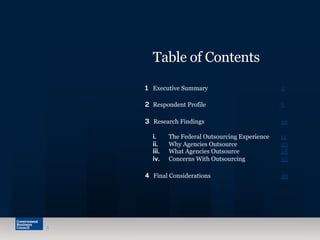
Table of Contents
1 Executive Summary 4
2 Respondent Profile 6
3  Research Findings 10
i. The Federal Outsourcing Experience 11
ii. Why Agencies Outsource 20
iii. What Agencies Outsource 28
iv. Concerns With Outsourcing 33
4 Final Considerations 39
3
4
1
Executive
Summary
Executive Summary
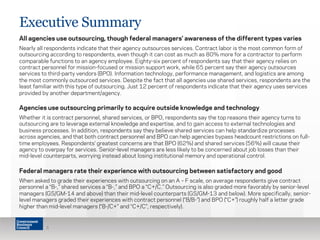
All agencies use outsourcing, though federal managers’ awareness of the different types varies
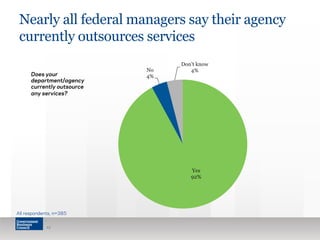
Nearly all respondents indicate that their agency outsources services. Contract labor is the most common form of
outsourcing according to respondents, even though it can cost as much as 80% more for a contractor to perform
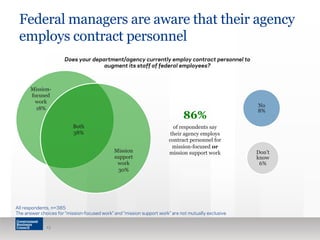
comparable functions to an agency employee. Eighty-six percent of respondents say that their agency relies on
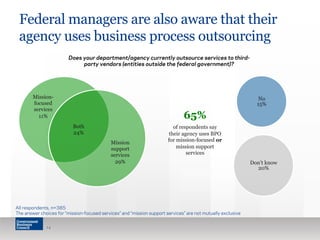
contract personnel for mission-focused or mission support work, while 65 percent say their agency outsources
services to third-party vendors (BPO). Information technology, performance management, and logistics are among
the most commonly outsourced services. Despite the fact that all agencies use shared services, respondents are the
least familiar with this type of outsourcing. Just 12 percent of respondents indicate that their agency uses services
provided by another department/agency.
Agencies use outsourcing primarily to acquire outside knowledge and technology
Whether it is contract personnel, shared services, or BPO, respondents say the top reasons their agency turns to
outsourcing are to leverage external knowledge and expertise, and to gain access to external technologies and
business processes. In addition, respondents say they believe shared services can help standardize processes
across agencies, and that both contract personnel and BPO can help agencies bypass headcount restrictions on full-
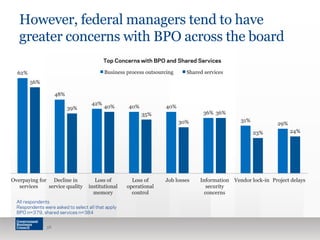
time employees. Respondents’ greatest concerns are that BPO (62%) and shared services (56%) will cause their
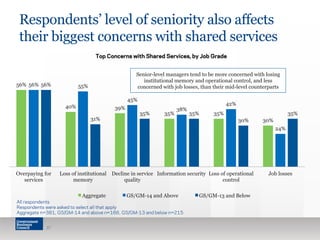
agency to overpay for services. Senior-level managers are less likely to be concerned about job losses than their
mid-level counterparts, worrying instead about losing institutional memory and operational control.
Federal managers rate their experience with outsourcing between satisfactory and good
When asked to grade their experiences with outsourcing on an A – F scale, on average respondents give contract
personnel a “B-,” shared services a “B-,” and BPO a “C+/C.” Outsourcing is also graded more favorably by senior-level
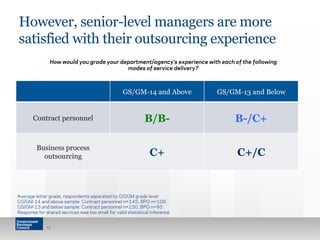
managers (GS/GM-14 and above) than their mid-level counterparts (GS/GM-13 and below). More specifically, senior-
level managers graded their experiences with contract personnel (“B/B-”) and BPO (“C+”) roughly half a letter grade
higher than mid-level managers (“B-/C+” and “C+/C”, respectively).
5
6
2
Respondent
Profile
Defense
35%
Civilian
65%
13%
7%
14%
23%
20%
20%
3%
Other
GS/GM-11
GS/GM-12
GS/GM-13
GS/GM-14
GS/GM-15
SES
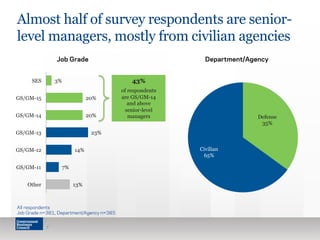
Almost half of survey respondents are senior-
level managers, mostly from civilian agencies
7
Job Grade Department/Agency
43%
of respondents
are GS/GM-14
and above
senior-level
managers
All respondents
Job Grade n=381, Department/Agency n=385
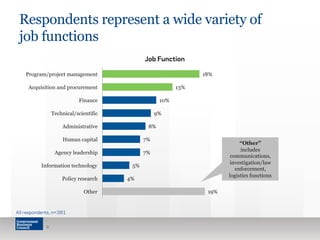
Respondents represent a wide variety of
job functions
8
19%
4%
5%
7%
7%
8%
9%
10%
13%
18%
Other
Policy research
Information technology
Agency leadership
Human capital
Administrative
Technical/scientific
Finance
Acquisition and procurement
Program/project management
Job Function
“Other”
includes
communications,
investigation/law
enforcement,
logistics functions
All respondents, n=381
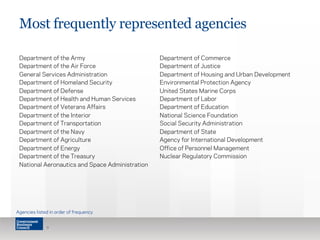
Most frequently represented agencies
Department of the Army
Department of the Air Force
General Services Administration
Department of Homeland Security
Department of Defense
Department of Health and Human Services
Department of Veterans Affairs
Department of the Interior
Department of Transportation
Department of the Navy
Department of Agriculture
Department of Energy
Department of the Treasury
National Aeronautics and Space Administration
Department of Commerce
Department of Justice
Department of Housing and Urban Development
Environmental Protection Agency
United States Marine Corps
Department of Labor
Department of Education
National Science Foundation
Social Security Administration
Department of State
Agency for International Development
Office of Personnel Management
Nuclear Regulatory Commission
9
Agencies listed in order of frequency
10
3
Research
Findings
11
i.
The Federal
Outsourcing
Experience
Nearly all federal managers say their agency
currently outsources services
12
All respondents, n=385
Does your
department/agency
currently outsource
any services?
Yes
92%
No
4%
Don't know
4%
Federal managers are aware that their agency
employs contract personnel
13
All respondents, n=385
The answer choices for “mission-focused work” and “mission support work” are not mutually exclusive
Does your department/agency currently employ contract personnel to
augment its staff of federal employees?
86%
of respondents say
their agency employs
contract personnel for
mission-focused or
mission support work
No
8%
Don’t
know
6%
Mission-
focused
work
18%
Both
38%
Mission
support
work
30%
Federal managers are also aware that their
agency uses business process outsourcing
14
All respondents, n=385
The answer choices for “mission-focused services” and “mission support services” are not mutually exclusive
Does your department/agency currently outsource services to third-
party vendors (entities outside the federal government)?
65%
of respondents say
their agency uses BPO
for mission-focused or
mission support
services
No
15%
Don’t know
20%
Mission-
focused
services
11%
Both
24%
Mission
support
services
29%
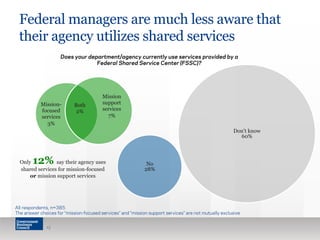
Federal managers are much less aware that
their agency utilizes shared services
15
Does your department/agency currently use services provided by a
Federal Shared Service Center (FSSC)?
Only 12% say their agency uses
shared services for mission-focused
or mission support services
All respondents, n=385
The answer choices for “mission-focused services” and “mission support services” are not mutually exclusive
No
28%
Don’t know
60%
Mission-
focused
services
3%
Mission
support
services
7%
Both
2%
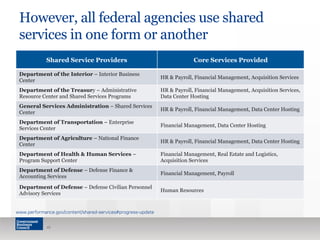
However, all federal agencies use shared
services in one form or another
16
Shared Service Providers Core Services Provided
Department of the Interior – Interior Business
Center
HR & Payroll, Financial Management, Acquisition Services
Department of the Treasury – Administrative
Resource Center and Shared Services Programs
HR & Payroll, Financial Management, Acquisition Services,
Data Center Hosting
General Services Administration – Shared Services
Center
HR & Payroll, Financial Management, Data Center Hosting
Department of Transportation – Enterprise
Services Center
Financial Management, Data Center Hosting
Department of Agriculture – National Finance
Center
HR & Payroll, Financial Management, Data Center Hosting
Department of Health & Human Services –
Program Support Center
Financial Management, Real Estate and Logistics,
Acquisition Services
Department of Defense – Defense Finance &
Accounting Services
Financial Management, Payroll
Department of Defense – Defense Civilian Personnel
Advisory Services
Human Resources
www.performance.gov/content/shared-services#progress-update
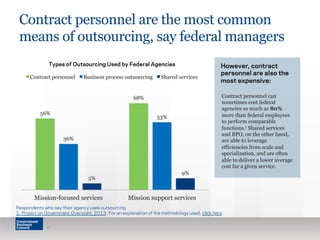
Contract personnel are the most common
means of outsourcing, say federal managers
17
56%
68%
36%
53%
5%
9%
Mission-focused services Mission support services
Contract personnel Business process outsourcing Shared services
Contract personnel can
sometimes cost federal
agencies as much as 80%
more than federal employees
to perform comparable
functions.1 Shared services
and BPO, on the other hand,
are able to leverage
efficiencies from scale and
specialization, and are often
able to deliver a lower average
cost for a given service.
Respondents who say their agency uses outsourcing
1. Project on Government Oversight, 2013. For an explanation of the methodology used, click here.
Types of Outsourcing Used by Federal Agencies However, contract
personnel are also the
most expensive:
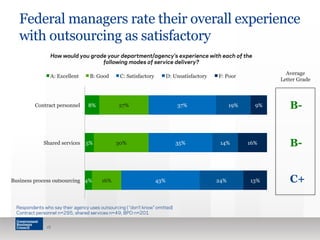
Federal managers rate their overall experience
with outsourcing as satisfactory
18
48%
of respondents disagree
or strongly disagree
4%
5%
8%
16%
30%
27%
43%
35%
37%
24%
14%
19%
13%
16%
9%
Business process outsourcing
Shared services
Contract personnel
A: Excellent B: Good C: Satisfactory D: Unsatisfactory F: Poor
How would you grade your department/agency’s experience with each of the
following modes of service delivery?
Respondents who say their agency uses outsourcing ( “don’t know” omitted)
Contract personnel n=295, shared services n=49, BPO n=201
B-
C+
Average
Letter Grade
B-
However, senior-level managers are more
satisfied with their outsourcing experience
19
How would you grade your department/agency’s experience with each of the following
modes of service delivery?
Average letter grade, respondents separated by GS/GM grade level
GS/GM-14 and above sample: Contract personnel n=145, BPO n=106
GS/GM-13 and below sample: Contract personnel n=150, BPO n=95
Response for shared services was too small for valid statistical inference
GS/GM-14 and Above GS/GM-13 and Below
Contract personnel B/B- B-/C+
Business process
outsourcing C+ C+/C
20
ii.
Why Agencies
Outsource
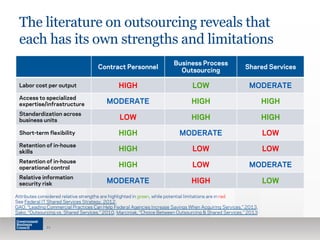
The literature on outsourcing reveals that
each has its own strengths and limitations
21
Contract Personnel
Business Process
Outsourcing
Shared Services
Labor cost per output HIGH LOW MODERATE
Access to specialized
expertise/infrastructure MODERATE HIGH HIGH
Standardization across
business units LOW HIGH HIGH
Short-term flexibility HIGH MODERATE LOW
Retention of in-house
skills HIGH LOW LOW
Retention of in-house
operational control HIGH LOW MODERATE
Relative information
security risk MODERATE HIGH LOW
Attributes considered relative strengths are highlighted in green, while potential limitations are in red
See Federal IT Shared Services Strategy, 2012,
GAO, “Leading Commercial Practices Can Help Federal Agencies Increase Savings When Acquiring Services,” 2013,
Sako, “Outsourcing vs. Shared Services,” 2010, Marciniak, “Choice Between Outsourcing & Shared Services,” 2013
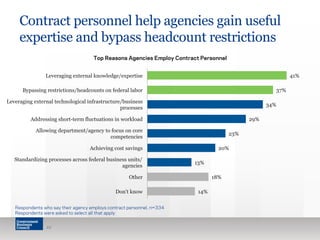
Contract personnel help agencies gain useful
expertise and bypass headcount restrictions
22
14%
18%
13%
20%
23%
29%
34%
37%
41%
Don't know
Other
Standardizing processes across federal business units/
agencies
Achieving cost savings
Allowing department/agency to focus on core
competencies
Addressing short-term fluctuations in workload
Leveraging external technological infrastructure/business
processes
Bypassing restrictions/headcounts on federal labor
Leveraging external knowledge/expertise
Top Reasons Agencies Employ Contract Personnel
Respondents who say their agency employs contract personnel, n=334
Respondents were asked to select all that apply
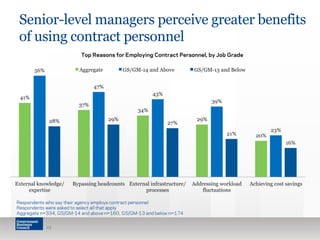
Senior-level managers perceive greater benefits
of using contract personnel
23
41%
37%
34%
29%
20%
56%
47%
43%
39%
23%
28% 29%
27%
21%
16%
External knowledge/
expertise
Bypassing headcounts External infrastructure/
processes
Addressing workload
fluctuations
Achieving cost savings
Aggregate GS/GM-14 and Above GS/GM-13 and Below
Respondents who say their agency employs contract personnel
Respondents were asked to select all that apply
Aggregate n=334, GS/GM-14 and above n=160, GS/GM-13 and below n=174
Top Reasons for Employing Contract Personnel, by Job Grade
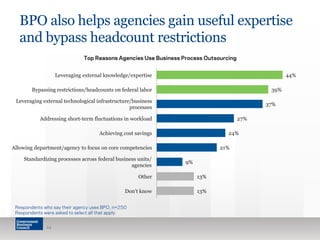
BPO also helps agencies gain useful expertise
and bypass headcount restrictions
24
13%
13%
9%
21%
24%
27%
37%
39%
44%
Don't know
Other
Standardizing processes across federal business units/
agencies
Allowing department/agency to focus on core competencies
Achieving cost savings
Addressing short-term fluctuations in workload
Leveraging external technological infrastructure/business
processes
Bypassing restrictions/headcounts on federal labor
Leveraging external knowledge/expertise
Respondents who say their agency uses BPO, n=250
Respondents were asked to select all that apply
Top Reasons Agencies Use Business Process Outsourcing
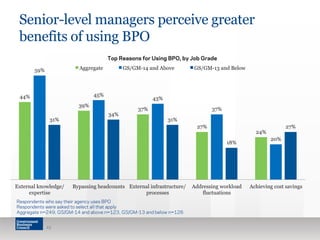
Senior-level managers perceive greater
benefits of using BPO
25
44%
39%
37%
27%
24%
59%
45%
43%
37%
20%
31%
34%
31%
18%
27%
External knowledge/
expertise
Bypassing headcounts External infrastructure/
processes
Addressing workload
fluctuations
Achieving cost savings
Aggregate GS/GM-14 and Above GS/GM-13 and Below
Respondents who say their agency uses BPO
Respondents were asked to select all that apply
Aggregate n=249, GS/GM-14 and above n=123, GS/GM-13 and below n=126
Top Reasons for Using BPO, by Job Grade
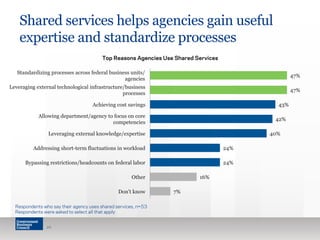
Shared services helps agencies gain useful
expertise and standardize processes
26
7%
16%
24%
24%
40%
42%
43%
47%
47%
Don't know
Other
Bypassing restrictions/headcounts on federal labor
Addressing short-term fluctuations in workload
Leveraging external knowledge/expertise
Allowing department/agency to focus on core
competencies
Achieving cost savings
Leveraging external technological infrastructure/business
processes
Standardizing processes across federal business units/
agencies
Respondents who say their agency uses shared services, n=53
Respondents were asked to select all that apply
Top Reasons Agencies Use Shared Services
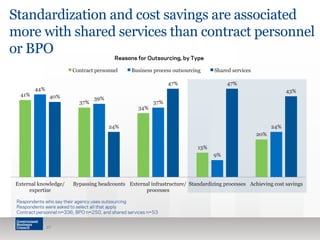
Standardization and cost savings are associated
more with shared services than contract personnel
or BPO
27
41%
37%
34%
13%
20%
44%
39%
37%
9%
24%
40%
24%
47% 47%
43%
External knowledge/
expertise
Bypassing headcounts External infrastructure/
processes
Standardizing processes Achieving cost savings
Contract personnel Business process outsourcing Shared services
Respondents who say their agency uses outsourcing
Respondents were asked to select all that apply
Contract personnel n=336, BPO n=250, and shared services n=53
Reasons for Outsourcing, by Type
28
iii.
What Agencies
Outsource
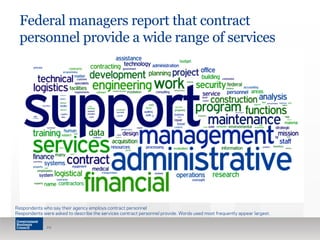
Federal managers report that contract
personnel provide a wide range of services
29
Respondents who say their agency employs contract personnel
Respondents were asked to describe the services contract personnel provide. Words used most frequently appear largest.
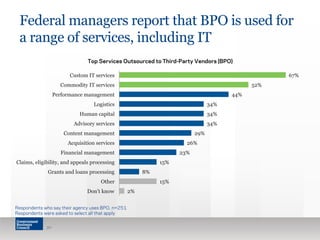
Federal managers report that BPO is used for
a range of services, including IT
30
Respondents who say their agency uses BPO, n=251
Respondents were asked to select all that apply
Top Services Outsourced to Third-Party Vendors (BPO)
2%
15%
8%
15%
23%
26%
29%
34%
34%
34%
44%
52%
67%
Don't know
Other
Grants and loans processing
Claims, eligibility, and appeals processing
Financial management
Acquisition services
Content management
Advisory services
Human capital
Logistics
Performance management
Commodity IT services
Custom IT services
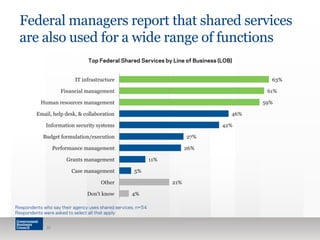
Federal managers report that shared services
are also used for a wide range of functions
31
4%
21%
5%
11%
26%
27%
42%
46%
59%
61%
63%
Don't know
Other
Case management
Grants management
Performance management
Budget formulation/execution
Information security systems
Email, help desk, & collaboration
Human resources management
Financial management
IT infrastructure
Respondents who say their agency uses shared services, n=54
Respondents were asked to select all that apply
Top Federal Shared Services by Line of Business (LOB)
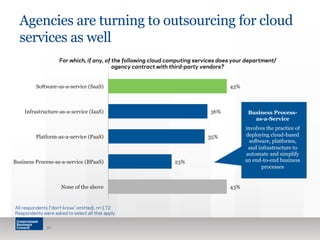
Agencies are turning to outsourcing for cloud
services as well
32
43%
23%
35%
36%
43%
None of the above
Business Process-as-a-service (BPaaS)
Platform-as-a-service (PaaS)
Infrastructure-as-a-service (IaaS)
Software-as-a-service (SaaS)
All respondents (“don’t know” omitted), n=172
Respondents were asked to select all that apply
For which, if any, of the following cloud computing services does your department/
agency contract with third-party vendors?
Business Process-
as-a-Service
involves the practice of
deploying cloud-based
software, platforms,
and infrastructure to
automate and simplify
an end-to-end business
processes
33
iv.
Concerns with
Outsourcing
12%
10%
6%
30%
31%
36%
40%
41%
42%
48%
48%
62%
Don't know
None of the above
Other
Project delays
Vendor lock-in
Information security concerns
Federal job losses
Loss of operational control
Loss of institutional memory
Decline in service quality
Contractors performing "inherently governmental" functions
Overpaying for services
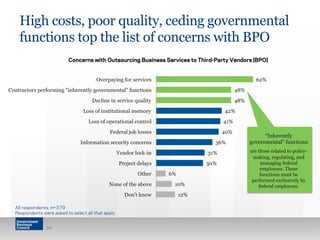
High costs, poor quality, ceding governmental
functions top the list of concerns with BPO
34
All respondents, n=379
Respondents were asked to select all that apply
Concerns with Outsourcing Business Services to Third-Party Vendors (BPO)
“Inherently
governmental” functions
are those related to policy-
making, regulating, and
managing federal
employees. These
functions must be
performed exclusively by
federal employees.
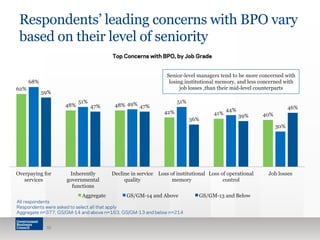
Respondents’ leading concerns with BPO vary
based on their level of seniority
35
62%
48% 48%
42% 41% 40%
68%
51% 49% 51%
44%
30%
59%
47% 47%
36%
39%
46%
Overpaying for
services
Inherently
governmental
functions
Decline in service
quality
Loss of institutional
memory
Loss of operational
control
Job losses
Aggregate GS/GM-14 and Above GS/GM-13 and Below
Top Concerns with BPO, by Job Grade
Senior-level managers tend to be more concerned with
losing institutional memory, and less concerned with
job losses ,than their mid-level counterparts
All respondents
Respondents were asked to select all that apply
Aggregate n=377, GS/GM-14 and above n=163, GS/GM-13 and below n=214
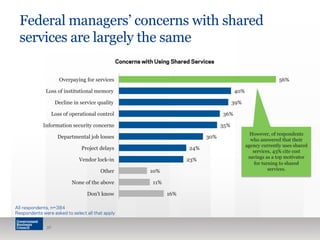
Federal managers’ concerns with shared
services are largely the same
36
16%
11%
10%
23%
24%
30%
35%
36%
39%
40%
56%
Don't know
None of the above
Other
Vendor lock-in
Project delays
Departmental job losses
Information security concerns
Loss of operational control
Decline in service quality
Loss of institutional memory
Overpaying for services
Concerns with Using Shared Services
All respondents, n=384
Respondents were asked to select all that apply
However, of respondents
who answered that their
agency currently uses shared
services, 43% cite cost
savings as a top motivator
for turning to shared
services.
Respondents’ level of seniority also affects
their biggest concerns with shared services
37
56%
40% 39%
35% 35%
30%
56% 55%
45%
38%
42%
24%
56%
31%
35% 35%
30%
35%
Overpaying for
services
Loss of institutional
memory
Decline in service
quality
Information security Loss of operational
control
Job losses
Aggregate GS/GM-14 and Above GS/GM-13 and Below
Senior-level managers tend to be more concerned with losing
institutional memory and operational control, and less
concerned with job losses, than their mid-level counterparts
Top Concerns with Shared Services, by Job Grade
All respondents
Respondents were asked to select all that apply
Aggregate n=381, GS/GM-14 and above n=166, GS/GM-13 and below n=215
However, federal managers tend to have
greater concerns with BPO across the board
38
62%
48%
42%
40% 40%
36%
31%
29%
56%
39% 40%
35%
30%
36%
23% 24%
Overpaying for
services
Decline in
service quality
Loss of
institutional
memory
Loss of
operational
control
Job losses Information
security
concerns
Vendor lock-in Project delays
Business process outsourcing Shared services
All respondents
Respondents were asked to select all that apply
BPO n=379, shared services n=384
Top Concerns with BPO and Shared Services
39
4
Final
Considerations
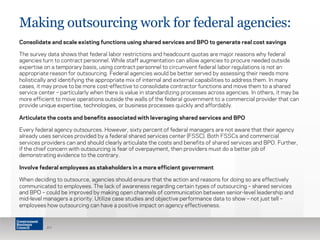
Making outsourcing work for federal agencies:
Consolidate and scale existing functions using shared services and BPO to generate real cost savings
The survey data shows that federal labor restrictions and headcount quotas are major reasons why federal
agencies turn to contract personnel. While staff augmentation can allow agencies to procure needed outside
expertise on a temporary basis, using contract personnel to circumvent federal labor regulations is not an
appropriate reason for outsourcing. Federal agencies would be better served by assessing their needs more
holistically and identifying the appropriate mix of internal and external capabilities to address them. In many
cases, it may prove to be more cost-effective to consolidate contractor functions and move them to a shared
service center – particularly when there is value in standardizing processes across agencies. In others, it may be
more efficient to move operations outside the walls of the federal government to a commercial provider that can
provide unique expertise, technologies, or business processes quickly and affordably.
Articulate the costs and benefits associated with leveraging shared services and BPO
Every federal agency outsources. However, sixty percent of federal managers are not aware that their agency
already uses services provided by a federal shared services center (FSSC). Both FSSCs and commercial
services providers can and should clearly articulate the costs and benefits of shared services and BPO. Further,
if the chief concern with outsourcing is fear of overpayment, then providers must do a better job of
demonstrating evidence to the contrary.
Involve federal employees as stakeholders in a more efficient government
When deciding to outsource, agencies should ensure that the action and reasons for doing so are effectively
communicated to employees. The lack of awareness regarding certain types of outsourcing – shared services
and BPO – could be improved by making open channels of communication between senior-level leadership and
mid-level managers a priority. Utilize case studies and objective performance data to show – not just tell –
employees how outsourcing can have a positive impact on agency effectiveness.
40
Underwritten by
About Accenture Federal Services
Accenture Federal Services is a U.S. company, with offices in
Arlington, Va., and is a wholly owned subsidiary of Accenture
LLP. Accenture’s federal business has served every cabinet-
level department and 30 of the largest federal organizations
with clients at defense, intelligence, public safety, civilian and
military health organizations.
About Accenture
Accenture is a global management consulting, technology
services and outsourcing company, with approximately
319,000 people serving clients in more than 120
countries.  Combining unparalleled experience,
comprehensive capabilities across all industries and
business functions, and extensive research on the world’s
most successful companies, Accenture collaborates with
clients to help them become high-performance businesses
and governments.  The company generated net revenues
of US$30.0 billion for the fiscal year ended Aug. 31,
2014.  Its home page is www.accenture.com.
41
Glenn Davidson
Managing Director
Tel. 571-414-2652
glenn.k.davidson@accenturefederal.com
accenture.com/federal
Follow @AccentureFed
About GBC
Contact
Zoe Grotophorst
Manager,
Research & Strategic Insights
Tel. 202.266.7335
zgrotophorst@govexec.com
govexec.com/GBC
@GovBizCouncil
Our Mission
Government Business Council (GBC), the research arm of
Government Executive Media Group, is dedicated to advancing the
business of government through analysis and insight. GBC partners
with industry to share best practices with top government decision
makers, understanding the deep value inherent in industry’s
experience engaging and supporting federal agencies.
42

Inside Federal Outsourcing

  • 1.
    Inside Federal Outsourcing A CandidSurvey of Federal Managers May 2015 Underwritten by:
  • 2.
    Purpose The U.S. governmentfinds itself in a bit of a paradox. Federal agencies’ mission scope is evolving and expanding on a daily basis, while their budgets remain stagnant, regulations keep them perennially understaffed, and new technologies necessitate unique and in-demand skill sets. As a result, agencies are increasingly turning to three forms of outsourcing—contract personnel, shared services, and business process outsourcing (BPO)—to help close this widening capabilities gap. While most government employees are likely familiar with contract personnel, professionals employed by private firms who perform services for the public sector, other forms of outsourcing like shared services and BPO are perhaps less understood. Shared services, as practiced in the federal government, are applications or business processes that are centralized and provided, either across a single department or agency, or by one federal agency to other departments and agencies. In both cases, shared services are oftentimes supported by a commercial provider. BPO, on the other hand, refers to the process of handing over the execution of a specific function or business process to a third-party commercial provider, which is often located off-site. However, questions remain about whether agencies are pursuing outsourcing on an ad hoc basis, or whether they are adopting a more strategic approach that takes into account the unique strengths and limitations of contract personnel, shared services, and BPO. 2 Methodology To assess the perceptions, attitudes, and experiences of federal managers regarding the ways their agencies use different forms of outsourcing, Government Business Council (GBC) and Accenture deployed a survey to a sample of Government Executive, Nextgov, and Defense One online and print subscribers in September 2014. The pool of 385 respondents includes employees at the GS/GM 11-15 grade levels and members of the Senior Executive Service (SES). At least 34 federal and defense agencies are represented. The findings included here are weighted by department/agency to more fully reflect the composition of the overall federal workforce.
  • 3.
    Table of Contents 1Executive Summary 4 2 Respondent Profile 6 3  Research Findings 10 i. The Federal Outsourcing Experience 11 ii. Why Agencies Outsource 20 iii. What Agencies Outsource 28 iv. Concerns With Outsourcing 33 4 Final Considerations 39 3
  • 4.
  • 5.
    Executive Summary All agenciesuse outsourcing, though federal managers’ awareness of the different types varies Nearly all respondents indicate that their agency outsources services. Contract labor is the most common form of outsourcing according to respondents, even though it can cost as much as 80% more for a contractor to perform comparable functions to an agency employee. Eighty-six percent of respondents say that their agency relies on contract personnel for mission-focused or mission support work, while 65 percent say their agency outsources services to third-party vendors (BPO). Information technology, performance management, and logistics are among the most commonly outsourced services. Despite the fact that all agencies use shared services, respondents are the least familiar with this type of outsourcing. Just 12 percent of respondents indicate that their agency uses services provided by another department/agency. Agencies use outsourcing primarily to acquire outside knowledge and technology Whether it is contract personnel, shared services, or BPO, respondents say the top reasons their agency turns to outsourcing are to leverage external knowledge and expertise, and to gain access to external technologies and business processes. In addition, respondents say they believe shared services can help standardize processes across agencies, and that both contract personnel and BPO can help agencies bypass headcount restrictions on full- time employees. Respondents’ greatest concerns are that BPO (62%) and shared services (56%) will cause their agency to overpay for services. Senior-level managers are less likely to be concerned about job losses than their mid-level counterparts, worrying instead about losing institutional memory and operational control. Federal managers rate their experience with outsourcing between satisfactory and good When asked to grade their experiences with outsourcing on an A – F scale, on average respondents give contract personnel a “B-,” shared services a “B-,” and BPO a “C+/C.” Outsourcing is also graded more favorably by senior-level managers (GS/GM-14 and above) than their mid-level counterparts (GS/GM-13 and below). More specifically, senior- level managers graded their experiences with contract personnel (“B/B-”) and BPO (“C+”) roughly half a letter grade higher than mid-level managers (“B-/C+” and “C+/C”, respectively). 5
  • 6.
  • 7.
    Defense 35% Civilian 65% 13% 7% 14% 23% 20% 20% 3% Other GS/GM-11 GS/GM-12 GS/GM-13 GS/GM-14 GS/GM-15 SES Almost half ofsurvey respondents are senior- level managers, mostly from civilian agencies 7 Job Grade Department/Agency 43% of respondents are GS/GM-14 and above senior-level managers All respondents Job Grade n=381, Department/Agency n=385
  • 8.
    Respondents represent awide variety of job functions 8 19% 4% 5% 7% 7% 8% 9% 10% 13% 18% Other Policy research Information technology Agency leadership Human capital Administrative Technical/scientific Finance Acquisition and procurement Program/project management Job Function “Other” includes communications, investigation/law enforcement, logistics functions All respondents, n=381
  • 9.
    Most frequently representedagencies Department of the Army Department of the Air Force General Services Administration Department of Homeland Security Department of Defense Department of Health and Human Services Department of Veterans Affairs Department of the Interior Department of Transportation Department of the Navy Department of Agriculture Department of Energy Department of the Treasury National Aeronautics and Space Administration Department of Commerce Department of Justice Department of Housing and Urban Development Environmental Protection Agency United States Marine Corps Department of Labor Department of Education National Science Foundation Social Security Administration Department of State Agency for International Development Office of Personnel Management Nuclear Regulatory Commission 9 Agencies listed in order of frequency
  • 10.
  • 11.
  • 12.
    Nearly all federalmanagers say their agency currently outsources services 12 All respondents, n=385 Does your department/agency currently outsource any services? Yes 92% No 4% Don't know 4%
  • 13.
    Federal managers areaware that their agency employs contract personnel 13 All respondents, n=385 The answer choices for “mission-focused work” and “mission support work” are not mutually exclusive Does your department/agency currently employ contract personnel to augment its staff of federal employees? 86% of respondents say their agency employs contract personnel for mission-focused or mission support work No 8% Don’t know 6% Mission- focused work 18% Both 38% Mission support work 30%
  • 14.
    Federal managers arealso aware that their agency uses business process outsourcing 14 All respondents, n=385 The answer choices for “mission-focused services” and “mission support services” are not mutually exclusive Does your department/agency currently outsource services to third- party vendors (entities outside the federal government)? 65% of respondents say their agency uses BPO for mission-focused or mission support services No 15% Don’t know 20% Mission- focused services 11% Both 24% Mission support services 29%
  • 15.
    Federal managers aremuch less aware that their agency utilizes shared services 15 Does your department/agency currently use services provided by a Federal Shared Service Center (FSSC)? Only 12% say their agency uses shared services for mission-focused or mission support services All respondents, n=385 The answer choices for “mission-focused services” and “mission support services” are not mutually exclusive No 28% Don’t know 60% Mission- focused services 3% Mission support services 7% Both 2%
  • 16.
    However, all federalagencies use shared services in one form or another 16 Shared Service Providers Core Services Provided Department of the Interior – Interior Business Center HR & Payroll, Financial Management, Acquisition Services Department of the Treasury – Administrative Resource Center and Shared Services Programs HR & Payroll, Financial Management, Acquisition Services, Data Center Hosting General Services Administration – Shared Services Center HR & Payroll, Financial Management, Data Center Hosting Department of Transportation – Enterprise Services Center Financial Management, Data Center Hosting Department of Agriculture – National Finance Center HR & Payroll, Financial Management, Data Center Hosting Department of Health & Human Services – Program Support Center Financial Management, Real Estate and Logistics, Acquisition Services Department of Defense – Defense Finance & Accounting Services Financial Management, Payroll Department of Defense – Defense Civilian Personnel Advisory Services Human Resources www.performance.gov/content/shared-services#progress-update
  • 17.
    Contract personnel arethe most common means of outsourcing, say federal managers 17 56% 68% 36% 53% 5% 9% Mission-focused services Mission support services Contract personnel Business process outsourcing Shared services Contract personnel can sometimes cost federal agencies as much as 80% more than federal employees to perform comparable functions.1 Shared services and BPO, on the other hand, are able to leverage efficiencies from scale and specialization, and are often able to deliver a lower average cost for a given service. Respondents who say their agency uses outsourcing 1. Project on Government Oversight, 2013. For an explanation of the methodology used, click here. Types of Outsourcing Used by Federal Agencies However, contract personnel are also the most expensive:
  • 18.
    Federal managers ratetheir overall experience with outsourcing as satisfactory 18 48% of respondents disagree or strongly disagree 4% 5% 8% 16% 30% 27% 43% 35% 37% 24% 14% 19% 13% 16% 9% Business process outsourcing Shared services Contract personnel A: Excellent B: Good C: Satisfactory D: Unsatisfactory F: Poor How would you grade your department/agency’s experience with each of the following modes of service delivery? Respondents who say their agency uses outsourcing ( “don’t know” omitted) Contract personnel n=295, shared services n=49, BPO n=201 B- C+ Average Letter Grade B-
  • 19.
    However, senior-level managersare more satisfied with their outsourcing experience 19 How would you grade your department/agency’s experience with each of the following modes of service delivery? Average letter grade, respondents separated by GS/GM grade level GS/GM-14 and above sample: Contract personnel n=145, BPO n=106 GS/GM-13 and below sample: Contract personnel n=150, BPO n=95 Response for shared services was too small for valid statistical inference GS/GM-14 and Above GS/GM-13 and Below Contract personnel B/B- B-/C+ Business process outsourcing C+ C+/C
  • 20.
  • 21.
    The literature onoutsourcing reveals that each has its own strengths and limitations 21 Contract Personnel Business Process Outsourcing Shared Services Labor cost per output HIGH LOW MODERATE Access to specialized expertise/infrastructure MODERATE HIGH HIGH Standardization across business units LOW HIGH HIGH Short-term flexibility HIGH MODERATE LOW Retention of in-house skills HIGH LOW LOW Retention of in-house operational control HIGH LOW MODERATE Relative information security risk MODERATE HIGH LOW Attributes considered relative strengths are highlighted in green, while potential limitations are in red See Federal IT Shared Services Strategy, 2012, GAO, “Leading Commercial Practices Can Help Federal Agencies Increase Savings When Acquiring Services,” 2013, Sako, “Outsourcing vs. Shared Services,” 2010, Marciniak, “Choice Between Outsourcing & Shared Services,” 2013
  • 22.
    Contract personnel helpagencies gain useful expertise and bypass headcount restrictions 22 14% 18% 13% 20% 23% 29% 34% 37% 41% Don't know Other Standardizing processes across federal business units/ agencies Achieving cost savings Allowing department/agency to focus on core competencies Addressing short-term fluctuations in workload Leveraging external technological infrastructure/business processes Bypassing restrictions/headcounts on federal labor Leveraging external knowledge/expertise Top Reasons Agencies Employ Contract Personnel Respondents who say their agency employs contract personnel, n=334 Respondents were asked to select all that apply
  • 23.
    Senior-level managers perceivegreater benefits of using contract personnel 23 41% 37% 34% 29% 20% 56% 47% 43% 39% 23% 28% 29% 27% 21% 16% External knowledge/ expertise Bypassing headcounts External infrastructure/ processes Addressing workload fluctuations Achieving cost savings Aggregate GS/GM-14 and Above GS/GM-13 and Below Respondents who say their agency employs contract personnel Respondents were asked to select all that apply Aggregate n=334, GS/GM-14 and above n=160, GS/GM-13 and below n=174 Top Reasons for Employing Contract Personnel, by Job Grade
  • 24.
    BPO also helpsagencies gain useful expertise and bypass headcount restrictions 24 13% 13% 9% 21% 24% 27% 37% 39% 44% Don't know Other Standardizing processes across federal business units/ agencies Allowing department/agency to focus on core competencies Achieving cost savings Addressing short-term fluctuations in workload Leveraging external technological infrastructure/business processes Bypassing restrictions/headcounts on federal labor Leveraging external knowledge/expertise Respondents who say their agency uses BPO, n=250 Respondents were asked to select all that apply Top Reasons Agencies Use Business Process Outsourcing
  • 25.
    Senior-level managers perceivegreater benefits of using BPO 25 44% 39% 37% 27% 24% 59% 45% 43% 37% 20% 31% 34% 31% 18% 27% External knowledge/ expertise Bypassing headcounts External infrastructure/ processes Addressing workload fluctuations Achieving cost savings Aggregate GS/GM-14 and Above GS/GM-13 and Below Respondents who say their agency uses BPO Respondents were asked to select all that apply Aggregate n=249, GS/GM-14 and above n=123, GS/GM-13 and below n=126 Top Reasons for Using BPO, by Job Grade
  • 26.
    Shared services helpsagencies gain useful expertise and standardize processes 26 7% 16% 24% 24% 40% 42% 43% 47% 47% Don't know Other Bypassing restrictions/headcounts on federal labor Addressing short-term fluctuations in workload Leveraging external knowledge/expertise Allowing department/agency to focus on core competencies Achieving cost savings Leveraging external technological infrastructure/business processes Standardizing processes across federal business units/ agencies Respondents who say their agency uses shared services, n=53 Respondents were asked to select all that apply Top Reasons Agencies Use Shared Services
  • 27.
    Standardization and costsavings are associated more with shared services than contract personnel or BPO 27 41% 37% 34% 13% 20% 44% 39% 37% 9% 24% 40% 24% 47% 47% 43% External knowledge/ expertise Bypassing headcounts External infrastructure/ processes Standardizing processes Achieving cost savings Contract personnel Business process outsourcing Shared services Respondents who say their agency uses outsourcing Respondents were asked to select all that apply Contract personnel n=336, BPO n=250, and shared services n=53 Reasons for Outsourcing, by Type
  • 28.
  • 29.
    Federal managers reportthat contract personnel provide a wide range of services 29 Respondents who say their agency employs contract personnel Respondents were asked to describe the services contract personnel provide. Words used most frequently appear largest.
  • 30.
    Federal managers reportthat BPO is used for a range of services, including IT 30 Respondents who say their agency uses BPO, n=251 Respondents were asked to select all that apply Top Services Outsourced to Third-Party Vendors (BPO) 2% 15% 8% 15% 23% 26% 29% 34% 34% 34% 44% 52% 67% Don't know Other Grants and loans processing Claims, eligibility, and appeals processing Financial management Acquisition services Content management Advisory services Human capital Logistics Performance management Commodity IT services Custom IT services
  • 31.
    Federal managers reportthat shared services are also used for a wide range of functions 31 4% 21% 5% 11% 26% 27% 42% 46% 59% 61% 63% Don't know Other Case management Grants management Performance management Budget formulation/execution Information security systems Email, help desk, & collaboration Human resources management Financial management IT infrastructure Respondents who say their agency uses shared services, n=54 Respondents were asked to select all that apply Top Federal Shared Services by Line of Business (LOB)
  • 32.
    Agencies are turningto outsourcing for cloud services as well 32 43% 23% 35% 36% 43% None of the above Business Process-as-a-service (BPaaS) Platform-as-a-service (PaaS) Infrastructure-as-a-service (IaaS) Software-as-a-service (SaaS) All respondents (“don’t know” omitted), n=172 Respondents were asked to select all that apply For which, if any, of the following cloud computing services does your department/ agency contract with third-party vendors? Business Process- as-a-Service involves the practice of deploying cloud-based software, platforms, and infrastructure to automate and simplify an end-to-end business processes
  • 33.
  • 34.
    12% 10% 6% 30% 31% 36% 40% 41% 42% 48% 48% 62% Don't know None ofthe above Other Project delays Vendor lock-in Information security concerns Federal job losses Loss of operational control Loss of institutional memory Decline in service quality Contractors performing "inherently governmental" functions Overpaying for services High costs, poor quality, ceding governmental functions top the list of concerns with BPO 34 All respondents, n=379 Respondents were asked to select all that apply Concerns with Outsourcing Business Services to Third-Party Vendors (BPO) “Inherently governmental” functions are those related to policy- making, regulating, and managing federal employees. These functions must be performed exclusively by federal employees.
  • 35.
    Respondents’ leading concernswith BPO vary based on their level of seniority 35 62% 48% 48% 42% 41% 40% 68% 51% 49% 51% 44% 30% 59% 47% 47% 36% 39% 46% Overpaying for services Inherently governmental functions Decline in service quality Loss of institutional memory Loss of operational control Job losses Aggregate GS/GM-14 and Above GS/GM-13 and Below Top Concerns with BPO, by Job Grade Senior-level managers tend to be more concerned with losing institutional memory, and less concerned with job losses ,than their mid-level counterparts All respondents Respondents were asked to select all that apply Aggregate n=377, GS/GM-14 and above n=163, GS/GM-13 and below n=214
  • 36.
    Federal managers’ concernswith shared services are largely the same 36 16% 11% 10% 23% 24% 30% 35% 36% 39% 40% 56% Don't know None of the above Other Vendor lock-in Project delays Departmental job losses Information security concerns Loss of operational control Decline in service quality Loss of institutional memory Overpaying for services Concerns with Using Shared Services All respondents, n=384 Respondents were asked to select all that apply However, of respondents who answered that their agency currently uses shared services, 43% cite cost savings as a top motivator for turning to shared services.
  • 37.
    Respondents’ level ofseniority also affects their biggest concerns with shared services 37 56% 40% 39% 35% 35% 30% 56% 55% 45% 38% 42% 24% 56% 31% 35% 35% 30% 35% Overpaying for services Loss of institutional memory Decline in service quality Information security Loss of operational control Job losses Aggregate GS/GM-14 and Above GS/GM-13 and Below Senior-level managers tend to be more concerned with losing institutional memory and operational control, and less concerned with job losses, than their mid-level counterparts Top Concerns with Shared Services, by Job Grade All respondents Respondents were asked to select all that apply Aggregate n=381, GS/GM-14 and above n=166, GS/GM-13 and below n=215
  • 38.
    However, federal managerstend to have greater concerns with BPO across the board 38 62% 48% 42% 40% 40% 36% 31% 29% 56% 39% 40% 35% 30% 36% 23% 24% Overpaying for services Decline in service quality Loss of institutional memory Loss of operational control Job losses Information security concerns Vendor lock-in Project delays Business process outsourcing Shared services All respondents Respondents were asked to select all that apply BPO n=379, shared services n=384 Top Concerns with BPO and Shared Services
  • 39.
  • 40.
    Making outsourcing workfor federal agencies: Consolidate and scale existing functions using shared services and BPO to generate real cost savings The survey data shows that federal labor restrictions and headcount quotas are major reasons why federal agencies turn to contract personnel. While staff augmentation can allow agencies to procure needed outside expertise on a temporary basis, using contract personnel to circumvent federal labor regulations is not an appropriate reason for outsourcing. Federal agencies would be better served by assessing their needs more holistically and identifying the appropriate mix of internal and external capabilities to address them. In many cases, it may prove to be more cost-effective to consolidate contractor functions and move them to a shared service center – particularly when there is value in standardizing processes across agencies. In others, it may be more efficient to move operations outside the walls of the federal government to a commercial provider that can provide unique expertise, technologies, or business processes quickly and affordably. Articulate the costs and benefits associated with leveraging shared services and BPO Every federal agency outsources. However, sixty percent of federal managers are not aware that their agency already uses services provided by a federal shared services center (FSSC). Both FSSCs and commercial services providers can and should clearly articulate the costs and benefits of shared services and BPO. Further, if the chief concern with outsourcing is fear of overpayment, then providers must do a better job of demonstrating evidence to the contrary. Involve federal employees as stakeholders in a more efficient government When deciding to outsource, agencies should ensure that the action and reasons for doing so are effectively communicated to employees. The lack of awareness regarding certain types of outsourcing – shared services and BPO – could be improved by making open channels of communication between senior-level leadership and mid-level managers a priority. Utilize case studies and objective performance data to show – not just tell – employees how outsourcing can have a positive impact on agency effectiveness. 40
  • 41.
    Underwritten by About AccentureFederal Services Accenture Federal Services is a U.S. company, with offices in Arlington, Va., and is a wholly owned subsidiary of Accenture LLP. Accenture’s federal business has served every cabinet- level department and 30 of the largest federal organizations with clients at defense, intelligence, public safety, civilian and military health organizations. About Accenture Accenture is a global management consulting, technology services and outsourcing company, with approximately 319,000 people serving clients in more than 120 countries.  Combining unparalleled experience, comprehensive capabilities across all industries and business functions, and extensive research on the world’s most successful companies, Accenture collaborates with clients to help them become high-performance businesses and governments.  The company generated net revenues of US$30.0 billion for the fiscal year ended Aug. 31, 2014.  Its home page is www.accenture.com. 41 Glenn Davidson Managing Director Tel. 571-414-2652 glenn.k.davidson@accenturefederal.com accenture.com/federal Follow @AccentureFed
  • 42.
    About GBC Contact Zoe Grotophorst Manager, Research& Strategic Insights Tel. 202.266.7335 zgrotophorst@govexec.com govexec.com/GBC @GovBizCouncil Our Mission Government Business Council (GBC), the research arm of Government Executive Media Group, is dedicated to advancing the business of government through analysis and insight. GBC partners with industry to share best practices with top government decision makers, understanding the deep value inherent in industry’s experience engaging and supporting federal agencies. 42