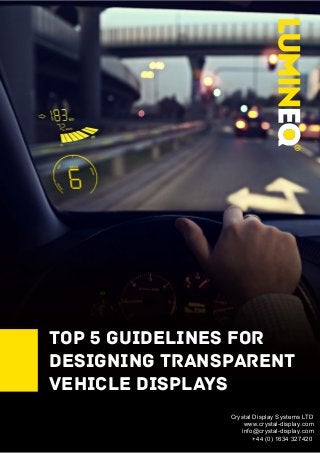
Top 5 guidelines for
designing transparent
vehicle displays
C
Crystal Display Systems LTD
www.crystal-display.com
info@crystal-display.com
+44 (0) 1634 327420
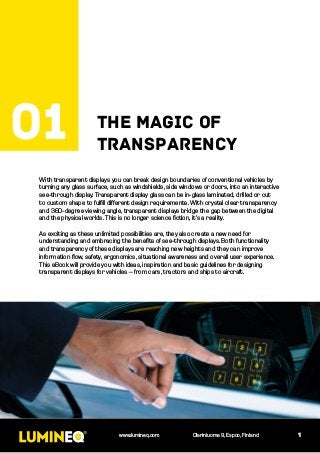
With transparent displays you can break design boundaries of conventional vehicles by
turning any glass surface, such as windshields, side windows or doors, into an interactive
see-through display. Transparent display glass can be in-glass laminated, drilled or cut
to custom shape to fulfill different design requirements. With crystal clear transparency
and 360-degree viewing angle, transparent displays bridge the gap between the digital
and the physical worlds. This is no longer science fiction, it’s a reality.
As exciting as these unlimited possibilities are, they also create a new need for
understanding and embracing the benefits of see-through displays. Both functionality
and transparency of these displays are reaching new heights and they can improve
information flow, safety, ergonomics, situational awareness and overall user experience.
This eBook will provide you with ideas, inspiration and basic guidelines for designing
transparent displays for vehicles – from cars, tractors and ships to aircraft.
1
The magic of
transparency
01
www.lumineq.com Olarinluoma 9, Espoo, Finland
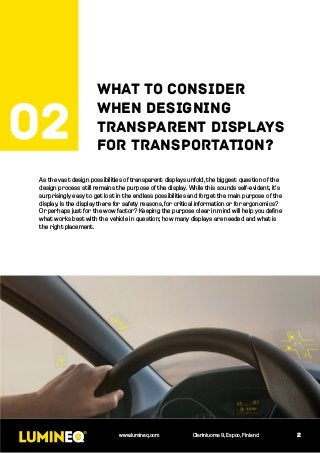
As the vast design possibilities of transparent displays unfold, the biggest question of the
design process still remains the purpose of the display. While this sounds self-evident, it’s
surprisingly easy to get lost in the endless possibilities and forget the main purpose of the
display. Is the display there for safety reasons, for critical information or for ergonomics?
Or perhaps just for the wow factor? Keeping the purpose clear in mind will help you define
what works best with the vehicle in question; how many displays are needed and what is
the right placement.
2www.lumineq.com Olarinluoma 9, Espoo, Finland
02
What to consider
when designing
transparent displays
for transportation?
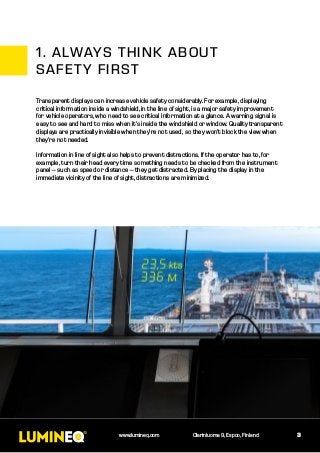
Transparent displays can increase vehicle safety considerably. For example, displaying
critical information inside a windshield, in the line of sight, is a major safety improvement
for vehicle operators, who need to see critical information at a glance. A warning signal is
easy to see and hard to miss when it’s inside the windshield or window. Quality transparent
displays are practically invisible when they’re not used, so they won’t block the view when
they’re not needed.
Information in line of sight also helps to prevent distractions. If the operator has to, for
example, turn their head every time something needs to be checked from the instrument
panel – such as speed or distance – they get distracted. By placing the display in the
immediate vicinity of the line of sight, distractions are minimized.
1. ALWAYS THINK ABOUT
SAFETY FIRST
3www.lumineq.com Olarinluoma 9, Espoo, Finland
4www.lumineq.com Olarinluoma 9, Espoo, Finland
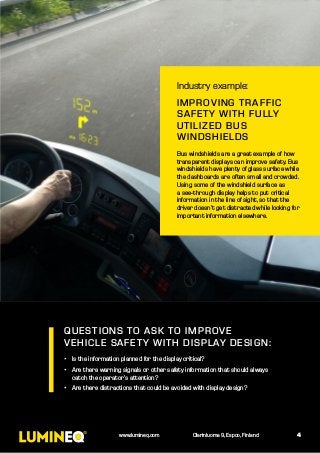
Industry example:
IMPROVING TRAFFIC
SAFETY WITH FULLY
UTILIZED BUS
WINDSHIELDS
Bus windshields are a great example of how
transparent displays can improve safety. Bus
windshields have plenty of glass surface while
the dashboards are often small and crowded.
Using some of the windshield surface as
a see-through display helps to put critical
information in the line of sight, so that the
driver doesn’t get distracted while looking for
important information elsewhere.
QUESTIONS TO ASK TO IMPROVE
VEHICLE SAFETY WITH DISPLAY DESIGN:
•	 Is the information planned for the display critical?
•	 Are there warning signals or other safety information that should always
catch the operator’s attention?
•	 Are there distractions that could be avoided with display design?
5www.lumineq.com Olarinluoma 9, Espoo, Finland
Not all information can, or should, be placed in line of sight at all times; it’s important to
separate critical information from less critical and not put all information in the same place.
The information should also always be presented as clearly as possible. Testing different
options and iterating every step of the way is critical in finding the best placement and the
best size for the display, among other things.
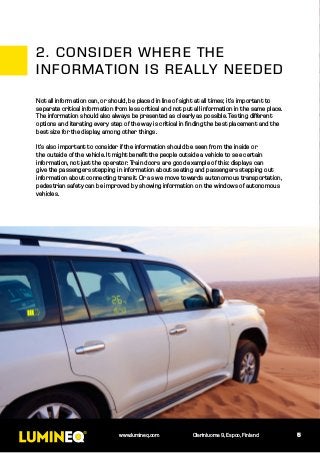
It’s also important to consider if the information should be seen from the inside or
the outside of the vehicle. It might benefit the people outside a vehicle to see certain
information, not just the operator. Train doors are good example of this: displays can
give the passengers stepping in information about seating and passengers stepping out
information about connecting transit. Or as we move towards autonomous transportation,
pedestrian safety can be improved by showing information on the windows of autonomous
vehicles.
2.	CONSIDER WHERE THE
INFORMATION IS REALLY NEEDED
QUESTIONS TO ASK TO PLACE THE
INFORMATION IN THE RIGHT PLACE:
•	 What information is needed and where and by who?
•	 How big should the information on the display be and what symbols should I use?
•	 Should there be several displays instead of putting all information to one?
6www.lumineq.com Olarinluoma 9, Espoo, Finland
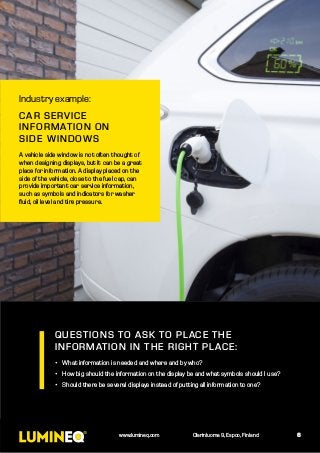
Industry example:
CAR SERVICE
INFORMATION ON
SIDE WINDOWS
A vehicle side window is not often thought of
when designing displays, but it can be a great
place for information. A display placed on the
side of the vehicle, close to the fuel cap, can
provide important car service information,
such as symbols and indicators for washer
fluid, oil level and tire pressure.
7www.lumineq.com Olarinluoma 9, Espoo, Finland
Transparent displays in vehicles often have a positive impact on ergonomics. Placing
the display in the right place and right height can, for example, prevent repetitive head
movements required to see crucial information. Also having several displays can be more
ergonomic than having just one. You might want to have different information on different
displays or double critical information from the main display to the line of sight.
Transparent displays can have a wide viewing angle and also be integrated in vertical
windshields. This enables the building of head-up displays (HUD) in areas where traditional
HUDs do not work. In demanding work conditions, blurred vision and fuzzy displays decrease
driver ergonomics and compromise safety. Quality see-through displays remain crystal-
clear even when the vehicle is shaking and tolerate shocks and vibration well.
3.	DETERMINE HOW TO ENHANCE
OPERATOR ERGONOMICS
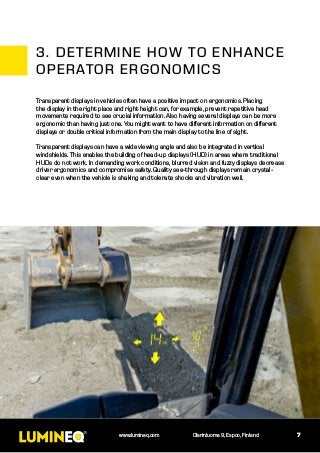
Industry example:
IMPROVED
ERGONOMICS FOR
HEAVY-DUTY VEHICLES
Ergonomics and safety of heavy equipment,
such as tractors, cranes and loaders, can
be considerably improved with see-through
displays. With well-placed information in the
confined cabins, the operator can e.g. avoid
unnecessary repetitive movements made in
effort to check critical information. Displays
can also be used to inform the people
working outside the machine. This way the
ergonomics and safety of both the people in
and outside the machine can be enhanced.
QUESTIONS TO ASK TO ENHANCE
ERGONOMICS WITH DISPLAY DESIGN:
•	 Where is the information easiest to see from?
•	 Can display placement prevent unnecessary repetitive movements?
•	 Should there be multiple displays in different directions and different heights?
•	 Does the display need to stay clear despite vibration and/or shocks?
8www.lumineq.com Olarinluoma 9, Espoo, Finland
9www.lumineq.com Olarinluoma 9, Espoo, Finland
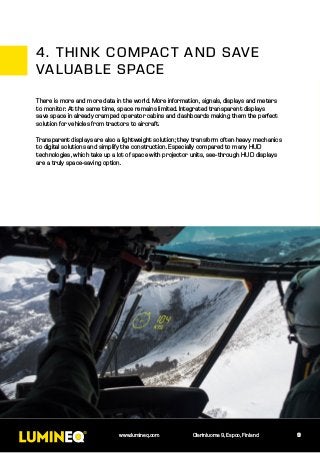
There is more and more data in the world. More information, signals, displays and meters
to monitor. At the same time, space remains limited. Integrated transparent displays
save space in already cramped operator cabins and dashboards making them the perfect
solution for vehicles from tractors to aircraft.
Transparent displays are also a lightweight solution; they transform often heavy mechanics
to digital solutions and simplify the construction. Especially compared to many HUD
technologies, which take up a lot of space with projector units, see-through HUD displays
are a truly space-saving option.
4.	THINK COMPACT AND SAVE
VALUABLE SPACE
QUESTIONS TO ASK TO SAVE SPACE
WITH DISPLAY DESIGN:
•	 What are the limitations of the space?
•	 Are there existing surfaces that could work as a display?
•	 Are there meters or gauges that could have additional information on them?
•	 Do most HUD solutions take too much space in the vehicle?
10
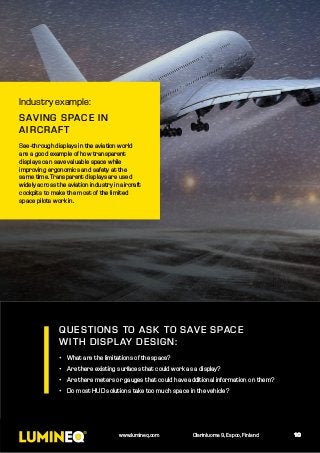
Industry example:
SAVING SPACE IN
AIRCRAFT
See-through displays in the aviation world
are a good example of how transparent
displays can save valuable space while
improving ergonomics and safety at the
same time. Transparent displays are used
widely across the aviation industry in aircraft
cockpits to make the most of the limited
space pilots work in.
10www.lumineq.com Olarinluoma 9, Espoo, Finland
11www.lumineq.com Olarinluoma 9, Espoo, Finland
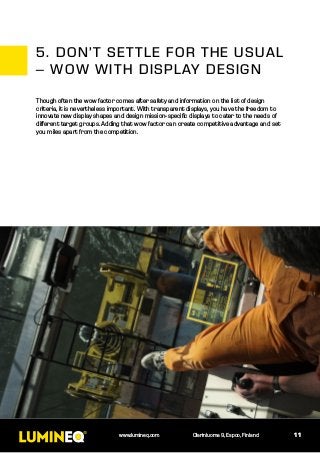
Though often the wow factor comes after safety and information on the list of design
criteria, it is nevertheless important. With transparent displays, you have the freedom to
innovate new display shapes and design mission-specific displays to cater to the needs of
different target groups. Adding that wow factor can create competitive advantage and set
you miles apart from the competition.
5.	DON’T SETTLE FOR THE USUAL
– WOW WITH DISPLAY DESIGN
QUESTIONS TO ASK TO REALLY WOW
WITH DISPLAY DESIGN:
•	 Could different target groups benefit from different kind of displays?
•	 Could an unusual display shape be both visually impressive and practical?
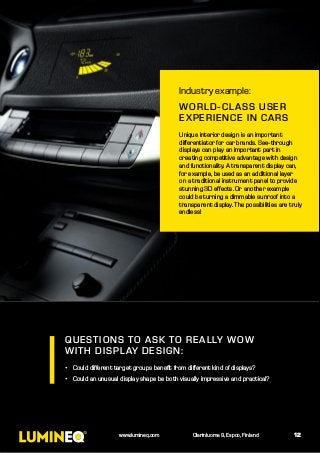
Industry example:
WORLD-CLASS USER
EXPERIENCE IN CARS
Unique interior design is an important
differentiator for car brands. See-through
displays can play an important part in
creating competitive advantage with design
and functionality. A transparent display can,
for example, be used as an additional layer
on a traditional instrument panel to provide
stunning 3D effects. Or another example
could be turning a dimmable sunroof into a
transparent display. The possibilities are truly
endless!
12www.lumineq.com Olarinluoma 9, Espoo, Finland
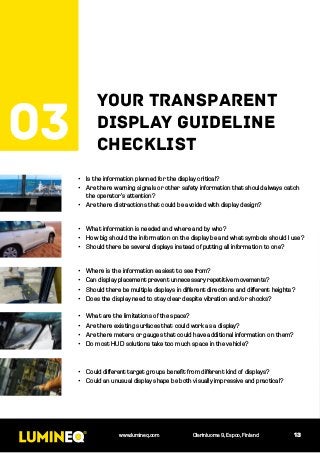
03
your transparent
display guideline
checklist
13www.lumineq.com Olarinluoma 9, Espoo, Finland
•	 What are the limitations of the space?
•	 Are there existing surfaces that could work as a display?
•	 Are there meters or gauges that could have additional information on them?
•	 Do most HUD solutions take too much space in the vehicle?
•	 Is the information planned for the display critical?
•	 Are there warning signals or other safety information that should always catch
the operator’s attention?
•	 Are there distractions that could be avoided with display design?
•	 Could different target groups benefit from different kind of displays?
•	 Could an unusual display shape be both visually impressive and practical?
•	 Where is the information easiest to see from?
•	 Can display placement prevent unnecessary repetitive movements?
•	 Should there be multiple displays in different directions and different heights?
•	 Does the display need to stay clear despite vibration and/or shocks?
•	 What information is needed and where and by who?
•	 How big should the information on the display be and what symbols should I use?
•	 Should there be several displays instead of putting all information to one?
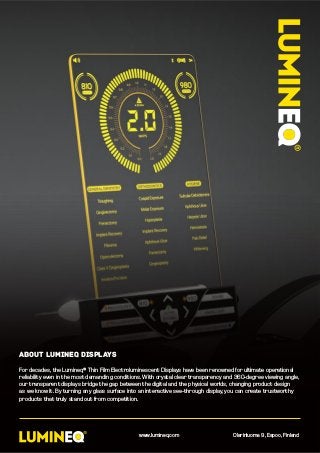
about lumineq displays
For decades, the Lumineq® Thin Film Electroluminescent Displays have been renowned for ultimate operational
reliability even in the most demanding conditions. With crystal clear transparency and 360-degree viewing angle,
our transparent displays bridge the gap between the digital and the physical worlds, changing product design
as we know it. By turning any glass surface into an interactive see-through display, you can create trustworthy
products that truly stand out from competition.
www.lumineq.com Olarinluoma 9, Espoo, Finland

CDS Lumineq Guidelines for Transparent Displays in Vehicles

  • 1.
    Top 5 guidelinesfor designing transparent vehicle displays C Crystal Display Systems LTD www.crystal-display.com info@crystal-display.com +44 (0) 1634 327420
  • 2.
    With transparent displaysyou can break design boundaries of conventional vehicles by turning any glass surface, such as windshields, side windows or doors, into an interactive see-through display. Transparent display glass can be in-glass laminated, drilled or cut to custom shape to fulfill different design requirements. With crystal clear transparency and 360-degree viewing angle, transparent displays bridge the gap between the digital and the physical worlds. This is no longer science fiction, it’s a reality. As exciting as these unlimited possibilities are, they also create a new need for understanding and embracing the benefits of see-through displays. Both functionality and transparency of these displays are reaching new heights and they can improve information flow, safety, ergonomics, situational awareness and overall user experience. This eBook will provide you with ideas, inspiration and basic guidelines for designing transparent displays for vehicles – from cars, tractors and ships to aircraft. 1 The magic of transparency 01 www.lumineq.com Olarinluoma 9, Espoo, Finland
  • 3.
    As the vastdesign possibilities of transparent displays unfold, the biggest question of the design process still remains the purpose of the display. While this sounds self-evident, it’s surprisingly easy to get lost in the endless possibilities and forget the main purpose of the display. Is the display there for safety reasons, for critical information or for ergonomics? Or perhaps just for the wow factor? Keeping the purpose clear in mind will help you define what works best with the vehicle in question; how many displays are needed and what is the right placement. 2www.lumineq.com Olarinluoma 9, Espoo, Finland 02 What to consider when designing transparent displays for transportation?
  • 4.
    Transparent displays canincrease vehicle safety considerably. For example, displaying critical information inside a windshield, in the line of sight, is a major safety improvement for vehicle operators, who need to see critical information at a glance. A warning signal is easy to see and hard to miss when it’s inside the windshield or window. Quality transparent displays are practically invisible when they’re not used, so they won’t block the view when they’re not needed. Information in line of sight also helps to prevent distractions. If the operator has to, for example, turn their head every time something needs to be checked from the instrument panel – such as speed or distance – they get distracted. By placing the display in the immediate vicinity of the line of sight, distractions are minimized. 1. ALWAYS THINK ABOUT SAFETY FIRST 3www.lumineq.com Olarinluoma 9, Espoo, Finland
  • 5.
    4www.lumineq.com Olarinluoma 9,Espoo, Finland Industry example: IMPROVING TRAFFIC SAFETY WITH FULLY UTILIZED BUS WINDSHIELDS Bus windshields are a great example of how transparent displays can improve safety. Bus windshields have plenty of glass surface while the dashboards are often small and crowded. Using some of the windshield surface as a see-through display helps to put critical information in the line of sight, so that the driver doesn’t get distracted while looking for important information elsewhere. QUESTIONS TO ASK TO IMPROVE VEHICLE SAFETY WITH DISPLAY DESIGN: • Is the information planned for the display critical? • Are there warning signals or other safety information that should always catch the operator’s attention? • Are there distractions that could be avoided with display design?
  • 6.
    5www.lumineq.com Olarinluoma 9,Espoo, Finland Not all information can, or should, be placed in line of sight at all times; it’s important to separate critical information from less critical and not put all information in the same place. The information should also always be presented as clearly as possible. Testing different options and iterating every step of the way is critical in finding the best placement and the best size for the display, among other things. It’s also important to consider if the information should be seen from the inside or the outside of the vehicle. It might benefit the people outside a vehicle to see certain information, not just the operator. Train doors are good example of this: displays can give the passengers stepping in information about seating and passengers stepping out information about connecting transit. Or as we move towards autonomous transportation, pedestrian safety can be improved by showing information on the windows of autonomous vehicles. 2. CONSIDER WHERE THE INFORMATION IS REALLY NEEDED
  • 7.
    QUESTIONS TO ASKTO PLACE THE INFORMATION IN THE RIGHT PLACE: • What information is needed and where and by who? • How big should the information on the display be and what symbols should I use? • Should there be several displays instead of putting all information to one? 6www.lumineq.com Olarinluoma 9, Espoo, Finland Industry example: CAR SERVICE INFORMATION ON SIDE WINDOWS A vehicle side window is not often thought of when designing displays, but it can be a great place for information. A display placed on the side of the vehicle, close to the fuel cap, can provide important car service information, such as symbols and indicators for washer fluid, oil level and tire pressure.
  • 8.
    7www.lumineq.com Olarinluoma 9,Espoo, Finland Transparent displays in vehicles often have a positive impact on ergonomics. Placing the display in the right place and right height can, for example, prevent repetitive head movements required to see crucial information. Also having several displays can be more ergonomic than having just one. You might want to have different information on different displays or double critical information from the main display to the line of sight. Transparent displays can have a wide viewing angle and also be integrated in vertical windshields. This enables the building of head-up displays (HUD) in areas where traditional HUDs do not work. In demanding work conditions, blurred vision and fuzzy displays decrease driver ergonomics and compromise safety. Quality see-through displays remain crystal- clear even when the vehicle is shaking and tolerate shocks and vibration well. 3. DETERMINE HOW TO ENHANCE OPERATOR ERGONOMICS
  • 9.
    Industry example: IMPROVED ERGONOMICS FOR HEAVY-DUTYVEHICLES Ergonomics and safety of heavy equipment, such as tractors, cranes and loaders, can be considerably improved with see-through displays. With well-placed information in the confined cabins, the operator can e.g. avoid unnecessary repetitive movements made in effort to check critical information. Displays can also be used to inform the people working outside the machine. This way the ergonomics and safety of both the people in and outside the machine can be enhanced. QUESTIONS TO ASK TO ENHANCE ERGONOMICS WITH DISPLAY DESIGN: • Where is the information easiest to see from? • Can display placement prevent unnecessary repetitive movements? • Should there be multiple displays in different directions and different heights? • Does the display need to stay clear despite vibration and/or shocks? 8www.lumineq.com Olarinluoma 9, Espoo, Finland
  • 10.
    9www.lumineq.com Olarinluoma 9,Espoo, Finland There is more and more data in the world. More information, signals, displays and meters to monitor. At the same time, space remains limited. Integrated transparent displays save space in already cramped operator cabins and dashboards making them the perfect solution for vehicles from tractors to aircraft. Transparent displays are also a lightweight solution; they transform often heavy mechanics to digital solutions and simplify the construction. Especially compared to many HUD technologies, which take up a lot of space with projector units, see-through HUD displays are a truly space-saving option. 4. THINK COMPACT AND SAVE VALUABLE SPACE
  • 11.
    QUESTIONS TO ASKTO SAVE SPACE WITH DISPLAY DESIGN: • What are the limitations of the space? • Are there existing surfaces that could work as a display? • Are there meters or gauges that could have additional information on them? • Do most HUD solutions take too much space in the vehicle? 10 Industry example: SAVING SPACE IN AIRCRAFT See-through displays in the aviation world are a good example of how transparent displays can save valuable space while improving ergonomics and safety at the same time. Transparent displays are used widely across the aviation industry in aircraft cockpits to make the most of the limited space pilots work in. 10www.lumineq.com Olarinluoma 9, Espoo, Finland
  • 12.
    11www.lumineq.com Olarinluoma 9,Espoo, Finland Though often the wow factor comes after safety and information on the list of design criteria, it is nevertheless important. With transparent displays, you have the freedom to innovate new display shapes and design mission-specific displays to cater to the needs of different target groups. Adding that wow factor can create competitive advantage and set you miles apart from the competition. 5. DON’T SETTLE FOR THE USUAL – WOW WITH DISPLAY DESIGN
  • 13.
    QUESTIONS TO ASKTO REALLY WOW WITH DISPLAY DESIGN: • Could different target groups benefit from different kind of displays? • Could an unusual display shape be both visually impressive and practical? Industry example: WORLD-CLASS USER EXPERIENCE IN CARS Unique interior design is an important differentiator for car brands. See-through displays can play an important part in creating competitive advantage with design and functionality. A transparent display can, for example, be used as an additional layer on a traditional instrument panel to provide stunning 3D effects. Or another example could be turning a dimmable sunroof into a transparent display. The possibilities are truly endless! 12www.lumineq.com Olarinluoma 9, Espoo, Finland
  • 14.
    03 your transparent display guideline checklist 13www.lumineq.comOlarinluoma 9, Espoo, Finland • What are the limitations of the space? • Are there existing surfaces that could work as a display? • Are there meters or gauges that could have additional information on them? • Do most HUD solutions take too much space in the vehicle? • Is the information planned for the display critical? • Are there warning signals or other safety information that should always catch the operator’s attention? • Are there distractions that could be avoided with display design? • Could different target groups benefit from different kind of displays? • Could an unusual display shape be both visually impressive and practical? • Where is the information easiest to see from? • Can display placement prevent unnecessary repetitive movements? • Should there be multiple displays in different directions and different heights? • Does the display need to stay clear despite vibration and/or shocks? • What information is needed and where and by who? • How big should the information on the display be and what symbols should I use? • Should there be several displays instead of putting all information to one?
  • 15.
    about lumineq displays Fordecades, the Lumineq® Thin Film Electroluminescent Displays have been renowned for ultimate operational reliability even in the most demanding conditions. With crystal clear transparency and 360-degree viewing angle, our transparent displays bridge the gap between the digital and the physical worlds, changing product design as we know it. By turning any glass surface into an interactive see-through display, you can create trustworthy products that truly stand out from competition. www.lumineq.com Olarinluoma 9, Espoo, Finland